

- Market Size (2026)
- USD 10.8 Bn
- Forecast (2036)
- USD 24.9 Bn
- CAGR (2026 to 2036)
- 8.7%
How big is Clinical Investigative Site Network Market in 2026?
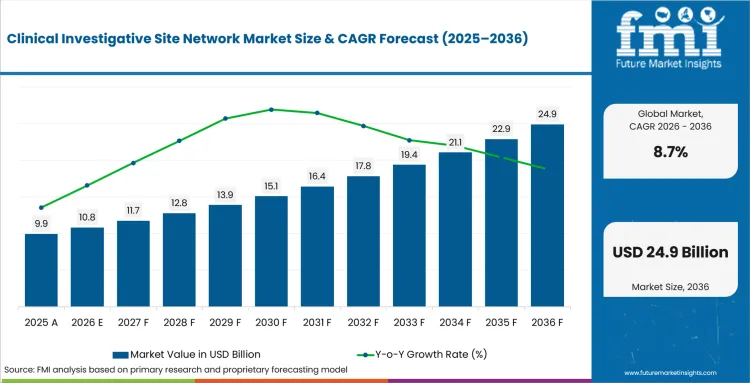
USD 10.8 billion in 2026 and USD 24.9 billion by 2036 at an 8.7% CAGR.
Demand for clinical investigative site networks is projected to expand at 8.7% CAGR between 2026 and 2036, increasing valuation from USD 10.8 billion in 2026 to USD 24.9 billion by 2036. Multicenter protocols create repeated feasibility and activation work across research locations that differ in staffing and participant access. The National Institutes of Health reported in May 2026 that NIH-supported clinical research enrolled 11,048,927 participants worldwide during fiscal 2025. The figure does not measure network revenue but shows the scale of participant activity requiring local supervision and consistent reporting. Networks earn repeat awards by shortening activation and delivering enrollment against plan across individual research locations. Central coordination makes multicenter clinical trials more manageable by improving local execution without weakening investigator responsibility.
Owned networks apply common staffing and quality controls across research locations governed by one operating organization. Federated networks extend reach through affiliated investigators but need stronger escalation across independently managed sites. Cross-border sponsors face different ethics-review routes and investigator-capacity limits across every participating national research system. The European Medicines Agency published the ICH E6(R3) guideline page in January 2025 and lists July 23, 2025, as the effective date for Principles and Annex 1. The framework supports proportionate quality management while preserving each investigator’s local medical responsibility for trial participants. Integrated eClinical systems give program leaders comparable milestones and earlier visibility into site-level exceptions across active studies. Commercial value weakens if central dashboards hide poor screening conversion or coordinator turnover at individual locations.
Key Takeaways of Clinical Investigative Site Network Market
- Sponsor demand increases as coordinated networks reduce repeated feasibility work and expose site-level delays across several research locations.
- By site type, independent clinical research sites are projected to account for 38.0% share in 2026 through flexible access to established investigators and local referral routes.
- In application, phase III clinical trials are estimated to hold 36.0% share in 2026 owing to broader enrollment plans and longer delivery periods.
- Pharmaceutical companies are forecast to represent 42.0% share of end user in 2026 through direct control over study budgets and network selection.
- Investigator scarcity and competition for eligible participants can weaken enrollment despite centralized contracts and common operating standards across network locations.
- IQVIA and Elligo Health Research use affiliated models that connect sponsors with established healthcare locations. Velocity Clinical Research and Headlands Research use integrated structures that centralize operating responsibility across controlled sites. Flourish Research and Alcanza Clinical Research use owned networks while Javara and M3 Wake Research connect trials with established care settings.
Analyst Perspective
“Clinical investigative site networks create value by making local research capacity usable across several studies without repeating commercial setup. Site count cannot prove execution because sponsors need evidence that each location starts promptly and enrolls suitable participants. Networks that expose weak locations early can protect study schedules while preserving local investigator responsibility for participant care.”
- Anurag Sharma, Principal Analyst, Future Market Insights
How is the Clinical Investigative Site Network Market segmented?
The clinical investigative site network market is segmented by Site Type, Application, End User, Distribution Channel, Therapeutic Area, and Region.
Site type separates independent locations from hospital-based, integrated, dedicated, and virtual research models with different ownership and staffing controls. Application distinguishes phase I through phase IV work alongside observational studies that create different enrollment and monitoring demands. End-user analysis covers pharmaceutical companies, biotechnology companies, contract research organizations, medical device companies, and public institutions that fund or manage studies. Distribution channel includes direct contracts, CRO arrangements, strategic alliances, digital marketplaces, and government research programs. Therapeutic area identifies the clinical expertise and participant access required across oncology, cardiovascular, neurological, infectious, and metabolic protocols. Regional analysis examines how regulation and trial support software shape activation across each national operating environment.
What supports independent clinical research sites within the site type category?
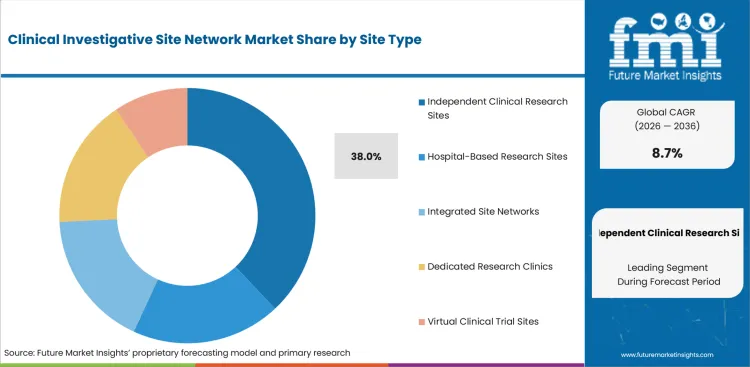
Independent research sites give sponsors local investigator access without requiring ownership of every participating clinical location. In October 2025 Alcanza Clinical Research opened Desert Clinical Research in Nevada with an on-site laboratory and pharmacy for late-stage studies. Central clinical data management can connect local staff with common sponsor processes and comparable performance reporting across research locations. Network value depends on consistent protocol execution across sites that retain responsibility for participant care and source documentation.
- Based on site type, independent clinical research sites are projected to account for 38.0% in 2026 due to flexible access to established investigators and local referral routes. Sponsors can add qualified locations without purchasing facilities or rebuilding referral relationships across each covered community. Common startup controls help networks preserve local clinical accountability across every participating site during multicenter trial delivery.
- Demand for independent clinical research sites is expected to grow among sponsors managing several related protocols across different therapeutic areas. Reliable enrollment and participant retention under comparable studies make repeat awards more likely across the sponsor’s development portfolio. Networks must remove persistently weak locations to prevent central overhead from exceeding the value of wider geographic coverage.
How do phase III clinical trials shape demand within the application category?
Phase III studies require broad participant pools and coordinated delivery across many sites during extended enrollment periods. Velocity reported in May 2025 that its integrated international network uses common contracts and operating standards across countries. Healthcare CRO services can align monitoring and escalation across confirmatory programs with several national components. One delayed subgroup or underperforming site can threaten statistical power across the complete phase III study population.
- In 2026, phase III clinical trials are expected to lead application with 36.0% share supported by broad enrollment plans that require coordinated delivery across many locations. Sponsors value networks that can redirect recruitment effort across qualified sites without weakening protocol consistency. Timely escalation from slow locations protects the analysis plan from enrollment gaps across important participant subgroups.
- Portfolio teams increasingly purchase phase III network capacity through master agreements covering startup and delivery across several countries. The arrangement reduces repeated commercial review and retains lessons from earlier studies within the same development program. Adoption weakens if site substitution requires new contracts or local regulatory work that interrupts active enrollment across multiple locations.
What keeps pharmaceutical companies ahead within the end user category?
Pharmaceutical companies control study budgets and decide which networks receive repeat work across a development portfolio. In May 2025 IQVIA announced a collaboration with SCRI Development Innovations combining global trial execution with a community oncology network. AI trial solutions can support feasibility review and site-performance comparison without replacing local investigator judgment. Portfolio value rises as proven operating practices transfer between related protocols and successive development programs.
- Pharmaceutical companies are set to lead the end user category with 42.0% share in 2026 due to direct control over protocol funding and network selection. Portfolio sponsors can consolidate contracts across several development programs under one governance structure for performance escalation. Their position reflects purchasing authority rather than a technical advantage held by any single site model.
- Pharmaceutical companies are drawing demand toward networks that report startup timing and enrollment delivery for every participating location. Comparable measures help program teams expand productive relationships and limit repeated remediation at weaker sites. Wider awards require therapeutic expertise and eligible participant access within each planned geography and protocol population. Contract terms must provide clear escalation rights for locations that miss agreed enrollment milestones during active study delivery.
Which buying mechanism supports direct contracting in the distribution channel category?
Direct contracting gives sponsors one commercial interface for site selection and performance escalation across participating locations. Headlands Research opened its Twin Cities site in August 2025 with single-contract access to Upper Midwest participant populations. Trial logistics platforms coordinate product delivery across selected sites while local teams retain responsibility for activation and participant care. Contract value depends on clear ownership of budgets and regulatory packages across every selected site.
- By distribution channel, direct contracting is forecast to represent 47.0% in 2026 enabled by faster commercial escalation across an integrated site network. Master agreements reduce repeated legal review and establish common service expectations across all participating research locations. The channel retains its position through alignment between local budgets and investigator commitments under one central contract.
- Sponsors increasingly use direct contracts for studies requiring coordinated activation across several locations under one operating calendar. The arrangement exposes delayed budgets and incomplete regulatory packages early enough to protect the wider study schedule. Adoption slows if the central agreement cannot resolve local staffing or ethics requirements within the planned schedule at each participating institution.
What supports oncology within the therapeutic area category?
Oncology networks need disease-specific investigators and participants who meet narrow molecular or treatment criteria across complex studies. Flourish Research reported in April 2026 that Valkyrie Clinical Trials joined its network with early-phase expertise and referral access across Southern and Central California. Clinical drug supply services support high-acuity protocols through controlled product delivery across distributed research sites. Commercial performance depends on rapid safety escalation and dependable referral routes beyond major academic cancer centers.
- By therapeutic area, oncology is estimated to hold 34.0% in 2026 owing to specialist staffing needs and complex protocol requirements. Networks can extend oncology expertise across community and dedicated locations while maintaining centralized safety oversight. The segment depends on access to eligible participants and experienced investigators rather than broad site counts.
- Community oncology practices increasingly purchase network support that adds coordinators and regulatory infrastructure around established physician relationships. The model reduces participant travel and extends trial access beyond major academic cancer centers into community practices. Adoption remains selective due to specialized safety requirements and dependable investigational-product handling across every active location supporting complex protocols.
What are the drivers, restraints, and opportunities in the Clinical Investigative Site Network Market?
Coordinated networks reduce repeated feasibility and activation work across multisite studies. Investigator shortages and uneven site performance can weaken enrollment. Comparable site-level measures create an opening for stronger selection and repeat awards.
- Driver: Coordinated networks reduce repeated feasibility and activation work across studies using several research locations.
- Restraint: Investigator shortages and uneven local performance can weaken enrollment despite centralized contracts and common operating standards.
- Opportunity: Comparable site-level measures can improve network selection and support repeat awards across related development programs.
Fragmented site contracting forces sponsors to repeat feasibility and activation work across studies using several research locations. In January 2025 the Association of Multisite Research Corporations launched with fourteen founding organizations representing nearly 400 sites and about 1,000 principal investigators. The membership scale shows that independent networks are building common operating standards and a shared commercial voice. Coordinated processes can shorten qualification work and give sponsors one escalation route for delayed locations. Revenue follows through repeat awards across related development programs rather than through one isolated clinical study.
Central agreements cannot create eligible participants or trained local staff, which makes uneven investigator capacity a material network restraint. A Veterans Affairs study published in December 2025 established standardized enrollment measures across a healthcare-system research consortium. Comparable measures help sponsors identify slow screening and weak retention early enough to prevent delays across the wider program. Network expansion becomes difficult to defend if coordinator turnover remains hidden inside aggregated portfolio performance measures. Transparent site-level reporting protects study schedules and preserves commercial accountability across every participating network location.
Standardized site evidence creates a commercial opening for networks that can compare feasibility and delivery across locations. A multicenter study published in September 2025 validated eighteen site-performance indicators across six Italian academic hospitals. The measures covered participant retention and consent alongside data completeness and timeliness while also assessing safety reporting and protocol compliance. Networks can pair site-performance measures with real-world evidence planning to select locations suited to each protocol population. The opportunity depends on reporting comparable measures at every active location throughout each sponsor development program.
Which country CAGRs are profiled in the Clinical Investigative Site Network Market?
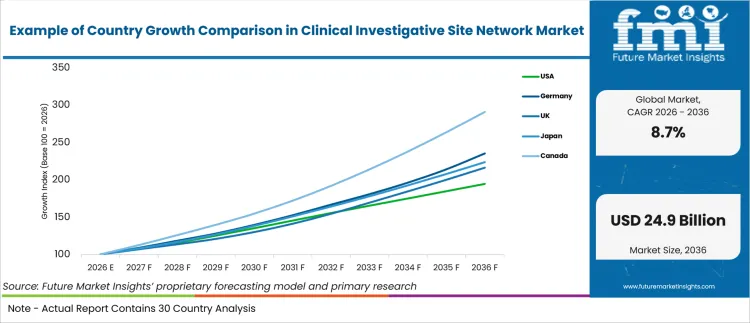
| Country | CAGR |
|---|---|
| Canada | 11.3% |
| Australia | 9.7% |
| Germany | 8.9% |
| Japan | 8.4% |
| UK | 8.0% |
| South Korea | 7.2% |
| USA | 6.9% |
How do country-level CAGRs compare in the Clinical Investigative Site Network Market?
The country forecasts span 4.4 percentage points and form a gradual progression rather than sharply separated tiers. Canada and Australia create the upper pair above the global market rate through coordinated national research systems. Germany and Japan remain close to the global forecast under different regulatory and activation conditions. The United Kingdom forms a narrow bridge to South Korea and the United States within the distribution. Comparable rates do not create identical commercial routes because local ethics review and investigator availability control network execution.
- Canada exceeds Australia by 1.6 percentage points and combines national authorization with provincial ethics and service arrangements.
- Australia remains 0.8 percentage point above Germany while distance between specialist centers raises monitoring and coordinator-support costs.
- Germany exceeds Japan by 0.5 percentage point under a unified European submission route and locally negotiated site contracts.
- Japan remains 0.4 percentage point above the United Kingdom as formal consultation improves preparation but extends sponsor onboarding.
- The United Kingdom exceeds South Korea by 0.8 percentage point and pairs predictable authorization timing with public-system contracting constraints.
- South Korea remains 0.3 percentage point above the United States despite concentrated metropolitan hospitals and intense participant competition.
- The United States closes the 4.4-point spread with broad research capacity but fragmented health-system contracting across many independent locations.
Similar forecast spacing can conceal material differences in contracting and service coverage across national research systems. Network economics depend on local activation quality and investigator capacity rather than the displayed CAGR alone. The full report provides country-level CAGR analysis across North America, Latin America, Europe, East Asia, South Asia, Oceania and the Middle East and Africa.
Country-wise Analysis
- Canadian trial activation combines federal authorization with research ethics review across provincial healthcare systems and institutional governance structures. Canada’s clinical investigative site network market is estimated to post 11.3% CAGR over the forecast period, supported by coordinated multisite planning across provincial healthcare systems. Health Canada’s December 2025 draft guidance stated that sponsors must file site information and secure research ethics approval before trial activity begins at each location. A national research ethics board can cover several sites and reduce repeated governance work for eligible studies. Provincial contracting differences and long service distances raise coordinator-support costs outside major urban research centers. Sponsors should verify local investigator capacity and service coverage before assigning several programs to one network.
- Australian trial execution depends on human research ethics review and sponsor oversight across widely separated research centers. Long travel distances and concentrated specialist capability raise monitoring costs across regional locations and smaller investigator groups. Australia’s clinical investigative site network outlook is anticipated to advance at 9.7% CAGR over the assessment period, shaped by wide service distances and concentrated specialist capacity. The Therapeutic Goods Administration stated in April 2025 that the online CTN form and fee establish the supply route with required ethics and institutional approvals. The route gives sponsors a defined activation mechanism but leaves site oversight with ethics committees and sponsors. Network economics depend on dependable coordinator support across research locations separated by substantial travel distances.
- German research sites operate under the European Union framework alongside locally negotiated contracts and institutional resource approvals. In Germany, clinical investigative site network demand is predicted to advance at 8.9% CAGR through 2036, enabled by the unified CTIS application route. The European Medicines Agency reported in January 2025 that more than 5,000 ongoing trials had transitioned through CTIS. The single-entry system helps sponsors coordinate regulatory planning across several European countries and participating research locations. German budgets and site-resource agreements remain local responsibilities that can delay activation beyond the central regulatory decision. Networks need local escalation teams that address contract delays without weakening program-wide quality controls or investigator relationships.
- Japanese site activation relies on formal regulatory consultation and careful qualification of investigators and supporting clinical staff. The PMDA published its fiscal 2025 prior-assessment schedule in September 2025 with electronic request submission and required pre-meetings for planned consultations. Adoption of clinical investigative site network services in Japan is estimated to expand at 8.4% CAGR through 2036, associated with formal consultation and experienced local operating teams. Formal consultation helps sponsors identify dossier issues early and organize responses within the PMDA’s published schedule. Japanese-language operations and conservative site qualification can extend onboarding for networks without established local management. Commercial expansion requires measured enrollment performance across each contracted location rather than national activity alone.
- United Kingdom research networks combine national authorization with site contracting across publicly managed healthcare institutions. The United Kingdom clinical investigative site network sector is projected to record 8.0% CAGR during the assessment period, reinforced by predictable authorization timing. The MHRA reported in June 2026 that 99% of May initial applications met statutory timelines with a 29-day median. Predictable regulatory timing helps networks sequence feasibility and contracting work across several planned research locations. National Health Service contracting and workforce capacity can delay activation beyond the regulatory decision across individual institutions. Sponsors should confirm local coordinator coverage before assigning several concurrent programs to the same network.
- South Korean trial activity concentrates within metropolitan hospitals that serve several competing sponsor programs across overlapping therapeutic areas. The Ministry of Food and Drug Safety reported in March 2026 that 783 trials received approval during 2025. By 2036, South Korea’s clinical investigative site network market is projected to grow at 7.2% CAGR, linked to concentrated investigator access across metropolitan hospitals. Dense metropolitan hospital networks provide established referral routes across several complex therapeutic areas and specialist services. Participant competition increases as several sponsors recruit from overlapping patient populations inside the same medical centers. Networks should test patient availability by protocol before expanding fixed coordinator capacity across additional studies. Local-language regulatory coordination increases the value of established national operating teams during sponsor onboarding and site expansion.
- United States research networks coordinate many independent health systems with different contracting and investigator-management practices. Fragmented legal and budget processes raise coordination costs across large multisite clinical programs within the national market. Clinical investigative site network revenue in the United States is forecast to expand at 6.9% CAGR by 2036, supported by broad research capacity and fragmented health-system contracting. The Food and Drug Administration reported in April 2026 that it contacted more than 2,200 sponsors and researchers. The action involved over 3,000 registered trials with missing results or incomplete National Library of Medicine review processes. Broad research capacity therefore coexists with uneven reporting discipline across many independent clinical research organizations nationwide. Network investment remains dependent on site-level startup and retention evidence across each contracted health system.
Who are the notable companies in the Clinical Investigative Site Network Market?
IQVIA, Velocity Clinical Research, Headlands Research, Flourish Research, Elligo Health Research, Alcanza Clinical Research, Javara, and M3 Wake Research.
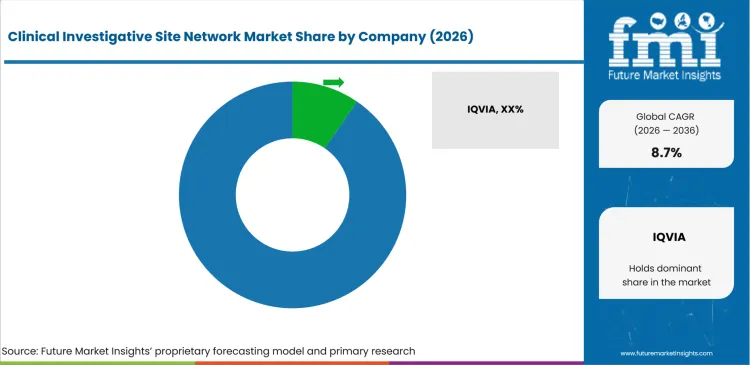
Clinical site networks focus on ownership models and therapeutic expertise alongside consistent performance across locations. Velocity Clinical Research reported in July 2026 that ten United States sites enrolled 1,000 vaccine-trial participants within 3.5 weeks. The same report described coordinated enrollment across research sites operating on both sides of the Atlantic. The result demonstrates network scale but does not replace protocol-specific evidence on screen failure and participant retention. Federated operators extend reach through affiliated locations while healthcare-embedded models connect trials with routine care. Clinical trial packaging becomes important for protocols that require controlled product delivery across widely distributed research locations. Sponsors should compare startup reliability and participant retention across similar studies before expanding a network award.
- IQVIA and Elligo Health Research use federated or affiliated models that connect sponsors with established healthcare locations. Elligo Health Research explained in May 2025 that its model embeds research with local physicians and uses hybrid delivery to reduce travel barriers. Affiliated structures widen community access but require common feasibility standards and rapid escalation across independently managed locations.
- Flourish Research’s April 2025 acquisition of Diablo Clinical Research added a California facility with more than 1,000 phase I through phase IV trials and medical-device studies. Alcanza Clinical Research and M3 Wake Research operate multisite structures with centralized operational support across their research locations. Owned networks can standardize staffing and reporting but carry fixed coordinator costs during slower enrollment.
- Javara embeds research teams inside health systems while M3 Wake Research builds community-physician partnerships around established care relationships. M3 Wake Research explained in September 2025 that its model supplies coordinators and regulatory support without displacing physician-led care. Embedded models widen participant access but depend on local clinician engagement and compatible health-system workflows.
Competitive Benchmarking: Clinical Investigative Site Network Market
| Company | Network Integration | Centralized Operations | Community-Care Access | Geographic Reach |
|---|---|---|---|---|
| IQVIA | Medium | High | High | Global |
| Velocity Clinical Research | High | High | Medium | United States and Europe |
| Headlands Research | High | High | High | North America |
| Flourish Research | High | High | Medium | United States |
| Elligo Health Research | Medium | High | High | United States |
| Alcanza Clinical Research | High | High | High | United States and Puerto Rico |
| Javara | Medium | High | High | United States |
| M3 Wake Research | High | High | High | United States |
Key Developments in the Clinical Investigative Site Network Market
- In March 2025, IQVIA Laboratories launched Site Lab Navigator with electronic requisitions and real-time specimen tracking for investigator sites. The suite reduces manual laboratory work and connects sample status with site workflows through One Home for Sites. Sponsors gain earlier visibility into collection errors and shipping exceptions across participating research locations during active studies. Commercial value depends on site-staff adoption and integration with protocol-specific laboratory processes during active studies.
- In July 2025, Headlands Research acquired CMRCenter in San Juan and expanded its network to 22 sites. The expanded network covers the United States and Canada alongside a Puerto Rico presence with documented participant retention at 90%. Sponsors gain community recruitment access through one commercial agreement covering the wider clinical research network. Post-acquisition performance depends on preserving CMRCenter’s community relationships and bilingual operating capability across participating studies.
- In May 2025, Flourish Research acquired the Georgia-based Center for Advanced Research and Education in Gainesville. The site contributed more than 25 years of experience and work across over 150 clinical trials. The acquisition expands southeastern coverage and supports oncology development through an established physician-led research operation. Integration quality determines whether centralized processes improve activation and sponsor access across the broader network.
- In July 2025, Javara partnered with Cape Fear Valley Health to embed research staff across an eight-hospital system serving more than one thousand physicians. The arrangement places trial delivery inside established care settings across southeastern North Carolina and existing physician relationships. Sponsors gain access to established patient relationships without building separate research sites or referral channels. Commercial execution depends on aligning research workflows with physician schedules and health-system governance during active clinical studies.
Key Players in the Clinical Investigative Site Network Market
Global and Federated Site Networks
- IQVIA
- Elligo Health Research
Wholly Owned Multisite Networks
- Velocity Clinical Research
- Headlands Research
- Flourish Research
- Alcanza Clinical Research
- M3 Wake Research
Health-System Embedded Research Networks
- Javara
Clinical Investigative Site Network Market - Report Scope
| Coverage field | Report scope |
|---|---|
| Market breakdown | Site Type, Application, End User, Distribution Channel, Therapeutic Area, and Region. |
| Market Definition | Networks of owned, affiliated, managed, or embedded clinical research sites that recruit participants and execute sponsor protocols across therapeutic areas and trial phases. |
| Regions Covered | North America, Latin America, Western Europe, Eastern Europe, East Asia, South Asia and Pacific, and Middle East and Africa. |
| Countries Covered | Canada, Australia, Germany, Japan, UK, South Korea, and USA. |
| Key Companies Profiled | IQVIA, Velocity Clinical Research, Headlands Research, Flourish Research, Elligo Health Research, Alcanza Clinical Research, Javara, and M3 Wake Research. |
| Forecast Period | 2026 to 2036. |
| Approach | Hybrid bottom-up and top-down market sizing supported by primary interviews and official desk research. |
Clinical Investigative Site Network Market - Research Methodology
| Method | Approach |
|---|---|
| Primary Research | FMI analysts gathered input from manufacturers, service providers, technology developers, distributors, end users, procurement teams, and subject-matter experts. Interviews examined purchasing decisions, product or service evaluation, adoption barriers, approval requirements, pricing considerations, and expectations for technical or commercial support. Respondents were also asked what evidence is required before a trial, pilot, or initial order develops into regular purchasing. |
| Desk Research | Desk research covered government statistics, regulatory publications, trade data, industry associations, technical literature, standards, company filings, product information, and official corporate announcements. Sources were reviewed for relevance, publication date, geographic coverage, and consistency with the defined market scope. Claims relating to performance, applications, approvals, capacity, investment, and commercial activity were retained only when supported by credible public evidence. |
| Market Sizing and Forecasting | The market model combined the baseline value with historical performance, segment structure, pricing and volume indicators, adoption levels, company participation, and country-level demand conditions. Forecast assumptions considered economic activity, investment trends, regulatory developments, technology adoption, purchasing cycles, supply availability, and barriers to wider market use. Segment and regional estimates were reconciled before the final market total was calculated. |
| Data Validation | Estimates were checked against multiple independent indicators, including public data, company activity, trade patterns, industry developments, and findings from primary interviews. Validation also tested whether products, services, applications, and company revenues fell within the defined market boundaries. Adjacent categories, unsupported claims, overlapping revenues, and activities without direct market relevance were excluded to reduce double counting and maintain consistency across segments and countries. |
Clinical Investigative Site Network Market by Segments
Clinical Investigative Site Network Market segmented by Site Type:
- Independent Clinical Research Sites
- Single Specialty Research Sites
- Multi Specialty Research Sites
- Hospital-Based Research Sites
- Academic Medical Centers
- Community Hospitals
- Integrated Site Networks
- Regional Site Networks
- Global Site Networks
- Dedicated Research Clinics
- Early Phase Clinics
- Late Phase Clinics
- Virtual Clinical Trial Sites
- Decentralized Trial Sites
- Hybrid Trial Sites
Clinical Investigative Site Network Market segmented by Application:
- Phase III Clinical Trials
- Oncology Studies
- Cardiovascular Studies
- Phase I Clinical Trials
- First-in-Human Studies
- Dose Escalation Studies
- Phase II Clinical Trials
- Proof-of-Concept Studies
- Dose Optimization Studies
- Phase IV Clinical Trials
- Post-Marketing Studies
- Real-World Evidence Studies
- Observational Studies
- Patient Registry Studies
- Epidemiological Studies
Clinical Investigative Site Network Market segmented by End User:
- Pharmaceutical Companies
- Innovator Pharmaceutical Companies
- Generic Pharmaceutical Companies
- Biotechnology Companies
- Emerging Biotechnology Companies
- Commercial Biotechnology Companies
- Contract Research Organizations
- Global CROs
- Regional CROs
- Medical Device Companies
- Device Manufacturers
- Diagnostic Companies
- Academic and Government Institutions
- Universities
- Public Research Institutes
Clinical Investigative Site Network Market segmented by Distribution Channel:
- Direct Contracting
- Sponsor Direct Contracts
- Master Service Agreements
- Contract Research Organizations
- Full-Service CRO Partnerships
- Functional Service Providers
- Strategic Research Alliances
- Academic Collaborations
- Healthcare Partnerships
- Clinical Trial Marketplaces
- Digital Trial Platforms
- Patient Recruitment Platforms
- Government Research Programs
- Public Health Research Programs
- Federally Funded Clinical Studies
Clinical Investigative Site Network Market segmented by Therapeutic Area:
- Oncology
- Solid Tumors
- Hematologic Malignancies
- Cardiovascular Disorders
- Heart Failure
- Coronary Artery Disease
- Neurology
- Alzheimer Disease
- Parkinson Disease
- Infectious Diseases
- Vaccine Studies
- Antiviral Studies
- Metabolic Disorders
- Diabetes
- Obesity
Clinical Investigative Site Network Market by Region:
- North America
- United States
- Canada
- Latin America
- Brazil
- Mexico
- Argentina
- Chile
- Western Europe
- Germany
- France
- United Kingdom
- Italy
- Spain
- Benelux
- Nordics
- Eastern Europe
- Poland
- Czech Republic
- Romania
- Hungary
- East Asia
- China
- Japan
- South Korea
- South Asia and Pacific
- India
- ASEAN
- Australia and New Zealand
- Middle East and Africa
- GCC Countries
- South Africa
- Türkiye
- Israel
Research Sources and Bibliography
- National Institutes of Health. (2026, May 27).
- European Medicines Agency. (2025, January 27).
- Alcanza Clinical Research. (2025, October 15).
- Velocity Clinical Research. (2025, May 15).
- IQVIA. (2025, May 16)
- Headlands Research. (2025, August 19).
- Flourish Research. (2026, April 7)
- Association of Multisite Research Corporations. (2025, January 23).
- Johnson, M. R., Raitt, M., Asghar, A., Beck, D., & Huang, G. D. (2025, December 9).
- Bozzetti, M., Lo Cascio, A., Napolitano, D., Orgiana, N., Mora, V., Fiorini, S., Petrucci, G., Resente, F., Baroni, I., Caruso, R., & Guberti, M. (2025, September 26).
- Health Canada. (2025, December 20)
- Therapeutic Goods Administration. (2025, April 9)
- European Medicines Agency. (2025, January 31).
- Pharmaceuticals and Medical Devices Agency. (2025, September 3)
- Medicines and Healthcare products Regulatory Agency. (2026, June 24).
- Ministry of Food and Drug Safety. (2026, March 6).
- U.S. Food and Drug Administration. (2026, April 13).
- Velocity Clinical Research. (2026, July 22)
- Flourish Research. (2025, April 28).
- Irvin, F. (2025, September 11).
- IQVIA Laboratories. (2025, March 4).
- Headlands Research. (2025, July 2)
- Jeffers, A. (2025, May 16).
- Javara. (2025, July 1).
- Yankyera, R. (2025, May 12).
This bibliography is provided for reader reference and is not exhaustive. The full report contains the complete reference list and detailed citations
This Report Answers
- How does the Clinical Investigative Site Network Market expand from USD 10.8 billion in 2026 to USD 24.9 billion by 2036?
- Which operating conditions support an 8.7% CAGR across the complete ten-year forecast period?
- How do owned networks and affiliated site models create different commercial advantages for pharmaceutical sponsors?
- Which enrollment and startup metrics provide credible evidence for wider sponsor awards across several locations?
- How do Canada, Australia, Germany, Japan, the United Kingdom, South Korea, and the United States differ in local activation conditions?
- Which current companies combine network integration with centralized operations and community-care access?
- How should sponsors evaluate centralized contracting without overlooking investigator capacity at individual sites?
- Which regulatory changes and company expansions influence site-network strategy during 2025 and 2026?
- What risks can weaken return on investment despite broad geographic reach and centralized reporting?
Frequently Asked Questions
How big is the Clinical Investigative Site Network Market in 2026?
The clinical investigative site network market is valued at USD 10.8 billion in 2026 and is forecast to reach USD 24.9 billion by 2036. Demand is supported by coordinated networks that reduce repeated feasibility and activation work across multicenter studies while improving visibility into site-level enrollment and startup performance.
What is the CAGR of the Clinical Investigative Site Network Market from 2026 to 2036?
The clinical investigative site network market grows at a CAGR of 8.7% between 2026 and 2036, supported by pharmaceutical and biotechnology sponsors seeking coordinated site activation, centralized operating standards, and comparable performance measures across research locations participating in multicenter clinical trials.
Which site type leads the Clinical Investigative Site Network Market?
Independent clinical research sites account for 38.0% of the clinical investigative site network market by site type in 2026, supported by flexible access to established investigators and local referral routes without requiring sponsors or networks to own every participating research location.
How much will the Clinical Investigative Site Network Market add between 2026 and 2036?
The clinical investigative site network market is set to add USD 14.1 billion between 2026 and 2036, growing from USD 10.8 billion to USD 24.9 billion as sponsors expand coordinated site networks to manage participant recruitment, study activation, and delivery across broader multicenter clinical trial programs.
Who are the leading companies in the Clinical Investigative Site Network Market?
Eight companies lead the clinical investigative site network market, including IQVIA, Velocity Clinical Research, Headlands Research, Flourish Research, Elligo Health Research, Alcanza Clinical Research, Javara, and M3 Wake Research, competing through centralized operations, owned and affiliated site models, community-care access, and broad geographic research coverage.
Preview the report firsthand - request a free sample
Get SampleGet the brochure for pricing and purchase details.
Get PDFTable of Content
- Key Takeaways
- Market Size and CAGR
- Top Growth Driver
- Fastest Growing Segment
- Leading Region
- Key Companies
- Emerging Opportunities
- Executive Summary
- Global Market Outlook
- Demand-side Trends
- Supply-side Trends
- Technology Roadmap Analysis
- Analysis and Recommendations
- Analyst Perspective (What is happening? Why now? What should investors know?)
- Key Questions Answered
- How large is the market?
- What is the CAGR?
- What are key trends?
- Which region dominates?
- Who are the leaders?
- Market Overview
- Market Coverage / Taxonomy
- Market Definition / Scope / Limitations
- Research Methodology
- Chapter Orientation
- Analytical Lens and Working Hypotheses
- Market Structure, Signals, and Trend Drivers
- Benchmarking and Cross-market Comparability
- Market Sizing, Forecasting, and Opportunity Mapping
- Research Design and Evidence Framework
- Desk Research Programme (Secondary Evidence)
- Expert Input and Fieldwork (Primary Evidence)
- Tooling, Models, and Reference Databases
- Data Engineering and Model Build
- Quality Assurance and Audit Trail
- Market Background
- Market Dynamics (Drivers, Restraints, Opportunity, Trends)
- Scenario Forecast (Optimistic, Likely, Conservative)
- Impact Analysis
- AI Impact
- Sustainability Impact
- Regulatory Impact
- Technology Impact
- Consumer / Buyer Analysis
- Purchase Drivers
- Adoption Barriers
- Buyer Journey
- Opportunity Map Analysis
- Product Life Cycle Analysis
- Supply Chain Analysis
- Investment Feasibility Matrix
- Value Chain Analysis
- PESTLE and Porter's Analysis
- Regulatory Landscape
- Regional Parent Market Outlook
- Production and Consumption Statistics
- Import and Export Statistics
- Global Market Analysis and Forecast, 2021 to 2036
- Historical Market Size Value (USD Billion) Analysis, 2021 to 2025
- Current and Future Market Size Value (USD Billion) Projections, 2026 to 2036
- Y-o-Y Growth Trend Analysis
- Absolute $ Opportunity Analysis
- Global Market Pricing Analysis, 2021 to 2036
- Global Market Analysis and Forecast, By Site Type, 2021 to 2036
- Introduction / Key Findings
- Historical Market Size Value (USD Billion) Analysis By Site Type, 2021 to 2025
- Current and Future Market Size Value (USD Billion) Analysis and Forecast By Site Type, 2026 to 2036
- Independent Clinical Research Sites
- Single Specialty Research Sites
- Multi Specialty Research Sites
- Hospital-Based Research Sites
- Academic Medical Centers
- Community Hospitals
- Integrated Site Networks
- Regional Site Networks
- Global Site Networks
- Dedicated Research Clinics
- Early Phase Clinics
- Late Phase Clinics
- Virtual Clinical Trial Sites
- Decentralized Trial Sites
- Hybrid Trial Sites
- Independent Clinical Research Sites
- Y-o-Y Growth Trend Analysis By Site Type, 2021 to 2025
- Absolute $ Opportunity Analysis By Site Type, 2026 to 2036
- Global Market Analysis and Forecast, By Application, 2021 to 2036
- Introduction / Key Findings
- Historical Market Size Value (USD Billion) Analysis By Application, 2021 to 2025
- Current and Future Market Size Value (USD Billion) Analysis and Forecast By Application, 2026 to 2036
- Phase III Clinical Trials
- Oncology Studies
- Cardiovascular Studies
- Phase I Clinical Trials
- First-in-Human Studies
- Dose Escalation Studies
- Phase II Clinical Trials
- Proof-of-Concept Studies
- Dose Optimization Studies
- Phase IV Clinical Trials
- Post-Marketing Studies
- Real-World Evidence Studies
- Observational Studies
- Patient Registry Studies
- Epidemiological Studies
- Phase III Clinical Trials
- Y-o-Y Growth Trend Analysis By Application, 2021 to 2025
- Absolute $ Opportunity Analysis By Application, 2026 to 2036
- Global Market Analysis and Forecast, By End User, 2021 to 2036
- Introduction / Key Findings
- Historical Market Size Value (USD Billion) Analysis By End User, 2021 to 2025
- Current and Future Market Size Value (USD Billion) Analysis and Forecast By End User, 2026 to 2036
- Pharmaceutical Companies
- Innovator Pharmaceutical Companies
- Generic Pharmaceutical Companies
- Biotechnology Companies
- Emerging Biotechnology Companies
- Commercial Biotechnology Companies
- Contract Research Organizations
- Global CROs
- Regional CROs
- Medical Device Companies
- Device Manufacturers
- Diagnostic Companies
- Academic and Government Institutions
- Universities
- Public Research Institutes
- Pharmaceutical Companies
- Y-o-Y Growth Trend Analysis By End User, 2021 to 2025
- Absolute $ Opportunity Analysis By End User, 2026 to 2036
- Global Market Analysis and Forecast, By Distribution Channel, 2021 to 2036
- Introduction / Key Findings
- Historical Market Size Value (USD Billion) Analysis By Distribution Channel, 2021 to 2025
- Current and Future Market Size Value (USD Billion) Analysis and Forecast By Distribution Channel, 2026 to 2036
- Direct Contracting
- Sponsor Direct Contracts
- Master Service Agreements
- Contract Research Organizations
- Full-Service CRO Partnerships
- Functional Service Providers
- Strategic Research Alliances
- Academic Collaborations
- Healthcare Partnerships
- Clinical Trial Marketplaces
- Digital Trial Platforms
- Patient Recruitment Platforms
- Government Research Programs
- Public Health Research Programs
- Federally Funded Clinical Studies
- Direct Contracting
- Y-o-Y Growth Trend Analysis By Distribution Channel, 2021 to 2025
- Absolute $ Opportunity Analysis By Distribution Channel, 2026 to 2036
- Global Market Analysis and Forecast, By Therapeutic Area, 2021 to 2036
- Introduction / Key Findings
- Historical Market Size Value (USD Billion) Analysis By Therapeutic Area, 2021 to 2025
- Current and Future Market Size Value (USD Billion) Analysis and Forecast By Therapeutic Area, 2026 to 2036
- Oncology
- Solid Tumors
- Hematologic Malignancies
- Cardiovascular Disorders
- Heart Failure
- Coronary Artery Disease
- Neurology
- Alzheimer Disease
- Parkinson Disease
- Infectious Diseases
- Vaccine Studies
- Antiviral Studies
- Metabolic Disorders
- Diabetes
- Obesity
- Oncology
- Y-o-Y Growth Trend Analysis By Therapeutic Area, 2021 to 2025
- Absolute $ Opportunity Analysis By Therapeutic Area, 2026 to 2036
- Global Market Analysis and Forecast, By Region, 2021 to 2036
- Introduction
- Historical Market Size Value (USD Billion) Analysis By Region, 2021 to 2025
- Current Market Size Value (USD Billion) Analysis and Forecast By Region, 2026 to 2036
- North America
- Latin America
- Western Europe
- Eastern Europe
- East Asia
- South Asia and Pacific
- Middle East & Africa
- Market Attractiveness Analysis By Region
- North America Market Analysis and Forecast, By Country, 2021 to 2036
- Historical Market Size Value (USD Billion) Trend Analysis By Market Taxonomy, 2021 to 2025
- Market Size Value (USD Billion) Forecast By Market Taxonomy, 2026 to 2036
- By Country
- USA
- Canada
- By Site Type
- By Application
- By End User
- By Distribution Channel
- By Therapeutic Area
- By Country
- Market Attractiveness Analysis
- By Country
- By Site Type
- By Application
- By End User
- By Distribution Channel
- By Therapeutic Area
- Key Takeaways
- Latin America Market Analysis and Forecast, By Country
- Historical Market Size Value (USD Billion) Trend Analysis By Market Taxonomy, 2021 to 2025
- Market Size Value (USD Billion) Forecast By Market Taxonomy, 2026 to 2036
- By Country
- Brazil
- Mexico
- Chile
- Rest of Latin America
- By Site Type
- By Application
- By End User
- By Distribution Channel
- By Therapeutic Area
- By Country
- Market Attractiveness Analysis
- By Country
- By Site Type
- By Application
- By End User
- By Distribution Channel
- By Therapeutic Area
- Key Takeaways
- Western Europe Market Analysis and Forecast, By Country
- Historical Market Size Value (USD Billion) Trend Analysis By Market Taxonomy, 2021 to 2025
- Market Size Value (USD Billion) Forecast By Market Taxonomy, 2026 to 2036
- By Country
- Germany
- UK
- Italy
- Spain
- France
- Nordic
- BENELUX
- Rest of Western Europe
- By Site Type
- By Application
- By End User
- By Distribution Channel
- By Therapeutic Area
- By Country
- Market Attractiveness Analysis
- By Country
- By Site Type
- By Application
- By End User
- By Distribution Channel
- By Therapeutic Area
- Key Takeaways
- Eastern Europe Market Analysis and Forecast, By Country
- Historical Market Size Value (USD Billion) Trend Analysis By Market Taxonomy, 2021 to 2025
- Market Size Value (USD Billion) Forecast By Market Taxonomy, 2026 to 2036
- By Country
- Russia
- Poland
- Hungary
- Balkan & Baltic
- Rest of Eastern Europe
- By Site Type
- By Application
- By End User
- By Distribution Channel
- By Therapeutic Area
- By Country
- Market Attractiveness Analysis
- By Country
- By Site Type
- By Application
- By End User
- By Distribution Channel
- By Therapeutic Area
- Key Takeaways
- East Asia Market Analysis and Forecast, By Country
- Historical Market Size Value (USD Billion) Trend Analysis By Market Taxonomy, 2021 to 2025
- Market Size Value (USD Billion) Forecast By Market Taxonomy, 2026 to 2036
- By Country
- China
- Japan
- South Korea
- By Site Type
- By Application
- By End User
- By Distribution Channel
- By Therapeutic Area
- By Country
- Market Attractiveness Analysis
- By Country
- By Site Type
- By Application
- By End User
- By Distribution Channel
- By Therapeutic Area
- Key Takeaways
- South Asia and Pacific Market Analysis and Forecast, By Country
- Historical Market Size Value (USD Billion) Trend Analysis By Market Taxonomy, 2021 to 2025
- Market Size Value (USD Billion) Forecast By Market Taxonomy, 2026 to 2036
- By Country
- India
- ASEAN
- Australia & New Zealand
- Rest of South Asia and Pacific
- By Site Type
- By Application
- By End User
- By Distribution Channel
- By Therapeutic Area
- By Country
- Market Attractiveness Analysis
- By Country
- By Site Type
- By Application
- By End User
- By Distribution Channel
- By Therapeutic Area
- Key Takeaways
- Middle East & Africa Market Analysis and Forecast, By Country
- Historical Market Size Value (USD Billion) Trend Analysis By Market Taxonomy, 2021 to 2025
- Market Size Value (USD Billion) Forecast By Market Taxonomy, 2026 to 2036
- By Country
- Kingdom of Saudi Arabia
- Other GCC Countries
- Türkiye
- South Africa
- Other African Union
- Rest of Middle East & Africa
- By Site Type
- By Application
- By End User
- By Distribution Channel
- By Therapeutic Area
- By Country
- Market Attractiveness Analysis
- By Country
- By Site Type
- By Application
- By End User
- By Distribution Channel
- By Therapeutic Area
- Key Takeaways
- Key Countries Market Analysis
- USA
- Pricing Analysis
- Market Share Analysis, 2025
- By Site Type
- By Application
- By End User
- By Distribution Channel
- By Therapeutic Area
- Canada
- Pricing Analysis
- Market Share Analysis, 2025
- By Site Type
- By Application
- By End User
- By Distribution Channel
- By Therapeutic Area
- Mexico
- Pricing Analysis
- Market Share Analysis, 2025
- By Site Type
- By Application
- By End User
- By Distribution Channel
- By Therapeutic Area
- Brazil
- Pricing Analysis
- Market Share Analysis, 2025
- By Site Type
- By Application
- By End User
- By Distribution Channel
- By Therapeutic Area
- Chile
- Pricing Analysis
- Market Share Analysis, 2025
- By Site Type
- By Application
- By End User
- By Distribution Channel
- By Therapeutic Area
- Germany
- Pricing Analysis
- Market Share Analysis, 2025
- By Site Type
- By Application
- By End User
- By Distribution Channel
- By Therapeutic Area
- UK
- Pricing Analysis
- Market Share Analysis, 2025
- By Site Type
- By Application
- By End User
- By Distribution Channel
- By Therapeutic Area
- Italy
- Pricing Analysis
- Market Share Analysis, 2025
- By Site Type
- By Application
- By End User
- By Distribution Channel
- By Therapeutic Area
- Spain
- Pricing Analysis
- Market Share Analysis, 2025
- By Site Type
- By Application
- By End User
- By Distribution Channel
- By Therapeutic Area
- France
- Pricing Analysis
- Market Share Analysis, 2025
- By Site Type
- By Application
- By End User
- By Distribution Channel
- By Therapeutic Area
- India
- Pricing Analysis
- Market Share Analysis, 2025
- By Site Type
- By Application
- By End User
- By Distribution Channel
- By Therapeutic Area
- ASEAN
- Pricing Analysis
- Market Share Analysis, 2025
- By Site Type
- By Application
- By End User
- By Distribution Channel
- By Therapeutic Area
- Australia & New Zealand
- Pricing Analysis
- Market Share Analysis, 2025
- By Site Type
- By Application
- By End User
- By Distribution Channel
- By Therapeutic Area
- China
- Pricing Analysis
- Market Share Analysis, 2025
- By Site Type
- By Application
- By End User
- By Distribution Channel
- By Therapeutic Area
- Japan
- Pricing Analysis
- Market Share Analysis, 2025
- By Site Type
- By Application
- By End User
- By Distribution Channel
- By Therapeutic Area
- South Korea
- Pricing Analysis
- Market Share Analysis, 2025
- By Site Type
- By Application
- By End User
- By Distribution Channel
- By Therapeutic Area
- Russia
- Pricing Analysis
- Market Share Analysis, 2025
- By Site Type
- By Application
- By End User
- By Distribution Channel
- By Therapeutic Area
- Poland
- Pricing Analysis
- Market Share Analysis, 2025
- By Site Type
- By Application
- By End User
- By Distribution Channel
- By Therapeutic Area
- Hungary
- Pricing Analysis
- Market Share Analysis, 2025
- By Site Type
- By Application
- By End User
- By Distribution Channel
- By Therapeutic Area
- Kingdom of Saudi Arabia
- Pricing Analysis
- Market Share Analysis, 2025
- By Site Type
- By Application
- By End User
- By Distribution Channel
- By Therapeutic Area
- Türkiye
- Pricing Analysis
- Market Share Analysis, 2025
- By Site Type
- By Application
- By End User
- By Distribution Channel
- By Therapeutic Area
- South Africa
- Pricing Analysis
- Market Share Analysis, 2025
- By Site Type
- By Application
- By End User
- By Distribution Channel
- By Therapeutic Area
- USA
- Market Structure Analysis
- Competition Dashboard
- Competition Benchmarking
- Market Share Analysis of Top Players
- By Regional
- By Site Type
- By Application
- By End User
- By Distribution Channel
- By Therapeutic Area
- Emerging Startups
- Innovation Benchmarking
- Competition Analysis
- Competition Deep Dive
- IQVIA
- Overview
- Product Portfolio
- Profitability by Market Segments
- Sales Footprint
- Strategy Overview
- Marketing Strategy
- Product Strategy
- Channel Strategy
- Velocity Clinical Research
- Headlands Research
- Flourish Research
- Elligo Health Research
- Alliance for Multispecialty Research
- Clinedge
- Synexus
- Phoenix Clinical Research
- IC Research
- IQVIA
- Case Studies
- Success Stories
- Recent Developments
- Competition Deep Dive
- Assumptions & Acronyms Used


