
- Market Size (2026)
- USD 4.3 Bn
- Forecast (2036)
- USD 8.9 Bn
- CAGR (2026 to 2036)
- 7.6%
How big is the CNG Compressors Market in 2026?
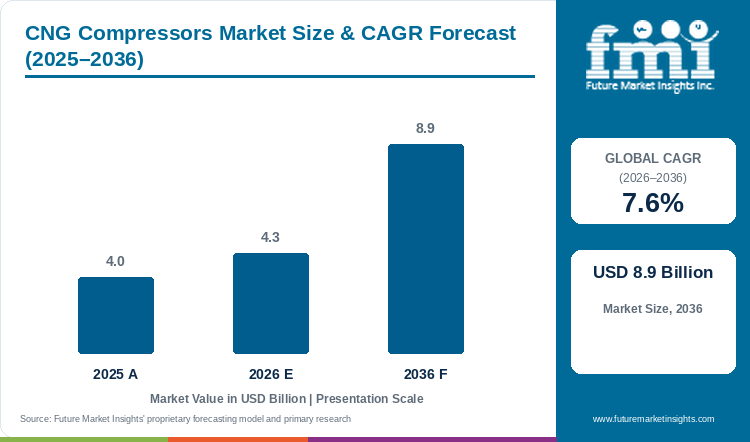
The CNG Compressors Market is projected to reach USD 8.9 billion by 2036, growing at a 7.6% CAGR from 2026 to 2036. The market is estimated at USD 4.3 billion in 2026. The market was valued at USD 4.0 billion in 2025. The Petroleum and Natural Gas Regulatory Board recorded 9,158 CNG stations as on 31 August 2026 [2]. On 22 April 2026, the Ministry of Petroleum and Natural Gas said the explosives regulator had processed 467 CNG and CBG dispensing station applications between 25 March and 21 April [6]. Final licences went to 157 of them, and 38 prior approvals were issued for new stations [6].
The US Energy Information Administration's October 2026 outlook put retail gasoline at USD 4.35 a gallon and diesel at USD 6.29 in September [8]. It expects Henry Hub gas to average USD 3.48 per million British thermal units in 2026 and USD 3.16 in 2027, a 9% decrease [8]. US vehicle-fuel natural gas use still fell to 53,149 million cubic feet in 2025 from 63,626 million in 2024 [7]. Compressor orders follow station build-out, so fuel prices alone do not set demand. Compressors serving industrial gas projects also let suppliers spread engineering cost across end uses.
Key Market Trends & Insights
- India is adding compression capacity quickly: Indraprastha Gas reported 1,031 CNG stations and 130.46 lakh kg a day of compression capacity on 30 September 2026 [3]. PNGRB data showed 9,158 CNG stations nationally on 31 August 2026 [2].
- Biomethane is entering the CNG chain. On 19 June 2026, VERBIO and Transgourmet opened a BioCNG station in Riedstadt, Hesse, that other CNG vehicle users can also use [10]. Transgourmet runs 40 BioCNG trucks there [10].
- Package approval is a live issue in India. The explosives regulator issued a circular dated 2 April 2026 on approval of CNG and CBG gas compressors for premises covered under Forms E, F and G of the Gas Cylinders Rules, 2016 [4]. A trade report of 8 April 2026 said relief for compressor packages had been extended to 30 September 2026 [5].
Regional Highlights
- Asia Pacific: India had 9,158 CNG stations as on 31 August 2026 [2]. CIMC Enric, a Chinese equipment group with a CNG hydraulic filling line, reported on 26 August 2026 that its first-half 2026 revenue rose to RMB 12.9 billion [17][18].
- North America: Clean Energy Fuels says it operates more than 600 fuelling stations [23]. US vehicle-fuel natural gas use was 53,149 million cubic feet in 2025 [7].
- Europe: gibgas.de counts more than 4,200 CNG stations across 35 countries [10]. ReFuels lists 16 public access CNG stations on major UK trucking routes, which supply biomethane to heavy goods vehicles [11].
CNG Compressors Market Size and Forecast
Table 1: CNG Compressors Market Size and Forecast
| Market size and forecast | Value |
|---|---|
| Market size in 2025 | USD 4.0 billion |
| Estimated market size in 2026 | USD 4.3 billion |
| Projected market size by 2036 | USD 8.9 billion |
| CAGR from 2026 to 2036 | 7.6% |
Source: Future Market Insights analysis of the CNG Compressors Market, 2026.
Analyst Perspective
“Compressors are sold into a fuel retail business, so buyers should weigh uptime and permit status ahead of headline pressure. India shows the pattern: station numbers are rising, and the explosives regulator now puts compressor package approval in the path of every new site. Suppliers with approved, skid-mounted packages and remote monitoring will convert that build-out faster than those quoting bare machines. Outside India, biomethane and fleet depots are likely to decide where new capacity is installed.”
- Nikhil Kaitwade, Principal Consultant, FMI
How is the CNG Compressors Market segmented?
- By compressor type: Reciprocating Compressors, Hydraulic Compressors, Rotary Screw Compressors and Others
- By application: CNG Refueling Stations, Industrial Applications, Pipeline Injection & Gas Distribution and Fleet Refueling Stations
- By end user: Oil & Gas Companies, Natural Gas Utilities, Transportation Sector and Industrial Users
- By region: North America, Europe and Asia Pacific
Why does Reciprocating Compressors lead by Compressor Type in the CNG Compressors Market in 2026?
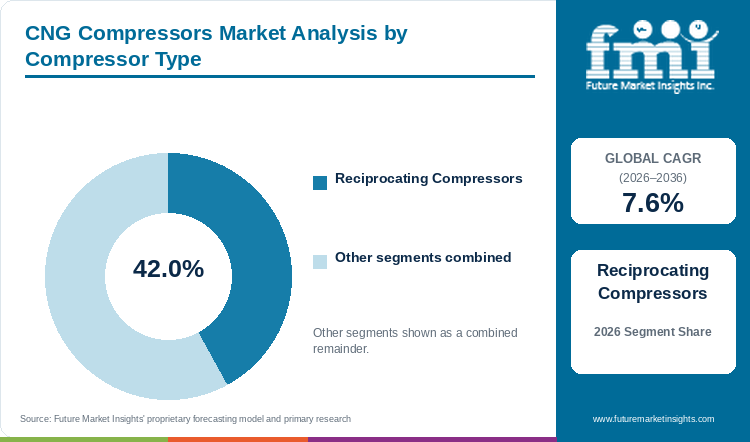
Reciprocating Compressors account for an estimated 42.0% of the CNG Compressors Market by compressor type in 2026. Piston machines are the design suppliers most often name when they describe a CNG station. Bauer says a heavy-duty reciprocating booster compressor sits at the heart of its CNG and RNG systems, with a gas after-cooler and an automatic condensate drain [12]. Atlas Copco lists its BBR gas compressors for high-pressure compressed natural gas at vehicle refuelling stations [13]. Ariel calls itself the leading manufacturer of reciprocating gas compressors in the global energy industry, with more than 75,000 compressors deployed since 1966 [14]. Fornovo Gas offers CNG models in horizontal and vertical layouts, including non-lubricated horizontal DA500 and vertical DA300 and SA200 units [16]. Japan's gas association notes that vehicles store natural gas on board at 20 MPa [22]. That pressure calls for a high final-stage pressure, a duty that multistage piston machines serve. Hydraulic designs are the compact alternative, such as Kirloskar's hydraulic booster packages and CIMC Enric's hydraulic filling equipment [15][17].
Table 2: Compressor Type, 2026 Share
| Leading Share | 2026 market share |
|---|---|
| Reciprocating Compressors | 42.0% |
| All Other Segments Combined Share | 58.0% |
Source: Future Market Insights analysis of the CNG Compressors Market, 2026.
Why does CNG Refueling Stations lead by Application in the CNG Compressors Market in 2026?
CNG Refueling Stations account for an estimated 42.0% of the CNG Compressors Market by application in 2026. Many public stations need a compressor, but non-boosted daughter stations do not, and station counts are rising in the largest gas-vehicle markets. India had 9,158 CNG stations as on 31 August 2026 [2]. The oil ministry's data showed 8,294 retail outlets offering CNG or CBG on 1 October 2026 [1]. Utilities treat compression as a capacity line. Indraprastha Gas reported 1,031 CNG stations and 130.46 lakh kg a day of compression capacity on 30 September 2026, serving about 25.4 lakh CNG vehicles in the Delhi region and nearby cities [3]. Station systems are also sold as complete packages. Bauer describes systems with drying, storage, priority and sequencing [12], and Atlas Copco says its CNG offer targets lower waste and lower cost of ownership [13]. Buyers familiar with compressed air treatment equipment will recognise the same dryer and filter content in these skids. Fleet refuelling is the smaller application, and ANGI Energy Systems lists refuelling systems for natural gas vehicles and RNG compression and decompression solutions [19].
Table 3: Application, 2026 Share
| Leading Share | 2026 market share |
|---|---|
| CNG Refueling Stations | 42.0% |
| All Other Segments Combined Share | 58.0% |
Source: Future Market Insights analysis of the CNG Compressors Market, 2026.
Why does Oil & Gas Companies lead by End User in the CNG Compressors Market in 2026?
Oil & Gas Companies account for an estimated 42.0% of the CNG Compressors Market by end user in 2026. Gas producers and midstream operators buy compression across the chain, then extend that buying to CNG supply. Ariel lists upstream, midstream, downstream, CNG, RNG, hydrogen and CO2 among its compressor applications [14]. It also refers to field gas gathering and to refining and petrochemical uses [14]. A buyer that already runs reciprocating fleets for gathering can specify the same supplier for a CNG mother station. Service networks keep these buyers close to established suppliers. Fornovo Gas says it builds and manages refuelling stations as well as compressors [16]. Bauer's standard package includes remote telemetry through BAUER CONNECT [12]. Utilities, transport operators and industrial users place smaller orders, usually through packaged systems. Kirloskar positions its online CNG compressor packages as part of the CNG distribution chain [15].
Table 4: End User, 2026 Share
| Leading Share | 2026 market share |
|---|---|
| Oil & Gas Companies | 42.0% |
| All Other Segments Combined Share | 58.0% |
Source: Future Market Insights analysis of the CNG Compressors Market, 2026.
What are the key drivers, restraints and opportunities?
Driver
Station build-out in gas-importing economies. India had 9,158 CNG stations on 31 August 2026 [2]. The 467 dispensing-station applications processed between 25 March and 21 April 2026 [6] point to continuing orders for station compressors. Indraprastha Gas alone reported 130.46 lakh kg a day of compression capacity on 30 September 2026 [3].
Fuel cost against diesel. The US Energy Information Administration expects Henry Hub gas to average USD 3.16 per million British thermal units in 2027, 9% below 2026 [8]. Diesel retail averaged USD 6.29 a gallon in September 2026 [8]. Fleet depots buying fuel in volume can justify a compressor on that price difference, which supports fleet orders.
Restraint
Uneven vehicle demand. US natural gas used as vehicle fuel was 53,149 million cubic feet in 2025. That is 16.5% below 2024 and below the 64,791 million cubic feet recorded in 2022 [7]. Lower volumes reduce station use, and operators defer compressor replacement when throughput falls.
Compliance cost. The explosives regulator issued a circular dated 2 April 2026 on approval of CNG and CBG gas compressors [4]. Trade reporting says manufacturers were directed to obtain package approval from the Chief Controller of Explosives' office by 30 September 2026 [5]. Germany's stepped natural gas tax adds to station operating cost, rising to EUR 27.33 per MWh in 2026 from EUR 22.85 in 2025 [9].
Opportunity
Biomethane stations. BioCNG needs the same compression as fossil CNG. The Riedstadt station opened on 19 June 2026 [10], and ReFuels supplies biomethane to heavy goods vehicles from 16 public access stations [11]. Bauer offers customised CNG and RNG systems [12]. ANGI lists RNG compression and decompression [19], and Ariel names RNG among its applications [14]. Buyers tracking biogas supply can compare feedstock growth with compression demand.
Multi-fuel and hydrogen-ready sites. ANGI lists fuel dispensers for hydrogen refuelling stations alongside its natural gas vehicle systems [19]. Ariel lists hydrogen among its compressor applications [14]. Operators of hydrogen fuelling stations can reuse site layouts and service contracts if one supplier covers both fuels.
CNG Compressors Market by Country (2026 to 2036)
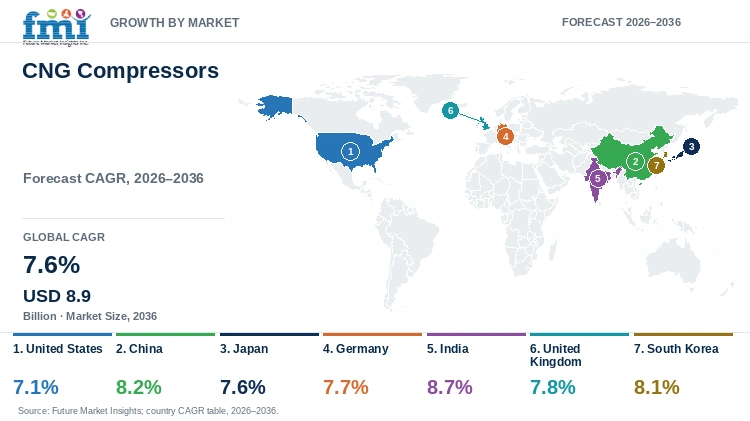
Table 5: CNG Compressors Market Country Growth Forecast
| Country | CAGR, 2026 to 2036 |
|---|---|
| United States | 7.1% |
| China | 8.2% |
| Japan | 7.6% |
| Germany | 7.7% |
| India | 8.7% |
| United Kingdom | 7.8% |
| South Korea | 8.1% |
Source: Future Market Insights analysis of the CNG Compressors Market, 2026.
United States
The US Energy Information Administration reported on 30 October 2026 that natural gas used as vehicle fuel was 53,149 million cubic feet in 2025 [7]. Earlier figures were 63,626 million in 2024, 60,130 million in 2023 and 64,791 million in 2022 [7]. The 2025 decline shows that compressor demand cannot depend on fleet adoption alone.
Diesel is priced well above gas in this outlook. In its 6 October 2026 outlook, the agency put September retail gasoline at USD 4.35 a gallon and diesel at USD 6.29 [8]. It expected Henry Hub gas at USD 3.48 per million British thermal units for 2026 and USD 3.16 for 2027 [8]. Depot-based fleets that refuel at one site are best placed to use that spread.
Clean Energy Fuels says it operates more than 600 fuelling stations [23]. ANGI Energy Systems, a Vontier company, lists refuelling systems for natural gas vehicles [19]. Bauer's standard package places variable-frequency-drive control systems remotely from the skid, as intended by Class 1, Division 2 requirements under the National Electrical Code [12]. It also lists a CRN pressure vessel code option [12]. US depot buyers should check that a quoted skid states its electrical classification and vessel code.
China
CIMC Enric describes itself as a leading Chinese manufacturer of key equipment and engineering services across the natural gas and hydrogen chain [18]. Its product list includes CNG tube skids, CNG storage cascades and CNG hydraulic filling equipment [17]. The company describes that equipment as compact, integrated and easy to transport and install [17].
On 26 August 2026, the group reported first-half 2026 revenue of RMB 12.9 billion [18]. New orders were higher across its clean energy, chemical and environmental, and liquid food segments [18]. On 25 March 2026 it reported 2025 profit attributable to shareholders of RMB 1.1 billion [18]. Because the group sells storage, cascade and filling equipment together, it can quote for more of a station than a compressor-only vendor.
CIMC Enric points to compact hydraulic filling skids for sites with limited space [17]. Buyers should confirm the scope of each tender. A bundled storage and filling price cannot be compared with a compressor-only quotation. Ask suppliers to price compression separately from storage.
Japan
The Japan Gas Association notes that a natural gas vehicle is broadly similar in structure to a gasoline or diesel vehicle, except for its fuel system [22]. The gas is stored on board at 20 MPa in a gas container, and a pressure-reducing valve feeds the engine [22]. That on-board pressure sets the delivery pressure a station compressor must reach.
Atlas Copco lists its BBR gas compressors for high-pressure CNG at vehicle refuelling stations [13]. Fornovo Gas offers non-lubricated CNG compressors in horizontal and vertical layouts [16]. Both are reciprocating designs, the type most used for station duty.
The association also runs a dedicated natural gas vehicle website [22]. In a mature gas-vehicle market, reliability and service response are the practical tests for a supplier. A quotation should state spare-part holdings and the response time promised to the station operator.
Germany
The Energy Tax Act sets a stepped rate for natural gas in section 2(2) [9]. The rate was EUR 22.85 per MWh in 2025 and EUR 27.33 in 2026, against the general rate of EUR 31.80 per MWh in section 2(1) [9]. The difference from the general rate narrows each year, which raises the value of efficient compression for station operators.
The industry initiative gibgas.de counts more than 4,200 CNG stations in 35 countries [10]. On 19 June 2026, VERBIO and Transgourmet opened a BioCNG station in Riedstadt, Hesse, that other CNG vehicle users can also use [10]. Transgourmet operates 40 BioCNG trucks at that station, and expects to save about 4,500 tonnes of CO2 a year against diesel [10].
On 24 September 2026, the same source reported on alternative drives at IAA Transportation 2026, highlighting CNG and LNG [10]. High-availability compressors with remote monitoring earn their place at biomethane stations and in heavy-duty fleets. Bauer's standard package includes such telemetry [12].
India
India is the clearest growth market. PNGRB data showed 9,158 CNG stations as on 31 August 2026 [2]. The oil ministry's data showed 8,294 retail outlets offering CNG or CBG on 1 October 2026 [1]. The two counts measure different things and cannot be used interchangeably.
Indraprastha Gas reported 1,031 CNG stations and about 25.4 lakh CNG vehicles in its Delhi region and nearby cities as on 30 September 2026 [3]. Its compression capacity stood at 130.46 lakh kg a day [3]. On 22 April 2026, the Petroleum Ministry said the explosives regulator had processed 467 CNG and CBG dispensing station applications between 25 March and 21 April [6]. Final licences were granted in 157 of those cases [6]. Kirloskar Pneumatic lists online CNG compressor packages and CNG hydraulic booster packages [15].
Compliance now shapes supplier choice. The explosives regulator's circular of 2 April 2026 covers approval of CNG and CBG gas compressors [4]. A trade report of 8 April 2026 said relief for compressor packages in Form E, F and G premises was extended to 30 September 2026 [5]. The report made that relief subject to approved Ex electrical components and directed manufacturers to obtain package approval by the same date [5]. That date has passed. Buyers should ask each bidder for its approval reference before award.
United Kingdom
ReFuels lists 16 public access CNG stations on major UK trucking routes [11]. It says it supplies biomethane to heavy goods vehicles from stations across the country, with an operations hub in Wigan [11]. Its network is heavy-duty and biomethane-fuelled.
ReFuels presented at the Pareto Securities Energy Conference on 16 September 2026 [11]. It also published its September 2026 biomethane station data [11]. Stations on trucking routes fill large tanks and run long hours, so compressor capacity and service cover matter more than purchase price.
Bauer lists a heavy-duty reciprocating booster system with remote telemetry, drying and sequencing [12]. A single network operator can sign one framework service agreement covering many sites, which is a route open to compressor suppliers in the UK.
South Korea
The Korea Gas Safety Corporation announced a High-Pressure Gas Facility Construction Capability Recognition Program on 26 October 2026 [24]. Under it, a recognised company's in-house pressure and leak test reports may be accepted. This applies when the company builds high-pressure gas manufacturing, filling or refrigeration facilities [24].
Test evidence is part of commissioning, so the programme can shorten delivery time for packaged compressor skids. Suppliers that fabricate and test complete skids before shipment are well placed to use such arrangements. Bauer describes integrated systems built on a steel skid for plug-and-play installation [12].
Korean buyers should ask suppliers how their factory test records will be treated under the programme. Bidders should also state the pressure rating and certification basis of the skid in their offers.
Who are the notable companies in the CNG Compressors Market?
Notable companies in the CNG Compressors Market include Atlas Copco AB, Ariel Corporation, Bauer Kompressoren GmbH, Ingersoll Rand Inc., ANGI Energy Systems LLC, CIMC Enric Holdings Limited, Kirloskar Pneumatic Company Limited and Fornovo Gas.
Scope of supply separates these companies more than compressor technology does. Bauer sells complete systems with drying, storage, priority and sequencing, a PLC, a gas after-cooler, remote telemetry and an optional weatherproof enclosure [12]. Atlas Copco presents CNG as an industry solution built around its BBR compressors [13]. Ingersoll Rand lists integrated CNG compression within its customised OEM solutions [21].
A second group sells the compressor and sits close to the station owner. Fornovo Gas says it builds and manages refuelling stations and makes non-lubricated CNG compressors [16]. ANGI Energy Systems, a Vontier company, lists refuelling systems for natural gas vehicles, RNG compression and decompression solutions and hydrogen dispensers [19]. Kirloskar Pneumatic offers online CNG compressor packages and hydraulic booster packages within its process gas systems range [15].
Large engine-compressor makers and equipment groups compete from other directions. Ariel supplies reciprocating compressors for upstream, midstream, downstream, CNG, RNG, hydrogen and CO2 applications [14]. Its buyer base therefore reaches gas producers and pipeline operators. CIMC Enric offers CNG tube skids, storage cascades and hydraulic filling equipment [17]. Atlas Copco's group results cover all its product lines, so they show scale, not CNG demand [20].
Key Developments in the CNG Compressors Market
- On 2 April 2026, the Petroleum and Explosives Safety Organisation issued a circular on approval of CNG and CBG gas compressors for premises covered under Forms E, F and G of the Gas Cylinders Rules, 2016 [4]. A trade report dated 8 April 2026 said package relief had been extended to 30 September 2026 [5].
- On 22 April 2026, India's Ministry of Petroleum and Natural Gas reported 467 CNG and CBG dispensing station applications processed on a priority basis between 25 March and 21 April. Final licences were granted in 157 cases [6].
- On 19 June 2026, VERBIO and Transgourmet opened a BioCNG station in Riedstadt, Hesse, that other CNG vehicle users can also use [10].
- On 22 October 2026, Atlas Copco reported third-quarter group orders received up 29% to SEK 52.3 billion, with an operating margin of 20.8% [20].
Key Players in the CNG Compressors Market
- Atlas Copco AB
- Ariel Corporation
- Bauer Kompressoren GmbH
- Ingersoll Rand Inc.
- ANGI Energy Systems LLC
- CIMC Enric Holdings Limited
- Kirloskar Pneumatic Company Limited
- Fornovo Gas
CNG Compressors Market Report Scope
Table 6: CNG Compressors Market Report Scope
| Coverage field | Report scope |
|---|---|
| Market definition | Compressors used to compress natural gas for CNG refuelling, fleet depots, pipeline injection and industrial gas supply, measured by value of sales |
| Compressor Type | Reciprocating Compressors; Hydraulic Compressors; Rotary Screw Compressors; Others |
| Application | CNG Refueling Stations; Industrial Applications; Pipeline Injection & Gas Distribution; Fleet Refueling Stations |
| End User | Oil & Gas Companies; Natural Gas Utilities; Transportation Sector; Industrial Users |
| Regions and profiled countries | North America, Europe and Asia Pacific; United States, China, Japan, Germany, India, United Kingdom, South Korea |
| Companies covered | Atlas Copco AB; Ariel Corporation; Bauer Kompressoren GmbH; Ingersoll Rand Inc.; ANGI Energy Systems LLC; CIMC Enric Holdings Limited; Kirloskar Pneumatic Company Limited; Fornovo Gas |
| Forecast period | 2026 to 2036, with 2025 as the historical base year |
| Quantitative Units | USD billion |
Source: Future Market Insights analysis of the CNG Compressors Market, 2026.
CNG Compressors Market by Segments
CNG Compressors Market segmented by Compressor Type:
- Reciprocating Compressors
- Hydraulic Compressors
- Rotary Screw Compressors
- Others
CNG Compressors Market segmented by Application:
- CNG Refueling Stations
- Industrial Applications
- Pipeline Injection & Gas Distribution
- Fleet Refueling Stations
CNG Compressors Market segmented by End User:
- Oil & Gas Companies
- Natural Gas Utilities
- Transportation Sector
- Industrial Users
CNG Compressors Market by Region
- North America
- Europe
- Asia Pacific
- United States
- China
- Japan
- Germany
- India
- United Kingdom
- South Korea
Research Sources and Bibliography
- [1] Petroleum Planning and Analysis Cell, Ministry of Petroleum and Natural Gas, India. (2026, October). Home page statistics: CNG stations and alternate fuel retail outlets. https://ppac.gov.in/
- [2] Petroleum and Natural Gas Regulatory Board, India. (2026, August 31). Key statistics: CNG stations. https://www.pngrb.gov.in/
- [3] Indraprastha Gas Limited. (2026, September 30). Highlights: CNG stations, compression capacity and CNG vehicles. https://www.iglonline.net/
- [4] Petroleum and Explosives Safety Organisation. (2026, April 2). Approval of CNG/CBG gas compressors proposed to be installed in the premises covered under Form-E&F and Form-G of the Gas Cylinders Rules, 2016. https://peso.gov.in/web/en/updates/approval-cngcbg-gas-compressors-proposed-be-installed-premises-covered-under-form-ef-and
- [5] Lexplosion Solutions. (2026, April 8). Petroleum and Explosives Safety Organisation issues circular regarding approval of CNG/CBG gas compressors. https://lexplosion.in/?p=148218
- [6] Bioenergy Times. (2026, April 23). Centre approves 41 biogas plants and clears 467 CNG and CBG station applications in priority fuel crisis drive. https://bioenergytimes.com/centre-approves-41-biogas-plants-and-clears-467-cng-and-cbg-station-applications-in-priority-fuel-crisis-drive/
- [7] U.S. Energy Information Administration. (2026, October 30). U.S. Natural Gas Consumption by End Use, vehicle fuel. https://www.eia.gov/dnav/ng/ng_cons_sum_dcu_nus_a.htm
- [8] U.S. Energy Information Administration. (2026, October 6). Short-Term Energy Outlook, October 2026. https://www.eia.gov/outlooks/steo/
- [9] Bundesministerium der Justiz. (n.d.). Energiesteuergesetz (EnergieStG), section 2. https://www.gesetze-im-internet.de/energiestg/__2.html
- [10] gibgas.de. (n.d.). CNG and BioCNG news. https://www.gibgas.de/
- [11] ReFuels N.V. (n.d.). Public access CNG stations and biomethane fuel for heavy goods vehicles. https://www.cngfuels.com/
- [12] BAUER COMP. (n.d.). CNG/RNG compressors solutions. https://www.bauercomp.com/es/node/486
- [13] Atlas Copco. (n.d.). Gas compressors, BBR natural gas compressor and CNG industry solutions. https://www.atlascopco.com/en-us/compressors/products/gas-compressors
- [14] Ariel Corporation. (n.d.). Ariel Corporation home page. https://www.arielcorp.com/
- [15] Kirloskar Pneumatic Company Limited. (n.d.). Process gas systems, CNG applications. https://www.kirloskarpneumatic.com/
- [16] Fornovo Gas. (n.d.). Compressori CNG. https://www.fornovogas.it/en/
- [17] CIMC Enric Holdings Limited. (n.d.). Products: CNG tube skids, CNG storage cascade and CNG hydraulic filling equipment. https://www.cimc-enric.com/products/
- [18] CIMC Enric Holdings Limited. (2026, August 26). News listing: 2026 interim results; 2025 results (2026, March 25). https://www.enricgroup.com/
- [19] ANGI Energy Systems, Inc., a Vontier company. (n.d.). Refueling solutions and systems for natural gas vehicles. https://www.angienergy.com/
- [20] Atlas Copco AB. (2026, October 22). Third-quarter report 2026. https://www.inderes.se/en/releases/atlas-copco-third-quarter-report-2026
- [21] Ingersoll Rand. (n.d.). Integrated compression CNG, OEM customised solutions. https://www.ingersollrand.com/en-us/products/oem-solutions/customised-solutions/integrated-compression-cng/
- [22] Japan Gas Association. (n.d.). Natural gas vehicles. https://www.gas.or.jp/ngvj/
- [23] Clean Energy Fuels Corp. (n.d.). Company home page. https://www.cleanenergyfuels.com/
- [24] Korea Gas Safety Corporation. (2026, October 26). High-Pressure Gas Facility Construction Capability Recognition Program. https://www.kgs.or.kr/eng/
Table of Content
Table of Content
- Key Takeaways
- Market Size and CAGR
- Top Growth Driver
- Fastest Growing Segment
- Leading Region
- Key Companies
- Emerging Opportunities
- Executive Summary
- Global Market Outlook
- Demand-side Trends
- Supply-side Trends
- Technology Roadmap Analysis
- Analysis and Recommendations
- Analyst Perspective (What is happening? Why now? What should investors know?)
- Key Questions Answered
- How large is the market?
- What is the CAGR?
- What are key trends?
- Which region dominates?
- Who are the leaders?
Read More...
- Market Overview
- Market Coverage / Taxonomy
- Market Definition / Scope / Limitations
- Research Methodology
- Chapter Orientation
- Analytical Lens and Working Hypotheses
- Market Structure, Signals, and Trend Drivers
- Benchmarking and Cross-market Comparability
- Market Sizing, Forecasting, and Opportunity Mapping
- Research Design and Evidence Framework
- Desk Research Programme (Secondary Evidence)
- Expert Input and Fieldwork (Primary Evidence)
- Tooling, Models, and Reference Databases
- Data Engineering and Model Build
- Quality Assurance and Audit Trail
- Market Background
- Market Dynamics (Drivers, Restraints, Opportunity, Trends)
- Scenario Forecast (Optimistic, Likely, Conservative)
- Impact Analysis
- AI Impact
- Sustainability Impact
- Regulatory Impact
- Technology Impact
- Consumer / Buyer Analysis
- Purchase Drivers
- Adoption Barriers
- Buyer Journey
- Opportunity Map Analysis
- Product Life Cycle Analysis
- Supply Chain Analysis
- Investment Feasibility Matrix
- Value Chain Analysis
- PESTLE and Porter's Analysis
- Regulatory Landscape
- Regional Parent Market Outlook
- Production and Consumption Statistics
- Import and Export Statistics
- Global Market Analysis and Forecast, 2021 to 2036
- Historical Market Size Value (USD Billion) Analysis, 2021 to 2025
- Current and Future Market Size Value (USD Billion) Projections, 2026 to 2036
- Y-o-Y Growth Trend Analysis
- Absolute $ Opportunity Analysis
- Global Market Pricing Analysis, 2021 to 2036
- Global Market Analysis and Forecast, By Compressor Type, 2021 to 2036
- Introduction / Key Findings
- Historical Market Size Value (USD Billion) Analysis By Compressor Type, 2021 to 2025
- Current and Future Market Size Value (USD Billion) Analysis and Forecast By Compressor Type, 2026 to 2036
- Reciprocating Compressors
- Hydraulic Compressors
- Rotary Screw Compressors
- Others
- Y-o-Y Growth Trend Analysis By Compressor Type, 2021 to 2025
- Absolute $ Opportunity Analysis By Compressor Type, 2026 to 2036
- Global Market Analysis and Forecast, By Application, 2021 to 2036
- Introduction / Key Findings
- Historical Market Size Value (USD Billion) Analysis By Application, 2021 to 2025
- Current and Future Market Size Value (USD Billion) Analysis and Forecast By Application, 2026 to 2036
- CNG Refueling Stations
- Industrial Applications
- Pipeline Injection & Gas Distribution
- Fleet Refueling Stations
- Y-o-Y Growth Trend Analysis By Application, 2021 to 2025
- Absolute $ Opportunity Analysis By Application, 2026 to 2036
- Global Market Analysis and Forecast, By End User, 2021 to 2036
- Introduction / Key Findings
- Historical Market Size Value (USD Billion) Analysis By End User, 2021 to 2025
- Current and Future Market Size Value (USD Billion) Analysis and Forecast By End User, 2026 to 2036
- Oil & Gas Companies
- Natural Gas Utilities
- Transportation Sector
- Industrial Users
- Y-o-Y Growth Trend Analysis By End User, 2021 to 2025
- Absolute $ Opportunity Analysis By End User, 2026 to 2036
- Global Market Analysis and Forecast, By Region, 2021 to 2036
- Introduction
- Historical Market Size Value (USD Billion) Analysis By Region, 2021 to 2025
- Current Market Size Value (USD Billion) Analysis and Forecast By Region, 2026 to 2036
- North America
- Europe
- Asia Pacific
- Market Attractiveness Analysis By Region
- North America Market Analysis and Forecast, By Country, 2021 to 2036
- Historical Market Size Value (USD Billion) Trend Analysis By Market Taxonomy, 2021 to 2025
- Market Size Value (USD Billion) Forecast By Market Taxonomy, 2026 to 2036
- By Country
- By Compressor Type
- By Application
- By End User
- Market Attractiveness Analysis
- By Country
- By Compressor Type
- By Application
- By End User
- Key Takeaways
- Europe Market Analysis and Forecast, By Country
- Historical Market Size Value (USD Billion) Trend Analysis By Market Taxonomy, 2021 to 2025
- Market Size Value (USD Billion) Forecast By Market Taxonomy, 2026 to 2036
- By Country
- By Compressor Type
- By Application
- By End User
- Market Attractiveness Analysis
- By Country
- By Compressor Type
- By Application
- By End User
- Key Takeaways
- Asia Pacific Market Analysis and Forecast, By Country
- Historical Market Size Value (USD Billion) Trend Analysis By Market Taxonomy, 2021 to 2025
- Market Size Value (USD Billion) Forecast By Market Taxonomy, 2026 to 2036
- By Country
- United States
- China
- Japan
- Germany
- India
- United Kingdom
- South Korea
- By Compressor Type
- By Application
- By End User
- By Country
- Market Attractiveness Analysis
- By Country
- By Compressor Type
- By Application
- By End User
- Key Takeaways
- Key Countries Market Analysis
- United States
- Pricing Analysis
- Market Share Analysis, 2025
- By Compressor Type
- By Application
- By End User
- Germany
- Pricing Analysis
- Market Share Analysis, 2025
- By Compressor Type
- By Application
- By End User
- United Kingdom
- Pricing Analysis
- Market Share Analysis, 2025
- By Compressor Type
- By Application
- By End User
- India
- Pricing Analysis
- Market Share Analysis, 2025
- By Compressor Type
- By Application
- By End User
- China
- Pricing Analysis
- Market Share Analysis, 2025
- By Compressor Type
- By Application
- By End User
- Japan
- Pricing Analysis
- Market Share Analysis, 2025
- By Compressor Type
- By Application
- By End User
- South Korea
- Pricing Analysis
- Market Share Analysis, 2025
- By Compressor Type
- By Application
- By End User
- United States
- Market Structure Analysis
- Competition Dashboard
- Competition Benchmarking
- Market Share Analysis of Top Players
- By Regional
- By Compressor Type
- By Application
- By End User
- Emerging Startups
- Innovation Benchmarking
- Competition Analysis
- Competition Deep Dive
- Atlas Copco AB
- Overview
- Product Portfolio
- Profitability by Market Segments
- Sales Footprint
- Strategy Overview
- Marketing Strategy
- Product Strategy
- Channel Strategy
- Ariel Corporation
- Bauer Kompressoren GmbH
- Ingersoll Rand Inc.
- ANGI Energy Systems LLC
- CIMC Enric Holdings Limited
- Kirloskar Pneumatic Company Limited
- Fornovo Gas
- Atlas Copco AB
- Case Studies
- Success Stories
- Recent Developments
- Competition Deep Dive
- Assumptions & Acronyms Used
List of Tables
- Table 1: Global Market Value (USD Billion) Forecast by Region, 2021 to 2036
- Table 2: Global Market Value (USD Billion) Forecast by Compressor Type, 2021 to 2036
- Table 3: Global Market Value (USD Billion) Forecast by Application, 2021 to 2036
- Table 4: Global Market Value (USD Billion) Forecast by End User, 2021 to 2036
- Table 5: North America Market Value (USD Billion) Forecast by Country, 2021 to 2036
- Table 6: North America Market Value (USD Billion) Forecast by Compressor Type, 2021 to 2036
- Table 7: North America Market Value (USD Billion) Forecast by Application, 2021 to 2036
- Table 8: North America Market Value (USD Billion) Forecast by End User, 2021 to 2036
- Table 9: Europe Market Value (USD Billion) Forecast by Country, 2021 to 2036
- Table 10: Europe Market Value (USD Billion) Forecast by Compressor Type, 2021 to 2036
- Table 11: Europe Market Value (USD Billion) Forecast by Application, 2021 to 2036
- Table 12: Europe Market Value (USD Billion) Forecast by End User, 2021 to 2036
- Table 13: Asia Pacific Market Value (USD Billion) Forecast by Country, 2021 to 2036
- Table 14: Asia Pacific Market Value (USD Billion) Forecast by Compressor Type, 2021 to 2036
- Table 15: Asia Pacific Market Value (USD Billion) Forecast by Application, 2021 to 2036
- Table 16: Asia Pacific Market Value (USD Billion) Forecast by End User, 2021 to 2036
List of Figures
- Figure 1: Global Market Pricing Analysis
- Figure 2: Global Market Value (USD Billion) Forecast 2021-2036
- Figure 3: Global Market Value Share and BPS Analysis by Compressor Type, 2026 and 2036
- Figure 4: Global Market Y-o-Y Growth Comparison by Compressor Type, 2026-2036
- Figure 5: Global Market Attractiveness Analysis by Compressor Type
- Figure 6: Global Market Value Share and BPS Analysis by Application, 2026 and 2036
- Figure 7: Global Market Y-o-Y Growth Comparison by Application, 2026-2036
- Figure 8: Global Market Attractiveness Analysis by Application
- Figure 9: Global Market Value Share and BPS Analysis by End User, 2026 and 2036
- Figure 10: Global Market Y-o-Y Growth Comparison by End User, 2026-2036
- Figure 11: Global Market Attractiveness Analysis by End User
- Figure 12: Global Market Value (USD Billion) Share and BPS Analysis by Region, 2026 and 2036
- Figure 13: Global Market Y-o-Y Growth Comparison by Region, 2026-2036
- Figure 14: Global Market Attractiveness Analysis by Region
- Figure 15: North America Market Incremental Dollar Opportunity, 2026-2036
- Figure 16: Europe Market Incremental Dollar Opportunity, 2026-2036
- Figure 17: Asia Pacific Market Incremental Dollar Opportunity, 2026-2036
- Figure 18: North America Market Value Share and BPS Analysis by Country, 2026 and 2036
- Figure 19: North America Market Value Share and BPS Analysis by Compressor Type, 2026 and 2036
- Figure 20: North America Market Y-o-Y Growth Comparison by Compressor Type, 2026-2036
- Figure 21: North America Market Attractiveness Analysis by Compressor Type
- Figure 22: North America Market Value Share and BPS Analysis by Application, 2026 and 2036
- Figure 23: North America Market Y-o-Y Growth Comparison by Application, 2026-2036
- Figure 24: North America Market Attractiveness Analysis by Application
- Figure 25: North America Market Value Share and BPS Analysis by End User, 2026 and 2036
- Figure 26: North America Market Y-o-Y Growth Comparison by End User, 2026-2036
- Figure 27: North America Market Attractiveness Analysis by End User
- Figure 28: Europe Market Value Share and BPS Analysis by Country, 2026 and 2036
- Figure 29: Europe Market Value Share and BPS Analysis by Compressor Type, 2026 and 2036
- Figure 30: Europe Market Y-o-Y Growth Comparison by Compressor Type, 2026-2036
- Figure 31: Europe Market Attractiveness Analysis by Compressor Type
- Figure 32: Europe Market Value Share and BPS Analysis by Application, 2026 and 2036
- Figure 33: Europe Market Y-o-Y Growth Comparison by Application, 2026-2036
- Figure 34: Europe Market Attractiveness Analysis by Application
- Figure 35: Europe Market Value Share and BPS Analysis by End User, 2026 and 2036
- Figure 36: Europe Market Y-o-Y Growth Comparison by End User, 2026-2036
- Figure 37: Europe Market Attractiveness Analysis by End User
- Figure 38: Asia Pacific Market Value Share and BPS Analysis by Country, 2026 and 2036
- Figure 39: Asia Pacific Market Value Share and BPS Analysis by Compressor Type, 2026 and 2036
- Figure 40: Asia Pacific Market Y-o-Y Growth Comparison by Compressor Type, 2026-2036
- Figure 41: Asia Pacific Market Attractiveness Analysis by Compressor Type
- Figure 42: Asia Pacific Market Value Share and BPS Analysis by Application, 2026 and 2036
- Figure 43: Asia Pacific Market Y-o-Y Growth Comparison by Application, 2026-2036
- Figure 44: Asia Pacific Market Attractiveness Analysis by Application
- Figure 45: Asia Pacific Market Value Share and BPS Analysis by End User, 2026 and 2036
- Figure 46: Asia Pacific Market Y-o-Y Growth Comparison by End User, 2026-2036
- Figure 47: Asia Pacific Market Attractiveness Analysis by End User
- Figure 48: Global Market - Tier Structure Analysis
- Figure 49: Global Market - Company Share Analysis
Frequently Asked Questions
How big is the CNG compressors market in 2026?
The CNG Compressors Market is estimated at USD 4.3 billion in 2026, up from USD 4.0 billion in 2025. It is projected to reach USD 8.9 billion by 2036, a 7.6% CAGR from 2026 to 2036.
Which segments lead the CNG compressors market?
Reciprocating Compressors lead by compressor type, CNG Refueling Stations by application and Oil & Gas Companies by end user, each with 42.0% in 2026. Bauer builds its CNG systems around a heavy-duty reciprocating booster compressor [12]. Atlas Copco lists BBR compressors for natural gas vehicle refuelling stations [13].
Which other segments matter?
By compressor type, Hydraulic Compressors hold 25.0%, Rotary Screw Compressors 18.0% and Others 15.0%. By application, Industrial Applications hold 25.0%, Pipeline Injection & Gas Distribution 18.0% and Fleet Refueling Stations 15.0%. By end user, Natural Gas Utilities hold 25.0%, Transportation Sector 18.0% and Industrial Users 15.0%. Kirloskar and CIMC Enric both offer hydraulic CNG equipment [15][17].
Which profiled country is forecast to grow fastest?
India has the highest forecast CAGR of the seven profiled countries, at 8.7% from 2026 to 2036. China follows at 8.2%, then South Korea at 8.1%. PNGRB data showed 9,158 CNG stations in India as on 31 August 2026 [2]. The United States has the lowest rate, at 7.1%. Its vehicle-fuel gas use fell to 53,149 million cubic feet in 2025 [7].
What rules are affecting compressor supply in India?
The explosives regulator issued a circular dated 2 April 2026 on approval of CNG and CBG gas compressors for premises covered under Forms E, F and G of the Gas Cylinders Rules, 2016 [4]. A trade report of 8 April 2026 said package relief was extended to 30 September 2026, and that manufacturers had to obtain package approval by that date [5].
What should a buyer check when choosing a CNG compressor supplier?
Check the scope of supply first: drying, storage, sequencing, controls and telemetry, as Bauer lists them [12]. Next, check certification options. Bauer lists a CE electrical code and a CRN pressure vessel code [12]. Finally, confirm local service cover and, in India, the package approval status [5].
Preview the report firsthand - request a free sample
Get SampleGet the brochure for pricing and purchase details.
Get PDF
