

- Market Size (2026)
- USD 3.9 Bn
- Forecast (2036)
- USD 6.4 Bn
- CAGR (2026 to 2036)
- 5.2%
How big is Oilfield Mud Additives Market in 2026?
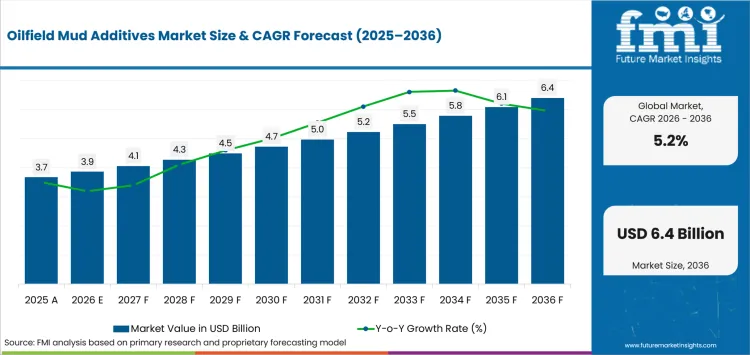
USD 3.9 billion in 2026 and USD 6.4 billion by 2036 at a 5.2% CAGR.
Demand for oilfield mud additives is projected to rise from USD 3.9 billion in 2026 to USD 6.4 billion by 2036 at a 5.2% CAGR. Longer horizontal sections extend fluid-control work. The USA Energy Information Administration reported in November 2025 that about 11,700 of more than 15,000 Lower 48 wells entering production in 2024 were horizontal. More horizontal drilling increases treatment work where instability would extend rig time.
Canada differs through a dense horizontal land-drilling base with regional service coverage. Alberta Energy Regulator data published in June 2025 show 3,385 new crude oil wells entered production in 2024 and 3,370 were horizontal. Repeatable well designs support treatment decisions. New additives need compatibility proof before field use.
Key Takeaways
- Long horizontal sections increase treatment intensity because mud engineers control solids and filtration for more circulating hours.
- By additive type, dispersants are estimated to hold 18.0% in 2026 owing to routine rheology and solids-control work during circulation.
- Water-based mud is set to lead the mud system category with 46.0% share in 2026 due to broad formulation flexibility.
- By application, exploration drilling is forecast to represent 24.0% in 2026 driven by adjustable treatment under uncertain formations.
- Qualification and discharge requirements slow substitution because new additives must remain compatible with the complete fluid package.
- Some of the key players in this market include Halliburton, SLB, Baker Hughes, Weatherford, Newpark Fluids Systems, TETRA Technologies, Innospec, Clariant, Nouryon, and AES Drilling Fluids.
Analyst Perspective
"Unit price is a weak comparison where fluid failure can extend rig time. Stronger offers prove compatibility under representative well conditions and place application support close to the rig."
- Nikhil Kaitwade, Principal Consultant, Future Market Insights
How is the oilfield mud additives market segmented?
The market is segmented by additive type, mud system, application, well environment, sales channel and region.
Additive type includes dispersants, emulsifiers, defoamers, lost circulation materials, biocides and corrosion inhibitors. Mud system covers water-based mud, oil-based mud, synthetic-based mud and high-performance mud systems. Application includes exploration drilling, development drilling, workover operations, deepwater drilling and horizontal drilling. Well environment covers conventional, unconventional, HPHT, sour gas and offshore wells. Sales channels include oilfield service companies, mud chemical distributors, direct E&P supply and integrated drilling contracts.
Why do dispersants lead the additive type category?
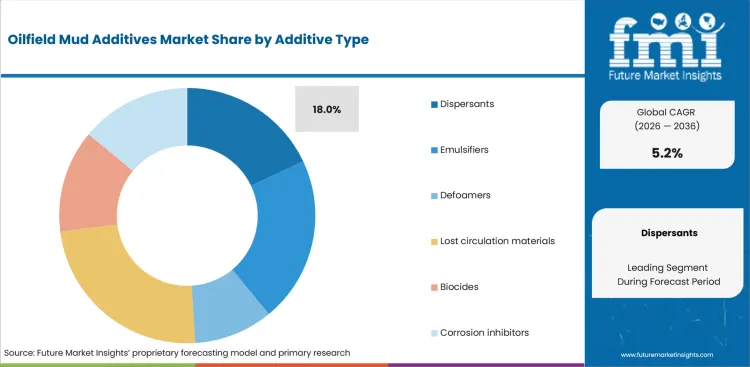
Mud engineers use dispersants to control interactions between drilled solids and the liquid phase. Excess viscosity can reduce hydraulic efficiency and complicate solids removal in drilling and completion fluids. The additive therefore supports routine rheology correction during circulation.
- By additive type, the dispersants segment is estimated to hold 18.0% in 2026 owing to repeated rheology correction during active fluid maintenance.
- The American Petroleum Institute scheduled the sixth edition of RP 13B-1 for January 2026. Current field-testing procedures give mud engineers a consistent basis for measuring water-based fluid response.
Why does water-based mud lead the mud system category?
Water-based mud gives drilling teams a fluid platform that can be adjusted for inhibition and filtration without replacing the complete system. The same platform is useful in onshore drilling fluids where crews need familiar handling and quick treatment changes.
- Water-based mud is set to lead the mud system category with 46.0% share in 2026 due to broad operating use and adjustable additive packages.
- Aramco's January 2026 sourcing list names water-based mud and high-performance water-based mud systems. The list also specifies a fluid-loss-control additive for water-based mud rated to 500°F.
How does exploration drilling shape the application category?
Exploration wells require flexible fluid treatment because pressure and formation behavior are still being resolved. Directional drilling services increase the cost of poor hole cleaning as longer trajectories extend the active interval.
- In 2026, exploration drilling is expected to lead the application category with 24.0% share because uncertain formations increase the value of adjustable treatment.
- Halliburton received a three-year Petrobras offshore drilling contract in January 2025 for development and exploration wells. The scope includes drilling-fluid services with BaraLogix real-time monitoring of technical limits.
Why do conventional wells lead the well environment category?
Conventional wells often use established mud designs over familiar hole sections. Repeatable procedures keep drilling tools and fluid maintenance tied to predictable treatment schedules. Repeatability favors formulations that reproduce the same response without extensive redesign.
- By well environment, conventional wells account for 31.0% in 2026 attributable to repeatable well designs and routine treatment requirements.
- The American Petroleum Institute's 2025 exploration and production catalog lists field-testing procedures for water-based and nonaqueous fluids. Standard field tests give operators a common basis for routine treatment decisions.
Why do oilfield service companies lead the sales channel category?
Oilfield service companies often supply mud chemistry with formulation support because treatment volumes change by hole section. The oil and gas field services model places engineering and material supply under one accountable workflow.
- By sales channel, oilfield service companies are forecast to represent 44.0% in 2026 driven by direct access to fluid engineering and rigsite treatment support.
- Weatherford disclosed in October 2025 that YPF awarded a one-year extension for drilling-fluid supply in Central Argentina. The award keeps material supply tied to an ongoing field-service relationship.
What are the drivers, restraints and opportunities in the Oilfield Mud Additives Market?
Longer well sections increase treatment intensity. Qualification and discharge rules can delay substitution. Digital fluid measurement and localized blending create a practical route to higher-value service.
- Driver: Longer horizontal and unconventional wells increase the time that fluid properties must remain controlled.
- Restraint: Environmental acceptance and fluid compatibility can extend approval cycles for new chemistry.
- Opportunity: Local formulation and real-time measurement can shorten diagnosis and treatment decisions at the rig.
Longer horizontal and unconventional wells extend the period that fluid properties must stay controlled. ADNOC Drilling reported in July 2025 that Turnwell had drilled 58 of 144 planned UAE unconventional wells and fractured more than 20. Longer well sections increase exposure to rheology drift and circulation losses. Mud pump systems therefore depend on treatment chemistry that keeps pressure behavior within the planned operating window.
Environmental acceptance can block a technically workable formulation from routine offshore use. The USA EPA issued a January 2026 notice for its offshore Gulf permit while retaining discharge limits for drilling fluids and cuttings. A new additive must fit the approved waste route as well as the mud system. Drilling waste management therefore affects substitution where disposal controls narrow the usable chemistry set.
Revenue improves where fluid teams can diagnose a deviation and change treatment without long material delays. SCF Partners reported in July 2025 that Newpark Fluids Systems was developing a liquid mud facility in West Texas and a technology center in Saudi Arabia. Local formulation capacity shortens response time for field engineers. Oilfield chemicals then compete on application speed as well as material performance.
Which country CAGRs are profiled in the Oilfield Mud Additives Market?
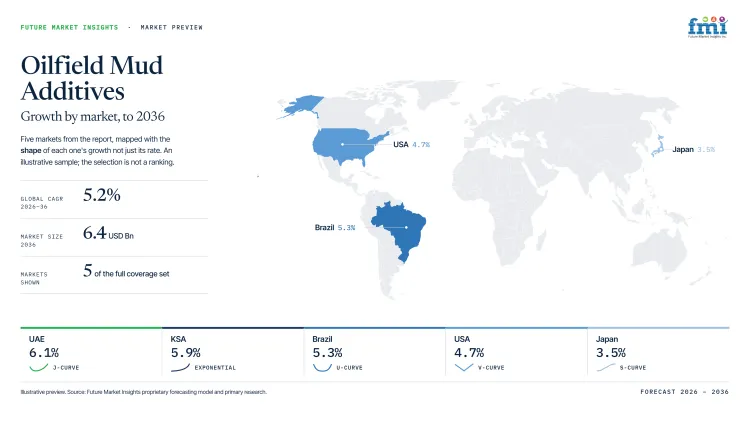
| Country | CAGR |
|---|---|
| UAE | 6.1% |
| KSA | 5.9% |
| Qatar | 5.7% |
| Brazil | 5.3% |
| Canada | 4.8% |
| USA | 4.7% |
| Japan | 3.5% |
How do country-level CAGRs compare in the Oilfield Mud Additives Market?
A 2.6 percentage-point spread separates the profiled country CAGRs. UAE, KSA and Qatar form the upper group through large operator-led programs. Brazil holds the middle position. Canada and USA sit close together in mature land programs with heavier treatment-cost scrutiny. Japan trails because upstream activity depends on discrete offshore projects.
- Abu Dhabi service bases shorten resupply to active unconventional rigs.
- Jafurah links large gas programs with localization and formal qualification.
- Offshore campaigns place marine delivery windows ahead of broad inventory.
- Pre-salt logistics increase the value of coastal material staging before mobilization.
- Seasonal access makes regional warehousing part of land-drilling service coverage planning.
- Shale operators benchmark treatment cost against extensive basin-specific field history.
- Project-led exploration favors campaign-sized inventory and planned technical mobilization offshore.
Rates can mask different entry conditions. Coverage includes North America, Latin America, Western Europe, Eastern Europe, East Asia, South Asia and Pacific, and the Middle East and Africa.
Country-wise Analysis
- Long horizontal wells in Al Dhafra expose mud systems to hot saline intervals that increase rheology and loss-control work. Oilfield mud additives demand in UAE is forecast to rise at 6.1% CAGR over the forecast period, driven by unconventional drilling and integrated service execution. ADNOC stated in May 2025 that Unconventional Onshore Block 3 covers 3,609 square kilometers and was awarded to EOG for exploration. Local service bases can adjust formulations quickly during active drilling. Entry still depends on operator qualification and reliable material availability before each hole section starts. Hydraulic fracturing services introduce a second coordination point because drilling-fluid condition can affect later stimulation preparation.
- Jafurah is moving Saudi gas drilling toward repeatable unconventional well programs that need consistent fluid performance over long campaigns. The KSA oilfield mud additives sector is projected to record 5.9% CAGR during the assessment period, attributable to gas development and localization of oilfield services. Aramco stated in February 2026 that Jafurah began production in December 2025 and covers about 17,000 square kilometers. Local technology centers can shorten laboratory review and reduce dependence on distant inventory. Formal operator qualification and localization requirements can lengthen entry for unfamiliar chemistry. New suppliers need formulations suited to unconventional gas conditions plus local stock that can be released on scheduled call-offs.
- Qatar concentrates drilling demand in operator-led offshore programs where mud materials must fit planned vessel and platform schedules. Oilfield mud additives demand in Qatar is forecast to rise at 5.7% CAGR over the forecast period, driven by continuing well programs and controlled offshore execution. QatarEnergy's Annual Review 2024 recorded 32 enhanced-water-flood wells drilled during 2024. The same operating model favors advance laboratory work before materials are mobilized. A concentrated operator base simplifies technical coordination between the mud engineer and material provider. Platform space and supply interruptions penalize bulky or high-treatment-rate chemistry. Compact treatment packages with local storage can fit scheduled call-offs without carrying excess material offshore.
- Brazilian pre-salt wells depend heavily on coastal staging because a late chemistry change becomes costly once materials are offshore. Oilfield mud additive sales in Brazil are forecast to expand at 5.3% CAGR by 2036, supported by continued pre-salt development and well connections. Petrobras reported in January 2026 that eleven wells were connected in Tupi and Iracema during 2025. Coastal inventory gives fluid teams a practical buffer for treatment changes. Deepwater logistics and narrow intervention windows make compatibility failures expensive. Well casing systems introduce another coordination point because the drilling fluid must protect hole condition until casing reaches planned well depth.
- Alberta land programs operate through regional service hubs that must cover remote locations and seasonal access constraints. Canada's oilfield mud additives outlook is anticipated to advance at 4.8% CAGR over the assessment period, supported by sustained crude output and horizontal drilling. Canada Energy Regulator data released in June 2026 show national crude oil production averaged 5.35 million barrels per day in 2025. Regional warehouses keep common drilling-fluid treatments close to active basin operations. Capital discipline still limits how much chemistry can be added per well. Formulations that tolerate changing water quality can reduce corrective deliveries during winter access windows and lower exposure to long transport runs.
- Permian operators are drilling longer laterals that increase cuttings transport and torque-control work during the active fluid cycle. USA oilfield mud additive demand is predicted to advance at 4.7% CAGR through 2036, driven by mature shale activity and treatment efficiency. The USA Energy Information Administration reported in August 2026 that 81% of new Permian horizontal wells in 2025 had laterals between five thousand and fifteen thousand feet. Dense service infrastructure gives operators fast access to replacement materials. Persistent price pressure still limits treatment intensity on many shale wells. A formulation earns repeat use through field data that show fewer corrective treatments or lower fluid-related downtime.
- Japanese upstream demand is tied to discrete offshore exploration programs instead of a continuous land-drilling base. Adoption of oilfield mud additives in Japan is estimated to expand at 3.5% CAGR through 2036, supported by project-specific offshore drilling and technical service. JAPEX reported in June 2026 that it completed exploratory drilling offshore Hidaka at a 1,900-meter water depth. Campaign planning gives importers time to stage specialized chemistry and laboratory support. The smaller drilling base does not justify large permanent inventories for every additive. Market entry therefore depends on dependable mobilization for individual wells plus technical support that can respond during the campaign.
Who are the notable companies in the Oilfield Mud Additives Market?
Halliburton, SLB, Baker Hughes, Weatherford, Newpark Fluids Systems, TETRA Technologies, Innospec, Clariant, Nouryon, and AES Drilling Fluids are notable companies active in this market.
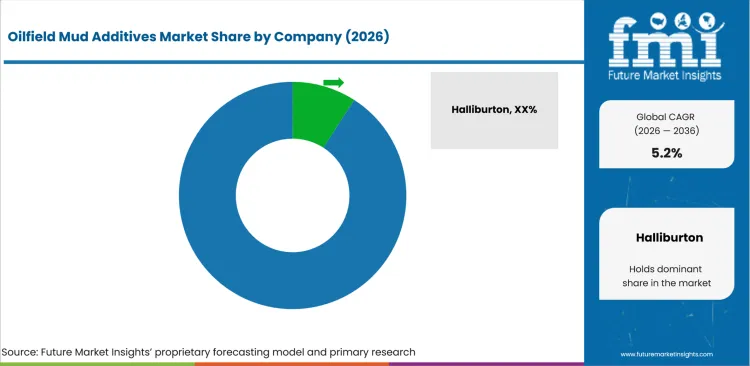
Competition separates integrated well-construction groups from focused fluid specialists. Halliburton and SLB pair drilling fluids with broader services. Newpark Fluids Systems and AES Drilling Fluids focus on fluid design and delivery. TETRA Technologies is narrower in reservoir fluids. Innospec, Clariant and Nouryon supply specialty chemistry. Entry depends on compatibility evidence.
- Halliburton and SLB form the integrated systems group with Baker Hughes and Weatherford.
- Newpark Fluids Systems and AES Drilling Fluids form the focused fluids group with TETRA Technologies.
- Innospec and Clariant supply specialty additive chemistry alongside Nouryon.
Competitive Benchmarking: Oilfield Mud Additives Market
| Company | Drilling Fluid and Additive Breadth | Complex-Well and HPHT Capability | Field Service and Fluid Analytics Integration | Geographic Reach |
|---|---|---|---|---|
| Halliburton | High | High | High | Global |
| SLB | High | High | High | Global |
| Baker Hughes | High | High | High | Global |
| Weatherford | High | High | High | Approximately 75 countries |
| Newpark Fluids Systems | High | High | High | 23-country fluids network |
| TETRA Technologies | Medium | High | Medium | North America and selected international markets |
| Innospec | Medium | Medium | Medium | Americas, Europe, Middle East, Africa and Asia-Pacific |
| Clariant | Medium | Medium | Medium | Global specialty-chemicals network with current West Africa drilling-additive distribution |
| Nouryon | Medium | Medium | Medium | North America and international oilfield chemistry markets |
| AES Drilling Fluids | High | Medium | High | United States shale basins with Mid-Continent expansion |
Scoring basis: High additive breadth requires multiple fluid systems or additive functions. Medium indicates narrower coverage and Low one function. High complex-well capability requires HPHT or deepwater evidence. Medium confirms difficult-well use and Low routine conditions. High integration requires field engineering or real-time analytics. Medium indicates technical service and Low product-only supply.
Key Developments in the Oilfield Mud Additives Market
- In July 2026, Halliburton won integrated drilling and completions contracts for the GranMorgu deepwater development offshore Suriname. The project scope includes an upgrade to its local liquid mud and cement plant.
- In June 2025, Nouryon opened an oilfield Innovation Center in Houston for drilling and completion applications. The site provides local formulation and testing support for temperature and salinity problems.
- In June 2025, AES Drilling Fluids completed the acquisition of Fossil Fluids. The deal expanded its field presence in western Oklahoma and the Cherokee shale.
Key Players in the Oilfield Mud Additives Market
Integrated Drilling-Fluid Systems and Field Services
- Halliburton
- SLB
- Baker Hughes
- Weatherford
Independent and Focused Fluid Specialists
- Newpark Fluids Systems
- AES Drilling Fluids
- TETRA Technologies
Specialty Additive Chemistry
- Innospec
- Clariant
- Nouryon
Oilfield Mud Additives Market - Report Scope
| Coverage field | Report scope |
|---|---|
| Market breakdown | By additive type, mud system, application, well environment, sales channel and region. |
| Quantitative Units | USD billion. |
| Market Definition | Commercial revenue from oilfield mud additives used to control drilling-fluid properties. Base mud and drilling equipment are excluded. Cementing, stimulation, completion-brine and production chemistry are excluded unless revenue belongs to the defined additive categories. |
| Regions Covered | North America; Latin America; Western Europe; Eastern Europe; East Asia; South Asia and Pacific; Middle East and Africa. |
| Countries Covered | UAE; KSA; Qatar; Brazil; Canada; USA; Japan; and more than twenty-five additional countries in the full report. |
| Key Companies Profiled | Halliburton; SLB; Baker Hughes; Weatherford; Newpark Fluids Systems; TETRA Technologies; Innospec; Clariant; Nouryon; AES Drilling Fluids. |
| Forecast Period | 2026 to 2036. |
| Approach | Primary and secondary research with market triangulation. |
Oilfield Mud Additives Market - Research Methodology
| Method | Approach |
|---|---|
| Primary Research | FMI analysts gathered input from manufacturers, service providers, technology developers, distributors, end users, procurement teams, and subject-matter experts. Interviews examined purchasing decisions, product or service evaluation, adoption barriers, approval requirements, pricing considerations, and expectations for technical or commercial support. Respondents were also asked what evidence is required before a trial, pilot, or initial order develops into regular purchasing. |
| Desk Research | Desk research covered government statistics, regulatory publications, trade data, industry associations, technical literature, standards, company filings, product information, and official corporate announcements. Sources were reviewed for relevance, publication date, geographic coverage, and consistency with the defined market scope. Claims relating to performance, applications, approvals, capacity, investment, and commercial activity were retained only when supported by credible public evidence. |
| Market Sizing and Forecasting | The market model combined the baseline value with historical performance, segment structure, pricing and volume indicators, adoption levels, company participation, and country-level demand conditions. Forecast assumptions considered economic activity, investment trends, regulatory developments, technology adoption, purchasing cycles, supply availability, and barriers to wider market use. Segment and regional estimates were reconciled before the final market total was calculated. |
| Data Validation | Estimates were checked against multiple independent indicators, including public data, company activity, trade patterns, industry developments, and findings from primary interviews. Validation also tested whether products, services, applications, and company revenues fell within the defined market boundaries. Adjacent categories, unsupported claims, overlapping revenues, and activities without direct market relevance were excluded to reduce double counting and maintain consistency across segments and countries. |
Oilfield Mud Additives Market by Segments
Oilfield Mud Additives Market segmented by Additive Type:
- Dispersants
- Emulsifiers
- Defoamers
- Lost circulation materials
- Biocides
- Corrosion inhibitors
Oilfield Mud Additives Market segmented by Mud System:
- Water-based mud
- Oil-based mud
- Synthetic-based mud
- High-performance mud systems
Oilfield Mud Additives Market segmented by Application:
- Exploration drilling
- Development drilling
- Workover operations
- Deepwater drilling
- Horizontal drilling
Oilfield Mud Additives Market segmented by Well Environment:
- Conventional
- Unconventional
- HPHT
- Sour gas
- Offshore
Oilfield Mud Additives Market segmented by Sales Channel:
- Oilfield service companies
- Mud chemical distributors
- Direct E&P supply
- Integrated drilling contracts
Oilfield Mud Additives Market by Region:
- North America
- United States
- Canada
- Latin America
- Brazil
- Mexico
- Argentina
- Chile
- Western Europe
- Germany
- France
- United Kingdom
- Italy
- Spain
- Benelux
- Nordics
- Eastern Europe
- Poland
- Czech Republic
- Romania
- Hungary
- East Asia
- China
- Japan
- South Korea
- South Asia and Pacific
- India
- ASEAN
- Australia and New Zealand
- Middle East and Africa
- GCC Countries
- South Africa
- Türkiye
- Israel
Research Sources and Bibliography
- USA Energy Information Administration. (2025, November 5). Rapid declines from horizontal wells require more drilling to sustain production.
- Alberta Energy Regulator. (2025, June). Crude Oil Well Activity.
- American Petroleum Institute. (2026). API Standards Plan: Industry Standards in Development.
- Aramco Asia India. (2026, January). 2026 Material Sourcing List - India.
- Halliburton. (2025, January 30). Halliburton secures major offshore drilling contract with Petrobras.
- American Petroleum Institute. (2025). Exploration and Production 2025.
- Weatherford International plc. (2025, October 21). Weatherford Announces Third Quarter 2025 Results.
- ADNOC Drilling. (2025, July 30). ADNOC Drilling Delivers Record 1H 2025 Results, Revenue Grows +30% to $2.37bn, Upgrades Guidance.
- USA Environmental Protection Agency. (2026, January 28). NPDES General Permit for New and Existing Sources and New Dischargers in the Offshore Subcategory.
- SCF Partners. (2025, July 7). Newpark Fluids Systems Strengthens Executive Leadership and Board to Drive Continued Growth.
- ADNOC. (2025, May 16). ADNOC Deepens Energy Partnerships with US Companies.
- Aramco. (2026, February 26). Aramco’s gas strategy builds momentum with major progress towards growth target.
- QatarEnergy. (2025). Annual Review 2024.
- Petrobras. (2026, January 13). Tupi/Iracema Field Returns to Reaching Production of 1 Million Barrels per Day.
- Canada Energy Regulator. (2026, June 17). Market Snapshot: Canada sets new record in crude oil production in 2025.
- USA Energy Information Administration. (2026, August 19). Longer wells boost Permian crude oil and natural gas production.
- Japan Petroleum Exploration Co., Ltd. (2026, June 12). Completion of Exploratory Drilling at Offshore Hidaka Area of Hokkaido.
- Clariant. (2026, July 29). Clariant appoints Gapuma Group as Well Service Additives distributor across West Africa.
- Nouryon. (2025, June 18). Nouryon launches Innovation Center for oilfield solutions in Texas, US.
- AES Drilling Fluids. (2025, June 17). Acquisition Announcement: Fossil Fluids LLC now part of AES Drilling Fluids.
- Halliburton Company. (2026, February 6). 2025 Form 10-K.
- SLB Limited. (2026, January 23). 2025 Form 10-K.
- Baker Hughes Company. (2026, February 5). 2025 Form 10-K.
- TETRA Technologies, Inc. (2026, February 25). 2025 Form 10-K.
- Innospec Inc. (2026, February 18). 2025 Form 10-K.
- Weatherford International plc. (2026, February 4). 2025 Form 10-K.
- Innospec. (2025, April 9). Innospec Oilfield Services’ OKC manufacturing center has earned ISO 9001 certification!
- Newpark Fluids Systems. (2025, September 4). Intelligent Mud Solutions (IMS) and Newpark Fluids Systems Announce Strategic Collaboration Agreement for Real-Time Fluids Measurement.
- SLB. (2025, March 31). SLB Awarded Major Drilling Contract by Woodside Energy for Ultra-deepwater Trion Development.
- QatarEnergy. (2026, January 3). Provision of Mud Chemicals, Equipment and Engineering Services for Offshore Operations.
- Halliburton. (2026, July 13). Halliburton wins integrated drilling and completions contracts for GranMorgu deepwater development offshore Suriname, operated by TotalEnergies.
- SLB. (2026, February 12). SLB Awarded Multiple Offshore Drilling Contracts by Mubadala Energy for Tangkulo Deepwater Development in Indonesia.
- Baker Hughes. (2026, May 26). Baker Hughes Extends and Expands Integrated Well Construction Contract with Petrobras.
- Newpark Fluids Systems. (2026, April 8). DeepDrill HPWBM Inhibits Shale.
- Nouryon. (2025, February 10). Nouryon opens new office in Al Dhahran to strengthen presence in Saudi Arabia and the Middle East.
- AES Drilling Fluids. (2025, September). Haynesville Regional Brochure v1.
This bibliography is provided for reader reference and is not exhaustive. The full report contains the complete reference list and detailed citations
This Report Answers
- What are the 2026 and 2036 values for the oilfield mud additives market?
- Which well-design changes increase oilfield mud additive treatment intensity?
- Why do dispersants lead the additive type category?
- Why does water-based mud lead the mud system category?
- How does exploration drilling shape the application category?
- Why do oilfield service companies lead the sales channel?
- How do growth rates differ among the seven profiled countries?
- Which companies provide drilling-fluid service or specialty additive chemistry?
- How do qualification and offshore discharge rules affect substitution?
Frequently Asked Questions
How big is the oilfield mud additives market in 2026?
The oilfield mud additives market is valued at USD 3.9 billion in 2026 and is projected to reach USD 6.4 billion by 2036. Longer horizontal wells increase fluid-treatment work.
What is the CAGR of the oilfield mud additives market from 2026 to 2036?
The oilfield mud additives market is projected to grow at a CAGR of 5.2% between 2026 and 2036. Longer well sections increase rheology and filtration treatment.
Which additive type leads the oilfield mud additives market?
The dispersants segment is expected to hold 18.0% of the oilfield mud additives market in 2026, attributable to routine rheology correction. Dispersants limit solids interactions that raise viscosity.
Which mud system leads the oilfield mud additives market?
The water-based mud segment is expected to hold 46.0% of the oilfield mud additives market in 2026, supported by formulation flexibility. Drilling teams can adjust inhibition and filtration without replacing the fluid system.
Which companies are active in the oilfield mud additives market?
Key companies operating in the oilfield mud additives market include Halliburton, SLB, Baker Hughes, Weatherford, Newpark Fluids Systems, TETRA Technologies, Innospec, Clariant, Nouryon, and AES Drilling Fluids. They compete through integrated fluid service or focused chemistry and field delivery.
Preview the report firsthand - request a free sample
Get SampleGet the brochure for pricing and purchase details.
Get PDFTable of Content
- Key Takeaways
- Market Size and CAGR
- Top Growth Driver
- Fastest Growing Segment
- Leading Region
- Key Companies
- Emerging Opportunities
- Executive Summary
- Global Market Outlook
- Demand-side Trends
- Supply-side Trends
- Technology Roadmap Analysis
- Analysis and Recommendations
- Analyst Perspective (What is happening? Why now? What should investors know?)
- Key Questions Answered
- How large is the market?
- What is the CAGR?
- What are key trends?
- Which region dominates?
- Who are the leaders?
- Market Overview
- Market Coverage / Taxonomy
- Market Definition / Scope / Limitations
- Research Methodology
- Chapter Orientation
- Analytical Lens and Working Hypotheses
- Market Structure, Signals, and Trend Drivers
- Benchmarking and Cross-market Comparability
- Market Sizing, Forecasting, and Opportunity Mapping
- Research Design and Evidence Framework
- Desk Research Programme (Secondary Evidence)
- Expert Input and Fieldwork (Primary Evidence)
- Tooling, Models, and Reference Databases
- Data Engineering and Model Build
- Quality Assurance and Audit Trail
- Market Background
- Market Dynamics (Drivers, Restraints, Opportunity, Trends)
- Scenario Forecast (Optimistic, Likely, Conservative)
- Impact Analysis
- AI Impact
- Sustainability Impact
- Regulatory Impact
- Technology Impact
- Consumer / Buyer Analysis
- Purchase Drivers
- Adoption Barriers
- Buyer Journey
- Opportunity Map Analysis
- Product Life Cycle Analysis
- Supply Chain Analysis
- Investment Feasibility Matrix
- Value Chain Analysis
- PESTLE and Porter's Analysis
- Regulatory Landscape
- Regional Parent Market Outlook
- Production and Consumption Statistics
- Import and Export Statistics
- Global Market Analysis and Forecast, 2021 to 2036
- Historical Market Size Value (USD Billion) Analysis, 2021 to 2025
- Current and Future Market Size Value (USD Billion) Projections, 2026 to 2036
- Y-o-Y Growth Trend Analysis
- Absolute $ Opportunity Analysis
- Global Market Pricing Analysis, 2021 to 2036
- Global Market Analysis and Forecast, By Additive Type, 2021 to 2036
- Introduction / Key Findings
- Historical Market Size Value (USD Billion) Analysis By Additive Type, 2021 to 2025
- Current and Future Market Size Value (USD Billion) Analysis and Forecast By Additive Type, 2026 to 2036
- Dispersants
- Emulsifiers
- Defoamers
- Lost circulation materials
- Biocides
- Corrosion inhibitors
- Dispersants
- Y-o-Y Growth Trend Analysis By Additive Type, 2021 to 2025
- Absolute $ Opportunity Analysis By Additive Type, 2026 to 2036
- Global Market Analysis and Forecast, By Mud System, 2021 to 2036
- Introduction / Key Findings
- Historical Market Size Value (USD Billion) Analysis By Mud System, 2021 to 2025
- Current and Future Market Size Value (USD Billion) Analysis and Forecast By Mud System, 2026 to 2036
- Water-based mud
- Oil-based mud
- Synthetic-based mud
- High-performance mud systems
- Water-based mud
- Y-o-Y Growth Trend Analysis By Mud System, 2021 to 2025
- Absolute $ Opportunity Analysis By Mud System, 2026 to 2036
- Global Market Analysis and Forecast, By Application, 2021 to 2036
- Introduction / Key Findings
- Historical Market Size Value (USD Billion) Analysis By Application, 2021 to 2025
- Current and Future Market Size Value (USD Billion) Analysis and Forecast By Application, 2026 to 2036
- Exploration drilling
- Development drilling
- Workover operations
- Deepwater drilling
- Horizontal drilling
- Exploration drilling
- Y-o-Y Growth Trend Analysis By Application, 2021 to 2025
- Absolute $ Opportunity Analysis By Application, 2026 to 2036
- Global Market Analysis and Forecast, By Well Environment, 2021 to 2036
- Introduction / Key Findings
- Historical Market Size Value (USD Billion) Analysis By Well Environment, 2021 to 2025
- Current and Future Market Size Value (USD Billion) Analysis and Forecast By Well Environment, 2026 to 2036
- Conventional
- Unconventional
- HPHT
- Sour gas
- Offshore
- Conventional
- Y-o-Y Growth Trend Analysis By Well Environment, 2021 to 2025
- Absolute $ Opportunity Analysis By Well Environment, 2026 to 2036
- Global Market Analysis and Forecast, By Sales Channel, 2021 to 2036
- Introduction / Key Findings
- Historical Market Size Value (USD Billion) Analysis By Sales Channel, 2021 to 2025
- Current and Future Market Size Value (USD Billion) Analysis and Forecast By Sales Channel, 2026 to 2036
- Oilfield service companies
- Mud chemical distributors
- Direct E&P supply
- Integrated drilling contracts
- Oilfield service companies
- Y-o-Y Growth Trend Analysis By Sales Channel, 2021 to 2025
- Absolute $ Opportunity Analysis By Sales Channel, 2026 to 2036
- Global Market Analysis and Forecast, By Region, 2021 to 2036
- Introduction
- Historical Market Size Value (USD Billion) Analysis By Region, 2021 to 2025
- Current Market Size Value (USD Billion) Analysis and Forecast By Region, 2026 to 2036
- North America
- Latin America
- Western Europe
- Eastern Europe
- East Asia
- South Asia and Pacific
- Middle East & Africa
- Market Attractiveness Analysis By Region
- North America Market Analysis and Forecast, By Country, 2021 to 2036
- Historical Market Size Value (USD Billion) Trend Analysis By Market Taxonomy, 2021 to 2025
- Market Size Value (USD Billion) Forecast By Market Taxonomy, 2026 to 2036
- By Country
- USA
- Canada
- By Additive Type
- By Mud System
- By Application
- By Well Environment
- By Sales Channel
- By Country
- Market Attractiveness Analysis
- By Country
- By Additive Type
- By Mud System
- By Application
- By Well Environment
- By Sales Channel
- Key Takeaways
- Latin America Market Analysis and Forecast, By Country
- Historical Market Size Value (USD Billion) Trend Analysis By Market Taxonomy, 2021 to 2025
- Market Size Value (USD Billion) Forecast By Market Taxonomy, 2026 to 2036
- By Country
- Brazil
- Mexico
- Chile
- Rest of Latin America
- By Additive Type
- By Mud System
- By Application
- By Well Environment
- By Sales Channel
- By Country
- Market Attractiveness Analysis
- By Country
- By Additive Type
- By Mud System
- By Application
- By Well Environment
- By Sales Channel
- Key Takeaways
- Western Europe Market Analysis and Forecast, By Country
- Historical Market Size Value (USD Billion) Trend Analysis By Market Taxonomy, 2021 to 2025
- Market Size Value (USD Billion) Forecast By Market Taxonomy, 2026 to 2036
- By Country
- Germany
- UK
- Italy
- Spain
- France
- Nordic
- BENELUX
- Rest of Western Europe
- By Additive Type
- By Mud System
- By Application
- By Well Environment
- By Sales Channel
- By Country
- Market Attractiveness Analysis
- By Country
- By Additive Type
- By Mud System
- By Application
- By Well Environment
- By Sales Channel
- Key Takeaways
- Eastern Europe Market Analysis and Forecast, By Country
- Historical Market Size Value (USD Billion) Trend Analysis By Market Taxonomy, 2021 to 2025
- Market Size Value (USD Billion) Forecast By Market Taxonomy, 2026 to 2036
- By Country
- Russia
- Poland
- Hungary
- Balkan & Baltic
- Rest of Eastern Europe
- By Additive Type
- By Mud System
- By Application
- By Well Environment
- By Sales Channel
- By Country
- Market Attractiveness Analysis
- By Country
- By Additive Type
- By Mud System
- By Application
- By Well Environment
- By Sales Channel
- Key Takeaways
- East Asia Market Analysis and Forecast, By Country
- Historical Market Size Value (USD Billion) Trend Analysis By Market Taxonomy, 2021 to 2025
- Market Size Value (USD Billion) Forecast By Market Taxonomy, 2026 to 2036
- By Country
- China
- Japan
- South Korea
- By Additive Type
- By Mud System
- By Application
- By Well Environment
- By Sales Channel
- By Country
- Market Attractiveness Analysis
- By Country
- By Additive Type
- By Mud System
- By Application
- By Well Environment
- By Sales Channel
- Key Takeaways
- South Asia and Pacific Market Analysis and Forecast, By Country
- Historical Market Size Value (USD Billion) Trend Analysis By Market Taxonomy, 2021 to 2025
- Market Size Value (USD Billion) Forecast By Market Taxonomy, 2026 to 2036
- By Country
- India
- ASEAN
- Australia & New Zealand
- Rest of South Asia and Pacific
- By Additive Type
- By Mud System
- By Application
- By Well Environment
- By Sales Channel
- By Country
- Market Attractiveness Analysis
- By Country
- By Additive Type
- By Mud System
- By Application
- By Well Environment
- By Sales Channel
- Key Takeaways
- Middle East & Africa Market Analysis and Forecast, By Country
- Historical Market Size Value (USD Billion) Trend Analysis By Market Taxonomy, 2021 to 2025
- Market Size Value (USD Billion) Forecast By Market Taxonomy, 2026 to 2036
- By Country
- Kingdom of Saudi Arabia
- Other GCC Countries
- Türkiye
- South Africa
- Other African Union
- Rest of Middle East & Africa
- By Additive Type
- By Mud System
- By Application
- By Well Environment
- By Sales Channel
- By Country
- Market Attractiveness Analysis
- By Country
- By Additive Type
- By Mud System
- By Application
- By Well Environment
- By Sales Channel
- Key Takeaways
- Key Countries Market Analysis
- USA
- Pricing Analysis
- Market Share Analysis, 2025
- By Additive Type
- By Mud System
- By Application
- By Well Environment
- By Sales Channel
- Canada
- Pricing Analysis
- Market Share Analysis, 2025
- By Additive Type
- By Mud System
- By Application
- By Well Environment
- By Sales Channel
- Mexico
- Pricing Analysis
- Market Share Analysis, 2025
- By Additive Type
- By Mud System
- By Application
- By Well Environment
- By Sales Channel
- Brazil
- Pricing Analysis
- Market Share Analysis, 2025
- By Additive Type
- By Mud System
- By Application
- By Well Environment
- By Sales Channel
- Chile
- Pricing Analysis
- Market Share Analysis, 2025
- By Additive Type
- By Mud System
- By Application
- By Well Environment
- By Sales Channel
- Germany
- Pricing Analysis
- Market Share Analysis, 2025
- By Additive Type
- By Mud System
- By Application
- By Well Environment
- By Sales Channel
- UK
- Pricing Analysis
- Market Share Analysis, 2025
- By Additive Type
- By Mud System
- By Application
- By Well Environment
- By Sales Channel
- Italy
- Pricing Analysis
- Market Share Analysis, 2025
- By Additive Type
- By Mud System
- By Application
- By Well Environment
- By Sales Channel
- Spain
- Pricing Analysis
- Market Share Analysis, 2025
- By Additive Type
- By Mud System
- By Application
- By Well Environment
- By Sales Channel
- France
- Pricing Analysis
- Market Share Analysis, 2025
- By Additive Type
- By Mud System
- By Application
- By Well Environment
- By Sales Channel
- India
- Pricing Analysis
- Market Share Analysis, 2025
- By Additive Type
- By Mud System
- By Application
- By Well Environment
- By Sales Channel
- ASEAN
- Pricing Analysis
- Market Share Analysis, 2025
- By Additive Type
- By Mud System
- By Application
- By Well Environment
- By Sales Channel
- Australia & New Zealand
- Pricing Analysis
- Market Share Analysis, 2025
- By Additive Type
- By Mud System
- By Application
- By Well Environment
- By Sales Channel
- China
- Pricing Analysis
- Market Share Analysis, 2025
- By Additive Type
- By Mud System
- By Application
- By Well Environment
- By Sales Channel
- Japan
- Pricing Analysis
- Market Share Analysis, 2025
- By Additive Type
- By Mud System
- By Application
- By Well Environment
- By Sales Channel
- South Korea
- Pricing Analysis
- Market Share Analysis, 2025
- By Additive Type
- By Mud System
- By Application
- By Well Environment
- By Sales Channel
- Russia
- Pricing Analysis
- Market Share Analysis, 2025
- By Additive Type
- By Mud System
- By Application
- By Well Environment
- By Sales Channel
- Poland
- Pricing Analysis
- Market Share Analysis, 2025
- By Additive Type
- By Mud System
- By Application
- By Well Environment
- By Sales Channel
- Hungary
- Pricing Analysis
- Market Share Analysis, 2025
- By Additive Type
- By Mud System
- By Application
- By Well Environment
- By Sales Channel
- Kingdom of Saudi Arabia
- Pricing Analysis
- Market Share Analysis, 2025
- By Additive Type
- By Mud System
- By Application
- By Well Environment
- By Sales Channel
- Türkiye
- Pricing Analysis
- Market Share Analysis, 2025
- By Additive Type
- By Mud System
- By Application
- By Well Environment
- By Sales Channel
- South Africa
- Pricing Analysis
- Market Share Analysis, 2025
- By Additive Type
- By Mud System
- By Application
- By Well Environment
- By Sales Channel
- USA
- Market Structure Analysis
- Competition Dashboard
- Competition Benchmarking
- Market Share Analysis of Top Players
- By Regional
- By Additive Type
- By Mud System
- By Application
- By Well Environment
- By Sales Channel
- Emerging Startups
- Innovation Benchmarking
- Competition Analysis
- Competition Deep Dive
- Halliburton
- Overview
- Product Portfolio
- Profitability by Market Segments
- Sales Footprint
- Strategy Overview
- Marketing Strategy
- Product Strategy
- Channel Strategy
- SLB
- Baker Hughes
- Newpark Resources
- TETRA Technologies
- Innospec
- Clariant
- Nouryon
- Solvay
- Aubin Group
- Halliburton
- Case Studies
- Success Stories
- Recent Developments
- Competition Deep Dive
- Assumptions & Acronyms Used


