

- Market Size (2026)
- USD 1.7 Bn
- Forecast (2036)
- USD 2.8 Bn
- CAGR (2026 to 2036)
- 5.1%
How big is Mud Viscosifier Chemicals Market in 2026?
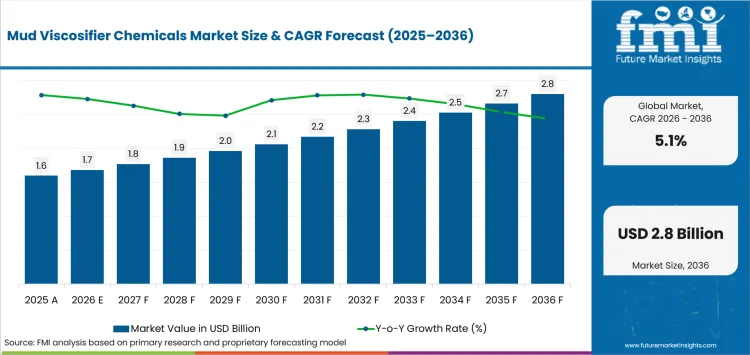
USD 1.7 billion in 2026 and USD 2.8 billion by 2036 at a 5.1% CAGR.
Demand for mud viscosifier chemicals is projected to expand at 5.1% CAGR between 2026 and 2036, lifting valuation from USD 1.7 billion to USD 2.8 billion. Longer laterals extend cuttings transport and increase suspension requirements before cuttings reach the surface. EIA's August 2026 analysis recorded an average Permian lateral length of 10,867 feet in 2025, 77% above 2015. The longer geometry makes rheology control a direct drilling-efficiency requirement during high-rate circulation.
Brazil carries higher offshore exposure than mature North American land programs, which makes fluid instability more expensive during deepwater campaigns. EPE's 2026 Brazilian Energy Balance recorded 97.6% of Brazil's 2025 oil production from maritime fields. Brazil's offshore concentration raises the value of qualified viscosity control because fluid corrections consume expensive rig time.
Key Takeaways
- Longer lateral and deepwater wells increase demand for viscosifiers that suspend cuttings without pushing circulating pressure beyond the planned hydraulic window.
- By viscosifier type, bentonite is estimated to hold 31.0% in 2026 owing to familiar hydration behavior and established drilling-fluid quality specifications.
- Water-based mud is projected to account for 56.0% of mud system demand in 2026 because it accepts mineral and water-soluble polymer treatments.
- In 2026, hole cleaning is expected to represent 29.0% of application demand because poor cuttings transport quickly reduces drilling efficiency.
- High salinity, temperature and solids loading can weaken clay hydration or polymer response and extend the qualification work needed before substitution.
- Some of the key players in this market include Halliburton, SLB, Baker Hughes, Newpark Fluids Systems, Ashland, Nouryon, CES Energy Solutions, Elementis, and TETRA Technologies.
Analyst Perspective
"The commercial test for a viscosifier is repeatable low-shear rheology after real brine, solids and temperature conditions are introduced. A cheaper additive loses its advantage if extra treatment or circulation time is required to recover the planned fluid profile."
- Nikhil Kaitwade, Principal Consultant, Future Market Insights
How is the mud viscosifier chemicals market segmented?
The market is segmented by viscosifier type, mud system, application, well environment and sales channel.
Viscosifier type covers bentonite, xanthan gum, PAC - CMC polymers, guar gum, organophilic clay and synthetic rheology modifiers. Mud systems include water-based mud, oil-based mud, synthetic-based mud and completion fluids. Applications cover hole cleaning, cuttings suspension, rheology control, lost circulation support and high-angle drilling. Well environments include conventional wells, shale wells, offshore wells, HPHT wells and directional wells. Sales channels include mud service companies, industrial mineral suppliers, oilfield chemical distributors and direct project supply.
What makes bentonite central to the viscosifier type category?
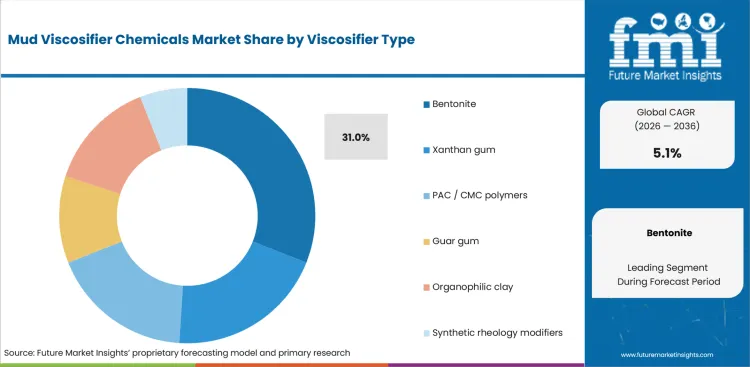
Bentonite hydration builds viscosity and gel strength in water-based fluids before higher-cost polymer reinforcement becomes necessary. Mud engineers add polymers as salinity or temperature weakens clay response, leaving bentonite economical where make-up water supports reliable field hydration.
- By viscosifier type, bentonite is forecast to represent 31.0% in 2026 due to familiar field handling and established quality specifications for drilling use.
- USGS's 2026 Mineral Commodity Summaries estimated that drilling mud accounted for 22% of USA bentonite use in 2025. The figure confirms a substantial drilling outlet without serving as evidence for FMI's modeled share.
Why does water-based mud lead the mud system category?
Water-based mud accepts bentonite, xanthan gum and PAC - CMC within one carrier phase, giving mud engineers several rheology routes before a system change becomes necessary. Treatment intensity can rise with salinity or solids, and familiar laboratory and field practices support routine adjustment.
- Water-based mud is set to lead the mud system category with 56.0% share in 2026 attributable to flexible mineral and water-soluble polymer treatment routes.
- EPA's January 2026 offshore permit fact sheet kept water-based drilling-fluid discharges inside the Gulf permit framework and tied compliance to monitored conditions. The requirement favors formulations with documented composition and predictable treatment response.
How does hole cleaning shape the application category?
Hole cleaning makes rheology an operating requirement because cuttings must remain mobile through deviated and extended intervals during circulation. Low-shear viscosity sustains transport, but excessive gel structure raises equivalent circulating density and consumes hydraulic margin.
- Hole cleaning is projected to hold 29.0% of application demand in 2026 driven by its immediate effect on circulation time and cuttings transport.
- EIA reported in August 2026 that super-laterals above 15,000 feet accounted for 15% of new Permian completions in 2025. Longer intervals extend the transport path, increasing the value of low-shear suspension that keeps cuttings mobile without excessive pump pressure.
What supports conventional wells within the well environment category?
Conventional onshore drilling fluids cover varied depths and formations without concentrating every program in severe temperature or extended-reach conditions. Proven mineral and polymer treatments carry routine fluid loads, and higher-specification viscosifiers enter as contamination, depth or deviation increases during active drilling.
- Conventional wells are estimated to hold 34.0% of well environment demand in 2026 because established mud programs suit a broad set of drilling conditions.
- ANP's August 2026 exploration review listed 14 onshore wells among 19 Brazilian exploration wells planned for 2026. That workload preserves demand for qualified base rheology systems outside deepwater projects.
Why do mud service companies lead the sales channel category?
Mud service companies control the treatment loop between laboratory formulation and rig execution, so mud engineers can adjust dosage after checking rheology, solids and contamination. The channel favors consistent chemistry and nearby inventory because treatment decisions occur during drilling.
- Mud service companies are anticipated to represent 42.0% of sales channel demand in 2026 because they convert chemical inventory into an engineered fluid program.
- Halliburton stated in January 2025 that its Petrobras contract will deploy BaraLogix to address drilling-fluid technical limits with hydraulic software and surface measurement automation. The award links service-channel chemistry selection with live operating data.
What are the drivers, restraints and opportunities in the Mud Viscosifier Chemicals Market?
Longer and deeper wells raise suspension requirements, fluid-system qualification limits rapid substitution, and higher-efficiency rheology packages offer a route to premium treatment value.
- Driver: Extended-reach and offshore wells increase the time that cuttings must remain transportable within a controlled pressure window.
- Restraint: Temperature, salinity, solids and discharge requirements narrow the chemistry that can be changed during an active mud program.
- Opportunity: Local fluid facilities and application laboratories can shorten testing and replenishment cycles for higher-performance polymer and mineral systems.
Long well sections increase the distance over which drilling fluid must carry cuttings without consuming excessive hydraulic margin. The Norwegian Offshore Directorate's January 2026 shelf review recorded two 2025 exploration wellbores measuring 10.7 and 10.2 kilometres, extending circulation exposure for fluid systems. Those lengths make low-shear suspension more valuable, so viscosifier demand follows well geometry as well as well count.
Substitution depends on the complete mud system because offshore discharge controls apply after fluids encounter treatment and well conditions. Offshore Norge's September 2025 environmental report recorded about 70,000 tonnes of water-based drilling-fluid cuttings discharged in 2024, with permission required from the Norwegian Environment Agency. That documented discharge route lengthens qualification before replacement chemistry enters routine use in offshore fluid programs.
Shorter qualification and replenishment cycles offer a commercial opening in difficult wells where treatment delays can extend rig exposure. SCF Partners documented in July 2025 that Newpark Fluids Systems was developing a liquid-mud facility in West Texas and a technology center in Saudi Arabia. Locating inventory and testing closer to drilling programs can shorten treatment delays, although custom rheology systems still require field validation before routine use.
Which country CAGRs are profiled in the Mud Viscosifier Chemicals Market?
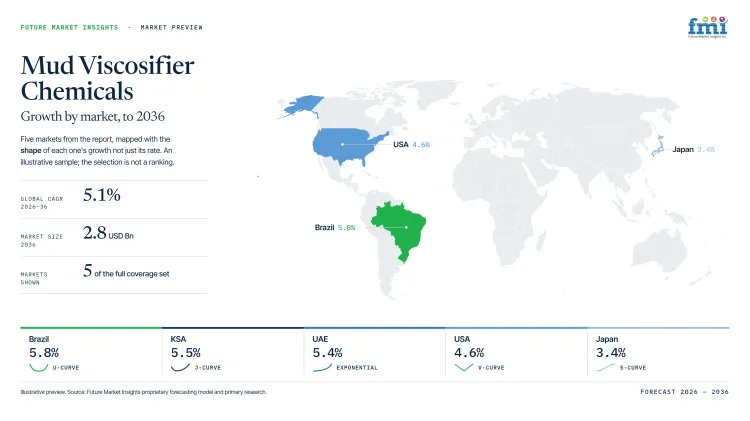
| Country | CAGR |
|---|---|
| Brazil | 5.8% |
| KSA | 5.5% |
| UAE | 5.4% |
| Mexico | 5.3% |
| USA | 4.6% |
| Canada | 4.5% |
| Japan | 3.4% |
How do country-level CAGRs compare in the Mud Viscosifier Chemicals Market?
The seven forecasts separate into three commercial bands. Brazil leads four countries above 5.0%, with KSA, UAE and Mexico within 0.2 points. USA and Canada form a second band near 4.5%, and Japan marks the lower endpoint at 3.4%. The 2.4-point spread separates campaign intensity from mature or selective drilling cadence.
- Brazil rewards stable low-shear response in difficult fluids.
- KSA pairs rig utilization with large treatment volumes.
- UAE favors campaign chemical planning for concentrated developments.
- Mexico keeps treatment economics under close project review.
- USA faces service competition despite high treatment intensity.
- Canada reflects service penetration more than weak drilling.
- Japan produces project orders instead of basin replenishment.
The report provides CAGR analysis for North America, Latin America, Western Europe, Eastern Europe, East Asia, South Asia and Pacific, and Middle East and Africa.
Country-wise Analysis
- Brazilian fluid programs carry heavy offshore exposure, so shore-base stock and qualification records must stay aligned with multiwell drilling schedules and deepwater service windows. ANP documented in December 2025 that 19 exploration wells started during 2025 and ten were offshore, and mud viscosifier chemicals demand in Brazil is forecast to rise at 5.8% CAGR through 2036 because deepwater work raises the cost of unstable rheology during active offshore campaigns. Local deepwater service capacity shortens treatment response, but long marine logistics make late substitutions expensive and favor companies holding verified batches near operating bases without loading rigs with unnecessary backup inventory.
- USA shale programs judge drilling-fluid chemistry against footage drilled, treatment rate and the time required to keep long laterals clean under aggressive drilling schedules. EIA documented in July 2026 that 2025 USA crude output reached a record 13.6 million barrels per day as drilling productivity improved, giving service networks a dense base for rapid fluid adjustment during active shale campaigns. Mud viscosifier chemical sales in USA are projected to grow at 4.6% CAGR over the forecast period tied to high horizontal-well intensity, but cost-per-foot discipline requires higher-priced treatments to prove lower dilution or faster hole cleaning before operators standardize them.
- Japanese demand comes from a smaller set of technically supervised drilling programs, so scheduled mobilization and documented fluid compatibility carry more weight than broad warehouse coverage between projects. Demand in Japan is anticipated to advance at 3.4% CAGR during the assessment period reflecting selective subsurface programs, and JOGMEC disclosed in November 2025 that drilling was completed for three wells at the Kashiwazaki Hydrogen Park demonstration. Government-linked projects give qualified distributors a defined entry route, but low campaign frequency raises inventory carrying costs and favors companies able to mobilize specialized additives without holding excessive stock between scheduled local offshore drilling programs.
- Saudi drilling programs require fluid companies to maintain treatment consistency through long conventional and unconventional campaigns, where repeated wells may share base systems but still need field-specific rheology adjustments. Aramco's 2025 annual report records 14 Arabian oil and natural gas field or reservoir discoveries announced by the Ministry of Energy, indicating continued upstream work that rewards local laboratories and regional stock. The KSA mud viscosifier chemicals sector is expected to post 5.5% CAGR by 2036 given sustained development, but campaign scale penalizes batch variation and late replenishment during multi-rig programs that cannot wait for imported treatment chemicals from overseas.
- UAE offshore procurement places drilling fluids inside integrated well programs, so hydraulic performance and service response are reviewed together before treatment changes reach the rig. Mud viscosifier chemicals demand in UAE is forecast to expand at 5.4% CAGR between 2026 and 2036 attributable to concentrated offshore work, and ADNOC announced in July 2026 that the Umm Shaif Gas Cap program includes 14 wells delivered over 18 months using three rigs. Mature service infrastructure shortens response time, but narrow pressure windows penalize over-treatment that consumes hydraulic margin or raises equivalent circulating density during tightly scheduled deepwater offshore drilling and completion operations.
- Mexican drilling-fluid purchases stay closely tied to national production plans and offshore projects, where long service chains make treatment economics visible before premium chemistry enters routine use. Pemex stated in August 2025 that its gas strategy targets an increase from 3.5 to 5.0 billion cubic feet per day, giving local fluid companies a clearer volume case for planned campaigns. The mud viscosifier chemicals market in Mexico is projected to record 5.3% CAGR during the forecast period owing to planned gas development and deepwater activity, but capital discipline requires evidence that lower dilution or faster hole cleaning offsets higher treatment prices.
- Western Canada concentrates drilling activity in corridors where long horizontal wells require controlled low-shear rheology and nearby material stock during winter mobilization and concentrated completion schedules. Canada is forecast to grow at 4.5% CAGR through 2036 supported by persistent basin activity, and Canada Energy Regulator data published in June 2026 put 2025 crude and equivalent production at 5.35 million barrels per day with Alberta accounting for 83.8%. Regional warehouses shorten treatment response, but price-sensitive programs reject unnecessary solids or dosage and reward repeatable rheology pertreatment unitplus winter logistics that prevent delayed chemical additions at remote winter drilling sites.
Who are the notable companies in the Mud Viscosifier Chemicals Market?
Halliburton, SLB, Baker Hughes, Newpark Fluids Systems, Ashland, Nouryon, CES Energy Solutions, Elementis, and TETRA Technologies are the notable companies profiled in this market.
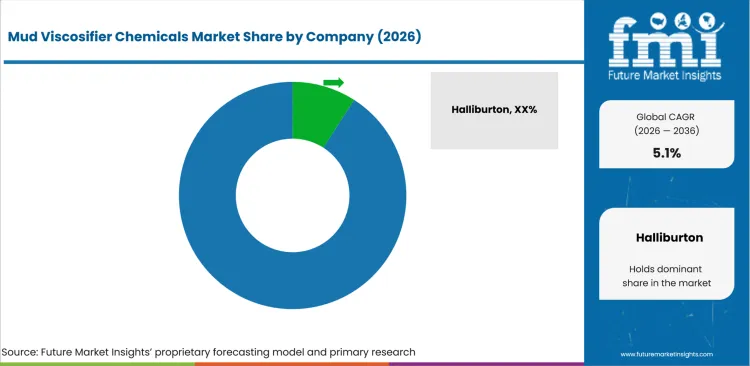
Competition divides among integrated drilling-fluid platforms, independent fluid specialists and rheology-chemistry producers. Orders depend on complete mud programs, specific polymer or mineral inputs and local laboratory support under actual brine and temperature conditions. Entry therefore requires verified performance data that survives field qualification instead of relying on nominal thickening claims.
- Integrated fluid platforms: Halliburton, SLB, Baker Hughes and Newpark Fluids Systems pair formulated systems with field engineering or testing support.
- Independent and specialty chemistry positions: CES Energy Solutions, Ashland, Nouryon and Elementis compete through fluid formulation, polymers or high-temperature rheology inputs.
- Completion-fluid and feedstock position: TETRA Technologies supplies brine-based fluids with regional mixing, testing and storage infrastructure.
Competitive Benchmarking: Mud Viscosifier Chemicals Market
| Company | Fluid-System Integration | Rheology Additive Depth | Field / Lab Support | Geographic Reach |
|---|---|---|---|---|
| Halliburton | High | High | High | Global |
| SLB | High | High | High | Global |
| Baker Hughes | High | High | High | Global |
| Newpark Fluids Systems | High | High | High | North America, Latin America, Middle East and international markets |
| Ashland | Low | High | Medium | Americas, Europe, Middle East, Africa and Asia Pacific |
| Nouryon | Low | Medium | High | Global with oilfield innovation centers in USA, UAE and Sweden |
| CES Energy Solutions | High | Medium | High | Canada and United States |
| Elementis | Low | High | Medium | Selected global oilfield and industrial markets |
| TETRA Technologies | Medium | Low | High | United States, Latin America, Europe, Asia and Middle East |
Scoring basis: High integration requires complete fluid design plus deployment support. Medium requires a broader package. Low identifies an ingredient position. High rheology depth requires multiple viscosifier routes. Medium indicates narrower chemistry and Low adjacent chemistry. High field or laboratory support requires engineering, live measurement or dedicated testing. Medium reflects narrower support. Geographic reach is descriptive.
Key Developments in the Mud Viscosifier Chemicals Market
- In June 2025, CES Energy Solutions completed the acquisition of substantially all Fossil Fluids business assets and placed the independent drilling-fluids business under AES Drilling Fluids. The deal expanded CES coverage in the USA Mid-Continent and increased its regional fluid-service base.
- In March 2025, SLB received Woodside Energy's Trion drilling contract for 18 ultra-deepwater wells offshore Mexico. The scope includes drilling and completions fluids inside a three-year integrated well-construction program.
- In June 2025, Nouryon opened an Innovation Center for oilfield applications in Houston, Texas. The center focuses on drilling, completion, production and stimulation research and gives regional fluid teams access to testing before field deployment.
Key Players in the Mud Viscosifier Chemicals Market
Integrated Drilling-Fluid Platforms
- Halliburton
- SLB
- Baker Hughes
- Newpark Fluids Systems
Independent Drilling-Fluid and Specialty-Chemistry Providers
- CES Energy Solutions
- Ashland
- Nouryon
- Elementis
Completion-Fluid and Feedstock Specialist
- TETRA Technologies
Mud Viscosifier Chemicals Market - Report Scope
| Coverage field | Report scope |
|---|---|
| Market breakdown | By viscosifier type, mud system, application, well environment, sales channel and region. |
| Quantitative Units | USD billion. |
| Market Definition | Commercial bentonite, xanthan gum, PAC - CMC polymers, guar gum, organophilic clay and synthetic rheology modifiers sold for viscosity, gel structure, suspension or hole-cleaning functions in drilling and completion fluid systems. |
| Regions Covered | North America, Latin America, Western Europe, Eastern Europe, East Asia, South Asia and Pacific, and Middle East and Africa. |
| Countries Covered | Brazil, KSA, UAE, Mexico, USA, Canada, Japan, and 20+ countries included in the full report. |
| Key Companies Profiled | Halliburton, SLB, Baker Hughes, Newpark Fluids Systems, Ashland, Nouryon, CES Energy Solutions, Elementis, and TETRA Technologies. |
| Forecast Period | 2026 to 2036. |
| Approach | Primary and secondary research with market triangulation. |
Mud Viscosifier Chemicals Market - Research Methodology
| Method | Approach |
|---|---|
| Primary Research | FMI analysts gathered input from manufacturers, service providers, technology developers, distributors, end users, procurement teams, and subject-matter experts. Interviews examined purchasing decisions, product or service evaluation, adoption barriers, approval requirements, pricing considerations, and expectations for technical or commercial support. Respondents were also asked what evidence is required before a trial, pilot, or initial order develops into regular purchasing. |
| Desk Research | Desk research covered government statistics, regulatory publications, trade data, industry associations, technical literature, standards, company filings, product information, and official corporate announcements. Sources were reviewed for relevance, publication date, geographic coverage, and consistency with the defined market scope. Claims relating to performance, applications, approvals, capacity, investment, and commercial activity were retained only when supported by credible public evidence. |
| Market Sizing and Forecasting | The market model combined the baseline value with historical performance, segment structure, pricing and volume indicators, adoption levels, company participation, and country-level demand conditions. Forecast assumptions considered economic activity, investment trends, regulatory developments, technology adoption, purchasing cycles, supply availability, and barriers to wider market use. Segment and regional estimates were reconciled before the final market total was calculated. |
| Data Validation | Estimates were checked against multiple independent indicators, including public data, company activity, trade patterns, industry developments, and findings from primary interviews. Validation also tested whether products, services, applications, and company revenues fell within the defined market boundaries. Adjacent categories, unsupported claims, overlapping revenues, and activities without direct market relevance were excluded to reduce double counting and maintain consistency across segments and countries. |
Mud Viscosifier Chemicals Market by Segments
Mud Viscosifier Chemicals Market segmented by Viscosifier Type:
- Bentonite
- Xanthan gum
- PAC - CMC polymers
- Guar gum
- Organophilic clay
- Synthetic rheology modifiers
Mud Viscosifier Chemicals Market segmented by Mud System:
- Water-based mud
- Oil-based mud
- Synthetic-based mud
- Completion fluids
Mud Viscosifier Chemicals Market segmented by Application:
- Hole cleaning
- Cuttings suspension
- Rheology control
- Lost circulation support
- High-angle drilling
Mud Viscosifier Chemicals Market segmented by Well Environment:
- Conventional wells
- Shale wells
- Offshore wells
- HPHT wells
- Directional wells
Mud Viscosifier Chemicals Market segmented by Sales Channel:
- Mud service companies
- Industrial mineral suppliers
- Oilfield chemical distributors
- Direct project supply
Mud Viscosifier Chemicals Market by Region:
- North America
- United States
- Canada
- Latin America
- Brazil
- Mexico
- Argentina
- Chile
- Western Europe
- Germany
- France
- United Kingdom
- Italy
- Spain
- Benelux
- Nordics
- Eastern Europe
- Poland
- Czech Republic
- Romania
- Hungary
- East Asia
- China
- Japan
- South Korea
- South Asia and Pacific
- India
- ASEAN
- Australia and New Zealand
- Middle East and Africa
- GCC Countries
- South Africa
- Türkiye
- Israel
Research Sources and Bibliography
- USA Energy Information Administration. (2026, August 19). Longer wells boost Permian crude oil and natural gas production.
- Empresa de Pesquisa Energética. (2026, July 2). Balanço Energético Nacional 2026.
- USA Geological Survey. (2026, February). Mineral Commodity Summaries 2026: Clays.
- USA Environmental Protection Agency. (2026, January). Fact sheet and supplemental information for the proposed reissuance of NPDES General Permit GMG290000.
- Agência Nacional do Petróleo, Gás Natural e Biocombustíveis. (2026, August 6). Seminário da ANP apresenta resultados da atividade de exploração em 2025.
- Halliburton. (2025, January 30). Halliburton secures major offshore drilling contract with Petrobras.
- SLB. (2025, March 31). SLB awarded major drilling contract by Woodside Energy for ultra-deepwater Trion development, offshore Mexico.
- Norwegian Offshore Directorate. (2026, January 8). Oil and gas on the NCS moving forward.
- SCF Partners. (2025, July 7). Newpark Fluids Systems strengthens executive leadership and board to drive continued growth.
- Agência Nacional do Petróleo, Gás Natural e Biocombustíveis. (2025, December 19). Número de blocos sob contrato cresce em 2025 e é o maior pelo segundo ano consecutivo.
- USA Energy Information Administration. (2026, July 9). The United States produced more crude oil than any other country in 2025.
- Japan Organization for Metals and Energy Security. (2025, November 21). Official opening of the Kashiwazaki Hydrogen Park.
- Saudi Aramco. (2026, March 10). Annual report 2025.
- ADNOC. (2026, July 21). ADNOC accelerates gas growth strategy with FID for Umm Shaif Gas Cap.
- Petróleos Mexicanos. (2025, August 5). SENER, Secretariat of Finance and Pemex unveil Strategic Plan with 10-year horizon and beyond.
- Canada Energy Regulator. (2026, June 17). Market Snapshot: Canada sets new record in crude oil production in 2025.
- CES Energy Solutions Corp. (2026, March 10). 2025 Annual Report.
- Offshore Norge. (2025, September 25). Climate and Environmental Report 2025: Discharges from drilling.
- Halliburton Company. (2026, February 6). 2025 Form 10-K.
- SLB. (2026, January 23). 2025 Form 10-K.
- Baker Hughes. (2026, February 5). 2025 Form 10-K.
- Ashland Inc. (2025, November 20). 2025 Form 10-K.
- Nouryon. (2025, June 18). Nouryon launches Innovation Center for oilfield solutions in Texas, US.
- Elementis. (2026, March). 2025 full year results presentation transcript.
- TETRA Technologies, Inc. (2026, February 25). 2025 Form 10-K.
- Newpark Fluids Systems and Intelligent Mud Solutions. (2025, September 4). Intelligent Mud Solutions and Newpark Fluids Systems announce collaboration agreement for real-time fluids measurement.
- Halliburton. (2026, August 25). bp awards Halliburton integrated contract for Bumerangue field appraisal in Brazil.
- SLB. (2026, February 12). SLB awarded multiple offshore drilling contracts by Mubadala Energy for Tangkulo deepwater development in Indonesia.
- Baker Hughes. (2026, January 28). Baker Hughes launches Kantori, a unified digital autonomous well construction solution.
- Baker Hughes. (2026, May 26). Baker Hughes extends and expands integrated well construction contract with Petrobras.
- Halliburton. (2026, July 13). Halliburton wins integrated drilling and completions contracts for GranMorgu deepwater development offshore Suriname.
- SLB. (2026, February 3). SLB awarded integrated development contract for Mutriba field in Kuwait.
- Halliburton. (2026, July 9). Eni and Halliburton achieve industry first with closed-loop rig automation in deepwater Indonesia.
This bibliography is provided for reader reference and is not exhaustive. The full report contains the complete reference list and detailed citations
This Report Answers
- What is the market size in 2026 and 2036?
- Why do longer laterals raise rheology requirements?
- Why does bentonite lead by viscosifier type?
- Why does water-based mud lead by mud system?
- Why does hole cleaning lead by application?
- How do profiled country CAGRs differ?
- Which companies provide fluids or specialty rheology chemistry?
- How do qualification rules limit substitution?
Frequently Asked Questions
How big is the Mud Viscosifier Chemicals Market in 2026?
The mud viscosifier chemicals market is valued at USD 1.7 billion in 2026 and is projected to reach USD 2.8 billion by 2036. Longer wells raise cuttings-suspension requirements during extended-reach and offshore drilling within a limited hydraulic window.
What is the CAGR of the Mud Viscosifier Chemicals Market from 2026 to 2036?
The mud viscosifier chemicals market is projected to grow at a CAGR of 5.1% between 2026 and 2036. Expansion follows extended-reach and offshore drilling that requires tighter rheology control under narrower operating pressure limits.
Which viscosifier type leads the Mud Viscosifier Chemicals Market?
The bentonite segment is expected to hold 31.0% of the mud viscosifier chemicals market in 2026, attributable to familiar hydration behavior. Salinity and temperature can shift treatment toward polymers under severe brine or thermal exposure.
Which mud system leads the Mud Viscosifier Chemicals Market?
The water-based mud segment is expected to hold 56.0% of the mud viscosifier chemicals market in 2026, supported by mineral and water-soluble polymers. Formulators can adjust rheology without changing the carrier phase during routine field treatment.
Which countries are projected to record the highest growth in the Mud Viscosifier Chemicals Market?
Brazil is projected to grow at 5.8% CAGR, followed by KSA at 5.5% and UAE at 5.4% through 2036. Deepwater programs raise drilling-fluid treatment intensity and require stronger local service coverage during multiwell campaigns.
Which companies are active in the Mud Viscosifier Chemicals Market?
Key companies operating in the mud viscosifier chemicals market include Halliburton, SLB, Baker Hughes, Newpark Fluids Systems, Ashland, Nouryon, CES Energy Solutions, Elementis, and TETRA Technologies. Their positions span complete fluid systems, rheology chemistry and field testing for active drilling programs.
Preview the report firsthand - request a free sample
Get SampleGet the brochure for pricing and purchase details.
Get PDFTable of Content
- Key Takeaways
- Market Size and CAGR
- Top Growth Driver
- Fastest Growing Segment
- Leading Region
- Key Companies
- Emerging Opportunities
- Executive Summary
- Global Market Outlook
- Demand-side Trends
- Supply-side Trends
- Technology Roadmap Analysis
- Analysis and Recommendations
- Analyst Perspective (What is happening? Why now? What should investors know?)
- Key Questions Answered
- How large is the market?
- What is the CAGR?
- What are key trends?
- Which region dominates?
- Who are the leaders?
- Market Overview
- Market Coverage / Taxonomy
- Market Definition / Scope / Limitations
- Research Methodology
- Chapter Orientation
- Analytical Lens and Working Hypotheses
- Market Structure, Signals, and Trend Drivers
- Benchmarking and Cross-market Comparability
- Market Sizing, Forecasting, and Opportunity Mapping
- Research Design and Evidence Framework
- Desk Research Programme (Secondary Evidence)
- Expert Input and Fieldwork (Primary Evidence)
- Tooling, Models, and Reference Databases
- Data Engineering and Model Build
- Quality Assurance and Audit Trail
- Market Background
- Market Dynamics (Drivers, Restraints, Opportunity, Trends)
- Scenario Forecast (Optimistic, Likely, Conservative)
- Impact Analysis
- AI Impact
- Sustainability Impact
- Regulatory Impact
- Technology Impact
- Consumer / Buyer Analysis
- Purchase Drivers
- Adoption Barriers
- Buyer Journey
- Opportunity Map Analysis
- Product Life Cycle Analysis
- Supply Chain Analysis
- Investment Feasibility Matrix
- Value Chain Analysis
- PESTLE and Porter's Analysis
- Regulatory Landscape
- Regional Parent Market Outlook
- Production and Consumption Statistics
- Import and Export Statistics
- Global Market Analysis and Forecast, 2021 to 2036
- Historical Market Size Value (USD Billion) Analysis, 2021 to 2025
- Current and Future Market Size Value (USD Billion) Projections, 2026 to 2036
- Y-o-Y Growth Trend Analysis
- Absolute $ Opportunity Analysis
- Global Market Pricing Analysis, 2021 to 2036
- Global Market Analysis and Forecast, By Viscosifier Type, 2021 to 2036
- Introduction / Key Findings
- Historical Market Size Value (USD Billion) Analysis By Viscosifier Type, 2021 to 2025
- Current and Future Market Size Value (USD Billion) Analysis and Forecast By Viscosifier Type, 2026 to 2036
- Bentonite
- Xanthan gum
- PAC / CMC polymers
- Guar gum
- Organophilic clay
- Synthetic rheology modifiers
- Bentonite
- Y-o-Y Growth Trend Analysis By Viscosifier Type, 2021 to 2025
- Absolute $ Opportunity Analysis By Viscosifier Type, 2026 to 2036
- Global Market Analysis and Forecast, By Mud System, 2021 to 2036
- Introduction / Key Findings
- Historical Market Size Value (USD Billion) Analysis By Mud System, 2021 to 2025
- Current and Future Market Size Value (USD Billion) Analysis and Forecast By Mud System, 2026 to 2036
- Water-based mud
- Oil-based mud
- Synthetic-based mud
- Completion fluids
- Water-based mud
- Y-o-Y Growth Trend Analysis By Mud System, 2021 to 2025
- Absolute $ Opportunity Analysis By Mud System, 2026 to 2036
- Global Market Analysis and Forecast, By Application, 2021 to 2036
- Introduction / Key Findings
- Historical Market Size Value (USD Billion) Analysis By Application, 2021 to 2025
- Current and Future Market Size Value (USD Billion) Analysis and Forecast By Application, 2026 to 2036
- Hole cleaning
- Cuttings suspension
- Rheology control
- Lost circulation support
- High-angle drilling
- Hole cleaning
- Y-o-Y Growth Trend Analysis By Application, 2021 to 2025
- Absolute $ Opportunity Analysis By Application, 2026 to 2036
- Global Market Analysis and Forecast, By Well Environment, 2021 to 2036
- Introduction / Key Findings
- Historical Market Size Value (USD Billion) Analysis By Well Environment, 2021 to 2025
- Current and Future Market Size Value (USD Billion) Analysis and Forecast By Well Environment, 2026 to 2036
- Conventional wells
- Shale wells
- Offshore wells
- HPHT wells
- Directional wells
- Conventional wells
- Y-o-Y Growth Trend Analysis By Well Environment, 2021 to 2025
- Absolute $ Opportunity Analysis By Well Environment, 2026 to 2036
- Global Market Analysis and Forecast, By Sales Channel, 2021 to 2036
- Introduction / Key Findings
- Historical Market Size Value (USD Billion) Analysis By Sales Channel, 2021 to 2025
- Current and Future Market Size Value (USD Billion) Analysis and Forecast By Sales Channel, 2026 to 2036
- Mud service companies
- Industrial mineral suppliers
- Oilfield chemical distributors
- Direct project supply
- Mud service companies
- Y-o-Y Growth Trend Analysis By Sales Channel, 2021 to 2025
- Absolute $ Opportunity Analysis By Sales Channel, 2026 to 2036
- Global Market Analysis and Forecast, By Region, 2021 to 2036
- Introduction
- Historical Market Size Value (USD Billion) Analysis By Region, 2021 to 2025
- Current Market Size Value (USD Billion) Analysis and Forecast By Region, 2026 to 2036
- North America
- Latin America
- Western Europe
- Eastern Europe
- East Asia
- South Asia and Pacific
- Middle East & Africa
- Market Attractiveness Analysis By Region
- North America Market Analysis and Forecast, By Country, 2021 to 2036
- Historical Market Size Value (USD Billion) Trend Analysis By Market Taxonomy, 2021 to 2025
- Market Size Value (USD Billion) Forecast By Market Taxonomy, 2026 to 2036
- By Country
- USA
- Canada
- By Viscosifier Type
- By Mud System
- By Application
- By Well Environment
- By Sales Channel
- By Country
- Market Attractiveness Analysis
- By Country
- By Viscosifier Type
- By Mud System
- By Application
- By Well Environment
- By Sales Channel
- Key Takeaways
- Latin America Market Analysis and Forecast, By Country
- Historical Market Size Value (USD Billion) Trend Analysis By Market Taxonomy, 2021 to 2025
- Market Size Value (USD Billion) Forecast By Market Taxonomy, 2026 to 2036
- By Country
- Brazil
- Mexico
- Chile
- Rest of Latin America
- By Viscosifier Type
- By Mud System
- By Application
- By Well Environment
- By Sales Channel
- By Country
- Market Attractiveness Analysis
- By Country
- By Viscosifier Type
- By Mud System
- By Application
- By Well Environment
- By Sales Channel
- Key Takeaways
- Western Europe Market Analysis and Forecast, By Country
- Historical Market Size Value (USD Billion) Trend Analysis By Market Taxonomy, 2021 to 2025
- Market Size Value (USD Billion) Forecast By Market Taxonomy, 2026 to 2036
- By Country
- Germany
- UK
- Italy
- Spain
- France
- Nordic
- BENELUX
- Rest of Western Europe
- By Viscosifier Type
- By Mud System
- By Application
- By Well Environment
- By Sales Channel
- By Country
- Market Attractiveness Analysis
- By Country
- By Viscosifier Type
- By Mud System
- By Application
- By Well Environment
- By Sales Channel
- Key Takeaways
- Eastern Europe Market Analysis and Forecast, By Country
- Historical Market Size Value (USD Billion) Trend Analysis By Market Taxonomy, 2021 to 2025
- Market Size Value (USD Billion) Forecast By Market Taxonomy, 2026 to 2036
- By Country
- Russia
- Poland
- Hungary
- Balkan & Baltic
- Rest of Eastern Europe
- By Viscosifier Type
- By Mud System
- By Application
- By Well Environment
- By Sales Channel
- By Country
- Market Attractiveness Analysis
- By Country
- By Viscosifier Type
- By Mud System
- By Application
- By Well Environment
- By Sales Channel
- Key Takeaways
- East Asia Market Analysis and Forecast, By Country
- Historical Market Size Value (USD Billion) Trend Analysis By Market Taxonomy, 2021 to 2025
- Market Size Value (USD Billion) Forecast By Market Taxonomy, 2026 to 2036
- By Country
- China
- Japan
- South Korea
- By Viscosifier Type
- By Mud System
- By Application
- By Well Environment
- By Sales Channel
- By Country
- Market Attractiveness Analysis
- By Country
- By Viscosifier Type
- By Mud System
- By Application
- By Well Environment
- By Sales Channel
- Key Takeaways
- South Asia and Pacific Market Analysis and Forecast, By Country
- Historical Market Size Value (USD Billion) Trend Analysis By Market Taxonomy, 2021 to 2025
- Market Size Value (USD Billion) Forecast By Market Taxonomy, 2026 to 2036
- By Country
- India
- ASEAN
- Australia & New Zealand
- Rest of South Asia and Pacific
- By Viscosifier Type
- By Mud System
- By Application
- By Well Environment
- By Sales Channel
- By Country
- Market Attractiveness Analysis
- By Country
- By Viscosifier Type
- By Mud System
- By Application
- By Well Environment
- By Sales Channel
- Key Takeaways
- Middle East & Africa Market Analysis and Forecast, By Country
- Historical Market Size Value (USD Billion) Trend Analysis By Market Taxonomy, 2021 to 2025
- Market Size Value (USD Billion) Forecast By Market Taxonomy, 2026 to 2036
- By Country
- Kingdom of Saudi Arabia
- Other GCC Countries
- Türkiye
- South Africa
- Other African Union
- Rest of Middle East & Africa
- By Viscosifier Type
- By Mud System
- By Application
- By Well Environment
- By Sales Channel
- By Country
- Market Attractiveness Analysis
- By Country
- By Viscosifier Type
- By Mud System
- By Application
- By Well Environment
- By Sales Channel
- Key Takeaways
- Key Countries Market Analysis
- USA
- Pricing Analysis
- Market Share Analysis, 2025
- By Viscosifier Type
- By Mud System
- By Application
- By Well Environment
- By Sales Channel
- Canada
- Pricing Analysis
- Market Share Analysis, 2025
- By Viscosifier Type
- By Mud System
- By Application
- By Well Environment
- By Sales Channel
- Mexico
- Pricing Analysis
- Market Share Analysis, 2025
- By Viscosifier Type
- By Mud System
- By Application
- By Well Environment
- By Sales Channel
- Brazil
- Pricing Analysis
- Market Share Analysis, 2025
- By Viscosifier Type
- By Mud System
- By Application
- By Well Environment
- By Sales Channel
- Chile
- Pricing Analysis
- Market Share Analysis, 2025
- By Viscosifier Type
- By Mud System
- By Application
- By Well Environment
- By Sales Channel
- Germany
- Pricing Analysis
- Market Share Analysis, 2025
- By Viscosifier Type
- By Mud System
- By Application
- By Well Environment
- By Sales Channel
- UK
- Pricing Analysis
- Market Share Analysis, 2025
- By Viscosifier Type
- By Mud System
- By Application
- By Well Environment
- By Sales Channel
- Italy
- Pricing Analysis
- Market Share Analysis, 2025
- By Viscosifier Type
- By Mud System
- By Application
- By Well Environment
- By Sales Channel
- Spain
- Pricing Analysis
- Market Share Analysis, 2025
- By Viscosifier Type
- By Mud System
- By Application
- By Well Environment
- By Sales Channel
- France
- Pricing Analysis
- Market Share Analysis, 2025
- By Viscosifier Type
- By Mud System
- By Application
- By Well Environment
- By Sales Channel
- India
- Pricing Analysis
- Market Share Analysis, 2025
- By Viscosifier Type
- By Mud System
- By Application
- By Well Environment
- By Sales Channel
- ASEAN
- Pricing Analysis
- Market Share Analysis, 2025
- By Viscosifier Type
- By Mud System
- By Application
- By Well Environment
- By Sales Channel
- Australia & New Zealand
- Pricing Analysis
- Market Share Analysis, 2025
- By Viscosifier Type
- By Mud System
- By Application
- By Well Environment
- By Sales Channel
- China
- Pricing Analysis
- Market Share Analysis, 2025
- By Viscosifier Type
- By Mud System
- By Application
- By Well Environment
- By Sales Channel
- Japan
- Pricing Analysis
- Market Share Analysis, 2025
- By Viscosifier Type
- By Mud System
- By Application
- By Well Environment
- By Sales Channel
- South Korea
- Pricing Analysis
- Market Share Analysis, 2025
- By Viscosifier Type
- By Mud System
- By Application
- By Well Environment
- By Sales Channel
- Russia
- Pricing Analysis
- Market Share Analysis, 2025
- By Viscosifier Type
- By Mud System
- By Application
- By Well Environment
- By Sales Channel
- Poland
- Pricing Analysis
- Market Share Analysis, 2025
- By Viscosifier Type
- By Mud System
- By Application
- By Well Environment
- By Sales Channel
- Hungary
- Pricing Analysis
- Market Share Analysis, 2025
- By Viscosifier Type
- By Mud System
- By Application
- By Well Environment
- By Sales Channel
- Kingdom of Saudi Arabia
- Pricing Analysis
- Market Share Analysis, 2025
- By Viscosifier Type
- By Mud System
- By Application
- By Well Environment
- By Sales Channel
- Türkiye
- Pricing Analysis
- Market Share Analysis, 2025
- By Viscosifier Type
- By Mud System
- By Application
- By Well Environment
- By Sales Channel
- South Africa
- Pricing Analysis
- Market Share Analysis, 2025
- By Viscosifier Type
- By Mud System
- By Application
- By Well Environment
- By Sales Channel
- USA
- Market Structure Analysis
- Competition Dashboard
- Competition Benchmarking
- Market Share Analysis of Top Players
- By Regional
- By Viscosifier Type
- By Mud System
- By Application
- By Well Environment
- By Sales Channel
- Emerging Startups
- Innovation Benchmarking
- Competition Analysis
- Competition Deep Dive
- Halliburton
- Overview
- Product Portfolio
- Profitability by Market Segments
- Sales Footprint
- Strategy Overview
- Marketing Strategy
- Product Strategy
- Channel Strategy
- SLB
- Baker Hughes
- Newpark Resources
- Imerys
- Ashland
- Nouryon
- Kemira
- Clariant
- CP Kelco
- Halliburton
- Case Studies
- Success Stories
- Recent Developments
- Competition Deep Dive
- Assumptions & Acronyms Used


