

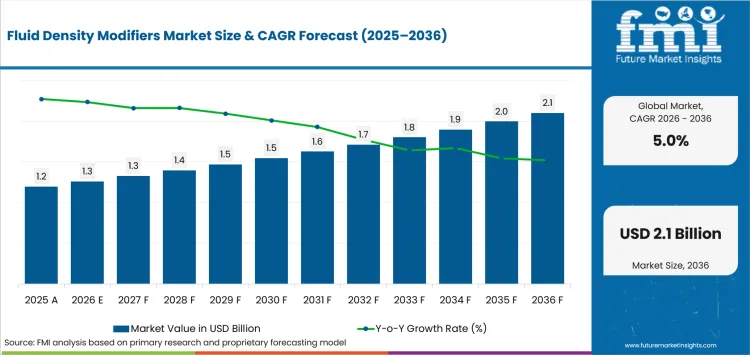
- Market Size (2026)
- USD 1.3 Bn
- Forecast (2036)
- USD 2.1 Bn
- CAGR (2026 to 2036)
- 5.0%
How big is Fluid Density Modifiers Market in 2026?
USD 1.3 billion in 2026 and USD 2.1 billion by 2036 at a 5.0% CAGR.
Fluid density modifier spending follows well difficulty more closely than rig count alone. The USA Energy Information Administration reported on March 31, 2026 that USA crude output reached a record 13.6 million barrels per day in 2025 even though Lower 48 rig activity fell 5%. Fewer rigs can therefore support substantial modifier demand from deeper or more productive wells that require tighter pressure control. Drilling fluids and related oilfield chemicals gain value where engineers must adjust density without pushing circulating pressure beyond the fracture limit.
Offshore project mix changes the density problem and the route to the wellsite. Brazil's ANP reported on August 3, 2026 that pre-salt production represented 82% of national oil and gas output in June and came from 198 wells. That concentration places more work in deepwater settings where high-density clear brines, low-sag barite materials, filtration, and logistics must be qualified together. Land programs can accept standardized bulk supply more often, so country revenue depends on pressure window, project type, and field services rather than drilling volume alone.
Key Takeaways
- Demand follows wells with narrow pressure margins because fluid density must control formation pressure without creating excessive equivalent circulating density or losses.
- By modifier type, weighting agents are estimated to hold 36.0% in 2026 owing to barite's familiar pressure-control role and adjustable solids loading during drilling and completion-fluid design.
- In 2026, drilling fluids are expected to lead fluid system demand with 39.0% share because density is checked and corrected repeatedly during active circulation.
- Density increase is projected to hold 46.0% share in 2026 owing to pressure-control requirements in high-density drilling and completion programs.
- Qualification can delay adoption because a material that reaches target density may still fail on sag, rheology, corrosion, compatibility, crush resistance, or delivered logistics.
- Key players in the fluid density modifiers market include Halliburton, SLB, Baker Hughes, TETRA Technologies, Newpark Fluids Systems, CES Energy Solutions Corp., ICL Group, and National Energy Services Reunited Corp.
Analyst Perspective
"Fluid density modifiers earn their margin at the pressure-window limit, where a cheap tonne of barite or brine becomes expensive if sag or corrosion forces a circulation change. The stronger commercial offer pairs verified density performance with local stock, filtration or reclaim options, and engineering support that keeps the planned well sequence intact."
- Nikhil Kaitwade, Principal Consultant, Future Market Insights
How is the fluid density modifiers market segmented?
The market is segmented by modifier type, fluid system, density direction, well environment, sales channel, and region.
The market is analyzed by modifier type, fluid system, density direction, well environment, sales channel, and region. Modifier type includes weighting agents, lightweight extenders, brine salts, microspheres, and density-balancing polymers. Fluid systems cover drilling, completion, cement, and workover fluids. Density direction separates increase, reduction, balancing, and low-sag adjustment. Well environment covers onshore, offshore, HPHT, deepwater, and depleted formations. Sales channels include oilfield service companies, mineral or brine providers, direct operator supply, and regional distribution.
What makes weighting agents central to the modifier type category?
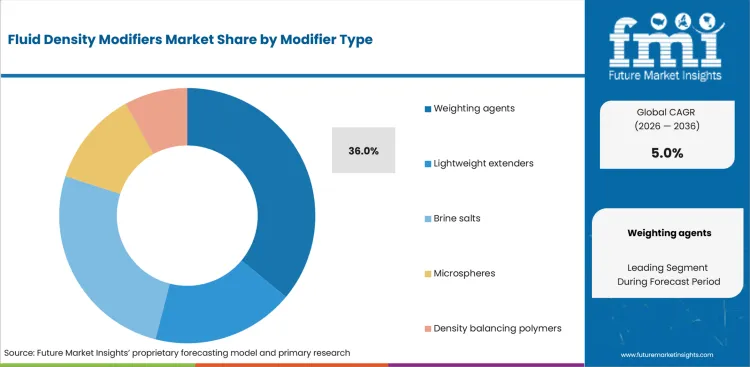
Weighting agents raise hydrostatic head by increasing solids mass in drilling and completion fluids. Approval depends on particle quality because poor settling behavior can raise rheology and sag. Engineers also compare equivalent circulating density against the fracture margin during circulation.
- By modifier type, weighting agents are estimated to hold 36.0% in 2026 owing to barite's familiar pressure-control role and adjustable solids loading during drilling and completion-fluid design.
- CES Energy Solutions' 2025 annual report, issued in March 2026, lists Superior Weighting Products beside AES Drilling Fluids in its USA operations. The structure links weighting-material supply with formulation and field service for repeat drilling programs.
Why do drilling fluids lead the fluid system category?
Drilling fluids circulate during well deepening, so density is corrected as pore pressure and fracture risk change. Completion and workover fluids have shorter placement windows, whereas onshore drilling fluids use the same adjustment cycle during circulation.
- By fluid system, drilling fluids are forecast to represent 39.0% in 2026 driven by repeated density checks during active circulation.
- Baker Hughes' Form 10-K filed February 5, 2026 lists drilling and completion fluids in well construction and drilling-fluid processing centers among principal facilities. The filing ties demand to a service network that processes and supports fluids at operating sites.
How does density increase shape the density direction category?
Density increase is required where the fluid column must provide more hydrostatic pressure than the base formulation can supply. Engineers must reach that target without increasing corrosion or narrowing the fluid's operating margin. High-density clear brine fluids offer a solids-free option in suitable completions.
- Density increase is set to lead the density direction category with 46.0% share in 2026 due to pressure-control requirements in high-density drilling and completion programs.
- ICL reported on February 18, 2026 that fourth-quarter 2025 clear-brine-fluid sales rose on stronger demand in South America and Europe. The result confirms current commercial demand for high-density brine chemistry.
What drives oilfield service companies in the sales channel category?
Oilfield service companies translate the well plan into density, rheology, temperature, and contamination limits before material reaches the rig. Field teams then correct density or rheology after measurements leave the planned operating range.
- In 2026, oilfield service companies are expected to lead the sales channel category with 42.0% share because formulation accountability and rig-side troubleshooting sit within the same service contract for active wells.
- SLB announced on February 12, 2026 that Tangkulo deepwater contracts include drilling fluids beside directional drilling, cementing, well testing, and completions. The integrated scope places modifier selection inside a wider well-construction service decision.
What are the drivers, restraints and opportunities in the Fluid Density Modifiers Market?
Complex wells require tighter pressure control, qualification can delay substitution, and lower-solids or dense brine systems extend the usable density range.
- Driver: Deepwater, HPHT, unconventional, and mature-field wells raise the cost of pressure-control errors and increase the value of stable density performance.
- Restraint: A formulation can reach target density and still fail qualification because sag, rheology, corrosion, compatibility, or logistics introduce another well risk.
- Opportunity: Lower-solids and high-density brine systems can win difficult wells if pressure, temperature, handling, and reuse performance are documented before deployment.
Pressure-control complexity increases modifier value during flat rig activity because each difficult well requires more engineering attention. BSEE reported on April 1, 2026 that USA Outer Continental Shelf oil production reached a record 714 million barrels in 2025 as major deepwater projects came online. High offshore failure costs make stable hydrostatic control and field correction worth more than a commodity density specification beside the drilling tools selected for the well.
Material qualification slows substitution because higher specific gravity does not guarantee acceptable circulation behavior. The USA Geological Survey's Mineral Commodity Summaries 2026 estimated higher 2025 barite sales despite lower rig counts and linked consumption to deeper wells. Deeper wells can use more weighting material per rig, but approval depends on sag, rheology, and the resulting drilling waste burden.
A wider usable density range provides the clearest commercial opening for completion-fluid specialists serving difficult wells. TETRA Technologies announced on May 28, 2026 that its board conditionally approved an Arkansas bromine facility, subject to financing. Additional bromine supply can strengthen dense clear-brine availability, provided filtration, corrosion control, recovery, and well-specific qualification remain acceptable.
Which country CAGRs are profiled in the Fluid Density Modifiers Market?
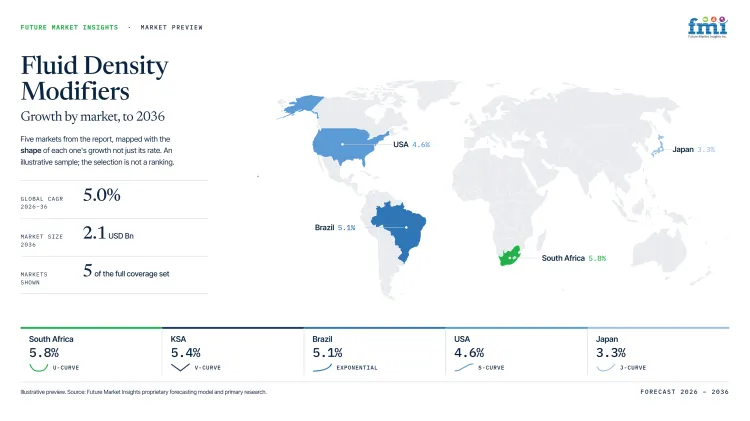
| Country | CAGR |
|---|---|
| South Africa | 5.8% |
| KSA | 5.4% |
| UAE | 5.3% |
| Brazil | 5.1% |
| USA | 4.6% |
How do country-level CAGRs compare in the Fluid Density Modifiers Market?
The five profiled countries span 1.2 percentage points from South Africa at 5.8% CAGR to USA at 4.6%. KSA, UAE, and Brazil form a 5.1% to 5.4% middle band. Small forecast gaps conceal larger differences in project type, approval timing, service depth, and offshore logistics for fluid contractors globally today.
- South Africa depends on offshore approvals becoming executable drilling schedules.
- KSA rewards bulk fluid supply during long unconventional gas campaigns.
- UAE island drilling puts a premium on rapid rig-side response.
- Brazil's pre-salt mix raises replacement costs during deepwater operations.
- USA splits demand between premium offshore and cost-disciplined land systems.
Comparable CAGRs still require different stocking, qualification, and service models.
The full report provides country-level CAGR analysis across North America, Latin America, Western Europe, Eastern Europe, East Asia, South Asia and Pacific, and Middle East and Africa.
Country-wise Analysis
- South African offshore campaigns depend on environmental authorization and appeal decisions, so fluid providers avoid fixing inventory to a drilling date too early. Fluid density modifier demand is forecast to rise at 5.8% CAGR over the forecast period, tied to approved wells that need qualified fluids and mobilized material before spud. On March 11, 2026, the Department of Forestry, Fisheries and the Environment said it would proceed with offshore drilling and seismic appeals along the west and south coasts. Flexible regional stock can respond after approvals, although uncertain start dates still make large dedicated inventories difficult to justify during uncertain campaign timing.
- Jafurah development requires fluid contractors to maintain repeatable specifications during long unconventional gas campaigns with high daily material use. Aramco stated on February 26, 2026 that Jafurah production had started in December 2025 and that technology had lowered drilling and stimulation costs. The Saudi fluid density modifiers sector is projected to record 5.4% CAGR during the assessment period, propelled by sustained gas drilling that favors bulk handling and local technical response. Scale supports larger supply commitments, yet quality drift or delivery gaps can interrupt multiwell schedules and raise nonproductive time. Regional inventory therefore carries more commercial weight than spot availability alone.
- UAE island rigs move between well slots on compact offshore programs, leaving short windows for fluid changes and resupply during active campaigns. On June 25, 2026, Emirates News Agency reported delivery of AD-300, the first of six AI-enabled walking island rigs under ADNOC Drilling's program. Adoption of fluid density modifiers in UAE is estimated to expand at 5.3% CAGR through 2036, aided by repeated offshore wells that require consistent density control and fast field response. Automation improves execution discipline, but it also raises the cost of late material or incompatible fluid changes. Qualified local stock becomes more valuable as the six-rig program advances.
- Brazilian pre-salt wells place density performance beside filtration and high-density brine logistics because deepwater replacement is expensive once a vessel is committed. Fluid density modifier sales in Brazil are forecast to expand at 5.1% CAGR by 2036, attributable to offshore programs that keep pressure control central to drilling and completion planning. ANP reported on December 19, 2025 that exploration-well starts rose 90% during 2025, with 10 of 19 new wells offshore. Local ports and service bases support mobilization, yet long offshore supply routes increase the penalty for missed specifications. Providers with in-country brine handling can shorten response time on pre-salt campaigns.
- Deepwater Gulf of America projects operate beside mature land basins in USA, producing different price and performance thresholds for the same density-control portfolio. BSEE's August 1, 2026 permit table recorded 30 deepwater new-well permits through July 2026, compared with 47 during 2025. By 2036, USA is projected to grow at 4.6% CAGR, because complex offshore wells sustain premium modifier demand while land programs keep commodity-grade pricing under pressure. Gulf service bases support rapid offshore response, although land-basin activity can move faster with commodity economics. Portfolio breadth is more useful here than a single premium-fluid strategy across both operating models and basin economics.
Who are the notable companies in the Fluid Density Modifiers Market?
Halliburton, SLB, Baker Hughes, TETRA Technologies, Newpark Fluids Systems, CES Energy Solutions Corp., ICL Group, National Energy Services Reunited Corp. are the notable companies serving this market.
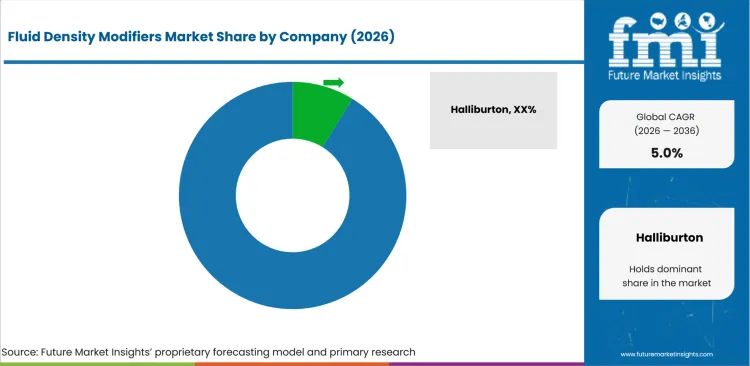
Competition separates integrated well-construction groups from specialists controlling brine chemistry, weighting supply, or regional fluid service. Adjacent production chemicals often share field-service infrastructure, but entry still depends on laboratory qualification, reliable material supply, and response before a density deviation interrupts the well program.
Integrated well-construction providers
- Halliburton, SLB, and Baker Hughes manage drilling-fluid decisions inside broader well-construction service packages.
Specialist fluid and density-control providers
- TETRA Technologies, Newpark Fluids Systems, and CES Energy Solutions Corp. provide brines, drilling fluids, weighting materials, and fluid laboratories.
Brine chemistry and regional service specialists
- ICL Group supplies clear-brine chemistry, and National Energy Services Reunited Corp. provides drilling and completion fluids in MENA.
Competitive Benchmarking: Fluid Density Modifiers Market
| Company | Density-Control Portfolio | Field-Service Integration | Qualification Infrastructure | Geographic Reach |
|---|---|---|---|---|
| Halliburton | High | High | High | Global |
| SLB | High | High | High | Global |
| Baker Hughes | High | High | High | Global |
| TETRA Technologies | High | Medium | High | North America, Latin America, Europe, Middle East, Africa |
| Newpark Fluids Systems | High | High | High | North America, Middle East, Europe, Latin America |
| CES Energy Solutions Corp. | High | High | High | USA and Canada |
| ICL Group | Medium | Low | Medium | Americas, Europe, Middle East |
| National Energy Services Reunited Corp. | Medium | High | Medium | Middle East and North Africa |
Scoring basis: Portfolio breadth is High with three or more documented density-control routes, Medium with two, and Low with one specialist route. Field integration is High for design plus wellsite service, Medium for technical support, and Low for material supply without field ownership. Qualification infrastructure is High with dedicated laboratories or testing in several regions, Medium with one documented route, and Low where official evidence shows limited specialist infrastructure. Geographic reach follows current operating records rather than corporate headquarters or general market reputation.
Key Developments in the Fluid Density Modifiers Market
- In July 2025, Newpark Fluids Systems and SCF Partners disclosed capital investment in a West Texas liquid-mud facility and a Saudi technology center for regional fluid support.
- In June 2025, CES Energy Solutions Corp. closed the Fossil Fluids asset acquisition and placed the Mid-Continent drilling-fluids business under AES Drilling Fluids for broader regional coverage.
- In January 2025, Halliburton secured a three-year Petrobras offshore drilling-services contract in Brazil that applies BaraLogix measurements to real-time drilling-fluid and hydraulics decisions.
Key Players in the Fluid Density Modifiers Market
Integrated Well-Construction Providers
- Halliburton
- SLB
- Baker Hughes
Specialist Fluid and Density-Control Providers
- TETRA Technologies
- Newpark Fluids Systems
- CES Energy Solutions Corp.
Brine Chemistry and Regional Service Specialists
- ICL Group
- National Energy Services Reunited Corp.
Fluid Density Modifiers Market - Report Scope
| Coverage field | Report scope |
|---|---|
| Market breakdown | By modifier type, fluid system, density direction, well environment, sales channel and region. |
| Quantitative Units | USD billion. |
| Market Definition | Commercial weighting agents, brine salts, microspheres, lightweight extenders, and density-balancing polymers used to raise, reduce, or stabilize drilling, completion, cement, and workover fluid density. |
| Regions Covered | North America, Latin America, Western Europe, Eastern Europe, East Asia, South Asia and Pacific, and Middle East and Africa. |
| Countries Covered | South Africa, KSA, UAE, Brazil, USA, and 20+ countries included in the full report. |
| Key Companies Profiled | Halliburton, SLB, Baker Hughes, TETRA Technologies, Newpark Fluids Systems, CES Energy Solutions Corp., ICL Group, National Energy Services Reunited Corp. |
| Forecast Period | 2026 to 2036. |
| Approach | Primary and secondary research with market triangulation. |
Fluid Density Modifiers Market - Research Methodology
| Method | Approach |
|---|---|
| Primary Research | FMI analysts gathered input from manufacturers, service providers, technology developers, distributors, end users, procurement teams, and subject-matter experts. Interviews examined purchasing decisions, product or service evaluation, adoption barriers, approval requirements, pricing considerations, and expectations for technical or commercial support. Respondents were also asked what evidence is required before a trial, pilot, or initial order develops into regular purchasing. |
| Desk Research | Desk research covered government statistics, regulatory publications, trade data, industry associations, technical literature, standards, company filings, product information, and official corporate announcements. Sources were reviewed for relevance, publication date, geographic coverage, and consistency with the defined market scope. Claims relating to performance, applications, approvals, capacity, investment, and commercial activity were retained only when supported by credible public evidence. |
| Market Sizing and Forecasting | The market model combined the baseline value with historical performance, segment structure, pricing and volume indicators, adoption levels, company participation, and country-level demand conditions. Forecast assumptions considered economic activity, investment trends, regulatory developments, technology adoption, purchasing cycles, supply availability, and barriers to wider market use. Segment and regional estimates were reconciled before the final market total was calculated. |
| Data Validation | Estimates were checked against multiple independent indicators, including public data, company activity, trade patterns, industry developments, and findings from primary interviews. Validation also tested whether products, services, applications, and company revenues fell within the defined market boundaries. Adjacent categories, unsupported claims, overlapping revenues, and activities without direct market relevance were excluded to reduce double counting and maintain consistency across segments and countries. |
Fluid Density Modifiers Market by Segments
Fluid Density Modifiers Market segmented by Modifier Type:
- Weighting agents
- Lightweight extenders
- Brine salts
- Microspheres
- Density-balancing polymers
Fluid Density Modifiers Market segmented by Fluid System:
- Drilling fluids
- Completion fluids
- Cement slurries
- Workover fluids
Fluid Density Modifiers Market segmented by Density Direction:
- Density increase
- Density reduction
- Fine tuning / balancing
- Low-sag enhancement
Fluid Density Modifiers Market segmented by Well Environment:
- Onshore
- Offshore
- HPHT
- Deepwater
- Depleted formations
Fluid Density Modifiers Market segmented by Sales Channel:
- Oilfield service companies
- Mineral / brine suppliers
- Direct operator supply
- Regional distributors
Fluid Density Modifiers Market by Region:
- North America
- United States
- Canada
- Latin America
- Brazil
- Mexico
- Chile
- Rest of Latin America
- Western Europe
- Germany
- United Kingdom
- Italy
- Spain
- France
- Nordics
- Benelux
- Rest of Western Europe
- Eastern Europe
- Russia
- Poland
- Hungary
- Balkan and Baltic States
- Rest of Eastern Europe
- East Asia
- China
- Japan
- South Korea
- South Asia and Pacific
- India
- ASEAN
- Australia and New Zealand
- Rest of South Asia and Pacific
- Middle East and Africa
- Kingdom of Saudi Arabia
- Other GCC Countries
- Türkiye
- South Africa
- Other African Union Countries
- Rest of Middle East and Africa
Research Sources and Bibliography
- USA Energy Information Administration. (2026, March 31). USA crude oil production rose in 2025, setting new record.
- Agência Nacional do Petróleo, Gás Natural e Biocombustíveis. (2026, August 3). ANP divulga dados consolidados da produção de petróleo e gás em junho de 2026.
- CES Energy Solutions Corp. (2026, March 10). 2025 Annual Report.
- USA Securities and Exchange Commission / Baker Hughes Company. (2026, February 5). Baker Hughes Company 2025 Form 10-K.
- ICL Group. (2026, February 18). ICL reports fourth quarter and full year 2025 results.
- SLB. (2026, February 12). SLB awarded multiple offshore drilling contracts by Mubadala Energy for Tangkulo deepwater development in Indonesia.
- Bureau of Safety and Environmental Enforcement. (2026, April 1). BSEE ensures safe, responsible operations as offshore production reaches record levels.
- USA Geological Survey. (2026, February 6). Mineral Commodity Summaries 2026.
- TETRA Technologies, Inc. (2026, May 28). TETRA Technologies, Inc. Board of Directors approves final investment decision for Arkansas bromine production facility.
- Department of Forestry, Fisheries and the Environment, South Africa. (2026, March 11). Minister Aucamp moves to end "Decision Paralysis" on offshore oil and gas exploration appeals.
- Aramco. (2026, February 26). Aramco’s gas strategy builds momentum with major progress towards growth target.
- Emirates News Agency. (2026, June 25). ADNOC Drilling delivers first AI-enabled walking island rig ahead of schedule.
- Agência Nacional do Petróleo, Gás Natural e Biocombustíveis. (2025, December 19). Número de blocos sob contrato cresce em 2025 e é o maior pelo segundo ano consecutivo.
- Bureau of Safety and Environmental Enforcement. (2026, August 1). Status of well permits in the Gulf of America.
- SCF Partners. (2025, July 7). Newpark Fluids Systems strengthens executive leadership and board to drive continued growth.
- CES Energy Solutions Corp. (2025, August 7). CES Energy Solutions Corp. announces strong Q2 2025 results with record second quarter revenue and declares cash dividend.
- Halliburton. (2025, January 30). Halliburton secures major offshore drilling contract with Petrobras.
- USA Securities and Exchange Commission / SLB. (2026, January 23). SLB 2025 Form 10-K.
- USA Securities and Exchange Commission / TETRA Technologies, Inc. (2026, February 25). TETRA Technologies, Inc. 2025 Form 10-K.
- CES Energy Solutions Corp. (n.d.). ISO 9001:2015.
- USA Securities and Exchange Commission / National Energy Services Reunited Corp. (2026, March 6). National Energy Services Reunited Corp. 2025 Form 10-K.
- Halliburton. (2026, July 13). Halliburton wins integrated drilling and completions contracts for GranMorgu deepwater project offshore Suriname.
- Baker Hughes. (2026, May 26). Baker Hughes extends and expands integrated well construction contract with Petrobras.
- TETRA Technologies, Inc. (2026, June 29). TETRA Technologies introduces TETRA Neptune Z-Lite deepwater completions fluid.
- Newpark Fluids Systems and Intelligent Mud Solutions. (2025, March 17). Intelligent Mud Solutions (IMS) and Newpark Fluids Systems Announce Strategic Collaboration Agreement for Real-Time Fluids Measurement.
- National Energy Services Reunited Corp. (2025, April 21). NESR begins construction of 180,000m2 facility at King Salman Energy Park (SPARK).
- Halliburton. (2026, July 15). Aramco awards Halliburton long-term contract for unconventional gas program.
- SLB. (2025, March 31). SLB awarded major drilling contract by Woodside Energy for ultra-deepwater Trion development, offshore Mexico.
- Baker Hughes. (2026, May 28). Baker Hughes, Equinor extend significant contracts to support North Sea energy production.
- TETRA Technologies, Inc. (2026, February 25). TETRA Technologies, Inc. announces fourth-quarter and strong full-year 2025 results and provides update on strategic initiatives.
- Intelligent Mud Solutions. (2025, October 10). First RheoSense to Newpark - Strengthening Global Collaboration for Real-Time Fluid Intelligence.
- ICL Group. (2026, March 11). ICL Files 2025 Annual Report on Form 20-F.
- National Energy Services Reunited Corp. (2026, August 5). NESR secures $300 million in multiple services and technology contracts in Kuwait.
- CES Energy Solutions Corp. (2026, August 6). CES Energy Solutions Corp. announces record Q2 2026 results and declares cash dividend.
This bibliography is provided for reader reference and is not exhaustive. The full report contains the complete reference list and detailed citations
This Report Answers
- How large is the fluid density modifiers market in 2026 and 2036?
- Which well conditions increase spending on fluid density control?
- Why do weighting agents lead the modifier type category?
- How does drilling-fluid circulation affect repeat modifier demand?
- Why does density increase lead the density direction category?
- How do growth rates differ among the five profiled countries?
- Which companies provide fluids, brines, weighting materials, and field support?
- Which formulation and logistics constraints delay modifier approval?
Frequently Asked Questions
How big is the Fluid Density Modifiers Market in 2026?
The fluid density modifiers market is valued at USD 1.3 billion in 2026 and is projected to reach USD 2.1 billion by 2036. Growth follows wells that need stable hydrostatic control inside a narrow pressure window.
What is the CAGR of the Fluid Density Modifiers Market from 2026 to 2036?
The fluid density modifiers market is projected to grow at a CAGR of 5.0% between 2026 and 2036. Deepwater and unconventional programs raise the value of density stability because pressure-control errors carry high operating costs.
Which modifier type leads the Fluid Density Modifiers Market?
The weighting agents segment is expected to hold 36.0% of the fluid density modifiers market in 2026, attributable to its direct route for increasing hydrostatic head. Commercial approval still depends on particle quality and sag behavior under the planned fluid conditions.
Which fluid system holds the largest current share in the Fluid Density Modifiers Market?
The drilling fluids segment is expected to hold 39.0% of the fluid density modifiers market in 2026 because density is corrected during circulation. That adjustment window is broader than the shorter placement periods typical of completion or workover fluids.
Which countries are projected to record the highest growth in the Fluid Density Modifiers Market?
South Africa is projected to grow at 5.8% CAGR, followed by KSA at 5.4% and UAE at 5.3% through 2036. Their growth paths differ because offshore approvals, unconventional gas scale, and island drilling require different inventory models.
Which companies are active in the Fluid Density Modifiers Market?
Key companies operating in the fluid density modifiers market include Halliburton, SLB, Baker Hughes, TETRA Technologies, Newpark Fluids Systems, CES Energy Solutions Corp., ICL Group, and National Energy Services Reunited Corp. Their positions span fluid engineering, brine chemistry, weighting supply, qualification, and field service.
Preview the report firsthand - request a free sample
Get SampleGet the brochure for pricing and purchase details.
Get PDFTable of Content
- Key Takeaways
- Market Size and CAGR
- Top Growth Driver
- Fastest Growing Segment
- Leading Region
- Key Companies
- Emerging Opportunities
- Executive Summary
- Global Market Outlook
- Demand-side Trends
- Supply-side Trends
- Technology Roadmap Analysis
- Analysis and Recommendations
- Analyst Perspective (What is happening? Why now? What should investors know?)
- Key Questions Answered
- How large is the market?
- What is the CAGR?
- What are key trends?
- Which region dominates?
- Who are the leaders?
- Market Overview
- Market Coverage / Taxonomy
- Market Definition / Scope / Limitations
- Research Methodology
- Chapter Orientation
- Analytical Lens and Working Hypotheses
- Market Structure, Signals, and Trend Drivers
- Benchmarking and Cross-market Comparability
- Market Sizing, Forecasting, and Opportunity Mapping
- Research Design and Evidence Framework
- Desk Research Programme (Secondary Evidence)
- Expert Input and Fieldwork (Primary Evidence)
- Tooling, Models, and Reference Databases
- Data Engineering and Model Build
- Quality Assurance and Audit Trail
- Market Background
- Market Dynamics (Drivers, Restraints, Opportunity, Trends)
- Scenario Forecast (Optimistic, Likely, Conservative)
- Impact Analysis
- AI Impact
- Sustainability Impact
- Regulatory Impact
- Technology Impact
- Consumer / Buyer Analysis
- Purchase Drivers
- Adoption Barriers
- Buyer Journey
- Opportunity Map Analysis
- Product Life Cycle Analysis
- Supply Chain Analysis
- Investment Feasibility Matrix
- Value Chain Analysis
- PESTLE and Porter's Analysis
- Regulatory Landscape
- Regional Parent Market Outlook
- Production and Consumption Statistics
- Import and Export Statistics
- Global Market Analysis and Forecast, 2021 to 2036
- Historical Market Size Value (USD Billion) Analysis, 2021 to 2025
- Current and Future Market Size Value (USD Billion) Projections, 2026 to 2036
- Y-o-Y Growth Trend Analysis
- Absolute $ Opportunity Analysis
- Global Market Pricing Analysis, 2021 to 2036
- Global Market Analysis and Forecast, By Modifier Type, 2021 to 2036
- Introduction / Key Findings
- Historical Market Size Value (USD Billion) Analysis By Modifier Type, 2021 to 2025
- Current and Future Market Size Value (USD Billion) Analysis and Forecast By Modifier Type, 2026 to 2036
- Weighting agents
- Lightweight extenders
- Brine salts
- Microspheres
- Density balancing polymers
- Weighting agents
- Y-o-Y Growth Trend Analysis By Modifier Type, 2021 to 2025
- Absolute $ Opportunity Analysis By Modifier Type, 2026 to 2036
- Global Market Analysis and Forecast, By Fluid System, 2021 to 2036
- Introduction / Key Findings
- Historical Market Size Value (USD Billion) Analysis By Fluid System, 2021 to 2025
- Current and Future Market Size Value (USD Billion) Analysis and Forecast By Fluid System, 2026 to 2036
- Drilling fluids
- Completion fluids
- Cement slurries
- Workover fluids
- Drilling fluids
- Y-o-Y Growth Trend Analysis By Fluid System, 2021 to 2025
- Absolute $ Opportunity Analysis By Fluid System, 2026 to 2036
- Global Market Analysis and Forecast, By Density Direction, 2021 to 2036
- Introduction / Key Findings
- Historical Market Size Value (USD Billion) Analysis By Density Direction, 2021 to 2025
- Current and Future Market Size Value (USD Billion) Analysis and Forecast By Density Direction, 2026 to 2036
- Density increase
- Density reduction
- Fine tuning / balancing
- Low-sag enhancement
- Density increase
- Y-o-Y Growth Trend Analysis By Density Direction, 2021 to 2025
- Absolute $ Opportunity Analysis By Density Direction, 2026 to 2036
- Global Market Analysis and Forecast, By Well Environment, 2021 to 2036
- Introduction / Key Findings
- Historical Market Size Value (USD Billion) Analysis By Well Environment, 2021 to 2025
- Current and Future Market Size Value (USD Billion) Analysis and Forecast By Well Environment, 2026 to 2036
- Onshore
- Offshore
- HPHT
- Deepwater
- Depleted formations
- Onshore
- Y-o-Y Growth Trend Analysis By Well Environment, 2021 to 2025
- Absolute $ Opportunity Analysis By Well Environment, 2026 to 2036
- Global Market Analysis and Forecast, By Sales Channel, 2021 to 2036
- Introduction / Key Findings
- Historical Market Size Value (USD Billion) Analysis By Sales Channel, 2021 to 2025
- Current and Future Market Size Value (USD Billion) Analysis and Forecast By Sales Channel, 2026 to 2036
- Oilfield service companies
- Mineral / brine suppliers
- Direct operator supply
- Regional distributors
- Oilfield service companies
- Y-o-Y Growth Trend Analysis By Sales Channel, 2021 to 2025
- Absolute $ Opportunity Analysis By Sales Channel, 2026 to 2036
- Global Market Analysis and Forecast, By Region, 2021 to 2036
- Introduction
- Historical Market Size Value (USD Billion) Analysis By Region, 2021 to 2025
- Current Market Size Value (USD Billion) Analysis and Forecast By Region, 2026 to 2036
- North America
- Latin America
- Western Europe
- Eastern Europe
- East Asia
- South Asia and Pacific
- Middle East & Africa
- Market Attractiveness Analysis By Region
- North America Market Analysis and Forecast, By Country, 2021 to 2036
- Historical Market Size Value (USD Billion) Trend Analysis By Market Taxonomy, 2021 to 2025
- Market Size Value (USD Billion) Forecast By Market Taxonomy, 2026 to 2036
- By Country
- USA
- Canada
- By Modifier Type
- By Fluid System
- By Density Direction
- By Well Environment
- By Sales Channel
- By Country
- Market Attractiveness Analysis
- By Country
- By Modifier Type
- By Fluid System
- By Density Direction
- By Well Environment
- By Sales Channel
- Key Takeaways
- Latin America Market Analysis and Forecast, By Country
- Historical Market Size Value (USD Billion) Trend Analysis By Market Taxonomy, 2021 to 2025
- Market Size Value (USD Billion) Forecast By Market Taxonomy, 2026 to 2036
- By Country
- Brazil
- Mexico
- Chile
- Rest of Latin America
- By Modifier Type
- By Fluid System
- By Density Direction
- By Well Environment
- By Sales Channel
- By Country
- Market Attractiveness Analysis
- By Country
- By Modifier Type
- By Fluid System
- By Density Direction
- By Well Environment
- By Sales Channel
- Key Takeaways
- Western Europe Market Analysis and Forecast, By Country
- Historical Market Size Value (USD Billion) Trend Analysis By Market Taxonomy, 2021 to 2025
- Market Size Value (USD Billion) Forecast By Market Taxonomy, 2026 to 2036
- By Country
- Germany
- UK
- Italy
- Spain
- France
- Nordic
- BENELUX
- Rest of Western Europe
- By Modifier Type
- By Fluid System
- By Density Direction
- By Well Environment
- By Sales Channel
- By Country
- Market Attractiveness Analysis
- By Country
- By Modifier Type
- By Fluid System
- By Density Direction
- By Well Environment
- By Sales Channel
- Key Takeaways
- Eastern Europe Market Analysis and Forecast, By Country
- Historical Market Size Value (USD Billion) Trend Analysis By Market Taxonomy, 2021 to 2025
- Market Size Value (USD Billion) Forecast By Market Taxonomy, 2026 to 2036
- By Country
- Russia
- Poland
- Hungary
- Balkan & Baltic
- Rest of Eastern Europe
- By Modifier Type
- By Fluid System
- By Density Direction
- By Well Environment
- By Sales Channel
- By Country
- Market Attractiveness Analysis
- By Country
- By Modifier Type
- By Fluid System
- By Density Direction
- By Well Environment
- By Sales Channel
- Key Takeaways
- East Asia Market Analysis and Forecast, By Country
- Historical Market Size Value (USD Billion) Trend Analysis By Market Taxonomy, 2021 to 2025
- Market Size Value (USD Billion) Forecast By Market Taxonomy, 2026 to 2036
- By Country
- China
- Japan
- South Korea
- By Modifier Type
- By Fluid System
- By Density Direction
- By Well Environment
- By Sales Channel
- By Country
- Market Attractiveness Analysis
- By Country
- By Modifier Type
- By Fluid System
- By Density Direction
- By Well Environment
- By Sales Channel
- Key Takeaways
- South Asia and Pacific Market Analysis and Forecast, By Country
- Historical Market Size Value (USD Billion) Trend Analysis By Market Taxonomy, 2021 to 2025
- Market Size Value (USD Billion) Forecast By Market Taxonomy, 2026 to 2036
- By Country
- India
- ASEAN
- Australia & New Zealand
- Rest of South Asia and Pacific
- By Modifier Type
- By Fluid System
- By Density Direction
- By Well Environment
- By Sales Channel
- By Country
- Market Attractiveness Analysis
- By Country
- By Modifier Type
- By Fluid System
- By Density Direction
- By Well Environment
- By Sales Channel
- Key Takeaways
- Middle East & Africa Market Analysis and Forecast, By Country
- Historical Market Size Value (USD Billion) Trend Analysis By Market Taxonomy, 2021 to 2025
- Market Size Value (USD Billion) Forecast By Market Taxonomy, 2026 to 2036
- By Country
- Kingdom of Saudi Arabia
- Other GCC Countries
- Türkiye
- South Africa
- Other African Union
- Rest of Middle East & Africa
- By Modifier Type
- By Fluid System
- By Density Direction
- By Well Environment
- By Sales Channel
- By Country
- Market Attractiveness Analysis
- By Country
- By Modifier Type
- By Fluid System
- By Density Direction
- By Well Environment
- By Sales Channel
- Key Takeaways
- Key Countries Market Analysis
- USA
- Pricing Analysis
- Market Share Analysis, 2025
- By Modifier Type
- By Fluid System
- By Density Direction
- By Well Environment
- By Sales Channel
- Canada
- Pricing Analysis
- Market Share Analysis, 2025
- By Modifier Type
- By Fluid System
- By Density Direction
- By Well Environment
- By Sales Channel
- Mexico
- Pricing Analysis
- Market Share Analysis, 2025
- By Modifier Type
- By Fluid System
- By Density Direction
- By Well Environment
- By Sales Channel
- Brazil
- Pricing Analysis
- Market Share Analysis, 2025
- By Modifier Type
- By Fluid System
- By Density Direction
- By Well Environment
- By Sales Channel
- Chile
- Pricing Analysis
- Market Share Analysis, 2025
- By Modifier Type
- By Fluid System
- By Density Direction
- By Well Environment
- By Sales Channel
- Germany
- Pricing Analysis
- Market Share Analysis, 2025
- By Modifier Type
- By Fluid System
- By Density Direction
- By Well Environment
- By Sales Channel
- UK
- Pricing Analysis
- Market Share Analysis, 2025
- By Modifier Type
- By Fluid System
- By Density Direction
- By Well Environment
- By Sales Channel
- Italy
- Pricing Analysis
- Market Share Analysis, 2025
- By Modifier Type
- By Fluid System
- By Density Direction
- By Well Environment
- By Sales Channel
- Spain
- Pricing Analysis
- Market Share Analysis, 2025
- By Modifier Type
- By Fluid System
- By Density Direction
- By Well Environment
- By Sales Channel
- France
- Pricing Analysis
- Market Share Analysis, 2025
- By Modifier Type
- By Fluid System
- By Density Direction
- By Well Environment
- By Sales Channel
- India
- Pricing Analysis
- Market Share Analysis, 2025
- By Modifier Type
- By Fluid System
- By Density Direction
- By Well Environment
- By Sales Channel
- ASEAN
- Pricing Analysis
- Market Share Analysis, 2025
- By Modifier Type
- By Fluid System
- By Density Direction
- By Well Environment
- By Sales Channel
- Australia & New Zealand
- Pricing Analysis
- Market Share Analysis, 2025
- By Modifier Type
- By Fluid System
- By Density Direction
- By Well Environment
- By Sales Channel
- China
- Pricing Analysis
- Market Share Analysis, 2025
- By Modifier Type
- By Fluid System
- By Density Direction
- By Well Environment
- By Sales Channel
- Japan
- Pricing Analysis
- Market Share Analysis, 2025
- By Modifier Type
- By Fluid System
- By Density Direction
- By Well Environment
- By Sales Channel
- South Korea
- Pricing Analysis
- Market Share Analysis, 2025
- By Modifier Type
- By Fluid System
- By Density Direction
- By Well Environment
- By Sales Channel
- Russia
- Pricing Analysis
- Market Share Analysis, 2025
- By Modifier Type
- By Fluid System
- By Density Direction
- By Well Environment
- By Sales Channel
- Poland
- Pricing Analysis
- Market Share Analysis, 2025
- By Modifier Type
- By Fluid System
- By Density Direction
- By Well Environment
- By Sales Channel
- Hungary
- Pricing Analysis
- Market Share Analysis, 2025
- By Modifier Type
- By Fluid System
- By Density Direction
- By Well Environment
- By Sales Channel
- Kingdom of Saudi Arabia
- Pricing Analysis
- Market Share Analysis, 2025
- By Modifier Type
- By Fluid System
- By Density Direction
- By Well Environment
- By Sales Channel
- Türkiye
- Pricing Analysis
- Market Share Analysis, 2025
- By Modifier Type
- By Fluid System
- By Density Direction
- By Well Environment
- By Sales Channel
- South Africa
- Pricing Analysis
- Market Share Analysis, 2025
- By Modifier Type
- By Fluid System
- By Density Direction
- By Well Environment
- By Sales Channel
- USA
- Market Structure Analysis
- Competition Dashboard
- Competition Benchmarking
- Market Share Analysis of Top Players
- By Regional
- By Modifier Type
- By Fluid System
- By Density Direction
- By Well Environment
- By Sales Channel
- Emerging Startups
- Innovation Benchmarking
- Competition Analysis
- Competition Deep Dive
- Halliburton
- Overview
- Product Portfolio
- Profitability by Market Segments
- Sales Footprint
- Strategy Overview
- Marketing Strategy
- Product Strategy
- Channel Strategy
- SLB
- Baker Hughes
- TETRA Technologies
- Newpark Resources
- Imerys
- Omya
- Sibelco
- 3M
- ICL Group
- Halliburton
- Case Studies
- Success Stories
- Recent Developments
- Competition Deep Dive
- Assumptions & Acronyms Used


