

- Market Size (2026)
- USD 2.1 Bn
- Forecast (2036)
- USD 3.5 Bn
- CAGR (2026 to 2036)
- 5.0%
How big is Oil-Based Mud Additives Market in 2026?
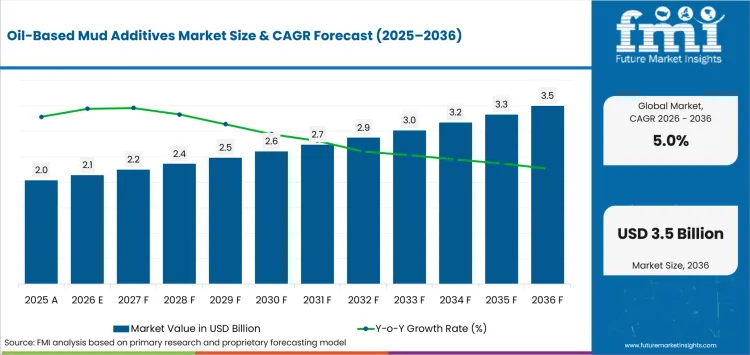
USD 2.1 billion in 2026 and USD 3.5 billion by 2036 at a 5.0% CAGR.
Demand for oil-based mud additives is projected to expand at 5.0% CAGR between 2026 and 2036, increasing valuation from USD 2.1 billion in 2026 to USD 3.5 billion by 2036. Difficult wells justify nonaqueous systems because unstable rheology or filtration can consume expensive rig time. BSEE published Gulf deepwater activity records through September 2026.
Country demand changes with sanctioned drilling and the share of wells that justify nonaqueous fluid economics. ANP reported in June 2026 that pre-salt fields produced about 80% of Brazil's oil during 2025. Concentrated offshore activity raises the cost of treatment failure. The forecast adds USD 1.4 billion in annual value by 2036.
Key Takeaways
- Demand follows difficult well sections that raise the cost of unstable rheology and poor filtration control.
- By additive type, oil-wet emulsifiers are estimated to hold 24.0% in 2026 owing to their role in interface stability and solids wetting.
- Diesel-based mud is set to represent 22.0% by base fluid in 2026 where local rules and operating practice preserve its cost advantage.
- Offshore wells are expected to account for 28.0% by well type in 2026 because rig-time exposure raises the value of controlled fluid performance.
- Environmental permitting and cuttings handling can erode the economics of conventional oil-based systems in tightly regulated offshore basins.
- Some of the key players in this market include Baker Hughes, Halliburton, SLB, Newpark Fluids Systems, Innospec, Elementis, Nouryon, SNF Group, Chevron Phillips Chemical, and TETRA Technologies.
Analyst Perspective
"Oil-based mud additive offers should be judged against the planned base fluid and downhole window before unit price. Commercial value is earned when laboratory qualification transfers into stable treatment practice with local inventory and field response."
- Nikhil Kaitwade, Principal Consultant, Future Market Insights
How is the oil-based mud additives market segmented?
Additive Type, Base Fluid, Well Type, Function and Sales Channel define the commercial split of oil-based mud additive demand.
Additive type covers oil-wet emulsifiers, organophilic clays, wetting agents, rheology modifiers, filtration control additives and lime - alkalinity control. Base fluid and well type separate carrier choice from operating severity. Function and sales channel identify the treatment objective and commercial route.
Why do oil-wet emulsifiers lead the additive type category?
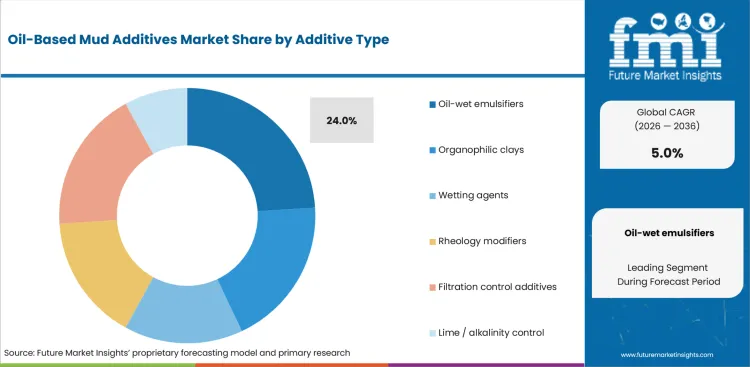
Oil-wet emulsifiers stabilize the oil-water interface and keep solids preferentially oil-wet. Dosage changes with contamination and oil-water ratio during a well section. Innospec's 2025 Form 10-K documented new additives intended to improve drilling muds within its Oilfield Services portfolio.
- By additive type, oil-wet emulsifiers are estimated to hold 24.0% in 2026 attributable to repeat treatment needs in invert-emulsion control.
- Formulators qualify emulsifier chemistry against the intended carrier and contamination load. Adjacent oilfield chemical systems show how specialist chemistry enters drilling programs through technical qualification.
Why does diesel-based mud lead the base fluid category?
Diesel-based mud retains a cost advantage where its environmental route remains acceptable. Offshore chemical controls weaken that advantage. OPRED's June 2025 alert required permit holders to stay within approved chemical usage and discharge concentrations for each well section.
- Diesel-based mud is set to lead the base fluid category with 22.0% share in 2026 supported by familiar formulation practice and carrier availability.
- Additive providers need chemistry that transfers into mineral or lower-aromatic carriers without complete reformulation. The same constraint shapes broader drilling and completion fluids programs.
Why do offshore wells lead the well type category?
Offshore programs carry high rig-time exposure and long logistics chains. Fluid instability therefore has a larger operating cost than in many short land sections. BSEE listed 59 permanent Gulf deepwater structures in water depths greater than 1,000 feet in September 2026.
- In 2026, offshore wells are expected to account for 28.0% of the well type category driven by costly well geometry and narrow operating windows.
- Service teams qualify treatment against temperature and solids loading before field use. They also coordinate drilling tools with fluid properties so mechanical choices do not undermine chemical control.
Why does emulsion stability lead the function category?
Emulsion stability determines whether the dispersed water phase stays controlled under heat and contamination. Poor interface control can disturb solids wetting before filtration performance deteriorates. Elementis reported in its 2025 annual report that hectorite-based blends serve oil and gas drilling stimulation fluids.
- By function, emulsion stability is forecast to represent 26.0% in 2026 owing to its influence on several linked fluid properties.
- Mud engineers test electrical stability and high-temperature behavior against the planned formulation. Comparable drilling mud chemicals face the same requirement for repeatable performance under expected well conditions.
Why do oilfield service companies lead the sales channel category?
Integrated fluid providers retain the channel advantage because treatment decisions continue after the chemical sale. Baker Hughes listed drilling fluids and chemical processing centers among its principal properties in its 2025 annual report.
- Oilfield service companies are anticipated to capture 45.0% of the sales channel category in 2026 driven by bundled formulation and field accountability.
- Operators often prefer one accountable fluid program as treatment frequency changes with the hole section. That service model also shapes purchasing and response expectations within oil and gas field services.
What are the drivers, restraints and opportunities in the Oil-Based Mud Additives Market?
Complex deepwater and HPHT wells raise demand for controlled fluid properties. Offshore chemical permits increase compliance work, while local formulation centers can shorten the path from laboratory testing to field use.
- Driver: Deepwater permitting keeps a sizable pool of wells exposed to high fluid-failure costs.
- Restraint: Offshore chemical controls can raise documentation and disposal costs for traditional nonaqueous systems.
- Opportunity: Regional testing centers can qualify lower-impact chemistry closer to active drilling programs.
Deepwater Permitting Keeps High-Performance Fluid Programs Active
Deepwater approvals preserve demand for fluids that control rheology and filtration under difficult well conditions. BSEE recorded 36 new deepwater well permits and 263 revised new-well permits through August 2026. Each approved program still requires chemistry qualified for its base fluid and pressure window because long well sections raise the cost of treatment failure.
Offshore Chemical Controls Raise the Cost of Traditional Nonaqueous Systems
Environmental controls can erase part of the price advantage of conventional oil-based mud. OPRED's February 2026 alert requires chemicals used in open offshore systems to appear on the associated chemical permit. Registration scope and shore-return requirements therefore affect carrier choice before field use.
Local Formulation Centers Shorten Qualification Cycles
Regional laboratories matter when revised chemistry must be qualified against the intended carrier and downhole window. Nouryon opened a Houston oilfield Innovation Center in June 2025 for drilling and completion research plus customer testing. Local formulation work can shorten qualification without forcing operators to rebuild the complete mud program.
Which country CAGRs are profiled in the Oil-Based Mud Additives Market?
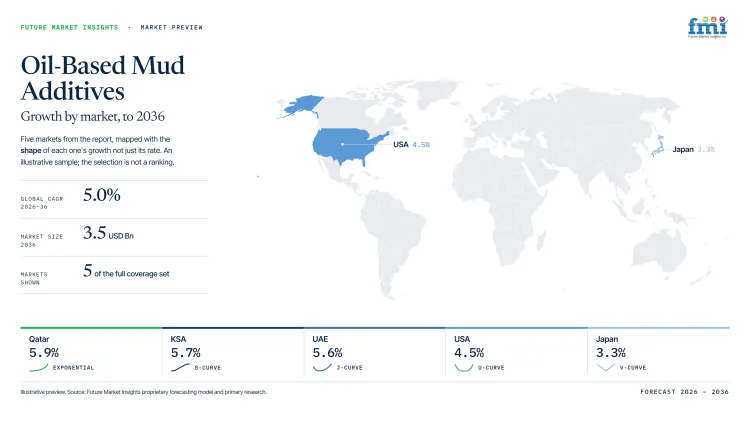
| Country | CAGR |
|---|---|
| Qatar | 5.9% |
| KSA | 5.7% |
| UAE | 5.6% |
| Brazil | 5.0% |
| USA | 4.5% |
| Norway | 4.4% |
| Japan | 3.3% |
How do country-level CAGRs compare in the Oil-Based Mud Additives Market?
The 2.6-percentage-point range separates three Gulf markets above 5.5% from slower mature or selective drilling programs. Brazil occupies the middle at 5.0%. USA and Norway cluster near 4.5% despite different drilling models. Japan's 3.3% rate reflects a smaller domestic offshore program with longer gaps between exploration campaigns.
- Qatar's North Field campaigns lengthen offshore inventory planning.
- KSA's Jafurah laterals increase solids-control treatment intensity.
- UAE's centralized rig fleet rewards formulation consistency.
- Brazil's pre-salt logistics favor shorebase technical stock.
- USA land and Gulf programs require separate inventory models.
- Norway's chemical permits shape carrier and waste choices.
- Japan's episodic exploration favors flexible import stock.
Comparable CAGRs still produce different service costs and stock requirements. The full report provides country-level CAGR analysis across North America, Latin America, Western Europe, Eastern Europe, East Asia, South Asia and Pacific and Middle East and Africa.
Country-wise Analysis
- Qatar's North Field program gives drilling contractors unusually long campaign visibility, so mud inventory can be staged before offshore sections begin. Oil-based mud additive demand in Qatar is forecast to rise at 5.9% CAGR through 2036, driven by sustained gas-field drilling. QatarEnergy's November 2025 investor presentation listed current LNG capacity at 77 MTPA and a 142 MTPA target for 2030. Offshore delivery distance makes emergency reformulation expensive during a treatment change. Local laboratory access and buffered stock therefore carry more value here than spot chemical availability because marine resupply can separate a rig from replacement material for extended periods during offshore drilling.
- Saudi unconventional-gas programs use long horizontal sections where fluid-property drift can extend costly circulation and cleanup work. Aramco reported in February 2026 that Jafurah had started production and Tanajib Gas Plant had begun operations at scale. The KSA oil-based mud additives outlook is anticipated to advance at 5.7% CAGR over the assessment period, attributable to repeat unconventional well construction. Local technical teams can adjust formulations quickly, but additives still have to hold rheology without lifting treatment cost through long sections. Companies that pair bulk mud supply with onshore drilling waste planning can cover treatment and handling requirements inside repeat campaigns.
- ADNOC's centralized rig fleet rewards standard fluid programs because engineers can compare treatment performance on a large set of wells. Oil-based mud additive demand in UAE is projected to grow at 5.6% CAGR during the forecast period, supported by high drilling scale. ADNOC and SLB reported in August 2026 that the RTOC platform covered more than 120 onshore and offshore rigs. Centralized operating data gives fluid teams faster feedback, but one formulation still has to perform through different formations and logistics nodes. Regional inventory and field engineers give entrants a practical response route when a rig needs a treatment correction without a long resupply delay.
- Brazilian pre-salt programs depend on shorebase preparation because long offshore sections leave little tolerance for late chemical resupply. ANP reported in March 2026 that pre-salt production represented 79.9% of national oil and gas output in January. Brazil is expected to record 5.0% CAGR through 2036, driven by continued deepwater well activity. A concentrated pre-salt base supports specialist fluid teams, but vessel schedules slow emergency treatment changes compared with land basins. Companies holding local mud stock can share shorebase laboratories and logistics with oilfield production chemicals teams during multi-well programs that would otherwise carry duplicate offshore support costs during scheduled marine rotations.
- USA demand splits between short-cycle land basins and Gulf programs that require longer mobilization plus separate offshore qualification. Oil-based mud additive sales in USA are predicted to advance at 4.5% CAGR through 2036, supported by both drilling models. BOEM's August 2026 BBG3 sale received 69 bids from 16 companies for 59 Gulf blocks. Lease-sale activity documents operator interest without proving immediate well starts. Entrants need basin-level stock for onshore drilling fluids and longer offshore response plans because the same inventory model cannot serve a fast land program and a marine rig with equal reliability without extra contingency stock during active drilling.
- Norwegian offshore fluid selection gives environmental acceptability equal weight with downhole performance because discharge rules can remove a low-cost carrier before price comparison. The Norwegian Offshore Directorate reported in February 2026 that 2025 oil output was the highest since 2009. Norway is forecast to grow at 4.4% CAGR through 2036, attributable to continued shelf activity. The installed offshore base supports specialist chemistry, but chemical permits and cuttings handling raise service cost more than in many peer markets. A viable offer needs formulations that fit recovery rules plus a drilling waste containment plan before major offshore operators accept the fluid program.
- Japan's domestic offshore schedule remains selective, so a single exploration well can change annual chemical demand more than in continuous drilling basins. JAPEX completed the Offshore Hidaka exploratory well in June 2026 after drilling at a water depth of 1,900 meters. The company confirmed gas but said the identified volume did not support immediate commercialization. Japanese oil-based mud additive demand is projected to grow at 3.3% CAGR through 2036, supported by intermittent deepwater evaluation. A flexible import-and-service model fits this pattern better than permanent high stock because long gaps can follow a noncommercial test and leave dedicated inventory idle between campaigns.
Who are the notable companies in the Oil-Based Mud Additives Market?
Baker Hughes, Halliburton, SLB, Newpark Fluids Systems, Innospec, Elementis, Nouryon, SNF Group, Chevron Phillips Chemical, and TETRA Technologies are the notable companies profiled in this market.
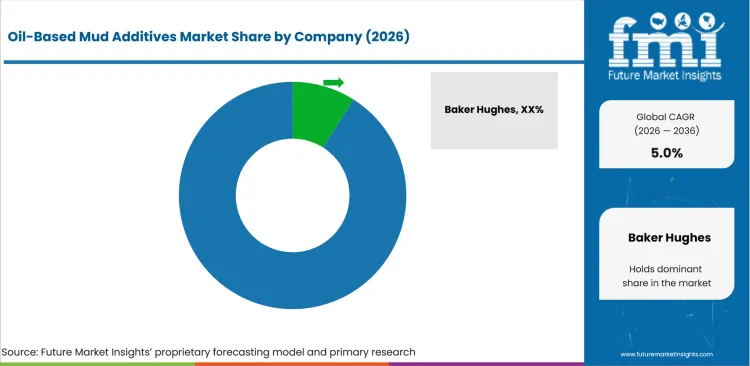
Competition separates integrated drilling-fluid platforms from specialist chemistry and adjacent well-fluid service. Integrated companies carry fluid-design responsibility and field execution. Specialists enter through defined additive functions, so qualification records and service reach matter more than corporate scale.
- Integrated drilling-fluid platforms include Baker Hughes and Halliburton. SLB and Newpark Fluids Systems also compete through full fluid programs.
- Specialty drilling-additive producers include Innospec and Elementis. Nouryon joins SNF Group and Chevron Phillips Chemical in specialist chemistry.
- Adjacent well-fluid specialist: TETRA Technologies.
Competitive Benchmarking: Oil-Based Mud Additives Market
| Company | Nonaqueous Fluid System Integration | Oil-Wet and Rheology Chemistry | Field Fluids Delivery | Geographic Reach |
|---|---|---|---|---|
| Baker Hughes | High | High | High | Global |
| Halliburton | High | High | High | Global |
| SLB | High | High | High | Global |
| Newpark Fluids Systems | High | Medium | High | Americas, Europe, Middle East and Asia-Pacific |
| Innospec | Low | Medium | Medium | Americas, Europe, Middle East, Africa and Asia-Pacific |
| Elementis | Low | High | Low | Global specialty-chemical sales network |
| Nouryon | Low | Medium | Medium | North America, Europe, Middle East and Asia |
| SNF Group | Low | Medium | Medium | Americas, Europe and Asia |
| Chevron Phillips Chemical | Low | Medium | Low | Global specialty-chemical distribution |
| TETRA Technologies | Low | Low | High | United States, Latin America, Europe, Asia, Middle East and Africa |
System integration rates a complete nonaqueous platform High. Partial fluid scope is Medium and a component role is Low. Chemistry rates direct emulsifier or rheology capability High. Adjacent functional additives are Medium and other verified functions are Low. Field delivery rates wellsite fluid service High. Regional technical support is Medium and component supply is Low.
Key Developments in the Oil-Based Mud Additives Market
- In November 2025, Chevron Phillips Chemical introduced NanoSlide after laboratory testing and a Bakken field trial. The lubricant targets friction and pipe wear in drilling fluids.
- In March 2025, SLB won Woodside Energy's Trion drilling contract for 18 ultra-deepwater wells with drilling and completion fluids in scope. The award places fluid service inside a three-year integrated well-construction program.
- In January 2025, Halliburton secured a three-year Petrobras offshore drilling contract with BaraLogix real-time fluid monitoring. Surface measurements and hydraulic software give fluid teams earlier warning of treatment limits.
Key Players in the Oil-Based Mud Additives Market
Integrated Drilling-Fluid Platforms
- Baker Hughes
- Halliburton
- SLB
- Newpark Fluids Systems
Specialty Drilling-Additive Producers
- Innospec
- Elementis
- Nouryon
- SNF Group
- Chevron Phillips Chemical
Adjacent Well-Fluid Chemistry and Delivery
- TETRA Technologies
Oil-Based Mud Additives Market - Report Scope
| Coverage field | Report scope |
|---|---|
| Market breakdown | By additive type, base fluid, well type, function, sales channel and region. |
| Quantitative Units | USD billion. |
| Market Definition | Revenue from additives sold for oil-based drilling-fluid use within the stated segmentation universe. Base-fluid revenue and unrelated completion or stimulation chemical revenue are excluded. |
| Regions Covered | North America, Latin America, Western Europe, Eastern Europe, East Asia, South Asia and Pacific, and Middle East and Africa. |
| Countries Covered | Qatar, KSA, UAE, Brazil, USA, Norway and Japan, with 30+ countries covered in the full report. |
| Key Companies Profiled | Baker Hughes, Halliburton, SLB, Newpark Fluids Systems, Innospec, Elementis, Nouryon, SNF Group, Chevron Phillips Chemical, TETRA Technologies. |
| Forecast Period | 2026 to 2036. |
| Approach | Primary and secondary research with market triangulation. |
Oil-Based Mud Additives Market - Research Methodology
| Method | Approach |
|---|---|
| Primary Research | FMI analysts gathered input from manufacturers, service providers, technology developers, distributors, end users, procurement teams, and subject-matter experts. Interviews examined purchasing decisions, product or service evaluation, adoption barriers, approval requirements, pricing considerations, and expectations for technical or commercial support. Respondents were also asked what evidence is required before a trial, pilot, or initial order develops into regular purchasing. |
| Desk Research | Desk research covered government statistics, regulatory publications, trade data, industry associations, technical literature, standards, company filings, product information, and official corporate announcements. Sources were reviewed for relevance, publication date, geographic coverage, and consistency with the defined market scope. Claims relating to performance, applications, approvals, capacity, investment, and commercial activity were retained only when supported by credible public evidence. |
| Market Sizing and Forecasting | The market model combined the baseline value with historical performance, segment structure, pricing and volume indicators, adoption levels, company participation, and country-level demand conditions. Forecast assumptions considered economic activity, investment trends, regulatory developments, technology adoption, purchasing cycles, supply availability, and barriers to wider market use. Segment and regional estimates were reconciled before the final market total was calculated. |
| Data Validation | Estimates were checked against multiple independent indicators, including public data, company activity, trade patterns, industry developments, and findings from primary interviews. Validation also tested whether products, services, applications, and company revenues fell within the defined market boundaries. Adjacent categories, unsupported claims, overlapping revenues, and activities without direct market relevance were excluded to reduce double counting and maintain consistency across segments and countries. |
Oil-Based Mud Additives Market by Segments
Oil-Based Mud Additives Market segmented by Additive Type:
- Oil-wet emulsifiers
- Organophilic clays
- Wetting agents
- Rheology modifiers
- Filtration control additives
- Lime - alkalinity control
Oil-Based Mud Additives Market segmented by Base Fluid:
- Diesel-based mud
- Mineral oil-based mud
- Low-aromatic oil-based mud
- Synthetic-oil blends
Oil-Based Mud Additives Market segmented by Well Type:
- Offshore wells
- Deepwater wells
- HPHT wells
- Shale wells
- Directional wells
Oil-Based Mud Additives Market segmented by Function:
- Emulsion stability
- Rheology control
- Fluid loss control
- Lubricity
- Shale stability
Oil-Based Mud Additives Market segmented by Sales Channel:
- Oilfield service companies
- Direct specialty chemical supply
- Mud service contractors
- Regional chemical distributors
Oil-Based Mud Additives Market by Region:
- North America
- United States
- Canada
- Latin America
- Brazil
- Mexico
- Argentina
- Chile
- Western Europe
- Germany
- France
- United Kingdom
- Italy
- Spain
- Benelux
- Nordics
- Eastern Europe
- Poland
- Czech Republic
- Romania
- Hungary
- East Asia
- China
- Japan
- South Korea
- South Asia and Pacific
- India
- ASEAN
- Australia and New Zealand
- Middle East and Africa
- GCC Countries
- South Africa
- Türkiye
- Israel
Research Sources and Bibliography
- Bureau of Safety and Environmental Enforcement. (2026, September 2). Deepwater Activity Weekly Report.
- Agência Nacional do Petróleo, Gás Natural e Biocombustíveis. (2026, June 30). ANP divulga dados consolidados do setor regulado em 2025.
- Innospec Inc. (2026, February 18). Annual report on Form 10-K for 2025.
- Offshore Petroleum Regulator for Environment and Decommissioning. (2025, June). Environmental Alert 001/2025: Offshore chemical permit concentration compliance.
- Bureau of Safety and Environmental Enforcement. (2026, September 6). Gulf of America Permanent Deepwater Structures.
- Elementis plc. (2026, March 26). Annual Report and Accounts 2025.
- Baker Hughes Company. (2026, February 5). Annual report on Form 10-K for 2025.
- Bureau of Safety and Environmental Enforcement. (2026, September 1). Status of Well Permits in the Gulf of America.
- Offshore Petroleum Regulator for Environment and Decommissioning. (2026, February). Environmental Alert 001/2026: Offshore chemicals used in open systems.
- Nouryon. (2025, June 18). Nouryon launches Innovation Center for oilfield solutions in Texas, US.
- QatarEnergy. (2025, November). QatarEnergy Investors Presentation.
- Saudi Aramco. (2026, February 26). Aramco’s gas strategy builds momentum with major progress towards growth target.
- ADNOC. (2026, August 4). ADNOC and SLB Deploy AI Platform Across Over 120 Drilling Rigs to Strengthen Upstream Performance.
- Agência Nacional do Petróleo, Gás Natural e Biocombustíveis. (2026, March 2). ANP divulga dados consolidados da produção de petróleo e gás em janeiro de 2026.
- Bureau of Ocean Energy Management. (2026, August 12). Big Beautiful Gulf 3 Oil & Gas Lease Sale.
- Norwegian Offshore Directorate. (2026, February 20). High production and increase in petroleum resources.
- Japan Petroleum Exploration Co., Ltd. (2026, June 12). Completion of Exploratory Drilling at Offshore Hidaka Area of Hokkaido.
- Halliburton Company. (2026, February 10). Annual report on Form 10-K for 2025.
- SLB. (2026, January 28). Annual report on Form 10-K for 2025.
- Newpark Fluids Systems. (2025, June 23). Newpark Fluids Systems Strengthens Executive Leadership and Board to Drive Continued Growth.
- Chevron Phillips Chemical. (2025, November 17). NanoSlide Drilling Fluid Lubricant: A Game-Changer in Lubrication.
- Baker Hughes. (2026, May 26). Baker Hughes Extends and Expands Integrated Well Construction Contract with Petrobras.
- TETRA Technologies, Inc. (2026, February 24). Annual report on Form 10-K for 2025.
- Chevron Phillips Chemical. (2025, June). Sustainability Report 2024.
- SNF Group. (2025, October 31). SNF Group to Acquire the Oil & Gas Division of Syensqo.
- Baker Hughes. (2026, January 28). Baker Hughes Launches Kantori, a Unified Digital Autonomous Well Construction Solution.
- SNF Group. (2026, January 2). SNF Group Completes the Acquisition of the Oil & Gas Division of Syensqo.
- SLB. (2025, March 31). SLB Awarded Major Drilling Contract by Woodside Energy for Ultra-deepwater Trion Development, Offshore Mexico.
- Innospec Inc. (2025, April 9). Innospec Oilfield Services' OKC manufacturing center has earned ISO 9001 certification!
- Halliburton. (2025, January 30). Halliburton secures major offshore drilling contract with Petrobras.
- Elementis plc. (2026). Certifications. Retrieved September 8, 2026.
- Newpark Fluids Systems. (2025, September 4). Intelligent Mud Solutions (IMS) and Newpark Fluids Systems Announce Strategic Collaboration Agreement for Real-Time Fluids Measurement.
- TETRA Technologies, Inc. (2026, June 29). TETRA Technologies Introduces TETRA Neptune Z-Lite Deepwater Completions Fluid.
This bibliography is provided for reader reference and is not exhaustive. The full report contains the complete reference list and detailed citations.
This Report Answers
- How large is the oil-based mud additives market in 2026 and 2036?
- Which well conditions support recurring oil-based mud additive use?
- Why do oil-wet emulsifiers hold the leading additive type share?
- How do base-fluid rules change additive qualification?
- Why do offshore wells account for the largest well type share?
- How do country CAGRs differ across the seven profiled countries?
- Which companies provide integrated fluid systems or specialist drilling chemistry?
- What raises the delivered cost of conventional nonaqueous systems?
- Which service capabilities shorten laboratory-to-field qualification?
Frequently Asked Questions
How big is the Oil-Based Mud Additives Market in 2026?
The oil-based mud additives market is valued at USD 2.1 billion in 2026 and is projected to reach USD 3.5 billion by 2036. Difficult wells sustain demand because unstable fluid performance can consume costly rig time.
What is the CAGR of the Oil-Based Mud Additives Market from 2026 to 2036?
The oil-based mud additives market is projected to grow at a CAGR of 5.0% between 2026 and 2036. Technically difficult drilling programs sustain qualified nonaqueous fluid use.
Which additive type leads the Oil-Based Mud Additives Market?
The oil-wet emulsifiers segment is expected to hold 24.0% of the oil-based mud additives market in 2026, attributable to interface stability and solids wetting. Contamination changes can raise treatment frequency during a well section.
How much value will the Oil-Based Mud Additives Market add between 2026 and 2036?
The market is expected to add USD 1.4 billion in annual value between 2026 and 2036. Difficult wells support spending on additive packages and field treatment.
Which companies are active in the Oil-Based Mud Additives Market?
Key companies operating in the market include Baker Hughes, Halliburton, SLB, Newpark Fluids Systems, Innospec, Elementis, Nouryon, SNF Group, Chevron Phillips Chemical, and TETRA Technologies. Competition centers on fluid-system scope and specialist chemistry plus qualification support and regional field delivery.
Preview the report firsthand - request a free sample
Get SampleGet the brochure for pricing and purchase details.
Get PDFTable of Content
- Key Takeaways
- Market Size and CAGR
- Top Growth Driver
- Fastest Growing Segment
- Leading Region
- Key Companies
- Emerging Opportunities
- Executive Summary
- Global Market Outlook
- Demand-side Trends
- Supply-side Trends
- Technology Roadmap Analysis
- Analysis and Recommendations
- Analyst Perspective (What is happening? Why now? What should investors know?)
- Key Questions Answered
- How large is the market?
- What is the CAGR?
- What are key trends?
- Which region dominates?
- Who are the leaders?
- Market Overview
- Market Coverage / Taxonomy
- Market Definition / Scope / Limitations
- Research Methodology
- Chapter Orientation
- Analytical Lens and Working Hypotheses
- Market Structure, Signals, and Trend Drivers
- Benchmarking and Cross-market Comparability
- Market Sizing, Forecasting, and Opportunity Mapping
- Research Design and Evidence Framework
- Desk Research Programme (Secondary Evidence)
- Expert Input and Fieldwork (Primary Evidence)
- Tooling, Models, and Reference Databases
- Data Engineering and Model Build
- Quality Assurance and Audit Trail
- Market Background
- Market Dynamics (Drivers, Restraints, Opportunity, Trends)
- Scenario Forecast (Optimistic, Likely, Conservative)
- Impact Analysis
- AI Impact
- Sustainability Impact
- Regulatory Impact
- Technology Impact
- Consumer / Buyer Analysis
- Purchase Drivers
- Adoption Barriers
- Buyer Journey
- Opportunity Map Analysis
- Product Life Cycle Analysis
- Supply Chain Analysis
- Investment Feasibility Matrix
- Value Chain Analysis
- PESTLE and Porter's Analysis
- Regulatory Landscape
- Regional Parent Market Outlook
- Production and Consumption Statistics
- Import and Export Statistics
- Global Market Analysis and Forecast, 2021 to 2036
- Historical Market Size Value (USD Billion) Analysis, 2021 to 2025
- Current and Future Market Size Value (USD Billion) Projections, 2026 to 2036
- Y-o-Y Growth Trend Analysis
- Absolute $ Opportunity Analysis
- Global Market Pricing Analysis, 2021 to 2036
- Global Market Analysis and Forecast, By Additive Type, 2021 to 2036
- Introduction / Key Findings
- Historical Market Size Value (USD Billion) Analysis By Additive Type, 2021 to 2025
- Current and Future Market Size Value (USD Billion) Analysis and Forecast By Additive Type, 2026 to 2036
- Oil-wet emulsifiers
- Organophilic clays
- Wetting agents
- Rheology modifiers
- Filtration control additives
- Lime / alkalinity control
- Oil-wet emulsifiers
- Y-o-Y Growth Trend Analysis By Additive Type, 2021 to 2025
- Absolute $ Opportunity Analysis By Additive Type, 2026 to 2036
- Global Market Analysis and Forecast, By Base Fluid, 2021 to 2036
- Introduction / Key Findings
- Historical Market Size Value (USD Billion) Analysis By Base Fluid, 2021 to 2025
- Current and Future Market Size Value (USD Billion) Analysis and Forecast By Base Fluid, 2026 to 2036
- Diesel-based mud
- Mineral oil-based mud
- Low-aromatic oil-based mud
- Synthetic-oil blends
- Diesel-based mud
- Y-o-Y Growth Trend Analysis By Base Fluid, 2021 to 2025
- Absolute $ Opportunity Analysis By Base Fluid, 2026 to 2036
- Global Market Analysis and Forecast, By Well Type, 2021 to 2036
- Introduction / Key Findings
- Historical Market Size Value (USD Billion) Analysis By Well Type, 2021 to 2025
- Current and Future Market Size Value (USD Billion) Analysis and Forecast By Well Type, 2026 to 2036
- Offshore wells
- Deepwater wells
- HPHT wells
- Shale wells
- Directional wells
- Offshore wells
- Y-o-Y Growth Trend Analysis By Well Type, 2021 to 2025
- Absolute $ Opportunity Analysis By Well Type, 2026 to 2036
- Global Market Analysis and Forecast, By Function, 2021 to 2036
- Introduction / Key Findings
- Historical Market Size Value (USD Billion) Analysis By Function, 2021 to 2025
- Current and Future Market Size Value (USD Billion) Analysis and Forecast By Function, 2026 to 2036
- Emulsion stability
- Rheology control
- Fluid loss control
- Lubricity
- Shale stability
- Emulsion stability
- Y-o-Y Growth Trend Analysis By Function, 2021 to 2025
- Absolute $ Opportunity Analysis By Function, 2026 to 2036
- Global Market Analysis and Forecast, By Sales Channel, 2021 to 2036
- Introduction / Key Findings
- Historical Market Size Value (USD Billion) Analysis By Sales Channel, 2021 to 2025
- Current and Future Market Size Value (USD Billion) Analysis and Forecast By Sales Channel, 2026 to 2036
- Oilfield service companies
- Direct specialty chemical supply
- Mud service contractors
- Regional chemical distributors
- Oilfield service companies
- Y-o-Y Growth Trend Analysis By Sales Channel, 2021 to 2025
- Absolute $ Opportunity Analysis By Sales Channel, 2026 to 2036
- Global Market Analysis and Forecast, By Region, 2021 to 2036
- Introduction
- Historical Market Size Value (USD Billion) Analysis By Region, 2021 to 2025
- Current Market Size Value (USD Billion) Analysis and Forecast By Region, 2026 to 2036
- North America
- Latin America
- Western Europe
- Eastern Europe
- East Asia
- South Asia and Pacific
- Middle East & Africa
- Market Attractiveness Analysis By Region
- North America Market Analysis and Forecast, By Country, 2021 to 2036
- Historical Market Size Value (USD Billion) Trend Analysis By Market Taxonomy, 2021 to 2025
- Market Size Value (USD Billion) Forecast By Market Taxonomy, 2026 to 2036
- By Country
- USA
- Canada
- By Additive Type
- By Base Fluid
- By Well Type
- By Function
- By Sales Channel
- By Country
- Market Attractiveness Analysis
- By Country
- By Additive Type
- By Base Fluid
- By Well Type
- By Function
- By Sales Channel
- Key Takeaways
- Latin America Market Analysis and Forecast, By Country
- Historical Market Size Value (USD Billion) Trend Analysis By Market Taxonomy, 2021 to 2025
- Market Size Value (USD Billion) Forecast By Market Taxonomy, 2026 to 2036
- By Country
- Brazil
- Mexico
- Chile
- Rest of Latin America
- By Additive Type
- By Base Fluid
- By Well Type
- By Function
- By Sales Channel
- By Country
- Market Attractiveness Analysis
- By Country
- By Additive Type
- By Base Fluid
- By Well Type
- By Function
- By Sales Channel
- Key Takeaways
- Western Europe Market Analysis and Forecast, By Country
- Historical Market Size Value (USD Billion) Trend Analysis By Market Taxonomy, 2021 to 2025
- Market Size Value (USD Billion) Forecast By Market Taxonomy, 2026 to 2036
- By Country
- Germany
- UK
- Italy
- Spain
- France
- Nordic
- BENELUX
- Rest of Western Europe
- By Additive Type
- By Base Fluid
- By Well Type
- By Function
- By Sales Channel
- By Country
- Market Attractiveness Analysis
- By Country
- By Additive Type
- By Base Fluid
- By Well Type
- By Function
- By Sales Channel
- Key Takeaways
- Eastern Europe Market Analysis and Forecast, By Country
- Historical Market Size Value (USD Billion) Trend Analysis By Market Taxonomy, 2021 to 2025
- Market Size Value (USD Billion) Forecast By Market Taxonomy, 2026 to 2036
- By Country
- Russia
- Poland
- Hungary
- Balkan & Baltic
- Rest of Eastern Europe
- By Additive Type
- By Base Fluid
- By Well Type
- By Function
- By Sales Channel
- By Country
- Market Attractiveness Analysis
- By Country
- By Additive Type
- By Base Fluid
- By Well Type
- By Function
- By Sales Channel
- Key Takeaways
- East Asia Market Analysis and Forecast, By Country
- Historical Market Size Value (USD Billion) Trend Analysis By Market Taxonomy, 2021 to 2025
- Market Size Value (USD Billion) Forecast By Market Taxonomy, 2026 to 2036
- By Country
- China
- Japan
- South Korea
- By Additive Type
- By Base Fluid
- By Well Type
- By Function
- By Sales Channel
- By Country
- Market Attractiveness Analysis
- By Country
- By Additive Type
- By Base Fluid
- By Well Type
- By Function
- By Sales Channel
- Key Takeaways
- South Asia and Pacific Market Analysis and Forecast, By Country
- Historical Market Size Value (USD Billion) Trend Analysis By Market Taxonomy, 2021 to 2025
- Market Size Value (USD Billion) Forecast By Market Taxonomy, 2026 to 2036
- By Country
- India
- ASEAN
- Australia & New Zealand
- Rest of South Asia and Pacific
- By Additive Type
- By Base Fluid
- By Well Type
- By Function
- By Sales Channel
- By Country
- Market Attractiveness Analysis
- By Country
- By Additive Type
- By Base Fluid
- By Well Type
- By Function
- By Sales Channel
- Key Takeaways
- Middle East & Africa Market Analysis and Forecast, By Country
- Historical Market Size Value (USD Billion) Trend Analysis By Market Taxonomy, 2021 to 2025
- Market Size Value (USD Billion) Forecast By Market Taxonomy, 2026 to 2036
- By Country
- Kingdom of Saudi Arabia
- Other GCC Countries
- Türkiye
- South Africa
- Other African Union
- Rest of Middle East & Africa
- By Additive Type
- By Base Fluid
- By Well Type
- By Function
- By Sales Channel
- By Country
- Market Attractiveness Analysis
- By Country
- By Additive Type
- By Base Fluid
- By Well Type
- By Function
- By Sales Channel
- Key Takeaways
- Key Countries Market Analysis
- USA
- Pricing Analysis
- Market Share Analysis, 2025
- By Additive Type
- By Base Fluid
- By Well Type
- By Function
- By Sales Channel
- Canada
- Pricing Analysis
- Market Share Analysis, 2025
- By Additive Type
- By Base Fluid
- By Well Type
- By Function
- By Sales Channel
- Mexico
- Pricing Analysis
- Market Share Analysis, 2025
- By Additive Type
- By Base Fluid
- By Well Type
- By Function
- By Sales Channel
- Brazil
- Pricing Analysis
- Market Share Analysis, 2025
- By Additive Type
- By Base Fluid
- By Well Type
- By Function
- By Sales Channel
- Chile
- Pricing Analysis
- Market Share Analysis, 2025
- By Additive Type
- By Base Fluid
- By Well Type
- By Function
- By Sales Channel
- Germany
- Pricing Analysis
- Market Share Analysis, 2025
- By Additive Type
- By Base Fluid
- By Well Type
- By Function
- By Sales Channel
- UK
- Pricing Analysis
- Market Share Analysis, 2025
- By Additive Type
- By Base Fluid
- By Well Type
- By Function
- By Sales Channel
- Italy
- Pricing Analysis
- Market Share Analysis, 2025
- By Additive Type
- By Base Fluid
- By Well Type
- By Function
- By Sales Channel
- Spain
- Pricing Analysis
- Market Share Analysis, 2025
- By Additive Type
- By Base Fluid
- By Well Type
- By Function
- By Sales Channel
- France
- Pricing Analysis
- Market Share Analysis, 2025
- By Additive Type
- By Base Fluid
- By Well Type
- By Function
- By Sales Channel
- India
- Pricing Analysis
- Market Share Analysis, 2025
- By Additive Type
- By Base Fluid
- By Well Type
- By Function
- By Sales Channel
- ASEAN
- Pricing Analysis
- Market Share Analysis, 2025
- By Additive Type
- By Base Fluid
- By Well Type
- By Function
- By Sales Channel
- Australia & New Zealand
- Pricing Analysis
- Market Share Analysis, 2025
- By Additive Type
- By Base Fluid
- By Well Type
- By Function
- By Sales Channel
- China
- Pricing Analysis
- Market Share Analysis, 2025
- By Additive Type
- By Base Fluid
- By Well Type
- By Function
- By Sales Channel
- Japan
- Pricing Analysis
- Market Share Analysis, 2025
- By Additive Type
- By Base Fluid
- By Well Type
- By Function
- By Sales Channel
- South Korea
- Pricing Analysis
- Market Share Analysis, 2025
- By Additive Type
- By Base Fluid
- By Well Type
- By Function
- By Sales Channel
- Russia
- Pricing Analysis
- Market Share Analysis, 2025
- By Additive Type
- By Base Fluid
- By Well Type
- By Function
- By Sales Channel
- Poland
- Pricing Analysis
- Market Share Analysis, 2025
- By Additive Type
- By Base Fluid
- By Well Type
- By Function
- By Sales Channel
- Hungary
- Pricing Analysis
- Market Share Analysis, 2025
- By Additive Type
- By Base Fluid
- By Well Type
- By Function
- By Sales Channel
- Kingdom of Saudi Arabia
- Pricing Analysis
- Market Share Analysis, 2025
- By Additive Type
- By Base Fluid
- By Well Type
- By Function
- By Sales Channel
- Türkiye
- Pricing Analysis
- Market Share Analysis, 2025
- By Additive Type
- By Base Fluid
- By Well Type
- By Function
- By Sales Channel
- South Africa
- Pricing Analysis
- Market Share Analysis, 2025
- By Additive Type
- By Base Fluid
- By Well Type
- By Function
- By Sales Channel
- USA
- Market Structure Analysis
- Competition Dashboard
- Competition Benchmarking
- Market Share Analysis of Top Players
- By Regional
- By Additive Type
- By Base Fluid
- By Well Type
- By Function
- By Sales Channel
- Emerging Startups
- Innovation Benchmarking
- Competition Analysis
- Competition Deep Dive
- Baker Hughes
- Overview
- Product Portfolio
- Profitability by Market Segments
- Sales Footprint
- Strategy Overview
- Marketing Strategy
- Product Strategy
- Channel Strategy
- Halliburton
- SLB
- Newpark Resources
- Innospec
- Clariant
- Nouryon
- Solvay
- Chevron Phillips Chemical
- TETRA Technologies
- Baker Hughes
- Case Studies
- Success Stories
- Recent Developments
- Competition Deep Dive
- Assumptions & Acronyms Used


