

- Market Size (2026)
- USD 1.9 Bn
- Forecast (2036)
- USD 4.0 Bn
- CAGR (2026 to 2036)
- 7.6%
How big is Oil Condition Monitors Market in 2026?
USD 1.9 billion in 2026 and USD 4.0 billion by 2036 at a 7.6% CAGR.
Demand for oil condition monitors is projected to push industry valuation from USD 1.9 billion in 2026 to USD 4.0 billion by 2036 at 7.6% CAGR from 2026 to 2036 as maintenance teams replace fixed service intervals with measured lubricant evidence. SGS reported in August 2025 that Australian users of online oil monitoring kits can maintain regular testing schedules and switch selected equipment to condition-based servicing. The service route gives condition monitoring systems a defined purchasing role by changing inspection timing or oil replacement on an installed asset.
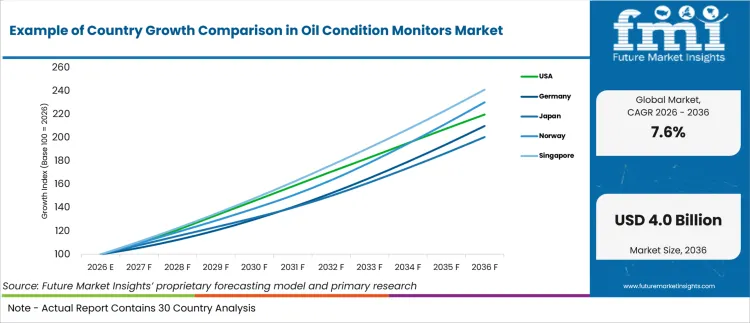
Country readiness affects the conversion of connected oil monitoring into routine orders because remote monitoring depends on communications access and local service coverage. Singapore is forecast at 7.0% CAGR while Japan is projected at 5.9% under different maritime monitoring conditions. MPA reported in March 2026 that maritime 5G coverage reached major fairways and terminals during 2025 to support real-time applications. Low-latency maritime coverage reduces a practical barrier for condition monitoring services that send alarms and trend data between vessels and shore teams.
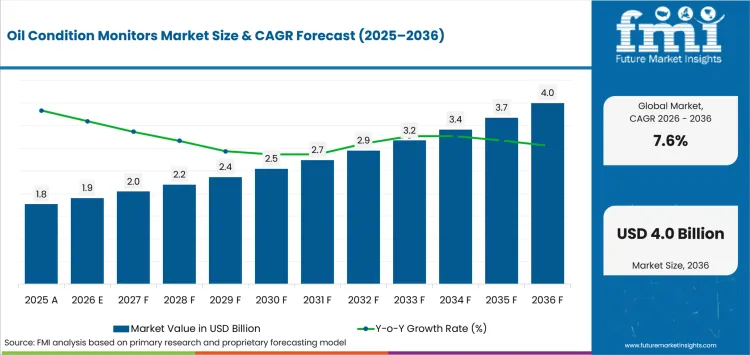
Key Takeaways of Oil Condition Monitors Market
- Maintenance teams increase oil condition monitoring as repeated measurements change filtration work or inspection timing ahead of equipment damage.
- The particle counters segment is likely to capture 23.0% share in 2026 attributable to contamination screening across lubricated machinery for filtration or inspection decisions.
- By deployment, online sensors are estimated to hold 39.0% in 2026 owing to continuous readings from installed equipment.
- Engine oil is set to lead the oil type category with 26.0% share in 2026 due to recurring samples that inform drain timing and mechanical investigation.
- Validation effort can slow adoption as alarm limits must remain credible across oil formulations and changing equipment operating conditions.
- AMETEK Spectro Scientific, Tan Delta Systems plc, Gastops Ltd., Shell plc, SGS, Fluid Intelligence Oy, MP Filtri S.p.A. and Parker-Hannifin Corporation are some key players.
Analyst Perspective
“Oil condition monitors earn repeat spending once technicians can tie particle, water or wear changes to a specific maintenance action without reworking the sampling route. The stronger commercial offer combines repeatable measurement with calibration support and data integration so each alarm remains defensible across the same asset over time.”
- Nikhil Kaitwade, Principal Consultant, Future Market Insights
How is the Oil Condition Monitors Market segmented?
The oil condition monitors market is segmented by monitor type, deployment, oil type, application, end use, sales model and region.
Monitor type includes particle counters, water-in-oil sensors, dielectric/TAN sensors, viscosity sensors, ferrous wear debris monitors and multi-parameter oil monitors. Deployment covers portable analyzers, online sensors, laboratory instruments and cloud-connected monitoring kits. Oil types are engine, hydraulic, gear, turbine and marine lube oil. Applications include marine engines, gearboxes, hydraulic systems, thrusters/propulsion and auxiliary machinery. End uses are marine, industrial manufacturing, power generation, mining and oil and gas. Sales models are device sale, monitoring subscription and bundled lab testing service.
What supports marine engines as the leading application?
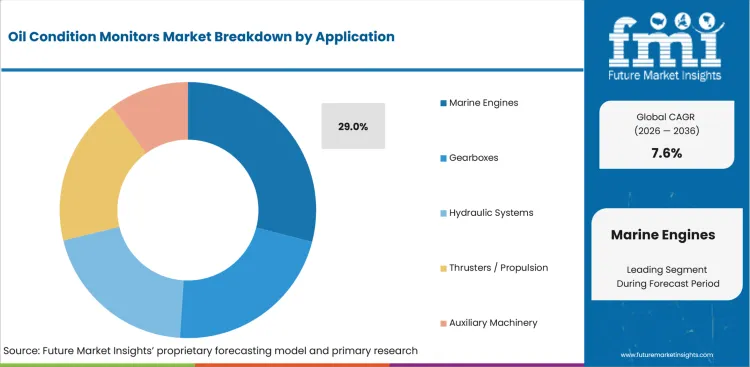
Marine engines operate far from laboratories so crews need oil evidence during voyages and port calls. Vessel engineers also need equipment that tolerates vibration and limited crew time during routine maintenance.
- The application category is forecast to be led by marine engines at 29.0% share in 2026 due to propulsion maintenance needs during voyages.
- Gastops and Leeway Marine reported in May 2025 that continuous oil condition and wear monitoring completed a full 2024 sailing season aboard the research vessel Novus. Marine greases and lubricants gain more value as compact onboard workflows fit established sampling duties during voyages.
What makes particle counters central to the monitor type category?
Particle counters give reliability teams a direct contamination signal that can trigger filtration or closer inspection across hydraulic and gearbox assets. MP Filtri announced its ICS inline sensors in February 2025 for continuous particle monitoring under ISO 4406 on systems operating up to 420 bar.
- Based on monitor type, particle counters are projected to account for 23.0% in 2026 due to contamination screening across lubricated assets exposed to wear debris.
- Hydraulic fluids need representative cleanliness readings so technicians can separate external contamination from internally generated wear and select filtration or component inspection.
Why do online sensors lead the deployment category?
Online sensors support continuous condition readings where maintenance teams require early visibility of contamination, water or wear changes. Their installed position enables trend monitoring without relying on a manual sampling route for every measurement.
- In 2026, online sensors are expected to lead deployment with 39.0% share because continuous data supports condition-based maintenance decisions.
- Gastops launched FluidSIGHT in April 2026 as an in-line system for real-time oil condition, contamination and wear monitoring. Continuous measurement helps maintenance teams identify abnormal trends before planned inspections or service intervals.
How does engine oil support leadership in the oil type category?
Engine oil carries wear particles and chemistry changes that can alter drain timing or trigger mechanical investigation during scheduled service.
- By oil type, engine oil is forecast to represent 26.0% in 2026 driven by recurring samples that connect lubricant condition with engine service decisions. SGS reported in June 2025 that its French oil condition monitoring laboratory could process 900 samples daily and assess engine wear plus lubricant condition.
- Lubricant additives affect acidity and oxidation behavior so maintenance teams need trend histories that separate normal formulation changes from abnormal equipment deterioration.
What are the drivers, restraints and opportunities in the Oil Condition Monitors Market?
Condition-based maintenance supports demand while poor decision conversion limits scale and connected multi-parameter monitoring increases recurring service potential.
- Driver: Frequent oil sampling gains commercial value once measured changes lead directly to filtration work or equipment inspection.
- Restraint: Monitoring programs lose economic value if repeated samples rarely produce maintenance actions or preventable equipment interventions.
- Opportunity: Connected multi-parameter monitoring can add recurring analytics revenue as trend history improves work-order prioritization across several assets.
Frequent Sampling Makes Maintenance Evidence Actionable
Repeated oil sampling earns its cost once maintenance teams use each result to decide whether equipment can remain in service or needs inspection. A USA Army test center reported in February 2025 that maintainers sometimes sampled vehicle oils every 25 operating hours during equipment trials. Frequent sampling strengthens predictive maintenance programs once defined thresholds turn contamination or wear changes into a documented work order.
Low Action Conversion Weakens Program Economics
Low action conversion leaves laboratory work and technician time intact while weakening the case for more instruments across fleets with stable operating conditions. The USA Army reported in September 2025 that fewer than 1% of returned AOAP samples produced maintenance actions across the global program.
Connected Monitoring Extends the Revenue Model
Connected monitoring becomes more valuable as oil readings remain as trends tied to the same machine and maintenance record. Fluid Intelligence secured a European patent in December 2025 covering Connected Oil and Fluid Eye for real-time monitoring plus lifecycle reporting. AI-driven predictive maintenance services can add recurring software revenue once technicians can rank abnormal assets without replacing installed measurement hardware.
Which country CAGRs are profiled in the Oil Condition Monitors Market?
| Country | CAGR |
|---|---|
| Singapore | 7.0% |
| Norway | 6.9% |
| USA | 6.6% |
| Germany | 6.2% |
| Japan | 5.9% |
How do country-level CAGRs compare in the Oil Condition Monitors Market?
The profiled countries span 1.1 percentage points between Singapore at 7.0% CAGR and Japan at 5.9% from 2026 to 2036. Singapore and Norway form a narrow marine-focused upper group while the USA occupies the middle position. Germany and Japan remain close as mature markets with longer qualification and integration cycles.
- Singapore combines dense vessel calls with port connectivity that favors ship-to-shore monitoring.
- Norway’s dispersed merchant fleet raises the value of onboard trending between service visits.
- USA pairs broad industrial service coverage with mixed installed assets needing flexible deployment.
- Germany requires monitor data to fit calibration records and established maintenance routines.
- Japan gives stable alarm behavior greater weight during long marine qualification cycles.
The narrow CAGR spread therefore masks different service costs and qualification routes. The full report provides country-level CAGR analysis across North America, Latin America, Europe, East Asia, South Asia, Oceania and the Middle East and Africa.
Country-wise Analysis
- Singapore concentrates vessel calls and marine service companies inside a compact port system that lets technicians reach ships between voyages. Tan Delta Systems announced in October 2025 that Shell Marine Products Singapore ordered real-time oil condition sensors for deployment across several vessels. Oil condition monitor demand in Singapore is forecast to rise at 7.0% CAGR over the forecast period aided by dense fleet activity and digital ship-to-shore links. Owners use different machinery controls and data formats, making mixed onboard systems a practical integration friction. Market entry therefore favors equipment with local calibration support and interfaces that technicians can verify during routine port calls.
- Statistics Norway reported in January 2026 that the 2025 merchant fleet contained 1,498 vessels across coastal and international service. Long offshore routes make specialist visits expensive and raise the value of dependable onboard trending between scheduled maintenance windows. Norway is estimated to post 6.9% CAGR over the forecast period reinforced by marine assets that require condition decisions away from laboratories. Harsh weather and costly false alarms tighten acceptance thresholds so new entrants need marine-rated hardware plus local technical support for propulsion and auxiliary equipment. Remote trend support also matters if engineers cannot bring a specialist aboard during an emerging equipment condition.
- The USA combines national industrial service networks with a dispersed marine fleet that uses route-based testing and permanent sensing across engines and hydraulic equipment. Adoption of oil condition monitors in the USA is estimated to expand at 6.6% CAGR through 2036 supported by service access across a large installed equipment base. MARAD reported in March 2026 that the USA-flag ocean-going merchant fleet contained 188 vessels of at least 1,000 gross tons. Equipment age and maintenance standards vary across sites so monitor manufacturers must prove repeatable readings and practical retrofit support as operators expand monitoring across mixed industrial and maritime assets.
- German ports and industrial plants use mature maintenance programs that judge oil monitors against existing calibration records and service routines. Standard interfaces help technicians compare new sensor readings with established laboratory or route-based checks across engines and hydraulic equipment. Germany’s oil condition monitors outlook is anticipated to advance at 6.2% CAGR over the assessment period supported by engineering service depth. MAN Energy Solutions expanded its Multi Fluid Monitor in January 2025 to cover continuous lube-oil monitoring on two-stroke engines. Long qualification cycles remain a friction so monitor manufacturers need repeatable readings plus service support that fits established industrial and marine maintenance procedures.
- Japanese coastal shipping keeps marine engines on intensive operating routes that reward stable alarms and planned maintenance between scheduled port calls. Operators often retain established inspection routines until a new oil monitoring method proves repeatable across long engine service cycles. Oil condition monitor sales in Japan are forecast to expand at 5.9% CAGR by 2036 aided by marine engineering skills and careful equipment qualification. Equipment manufacturers gain access by documenting alarm behavior and supporting onboard staff during the transition from laboratory testing to more frequent condition checks. NYK announced in April 2026 that group company Nippon Yuka would launch lubricating-oil analysis for condition monitoring of ammonia-fueled engines after verification trials.
Who are the notable companies in the Oil Condition Monitors Market?
AMETEK Spectro Scientific, Tan Delta Systems plc, Gastops Ltd., Shell plc, SGS, Fluid Intelligence Oy, MP Filtri S.p.A. and Parker-Hannifin Corporation are the notable companies serving this market.
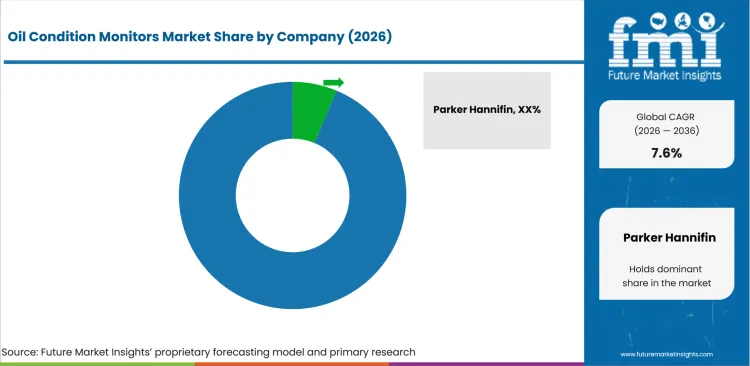
Competition is fragmented among three groups: fluid-analysis instrument makers, inline oil-sensing specialists and service providers that interpret samples within existing maintenance programs. Plants and fleets hesitate to replace established laboratory or route-based checks without comparable records, making repeatable readings and retrofit support key entry requirements. machine condition monitoring platforms compete for the same reliability budgets once technicians combine lubricant evidence with vibration or temperature data.
- AMETEK Spectro Scientific, Gastops Ltd. and Parker-Hannifin Corporation compete with portable analysis and broader fluid-diagnostics instrument platforms.
- Tan Delta Systems plc, Fluid Intelligence Oy and MP Filtri S.p.A. focus on inline sensing and connected condition trending.
- Shell plc and SGS pair oil measurements with marine or laboratory services that provide expert interpretation beside measured results.
Competitive Benchmarking: Oil Condition Monitors Market
| Company | Current Deployment Evidence | Installed-Asset Fit | Service / Analytics Depth | Geographic Reach |
|---|---|---|---|---|
| AMETEK Spectro Scientific | Medium | Medium | High | Global |
| Tan Delta Systems plc | High | High | Medium | Europe and United States |
| Gastops Ltd. | High | High | High | North America and international deployments |
| Shell plc | Medium | High | High | Global marine and industrial markets |
| SGS | High | High | High | Global laboratory and field-service network |
| Fluid Intelligence Oy | Medium | High | High | Europe |
| MP Filtri S.p.A. | Medium | Medium | Medium | Italy, United Kingdom and United States |
| Parker-Hannifin Corporation | Medium | High | High | Global industrial and marine channels |
Key Developments in the Oil Condition Monitors Market
- In June 2026, Gastops Ltd. delivered its 20,000th MetalSCAN oil debris monitoring sensor for Pratt & Whitney’s F135 engine program.
- In April 2026, AMETEK Spectro Scientific introduced TruVu 360 Fluid IQ, an AI-powered capability that compares on-site fluid results with historical data to forecast oil degradation and remaining service life.
- In November 2025, Tan Delta Systems plc began a paid Phase 2 gearbox trial across additional European and United States distribution centers.
Key Players in the Oil Condition Monitors Market
Instrument and On-site Analysis Platforms
- AMETEK Spectro Scientific
- Gastops Ltd.
- Parker-Hannifin Corporation
Connected Oil Monitoring Specialists
- Tan Delta Systems plc
- Fluid Intelligence Oy
- MP Filtri S.p.A.
Service-led Monitoring Providers
- Shell plc
- SGS
Oil Condition Monitors Market - Report Scope
| Coverage field | Report scope |
|---|---|
| Market breakdown | By monitor type, deployment, oil type, application, end use, sales model and region. |
| Quantitative Units | Revenue in USD million and CAGR in %. |
| Market Definition | Devices and related monitoring services used to measure lubricant condition, contamination or wear signals for maintenance decisions on lubricated equipment. |
| Regions Covered | North America, Latin America, Europe, East Asia, South Asia and Pacific and Middle East and Africa. |
| Countries Covered | Singapore, Norway, USA, Germany, Japan, and 20+ countries included in the full report. |
| Key Companies Profiled | AMETEK Spectro Scientific, Tan Delta Systems plc, Gastops Ltd., Shell plc, SGS, Fluid Intelligence Oy, MP Filtri S.p.A., Parker-Hannifin Corporation. |
| Forecast Period | 2026 to 2036. |
| Approach | Primary and secondary research with market triangulation. |
Oil Condition Monitors Market - Research Methodology
| Method | Approach |
|---|---|
| Primary Research | FMI analysts gathered input from manufacturers, service providers, technology developers, distributors, end users, procurement teams, and subject-matter experts. Interviews examined purchasing decisions, product or service evaluation, adoption barriers, approval requirements, pricing considerations, and expectations for technical or commercial support. Respondents were also asked what evidence is required before a trial, pilot, or initial order develops into regular purchasing. |
| Desk Research | Desk research covered government statistics, regulatory publications, trade data, industry associations, technical literature, standards, company filings, product information, and official corporate announcements. Sources were reviewed for relevance, publication date, geographic coverage, and consistency with the defined market scope. Claims relating to performance, applications, approvals, capacity, investment, and commercial activity were retained only when supported by credible public evidence. |
| Market Sizing and Forecasting | The market model combined the baseline value with historical performance, segment structure, pricing and volume indicators, adoption levels, company participation, and country-level demand conditions. Forecast assumptions considered economic activity, investment trends, regulatory developments, technology adoption, purchasing cycles, supply availability, and barriers to wider market use. Segment and regional estimates were reconciled before the final market total was calculated. |
| Data Validation | Estimates were checked against multiple independent indicators, including public data, company activity, trade patterns, industry developments, and findings from primary interviews. Validation also tested whether products, services, applications, and company revenues fell within the defined market boundaries. Adjacent categories, unsupported claims, overlapping revenues, and activities without direct market relevance were excluded to reduce double counting and maintain consistency across segments and countries. |
Oil Condition Monitors Market by Segments
Oil Condition Monitors Market segmented by Monitor Type:
- Particle Counters
- Water-in-oil Sensors
- Dielectric / TAN Sensors
- Viscosity Sensors
- Ferrous Wear Debris Monitors
- Multi-parameter Oil Monitors
Oil Condition Monitors Market segmented by Deployment:
- Online Sensors
- Portable Analyzers
- Laboratory Instruments
- Cloud-connected Monitoring Kits
Oil Condition Monitors Market segmented by Oil Type:
- Engine Oil
- Hydraulic Oil
- Gear Oil
- Turbine Oil
- Marine Lube Oil
Oil Condition Monitors Market segmented by Application:
- Marine Engines
- Gearboxes
- Hydraulic Systems
- Thrusters / Propulsion
- Auxiliary Machinery
Oil Condition Monitors Market segmented by End Use:
- Marine
- Industrial Manufacturing
- Power Generation
- Mining
- Oil & Gas
Oil Condition Monitors Market segmented by Sales Model:
- Device Sale
- Monitoring Subscription
- Lab Testing Service Bundled
Oil Condition Monitors Market by Region:
- North America
- United States
- Canada
- Latin America
- Brazil
- Mexico
- Chile
- Rest of Latin America
- Western Europe
- Germany
- United Kingdom
- Italy
- Spain
- France
- Nordics
- Benelux
- Rest of Western Europe
- Eastern Europe
- Russia
- Poland
- Hungary
- Balkan and Baltic States
- Rest of Eastern Europe
- East Asia
- China
- Japan
- South Korea
- South Asia and Pacific
- India
- ASEAN
- Australia and New Zealand
- Rest of South Asia and Pacific
- Middle East and Africa
- Kingdom of Saudi Arabia
- Other GCC Countries
- Türkiye
- South Africa
- Other African Union Countries
- Rest of Middle East and Africa
Research Sources and Bibliography
- SGS. (2025, August 21). Oil Condition Monitoring Kits Online | SGS Australia | SGS Australia.
- Maritime and Port Authority of Singapore. (2026, March 4). STRENGTHENING MARITIME COMPETITIVENESS AND OPERATIONAL EXCELLENCE.
- MP Filtri S.p.A. (2025, February 14). NEW ICS CONTAMINATION MONITORING SENSORS FROM MP FILTRI.
- Gastops Ltd. (2025, August 6). US Air Force Awards Gastops $18.6M Contract for ChipCHECK Oil Debris Analyzers.
- SGS. (2025, June 6). L’analyse d’huile moteur OCM par les experts SGS.
- Gastops Ltd. (2025, May 26). Gastops and Leeway Marine Advance Innovative Engine Oil Monitoring System with Successful Field Testing.
- Henderson, A. (2025, February 6). Oil analysis lab brings new capability to Yuma Test Center.
- Porter, C. (2025, September 16). AOAP Europe lab shutters doors; all special samples of oil to be mailed to US for testing.
- Fluid Intelligence Oy. (2025, December 16). Fluid Intelligence Secures European Patent for Connected Oil® and Fluid Eye® Solutions.
- Tan Delta Systems plc. (2025, October 7). New £120,000 Order from Shell Marine Products.
- Statistics Norway. (2026, January 23). The Norwegian Merchant Fleet.
- USA Maritime Administration. (2026, March). USA-flag fleet dashboard.
- MAN Energy Solutions. (2025, January 23). MAN Fluid Monitor wird MAN Multi Fluid Monitor.
- NYK Line. (2026, April 21). NYK Group Launches New Lubricating Oil Analysis Service for Condition Monitoring of Ammonia Fueled Engines.
- Shell plc. (2025, November 3). Shell Marine launches 24/7 onboard monitoring service to improve vessel uptime in shipping.
- AMETEK Spectro Scientific. (2026, April 22). AMETEK Spectro Scientific Introduces TruVu 360™ Fluid IQ.
- Tan Delta Systems plc. (2025, November 6). Phase 2 trial with global online retailer.
- Parker-Hannifin Corporation. (2025, August 22). Annual report on Form 10-K for the fiscal year ended June 30, 2025.
- Gastops Ltd. (2026, July 21). Gastops Delivers 20,000th MetalSCAN® Sensor to the Aerospace Market.
This bibliography is provided for reader reference and is not exhaustive. The full report contains the complete reference list and detailed citations
This Report Answers
- What value is projected for oil condition monitors by 2036?
- Which maintenance decisions create repeat demand for oil condition monitoring?
- Why do particle counters remain important for contamination control across lubricated machinery?
- How do portable analyzers change testing economics across route-based maintenance programs?
- What evidence connects engine oil analysis with drain timing and mechanical investigation?
- How do country growth conditions differ across Singapore, Norway, USA, Germany and Japan?
- Which company capabilities matter when comparing instruments, connected sensing and service-led monitoring?
- What validation and integration frictions limit wider deployment of oil condition monitors?
Frequently Asked Questions
How big is the Oil Condition Monitors Market in 2026?
The oil condition monitors market is expected to be valued at USD 1.9 billion in 2026 and reach USD 4.0 billion by 2036. Repeated oil measurements increase spending once they change filtration work or inspection timing across installed assets.
What is the CAGR of the Oil Condition Monitors Market from 2026 to 2036?
The oil condition monitors market is projected to expand at 7.6% CAGR from 2026 to 2036. Condition-based maintenance programs sustain demand by using lubricant evidence to refine service timing across installed machinery.
Which monitor type is projected to lead the Oil Condition Monitors Market?
The particle counters are expected to lead with 23.0% share by monitor type in 2026. Their position reflects the direct role of particle data in contamination control and wear screening across lubricated assets.
How much will the Oil Condition Monitors Market add between 2026 and 2036?
The oil condition monitors market is expected to add USD 2.1 billion between 2026 and 2036. The incremental value reflects wider use of connected monitoring as repeated readings become part of routine maintenance decisions.
Which companies are active in the Oil Condition Monitors Market?
The oil condition monitors market includes AMETEK Spectro Scientific, Tan Delta Systems plc, Gastops Ltd., Shell plc, SGS, Fluid Intelligence Oy, MP Filtri S.p.A. and Parker-Hannifin Corporation. Competition spans instrument platforms plus connected sensing and service-led oil analysis routes used by maintenance teams.
Preview the report firsthand - request a free sample
Get SampleGet the brochure for pricing and purchase details.
Get PDFTable of Content
- Key Takeaways
- Market Size and CAGR
- Top Growth Driver
- Fastest Growing Segment
- Leading Region
- Key Companies
- Emerging Opportunities
- Executive Summary
- Global Market Outlook
- Demand-side Trends
- Supply-side Trends
- Technology Roadmap Analysis
- Analysis and Recommendations
- Analyst Perspective (What is happening? Why now? What should investors know?)
- Key Questions Answered
- How large is the market?
- What is the CAGR?
- What are key trends?
- Which region dominates?
- Who are the leaders?
- Market Overview
- Market Coverage / Taxonomy
- Market Definition / Scope / Limitations
- Research Methodology
- Chapter Orientation
- Analytical Lens and Working Hypotheses
- Market Structure, Signals, and Trend Drivers
- Benchmarking and Cross-market Comparability
- Market Sizing, Forecasting, and Opportunity Mapping
- Research Design and Evidence Framework
- Desk Research Programme (Secondary Evidence)
- Expert Input and Fieldwork (Primary Evidence)
- Tooling, Models, and Reference Databases
- Data Engineering and Model Build
- Quality Assurance and Audit Trail
- Market Background
- Market Dynamics (Drivers, Restraints, Opportunity, Trends)
- Scenario Forecast (Optimistic, Likely, Conservative)
- Impact Analysis
- AI Impact
- Sustainability Impact
- Regulatory Impact
- Technology Impact
- Consumer / Buyer Analysis
- Purchase Drivers
- Adoption Barriers
- Buyer Journey
- Opportunity Map Analysis
- Product Life Cycle Analysis
- Supply Chain Analysis
- Investment Feasibility Matrix
- Value Chain Analysis
- PESTLE and Porter's Analysis
- Regulatory Landscape
- Regional Parent Market Outlook
- Production and Consumption Statistics
- Import and Export Statistics
- Global Market Analysis and Forecast, 2021 to 2036
- Historical Market Size Value (USD Billion) Analysis, 2021 to 2025
- Current and Future Market Size Value (USD Billion) Projections, 2026 to 2036
- Y-o-Y Growth Trend Analysis
- Absolute $ Opportunity Analysis
- Global Market Pricing Analysis, 2021 to 2036
- Global Market Analysis and Forecast, By Monitor Type, 2021 to 2036
- Introduction / Key Findings
- Historical Market Size Value (USD Billion) Analysis By Monitor Type, 2021 to 2025
- Current and Future Market Size Value (USD Billion) Analysis and Forecast By Monitor Type, 2026 to 2036
- Particle Counters
- Water-in-oil Sensors
- Dielectric / TAN Sensors
- Viscosity Sensors
- Ferrous Wear Debris Monitors
- Multi-parameter Oil Monitors
- Particle Counters
- Y-o-Y Growth Trend Analysis By Monitor Type, 2021 to 2025
- Absolute $ Opportunity Analysis By Monitor Type, 2026 to 2036
- Global Market Analysis and Forecast, By Deployment, 2021 to 2036
- Introduction / Key Findings
- Historical Market Size Value (USD Billion) Analysis By Deployment, 2021 to 2025
- Current and Future Market Size Value (USD Billion) Analysis and Forecast By Deployment, 2026 to 2036
- Online Sensors
- Portable Analyzers
- Laboratory Instruments
- Cloud-connected Monitoring Kits
- Online Sensors
- Y-o-Y Growth Trend Analysis By Deployment, 2021 to 2025
- Absolute $ Opportunity Analysis By Deployment, 2026 to 2036
- Global Market Analysis and Forecast, By Oil Type, 2021 to 2036
- Introduction / Key Findings
- Historical Market Size Value (USD Billion) Analysis By Oil Type, 2021 to 2025
- Current and Future Market Size Value (USD Billion) Analysis and Forecast By Oil Type, 2026 to 2036
- Engine Oil
- Hydraulic Oil
- Gear Oil
- Turbine Oil
- Marine Lube Oil
- Engine Oil
- Y-o-Y Growth Trend Analysis By Oil Type, 2021 to 2025
- Absolute $ Opportunity Analysis By Oil Type, 2026 to 2036
- Global Market Analysis and Forecast, By Application, 2021 to 2036
- Introduction / Key Findings
- Historical Market Size Value (USD Billion) Analysis By Application, 2021 to 2025
- Current and Future Market Size Value (USD Billion) Analysis and Forecast By Application, 2026 to 2036
- Marine Engines
- Gearboxes
- Hydraulic Systems
- Thrusters / Propulsion
- Auxiliary Machinery
- Marine Engines
- Y-o-Y Growth Trend Analysis By Application, 2021 to 2025
- Absolute $ Opportunity Analysis By Application, 2026 to 2036
- Global Market Analysis and Forecast, By End Use, 2021 to 2036
- Introduction / Key Findings
- Historical Market Size Value (USD Billion) Analysis By End Use, 2021 to 2025
- Current and Future Market Size Value (USD Billion) Analysis and Forecast By End Use, 2026 to 2036
- Industrial Manufacturing
- Marine
- Power Generation
- Mining
- Oil & Gas
- Industrial Manufacturing
- Y-o-Y Growth Trend Analysis By End Use, 2021 to 2025
- Absolute $ Opportunity Analysis By End Use, 2026 to 2036
- Global Market Analysis and Forecast, By Region, 2021 to 2036
- Introduction
- Historical Market Size Value (USD Billion) Analysis By Region, 2021 to 2025
- Current Market Size Value (USD Billion) Analysis and Forecast By Region, 2026 to 2036
- North America
- Latin America
- Western Europe
- Eastern Europe
- East Asia
- South Asia and Pacific
- Middle East & Africa
- Market Attractiveness Analysis By Region
- North America Market Analysis and Forecast, By Country, 2021 to 2036
- Historical Market Size Value (USD Billion) Trend Analysis By Market Taxonomy, 2021 to 2025
- Market Size Value (USD Billion) Forecast By Market Taxonomy, 2026 to 2036
- By Country
- USA
- Canada
- By Monitor Type
- By Deployment
- By Oil Type
- By Application
- By End Use
- By Country
- Market Attractiveness Analysis
- By Country
- By Monitor Type
- By Deployment
- By Oil Type
- By Application
- By End Use
- Key Takeaways
- Latin America Market Analysis and Forecast, By Country
- Historical Market Size Value (USD Billion) Trend Analysis By Market Taxonomy, 2021 to 2025
- Market Size Value (USD Billion) Forecast By Market Taxonomy, 2026 to 2036
- By Country
- Brazil
- Mexico
- Chile
- Rest of Latin America
- By Monitor Type
- By Deployment
- By Oil Type
- By Application
- By End Use
- By Country
- Market Attractiveness Analysis
- By Country
- By Monitor Type
- By Deployment
- By Oil Type
- By Application
- By End Use
- Key Takeaways
- Western Europe Market Analysis and Forecast, By Country
- Historical Market Size Value (USD Billion) Trend Analysis By Market Taxonomy, 2021 to 2025
- Market Size Value (USD Billion) Forecast By Market Taxonomy, 2026 to 2036
- By Country
- Germany
- UK
- Italy
- Spain
- France
- Nordic
- BENELUX
- Rest of Western Europe
- By Monitor Type
- By Deployment
- By Oil Type
- By Application
- By End Use
- By Country
- Market Attractiveness Analysis
- By Country
- By Monitor Type
- By Deployment
- By Oil Type
- By Application
- By End Use
- Key Takeaways
- Eastern Europe Market Analysis and Forecast, By Country
- Historical Market Size Value (USD Billion) Trend Analysis By Market Taxonomy, 2021 to 2025
- Market Size Value (USD Billion) Forecast By Market Taxonomy, 2026 to 2036
- By Country
- Russia
- Poland
- Hungary
- Balkan & Baltic
- Rest of Eastern Europe
- By Monitor Type
- By Deployment
- By Oil Type
- By Application
- By End Use
- By Country
- Market Attractiveness Analysis
- By Country
- By Monitor Type
- By Deployment
- By Oil Type
- By Application
- By End Use
- Key Takeaways
- East Asia Market Analysis and Forecast, By Country
- Historical Market Size Value (USD Billion) Trend Analysis By Market Taxonomy, 2021 to 2025
- Market Size Value (USD Billion) Forecast By Market Taxonomy, 2026 to 2036
- By Country
- China
- Japan
- South Korea
- By Monitor Type
- By Deployment
- By Oil Type
- By Application
- By End Use
- By Country
- Market Attractiveness Analysis
- By Country
- By Monitor Type
- By Deployment
- By Oil Type
- By Application
- By End Use
- Key Takeaways
- South Asia and Pacific Market Analysis and Forecast, By Country
- Historical Market Size Value (USD Billion) Trend Analysis By Market Taxonomy, 2021 to 2025
- Market Size Value (USD Billion) Forecast By Market Taxonomy, 2026 to 2036
- By Country
- India
- ASEAN
- Australia & New Zealand
- Rest of South Asia and Pacific
- By Monitor Type
- By Deployment
- By Oil Type
- By Application
- By End Use
- By Country
- Market Attractiveness Analysis
- By Country
- By Monitor Type
- By Deployment
- By Oil Type
- By Application
- By End Use
- Key Takeaways
- Middle East & Africa Market Analysis and Forecast, By Country
- Historical Market Size Value (USD Billion) Trend Analysis By Market Taxonomy, 2021 to 2025
- Market Size Value (USD Billion) Forecast By Market Taxonomy, 2026 to 2036
- By Country
- Kingdom of Saudi Arabia
- Other GCC Countries
- Türkiye
- South Africa
- Other African Union
- Rest of Middle East & Africa
- By Monitor Type
- By Deployment
- By Oil Type
- By Application
- By End Use
- By Country
- Market Attractiveness Analysis
- By Country
- By Monitor Type
- By Deployment
- By Oil Type
- By Application
- By End Use
- Key Takeaways
- Key Countries Market Analysis
- USA
- Pricing Analysis
- Market Share Analysis, 2025
- By Monitor Type
- By Deployment
- By Oil Type
- By Application
- By End Use
- Canada
- Pricing Analysis
- Market Share Analysis, 2025
- By Monitor Type
- By Deployment
- By Oil Type
- By Application
- By End Use
- Mexico
- Pricing Analysis
- Market Share Analysis, 2025
- By Monitor Type
- By Deployment
- By Oil Type
- By Application
- By End Use
- Brazil
- Pricing Analysis
- Market Share Analysis, 2025
- By Monitor Type
- By Deployment
- By Oil Type
- By Application
- By End Use
- Chile
- Pricing Analysis
- Market Share Analysis, 2025
- By Monitor Type
- By Deployment
- By Oil Type
- By Application
- By End Use
- Germany
- Pricing Analysis
- Market Share Analysis, 2025
- By Monitor Type
- By Deployment
- By Oil Type
- By Application
- By End Use
- UK
- Pricing Analysis
- Market Share Analysis, 2025
- By Monitor Type
- By Deployment
- By Oil Type
- By Application
- By End Use
- Italy
- Pricing Analysis
- Market Share Analysis, 2025
- By Monitor Type
- By Deployment
- By Oil Type
- By Application
- By End Use
- Spain
- Pricing Analysis
- Market Share Analysis, 2025
- By Monitor Type
- By Deployment
- By Oil Type
- By Application
- By End Use
- France
- Pricing Analysis
- Market Share Analysis, 2025
- By Monitor Type
- By Deployment
- By Oil Type
- By Application
- By End Use
- India
- Pricing Analysis
- Market Share Analysis, 2025
- By Monitor Type
- By Deployment
- By Oil Type
- By Application
- By End Use
- ASEAN
- Pricing Analysis
- Market Share Analysis, 2025
- By Monitor Type
- By Deployment
- By Oil Type
- By Application
- By End Use
- Australia & New Zealand
- Pricing Analysis
- Market Share Analysis, 2025
- By Monitor Type
- By Deployment
- By Oil Type
- By Application
- By End Use
- China
- Pricing Analysis
- Market Share Analysis, 2025
- By Monitor Type
- By Deployment
- By Oil Type
- By Application
- By End Use
- Japan
- Pricing Analysis
- Market Share Analysis, 2025
- By Monitor Type
- By Deployment
- By Oil Type
- By Application
- By End Use
- South Korea
- Pricing Analysis
- Market Share Analysis, 2025
- By Monitor Type
- By Deployment
- By Oil Type
- By Application
- By End Use
- Russia
- Pricing Analysis
- Market Share Analysis, 2025
- By Monitor Type
- By Deployment
- By Oil Type
- By Application
- By End Use
- Poland
- Pricing Analysis
- Market Share Analysis, 2025
- By Monitor Type
- By Deployment
- By Oil Type
- By Application
- By End Use
- Hungary
- Pricing Analysis
- Market Share Analysis, 2025
- By Monitor Type
- By Deployment
- By Oil Type
- By Application
- By End Use
- Kingdom of Saudi Arabia
- Pricing Analysis
- Market Share Analysis, 2025
- By Monitor Type
- By Deployment
- By Oil Type
- By Application
- By End Use
- Türkiye
- Pricing Analysis
- Market Share Analysis, 2025
- By Monitor Type
- By Deployment
- By Oil Type
- By Application
- By End Use
- South Africa
- Pricing Analysis
- Market Share Analysis, 2025
- By Monitor Type
- By Deployment
- By Oil Type
- By Application
- By End Use
- USA
- Market Structure Analysis
- Competition Dashboard
- Competition Benchmarking
- Market Share Analysis of Top Players
- By Regional
- By Monitor Type
- By Deployment
- By Oil Type
- By Application
- By End Use
- Emerging Startups
- Innovation Benchmarking
- Competition Analysis
- Competition Deep Dive
- Parker Hannifin
- Overview
- Product Portfolio
- Profitability by Market Segments
- Sales Footprint
- Strategy Overview
- Marketing Strategy
- Product Strategy
- Channel Strategy
- HYDAC
- SPECTRO Analytical
- SKF
- Tan Delta Systems
- Poseidon Systems
- Checkfluid
- CM Technologies
- Kittiwake / Parker
- Des-Case
- Parker Hannifin
- Case Studies
- Success Stories
- Recent Developments
- Competition Deep Dive
- Assumptions & Acronyms Used


