

- Market Size (2026)
- USD 980.6 Mn
- Forecast (2036)
- USD 3156.1 Mn
- CAGR (2026 to 2036)
- 12.4%
How big is the CO₂ Solvents Market in 2026?
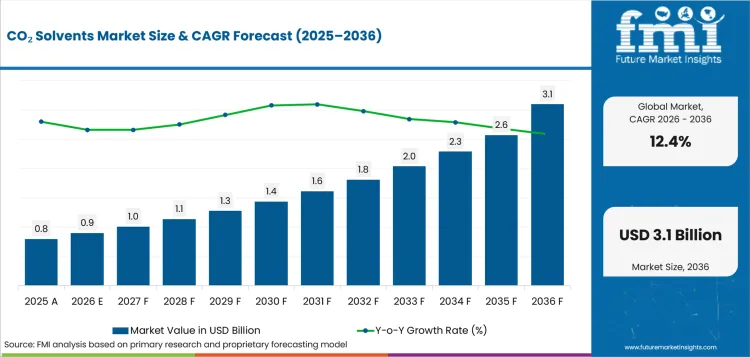
USD 980.6 million in 2026 and USD 3,156.1 million by 2036 at a 12.4% CAGR.
The CO₂ Solvents Market value is forecast to grow from USD 872.4 million in 2025 to USD 3,156.1 million by 2036 at 12.4% CAGR as industrial capture projects move from pilots into larger procurement decisions. Direct Contracts are projected to represent 74.0% share in 2026 because solvent supply is usually tied to process licensing, performance guarantees, and plant support. Amine Solvents are expected to secure 61.0% share in 2026, led by proven absorber-stripper chemistry for flue-gas CO₂ removal.
CO₂ Solvents Market Overview: Size and Forecast
- 2026 Market Size: USD 980.6 million
- 2036 Market Size: USD 3,156.1 million
- Forecast CAGR: 12.4% from 2026 to 2036
- Leading Sales Channel: Direct Contracts
- Direct Contracts Share in 2026: 74.0%
- Leading Solvent Type: Amine Solvents
- Amine Solvents Share in 2026: 61.0%
- Fastest-growing Country: China
- China CAGR: 14.2% by 2036
Summary of the CO₂ Solvents Market
- Demand and Growth Drivers
- Industrial capture projects are moving from feasibility studies toward licensed solvent packages with engineering support.
- Power and cement operators are comparing regeneration energy with capture rate before approving solvent systems.
- Gas processors continue using solvent-based sweetening where CO₂ removal is needed before pipeline or LNG specifications.
- Product and Segment View
- Direct Contracts are projected to hold 74.0% share in 2026, influenced by performance risk and licensor-led service support.
- Amine Solvents are expected to secure 61.0% share in 2026, supported by proven CO₂ absorption and reclaiming know-how.
- New Capture Plants are forecast to account for 57.0% share in 2026, led by early solvent specification during front-end design.
- Geography and Competitive Outlook
- China is projected to record 14.2% CAGR by 2036, backed by coal-linked and industrial CCUS scale-up.
- India is expected to advance at 13.5% CAGR by 2036 as cement and steel decarbonization programs create early solvent tenders.
- South Korea is forecast to grow at 13.1% CAGR by 2036 through EPC-led industrial capture studies.
- BASF, Shell Catalysts & Technologies, Honeywell UOP, and Mitsubishi Heavy Industries compete through high-spec solvent licensing.
- Carbon Clean and SLB Capturi focus on modular systems where footprint and installation speed influence project selection.
- Analyst Opinion
- Nikhil Kaitwade,, Associate Vice President at FMI, observes, “CO₂ solvent buying is moving from chemistry selection toward project risk reduction. Clients now ask which solvent lowers steam use, limits degradation, and carries evidence from real flue-gas operation. The strongest profit pool should sit in post-combustion capture for power, waste-to-energy, cement, and process heat assets. Suppliers with tested solvent packages, reclaiming support, and licensing partners will hold an advantage over companies offering chemistry alone.”
The CO₂ Solvents Market is expected to witness strong growth through 2036, driven by solvent-based capture demand from power, cement, chemicals, oil and gas, and other hard-to-abate industrial assets. Market expansion is further supported by project pipelines requiring lower heat duty, lower degradation, and verified performance under real flue-gas conditions.
Market outlook is supported by industrial capture capacity, policy funding, and storage readiness across hard-to-abate sectors. The International Energy Agency reported in April 2025 that operating capture and storage capacity stood just above 50 Mt of CO₂ per year in the first quarter of 2025, while the current project pipeline could reach around 430 Mt of CO₂ per year by 2030. The USA Department of Energy stated in March 2025 that the Bipartisan Infrastructure Law would invest up to USD 2.537 billion for domestic CCUS demonstration and commercial-scale projects, with USD 937 million for large-scale pilot projects. The European Commission reported in May 2026 that the EU target remains 50 million tonnes of annual CO₂ injection capacity by 2030, strengthening demand for qualified capture solvents linked to storage-ready projects.
Which factors support expansion in the CO₂ Solvents Market?
Solvent heat duty, emissions control, and project-linked supply contracts support market value across regulated industrial channels.
- Market value is supported by licensed solvent packages before make-up chemical volumes add recurring revenue.
- Supplier pricing reflects solvent stability, amine emissions control, and heat integration before commodity input cost affects margins.
- Revenue improves as capture projects convert feasibility work into construction-linked solvent orders.
- Buyer trust rises when licensors provide performance warranties, reclaiming plans, and proof from operating test campaigns.
Why is the CO₂ Solvents Market growing?
Industrial emitters are adopting solvent systems because many power, cement, refinery, and chemical assets need CO₂ removal from existing flue-gas or process streams without replacing the entire plant.
Growth outlook is becoming more structured as funded demonstrations push capture solvents from engineering studies into tested operating packages. The USA Department of Energy opened applications in December 2024 for up to USD 1.3 billion to support transformational CCUS technologies across capture, transport, storage, and utilization. This improves the commercial path for licensors that can document capture rate, heat duty, solvent degradation, and stable operation before customers approve long-duration projects.
How is the CO₂ Solvents Market segmented?
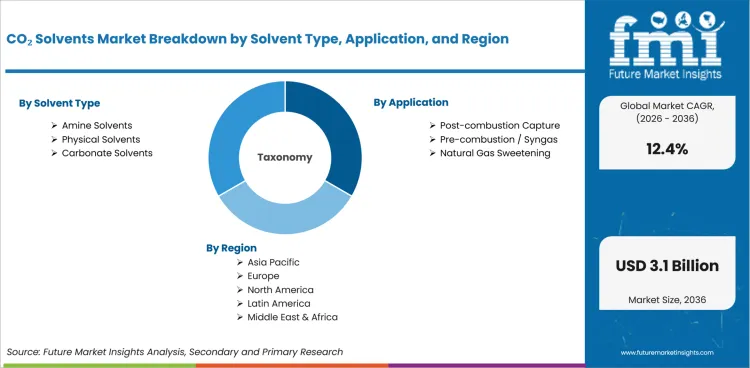
The CO₂ Solvents Market is segmented by solvent type, application, end use, deployment, and sales channel.
- Amine Solvents are projected to secure 61.0% share in 2026, led by proven absorber-stripper chemistry and easier integration with large flue-gas capture systems.
- Post-combustion Capture is expected to represent 54.0% share in 2026, supported by retrofit demand from power, cement, waste-to-energy, and process heat assets.
- Power & Utilities are anticipated to hold 38.0% share in 2026, reflected by large flue-gas volumes and recurring solvent make-up needs.
- New Capture Plants are estimated to account for 57.0% share in 2026, owing to solvent choice being fixed during early engineering and plant layout.
- Direct Contracts are forecast to represent 74.0% share in 2026, shaped by performance guarantees, process licensing, and technical support requirements.
Why do amine solvents dominate the CO₂ Solvents Market?
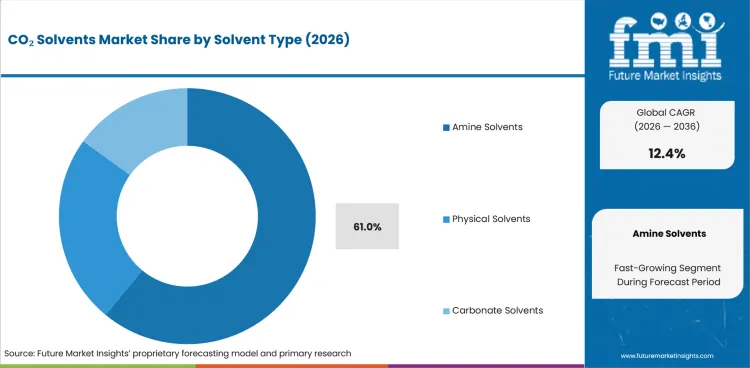
- Amine Solvents are projected to account for 61.0% share in 2026, influenced by proven CO₂ absorption, available reclaiming know-how, and compatibility with large post-combustion plants.
- Physical solvents gain use in higher-pressure gas streams where absorption efficiency improves without the same regeneration pattern as amines.
Which application leads the CO₂ Solvents Market?
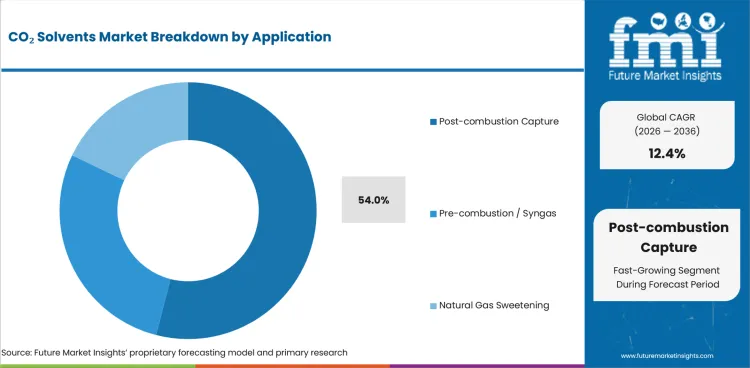
- Post-combustion Capture is expected to represent 54.0% share in 2026, guided by retrofit demand from cement kilns, power plants, and waste-to-energy units.
- Pre-combustion and syngas applications grow where hydrogen, ammonia, and gas-processing facilities require CO₂ separation before downstream conversion.
Which end use leads the CO₂ Solvents Market?
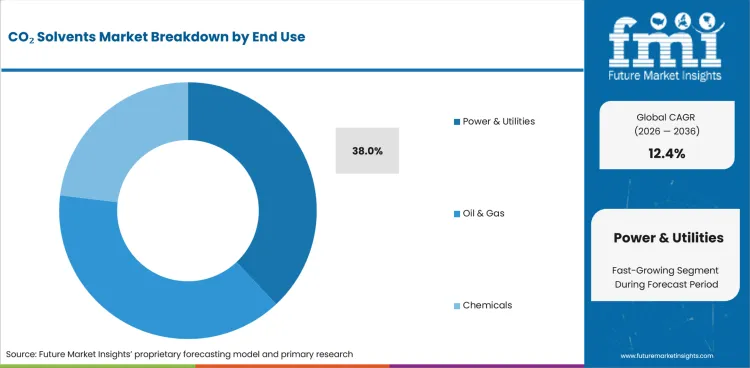
- Power & Utilities are anticipated to hold 38.0% share in 2026, shaped by large gas volumes and repeat solvent supply across capture operations.
- Cement and metals gain importance as process emissions make electrification alone insufficient for deep decarbonization.
Which deployment model leads the CO₂ Solvents Market?
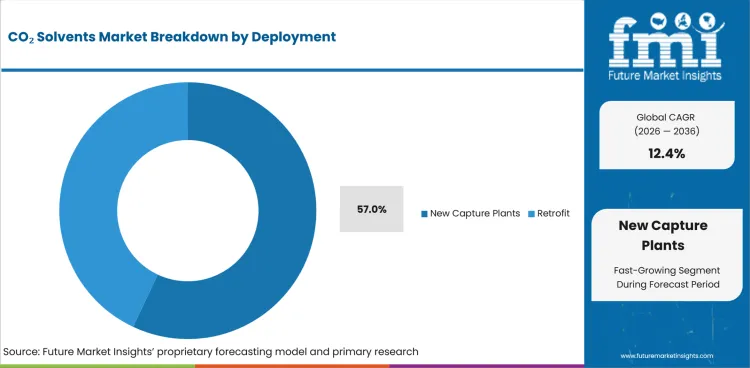
- New Capture Plants are estimated to account for 57.0% share in 2026, supported by front-end solvent specification before equipment orders are placed.
- Retrofit projects continue to create demand where existing boilers, kilns, and process heaters need capture systems without full asset replacement.
Which sales channel leads the CO₂ Solvents Market?
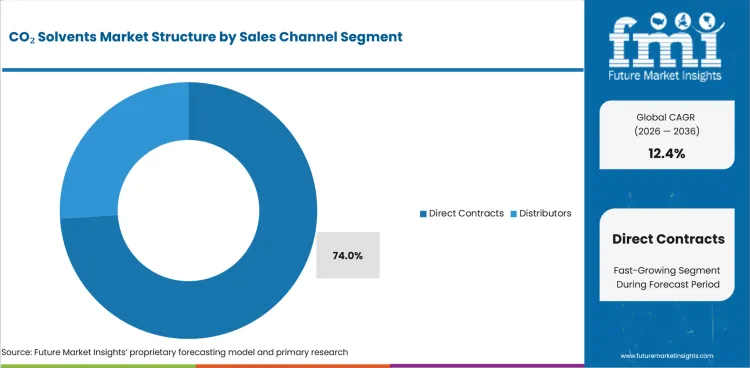
- Direct Contracts are projected to represent 74.0% share in 2026, led by licensor warranties and operating support for large solvent systems.
- Distributor sales work better for smaller make-up volumes, while large capture plants usually need direct audits, reclaiming support, and emissions control guidance.
What are the driver, restraints, and opportunities in the CO₂ Solvents Market?
Solvent performance supports adoption while regeneration energy and storage readiness limit faster procurement.
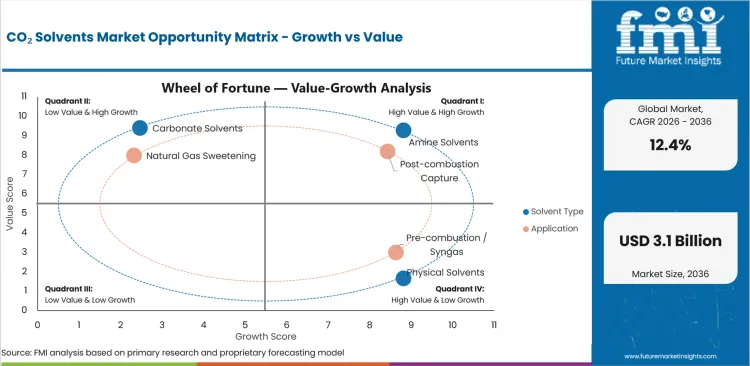
- Driver: Industrial emitters need proven solvents that remove CO₂ from low-pressure flue gas while preserving plant reliability.
- Restraint: Regeneration energy can raise operating cost when retrofit plants have limited steam flexibility.
- Opportunity: Storage-linked industrial clusters can create repeat solvent demand after transport and injection routes become bankable.
Solvent Heat Duty Control
Solvent heat duty control is the main buying issue because regeneration steam can decide whether a capture project passes financial review. The International Energy Agency stated in April 2024 that more than 700 CCUS projects were in various stages of development across the value chain. This wider funnel gives solvent suppliers more pilots and front-end studies, but it also increases buyer scrutiny. Suppliers that prove stable operation under real flue gas can defend premium pricing during licensing talks.
Amine Emissions and Degradation Management
Amine emissions management is becoming a stronger commercial filter because communities and regulators examine solvent slip around capture plants. The IEA CCUS Projects Database updated in March 2026 covers large CO₂ capture projects above 100,000 tonnes per year and direct air capture projects above 1,000 tonnes per year. This scale threshold shows why larger capture assets demand stronger solvent documentation, reclaiming plans, and emissions control evidence before procurement.
Storage-Linked Retrofit Opportunity
Retrofit opportunity depends on storage access because capture chemistry creates value only when the full CO₂ chain is bankable. The European Commission reported in September 2024 that the EU may need around 280 Mt of CO₂ capture per year by 2040 and approximately 450 Mt by 2050. That long-term requirement supports solvent suppliers serving industrial clusters, especially when capture projects can connect to regulated transport and injection capacity.
Which countries are growing fastest in the CO₂ Solvents Market?
China 14.2% CAGR, India 13.5% CAGR, South Korea 13.1% CAGR, United Kingdom 12.6% CAGR, Germany 12.0% CAGR, Japan 11.9% CAGR, United States 11.8% CAGR, and France 11.5% CAGR through 2036.
.webp "Top Country Growth Comparison Co2 Solvents Market Cagr (2026 2036)")
| Country | CAGR |
|---|---|
| United States | 11.8% |
| United Kingdom | 12.6% |
| Germany | 12.0% |
| France | 11.5% |
| Japan | 11.9% |
| China | 14.2% |
| South Korea | 13.1% |
| India | 13.5% |
Source: Future Market Insights, 2026.
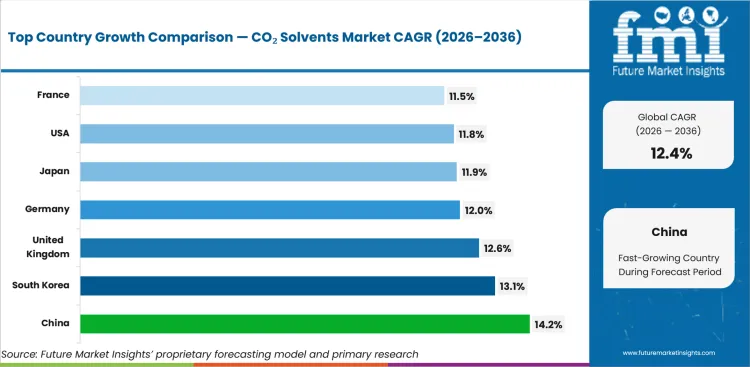
How do country-level CAGRs compare in the CO₂ Solvents Market?
China leads country growth while France records the most measured expansion outlook among profiled markets.
- United States is projected to record 11.8% CAGR by 2036 based on country-specific capture policy, industrial demand, and solvent procurement conditions.
- United Kingdom is projected to record 12.6% CAGR by 2036 based on country-specific capture policy, industrial demand, and solvent procurement conditions.
- Germany is projected to record 12.0% CAGR by 2036 based on country-specific capture policy, industrial demand, and solvent procurement conditions.
- France is projected to record 11.5% CAGR by 2036 based on country-specific capture policy, industrial demand, and solvent procurement conditions.
- Japan is projected to record 11.9% CAGR by 2036 based on country-specific capture policy, industrial demand, and solvent procurement conditions.
- China is projected to record 14.2% CAGR by 2036 based on country-specific capture policy, industrial demand, and solvent procurement conditions.
- South Korea is projected to record 13.1% CAGR by 2036 based on country-specific capture policy, industrial demand, and solvent procurement conditions.
- India is projected to record 13.5% CAGR by 2036 based on country-specific capture policy, industrial demand, and solvent procurement conditions.
What is the CO₂ Solvents Market outlook in the United States?
An 11.8% CAGR through 2036 is supported by demonstration funding, Gulf Coast emitters, and solvent-based capture pilots.
Country Market Snapshot Table
| Parameter | Value |
|---|---|
| Market Size in 2025 (Value) | USD 230.0 million |
| Market Size in 2026 (Value) | USD 257.1 million |
| Market Forecast in 2036 (Value) | USD 784.3 million |
| CAGR (2026 to 2036) | 11.8% |
| Years Considered | 2021 to 2036 |
| Base Year | 2025 |
| Forecast Period | 2026 to 2036 |
| Units Considered | Value (USD million) |
| Leading Sub-Region | Gulf Coast industrial and hydrogen corridors |
United States CO₂ Solvents Market Outlook
United States demand is shaped by Gulf Coast refineries, hydrogen assets, power plants, and pulp and paper mills that need solvent systems near storage and transport planning. Buyers usually shortlist licensors through engineering contractors and pilot evidence before approving solvent packages.
Suppliers with field data on heat duty, solvent degradation, and product purity should gain stronger project access. Solvent orders can move faster when storage rights, pipeline routes, and tax-credit economics are clear before final investment review.
Key Growth Drivers
- DOE funding opened applications for up to USD 1.3 billion in 2024 to support transformational CCUS technologies across capture and storage projects.
- Power-sector emissions create a large retrofit pool because 1,320 USA power plants reported approximately 1.5 billion metric tons of carbon dioxide emissions in 2023.
- Gulf Coast refineries and hydrogen plants need CO₂ removal chemistry near existing pipeline and storage planning.
- Pulp and paper carbon removal projects create an additional solvent outlet beyond power and refining.
Key Restraints
- Industry accounted for 30% of USA greenhouse gas emissions in EPA sector reporting, keeping permitting scrutiny high for large solvent-based capture sites.
- CO₂ pipeline permitting uncertainty can delay capture plant orders after solvent testing and front-end design work.
- Industrial buyers remain cautious about long-term solvent degradation under mixed flue-gas impurities.
What makes United States unique
The United States is unique due to public funding, tax-credit support, industrial cluster demand, and a broad mix of solvent-based capture applications.
Key Companies
- Honeywell UOP
- Carbon Clean
- SLB Capturi
- BASF
- Shell Catalysts & Technologies
- Fluor
- Linde Engineering
Sales & Marketing Channels
- Direct licensor contracts
- Engineering contractor partnerships
- DOE demonstration project channels
- Industrial cluster procurement
- Utility and refinery owner negotiations
- Solvent make-up supply agreements
Country Segment Breakdown Table
| Segment | Sub-Segments |
|---|---|
| By Solvent Type | Amine Solvents, Physical Solvents, Carbonate Solvents, Ionic Liquids / Other |
| By Application | Post-combustion Capture, Pre-combustion / Syngas, Natural Gas Sweetening, Biogas Upgrading |
| By End Use | Power & Utilities, Oil & Gas, Chemicals, Cement & Metals |
| By Deployment | New Capture Plants, Retrofit |
| By Sales Channel | Direct Contracts, Distributors |
| Key Sub-Regions Covered, Gulf Coast industrial and hydrogen corridors | Gulf Coast, Midwest, California, Appalachian Basin, Texas, Pacific Northwest |
Frequently Asked Questions
How fast is United States CO₂ Solvents Market growing?
Demand in the United States is anticipated to grow at 11.8% CAGR from 2026 to 2036 with funded capture demonstrations supporting solvent selection.
Who leads United States CO₂ Solvents Market?
Honeywell UOP, Carbon Clean, SLB Capturi, BASF, Shell Catalysts & Technologies, and Fluor compete through solvent packages and capture project references.
What is driving adoption in United States CO₂ Solvents Market?
Federal demonstration funding, Gulf Coast industrial clusters, and power-sector retrofit demand are moving buyers toward licensed solvent systems.
How is the CO₂ Solvents Market performing in the United Kingdom?
A 12.6% CAGR through 2036 reflects cluster-backed demand, shared storage planning, and early Teesside project momentum.
Country Market Snapshot Table
| Parameter | Value |
|---|---|
| Market Size in 2025 (Value) | USD 72.8 million |
| Market Size in 2026 (Value) | USD 82.0 million |
| Market Forecast in 2036 (Value) | USD 268.9 million |
| CAGR (2026 to 2036) | 12.6% |
| Years Considered | 2021 to 2036 |
| Base Year | 2025 |
| Forecast Period | 2026 to 2036 |
| Units Considered | Value (USD million) |
| Leading Sub-Region | Teesside and Merseyside CCUS clusters |
United Kingdom CO₂ Solvents Market Outlook
United Kingdom demand is tied to cluster sequencing, shared offshore storage, and project-level contracts in Teesside and Merseyside. Buyers are expected to prefer integrated capture systems that combine solvent chemistry with EPC execution and long-term performance guarantees.
Public funding scrutiny will keep pressure on solvent reliability, capture performance, and cost transparency. Suppliers with UK cluster references and post-combustion power experience should gain better positioning.
Key Growth Drivers
- The government committed £21.7 billion over 25 years to support CCUS clusters in the North West and North East of England.
- East Coast Cluster contracts are expected to unlock £4 billion of supply-chain awards while initially supporting 2,000 jobs in the North East.
- Teesside cluster construction supports early solvent orders for gas power and industrial emitters.
- Shared offshore storage routes support direct solvent licensing inside integrated capture packages.
Key Restraints
- The 2024 to 2025 performance report recorded a £200 million underspend against the CCUS and hydrogen budget as final investment decision timing moved.
- Project timing risk can delay solvent purchases when transport and storage milestones shift.
- Public cost scrutiny may force stricter performance tests before solvent systems are approved.
What makes United Kingdom unique
The United Kingdom is unique because solvent demand is linked to cluster-first procurement and shared CO₂ transport into offshore storage.
Key Companies
- Shell Catalysts & Technologies
- Technip Energies
- Carbon Clean
- SLB Capturi
- Fluor
- Linde Engineering
- Air Liquide
Sales & Marketing Channels
- Cluster project procurement
- Direct process licensing
- EPC contractor frameworks
- Utility owner negotiations
- Waste-to-energy operator channels
- Government-backed project tenders
Country Segment Breakdown Table
| Segment | Sub-Segments |
|---|---|
| By Solvent Type | Amine Solvents, Physical Solvents, Carbonate Solvents, Ionic Liquids / Other |
| By Application | Post-combustion Capture, Pre-combustion / Syngas, Natural Gas Sweetening, Biogas Upgrading |
| By End Use | Power & Utilities, Oil & Gas, Chemicals, Cement & Metals |
| By Deployment | New Capture Plants, Retrofit |
| By Sales Channel | Direct Contracts, Distributors |
| Key Sub-Regions Covered, Teesside and Merseyside CCUS clusters | Teesside, Merseyside, Humber, Scotland, South Wales, London procurement hubs |
Frequently Asked Questions
How fast is United Kingdom CO₂ Solvents Market growing?
Industry in the United Kingdom is projected to increase at 12.6% CAGR from 2026 to 2036 with cluster-backed solvent demand.
Who leads United Kingdom CO₂ Solvents Market?
Shell Catalysts & Technologies, Technip Energies, Carbon Clean, SLB Capturi, and Fluor compete through cluster-linked capture systems.
What is driving adoption in United Kingdom CO₂ Solvents Market?
Teesside project momentum and government-backed CCUS clusters are moving solvent packages from engineering work into procurement planning.
What is driving CO₂ Solvents Market growth in Germany?
A 12.0% CAGR through 2036 reflects industrial decarbonization needs, emissions-trading pressure, and clearer CCS policy direction.
Country Market Snapshot Table
| Parameter | Value |
|---|---|
| Market Size in 2025 (Value) | USD 83.9 million |
| Market Size in 2026 (Value) | USD 94.0 million |
| Market Forecast in 2036 (Value) | USD 291.9 million |
| CAGR (2026 to 2036) | 12.0% |
| Years Considered | 2021 to 2036 |
| Base Year | 2025 |
| Forecast Period | 2026 to 2036 |
| Units Considered | Value (USD million) |
| Leading Sub-Region | Rhine-Ruhr industrial and cement corridors |
Germany CO₂ Solvents Market Outlook
Germany demand is tied to cement, lime, chemicals, waste incineration, and other hard-to-abate industrial operations. Local buyers usually require strong evidence on solvent emissions, energy integration, and permitting risk before selecting capture chemistry.
BASF’s domestic gas-treatment base improves Germany’s technical position. Adoption should move first in industrial facilities where process emissions cannot be fully removed through electrification alone.
Key Growth Drivers
- Germany’s greenhouse gas emissions fell by 3.4% to 649 million tonnes of CO₂ equivalents in 2024, keeping industrial decarbonization pressure visible.
- Energy-intensive industries emitted 102 million tonnes of CO₂ equivalents in 2024, sustaining solvent demand in cement, steel, and chemical operations.
- Federal carbon management policy creates a clearer route for industrial CO₂ capture studies.
- BASF’s German gas treatment expertise supports local solvent credibility and buyer confidence.
Key Restraints
- Germany recorded 7.03 tonnes of CO₂ emissions per capita in 2024, which keeps public and industrial climate scrutiny high around capture projects.
- Public sensitivity around CO₂ storage can extend permitting discussions for solvent-based capture projects.
- Industrial customers may delay solvent commitments until transport corridors become bankable.
What makes Germany unique
Germany is unique because solvent demand is linked to hard-to-abate industrial competitiveness rather than power-sector capture alone.
Key Companies
- BASF
- Linde Engineering
- Shell Catalysts & Technologies
- Carbon Clean
- Fluor
- SLB Capturi
- Air Liquide
Sales & Marketing Channels
- Direct licensor engagement
- Industrial decarbonization tenders
- EPC pre-FEED studies
- Chemical cluster procurement
- Cement plant owner channels
- Utility-linked retrofit studies
Country Segment Breakdown Table
| Segment | Sub-Segments |
|---|---|
| By Solvent Type | Amine Solvents, Physical Solvents, Carbonate Solvents, Ionic Liquids / Other |
| By Application | Post-combustion Capture, Pre-combustion / Syngas, Natural Gas Sweetening, Biogas Upgrading |
| By End Use | Power & Utilities, Oil & Gas, Chemicals, Cement & Metals |
| By Deployment | New Capture Plants, Retrofit |
| By Sales Channel | Direct Contracts, Distributors |
| Key Sub-Regions Covered, Rhine-Ruhr industrial and cement corridors | Rhine-Ruhr, Bavaria, Lower Saxony, Hamburg, Brandenburg, Saxony |
Frequently Asked Questions
How fast is Germany CO₂ Solvents Market growing?
Demand in Germany is ready to rise at 12.0% CAGR from 2026 to 2036 with industrial carbon management needs supporting solvent use.
Who leads Germany CO₂ Solvents Market?
BASF, Linde Engineering, Shell Catalysts & Technologies, Carbon Clean, and Fluor compete through gas treatment and capture integration capability.
What is driving adoption in Germany CO₂ Solvents Market?
Industrial emissions pressure and a clearer carbon management direction are moving cement, chemicals, and waste assets toward capture studies.
What is the CO₂ Solvents Market forecast for France?
An 11.5% CAGR through 2036 reflects industrial valley planning, CCUS deployment work, and storage-route evaluation.
Country Market Snapshot Table
| Parameter | Value |
|---|---|
| Market Size in 2025 (Value) | USD 62.8 million |
| Market Size in 2026 (Value) | USD 70.0 million |
| Market Forecast in 2036 (Value) | USD 207.9 million |
| CAGR (2026 to 2036) | 11.5% |
| Years Considered | 2021 to 2036 |
| Base Year | 2025 |
| Forecast Period | 2026 to 2036 |
| Units Considered | Value (USD million) |
| Leading Sub-Region | Dunkerque, Fos, Le Havre, and industrial valleys |
France CO₂ Solvents Market Outlook
France demand is concentrated in Dunkerque, Fos, Le Havre, and other industrial areas where cement, metals, chemicals, and refining assets need credible capture options. Buyers compare solvent systems with cryogenic and other technologies according to flue-gas concentration.
Solvent orders should depend on storage testing, transport access, and public aid mechanisms. Suppliers with strong EPC links and heavy-industry references should be better placed for early deployments.
Key Growth Drivers
- France’s July 2024 CCUS deployment material cited the European framework for 50 million tonnes of annual geological CO₂ storage capacity by 2030.
- France’s 2025 low-carbon strategy project stated emissions outside land-use sinks declined by 32% from 1990 to 2024, equal to a 177 Mt CO₂e decrease.
- Industrial decarbonization aid creates a route for large capture projects in heavy industry.
- CO₂ hub planning supports solvent supplier entry through early engineering packages.
Key Restraints
- France’s 2025 strategy project indicates annual emissions reductions need to average about 5% from 2024 to 2030, raising pressure on project selection and delivery timing.
- Storage site testing may slow solvent orders before full value-chain approval.
- Buyers may compare solvent systems with cryogenic capture for concentrated industrial streams.
What makes France unique
France is unique because solvent demand is combined with national industrial valley planning and storage-site testing.
Key Companies
- Air Liquide
- Technip Energies
- Carbon Clean
- BASF
- Shell Catalysts & Technologies
- SLB Capturi
- Fluor
Sales & Marketing Channels
- Industrial decarbonization aid programs
- Direct plant owner negotiations
- EPC and engineering studies
- Cluster project tenders
- Capture technology comparisons
- Cross-border storage partnerships
Country Segment Breakdown Table
| Segment | Sub-Segments |
|---|---|
| By Solvent Type | Amine Solvents, Physical Solvents, Carbonate Solvents, Ionic Liquids / Other |
| By Application | Post-combustion Capture, Pre-combustion / Syngas, Natural Gas Sweetening, Biogas Upgrading |
| By End Use | Power & Utilities, Oil & Gas, Chemicals, Cement & Metals |
| By Deployment | New Capture Plants, Retrofit |
| By Sales Channel | Direct Contracts, Distributors |
| Key Sub-Regions Covered, Dunkerque, Fos, Le Havre, and industrial valleys | Dunkerque, Fos, Le Havre, Lyon corridor, Grand Est, Normandy |
Frequently Asked Questions
How fast is France CO₂ Solvents Market growing?
Demand in France is estimated to grow at 11.5% CAGR from 2026 to 2036 as industrial decarbonization projects advance.
Who leads France CO₂ Solvents Market?
Air Liquide, Technip Energies, Carbon Clean, BASF, Shell Catalysts & Technologies, and SLB Capturi compete through capture and engineering channels.
What is driving adoption in France CO₂ Solvents Market?
Industrial valley planning, CCUS deployment studies, and storage-route evaluation are moving heavy emitters toward solvent-based capture review.
How fast is the CO₂ Solvents Market growing in Japan?
An 11.9% CAGR through 2036 reflects advanced CCS projects, compact capture systems, and shipping-based storage planning.
Country Market Snapshot Table
| Parameter | Value |
|---|---|
| Market Size in 2025 (Value) | USD 75.1 million |
| Market Size in 2026 (Value) | USD 84.0 million |
| Market Forecast in 2036 (Value) | USD 258.0 million |
| CAGR (2026 to 2036) | 11.9% |
| Years Considered | 2021 to 2036 |
| Base Year | 2025 |
| Forecast Period | 2026 to 2036 |
| Units Considered | Value (USD million) |
| Leading Sub-Region | Tokyo Bay, Kansai, and industrial coastal hubs |
Japan CO₂ Solvents Market Outlook
Japan demand is shaped by power stations, paper mills, industrial boilers, and overseas storage links. Local buyers emphasize compact capture equipment, low amine emissions, and solvent efficiency because site space and reliability expectations are strict.
Mitsubishi Heavy Industries provides a strong domestic solvent pathway through KS-21 and CO₂MPACT activity. Demand should be strongest where emitters can connect to shipping-based storage or regional CO₂ hubs.
Key Growth Drivers
- METI stated in June 2024 that advanced CCS projects aim to secure 6 to 12 Mtpa of annual CO₂ storage volume by 2030.
- JOGMEC selected nine Japanese advanced CCS projects in July 2024 to support business scale-up and cost reduction toward the 2030 target.
- MHI’s KS-21 solvent gives domestic buyers a proven technology reference for compact post-combustion capture.
- Paper and power plant demonstrations widen solvent use beyond refinery and gas streams.
Key Restraints
- Japan’s 2025 Strategic Energy Plan links the same 6 to 12 million tonnes annual storage objective to Advanced CCS Projects, showing storage access remains a key gating item.
- Limited domestic storage can delay capture decisions until transport routes are approved.
- High plant reliability expectations can lengthen solvent qualification cycles.
What makes Japan unique
Japan is unique because solvent demand is closely tied to compact capture units and shipping-based storage planning.
Key Companies
- Mitsubishi Heavy Industries
- JGC Holdings
- Toyo Engineering
- Kawasaki Heavy Industries
- Shell Catalysts & Technologies
- BASF
- JGC Corporation
Sales & Marketing Channels
- Technology licensor contracts
- Utility demonstration programs
- Industrial plant owner channels
- Government-backed CCS studies
- EPC partnerships
- Overseas storage consortiums
Country Segment Breakdown Table
| Segment | Sub-Segments |
|---|---|
| By Solvent Type | Amine Solvents, Physical Solvents, Carbonate Solvents, Ionic Liquids / Other |
| By Application | Post-combustion Capture, Pre-combustion / Syngas, Natural Gas Sweetening, Biogas Upgrading |
| By End Use | Power & Utilities, Oil & Gas, Chemicals, Cement & Metals |
| By Deployment | New Capture Plants, Retrofit |
| By Sales Channel | Direct Contracts, Distributors |
| Key Sub-Regions Covered, Tokyo Bay, Kansai, and industrial coastal hubs | Tokyo Bay, Kansai, Hokkaido, Kyushu, Chubu, Offshore storage corridors |
Frequently Asked Questions
How fast is Japan CO₂ Solvents Market growing?
Industry in Japan is projected to expand at 11.9% CAGR from 2026 to 2036 through advanced CCS and compact capture projects.
Who leads Japan CO₂ Solvents Market?
Mitsubishi Heavy Industries, JGC Holdings, Toyo Engineering, and Kawasaki Heavy Industries compete with global solvent licensors.
What is driving adoption in Japan CO₂ Solvents Market?
Advanced CCS project support and compact capture technology are moving Japanese emitters toward solvent-based capture systems.
What is the CO₂ Solvents Market outlook in China?
A 14.2% CAGR through 2036 reflects coal power, petrochemical projects, and state-owned CCUS scale-up.
Country Market Snapshot Table
| Parameter | Value |
|---|---|
| Market Size in 2025 (Value) | USD 157.6 million |
| Market Size in 2026 (Value) | USD 180.0 million |
| Market Forecast in 2036 (Value) | USD 678.2 million |
| CAGR (2026 to 2036) | 14.2% |
| Years Considered | 2021 to 2036 |
| Base Year | 2025 |
| Forecast Period | 2026 to 2036 |
| Units Considered | Value (USD million) |
| Leading Sub-Region | Coal power, petrochemical, and oilfield CCUS bases |
China CO₂ Solvents Market Outlook
China demand is anchored in coal power, petrochemicals, oilfield projects, and large state-owned energy platforms. Buyers often evaluate solvent systems through state-owned project references and local engineering institutes before broader deployment.
Low-cost operation is central because coal-fired capture involves large flue-gas volumes and tight power economics. Suppliers need local service support and validated solvent performance to compete effectively.
Key Growth Drivers
- China Energy had more than 20 CCUS projects with completed and operating projects exceeding 4 million tonnes per year of CO₂ capture capacity in 2024.
- China Energy’s Ningdong project includes a first-phase 500,000 tonnes per year CO₂ capture and liquefaction unit that reinforces solvent demand in coal chemical sites.
- Provincial low-carbon projects create demand for capture systems with local support.
- Petrochemical and oilfield CO₂ use creates solvent demand in recovery and purification.
Key Restraints
- A 2025 China CCUS review noted that solvent regeneration heat created about 67% of power loss in a major coal-fired capture project, keeping efficiency pressure high.
- Provincial storage and utilization options differ widely, which can fragment solvent demand.
- Price pressure from domestic suppliers can limit margins for imported solvent packages.
What makes China unique
China is unique because operating CCUS scale is already visible across coal and industrial assets.
Key Companies
- China Energy
- Sinopec
- PetroChina
- CNOOC
- BASF
- Shell Catalysts & Technologies
- Honeywell UOP
Sales & Marketing Channels
- State-owned enterprise procurement
- Power plant demonstration contracts
- Provincial low-carbon project tenders
- EPC and design institute channels
- Petrochemical group procurement
- Technology licensing partnerships
Country Segment Breakdown Table
| Segment | Sub-Segments |
|---|---|
| By Solvent Type | Amine Solvents, Physical Solvents, Carbonate Solvents, Ionic Liquids / Other |
| By Application | Post-combustion Capture, Pre-combustion / Syngas, Natural Gas Sweetening, Biogas Upgrading |
| By End Use | Power & Utilities, Oil & Gas, Chemicals, Cement & Metals |
| By Deployment | New Capture Plants, Retrofit |
| By Sales Channel | Direct Contracts, Distributors |
| Key Sub-Regions Covered, Coal power, petrochemical, and oilfield CCUS bases | Inner Mongolia, Shandong, Guangdong, Jiangsu, Xinjiang, Sichuan |
Frequently Asked Questions
How fast is China CO₂ Solvents Market growing?
Demand in China is projected to record 14.2% CAGR from 2026 to 2036 with coal and industrial CCUS supporting solvent use.
Who leads China CO₂ Solvents Market?
China Energy, Sinopec, PetroChina, CNOOC, BASF, Shell Catalysts & Technologies, and Honeywell UOP compete through state-linked projects and technology licensing.
What is driving adoption in China CO₂ Solvents Market?
Large state-owned capture projects, petrochemical purification needs, and coal-linked industrial emissions are supporting solvent demand.
How is the CO₂ Solvents Market performing in South Korea?
A 13.1% CAGR through 2036 reflects concentrated industrial emissions, EPC capability, and formal CCUS policy movement.
Country Market Snapshot Table
| Parameter | Value |
|---|---|
| Market Size in 2025 (Value) | USD 53.1 million |
| Market Size in 2026 (Value) | USD 60.0 million |
| Market Forecast in 2036 (Value) | USD 205.7 million |
| CAGR (2026 to 2036) | 13.1% |
| Years Considered | 2021 to 2036 |
| Base Year | 2025 |
| Forecast Period | 2026 to 2036 |
| Units Considered | Value (USD million) |
| Leading Sub-Region | Ulsan, Yeosu, and west-coast industrial clusters |
South Korea CO₂ Solvents Market Outlook
South Korea demand is shaped by refining, petrochemicals, steel, power assets, and strong engineering companies. Buyers are likely to favor solvent packages that can be integrated by domestic EPC providers into power and petrochemical facilities.
Early buying should move through engineering pilots and cluster studies while storage confirmation improves. Supplier partnerships with local EPC firms should have an advantage in procurement.
Key Growth Drivers
- South Korea reported 624.2 million tons of greenhouse gas emissions in 2023, keeping large industrial emitters under pressure to evaluate solvent-based capture options.
- The IEA stated in November 2025 that Korea’s emissions trading system covers about three-quarters of national greenhouse gas emissions, giving industrial buyers a stronger carbon-cost signal.
- Korean EPC firms can package solvent systems for power and petrochemical customers.
- Refining and steel assets create demand for capture chemistry suited to large emission sources.
Key Restraints
- The Korean Ministry of Environment stated in October 2024 that industry exceeded its greenhouse gas reduction target by 6.8%, which raises expectations for verified low-carbon project performance.
- Offshore storage confirmation may lag capture project planning across early industrial sites.
- Industrial buyers may wait for clearer carbon pricing before committing to full solvent packages.
What makes South Korea unique
South Korea is unique because it combines concentrated industrial emissions with strong EPC capability and early CCUS legal structuring.
Key Companies
- Samsung E&A
- Honeywell UOP
- SK Innovation
- Hyundai Engineering
- DL E&C
- BASF
- Shell Catalysts & Technologies
Sales & Marketing Channels
- EPC partnership channels
- Power plant owner negotiations
- Petrochemical group procurement
- Legal-framework guided permits
- Engineering pilot contracts
- Industrial cluster studies
Country Segment Breakdown Table
| Segment | Sub-Segments |
|---|---|
| By Solvent Type | Amine Solvents, Physical Solvents, Carbonate Solvents, Ionic Liquids / Other |
| By Application | Post-combustion Capture, Pre-combustion / Syngas, Natural Gas Sweetening, Biogas Upgrading |
| By End Use | Power & Utilities, Oil & Gas, Chemicals, Cement & Metals |
| By Deployment | New Capture Plants, Retrofit |
| By Sales Channel | Direct Contracts, Distributors |
| Key Sub-Regions Covered, Ulsan, Yeosu, and west-coast industrial clusters | Ulsan, Yeosu, Incheon, Pohang, Daesan, Busan |
Frequently Asked Questions
How fast is South Korea CO₂ Solvents Market growing?
Industry in South Korea is expected to rise at 13.1% CAGR from 2026 to 2036 as EPC-led capture studies expand.
Who leads South Korea CO₂ Solvents Market?
Samsung E&A, Honeywell UOP, SK Innovation, Hyundai Engineering, DL E&C, and global solvent licensors compete through project integration.
What is driving adoption in South Korea CO₂ Solvents Market?
Power, refining, steel, and petrochemical clusters are moving solvent suppliers toward EPC-led pilot and engineering channels.
What is driving CO₂ Solvents Market growth in India?
A 13.5% CAGR through 2036 is supported by cement testbeds, steel decarbonization planning, and public-private CCUS programs.
Country Market Snapshot Table
| Parameter | Value |
|---|---|
| Market Size in 2025 (Value) | USD 61.7 million |
| Market Size in 2026 (Value) | USD 70.0 million |
| Market Forecast in 2036 (Value) | USD 248.9 million |
| CAGR (2026 to 2036) | 13.5% |
| Years Considered | 2021 to 2036 |
| Base Year | 2025 |
| Forecast Period | 2026 to 2036 |
| Units Considered | Value (USD million) |
| Leading Sub-Region | Cement, steel, refinery, and chemical belts |
India CO₂ Solvents Market Outlook
India demand is expected to begin with cement, steel, refineries, chemicals, and power assets that need low-energy capture options. Buyers will be cost-sensitive and application-specific because many projects are still moving from testbed design to bankable scale.
Solvent suppliers with modular systems, local engineering support, and cement-sector evidence should gain early traction. Broader adoption should improve as transport, storage, and utilization infrastructure mature.
Key Growth Drivers
- India approved five CCU testbeds in 2025 for cement-sector translational R&D, including a two-tonnes-per-day CO₂ capture pilot at Ballabhgarh.
- India’s 2026 budget proposed ₹20,000 crore over five years to raise CCUS technology readiness across power, steel, cement, refineries, and chemicals.
- Steel and refinery decarbonization planning supports future solvent trials.
- Local engineering and lower-cost manufacturing can reduce pilot-to-scale barriers.
Key Restraints
- India produced 1,047.523 million tonnes of coal in 2024 to 2025, which keeps flue-gas volumes high and raises the performance burden for solvent systems.
- Storage and transport infrastructure are not yet mature enough for many full-scale projects.
- Buyers may delay purchases until solvent cost and utilization revenue are clearer.
What makes India unique
India is unique because early solvent demand is likely to come through cement testbeds before storage-led CCS scale-up.
Key Companies
- Carbon Clean
- BASF
- Shell Catalysts & Technologies
- Honeywell UOP
- Linde Engineering
- Thermax
- Tata Consulting Engineers
Sales & Marketing Channels
- Public-private testbed programs
- Cement plant partnerships
- EPC contractor channels
- Industrial consortium studies
- Direct technology licensing
- Local service and maintenance networks
Country Segment Breakdown Table
| Segment | Sub-Segments |
|---|---|
| By Solvent Type | Amine Solvents, Physical Solvents, Carbonate Solvents, Ionic Liquids / Other |
| By Application | Post-combustion Capture, Pre-combustion / Syngas, Natural Gas Sweetening, Biogas Upgrading |
| By End Use | Power & Utilities, Oil & Gas, Chemicals, Cement & Metals |
| By Deployment | New Capture Plants, Retrofit |
| By Sales Channel | Direct Contracts, Distributors |
| Key Sub-Regions Covered, Cement, steel, refinery, and chemical belts | Gujarat, Maharashtra, Odisha, Chhattisgarh, Tamil Nadu, Andhra Pradesh |
Frequently Asked Questions
How fast is India CO₂ Solvents Market growing?
Demand in India is forecast to grow at 13.5% CAGR from 2026 to 2036 with cement and industrial testbeds supporting solvent use.
Who leads India CO₂ Solvents Market?
Carbon Clean, BASF, Shell Catalysts & Technologies, Honeywell UOP, Linde Engineering, Thermax, and engineering partners compete through modular and project-led channels.
What is driving adoption in India CO₂ Solvents Market?
Cement-sector CCU testbeds, budget-backed technology readiness support, and industrial decarbonization planning are moving buyers toward solvent trials.
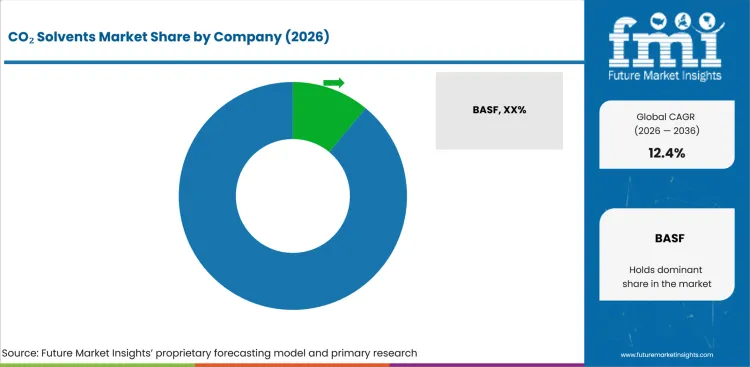
Who are the leading companies in the CO₂ Solvents Market?
BASF, Shell Catalysts & Technologies, Mitsubishi Heavy Industries, Honeywell UOP and Carbon Clean are listed with SLB Capturi among other suppliers.
- Established solvent licensors hold an advantage through field-tested chemistry and direct process support.
- Engineering-led capture providers gain buyer attention by connecting solvent choice with absorber design and heat integration.
- Modular specialists gain project access where site footprint and installation speed affect procurement decisions.
- Carbon capture suppliers compete by combining solvent evidence with storage-linked project delivery support.
Large solvent licensors compete by proving capture performance and operating stability before customers approve full-scale plants. BASF and Shell Catalysts & Technologies benefit from amine and gas-treatment depth across waste-to-energy, power, cement, and industrial applications. Mitsubishi Heavy Industries and Honeywell UOP hold strong positions where buyers need capture-process integration and established licensing support. Project owners assess heat duty, solvent degradation, and emissions control before approving supplier selection.
Engineering and modular capture companies are becoming more important as project developers move from studies to bankable layouts. Carbon Clean and SLB Capturi compete where compact systems and shorter installation paths matter for retrofits. Fluor, Technip Energies, Linde Engineering, and Air Liquide support projects through engineering, integration, and balance-of-plant experience. Suppliers with solvent data and EPC relationships should gain stronger entry into industrial clusters.
Regional and country-specific competitors can win through local project references and field service capability. China and India create opportunities for local engineering partners because cost, site support, and industrial testbeds influence early procurement. South Korea and Japan favor suppliers able to work with EPC firms and compact capture requirements. Companies with verified solvent performance and direct contract support should gain more durable positions than suppliers offering chemical supply alone.
How do top CO₂ Solvents companies compare?
BASF and Shell score strongest on solvent chemistry depth while Mitsubishi Heavy Industries leads field validation in post-combustion capture.
| Company | Relevance to Market Title | Solvent Chemistry Depth | Capture Process Integration | Field Validation Coverage | Direct Contract Support | Geographic Footprint |
|---|---|---|---|---|---|---|
| BASF | Very High | Very Strong | Strong | Strong | Strong | Global |
| Shell Catalysts & Technologies | Very High | Very Strong | Very Strong | Strong | Very Strong | Global |
| Mitsubishi Heavy Industries | Very High | Very Strong | Very Strong | Very Strong | Strong | Global |
| Honeywell UOP | High | Strong | Very Strong | Moderate | Strong | Global |
| Carbon Clean | High | Strong | Strong | Moderate | Strong | Global |
| SLB Capturi | High | Moderate | Very Strong | Moderate | Strong | Global |
| Fluor | High | Moderate | Very Strong | Strong | Strong | Global |
| Technip Energies | High | Moderate | Very Strong | Strong | Strong | Global |
| Linde Engineering | Moderate to High | Moderate | Strong | Moderate | Strong | Global |
| Air Liquide | Moderate | Moderate | Strong | Strong | Moderate | Europe and Global |
Source: Future Market Insights competitive analysis, 2026.
Who are the key players in the CO₂ Solvents Market?
BASF, Shell Catalysts & Technologies and Mitsubishi Heavy Industries are listed with Honeywell UOP and Carbon Clean among other suppliers.
Key global companies leading the CO₂ Solvents Market include:
- BASF
- Shell Catalysts & Technologies
- Mitsubishi Heavy Industries
- Honeywell UOP
- Carbon Clean
- SLB Capturi
- Fluor
- Technip Energies
- Linde Engineering
- Air Liquide
Key Developments in CO₂ Solvents Market
- In October 2025, BASF and ANDRITZ signed an OASE blue license agreement for a planned Aarhus waste-to-energy carbon capture project targeting approximately 435,000 tons of CO₂ annually.
- In July 2025, Shell Catalysts & Technologies and Technip Energies signed a global alliance agreement to deliver post-combustion amine-based carbon capture using CANSOLV CO₂ technology.
- In August 2024, SLB and Aker Carbon Capture’s joint venture received a FEED contract from CO280 for a USA Gulf Coast pulp and paper project aiming to remove 800,000 tonnes of emissions annually.
Key Players in the CO₂ Solvents Market
Solvent Licensors
- BASF
- Shell Catalysts & Technologies
- Honeywell UOP
- Mitsubishi Heavy Industries
Integrated Capture System Providers
- Fluor
- SLB Capturi
- Technip Energies
- Linde Engineering
Modular Specialists
- Carbon Clean
- Air Liquide
CO₂ Solvents Market - Report Scope
| Parameter | Details |
|---|---|
| Forecast period | 2026 to 2036 |
| Historical period | 2021 to 2025 |
| Quantitative unit | Revenue in USD million |
| By solvent type | Amine solvents, physical solvents, carbonate solvents, ionic liquids / other |
| By application | Post-combustion capture, pre-combustion / syngas, natural gas sweetening, biogas upgrading |
| By end use | Power & utilities, oil & gas, chemicals, cement & metals |
| By deployment | New capture plants, retrofit |
| By sales channel | Direct contracts, distributors |
| Regions covered | North America, Latin America, Europe, East Asia, South Asia and Pacific, Middle East and Africa |
| Countries covered | United States, United Kingdom, Germany, France, Japan, China, South Korea, India |
| Key companies profiled | BASF, Shell Catalysts & Technologies, Honeywell UOP, Mitsubishi Heavy Industries, Fluor, Carbon Clean, SLB Capturi |
| Approach | Bottom-up project-boundary approach using solvent demand, project pipeline evidence, capture application mix, company technology positioning, and country-level adoption |
Source: Future Market Insights, 2026.
CO₂ Solvents Market - Scope & Definition
| Attribute | Detail |
|---|---|
| Market Definition | Chemical and physical solvent systems used to capture carbon dioxide from flue gas, syngas, natural gas, and biogas streams. |
| Functions Covered | CO₂ absorption, solvent regeneration, gas sweetening, capture performance support, and emissions management. |
| Applications Covered | Post-combustion capture, pre-combustion / syngas capture, natural gas sweetening, and biogas upgrading. |
| End-Use Industries | Power and utilities, oil and gas, chemicals, cement, metals, waste-to-energy, and other industrial emitters. |
| Grades Covered | Amine solvents, physical solvents, carbonate solvents, and ionic liquid or blended solvent systems. |
| Inclusions | Commercial solvent systems, solvent make-up supply, licensed solvent packages, reclaiming support, and direct contract supply linked to capture plants. |
| Exclusions | Solid sorbents, membranes, direct air capture sorbents, pure cryogenic separation, CO₂ compressors, pipelines, storage wells, and carbon credits. |
CO₂ Solvents Market - Research Methodology
| Method | Description |
|---|---|
| Primary Research | FMI analyst interviews with capture plant developers, solvent licensors, engineering contractors, utility buyers, cement operators, gas processors, and specialty chemical channel partners. |
| Desk Research | Review of government carbon management programs, official CCUS databases, company technology pages, public funding notices, standards information, and carbon capture project releases. |
| Market Sizing & Forecasting | Bottom-up project-boundary approach using solvent make-up volumes, process licensing activity, capture project stages, plant scale, country policy support, and application mix. |
| Data Validation | Cross-verification using capture capacity pipelines, company developments, end-use project signals, adjacent amine-based capture categories, and country-level policy evidence. |
CO₂ Solvents Market Breakdown by Solvent Type, Application, End Use, Deployment, Sales Channel, and Region
CO₂ Solvents Market Segmented by Solvent Type
- Amine Solvents
- Physical Solvents
- Carbonate Solvents
- Ionic Liquids / Other
CO₂ Solvents Market Segmented by Application
- Post-combustion Capture
- Pre-combustion / Syngas
- Natural Gas Sweetening
- Biogas Upgrading
CO₂ Solvents Market Segmented by End Use
- Power & Utilities
- Oil & Gas
- Chemicals
- Cement & Metals
CO₂ Solvents Market Segmented by Deployment
- New Capture Plants
- Retrofit
CO₂ Solvents Market Segmented by Sales Channel
- Direct Contracts
- Distributors
CO₂ Solvents Market by Region
- North America
- Latin America
- Europe
- East Asia
- South Asia and Pacific
- Middle East and Africa
Research Sources and Bibliography
- International Energy Agency. (2025, April 30). CCUS projects around the world are reaching new milestones. IEA.
- International Energy Agency. (2024, April 25). Carbon capture utilisation and storage. IEA.
- International Energy Agency. (2026, March 27). CCUS projects database. IEA.
- International Energy Agency. (2025, November 25). Korea 2025: Energy policy review. IEA.
- USA Department of Energy. (2025, March 1). Point source carbon capture large-scale pilots, commercial demonstrations, and FEED studies. Office of Clean Energy Demonstrations.
- USA Department of Energy. (2024, December 17). OCED announces $1.3 billion in new funding to bolster carbon capture, utilization and storage technologies. Office of Clean Energy Demonstrations.
- European Commission. (2026, May 28). The EU makes good progress towards its 2030 CO₂ injection target. European Commission.
- European Commission. (2024, September 16). In focus: Industrial carbon management. European Commission.
- USA Environmental Protection Agency. (2024, October 15). EPA releases 2023 data collected under greenhouse gas reporting program. EPA.
- USA Environmental Protection Agency. (2026, March 10). Industry sector emissions. EPA.
- Department for Energy Security and Net Zero. (2025, April 8). UK carbon capture, usage and storage. GOV.UK.
- Department for Energy Security and Net Zero. (2024, December 10). Contracts signed for UK’s first carbon capture projects in Teesside. GOV.UK.
- Department for Energy Security and Net Zero. (2025, September 15). DESNZ annual report and accounts 2024 to 2025: Performance report. GOV.UK.
- German Environment Agency. (2025, March 14). Germany on track for 2030 climate targets. Umweltbundesamt.
- German Environment Agency. (2025, July 16). German emissions nearly halved in 20 years of trading. Umweltbundesamt.
- Federal Statistical Office of Germany. (2025, September 29). Key table: Carbon dioxide emissions per capita. Destatis.
- Ministry for the Ecological Transition. (2024, July 26). État des lieux et perspectives de déploiement du CCUS en France. Government of France.
- Ministry for the Ecological Transition. (2025, December 9). Stratégie nationale bas-carbone 3. Government of France.
- Ministry of Economy, Trade and Industry. (2024, June 28). Advanced efforts for commercialization of CCS. METI.
- Japan Organization for Metals and Energy Security. (2024, July 24). JOGMEC selects nine projects as Japanese Advanced CCS Projects. JOGMEC.
- Agency for Natural Resources and Energy. (2025). Strategic Energy Plan. METI.
- State-owned Assets Supervision and Administration Commission of the State Council. (2024, August 1). China Energy advances CCUS project scale. SASAC.
- China Energy Investment Corporation. (2024, January 23). China’s largest CCUS demonstrative project’s spherical tanks in place. China Energy.
- Low Emission Technology Australia and Coal Industry Advisory Board. (2025, April 25). China’s impressive strides towards carbon capture, utilisation and storage. Low Emission Technology Australia.
- Ministry of Environment. (2024, October 30). Presidential Commission on Carbon Neutrality and Green Growth announces results of Greenhouse Gas Reduction Inspection. Republic of Korea.
- Press Information Bureau. (2025, May 14). India launches first cluster of CCU testbeds in academia and industry. Government of India.
- Press Information Bureau. (2025, December 4). R&D roadmap to enable India’s net zero targets through carbon capture, utilization and storage launched. Government of India.
- Press Information Bureau. (2026, February 1). Budget 2026 to 2027 speech of Nirmala Sitharaman. Government of India.
- Shell Catalysts & Technologies. (2024, December 24). CANSOLV CO₂ Capture System poised for another deployment after Net Zero Teesside Power takes FID. Shell.
- Shell Catalysts & Technologies. (2025, July 17). Shell Catalysts & Technologies and Technip Energies have signed a global alliance agreement for carbon capture delivery. Shell.
- BASF. (2025, October 23). BASF and ANDRITZ sign license agreement for OASE blue. BASF.
- SLB. (2024, August 1). SLB and Aker Carbon Capture joint venture awarded FEED contract by CO280 for large-scale carbon removal project. SLB.
This bibliography is provided for reader reference and is not exhaustive. The full report contains the complete reference list and detailed citations.
This Report Answers
- Market size estimates for 2026 and forecasts through 2036 for the CO₂ Solvents Market.
- Insights across more than 30 regional and country-level markets.
- Analysis of demand drivers, solvent selection patterns, project pipeline activity, and procurement behavior.
- Evaluation of key solvent types and applications, including amine solvents and post-combustion capture.
- Assessment of regulatory frameworks, carbon management funding, and storage-readiness impacts on market development.
- Identification of opportunities across solvent chemistry, deployment models, end-use industries, and direct contract channels.
- Evaluation of supply chain dynamics, solvent licensing trends, and project delivery structures.
- Country-level growth analysis covering the United States, United Kingdom, Germany, France, Japan, China, South Korea, and India.
- Assessment of the competitive landscape, including leading solvent licensors and integrated capture system providers.
- Analysis of industrial decarbonization needs, solvent performance requirements, and emerging growth opportunities.
- Regional outlooks across North America, Europe, East Asia, South Asia and Pacific, and other selected regions.
- Delivery of market data, forecasts, and supporting analysis in PDF and Excel formats.
Frequently Asked Questions
What is the growth prospect for CO₂ solvents?
Demand for CO₂ solvents is expected to rise at a considerable pace as industrial emitters adopt solvent-based capture systems for regulated decarbonization projects.
Which companies are expected to shape the CO₂ Solvents Market?
BASF, Shell Catalysts & Technologies, Mitsubishi Heavy Industries, Honeywell UOP, Carbon Clean, and SLB Capturi are expected to shape competition through solvent technology and project delivery support.
Why are leading capture technology companies investing in CO₂ solvents?
Leading capture technology companies are investing in CO₂ solvents to lower heat duty, control solvent degradation, and support industrial customers seeking verified capture performance.
Preview the report firsthand - request a free sample
Get SampleGet the brochure for pricing and purchase details.
Get PDFTable of Content
- Executive Summary
- Global Market Outlook
- Demand-side Trends
- Supply-side Trends
- Technology Roadmap Analysis
- Analysis and Recommendations
- Market Overview
- Market Coverage / Taxonomy
- Market Definition / Scope / Limitations
- Research Methodology
- Chapter Orientation
- Analytical Lens and Working Hypotheses
- Market Structure, Signals, and Trend Drivers
- Benchmarking and Cross-market Comparability
- Market Sizing, Forecasting, and Opportunity Mapping
- Research Design and Evidence Framework
- Desk Research Programme (Secondary Evidence)
- Company Annual and Sustainability Reports
- Peer-reviewed Journals and Academic Literature
- Corporate Websites, Product Literature, and Technical Notes
- Earnings Decks and Investor Briefings
- Statutory Filings and Regulatory Disclosures
- Technical White Papers and Standards Notes
- Trade Journals, Industry Magazines, and Analyst Briefs
- Conference Proceedings, Webinars, and Seminar Materials
- Government Statistics Portals and Public Data Releases
- Press Releases and Reputable Media Coverage
- Specialist Newsletters and Curated Briefings
- Sector Databases and Reference Repositories
- FMI Internal Proprietary Databases and Historical Market Datasets
- Subscription Datasets and Paid Sources
- Social Channels, Communities, and Digital Listening Inputs
- Additional Desk Sources
- Expert Input and Fieldwork (Primary Evidence)
- Primary Modes
- Qualitative Interviews and Expert Elicitation
- Quantitative Surveys and Structured Data Capture
- Blended Approach
- Why Primary Evidence is Used
- Field Techniques
- Interviews
- Surveys
- Focus Groups
- Observational and In-context Research
- Social and Community Interactions
- Stakeholder Universe Engaged
- C-suite Leaders
- Board Members
- Presidents and Vice Presidents
- R&D and Innovation Heads
- Technical Specialists
- Domain Subject-matter Experts
- Scientists
- Physicians and Other Healthcare Professionals
- Governance, Ethics, and Data Stewardship
- Research Ethics
- Data Integrity and Handling
- Primary Modes
- Tooling, Models, and Reference Databases
- Desk Research Programme (Secondary Evidence)
- Data Engineering and Model Build
- Data Acquisition and Ingestion
- Cleaning, Normalisation, and Verification
- Synthesis, Triangulation, and Analysis
- Quality Assurance and Audit Trail
- Market Background
- Market Dynamics
- Drivers
- Restraints
- Opportunity
- Trends
- Scenario Forecast
- Demand in Optimistic Scenario
- Demand in Likely Scenario
- Demand in Conservative Scenario
- Opportunity Map Analysis
- Product Life Cycle Analysis
- Supply Chain Analysis
- Investment Feasibility Matrix
- Value Chain Analysis
- PESTLE and Porter’s Analysis
- Regulatory Landscape
- Regional Parent Market Outlook
- Production and Consumption Statistics
- Import and Export Statistics
- Market Dynamics
- Global Market Analysis 2021 to 2025 and Forecast, 2026 to 2036
- Historical Market Size Value (USD Million) Analysis, 2021 to 2025
- Current and Future Market Size Value (USD Million) Projections, 2026 to 2036
- Y-o-Y Growth Trend Analysis
- Absolute $ Opportunity Analysis
- Global Market Pricing Analysis 2021 to 2025 and Forecast 2026 to 2036
- Global Market Analysis 2021 to 2025 and Forecast 2026 to 2036, By Solvent Type
- Introduction / Key Findings
- Historical Market Size Value (USD Million) Analysis By Solvent Type , 2021 to 2025
- Current and Future Market Size Value (USD Million) Analysis and Forecast By Solvent Type , 2026 to 2036
- Amine Solvents
- Physical Solvents
- Carbonate Solvents
- Amine Solvents
- Y-o-Y Growth Trend Analysis By Solvent Type , 2021 to 2025
- Absolute $ Opportunity Analysis By Solvent Type , 2026 to 2036
- Global Market Analysis 2021 to 2025 and Forecast 2026 to 2036, By Application
- Introduction / Key Findings
- Historical Market Size Value (USD Million) Analysis By Application, 2021 to 2025
- Current and Future Market Size Value (USD Million) Analysis and Forecast By Application, 2026 to 2036
- Post-combustion Capture
- Pre-combustion / Syngas
- Natural Gas Sweetening
- Post-combustion Capture
- Y-o-Y Growth Trend Analysis By Application, 2021 to 2025
- Absolute $ Opportunity Analysis By Application, 2026 to 2036
- Global Market Analysis 2021 to 2025 and Forecast 2026 to 2036, By End Use
- Introduction / Key Findings
- Historical Market Size Value (USD Million) Analysis By End Use, 2021 to 2025
- Current and Future Market Size Value (USD Million) Analysis and Forecast By End Use, 2026 to 2036
- Power & Utilities
- Oil & Gas
- Chemicals
- Power & Utilities
- Y-o-Y Growth Trend Analysis By End Use, 2021 to 2025
- Absolute $ Opportunity Analysis By End Use, 2026 to 2036
- Global Market Analysis 2021 to 2025 and Forecast 2026 to 2036, By Deployment
- Introduction / Key Findings
- Historical Market Size Value (USD Million) Analysis By Deployment, 2021 to 2025
- Current and Future Market Size Value (USD Million) Analysis and Forecast By Deployment, 2026 to 2036
- New Capture Plants
- Retrofit
- New Capture Plants
- Y-o-Y Growth Trend Analysis By Deployment, 2021 to 2025
- Absolute $ Opportunity Analysis By Deployment, 2026 to 2036
- Global Market Analysis 2021 to 2025 and Forecast 2026 to 2036, By Sales Channel
- Introduction / Key Findings
- Historical Market Size Value (USD Million) Analysis By Sales Channel, 2021 to 2025
- Current and Future Market Size Value (USD Million) Analysis and Forecast By Sales Channel, 2026 to 2036
- Direct Contracts
- Distributors
- Direct Contracts
- Y-o-Y Growth Trend Analysis By Sales Channel, 2021 to 2025
- Absolute $ Opportunity Analysis By Sales Channel, 2026 to 2036
- Global Market Analysis 2021 to 2025 and Forecast 2026 to 2036, By Region
- Introduction
- Historical Market Size Value (USD Million) Analysis By Region, 2021 to 2025
- Current Market Size Value (USD Million) Analysis and Forecast By Region, 2026 to 2036
- North America
- Latin America
- Western Europe
- Eastern Europe
- East Asia
- South Asia and Pacific
- Middle East & Africa
- Market Attractiveness Analysis By Region
- North America Market Analysis 2021 to 2025 and Forecast 2026 to 2036, By Country
- Historical Market Size Value (USD Million) Trend Analysis By Market Taxonomy, 2021 to 2025
- Market Size Value (USD Million) Forecast By Market Taxonomy, 2026 to 2036
- By Country
- USA
- Canada
- Mexico
- By Solvent Type
- By Application
- By End Use
- By Deployment
- By Sales Channel
- By Country
- Market Attractiveness Analysis
- By Country
- By Solvent Type
- By Application
- By End Use
- By Deployment
- By Sales Channel
- Key Takeaways
- Latin America Market Analysis 2021 to 2025 and Forecast 2026 to 2036, By Country
- Historical Market Size Value (USD Million) Trend Analysis By Market Taxonomy, 2021 to 2025
- Market Size Value (USD Million) Forecast By Market Taxonomy, 2026 to 2036
- By Country
- Brazil
- Chile
- Rest of Latin America
- By Solvent Type
- By Application
- By End Use
- By Deployment
- By Sales Channel
- By Country
- Market Attractiveness Analysis
- By Country
- By Solvent Type
- By Application
- By End Use
- By Deployment
- By Sales Channel
- Key Takeaways
- Western Europe Market Analysis 2021 to 2025 and Forecast 2026 to 2036, By Country
- Historical Market Size Value (USD Million) Trend Analysis By Market Taxonomy, 2021 to 2025
- Market Size Value (USD Million) Forecast By Market Taxonomy, 2026 to 2036
- By Country
- Germany
- UK
- Italy
- Spain
- France
- Nordic
- BENELUX
- Rest of Western Europe
- By Solvent Type
- By Application
- By End Use
- By Deployment
- By Sales Channel
- By Country
- Market Attractiveness Analysis
- By Country
- By Solvent Type
- By Application
- By End Use
- By Deployment
- By Sales Channel
- Key Takeaways
- Eastern Europe Market Analysis 2021 to 2025 and Forecast 2026 to 2036, By Country
- Historical Market Size Value (USD Million) Trend Analysis By Market Taxonomy, 2021 to 2025
- Market Size Value (USD Million) Forecast By Market Taxonomy, 2026 to 2036
- By Country
- Russia
- Poland
- Hungary
- Balkan & Baltic
- Rest of Eastern Europe
- By Solvent Type
- By Application
- By End Use
- By Deployment
- By Sales Channel
- By Country
- Market Attractiveness Analysis
- By Country
- By Solvent Type
- By Application
- By End Use
- By Deployment
- By Sales Channel
- Key Takeaways
- East Asia Market Analysis 2021 to 2025 and Forecast 2026 to 2036, By Country
- Historical Market Size Value (USD Million) Trend Analysis By Market Taxonomy, 2021 to 2025
- Market Size Value (USD Million) Forecast By Market Taxonomy, 2026 to 2036
- By Country
- China
- Japan
- South Korea
- By Solvent Type
- By Application
- By End Use
- By Deployment
- By Sales Channel
- By Country
- Market Attractiveness Analysis
- By Country
- By Solvent Type
- By Application
- By End Use
- By Deployment
- By Sales Channel
- Key Takeaways
- South Asia and Pacific Market Analysis 2021 to 2025 and Forecast 2026 to 2036, By Country
- Historical Market Size Value (USD Million) Trend Analysis By Market Taxonomy, 2021 to 2025
- Market Size Value (USD Million) Forecast By Market Taxonomy, 2026 to 2036
- By Country
- India
- ASEAN
- Australia & New Zealand
- Rest of South Asia and Pacific
- By Solvent Type
- By Application
- By End Use
- By Deployment
- By Sales Channel
- By Country
- Market Attractiveness Analysis
- By Country
- By Solvent Type
- By Application
- By End Use
- By Deployment
- By Sales Channel
- Key Takeaways
- Middle East & Africa Market Analysis 2021 to 2025 and Forecast 2026 to 2036, By Country
- Historical Market Size Value (USD Million) Trend Analysis By Market Taxonomy, 2021 to 2025
- Market Size Value (USD Million) Forecast By Market Taxonomy, 2026 to 2036
- By Country
- Kingdom of Saudi Arabia
- Other GCC Countries
- Turkiye
- South Africa
- Other African Union
- Rest of Middle East & Africa
- By Solvent Type
- By Application
- By End Use
- By Deployment
- By Sales Channel
- By Country
- Market Attractiveness Analysis
- By Country
- By Solvent Type
- By Application
- By End Use
- By Deployment
- By Sales Channel
- Key Takeaways
- Key Countries Market Analysis
- USA
- Pricing Analysis
- Market Share Analysis, 2025
- By Solvent Type
- By Application
- By End Use
- By Deployment
- By Sales Channel
- Canada
- Pricing Analysis
- Market Share Analysis, 2025
- By Solvent Type
- By Application
- By End Use
- By Deployment
- By Sales Channel
- Mexico
- Pricing Analysis
- Market Share Analysis, 2025
- By Solvent Type
- By Application
- By End Use
- By Deployment
- By Sales Channel
- Brazil
- Pricing Analysis
- Market Share Analysis, 2025
- By Solvent Type
- By Application
- By End Use
- By Deployment
- By Sales Channel
- Chile
- Pricing Analysis
- Market Share Analysis, 2025
- By Solvent Type
- By Application
- By End Use
- By Deployment
- By Sales Channel
- Germany
- Pricing Analysis
- Market Share Analysis, 2025
- By Solvent Type
- By Application
- By End Use
- By Deployment
- By Sales Channel
- UK
- Pricing Analysis
- Market Share Analysis, 2025
- By Solvent Type
- By Application
- By End Use
- By Deployment
- By Sales Channel
- Italy
- Pricing Analysis
- Market Share Analysis, 2025
- By Solvent Type
- By Application
- By End Use
- By Deployment
- By Sales Channel
- Spain
- Pricing Analysis
- Market Share Analysis, 2025
- By Solvent Type
- By Application
- By End Use
- By Deployment
- By Sales Channel
- France
- Pricing Analysis
- Market Share Analysis, 2025
- By Solvent Type
- By Application
- By End Use
- By Deployment
- By Sales Channel
- India
- Pricing Analysis
- Market Share Analysis, 2025
- By Solvent Type
- By Application
- By End Use
- By Deployment
- By Sales Channel
- ASEAN
- Pricing Analysis
- Market Share Analysis, 2025
- By Solvent Type
- By Application
- By End Use
- By Deployment
- By Sales Channel
- Australia & New Zealand
- Pricing Analysis
- Market Share Analysis, 2025
- By Solvent Type
- By Application
- By End Use
- By Deployment
- By Sales Channel
- China
- Pricing Analysis
- Market Share Analysis, 2025
- By Solvent Type
- By Application
- By End Use
- By Deployment
- By Sales Channel
- Japan
- Pricing Analysis
- Market Share Analysis, 2025
- By Solvent Type
- By Application
- By End Use
- By Deployment
- By Sales Channel
- South Korea
- Pricing Analysis
- Market Share Analysis, 2025
- By Solvent Type
- By Application
- By End Use
- By Deployment
- By Sales Channel
- Russia
- Pricing Analysis
- Market Share Analysis, 2025
- By Solvent Type
- By Application
- By End Use
- By Deployment
- By Sales Channel
- Poland
- Pricing Analysis
- Market Share Analysis, 2025
- By Solvent Type
- By Application
- By End Use
- By Deployment
- By Sales Channel
- Hungary
- Pricing Analysis
- Market Share Analysis, 2025
- By Solvent Type
- By Application
- By End Use
- By Deployment
- By Sales Channel
- Kingdom of Saudi Arabia
- Pricing Analysis
- Market Share Analysis, 2025
- By Solvent Type
- By Application
- By End Use
- By Deployment
- By Sales Channel
- Turkiye
- Pricing Analysis
- Market Share Analysis, 2025
- By Solvent Type
- By Application
- By End Use
- By Deployment
- By Sales Channel
- South Africa
- Pricing Analysis
- Market Share Analysis, 2025
- By Solvent Type
- By Application
- By End Use
- By Deployment
- By Sales Channel
- USA
- Market Structure Analysis
- Competition Dashboard
- Competition Benchmarking
- Market Share Analysis of Top Players
- By Regional
- By Solvent Type
- By Application
- By End Use
- By Deployment
- By Sales Channel
- Competition Analysis
- Competition Deep Dive
- BASF
- Overview
- Product Portfolio
- Profitability by Market Segments (Product/Age /Sales Channel/Region)
- Sales Footprint
- Strategy Overview
- Marketing Strategy
- Product Strategy
- Channel Strategy
- Shell Catalysts & Technologies
- Mitsubishi Heavy Industries
- Honeywell UOP
- Carbon Clean
- SLB Capturi
- BASF
- Competition Deep Dive
- Assumptions & Acronyms Used


