

- Market Size (2026)
- USD 89.0 Mn
- Forecast (2036)
- USD 139.5 Mn
- CAGR (2026 to 2036)
- 4.6%
How Big is the Cosmetic-Grade Hypochlorous Acid Market in 2026?
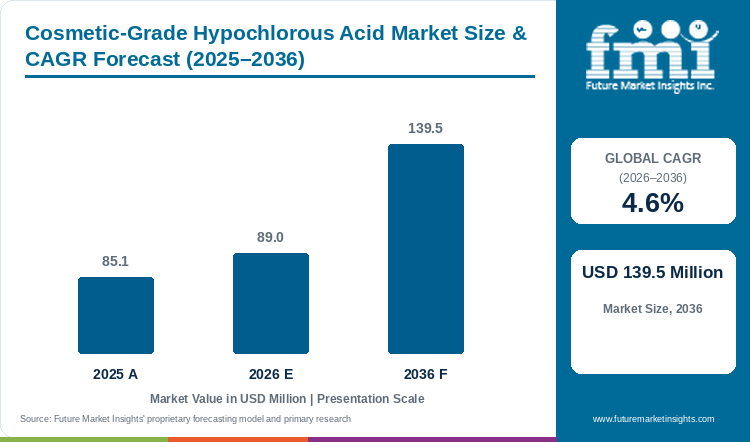
Brand formulators and contract manufacturers will spend USD 89.0 Million on cosmetic-grade hypochlorous acid in 2026, up from USD 85.1 Million in 2025. A 4.6% CAGR is set to take revenue to USD 139.5 Million by 2036.
Sales of cosmetic-grade hypochlorous acid are projected to grow at 4.6% CAGR between 2026 and 2036, as per FMI. Market value is expected to increase from USD 85.1 Million in 2025 to USD 89.0 Million in 2026 and is forecast to reach USD 139.5 Million by 2036, adding USD 50.5 Million over the forecast decade. Skincare brands selling facial mists, toners and sensitive-skin routines are buying most of the volume, due to which facial skincare is expected to account for 40% of demand by application in 2026. Brand formulators buy mainly from HOCl producers, and direct to brands is projected to hold 43% of demand by sales channel.
Ingredient restrictions in the EU are opening a second route to demand for cosmetic-grade HOCl. Commission Regulation (EU) 2025/877 of 12 May 2025 added substances classified as carcinogenic, mutagenic or toxic for reproduction to EU cosmetic restrictions, applying from 1 September 2025 [1]. Due to this, brands are going back into reformulation, and standard cosmetic grade, at 47% of demand by grade in 2026, is expected to collect most of the new briefs. Claim wording will set the size of this opportunity, as antimicrobial or disease-treatment language moves a finished product into a drug or over-the-counter pathway.
Stability loss under light, heat and pH drift is a key challenge in the cosmetic-grade HOCl market, owing to which brands repeat shelf-life tests before any repeat order. Brand owners are bringing production in-house to control this loss, as Magic Science Corporation acquired an HOCl manufacturer in August 2025 to secure purity, stability and shelf life from production through packaging [2]. However, packaging and shelf-life validation will decide the time each brand needs to move from trial to regular order.
Finished skincare spending is also widening the opportunity for HOCl producers, as the skincare market is projected to expand from USD 215.4 Billion to USD 467.8 Billion at 8.1% CAGR. Demand for protection systems in the same water-based formulas is estimated to increase, with the cosmetic grade preservative market set to rise from USD 707.1 Million in 2026 to USD 1,327.2 Million by 2036 at 6.5% CAGR. Upstream sodium hypochlorite sales are expected to grow from USD 267.9 Million in 2025 to USD 457.7 Million by 2035 at 5.5% CAGR. FMI predicts that cosmetic-grade HOCl will grow more slowly than the wider skincare category through 2036. During the forecast period, suppliers shipping assay data, packaging guidance and cosmetic-only claim support are expected to take the larger portion of the USD 50.5 Million gain.
Key Takeaways
- Notable companies in the cosmetic-grade hypochlorous acid market include Ashland, Symrise, DSM-Firmenich, Clariant, IFF, Givaudan, Evonik, BASF, Lubrizol and Croda.
- Based on product type, standard grade is projected to account for 40% in 2026, owing to low qualification cost in routine facial and body formulas.
- By function, anti-aging is estimated to hold 32% in 2026, as multi-active formulas pair HOCl with established age-management actives, and facial skincare is expected at 40% by application.
- Among profiled countries, the UAE is expected to post 5.9% CAGR through 2036, followed by Saudi Arabia at 5.5%, owing to conformity certification and SFDA ingredient lists shaping cosmetic imports and formula choices.
Analyst Perspective
“Ready-to-formulate HOCl systems shipped with assay data, pH limits and packaging guidance in one dossier will offer the clearest revenue opportunity through 2036. Suppliers holding specification across a full shelf life under tighter EU, Gulf and Korean rules will convert single brand trials into multi-year supply programs.”
- Nikhil Kaitwade, Principal Consultant, Future Market Insights
How is the Cosmetic-Grade Hypochlorous Acid Market Segmented?
The cosmetic-grade hypochlorous acid market is segmented into product type, function, application, grade, sales channel and region.
As per FMI, the market is segmented by product type into standard grade, high-purity and clinical grade, natural and certified grade, and customized systems. By function, the market is segmented into anti-aging, hydration and barrier, brightening, soothing and sensitive, and UV and protection. By application, the market is segmented into facial skincare, body care, haircare, color cosmetics and suncare. By grade, the market is segmented into standard cosmetic grade, COSMOS and natural certified, pharma and clinical grade, and organic certified. By sales channel, the market is segmented into direct to brands, specialty distributors, contract manufacturers and online B2B. The regional analysis covers seven regions and more than 25 countries.
Why Does Standard Grade Lead the Cosmetic-Grade Hypochlorous Acid Market by Product Type?
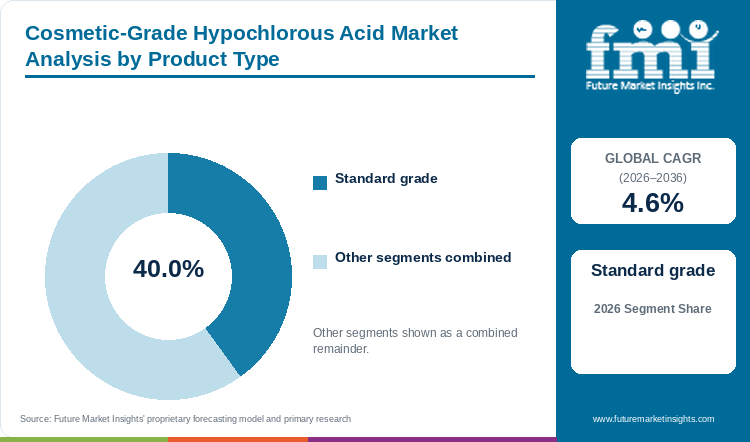
By product type, standard grade will account for 40% of market share in 2026.
Brands launching more sensitive-skin mists, toners and cleansers are supporting the demand for cosmetic-grade hypochlorous acid in standard grade. Buyers can approve a fixed-pH, fixed-concentration solution with minimal paperwork and testing spend, owing to which formulators specify standard grade for most launches. Specs for high-purity and clinical grade are tighter, and few cosmetic projects can justify the higher price, so this grade is growing at a slower pace. Certification fees and fewer qualified producers hold back natural and certified grade. Customized systems serve smaller volumes, mainly for brands ready to fund co-development and shelf testing one project at a time. Producers of similar reactive chemicals are also covered in the oxidizing agents market. However, stable assay over the full shelf period will decide repeat orders for standard grade suppliers.
- Standard grade is projected to account for 40% of demand by product type in 2026, owing to low qualification cost in routine facial and body formulas.
- Magic Science sells HOCl skincare through Target, ULTA Beauty, Amazon and more than 1,000 specialty retailers in the USA [2].
Why Does Anti-aging Lead the Cosmetic-Grade Hypochlorous Acid Market by Function?
Based on function, anti-aging will account for 32% of market share in 2026.
Growing launches of multi-active age-care routines are supporting the demand for cosmetic-grade hypochlorous acid in anti-aging formulas. Formulators add HOCl as a soothing partner next to proven wrinkle and firming ingredients, owing to which anti-aging projects generate the most HOCl briefs. Humectants and lipids carry the main claim in hydration and barrier products, so formulas use little HOCl and growth is slower. In markets such as South Korea, brightening and UV and protection launches go through functional cosmetic review, adding time before sale. Calming launches for reactive skin use HOCl most directly, though soothing and sensitive products see fewer launches than age-care lines. However, the fit between HOCl and partner ingredients will decide the dose each anti-aging launch can carry.
- Anti-aging is estimated to hold 32% of demand by function in 2026, supported by multi-active formulas pairing HOCl with established age-management actives.
- In March 2026, Givaudan Active Beauty introduced VectorHyal, a hyaluronic acid-based delivery system offering enzyme-triggered release and added stability for sensitive ingredients [3].
Why Does Facial Skincare Lead the Cosmetic-Grade Hypochlorous Acid Market by Application?
In 2026, facial skincare will account for 40% of market share by application.
Increasing daily use of rinse-free facial mists and toners is supporting the demand for cosmetic-grade hypochlorous acid in facial skincare. Water-based HOCl suits leave-on products applied several times a day with almost no residue, owing to which brand formulators place most HOCl volume in face products. Larger body care packs sell for less per unit, so body care is growing at a slower pace. Haircare brands buy smaller volumes, as pH and scent compatibility narrow the product range. Contact between a reactive oxidant and pigments, oils or sunscreen filters raises stability cost for color cosmetics and suncare. Launch pipelines in the facial care products market are the deepest for face formats. However, label claims on mists for reactive skin will decide the regulatory route, cosmetic or over-the-counter, for each launch.
- Facial skincare is expected to account for 40% of demand by application in 2026, owing to rinse-free mists and toners used in daily sensitive-skin routines.
- In March 2026, Sonoma Pharmaceuticals launched the Aquanil AD Repair Mist, Recovery Gel and Rescue Serum with Person & Covey for sensitive skin, built on stabilized HOCl [4].
Why Does Standard Cosmetic Grade Lead the Cosmetic-Grade Hypochlorous Acid Market by Grade?
By grade, standard cosmetic grade will account for 47% of market share in 2026.
Formulators buy more standard cosmetic grade HOCl for multi-country launches, as one cosmetic ingredient file satisfies most project requests with modest lab and inspection spend. Brand teams want documented supply for filings without paying for drug-level controls, owing to which this grade leads the category. Audit fees and a thin supply of approved raw materials slow growth for COSMOS and natural certified grade. Fewer launches and similar audit hurdles hold back organic certified grade. Pharma and clinical grade fits wound care and drug claims, and the expense of drug-style controls is seldom recovered on a cosmetic mist or toner. Ingredient suppliers across the cosmetic chemicals market also follow this standard file format. However, EU, UK and Gulf submission rules will decide the paperwork suppliers prepare for brand clients.
- Standard cosmetic grade is projected to hold 47% of demand by grade in 2026, supported by brand briefs requiring a cosmetic ingredient dossier for EU, UK and Gulf filings.
- Claim wording is expected to guide grade selection, as cosmetic-only claim sets keep pharma and clinical grade outside most mist and toner briefs.
Why Does Direct to Brands Lead the Cosmetic-Grade Hypochlorous Acid Market by Sales Channel?
Based on sales channel, direct to brands will account for 43% of market share in 2026.
Brand product development teams are buying more HOCl through direct supply agreements, supporting the demand for cosmetic-grade hypochlorous acid in the direct to brands channel. Target strength, pH, pack type and claim language are agreed jointly before any first purchase, owing to which formulators prefer buying straight from the producer. Regional sampling and restocking pass to specialty distributors once the specification is frozen. Trial-size orders go through online B2B platforms, and contract manufacturers steer sourcing for contract-owned formulas alone. Big ingredient suppliers also appoint partners to widen coverage in the personal care ingredient market, and Ashland appointed IMCD as sole US distributor of personal and home care ingredients from 1 April 2026 [5]. However, the duration of shared stability work will determine the speed at which direct deals turn into recurring orders.
- Direct to brands is estimated to account for 43% of demand by sales channel in 2026, owing to joint stability and compatibility testing before repeat orders.
- The IMCD agreement covers skin care, hair care, microbial protection and biofunctional actives, with laboratory support in Miami and Los Angeles [5].
What are the Drivers, Restraints, and Opportunities in the Cosmetic-Grade Hypochlorous Acid Market?
According to FMI, reformulation under tighter cosmetic rules is increasing demand, HOCl stability and claim classification are slowing qualification, and documented ready-to-formulate systems will open the largest revenue pool through 2036.
- Driver: Ingredient restrictions and claim reviews are sending brands back into reformulation, due to which briefs for low-residue aqueous actives such as HOCl are increasing.
- Restraint: HOCl loses useful concentration with light, heat and pH drift, and claim wording can move a finished product into a drug pathway.
- Opportunity: Stabilized HOCl systems sold with assay data, packaging guidance and market-specific dossiers can command a premium over bulk solutions.
Over-the-counter launches are also widening the shelf presence of HOCl beyond prestige facial mists. WellSpring Consumer Healthcare introduced seven HOCl products across Bactine, vH Essentials, A+D and Solarcaine in August 2026, sold through Amazon, Walmart, CVS, Walgreens and Target [6]. Finished-product revenue falls outside this market, though each launch adds stability and packaging specifications that upstream cosmetic-grade suppliers will need to meet in brand programs.
Key challenges in the market are linked to qualification cost, as a technically sound HOCl formula can still fail a shelf-life, packaging or claim review. Gulf rules are adding documentation layers, as the UAE notified the WTO in August 2025 of a draft Cabinet decision requiring a Certificate of Conformity and testing only in ministry-approved or accredited laboratories [7]. Due to this, a single package of lab reports, formula support and stability data is expected to shorten the qualification cycle for brands and importers.
Which Country CAGRs are Profiled in the Cosmetic-Grade Hypochlorous Acid Market?
| Country | CAGR, 2026 to 2036 |
|---|---|
| UAE | 5.9% |
| Saudi Arabia | 5.5% |
| South Korea | 5.2% |
| USA | 4.9% |
| UK | 4.6% |
| France | 4.3% |
| Germany | 4% |
| Japan | 3.6% |
How do Country-level CAGRs Compare in the Cosmetic-Grade Hypochlorous Acid Market?
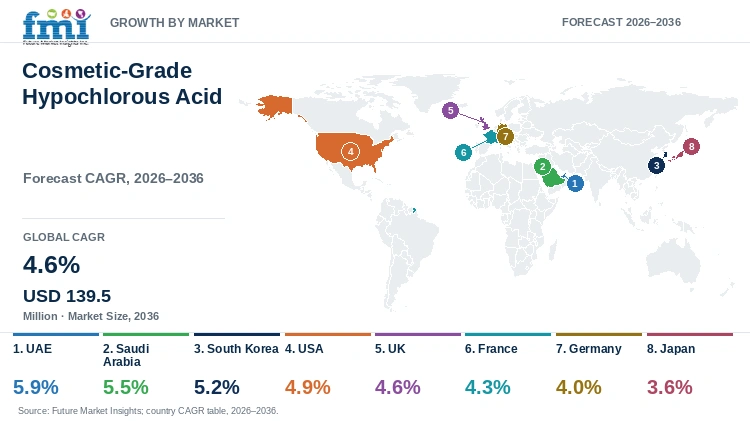
Demand for cosmetic-grade HOCl is projected to grow at 5.2% or above in the UAE, Saudi Arabia and South Korea, as per FMI's analysis of eight profiled countries. The USA, UK, France and Germany are expected to grow between 4% and 4.9%, and Japan is forecast at 3.6%. Absolute revenue rankings for these markets are covered separately in the full country model.
- UAE leads at 5.9% as conformity certification shapes cosmetic imports into the country.
- Saudi Arabia follows at 5.5%, with SFDA ingredient lists steering formula choices.
- Safety assessment reform will carry South Korea to a 5.2% CAGR.
- Growth of 4.9% in the USA will track claim discipline on HOCl labels.
- Demand for HOCl in the UK will rise at 4.6% under a separate GB notification route.
- France will expand at 4.3% as EU reformulation work reaches local formulation labs.
- Germany grows at 4% on reproducibility demands from experienced formulation teams.
- Japan grows slowest at 3.6%, with ingredient standards guiding every new active.
The full report extends CAGR estimates past these eight profiled countries to more than 25 national and grouped markets across seven regions.
Country Outlook
- The UAE is forecast at 5.9% CAGR, the fastest among profiled countries, and conformity paperwork is setting the pace of market entry for brands. The Ministry of Industry and Advanced Technology notified the WTO in August 2025 of a draft Cabinet decision requiring Certificates of Conformity and testing in ministry-approved or accredited laboratories [7]. Clear composition and stability records will speed HOCl inputs through importer reviews.
- Saudi Arabia, on a 5.5% CAGR, is tightening cosmetic ingredient lists at a steady pace. The SFDA added 21 substances to the prohibited cosmetic ingredients list in September 2025 [8]. Exact identity and concentration data will make cosmetic-grade HOCl easier for local brands and importers to notify.
- Mandatory safety assessment is the next regulatory step for Korean beauty brands, with demand growing at a 5.2% CAGR. MFDS plans phased implementation from 2028 and full coverage of all companies and existing products by 2031 [9]. Toxicology and compatibility data supplied with HOCl will lighten that documentation load for brands.
- Claim discipline shapes the US route to shelf, and US sales will expand at a 4.9% CAGR till 2036. Magic Science sells through Target, ULTA Beauty and Amazon and brought HOCl manufacturing in-house in August 2025 [2]. WellSpring took the over-the-counter route for seven HOCl launches in August 2026 [6].
- Great Britain runs a cosmetic notification route separate from the EU, and demand for HOCl in the UK is projected at 4.6% CAGR. The Office for Product Safety and Standards notified the WTO in November 2025 of amendments to the annexes of the UK Cosmetics Regulation [10]. Ingredient dossiers built for both regimes will shorten GB launch work for brands.
- Demand for cosmetic-grade HOCl in France is expected to expand at 4.3% CAGR as EU rules keep reopening formulas. Commission Regulation (EU) 2025/877 applied from 1 September 2025 to cosmetic products on the EU market [1]. Each reformulation cycle will give French formulation labs a fresh reason to screen HOCl against preservation systems and packaging.
- Germany, at a 4% CAGR, combines EU safety rules with a dense ingredient research base that includes BASF and Evonik. Experienced formulation teams will expect assay, pH drift and packaging data in a familiar technical format before approving an HOCl source.
- Japan is projected at 3.6%, the slowest in the group, and compliance with national ingredient standards is required for any new active. Revised Japanese standards for quasi-drug ingredients cover 222 ingredients and require full compliance by 1 October 2026 [11]. Local partners will ask for more stability evidence before adding a reactive aqueous ingredient.
Who are the Notable Companies in the Cosmetic-Grade Hypochlorous Acid Market?
Competition among the ten ingredient suppliers profiled by FMI, including Ashland, Symrise, DSM-Firmenich, Givaudan, BASF and Croda, turns on stability support, formulation compatibility and regulatory documentation.
Dedicated HOCl producers control generation chemistry and assay stability, and large beauty-ingredient houses supply the preservation, delivery and active systems used around HOCl in a formula. Public material for most of the ten profiled ingredient houses shows no dedicated cosmetic-grade HOCl offering, due to which the core chemistry remains with specialist producers and concentration stays low. Producers are integrating further, as Magic Science combined HOCl production with packaging and distribution in August 2025 [2]. Large ingredient houses are competing on delivery science and stability support, with Givaudan adding the VectorHyal delivery system in March 2026 [3]. Brands repeat shelf-life and compatibility tests before changing an HOCl source, owing to which stability data, packaging validation and claim documentation work as entry barriers. Distribution partnerships are widening reach, as Ashland moved US personal care distribution to IMCD from April 2026 [5]. However, more over-the-counter and cosmetic launches will give brands qualified second sources, and competition is expected to increase through 2036.
- Formulation and Product-Protection Infrastructure: Ashland, Clariant, Evonik and Lubrizol supply microbial protection, rheology modifiers, polymers and testing capability for stable water-based cosmetics.
- Skin-Active and Delivery Science Platforms: Symrise, DSM-Firmenich, Givaudan and Croda supply skin actives, soothing ingredients and delivery systems used in multi-active formulas.
- Broad Personal-Care Ingredient Platforms: IFF and BASF cover emulsifiers, actives and formulation support across skin, body and hair care formats.
Competitive Benchmarking
| Company | HOCl-Specific Offering | Aqueous Formulation and Product Protection | Skin-Active and Sensitive-Skin Support | Geographic Reach |
|---|---|---|---|---|
| Ashland | Low | High | Medium | Global, with customers in more than 100 countries and US personal-care distribution support |
| Symrise | Low | High | High | Global, with research centers in Germany and Brazil and regional application teams |
| DSM-Firmenich | Low | Medium | High | Global, with operations in almost 60 countries |
| Clariant | Low | High | High | Global, with personal-care activity across Europe, North America and other regions |
| IFF | Low | Medium | High | Global beauty and personal-care platform spanning skin, body and hair care |
| Givaudan | Low | Medium | High | Global Active Beauty platform with international delivery-science capabilities |
| Evonik | Low | High | High | Global Beauty and Personal Care portfolio with formulation and delivery-system support |
| BASF | Low | High | High | Global, with personal-care production and development sites in all regions |
| Lubrizol | Low | High | High | Global, with more than 100 manufacturing, sales and technical locations plus beauty research centers |
| Croda | Low | High | High | Global Consumer Care and Beauty capabilities with expanding Asian and European technical reach |
Scoring basis: HOCl-Specific Offering is High for a dedicated cosmetic-grade HOCl ingredient or system in public company material and Low for no documented offering. Aqueous Formulation and Product Protection rates documented preservation, rheology, emulsification and stability support for water-based cosmetics. Skin-Active and Sensitive-Skin Support rates documented skin-care actives, barrier, soothing and delivery capability. High marks broad documented capability, Medium marks narrower coverage, and Low marks limited public documentation for the criterion.
Key Developments
- In August 2025, Magic Science Corporation announced a strategic partnership with NexPhase Capital and the acquisition of an HOCl manufacturer, integrating production through packaging and distribution [2].
- In March 2026, Sonoma Pharmaceuticals launched the Aquanil AD line of stabilized HOCl products for sensitive skin with Person & Covey through US over-the-counter dermatology channels [4].
- In August 2026, WellSpring Consumer Healthcare introduced seven HOCl products across the Bactine, vH Essentials, A+D and Solarcaine brands [6].
Key Players
Formulation and Product-Protection Infrastructure
- Ashland
- Clariant
- Evonik
- Lubrizol
Skin-Active and Delivery Science Platforms
- Symrise
- DSM-Firmenich
- Givaudan
- Croda
Broad Personal-Care Ingredient Platforms
- IFF
- BASF
Report Scope and Methodology
| Coverage field | Report scope |
|---|---|
| Market breakdown | 5 categories plus region: Product Type (Standard grade, High-purity & clinical grade, Natural & certified grade, Customized systems), Function (Anti-aging, Hydration & barrier, Brightening, Soothing & sensitive, UV & protection), Application (Facial skincare, Body care, Haircare, Color cosmetics, Suncare), Grade (Standard cosmetic grade, COSMOS & natural certified, Pharma & clinical grade, Organic certified), Sales Channel (Direct to brands, Specialty distributors, Contract manufacturers, Online B2B), and Region |
| Quantitative units | USD Million |
| Market definition | Revenue from B2B sales of cosmetic-grade hypochlorous acid solutions, concentrates and customized HOCl systems sold for use across the stated cosmetic segments. Downstream finished-product revenue, medical or wound-care HOCl, surface-disinfection and water-treatment uses, non-HOCl substitutes and standalone services are excluded, and bundled technical support counts only when inseparable from the HOCl product sold. |
| Regions covered | North America, Latin America, Western Europe, Eastern Europe, East Asia, South Asia and Pacific, Middle East and Africa |
| Countries covered | Over 25 national and grouped markets, with the USA, Germany, France, the UK, Japan, South Korea, Saudi Arabia and the UAE profiled in detail |
| Key companies profiled | Ashland, Symrise, DSM-Firmenich, Clariant, IFF, Givaudan, Evonik, BASF, Lubrizol and Croda, selected from a wider field of beauty and personal-care ingredient suppliers |
| Forecast period | 2026 to 2036 |
| Approach | HOCl volumes, grade pricing and supplier revenue indicators triangulated by FMI from primary interviews and secondary sources. |
Research Methodology
| Method | Approach |
|---|---|
| Primary research | Interviews with brand formulators, contract manufacturers, HOCl producers, ingredient distributors and regulatory specialists test purchase drivers, stability and packaging requirements, claim boundaries and pricing, plus the evidence a brand asks for before a trial turns into repeat orders. |
| Desk research | The analysis reviews government and regulatory publications, standards, technical literature, company filings, product information and corporate announcements. Sources are retained for relevance, publication date, geographic coverage and fit with the defined market scope. |
| Market sizing and forecasting | Baseline value is built up through segment splits, grade pricing and volumes, brand adoption, supplier participation and demand conditions in each country. Regulation, claim reviews, technology adoption, purchasing cycles and supply availability shape the forecast path. |
| Data validation | Public data, company activity, trade patterns and interview findings serve as cross-checks on each estimate. Finished-product revenue, adjacent categories and unverified claims are removed so no revenue is counted twice across segments or countries. |
Cosmetic-Grade Hypochlorous Acid Market by Segments
Cosmetic-Grade Hypochlorous Acid Market Segmented by Product Type
- Standard grade
- High-purity & clinical grade
- Natural & certified grade
- Customized systems
Cosmetic-Grade Hypochlorous Acid Market Segmented by Function
- Anti-aging
- Hydration & barrier
- Brightening
- Soothing & sensitive
- UV & protection
Cosmetic-Grade Hypochlorous Acid Market Segmented by Application
- Facial skincare
- Body care
- Haircare
- Color cosmetics
- Suncare
Cosmetic-Grade Hypochlorous Acid Market Segmented by Grade
- Standard cosmetic grade
- COSMOS & natural certified
- Pharma & clinical grade
- Organic certified
Cosmetic-Grade Hypochlorous Acid Market Segmented by Sales Channel
- Direct to brands
- Specialty distributors
- Contract manufacturers
- Online B2B
Cosmetic-Grade Hypochlorous Acid Market Segmented by Region
- North America
- Latin America
- Western Europe
- Eastern Europe
- East Asia
- South Asia and Pacific
- Middle East and Africa
Research Sources and Bibliography
- [1] European Commission (2025, May 12). Commission Regulation (EU) 2025/877 amending Regulation (EC) No 1223/2009 as regards the use in cosmetic products of certain substances classified as carcinogenic, mutagenic or toxic for reproduction.
- [2] NexPhase Capital (2025, August 26). Magic Science Corporation Announces Strategic Partnership With NexPhase Capital and Acquisition of Leading Hypochlorous Acid Manufacturer.
- [3] Givaudan (2026, March 17). Givaudan Active Beauty elevates its delivery systems technology with VectorHyal.
- [4] Sonoma Pharmaceuticals (2026, March 18). Sonoma Pharmaceuticals Announces Launch of New Dermatology Product Line under Person & Covey's Aquanil Brand for Sensitive Skin.
- [5] Personal Care Magazine (2026, March 16). IMCD lands exclusive US Ashland distribution deal.
- [6] Chain Drug Review (2026, August 18). WellSpring Consumer Healthcare launches hypochlorous acid products across personal care portfolio.
- [7] ChemLinked (2025, August 15). UAE Notifies WTO of Draft Cabinet Decision on Cosmetic Management for Public Consultation.
- [8] SGS (2025, December 11). Navigating Saudi Arabia's Updated Cosmetic Regulations.
- [9] ChemLinked (2025, September 22). South Korea's MFDS Reveals Framework for Upcoming Mandatory Cosmetic Safety Assessment.
- [10] Cosmetic, Toiletry and Perfumery Association (2025, December 1). Amendments to the UK Cosmetics Regulation Notified to WTO.
- [11] REACH24H (2026, February 25). APAC Cosmetic Regulatory Outlook 2026: Key Compliance Transitions in Japan, South Korea, and Indonesia.
This bibliography is provided for reader reference and is not exhaustive. The full report contains the complete reference list and detailed citations.
This Report Answers
- What revenue will cosmetic-grade hypochlorous acid generate in 2026, and what total will the market reach by 2036?
- Which ingredient rules and claim reviews will push brands to reformulate with HOCl through 2036?
- Why will standard grade carry the largest product type share in 2026 across routine facial and body formulas?
- Why will anti-aging lead the function category, and what role will multi-active formulas play in HOCl use?
- Which growth rates will the UAE, Saudi Arabia and South Korea post against the USA, UK, France, Germany and Japan by 2036?
- Which stability and packaging requirements will raise the cost of qualifying an HOCl supplier through 2036?
- Which profiled ingredient houses will supply the preservation, delivery and active systems around HOCl formulas?
- Which assay, pH, packaging and claim evidence will brands request before approving a cosmetic-grade HOCl source?
Frequently Asked Questions
How Big Is the Cosmetic-Grade Hypochlorous Acid Market Expected to Be in 2026?
Cosmetic-grade hypochlorous acid will generate USD 89.0 Million in 2026, up from USD 85.1 Million in 2025, as FMI estimates show. By 2036, sales will reach USD 139.5 Million as brands qualify stabilized HOCl systems for facial and sensitive-skin formulas.
What Is the CAGR of the Cosmetic-Grade Hypochlorous Acid Market from 2026 to 2036?
Demand for cosmetic-grade HOCl will grow on a 4.6% CAGR over the 2026 to 2036 period. Stability, compatibility and regulatory documentation will govern the pace, since brands will move to repeat orders only after an HOCl input holds specification across shelf life.
Which Product Type Holds the Largest Share of the Cosmetic-Grade Hypochlorous Acid Market?
Standard grade will lead with 40% of market share by product type in 2026. Broad formulation fit and a lighter qualification burden will support the position across routine facial and body formulas.
Which Function Leads the Cosmetic-Grade Hypochlorous Acid Market?
Anti-aging will lead with 32% of market share by function in 2026. Multi-active well-aging formulas will give HOCl a skin-comfort role beside established age-management actives.
Which Country Is Expected to Grow Fastest in the Cosmetic-Grade Hypochlorous Acid Market?
Demand in the UAE will post the quickest rise, a 5.9% CAGR till 2036, with Saudi Arabia next at 5.5% and South Korea third at 5.2%. Japan, at 3.6%, will post the slowest rate of the eight profiled countries.
What Notable Restraint Affects the Cosmetic-Grade Hypochlorous Acid Market?
Key challenges will include HOCl stability under light, heat and pH drift, packaging compatibility and the claim boundary between cosmetics and drugs. A technically sound formula will still need to clear each buyer's shelf-life and compliance checks before a trial becomes a standing order.
Which Are the Key Companies in the Cosmetic-Grade Hypochlorous Acid Market?
Ingredient suppliers covered by FMI include Ashland, Symrise, DSM-Firmenich, Clariant, IFF, Givaudan, Evonik, BASF, Lubrizol and Croda. The suppliers fall into three groups, covering formulation and product-protection infrastructure, skin-active and delivery science platforms, and broad personal-care ingredient platforms.
Preview the report firsthand - request a free sample
Get SampleGet the brochure for pricing and purchase details.
Get PDFTable of Content
- Key Takeaways
- Market Size and CAGR
- Top Growth Driver
- Fastest Growing Segment
- Leading Region
- Key Companies
- Emerging Opportunities
- Executive Summary
- Global Market Outlook
- Demand-side Trends
- Supply-side Trends
- Technology Roadmap Analysis
- Analysis and Recommendations
- Analyst Perspective (What is happening? Why now? What should investors know?)
- Key Questions Answered
- How large is the market?
- What is the CAGR?
- What are key trends?
- Which region dominates?
- Who are the leaders?
- Market Overview
- Market Coverage / Taxonomy
- Market Definition / Scope / Limitations
- Research Methodology
- Chapter Orientation
- Analytical Lens and Working Hypotheses
- Market Structure, Signals, and Trend Drivers
- Benchmarking and Cross-market Comparability
- Market Sizing, Forecasting, and Opportunity Mapping
- Research Design and Evidence Framework
- Desk Research Programme (Secondary Evidence)
- Expert Input and Fieldwork (Primary Evidence)
- Tooling, Models, and Reference Databases
- Data Engineering and Model Build
- Quality Assurance and Audit Trail
- Market Background
- Market Dynamics (Drivers, Restraints, Opportunity, Trends)
- Scenario Forecast (Optimistic, Likely, Conservative)
- Impact Analysis
- AI Impact
- Sustainability Impact
- Regulatory Impact
- Technology Impact
- Consumer / Buyer Analysis
- Purchase Drivers
- Adoption Barriers
- Buyer Journey
- Opportunity Map Analysis
- Product Life Cycle Analysis
- Supply Chain Analysis
- Investment Feasibility Matrix
- Value Chain Analysis
- PESTLE and Porter's Analysis
- Regulatory Landscape
- Regional Parent Market Outlook
- Production and Consumption Statistics
- Import and Export Statistics
- Global Market Analysis and Forecast, 2021 to 2036
- Historical Market Size Value (USD Million) Analysis, 2021 to 2025
- Current and Future Market Size Value (USD Million) Projections, 2026 to 2036
- Y-o-Y Growth Trend Analysis
- Absolute $ Opportunity Analysis
- Global Market Pricing Analysis, 2021 to 2036
- Global Market Analysis and Forecast, By Product Type, 2021 to 2036
- Introduction / Key Findings
- Historical Market Size Value (USD Million) Analysis By Product Type, 2021 to 2025
- Current and Future Market Size Value (USD Million) Analysis and Forecast By Product Type, 2026 to 2036
- Standard grade
- High-purity & clinical grade
- Natural & certified grade
- Customized systems
- Y-o-Y Growth Trend Analysis By Product Type, 2021 to 2025
- Absolute $ Opportunity Analysis By Product Type, 2026 to 2036
- Global Market Analysis and Forecast, By Function, 2021 to 2036
- Introduction / Key Findings
- Historical Market Size Value (USD Million) Analysis By Function, 2021 to 2025
- Current and Future Market Size Value (USD Million) Analysis and Forecast By Function, 2026 to 2036
- Anti-aging
- Hydration & barrier
- Brightening
- Soothing & sensitive
- UV & protection
- Y-o-Y Growth Trend Analysis By Function, 2021 to 2025
- Absolute $ Opportunity Analysis By Function, 2026 to 2036
- Global Market Analysis and Forecast, By Application, 2021 to 2036
- Introduction / Key Findings
- Historical Market Size Value (USD Million) Analysis By Application, 2021 to 2025
- Current and Future Market Size Value (USD Million) Analysis and Forecast By Application, 2026 to 2036
- Facial skincare
- Body care
- Haircare
- Color cosmetics
- Suncare
- Y-o-Y Growth Trend Analysis By Application, 2021 to 2025
- Absolute $ Opportunity Analysis By Application, 2026 to 2036
- Global Market Analysis and Forecast, By Grade, 2021 to 2036
- Introduction / Key Findings
- Historical Market Size Value (USD Million) Analysis By Grade, 2021 to 2025
- Current and Future Market Size Value (USD Million) Analysis and Forecast By Grade, 2026 to 2036
- Standard cosmetic grade
- COSMOS & natural certified
- Pharma & clinical grade
- Organic certified
- Y-o-Y Growth Trend Analysis By Grade, 2021 to 2025
- Absolute $ Opportunity Analysis By Grade, 2026 to 2036
- Global Market Analysis and Forecast, By Sales Channel, 2021 to 2036
- Introduction / Key Findings
- Historical Market Size Value (USD Million) Analysis By Sales Channel, 2021 to 2025
- Current and Future Market Size Value (USD Million) Analysis and Forecast By Sales Channel, 2026 to 2036
- Direct to brands
- Specialty distributors
- Contract manufacturers
- Online B2B
- Y-o-Y Growth Trend Analysis By Sales Channel, 2021 to 2025
- Absolute $ Opportunity Analysis By Sales Channel, 2026 to 2036
- Global Market Analysis and Forecast, By Region, 2021 to 2036
- Introduction
- Historical Market Size Value (USD Million) Analysis By Region, 2021 to 2025
- Current Market Size Value (USD Million) Analysis and Forecast By Region, 2026 to 2036
- North America
- Latin America
- Western Europe
- Eastern Europe
- East Asia
- South Asia and Pacific
- Middle East and Africa
- Market Attractiveness Analysis By Region
- North America Market Analysis and Forecast, By Country, 2021 to 2036
- Historical Market Size Value (USD Million) Trend Analysis By Market Taxonomy, 2021 to 2025
- Market Size Value (USD Million) Forecast By Market Taxonomy, 2026 to 2036
- By Country
- By Product Type
- By Function
- By Application
- By Grade
- By Sales Channel
- Market Attractiveness Analysis
- By Country
- By Product Type
- By Function
- By Application
- By Grade
- By Sales Channel
- Key Takeaways
- Latin America Market Analysis and Forecast, By Country
- Historical Market Size Value (USD Million) Trend Analysis By Market Taxonomy, 2021 to 2025
- Market Size Value (USD Million) Forecast By Market Taxonomy, 2026 to 2036
- By Country
- By Product Type
- By Function
- By Application
- By Grade
- By Sales Channel
- Market Attractiveness Analysis
- By Country
- By Product Type
- By Function
- By Application
- By Grade
- By Sales Channel
- Key Takeaways
- Western Europe Market Analysis and Forecast, By Country
- Historical Market Size Value (USD Million) Trend Analysis By Market Taxonomy, 2021 to 2025
- Market Size Value (USD Million) Forecast By Market Taxonomy, 2026 to 2036
- By Country
- By Product Type
- By Function
- By Application
- By Grade
- By Sales Channel
- Market Attractiveness Analysis
- By Country
- By Product Type
- By Function
- By Application
- By Grade
- By Sales Channel
- Key Takeaways
- Eastern Europe Market Analysis and Forecast, By Country
- Historical Market Size Value (USD Million) Trend Analysis By Market Taxonomy, 2021 to 2025
- Market Size Value (USD Million) Forecast By Market Taxonomy, 2026 to 2036
- By Country
- By Product Type
- By Function
- By Application
- By Grade
- By Sales Channel
- Market Attractiveness Analysis
- By Country
- By Product Type
- By Function
- By Application
- By Grade
- By Sales Channel
- Key Takeaways
- East Asia Market Analysis and Forecast, By Country
- Historical Market Size Value (USD Million) Trend Analysis By Market Taxonomy, 2021 to 2025
- Market Size Value (USD Million) Forecast By Market Taxonomy, 2026 to 2036
- By Country
- By Product Type
- By Function
- By Application
- By Grade
- By Sales Channel
- Market Attractiveness Analysis
- By Country
- By Product Type
- By Function
- By Application
- By Grade
- By Sales Channel
- Key Takeaways
- South Asia and Pacific Market Analysis and Forecast, By Country
- Historical Market Size Value (USD Million) Trend Analysis By Market Taxonomy, 2021 to 2025
- Market Size Value (USD Million) Forecast By Market Taxonomy, 2026 to 2036
- By Country
- By Product Type
- By Function
- By Application
- By Grade
- By Sales Channel
- Market Attractiveness Analysis
- By Country
- By Product Type
- By Function
- By Application
- By Grade
- By Sales Channel
- Key Takeaways
- Middle East and Africa Market Analysis and Forecast, By Country
- Historical Market Size Value (USD Million) Trend Analysis By Market Taxonomy, 2021 to 2025
- Market Size Value (USD Million) Forecast By Market Taxonomy, 2026 to 2036
- By Country
- By Product Type
- By Function
- By Application
- By Grade
- By Sales Channel
- Market Attractiveness Analysis
- By Country
- By Product Type
- By Function
- By Application
- By Grade
- By Sales Channel
- Key Takeaways
- Key Countries Market Analysis
- UAE
- Pricing Analysis
- Market Share Analysis, 2025
- By Product Type
- By Function
- By Application
- By Grade
- By Sales Channel
- Saudi Arabia
- Pricing Analysis
- Market Share Analysis, 2025
- By Product Type
- By Function
- By Application
- By Grade
- By Sales Channel
- South Korea
- Pricing Analysis
- Market Share Analysis, 2025
- By Product Type
- By Function
- By Application
- By Grade
- By Sales Channel
- USA
- Pricing Analysis
- Market Share Analysis, 2025
- By Product Type
- By Function
- By Application
- By Grade
- By Sales Channel
- UK
- Pricing Analysis
- Market Share Analysis, 2025
- By Product Type
- By Function
- By Application
- By Grade
- By Sales Channel
- France
- Pricing Analysis
- Market Share Analysis, 2025
- By Product Type
- By Function
- By Application
- By Grade
- By Sales Channel
- Germany
- Pricing Analysis
- Market Share Analysis, 2025
- By Product Type
- By Function
- By Application
- By Grade
- By Sales Channel
- Japan
- Pricing Analysis
- Market Share Analysis, 2025
- By Product Type
- By Function
- By Application
- By Grade
- By Sales Channel
- UAE
- Market Structure Analysis
- Competition Dashboard
- Competition Benchmarking
- Market Share Analysis of Top Players
- By Regional
- By Product Type
- By Function
- By Application
- By Grade
- By Sales Channel
- Emerging Startups
- Innovation Benchmarking
- Competition Analysis
- Competition Deep Dive
- Ashland
- Overview
- Product Portfolio
- Profitability by Market Segments
- Sales Footprint
- Strategy Overview
- Marketing Strategy
- Product Strategy
- Channel Strategy
- Symrise
- DSM-Firmenich
- Clariant
- IFF
- Givaudan
- Evonik
- BASF
- Lubrizol
- Croda
- Ashland
- Case Studies
- Success Stories
- Recent Developments
- Competition Deep Dive
- Assumptions & Acronyms Used


