

- Market Size (2026)
- USD 620.6 Mn
- Forecast (2036)
- USD 1050.1 Mn
- CAGR (2026 to 2036)
- 5.4%
How big is Acid Retarder Additives Market in 2026?
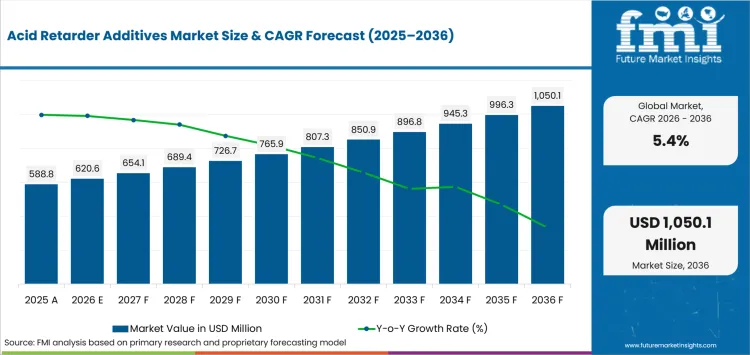
USD 620.6 million in 2026 and USD 1050.1 million by 2036 at a 5.4% CAGR.
Demand for acid retarder additives is projected to expand at a 5.4% CAGR between 2026 and 2036. Market valuation is projected to increase from USD 620.6 million in 2026 to USD 1050.1 million by 2036. Carbonate treatments need reaction control since straight acid can spend near the wellbore and leave less live fluid for deeper rock. Baker Hughes extended two Petrobras offshore stimulation vessels in September 2025 with associated chemicals and onboard laboratories. The extension keeps oilfield stimulation chemicals close to well-specific treatment design during offshore campaigns.
Country demand diverges with reservoir setting and the distance specialized chemistry travels from shore storage to the well. In August 2025 Brazil’s Ministry of Mines and Energy reported that pre-salt supplied 78.8% of national oil and gas production during June. Pre-salt concentration increases retreatment penalties and lengthens resupply routes from shore bases. Gulf programs place more weight on high-temperature qualification as USA oilfield chemicals face shorter shale cycles and tighter job economics.
Key Takeaways
- The acid retarder additives market reached an estimated USD 620.6 million in 2026 as deeper carbonate treatments increased demand for controlled acid spending.
- Based on retarder type, surfactant retarders are projected to account for 26.0% in 2026 due to adsorption-based reaction control without heavy gel viscosity.
- By acid system, HCl systems are estimated to hold 39.0% in 2026 owing to strong carbonate dissolution and controlled near-wellbore spending.
- Deep penetration acidizing is likely to capture 34.0% share in 2026 attributable to preserving live acid beyond the near-wellbore zone.
- High-temperature compatibility and treatment-specific qualification restrict substitution as corrosion packages and formation fluids can alter retarder performance alongside injection hardware.
- Some of the key players in this market include Baker Hughes, Halliburton, SLB, Weatherford, Clariant, Nouryon, Stepan Company, and Innospec Inc.
Analyst Perspective
"Acid retarder additives deserve a reservoir-contact test first since a lower additive price has little value if live acid spends near the wellbore. Commercial performance depends on reaction control surviving the target temperature and acid strength inside a service workflow that can place the same chemistry repeatedly."
- Nikhil Kaitwade, Principal Consultant, Future Market Insights
How is the Acid Retarder Additives Market segmented?
The acid retarder additives market is segmented by retarder type, acid system, application, well environment, sales channel and region.
Retarder type includes surfactant retarders, polymer retarders, gel retarded acids, emulsified acid retarders and self-retarding acid systems. Acid systems cover HCl, mud acid, organic acid and emulsified acid systems. Applications include deep penetration acidizing, carbonate stimulation, high-temperature acidizing and fluid loss control support. Well environments comprise carbonate reservoirs, HPHT wells, offshore wells, long interval treatments and mature wells. Sales channels include stimulation service companies, specialty acid suppliers, direct E&P supply and regional formulators.
Why do HCl systems lead the acid system category?
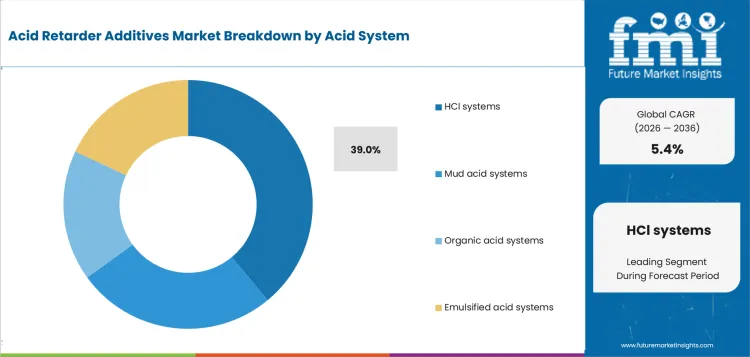
HCl systems dissolve carbonate rapidly and use retardation to slow acid consumption during treatment. Commercial selection depends on preserving HCl activity long enough for live acid to reach beyond the immediate wellbore. In April 2026 SLB disclosed ADNOC Offshore used OpenPath Flex and VDA in tight carbonate at Abu Al Bukhoosh.
- HCl systems are projected to account for 39.0% of the acid system category in 2026 driven by strong carbonate dissolution that benefits from controlled spending.
- ADNOC Offshore calibrated the treatment with core-flow data before pumping the multilateral well. The calibration links acid choice with corrosion inhibitors and zonal placement during repeat field programs.
Why do surfactant retarders lead the retarder type category?
Surfactant retarders slow acid-rock contact without forcing the treatment into a heavily gelled fluid during high-temperature pumping. Service teams value this route for manageable pumpability during long treatment intervals. At ADIPEC in November 2025 Stepan stated that PETROSTEP SAR-1 and its viscoelastic surfactant additives were entering local manufacture in Saudi Arabia.
- By retarder type, surfactant retarders are estimated to hold 26.0% in 2026 owing to surface-controlled reaction delay with comparatively low viscosity.
- Field qualification requires evidence that the formulation performs at intended acid strength and formation temperature. Local Saudi manufacture shortens replenishment routes for approved chemistry serving Gulf stimulation programs.
Why does deep penetration acidizing lead the application category?
Deep penetration acidizing turns reaction delay into a measurable reservoir-contact objective during carbonate stimulation. Treatments must preserve live acid for useful wormhole or fracture reach without excessive friction. SLB’s January 2026 full-year release documented more than 580,000 cumulative incremental barrels from 33 Daleel Petroleum acidizing jobs using OpenPath Flex retardation and diversion.
- Deep penetration acidizing is estimated to capture 34.0% of the application category in 2026 attributable to deeper live-acid placement that can improve reservoir contact.
- Daleel paired fluid retardation with diversion and real-time pressure monitoring during its Oman campaign. The field record ties commercial value to placement control and laboratory reaction rate.
Why do stimulation service companies lead the sales channel category?
Stimulation service companies control more of the qualification sequence as acid chemistry must fit drilling and completion fluids plus the final pumping design. Nouryon opened its Houston oilfield Innovation Center in June 2025 with testing facilities for stimulation plus corrosion and scale inhibition.
- Stimulation service companies are forecast to represent 44.0% of the sales channel category in 2026 due to integrated chemistry testing and field execution.
- Customer workshops and technical training at the Houston center let operating teams resolve compatibility questions ahead of wellsite execution. Local testing also reduces handoffs during formulation changes and gives service teams faster feedback on chemistry adjustments.
What are the drivers, restraints and opportunities in the Acid Retarder Additives Market?
Reactive carbonate programs raise demand for controlled acid placement, qualification work slows substitution and regional manufacturing shortens replenishment routes.
- Driver: Reactive carbonate and unconventional wells raise the cost of premature acid spending by reducing live-fluid reach inside the intended treatment interval.
- Restraint: Qualification extends purchasing cycles as completion design and pumping sequence can alter field results after acceptable laboratory testing.
- Opportunity: Regional surfactant capacity and basin-level testing can shorten replenishment time without weakening temperature or acid-strength qualification.
Reactive carbonate and unconventional programs raise the cost of acid spending too early in the treatment path. EIA forecast in August 2026 that United States marketed gas production would average 122.5 Bcf/d during 2026, with much of the increase concentrated in Permian and Haynesville output. Permian and Haynesville growth concentrates service activity in corridors that also consume onshore drilling fluids and reward rapid field support for acidizing programs.
Retarder selection becomes expensive if chemistry performance cannot be separated from completion hardware and the final pumping sequence. Weatherford reported seven Petrobras OptiROSS installations in October 2025 and stated that remotely operated sleeves optimized acid-stimulation logistics in Brazil. Diversion points and injection timing can defeat a laboratory-qualified formulation during multistage work with fracking fluids and chemicals.
Regional manufacturing shortens the path between formulation adjustment and field approval for surfactant-based retarder products. Stepan began production at its Pasadena alkoxylation facility in April 2025 with annual capacity of 75,000 metric tons for surfactants serving oilfield and other markets. Local well stimulation materials testing can pair that capacity with basin-specific qualification and reduce replenishment risk for approved chemistries.
Which country CAGRs are profiled in the Acid Retarder Additives Market?
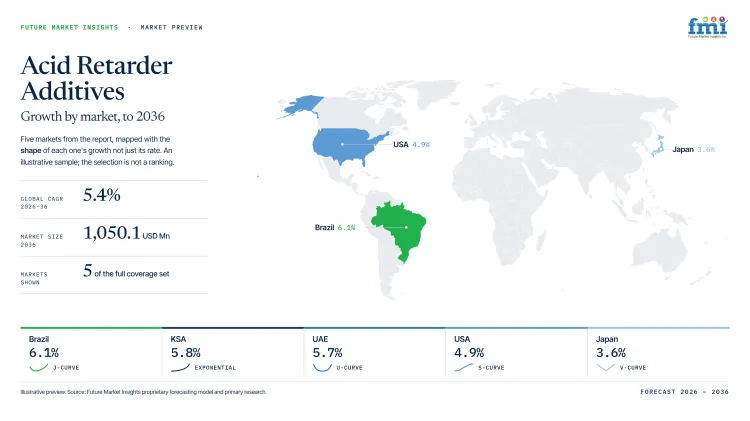
| Country | CAGR |
|---|---|
| Brazil | 6.1% |
| KSA | 5.8% |
| UAE | 5.7% |
| USA | 4.9% |
| Japan | 3.6% |
How do country-level CAGRs compare in the Acid Retarder Additives Market?
The profiled countries form a compact upper cluster and one mature follower within 2.5 percentage points overall. Brazil leads at 6.1% as offshore logistics raise the penalty for formulation failure. KSA, UAE and USA remain grouped as the Japan follows at 3.6% under stricter cycle-time discipline.
- Brazilian vessel contracting concentrates acid-treatment purchasing inside integrated offshore stimulation packages for Petrobras.
- Saudi contracts give integrated stimulation groups repeat demand visibility during unconventional gas programs.
- UAE multilateral carbonate work ties acid placement directly to completion geometry requirements.
- USA chemical depth gives shale service companies more alternatives between repeated basin jobs.
- Japan’s chemical expertise supports flexible acid retarder additive selection.
Comparable CAGRs therefore mask different qualification costs and operating risks for formulators. The full report provides country-level CAGR analysis across North America, Latin America, Europe, East Asia, South Asia, Oceania and the Middle East and Africa.
Country-wise Analysis
- Brazilian stimulation programs concentrate in pre-salt offshore fields and vessel schedules make treatment failure expensive for Petrobras and its service contractors. Brazil’s acid retarder additives outlook is anticipated to advance at 6.1% CAGR over the assessment period attributable to deepwater work that raises the value of stable reaction control. ANP stated in August 2026 that pre-salt supplied 82% of national production during June. An 82% pre-salt share leaves national output heavily dependent on uninterrupted offshore operating continuity and vessel availability. Petrobras-linked vessel capacity exposes qualified formulations to repeated offshore campaigns and gives service teams steady access to scheduled treatments. Long resupply routes raise inventory risk and make documented offshore performance especially persuasive for companies seeking entry.
- In the Eastern Province, unconventional gas programs concentrate Saudi acid-retarder demand and require fast technical response between repeated stimulation schedules serving large pad campaigns. In February 2026 Aramco stated that Jafurah started shale-gas production in December 2025 and technology had lowered drilling and stimulation costs. The Saudi sector is projected to record 5.8% CAGR during the assessment period propelled by Jafurah-scale activity and repeated treatment intensity. Local manufacturing and regional laboratories shorten formulation support during active programs and reduce dependence on long import routes. High-temperature qualification and operator approval lengthen adoption for unfamiliar chemistries entering established long-term service contracts.
- Multilateral completion planning in Abu Dhabi ties tight-carbonate treatment design to nearby technical support and integrated execution for high-value wells. Adoption of acid retarder additives in the UAE is estimated to expand at 5.7% CAGR through 2036 tied to complex carbonate work and integrated execution. The Abu Dhabi Media Office confirmed in June 2025 that ADNOC achieved the emirate’s first unconventional gas production using advanced technologies with international energy companies. ADNOC’s operating base gives proven chemistry access to demanding programs and requires service companies to coordinate directly with operator teams. Project-specific qualification protects incumbent relationships and slows entry for formulations without established local field performance records.
- Rapid job turnover in Texas and New Mexico forces United States service teams to test acidizing formulations against hard cost benchmarks. The USA is estimated to post 4.9% CAGR over the forecast period because a large well base sustains repeat stimulation work without removing pressure on treatment economics. EIA reported in May 2026 that crude production averaged a record 13.6 million barrels per day in 2025, despite lower rig and well counts. Domestic service depth lets operators compare qualified formulations quickly and scale chemistry after measurable placement gains appear. Price pressure limits premium capture for products that cannot show a field-level advantage over established acid packages.
- Japan’s mature oil and gas infrastructure and specialized chemical capabilities give service companies flexibility in selecting acidizing formulations for targeted well stimulation. The Japan acid retarder additives market is estimated to register a 3.6% CAGR over the forecast period, supported by ongoing maintenance and stimulation requirements across domestic oil and gas operations. Limited drilling activity and a smaller well base constrain overall demand, making treatment efficiency and cost control important factors in formulation selection. Service providers increasingly assess acid retarder performance against established treatment packages, with premium products requiring measurable improvements in stimulation effectiveness, corrosion control, or placement performance to justify higher costs.
Who are the notable companies in the Acid Retarder Additives Market?
Baker Hughes, Halliburton, SLB, Weatherford, Clariant, Nouryon, Stepan Company and Innospec Inc. are the notable companies serving this market.
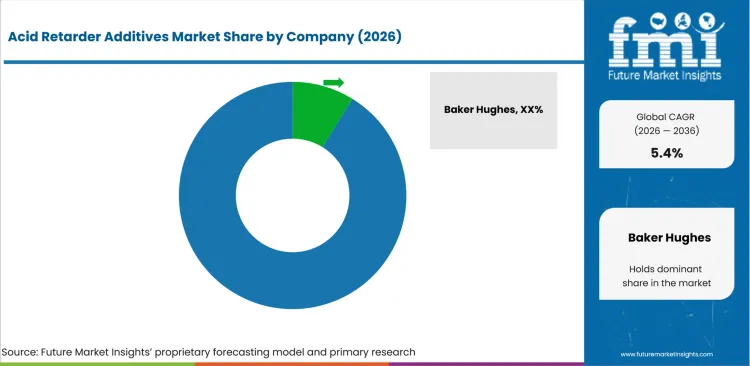
Competition separates integrated treatment execution from formulation-led chemistry supply under a commercial model that depends on both chemistry and placement. Baker Hughes, Halliburton and SLB link stimulation chemistry with field design and pumping services during complex treatment programs. Weatherford provides completion hardware that changes acid-placement logistics in multistage and offshore wells. Clariant, Nouryon, Stepan Company and Innospec Inc. sell specialty chemistry or technical support used during stimulation. Existing oilfield chemical relationships improve account access without replacing the field evidence required for retarded-acid qualification.
- Baker Hughes, Halliburton and SLB provide integrated stimulation systems that link chemistry selection with treatment design and field execution during complex acidizing programs.
- Weatherford competes with completion hardware and service workflows that influence acid placement plus treatment logistics during offshore and multistage well programs.
- Clariant, Nouryon, Stepan Company and Innospec Inc. provide specialty chemistry or technical support routes used during stimulation and formulation work.
Competitive Benchmarking: Acid Retarder Additives Market
| Company | Retarded-Acid System Depth | Stimulation Chemistry Breadth | Field Qualification Support | Geographic Reach |
|---|---|---|---|---|
| Baker Hughes | Medium | High | High | Global |
| Halliburton | Medium | High | High | Global |
| SLB | High | High | High | Global |
| Weatherford | Low | Low | High | Global |
| Clariant | Low | High | Medium | Europe, Middle East, Africa and Americas |
| Nouryon | Low | High | High | North America, Middle East and Europe |
| Stepan Company | High | High | Medium | North America and Middle East |
| Innospec Inc. | Low | Medium | Medium | Americas, Europe, Middle East, Africa and Asia-Pacific |
Scoring basis: High retarded-acid depth requires a named delayed-acid system with current field evidence for demanding carbonate treatments. Medium requires current acid-stimulation capability without equivalent named retarded-acid deployment and Low records narrower documented stimulation participation. High chemistry breadth requires several acid-package functions while Medium covers several stimulation chemistry classes and Low covers one documented class. High field qualification support requires integrated execution with laboratory or treatment-design support while Medium requires regional testing or technical service. Low field qualification support records commercial participation without documented integrated qualification infrastructure and never substitutes for missing public evidence.
Key Developments in the Acid Retarder Additives Market
- In July 2026, Clariant appointed Gapuma Group to distribute Well Service Additives in Nigeria plus Côte d’Ivoire and Ghana. The agreement extends regional access to HOSTASTIM stimulation chemistry for West African well-service teams.
- In July 2026, Halliburton received a multi-year Aramco contract for integrated stimulation and completion services supporting Saudi unconventional gas development.
- In July 2025, Innospec Inc. completed its acquisition of Biotechnology Solutions LLC for its Oilfield Services business. The acquired portfolio includes biology-based products used in completion plus production and stimulation applications.
Key Players in the Acid Retarder Additives Market
Integrated Acid-Stimulation System Providers
- Baker Hughes
- Halliburton
- SLB
Completion and Field-Support Platforms
- Weatherford
- Nouryon
Specialty Stimulation Chemistry Providers
- Clariant
- Stepan Company
- Innospec Inc.
Acid Retarder Additives Market - Report Scope
| Coverage field | Report scope |
|---|---|
| Market breakdown | By retarder type, acid system, application, well environment, sales channel and region. |
| Quantitative Units | USD Million. |
| Market Definition | Acid-retarding additives and retarder-enabled acid chemistries used to control acid spending during oilfield stimulation and acidizing treatments. |
| Regions Covered | North America, Latin America, Europe, East Asia, South Asia and Pacific, and Middle East and Africa. |
| Countries Covered | Brazil, KSA, UAE, Qatar, USA, and 20+ countries included in the full report. |
| Key Companies Profiled | Baker Hughes, Halliburton, SLB, Weatherford, Clariant, Nouryon, Stepan Company, and Innospec Inc. |
| Forecast Period | 2026 to 2036. |
| Approach | Primary and secondary research with market triangulation. |
Acid Retarder Additives Market - Research Methodology
| Method | Approach |
|---|---|
| Primary Research | FMI analysts gathered input from manufacturers, service providers, technology developers, distributors, end users, procurement teams, and subject-matter experts. Interviews examined purchasing decisions, product or service evaluation, adoption barriers, approval requirements, pricing considerations, and expectations for technical or commercial support. Respondents were also asked what evidence is required before a trial, pilot, or initial order develops into regular purchasing. |
| Desk Research | Desk research covered government statistics, regulatory publications, trade data, industry associations, technical literature, standards, company filings, product information, and official corporate announcements. Sources were reviewed for relevance, publication date, geographic coverage, and consistency with the defined market scope. Claims relating to performance, applications, approvals, capacity, investment, and commercial activity were retained only when supported by credible public evidence. |
| Market Sizing and Forecasting | The market model combined the baseline value with historical performance, segment structure, pricing and volume indicators, adoption levels, company participation, and country-level demand conditions. Forecast assumptions considered economic activity, investment trends, regulatory developments, technology adoption, purchasing cycles, supply availability, and barriers to wider market use. Segment and regional estimates were reconciled before the final market total was calculated. |
| Data Validation | Estimates were checked against multiple independent indicators, including public data, company activity, trade patterns, industry developments, and findings from primary interviews. Validation also tested whether products, services, applications, and company revenues fell within the defined market boundaries. Adjacent categories, unsupported claims, overlapping revenues, and activities without direct market relevance were excluded to reduce double counting and maintain consistency across segments and countries. |
Acid Retarder Additives Market by Segments
Retarder Type
- Surfactant retarders
- Polymer retarders
- Gel retarded acids
- Emulsified acid retarders
- Self-retarding acid systems
Acid System
- HCl systems
- Mud acid systems
- Organic acid systems
- Emulsified acid systems
Application
- Deep penetration acidizing
- Carbonate stimulation
- High-temperature acidizing
- Fluid loss control support
Well Environment
- Carbonate reservoirs
- HPHT wells
- Offshore wells
- Long interval treatments
- Mature wells
Sales Channel
- Stimulation service companies
- Specialty acid suppliers
- Direct E&P supply
- Regional formulators
Acid Retarder Additives Market by Region:
- North America
- United States
- Canada
- Latin America
- Brazil
- Mexico
- Argentina
- Chile
- Western Europe
- Germany
- France
- United Kingdom
- Italy
- Spain
- Benelux
- Nordics
- Eastern Europe
- Poland
- Czech Republic
- Romania
- Hungary
- East Asia
- China
- Japan
- South Korea
- South Asia and Pacific
- India
- ASEAN
- Australia and New Zealand
- Middle East and Africa
- GCC Countries
- South Africa
- Türkiye
- Israel
Research Sources and Bibliography
- Baker Hughes. (2025, September 17). Baker Hughes Secures Multi-Year Contract with Petrobras for Offshore Stimulation Vessels.
- Ministry of Mines and Energy, Brazil. (2025, August 4). Produção de petróleo e gás no Brasil bate recorde e alcança 4,9 milhões de barris por dia.
- Stepan Company. (2025, October 31). Meet Stepan Oilfield Solutions at ADIPEC 2025.
- SLB. (2026, April 24). SLB Announces First-Quarter 2026 Results.
- SLB. (2026, January 23). SLB Announces Fourth-Quarter and Full-Year 2025 Results.
- Nouryon. (2025, June 18). Nouryon launches Innovation Center for oilfield solutions in Texas, US.
- USA Energy Information Administration. (2026, August 12). United States on track for record natural gas production in 2026.
- Weatherford International plc. (2025, October 21). Weatherford Announces Third Quarter 2025 Results.
- Stepan Company. (2025, April 28). Stepan Company Starts Production at New Alkoxylation Hub in Pasadena, Texas.
- Agência Nacional do Petróleo, Gás Natural e Biocombustíveis. (2026, August 3). ANP divulga dados consolidados da produção de petróleo e gás em junho de 2026.
- Aramco. (2026, February 26). Aramco’s gas strategy builds momentum with major progress towards growth target.
- Abu Dhabi Media Office. (2025, June 10). Khaled bin Mohamed bin Zayed chairs meeting of Executive Committee of ADNOC Board of Directors.
- QatarEnergy. (2026, August 1). PROVISION OF STIMULATION VESSEL, RIG BASED PACKAGE EQUIPMENT AND SERVICES FOR OFFSHORE OPERATIONS.
- USA Energy Information Administration. (2026, May 11). The United States set record energy production in 2025, again.
- Clariant. (2026, July 29). Clariant appoints Gapuma Group as Well Service Additives distributor across West Africa.
- Halliburton. (2026, July 15). Aramco awards Halliburton long-term contract for unconventional gas program.
- Innospec Inc. (2026, February 18). Annual Report on Form 10-K for the fiscal year ended December 31, 2025.
- Nouryon. (2025, February 10). Nouryon opens new office in Al Dhahran to strengthen presence in Saudi Arabia and the Middle East.
- Stepan Company. (2025, June 3). Stepan Company Boosts AOS Production Capacity by 25% Annually.
- SLB. (2026, August 6). SLB and Equinor Sign Multi-Year Stimulation Agreement for Norwegian Continental Shelf.
- Halliburton. (2026, July 16). Halliburton Awarded LSTK Contracts by Aramco for Onshore Oil Re-Entry Program.
- Weatherford International plc. (2026, May 21). Weatherford Awarded Deepwater Integrated Completions Contract with ExxonMobil in Nigeria.
- Baker Hughes. (2026, August 11). Baker Hughes Awarded Multi-Year Contract by Kuwait Oil Company for Ahmadi Innovation Valley Project.
- BASF SE. (2026, March 18). BASF-Hannong Chemicals Joint Venture inaugurates the new non-ionic surfactant (NIS) site in Seosan, Korea.
- BSI Assurance UK Limited. (2025, February 26). Italmatch Chemicals GB Ltd - OHS 804896.
- Weatherford International plc. (2026, February 12). Weatherford Awarded Multi-Year Integrated Completions Contract in Denmark.
- BASF SE. (2025, November 19). BASF inaugurates the expansion of production capacity for Alkyl Polyglucosides (APGs) in Bangpakong, Thailand.
- Clariant. (2026, June 24). Clariant achieves North Sea breakthrough with OSPAR-compliant low-dosage hydrate inhibitor technology.
- Innospec Inc. (2026, August 4). Innospec Reports Second Quarter 2026 Financial Results.
- SLB. (2025, December 23). Aramco Awards SLB Long-Term Contract to Support Kingdom’s Unconventional Gas Production Growth.
This bibliography is provided for reader reference and is not exhaustive. The full report contains the complete reference list and detailed citations
This Report Answers
- How large is the acid retarder additives market in 2026 and 2036?
- What operating conditions increase demand for controlled acid spending?
- Why do surfactant retarders hold 26.0% of retarder type demand in 2026?
- Why do HCl systems account for 39.0% of acid system demand in 2026?
- Why does deep penetration acidizing account for 34.0% of application demand in 2026?
- How do country CAGRs differ among Brazil, KSA, UAE, Qatar and USA?
- Which companies provide integrated acid stimulation or specialty retarder chemistry?
- What limits substitution among qualified acid-retarder formulations?
Frequently Asked Questions
How big is the acid retarder additives market in 2026?
The acid retarder additives market is valued at USD 620.6 million in 2026 and is projected to reach USD 1,050.1 million by 2036. Growth is driven by demand for deeper controlled acid placement in reactive carbonate treatments.
What is the CAGR of the acid retarder additives market from 2026 to 2036?
The acid retarder additives market is projected to grow at a CAGR of 5.4% between 2026 and 2036. Expansion is supported by technically demanding carbonate treatments and repeated stimulation work in offshore and unconventional programs.
Which retarder type leads the acid retarder additives market?
The surfactant retarders segment is expected to hold 26.0% of the acid retarder additives market in 2026, driven by reaction control that can preserve pumpability without heavy gelling. The route requires temperature and acid-strength qualification ahead of field use in demanding stimulation programs.
Which acid system leads the acid retarder additives market?
The HCl systems segment is expected to hold 39.0% of the acid retarder additives market in 2026, attributable to HCl’s central role in carbonate dissolution. Retardation protects useful acid reach where untreated reaction speed would spend fluid near the wellbore.
How much value will the acid retarder additives market add between 2026 and 2036?
The acid retarder additives market is expected to add USD 429.5 million in value between 2026 and 2036. Expansion comes from wider use of controlled acid placement in complex carbonate and unconventional treatment programs.
Which countries are projected to record the highest growth in the acid retarder additives market?
Brazil is projected to grow at 6.1% CAGR, followed by KSA at 5.8% and the UAE at 5.7% through 2036. Growth is supported by deepwater and unconventional programs that require tighter acid-placement control.
Which companies are active in the acid retarder additives market?
Key companies operating in the acid retarder additives market include Baker Hughes, Halliburton, SLB, Weatherford, Clariant, Nouryon, Stepan Company, and Innospec Inc. Their positions differ by field execution and formulation breadth plus regional technical support and documented stimulation chemistry.
Preview the report firsthand - request a free sample
Get SampleGet the brochure for pricing and purchase details.
Get PDFTable of Content
- Key Takeaways
- Market Size and CAGR
- Top Growth Driver
- Fastest Growing Segment
- Leading Region
- Key Companies
- Emerging Opportunities
- Executive Summary
- Global Market Outlook
- Demand-side Trends
- Supply-side Trends
- Technology Roadmap Analysis
- Analysis and Recommendations
- Analyst Perspective (What is happening? Why now? What should investors know?)
- Key Questions Answered
- How large is the market?
- What is the CAGR?
- What are key trends?
- Which region dominates?
- Who are the leaders?
- Market Overview
- Market Coverage / Taxonomy
- Market Definition / Scope / Limitations
- Research Methodology
- Chapter Orientation
- Analytical Lens and Working Hypotheses
- Market Structure, Signals, and Trend Drivers
- Benchmarking and Cross-market Comparability
- Market Sizing, Forecasting, and Opportunity Mapping
- Research Design and Evidence Framework
- Desk Research Programme (Secondary Evidence)
- Expert Input and Fieldwork (Primary Evidence)
- Tooling, Models, and Reference Databases
- Data Engineering and Model Build
- Quality Assurance and Audit Trail
- Market Background
- Market Dynamics (Drivers, Restraints, Opportunity, Trends)
- Scenario Forecast (Optimistic, Likely, Conservative)
- Impact Analysis
- AI Impact
- Sustainability Impact
- Regulatory Impact
- Technology Impact
- Consumer / Buyer Analysis
- Purchase Drivers
- Adoption Barriers
- Buyer Journey
- Opportunity Map Analysis
- Product Life Cycle Analysis
- Supply Chain Analysis
- Investment Feasibility Matrix
- Value Chain Analysis
- PESTLE and Porter's Analysis
- Regulatory Landscape
- Regional Parent Market Outlook
- Production and Consumption Statistics
- Import and Export Statistics
- Global Market Analysis and Forecast, 2021 to 2036
- Historical Market Size Value (USD Million) Analysis, 2021 to 2025
- Current and Future Market Size Value (USD Million) Projections, 2026 to 2036
- Y-o-Y Growth Trend Analysis
- Absolute $ Opportunity Analysis
- Global Market Pricing Analysis, 2021 to 2036
- Global Market Analysis and Forecast, By Retarder Type, 2021 to 2036
- Introduction / Key Findings
- Historical Market Size Value (USD Million) Analysis By Retarder Type, 2021 to 2025
- Current and Future Market Size Value (USD Million) Analysis and Forecast By Retarder Type, 2026 to 2036
- Surfactant retarders
- Polymer retarders
- Gel retarded acids
- Emulsified acid retarders
- Self-retarding acid systems
- Surfactant retarders
- Y-o-Y Growth Trend Analysis By Retarder Type, 2021 to 2025
- Absolute $ Opportunity Analysis By Retarder Type, 2026 to 2036
- Global Market Analysis and Forecast, By Acid System, 2021 to 2036
- Introduction / Key Findings
- Historical Market Size Value (USD Million) Analysis By Acid System, 2021 to 2025
- Current and Future Market Size Value (USD Million) Analysis and Forecast By Acid System, 2026 to 2036
- HCl systems
- Mud acid systems
- Organic acid systems
- Emulsified acid systems
- HCl systems
- Y-o-Y Growth Trend Analysis By Acid System, 2021 to 2025
- Absolute $ Opportunity Analysis By Acid System, 2026 to 2036
- Global Market Analysis and Forecast, By Application, 2021 to 2036
- Introduction / Key Findings
- Historical Market Size Value (USD Million) Analysis By Application, 2021 to 2025
- Current and Future Market Size Value (USD Million) Analysis and Forecast By Application, 2026 to 2036
- Deep penetration acidizing
- Carbonate stimulation
- High-temperature acidizing
- Fluid loss control support
- Deep penetration acidizing
- Y-o-Y Growth Trend Analysis By Application, 2021 to 2025
- Absolute $ Opportunity Analysis By Application, 2026 to 2036
- Global Market Analysis and Forecast, By Well Environment, 2021 to 2036
- Introduction / Key Findings
- Historical Market Size Value (USD Million) Analysis By Well Environment, 2021 to 2025
- Current and Future Market Size Value (USD Million) Analysis and Forecast By Well Environment, 2026 to 2036
- Carbonate reservoirs
- HPHT wells
- Offshore wells
- Long interval treatments
- Mature wells
- Carbonate reservoirs
- Y-o-Y Growth Trend Analysis By Well Environment, 2021 to 2025
- Absolute $ Opportunity Analysis By Well Environment, 2026 to 2036
- Global Market Analysis and Forecast, By Sales Channel, 2021 to 2036
- Introduction / Key Findings
- Historical Market Size Value (USD Million) Analysis By Sales Channel, 2021 to 2025
- Current and Future Market Size Value (USD Million) Analysis and Forecast By Sales Channel, 2026 to 2036
- Stimulation service companies
- Specialty acid suppliers
- Direct E&P supply
- Regional formulators
- Stimulation service companies
- Y-o-Y Growth Trend Analysis By Sales Channel, 2021 to 2025
- Absolute $ Opportunity Analysis By Sales Channel, 2026 to 2036
- Global Market Analysis and Forecast, By Region, 2021 to 2036
- Introduction
- Historical Market Size Value (USD Million) Analysis By Region, 2021 to 2025
- Current Market Size Value (USD Million) Analysis and Forecast By Region, 2026 to 2036
- North America
- Latin America
- Western Europe
- Eastern Europe
- East Asia
- South Asia and Pacific
- Middle East & Africa
- Market Attractiveness Analysis By Region
- North America Market Analysis and Forecast, By Country, 2021 to 2036
- Historical Market Size Value (USD Million) Trend Analysis By Market Taxonomy, 2021 to 2025
- Market Size Value (USD Million) Forecast By Market Taxonomy, 2026 to 2036
- By Country
- USA
- Canada
- By Retarder Type
- By Acid System
- By Application
- By Well Environment
- By Sales Channel
- By Country
- Market Attractiveness Analysis
- By Country
- By Retarder Type
- By Acid System
- By Application
- By Well Environment
- By Sales Channel
- Key Takeaways
- Latin America Market Analysis and Forecast, By Country
- Historical Market Size Value (USD Million) Trend Analysis By Market Taxonomy, 2021 to 2025
- Market Size Value (USD Million) Forecast By Market Taxonomy, 2026 to 2036
- By Country
- Brazil
- Mexico
- Chile
- Rest of Latin America
- By Retarder Type
- By Acid System
- By Application
- By Well Environment
- By Sales Channel
- By Country
- Market Attractiveness Analysis
- By Country
- By Retarder Type
- By Acid System
- By Application
- By Well Environment
- By Sales Channel
- Key Takeaways
- Western Europe Market Analysis and Forecast, By Country
- Historical Market Size Value (USD Million) Trend Analysis By Market Taxonomy, 2021 to 2025
- Market Size Value (USD Million) Forecast By Market Taxonomy, 2026 to 2036
- By Country
- Germany
- UK
- Italy
- Spain
- France
- Nordic
- BENELUX
- Rest of Western Europe
- By Retarder Type
- By Acid System
- By Application
- By Well Environment
- By Sales Channel
- By Country
- Market Attractiveness Analysis
- By Country
- By Retarder Type
- By Acid System
- By Application
- By Well Environment
- By Sales Channel
- Key Takeaways
- Eastern Europe Market Analysis and Forecast, By Country
- Historical Market Size Value (USD Million) Trend Analysis By Market Taxonomy, 2021 to 2025
- Market Size Value (USD Million) Forecast By Market Taxonomy, 2026 to 2036
- By Country
- Russia
- Poland
- Hungary
- Balkan & Baltic
- Rest of Eastern Europe
- By Retarder Type
- By Acid System
- By Application
- By Well Environment
- By Sales Channel
- By Country
- Market Attractiveness Analysis
- By Country
- By Retarder Type
- By Acid System
- By Application
- By Well Environment
- By Sales Channel
- Key Takeaways
- East Asia Market Analysis and Forecast, By Country
- Historical Market Size Value (USD Million) Trend Analysis By Market Taxonomy, 2021 to 2025
- Market Size Value (USD Million) Forecast By Market Taxonomy, 2026 to 2036
- By Country
- China
- Japan
- South Korea
- By Retarder Type
- By Acid System
- By Application
- By Well Environment
- By Sales Channel
- By Country
- Market Attractiveness Analysis
- By Country
- By Retarder Type
- By Acid System
- By Application
- By Well Environment
- By Sales Channel
- Key Takeaways
- South Asia and Pacific Market Analysis and Forecast, By Country
- Historical Market Size Value (USD Million) Trend Analysis By Market Taxonomy, 2021 to 2025
- Market Size Value (USD Million) Forecast By Market Taxonomy, 2026 to 2036
- By Country
- India
- ASEAN
- Australia & New Zealand
- Rest of South Asia and Pacific
- By Retarder Type
- By Acid System
- By Application
- By Well Environment
- By Sales Channel
- By Country
- Market Attractiveness Analysis
- By Country
- By Retarder Type
- By Acid System
- By Application
- By Well Environment
- By Sales Channel
- Key Takeaways
- Middle East & Africa Market Analysis and Forecast, By Country
- Historical Market Size Value (USD Million) Trend Analysis By Market Taxonomy, 2021 to 2025
- Market Size Value (USD Million) Forecast By Market Taxonomy, 2026 to 2036
- By Country
- Kingdom of Saudi Arabia
- Other GCC Countries
- Türkiye
- South Africa
- Other African Union
- Rest of Middle East & Africa
- By Retarder Type
- By Acid System
- By Application
- By Well Environment
- By Sales Channel
- By Country
- Market Attractiveness Analysis
- By Country
- By Retarder Type
- By Acid System
- By Application
- By Well Environment
- By Sales Channel
- Key Takeaways
- Key Countries Market Analysis
- USA
- Pricing Analysis
- Market Share Analysis, 2025
- By Retarder Type
- By Acid System
- By Application
- By Well Environment
- By Sales Channel
- Canada
- Pricing Analysis
- Market Share Analysis, 2025
- By Retarder Type
- By Acid System
- By Application
- By Well Environment
- By Sales Channel
- Mexico
- Pricing Analysis
- Market Share Analysis, 2025
- By Retarder Type
- By Acid System
- By Application
- By Well Environment
- By Sales Channel
- Brazil
- Pricing Analysis
- Market Share Analysis, 2025
- By Retarder Type
- By Acid System
- By Application
- By Well Environment
- By Sales Channel
- Chile
- Pricing Analysis
- Market Share Analysis, 2025
- By Retarder Type
- By Acid System
- By Application
- By Well Environment
- By Sales Channel
- Germany
- Pricing Analysis
- Market Share Analysis, 2025
- By Retarder Type
- By Acid System
- By Application
- By Well Environment
- By Sales Channel
- UK
- Pricing Analysis
- Market Share Analysis, 2025
- By Retarder Type
- By Acid System
- By Application
- By Well Environment
- By Sales Channel
- Italy
- Pricing Analysis
- Market Share Analysis, 2025
- By Retarder Type
- By Acid System
- By Application
- By Well Environment
- By Sales Channel
- Spain
- Pricing Analysis
- Market Share Analysis, 2025
- By Retarder Type
- By Acid System
- By Application
- By Well Environment
- By Sales Channel
- France
- Pricing Analysis
- Market Share Analysis, 2025
- By Retarder Type
- By Acid System
- By Application
- By Well Environment
- By Sales Channel
- India
- Pricing Analysis
- Market Share Analysis, 2025
- By Retarder Type
- By Acid System
- By Application
- By Well Environment
- By Sales Channel
- ASEAN
- Pricing Analysis
- Market Share Analysis, 2025
- By Retarder Type
- By Acid System
- By Application
- By Well Environment
- By Sales Channel
- Australia & New Zealand
- Pricing Analysis
- Market Share Analysis, 2025
- By Retarder Type
- By Acid System
- By Application
- By Well Environment
- By Sales Channel
- China
- Pricing Analysis
- Market Share Analysis, 2025
- By Retarder Type
- By Acid System
- By Application
- By Well Environment
- By Sales Channel
- Japan
- Pricing Analysis
- Market Share Analysis, 2025
- By Retarder Type
- By Acid System
- By Application
- By Well Environment
- By Sales Channel
- South Korea
- Pricing Analysis
- Market Share Analysis, 2025
- By Retarder Type
- By Acid System
- By Application
- By Well Environment
- By Sales Channel
- Russia
- Pricing Analysis
- Market Share Analysis, 2025
- By Retarder Type
- By Acid System
- By Application
- By Well Environment
- By Sales Channel
- Poland
- Pricing Analysis
- Market Share Analysis, 2025
- By Retarder Type
- By Acid System
- By Application
- By Well Environment
- By Sales Channel
- Hungary
- Pricing Analysis
- Market Share Analysis, 2025
- By Retarder Type
- By Acid System
- By Application
- By Well Environment
- By Sales Channel
- Kingdom of Saudi Arabia
- Pricing Analysis
- Market Share Analysis, 2025
- By Retarder Type
- By Acid System
- By Application
- By Well Environment
- By Sales Channel
- Türkiye
- Pricing Analysis
- Market Share Analysis, 2025
- By Retarder Type
- By Acid System
- By Application
- By Well Environment
- By Sales Channel
- South Africa
- Pricing Analysis
- Market Share Analysis, 2025
- By Retarder Type
- By Acid System
- By Application
- By Well Environment
- By Sales Channel
- USA
- Market Structure Analysis
- Competition Dashboard
- Competition Benchmarking
- Market Share Analysis of Top Players
- By Regional
- By Retarder Type
- By Acid System
- By Application
- By Well Environment
- By Sales Channel
- Emerging Startups
- Innovation Benchmarking
- Competition Analysis
- Competition Deep Dive
- Baker Hughes
- Overview
- Product Portfolio
- Profitability by Market Segments
- Sales Footprint
- Strategy Overview
- Marketing Strategy
- Product Strategy
- Channel Strategy
- Halliburton
- SLB
- ChampionX
- Clariant
- Innospec
- Nouryon
- Solvay
- TETRA Technologies
- Aubin Group
- Baker Hughes
- Case Studies
- Success Stories
- Recent Developments
- Competition Deep Dive
- Assumptions & Acronyms Used


