

- Market Size (2026)
- USD 720.7 Mn
- Forecast (2036)
- USD 1254.6 Mn
- CAGR (2026 to 2036)
- 5.7%
How big is Acid Diversion Chemicals Market in 2026?
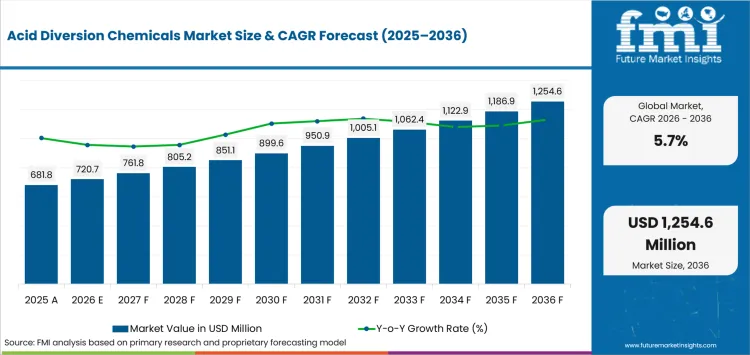
USD 720.7 million in 2026 and USD 1,254.6 million by 2036 at a 5.7% CAGR.
Demand for acid diversion chemicals are projected to expand at 5.7% CAGR between 2026 and 2036 as operators pursue more uniform reservoir contact. Halliburton announced a multi-year Aramco stimulation contract in July 2026 for unconventional gas development that requires integrated completion and stimulation delivery. The award ties chemical placement to execution quality during high-intensity well programs where treatment failure carries substantial operating cost. Adjacent oilfield chemicals purchasing shows a similar emphasis on field performance before repeat orders enter wider service programs.
Country economics determine how quickly technical demand becomes chemical orders because activity and treatment intensity differ by basin. The USA Energy Information Administration stated in July 2026 that USA crude production averaged a record 13.6 million barrels per day during 2025. High output raises the value of treatment efficiency without proving direct demand for any specific diversion formulation or chemical system. Operators therefore compare diversion performance with wider production chemicals programs and total well intervention economics. They also evaluate field services capacity because field execution determines whether qualified chemistry reaches the intended interval.
Key Takeaways of Acid Diversion Chemicals Market
- Live acid preferentially enters the easiest flow paths in long horizontal sections, raising the cost of untreated intervals in heterogeneous rock.
- By chemical type, viscoelastic surfactant diverters are estimated to hold 29.0% in 2026 owing to spent-acid rheology that redirects fresh acid without permanent isolation hardware.
- In 2026, carbonate is expected to lead reservoir type with 39.0% share because rapid acid-rock reaction makes placement control commercially important.
- Matrix acidizing is set to lead the operation category with 36.0% share in 2026 due to below-fracture-pressure treatments requiring controlled fluid distribution along damaged intervals.
- Qualification can delay adoption because each formulation must retain temporary blocking strength and then clear under the planned temperature and acid conditions.
- Some of the key players in this market include Halliburton, SLB, Baker Hughes, Nouryon, Clariant, Stepan Company, SNF Group, and Locus Bio-Energy.
Analyst Perspective
"Acid diversion earns its value during placement, so treatment teams should compare diversion strength with cleanup timing under the actual downhole window. The stronger commercial offer pairs chemistry with fast compatibility testing and field support that reduces the risk of an ineffective acid stage."
-Nikhil Kaitwade, Principal Consultant, Future Market Insights
How is the Acid Diversion Chemicals Market segmented?
The acid diversion chemicals market is segmented by chemical type, reservoir type, operation, degradation, sales channel and region.
Chemical types include viscoelastic surfactant diverters, particulate diverters, degradable fibers and polymer-based diverting agents. Reservoir types cover carbonate, sandstone, fractured carbonate and heterogeneous reservoirs. Operations include matrix acidizing, fracture acidizing, selective zonal treatment and mature well stimulation. Degradation routes include temperature degradable, acid soluble, oil soluble and biodegradable systems. Sales channels include stimulation service companies, specialty chemical suppliers, direct operator contracts and regional distributors.
What drives Stimulation service companies in the Sales channel category?
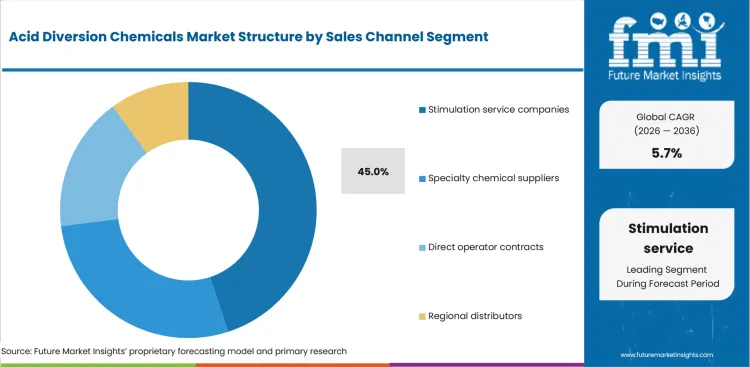
Stimulation service companies control treatment design, pumping schedules and field execution during acidizing jobs with little room for chemistry-handling errors. Baker Hughes secured a September 2025 Petrobras contract covering stimulation vessels with chemicals and services for Brazilian offshore fields. The bundled model gives operators one execution route and places chemistry beside inflow control devices during completion planning.
- Stimulation service companies are estimated to hold 45.0% of the sales channel category in 2026 because operators frequently purchase chemistry inside complete treatment programs.
- Baker Hughes attached chemicals and services to its vessel contract, showing why offshore customers often prefer one accountable execution route for complex stimulation work.
What makes Viscoelastic surfactant diverters central to the Chemical type category?
Viscoelastic surfactant systems thicken after acid spends in carbonate rock and redirect fresh acid toward less-treated zones. Stepan stated for ADIPEC 2025 that its Saudi manufacturing start-up would include viscoelastic surfactant additives for regional stimulation work. The local route can shorten replenishment for Middle Eastern upstream services programs that require repeat acid treatments.
- By chemical type, viscoelastic surfactant diverters are estimated to hold 29.0% in 2026 because spent-acid viscosity can redirect fluid without permanent mechanical isolation.
- Stepan tied local production directly to viscoelastic surfactant and acid-retarder chemistries, giving service teams a shorter supply route for basin-specific stimulation trials.
Why does Carbonate lead the Reservoir type category?
Carbonate formations react quickly with hydrochloric acid and contain fractures that concentrate treatment into receptive rock. Kuwait Oil Company held a July 2025 stimulation workshop focused on tight carbonates and advanced acid fracturing. The operating problem makes diversion a placement tool instead of a standalone additive because compatible completion fluids must fit the final treatment sequence before pumping.
- Carbonate is expected to account for 39.0% of the reservoir type category in 2026 because rapid reaction and uneven permeability increase the value of selective placement.
- Kuwait Oil Company linked tight-carbonate development with advanced stimulation methods, which keeps acid coverage and treatment distribution central to technical screening.
How does Matrix acidizing lead the Operation category?
Matrix acidizing treats formation damage below fracture pressure, so productive results depend on spreading live acid beyond the most receptive entry point. Halliburton and Pertamina signed a February 2026 memorandum covering acid stimulation and unconventional fracturing in Indonesia. The agreement places chemical treatment beside wider drilling tools and completion decisions during field development.
- Matrix acidizing is projected to represent 36.0% of operation in 2026 because diversion improves treatment distribution along damaged or lower-permeability sections.
- The Halliburton-Pertamina program explicitly includes acid stimulation, which gives integrated service teams a direct route to qualify placement chemistry inside field campaigns.
What are the drivers, restraints and opportunities in the Acid Diversion Chemicals Market?
Selective acid placement supports demand, reservoir-specific qualification limits the usable formulation set and self-breaking chemistry offers a route to reduce post-treatment cleanup.
- Driver: Longer treated intervals raise the cost of channeling because untreated rock can limit the production response from an otherwise successful acid stage.
- Restraint: Temperature, salinity and mineralogy narrow each chemistry operating window because diversion strength and post-treatment break must occur in sequence.
- Opportunity: Degradable and self-diverting systems can remove separate isolation or cleanup steps provided laboratory testing confirms a reliable downhole break profile.
Long intervals raise the cost of poor acid placement
Operators pay for diversion if untreated sections threaten the return from an acid stage instead of responding to chemical volume alone. SLB received a five-year Aramco contract in December 2025 covering stimulation and intervention work for unconventional gas wells. Repeated development programs give field placement performance more weight than isolated laboratory results. Completion tools influence access to the treated interval and the pumping sequence.
Qualification narrows the usable formulation window
A diverter must resist flow long enough to redirect acid and then lose strength before production resumes. Nouryon opened a Houston oilfield innovation center in June 2025 with testing capacity for drilling, completion, production and stimulation applications. The Houston investment addresses a practical need to reproduce fluid behavior under representative conditions before field approval begins. Qualification becomes harder as acid strength and bottomhole temperature move beyond familiar laboratory envelopes used for onshore drilling fluids.
Self-breaking chemistry reduces post-treatment work
Treatment economics improve if advanced diversion controls acid placement without adding a separate intervention step. The Society of Petroleum Engineers' June 2025 acidizing review cited a field case using retarded acid with gel slugs and a fluidic oscillator. The reported treatment doubled oil production and reduced water cut by 10% during a single intervention. The result supports continued spending on placement chemistry and faster downhole feedback from wired drill pipe systems during complex pumping.
Which country CAGRs are profiled in the Acid Diversion Chemicals Market?
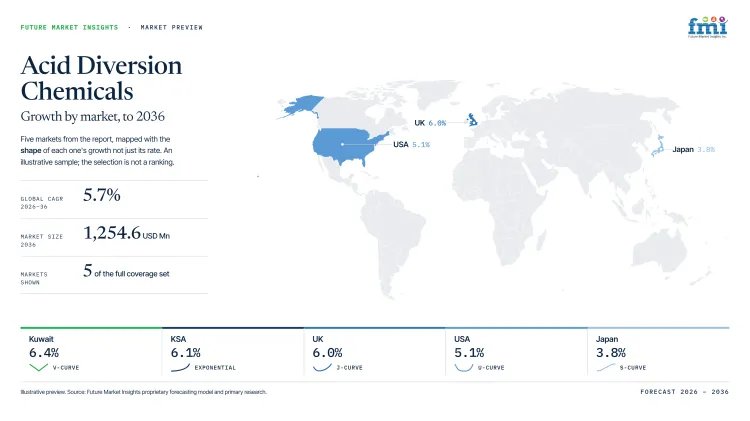
| Country | CAGR |
|---|---|
| Kuwait | 6.4% |
| KSA | 6.1% |
| UK | 6.0% |
| USA | 5.1% |
| Japan | 3.8% |
How do country-level CAGRs compare in the Acid Diversion Chemicals Market?
Five profiled rates span 1.3 percentage points from Kuwait at 6.4% to USA at 5.1%. Kuwait, KSA and UK form a tight upper group within 0.4 points. Brazil occupies the transition position at 5.6%, and USA follows at 5.1%. The spacing points to different program intensity instead of current market size.
- Kuwait's lead reflects carbonate-heavy stimulation exposure that raises diversion intensity per treatment.
- KSA concentrates repeat stimulation demand inside large multi-well unconventional gas development programs.
- UK supports specialist chemistry through technically intensive offshore interventions despite modest well counts.
- USA scales treatment-efficiency gains through a much larger installed base of producing wells.
- Japan targets treatment-efficiency gains through a smaller installed base of mature and technically challenging wells.
Similar forecast rates therefore produce very different revenue pools and qualification economics. The full report provides country-level CAGR analysis across North America, Latin America, Europe, East Asia, South Asia, Oceania and the Middle East and Africa.
Country-wise Analysis
- Kuwait's stimulation programs run through national operator control, with carbonate and Jurassic reservoirs screened against tightly defined field procedures before execution. Acid diversion chemicals in Kuwait are projected to grow at 6.4% CAGR during the assessment period, attributable to repeat programs that follow successful qualification. Kuwait Oil Company reported in July 2026 that the first phase of its unconventional Jurassic development succeeded with specialist service participation. Operator access gives approved chemistry a direct deployment route, though reservoir-specific testing still governs broader program entry. New chemistry entrants therefore need local technical support and formulations that fit KOC treatment procedures without lengthening qualification schedules.
- Large Saudi operator programs require chemistry that can clear qualification at scale before Jafurah and other gas developments expand treatment schedules. Aramco stated in February 2026 that Jafurah production had started in December 2025 and technology was lowering drilling and stimulation costs. Saudi Arabia is estimated to post 6.1% CAGR over the forecast period, given continued unconventional gas activity and expanding local chemical supply. In-country manufacturing shortens replenishment routes, though high-temperature reservoir conditions still raise the cost of failed qualification before broader deployment. Chemical formulators with local technical teams are better placed to convert laboratory approval into wider program access without delaying treatment schedules.
- Mature offshore wells give the UK a restoration-led demand pattern, with operators comparing intervention value against remaining field life. The North Sea Transition Authority reported in August 2026 that 398 well interventions occurred during 2025 and 56 reinstated wells produced 16 million boe. Existing intervention fleets give qualified chemistry a direct deployment route after laboratory approval on selected restoration jobs. Offshore chemistry demand in the UK is forecast to rise at 6.0% CAGR through 2036, tied to continued well-restoration activity. Capital competition from decommissioning limits marginal treatments, so chemical companies must show measurable production benefit without extending costly offshore rig time.
- USA shale operators judge chemistry by treatment cost and incremental productivity under short basin-level budgeting cycles. The USA Energy Information Administration forecast in January 2026 that crude production would stay near the 2025 record before easing under lower prices. Acid diversion chemicals in USA are projected to grow at 5.1% CAGR over the forecast period because operators continue to seek efficiency from active wells. Dense service-company coverage supports rapid qualification, but price sensitivity penalizes formulations that add pumping complexity without measurable reservoir-contact gains. Compared with Gulf programs, chemical companies need stronger basin-level evidence that added diversion cost improves treatment economics.
- Japan operators evaluate acid diversion chemistry primarily on treatment cost, recovery improvement, and suitability for mature or technically challenging wells under disciplined upstream budgets. Japan’s limited domestic hydrocarbon production constrains large-scale stimulation activity, while ongoing efforts to improve recovery from existing resources support selective demand for specialized completion and stimulation chemicals. Acid diversion chemicals in Japan are projected to grow at 3.8% CAGR over the forecast period as operators seek incremental productivity from technically demanding wells. Established engineering capabilities support qualification of advanced formulations, but relatively small upstream activity limits overall volume growth and favors chemicals that demonstrate measurable reservoir-contact improvements without adding significant treatment complexity. Compared with Gulf programs, chemical companies need stronger field-specific evidence that added diversion costs translate into meaningful recovery gains and improved treatment economics.
Who are the notable companies in the Acid Diversion Chemicals Market?
Halliburton, SLB, Baker Hughes, Nouryon, Clariant, Stepan Company, SNF Group, and Locus Bio-Energy are notable companies serving this market.
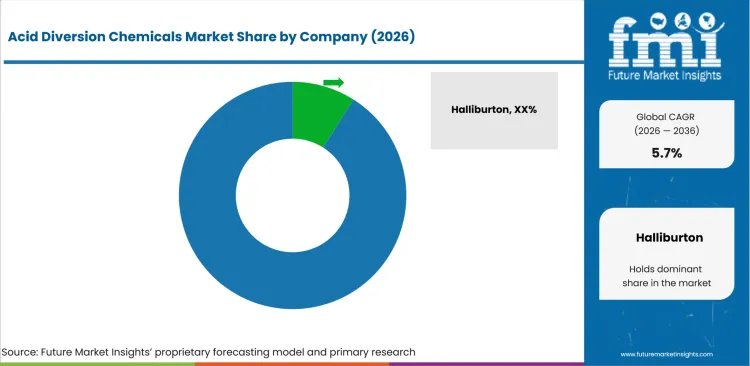
Field access separates integrated service companies from specialist chemistry producers because acid-diversion performance must clear qualification before repeat programs begin. Halliburton, SLB and Baker Hughes can carry chemistry through treatment design and execution. Nouryon, Clariant, Stepan Company, SNF Group and Locus Bio-Energy compete through formulation depth, regional supply or application testing.
- Halliburton, SLB and Baker Hughes control integrated stimulation routes that can carry chemical qualification directly into field execution programs.
- Nouryon, Clariant, Stepan Company and SNF Group compete through oilfield chemistry platforms with formulation work, regional manufacturing or technical-service access.
- Locus Bio-Energy serves North American acid-stimulation programs through biosurfactant formulations paired with field validation and technical support.
Competitive Benchmarking: Acid Diversion Chemicals Market
| Company | Acid-Diversion Chemistry Breadth | Integrated Stimulation Execution | Qualification and Technical Support | Geographic Reach |
|---|---|---|---|---|
| Halliburton | High | High | High | Global |
| SLB | High | High | High | Global |
| Baker Hughes | Medium | High | High | Global |
| Nouryon | Medium | Low | High | Americas, Middle East, Europe and Asia |
| Clariant | Medium | Low | High | Global oil-services reach |
| Stepan Company | High | Low | Medium | North America, Middle East and international sales |
| SNF Group | Medium | Low | Medium | Americas, Europe and Asia |
| Locus Bio-Energy | Medium | Low | High | North America |
Scoring basis: High chemistry breadth requires at least three verified acidizing or stimulation routes, compared with two for Medium and one for Low. High execution requires integrated treatment design plus field delivery, whereas Medium identifies service coordination and Low indicates chemistry supply without integrated execution. For technical support, High requires dedicated testing infrastructure plus field application support. Medium requires one of those capabilities, and Low reflects limited documented support.
Key Developments in the Acid Diversion Chemicals Market
- In July 2025, SLB completed its acquisition of ChampionX and integrated the acquired production-chemistry business into a larger global oilfield technology platform.
- In July 2026, Clariant appointed Gapuma Group to distribute well-service additives in West Africa and expanded regional access to stimulation-related chemistry.
- In August 2025, SNF Group announced the acquisition of Obsidian Chemical Solutions and added customized formulations for stimulation, acidizing, drill-out and completion operations.
Key Players in the Acid Diversion Chemicals Market
Integrated Stimulation Service Platforms
- Halliburton
- SLB
- Baker Hughes
Oilfield Specialty Chemistry Platforms
- Nouryon
- Clariant
- SNF Group
Stimulation Formulation Specialists
- Stepan Company
- Locus Bio-Energy
Acid Diversion Chemicals Market - Report Scope
| Coverage field | Report scope |
|---|---|
| Market breakdown | By chemical type, reservoir type, operation, degradation, sales channel and region. |
| Quantitative Units | USD Million. |
| Market Definition | Revenue includes acid diversion chemicals and self-diverting acid formulations sold for oil and gas well stimulation. Bulk base acids without diversion functionality, mechanical isolation hardware and unrelated stimulation additives are excluded. |
| Forecast Period | 2026 to 2036. |
| Countries Covered | Kuwait, KSA, UK, Brazil and USA, and 20+ countries included in the full report. |
| Regions Covered | North America, Latin America, Western Europe, Eastern Europe, East Asia, South Asia and Pacific, and Middle East and Africa |
| Key Companies Profiled | Halliburton, SLB, Baker Hughes, Nouryon, Clariant, Stepan Company, SNF Group, and Locus Bio-Energy. |
| Additional Attributes | Segment shares, country CAGRs, competitive benchmarking, company developments, market drivers, restraints, opportunities and source-backed country analysis. |
Acid Diversion Chemicals Market - Research Methodology
| Method | Approach |
|---|---|
| Primary Research | FMI analysts gathered input from manufacturers, service providers, technology developers, distributors, end users, procurement teams, and subject-matter experts. Interviews examined purchasing decisions, product or service evaluation, adoption barriers, approval requirements, pricing considerations, and expectations for technical or commercial support. Respondents were also asked what evidence is required before a trial, pilot, or initial order develops into regular purchasing. |
| Desk Research | Desk research covered government statistics, regulatory publications, trade data, industry associations, technical literature, standards, company filings, product information, and official corporate announcements. Sources were reviewed for relevance, publication date, geographic coverage, and consistency with the defined market scope. Claims relating to performance, applications, approvals, capacity, investment, and commercial activity were retained only when supported by credible public evidence. |
| Market Sizing and Forecasting | The market model combined the baseline value with historical performance, segment structure, pricing and volume indicators, adoption levels, company participation, and country-level demand conditions. Forecast assumptions considered economic activity, investment trends, regulatory developments, technology adoption, purchasing cycles, supply availability, and barriers to wider market use. Segment and regional estimates were reconciled before the final market total was calculated. |
| Data Validation | Estimates were checked against multiple independent indicators, including public data, company activity, trade patterns, industry developments, and findings from primary interviews. Validation also tested whether products, services, applications, and company revenues fell within the defined market boundaries. Adjacent categories, unsupported claims, overlapping revenues, and activities without direct market relevance were excluded to reduce double counting and maintain consistency across segments and countries. |
Acid Diversion Chemicals Market by Segments
Acid Diversion Chemicals Market segmented by Chemical Type:
- Viscoelastic surfactant diverters
- Particulate diverters
- Degradable fibers
- Polymer-based diverting agents
Acid Diversion Chemicals Market segmented by Reservoir Type:
- Carbonate
- Sandstone
- Fractured carbonate
- Heterogeneous reservoirs
Acid Diversion Chemicals Market segmented by Operation:
- Matrix acidizing
- Fracture acidizing
- Selective zonal treatment
- Mature well stimulation
Acid Diversion Chemicals Market segmented by Degradation:
- Temperature degradable
- Acid soluble
- Oil soluble
- Biodegradable
Acid Diversion Chemicals Market segmented by Sales Channel:
- Stimulation service companies
- Specialty chemical suppliers
- Direct operator contracts
- Regional distributors
Acid Diversion Chemicals Market by Region:
- North America
- USA
- Canada
- Latin America
- Brazil
- Mexico
- Argentina
- Chile
- Rest of Latin America
- Western Europe
- Germany
- France
- UK
- Italy
- Spain
- Nordics
- Benelux
- Rest of Western Europe
- Eastern Europe
- Poland
- Czech Republic
- Romania
- Hungary
- Rest of Eastern Europe
- East Asia
- China
- Japan
- South Korea
- South Asia and Pacific
- India
- ASEAN
- Australia and New Zealand
- Rest of South Asia and Pacific
- Middle East and Africa
- KSA
- Other GCC Countries
- Türkiye
- Israel
- South Africa
- Rest of Middle East and Africa
Research Sources and Bibliography
- Halliburton. (2026, July 15). Aramco awards Halliburton long-term contract for unconventional gas program.
- USA Energy Information Administration. (2026, July 9). The United States produced more crude oil than any other country in 2025.
- Stepan Company. (2025, October 31). Meet Stepan Oilfield Solutions at ADIPEC 2025.
- Kuwait Oil Company. (2025, July 27). KOC & WJO Technical Collaboration Session.
- Halliburton. (2026, February 22). Pertamina and Halliburton sign an integrated unconventional fracturing MOU in Indonesia.
- Baker Hughes. (2025, September 17). Baker Hughes Secures Multi-Year Contract with Petrobras for Offshore Stimulation Vessels.
- SLB. (2025, December 23). Aramco Awards SLB Long-Term Contract to Support Kingdom’s Unconventional Gas Production Growth.
- Nouryon. (2025, June 18). Nouryon launches Innovation Center for oilfield solutions in Texas, US.
- Carpenter, C. (2025, June 1). Acidizing-2025.
- Kuwait Oil Company. (2026, July 13). KOC Celebrates the success of the first phase of developing Unconventional Jurassic Reservoirs.
- Aramco. (2026, February 26). Aramco’s gas strategy builds momentum with major progress towards growth target.
- North Sea Transition Authority. (2026, August 11). Reinstated wells produced 16 million boe in 2025.
- Halliburton. (2025, October 15). Petrobras awards Halliburton deepwater contracts for completion and stimulation services in Brazil.
- USA Energy Information Administration. (2026, January 22). EIA forecasts near-term USA crude oil production will remain near 2025 record.
- SLB. (2025, July 16). SLB Completes Acquisition of ChampionX.
- Clariant. (2026, July 29). Clariant appoints Gapuma Group as Well Service Additives distributor across West Africa.
- Halliburton. (2025, August 13). ConocoPhillips awards Halliburton multi-year well stimulation services contract in the North Sea.
- SLB. (2026, August 6). SLB and Equinor Sign Multi-Year Stimulation Agreement for Norwegian Continental Shelf.
- Baker Hughes. (2026, May 26). Baker Hughes Extends and Expands Integrated Well Construction Contract with Petrobras.
- Nouryon. (2025, February 10). Nouryon opens new office in Al Dhahran to strengthen presence in Saudi Arabia and the Middle East.
- Clariant. (2025, September 2). Clariant Oil Services and Swire Energy Services open new supply base in Norway supporting European energy production.
- Stepan Company. (2025, December 19). Stepan celebrates Pasadena site ribbon cutting: a new era of growth and enablement.
- SNF Group. (2026, January 2). SNF GROUP COMPLETES THE ACQUISITION OF THE OIL & GAS DIVISION OF SYENSQO.
- Locus Bio-Energy. (2025, July 23). Cal Coast Acidizing Partners with Locus Bio-Energy to Deliver High-Performance Well Treatments Across California.
This bibliography is provided for reader reference and is not exhaustive. The full report contains the complete reference list and detailed citations.
This Report Answers
- How large is the acid diversion chemicals market in 2026 and 2036?
- Why do viscoelastic surfactant diverters lead the chemical type category?
- Why do carbonate reservoirs lead the reservoir type category?
- Why does matrix acidizing lead the operation category?
- How do profiled country growth rates compare through 2036?
- Which companies serve integrated stimulation and specialist chemistry routes?
- Which qualification constraints delay wider diversion chemistry use?
- How do operators compare chemistry performance with total treatment economics?
Frequently Asked Questions
How big is the acid diversion chemicals market in 2026?
The acid diversion chemicals market is valued at USD 720.7 million in 2026 and is projected to reach USD 1,254.6 million by 2036. Selective placement in heterogeneous reservoirs supports demand during stimulation jobs with uneven fluid entry.
What is the CAGR of the acid diversion chemicals market from 2026 to 2036?
The acid diversion chemicals market is projected to grow at a CAGR of 5.7% between 2026 and 2036. Expansion is tied to stimulation programs that require better fluid placement and reliable post-treatment cleanup.
Which chemical type leads the acid diversion chemicals market?
The viscoelastic surfactant diverters segment is expected to hold 29.0% of the acid diversion chemicals market in 2026, attributable to reversible rheology that redirects acid toward less-treated zones. Polymer-free chemistry can also simplify cleanup on jobs with strict residue limits.
Which reservoir type leads the acid diversion chemicals market?
The carbonate segment is expected to hold 39.0% of the acid diversion chemicals market in 2026 because rapid acid-rock reaction concentrates treatment in receptive zones. Diversion improves interval coverage without relying entirely on mechanical isolation during each acid stage.
Which companies are active in the acid diversion chemicals market?
Key companies operating in the acid diversion chemicals market include Halliburton, SLB, Baker Hughes, Nouryon, Clariant, Stepan Company, SNF Group, and Locus Bio-Energy. Their competition centers on stimulation execution, formulation depth, local manufacturing and technical qualification support.
Preview the report firsthand - request a free sample
Get SampleGet the brochure for pricing and purchase details.
Get PDFTable of Content
- Key Takeaways
- Market Size and CAGR
- Top Growth Driver
- Fastest Growing Segment
- Leading Region
- Key Companies
- Emerging Opportunities
- Executive Summary
- Global Market Outlook
- Demand-side Trends
- Supply-side Trends
- Technology Roadmap Analysis
- Analysis and Recommendations
- Analyst Perspective (What is happening? Why now? What should investors know?)
- Key Questions Answered
- How large is the market?
- What is the CAGR?
- What are key trends?
- Which region dominates?
- Who are the leaders?
- Market Overview
- Market Coverage / Taxonomy
- Market Definition / Scope / Limitations
- Research Methodology
- Chapter Orientation
- Analytical Lens and Working Hypotheses
- Market Structure, Signals, and Trend Drivers
- Benchmarking and Cross-market Comparability
- Market Sizing, Forecasting, and Opportunity Mapping
- Research Design and Evidence Framework
- Desk Research Programme (Secondary Evidence)
- Expert Input and Fieldwork (Primary Evidence)
- Tooling, Models, and Reference Databases
- Data Engineering and Model Build
- Quality Assurance and Audit Trail
- Market Background
- Market Dynamics (Drivers, Restraints, Opportunity, Trends)
- Scenario Forecast (Optimistic, Likely, Conservative)
- Impact Analysis
- AI Impact
- Sustainability Impact
- Regulatory Impact
- Technology Impact
- Consumer / Buyer Analysis
- Purchase Drivers
- Adoption Barriers
- Buyer Journey
- Opportunity Map Analysis
- Product Life Cycle Analysis
- Supply Chain Analysis
- Investment Feasibility Matrix
- Value Chain Analysis
- PESTLE and Porter's Analysis
- Regulatory Landscape
- Regional Parent Market Outlook
- Production and Consumption Statistics
- Import and Export Statistics
- Global Market Analysis and Forecast, 2021 to 2036
- Historical Market Size Value (USD Million) Analysis, 2021 to 2025
- Current and Future Market Size Value (USD Million) Projections, 2026 to 2036
- Y-o-Y Growth Trend Analysis
- Absolute $ Opportunity Analysis
- Global Market Pricing Analysis, 2021 to 2036
- Global Market Analysis and Forecast, By Chemical Type, 2021 to 2036
- Introduction / Key Findings
- Historical Market Size Value (USD Million) Analysis By Chemical Type, 2021 to 2025
- Current and Future Market Size Value (USD Million) Analysis and Forecast By Chemical Type, 2026 to 2036
- Viscoelastic surfactant diverters
- Particulate diverters
- Polymer gel diverters
- Foamed acid diverters
- Self-diverting acid blends
- Viscoelastic surfactant diverters
- Y-o-Y Growth Trend Analysis By Chemical Type, 2021 to 2025
- Absolute $ Opportunity Analysis By Chemical Type, 2026 to 2036
- Global Market Analysis and Forecast, By Reservoir Type, 2021 to 2036
- Introduction / Key Findings
- Historical Market Size Value (USD Million) Analysis By Reservoir Type, 2021 to 2025
- Current and Future Market Size Value (USD Million) Analysis and Forecast By Reservoir Type, 2026 to 2036
- Carbonate
- Sandstone
- Fractured carbonate
- Heterogeneous reservoirs
- Carbonate
- Y-o-Y Growth Trend Analysis By Reservoir Type, 2021 to 2025
- Absolute $ Opportunity Analysis By Reservoir Type, 2026 to 2036
- Global Market Analysis and Forecast, By Operation, 2021 to 2036
- Introduction / Key Findings
- Historical Market Size Value (USD Million) Analysis By Operation, 2021 to 2025
- Current and Future Market Size Value (USD Million) Analysis and Forecast By Operation, 2026 to 2036
- Matrix acidizing
- Fracture acidizing
- Selective zonal treatment
- Mature well stimulation
- Matrix acidizing
- Y-o-Y Growth Trend Analysis By Operation, 2021 to 2025
- Absolute $ Opportunity Analysis By Operation, 2026 to 2036
- Global Market Analysis and Forecast, By Degradation, 2021 to 2036
- Introduction / Key Findings
- Historical Market Size Value (USD Million) Analysis By Degradation, 2021 to 2025
- Current and Future Market Size Value (USD Million) Analysis and Forecast By Degradation, 2026 to 2036
- Temperature degradable
- Acid soluble
- Oil soluble
- Biodegradable
- Temperature degradable
- Y-o-Y Growth Trend Analysis By Degradation, 2021 to 2025
- Absolute $ Opportunity Analysis By Degradation, 2026 to 2036
- Global Market Analysis and Forecast, By Sales Channel, 2021 to 2036
- Introduction / Key Findings
- Historical Market Size Value (USD Million) Analysis By Sales Channel, 2021 to 2025
- Current and Future Market Size Value (USD Million) Analysis and Forecast By Sales Channel, 2026 to 2036
- Stimulation service companies
- Specialty chemical suppliers
- Direct operator contracts
- Regional distributors
- Stimulation service companies
- Y-o-Y Growth Trend Analysis By Sales Channel, 2021 to 2025
- Absolute $ Opportunity Analysis By Sales Channel, 2026 to 2036
- Global Market Analysis and Forecast, By Region, 2021 to 2036
- Introduction
- Historical Market Size Value (USD Million) Analysis By Region, 2021 to 2025
- Current Market Size Value (USD Million) Analysis and Forecast By Region, 2026 to 2036
- North America
- Latin America
- Western Europe
- Eastern Europe
- East Asia
- South Asia and Pacific
- Middle East & Africa
- Market Attractiveness Analysis By Region
- North America Market Analysis and Forecast, By Country, 2021 to 2036
- Historical Market Size Value (USD Million) Trend Analysis By Market Taxonomy, 2021 to 2025
- Market Size Value (USD Million) Forecast By Market Taxonomy, 2026 to 2036
- By Country
- USA
- Canada
- By Chemical Type
- By Reservoir Type
- By Operation
- By Degradation
- By Sales Channel
- By Country
- Market Attractiveness Analysis
- By Country
- By Chemical Type
- By Reservoir Type
- By Operation
- By Degradation
- By Sales Channel
- Key Takeaways
- Latin America Market Analysis and Forecast, By Country
- Historical Market Size Value (USD Million) Trend Analysis By Market Taxonomy, 2021 to 2025
- Market Size Value (USD Million) Forecast By Market Taxonomy, 2026 to 2036
- By Country
- Brazil
- Mexico
- Chile
- Rest of Latin America
- By Chemical Type
- By Reservoir Type
- By Operation
- By Degradation
- By Sales Channel
- By Country
- Market Attractiveness Analysis
- By Country
- By Chemical Type
- By Reservoir Type
- By Operation
- By Degradation
- By Sales Channel
- Key Takeaways
- Western Europe Market Analysis and Forecast, By Country
- Historical Market Size Value (USD Million) Trend Analysis By Market Taxonomy, 2021 to 2025
- Market Size Value (USD Million) Forecast By Market Taxonomy, 2026 to 2036
- By Country
- Germany
- UK
- Italy
- Spain
- France
- Nordic
- BENELUX
- Rest of Western Europe
- By Chemical Type
- By Reservoir Type
- By Operation
- By Degradation
- By Sales Channel
- By Country
- Market Attractiveness Analysis
- By Country
- By Chemical Type
- By Reservoir Type
- By Operation
- By Degradation
- By Sales Channel
- Key Takeaways
- Eastern Europe Market Analysis and Forecast, By Country
- Historical Market Size Value (USD Million) Trend Analysis By Market Taxonomy, 2021 to 2025
- Market Size Value (USD Million) Forecast By Market Taxonomy, 2026 to 2036
- By Country
- Russia
- Poland
- Hungary
- Balkan & Baltic
- Rest of Eastern Europe
- By Chemical Type
- By Reservoir Type
- By Operation
- By Degradation
- By Sales Channel
- By Country
- Market Attractiveness Analysis
- By Country
- By Chemical Type
- By Reservoir Type
- By Operation
- By Degradation
- By Sales Channel
- Key Takeaways
- East Asia Market Analysis and Forecast, By Country
- Historical Market Size Value (USD Million) Trend Analysis By Market Taxonomy, 2021 to 2025
- Market Size Value (USD Million) Forecast By Market Taxonomy, 2026 to 2036
- By Country
- China
- Japan
- South Korea
- By Chemical Type
- By Reservoir Type
- By Operation
- By Degradation
- By Sales Channel
- By Country
- Market Attractiveness Analysis
- By Country
- By Chemical Type
- By Reservoir Type
- By Operation
- By Degradation
- By Sales Channel
- Key Takeaways
- South Asia and Pacific Market Analysis and Forecast, By Country
- Historical Market Size Value (USD Million) Trend Analysis By Market Taxonomy, 2021 to 2025
- Market Size Value (USD Million) Forecast By Market Taxonomy, 2026 to 2036
- By Country
- India
- ASEAN
- Australia & New Zealand
- Rest of South Asia and Pacific
- By Chemical Type
- By Reservoir Type
- By Operation
- By Degradation
- By Sales Channel
- By Country
- Market Attractiveness Analysis
- By Country
- By Chemical Type
- By Reservoir Type
- By Operation
- By Degradation
- By Sales Channel
- Key Takeaways
- Middle East & Africa Market Analysis and Forecast, By Country
- Historical Market Size Value (USD Million) Trend Analysis By Market Taxonomy, 2021 to 2025
- Market Size Value (USD Million) Forecast By Market Taxonomy, 2026 to 2036
- By Country
- Kingdom of Saudi Arabia
- Other GCC Countries
- Türkiye
- South Africa
- Other African Union
- Rest of Middle East & Africa
- By Chemical Type
- By Reservoir Type
- By Operation
- By Degradation
- By Sales Channel
- By Country
- Market Attractiveness Analysis
- By Country
- By Chemical Type
- By Reservoir Type
- By Operation
- By Degradation
- By Sales Channel
- Key Takeaways
- Key Countries Market Analysis
- USA
- Pricing Analysis
- Market Share Analysis, 2025
- By Chemical Type
- By Reservoir Type
- By Operation
- By Degradation
- By Sales Channel
- Canada
- Pricing Analysis
- Market Share Analysis, 2025
- By Chemical Type
- By Reservoir Type
- By Operation
- By Degradation
- By Sales Channel
- Mexico
- Pricing Analysis
- Market Share Analysis, 2025
- By Chemical Type
- By Reservoir Type
- By Operation
- By Degradation
- By Sales Channel
- Brazil
- Pricing Analysis
- Market Share Analysis, 2025
- By Chemical Type
- By Reservoir Type
- By Operation
- By Degradation
- By Sales Channel
- Chile
- Pricing Analysis
- Market Share Analysis, 2025
- By Chemical Type
- By Reservoir Type
- By Operation
- By Degradation
- By Sales Channel
- Germany
- Pricing Analysis
- Market Share Analysis, 2025
- By Chemical Type
- By Reservoir Type
- By Operation
- By Degradation
- By Sales Channel
- UK
- Pricing Analysis
- Market Share Analysis, 2025
- By Chemical Type
- By Reservoir Type
- By Operation
- By Degradation
- By Sales Channel
- Italy
- Pricing Analysis
- Market Share Analysis, 2025
- By Chemical Type
- By Reservoir Type
- By Operation
- By Degradation
- By Sales Channel
- Spain
- Pricing Analysis
- Market Share Analysis, 2025
- By Chemical Type
- By Reservoir Type
- By Operation
- By Degradation
- By Sales Channel
- France
- Pricing Analysis
- Market Share Analysis, 2025
- By Chemical Type
- By Reservoir Type
- By Operation
- By Degradation
- By Sales Channel
- India
- Pricing Analysis
- Market Share Analysis, 2025
- By Chemical Type
- By Reservoir Type
- By Operation
- By Degradation
- By Sales Channel
- ASEAN
- Pricing Analysis
- Market Share Analysis, 2025
- By Chemical Type
- By Reservoir Type
- By Operation
- By Degradation
- By Sales Channel
- Australia & New Zealand
- Pricing Analysis
- Market Share Analysis, 2025
- By Chemical Type
- By Reservoir Type
- By Operation
- By Degradation
- By Sales Channel
- China
- Pricing Analysis
- Market Share Analysis, 2025
- By Chemical Type
- By Reservoir Type
- By Operation
- By Degradation
- By Sales Channel
- Japan
- Pricing Analysis
- Market Share Analysis, 2025
- By Chemical Type
- By Reservoir Type
- By Operation
- By Degradation
- By Sales Channel
- South Korea
- Pricing Analysis
- Market Share Analysis, 2025
- By Chemical Type
- By Reservoir Type
- By Operation
- By Degradation
- By Sales Channel
- Russia
- Pricing Analysis
- Market Share Analysis, 2025
- By Chemical Type
- By Reservoir Type
- By Operation
- By Degradation
- By Sales Channel
- Poland
- Pricing Analysis
- Market Share Analysis, 2025
- By Chemical Type
- By Reservoir Type
- By Operation
- By Degradation
- By Sales Channel
- Hungary
- Pricing Analysis
- Market Share Analysis, 2025
- By Chemical Type
- By Reservoir Type
- By Operation
- By Degradation
- By Sales Channel
- Kingdom of Saudi Arabia
- Pricing Analysis
- Market Share Analysis, 2025
- By Chemical Type
- By Reservoir Type
- By Operation
- By Degradation
- By Sales Channel
- Türkiye
- Pricing Analysis
- Market Share Analysis, 2025
- By Chemical Type
- By Reservoir Type
- By Operation
- By Degradation
- By Sales Channel
- South Africa
- Pricing Analysis
- Market Share Analysis, 2025
- By Chemical Type
- By Reservoir Type
- By Operation
- By Degradation
- By Sales Channel
- USA
- Market Structure Analysis
- Competition Dashboard
- Competition Benchmarking
- Market Share Analysis of Top Players
- By Regional
- By Chemical Type
- By Reservoir Type
- By Operation
- By Degradation
- By Sales Channel
- Emerging Startups
- Innovation Benchmarking
- Competition Analysis
- Competition Deep Dive
- Halliburton
- Overview
- Product Portfolio
- Profitability by Market Segments
- Sales Footprint
- Strategy Overview
- Marketing Strategy
- Product Strategy
- Channel Strategy
- SLB
- Baker Hughes
- ChampionX
- Clariant
- Innospec
- Nouryon
- Solvay
- TETRA Technologies
- Aubin Group
- Halliburton
- Case Studies
- Success Stories
- Recent Developments
- Competition Deep Dive
- Assumptions & Acronyms Used


