

- Industry Size (2026)
- USD 55.3 Bn
- Forecast (2036)
- USD 92.1 Bn
- CAGR (2026 to 2036)
- 5.2%
Oxidizing Agents Market Size, Market Forecast and Outlook By FMI
The oxidizing agents market was valued at USD 52.4 billion in 2025. The industry is poised to cross USD 55.3 billion in 2026 at a CAGR of 5.2% during the forecast period. Sustained investment propels the valuation to USD 92.1 billion through 2036 as sustained expansion in municipal and industrial effluent processing dictates that chemical oxidation remains the only viable mechanism for neutralizing complex organic loads without generating secondary sludge.
Procurement teams are currently forced to choose between legacy halogenated systems that invite regulatory scrutiny and oxygen-based alternatives that demand entirely new storage infrastructure. Operations directors can no longer default to sodium hypochlorite without evaluating the downstream impact of disinfection by-products on their discharge permits. Facilities that delay this qualification process risk facing immediate production curtailments when municipal wastewater authorities tighten local discharge limits. Plant operators resist shifting from chlorine to peroxides, such as advanced oxidation chemicals, not because of chemical costs, but because it breaks their established dosing automation loops. This tension forces water treatment chemicals specifiers to integrate total lifecycle compliance costs rather than just unit pricing.
Summary of Oxidizing Agents Market
- Oxidizing Agents Market Definition This market tracks the supply of reactive compounds designed to facilitate industrial electron transfer. It structurally separates manufactured chemical oxidizers used for precise material transformation, disinfection, and synthesis from ambient oxidation processes, focusing entirely on controlled, high-yield redox applications.
- Demand Drivers in the Market
- Zero-discharge environmental mandates compel municipal wastewater engineers to transition toward ozone and peroxide systems that leave no regulated halogenated residues.
- Total-chlorine-free (TCF) export standards require pulp mill operations directors to abandon legacy hypochlorite bleaching lines.
- Complex active pharmaceutical ingredient synthesis forces chemical process engineers to specify electronic grade hydrogen peroxide for selective, ultra-pure oxidation steps.
- Key Segments Analyzed in the FMI Report
- Hydrogen Peroxide: Hydrogen Peroxide is poised to hold 38.4% share in 2026, because it decomposes cleanly into water and oxygen, eliminating downstream remediation costs associated with halogenated residues.
- Paper & Pulp: Paper & Pulp is poised to hold 29.6% share in 2026, driven by the sheer volumetric demand of continuous elemental-chlorine-free and total-chlorine-free bleaching cycles.
- Liquid: Liquid is poised to hold 61.2% share in 2026, owing to its exact compatibility with automated continuous-flow dosing systems essential in modern manufacturing.
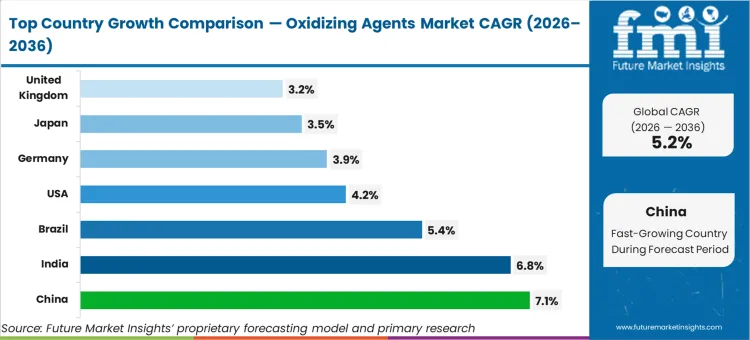
- China: 7.1% CAGR, its central environmental directives mandate immediate retrofits of legacy pulp bleaching lines, forcing a compressed adoption timeline.
- Analyst Opinion at FMI
- Nikhil Kaitwade, Principal Analyst, Chemicals, at FMI, opines, "The general consensus is that safety concerns primarily limit the shift from solid to liquid oxidizers. However, plant operators resist shifting from chlorine to peroxides not because of perceived chemical hazards, but because it breaks their established dosing automation loops. Transitioning requires an entirely new tier of sensor calibration and feedback control that most legacy facilities are unequipped to handle natively."
- Strategic Implications / Executive Takeaways
- Process technology vendors must bundle sensor calibration support with chemical supply to unblock the primary operational barrier at the plant level.
- Tier-1 chemical producers should secure regional distribution partnerships for unstable peroxides to protect margins against rising specialized transport costs.
- Pulp mill procurement heads face a shrinking vendor base for legacy chlorates, requiring accelerated qualification of alternative elemental-chlorine-free supply chains.
- Methodology
- Primary Research: Sourcing heads at major municipal utilities and chemical formulation directors.
- Desk Research: Aggregation of environmental discharge compliance timelines and industrial capacity databases.
- Market-Sizing and Forecasting: Grounded in volumetric flow rates of primary end-use sectors like paper production and water treatment.
- Data Validation and Update Cycle: Cross-referenced against quarterly earnings data from leading chlor-alkali and peroxide manufacturers.
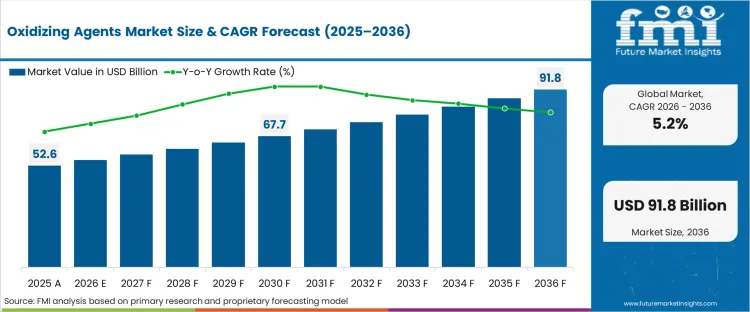
Before growth becomes self-reinforcing, one specific condition must be met: the threshold where municipal discharge penalties for chlorate residues exceed the capital amortization costs of upgrading to advanced oxidation processes. Environmental regulatory boards trigger this gate when they shift from advisory guidelines to hard concentration limits on effluent streams. Once passed, engineering firms default to specifying zero-residue oxidation systems for all new plant designs, isolating legacy chemical usage strictly to older installations.
China is expected to advance at 7.1%, followed by India tracking at 6.8%. Brazil is likely to post a CAGR of 5.4%, while the United States expands at 4.2%. Germany is set to register 3.9%, Japan follows at 3.5%, and the United Kingdom expands at 3.2%. This spread reflects the structural reality that emerging manufacturing bases are replacing entire legacy bleaching lines simultaneously to meet global export standards, whereas mature industrial economies are merely running incremental optimization cycles on existing compliance-grade infrastructure.
Oxidizing Agents Market Definition
The oxidizing agents market encompasses the commercial provision of highly reactive chemical compounds engineered specifically to accept electrons during redox reactions in industrial settings. It structurally excludes atmospheric oxygen used in combustion or passive aeration. The boundary defining this market is the deliberate chemical synthesis, stabilization, and controlled deployment of these agents to achieve specific material transformations, bleaching, or pathogen neutralization outcomes.
Oxidizing Agents Market Inclusions
The scope includes bulk liquid peroxides, concentrated nitric and sulfuric acid streams designated for oxidation, solid-state chlorates and permanganates, and commercially synthesized gaseous oxidizers like ozone and chlorine dioxide. Many industrial sectors utilize hydrogen peroxide due to its high oxidative potential and clean decomposition. Systems and precursor chemicals used explicitly for on-site generation of short-lived bleaching agents are captured within this boundary. The assessment accounts for all commercially traded volumes regardless of the final delivery format.
Oxidizing Agents Market Exclusions
The analysis explicitly excludes oxygen gas supplied for medical respiration, metallurgy, or standard combustion enhancement. These applications rely on physical concentration rather than chemical synthesis and function under entirely different procurement economics. Biochemical oxidation processes utilizing enzymes or bacterial cultures are also excluded, as their mechanism relies on biological catalysis rather than stoichiometric chemical electron transfer, placing them in an adjacent specialty biochemical category.
Oxidizing Agents Market Research Methodology
- Primary Research: Procurement directors at tier-1 pulp mills, municipal wastewater facility lead engineers, and specialty chemical formulator sourcing heads.
- Desk Research: European Chemicals Agency (ECHA) dossier updates, national environmental discharge limit registries, and industrial facility upgrade tender documents.
- Market-Sizing and Forecasting: Baseline anchored to global pulp production volumes and municipal water treatment capacity throughput metrics.
- Data Validation and Update Cycle: Forecasts triangulated against bulk basic chemical capacity expansion announcements and electrochemical cell manufacturing output data.
Segmental Analysis
Oxidizing Agents Market Analysis by Product Type
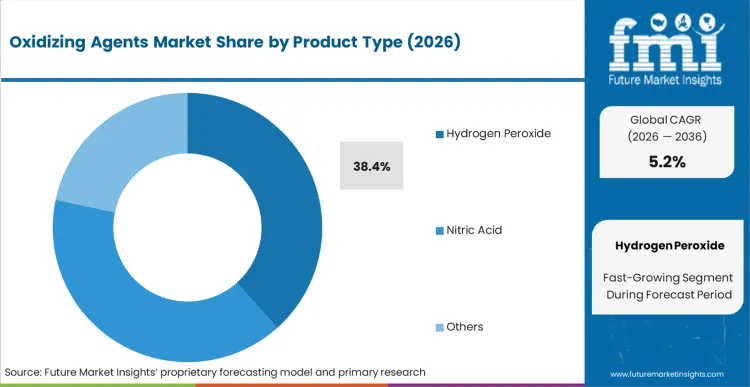
Legacy hypochlorite bleaching lines simply cannot deliver the total-chlorine-free verification that major consumer tissue brands now demand, forcing a structural exit from older chemistries. Based on FMI's assessment, hydrogen peroxide holds 38.4% of the market because it decomposes entirely into water and oxygen, eliminating the downstream remediation costs that make halogenated residues financially unviable. Operations directors running continuous pulp bleaching cycles prioritize this specific trait to bypass secondary effluent treatment phases entirely. To ensure safety during storage and transport, manufacturers often utilize hydrogen peroxide stabilizers. When a mill converts to peroxide, they essentially eliminate an entire step of environmental compliance tracking. Facilities that fail to execute this transition face immediate exclusion from premium European and North American retail supply chains. To support this shift, chemical manufacturers are heavily investing in localized industrial hydrogen peroxide production hubs.
- Trigger Threshold: The moment municipal or regional authorities implement strict halogenated by-product discharge limits. Mill operators must immediately evaluate alternatives to maintain operating permits.
- Validation Metric: Procurement teams validate the choice during trial runs by measuring the exact reduction in secondary effluent treatment costs against the higher unit price of the peroxide.
- Expansion Catalyst: Buyers lock into long-term supply contracts when the absence of regulatory friction allows them to increase total plant throughput without triggering new environmental impact assessments.
Oxidizing Agents Market Analysis by End-use Industry
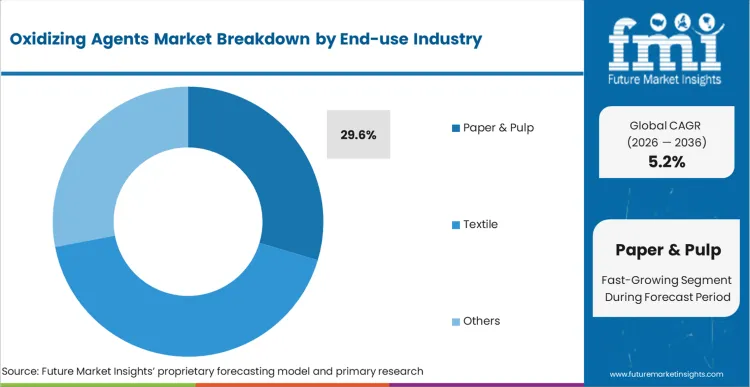
Procurement teams in the paper sector are currently facing a critical choice between maintaining depreciated elemental-chlorine-free systems or funding the capital expenditure for total-chlorine-free conversions. Mill managers who convert to advanced peroxide and ozone sequences fundamentally alter their procurement profile, trading lower bulk chemical costs for significantly reduced water consumption and regulatory overhead. The broader shift toward active oxygens reflects an industry-wide prioritization of high-efficiency, residue-free bleaching. As per FMI's projection, the Paper & Pulp industry represents 29.6% of demand precisely because the sheer volumetric scale of continuous bleaching operations dictates massive, uninterrupted chemical consumption. The integration of specialized pulp and paper processing chemicals allows facilities to close their water loops. Delaying this capital transition leaves mills structurally uncompetitive on per-ton production costs in regions where water and discharge pricing is aggressively indexed.
- Baseline Expenditure: Cost savings initially originate by avoiding the rising tariffs associated with hazardous wastewater discharge. Facilities capture these savings in their compliance budgets immediately.
- Hidden Operational Drain: Upgrading requires entirely new metallurgy for storage tanks and piping, introducing significant hidden capital costs during the installation phase that operators must amortize.
- Lifecycle Comparison: When assessed over a ten-year horizon, the elimination of secondary sludge handling makes advanced oxidation economically superior, despite the higher initial chemical dosing expenses.
Oxidizing Agents Market Analysis by Form
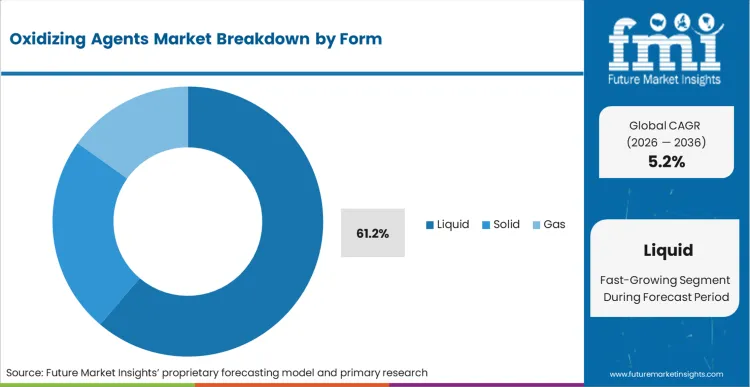
The reason the Liquid form commands 61.2% of the market rests on its exact compatibility with the automated continuous-flow dosing systems essential in modern industrial manufacturing. FMI analysts opine that solid oxidizers, while highly stable for transport, require batch mixing processes that introduce unacceptable variability in continuous municipal water treatment loops. For specific industrial applications, specialized liquids like methyl ethyl ketone peroxide are essential for polymer curing and synthesis. Liquid formulations integrate directly into inline sensors and feedback control systems, allowing operations managers to achieve precise stoichiometric ratios without manual intervention. This seamless integration removes the human error element from hazardous chemical handling. The demand for water purification chemicals in liquid state reflects this automation imperative. Facilities that cling to solid bulk handling face higher labor costs and periodic dosing inconsistencies that can temporarily violate final product quality standards or environmental discharge limits.
- Process Drift: Continuous liquid dosing prevents the chemical concentration spiking and troughing inherent in batch-mixed solid systems. This stabilization protects downstream biological treatment processes from accidental sterilization.
- Residual Volatility: Highly concentrated liquid peroxides remain acutely sensitive to trace metal contamination during storage. Operators must maintain strict passivated environments to prevent sudden, violent decomposition.
- Realization Requirement: To capture the full automation benefit of liquid forms, plant engineers must continuously recalibrate their flow meters and ORP sensors to match the specific degradation curve of the stored chemical.
Oxidizing Agents Market Drivers, Restraints, and Opportunities
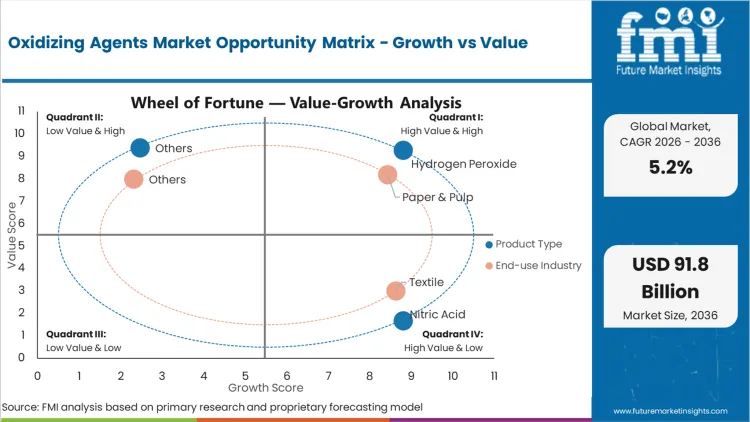
Procurement directors at tier-1 pulp and paper mills are being forced to decide whether to abandon depreciated chlorine infrastructure or face exclusion from premium retail supply chains. This structural pressure forces the transition toward total-chlorine-free verification, compelling facilities to adopt oxygen-based bleaching sequences regardless of the immediate capital expenditure required. In environmental control, a regenerative thermal oxidizer is often paired with chemical agents to handle complex VOC loads. The commercial stakes are absolute: brands are actively auditing their supply chains for halogenated residues, and mills that cannot provide clean chemistry certifications are immediately removed from approved vendor lists.
The primary structural friction slowing adoption is the severe capital intensity required to retrofit storage and handling infrastructure when shifting from stable solid oxidizers to highly reactive liquid peroxides. Plant engineering heads face metallurgy compatibility issues, as legacy tanks and piping will rapidly degrade or catalyze violent decomposition if exposed to advanced oxidizers. To manage hazardous fumes, facilities often implement voc control systems alongside chemical redox. While modular, on-site ozone generation technologies offer a partial solution by eliminating bulk storage, their high energy draw and complex maintenance requirements limit their viability strictly to facilities with massive, highly skilled engineering teams.
Opportunities in the Oxidizing Agents Market
- On-site Generation Leasing: The inherent instability of advanced oxidizers makes long-distance transport economically and physically risky. Specialized chemical equipment vendors can capture recurring revenue by transitioning to a build-own-operate model for on-site synthesis units at major industrial sites.
- Sensor Integration Pairing: Transitioning away from legacy halogens breaks existing automated dosing loops. Process technology firms that bundle pre-calibrated, oxidant-specific sensor suites with their chemical delivery contracts will secure exclusive long-term supplier status.
- Selective Catalytic Enhancement: Complex pharmaceutical synthesis requires oxidation without degrading sensitive molecular structures. Researchers are exploring methane oxidation catalysts and other specialty additives to improve selectivity and yield in catalytic processes.
Regional Analysis
Based on the regional analysis, the oxidizing agents market is segmented into North America and Latin America, Europe, Asia Pacific, and Middle East & Africa across 40 plus countries.
Country CAGR (2026 to 2036)
.webp "Top Country Growth Comparison Oxidizing Agents Market Cagr (2026 2036)")
| Country | CAGR |
|---|---|
| China | 7.1% |
| India | 6.8% |
| Brazil | 5.4% |
| United States | 4.2% |
| Germany | 3.9% |
| Japan | 3.5% |
| United Kingdom | 3.2% |
Source: Future Market Insights (FMI) analysis, based on proprietary forecasting model and primary research
Asia Pacific Oxidizing Agents Market Analysis
In FMI's view, aggressive mandates targeting industrial effluent from the textile and paper sectors force a synchronized, non-negotiable shift away from legacy chemistries. This regulatory environment accelerates the deployment of massive, localized chlor-alkali and peroxide synthesis hubs to feed the sudden geographic concentration of demand. To monitor industrial performance, an oxidation stability analyzer is becoming a standard tool for quality assurance in regional chemical plants. Centralized environmental policy directives fundamentally dictate the adoption curve in this region, rather than localized municipal budgeting.
- China: The market for oxidizing agents in China is forecast to register a CAGR of 7.1%. Facilities that successfully execute this rapid infrastructure upgrade secure exclusive access to lucrative export contracts that require stringent environmental compliance verification. Mill operators in these provinces must immediately qualify advanced peroxide bleaching sequences or face forced operational shutdowns during peak manufacturing seasons. China's centralized mandates regarding industrial water discharge force regional pulp and textile hubs to completely eliminate chlorate residues from their effluent streams.
- India: While China operates on strict central mandates, India's trajectory is defined by a phased industrial compliance approach driven by export-oriented textile and pharmaceutical hubs. India's oxidizing agents sector is anticipated to increase by a CAGR of 6.8%. To comply with international wastewater zero-discharge standards, plant managers are gradually retrofitting existing biological treatment basins with advanced chemical dosing systems. This phased capital injection ultimately stabilizes long-term operating expenses, as facilities eliminate the unpredictable costs of secondary sludge disposal while securing their position in global supply chains.
- Japan: Facilities integrate high-yield ozone and specialty peroxides to maximize throughput in existing municipal water treatment clarifiers without expanding the plant's geographic perimeter. In the food sector, oxidized starch serves as a key ingredient, demonstrating the breadth of oxidative chemistry beyond heavy industry. Japan's highly saturated domestic industrial base means operators evaluate oxidizing chemistries almost entirely on their ability to optimize limited physical footprint rather than raw production volume. This dynamic establishes the structural trajectory for the region, moving away from bulk commodity chemical transport toward highly efficient, decentralized on-site generation models.
North America and Latin America Oxidizing Agents Market Analysis
This infrastructural reality splits the region into highly modernized urban centers utilizing on-site generation, and vast networks of rural facilities permanently locked into stable, bulk-transported halogens. The adoption of specialized advanced oxidation technologies moves only as fast as the municipal capital upgrade cycle allows. According to FMI's estimates, aging clarification and filtration assets constrain the ability of utility directors to simply drop in highly reactive agents without causing extensive damage to legacy piping. In personal care and cleaning, amine oxide is widely used for its oxidative stability and surfactant properties.
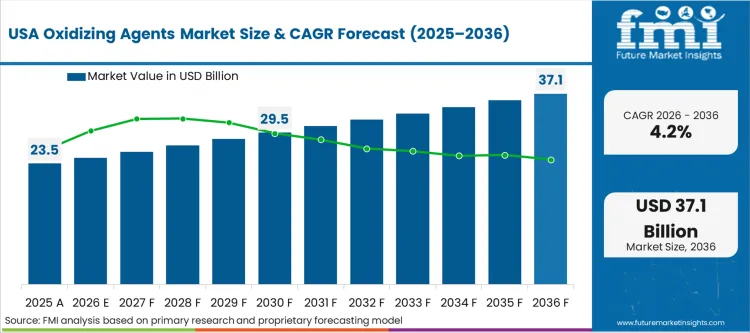
- United States: Utility procurement heads face wildly varying regional discharge limits, meaning chemical selection is optimized purely for local compliance rather than national standardization. A CAGR of 4.2% is expected for oxidizing agents in the United States. The demand for inorganic oxides remains steady across industrial manufacturing and catalyst production. The decentralized, highly fragmented nature of municipal water districts creates localized pockets of advanced oxidation adoption surrounded by vast areas locked into legacy chlorine infrastructure. This fragmented landscape positions early adopters of modular, on-site peroxide generation to outcompete facilities relying on increasingly expensive bulk hazardous chemical transport across interstate lines.
Europe Oxidizing Agents Market Analysis
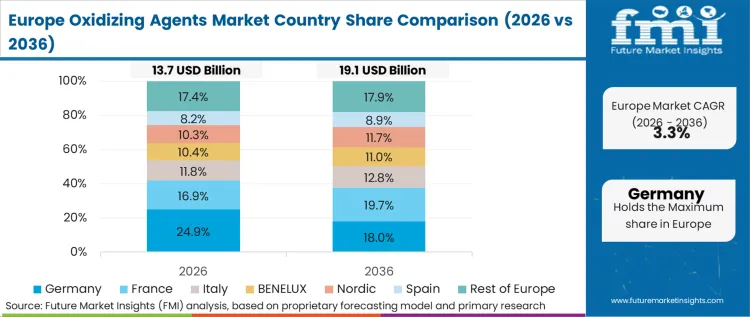
The integration of highly specific textile chemicals allows facilities to bypass thermal penalties entirely. Based on FMI's assessment, the high cost of continuous stenter energy consumption forces textile and paper facilities to evaluate chemical unit costs against activation temperature. In construction and soil stabilization, the use of calcium oxide provides a robust oxidative baseline for high-pH treatment. Plant managers are optimizing their chemical oxidation sequences to minimize the thermal energy required for reaction kinetics. This economic equation heavily favors catalytic peroxide systems that function at ambient temperatures over cheaper alternatives that demand massive steam inputs. Cost structures, specifically the aggressively indexed pricing of carbon emissions and energy, drive procurement decisions across this market rather than basic regulatory compliance.
- Germany: Procurement teams meticulously balance the high unit cost of advanced liquid peroxides against the eliminated expenses of sludge transport and incineration. FMI estimates the oxidizing agents market in Germany to expand at a CAGR of 3.9%. Germany's extended producer responsibility frameworks penalize secondary sludge generation, forcing municipal and industrial wastewater engineers to abandon chemistries that leave particulate residues. What this actually looks like inside the market is a permanent shift in engineering design, where new facilities are built entirely without secondary settling tanks, fully committing the operation to zero-residue chemical oxidation.
- United Kingdom: Sourcing directors isolate their supply chains by transitioning toward robust, localized electrochemical generation for fundamental bleach components. Many industrial processes utilize magnesium oxide as a refractory agent and oxidative catalyst. Post-Brexit supply chain recalibrations require UK facility operators to heavily prioritize domestically synthesized oxidizing agents over imports that face complex hazardous material border friction. When this localized sourcing transition is achieved, facilities structurally decouple their daily operational continuity from the volatility of cross-channel chemical shipping logistics. All these factors lead to the estimation of a CAGR of 3.2% for the United Kingdom.
Competitive Aligners for Market Players
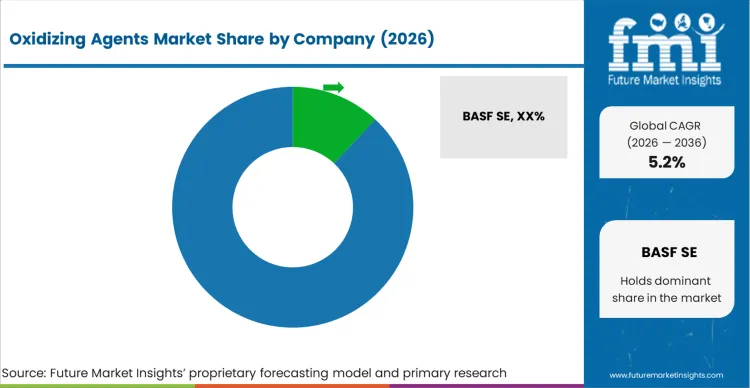
The structural requirement for massive capital investment in continuous-process electrochemical synthesis and air separation dictates a highly concentrated competitive environment. Basic chemical production is inherently volume-dependent, meaning operators cannot achieve margin viability without running massive synthesis plants at absolute capacity. Major producers dominate precisely because they have already amortized multi-billion-dollar infrastructure investments. Buyers distinguish qualified from unqualified vendors almost entirely on the supplier's ability to guarantee uninterrupted regional delivery logistics for hazardous compounds. For instance, the supply of high-purity zinc oxide is critical for rubber, ceramic, and chemical processing.
Incumbents maintain their dominance through extensive, heavily regulated localized storage and distribution networks. Companies hold a structural advantage because they control the highly specialized, passivated rail and tanker fleets required to move volatile peroxides and chlorates safely across specific regional corridors. In specialized healthcare disinfection, disinfectant fogging represents a high-growth niche for tailored oxidizing formulations. To replicate this, a challenger must build out a dedicated hazardous logistics network from scratch. Vendors that co-develop highly specific chemical synthesis catalysts further cement this architectural advantage, embedding their chemistry so deeply into the plant's automation loop that switching costs become prohibitively high.
Large industrial procurement directors actively resist this logistical lock-in by designing new facilities to accommodate multiple parallel oxidation chemistries. The fundamental tension shaping this sector centers on the conflict between legacy bulk suppliers and industrial buyers migrating toward modular technologies. As vaporized hydrogen peroxide becomes a standard for terminal sterilization, the competitive landscape concentrates around firms capable of providing full-suite equipment leasing. In the power sector, the transition to peroxide free crosslinking agents illustrates how even high-performance markets seek oxidative alternatives to manage thermal stress. Ultimately, the integration of antioxidants into industrial feedstocks ensures that the oxidative cycle is controlled at every stage of the material lifecycle.
Key Players in Oxidizing Agents Market
- BASF SE
- Evonik Industries AG
- Solvay S.A.
- Akzo Nobel N.V.
- Arkema S.A.
- FMC Corporation
- Mitsubishi Gas Chemical Company, Inc.
- Kemira Oyj
Scope of the Report
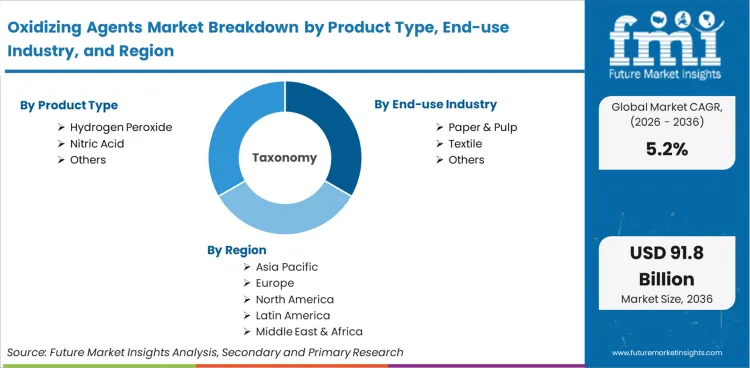
| Metric | Value |
|---|---|
| Quantitative Units | USD 55.3 billion to USD 92.1 billion, at a CAGR of 5.2% |
| Market Definition | This market tracks the commercial supply of manufactured, highly reactive chemical compounds designed explicitly to accept electrons during industrial redox, disinfection, and bleaching applications, excluding ambient atmospheric oxygen. |
| Product Type Segmentation | Hydrogen Peroxide, Nitric Acid, Chlorates, Hypochlorites, Others |
| End-use Industry Segmentation | Water Treatment, Paper & Pulp, Textile, Chemical Synthesis, Healthcare, Others |
| Form Segmentation | Liquid, Solid, Gas |
| Regions Covered | North America, Latin America, Europe, East Asia, South Asia & Pacific, Middle East & Africa |
| Countries Covered | China, India, Brazil, United States, Germany, Japan, United Kingdom, and 40 plus countries |
| Key Companies Profiled | BASF SE, Evonik Industries AG, Solvay S.A., Akzo Nobel N.V., Arkema S.A., FMC Corporation, Mitsubishi Gas Chemical Company, Inc., Kemira Oyj |
| Forecast Period | 2026 to 2036 |
| Approach | Primary interviews targeted procurement directors at tier-1 pulp mills and municipal wastewater lead engineers. The baseline data anchored to volumetric flow rates of global paper production and water treatment throughput. Forecasts were cross-validated against capacity expansion data from leading basic chemical manufacturers. |
Source: Future Market Insights (FMI) analysis, based on proprietary forecasting model and primary research
Oxidizing Agents Market Analysis by Segments
-
Product Type
- Hydrogen Peroxide
- Nitric Acid
- Chlorates
- Hypochlorites
- Others
-
End‑use Industry
- Water Treatment
- Paper & Pulp
- Textile
- Chemical Synthesis
- Healthcare
- Others
-
Form
- Liquid
- Solid
- Gas
-
Region
- North America
- Latin America
- Europe
- Asia Pacific
- Middle East & Africa
Bibliography
- EPA (Environmental Protection Agency). (2026, January). Drinking Water Treatability Database (TDB). EPA Water Research.
- Solvay S.A. (2024). Leading the Charge in Hydrogen Peroxide Solutions. Solvay corporate resource.
- American Chemistry Council (ACC). (2024, June). Dive into Summer with the Chemistry of Chlorine: Municipal Water Treatment. ACC publications.
- European Chemicals Agency (ECHA). (2025). Biocidal Products Regulation (BPR) Legislation and Updates. ECHA regulatory portal.
- TAPPI (Technical Association of the Pulp and Paper Industry). (2024). Standards, Technical Information Papers (TIPs), and Useful Methods (UMs). TAPPI guidelines.
This bibliography is provided for reader reference. The full FMI report contains the complete reference list with primary source documentation.
This Report Addresses
- Market intelligence to support strategic decision making across hydrogen peroxide, nitric acid, and advanced liquid formulation categories
- Market size estimation and 10-year revenue forecasts from 2026 to 2036, supported by volumetric throughput mapping of primary industrial end-users
- Growth opportunity mapping across product types and end-use applications with emphasis on the specific threshold where municipal discharge penalties exceed capital upgrade costs
- Segment and regional revenue forecasts covering continuous-flow liquid dosing segments across strictly regulated European and rapidly modernizing East Asian environments
- Competition strategy assessment including regional distribution network monopolies, on-site synthesis transitions, and specialized hazardous transport logistics
- Technology development tracking including automated inline sensor integration, specific catalyst-moderated acid blends, and modular ozone generation platforms
- Market access analysis covering total-chlorine-free export certification standards and European extended producer responsibility frameworks regarding secondary sludge
- Market report delivery in PDF, Excel, PPT, and interactive dashboard formats for executive strategy, facility capital expenditure planning, and operational benchmarking use
Frequently Asked Questions
How large is the Oxidizing Agents market in 2026?
The market is valued at USD 55.3 billion in 2026. This massive baseline reflects the absolute reliance of municipal infrastructure and heavy industry on continuous, stoichiometric chemical dosing to maintain basic societal and manufacturing functions.
What will it be valued at by 2036?
The valuation reaches USD 92.1 billion by 2036. This cumulative buildup signals the massive capital transition underway as industries completely replace legacy halogen infrastructure with oxygen-based systems.
What CAGR is projected?
A CAGR of 5.2% is projected through the forecast period. This steady rate captures the physical constraints of municipal engineering upgrades, where infrastructure transitions are paced by capital budgeting cycles rather than immediate chemical demand.
Which Product Type segment leads?
Hydrogen peroxide commands the segment because it decomposes cleanly into water and oxygen. Operators select it explicitly to eliminate the secondary effluent treatment costs associated with halogenated residues.
Which End-use Industry segment leads?
The Paper & Pulp sector dominates demand. The sheer volumetric scale of continuous bleaching operations requires massive, uninterrupted chemical consumption that dwarfs other specialty manufacturing applications.
Which Form segment leads?
The liquid form leads because it integrates flawlessly with automated continuous-flow dosing systems. Operations directors require liquids to achieve precise stoichiometric ratios without the human error and variability inherent in batch-mixed solid systems.
What drives rapid growth?
Zero-discharge environmental mandates force facilities to adopt oxygen-based sequences. Procurement directors must abandon depreciated chlorine infrastructure to avoid absolute exclusion from premium retail supply chains and sudden municipal discharge penalties.
What is the primary restraint?
The severe capital intensity required to retrofit storage metallurgy blocks rapid transition. Legacy tanks and piping will rapidly degrade or catalyze violent decomposition if exposed to advanced peroxides, creating a fundamental architectural constraint.
Which country grows fastest?
China advances at 7.1%, outpacing India structurally. China's central environmental directives mandate immediate, synchronized retrofits of legacy pulp bleaching lines, forcing a compressed adoption timeline compared to India's more phased industrial compliance approach.
How do total-chlorine-free standards alter procurement?
Brand audits for halogenated residues shift the purchasing dynamic from tracking unit chemical prices to evaluating total lifecycle compliance. Mills that cannot provide clean chemistry certifications lose their approved vendor status instantly, making legacy chlorates commercially unviable.
Why is on-site generation disrupting bulk chemical transport?
The inherent instability of advanced oxidizers makes long-distance transport economically and physically risky. Shifting to modular, on-site synthesis eliminates hazardous transit costs and functionally turns chemical suppliers into equipment leasing providers.
What secures incumbent vendor dominance in this space?
Incumbents control the highly specialized, passivated rail and tanker fleets required to move volatile peroxides safely. Buyers distinguish vendors almost entirely by this logistical reliability, knowing a delivery failure causes an immediate plant shutdown.
How does sensor calibration impact peroxide adoption?
Transitioning away from legacy halogens breaks existing automated dosing loops. Facilities delay peroxide upgrades primarily because they lack the technical capability to manage the entirely new tier of sensor calibration and feedback control required.
Why do liquid formulations outcompete solid variants in water treatment?
Solid oxidizers require batch mixing processes that introduce unacceptable concentration variability in continuous loops. Liquids prevent this process drift, protecting downstream biological treatment phases from accidental sterilization spikes.
What limits the broader adoption of ozone generation?
While ozone eliminates bulk storage requirements, its exceptionally high energy draw and complex maintenance profile restrict its viability. Only facilities with massive, highly skilled engineering teams and robust energy grids can sustain it.
How do German EPR frameworks shape chemical selection?
Extended producer responsibility rules heavily penalize the generation of secondary sludge. German municipal engineers abandon legacy chemistries that leave particulate residues, actively balancing the high cost of liquid peroxides against eliminated sludge incineration expenses.
Why does the US market show fragmented adoption patterns?
The decentralized nature of US municipal water districts subjects procurement heads to wildly varying regional discharge limits. Facilities optimize purely for local compliance, resulting in advanced on-site generation in urban centers and legacy chlorine dominance in rural areas.
What role does process metallurgy play in supplier selection?
Incompatible piping will rapidly catalyze the violent decomposition of concentrated peroxides. Chemical vendors who provide comprehensive metallurgical audits and compatibility retrofits alongside their chemical contracts secure exclusive long-term buyer relationships.
How does the textile sector justify the premium for specific catalyst-moderated acid blends?
Complex fiber processing requires oxidation without degrading sensitive molecular structures. Textile operators absorb the premium for these specialty formulators because the alternative is unacceptable fabric damage during the bleaching phase.
Why are South Korean metrics isolated from broader commodity trends?
South Korea's demand is heavily skewed by its advanced electronics manufacturing base. Semiconductor wafer etching requires ultra-high-purity oxidizing acids, functioning under entirely different procurement economics than standard pulp and water treatment applications.
Preview the report firsthand - request a free sample
Get SampleGet the brochure for pricing and purchase details.
Get PDFTable of Content
- Executive Summary
- Global Market Outlook
- Demand-side Trends
- Supply-side Trends
- Technology Roadmap Analysis
- Analysis and Recommendations
- Market Overview
- Market Coverage / Taxonomy
- Market Definition / Scope / Limitations
- Research Methodology
- Chapter Orientation
- Analytical Lens and Working Hypotheses
- Market Structure, Signals, and Trend Drivers
- Benchmarking and Cross-market Comparability
- Market Sizing, Forecasting, and Opportunity Mapping
- Research Design and Evidence Framework
- Desk Research Programme (Secondary Evidence)
- Company Annual and Sustainability Reports
- Peer-reviewed Journals and Academic Literature
- Corporate Websites, Product Literature, and Technical Notes
- Earnings Decks and Investor Briefings
- Statutory Filings and Regulatory Disclosures
- Technical White Papers and Standards Notes
- Trade Journals, Industry Magazines, and Analyst Briefs
- Conference Proceedings, Webinars, and Seminar Materials
- Government Statistics Portals and Public Data Releases
- Press Releases and Reputable Media Coverage
- Specialist Newsletters and Curated Briefings
- Sector Databases and Reference Repositories
- FMI Internal Proprietary Databases and Historical Market Datasets
- Subscription Datasets and Paid Sources
- Social Channels, Communities, and Digital Listening Inputs
- Additional Desk Sources
- Expert Input and Fieldwork (Primary Evidence)
- Primary Modes
- Qualitative Interviews and Expert Elicitation
- Quantitative Surveys and Structured Data Capture
- Blended Approach
- Why Primary Evidence is Used
- Field Techniques
- Interviews
- Surveys
- Focus Groups
- Observational and In-context Research
- Social and Community Interactions
- Stakeholder Universe Engaged
- C-suite Leaders
- Board Members
- Presidents and Vice Presidents
- R&D and Innovation Heads
- Technical Specialists
- Domain Subject-matter Experts
- Scientists
- Physicians and Other Healthcare Professionals
- Governance, Ethics, and Data Stewardship
- Research Ethics
- Data Integrity and Handling
- Primary Modes
- Tooling, Models, and Reference Databases
- Desk Research Programme (Secondary Evidence)
- Data Engineering and Model Build
- Data Acquisition and Ingestion
- Cleaning, Normalisation, and Verification
- Synthesis, Triangulation, and Analysis
- Quality Assurance and Audit Trail
- Market Background
- Market Dynamics
- Drivers
- Restraints
- Opportunity
- Trends
- Scenario Forecast
- Demand in Optimistic Scenario
- Demand in Likely Scenario
- Demand in Conservative Scenario
- Opportunity Map Analysis
- Product Life Cycle Analysis
- Supply Chain Analysis
- Investment Feasibility Matrix
- Value Chain Analysis
- PESTLE and Porter’s Analysis
- Regulatory Landscape
- Regional Parent Market Outlook
- Production and Consumption Statistics
- Import and Export Statistics
- Market Dynamics
- Global Market Analysis 2021 to 2025 and Forecast, 2026 to 2036
- Historical Market Size Value (USD Million) Analysis, 2021 to 2025
- Current and Future Market Size Value (USD Million) Projections, 2026 to 2036
- Y-o-Y Growth Trend Analysis
- Absolute $ Opportunity Analysis
- Global Market Pricing Analysis 2021 to 2025 and Forecast 2026 to 2036
- Global Market Analysis 2021 to 2025 and Forecast 2026 to 2036, By Product Type
- Introduction / Key Findings
- Historical Market Size Value (USD Million) Analysis By Product Type , 2021 to 2025
- Current and Future Market Size Value (USD Million) Analysis and Forecast By Product Type , 2026 to 2036
- Hydrogen Peroxide
- Nitric Acid
- Others
- Hydrogen Peroxide
- Y-o-Y Growth Trend Analysis By Product Type , 2021 to 2025
- Absolute $ Opportunity Analysis By Product Type , 2026 to 2036
- Global Market Analysis 2021 to 2025 and Forecast 2026 to 2036, By End-use Industry
- Introduction / Key Findings
- Historical Market Size Value (USD Million) Analysis By End-use Industry, 2021 to 2025
- Current and Future Market Size Value (USD Million) Analysis and Forecast By End-use Industry, 2026 to 2036
- Paper & Pulp
- Textile
- Others
- Paper & Pulp
- Y-o-Y Growth Trend Analysis By End-use Industry, 2021 to 2025
- Absolute $ Opportunity Analysis By End-use Industry, 2026 to 2036
- Global Market Analysis 2021 to 2025 and Forecast 2026 to 2036, By Form
- Introduction / Key Findings
- Historical Market Size Value (USD Million) Analysis By Form, 2021 to 2025
- Current and Future Market Size Value (USD Million) Analysis and Forecast By Form, 2026 to 2036
- Liquid
- Solid
- Gas
- Liquid
- Y-o-Y Growth Trend Analysis By Form, 2021 to 2025
- Absolute $ Opportunity Analysis By Form, 2026 to 2036
- Global Market Analysis 2021 to 2025 and Forecast 2026 to 2036, By Region
- Introduction
- Historical Market Size Value (USD Million) Analysis By Region, 2021 to 2025
- Current Market Size Value (USD Million) Analysis and Forecast By Region, 2026 to 2036
- North America
- Latin America
- Western Europe
- Eastern Europe
- East Asia
- South Asia and Pacific
- Middle East & Africa
- Market Attractiveness Analysis By Region
- North America Market Analysis 2021 to 2025 and Forecast 2026 to 2036, By Country
- Historical Market Size Value (USD Million) Trend Analysis By Market Taxonomy, 2021 to 2025
- Market Size Value (USD Million) Forecast By Market Taxonomy, 2026 to 2036
- By Country
- USA
- Canada
- Mexico
- By Product Type
- By End-use Industry
- By Form
- By Country
- Market Attractiveness Analysis
- By Country
- By Product Type
- By End-use Industry
- By Form
- Key Takeaways
- Latin America Market Analysis 2021 to 2025 and Forecast 2026 to 2036, By Country
- Historical Market Size Value (USD Million) Trend Analysis By Market Taxonomy, 2021 to 2025
- Market Size Value (USD Million) Forecast By Market Taxonomy, 2026 to 2036
- By Country
- Brazil
- Chile
- Rest of Latin America
- By Product Type
- By End-use Industry
- By Form
- By Country
- Market Attractiveness Analysis
- By Country
- By Product Type
- By End-use Industry
- By Form
- Key Takeaways
- Western Europe Market Analysis 2021 to 2025 and Forecast 2026 to 2036, By Country
- Historical Market Size Value (USD Million) Trend Analysis By Market Taxonomy, 2021 to 2025
- Market Size Value (USD Million) Forecast By Market Taxonomy, 2026 to 2036
- By Country
- Germany
- UK
- Italy
- Spain
- France
- Nordic
- BENELUX
- Rest of Western Europe
- By Product Type
- By End-use Industry
- By Form
- By Country
- Market Attractiveness Analysis
- By Country
- By Product Type
- By End-use Industry
- By Form
- Key Takeaways
- Eastern Europe Market Analysis 2021 to 2025 and Forecast 2026 to 2036, By Country
- Historical Market Size Value (USD Million) Trend Analysis By Market Taxonomy, 2021 to 2025
- Market Size Value (USD Million) Forecast By Market Taxonomy, 2026 to 2036
- By Country
- Russia
- Poland
- Hungary
- Balkan & Baltic
- Rest of Eastern Europe
- By Product Type
- By End-use Industry
- By Form
- By Country
- Market Attractiveness Analysis
- By Country
- By Product Type
- By End-use Industry
- By Form
- Key Takeaways
- East Asia Market Analysis 2021 to 2025 and Forecast 2026 to 2036, By Country
- Historical Market Size Value (USD Million) Trend Analysis By Market Taxonomy, 2021 to 2025
- Market Size Value (USD Million) Forecast By Market Taxonomy, 2026 to 2036
- By Country
- China
- Japan
- South Korea
- By Product Type
- By End-use Industry
- By Form
- By Country
- Market Attractiveness Analysis
- By Country
- By Product Type
- By End-use Industry
- By Form
- Key Takeaways
- South Asia and Pacific Market Analysis 2021 to 2025 and Forecast 2026 to 2036, By Country
- Historical Market Size Value (USD Million) Trend Analysis By Market Taxonomy, 2021 to 2025
- Market Size Value (USD Million) Forecast By Market Taxonomy, 2026 to 2036
- By Country
- India
- ASEAN
- Australia & New Zealand
- Rest of South Asia and Pacific
- By Product Type
- By End-use Industry
- By Form
- By Country
- Market Attractiveness Analysis
- By Country
- By Product Type
- By End-use Industry
- By Form
- Key Takeaways
- Middle East & Africa Market Analysis 2021 to 2025 and Forecast 2026 to 2036, By Country
- Historical Market Size Value (USD Million) Trend Analysis By Market Taxonomy, 2021 to 2025
- Market Size Value (USD Million) Forecast By Market Taxonomy, 2026 to 2036
- By Country
- Kingdom of Saudi Arabia
- Other GCC Countries
- Turkiye
- South Africa
- Other African Union
- Rest of Middle East & Africa
- By Product Type
- By End-use Industry
- By Form
- By Country
- Market Attractiveness Analysis
- By Country
- By Product Type
- By End-use Industry
- By Form
- Key Takeaways
- Key Countries Market Analysis
- USA
- Pricing Analysis
- Market Share Analysis, 2025
- By Product Type
- By End-use Industry
- By Form
- Canada
- Pricing Analysis
- Market Share Analysis, 2025
- By Product Type
- By End-use Industry
- By Form
- Mexico
- Pricing Analysis
- Market Share Analysis, 2025
- By Product Type
- By End-use Industry
- By Form
- Brazil
- Pricing Analysis
- Market Share Analysis, 2025
- By Product Type
- By End-use Industry
- By Form
- Chile
- Pricing Analysis
- Market Share Analysis, 2025
- By Product Type
- By End-use Industry
- By Form
- Germany
- Pricing Analysis
- Market Share Analysis, 2025
- By Product Type
- By End-use Industry
- By Form
- UK
- Pricing Analysis
- Market Share Analysis, 2025
- By Product Type
- By End-use Industry
- By Form
- Italy
- Pricing Analysis
- Market Share Analysis, 2025
- By Product Type
- By End-use Industry
- By Form
- Spain
- Pricing Analysis
- Market Share Analysis, 2025
- By Product Type
- By End-use Industry
- By Form
- France
- Pricing Analysis
- Market Share Analysis, 2025
- By Product Type
- By End-use Industry
- By Form
- India
- Pricing Analysis
- Market Share Analysis, 2025
- By Product Type
- By End-use Industry
- By Form
- ASEAN
- Pricing Analysis
- Market Share Analysis, 2025
- By Product Type
- By End-use Industry
- By Form
- Australia & New Zealand
- Pricing Analysis
- Market Share Analysis, 2025
- By Product Type
- By End-use Industry
- By Form
- China
- Pricing Analysis
- Market Share Analysis, 2025
- By Product Type
- By End-use Industry
- By Form
- Japan
- Pricing Analysis
- Market Share Analysis, 2025
- By Product Type
- By End-use Industry
- By Form
- South Korea
- Pricing Analysis
- Market Share Analysis, 2025
- By Product Type
- By End-use Industry
- By Form
- Russia
- Pricing Analysis
- Market Share Analysis, 2025
- By Product Type
- By End-use Industry
- By Form
- Poland
- Pricing Analysis
- Market Share Analysis, 2025
- By Product Type
- By End-use Industry
- By Form
- Hungary
- Pricing Analysis
- Market Share Analysis, 2025
- By Product Type
- By End-use Industry
- By Form
- Kingdom of Saudi Arabia
- Pricing Analysis
- Market Share Analysis, 2025
- By Product Type
- By End-use Industry
- By Form
- Turkiye
- Pricing Analysis
- Market Share Analysis, 2025
- By Product Type
- By End-use Industry
- By Form
- South Africa
- Pricing Analysis
- Market Share Analysis, 2025
- By Product Type
- By End-use Industry
- By Form
- USA
- Market Structure Analysis
- Competition Dashboard
- Competition Benchmarking
- Market Share Analysis of Top Players
- By Regional
- By Product Type
- By End-use Industry
- By Form
- Competition Analysis
- Competition Deep Dive
- BASF SE
- Overview
- Product Portfolio
- Profitability by Market Segments (Product/Age /Sales Channel/Region)
- Sales Footprint
- Strategy Overview
- Marketing Strategy
- Product Strategy
- Channel Strategy
- Evonik Industries AG
- Solvay S.A.
- Akzo Nobel N.V.
- Arkema S.A.
- FMC Corporation
- Mitsubishi Gas Chemical Company, Inc.
- BASF SE
- Competition Deep Dive
- Assumptions & Acronyms Used


