

- Industry Size (2026)
- USD 549.1 Mn
- Forecast (2036)
- USD 946.9 Mn
- CAGR (2026 to 2036)
- 5.60%
Peroxide-Free XLPE Crosslinking Agents Market Forecast and Outlook 2026 to 2036
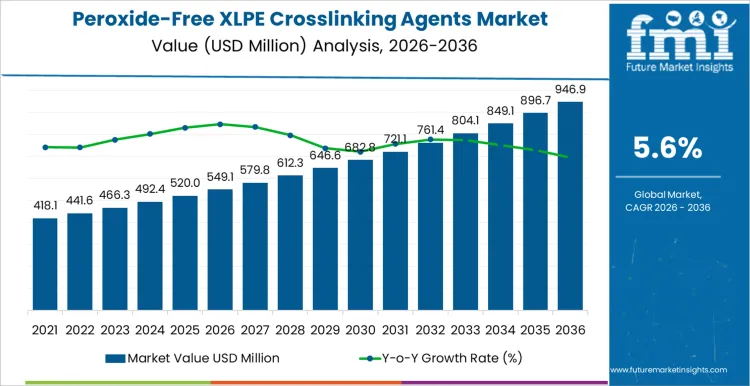
Peroxide-free XLPE crosslinking agents revenues are anticipated to advance from USD 549.1 million in 2026 to USD 946.9 million in 2036, supported by a CAGR of 5.60%. Competitive power in this market is shaped by technical specialization rather than volume dominance, as crosslinking performance directly affects cable reliability and regulatory acceptance. Leading suppliers defend pricing power through proprietary silane chemistries, validated processing windows, and long-term qualification with cable manufacturers and utilities.
Entry barriers remain high due to the need for deep application knowledge, extensive electrical and thermal aging data, and close integration with extrusion and curing processes. Fragmentation persists because regional cable standards, voltage classes, and processing practices require tailored solutions rather than fully standardized products. At the same time, consolidation pressure is limited, as customers prefer multi-sourcing strategies to reduce supply risk in critical infrastructure projects. Market control is maintained through technical lock-in and performance credibility rather than scale-driven cost competition, sustaining stable margins for established players.
Quick Stats for Peroxide-Free XLPE Crosslinking Agents Market
- Peroxide-Free XLPE Crosslinking Agents Market Value (2026): USD 549.1 Million
- Peroxide-Free XLPE Crosslinking Agents Market Forecast Value (2036): USD 946.9 Million
- Peroxide-Free XLPE Crosslinking Agents Market Forecast CAGR 2026 to 2036: 5.60%
- Leading Chemistry in Peroxide-Free XLPE Crosslinking Agents Market: Silane-Grafted Systems (40% share)
- Key Growth Regions in Peroxide-Free XLPE Crosslinking Agents Market: Asia Pacific, Europe, North America, Latin America, Middle East & Africa
- Top Key Players in Peroxide-Free XLPE Crosslinking Agents Market: Borealis, Dow, Nouryon, Wacker Chemie AG, Evonik Industries AG, Momentive Performance Materials, Elkem Silicones, Mitsui Chemicals, LyondellBasell, SABIC
Peroxide-Free XLPE Crosslinking Agents Market Key Takeaways
| Metric | Value |
|---|---|
| Peroxide-Free XLPE Crosslinking Agents Market Value (2026) | USD 549.1 Million |
| Peroxide-Free XLPE Crosslinking Agents Market Forecast Value (2036) | USD 946.9 Million |
| Peroxide-Free XLPE Crosslinking Agents Market Forecast CAGR 2026 to 2036 | 5.60% |
How are Process Stability and Cable Reliability Requirements Driving the Peroxide-Free XLPE Crosslinking Agents Market?
The peroxide-free XLPE crosslinking agents market is expanding as wire and cable manufacturers seek greater control over crosslinking processes while minimizing by-product formation and processing variability. Unlike peroxide-based systems, peroxide-free chemistries such as silane and radiation-assisted approaches enable crosslinking at lower temperatures with improved uniformity. For cable producers, this translates into more consistent insulation properties, reduced scorch risk, and tighter control over extrusion and curing operations.
Manufacturing efficiency and product quality are central to adoption. Cable manufacturers are prioritizing crosslinking agents that support continuous processing, stable melt behavior, and predictable crosslink density across long production runs. Peroxide-free systems also reduce odor, volatile by-products, and post-curing requirements, improving plant safety and working conditions. Suppliers that can tailor crosslinking packages to specific voltage classes and polymer grades are gaining preference during material qualification.
Long-term performance and regulatory considerations are further reinforcing demand. Power utilities and infrastructure developers increasingly evaluate XLPE insulation based on thermal aging resistance, electrical breakdown strength, and long service life. Peroxide-free crosslinking agents support these requirements by delivering cleaner polymer networks with fewer residuals that can affect dielectric performance. For additive suppliers and compounders, competitive advantage increasingly depends on application engineering support, processing reliability, and validated performance data positioning peroxide-free XLPE crosslinking agents as a steady-growth enabler in modern power and communication cable systems.
How is The Peroxide-Free XLPE Crosslinking Agents Market Structured By Chemistry And Application?
The peroxide-free XLPE crosslinking agents market is segmented by chemistry and application, reflecting how crosslinking mechanism and end-use performance requirements influence material selection. By chemistry, silane-grafted systems lead the market, as they enable controlled crosslinking without peroxide-related processing risks. Other chemistries include radiation or photoinitiated systems, azide and other non-peroxide approaches, and alternative crosslinking concepts developed for specific processing environments. By application, power and medium-voltage cables represent the largest demand segment, followed by low-voltage and building wires, pipe and plumbing systems, and other specialized uses where thermal and electrical stability are required.
Why Do Silane-Grafted Systems Lead Chemistry Adoption In The Peroxide-Free XLPE Crosslinking Agents Market?
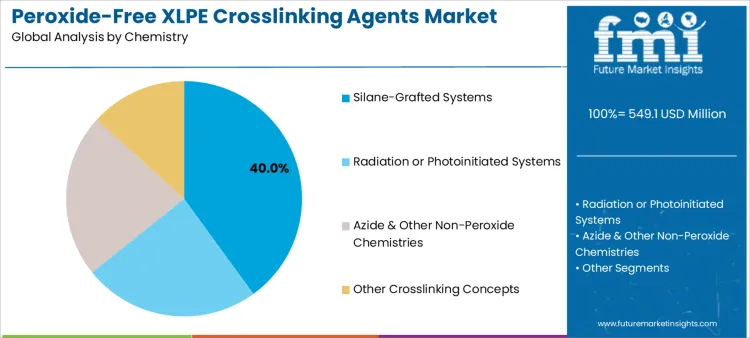
Silane-grafted systems account for 40% share of the peroxide-free XLPE crosslinking agents market because they allow crosslinking to occur after extrusion through moisture curing. This separation of extrusion and crosslinking improves process stability and reduces risks associated with premature gel formation. Cable manufacturers prefer silane systems for consistent insulation thickness and smooth surface quality. These systems support high line speeds and flexible production layouts. Compatibility with existing extrusion equipment further encourages adoption. Reliable crosslink density and long-term mechanical performance explain why silane-grafted chemistries remain the most widely used non-peroxide solution.
Why Do Power And Medium-Voltage Cables Dominate Application Demand In The Peroxide-Free XLPE Crosslinking Agents Market?
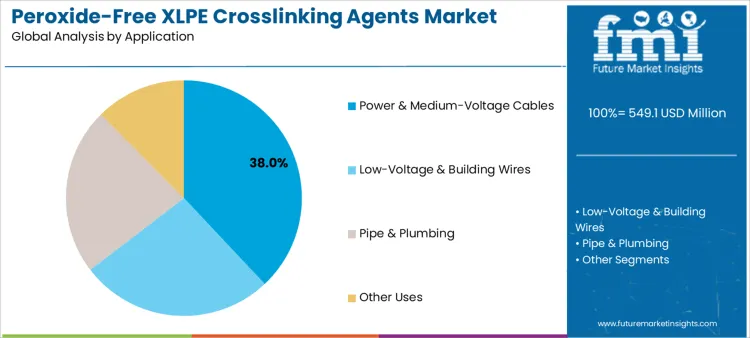
Power and medium-voltage cables hold 38% share of the peroxide-free XLPE crosslinking agents market because electrical insulation performance is critical in these applications. XLPE insulation must withstand thermal stress, electrical load, and long service lifetimes without degradation. Peroxide-free crosslinking agents reduce processing variability and improve insulation uniformity, which is essential for voltage reliability. Expanding power transmission and distribution infrastructure drives sustained cable production volumes. Cable manufacturers prioritize crosslinking systems that deliver predictable performance and efficient manufacturing. These reliability-focused and volume-driven factors explain why power and medium-voltage cables remain the leading application segment.
What are The Key Dynamics of the Peroxide-Free XLPE Crosslinking Agents Market?
The peroxide-free XLPE crosslinking agents market is driven by demand for advanced crosslinking solutions that improve performance of crosslinked polyethylene (XLPE) used in power cables, automotive wiring, insulation, and industrial tubing. Peroxide-free systems such as silane coupling, irradiation, and azo initiators enable controlled crosslinking without peroxide residues that can compromise thermal stability or introduce impurities. For chemical suppliers, compounders, and cable manufacturers, crosslinking efficiency, uniformity, thermal and electrical performance, processability, and minimal byproduct formation are central factors that influence agent selection and long-term reliability in critical applications.
How Are Technology And Application Trends Shaping This Market?
Technology and application trends are shaping the peroxide-free XLPE crosslinking agents market through increased adoption in high-voltage power distribution, automotive electrification, renewable energy infrastructure, and advanced industrial systems that require enhanced dielectric, thermal, and mechanical properties. Silane grafting and irradiation techniques reduce dependence on peroxides, enabling cleaner crosslinked networks with improved insulation performance and lower risk of byproduct-induced aging. Growth in medium and high-voltage cable systems, electric vehicle (EV) wiring harnesses, and battery enclosure conduits increases demand for crosslinking agents that support precise control of crosslink density and uniformity. Suppliers that provide comprehensive processing guidance, scalable agent formulations, and quality consistency strengthen their value proposition to converters and OEMs.
Why Do Cost, Integration, And Technical Challenges Restrain Market Adoption?
Cost, integration, and technical challenges restrain growth of the peroxide-free XLPE crosslinking agents market because alternative crosslinking systems often require specialized equipment, additional process steps, or higher initial investment relative to traditional peroxide methods. Silane and irradiation routes may involve grafting reactors, moisture conditioning stages, or access to irradiation facilities, all of which can increase capital expenditure and complexity for compounders. Ensuring compatibility with existing extrusion and wire and cable lines requires detailed engineering evaluation, testing, and qualification, which extend development timelines. Some advanced crosslinking technologies also necessitate stringent control of processing parameters to achieve consistent crosslink density, raising technical entry barriers for converters with limited in-house expertise.
How Does the Growth Trajectory of Peroxide-Free XLPE Crosslinking Agents Vary by Country?
The peroxide-free XLPE crosslinking agents market is growing as wire, cable, and pipe manufacturers shift toward alternative crosslinking chemistries that improve processing control, safety, and material consistency. These agents are widely used in power and building cables, automotive wiring, and plumbing applications where uniform crosslinking and long-term thermal stability are required. Country-wise growth differs based on infrastructure investment, power transmission upgrades, and adoption of advanced polymer processing technologies. High-growth markets benefit from expanding electrical networks and industrial development, while mature regions focus on performance optimization, compliance, and reliability in critical applications.
| Country | CAGR (%) |
|---|---|
| China | 6.8 |
| Brazil | 6.4 |
| United States | 5.3 |
| Germany | 5.2 |
| South Korea | 4.8 |
Why is China Leading the Peroxide-Free XLPE Crosslinking Agents Market?
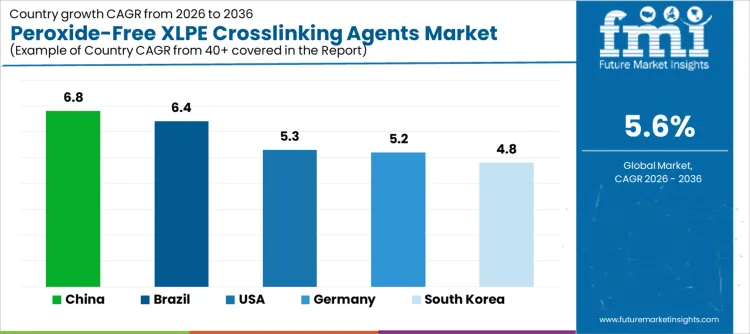
Demand for peroxide-free XLPE crosslinking agents in China is expanding at a CAGR of 6.8% during 2026 to 2036, driven by large-scale investments in power infrastructure, urban construction, and electric vehicle charging networks. Demand is particularly strong in medium- and high-voltage power cables, building wires, and industrial cable systems where consistent insulation performance is essential. Peroxide-free crosslinking agents are increasingly preferred for their ability to deliver uniform crosslink density while reducing processing complexity and by-product formation. Chinese cable manufacturers prioritize crosslinking systems that offer stable processing windows, reduced scrap rates, and compatibility with high-speed extrusion lines. Silane-grafted and radiation-based crosslinking approaches are gaining traction, especially for applications requiring precise insulation thickness and long-term thermal resistance. Domestic chemical suppliers benefit from integrated polymer supply chains and the ability to support -volume production requirements.
Why is Brazil Seeing Increasing Adoption of Peroxide-Free XLPE Crosslinking Agents?
Sale of peroxide-free XLPE crosslinking agents in Brazil is growing at a CAGR of 6.4% during 2026 to 2036, supported by rising investment in power distribution networks, construction activity, and infrastructure modernization. Demand is driven by low- and medium-voltage cables used in residential buildings, commercial projects, and utility upgrades. Manufacturers are increasingly adopting peroxide-free systems to improve processing efficiency and insulation consistency. Brazilian cable producers value crosslinking agents that offer reduced processing risk, improved surface quality, and stable electrical properties. Silane-based crosslinking systems are widely used due to their compatibility with existing extrusion equipment and flexibility across multiple cable designs. Cost sensitivity remains an important factor, encouraging adoption of solutions that balance performance and operational efficiency. Procurement decisions often favor suppliers offering technical support, localized availability, and proven performance in tropical operating conditions.
What is Driving Demand for Peroxide-Free XLPE Crosslinking Agents in the United States?
The United States peroxide-free XLPE crosslinking agents market is expanding at a CAGR of 5.3% during 2026 to 2036, driven by upgrades to aging power infrastructure and growing demand for high-performance building and industrial cables. Utility companies and cable manufacturers increasingly prefer peroxide-free crosslinking systems for applications requiring controlled insulation properties and long service life. U.S. buyers emphasize process consistency, electrical performance, and compliance with strict industry standards. Radiation and advanced silane-based crosslinking methods are adopted for specialty cables used in renewable energy, data centers, and industrial installations. Adoption is more selective and focused on performance-critical applications rather than mass-volume expansion. Procurement decisions prioritize long-term supplier reliability, technical documentation, and validated performance data. Market growth is shaped by grid modernization efforts, expansion of renewable energy projects, and continued demand for high-quality cable insulation materials.
How is Germany Supporting the Peroxide-Free XLPE Crosslinking Agents Market?
Sale of peroxide-free XLPE crosslinking agents in Germany is growing at a CAGR of 5.2% during 2026 to 2036, supported by demand from advanced cable manufacturing, industrial automation, and power transmission projects. German manufacturers emphasize precision processing and consistent insulation quality, making peroxide-free crosslinking systems attractive for high-specification applications.
Silane-grafted crosslinking agents are widely used in building wires and industrial cables, while radiation-based systems are applied in specialized applications requiring tight dimensional control. Buyers prioritize reproducible material behavior, compliance with stringent electrical standards, and long-term reliability. Procurement decisions favor suppliers with strong quality systems, detailed technical support, and the ability to meet customized application requirements. Market growth is reinforced by Germany’s focus on engineering excellence, grid efficiency, and advanced manufacturing practices.
How is South Korea Adopting Peroxide-Free XLPE Crosslinking Agents?
Sale of peroxide-free XLPE crosslinking agents in South Korea is expanding at a CAGR of 4.8% during 2026 to 2036, driven by demand from electronics, automotive wiring, and power cable manufacturing. As manufacturers focus on compact designs and high-performance insulation, peroxide-free systems are adopted for their process control and material consistency. Buyers emphasize compatibility with precision extrusion processes, stable electrical properties, and suitability for export-oriented products. Silane-based crosslinking agents are commonly used due to their flexibility and efficiency across different cable types. Procurement decisions are influenced by supplier reliability, technical collaboration, and compliance with global cable standards. Market growth is supported by continued investment in advanced manufacturing and steady demand for high-quality cable insulation solutions.
How are Suppliers Competing in the Peroxide-Free XLPE Crosslinking Agents Market?
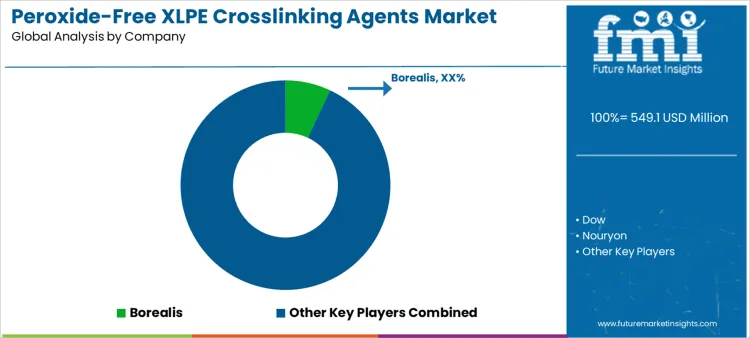
Competition in the peroxide-free XLPE crosslinking agents market is shaped by crosslink efficiency, process safety, and electrical performance for power and medium-voltage cable insulation. As manufacturers move away from peroxide systems to reduce by-products and improve processing control, suppliers differentiate through silane-based, moisture-curable, and alternative non-peroxide chemistries. Borealis anchors the market with silane crosslinking solutions optimized for cable compounds, emphasizing uniform crosslink density, low scorch risk, and stable dielectric properties. Dow competes through peroxide-free crosslinkable polyethylene systems designed for consistent melt processing and long-term thermal aging resistance.
Specialty chemicals and silicone leaders add depth through formulation expertise. Nouryon positions its crosslinking catalysts and additives around precise reaction control and faster moisture curing, supporting high-throughput cable lines. Wacker Chemie AG differentiates with silane chemistries and curing systems engineered for predictable crosslinking without peroxide residues. Evonik Industries AG and Momentive Performance Materials emphasize additive systems that improve crosslink uniformity and insulation durability under thermal and electrical stress.
Global polymer producers strengthen competition through scale and cable-grade integration. Elkem Silicones and Mitsui Chemicals focus on non-peroxide crosslinking platforms compatible with advanced cable formulations. LyondellBasell and SABIC leverage broad PE portfolios to deliver peroxide-free XLPE systems with consistent quality and global supply. Across the market, competitive advantage is defined by processing safety, dielectric reliability, and long-term insulation performance rather than crosslinking agent price alone.
Key Players in Peroxide-Free XLPE Crosslinking Agents Market
- Borealis
- Dow
- Nouryon
- Wacker Chemie AG
- Evonik Industries AG
- Momentive Performance Materials
- Elkem Silicones
- Mitsui Chemicals
- LyondellBasell
- SABIC
Scope of Report
| Attribute | Details |
|---|---|
| Market Size Unit | USD Million |
| Chemistry Covered | Silane-Grafted Systems, Radiation or Photoinitiated Systems, Azide & Other Non-Peroxide Chemistries, Other Advanced Crosslinking Concepts |
| Application Covered | Power & Medium-Voltage Cables, Low-Voltage & Building Wires, Pipe & Plumbing Systems, Other Industrial and Specialty Uses |
| Countries Covered | China, Japan, South Korea, India, Australia & New Zealand, ASEAN, Rest of Asia Pacific, Germany, United Kingdom, France, Italy, Spain, Nordic, BENELUX, Rest of Europe, United States, Canada, Mexico, Brazil, Chile, Rest of Latin America, Kingdom of Saudi Arabia, Other GCC Countries, Turkey, South Africa, Other African Union, Rest of Middle East & Africa |
| Regions Covered | Asia Pacific, Europe, North America, Latin America, Middle East & Africa |
| Key Companies Profiled | Borealis, Dow, Nouryon, Wacker Chemie AG, Evonik Industries AG, Momentive Performance Materials, Elkem Silicones, Mitsui Chemicals, LyondellBasell, SABIC |
| Additional Attributes | Dollar sales by chemistry and application are evaluated across wire, cable, and pipe manufacturing value chains. The scope analyzes process stability, crosslinking efficiency, by-product reduction, and compatibility with continuous extrusion systems. Country-level analysis reflects grid expansion, building wire demand, and regulatory shifts toward low-emission and peroxide-free polymer processing technologies. |
Peroxide-Free XLPE Crosslinking Agents Market by Key Segments
Chemistry:
- Silane-Grafted Systems
- Radiation or Photoinitiated Systems
- Azide & Other Non-Peroxide Chemistries
- Other Crosslinking Concepts
Application:
- Power & Medium-Voltage Cables
- Low-Voltage & Building Wires
- Pipe & Plumbing
- Other Uses
Region:
- Asia Pacific
- China
- Japan
- South Korea
- India
- Australia & New Zealand
- ASEAN
- Rest of Asia Pacific
- Europe
- Germany
- United Kingdom
- France
- Italy
- Spain
- Nordic
- BENELUX
- Rest of Europe
- North America
- United States
- Canada
- Mexico
- Latin America
- Brazil
- Chile
- Rest of Latin America
- Middle East & Africa
- Kingdom of Saudi Arabia
- Other GCC Countries
- Turkey
- South Africa
- Other African Union
- Rest of Middle East & Africa
Bibliography
- Organisation for Economic Co‑operation and Development. (2024). Sustainable chemistry pathways for advanced polymer materials. OECD Publishing.
- International Energy Agency. (2024). Energy‑efficient industrial processes and advanced polymer applications. International Energy Agency.
- United States Environmental Protection Agency. (2023). Overview of polymer processing and environmental considerations.
- European Chemicals Agency. (2023). Guidance on polymer material performance and regulatory expectations. European Chemicals Agency.
Frequently Asked Questions
How big is the peroxide-free xlpe crosslinking agents market in 2026?
The global peroxide-free xlpe crosslinking agents market is estimated to be valued at USD 549.1 million in 2026.
What will be the size of peroxide-free xlpe crosslinking agents market in 2036?
The market size for the peroxide-free xlpe crosslinking agents market is projected to reach USD 946.9 million by 2036.
How much will be the peroxide-free xlpe crosslinking agents market growth between 2026 and 2036?
The peroxide-free xlpe crosslinking agents market is expected to grow at a 5.6% CAGR between 2026 and 2036.
What are the key product types in the peroxide-free xlpe crosslinking agents market?
The key product types in peroxide-free xlpe crosslinking agents market are silane-grafted systems, radiation or photoinitiated systems, azide & other non-peroxide chemistries and other crosslinking concepts.
Which application segment to contribute significant share in the peroxide-free xlpe crosslinking agents market in 2026?
In terms of application, power & medium-voltage cables segment to command 38.0% share in the peroxide-free xlpe crosslinking agents market in 2026.
Preview the report firsthand - request a free sample
Get SampleGet the brochure for pricing and purchase details.
Get PDFTable of Content
- Executive Summary
- Global Market Outlook
- Demand-side Trends
- Supply-side Trends
- Technology Roadmap Analysis
- Analysis and Recommendations
- Market Overview
- Market Coverage / Taxonomy
- Market Definition / Scope / Limitations
- Market Background
- Market Dynamics
- Drivers
- Restraints
- Opportunity
- Trends
- Scenario Forecast
- Demand in Optimistic Scenario
- Demand in Likely Scenario
- Demand in Conservative Scenario
- Opportunity Map Analysis
- Product Life Cycle Analysis
- Supply Chain Analysis
- Investment Feasibility Matrix
- Value Chain Analysis
- PESTLE and Porter’s Analysis
- Regulatory Landscape
- Regional Parent Market Outlook
- Production and Consumption Statistics
- Import and Export Statistics
- Market Dynamics
- Global Market Analysis 2021 to 2025 and Forecast, 2026 to 2036
- Historical Market Size Value (USD Million) Analysis, 2021 to 2025
- Current and Future Market Size Value (USD Million) Projections, 2026 to 2036
- Y-o-Y Growth Trend Analysis
- Absolute $ Opportunity Analysis
- Global Market Pricing Analysis 2021 to 2025 and Forecast 2026 to 2036
- Global Market Analysis 2021 to 2025 and Forecast 2026 to 2036, By Chemistry
- Introduction / Key Findings
- Historical Market Size Value (USD Million) Analysis By Chemistry , 2021 to 2025
- Current and Future Market Size Value (USD Million) Analysis and Forecast By Chemistry , 2026 to 2036
- Silane-Grafted Systems
- Radiation or Photoinitiated Systems
- Azide & Other Non-Peroxide Chemistries
- Other Crosslinking Concepts
- Silane-Grafted Systems
- Y-o-Y Growth Trend Analysis By Chemistry , 2021 to 2025
- Absolute $ Opportunity Analysis By Chemistry , 2026 to 2036
- Global Market Analysis 2021 to 2025 and Forecast 2026 to 2036, By Application
- Introduction / Key Findings
- Historical Market Size Value (USD Million) Analysis By Application, 2021 to 2025
- Current and Future Market Size Value (USD Million) Analysis and Forecast By Application, 2026 to 2036
- Power & Medium-Voltage Cables
- Low-Voltage & Building Wires
- Pipe & Plumbing
- Other Uses
- Power & Medium-Voltage Cables
- Y-o-Y Growth Trend Analysis By Application, 2021 to 2025
- Absolute $ Opportunity Analysis By Application, 2026 to 2036
- Global Market Analysis 2021 to 2025 and Forecast 2026 to 2036, By Region
- Introduction
- Historical Market Size Value (USD Million) Analysis By Region, 2021 to 2025
- Current Market Size Value (USD Million) Analysis and Forecast By Region, 2026 to 2036
- North America
- Latin America
- Western Europe
- Eastern Europe
- East Asia
- South Asia and Pacific
- Middle East & Africa
- Market Attractiveness Analysis By Region
- North America Market Analysis 2021 to 2025 and Forecast 2026 to 2036, By Country
- Historical Market Size Value (USD Million) Trend Analysis By Market Taxonomy, 2021 to 2025
- Market Size Value (USD Million) Forecast By Market Taxonomy, 2026 to 2036
- By Country
- USA
- Canada
- Mexico
- By Chemistry
- By Application
- By Country
- Market Attractiveness Analysis
- By Country
- By Chemistry
- By Application
- Key Takeaways
- Latin America Market Analysis 2021 to 2025 and Forecast 2026 to 2036, By Country
- Historical Market Size Value (USD Million) Trend Analysis By Market Taxonomy, 2021 to 2025
- Market Size Value (USD Million) Forecast By Market Taxonomy, 2026 to 2036
- By Country
- Brazil
- Chile
- Rest of Latin America
- By Chemistry
- By Application
- By Country
- Market Attractiveness Analysis
- By Country
- By Chemistry
- By Application
- Key Takeaways
- Western Europe Market Analysis 2021 to 2025 and Forecast 2026 to 2036, By Country
- Historical Market Size Value (USD Million) Trend Analysis By Market Taxonomy, 2021 to 2025
- Market Size Value (USD Million) Forecast By Market Taxonomy, 2026 to 2036
- By Country
- Germany
- UK
- Italy
- Spain
- France
- Nordic
- BENELUX
- Rest of Western Europe
- By Chemistry
- By Application
- By Country
- Market Attractiveness Analysis
- By Country
- By Chemistry
- By Application
- Key Takeaways
- Eastern Europe Market Analysis 2021 to 2025 and Forecast 2026 to 2036, By Country
- Historical Market Size Value (USD Million) Trend Analysis By Market Taxonomy, 2021 to 2025
- Market Size Value (USD Million) Forecast By Market Taxonomy, 2026 to 2036
- By Country
- Russia
- Poland
- Hungary
- Balkan & Baltic
- Rest of Eastern Europe
- By Chemistry
- By Application
- By Country
- Market Attractiveness Analysis
- By Country
- By Chemistry
- By Application
- Key Takeaways
- East Asia Market Analysis 2021 to 2025 and Forecast 2026 to 2036, By Country
- Historical Market Size Value (USD Million) Trend Analysis By Market Taxonomy, 2021 to 2025
- Market Size Value (USD Million) Forecast By Market Taxonomy, 2026 to 2036
- By Country
- China
- Japan
- South Korea
- By Chemistry
- By Application
- By Country
- Market Attractiveness Analysis
- By Country
- By Chemistry
- By Application
- Key Takeaways
- South Asia and Pacific Market Analysis 2021 to 2025 and Forecast 2026 to 2036, By Country
- Historical Market Size Value (USD Million) Trend Analysis By Market Taxonomy, 2021 to 2025
- Market Size Value (USD Million) Forecast By Market Taxonomy, 2026 to 2036
- By Country
- India
- ASEAN
- Australia & New Zealand
- Rest of South Asia and Pacific
- By Chemistry
- By Application
- By Country
- Market Attractiveness Analysis
- By Country
- By Chemistry
- By Application
- Key Takeaways
- Middle East & Africa Market Analysis 2021 to 2025 and Forecast 2026 to 2036, By Country
- Historical Market Size Value (USD Million) Trend Analysis By Market Taxonomy, 2021 to 2025
- Market Size Value (USD Million) Forecast By Market Taxonomy, 2026 to 2036
- By Country
- Kingdom of Saudi Arabia
- Other GCC Countries
- Turkiye
- South Africa
- Other African Union
- Rest of Middle East & Africa
- By Chemistry
- By Application
- By Country
- Market Attractiveness Analysis
- By Country
- By Chemistry
- By Application
- Key Takeaways
- Key Countries Market Analysis
- USA
- Pricing Analysis
- Market Share Analysis, 2025
- By Chemistry
- By Application
- Canada
- Pricing Analysis
- Market Share Analysis, 2025
- By Chemistry
- By Application
- Mexico
- Pricing Analysis
- Market Share Analysis, 2025
- By Chemistry
- By Application
- Brazil
- Pricing Analysis
- Market Share Analysis, 2025
- By Chemistry
- By Application
- Chile
- Pricing Analysis
- Market Share Analysis, 2025
- By Chemistry
- By Application
- Germany
- Pricing Analysis
- Market Share Analysis, 2025
- By Chemistry
- By Application
- UK
- Pricing Analysis
- Market Share Analysis, 2025
- By Chemistry
- By Application
- Italy
- Pricing Analysis
- Market Share Analysis, 2025
- By Chemistry
- By Application
- Spain
- Pricing Analysis
- Market Share Analysis, 2025
- By Chemistry
- By Application
- France
- Pricing Analysis
- Market Share Analysis, 2025
- By Chemistry
- By Application
- India
- Pricing Analysis
- Market Share Analysis, 2025
- By Chemistry
- By Application
- ASEAN
- Pricing Analysis
- Market Share Analysis, 2025
- By Chemistry
- By Application
- Australia & New Zealand
- Pricing Analysis
- Market Share Analysis, 2025
- By Chemistry
- By Application
- China
- Pricing Analysis
- Market Share Analysis, 2025
- By Chemistry
- By Application
- Japan
- Pricing Analysis
- Market Share Analysis, 2025
- By Chemistry
- By Application
- South Korea
- Pricing Analysis
- Market Share Analysis, 2025
- By Chemistry
- By Application
- Russia
- Pricing Analysis
- Market Share Analysis, 2025
- By Chemistry
- By Application
- Poland
- Pricing Analysis
- Market Share Analysis, 2025
- By Chemistry
- By Application
- Hungary
- Pricing Analysis
- Market Share Analysis, 2025
- By Chemistry
- By Application
- Kingdom of Saudi Arabia
- Pricing Analysis
- Market Share Analysis, 2025
- By Chemistry
- By Application
- Turkiye
- Pricing Analysis
- Market Share Analysis, 2025
- By Chemistry
- By Application
- South Africa
- Pricing Analysis
- Market Share Analysis, 2025
- By Chemistry
- By Application
- USA
- Market Structure Analysis
- Competition Dashboard
- Competition Benchmarking
- Market Share Analysis of Top Players
- By Regional
- By Chemistry
- By Application
- Competition Analysis
- Competition Deep Dive
- Borealis
- Overview
- Product Portfolio
- Profitability by Market Segments (Product/Age /Sales Channel/Region)
- Sales Footprint
- Strategy Overview
- Marketing Strategy
- Product Strategy
- Channel Strategy
- Dow
- Nouryon
- Wacker Chemie AG
- Evonik Industries AG
- Momentive Performance Materials
- Elkem Silicones
- Mitsui Chemicals
- LyondellBasell
- SABIC
- Borealis
- Competition Deep Dive
- Assumptions & Acronyms Used
- Research Methodology


