

- Industry Size (2026)
- USD 410.0 Mn
- Forecast (2036)
- USD 667.8 Mn
- CAGR (2026 to 2036)
- 5.0%
Hydrogen Peroxide Stabilizers Market Forecast and Outlook 2026 to 2036
The hydrogen peroxide stabilizers market is likely to be valued at USD 410.0 million in 2026 and set to reach USD 667.8 million by 2036, advancing at a 5.0% CAGR during the forecast period. Demand is anchored in industrial reliance on hydrogen peroxide as a controlled oxidizing agent across bleaching, disinfection, and chemical synthesis workflows. Unstabilized hydrogen peroxide decomposes rapidly in the presence of heat, light, and trace metal contaminants, leading to loss of efficacy, safety risks, and inconsistent process outcomes. Stabilizers are incorporated to inhibit catalytic decomposition, preserve oxidizing strength, and maintain predictable concentration during storage, transport, and dosing. Pulp and paper mills, textile processors, and electronics manufacturers depend on stabilized peroxide formulations to achieve uniform performance under alkaline, high-temperature, or high-purity operating conditions where peroxide degradation directly affects output quality and yield consistency.
Water treatment facilities, healthcare sanitation providers, and industrial cleaning operations require stable peroxide concentration to meet defined disinfection and oxidation targets without overconsumption or frequent replenishment. Chemical producers integrate stabilizers to protect peroxide during bulk logistics and automated feed systems, reducing variability across production batches. Selection decisions prioritize stabilizer compatibility with specific peroxide grades, minimal interference with downstream reactions, and compliance with environmental and chemical safety regulations governing chelating agents. Ongoing development of stabilizer chemistries focuses on improved performance under elevated temperatures, resistance to metal contamination, and alignment with tightening regulatory frameworks. These process control, safety, and compliance-driven factors position hydrogen peroxide stabilizers as functional enablers of peroxide-intensive industrial operations rather than optional formulation additives.
Quick Stats for Hydrogen Peroxide Stabilizers Market
- Hydrogen Peroxide Stabilizers Market Value (2026): USD 410.0 million
- Hydrogen Peroxide Stabilizers Market Forecast Value (2036): USD 667.8 million
- Hydrogen Peroxide Stabilizers Market Forecast CAGR (2026 to 2036): 5.0%
- Leading Stabilizer Chemistry by Demand Share: Phosphonates
- Fastest-Growing Countries: India, China, Vietnam, Indonesia, Bangladesh
- Top Players in Global Demand: Nouryon, Solvay, BASF, Kemira, Evonik Industries
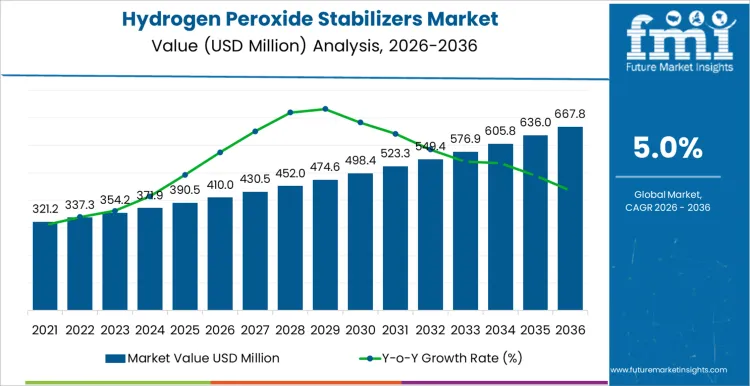
Hydrogen Peroxide Stabilizers Market Key Takeaways
| Metric | Value |
|---|---|
| Market Value (2026) | USD 410.0 million |
| Market Forecast Value (2036) | USD 667.8 million |
| Forecast CAGR 2026 to 2036 | 5.0% |
Why is the Demand for Hydrogen Peroxide Stabilizers Growing?
Demand for hydrogen peroxide stabilizers is increasing as industrial users seek to maintain product efficacy and safety during storage and application. Hydrogen peroxide degrades rapidly when exposed to heat, light, and trace metal ions, compromising oxidation potential essential for bleaching, disinfection, and chemical synthesis. Stabilizers suppress decomposition pathways by chelating metal catalysts and buffering pH, extending shelf life for grades used in pulp and paper bleaching, textile processing, and wastewater treatment. Chemical manufacturers specify stabilized formulations to ensure consistent strength during transportation and in automated dosing systems. End users in electronics cleaning rely on stabilized hydrogen peroxide to maintain oxidizing power required for microfabrication and surface preparation processes.
Procurement activity in sanitation and healthcare sectors supports market growth because regulated disinfection protocols require reliable oxidant concentration to achieve biocidal targets. In controlled environments, vaporized hydrogen peroxide sterilization applications further increase requirements for predictable concentration and validated stability through handling. Facilities managing potable water and swimming pool systems incorporate stabilized hydrogen peroxide blends to reduce variability in disinfectant performance. In municipal and industrial systems, advanced oxidation chemicals are increasingly specified where stable oxidant performance is needed under variable water matrices and dosing windows. Suppliers scale production of stabilizer additives that meet regulatory safety criteria and integrate seamlessly with varied hydrogen peroxide concentrations. Technical service teams assist formulators with compatibility assessments to prevent interference with downstream chemistry. Research and development into novel stabilizer chemistries aims to improve performance under elevated temperatures and over extended storage periods, supporting broader adoption in industrial and institutional applications.
How Is the Hydrogen Peroxide Stabilizers Industry Segmented by Stabilizer Chemistry, Application, and End Use?
Demand for hydrogen peroxide stabilizers is shaped by process safety requirements, peroxide decomposition control, and performance consistency under varying temperature and pH conditions. Industrial users focus on stabilizer compatibility with substrates, environmental compliance, and impact on downstream product quality. Adoption patterns differ across bleaching, cleaning, and formulation processes depending on peroxide concentration and operating conditions. Segmentation highlights how stabilizer chemistry selection, functional application, and industrial deployment structure utilization across peroxide-dependent production environments.
Which Stabilizer Chemistry Holds the Largest Share in Hydrogen Peroxide Stabilization?
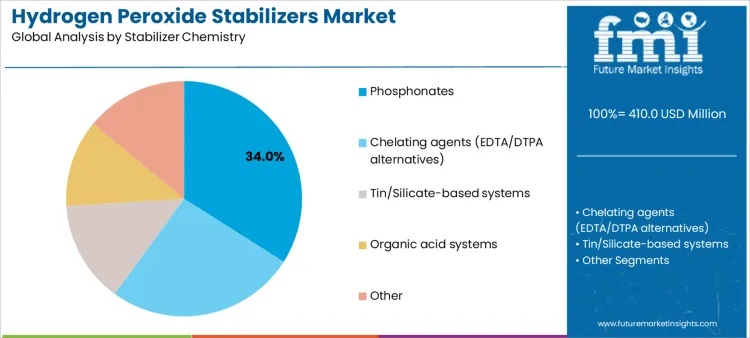
Phosphonates account for 34.0%, reflecting widespread use for metal ion sequestration and long-term peroxide stability under alkaline conditions. These chemistries are valued for effectiveness at low dosage levels and compatibility with high-temperature processes. Chelating agents, including EDTA and DTPA alternatives, represent 26.0%, supporting transition metal control where regulatory pressure favors lower environmental persistence. Tin and silicate-based systems at 14.0% provide stabilization in specific inorganic processing environments. Organic acid systems at 12.0% are applied where biodegradability and mild stabilization are required. Other niche stabilizer chemistries collectively account for the remaining 14.0% share. Chemistry segmentation reflects balance between stability performance and regulatory alignment.
Key Points:
- Phosphonates provide robust metal ion control.
- Chelants support regulatory and performance balance.
- Alternative systems serve niche stabilization needs.
How Do Application Areas Influence Demand for Hydrogen Peroxide Stabilizers?
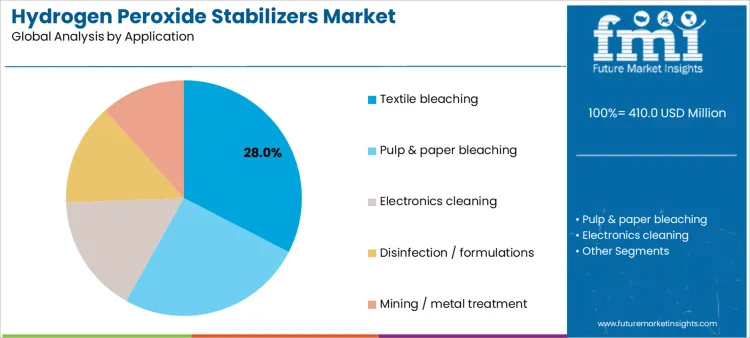
Textile bleaching represents 28.0%, driven by need for controlled peroxide activity to achieve uniform fabric whiteness and strength retention. Pulp and paper bleaching at 22.0% relies on stabilizers to manage peroxide decomposition in fiber processing stages. Electronics cleaning accounts for 14.0%, emphasizing high-purity stabilization to avoid surface defects. Disinfection and formulation applications at 12.0% require stability during storage and dilution. Mining and metal treatment at 10.0% apply stabilizers to control oxidative reactions during ore processing. Application segmentation highlights stronger utilization where peroxide exposure conditions demand consistent reactivity control.
Key Points:
- Textile processing requires controlled bleaching performance.
- Pulp operations depend on stability during fiber treatment.
- Electronics cleaning demands high-purity stabilization.
Which End Use Segments Drive Consumption of Hydrogen Peroxide Stabilizers?
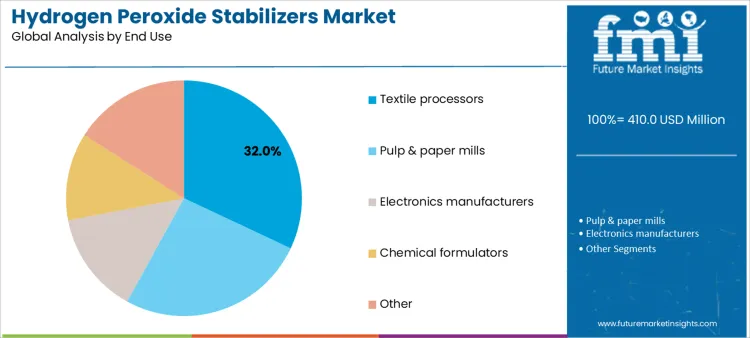
Textile processors account for 32.0%, reflecting continuous peroxide usage across bleaching and finishing operations. Pulp and paper mills at 26.0% integrate stabilizers into large-volume bleaching systems to protect fiber quality. Electronics manufacturers represent 14.0%, applying stabilizers in precision cleaning environments. Chemical formulators at 12.0% incorporate stabilizers into peroxide-based products for storage and transport stability. Other end users at 16.0% include mining, water treatment, and specialty chemical operations. End-use segmentation shows concentration where peroxide intensity, process scale, and quality control requirements are highest.
Key Points:
- Textile processors drive steady stabilizer consumption.
- Paper mills require stability at large processing scales.
- Electronics users focus on purity and reaction control.
What are the Key Dynamics in the Hydrogen Peroxide Stabilizers Market?
Demand dynamics in the hydrogen peroxide stabilizers market are shaped by industrial and institutional users seeking reliable peroxide performance with extended shelf life and controlled decomposition. Use cases in paper bleaching, textile processing, water treatment, and chemical synthesis place emphasis on stabilizer effectiveness under diverse pH and temperature conditions. Demand for peroxide-based groundwater remediation chemicals reinforces the need for stabilizer systems that tolerate metals and temperature swings without rapid strength loss. Value realization depends on stabilizer compatibility with hydrogen peroxide grades and process chemistries, which affects peroxide strength retention, handling safety, and storage stability. Procurement decisions reflect formulation performance, cost per unit of stabilized peroxide, and regulatory compliance with safety standards governing peroxide use and transport.
How do process stability requirements in industrial applications shape adoption?
Adoption of hydrogen peroxide stabilizers rises in production environments where peroxide decomposition leads to process inefficiencies, increased chemical consumption, or safety risks. In pulp and paper operations, stabilizers preserve oxidizing strength through high temperature and alkaline conditions, reducing chemical turnover and dosing frequency. Textile processors favor stabilizers that limit oxygen release during bleaching cycles, which enhances fabric quality and reduces machine corrosion. Water treatment facilities that dose peroxide for disinfection or oxidation control select stabilizers that maintain peroxide activity over extended contact times without interfering with downstream treatment stages. Field programs using in-situ chemical oxidation agents also rely on controlled peroxide stability to reduce performance drift during injection, contact time, and reaction staging. Chemical manufacturing plants using peroxide in epoxidation and organic synthesis depend on stabilizers that prevent premature breakdown, ensuring consistent reaction yields and reduced batch variation. Across these industries, formulation compatibility and predictable performance under operational stress are key drivers for stabilized peroxide adoption.
How do regulatory constraints and technical performance limitations influence market scalability?
Market scalability is influenced by regulatory constraints and technical performance limitations inherent to stabilizer systems. Use of certain stabilizer chemistries is governed by regional chemical safety and environmental regulations, which affect permissible concentrations and labeling obligations tied to peroxide formulations. Some stabilizers exhibit reduced effectiveness under extreme pH, high heat, or in the presence of metal ions, which increases formulation complexity for specific industrial applications. Peroxide users may incur additional quality assurance costs to validate stabilized peroxide performance in situ, raising barriers for smaller processors with limited analytical capabilities. Supply variability for specialty stabilizer raw materials affects cost predictability and formulation consistency across production batches. These factors shape formulator and end user decisions as they balance peroxide stability needs with compliance, cost pressures, and performance uniformity across diverse use environments.
How Is Demand for the Hydrogen Peroxide Stabilizers Market Evolving Globally?
Global demand for hydrogen peroxide stabilizers is increasing as downstream industries scale hydrogen peroxide usage for bleaching, disinfection, and oxidation processes. Growth reflects higher consumption within textiles, pulp and paper, water treatment, and chemical processing applications requiring controlled peroxide decomposition. Demand expansion remains linked to process safety requirements, storage stability needs, and rising concentration levels in industrial hydrogen peroxide grades. India records 6.7% CAGR, China records 6.3% CAGR, Vietnam records 6.1% CAGR, Indonesia records 5.8% CAGR, and Bangladesh records 5.6% CAGR. Adoption intensity varies by textile output, chemical manufacturing scale, and regulatory emphasis on handling stability.
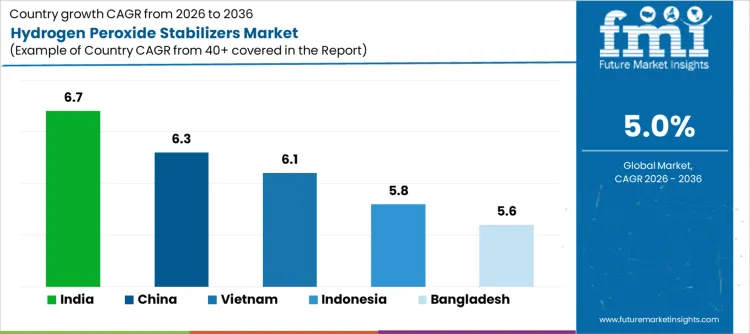
| Country | CAGR (%) |
|---|---|
| India | 6.7% |
| China | 6.3% |
| Vietnam | 6.1% |
| Indonesia | 5.8% |
| Bangladesh | 5.6% |
What is driving growth of hydrogen peroxide stabilizers demand in India?
Demand for hydrogen peroxide stabilizers in India is expanding as textile processing and chemical manufacturing increase peroxide consumption volumes. Growth at 6.7% CAGR reflects heavy usage in cotton bleaching, synthetic fabric treatment, and specialty chemical synthesis. Stabilizers are specified to control peroxide decomposition under high temperature and alkaline processing conditions. Industrial users prioritize consistent peroxide strength across storage and transport cycles. Rising wastewater treatment investments support additional stabilizer demand where peroxide dosing accuracy is required. Domestic peroxide producers integrate stabilizers to meet safety norms and minimize process losses. Demand concentrates within textile clusters, paper mills, and bulk chemical manufacturing zones.
- Expansion of textile bleaching operations
- Growth in specialty chemical manufacturing
- Emphasis on peroxide storage stability
- Rising wastewater treatment applications
Why is China seeing expansion in hydrogen peroxide stabilizers adoption?
Hydrogen peroxide stabilizers demand in China is rising as large scale industrial peroxide consumption continues across textiles, electronics, and chemical synthesis. Growth at 6.3% CAGR reflects high concentration peroxide usage requiring controlled reactivity during storage and application. Electronics and semiconductor cleaning processes increase demand for high purity stabilized peroxide solutions. Industrial safety standards reinforce stabilizer inclusion to prevent decomposition incidents. Domestic peroxide capacity expansions incorporate stabilizer systems as standard formulations. Demand remains closely linked to export oriented textile production and advanced manufacturing operations requiring precise oxidation control.
- High volume industrial peroxide usage
- Electronics and semiconductor cleaning demand
- Industrial safety compliance requirements
- Integration with domestic peroxide capacity
What factors are shaping hydrogen peroxide stabilizers sales in Vietnam?
Sales of hydrogen peroxide stabilizers in Vietnam are increasing as textile and garment processing capacity expands. Growth at 6.1% CAGR reflects rising peroxide consumption in fabric whitening and finishing operations. Stabilizers are required to maintain peroxide effectiveness across variable water quality and processing conditions. Export driven textile manufacturers emphasize consistent bleaching results to meet buyer specifications. Chemical processing growth supports stabilizer usage in controlled oxidation reactions. Demand concentrates within industrial parks hosting textile dyeing, garment finishing, and supporting chemical operations.
- Expansion of garment and textile processing
- Export driven quality consistency requirements
- Variable water quality management
- Growth of industrial chemical operations
How is Indonesia supporting growth of hydrogen peroxide stabilizers demand?
Hydrogen peroxide stabilizers market demand in Indonesia is advancing as pulp, paper, and textile sectors increase peroxide based processing. Growth at 5.8% CAGR reflects stabilizer usage to manage peroxide decomposition in high moisture and tropical operating environments. Paper bleaching operations require stabilizers to maintain brightness uniformity and reduce chemical loss. Textile producers specify stabilizers to improve peroxide handling safety during storage and transport. Industrial wastewater treatment adoption supports controlled peroxide dosing applications. Demand remains concentrated in regions with integrated pulp mills and textile manufacturing clusters.
- Expansion of pulp and paper bleaching
- Tropical processing condition management
- Textile peroxide safety requirements
- Industrial wastewater treatment usage
What is driving expansion of hydrogen peroxide stabilizers demand in Bangladesh?
Demand for hydrogen peroxide stabilizers in Bangladesh is growing as textile manufacturing continues to scale for export markets. Growth at 5.6% CAGR reflects increasing peroxide usage in fabric bleaching and finishing processes. Stabilizers are required to ensure controlled peroxide performance within low margin, high throughput textile operations. Export compliance pressures encourage consistent chemical processing outcomes. Local chemical suppliers expand stabilizer offerings aligned with textile mill requirements. Demand remains primarily linked to garment processing clusters supplying international apparel brands.
- Expansion of export oriented textiles
- High throughput fabric bleaching demand
- Focus on processing consistency
- Growth of local chemical supply chains
What is the competitive landscape of demand for the hydrogen peroxide stabilizers market globally?
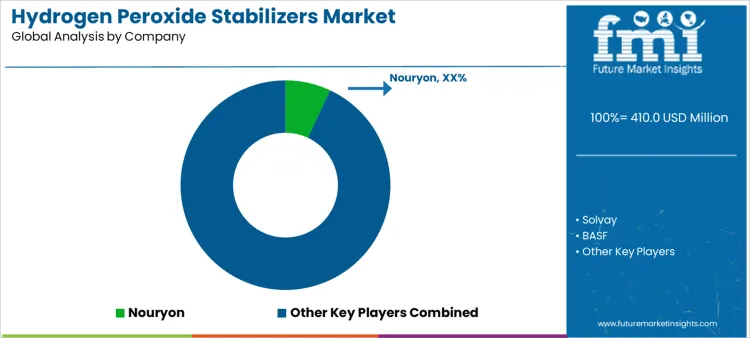
Demand for hydrogen peroxide stabilizers is driven by peroxide use in pulp bleaching, chemical synthesis, electronics cleaning, and textile processing. Industrial users evaluate stabilizer effectiveness in preventing catalytic decomposition, compatibility with metal ions, dosage efficiency, and performance across temperature ranges. Buyer assessment includes impact on peroxide shelf stability, process yield protection, interaction with substrates, and residue control. Procurement behavior favors suppliers offering application-specific formulations, consistent quality, and technical guidance for safe peroxide handling. Trend in the hydrogen peroxide stabilizers market reflects tighter process control requirements and broader peroxide adoption in high-purity and regulated applications.
Nouryon leads competitive positioning through a comprehensive stabilizer portfolio optimized for pulp, chemical, and specialty peroxide applications. Solvay competes by supplying stabilizers aligned with advanced oxidation processes and high-purity chemical manufacturing. BASF supports demand with chelation and stabilization chemistries integrated within broader peroxide and water treatment programs. Kemira maintains relevance through stabilizers tailored for pulp bleaching efficiency and controlled peroxide utilization. Evonik Industries participates by offering specialty additives supporting peroxide stability in electronics and industrial processing environments. Competitive differentiation centers on stabilization efficiency, impurity control capability, formulation reliability, and supplier technical support depth.
Key Players in the Hydrogen Peroxide Stabilizers Market
- Nouryon
- Solvay
- BASF
- Kemira
- Evonik Industries
- Italmatch Chemicals
Scope of the Report
| Items | Values |
|---|---|
| Quantitative Units | USD million |
| Stabilizer Chemistry | Phosphonates; Chelating agents (EDTA/DTPA alternatives); Tin/Silicate-based systems; Organic acid systems; Other |
| Application | Textile bleaching; Pulp & paper bleaching; Electronics cleaning; Disinfection / formulations; Mining / metal treatment |
| End Use | Textile processors; Pulp & paper mills; Electronics manufacturers; Chemical formulators; Other |
| Regions Covered | Asia Pacific, Europe, North America, Latin America, Middle East & Africa |
| Countries Covered | India, China, Vietnam, Indonesia, Bangladesh, and 40+ countries |
| Key Companies Profiled | Nouryon; Solvay; BASF; Kemira; Evonik Industries; Italmatch Chemicals |
| Additional Attributes | Dollar sales by stabilizer chemistry, application, and end use; stabilization efficiency under high-temperature and high-alkalinity bleaching conditions; control of catalytic metal decomposition to extend hydrogen peroxide shelf life and process yield; compatibility with low-metal and environmentally compliant formulations; performance requirements varying across textile, pulp, electronics, and disinfection uses; procurement dynamics influenced by process chemistry optimization, regulatory pressure on chelating agents, and long-term supply agreements with industrial users. |
Hydrogen Peroxide Stabilizers Market by Segment
Stabilizer Chemistry:
- Phosphonates
- Chelating agents (EDTA/DTPA alternatives)
- Tin/Silicate‑based systems
- Organic acid systems
- Other
Application:
- Textile bleaching
- Pulp & paper bleaching
- Electronics cleaning
- Disinfection / formulations
- Mining / metal treatment
End Use:
- Textile processors
- Pulp & paper mills
- Electronics manufacturers
- Chemical formulators
- Other
Region:
- Asia Pacific
- China
- Japan
- South Korea
- India
- Australia & New Zealand
- ASEAN
- Rest of Asia Pacific
- Europe
- Germany
- United Kingdom
- France
- Italy
- Spain
- Nordic
- BENELUX
- Rest of Europe
- North America
- United States
- Canada
- Mexico
- Latin America
- Brazil
- Chile
- Rest of Latin America
- Middle East & Africa
- Kingdom of Saudi Arabia
- Other GCC Countries
- Turkey
- South Africa
- Other African Union
- Rest of Middle East & Africa
Bibliography
- European Chemicals Agency. (2024). Stabilizers and chelating agents used in industrial peroxide systems: Regulatory and safety framework. ECHA Technical Report.
- United States Environmental Protection Agency. (2024). Advanced oxidation processes: Hydrogen peroxide handling, stabilization requirements, and decomposition pathways in industrial and municipal systems. U.S. EPA.
- World Health Organization. (2024). Use of hydrogen peroxide in drinking-water treatment: Stability, safety, and operational guidance. WHO Guidelines Series.
Frequently Asked Questions
How big is the hydrogen peroxide stabilizers market in 2026?
The global hydrogen peroxide stabilizers market is estimated to be valued at USD 410.0 million in 2026.
What will be the size of hydrogen peroxide stabilizers market in 2036?
The market size for the hydrogen peroxide stabilizers market is projected to reach USD 667.8 million by 2036.
How much will be the hydrogen peroxide stabilizers market growth between 2026 and 2036?
The hydrogen peroxide stabilizers market is expected to grow at a 5.0% CAGR between 2026 and 2036.
What are the key product types in the hydrogen peroxide stabilizers market?
The key product types in hydrogen peroxide stabilizers market are phosphonates, chelating agents (edta/dtpa alternatives), tin/silicate‑based systems, organic acid systems and other.
Which application segment to contribute significant share in the hydrogen peroxide stabilizers market in 2026?
In terms of application, textile bleaching segment to command 28.0% share in the hydrogen peroxide stabilizers market in 2026.
Preview the report firsthand - request a free sample
Get SampleGet the brochure for pricing and purchase details.
Get PDFTable of Content
- Executive Summary
- Global Market Outlook
- Demand-side Trends
- Supply-side Trends
- Technology Roadmap Analysis
- Analysis and Recommendations
- Market Overview
- Market Coverage / Taxonomy
- Market Definition / Scope / Limitations
- Market Background
- Market Dynamics
- Drivers
- Restraints
- Opportunity
- Trends
- Scenario Forecast
- Demand in Optimistic Scenario
- Demand in Likely Scenario
- Demand in Conservative Scenario
- Opportunity Map Analysis
- Product Life Cycle Analysis
- Supply Chain Analysis
- Investment Feasibility Matrix
- Value Chain Analysis
- PESTLE and Porter’s Analysis
- Regulatory Landscape
- Regional Parent Market Outlook
- Production and Consumption Statistics
- Import and Export Statistics
- Market Dynamics
- Global Market Analysis 2021 to 2025 and Forecast, 2026 to 2036
- Historical Market Size Value (USD Million) Analysis, 2021 to 2025
- Current and Future Market Size Value (USD Million) Projections, 2026 to 2036
- Y-o-Y Growth Trend Analysis
- Absolute $ Opportunity Analysis
- Global Market Pricing Analysis 2021 to 2025 and Forecast 2026 to 2036
- Global Market Analysis 2021 to 2025 and Forecast 2026 to 2036, By Stabilizer Chemistry
- Introduction / Key Findings
- Historical Market Size Value (USD Million) Analysis By Stabilizer Chemistry , 2021 to 2025
- Current and Future Market Size Value (USD Million) Analysis and Forecast By Stabilizer Chemistry , 2026 to 2036
- Phosphonates
- Chelating agents (EDTA/DTPA alternatives)
- Tin/Silicate‑based systems
- Organic acid systems
- Other
- Phosphonates
- Y-o-Y Growth Trend Analysis By Stabilizer Chemistry , 2021 to 2025
- Absolute $ Opportunity Analysis By Stabilizer Chemistry , 2026 to 2036
- Global Market Analysis 2021 to 2025 and Forecast 2026 to 2036, By Application
- Introduction / Key Findings
- Historical Market Size Value (USD Million) Analysis By Application, 2021 to 2025
- Current and Future Market Size Value (USD Million) Analysis and Forecast By Application, 2026 to 2036
- Textile bleaching
- Pulp & paper bleaching
- Electronics cleaning
- Disinfection / formulations
- Mining / metal treatment
- Textile bleaching
- Y-o-Y Growth Trend Analysis By Application, 2021 to 2025
- Absolute $ Opportunity Analysis By Application, 2026 to 2036
- Global Market Analysis 2021 to 2025 and Forecast 2026 to 2036, By End Use
- Introduction / Key Findings
- Historical Market Size Value (USD Million) Analysis By End Use, 2021 to 2025
- Current and Future Market Size Value (USD Million) Analysis and Forecast By End Use, 2026 to 2036
- Textile processors
- Pulp & paper mills
- Electronics manufacturers
- Chemical formulators
- Other
- Textile processors
- Y-o-Y Growth Trend Analysis By End Use, 2021 to 2025
- Absolute $ Opportunity Analysis By End Use, 2026 to 2036
- Global Market Analysis 2021 to 2025 and Forecast 2026 to 2036, By Region
- Introduction
- Historical Market Size Value (USD Million) Analysis By Region, 2021 to 2025
- Current Market Size Value (USD Million) Analysis and Forecast By Region, 2026 to 2036
- North America
- Latin America
- Western Europe
- Eastern Europe
- East Asia
- South Asia and Pacific
- Middle East & Africa
- Market Attractiveness Analysis By Region
- North America Market Analysis 2021 to 2025 and Forecast 2026 to 2036, By Country
- Historical Market Size Value (USD Million) Trend Analysis By Market Taxonomy, 2021 to 2025
- Market Size Value (USD Million) Forecast By Market Taxonomy, 2026 to 2036
- By Country
- USA
- Canada
- Mexico
- By Stabilizer Chemistry
- By Application
- By End Use
- By Country
- Market Attractiveness Analysis
- By Country
- By Stabilizer Chemistry
- By Application
- By End Use
- Key Takeaways
- Latin America Market Analysis 2021 to 2025 and Forecast 2026 to 2036, By Country
- Historical Market Size Value (USD Million) Trend Analysis By Market Taxonomy, 2021 to 2025
- Market Size Value (USD Million) Forecast By Market Taxonomy, 2026 to 2036
- By Country
- Brazil
- Chile
- Rest of Latin America
- By Stabilizer Chemistry
- By Application
- By End Use
- By Country
- Market Attractiveness Analysis
- By Country
- By Stabilizer Chemistry
- By Application
- By End Use
- Key Takeaways
- Western Europe Market Analysis 2021 to 2025 and Forecast 2026 to 2036, By Country
- Historical Market Size Value (USD Million) Trend Analysis By Market Taxonomy, 2021 to 2025
- Market Size Value (USD Million) Forecast By Market Taxonomy, 2026 to 2036
- By Country
- Germany
- UK
- Italy
- Spain
- France
- Nordic
- BENELUX
- Rest of Western Europe
- By Stabilizer Chemistry
- By Application
- By End Use
- By Country
- Market Attractiveness Analysis
- By Country
- By Stabilizer Chemistry
- By Application
- By End Use
- Key Takeaways
- Eastern Europe Market Analysis 2021 to 2025 and Forecast 2026 to 2036, By Country
- Historical Market Size Value (USD Million) Trend Analysis By Market Taxonomy, 2021 to 2025
- Market Size Value (USD Million) Forecast By Market Taxonomy, 2026 to 2036
- By Country
- Russia
- Poland
- Hungary
- Balkan & Baltic
- Rest of Eastern Europe
- By Stabilizer Chemistry
- By Application
- By End Use
- By Country
- Market Attractiveness Analysis
- By Country
- By Stabilizer Chemistry
- By Application
- By End Use
- Key Takeaways
- East Asia Market Analysis 2021 to 2025 and Forecast 2026 to 2036, By Country
- Historical Market Size Value (USD Million) Trend Analysis By Market Taxonomy, 2021 to 2025
- Market Size Value (USD Million) Forecast By Market Taxonomy, 2026 to 2036
- By Country
- China
- Japan
- South Korea
- By Stabilizer Chemistry
- By Application
- By End Use
- By Country
- Market Attractiveness Analysis
- By Country
- By Stabilizer Chemistry
- By Application
- By End Use
- Key Takeaways
- South Asia and Pacific Market Analysis 2021 to 2025 and Forecast 2026 to 2036, By Country
- Historical Market Size Value (USD Million) Trend Analysis By Market Taxonomy, 2021 to 2025
- Market Size Value (USD Million) Forecast By Market Taxonomy, 2026 to 2036
- By Country
- India
- ASEAN
- Australia & New Zealand
- Rest of South Asia and Pacific
- By Stabilizer Chemistry
- By Application
- By End Use
- By Country
- Market Attractiveness Analysis
- By Country
- By Stabilizer Chemistry
- By Application
- By End Use
- Key Takeaways
- Middle East & Africa Market Analysis 2021 to 2025 and Forecast 2026 to 2036, By Country
- Historical Market Size Value (USD Million) Trend Analysis By Market Taxonomy, 2021 to 2025
- Market Size Value (USD Million) Forecast By Market Taxonomy, 2026 to 2036
- By Country
- Kingdom of Saudi Arabia
- Other GCC Countries
- Turkiye
- South Africa
- Other African Union
- Rest of Middle East & Africa
- By Stabilizer Chemistry
- By Application
- By End Use
- By Country
- Market Attractiveness Analysis
- By Country
- By Stabilizer Chemistry
- By Application
- By End Use
- Key Takeaways
- Key Countries Market Analysis
- USA
- Pricing Analysis
- Market Share Analysis, 2025
- By Stabilizer Chemistry
- By Application
- By End Use
- Canada
- Pricing Analysis
- Market Share Analysis, 2025
- By Stabilizer Chemistry
- By Application
- By End Use
- Mexico
- Pricing Analysis
- Market Share Analysis, 2025
- By Stabilizer Chemistry
- By Application
- By End Use
- Brazil
- Pricing Analysis
- Market Share Analysis, 2025
- By Stabilizer Chemistry
- By Application
- By End Use
- Chile
- Pricing Analysis
- Market Share Analysis, 2025
- By Stabilizer Chemistry
- By Application
- By End Use
- Germany
- Pricing Analysis
- Market Share Analysis, 2025
- By Stabilizer Chemistry
- By Application
- By End Use
- UK
- Pricing Analysis
- Market Share Analysis, 2025
- By Stabilizer Chemistry
- By Application
- By End Use
- Italy
- Pricing Analysis
- Market Share Analysis, 2025
- By Stabilizer Chemistry
- By Application
- By End Use
- Spain
- Pricing Analysis
- Market Share Analysis, 2025
- By Stabilizer Chemistry
- By Application
- By End Use
- France
- Pricing Analysis
- Market Share Analysis, 2025
- By Stabilizer Chemistry
- By Application
- By End Use
- India
- Pricing Analysis
- Market Share Analysis, 2025
- By Stabilizer Chemistry
- By Application
- By End Use
- ASEAN
- Pricing Analysis
- Market Share Analysis, 2025
- By Stabilizer Chemistry
- By Application
- By End Use
- Australia & New Zealand
- Pricing Analysis
- Market Share Analysis, 2025
- By Stabilizer Chemistry
- By Application
- By End Use
- China
- Pricing Analysis
- Market Share Analysis, 2025
- By Stabilizer Chemistry
- By Application
- By End Use
- Japan
- Pricing Analysis
- Market Share Analysis, 2025
- By Stabilizer Chemistry
- By Application
- By End Use
- South Korea
- Pricing Analysis
- Market Share Analysis, 2025
- By Stabilizer Chemistry
- By Application
- By End Use
- Russia
- Pricing Analysis
- Market Share Analysis, 2025
- By Stabilizer Chemistry
- By Application
- By End Use
- Poland
- Pricing Analysis
- Market Share Analysis, 2025
- By Stabilizer Chemistry
- By Application
- By End Use
- Hungary
- Pricing Analysis
- Market Share Analysis, 2025
- By Stabilizer Chemistry
- By Application
- By End Use
- Kingdom of Saudi Arabia
- Pricing Analysis
- Market Share Analysis, 2025
- By Stabilizer Chemistry
- By Application
- By End Use
- Turkiye
- Pricing Analysis
- Market Share Analysis, 2025
- By Stabilizer Chemistry
- By Application
- By End Use
- South Africa
- Pricing Analysis
- Market Share Analysis, 2025
- By Stabilizer Chemistry
- By Application
- By End Use
- USA
- Market Structure Analysis
- Competition Dashboard
- Competition Benchmarking
- Market Share Analysis of Top Players
- By Regional
- By Stabilizer Chemistry
- By Application
- By End Use
- Competition Analysis
- Competition Deep Dive
- Nouryon
- Overview
- Product Portfolio
- Profitability by Market Segments (Product/Age /Sales Channel/Region)
- Sales Footprint
- Strategy Overview
- Marketing Strategy
- Product Strategy
- Channel Strategy
- Solvay
- BASF
- Kemira
- Evonik Industries
- Italmatch Chemicals
- Nouryon
- Competition Deep Dive
- Assumptions & Acronyms Used
- Research Methodology


