

- Market Size (2026)
- USD 2860.70 Mn
- Forecast (2036)
- USD 5523.10 Mn
- CAGR (2026 to 2036)
- 6.8%
How big is the Cosmetic Film Formers Market in 2026?
USD 2,860.70 million in 2026 and USD 5,523.10 million by 2036 at a 6.8% CAGR.
Cosmetic film former industry value is predicted to rise from USD 2,678.56 million in 2025 to USD 5,523.10 million by 2036 at 6.8% CAGR, led by beauty brands moving long-wear and sensory-led claims into more finished formulas. Direct to brand and formulators is expected to hold 61.0% share in 2026, supported by lab trials and application support. Liquid dispersions are projected to secure 52.0% share in 2026, driven by faster lab screening and easier dispersion into emulsions.
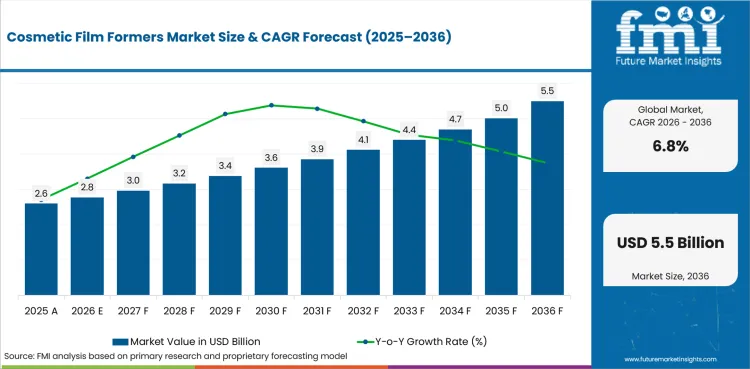
| Metric | Value |
|---|---|
| 2026 Market Size | USD 2,860.70 million |
| 2036 Market Size | USD 5,523.10 million |
| Forecast CAGR (2026-2036) | 6.8% |
| Leading Sales Channel | Direct to Brand and Formulators |
| Direct to Brand and Formulators Share (2026) | 61.0% |
| Leading Form | Liquid Dispersions |
| Liquid Dispersions Share (2026) | 52.0% |
| Fastest-growing Country | China |
| China CAGR by 2036 | 8.0% |
Summary of the Cosmetic Film Formers Market
| Market Signal | Commercial Impact |
|---|---|
| Demand and Growth Drivers | Demand for cosmetic film formers is increasing as beauty brands prioritize long-wear performance, water resistance, and improved sensory experience across color cosmetics and skincare formulations.
|
| Product and Segment View | Direct sales to formulators, liquid dispersions, and long-wear applications continue to define the leading commercial opportunities within the market.
|
| Geography and Growth Outlook | Asia continues to strengthen its position as cosmetic manufacturing and specialty ingredient demand expand across major beauty markets.
|
| Competitive Landscape | Competition centers on advanced polymer technologies, formulation expertise, and technical support for cosmetic manufacturers.
|
| Analyst Perspective | Cosmetic film formers are increasingly becoming strategic formulation ingredients as brands seek to balance wear performance, sensory appeal, and sustainability expectations.
- Nikhil Kaitwade, Principal Consultant at Future Market Insights |
Cosmetic film former demand is forecast to expand through 2036, supported by long-wear makeup and ingredient documentation needs across branded and contract-manufactured cosmetics.
Cosmetic ingredient buying now reflects documentation pressure and claim-testing discipline. FDA registration and listing material updated in April 2026 confirmed facility registration renewal every 2 years, reinforcing product listing and supplier file discipline. Personal Care Products Council reported in May 2026 that personal care products generated USD 495.6 billion in total economic output and supported more than 2.6 million jobs in 2024. Cosmetics Europe valued European cosmetics and personal care retail sales at EUR 110 billion in 2025, led by Germany at EUR 18.0 billion, United Kingdom at EUR 14.7 billion, and France at EUR 14.5 billion. Regulated beauty channels support film former demand as brands seek polymers connecting wear and compliance files.
Which factors support expansion in the Cosmetic Film Formers Market?
Finished formula performance and documentation-led supplier support shape market value across color cosmetics and skincare.
- Market value rises as long-wear makeup needs polymer films that keep pigment attached after touch and daily use.
- Sun care formulas raise polymer intensity as water resistance and UV filter distribution require tested film layers.
- Hair styling products influence steady demand through hold and lower residue feel.
- Natural-origin claims are moving spending toward bio-based film formers that can match synthetic polymer performance.
Why is the Cosmetic Film Formers Market growing?
Wear-led cosmetics and SPF-support formulas increase film former demand as brands compete on formula proof rather than ingredient claims alone.
Cosmetic film former buyers spend more on specialty polymers as color cosmetics and hair styling formulas require longer wear without tackiness or flaking. Cosmetics Europe reported more than 3.6 million jobs supported by Europe’s cosmetics and personal care industry in 2025, including more than 265,000 direct workers. Large employment across manufacturing and distribution keeps product development cycles active and raises demand for ingredients that help claims survive lab screening. Suppliers able to link polymer choice with transfer resistance and documentation gain stronger positions in brand and formulator accounts.
How is the Cosmetic Film Formers Market segmented?
Cosmetic film formers market is segmented by polymer type, application, form, function, and sales channel.
- Acrylic polymers are projected to account for 41.0% share in 2026, influenced by dependable film integrity in mascara and hair styling systems.
- Color cosmetics are expected to hold 38.0% share in 2026, shaped by pigment-binding needs and transfer-control claims across consumer-facing formats.
- Liquid dispersions are anticipated to account for 52.0% share in 2026, led by lower handling complexity and faster testing inside emulsion development.
- Long-wear and transfer resistance is projected to hold 44.0% share by Function in 2026, guided by demand for rub-off control and flexible film behavior.
- Direct to brand and formulators is expected to represent 61.0% share by Sales Channel in 2026, supported by application trials and direct technical service.
Why do Acrylic Polymers dominate the Cosmetic Film Formers Market by polymer type?
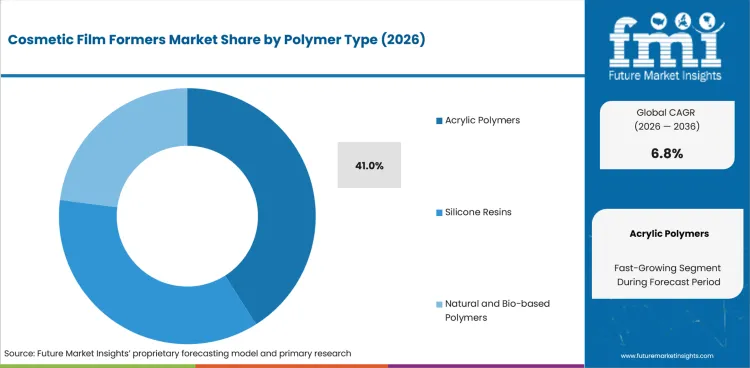
- Acrylic polymers are projected to account for 41.0% share in 2026, driven by repeatable film strength and familiar processing across makeup and hair styling lines.
- Silicone resins gain demand in premium formulas as brands seek softer feel and water resistance without a heavy surface film.
Which application leads the Cosmetic Film Formers Market?
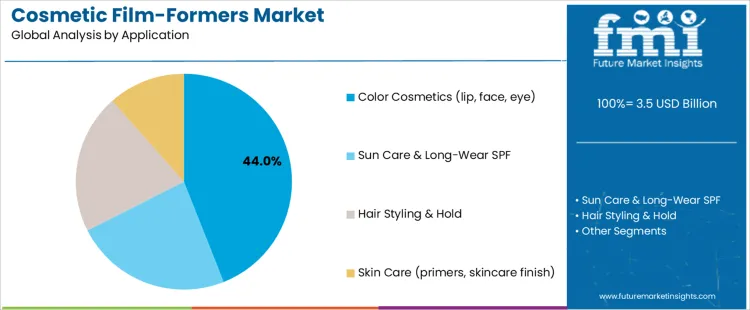
- Color cosmetics are expected to hold 38.0% share in 2026, shaped by lip and complexion products that require pigment hold and transfer resistance.
- Sun care gains use as SPF systems need uniform UV filter spread and film continuity during consumer wear.
Which form leads the Cosmetic Film Formers Market?
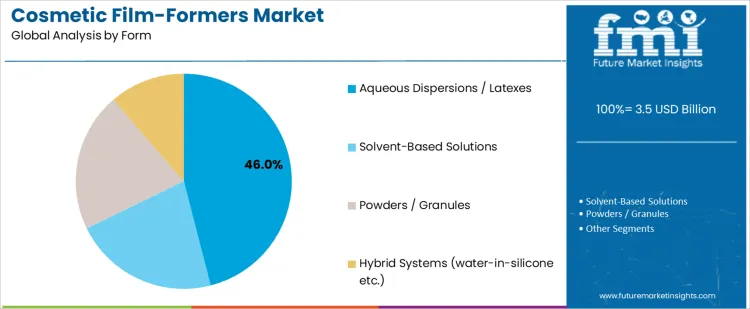
- Liquid dispersions are anticipated to hold 52.0% share in 2026, reflected by faster lab screening and simpler dispersion in water-based or emulsion formulas.
- Powders remain active in concentrated systems as formulators seek better transport economics and specific processing behavior.
Which function leads the Cosmetic Film Formers Market?
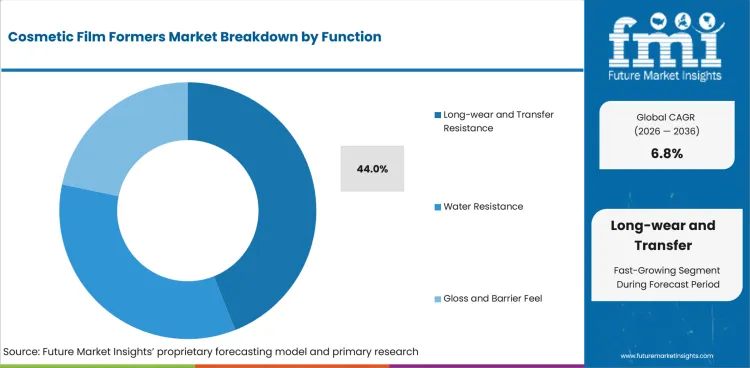
- Long-wear and transfer resistance is projected to hold 44.0% share in 2026, guided by consumer expectations for lip and complexion products that resist rub-off.
- Water resistance gains demand in sunscreen and hair styling systems as brands need film layers that protect claims after humidity or rinsing exposure.
Which sales channel leads the Cosmetic Film Formers Market?
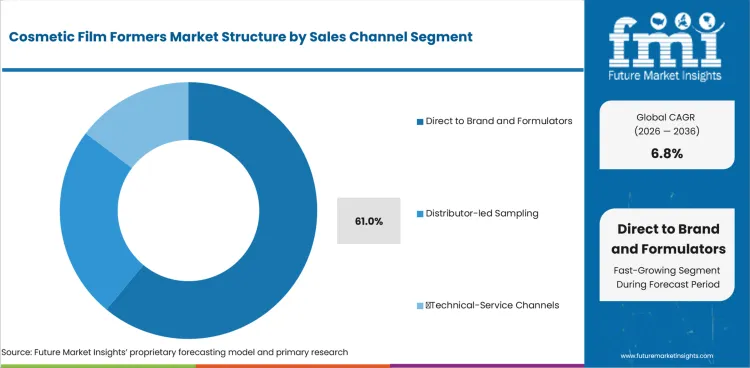
- Direct to brand and formulators is expected to represent 61.0% share in 2026, guided by buyer preference for formulation support and claim-testing data.
- Distributor-led sampling remains active among smaller brands as local stock and technical introductions shorten early screening cycles.
What are the drivers, restraints, and opportunities in the Cosmetic Film Formers Market?
Long-wear beauty claims and bio-based polymer development are shaping cosmetic film former buying decisions.
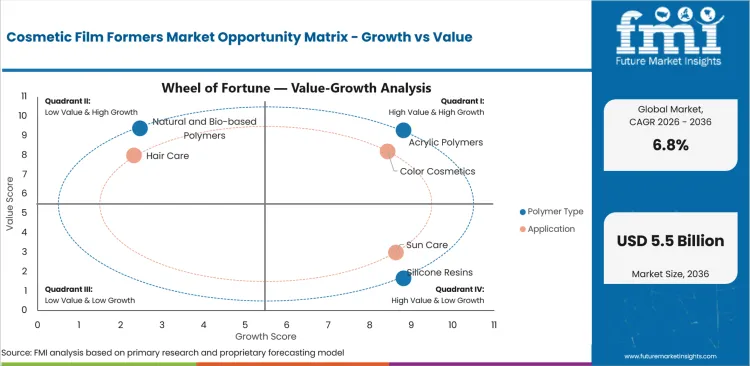
- Driver: Color cosmetics and sun care brands need film formers that support pigment hold and pleasant after-feel.
- Restraint: Synthetic polymer review can slow reformulation as buyers seek biodegradability proof and full documentation.
- Opportunity: Bio-based film formers can support premium launches as brands seek natural-origin claims without losing wear performance.
Wear-Claim Testing Strengthens Polymer Shortlisting
Long-wear formulas require polymers that pass laboratory testing and consumer-use expectations. Personal Care Products Council reported that United States personal care exports reached USD 15.8 billion in 2025, showing how brand supply chains depend on internationally accepted ingredient files and repeatable product quality. Export-led beauty portfolios need film formers that support pigment hold and stability across climates. Suppliers with application labs can convert trial work into repeat buying as brands seek proof before launch approvals.
Microplastic Rules Raise Synthetic Polymer Review Burden
Regulatory scrutiny is increasing file burden for synthetic polymer systems. European Commission microplastic rules target intentionally added synthetic polymer microparticles and apply a 0.01% concentration threshold, creating added review steps for leave-on cosmetic ingredients and claim files. Reformulation pressure can raise testing cost for acrylic and specialty polymer suppliers. Film former makers can reduce buyer hesitation through biodegradability data and documented alternatives for makeup and hair styling formulas.
Documentation-Ready Bio-Based Films Open Direct-Sales Gains
Bio-based film former suppliers gain opportunity as regulated beauty companies compare wear data, safety files, and launch timelines before switching polymers. FDA reported in 2026 that more than 14,000 cosmetic product facilities were registered, showing the scale of facility-level documentation now connected with cosmetic supply chains. Ingredient suppliers offering biodegradable films with claim evidence can support customers during listing and formula review. Direct technical teams gain renewal value when they connect natural-origin positioning with measured film performance.
Which countries are growing at higher CAGRs in the Cosmetic Film Formers Market?
China 8.0% CAGR, India 7.9% CAGR, South Korea 7.7% CAGR, United States 6.4% CAGR, United Kingdom 6.1% CAGR, Germany 6.0% CAGR, France 5.9% CAGR, and Japan 5.5% CAGR through 2036.
.webp "Top Country Growth Comparison Cosmetic Film Formers Market Cagr (2026 2036)")
| Country | CAGR |
|---|---|
| China | 8.0% |
| India | 7.9% |
| South Korea | 7.7% |
| United States | 6.4% |
| United Kingdom | 6.1% |
| Germany | 6.0% |
| France | 5.9% |
| Japan | 5.5% |
Source: Future Market Insights, 2026.
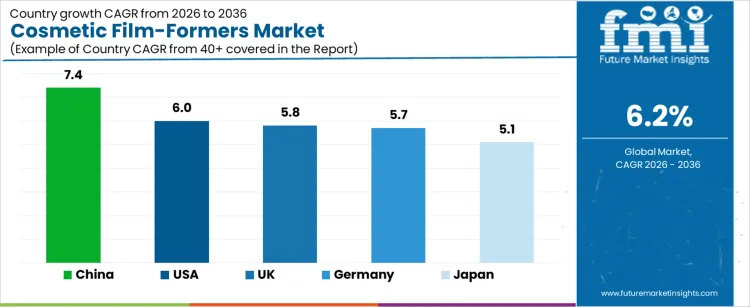
How do country-level CAGRs compare in the Cosmetic Film Formers Market?
China records the top country CAGR while Japan shows the most measured pace among profiled markets.
- China is forecast to record 8.0% CAGR by 2036 through local beauty manufacturing and specialty ingredient registration.
- India is expected to expand at 7.9% CAGR from 2026 to 2036, led by beauty e-commerce and domestic formulation activity.
- South Korea is projected to grow at 7.7% CAGR through 2036 as K-beauty exports and product cycles support film former trials.
- United States is estimated to rise at 6.4% CAGR by 2036, reflected by branded beauty scale and regulatory file discipline.
- United Kingdom is expected to advance at 6.1% CAGR over the forecast period as indie brands and contract formulators use distributor-led sampling.
- Germany is forecast to grow at 6.0% CAGR by 2036, backed by chemical manufacturing strength and premium cosmetic formulation.
- France is projected to post 5.9% CAGR by 2036, guided by luxury beauty, export orientation, and formulation support networks.
- Japan is expected to record 5.5% CAGR by 2036, driven by high-quality beauty manufacturing and mature ingredient approval practices.
What is the Cosmetic Film Formers Market outlook in China?
A 8.0% CAGR through 2036 reflects local beauty manufacturing and specialty ingredient registration activity.
Country Market Snapshot Table
| Parameter | Value |
|---|---|
| Market Size in 2025 (Value) | USD 338.6 million |
| Market Size in 2026 (Value) | USD 365.7 million |
| Market Forecast in 2036 (Value) | USD 789.6 million |
| CAGR (2026 to 2036) | 8.0% |
| Years Considered | 2021 to 2036 |
| Base Year | 2025 |
| Forecast Period | 2026 to 2036 |
| Units Considered | Value (USD million) |
| Leading Sub-Region | Yangtze River Delta and Guangdong beauty manufacturing corridors |
China Cosmetic Film Formers Market Outlook
China cosmetic film former demand comes from domestic beauty brands and local ingredient registration. Formula teams need polymers supporting sunscreen texture and hair styling claims.
Buyers are expected to favor local suppliers offering sample access, compatibility testing, and documentation support. Digital beauty retail keeps launch cycles short, pushing brands toward film former systems with faster screening paths.
Key Growth Drivers
- Beauty retail strength creates a large testing base for color cosmetics and skincare, reinforced by cosmetics retail sales of CNY 465.3 billion in 2025 among enterprises above designated size.
- Specialty ingredient activity raises supplier participation, as China’s regulator recorded more than 20,000 cosmetic registrants and filing entities by end-October 2025.
- Domestic brands need film formers that support matte lip color, mascara hold, sunscreen spread, and hair styling feel across short launch cycles.
- Local ingredient distributors gain scope as brands seek sample kits and rapid documentation support during formulation screening.
Key Restraints
- Ingredient registration work can delay new polymer launches as formula owners check safety files and composition details.
- Brand competition can compress additive budgets, making premium film former adoption harder for mass-market makeup lines.
- Reform guidance can add administrative work, as China’s cosmetics regulator released 24 reform measures across 5 policy areas for cosmetics supervision.
What makes China unique
China stands apart through specialty ingredient filings and dense beauty manufacturing corridors.
Key Companies
- Guangzhou Tinci Materials Technology
- Shanghai OLI Enterprises
- Guangdong Bason Cosmetic
- Shenzhen Readline Biotech
- Bloomage Biotech
- Guangzhou DX Chemical
- Shanghai Cosroma Biotech
Sales & Marketing Channels
- Direct technical sales to cosmetic contract manufacturers
- Distributor-led ingredient sampling for indie brands
- Application laboratory support for color cosmetics and sun care
- Online brand trial programs
- Ingredient trade fairs and formulation workshops
- Regional sample-stock distributor networks
Country Segment Breakdown Table
| Segment | Sub-Segments |
|---|---|
| By Polymer Type | Acrylic Polymers, Silicone Resins, Natural and Bio-based Polymers, Polyurethane and Other |
| By Application | Color Cosmetics, Sun Care, Hair Care, Skin Care |
| By Form | Liquid Dispersions, Powder, Emulsions |
| By Function | Long-wear and Transfer Resistance, Water Resistance, Gloss and Barrier Feel, Hold and Styling Support |
| By Sales Channel | Direct to Brand and Formulators, Distributor-led Sampling, Technical-Service Channels |
| Key Sub-Regions Covered, Beauty Manufacturing Corridors | Yangtze River Delta, Guangdong, Shanghai, Zhejiang, Jiangsu, Beijing-Tianjin-Hebei |
Frequently Asked Questions
How fast is China Cosmetic Film Formers Market growing?
Industry in China is projected to rise at 8.0% CAGR from 2026 to 2036, guided by domestic beauty manufacturing and ingredient filing activity.
Who leads China Cosmetic Film Formers Market?
Guangzhou Tinci Materials Technology, Bloomage Biotech, Shanghai OLI Enterprises, and Guangdong Bason Cosmetic compete through local ingredient supply and formulation support.
What is driving adoption in China Cosmetic Film Formers Market?
Domestic makeup launches and specialty ingredient filings are moving brands toward trial-ready film former systems.
What is the Cosmetic Film Formers Market outlook in India?
A 7.9% CAGR through 2036 reflects domestic beauty retail and fast sampling demand.
Country Market Snapshot Table
| Parameter | Value |
|---|---|
| Market Size in 2025 (Value) | USD 174.3 million |
| Market Size in 2026 (Value) | USD 188.1 million |
| Market Forecast in 2036 (Value) | USD 402.5 million |
| CAGR (2026 to 2036) | 7.9% |
| Years Considered | 2021 to 2036 |
| Base Year | 2025 |
| Forecast Period | 2026 to 2036 |
| Units Considered | Value (USD million) |
| Leading Sub-Region | West India and South India beauty manufacturing corridors |
India Cosmetic Film Formers Market Outlook
India cosmetic film former buying is influenced by local beauty launches and contract manufacturing. Formulators need polymers that support sweat resistance and hair styling durability.
Suppliers offering smaller trial lots and local technical visits are expected to gain preference. Domestic manufacturing and online beauty channels support higher testing frequency for acrylic and bio-based systems.
Key Growth Drivers
- Beauty e-commerce supports faster product testing, as value sales across beauty e-commerce and quick commerce rose 39% between June 2024 and November 2024.
- Natural and herbal positioning helps bio-based film former trials, as AYUSH and herbal product exports reached USD 688.89 million in 2024-25.
- Color cosmetics brands need sweat-resistant films for lip and complexion formats suited to warm-climate consumer use.
- Local distributors gain scope as emerging brands request starter formulas and low-volume sampling support.
Key Restraints
- Smaller brands can delay premium polymer adoption as finished formula budgets remain tight during early launch cycles.
- Testing gaps can slow switching from familiar acrylics to biodegradable systems in mascara and sunscreen.
- Laboratory approval capacity can constrain reformulation speed, as 34 state laboratories and 108 private laboratories are approved for AYUSH and herbal product testing.
What makes India unique
India differs through affordable beauty launches and distributor-led access for emerging brands.
Key Companies
- Galaxy Surfactants
- Rossari Biotech
- Kumar Organic Products
- Apple Chemie India
- Resil Chemicals
- Nikita Transphase
- Fine Organics
Sales & Marketing Channels
- Distributor-led sampling for beauty startups
- Direct technical selling to contract manufacturers
- Application support through local ingredient laboratories
- Small-pack trial supply through regional distributors
- Digital beauty brand sampling programs
- Contract-manufacturer formulation support
Country Segment Breakdown Table
| Segment | Sub-Segments |
|---|---|
| By Polymer Type | Acrylic Polymers, Silicone Resins, Natural and Bio-based Polymers, Polyurethane and Other |
| By Application | Color Cosmetics, Sun Care, Hair Care, Skin Care |
| By Form | Liquid Dispersions, Powder, Emulsions |
| By Function | Long-wear and Transfer Resistance, Water Resistance, Gloss and Barrier Feel, Hold and Styling Support |
| By Sales Channel | Direct to Brand and Formulators, Distributor-led Sampling, Technical-Service Channels |
| Key Sub-Regions Covered, Beauty Manufacturing Corridors | Maharashtra, Gujarat, Karnataka, Telangana, Tamil Nadu, Delhi NCR |
Frequently Asked Questions
How fast is India Cosmetic Film Formers Market growing?
Industry in India is projected to rise at 7.9% CAGR from 2026 to 2036, led by local beauty launches and digital beauty retail.
Who leads India Cosmetic Film Formers Market?
Galaxy Surfactants, Rossari Biotech, Kumar Organic Products, Apple Chemie India, and Resil Chemicals compete through local personal care ingredient supply.
What is driving adoption in India Cosmetic Film Formers Market?
Sweat-resistant makeup and distributor sampling are moving formulators toward acrylic and bio-based film former trials.
What is the Cosmetic Film Formers Market outlook in South Korea?
A 7.7% CAGR through 2036 reflects K-beauty exports and premium formulation work.
Country Market Snapshot Table
| Parameter | Value |
|---|---|
| Market Size in 2025 (Value) | USD 146.8 million |
| Market Size in 2026 (Value) | USD 158.1 million |
| Market Forecast in 2036 (Value) | USD 332.5 million |
| CAGR (2026 to 2036) | 7.7% |
| Years Considered | 2021 to 2036 |
| Base Year | 2025 |
| Forecast Period | 2026 to 2036 |
| Units Considered | Value (USD million) |
| Leading Sub-Region | Gyeonggi and Incheon beauty manufacturing corridors |
South Korea Cosmetic Film Formers Market Outlook
South Korea cosmetic film former demand is linked to export-led K-beauty, sunscreen innovation, and short product refresh cycles. Ingredient buyers need film systems that protect texture and claim support.
Suppliers with local technical teams are expected to gain repeat trials. Brands need polymers that can move from concept sampling to finished formula validation without long delays.
Key Growth Drivers
- Export-oriented beauty manufacturing strengthens formula testing, as cosmetics exports reached USD 11.4 billion in 2025.
- Digital beauty sales support frequent formulation refreshes, as official online shopping transaction value reached KRW 24.2904 trillion in December 2025.
- Cushion foundations and hair styling products require soft films that do not flake during wear.
- Local specialty ingredient makers gain opportunity as K-beauty brands seek fast screening and claim support.
Key Restraints
- Short product cycles can limit longer polymer validation work, especially for new bio-based systems.
- Export claims require documentation matched to destination rules, raising work for small formulation teams.
- Overseas review pressure remains high as cosmetics shipments rose 12.3% from 2024 to 2025.
What makes South Korea unique
South Korea’s advantage comes from K-beauty exports and advanced sunscreen formulation.
Key Companies
- KCI Limited
- DaebongLS
- Sunjin Beauty Science
- BioSpectrum
- SK Bioland
- CQV
- COSMAX BTI
Sales & Marketing Channels
- Direct supply to K-beauty formulators
- Technical partnerships with contract manufacturers
- Distributor sampling for export-focused indie brands
- Application workshops for sunscreen and makeup developers
- Qualified supplier programs with brand laboratories
- Local technical seminars for formulation chemists
Country Segment Breakdown Table
| Segment | Sub-Segments |
|---|---|
| By Polymer Type | Acrylic Polymers, Silicone Resins, Natural and Bio-based Polymers, Polyurethane and Other |
| By Application | Color Cosmetics, Sun Care, Hair Care, Skin Care |
| By Form | Liquid Dispersions, Powder, Emulsions |
| By Function | Long-wear and Transfer Resistance, Water Resistance, Gloss and Barrier Feel, Hold and Styling Support |
| By Sales Channel | Direct to Brand and Formulators, Distributor-led Sampling, Technical-Service Channels |
| Key Sub-Regions Covered, Beauty Manufacturing Corridors | Gyeonggi, Incheon, Seoul, Chungcheong, Busan, Daegu |
Frequently Asked Questions
How fast is South Korea Cosmetic Film Formers Market growing?
Industry in South Korea is projected to rise at 7.7% CAGR from 2026 to 2036, supported by export-led K-beauty and short launch cycles.
Who leads South Korea Cosmetic Film Formers Market?
KCI Limited, DaebongLS, Sunjin Beauty Science, BioSpectrum, and SK Bioland compete through local ingredient manufacturing and cosmetic formulation access.
What is driving adoption in South Korea Cosmetic Film Formers Market?
Sunscreen textures and export documentation are moving K-beauty formulators toward performance-tested film systems.
What is the Cosmetic Film Formers Market outlook in the United States?
A 6.4% CAGR through 2036 reflects branded beauty scale and performance-led formulation.
Country Market Snapshot Table
| Parameter | Value |
|---|---|
| Market Size in 2025 (Value) | USD 617.2 million |
| Market Size in 2026 (Value) | USD 656.7 million |
| Market Forecast in 2036 (Value) | USD 1,220.7 million |
| CAGR (2026 to 2036) | 6.4% |
| Years Considered | 2021 to 2036 |
| Base Year | 2025 |
| Forecast Period | 2026 to 2036 |
| Units Considered | Value (USD million) |
| Leading Sub-Region | Northeast personal care and Southern contract manufacturing corridors |
United States Cosmetic Film Formers Market Outlook
United States demand for cosmetic film formers reflects branded beauty scale and claim-support needs. Suppliers need strong formulation files for long-wear makeup and hair styling systems.
Buyers are expected to favor polymer suppliers combining application labs with documentation support. Compliance routines strengthen demand for direct technical channels.
Key Growth Drivers
- Personal care manufacturing scale supports ingredient demand, as industry output reached USD 495.6 billion in 2024 across total economic contribution.
- Export activity supports globally accepted formulation files, with personal care exports reaching USD 15.8 billion in 2025.
- Long-wear lip, eye, and complexion formats require flexible films that resist transfer without tacky residue.
- Indie brands create distributor demand for sample kits and starter formulation guidance.
Key Restraints
- Compliance files can slow smaller brand launches as ingredient records and listing work need review.
- Premium polymers face price pressure in mass-market formulas that rely on familiar acrylic or PVP-style systems.
- Facility renewal work raises administrative pressure, as FDA reported more than 14,000 registered cosmetic product facilities in 2026.
What makes the United States unique
United States demand is distinguished by branded beauty scale and formal cosmetic listing discipline.
Key Companies
- Ashland
- Dow
- Lubrizol
- Momentive
- Grant Industries
- Kobo Products
- MakingCosmetics
Sales & Marketing Channels
- Direct brand and formulator selling
- Distributor sample kits for indie beauty brands
- Technical-service support for claim testing
- Contract manufacturer support programs
- Regulatory documentation support
- Beauty trade show sampling
Country Segment Breakdown Table
| Segment | Sub-Segments |
|---|---|
| By Polymer Type | Acrylic Polymers, Silicone Resins, Natural and Bio-based Polymers, Polyurethane and Other |
| By Application | Color Cosmetics, Sun Care, Hair Care, Skin Care |
| By Form | Liquid Dispersions, Powder, Emulsions |
| By Function | Long-wear and Transfer Resistance, Water Resistance, Gloss and Barrier Feel, Hold and Styling Support |
| By Sales Channel | Direct to Brand and Formulators, Distributor-led Sampling, Technical-Service Channels |
| Key Sub-Regions Covered, Beauty Manufacturing Corridors | New Jersey, New York, California, Texas, Ohio, North Carolina |
Frequently Asked Questions
How fast is United States Cosmetic Film Formers Market growing?
Industry in the United States is projected to rise at 6.4% CAGR from 2026 to 2036, led by branded beauty scale and MoCRA-related documentation routines.
Who leads United States Cosmetic Film Formers Market?
Ashland, Dow, Lubrizol, Momentive, Grant Industries, and Kobo Products compete through domestic formulation support and personal care ingredient supply.
What is driving adoption in United States Cosmetic Film Formers Market?
Long-wear beauty claims, sunscreen testing and formal listing work are moving brands toward supplier-backed polymer systems.
How is the Cosmetic Film Formers Market performing in the United Kingdom?
A 6.1% CAGR through 2036 reflects distributor-led sampling and product notification discipline.
Country Market Snapshot Table
| Parameter | Value |
|---|---|
| Market Size in 2025 (Value) | USD 195.3 million |
| Market Size in 2026 (Value) | USD 207.2 million |
| Market Forecast in 2036 (Value) | USD 374.5 million |
| CAGR (2026 to 2036) | 6.1% |
| Years Considered | 2021 to 2036 |
| Base Year | 2025 |
| Forecast Period | 2026 to 2036 |
| Units Considered | Value (USD million) |
| Leading Sub-Region | Yorkshire, Humber, and southern formulation corridors |
United Kingdom Cosmetic Film Formers Market Outlook
United Kingdom cosmetic film former demand benefits from indie beauty brands and contract formulation. Buyers need polymers that support water resistance and clean documentation.
Local distributors are expected to retain influence in early-stage sampling. Direct supplier support remains important for brands scaling beyond domestic retail.
Key Growth Drivers
- Beauty retail scale supports film former trials, reflected by United Kingdom cosmetics and personal care retail sales of EUR 14.7 billion in 2025.
- Personal care economic activity supports contract formulation demand, as beauty’s GDP contribution reached GBP 30.4 billion in 2024.
- Color cosmetics and sun care brands need film systems that balance wear and ingredient positioning.
- Distributor-led sampling helps smaller brands test acrylic and bio-based systems before production.
Key Restraints
- Indie brands can delay premium polymer adoption as testing and packaging work raise launch complexity.
- Smaller formulation teams may rely on familiar systems rather than testing new biodegradable options.
- Beauty sector labor and cost pressure can affect product development budgets, as national beauty employment is placed near 500,000 workers.
What makes the United Kingdom unique
United Kingdom demand has a distinct distributor culture and contract-formulation base.
Key Companies
- Croda
- Surfachem
- Lake Personal Care
- Stephenson
- Cornelius Group
- O&3
- Aston Chemicals
Sales & Marketing Channels
- Distributor-led ingredient sampling
- Direct selling to contract formulators
- Technical-service support for indie beauty launches
- Beauty ingredient seminars
- Local sample-stock programs
- Dual-market documentation support
Country Segment Breakdown Table
| Segment | Sub-Segments |
|---|---|
| By Polymer Type | Acrylic Polymers, Silicone Resins, Natural and Bio-based Polymers, Polyurethane and Other |
| By Application | Color Cosmetics, Sun Care, Hair Care, Skin Care |
| By Form | Liquid Dispersions, Powder, Emulsions |
| By Function | Long-wear and Transfer Resistance, Water Resistance, Gloss and Barrier Feel, Hold and Styling Support |
| By Sales Channel | Direct to Brand and Formulators, Distributor-led Sampling, Technical-Service Channels |
| Key Sub-Regions Covered, Beauty Manufacturing Corridors | Yorkshire, Humber, London, South East, North West, Midlands |
Frequently Asked Questions
How fast is United Kingdom Cosmetic Film Formers Market growing?
Industry in the United Kingdom is projected to rise at 6.1% CAGR from 2026 to 2036, supported by indie beauty and contract formulation.
Who leads United Kingdom Cosmetic Film Formers Market?
Croda, Surfachem, Lake Personal Care, Stephenson, Cornelius Group, and Aston Chemicals compete through local ingredient supply and formulation access.
What is driving adoption in United Kingdom Cosmetic Film Formers Market?
Indie beauty sampling and premium color cosmetics are moving brands toward distributor-supported film former trials.
How is the Cosmetic Film Formers Market developing in Germany?
A 6.0% CAGR through 2036 reflects specialty chemistry strength and regulated formulation work.
Country Market Snapshot Table
| Parameter | Value |
|---|---|
| Market Size in 2025 (Value) | USD 268.9 million |
| Market Size in 2026 (Value) | USD 285.0 million |
| Market Forecast in 2036 (Value) | USD 510.4 million |
| CAGR (2026 to 2036) | 6.0% |
| Years Considered | 2021 to 2036 |
| Base Year | 2025 |
| Forecast Period | 2026 to 2036 |
| Units Considered | Value (USD million) |
| Leading Sub-Region | Rhine-Ruhr, Hamburg, and Bavaria chemical corridors |
Germany Cosmetic Film Formers Market Outlook
Germany cosmetic film former demand draws on specialty chemical manufacturing, premium skin care, and hair styling innovation. Local suppliers combine polymer science with formulation support.
Buyers are expected to emphasize compliance files and sustainable ingredients. Bio-based film formers will gain attention as formulators seek lower residue and improved biodegradability.
Key Growth Drivers
- Germany remains a major European beauty market, with cosmetics and personal care retail sales valued at EUR 18.0 billion in 2025.
- Beauty and home care sales reached EUR 35.6 billion in 2025, supporting ingredient demand across local and export-oriented manufacturers.
- Premium hair styling and skin care formulas need film formers that maintain texture and pleasant feel.
- Specialty chemical producers support local adoption through application labs and direct technical service.
Key Restraints
- Regulatory review of synthetic polymer particles can slow approval of familiar film-forming systems.
- High energy and labor costs can make brands cautious about extensive reformulation work.
- Foreign sales of German beauty and home care products declined 2.1% in 2025, limiting some export-led launch budgets.
What makes Germany unique
Germany’s market identity rests on specialty chemistry and premium beauty formulation.
Key Companies
- BASF
- Evonik
- Wacker Chemie
- Symrise
- KahlWax
- CLR Berlin
- Beiersdorf Manufacturing
Sales & Marketing Channels
- Direct technical selling to personal care manufacturers
- Distributor support for specialty ingredient trials
- Application laboratory services for hair care and skin care
- Supplier-led performance workshops
- Compliance documentation programs
- Chemical distributor sample networks
Country Segment Breakdown Table
| Segment | Sub-Segments |
|---|---|
| By Polymer Type | Acrylic Polymers, Silicone Resins, Natural and Bio-based Polymers, Polyurethane and Other |
| By Application | Color Cosmetics, Sun Care, Hair Care, Skin Care |
| By Form | Liquid Dispersions, Powder, Emulsions |
| By Function | Long-wear and Transfer Resistance, Water Resistance, Gloss and Barrier Feel, Hold and Styling Support |
| By Sales Channel | Direct to Brand and Formulators, Distributor-led Sampling, Technical-Service Channels |
| Key Sub-Regions Covered, Beauty Manufacturing Corridors | North Rhine-Westphalia, Hamburg, Bavaria, Baden-Württemberg, Hesse, Saxony |
Frequently Asked Questions
How fast is Germany Cosmetic Film Formers Market growing?
Industry in Germany is projected to rise at 6.0% CAGR from 2026 to 2036, backed by specialty chemistry and premium beauty formulation.
Who leads Germany Cosmetic Film Formers Market?
BASF, Evonik, Wacker Chemie, Symrise, KahlWax, and CLR Berlin compete through domestic ingredient manufacturing and application support.
What is driving adoption in Germany Cosmetic Film Formers Market?
Bio-based hair styling and technical documentation are moving German formulators toward higher-performance film systems.
How is the Cosmetic Film Formers Market performing in France?
A 5.9% CAGR through 2036 reflects luxury beauty and high-performance cosmetic ingredients.
Country Market Snapshot Table
| Parameter | Value |
|---|---|
| Market Size in 2025 (Value) | USD 225.7 million |
| Market Size in 2026 (Value) | USD 239.0 million |
| Market Forecast in 2036 (Value) | USD 424.0 million |
| CAGR (2026 to 2036) | 5.9% |
| Years Considered | 2021 to 2036 |
| Base Year | 2025 |
| Forecast Period | 2026 to 2036 |
| Units Considered | Value (USD million) |
| Leading Sub-Region | Cosmetic Valley, Normandy, and Auvergne-Rhône-Alpes corridors |
France Cosmetic Film Formers Market Outlook
France cosmetic film former demand reflects luxury beauty and sensory-focused skincare. Suppliers need polymers that protect claim quality while supporting texture expectations.
Buyers are expected to favor local suppliers with documentation and formulation support. Premium brands require film formers that perform without compromising sensory profile.
Key Growth Drivers
- French beauty scale supports ingredient trials, with cosmetics industry turnover reaching EUR 35.6 billion in 2024.
- Export orientation strengthens claim-ready formulation demand, as cosmetics exports exceeded EUR 22.5 billion in 2024.
- Luxury color cosmetics need soft films that improve wear without stiffness or whitening.
- Local ingredient specialists gain scope through sensory testing and brand technical support.
Key Restraints
- Premium formulation teams may slow new polymer adoption until biodegradability and claim files are complete.
- Export conditions can reduce launch confidence in smaller brands and contract manufacturers.
- Industry survey pressure was evident as around 50% of French cosmetics executives reported project or investment delays in early 2025.
What makes France unique
France is differentiated by luxury beauty standards and specialist ingredient suppliers.
Key Companies
- Seppic
- Gattefossé
- Roquette Beauté
- Solabia Group
- Stéarinerie Dubois
- SNF
- Lessonia
Sales & Marketing Channels
- Direct technical selling to luxury beauty formulators
- Specialty distributor support for indie brands
- Application trials through local ingredient laboratories
- Sensory testing workshops
- Natural-origin formulation concepts
- Export documentation support
Country Segment Breakdown Table
| Segment | Sub-Segments |
|---|---|
| By Polymer Type | Acrylic Polymers, Silicone Resins, Natural and Bio-based Polymers, Polyurethane and Other |
| By Application | Color Cosmetics, Sun Care, Hair Care, Skin Care |
| By Form | Liquid Dispersions, Powder, Emulsions |
| By Function | Long-wear and Transfer Resistance, Water Resistance, Gloss and Barrier Feel, Hold and Styling Support |
| By Sales Channel | Direct to Brand and Formulators, Distributor-led Sampling, Technical-Service Channels |
| Key Sub-Regions Covered, Beauty Manufacturing Corridors | Cosmetic Valley, Normandy, Auvergne-Rhône-Alpes, Île-de-France, Provence-Alpes-Côte d’Azur, Grand Est |
Frequently Asked Questions
How fast is France Cosmetic Film Formers Market growing?
Industry in France is projected to rise at 5.9% CAGR from 2026 to 2036, supported by luxury beauty and export-oriented formulation.
Who leads France Cosmetic Film Formers Market?
Seppic, Gattefossé, Roquette Beauté, Solabia Group, Stéarinerie Dubois, and SNF compete through local personal care ingredient portfolios.
What is driving adoption in France Cosmetic Film Formers Market?
Luxury makeup wear claims and natural-origin ingredient positioning are moving brands toward premium film former trials.
How is the Cosmetic Film Formers Market performing in Japan?
A 5.5% CAGR through 2036 reflects mature beauty manufacturing and disciplined ingredient approval.
Country Market Snapshot Table
| Parameter | Value |
|---|---|
| Market Size in 2025 (Value) | USD 210.6 million |
| Market Size in 2026 (Value) | USD 222.2 million |
| Market Forecast in 2036 (Value) | USD 379.6 million |
| CAGR (2026 to 2036) | 5.5% |
| Years Considered | 2021 to 2036 |
| Base Year | 2025 |
| Forecast Period | 2026 to 2036 |
| Units Considered | Value (USD million) |
| Leading Sub-Region | Kanto and Kansai cosmetic manufacturing corridors |
Japan Cosmetic Film Formers Market Outlook
Japan cosmetic film former demand follows mature skincare, premium makeup, and careful sensory formulation. Suppliers need polymers that deliver wear without residue or discomfort.
Buyers are expected to prioritize proven safety files and formulation reliability. Local ingredient producers gain share through close technical contact with brand laboratories.
Key Growth Drivers
- Cosmetic shipments support ingredient use across skin care and makeup, as domestic shipments reached JPY 1,302.4 billion in 2023 in statistics published in 2024.
- Ingredient color and formula discipline remain tight, shown by 83 permitted tar colors and 20 voluntarily restricted colors in industry standards.
- Premium foundations and sunscreens need flexible film systems that maintain feel after drying.
- Local suppliers gain scope through technical support suited to high-sensory and high-stability formulas.
Key Restraints
- Mature beauty demand can make polymer switching gradual as brands avoid sensory risk in established formulas.
- Strict ingredient quality expectations raise testing burden for unfamiliar bio-based or specialty film formers.
- License oversight adds supplier discipline, as 4,243 marketing license holders and 4,222 manufacturing license holders were recorded by industry statistics.
What makes Japan unique
Japan’s demand profile reflects sensory precision and disciplined cosmetic approval practices.
Key Companies
- Shin-Etsu Chemical
- Daito Kasei Kogyo
- Nikko Chemicals
- Ajinomoto
- Tayca
- Kobo Products Japan
- Nippon Fine Chemical
Sales & Marketing Channels
- Direct technical selling to cosmetic manufacturers
- Specialty distributor support for premium brands
- Application testing for sunscreen, makeup, and hair care
- Local-language documentation support
- Qualified supplier programs
- Lab-backed sampling for sensory evaluation
Country Segment Breakdown Table
| Segment | Sub-Segments |
|---|---|
| By Polymer Type | Acrylic Polymers, Silicone Resins, Natural and Bio-based Polymers, Polyurethane and Other |
| By Application | Color Cosmetics, Sun Care, Hair Care, Skin Care |
| By Form | Liquid Dispersions, Powder, Emulsions |
| By Function | Long-wear and Transfer Resistance, Water Resistance, Gloss and Barrier Feel, Hold and Styling Support |
| By Sales Channel | Direct to Brand and Formulators, Distributor-led Sampling, Technical-Service Channels |
| Key Sub-Regions Covered, Beauty Manufacturing Corridors | Kanto, Kansai, Chubu, Kyushu, Tohoku, Shikoku |
Frequently Asked Questions
How fast is Japan Cosmetic Film Formers Market growing?
Industry in Japan is projected to rise at 5.5% CAGR from 2026 to 2036, led by premium beauty formats and strict sensory validation.
Who leads Japan Cosmetic Film Formers Market?
Shin-Etsu Chemical, Daito Kasei Kogyo, Nikko Chemicals, Ajinomoto, Tayca, and Nippon Fine Chemical compete through domestic ingredient expertise.
What is driving adoption in Japan Cosmetic Film Formers Market?
Premium sunscreen and local safety expectations are moving formulators toward proven film former systems.
Who are the leading companies in the Cosmetic Film Formers Market?
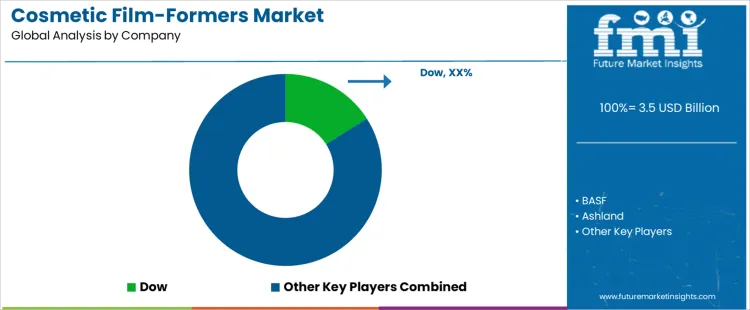
Dow, Ashland, BASF, Evonik and Momentive.
- Established specialty ingredient suppliers hold an advantage through application labs and tested polymer portfolios.
- Silicone and acrylic suppliers gain acceptance by connecting film strength with sensory profile and water resistance.
- Regional ingredient companies win in country markets by offering local sample access and formulation visits.
- Documentation-ready suppliers improve renewal chances led by safety files and claim-testing evidence.
Cosmetic ingredient companies compete by combining film-forming materials and application support. Dow has a strong position depending on acrylic and silicone-linked personal care materials. Ashland competes through film-forming polymers for sun care and color cosmetics. BASF has deep natural-based and synthetic personal care ingredient capability across Europe and global markets.
Formulation support and documentation have become stronger competitive separators as beauty brands move beyond catalogue ingredient selection. Evonik and Croda compete based on bio-based film formers and SPF-support materials. Momentive and Wacker Chemie compete on silicone systems for feel, gloss, and water resistance. Lubrizol, Nouryon, and Seppic strengthen competition through polymer depth and technical support.
Smaller and regional suppliers can win through local formulation knowledge and sample delivery. China, India, and South Korea create opportunities for suppliers with application laboratories and local service teams. United States and Europe create stronger demand for compliance documentation and technical validation. Companies proving film performance in sunscreen and styling mousse formulas should gain more durable supplier relationships.
How do top Cosmetic Film Formers companies compare?
Dow and Ashland score high on film performance depth while BASF leads through natural-based polymer innovation and application capability.
| Company | Relevance to Market Title | Film Performance Depth | Cosmetic Formulation Support | Documentation Strength | Channel Reach | Geographic Footprint |
|---|---|---|---|---|---|---|
| Dow | Very High | Very Strong | Very Strong | Strong | Very Strong | Global |
| Ashland | Very High | Very Strong | Very Strong | Very Strong | Strong | Global |
| BASF | Very High | Very Strong | Very Strong | Very Strong | Very Strong | Global |
| Evonik | High | Strong | Very Strong | Strong | Strong | Global |
| Momentive | High | Very Strong | Strong | Strong | Strong | Global |
| Wacker Chemie | High | Very Strong | Strong | Strong | Strong | Global |
| Lubrizol | High | Strong | Very Strong | Strong | Strong | Global |
| Nouryon | Moderate to High | Strong | Strong | Moderate | Strong | Global |
| Seppic | Moderate to High | Strong | Very Strong | Strong | Moderate | Europe and Asia |
| Croda | High | Strong | Very Strong | Strong | Strong | Global |
Source: Future Market Insights competitive analysis, 2026.
Who are the key players in the Cosmetic Film Formers Market?
Dow, Ashland and BASF are listed with Evonik and Momentive among other suppliers.
Key global companies leading the Cosmetic Film Formers Market include:
- Dow
- Ashland
- BASF
- Evonik
- Momentive
- Wacker Chemie
- Lubrizol
- Nouryon
- Seppic
- Croda
Key Developments in Cosmetic Film Formers Market
- In May 2024, Ashland showcased Antaron soja glyceride as a nature-derived biodegradable film former for more natural sun care, lotions, gels, and color cosmetics.
- In April 2025, BASF launched Verdessence Maize as a plant-based styling ingredient and readily biodegradable alternative to PVP and VP/VA polymers.
- In November 2025, Croda released Crodabond CSN sun care data showing SPF and UVA protection improvement of up to 111% through film formation and UV filter distribution.
Key Players in the Cosmetic Film Formers Market
Performance Polymer Suppliers
- Dow
- Ashland
- BASF
- Evonik
Silicone and Sensory Specialists
- Momentive
- Wacker Chemie
- Shin-Etsu Chemical
- Grant Industries
Bio-based and Formulation Specialists
- Croda
- Seppic
- Gattefossé
- Roquette Beauté
Regional Ingredient and Distributor Companies
- Galaxy Surfactants
- KCI Limited
- Surfachem
- Daito Kasei Kogyo
Cosmetic Film Formers Market - Report Scope
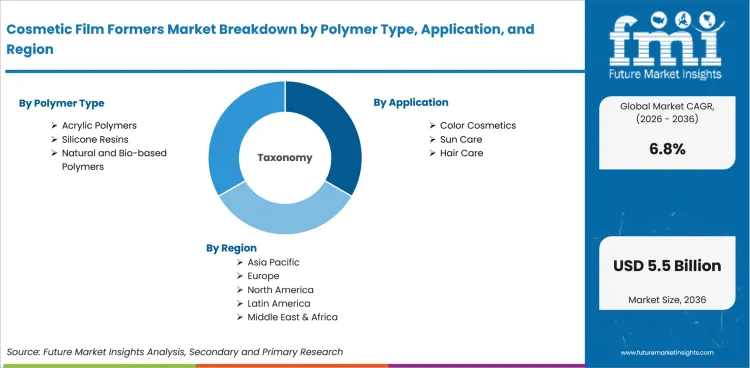
| Parameter | Details |
|---|---|
| Forecast period | 2026 to 2036 |
| Historical period | 2021 to 2025 |
| Quantitative unit | Revenue in USD million |
| By polymer type | Acrylic polymers, silicone resins, natural and bio-based polymers, polyurethane and other |
| By application | Color cosmetics, sun care, hair care, skin care |
| By form | Liquid dispersions, powder, emulsions |
| By function | Long-wear and transfer resistance, water resistance, gloss and barrier feel, hold and styling support |
| By sales channel | Direct to brand and formulators, distributor-led sampling, technical-service channels |
| Regions covered | North America, Latin America, Europe, East Asia, South Asia and Pacific, Middle East and Africa |
| Countries covered | China, India, South Korea, United States, United Kingdom, Germany, France, Japan |
| Key companies profiled | Dow, Ashland, BASF, Evonik, Momentive, Wacker Chemie, Lubrizol, Nouryon, Seppic, Croda |
| Approach | Bottom-up ingredient consumption approach using formula adoption, use-rate assumptions, application mix, sales-channel share, and country-level beauty manufacturing exposure |
Source: Future Market Insights competitive analysis, 2026.
Cosmetic Film Formers Market - Scope & Definition
| Attribute | Detail |
|---|---|
| Market Definition | Consumable cosmetic-grade polymers and resins used in beauty formulations to create thin films on skin, hair, lips, nails, or product surfaces after application |
| Functions Covered | Pigment binding, transfer resistance, water resistance, gloss control, barrier feel, styling hold, curl retention, texture support, and UV filter spread support |
| Applications Covered | Color cosmetics, sun care, hair care, skin care, and related beauty formulations using film-forming ingredients |
| End-Use Industries | Cosmetic brands, contract manufacturers, personal care formulators, ingredient distributors, and specialty beauty ingredient suppliers |
| Grades Covered | Acrylic polymer dispersions, silicone resin systems, natural and bio-based polymers, polyurethane systems, powder grades, liquid dispersions, and emulsions |
| Inclusions | All commercially traded cosmetic film-forming ingredients across polymer type, application, form, function, sales channel, and country-level cosmetic use |
| Exclusions | Finished cosmetic products sold to consumers, pharmaceutical tablet coatings, industrial coating resins, packaging barrier films, medical wound films, paint binders, and non-cosmetic adhesives |
Cosmetic Film Formers Market - Research Methodology
| Method | Description |
|---|---|
| Primary Research | FMI analyst interviews with cosmetic ingredient buyers, formulation chemists, distributors, application laboratory teams, contract manufacturers, and technical sales specialists across selected markets |
| Desk Research | Review of cosmetic ingredient portfolios, regulator materials, official beauty industry statistics, company product disclosures, association reports, product literature, and public formulation evidence |
| Market Sizing & Forecasting | Bottom-up ingredient consumption approach using formula adoption, use-rate assumptions, polymer family pricing, application mix, sales channel split, and country-level beauty manufacturing exposure |
| Data Validation | Cross-verification using company portfolios, official cosmetic trade data, regional beauty activity, product launch evidence, and parent personal care ingredient demand checks |
Cosmetic Film Formers Market Breakdown by Polymer Type, Application, Form, Function, Sales Channel, and Region
Cosmetic Film Formers Market Segmented by Polymer Type
- Acrylic Polymers
- Silicone Resins
- Natural and Bio-based Polymers
- Polyurethane and Other
Cosmetic Film Formers Market Segmented by Application
- Color Cosmetics
- Sun Care
- Hair Care
- Skin Care
Cosmetic Film Formers Market Segmented by Form
- Liquid Dispersions
- Powder
- Emulsions
Cosmetic Film Formers Market Segmented by Function
- Long-wear and Transfer Resistance
- Water Resistance
- Gloss and Barrier Feel
- Hold and Styling Support
Cosmetic Film Formers Market Segmented by Sales Channel
- Direct to Brand and Formulators
- Distributor-led Sampling
- Technical-Service Channels
Cosmetic Film Formers Market by Region
- North America
- Latin America
- Europe
- East Asia
- South Asia and Pacific
- Middle East and Africa
Research Sources and Bibliography
- Ashland Inc. (2024, May). Ashland showcases innovative platform technologies and breakthrough personal care ingredients at NYSCC Suppliers’ Day 2024 in New York City.
- BASF. (2025, April). BASF launches natural-based innovations for personal care at in-cosmetics Global 2025.
- British Beauty Council. (2025, July). Value of Beauty 2025: Beauty sector’s GDP contribution outpaces UK economy.
- Cosmetics Europe. (2025). Our industry: Economic value of cosmetics and personal care products.
- Croda. (2025, November). Effective SPF boosting for high performance sun care.
- European Commission. (2025, July). Commission Regulation restriction of microplastics intentionally added to products.
- Evonik. (2026, April). In-cosmetics Global 2026: Evonik brings new beauty identity to life with innovation world.
- FDA. (2026, April). Registration and listing of cosmetic product facilities and products.
- FDA. (2026). FDA updates web portal and informational materials to help cosmetic facilities prepare for biennial registration renewal.
- FEBEA. (2025, June). Beauty industry package: FEBEA’s priorities for a competitive and sustainable cosmetics industry.
- German Cosmetic, Toiletry, Perfumery and Detergent Association. (2025, December). Market data: Renewed growth for the beauty and home care industry.
- India Brand Equity Foundation. (2025, February). India, you e-beauty! The blush-and-glow of the new billion-dollar boom.
- India Brand Equity Foundation. (2026). AYUSH industry in India: Growth, market size and opportunities.
- Japan Cosmetic Industry Association. (2024, September). The list of JCIA standards for tar colors.
- Japan Cosmetic Industry Association. (2024, October). Cosmetic shipments.
- Japan Cosmetic Industry Association. (2024, October). Marketing license holders and manufacturing license holders by prefecture.
- Korea.net. (2026, January). Cosmetics exports hit record USD 11.4 billion in 2025.
- Korea.net. (2026, May). Cosmetics surplus breaks USD 10 billion, exports ranked second worldwide.
- Ministry of Data and Statistics, Republic of Korea. (2026). Online shopping transaction survey: December 2025.
- National Bureau of Statistics of China. (2026, January). Total retail sales of consumer goods in December 2025.
- National Medical Products Administration. (2025, December). Policy interpretation of opinions on deepening reform of cosmetics regulation to promote high-quality development of the cosmetics industry.
- Personal Care Products Council. (2026, May). USA personal care products industry drives nearly USD 500 billion in economic output, supports more than 2.6 million jobs.
- Personal Care Products Council. (2026). 2026 economic and social contributions report.
- Submit Cosmetic Product Notification Service. (2025). Submit cosmetic product notifications.
This bibliography is provided for reader reference and is not exhaustive. The full report contains the complete reference list and detailed citations.
This Report Answers
- Market size estimates for 2026 and forecasts through 2036 for the Cosmetic Film Formers Market.
- Insights across regional and country-level cosmetic ingredient markets.
- Analysis of demand drivers and purchasing behavior.
- Evaluation of polymer types, applications, forms, functions, and sales channels.
- Assessment of long-wear makeup and skincare impacts.
- Identification of opportunities across acrylic and polyurethane film formers.
- Evaluation of direct selling and technical-service channels.
- Country-level analysis covering China, India, South Korea, United States, United Kingdom, Germany, France, and Japan.
- Assessment of competition, including leading cosmetic ingredient suppliers and formulation-support companies.
- Analysis of brand-level decision drivers and claim-testing criteria.
- Regional outlooks across North America, Europe, East Asia, South Asia and Pacific, Latin America, and Middle East and Africa.
- Delivery of market data, forecasts, and supporting analysis in report-ready format.
Frequently Asked Questions
What is the growth prospect for cosmetic film formers?
Demand for cosmetic film formers is expected to rise as brands shift toward long-wear makeup and sensory-led formulas.
Which companies are expected to shape the Cosmetic Film Formers Market?
Dow, Ashland, BASF, Evonik, Momentive, Wacker Chemie, Lubrizol, Nouryon, Seppic, and Croda are expected to shape market competition through polymer portfolios and application support.
Why are beauty ingredient companies investing in cosmetic film formers?
Beauty ingredient companies are investing in cosmetic film formers to support transfer resistance and natural-origin positioning.
Why are direct sales channels important in the Cosmetic Film Formers Market?
Direct sales channels support formulation trials and claim-testing work across brand and contract manufacturer accounts.
Which polymer formats are gaining attention in cosmetic film formers?
Natural and bio-based polymers are gaining attention as brands seek biodegradability and natural-origin claims without losing wear performance.
How do regulations influence cosmetic film former demand?
Regulations influence demand through product listing, ingredient documentation and claim-support requirements.
Why are liquid dispersions important for cosmetic film formers?
Liquid dispersions are important as labs can screen them quickly inside emulsions and color cosmetics.
What role does Direct to Brand and Formulators play in cosmetic film former adoption?
Direct to Brand and Formulators supports adoption by combining ingredient supply with formulation support and performance testing.
Preview the report firsthand - request a free sample
Get SampleGet the brochure for pricing and purchase details.
Get PDFTable of Content
- Key Takeaways
- Market Size and CAGR
- Top Growth Driver
- Fastest Growing Segment
- Leading Region
- Key Companies
- Emerging Opportunities
- Executive Summary
- Global Market Outlook
- Demand-side Trends
- Supply-side Trends
- Technology Roadmap Analysis
- Analysis and Recommendations
- Analyst Perspective (What is happening? Why now? What should investors know?)
- Key Questions Answered
- How large is the market?
- What is the CAGR?
- What are key trends?
- Which region dominates?
- Who are the leaders?
- Market Overview
- Market Coverage / Taxonomy
- Market Definition / Scope / Limitations
- Research Methodology
- Chapter Orientation
- Analytical Lens and Working Hypotheses
- Market Structure, Signals, and Trend Drivers
- Benchmarking and Cross-market Comparability
- Market Sizing, Forecasting, and Opportunity Mapping
- Research Design and Evidence Framework
- Desk Research Programme (Secondary Evidence)
- Expert Input and Fieldwork (Primary Evidence)
- Tooling, Models, and Reference Databases
- Data Engineering and Model Build
- Quality Assurance and Audit Trail
- Market Background
- Market Dynamics (Drivers, Restraints, Opportunity, Trends)
- Scenario Forecast (Optimistic, Likely, Conservative)
- Impact Analysis
- AI Impact
- Sustainability Impact
- Regulatory Impact
- Technology Impact
- Consumer / Buyer Analysis
- Purchase Drivers
- Adoption Barriers
- Buyer Journey
- Opportunity Map Analysis
- Product Life Cycle Analysis
- Supply Chain Analysis
- Investment Feasibility Matrix
- Value Chain Analysis
- PESTLE and Porter's Analysis
- Regulatory Landscape
- Regional Parent Market Outlook
- Production and Consumption Statistics
- Import and Export Statistics
- Global Market Analysis and Forecast, 2021 to 2036
- Historical Market Size Value (USD Million) Analysis, 2021 to 2025
- Current and Future Market Size Value (USD Million) Projections, 2026 to 2036
- Y-o-Y Growth Trend Analysis
- Absolute $ Opportunity Analysis
- Global Market Pricing Analysis, 2021 to 2036
- Global Market Analysis and Forecast, By Polymer Type, 2021 to 2036
- Introduction / Key Findings
- Historical Market Size Value (USD Million) Analysis By Polymer Type, 2021 to 2025
- Current and Future Market Size Value (USD Million) Analysis and Forecast By Polymer Type, 2026 to 2036
- Acrylic Polymers
- Silicone Resins
- Natural and Bio-based Polymers
- Acrylic Polymers
- Y-o-Y Growth Trend Analysis By Polymer Type, 2021 to 2025
- Absolute $ Opportunity Analysis By Polymer Type, 2026 to 2036
- Global Market Analysis and Forecast, By Application, 2021 to 2036
- Introduction / Key Findings
- Historical Market Size Value (USD Million) Analysis By Application, 2021 to 2025
- Current and Future Market Size Value (USD Million) Analysis and Forecast By Application, 2026 to 2036
- Color Cosmetics
- Sun Care
- Hair Care
- Color Cosmetics
- Y-o-Y Growth Trend Analysis By Application, 2021 to 2025
- Absolute $ Opportunity Analysis By Application, 2026 to 2036
- Global Market Analysis and Forecast, By Form, 2021 to 2036
- Introduction / Key Findings
- Historical Market Size Value (USD Million) Analysis By Form, 2021 to 2025
- Current and Future Market Size Value (USD Million) Analysis and Forecast By Form, 2026 to 2036
- Liquid Dispersions
- Powder
- Emulsions
- Liquid Dispersions
- Y-o-Y Growth Trend Analysis By Form, 2021 to 2025
- Absolute $ Opportunity Analysis By Form, 2026 to 2036
- Global Market Analysis and Forecast, By Function, 2021 to 2036
- Introduction / Key Findings
- Historical Market Size Value (USD Million) Analysis By Function, 2021 to 2025
- Current and Future Market Size Value (USD Million) Analysis and Forecast By Function, 2026 to 2036
- Long-wear and Transfer Resistance
- Water Resistance
- Gloss and Barrier Feel
- Long-wear and Transfer Resistance
- Y-o-Y Growth Trend Analysis By Function, 2021 to 2025
- Absolute $ Opportunity Analysis By Function, 2026 to 2036
- Global Market Analysis and Forecast, By Sales Channel, 2021 to 2036
- Introduction / Key Findings
- Historical Market Size Value (USD Million) Analysis By Sales Channel, 2021 to 2025
- Current and Future Market Size Value (USD Million) Analysis and Forecast By Sales Channel, 2026 to 2036
- Direct to Brand and Formulators
- Distributor-led Sampling
- Technical-Service Channels
- Direct to Brand and Formulators
- Y-o-Y Growth Trend Analysis By Sales Channel, 2021 to 2025
- Absolute $ Opportunity Analysis By Sales Channel, 2026 to 2036
- Global Market Analysis and Forecast, By Region, 2021 to 2036
- Introduction
- Historical Market Size Value (USD Million) Analysis By Region, 2021 to 2025
- Current Market Size Value (USD Million) Analysis and Forecast By Region, 2026 to 2036
- North America
- Latin America
- Western Europe
- Eastern Europe
- East Asia
- South Asia and Pacific
- Middle East & Africa
- Market Attractiveness Analysis By Region
- North America Market Analysis and Forecast, By Country, 2021 to 2036
- Historical Market Size Value (USD Million) Trend Analysis By Market Taxonomy, 2021 to 2025
- Market Size Value (USD Million) Forecast By Market Taxonomy, 2026 to 2036
- By Country
- USA
- Canada
- Mexico
- By Polymer Type
- By Application
- By Form
- By Function
- By Sales Channel
- By Country
- Market Attractiveness Analysis
- By Country
- By Polymer Type
- By Application
- By Form
- By Function
- By Sales Channel
- Key Takeaways
- Latin America Market Analysis and Forecast, By Country
- Historical Market Size Value (USD Million) Trend Analysis By Market Taxonomy, 2021 to 2025
- Market Size Value (USD Million) Forecast By Market Taxonomy, 2026 to 2036
- By Country
- Brazil
- Chile
- Rest of Latin America
- By Polymer Type
- By Application
- By Form
- By Function
- By Sales Channel
- By Country
- Market Attractiveness Analysis
- By Country
- By Polymer Type
- By Application
- By Form
- By Function
- By Sales Channel
- Key Takeaways
- Western Europe Market Analysis and Forecast, By Country
- Historical Market Size Value (USD Million) Trend Analysis By Market Taxonomy, 2021 to 2025
- Market Size Value (USD Million) Forecast By Market Taxonomy, 2026 to 2036
- By Country
- Germany
- UK
- Italy
- Spain
- France
- Nordic
- BENELUX
- Rest of Western Europe
- By Polymer Type
- By Application
- By Form
- By Function
- By Sales Channel
- By Country
- Market Attractiveness Analysis
- By Country
- By Polymer Type
- By Application
- By Form
- By Function
- By Sales Channel
- Key Takeaways
- Eastern Europe Market Analysis and Forecast, By Country
- Historical Market Size Value (USD Million) Trend Analysis By Market Taxonomy, 2021 to 2025
- Market Size Value (USD Million) Forecast By Market Taxonomy, 2026 to 2036
- By Country
- Russia
- Poland
- Hungary
- Balkan & Baltic
- Rest of Eastern Europe
- By Polymer Type
- By Application
- By Form
- By Function
- By Sales Channel
- By Country
- Market Attractiveness Analysis
- By Country
- By Polymer Type
- By Application
- By Form
- By Function
- By Sales Channel
- Key Takeaways
- East Asia Market Analysis and Forecast, By Country
- Historical Market Size Value (USD Million) Trend Analysis By Market Taxonomy, 2021 to 2025
- Market Size Value (USD Million) Forecast By Market Taxonomy, 2026 to 2036
- By Country
- China
- Japan
- South Korea
- By Polymer Type
- By Application
- By Form
- By Function
- By Sales Channel
- By Country
- Market Attractiveness Analysis
- By Country
- By Polymer Type
- By Application
- By Form
- By Function
- By Sales Channel
- Key Takeaways
- South Asia and Pacific Market Analysis and Forecast, By Country
- Historical Market Size Value (USD Million) Trend Analysis By Market Taxonomy, 2021 to 2025
- Market Size Value (USD Million) Forecast By Market Taxonomy, 2026 to 2036
- By Country
- India
- ASEAN
- Australia & New Zealand
- Rest of South Asia and Pacific
- By Polymer Type
- By Application
- By Form
- By Function
- By Sales Channel
- By Country
- Market Attractiveness Analysis
- By Country
- By Polymer Type
- By Application
- By Form
- By Function
- By Sales Channel
- Key Takeaways
- Middle East & Africa Market Analysis and Forecast, By Country
- Historical Market Size Value (USD Million) Trend Analysis By Market Taxonomy, 2021 to 2025
- Market Size Value (USD Million) Forecast By Market Taxonomy, 2026 to 2036
- By Country
- Kingdom of Saudi Arabia
- Other GCC Countries
- Türkiye
- South Africa
- Other African Union
- Rest of Middle East & Africa
- By Polymer Type
- By Application
- By Form
- By Function
- By Sales Channel
- By Country
- Market Attractiveness Analysis
- By Country
- By Polymer Type
- By Application
- By Form
- By Function
- By Sales Channel
- Key Takeaways
- Key Countries Market Analysis
- USA
- Pricing Analysis
- Market Share Analysis, 2025
- By Polymer Type
- By Application
- By Form
- By Function
- By Sales Channel
- Canada
- Pricing Analysis
- Market Share Analysis, 2025
- By Polymer Type
- By Application
- By Form
- By Function
- By Sales Channel
- Mexico
- Pricing Analysis
- Market Share Analysis, 2025
- By Polymer Type
- By Application
- By Form
- By Function
- By Sales Channel
- Brazil
- Pricing Analysis
- Market Share Analysis, 2025
- By Polymer Type
- By Application
- By Form
- By Function
- By Sales Channel
- Chile
- Pricing Analysis
- Market Share Analysis, 2025
- By Polymer Type
- By Application
- By Form
- By Function
- By Sales Channel
- Germany
- Pricing Analysis
- Market Share Analysis, 2025
- By Polymer Type
- By Application
- By Form
- By Function
- By Sales Channel
- UK
- Pricing Analysis
- Market Share Analysis, 2025
- By Polymer Type
- By Application
- By Form
- By Function
- By Sales Channel
- Italy
- Pricing Analysis
- Market Share Analysis, 2025
- By Polymer Type
- By Application
- By Form
- By Function
- By Sales Channel
- Spain
- Pricing Analysis
- Market Share Analysis, 2025
- By Polymer Type
- By Application
- By Form
- By Function
- By Sales Channel
- France
- Pricing Analysis
- Market Share Analysis, 2025
- By Polymer Type
- By Application
- By Form
- By Function
- By Sales Channel
- India
- Pricing Analysis
- Market Share Analysis, 2025
- By Polymer Type
- By Application
- By Form
- By Function
- By Sales Channel
- ASEAN
- Pricing Analysis
- Market Share Analysis, 2025
- By Polymer Type
- By Application
- By Form
- By Function
- By Sales Channel
- Australia & New Zealand
- Pricing Analysis
- Market Share Analysis, 2025
- By Polymer Type
- By Application
- By Form
- By Function
- By Sales Channel
- China
- Pricing Analysis
- Market Share Analysis, 2025
- By Polymer Type
- By Application
- By Form
- By Function
- By Sales Channel
- Japan
- Pricing Analysis
- Market Share Analysis, 2025
- By Polymer Type
- By Application
- By Form
- By Function
- By Sales Channel
- South Korea
- Pricing Analysis
- Market Share Analysis, 2025
- By Polymer Type
- By Application
- By Form
- By Function
- By Sales Channel
- Russia
- Pricing Analysis
- Market Share Analysis, 2025
- By Polymer Type
- By Application
- By Form
- By Function
- By Sales Channel
- Poland
- Pricing Analysis
- Market Share Analysis, 2025
- By Polymer Type
- By Application
- By Form
- By Function
- By Sales Channel
- Hungary
- Pricing Analysis
- Market Share Analysis, 2025
- By Polymer Type
- By Application
- By Form
- By Function
- By Sales Channel
- Kingdom of Saudi Arabia
- Pricing Analysis
- Market Share Analysis, 2025
- By Polymer Type
- By Application
- By Form
- By Function
- By Sales Channel
- Türkiye
- Pricing Analysis
- Market Share Analysis, 2025
- By Polymer Type
- By Application
- By Form
- By Function
- By Sales Channel
- South Africa
- Pricing Analysis
- Market Share Analysis, 2025
- By Polymer Type
- By Application
- By Form
- By Function
- By Sales Channel
- USA
- Market Structure Analysis
- Competition Dashboard
- Competition Benchmarking
- Market Share Analysis of Top Players
- By Regional
- By Polymer Type
- By Application
- By Form
- By Function
- By Sales Channel
- Emerging Startups
- Innovation Benchmarking
- Competition Analysis
- Competition Deep Dive
- Dow
- Overview
- Product Portfolio
- Profitability by Market Segments (Product/Region/Sales Channel)
- Sales Footprint
- Strategy Overview
- Marketing Strategy
- Product Strategy
- Channel Strategy
- Ashland
- BASF
- Evonik
- Momentive
- Wacker Chemie
- Lubrizol
- Nouryon
- Dow
- Case Studies
- Success Stories
- Recent Developments
- Competition Deep Dive
- Assumptions & Acronyms Used


