

- Market Size (2026)
- USD 640.6 Mn
- Forecast (2036)
- USD 2313.1 Mn
- CAGR (2026 to 2036)
- 13.7%
How big is the Cotton Dissolution Solvents Market?
USD 640.6 million in 2026 and USD 2,313.1 million by 2036 at a 13.7% CAGR.
The cotton dissolution solvents market is moving from lab proof into commercial cellulose recovery for textile circularity. Apparel brands need routes able to convert cotton-rich waste into fiber-grade pulp, reinforced by EU textile waste of 12.6 million tonnes each year and clothing or footwear waste of 5.2 million tonnes. Fiber makers also need solvent systems able to protect viscosity across repeated batches. Only 1% of material used in clothing returns to new clothing through recycling, which keeps fibre-grade recovery routes important for brand programs.
NMMO keeps early trust through lyocell recovery experience. Ionic liquids and DES routes earn technical attention for dyed or blended feedstock. EU separate collection rules beginning in 2025 send more material into formal sorting. Producer responsibility rules adopted in 2025 also require producers to cover collection, sorting and recycling costs through national schemes. WRAP reported 16% recycled fibre use among UK Textiles Pact signatories in 2024-25, compared with a 7.6% global average.
Buyers now compare solvent routes through recovery cost and pulp consistency. Trial readiness also shapes approval once recyclers move from pilot batches to supply programs. Commercial decisions rest on repeated-batch stability and controlled recovery. Fiber-grade output must be proven without avoidable processing risk.
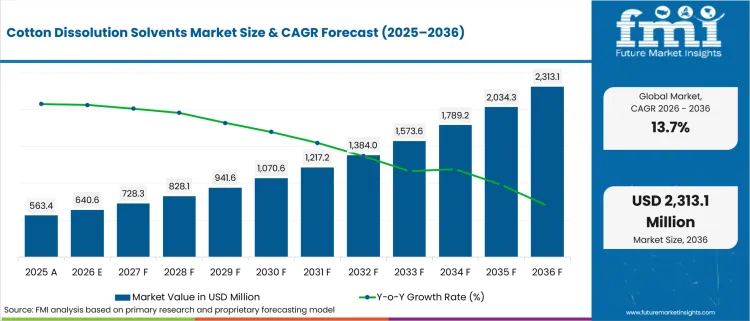
| Metric | Value |
|---|---|
| 2025 Market Size | USD 563.4 million |
| 2026 Market Size | USD 640.6 million |
| 2036 Market Size | USD 2,313.1 million |
| Forecast CAGR (2026-2036) | 13.7% |
| Leading Sales Model | Closed-loop Recovery |
| Closed-loop Recovery Share (2026) | 50.0% |
| Leading Application | Textile-to-textile Recycling |
| Textile-to-textile Recycling Share (2026) | 47.0% |
| Leading Solvent Type | NMMO |
| NMMO Share (2026) | 41.0% |
| Fastest-growing Country | China |
| China CAGR by 2036 | 15.2% |
Summary of the Cotton Dissolution Solvents Market
| Market Signal | Commercial Impact |
|---|---|
| Demand and Growth Drivers | Demand for cotton dissolution solvents is increasing as textile recyclers and fiber manufacturers seek high-quality cellulose recovery solutions that support circular textile production and recycled fiber development.
|
| Product and Segment View | Closed-loop recovery, textile-to-textile recycling, and NMMO solvent systems continue to represent the leading commercial opportunities across the market.
|
| Geography and Growth Outlook | Asia continues to lead market expansion as textile manufacturing, recycling infrastructure, and circular economy initiatives accelerate.
|
| Competitive Landscape | Competition increasingly focuses on cellulose recovery technologies, recycled pulp quality, and integrated textile recycling solutions.
|
| Analyst Perspective | Cotton dissolution solvents are evolving into critical recovery technologies where cellulose quality, process efficiency, and fiber-grade consistency determine long-term commercial success.
- Nikhil Kaitwade, Principal Consultant at Future Market Insights |
How is the cotton dissolution solvents market segmented?
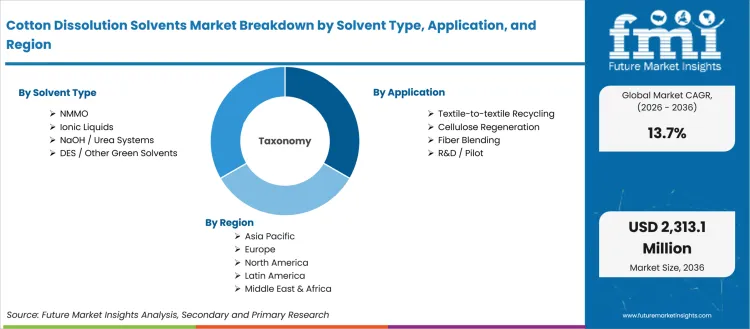
The cotton dissolution solvents industry is segmented by solvent type, application, feedstock, end use, sales model and region.
The cotton dissolution solvents market is segmented by solvent type, application, feedstock, end use, sales model and region. By solvent type, coverage includes ionic liquids, NMMO, NaOH / urea systems and DES / Other Green Solvents. By application, coverage includes textile-to-textile recycling, cellulose regeneration, fiber blending and R&D / Pilot. By feedstock, coverage includes post-consumer cotton, pre-consumer textile waste, cotton-rich blends and other cellulosics. By end use, demand comes from recycled fiber producers, textile recyclers, chemical producers and research institutes. By sales model, coverage includes solvent supply, closed-loop recovery and technology package models, with regional coverage across North America, Latin America, Europe, East Asia, South Asia and Pacific and the Middle East and Africa.
Why does NMMO lead within the solvent-type category?
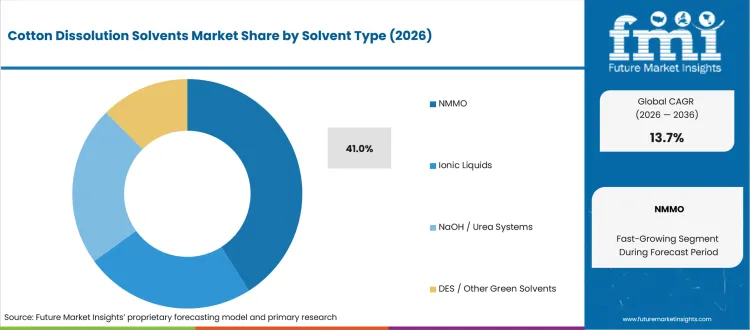
NMMO leads through lyocell process familiarity and commercial reference points in regenerated cellulose. Lenzing reported EUR 2,602.4 million group revenue and EUR 413 million EBITDA in 2025, giving buyers a scale reference for suppliers already operating cellulosic fiber processes. Recycled fiber producers use such operating history to assess recovery cost before shifting cotton-rich textile waste into commercial recovery lines.
- NMMO is expected to account for 41.0% share in 2026, backed by lyocell producers already using direct cellulose dissolution and closed-loop recovery. Lenzing reported its specific GHG emissions indicator at 52% in 2025, down 6%, providing solvent buyers a measurable reference for process discipline inside regenerated fiber operations.
- Process familiarity supports NMMO adoption among recycled fiber producers. Lenzing’s participation in the EU-funded CELLFIL project, launched in mid-2024 and planned for 4 years, shows continued work around cellulose filament innovation and process refinement.
What supports demand for textile-to-textile recycling applications?
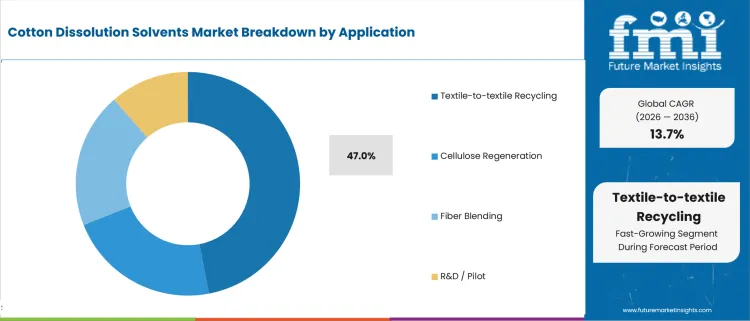
Textile-to-textile recycling gains attention as brands seek material recovery routes above wiping rags or downcycling. WRAP reported 16% recycled fibre use among UK Textiles Pact signatories in 2024-25, compared with a 7.6% global average. Solvent systems create value once recycled cellulose can return to apparel and support repeatable fiber quality for offtake partners.
- Textile-to-textile recycling are anticipated to hold 47.0% share in 2026, led by brand need for recycled cellulose streams able to return to apparel. WRAP reported that 62% of textiles placed on the market by UK Textiles Pact signatories had reduced environmental impacts in 2024-25, attracting qualification interest in recycled fiber inputs.
- Application buyers care about material continuity from waste garment to new fiber. Eastman reported recycling 8,000 pounds of unusable Patagonia apparel through its textile recycling collaboration in 2024, showing how brand-owned waste can move into higher-value material recovery trials.
How do buyers evaluate cotton-rich blends within feedstock?
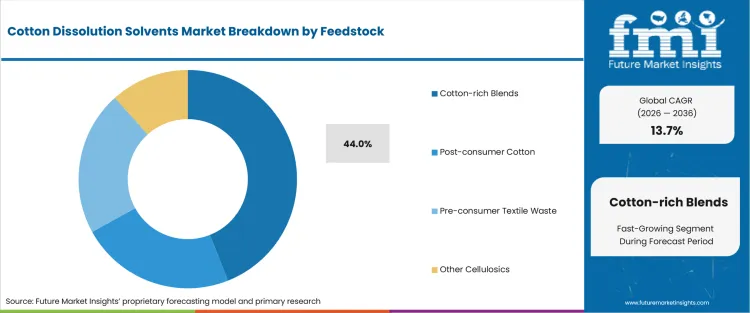
Cotton-rich blends create the main process test for solvent suppliers. The European Environment Agency estimated that 4% to 9% of textile products placed on the European market are destroyed before use, equal to 264,000 to 594,000 tonnes each year. Mixed garments often contain dyes and synthetic fiber residues, so buyers assess whether cellulose recovery can stay consistent under uneven feedstock conditions.
- Cotton-rich Blends are projected to represent 44.0% share in 2026, shaped by mixed garments creating a practical separation challenge. Circ’s planned Saint-Avold facility is designed to process 70,000 metric tons of polycotton material per year, showing why blend separation is moving from pilot work toward industrial planning.
- Feedstock buyers prefer systems able to tolerate real garment variation. Sorting alone cannot remove every dye or trim, so solvent performance must support fiber-grade recovery under uneven input conditions while protecting output quality during repeated filtration steps.
What market factors influence recycled fiber producers?
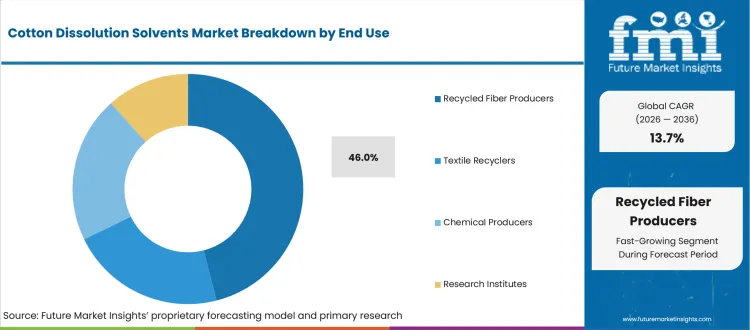
Recycled fiber producers control approval decisions for recovered cellulose pulp. Refashion reported 480,000 tonnes of carbon dioxide equivalent avoided through the French textile EPR sector in 2024, showing why fiber recovery routes need measurable material and environmental outcomes. Solvent selection must therefore support stable viscosity and dope preparation behavior that fiber plants can use without adding costly qualification delays.
- Recycled fiber producers are expected to account for 46.0% share in 2026, reflecting fiber-maker control over recovered pulp approval. Refashion also reported more than 826,000 repairs carried out by 2024, which shows how circular textile systems are expanding across repair and recycling channels.
- Fiber producers need low ash and predictable dope preparation. Solvent suppliers that support trial batches and process adjustment can shorten qualification cycles for recycled pulp, especially once recycled cellulose are required to meet fiber-maker quality gates.
How is closed-loop recovery positioned within the sales-model category?
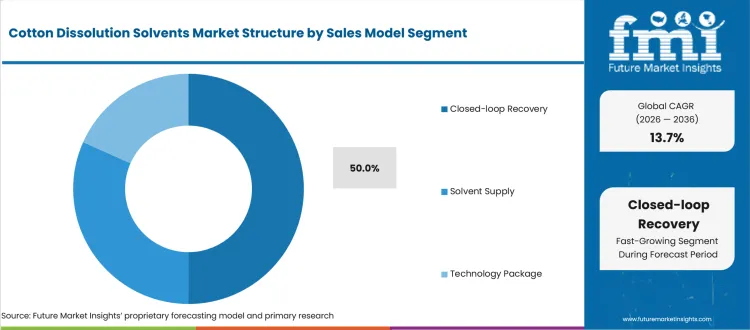
Closed-loop recovery is central to solvent buying since repeated use controls plant cost. Circulose states, its Ortviken facility is reopening in 2026 with production capacity of 60,000 tonnes per year and potential to double capacity over time. Buyers examine purification design and operator training before treating a solvent package as ready for commercial textile recovery.
- Closed-loop recovery is set to secure 50.0% share in 2026, driven by solvent reuse economics. Lenzing set a target for 5 lyocell production sites to achieve wastewater and responsible production alignment by 2028, explaining why buyers assess recovery systems as part of plant design.
- Recovery-led models reduce exposure to solvent loss and wastewater risk. Technical packages including purification and monitoring support higher confidence among recyclers before commercial textile recovery moves beyond trial batches.
What are the drivers, restraints, and opportunities in the Cotton Dissolution Solvents Market?
Near-term purchases are being shaped by the recovery requirement and scale-up route outlined below.
- Driver: Fiber-to-fiber recovery programs drive solvent demand when recyclers need cotton cellulose pulp that can return to regenerated fiber production. European Parliament materials state that EU textile waste totals 12.6 million tonnes each year, including 5.2 million tonnes of clothing and footwear waste.
- Restraint: Feedstock variation restrains adoption when dyes and polyester residues raise filtration and quality-control risk. WRAP reported 17% more textiles for sale in 2024 compared with 2019, while the Pact’s total carbon footprint was 10% higher and water use was 7% higher.
- Opportunity: Technology package models open an opportunity among recyclers that need solvent recovery know-how before buying bulk chemistry. The European Commission links textile collection for reuse with 20 to 35 jobs for every 1,000 tonnes collected, supporting service-led models around sorting and preparation.
Solvent demand rises when textile recyclers treat cellulose recovery as a fiber-quality issue. European Commission materials note that only 1% of material used in clothing is recycled into new clothing, which leaves a large gap for solvent systems that can recover cotton cellulose into fiber-grade pulp. Suppliers that prove repeatable viscosity and low contamination can support larger trial programs.
Feedstock quality remains a practical constraint for commercial plants. Returned and unsold textile destruction in Europe is estimated at 264,000 to 594,000 tonnes each year, reflecting why recyclers need better sorting decisions before chemical recovery begins. Solvent suppliers gain an advantage when process packages include preparation guidance and recovery monitoring.
Technology packages create an expansion route beyond solvent supply. Smaller recyclers need operating discipline and recovery design before committing to commercial batches. Suppliers combining solvent chemistry with recovery support can defend value against commodity chemical purchasing.
Which country CAGRs are profiled in the Cotton Dissolution Solvents Market?
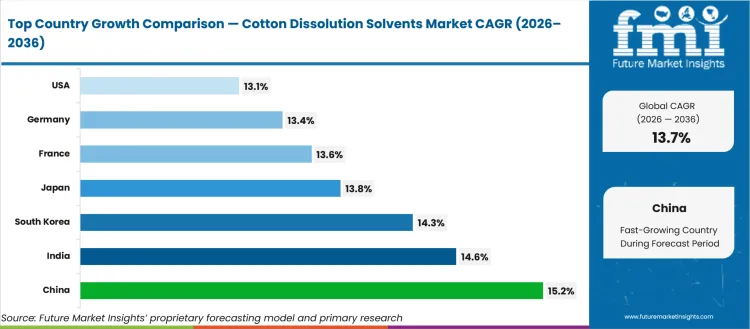
| Country | CAGR |
|---|---|
| China | 15.2% |
| India | 14.6% |
| South Korea | 14.3% |
| Japan | 13.8% |
| France | 13.6% |
| Germany | 13.4% |
| United States | 13.1% |
| United Kingdom | 12.9% |
How do country-level CAGRs compare in the cotton dissolution solvents market?
Country growth in cotton dissolution solvents are expected to be led by the recovery pressure behind textile circularity. China, India and South Korea connect solvent demand with textile production scale and fabric-scrap pilots. Japan, France, Germany, the United States and the United Kingdom connect adoption with collection targets and used-textile handling. For senior buyers, the question is more about which market can provide sorted cotton-rich feedstock and fiber-grade offtake partners.
- China is estimated at 15.2% CAGR through 2036, supported by textile output depth and domestic chemical processing capacity that can place solvent recovery projects close to cotton-rich manufacturing streams. Solvent suppliers gain a stronger deployment base near fiber and chemical clusters, as national industrial data reported 4.6% growth in textile industry value added and 9.4% growth in raw chemical materials and chemical products in December 2024.
- India is projected at 14.6% CAGR by 2036, helped by apparel export scale creating larger cotton and blended-fabric flows for recovery planning. Solvent suppliers can link recycling trials with established textile trade channels, with official data showing total textile exports rising to ₹3,16,334.9 crore in FY 2025-26 and ready-made garment exports reaching ₹1,39,349.6 crore.
- South Korea is estimated to record 14.3% CAGR through 2036, reinforced by public recycling pilots that move waste fabric scraps from disposal into material-centered reuse pathways. Feedstock preparation gains more structure through public coordination, after the Ministry of Environment said a 2024 agreement involved 4 Seoul local governments and the Korea Recycling Service Agency for a material-recycling-centered system.
- Japan is set to post 13.8% CAGR by 2036, aided by circular fashion policy targets that can raise collection discipline and improve the quality of textile inputs available for fiber-grade cellulose recovery. Solvent systems gain from stronger waste-reduction planning, since Ministry of Environment policy targets a 25% reduction in household clothing waste by FY2030.
- France is projected to rise at 13.6% CAGR through 2036, reinforced by producer responsibility structures and measurable textile collection channels creating a clearer feedstock pathway for cellulose recovery projects. Recyclers can assess collection depth more confidently, since ADEME reported 886 thousand tonnes of household textiles and footwear placed on the French market in 2024, along with 289 kt collected through different channels.
- Germany is forecast to grow at 13.4% CAGR by 2036, underpinned by ecodesign guidance able to make future textile streams easier to separate and process through chemical recovery systems. Solvent buyers benefit from clearer recyclability rules, since UBA’s 2026 textile ecodesign work recommends limiting fabric-layer material mixtures to 2 materials and keeping elastane at 5% to 10%.
- United States is expected to expand at 13.1% CAGR through 2036, backed by state-level textile stewardship momentum and a large disposal base that can support future sorting and recycling infrastructure. Solvent demand becomes more credible once landfill diversion programs are established, since CalRecycle states that Californians throw away 1.2 million tons of textiles each year, equal to 3% of landfill disposal in the state.
- United Kingdom is projected to rise at 12.9% CAGR through 2036, shaped by brand participation in reuse and recycling programs that can supply textile streams for higher-value recovery routes. Cotton-rich feedstock access improves as collection organizations scale activity, with WRAP reporting that reuse and recycling organizations handled 210,000 tonnes of used textiles in 2024, a 27% increase from 2019.
Who are the notable companies in the Cotton Dissolution Solvents Market?
Lenzing, Birla Cellulose, Circ, Circulose, Infinited Fiber Company, SaXcell, Ioncell and Eastman are the notable companies shaping cotton dissolution solvents and recycled cellulose pathways.
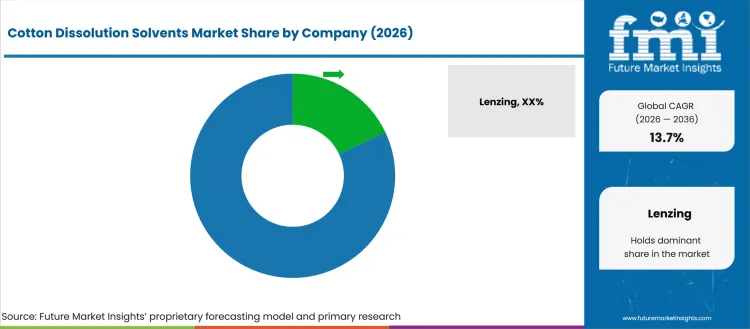
Competition in the cotton dissolution solvents market is grouped by how buyers want recovery control to work. Lenzing and Birla Cellulose are stronger when solvent recovery and regenerated fiber knowledge drive buyer confidence. Circ, Circulose, Infinited Fiber Company and SaXcell are important for textile-to-textile pulp conversion and brand offtake shape project decisions. Ioncell and Eastman add technical pressure through research depth and adjacent material recovery pathways.
- Lenzing has an advantage through lyocell process experience and NMMO recovery knowledge. Buyers can connect solvent choice with regenerated cellulose quality and existing fiber-production discipline.
- Birla Cellulose is positioned through regenerated cellulosic fiber capacity and partnerships with recycling technology firms. Fiber-conversion capability makes recycled pulp offtake more credible for solvent-linked projects.
- Circ and Circulose bring textile-to-textile conversion models relying on sorted cotton-rich waste and recycled pulp acceptance. Commercial value improves once pulp can move into lyocell or filament routes.
- Infinited Fiber Company, SaXcell, Ioncell and Eastman strengthen competition through cotton-rich feedstock conversion or adjacent molecular recycling pathways. Buyers compare these companies through feedstock tolerance and partner access.
Competitive Benchmarking: Cotton Dissolution Solvents Market
| Company | Solvent Recovery Depth | Textile-to-textile Workflow Alignment | Feedstock Control Support | Geographic Reach |
|---|---|---|---|---|
| Lenzing | High | Strong | Strong | Global |
| Birla Cellulose | High | Strong | Medium | Global |
| Circ | Medium | Strong | Strong | North America and Asia-facing partnerships |
| Circulose | Medium | Strong | High | Europe and global brand network |
| Infinited Fiber Company | Medium | Strong | Strong | Europe |
| SaXcell | Medium | Medium | Medium | Europe |
| Ioncell | Medium | Medium | Medium | Europe |
| Eastman | Medium | Medium | Medium | North America and Europe |
Source: Future Market Insights competitive analysis, 2026.
Key Developments in the Cotton Dissolution Solvents Market
- In October 2024, Birla Cellulose and Circ announced a long-term partnership in which Birla Cellulose proposed to purchase up to 5,000 tons of Circ pulp per year for 5 years from Circ’s first commercial-scale facility. The agreement is important for solvent-linked recycling since recycled cotton pulp needs a fiber producer before commercial plants can secure buyer confidence.
- In March 2024, Infinited Fiber Company completed a EUR 40 million development financing round with investors including Inditex, TTY Management, Youngone and Goldwin. The financing supports cotton-rich textile waste conversion by giving the company more scale-up resources for Infinna fiber production.
- In February 2026, Circulose announced the restart of commercial-scale production at Ortviken in Sundsvall, Sweden. Planned CIRCULOSE pulp output in Q4 2026 supports commercial recycled cotton pulp supply for solvent-based cellulose fiber pathways.
Key Players in the Cotton Dissolution Solvents Market
Solvent Recovery and Fiber Leaders
- Lenzing
- Birla Cellulose
Textile-to-textile Technology Specialists
- Circ
- Circulose
- Infinited Fiber Company
- SaXcell
Research and Adjacent Material Innovators
- Ioncell
- Eastman
Cotton Dissolution Solvents Market - Report Scope
| Coverage field | Report scope |
|---|---|
| Market breakdown | Cotton Dissolution Solvents Market Breakdown By Solvent Type, Application, Feedstock, End Use, Sales Model, and Region |
| Market Definition | Chemical solvent systems that dissolve cellulose from cotton waste or cotton-rich textile streams for regeneration, fiber blending, and textile-to-textile recycling |
| Regions Covered | North America, Latin America, Europe, East Asia, South Asia and Pacific, Middle East and Africa |
| Countries Covered | United States, United Kingdom, Germany, France, Japan, China, South Korea, India and 30+ countries |
| Key Companies Profiled | Lenzing, Birla Cellulose, Circ, Circulose, Infinited Fiber Company, SaXcell, Ioncell, Eastman |
| Forecast Period | 2026 to 2036 |
| Approach | Hybrid bottom-up and top-down methodology using solvent use, recovery intensity, feedstock quality, application mix, and country-level adoption signals |
Cotton Dissolution Solvents Market - Research Methodology
| Method | Approach |
|---|---|
| Primary Research | FMI analysts reviewed inputs from textile recyclers, regenerated fiber producers, specialty chemical suppliers, and recovery technology partners. Discussions focused on solvent loss, pulp quality, feedstock variability, and buyer acceptance. |
| Desk Research | Desk research covered textile collection policy, official waste data, company technology updates, recycled cellulose partnerships, and technical literature on cellulose dissolution. Product coverage was checked against solvent type, recovery model, feedstock route, and commercial application. |
| Market Sizing and Forecasting | The model combined solvent use per tonne of processed cotton waste with recovery rate, plant-scale adoption, end-use mix, and country-level policy signals. Forecast assumptions were adjusted for closed-loop recovery, textile-to-textile demand, and feedstock sorting maturity. |
| Data Validation | Forecasts were checked against textile waste recovery signals, lyocell process evidence, company partnership activity, and recycled pulp offtake announcements. Company portfolios were reviewed to avoid counting adjacent chemistry without cotton cellulose dissolution use. |
Cotton Dissolution Solvents Market by Segments
Cotton Dissolution Solvents Market segmented by Solvent Type:
- Ionic Liquids
- NMMO
- NaOH / Urea Systems
- DES / Other Green Solvents
Cotton Dissolution Solvents Market segmented by Application:
- Textile-to-textile Recycling
- Cellulose Regeneration
- Fiber Blending
- R&D / Pilot
Cotton Dissolution Solvents Market segmented by Feedstock:
- Post-consumer Cotton
- Pre-consumer Textile Waste
- Cotton-rich Blends
- Other Cellulosics
Cotton Dissolution Solvents Market segmented by End Use:
- Recycled Fiber Producers
- Textile Recyclers
- Chemical Producers
- Research Institutes
Cotton Dissolution Solvents Market segmented by Sales Model:
- Solvent Supply
- Closed-loop Recovery
- Technology Package
Cotton Dissolution Solvents Market by Region:
- North America
- United States
- Canada
- Mexico
- Latin America
- Brazil
- Chile
- Rest of Latin America
- Western Europe
- Germany
- UK
- Italy
- Spain
- France
- Nordic
- BENELUX
- Rest of Western Europe
- Eastern Europe
- Russia
- Poland
- Hungary
- Balkan & Baltic
- Rest of Eastern Europe
- East Asia
- China
- Japan
- South Korea
- South Asia and Pacific
- India
- ASEAN
- Australia & New Zealand
- Rest of South Asia and Pacific
- Middle East & Africa
- Kingdom of Saudi Arabia
- Other GCC Countries
- Turkiye
- South Africa
- Other African Union
- Rest of Middle East & Africa
Research Sources and Bibliography
- California Department of Resources Recycling and Recovery. (2026). Textile Stewardship. CalRecycle.
- European Parliament. (2025, September 9). Parliament adopts new EU rules to reduce textile and food waste. European Parliament.
- European Parliament. (2025, September 12). Fast fashion: EU laws for sustainable textile consumption. European Parliament.
- European Commission. (2025, October 16). Revised Waste Framework Directive enters into force. European Commission.
- European Commission. (2022, March 30). EU Strategy for Sustainable and Circular Textiles. European Commission.
- European Environment Agency. (2024, May 21). Management of used and waste textiles in Europe’s circular economy. European Environment Agency.
- European Environment Agency. (2025, March 26). Circularity of the EU textiles value chain in numbers. European Environment Agency.
- WRAP. (2025, October 28). UK Textiles Pact Annual Progress Update 2024-25. Waste and Resources Action Programme.
- WRAP. (2025, October 28). New UK Textiles Pact Roadmap helps industry reach critical environmental targets. Waste and Resources Action Programme.
- Lenzing Aktiengesellschaft. (2026, March 19). Annual and Sustainability Report 2025. Lenzing Aktiengesellschaft.
- Lenzing Aktiengesellschaft. (2026, March 19). Fiber Division: Annual and Sustainability Report 2025. Lenzing Aktiengesellschaft.
- Lenzing Aktiengesellschaft. (2026, March 19). Metrics: Resource use and circular economy, Annual and Sustainability Report 2025. Lenzing Aktiengesellschaft.
- Lenzing Aktiengesellschaft. (2026, March 19). Targets: Pollution, Annual and Sustainability Report 2025. Lenzing Aktiengesellschaft.
- National Bureau of Statistics of China. (2025, January 24). Industrial production operation in December 2024. National Bureau of Statistics of China.
- National Bureau of Statistics of China. (2025, February 28). Statistical Communiqué of the People’s Republic of China on the 2024 National Economic and Social Development. National Bureau of Statistics of China.
- Ministry of Textiles, Government of India. (2026, March 10). Union Minister of Textiles releases Report on Mapping of Textile Waste Value Chain in India. Press Information Bureau.
- Ministry of Textiles, Government of India. (2026, April 22). India’s textile exports register growth of 2.1% in FY 2025-26. Press Information Bureau.
- Ministry of the Environment, Republic of Korea. (2025, September 9). Waste fabric scraps once incinerated or landfilled, embraced as resources. Ministry of the Environment.
- Ministry of the Environment, Japan. (2026, March). Japan’s policy trends for sustainable fashion. Ministry of the Environment.
- German Environment Agency. (2026, February 26). UBA study recommends eco-design requirements for textiles. German Environment Agency.
- ADEME. (2026, March 26). Textiles d’habillement, linge de maison et chaussures: Données 2024. ADEME.
- Refashion. (2025, June 18). The environmental performance of the textiles and footwear EPR sector. Refashion.
- Refashion. (2025, June 26). Refashion Activity Report 2024. Refashion.
- Grasim Industries Limited. (2024, October 28). Birla Cellulose and Circ announce strategic partnership to accelerate scaling textile recycling innovation. Grasim Industries Limited.
- Eastman Chemical Company. (2024, February 27). Eastman and Patagonia tackle global textile waste crisis. Eastman Chemical Company.
- Circ. (2025, May 19). Circ establishes first polycotton recycling plant. Circ.
- Infinited Fiber Company. (2024, March 8). Infinited Fiber Company successfully completes EUR 40 million development financing round. Infinited Fiber Company.
- Circulose. (2026, February 16). Circulose restarts commercial-scale production at Ortviken plant in Sundsvall, Sweden. Circulose.
- Circulose. (2026). Made in Sweden. Circulose.
This bibliography is provided for reader reference and is not exhaustive. The full report contains the complete reference list and detailed citations.
This Report Answers
- What is the expected global value of the cotton dissolution solvents market in 2026 and 2036?
- What CAGR is forecast for cotton dissolution solvents during the 2026 to 2036 period?
- Which solvent type category is used to assess NMMO demand in 2026?
- Why do textile recyclers and fiber producers buy controlled cotton dissolution solvent systems?
- How do NMMO and ionic liquid systems shape recycled cellulose recovery choices?
- Which countries are compared in the cotton dissolution solvents forecast?
- Which companies compete across solvent recovery and regenerated fiber pathways?
- What solvent systems and applications are included within the cotton dissolution solvents definition?
- How does FMI size and forecast cotton dissolution solvent demand across segments and countries?
- What implementation and supplier-selection factors should executives assess?
Frequently Asked Questions
What is driving growth in the Cotton Dissolution Solvents Market?
Growth is driven by textile-to-textile recycling demand and the need to recover fiber-grade cellulose from cotton-rich waste.
Why should executives track the Cotton Dissolution Solvents Market?
Executives should track this market since solvent recovery decisions affect plant economics and the cost of scaling textile circularity projects.
What business problem does the Cotton Dissolution Solvents Market address?
It helps recyclers dissolve cotton cellulose from waste textiles and produce pulp that can move into regenerated fiber pathways.
What should procurement leaders evaluate before selecting suppliers?
Sourcing leaders should compare solvent recovery depth and offtake partner access.
What can limit return on investment for buyers?
Return on investment can be delayed when feedstock streams contain uneven dye loads or inconsistent cotton content. Buyers can reduce this risk by improving sorting and phasing qualification trials.
How can suppliers build executive confidence?
Suppliers build confidence through proven recovery rates and accountable support during scale-up.
Preview the report firsthand - request a free sample
Get SampleGet the brochure for pricing and purchase details.
Get PDFTable of Content
- Key Takeaways
- Market Size and CAGR
- Top Growth Driver
- Fastest Growing Segment
- Leading Region
- Key Companies
- Emerging Opportunities
- Executive Summary
- Global Market Outlook
- Demand-side Trends
- Supply-side Trends
- Technology Roadmap Analysis
- Analysis and Recommendations
- Analyst Perspective (What is happening? Why now? What should investors know?)
- Key Questions Answered
- How large is the market?
- What is the CAGR?
- What are key trends?
- Which region dominates?
- Who are the leaders?
- Market Overview
- Market Coverage / Taxonomy
- Market Definition / Scope / Limitations
- Research Methodology
- Chapter Orientation
- Analytical Lens and Working Hypotheses
- Market Structure, Signals, and Trend Drivers
- Benchmarking and Cross-market Comparability
- Market Sizing, Forecasting, and Opportunity Mapping
- Research Design and Evidence Framework
- Desk Research Programme (Secondary Evidence)
- Expert Input and Fieldwork (Primary Evidence)
- Tooling, Models, and Reference Databases
- Data Engineering and Model Build
- Quality Assurance and Audit Trail
- Market Background
- Market Dynamics (Drivers, Restraints, Opportunity, Trends)
- Scenario Forecast (Optimistic, Likely, Conservative)
- Impact Analysis
- AI Impact
- Sustainability Impact
- Regulatory Impact
- Technology Impact
- Consumer / Buyer Analysis
- Purchase Drivers
- Adoption Barriers
- Buyer Journey
- Opportunity Map Analysis
- Product Life Cycle Analysis
- Supply Chain Analysis
- Investment Feasibility Matrix
- Value Chain Analysis
- PESTLE and Porter's Analysis
- Regulatory Landscape
- Regional Parent Market Outlook
- Production and Consumption Statistics
- Import and Export Statistics
- Global Market Analysis and Forecast, 2021 to 2036
- Historical Market Size Value (USD Million) & Volume (Unit) Analysis, 2021 to 2025
- Current and Future Market Size Value (USD Million) & Volume (Unit) Projections, 2026 to 2036
- Y-o-Y Growth Trend Analysis
- Absolute $ Opportunity Analysis
- Global Market Pricing Analysis, 2021 to 2036
- Global Market Analysis and Forecast, By Solvent Type, 2021 to 2036
- Introduction / Key Findings
- Historical Market Size Value (USD Million) & Volume (Unit) Analysis By Solvent Type, 2021 to 2025
- Current and Future Market Size Value (USD Million) & Volume (Unit) Analysis and Forecast By Solvent Type, 2026 to 2036
- NMMO
- Ionic Liquids
- NaOH / Urea Systems
- DES / Other Green Solvents
- NMMO
- Y-o-Y Growth Trend Analysis By Solvent Type, 2021 to 2025
- Absolute $ Opportunity Analysis By Solvent Type, 2026 to 2036
- Global Market Analysis and Forecast, By Application, 2021 to 2036
- Introduction / Key Findings
- Historical Market Size Value (USD Million) & Volume (Unit) Analysis By Application, 2021 to 2025
- Current and Future Market Size Value (USD Million) & Volume (Unit) Analysis and Forecast By Application, 2026 to 2036
- Textile-to-textile Recycling
- Cellulose Regeneration
- Fiber Blending
- R&D / Pilot
- Textile-to-textile Recycling
- Y-o-Y Growth Trend Analysis By Application, 2021 to 2025
- Absolute $ Opportunity Analysis By Application, 2026 to 2036
- Global Market Analysis and Forecast, By Feedstock, 2021 to 2036
- Introduction / Key Findings
- Historical Market Size Value (USD Million) & Volume (Unit) Analysis By Feedstock, 2021 to 2025
- Current and Future Market Size Value (USD Million) & Volume (Unit) Analysis and Forecast By Feedstock, 2026 to 2036
- Cotton-rich Blends
- Post-consumer Cotton
- Pre-consumer Textile Waste
- Other Cellulosics
- Cotton-rich Blends
- Y-o-Y Growth Trend Analysis By Feedstock, 2021 to 2025
- Absolute $ Opportunity Analysis By Feedstock, 2026 to 2036
- Global Market Analysis and Forecast, By End Use, 2021 to 2036
- Introduction / Key Findings
- Historical Market Size Value (USD Million) & Volume (Unit) Analysis By End Use, 2021 to 2025
- Current and Future Market Size Value (USD Million) & Volume (Unit) Analysis and Forecast By End Use, 2026 to 2036
- Recycled Fiber Producers
- Textile Recyclers
- Chemical Producers
- Research Institutes
- Recycled Fiber Producers
- Y-o-Y Growth Trend Analysis By End Use, 2021 to 2025
- Absolute $ Opportunity Analysis By End Use, 2026 to 2036
- Global Market Analysis and Forecast, By Sales Model, 2021 to 2036
- Introduction / Key Findings
- Historical Market Size Value (USD Million) & Volume (Unit) Analysis By Sales Model, 2021 to 2025
- Current and Future Market Size Value (USD Million) & Volume (Unit) Analysis and Forecast By Sales Model, 2026 to 2036
- Closed-loop Recovery
- Solvent Supply
- Technology Package
- Closed-loop Recovery
- Y-o-Y Growth Trend Analysis By Sales Model, 2021 to 2025
- Absolute $ Opportunity Analysis By Sales Model, 2026 to 2036
- Global Market Analysis and Forecast, By Region, 2021 to 2036
- Introduction
- Historical Market Size Value (USD Million) & Volume (Unit) Analysis By Region, 2021 to 2025
- Current Market Size Value (USD Million) & Volume (Unit) Analysis and Forecast By Region, 2026 to 2036
- North America
- Latin America
- Western Europe
- Eastern Europe
- East Asia
- South Asia and Pacific
- Middle East & Africa
- Market Attractiveness Analysis By Region
- North America Market Analysis and Forecast, By Country, 2021 to 2036
- Historical Market Size Value (USD Million) & Volume (Unit) Trend Analysis By Market Taxonomy, 2021 to 2025
- Market Size Value (USD Million) & Volume (Unit) Forecast By Market Taxonomy, 2026 to 2036
- By Country
- USA
- Canada
- Mexico
- By Solvent Type
- By Application
- By Feedstock
- By End Use
- By Sales Model
- By Country
- Market Attractiveness Analysis
- By Country
- By Solvent Type
- By Application
- By Feedstock
- By End Use
- By Sales Model
- Key Takeaways
- Latin America Market Analysis and Forecast, By Country
- Historical Market Size Value (USD Million) & Volume (Unit) Trend Analysis By Market Taxonomy, 2021 to 2025
- Market Size Value (USD Million) & Volume (Unit) Forecast By Market Taxonomy, 2026 to 2036
- By Country
- Brazil
- Chile
- Rest of Latin America
- By Solvent Type
- By Application
- By Feedstock
- By End Use
- By Sales Model
- By Country
- Market Attractiveness Analysis
- By Country
- By Solvent Type
- By Application
- By Feedstock
- By End Use
- By Sales Model
- Key Takeaways
- Western Europe Market Analysis and Forecast, By Country
- Historical Market Size Value (USD Million) & Volume (Unit) Trend Analysis By Market Taxonomy, 2021 to 2025
- Market Size Value (USD Million) & Volume (Unit) Forecast By Market Taxonomy, 2026 to 2036
- By Country
- Germany
- UK
- Italy
- Spain
- France
- Nordic
- BENELUX
- Rest of Western Europe
- By Solvent Type
- By Application
- By Feedstock
- By End Use
- By Sales Model
- By Country
- Market Attractiveness Analysis
- By Country
- By Solvent Type
- By Application
- By Feedstock
- By End Use
- By Sales Model
- Key Takeaways
- Eastern Europe Market Analysis and Forecast, By Country
- Historical Market Size Value (USD Million) & Volume (Unit) Trend Analysis By Market Taxonomy, 2021 to 2025
- Market Size Value (USD Million) & Volume (Unit) Forecast By Market Taxonomy, 2026 to 2036
- By Country
- Russia
- Poland
- Hungary
- Balkan & Baltic
- Rest of Eastern Europe
- By Solvent Type
- By Application
- By Feedstock
- By End Use
- By Sales Model
- By Country
- Market Attractiveness Analysis
- By Country
- By Solvent Type
- By Application
- By Feedstock
- By End Use
- By Sales Model
- Key Takeaways
- East Asia Market Analysis and Forecast, By Country
- Historical Market Size Value (USD Million) & Volume (Unit) Trend Analysis By Market Taxonomy, 2021 to 2025
- Market Size Value (USD Million) & Volume (Unit) Forecast By Market Taxonomy, 2026 to 2036
- By Country
- China
- Japan
- South Korea
- By Solvent Type
- By Application
- By Feedstock
- By End Use
- By Sales Model
- By Country
- Market Attractiveness Analysis
- By Country
- By Solvent Type
- By Application
- By Feedstock
- By End Use
- By Sales Model
- Key Takeaways
- South Asia and Pacific Market Analysis and Forecast, By Country
- Historical Market Size Value (USD Million) & Volume (Unit) Trend Analysis By Market Taxonomy, 2021 to 2025
- Market Size Value (USD Million) & Volume (Unit) Forecast By Market Taxonomy, 2026 to 2036
- By Country
- India
- ASEAN
- Australia & New Zealand
- Rest of South Asia and Pacific
- By Solvent Type
- By Application
- By Feedstock
- By End Use
- By Sales Model
- By Country
- Market Attractiveness Analysis
- By Country
- By Solvent Type
- By Application
- By Feedstock
- By End Use
- By Sales Model
- Key Takeaways
- Middle East & Africa Market Analysis and Forecast, By Country
- Historical Market Size Value (USD Million) & Volume (Unit) Trend Analysis By Market Taxonomy, 2021 to 2025
- Market Size Value (USD Million) & Volume (Unit) Forecast By Market Taxonomy, 2026 to 2036
- By Country
- Kingdom of Saudi Arabia
- Other GCC Countries
- Türkiye
- South Africa
- Other African Union
- Rest of Middle East & Africa
- By Solvent Type
- By Application
- By Feedstock
- By End Use
- By Sales Model
- By Country
- Market Attractiveness Analysis
- By Country
- By Solvent Type
- By Application
- By Feedstock
- By End Use
- By Sales Model
- Key Takeaways
- Key Countries Market Analysis
- USA
- Pricing Analysis
- Market Share Analysis, 2025
- By Solvent Type
- By Application
- By Feedstock
- By End Use
- By Sales Model
- Canada
- Pricing Analysis
- Market Share Analysis, 2025
- By Solvent Type
- By Application
- By Feedstock
- By End Use
- By Sales Model
- Mexico
- Pricing Analysis
- Market Share Analysis, 2025
- By Solvent Type
- By Application
- By Feedstock
- By End Use
- By Sales Model
- Brazil
- Pricing Analysis
- Market Share Analysis, 2025
- By Solvent Type
- By Application
- By Feedstock
- By End Use
- By Sales Model
- Chile
- Pricing Analysis
- Market Share Analysis, 2025
- By Solvent Type
- By Application
- By Feedstock
- By End Use
- By Sales Model
- Germany
- Pricing Analysis
- Market Share Analysis, 2025
- By Solvent Type
- By Application
- By Feedstock
- By End Use
- By Sales Model
- UK
- Pricing Analysis
- Market Share Analysis, 2025
- By Solvent Type
- By Application
- By Feedstock
- By End Use
- By Sales Model
- Italy
- Pricing Analysis
- Market Share Analysis, 2025
- By Solvent Type
- By Application
- By Feedstock
- By End Use
- By Sales Model
- Spain
- Pricing Analysis
- Market Share Analysis, 2025
- By Solvent Type
- By Application
- By Feedstock
- By End Use
- By Sales Model
- France
- Pricing Analysis
- Market Share Analysis, 2025
- By Solvent Type
- By Application
- By Feedstock
- By End Use
- By Sales Model
- India
- Pricing Analysis
- Market Share Analysis, 2025
- By Solvent Type
- By Application
- By Feedstock
- By End Use
- By Sales Model
- ASEAN
- Pricing Analysis
- Market Share Analysis, 2025
- By Solvent Type
- By Application
- By Feedstock
- By End Use
- By Sales Model
- Australia & New Zealand
- Pricing Analysis
- Market Share Analysis, 2025
- By Solvent Type
- By Application
- By Feedstock
- By End Use
- By Sales Model
- China
- Pricing Analysis
- Market Share Analysis, 2025
- By Solvent Type
- By Application
- By Feedstock
- By End Use
- By Sales Model
- Japan
- Pricing Analysis
- Market Share Analysis, 2025
- By Solvent Type
- By Application
- By Feedstock
- By End Use
- By Sales Model
- South Korea
- Pricing Analysis
- Market Share Analysis, 2025
- By Solvent Type
- By Application
- By Feedstock
- By End Use
- By Sales Model
- Russia
- Pricing Analysis
- Market Share Analysis, 2025
- By Solvent Type
- By Application
- By Feedstock
- By End Use
- By Sales Model
- Poland
- Pricing Analysis
- Market Share Analysis, 2025
- By Solvent Type
- By Application
- By Feedstock
- By End Use
- By Sales Model
- Hungary
- Pricing Analysis
- Market Share Analysis, 2025
- By Solvent Type
- By Application
- By Feedstock
- By End Use
- By Sales Model
- Kingdom of Saudi Arabia
- Pricing Analysis
- Market Share Analysis, 2025
- By Solvent Type
- By Application
- By Feedstock
- By End Use
- By Sales Model
- Türkiye
- Pricing Analysis
- Market Share Analysis, 2025
- By Solvent Type
- By Application
- By Feedstock
- By End Use
- By Sales Model
- South Africa
- Pricing Analysis
- Market Share Analysis, 2025
- By Solvent Type
- By Application
- By Feedstock
- By End Use
- By Sales Model
- USA
- Market Structure Analysis
- Competition Dashboard
- Competition Benchmarking
- Market Share Analysis of Top Players
- By Regional
- By Solvent Type
- By Application
- By Feedstock
- By End Use
- By Sales Model
- Emerging Startups
- Innovation Benchmarking
- Competition Analysis
- Competition Deep Dive
- Lenzing
- Overview
- Product Portfolio
- Profitability by Market Segments (Product/Region/Sales Channel)
- Sales Footprint
- Strategy Overview
- Marketing Strategy
- Product Strategy
- Channel Strategy
- Birla Cellulose
- Circ
- Circulose
- Infinited Fiber Company
- Lenzing
- Case Studies
- Success Stories
- Recent Developments
- Competition Deep Dive
- Assumptions & Acronyms Used


