

- Industry Size (2026)
- USD 834.6 Mn
- Forecast (2036)
- USD 1641.8 Mn
- CAGR (2026 to 2036)
- 7.0%
High-Tenacity Cellulosic Staple Fiber Market Forecast and Outlook 2026 to 2036
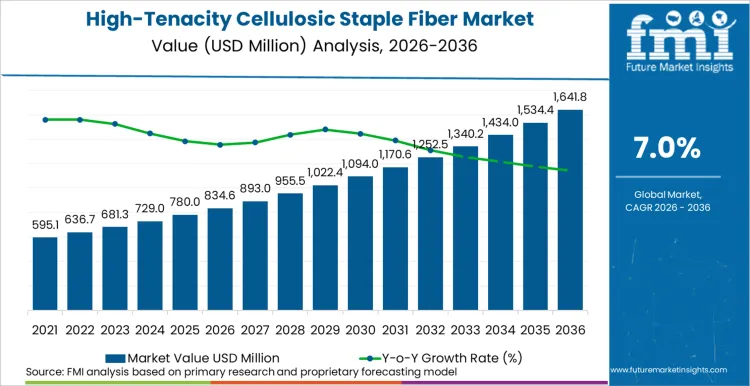
USD 834.6 million defines the opening size of the high-tenacity cellulosic staple fiber market in 2026, with the value projected to reach USD 1,641.8 million by 2036 at a 7.0% CAGR. Demand is tied to reinforcement needs in tire cord, industrial yarns, and technical textiles where strength retention and dimensional control govern material choice. Engineers specify tenacity class, moisture response, and fibrillation limits during product design. Once a construction enters approval, later fiber substitution requires renewed mechanical testing and qualification. Volume growth follows expansion of belts, hoses, and reinforced fabrics that rely on stable elongation under cyclic load across long service programs.
Procurement and specification control shape participation in the high-tenacity cellulosic staple fiber market through approved material lists, test regimes, and customer standards. Access depends on documented tensile performance, fatigue resistance, and consistency across production lots. Product families remain fixed across extended program timelines because compliance files and warranty assumptions reference specific fiber grades. Supplier changes occur during platform updates rather than routine sourcing cycles. Revenue development reflects the number of industrial and technical textile programs that adopt higher strength cellulosic reinforcement. Competitive position depends on early involvement in application engineering, dependable supply continuity, and sustained acceptance within qualification frameworks used by converters and end users.
Quick Stats for High-Tenacity Cellulosic Staple Fiber Market
- High-Tenacity Cellulosic Staple Fiber Market Value (2026): USD 834.6 million
- High-Tenacity Cellulosic Staple Fiber Market Forecast Value (2036): USD 1,641.8 million
- High-Tenacity Cellulosic Staple Fiber Market Forecast CAGR 2026 to 2036: 7.0%
- Leading Fiber Type by Demand Share: High-Tenacity Viscose
- Fastest-Growing Countries: China, Brazil, USA, Germany, South Korea
- Key Industry Participants: Lenzing, Birla Cellulose, Kelheim Fibres, Sateri, Aditya Birla Group (Grasim)
High-Tenacity Cellulosic Staple Fiber Market Key Takeaways
| Metric | Value |
|---|---|
| Market Value (2026) | USD 834.6 million |
| Market Forecast Value (2036) | USD 1,641.8 million |
| Forecast CAGR 2026 to 2036 | 7.0% |
Source: FMI analysis based on primary research and proprietary forecasting model
Why is the Demand for High Tenacity Cellulosic Staple Fiber Growing?
Growth in the high tenacity cellulosic staple fiber market is driven by apparel and technical textile manufacturers seeking alternatives that combine strength with sustainability. These fibers deliver tensile performance and abrasion resistance comparable to conventional synthetics while originating from renewable cellulose sources. Industrial segments such as workwear, protective clothing, and safety equipment increasingly specify high tenacity cellulosic staple fibers because they offer durability under heavy load and repeated mechanical stress without the environmental concerns associated with petrochemical derived yarns. Mill converters appreciate these fibers for their compatibility with existing spinning and weaving systems, enabling integration into blends that enhance tear strength and dimensional stability while maintaining comfort and breathability. Fabric developers rely on high tenacity cellulosic staple fibers in canvas, duck cloth, and performance denim where robustness must be paired with natural fiber character.
Procurement teams are also influenced by corporate environmental strategies and fiber sourcing policies that prioritize traceability, lower carbon footprint, and reduced reliance on non renewable feedstocks. Retail brands incorporating sustainable materials in outdoor apparel, backpacks, and lifestyle collections emphasize fiber origin and lifecycle impacts in product specifications and supplier contracts. Advances in pulping and fiber production technologies have improved uniformity and reduced micro fibrillation, supporting consistent processing and final fabric quality. Quality control laboratories conduct rigorous testing of tenacity, elongation, and abrasion resistance to validate supplier claims and ensure compliance with performance standards for demanding end uses, strengthening confidence in adoption across value chains.
How Is the High-Tenacity Cellulosic Staple Fiber Market Structured by Fiber Type, Application, and Processing Route?
High-tenacity cellulosic staple fibers are engineered to deliver higher tensile strength and dimensional stability than conventional regenerated fibers. Demand is shaped by sustainability mandates, substitution of synthetic reinforcements, and performance requirements in industrial textile applications. Segmentation by fiber type, application, and processing route explains how material selection aligns with mechanical and processing needs.
Which Fiber Types Dominate the High-Tenacity Cellulosic Staple Fiber Market?
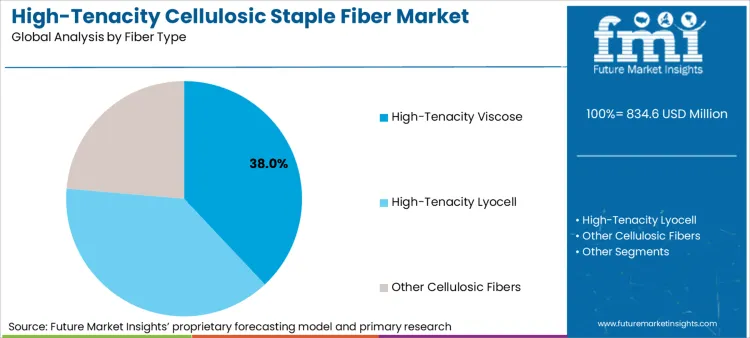
High-tenacity viscose accounts for 38.0%, supported by its established production base, cost efficiency, and balanced strength-to-elongation profile. It is widely adopted where consistent mechanical performance and large-scale availability are required. High-tenacity lyocell is preferred in applications demanding higher wet strength, lower fibrillation, and improved environmental credentials due to closed-loop solvent systems. Other cellulosic fibers include specialty regenerated cellulose variants and blends engineered for niche strength, bonding, or thermal behavior requirements.
Key Points
- High-tenacity viscose leads due to scalability and cost stability.
- Lyocell gains traction where wet strength and sustainability are critical.
- Specialty cellulosic fibers address application-specific performance gaps.
How Are High-Tenacity Cellulosic Staple Fibers Applied Across Industrial Uses?
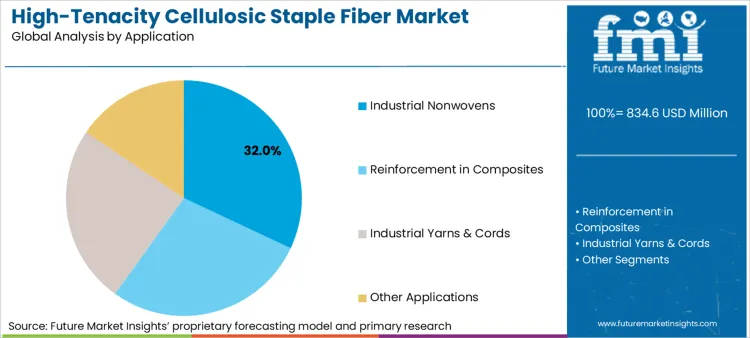
Industrial nonwovens represent 32.0%, driven by use in wipes, filtration media, insulation layers, and technical felts where strength retention and biodegradability are valued. Reinforcement in composites uses these fibers as partial substitutes for glass or synthetic fibers in lightweight or semi-structural applications. Industrial yarns and cords incorporate high-tenacity cellulosic fibers for ropes, tapes, and reinforcement textiles requiring controlled elongation. Other applications include specialty papers, molded fiber products, and engineered textile substrates.
Key Points
- Nonwovens dominate due to process compatibility and sustainability benefits.
- Composite reinforcement supports lightweight and hybrid material designs.
- Industrial yarns leverage controlled strength and elongation behavior.
Which Processing Routes Are Most Common for High-Tenacity Cellulosic Fibers?
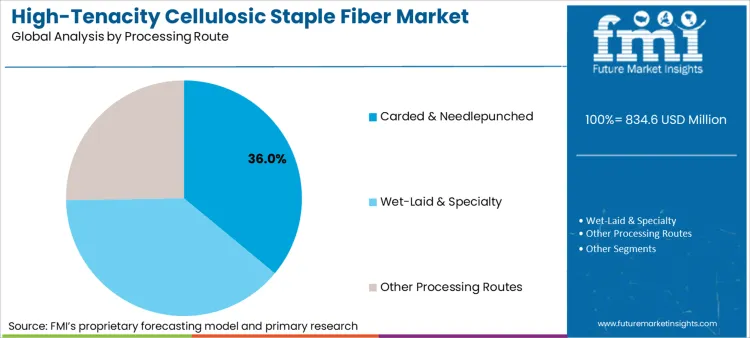
Carded and needlepunched processing accounts for 36.0%, reflecting widespread use in industrial felts, geotextiles, and insulation products. These routes allow efficient fiber orientation and mechanical bonding without chemical binders. Wet-laid and specialty processes are used where uniform fiber dispersion, fine structures, or paper-like webs are required. Other processing routes include air-laid and hybrid systems adapted to specific end-use performance targets.
Key Points
- Carded and needlepunched routes dominate industrial textile production.
- Wet-laid processing supports uniformity and fine-structure applications.
- Alternative routes enable customization for niche technical requirements.
What are the Key Dynamics in the High Tenacity Cellulosic Staple Fiber Market?
Demand for high‑tenacity cellulosic staple fiber is driven by the increasing need for sustainable and high-performance materials in textiles and industrial applications. Manufacturers across the apparel, automotive, and technical textiles sectors prioritize fibers that offer strength, durability, and the ability to withstand harsh conditions. High‑tenacity cellulosic fibers, such as those made from wood pulp or agricultural residues, offer superior tensile strength and abrasion resistance, making them ideal for use in workwear, protective clothing, and industrial fabrics. The global shift towards sustainability and renewable resources also fuels interest in these fibers, as they provide a natural alternative to synthetic materials while meeting performance requirements.
How do application performance requirements shape uptake?
High tenacity cellulosic staple fibers are increasingly adopted in applications requiring superior mechanical properties, such as in workwear, automotive textiles, and industrial fabrics. These fibers offer enhanced tensile strength, enabling garments and materials to resist wear and tear while maintaining their form. In industrial sectors, fibers are used in fabrics that need to endure heavy loads, abrasion, and constant stress, ensuring the longevity and reliability of products like protective clothing, industrial workwear, and safety gear. Additionally, in the automotive industry, high tenacity fibers are used in applications such as seat covers, airbags, and other interior components, where durability is crucial. As consumer demand for more sustainable products grows, these fibers also meet the need for eco-friendly materials that reduce dependence on petroleum-based synthetics.
How do sustainability expectations and supply chain realities influence market growth?
Sustainability expectations are a key driver for the growth of the high‑tenacity cellulosic staple fiber market. With increasing consumer awareness and regulatory pressure on reducing environmental impact, manufacturers are turning to renewable materials, such as plant-based fibers, to reduce their carbon footprint. High‑tenacity cellulosic fibers, derived from sustainably managed forests or agricultural residues, offer a renewable alternative to synthetic fibers and align with the global push for a circular economy.
However, supply chain challenges, such as ensuring consistent feedstock quality and managing the processing costs associated with these fibers, can limit their broader adoption, especially in price-sensitive markets. While these fibers often come at a premium compared to conventional synthetics, their environmental benefits and increasing integration into recycling systems help to justify the cost for brands aiming to meet sustainability goals. As global textile waste management improves and recycling technologies advance, demand for high‑tenacity cellulosic fibers is expected to rise, further supporting their growth across multiple industries.
How Is Demand for the High-Tenacity Cellulosic Staple Fiber Market Evolving Globally?
Global demand for high-tenacity cellulosic staple fibers is rising as industries seek sustainable alternatives to synthetic fibers, particularly in apparel, automotive, and industrial applications. Growth reflects the increasing use of high-performance, eco-friendly fibers in textiles requiring durability, strength, and moisture management. High-tenacity cellulosic fibers offer superior strength-to-weight ratios and biodegradability, making them ideal for products like performance fabrics, ropes, and automotive textiles. China records 8.2% CAGR, Brazil records 7.8% CAGR, USA records 6.7% CAGR, Germany records 6.6% CAGR, and South Korea records 6.2% CAGR. Adoption is driven by the demand for high-performance, sustainable, and versatile fiber solutions.
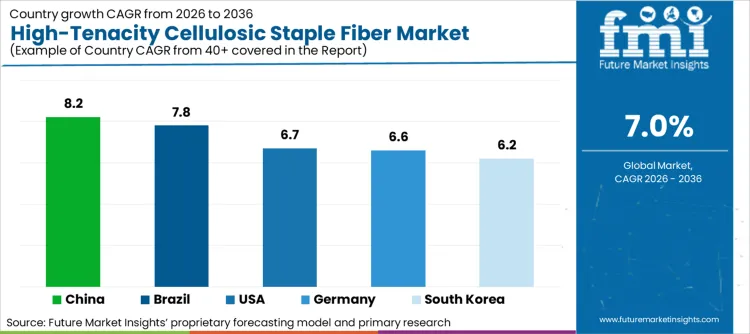
| Country | CAGR (%) |
|---|---|
| China | 8.2% |
| Brazil | 7.8% |
| USA | 6.7% |
| Germany | 6.6% |
| South Korea | 6.2% |
Source: FMI analysis based on primary research and proprietary forecasting model
What is driving growth of high-tenacity cellulosic staple fiber demand in China?
Demand for high-tenacity cellulosic staple fibers in China is expanding as the textile industry adopts more sustainable materials to meet growing demand for eco-friendly textiles. Growth at 8.2% CAGR reflects the increasing use of these fibers in applications like apparel, home textiles, and industrial fabrics, where strength and durability are essential. China’s large-scale textile manufacturing base is shifting towards high-performance, biodegradable alternatives to synthetic fibers, driven by both domestic and export market requirements. Government regulations on plastic reduction and growing consumer preference for sustainable products further accelerate the adoption of high-tenacity cellulosic fibers in various sectors.
- Growth of sustainable textile production
- Increasing adoption in performance fabrics and industrial textiles
- Regulatory pressure on synthetic fibers
- Consumer demand for eco-friendly, biodegradable materials
Why is Brazil seeing expansion in high-tenacity cellulosic staple fiber adoption?
High-tenacity cellulosic staple fiber demand in Brazil is increasing as the country’s textile industry shifts toward sustainable and high-performance materials. Growth at 7.8% CAGR reflects the rising use of these fibers in the production of durable, eco-friendly textiles for apparel, home goods, and industrial applications. Brazil’s textile manufacturers are focusing on replacing petroleum-based fibers with biodegradable, high-strength alternatives that offer improved mechanical properties. The demand for high-tenacity cellulosic fibers is also supported by consumer preferences for environmentally conscious products and the growing emphasis on reducing waste in the textile sector.
- Rising demand for durable and biodegradable textiles
- Focus on replacing petroleum-based fibers with sustainable options
- Consumer-driven demand for eco-conscious products
- Investment in sustainable textile manufacturing processes
What factors are shaping high-tenacity cellulosic staple fiber sales in the USA?
Sales of high-tenacity cellulosic staple fibers in the USA are increasing as industries focus on improving the sustainability of their supply chains. Growth at 6.7% CAGR reflects adoption in high-performance fabrics used in activewear, automotive textiles, and industrial applications. The USA’s growing emphasis on sustainability and reduced reliance on fossil-based materials is driving the shift towards biodegradable, strong, and lightweight fibers. High-tenacity cellulosic fibers are gaining traction due to their superior strength, moisture-wicking properties, and environmental benefits, making them ideal for a wide range of textile applications.
- Focus on sustainable and eco-friendly fiber production
- Increasing use of durable fibers in activewear and industrial textiles
- Consumer demand for high-performance, biodegradable materials
- Government regulations promoting sustainable manufacturing practices
How is Germany supporting growth of high-tenacity cellulosic staple fiber demand?
Germany is supporting growth in high-tenacity cellulosic staple fiber demand as part of its commitment to sustainable textile production and circular economy initiatives. Growth at 6.6% CAGR reflects the increasing adoption of these fibers in eco-friendly textiles, particularly in automotive and technical fabrics. Germany’s stringent sustainability regulations and focus on reducing environmental impact drive the demand for high-performance, biodegradable fibers. The country’s robust textile innovation ecosystem continues to develop new applications for high-tenacity cellulosic fibers, ensuring their adoption in various industrial sectors that require both strength and eco-friendliness.
- Strong regulatory push for sustainable fiber production
- Focus on reducing environmental impact in the textile industry
- Innovation in high-performance textile applications
- Growing demand for biodegradable, durable materials in industrial textiles
What is driving expansion of high-tenacity cellulosic staple fiber demand in South Korea?
Demand for high-tenacity cellulosic staple fibers in South Korea is rising as the textile and automotive industries increasingly prioritize sustainable and high-performance materials. Growth at 6.2% CAGR reflects South Korea’s shift towards high-tenacity fibers for use in durable, lightweight applications such as automotive textiles, performance apparel, and industrial products. South Korea’s advanced manufacturing capabilities, along with consumer demand for eco-friendly products, are driving the adoption of these fibers. The country’s focus on reducing plastic usage and increasing recycling further supports the growth of sustainable alternatives like high-tenacity cellulosic fibers.
- Strong focus on sustainable, high-performance textiles
- Growth of eco-friendly textile production in the automotive and apparel sectors
- Consumer demand for biodegradable and durable materials
- National push to reduce plastic and improve recycling practices
What Defines the Competitive Landscape for the High-Tenacity Cellulosic Staple Fiber Market Globally?
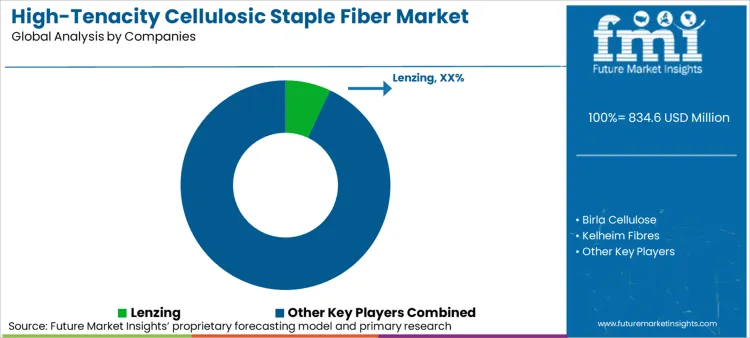
The demand for high-tenacity cellulosic staple fibers is primarily driven by their use in applications that require strength, durability, and eco-friendly properties, such as textiles, nonwovens, and industrial fabrics. Buyers assess fiber performance based on tensile strength, durability under stress, fiber length uniformity, and overall processing efficiency. Additionally, sustainability factors, such as the use of renewable and biodegradable materials, are increasingly important in consumer and industrial markets. Procurement behavior favors manufacturers who can consistently deliver fibers with high-tenacity characteristics while also ensuring that their production processes are environmentally responsible and scalable. The trend in the global market reflects a shift towards more sustainable, high-performance fibers that align with circular economy initiatives.
Lenzing holds strong positioning in the global market with its Tencel® and other branded fibers, which are known for their high-tenacity characteristics and commitment to sustainability. Birla Cellulose competes by offering sustainable, high-strength fibers, leveraging its strong brand recognition and expertise in manufacturing cellulosic fibers for the textile industry. Kelheim Fibres supports demand by producing high-performance fibers, particularly for technical applications, with a focus on quality and performance. Sateri leads in China and other regions with its high-tenacity cellulosic fibers, produced from sustainably sourced wood pulp, offering an eco-friendly solution for textile and industrial applications.
Aditya Birla Group (Grasim) participates by leveraging its extensive supply chain and focus on high-strength fibers for a wide range of uses. Mitsubishi Chemical Group, Eastman, and Tangshan Sanyou provide strong regional competition, offering innovative cellulosic fiber solutions that balance performance and sustainability. Suez Rayon also participates in the market with cost-effective and high-tenacity staple fibers catering to industrial and consumer product segments. Competitive differentiation in the market is based on fiber strength, environmental sustainability, innovation in product applications, and supply chain reliability.
Key Players in the High-Tenacity Cellulosic Staple Fiber Market
- Lenzing
- Birla Cellulose
- Kelheim Fibres
- Sateri
- Tangshan Sanyou
- Aditya Birla Group (Grasim)
- Eastman
- Mitsubishi Chemical Group
- Sateri
- Suez Rayon
Scope of the Report
| Items | Values |
|---|---|
| Quantitative Units | USD million |
| Fiber Type | High-Tenacity Viscose; High-Tenacity Lyocell; Other Cellulosic Fibers |
| Application | Industrial Nonwovens; Reinforcement in Composites; Industrial Yarns & Cords; Other Applications |
| Processing Route | Carded & Needlepunched; Wet-Laid & Specialty; Other Processing Routes |
| Regions Covered | Asia Pacific, Europe, North America, Latin America, Middle East & Africa |
| Countries Covered | China, Brazil, USA, Germany, South Korea, and 40+ countries |
| Key Companies Profiled | Lenzing; Birla Cellulose; Kelheim Fibres; Sateri; Tangshan Sanyou; Aditya Birla Group (Grasim); Eastman; Mitsubishi Chemical Group; Sateri; Suez Rayon |
| Additional Attributes | Dollar sales by fiber type, application, and processing route; advancements in high-tenacity fiber manufacturing; growing demand for industrial and reinforcement applications in textiles and composites; focus on sustainability in cellulosic fiber production; procurement trends towards cost-effective, high-strength fibers. |
High-Tenacity Cellulosic Staple Fiber Market by Segment
Fiber Type:
- High-Tenacity Viscose
- High-Tenacity Lyocell
- Other Cellulosic Fibers
Application:
- Industrial Nonwovens
- Reinforcement in Composites
- Industrial Yarns & Cords
- Other Applications
Processing Route:
- Carded & Needlepunched
- Wet-Laid & Specialty
- Other Processing Routes
Region:
- Asia Pacific
- China
- Japan
- South Korea
- India
- Australia & New Zealand
- ASEAN
- Rest of Asia Pacific
- Europe
- Germany
- United Kingdom
- France
- Italy
- Spain
- Nordic
- BENELUX
- Rest of Europe
- North America
- United States
- Canada
- Mexico
- Latin America
- Brazil
- Chile
- Rest of Latin America
- Middle East & Africa
- Kingdom of Saudi Arabia
- Other GCC Countries
- Turkey
- South Africa
- Other African Union
- Rest of Middle East & Africa
Bibliography
- European Commission. (2023). Sustainable and circular textiles strategy: Implications for regenerated and cellulosic fibres. Publications Office of the European Union.
- OECD. (2023). Circular economy approaches for fibre-based materials and industrial textiles. OECD Publishing.
- International Organization for Standardization. (2024). ISO 13934-1: Textiles-Using tensile testing to evaluate fibre and fabric strength. ISO.
- European Apparel and Textile Confederation. (2023). Substitution of synthetic fibres with regenerated cellulosic materials in industrial textiles. EURATEX.
Frequently Asked Questions
How big is the high-tenacity cellulosic staple fiber market in 2026?
The global high-tenacity cellulosic staple fiber market is estimated to be valued at USD 834.6 million in 2026.
What will be the size of high-tenacity cellulosic staple fiber market in 2036?
The market size for the high-tenacity cellulosic staple fiber market is projected to reach USD 1,641.8 million by 2036.
How much will be the high-tenacity cellulosic staple fiber market growth between 2026 and 2036?
The high-tenacity cellulosic staple fiber market is expected to grow at a 7.0% CAGR between 2026 and 2036.
What are the key product types in the high-tenacity cellulosic staple fiber market?
The key product types in high-tenacity cellulosic staple fiber market are high-tenacity viscose, high-tenacity lyocell and other cellulosic fibers.
Which application segment to contribute significant share in the high-tenacity cellulosic staple fiber market in 2026?
In terms of application, industrial nonwovens segment to command 32.0% share in the high-tenacity cellulosic staple fiber market in 2026.
Preview the report firsthand - request a free sample
Get SampleGet the brochure for pricing and purchase details.
Get PDFTable of Content
- Executive Summary
- Global Market Outlook
- Demand-side Trends
- Supply-side Trends
- Technology Roadmap Analysis
- Analysis and Recommendations
- Market Overview
- Market Coverage / Taxonomy
- Market Definition / Scope / Limitations
- Market Background
- Market Dynamics
- Drivers
- Restraints
- Opportunity
- Trends
- Scenario Forecast
- Demand in Optimistic Scenario
- Demand in Likely Scenario
- Demand in Conservative Scenario
- Opportunity Map Analysis
- Product Life Cycle Analysis
- Supply Chain Analysis
- Investment Feasibility Matrix
- Value Chain Analysis
- PESTLE and Porter’s Analysis
- Regulatory Landscape
- Regional Parent Market Outlook
- Production and Consumption Statistics
- Import and Export Statistics
- Market Dynamics
- Global Market Analysis 2021 to 2025 and Forecast, 2026 to 2036
- Historical Market Size Value (USD Million) Analysis, 2021 to 2025
- Current and Future Market Size Value (USD Million) Projections, 2026 to 2036
- Y-o-Y Growth Trend Analysis
- Absolute $ Opportunity Analysis
- Global Market Pricing Analysis 2021 to 2025 and Forecast 2026 to 2036
- Global Market Analysis 2021 to 2025 and Forecast 2026 to 2036, By Fiber Type
- Introduction / Key Findings
- Historical Market Size Value (USD Million) Analysis By Fiber Type , 2021 to 2025
- Current and Future Market Size Value (USD Million) Analysis and Forecast By Fiber Type , 2026 to 2036
- High-Tenacity Viscose
- High-Tenacity Lyocell
- Other Cellulosic Fibers
- High-Tenacity Viscose
- Y-o-Y Growth Trend Analysis By Fiber Type , 2021 to 2025
- Absolute $ Opportunity Analysis By Fiber Type , 2026 to 2036
- Global Market Analysis 2021 to 2025 and Forecast 2026 to 2036, By Application
- Introduction / Key Findings
- Historical Market Size Value (USD Million) Analysis By Application, 2021 to 2025
- Current and Future Market Size Value (USD Million) Analysis and Forecast By Application, 2026 to 2036
- Industrial Nonwovens
- Reinforcement in Composites
- Industrial Yarns & Cords
- Other Applications
- Industrial Nonwovens
- Y-o-Y Growth Trend Analysis By Application, 2021 to 2025
- Absolute $ Opportunity Analysis By Application, 2026 to 2036
- Global Market Analysis 2021 to 2025 and Forecast 2026 to 2036, By Processing Route
- Introduction / Key Findings
- Historical Market Size Value (USD Million) Analysis By Processing Route, 2021 to 2025
- Current and Future Market Size Value (USD Million) Analysis and Forecast By Processing Route, 2026 to 2036
- Carded & Needlepunched
- Wet-Laid & Specialty
- Other Processing Routes
- Carded & Needlepunched
- Y-o-Y Growth Trend Analysis By Processing Route, 2021 to 2025
- Absolute $ Opportunity Analysis By Processing Route, 2026 to 2036
- Global Market Analysis 2021 to 2025 and Forecast 2026 to 2036, By Region
- Introduction
- Historical Market Size Value (USD Million) Analysis By Region, 2021 to 2025
- Current Market Size Value (USD Million) Analysis and Forecast By Region, 2026 to 2036
- North America
- Latin America
- Western Europe
- Eastern Europe
- East Asia
- South Asia and Pacific
- Middle East & Africa
- Market Attractiveness Analysis By Region
- North America Market Analysis 2021 to 2025 and Forecast 2026 to 2036, By Country
- Historical Market Size Value (USD Million) Trend Analysis By Market Taxonomy, 2021 to 2025
- Market Size Value (USD Million) Forecast By Market Taxonomy, 2026 to 2036
- By Country
- USA
- Canada
- Mexico
- By Fiber Type
- By Application
- By Processing Route
- By Country
- Market Attractiveness Analysis
- By Country
- By Fiber Type
- By Application
- By Processing Route
- Key Takeaways
- Latin America Market Analysis 2021 to 2025 and Forecast 2026 to 2036, By Country
- Historical Market Size Value (USD Million) Trend Analysis By Market Taxonomy, 2021 to 2025
- Market Size Value (USD Million) Forecast By Market Taxonomy, 2026 to 2036
- By Country
- Brazil
- Chile
- Rest of Latin America
- By Fiber Type
- By Application
- By Processing Route
- By Country
- Market Attractiveness Analysis
- By Country
- By Fiber Type
- By Application
- By Processing Route
- Key Takeaways
- Western Europe Market Analysis 2021 to 2025 and Forecast 2026 to 2036, By Country
- Historical Market Size Value (USD Million) Trend Analysis By Market Taxonomy, 2021 to 2025
- Market Size Value (USD Million) Forecast By Market Taxonomy, 2026 to 2036
- By Country
- Germany
- UK
- Italy
- Spain
- France
- Nordic
- BENELUX
- Rest of Western Europe
- By Fiber Type
- By Application
- By Processing Route
- By Country
- Market Attractiveness Analysis
- By Country
- By Fiber Type
- By Application
- By Processing Route
- Key Takeaways
- Eastern Europe Market Analysis 2021 to 2025 and Forecast 2026 to 2036, By Country
- Historical Market Size Value (USD Million) Trend Analysis By Market Taxonomy, 2021 to 2025
- Market Size Value (USD Million) Forecast By Market Taxonomy, 2026 to 2036
- By Country
- Russia
- Poland
- Hungary
- Balkan & Baltic
- Rest of Eastern Europe
- By Fiber Type
- By Application
- By Processing Route
- By Country
- Market Attractiveness Analysis
- By Country
- By Fiber Type
- By Application
- By Processing Route
- Key Takeaways
- East Asia Market Analysis 2021 to 2025 and Forecast 2026 to 2036, By Country
- Historical Market Size Value (USD Million) Trend Analysis By Market Taxonomy, 2021 to 2025
- Market Size Value (USD Million) Forecast By Market Taxonomy, 2026 to 2036
- By Country
- China
- Japan
- South Korea
- By Fiber Type
- By Application
- By Processing Route
- By Country
- Market Attractiveness Analysis
- By Country
- By Fiber Type
- By Application
- By Processing Route
- Key Takeaways
- South Asia and Pacific Market Analysis 2021 to 2025 and Forecast 2026 to 2036, By Country
- Historical Market Size Value (USD Million) Trend Analysis By Market Taxonomy, 2021 to 2025
- Market Size Value (USD Million) Forecast By Market Taxonomy, 2026 to 2036
- By Country
- India
- ASEAN
- Australia & New Zealand
- Rest of South Asia and Pacific
- By Fiber Type
- By Application
- By Processing Route
- By Country
- Market Attractiveness Analysis
- By Country
- By Fiber Type
- By Application
- By Processing Route
- Key Takeaways
- Middle East & Africa Market Analysis 2021 to 2025 and Forecast 2026 to 2036, By Country
- Historical Market Size Value (USD Million) Trend Analysis By Market Taxonomy, 2021 to 2025
- Market Size Value (USD Million) Forecast By Market Taxonomy, 2026 to 2036
- By Country
- Kingdom of Saudi Arabia
- Other GCC Countries
- Turkiye
- South Africa
- Other African Union
- Rest of Middle East & Africa
- By Fiber Type
- By Application
- By Processing Route
- By Country
- Market Attractiveness Analysis
- By Country
- By Fiber Type
- By Application
- By Processing Route
- Key Takeaways
- Key Countries Market Analysis
- USA
- Pricing Analysis
- Market Share Analysis, 2025
- By Fiber Type
- By Application
- By Processing Route
- Canada
- Pricing Analysis
- Market Share Analysis, 2025
- By Fiber Type
- By Application
- By Processing Route
- Mexico
- Pricing Analysis
- Market Share Analysis, 2025
- By Fiber Type
- By Application
- By Processing Route
- Brazil
- Pricing Analysis
- Market Share Analysis, 2025
- By Fiber Type
- By Application
- By Processing Route
- Chile
- Pricing Analysis
- Market Share Analysis, 2025
- By Fiber Type
- By Application
- By Processing Route
- Germany
- Pricing Analysis
- Market Share Analysis, 2025
- By Fiber Type
- By Application
- By Processing Route
- UK
- Pricing Analysis
- Market Share Analysis, 2025
- By Fiber Type
- By Application
- By Processing Route
- Italy
- Pricing Analysis
- Market Share Analysis, 2025
- By Fiber Type
- By Application
- By Processing Route
- Spain
- Pricing Analysis
- Market Share Analysis, 2025
- By Fiber Type
- By Application
- By Processing Route
- France
- Pricing Analysis
- Market Share Analysis, 2025
- By Fiber Type
- By Application
- By Processing Route
- India
- Pricing Analysis
- Market Share Analysis, 2025
- By Fiber Type
- By Application
- By Processing Route
- ASEAN
- Pricing Analysis
- Market Share Analysis, 2025
- By Fiber Type
- By Application
- By Processing Route
- Australia & New Zealand
- Pricing Analysis
- Market Share Analysis, 2025
- By Fiber Type
- By Application
- By Processing Route
- China
- Pricing Analysis
- Market Share Analysis, 2025
- By Fiber Type
- By Application
- By Processing Route
- Japan
- Pricing Analysis
- Market Share Analysis, 2025
- By Fiber Type
- By Application
- By Processing Route
- South Korea
- Pricing Analysis
- Market Share Analysis, 2025
- By Fiber Type
- By Application
- By Processing Route
- Russia
- Pricing Analysis
- Market Share Analysis, 2025
- By Fiber Type
- By Application
- By Processing Route
- Poland
- Pricing Analysis
- Market Share Analysis, 2025
- By Fiber Type
- By Application
- By Processing Route
- Hungary
- Pricing Analysis
- Market Share Analysis, 2025
- By Fiber Type
- By Application
- By Processing Route
- Kingdom of Saudi Arabia
- Pricing Analysis
- Market Share Analysis, 2025
- By Fiber Type
- By Application
- By Processing Route
- Turkiye
- Pricing Analysis
- Market Share Analysis, 2025
- By Fiber Type
- By Application
- By Processing Route
- South Africa
- Pricing Analysis
- Market Share Analysis, 2025
- By Fiber Type
- By Application
- By Processing Route
- USA
- Market Structure Analysis
- Competition Dashboard
- Competition Benchmarking
- Market Share Analysis of Top Players
- By Regional
- By Fiber Type
- By Application
- By Processing Route
- Competition Analysis
- Competition Deep Dive
- Lenzing
- Overview
- Product Portfolio
- Profitability by Market Segments (Product/Age /Sales Channel/Region)
- Sales Footprint
- Strategy Overview
- Marketing Strategy
- Product Strategy
- Channel Strategy
- Birla Cellulose
- Kelheim Fibres
- Sateri
- Tangshan Sanyou
- Aditya Birla Group (Grasim)
- Eastman
- Mitsubishi Chemical Group
- Sateri
- Suez Rayon
- Lenzing
- Competition Deep Dive
- Assumptions & Acronyms Used
- Research Methodology


