

- Market Size (2026)
- USD 367.2 Mn
- Forecast (2036)
- USD 756.8 Mn
- CAGR (2026 to 2036)
- 7.5%
Low-Pilling High-Tenacity Cellulosic Staple Fiber Market
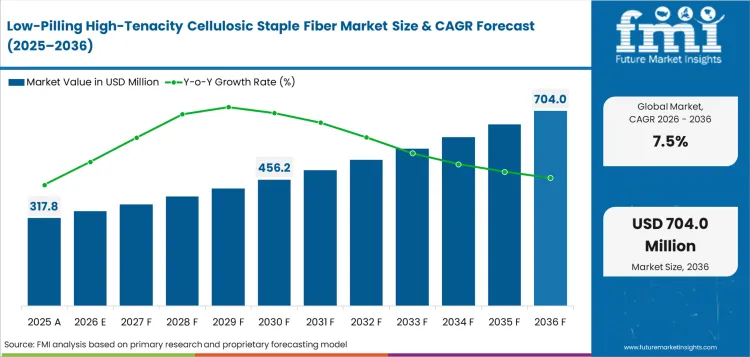
The low-pilling high-tenacity cellulosic staple fiber market was valued at USD 341.6 million in 2025. The market is forecast to reach USD 367.2 million by the end of 2026 and expand at a CAGR of 7.5% between 2026 and 2036 to reach USD 756.8 million by 2036. Apparel brands are expected to lead with a 41.0% end-user share, and high-tenacity viscose is expected to lead the fiber type segment with a 36.0% share.
Fabric surface failure is becoming a buying risk for apparel brands and mills using cellulosic fibers in frequent-wash products. ASTM’s 2024 fabric test listing connects pilling resistance with breaking force and elongation, giving buyers a firmer basis for low-pill fiber approval. Eastman’s April 2025 Naia Renew evidence links reduced pilling with shape retention after repeated wear and washing, helping cellulosic staple fibers enter activewear and home textile fillings.
Sateri’s September 2025 disclosure adds the supply-side signal, with four Shandong Lyocell lines planned at more than 150,000 tonnes each. Large planned capacity matters for mills since low-pill specialty fibers need repeatable lots before bulk fabric programs start. Textile Exchange’s 2025 fiber data adds the substitution pressure, with polyester holding 59% of 2024 global fiber output. Cellulosic suppliers need proof of surface durability and reliable volume access to win programs beyond premium softness claims.
Summary of the Low-Pilling High-Tenacity Cellulosic Staple Fiber Market
- Demand and Growth Drivers
- Fabric appearance needs raise demand for low-pilling cellulosic fibers as apparel brands reduce surface fuzz complaints.
- Wash durability needs lift fiber-level testing as performance apparel must retain softness across repeated use.
- Mill conversion needs reinforce demand for familiar cellulose grades with better tensile strength and lower trial waste.
- Product and Segment View
- High-tenacity viscose is expected to lead the fiber type segment with 36.0% share in 2026, reflecting spinning familiarity.
- Low-fibrillation fiber is expected to lead pilling control demand with 34.0% share in 2026, reflecting stronger surface stability.
- Performance apparel is expected to hold high-value application demand as activewear fabrics face frequent wash cycles.
- Geography and Competitive Outlook
- China is forecast to advance at 8.5% CAGR through 2036 with textile conversion clusters accelerating grade qualification.
- India’s market is projected to rise at 8.0% CAGR by 2036 as garment exporters require stronger fabric performance standards.
- Companies combining cellulose chemistry depth with fabric-test records are improving supplier position during the forecast period.
- Analyst Opinion
- Nikhil Kaitwade, Principal Consultant for Chemicals and Materials at FMI says, “Low-pilling high-tenacity cellulosic staple fiber is turning into a stricter specification for apparel fabrics. Brands need softer cloth with fewer surface defects after wear. Mills need stable bale quality and lower trial waste. Pulp cost and finishing control still strain margins.”
- Low-Pilling High-Tenacity Cellulosic Staple Fiber Market Value Analysis
- The low-pilling high-tenacity cellulosic staple fiber market is developing from standard cellulose supply into a performance textile input category.
- Apparel programs are using more softer fabrics with better resistance to fuzz formation.
- The market is supported by deeper use of high-tenacity cellulosic staple fiber across durable textile programs.
- Wash-tested surface performance is raising demand across apparel and home textile fabric applications.
Key Takeaways
- The low-pilling high-tenacity cellulosic staple fiber market was valued at USD 341.6 million in 2025.
- By 2036, the low-pilling high-tenacity cellulosic staple fiber market is expected to be worth USD 756.8 million.
- From 2026 to 2036, the market is projected to expand at a CAGR of 7.5%.
- The market is projected to create an incremental opportunity of USD 389.6 million between 2026 and 2036.
- In 2026, apparel brands are expected to account for 41.0% of end-user demand.
- China at 8.5% and India at 8.0% are two of the faster-growing country markets.
Low-Pilling High-Tenacity Cellulosic Staple Fiber Market Definition
The low-pilling high-tenacity cellulosic staple fiber market includes regenerated cellulose staple fibers engineered for higher tensile strength and lower surface fuzz. These fibers serve apparel, workwear, home textile, knitwear, and technical textile applications. Scope includes viscose, lyocell, modal, acetate, and modified cellulose staple grades. Finished garments and standard cellulosic fibers without low-pilling performance claims are outside the scope.
Low-Pilling High-Tenacity Cellulosic Staple Fiber Market Inclusions
Market scope covers all commercially traded low-pilling high-tenacity cellulosic staple fiber products categorized by fiber type such as high-tenacity viscose and high-tenacity lyocell. Pilling control scope covers low-fibrillation fiber, air-jet spun blends, enzyme-ready fiber, modified cross-section fiber, and finish-assisted fiber. Application scope includes performance apparel, workwear, home textiles, knitwear, and technical textiles. Revenue scope covers 2026 to 2036. Key stakeholders include cellulosic fiber producers, dissolving pulp suppliers, yarn spinners, fabric mills, apparel brands, uniform suppliers, home textile producers, textile testing laboratories, distributors, and certification bodies.
Low-Pilling High-Tenacity Cellulosic Staple Fiber Market Exclusions
Scope does not include finished apparel sales, conventional viscose without low-pill claims, synthetic staple fibers, yarn trading without fiber specification, or standalone textile finishing chemicals.
Low-Pilling High-Tenacity Cellulosic Staple Fiber Market Research Methodology
- Primary Research: FMI analysts interviewed fiber producers, yarn spinners, fabric mills, and apparel sourcing teams in major markets.
- Desk Research: FMI combined data from textile production sources, company fiber portfolios, and buyer specifications for low-pill fabric performance.
- Market sizing and forecasting: FMI added fiber use across end users and application groups from the bottom up.
- Data validation: Cross-checked every three months against fiber price bands, mill acceptance patterns, and company portfolio coverage.
Why is the Low-Pilling High-Tenacity Cellulosic Staple Fiber Market Growing?
- Apparel brands are adopting low-pill fiber specifications earlier to reduce returns caused by fabric surface defects.
- Fabric mills are qualifying specialty cellulose fiber grades as buyers request better wash appearance.
- Yarn spinners are testing staple fibers with better strength to cut breakage risk during conversion.
Apparel fiber selection is now a durability decision as brands seek fewer appearance complaints after washing. Textile Exchange reported in September 2025 that global fiber production reached about 132 million tonnes in 2024. Polyester accounted for 59% of total output, pushing cellulosic suppliers to prove fabric performance beyond softness. Low-pilling cellulose grades help mills address this performance gap through better surface stability and stronger yarn behavior. Buyers gain a practical way to reduce fuzz complaints without moving fully into synthetic fiber systems.
Input cost control shapes adoption of specialty regenerated cellulose fibers. FAO reported in December 2025 that global wood and paper product exports reached USD 486 billion in 2024. Wood pulp production rose 3% in 2024, giving fiber producers a more stable base for longer specialty production runs. Low-pill high-tenacity grades need stable pulp quality as fiber strength and surface behavior are both controlled upstream. Mills benefit through fewer batch changes and more reliable shipment planning.
Market Segmentation Analysis
- High-tenacity viscose is projected to represent 36.0% of the fiber type segment in 2026, supported by steady acceptance across apparel mills.
- Low-fibrillation fiber is expected to hold 34.0% share in pilling control applications in 2026 as mills prioritize surface-stable fabrics.
- Performance apparel is forecast to capture 33.0% of application share in 2026 because of frequent wash cycles and wear exposure.
- Ring spun yarn is estimated to make up 31.0% of yarn system use in 2026, because mills know the process and softer fabric hand.
Apparel brands are projected to account for 41.0% of end-user participation in 2026 as fabric quality programs move closer to brand approval teams.
The market for low-pilling high-tenacity cellulosic staple fiber is divided into five primary segment groups based on fiber type, pilling control, application, yarn system, and end user. Fiber type includes high-tenacity viscose, high-tenacity lyocell, low-pill modal, cellulose acetate, and other fibers. Pilling control includes low-fibrillation fiber, air-jet spun blends, enzyme-ready fiber, modified cross-section, and finish-assisted fiber. Application includes performance apparel, workwear, home textiles, knitwear, and technical textiles. Yarn system includes ring spun yarn, compact yarn, air-jet yarn, open-end yarn, and core-spun yarn. End user includes apparel brands, fabric mills, yarn spinners, uniform suppliers, and home textile producers.
Insights into Low-Pilling High-Tenacity Cellulosic Staple Fiber Market by Fiber Type
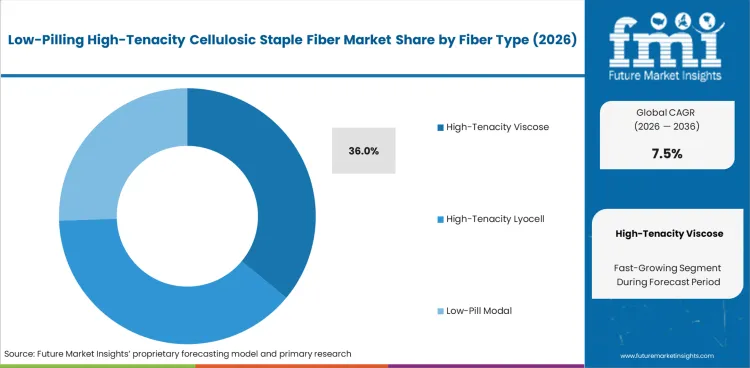
- In 2026, high-tenacity viscose is estimated to account for 36.0% of the fiber type segment. Familiar spinning behavior supports mill acceptance and helps reduce trial loss during fabric approval.
- High-tenacity lyocell serves premium apparel and technical textile programs requiring stronger wet strength. This fiber gains preference in fabrics needing softness with better surface performance.
Insights into Low-Pilling High-Tenacity Cellulosic Staple Fiber Market by Pilling Control
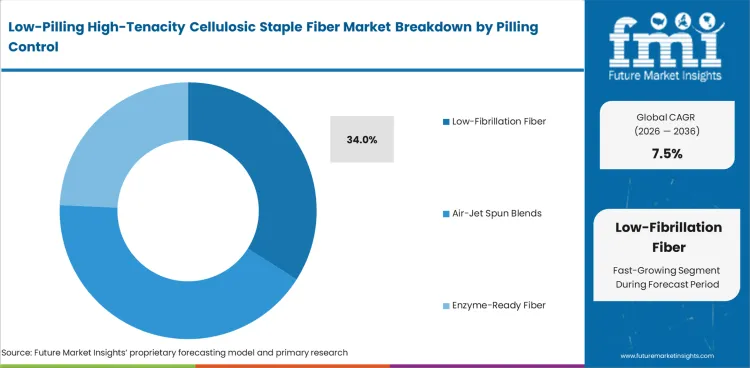
- low-fibrillation fiber is expected to hold 34.0% of the pilling control segment in 2026. Fiber-level surface stability helps limit fuzz formation before finishing and wash testing.
- Finish-assisted fiber grades serve fabric programs needing added surface control after spinning. Use is stronger in applications requiring better wash appearance without major yarn changes.
Insights into Low-Pilling High-Tenacity Cellulosic Staple Fiber Market by Application
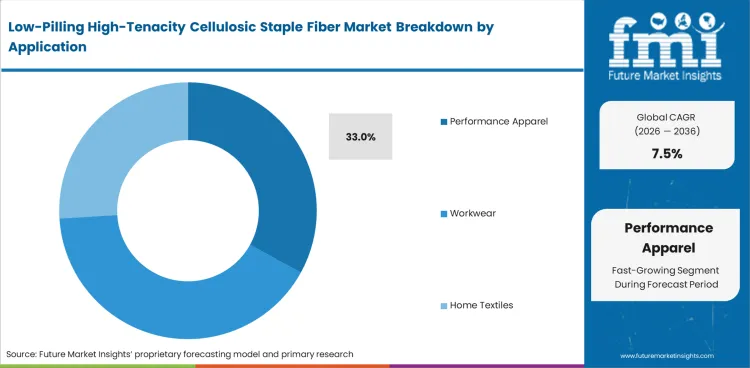
- performance apparel is forecast to account for 33.0% of the application segment in 2026. Frequent washing and body movement raise the need for stronger fiber surfaces.
- Workwear and home textile applications support demand across longer replacement cycles and repeated laundering. These programs need comfort and surface durability in the same fabric specification.
Insights into Low-Pilling High-Tenacity Cellulosic Staple Fiber Market by Yarn System
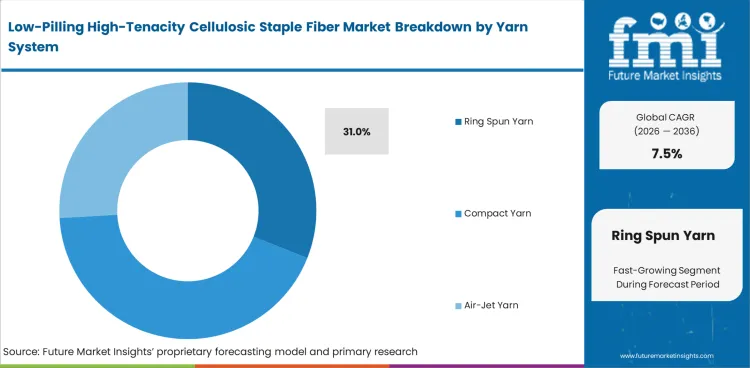
- ring spun yarn is projected to account for 31.0% of the yarn system segment in 2026. Mills prefer this system for softer fabric hand and easier blend control.
- Compact yarn and air-jet yarn serve programs requiring tighter surface control after spinning. Their use is stronger in low-fuzz fabrics needing stable appearance after repeated washing.
Insights into Low-Pilling High-Tenacity Cellulosic Staple Fiber Market by End User
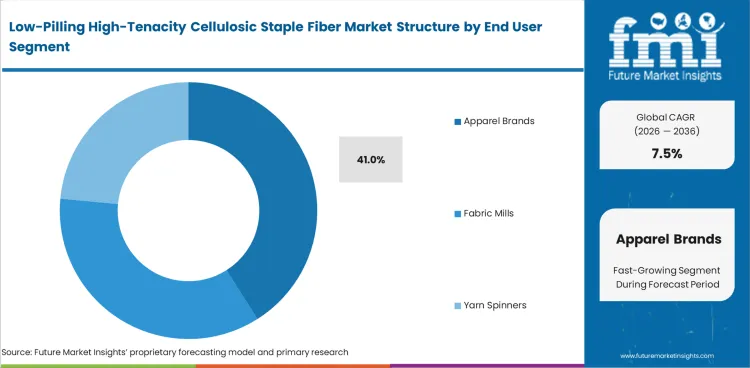
- apparel brands are projected to account for 41.0% of the end-user segment in 2026. Brand teams prioritize low-pilling textile staples to reduce returns and protect product ratings.
- Fabric mills and yarn spinners favor bulk conversion once fiber grades pass brand trials. Their role expands after approved fabrics move into bulk production programs.
Low-Pilling High-Tenacity Cellulosic Staple Fiber Market Drivers, Restraints, and Opportunities
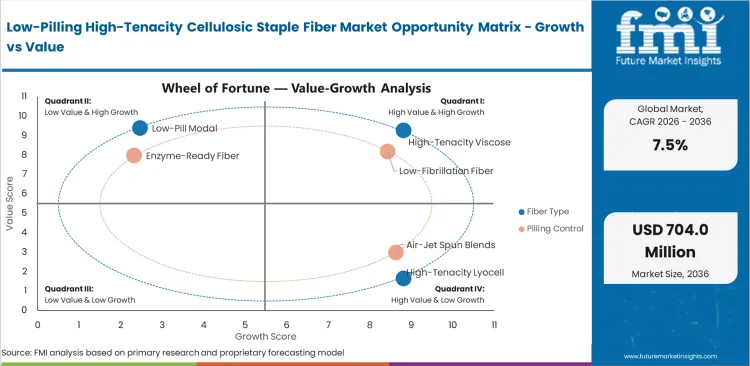
- Fiber-level pilling control creates structured demand for cellulose grades with better surface stability.
- Apparel return pressure raises interest in low-shedding synthetic textile fibers and low-pill cellulose alternatives.
- Dissolving pulp and finish control increase price pressure for specialty fiber producers.
- Enzyme-ready fabric programs create an opportunity for enzyme-ready finishing fibers and low-fuzz cellulose blends.
Low-pilling high-tenacity cellulosic staple fiber demand is expected to rise as apparel and textile mills need softer fabrics with better surface stability after repeated washing. Cost pressure from dissolving pulp and tighter fiber finishing can slow broader use. Demand is concentrated in performance apparel and home textile applications.
Cotton Benchmarks Limit Cellulosic Premiums
In February 2026, USDA projected the 2026/27 cotton A-Index at 78 cents/lb, only 2 cents above 2025/26. The USA upland farm price was expected to move to 63 cents/lb from 60 cents/lb. For low-pilling high-tenacity cellulosic staple fiber, this keeps the substitute benchmark tight: apparel mills can compare viscose, modal, and lyocell staple against a still-soft cotton price floor instead of accepting wide premium increases.
Producers seeking price increases will need to justify them through lower pilling claims, higher yarn strength, reduced blending loss, and certified pulp sourcing. The practical implication is selective pass-through, rather than a blanket price reset, especially in cotton-rich knit and woven programs.
Cellulose suppliers can gain if they help exporters meet buyer standards without adding rework.
Dissolving Pulp Duties Raise Cost Exposure
In March 2026, the USA Department of Commerce preliminarily set a 3.67% ad valorem countervailable subsidy rate on high-purity dissolving pulp from Brazil, with cash deposits to be required on covered entries. The scope is commercially relevant because it covers pulp with alpha cellulose of 90% or higher and brightness of 90% or higher, the type of specification that supports consistent staple spinning and higher-tenacity cellulosic fiber programs.
The measure does not automatically raise global fiber prices. It lifts landed-cost uncertainty for buyers with USA exposure and weakens spot leverage when approved pulp sources are limited. Mills should expect suppliers to separate commodity viscose offers from low-pilling, high-tenacity grades with documented pulp qualification.
Analysis of Low-Pilling High-Tenacity Cellulosic Staple Fiber Market By Key Countries
.webp "Top Country Growth Comparison Low Pilling High Tenacity Cellulosic Staple Fiber Market Cagr (2026 2036)")
| Country | CAGR |
|---|---|
| China | 8.5% |
| India | 8.0% |
| USA | 6.7% |
| Germany | 5.1% |
| UK | 4.2% |
Source: Future Market Insights, 2026.
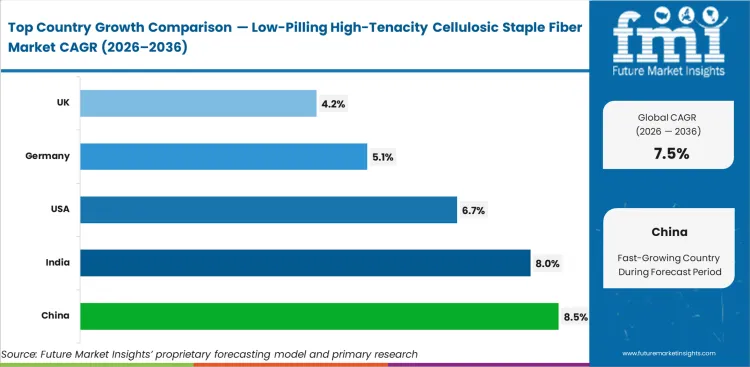
Low-Pilling High-Tenacity Cellulosic Staple Fiber Market CAGR Analysis By Country
- China is forecast to record an 8.5% CAGR through 2036 as dense textile clusters shorten fiber trial cycles.
- India is estimated to grow at 8.0% CAGR from 2026 to 2036 as apparel export scale and stronger mill interest in specialty cellulosic blends.
- The United States is projected to record 6.7% CAGR by 2036 because of fabric import scrutiny and brand focus on surface durability.
- Germany’s 5.1% CAGR and the UK’s 4.2% CAGR indicate measured expansion across mature apparel supply bases.
Demand for low-pilling high-tenacity cellulosic staple fiber is forecast to rise at 7.5% CAGR from 2026 to 2036. Country-level analysis covers the major markets contributing to this forecast, with the markets listed below.
Demand Outlook for Low-Pilling High-Tenacity Cellulosic Staple Fiber Market in China
China’s low-pilling high-tenacity cellulosic staple fiber industry is projected to record a CAGR of 8.5% through 2036. China Customs listed textile yarn, fabrics, and related articles exports at USD 13,134.6 million in December 2024. This export scale supports low-pilling high-tenacity cellulosic staple fiber demand in China as mills serve volume apparel and fabric buyers. Local lyocell and viscose capacity offers converters faster access to test lots. Suppliers with consistent surface performance can move from trials into routine fabric programs.
- Local fabric conversion scale raises demand for pilling-tested cellulosic staple fiber grades.
- Domestic lyocell capacity helps mills test surface-stable apparel fabrics and blended textile substrates.
- Export mills need fiber suppliers for repeatable bale strength and wash appearance records.
Sales Analysis of Low-Pilling High-Tenacity Cellulosic Staple Fiber Market in India
The low-pilling high-tenacity cellulosic staple fiber sector in India is expected to expand at a CAGR of 8.0% during the assessment period. India’s textile and apparel exports reached USD 37.75 billion in 2024-25, according to the Ministry of Textiles. This export base supports low-pilling high-tenacity cellulosic staple fiber demand in India as mills pursue better fabric ratings. Readymade garments and man-made textiles create practical use cases for low-pill blends. Local suppliers can gain through fabric approval help and stronger yarn conversion data.
- Export apparel programs raise demand for fiber grades with wash-tested surface behavior.
- Mill buyers need sweat-resistant apparel inputs with softness and low fuzz performance.
- Domestic converters need fiber partners to reduce trial loss during blend approval.
Demand Outlook for Low-Pilling High-Tenacity Cellulosic Staple Fiber Market in the United States
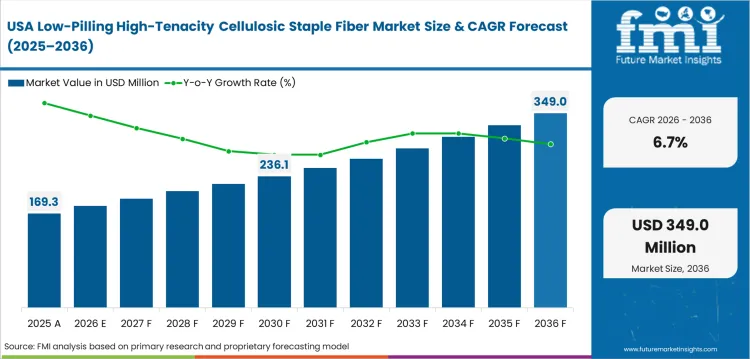
The USA low-pilling high-tenacity cellulosic staple fiber industry is forecast to grow at a CAGR of 6.7% by 2036. USA textile and apparel imports were 49,455.6 MSME for the year to date through June 2025, according to the Office of Textiles and Apparel. The import base keeps brand teams focused on fabric inspection and surface quality claims. Low-pill cellulosic fibers help mills serve buyers seeking comfort and longer product appearance. Supplier value improves with documented pilling ratings and consistent hand feel.
- Apparel import scale keeps fiber qualification connected to fabric durability and return reduction.
- Performance apparel buyers compare low-pill cellulose against polyester fiber blends for comfort and surface control.
- Brand programs favor suppliers with repeatable test records across ring and air-jet yarn systems.
Opportunity Analysis of Low-Pilling High-Tenacity Cellulosic Staple Fiber Market in Germany
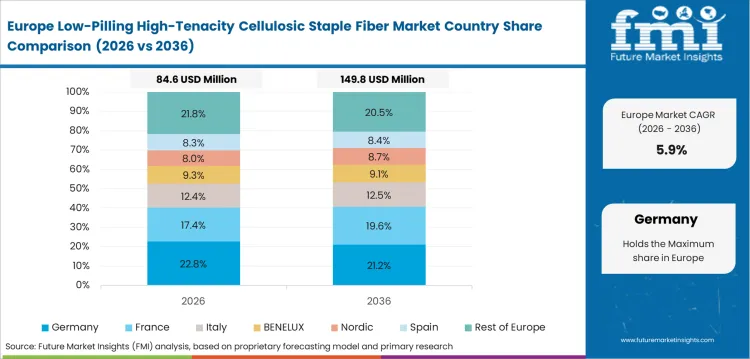
The low-pilling high-tenacity cellulosic staple fiber segment in Germany is projected to advance at 5.1% CAGR over the forecast years. Germany’s textile base is shaped by technical fabrics and premium apparel sourcing. As per the Germany Trade & Invest October 2024 report, Reju opened its textile-to-textile operating unit in western Germany. The recycling activity raises interest in fiber systems designed for durability and repeat use. Suppliers serving Germany need proof of pilling control and compatibility with blended fibers used in premium fabric lines.
- Technical fabric buyers raise demand for cellulose grades with tested surface performance.
- Premium apparel mills need fiber inputs to protect hand feel across repeated laundering.
- Circular textile projects increase openings for recycled polyester apparel fiber and cellulose blend platforms.
Future Outlook for Low-Pilling High-Tenacity Cellulosic Staple Fiber Market in the United Kingdom
The UK low-pilling high-tenacity cellulosic staple fiber industry is expected to post 4.2% CAGR through 2036. UK fashion demand is shaped by online retail and buyer reviews. According to the International Trade Administration's February 2026 report, UK eCommerce sales increased by nearly 30% in 2024-2025. Fashion was listed among the top eCommerce product categories. The online retail base supports UK low-pilling high-tenacity cellulosic staple fiber demand as surface appearance affects online ratings. Suppliers with better wash appearance data can serve apparel brands and fabric buyers.
- Online fashion sales raise pressure for fabrics that keep a smooth surface after repeated use.
- UK brand buyers value technical textiles knowledge in performance apparel and workwear programs.
- Suppliers with transparent fiber records can reduce buyer risk across private-label apparel ranges.
Competitive Landscape and Strategic Positioning
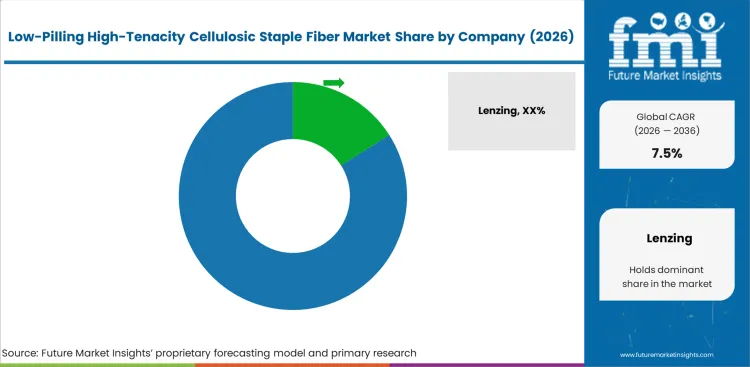
Low-Pilling High-Tenacity Cellulosic Staple Fiber Market Analysis By Company
- Lenzing uses TENCEL Lyocell and Modal fiber portfolios with strong apparel mill relationships across major fabric programs.
- Eastman and Birla Cellulose emphasize branded cellulosic fibers designed for casualwear and apparel fabric development.
- Specialist viscose and lyocell producers focus on fiber modification and low-fuzz behavior for regional mill programs.
Competition in the low-pilling high-tenacity cellulosic staple fiber market centers on proven fiber performance and acceptance across brand-approved mill programs. Lenzing holds a defensible position through branded lyocell and modal platforms used in apparel and technical textiles. Eastman serves casualwear programs through Naia staple fiber with reduced pilling claims and comfort-focused positioning. Birla Cellulose addresses apparel programs through viscose and lyocell blends with recycled content options. Sateri and Kelheim Fibres focus on cellulose chemistry and scalable fiber supply.
Competitive barriers include dissolving pulp cost, bale consistency, and proof of surface durability after repeated washing. Fiber producers need stronger surface control and faster mill trials to manage long apparel approval cycles. Buyers favor suppliers offering low-pill test evidence and practical spinning guidance for fabric conversion. Companies with broader cellulose portfolios and dependable mill service are better positioned for supplier selection, as they reduce fabric rework and simplify supplier coordination.
Key Companies in the Low-Pilling High-Tenacity Cellulosic Staple Fiber Market
Major global companies in the low-pilling high-tenacity cellulosic staple fiber market include:
- Lenzing, Eastman, and Birla Cellulose have strong branded fiber portfolios for apparel and textile conversion.
- Sateri and Kelheim Fibres serve manufacturers through viscose and lyocell capacity with specialty cellulose know-how.
- Tangshan Sanyou and Asia Pacific Rayon hold regional positions across cellulosic staple fiber supply and mill relationships.
Competitive Benchmarking: Low-Pilling High-Tenacity Cellulosic Staple Fiber Market
| Company | Geographic Footprint | Low-Pill Evidence Depth | Cellulosic Fiber Breadth | Mill Conversion Readiness |
|---|---|---|---|---|
| Lenzing | Austria-led global footprint with fiber and pulp sites across major textile regions | High | High | Strong |
| Eastman | USA-based global specialty materials footprint with locations across North America and Europe | High | Medium | Strong |
| Birla Cellulose | India-headquartered global footprint with pulp and fiber facilities across Asia and North America | Medium | High | Strong |
| Sateri | China-centered production footprint with viscose and lyocell operations across major Chinese textile clusters | Medium | High | Strong |
| Kelheim Fibres | Germany-based specialty viscose footprint serving European and export customers | Medium | Medium | Strong |
| Tangshan Sanyou | China-based cellulose fiber footprint with viscose, modal, and lyocell capability | Medium | Medium | Moderate |
| Asia Pacific Rayon | Indonesia-based integrated viscose footprint centered in Riau province | Low | Medium | Moderate |
Source: Future Market Insights, 2026.
Key Developments in Low-Pilling High-Tenacity Cellulosic Staple Fiber Market
- In April 2026, Lenzing introduced TENCEL Lyocell A100 blends with a non-fibrillating surface for protective wear applications.
- In April 2025, Eastman debuted Naia on the Move with Naia Renew staple fiber for commuting and light sports apparel.
- In 2025, Sateri disclosed lyocell expansion plans with production lines exceeding 150,000 tonnes each at its Shandong site.
- In October 2025, Birla Cellulose launched Liva Reviva M as a recycled cellulosic fiber for circular fashion programs.
Key Players in the Low-Pilling High-Tenacity Cellulosic Staple Fiber Market
Major Global Players
- Lenzing
- Eastman
- Birla Cellulose
- Sateri
Specialist Players
- Kelheim Fibres
- Tangshan Sanyou
- Asia Pacific Rayon
Report Scope and Coverage
| Parameter | Details |
|---|---|
| Quantitative Units | USD 367.2 million to USD 756.8 million, at a CAGR of 7.5% |
| Market Definition | The market encompasses specialty regenerated cellulose staple fibers with higher tensile strength and lower pilling behavior. |
| Regions Covered | North America, Latin America, Europe, East Asia, South Asia and Pacific, Middle East and Africa |
| Countries Covered | USA, UK, Germany, China, India, Japan, South Korea, and 30 plus countries |
| Key Companies Profiled | Lenzing, Eastman, Birla Cellulose, Sateri, Kelheim Fibres, Tangshan Sanyou, Asia Pacific Rayon |
| Forecast Period | 2026 to 2036 |
| Approach | Hybrid bottom-up and top-down methodology starting with specialty fiber demand and verified textile use patterns |
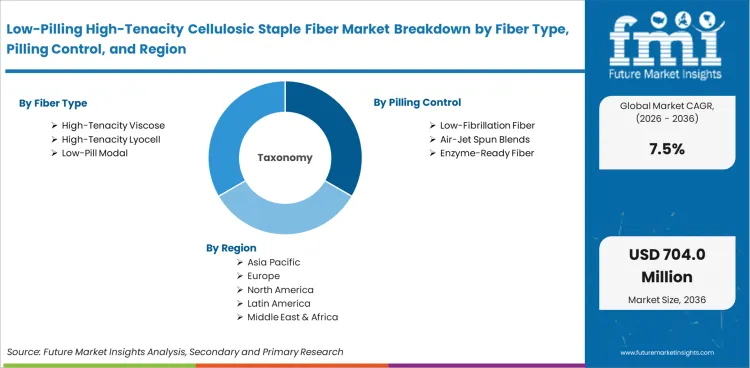
Low-Pilling High-Tenacity Cellulosic Staple Fiber Market Breakdown By Fiber Type, Pilling Control, Application, Yarn System, End User, and Region
Low-Pilling High-Tenacity Cellulosic Staple Fiber Market Segmented by Fiber Type:
- · High-Tenacity Viscose
- · High-Tenacity Lyocell
- · Low-Pill Modal
- · Cellulose Acetate
- · Other Fibers
Low-Pilling High-Tenacity Cellulosic Staple Fiber Market Segmented by Pilling Control:
- · Low-Fibrillation Fiber
- · Air-Jet Spun Blends
- · Enzyme-Ready Fiber
- · Modified Cross-Section
- · Finish-Assisted Fiber
Low-Pilling High-Tenacity Cellulosic Staple Fiber Market Segmented by Application:
- · Performance Apparel
- · Workwear
- · Home Textiles
- · Knitwear
- · Technical Textiles
Low-Pilling High-Tenacity Cellulosic Staple Fiber Market Segmented by Yarn System:
- · Ring Spun Yarn
- · Compact Yarn
- · Air-Jet Yarn
- · Open-End Yarn
- · Core-Spun Yarn
Low-Pilling High-Tenacity Cellulosic Staple Fiber Market Segmented by End User:
- · Apparel Brands
- · Fabric Mills
- · Yarn Spinners
- · Uniform Suppliers
- · Home Textile Producers
Low-Pilling High-Tenacity Cellulosic Staple Fiber Market by Region:
- North America
- USA
- Canada
- Mexico
- Latin America
- Brazil
- Chile
- Rest of Latin America
- Europe
- Germany
- UK
- Italy
- Spain
- France
- Rest of Europe
- East Asia
- China
- Japan
- South Korea
- South Asia and Pacific
- India
- ASEAN
- Australia & New Zealand
- Rest of South Asia and Pacific
- Middle East and Africa
- Saudi Arabia
- Other GCC Countries
- South Africa
- Rest of Middle East and Africa
Research Sources and Bibliography
- USA Department of Agriculture. (2026, February 19). Cotton Outlook. USDA’s 102nd Annual Agricultural Outlook Forum.
- International Trade Administration. (2026, March 25). High purity dissolving pulp from Brazil: Preliminary affirmative countervailing duty determination and alignment of final determination with final antidumping duty determination. Federal Register, 91, 14524.
- Textile Exchange. (2025, September). Materials market report 2025. Textile Exchange.
- Food and Agriculture Organization of the United Nations. (2025, December 24). Global forest products trade and production show signs of recovery in 2024. FAO.
- Press Information Bureau. (2025, August 20). Indian textile exports show resilience and growth despite mixed global trade sentiments. Ministry of Textiles, Government of India.
- Press Information Bureau. (2025, December 16). Performance of textile sector. Ministry of Textiles, Government of India.
- Office of Textiles and Apparel. (2025, February 5). December 2024 Trade Data Release. International Trade Administration, U.S. Department of Commerce.
- Office of Textiles and Apparel. (2025, August 5). June 2025 Trade Data Release. International Trade Administration, U.S. Department of Commerce.
- General Administration of Customs of the People’s Republic of China. (2025, January). China’s major exports by quantity and value, December 2024.
- International Trade Administration. (2026, February 3). United Kingdom - eCommerce. U.S. Department of Commerce.
- Germany Trade & Invest. (2024, October 14). French textile recycler comes to Frankfurt. GTAI.
- Lenzing. (2026, April 14). Lenzing unveils three-tier cellulosic fiber portfolio for next-generation protective wear.
- Eastman. (2025, April 9). Naia on the Move debuts at Intertextile 2025.
- Sateri. (2025, September). Sateri sustainability report 2024.
Frequently Asked Questions
What is the current size of the Low-Pilling High-Tenacity Cellulosic Staple Fiber Market?
The low-pilling high-tenacity cellulosic staple fiber market is estimated at USD 367.2 million in 2026.
What is the forecast value of the market by 2036?
The market is projected to reach USD 756.8 million by 2036 under FMI’s specialty textile fiber forecast model.
What CAGR is expected during the forecast period?
The market is projected to expand at a CAGR of 7.5% from 2026 to 2036.
Which fiber type is expected to lead the market?
High-tenacity viscose is expected to lead the fiber type segment with 36.0% share in 2026.
Which end user is expected to dominate demand?
Apparel brands are expected to account for 41.0% of end-user demand in 2026.
Preview the report firsthand - request a free sample
Get SampleGet the brochure for pricing and purchase details.
Get PDFTable of Content
- Key Takeaways
- Market Size and CAGR
- Top Growth Driver
- Fastest Growing Segment
- Leading Region
- Key Companies
- Emerging Opportunities
- Executive Summary
- Global Market Outlook
- Demand-side Trends
- Supply-side Trends
- Technology Roadmap Analysis
- Analysis and Recommendations
- Analyst Perspective (What is happening? Why now? What should investors know?)
- Key Questions Answered
- How large is the market?
- What is the CAGR?
- What are key trends?
- Which region dominates?
- Who are the leaders?
- Market Overview
- Market Coverage / Taxonomy
- Market Definition / Scope / Limitations
- Research Methodology
- Chapter Orientation
- Analytical Lens and Working Hypotheses
- Market Structure, Signals, and Trend Drivers
- Benchmarking and Cross-market Comparability
- Market Sizing, Forecasting, and Opportunity Mapping
- Research Design and Evidence Framework
- Desk Research Programme (Secondary Evidence)
- Expert Input and Fieldwork (Primary Evidence)
- Tooling, Models, and Reference Databases
- Data Engineering and Model Build
- Quality Assurance and Audit Trail
- Market Background
- Market Dynamics (Drivers, Restraints, Opportunity, Trends)
- Scenario Forecast (Optimistic, Likely, Conservative)
- Impact Analysis
- AI Impact
- Sustainability Impact
- Regulatory Impact
- Technology Impact
- Consumer / Buyer Analysis
- Purchase Drivers
- Adoption Barriers
- Buyer Journey
- Opportunity Map Analysis
- Product Life Cycle Analysis
- Supply Chain Analysis
- Investment Feasibility Matrix
- Value Chain Analysis
- PESTLE and Porter's Analysis
- Regulatory Landscape
- Regional Parent Market Outlook
- Production and Consumption Statistics
- Import and Export Statistics
- Global Market Analysis and Forecast, 2021 to 2036
- Historical Market Size Value (USD Million) & Volume (Unit) Analysis, 2021 to 2025
- Current and Future Market Size Value (USD Million) & Volume (Unit) Projections, 2026 to 2036
- Y-o-Y Growth Trend Analysis
- Absolute $ Opportunity Analysis
- Global Market Pricing Analysis, 2021 to 2036
- Global Market Analysis and Forecast, By Fiber Type, 2021 to 2036
- Introduction / Key Findings
- Historical Market Size Value (USD Million) & Volume (Unit) Analysis By Fiber Type, 2021 to 2025
- Current and Future Market Size Value (USD Million) & Volume (Unit) Analysis and Forecast By Fiber Type, 2026 to 2036
- High-Tenacity Viscose
- High-Tenacity Lyocell
- Low-Pill Modal
- Cellulose Acetate
- Other Fibers
- High-Tenacity Viscose
- Y-o-Y Growth Trend Analysis By Fiber Type, 2021 to 2025
- Absolute $ Opportunity Analysis By Fiber Type, 2026 to 2036
- Global Market Analysis and Forecast, By Pilling Control, 2021 to 2036
- Introduction / Key Findings
- Historical Market Size Value (USD Million) & Volume (Unit) Analysis By Pilling Control, 2021 to 2025
- Current and Future Market Size Value (USD Million) & Volume (Unit) Analysis and Forecast By Pilling Control, 2026 to 2036
- Low-Fibrillation Fiber
- Air-Jet Spun Blends
- Enzyme-Ready Fiber
- Modified Cross-Section
- Finish-Assisted Fiber
- Low-Fibrillation Fiber
- Y-o-Y Growth Trend Analysis By Pilling Control, 2021 to 2025
- Absolute $ Opportunity Analysis By Pilling Control, 2026 to 2036
- Global Market Analysis and Forecast, By Application, 2021 to 2036
- Introduction / Key Findings
- Historical Market Size Value (USD Million) & Volume (Unit) Analysis By Application, 2021 to 2025
- Current and Future Market Size Value (USD Million) & Volume (Unit) Analysis and Forecast By Application, 2026 to 2036
- Performance Apparel
- Workwear
- Home Textiles
- Knitwear
- Technical Textiles
- Performance Apparel
- Y-o-Y Growth Trend Analysis By Application, 2021 to 2025
- Absolute $ Opportunity Analysis By Application, 2026 to 2036
- Global Market Analysis and Forecast, By Yarn System, 2021 to 2036
- Introduction / Key Findings
- Historical Market Size Value (USD Million) & Volume (Unit) Analysis By Yarn System, 2021 to 2025
- Current and Future Market Size Value (USD Million) & Volume (Unit) Analysis and Forecast By Yarn System, 2026 to 2036
- Ring Spun Yarn
- Compact Yarn
- Air-Jet Yarn
- Open-End Yarn
- Core-Spun Yarn
- Ring Spun Yarn
- Y-o-Y Growth Trend Analysis By Yarn System, 2021 to 2025
- Absolute $ Opportunity Analysis By Yarn System, 2026 to 2036
- Global Market Analysis and Forecast, By End User, 2021 to 2036
- Introduction / Key Findings
- Historical Market Size Value (USD Million) & Volume (Unit) Analysis By End User, 2021 to 2025
- Current and Future Market Size Value (USD Million) & Volume (Unit) Analysis and Forecast By End User, 2026 to 2036
- Apparel Brands
- Fabric Mills
- Yarn Spinners
- Uniform Suppliers
- Home Textile Producers
- Apparel Brands
- Y-o-Y Growth Trend Analysis By End User, 2021 to 2025
- Absolute $ Opportunity Analysis By End User, 2026 to 2036
- Global Market Analysis and Forecast, By Region, 2021 to 2036
- Introduction
- Historical Market Size Value (USD Million) & Volume (Unit) Analysis By Region, 2021 to 2025
- Current Market Size Value (USD Million) & Volume (Unit) Analysis and Forecast By Region, 2026 to 2036
- North America
- Latin America
- Western Europe
- Eastern Europe
- East Asia
- South Asia and Pacific
- Middle East & Africa
- Market Attractiveness Analysis By Region
- North America Market Analysis and Forecast, By Country, 2021 to 2036
- Historical Market Size Value (USD Million) & Volume (Unit) Trend Analysis By Market Taxonomy, 2021 to 2025
- Market Size Value (USD Million) & Volume (Unit) Forecast By Market Taxonomy, 2026 to 2036
- By Country
- USA
- Canada
- Mexico
- By Fiber Type
- By Pilling Control
- By Application
- By Yarn System
- By End User
- By Country
- Market Attractiveness Analysis
- By Country
- By Fiber Type
- By Pilling Control
- By Application
- By Yarn System
- By End User
- Key Takeaways
- Latin America Market Analysis and Forecast, By Country
- Historical Market Size Value (USD Million) & Volume (Unit) Trend Analysis By Market Taxonomy, 2021 to 2025
- Market Size Value (USD Million) & Volume (Unit) Forecast By Market Taxonomy, 2026 to 2036
- By Country
- Brazil
- Chile
- Rest of Latin America
- By Fiber Type
- By Pilling Control
- By Application
- By Yarn System
- By End User
- By Country
- Market Attractiveness Analysis
- By Country
- By Fiber Type
- By Pilling Control
- By Application
- By Yarn System
- By End User
- Key Takeaways
- Western Europe Market Analysis and Forecast, By Country
- Historical Market Size Value (USD Million) & Volume (Unit) Trend Analysis By Market Taxonomy, 2021 to 2025
- Market Size Value (USD Million) & Volume (Unit) Forecast By Market Taxonomy, 2026 to 2036
- By Country
- Germany
- UK
- Italy
- Spain
- France
- Nordic
- BENELUX
- Rest of Western Europe
- By Fiber Type
- By Pilling Control
- By Application
- By Yarn System
- By End User
- By Country
- Market Attractiveness Analysis
- By Country
- By Fiber Type
- By Pilling Control
- By Application
- By Yarn System
- By End User
- Key Takeaways
- Eastern Europe Market Analysis and Forecast, By Country
- Historical Market Size Value (USD Million) & Volume (Unit) Trend Analysis By Market Taxonomy, 2021 to 2025
- Market Size Value (USD Million) & Volume (Unit) Forecast By Market Taxonomy, 2026 to 2036
- By Country
- Russia
- Poland
- Hungary
- Balkan & Baltic
- Rest of Eastern Europe
- By Fiber Type
- By Pilling Control
- By Application
- By Yarn System
- By End User
- By Country
- Market Attractiveness Analysis
- By Country
- By Fiber Type
- By Pilling Control
- By Application
- By Yarn System
- By End User
- Key Takeaways
- East Asia Market Analysis and Forecast, By Country
- Historical Market Size Value (USD Million) & Volume (Unit) Trend Analysis By Market Taxonomy, 2021 to 2025
- Market Size Value (USD Million) & Volume (Unit) Forecast By Market Taxonomy, 2026 to 2036
- By Country
- China
- Japan
- South Korea
- By Fiber Type
- By Pilling Control
- By Application
- By Yarn System
- By End User
- By Country
- Market Attractiveness Analysis
- By Country
- By Fiber Type
- By Pilling Control
- By Application
- By Yarn System
- By End User
- Key Takeaways
- South Asia and Pacific Market Analysis and Forecast, By Country
- Historical Market Size Value (USD Million) & Volume (Unit) Trend Analysis By Market Taxonomy, 2021 to 2025
- Market Size Value (USD Million) & Volume (Unit) Forecast By Market Taxonomy, 2026 to 2036
- By Country
- India
- ASEAN
- Australia & New Zealand
- Rest of South Asia and Pacific
- By Fiber Type
- By Pilling Control
- By Application
- By Yarn System
- By End User
- By Country
- Market Attractiveness Analysis
- By Country
- By Fiber Type
- By Pilling Control
- By Application
- By Yarn System
- By End User
- Key Takeaways
- Middle East & Africa Market Analysis and Forecast, By Country
- Historical Market Size Value (USD Million) & Volume (Unit) Trend Analysis By Market Taxonomy, 2021 to 2025
- Market Size Value (USD Million) & Volume (Unit) Forecast By Market Taxonomy, 2026 to 2036
- By Country
- Kingdom of Saudi Arabia
- Other GCC Countries
- Türkiye
- South Africa
- Other African Union
- Rest of Middle East & Africa
- By Fiber Type
- By Pilling Control
- By Application
- By Yarn System
- By End User
- By Country
- Market Attractiveness Analysis
- By Country
- By Fiber Type
- By Pilling Control
- By Application
- By Yarn System
- By End User
- Key Takeaways
- Key Countries Market Analysis
- USA
- Pricing Analysis
- Market Share Analysis, 2025
- By Fiber Type
- By Pilling Control
- By Application
- By Yarn System
- By End User
- Canada
- Pricing Analysis
- Market Share Analysis, 2025
- By Fiber Type
- By Pilling Control
- By Application
- By Yarn System
- By End User
- Mexico
- Pricing Analysis
- Market Share Analysis, 2025
- By Fiber Type
- By Pilling Control
- By Application
- By Yarn System
- By End User
- Brazil
- Pricing Analysis
- Market Share Analysis, 2025
- By Fiber Type
- By Pilling Control
- By Application
- By Yarn System
- By End User
- Chile
- Pricing Analysis
- Market Share Analysis, 2025
- By Fiber Type
- By Pilling Control
- By Application
- By Yarn System
- By End User
- Germany
- Pricing Analysis
- Market Share Analysis, 2025
- By Fiber Type
- By Pilling Control
- By Application
- By Yarn System
- By End User
- UK
- Pricing Analysis
- Market Share Analysis, 2025
- By Fiber Type
- By Pilling Control
- By Application
- By Yarn System
- By End User
- Italy
- Pricing Analysis
- Market Share Analysis, 2025
- By Fiber Type
- By Pilling Control
- By Application
- By Yarn System
- By End User
- Spain
- Pricing Analysis
- Market Share Analysis, 2025
- By Fiber Type
- By Pilling Control
- By Application
- By Yarn System
- By End User
- France
- Pricing Analysis
- Market Share Analysis, 2025
- By Fiber Type
- By Pilling Control
- By Application
- By Yarn System
- By End User
- India
- Pricing Analysis
- Market Share Analysis, 2025
- By Fiber Type
- By Pilling Control
- By Application
- By Yarn System
- By End User
- ASEAN
- Pricing Analysis
- Market Share Analysis, 2025
- By Fiber Type
- By Pilling Control
- By Application
- By Yarn System
- By End User
- Australia & New Zealand
- Pricing Analysis
- Market Share Analysis, 2025
- By Fiber Type
- By Pilling Control
- By Application
- By Yarn System
- By End User
- China
- Pricing Analysis
- Market Share Analysis, 2025
- By Fiber Type
- By Pilling Control
- By Application
- By Yarn System
- By End User
- Japan
- Pricing Analysis
- Market Share Analysis, 2025
- By Fiber Type
- By Pilling Control
- By Application
- By Yarn System
- By End User
- South Korea
- Pricing Analysis
- Market Share Analysis, 2025
- By Fiber Type
- By Pilling Control
- By Application
- By Yarn System
- By End User
- Russia
- Pricing Analysis
- Market Share Analysis, 2025
- By Fiber Type
- By Pilling Control
- By Application
- By Yarn System
- By End User
- Poland
- Pricing Analysis
- Market Share Analysis, 2025
- By Fiber Type
- By Pilling Control
- By Application
- By Yarn System
- By End User
- Hungary
- Pricing Analysis
- Market Share Analysis, 2025
- By Fiber Type
- By Pilling Control
- By Application
- By Yarn System
- By End User
- Kingdom of Saudi Arabia
- Pricing Analysis
- Market Share Analysis, 2025
- By Fiber Type
- By Pilling Control
- By Application
- By Yarn System
- By End User
- Türkiye
- Pricing Analysis
- Market Share Analysis, 2025
- By Fiber Type
- By Pilling Control
- By Application
- By Yarn System
- By End User
- South Africa
- Pricing Analysis
- Market Share Analysis, 2025
- By Fiber Type
- By Pilling Control
- By Application
- By Yarn System
- By End User
- USA
- Market Structure Analysis
- Competition Dashboard
- Competition Benchmarking
- Market Share Analysis of Top Players
- By Regional
- By Fiber Type
- By Pilling Control
- By Application
- By Yarn System
- By End User
- Emerging Startups
- Innovation Benchmarking
- Competition Analysis
- Competition Deep Dive
- Lenzing
- Overview
- Product Portfolio
- Profitability by Market Segments (Product/Region/Sales Channel)
- Sales Footprint
- Strategy Overview
- Marketing Strategy
- Product Strategy
- Channel Strategy
- Eastman
- Birla Cellulose
- Sateri
- Kelheim Fibres
- Tangshan Sanyou
- Asia Pacific Rayon
- Lenzing
- Case Studies
- Success Stories
- Recent Developments
- Competition Deep Dive
- Assumptions & Acronyms Used


