

- Market Size (2026)
- USD 175.0 Mn
- Forecast (2036)
- USD 453.9 Mn
- CAGR (2026 to 2036)
- 10.0%
How big is the Craniopagus Twin Separation Surgical Implants Market in 2026?
USD 175.0 million in 2026 and USD 453.9 million by 2036 at a 10.0% CAGR.
The craniopagus twin separation surgical implants market value is anticipated to scale from USD 159.1 million in 2025 to USD 453.9 million by 2036 at 10.0% CAGR since rare pediatric reconstruction programs adopt custom cranial implant design and surgical planning support. Titanium and alloys are anticipated to account for 52.0% share in 2026, reflecting fixation reliability and clinical familiarity in cranial reconstruction. Craniopagus twin specialized pediatric hospitals are projected to secure 49.0% share in 2026, guided by multidisciplinary case control across neurosurgery and intensive care.
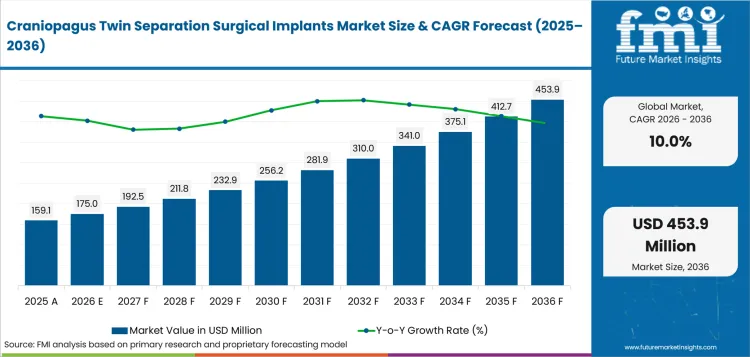
| Metric | Value |
|---|---|
| 2026 Market Size | USD 175.0 million |
| 2036 Market Size | USD 453.9 million |
| Forecast CAGR (2026-2036) | 10.0% |
| Leading Material | Titanium and Alloys |
| Titanium and Alloys Share (2026) | 52.0% |
| Leading End User | Specialized Pediatric Hospitals |
| Specialized Pediatric Hospitals Share (2026) | 49.0% |
| Fastest-growing Country | India |
| India CAGR by 2036 | 12.2% |
Summary of the Craniopagus Twin Separation Surgical Implants Market
| Market Signal | Commercial Impact |
|---|---|
| Demand and Growth Drivers | Demand for craniopagus twin separation surgical implants is increasing as highly specialized cranial reconstruction procedures require patient-specific implant solutions and advanced surgical planning.
|
| Product and Segment View | Titanium implants, specialized pediatric hospitals, and craniopagus twin separation procedures continue to represent the leading market segments.
|
| Geography and Growth Outlook | Asia continues to emerge as a key growth region as specialty healthcare infrastructure and domestic medical device manufacturing capabilities expand.
|
| Competitive Landscape | Competition increasingly focuses on patient-specific implant design, regulated surgical planning, and engineering collaboration with clinical teams.
|
| Analyst Perspective | Craniopagus twin separation surgical implants are becoming increasingly dependent on integrated engineering, digital planning, and multidisciplinary clinical collaboration rather than implant manufacturing alone.
- Anurag Sharma, Principal Consultant at Future Market Insights |
Regulated patient-specific cranial reconstruction is gaining value as hospitals request CT-derived implant geometry and documented material pathways before rare separation cases enter surgery. FDA-cleared VSP PEEK Cranial Implants are designed from CT imaging data and surgeon input across implant sizes from 35 × 35 mm to 150 × 150 mm, supporting custom cranioplasty planning. 3D Systems reported nearly 40 cranial implants printed in Europe before its 2024 USA clearance, while USA medical reference data describe conjoined twin incidence at about 1.5 per 100,000 births, creating a rare but high-complexity clinical base for planning-led implant programs. Patient-specific implant suppliers gain value as hospitals need anatomical models and CT-based design review to reduce uncertainty before separation and reconstruction.
Which factors support expansion in the Craniopagus Twin Separation Surgical Implants Market?
Custom cranial implant supply and planning-linked service support strengthen market value across rare pediatric separation programs.
- Market value rises as rare cranial separation cases need patient-specific implants aligned with skull defects and staged surgical planning.
- CT-based design review supports clinical confidence as surgeons can examine geometry before final implant production.
- 3D-printed anatomical models improve multidisciplinary planning among neurosurgery and biomedical engineering teams.
- Titanium and PEEK options give hospitals material flexibility across fixation strength and reconstruction design.
Why is the Craniopagus Twin Separation Surgical Implants Market growing?
Complex separation surgery raises demand for case-specific cranial reconstruction and planning support.
Rare craniopagus procedures need implant pathways designed around shared anatomy, staged separation, and pediatric cranial defect reconstruction. Gemini Untwined reported in 2024 that Mirha and Minal were separated after a final 14-hour operation involving shared vital blood vessels and brain tissue, illustrating the planning burden behind rare cranial separation cases. Patient-specific implants and CT-based design reviews gain demand as surgical teams need a common planning reference before reconstruction begins. Suppliers able to link custom implant production with case-planning support gain stronger acceptance across high-risk pediatric surgical programs.
How is the Craniopagus Twin Separation Surgical Implants Market segmented?
Craniopagus Twin Separation Surgical Implants Market is segmented by procedure type, technology, material, end user, and planning support.
- Craniopagus Twin Separation is anticipated to account for 46.0% share in 2026, led by staged reconstruction and implant geometry needs across two-patient surgical plans.
- 3D Printing is expected to represent 41.0% share in 2026, supported by anatomical model use and patient-matched implant production.
- Titanium and Alloys are projected to account for 52.0% share in 2026, influenced by fixation reliability and long clinical familiarity in cranial reconstruction.
- Specialized Pediatric Hospitals are expected to hold 49.0% share in 2026, shaped by multidisciplinary surgical control and rare-case referral concentration.
- CT-Based Design Review is projected to hold 44.0% share in 2026, guided by the need to verify implant fit before production and sterilization.
Why does Craniopagus Twin Separation lead the market by procedure type?
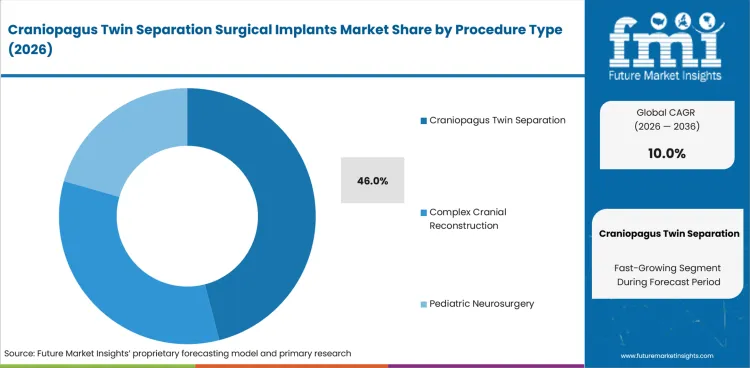
- Craniopagus twin separation is anticipated to account for 46.0% share in 2026, guided by two-patient reconstruction needs and shared cranial anatomy that requires defect-specific implant design.
- Complex cranial reconstruction widens the addressable base as tumor and congenital defect cases use similar CT-derived planning and custom implant workflows.
Which technology leads the Craniopagus Twin Separation Surgical Implants Market?
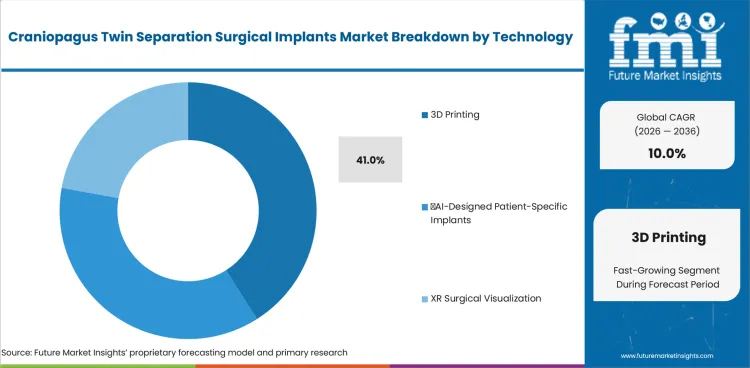
- 3D Printing is expected to represent 41.0% share in 2026, supported by anatomical models and planning tools used across high-risk cranial cases.
- AI-Designed Patient-Specific Implants gain selective use as image segmentation and surgeon review combine into more structured design pathways.
Why do Titanium and Alloys dominate the market by material?
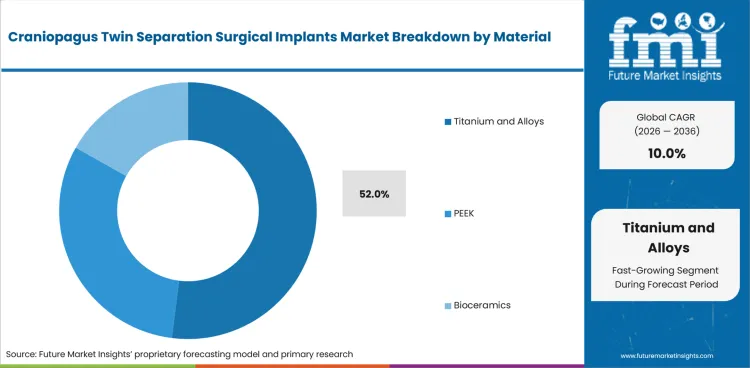
- Titanium and alloys are projected to account for 52.0% share in 2026, driven by rigid fixation needs across pediatric cranial reconstruction and surgeon familiarity with craniofacial plates.
- PEEK gains demand as selected cases need lighter implants and custom geometry for defects that differ from standard cranioplasty patterns.
Which end user leads the Craniopagus Twin Separation Surgical Implants Market?
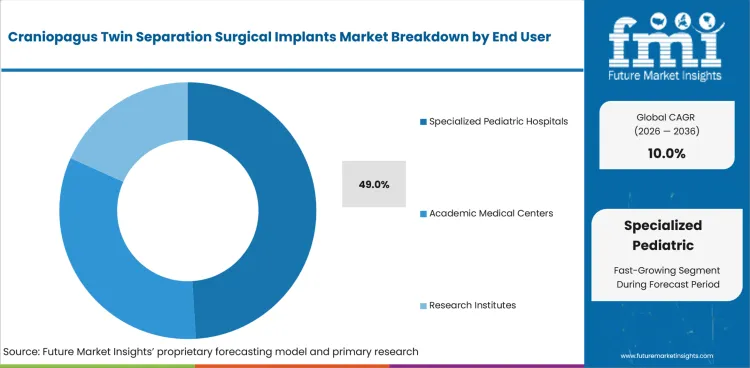
- Specialized pediatric hospitals are expected to hold 49.0% share in 2026, shaped by case boards that include neurosurgeons and intensive-care teams.
- Academic medical centers support adoption as complex cases often need research-backed planning and cross-specialty surgical preparation before implant selection.
Which planning support segment leads the Craniopagus Twin Separation Surgical Implants Market?
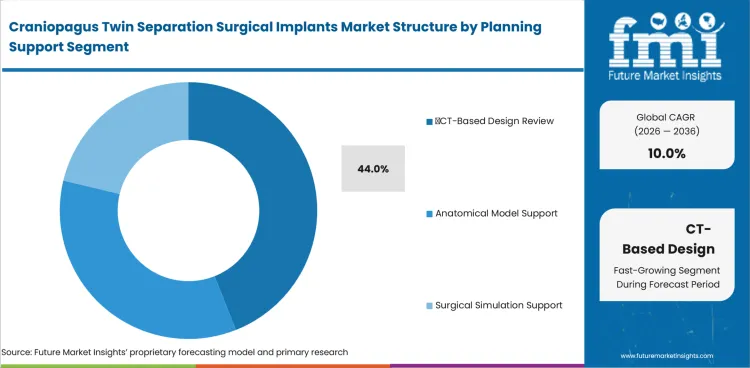
- CT-based design review is projected to hold 44.0% share in 2026, reflected by surgeon review needs before final geometry approval and implant release.
- Anatomical model support remains active as physical models help surgical teams rehearse bone cuts and material choices before staged pediatric procedures.
What are the drivers, restraints, and opportunities in the Craniopagus Twin Separation Surgical Implants Market?
Patient-specific cranial reconstruction and planning-led implant supply are shaping buying decisions.
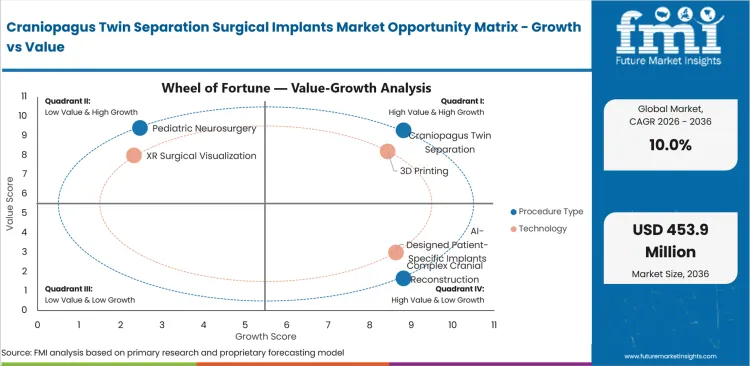
- Driver: Rare pediatric cranial separation programs require custom implants and case-ready planning support before surgery.
- Restraint: Low procedure frequency and high documentation needs can limit routine supplier participation across smaller hospital systems.
- Opportunity: Regulated image-to-device pathways can improve supplier selection as hospitals request clear design controls and revision options.
CT-Derived Cranial Implant Pathways Strengthen Demand
Custom cranial implants gain value as regulators and hospitals expect traceable design inputs from imaging data to final implant geometry. FDA’s 2025 510(k) summary for Kelyniam Fusion Craniofacial Implant and Fusion Skull Implant describes patient-specific plates ranging from 2 mm to 10 mm thick and 25 mm to 250 mm wide or long, prepared from patient CT scan imaging data. Such implant ranges support cranial reconstruction programs that need adjustable geometry before rare pediatric surgery. Suppliers that can document CT transfer and sterilization steps can improve acceptance across specialty pediatric reconstruction programs.
Rare-Case Volume Limits Routine Standardization
Commercial adoption remains constrained by low procedure frequency and the high cost of maintaining clinical engineering support for rare pediatric cases. USA medical reference data updated after 2024 describe conjoined twin incidence from 1 per 50,000 to 200,000 births, with stillbirth estimated at about 60%, which restricts the number of cases available for standardized implant programs. Implant suppliers need adjacent cranial reconstruction demand to keep design teams and production workflows commercially sustainable. Hospital buyers can also delay premium implant approval if case timing or surgeon sign-off remains uncertain.
3D-Printed Cranial Implant Workflows Create Service-Led Expansion
Planning support can create a stronger commercial route as hospitals ask suppliers to assist with segmentation, surgeon review, and implant option selection. 3D Systems reported that its EXT 220 MED platform had enabled nearly 40 cranial implants across European sites before USA clearance for VSP PEEK Cranial Implant, showing how validated workflow experience can support surgeon confidence. Rare cranial reconstruction buyers value coordinated planning support as much as material selection in complex pediatric cases. Suppliers connecting implant production and case-ready documentation can move beyond one-time device supply.
Which countries are growing in the Craniopagus Twin Separation Surgical Implants Market?
India 12.2% CAGR, China 11.7% CAGR, South Korea 10.8% CAGR, United Kingdom 10.4% CAGR, Germany 9.8% CAGR, United States 9.6% CAGR, France 9.4% CAGR, and Japan 8.9% CAGR through 2036.
.webp "Top Country Growth Comparison Craniopagus Twin Separation Surgical Implants Market Cagr (2026 2036)")
| Country | CAGR |
|---|---|
| India | 12.2% |
| China | 11.7% |
| South Korea | 10.8% |
| United Kingdom | 10.4% |
| Germany | 9.8% |
| United States | 9.6% |
| France | 9.4% |
| Japan | 8.9% |
Source: Future Market Insights, 2026.
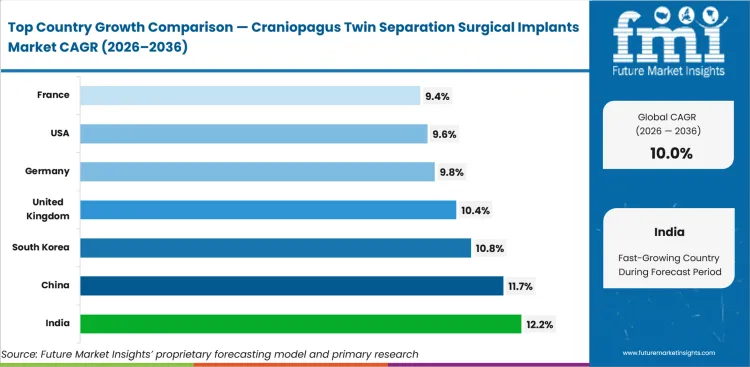
How do country-level CAGRs compare in the Craniopagus Twin Separation Surgical Implants Market?
India leads country expansion while Japan records the most cautious pace among profiled markets.
- India is forecast to record 12.2% CAGR by 2036, supported by specialty hospital investment and domestic medical device production.
- China is expected to expand at 11.7% CAGR from 2026 to 2036, led by hospital infrastructure depth and local implant capacity.
- South Korea is projected to grow at 10.8% CAGR through 2036 as craniofacial implant manufacturers support patient-specific device pathways.
- United Kingdom is estimated to rise at 10.4% CAGR by 2036, reflected by concentrated highly specialized craniofacial units.
- Germany is expected to advance at 9.8% CAGR over the forecast period as domestic craniofacial engineering suppliers support custom implants.
- United States is forecast to grow at 9.6% CAGR by 2036, backed by FDA-cleared patient-specific cranial implant platforms.
- France is projected to post 9.4% CAGR by 2036, guided by hospital spending and cranio-maxillofacial reconstruction demand.
- Japan is expected to record 8.9% CAGR by 2036, driven by imaging capacity and established medical device regulation.
How fast is the Craniopagus Twin Separation Surgical Implants Market growing in India?
A 12.2% CAGR through 2036 reflects specialty hospital expansion and domestic cranial implant manufacturing.
Country Market Snapshot Table
| Parameter | Value |
|---|---|
| Market Size in 2025 (Value) | USD 19.8 million |
| Market Size in 2026 (Value) | USD 22.2 million |
| Market Forecast in 2036 (Value) | USD 70.2 million |
| CAGR (2026 to 2036) | 12.2% |
| Years Considered | 2021 to 2036 |
| Base Year | 2025 |
| Forecast Period | 2026 to 2036 |
| Units Considered | Value (USD million) |
| Leading Sub-Region | Delhi NCR, Mumbai, Bengaluru, Chennai, and Hyderabad specialty corridors |
India Craniopagus Twin Separation Surgical Implants Market Outlook
India craniopagus twin separation surgical implants market is driven by craniofacial reconstruction programs and local 3D medical printing suppliers. Complex cranial cases need CT review and material options before rare separation procedures.
Hospital buyers are expected to favor local implant partners with design support and short production cycles. Domestic access can reduce delay during staged surgical planning and revision discussions.
Key Growth Drivers
- Specialty care access is expanding across public and teaching hospitals, supported by 714 district hospitals and 362 medical colleges reported in national health infrastructure data for 2023.
- Domestic device manufacturing supports local cranial implant supply, reinforced by India’s medical device sector value near USD 14 billion in 2025 and a target of USD 30 billion by 2030.
- Pediatric craniofacial teams increasingly use local design partners for anatomical models and custom plates as complex reconstruction requires faster iteration.
- Local manufacturing partners gain scope as hospitals seek lower lead time for cranial models and patient-specific implant review.
Key Restraints
- Public infrastructure gaps can slow advanced cranial reconstruction access, shown by 818,661 beds across PHC and medical college facilities against a policy recommendation of 2 beds per 1,000 people.
- Rare case concentration keeps buying decisions close to selected tertiary centers rather than routine surgical departments.
- Custom implant approval can slow as hospital administrators and device review teams evaluate each case individually.
What makes India unique
India stands apart through domestic 3D medical printing firms and local anatomical modeling services for complex pediatric surgery.
Key Companies
- Lucid Implants
- Osteo3D
- CTARS
- Incredible AM
- Auxein Medical
- Craniotech
- Anatomiz3D Healthcare
Sales & Marketing Channels
- Direct hospital sales
- Pediatric neurosurgery referral networks
- Craniofacial surgeon engagement
- Medical college partnerships
- Local 3D planning service channels
- Hospital value-analysis committee meetings
Country Segment Breakdown Table
| Segment | Sub-Segments |
|---|---|
| By Procedure Type | Craniopagus Twin Separation, Complex Cranial Reconstruction, Pediatric Neurosurgery |
| By Technology | AI-Designed Patient-Specific Implants, 3D Printing, XR Surgical Visualization |
| By Material | Titanium and Alloys, PEEK, Bioceramics |
| By End User | Specialized Pediatric Hospitals, Academic Medical Centers, Research Institutes |
| By Planning Support | CT-Based Design Review, Anatomical Model Support, Surgical Simulation Support |
| Key Sub-Regions Covered, Specialty Corridors | Delhi NCR, Mumbai, Bengaluru, Chennai, Hyderabad, Pune |
Frequently Asked Questions
How fast is India Craniopagus Twin Separation Surgical Implants Market growing?
Industry in India is projected to rise at 12.2% CAGR from 2026 to 2036, led by local cranial implant production and specialty hospital capacity.
Who leads India Craniopagus Twin Separation Surgical Implants Market?
Lucid Implants, Osteo3D, CTARS, Incredible AM, Auxein Medical, Craniotech, and Anatomiz3D Healthcare compete depending on local implant design, 3D planning, and hospital access.
What is driving adoption in India Craniopagus Twin Separation Surgical Implants Market?
Pediatric referral centers and domestic medical modeling firms are moving hospitals toward patient-specific cranial planning.
What is the Craniopagus Twin Separation Surgical Implants Market outlook in China?
An 11.7% CAGR through 2036 reflects hospital infrastructure depth and domestic implant manufacturing.
Country Market Snapshot Table
| Parameter | Value |
|---|---|
| Market Size in 2025 (Value) | USD 18.6 million |
| Market Size in 2026 (Value) | USD 20.8 million |
| Market Forecast in 2036 (Value) | USD 63.1 million |
| CAGR (2026 to 2036) | 11.7% |
| Years Considered | 2021 to 2036 |
| Base Year | 2025 |
| Forecast Period | 2026 to 2036 |
| Units Considered | Value (USD million) |
| Leading Sub-Region | Beijing, Shanghai, Guangdong, Jiangsu, and Zhejiang hospital clusters |
China Craniopagus Twin Separation Surgical Implants Market Outlook
China craniopagus twin separation surgical implants market builds around local implant firms and cranio-maxillofacial reconstruction needs. Advanced hospitals need custom implant design and imaging-led planning for complex pediatric cranial cases.
Domestic suppliers are expected to compete through titanium implants and hospital-linked production. Centralized hospital demand favors suppliers with documentation and reliable sterilization pathways.
Key Growth Drivers
- Hospital infrastructure supports complex surgical referrals, backed by 1.092 million medical and health institutions, including about 39,000 hospitals at the end of 2024.
- Birth volume sustains a pediatric specialty care base, reflected by 7.92 million births reported in 2025.
- Local cranial and orthopedic implant firms can supply titanium and porous biomaterial options for patient-specific reconstruction.
- Leading children’s hospitals and academic centers support complex case planning through imaging, craniofacial surgery, and neurosurgery teams.
Key Restraints
- Public hospital concentration can lengthen supplier approval cycles, as public facilities provided 70.2% of hospital beds and 83.4% of patient visits in 2024.
- Rare cranial separation cases concentrate demand in a limited number of tertiary pediatric hospitals.
- Device qualification and local clinical validation can delay entry for smaller custom implant firms.
What makes China unique
China differs through hospital scale and academic surgical centers serving complex pediatric reconstruction.
Key Companies
- AK Medical
- Beijing Chunlizhengda Medical Instruments
- Shanghai MicroPort Orthopedics
- Shandong Weigao Orthopaedic Device
- Medprin Regenerative Medical Technologies
- Beijing Datsing Bio-Tech
- Rebone Biomaterials
Sales & Marketing Channels
- Direct tender participation
- Hospital surgeon education
- Provincial distributor networks
- Academic hospital partnerships
- Local device registration support
- Surgeon-led implant demonstration meetings
Country Segment Breakdown Table
| Segment | Sub-Segments |
|---|---|
| By Procedure Type | Craniopagus Twin Separation, Complex Cranial Reconstruction, Pediatric Neurosurgery |
| By Technology | AI-Designed Patient-Specific Implants, 3D Printing, XR Surgical Visualization |
| By Material | Titanium and Alloys, PEEK, Bioceramics |
| By End User | Specialized Pediatric Hospitals, Academic Medical Centers, Research Institutes |
| By Planning Support | CT-Based Design Review, Anatomical Model Support, Surgical Simulation Support |
| Key Sub-Regions Covered, Specialty Corridors | Beijing, Shanghai, Guangdong, Jiangsu, Zhejiang, Shandong |
Frequently Asked Questions
How fast is China Craniopagus Twin Separation Surgical Implants Market growing?
Industry in China is projected to rise at 11.7% CAGR from 2026 to 2036, guided by tertiary hospital depth and domestic craniofacial implant capacity.
Who leads China Craniopagus Twin Separation Surgical Implants Market?
AK Medical, Chunli, MicroPort Orthopedics, Weigao Orthopaedic, Medprin, Datsing Bio-Tech, and Rebone Biomaterials compete led by local implant manufacturing and hospital channels.
What is driving adoption in China Craniopagus Twin Separation Surgical Implants Market?
Large hospital systems and domestic implant firms are moving pediatric cranial reconstruction toward patient-specific design review.
How is the Craniopagus Twin Separation Surgical Implants Market performing in South Korea?
A 10.8% CAGR through 2036 reflects local patient-specific implant manufacturing and advanced hospital access.
Country Market Snapshot Table
| Parameter | Value |
|---|---|
| Market Size in 2025 (Value) | USD 11.3 million |
| Market Size in 2026 (Value) | USD 12.5 million |
| Market Forecast in 2036 (Value) | USD 34.9 million |
| CAGR (2026 to 2036) | 10.8% |
| Years Considered | 2021 to 2036 |
| Base Year | 2025 |
| Forecast Period | 2026 to 2036 |
| Units Considered | Value (USD million) |
| Leading Sub-Region | Seoul, Gyeonggi, Daejeon, and Daegu medical corridors |
South Korea Craniopagus Twin Separation Surgical Implants Market Outlook
South Korea craniopagus twin separation surgical implants market comes from local cranial implant producers and export-oriented medical device capability. Pediatric cranial reconstruction cases rely on design review and documented implant pathways.
Hospital buyers are expected to favor local firms able to combine titanium implant manufacturing and regulatory documentation. Specialty neurosurgical centers shape adoption through referral-based case planning.
Key Growth Drivers
- Advanced hospital capacity supports complex surgery, reflected by 12.6 hospital beds per 1,000 people and 87 CT, MRI, and PET scanners per 1 million people in OECD health data.
- Local patient-specific implant capability is improving as CGBIO’s 2026 FDA-cleared EASYMADE TI implant is created from patient CT scan data through Laser Powder Bed Fusion using Ti-6Al-4V ELI Grade 23 titanium alloy.
- Seoul-based craniofacial and neurosurgery centers support case review pathways for rare pediatric reconstruction.
- Domestic device makers can support titanium implants and biomaterial scaffolds for custom cranial defect repair.
Key Restraints
- Compliance demands can slow supplier entry, with 265 South Korean MDSAP-certified manufacturer sites reported by July 2025 after 241 sites in 2024, raising documentation expectations.
- Rare craniopagus cases keep procedure-linked implant demand irregular despite strong specialty-care capability.
- Smaller implant firms may face surgeon-access barriers in tertiary hospitals with established vendor preferences.
What makes South Korea unique
South Korea stands out through FDA-cleared local patient-specific implant production and dense tertiary hospital capacity.
Key Companies
- CGBIO
- Jeil Medical Corporation
- T&R Biofab
- Corentec
- L&C Bio
- Medyssey
- Osstem Implant
Sales & Marketing Channels
- Direct tertiary hospital sales
- Neurosurgery and craniofacial surgeon training
- Regulatory dossier-led selling
- Academic hospital case support
- Domestic distributor networks
- Implant design workshop programs
Country Segment Breakdown Table
| Segment | Sub-Segments |
|---|---|
| By Procedure Type | Craniopagus Twin Separation, Complex Cranial Reconstruction, Pediatric Neurosurgery |
| By Technology | AI-Designed Patient-Specific Implants, 3D Printing, XR Surgical Visualization |
| By Material | Titanium and Alloys, PEEK, Bioceramics |
| By End User | Specialized Pediatric Hospitals, Academic Medical Centers, Research Institutes |
| By Planning Support | CT-Based Design Review, Anatomical Model Support, Surgical Simulation Support |
| Key Sub-Regions Covered, Specialty Corridors | Seoul, Gyeonggi, Daejeon, Daegu, Busan, Incheon |
Frequently Asked Questions
How fast is South Korea Craniopagus Twin Separation Surgical Implants Market growing?
Industry in South Korea is projected to rise at 10.8% CAGR from 2026 to 2036, supported by advanced imaging access and local patient-specific implant approvals.
Who leads South Korea Craniopagus Twin Separation Surgical Implants Market?
CGBIO, Jeil Medical, T&R Biofab, Corentec, L&C Bio, Medyssey, and Osstem Implant compete through Korean implant manufacturing and surgeon-facing technical support.
What is driving adoption in South Korea Craniopagus Twin Separation Surgical Implants Market?
FDA-cleared Korean titanium implant pathways and tertiary hospital imaging depth are supporting custom cranial reconstruction adoption.
What is the Craniopagus Twin Separation Surgical Implants Market forecast for the United Kingdom?
A 10.4% CAGR through 2036 reflects highly specialized craniofacial units and pediatric neurosurgery concentration.
Country Market Snapshot Table
| Parameter | Value |
|---|---|
| Market Size in 2025 (Value) | USD 10.9 million |
| Market Size in 2026 (Value) | USD 12.0 million |
| Market Forecast in 2036 (Value) | USD 32.4 million |
| CAGR (2026 to 2036) | 10.4% |
| Years Considered | 2021 to 2036 |
| Base Year | 2025 |
| Forecast Period | 2026 to 2036 |
| Units Considered | Value (USD million) |
| Leading Sub-Region | London, Oxford, Birmingham, and Liverpool craniofacial corridors |
United Kingdom Craniopagus Twin Separation Surgical Implants Market Outlook
United Kingdom craniopagus twin separation surgical implants market reflects highly specialized craniofacial units and pediatric neurosurgery teams. Rare cranial separation cases need structured planning and custom implant options.
Local planning firms and medical 3D Printing service providers support hospitals through anatomical models and design preparation. Supplier value improves through documented case support rather than standalone implant sale.
Key Growth Drivers
- Craniofacial surgery is concentrated in specialist networks, supported by 4 highly specialized craniofacial units in England and 1 in Scotland listed by BAOMS.
- Specialist pediatric craniofacial workload supports planning demand, as Great Ormond Street Hospital reports about 250 new craniofacial patients and 200 procedures each year.
- Local medical 3D planning firms can supply anatomical models and hospital-based case visualization support.
- Charity-backed rare conjoined twin programs create awareness for multidisciplinary cranial separation planning.
Key Restraints
- Imaging access can constrain capacity, with the United Kingdom reporting 19 CT, MRI, and PET scanners per 1 million people and 2.4 hospital beds per 1,000 people in OECD health data.
- Highly specialized case concentration limits routine buying across general hospitals.
- Budget review for custom implants can slow approvals before surgical teams finalize material selection.
What makes the United Kingdom unique
United Kingdom is distinguished by charity-linked rare twin surgery support and local surgical planning firms.
Key Companies
- Axial3D
- 3D LifePrints
- Renishaw
- Additive Instruments
- Xiros
- Ossiform UK
- Laser Lines Medical
Sales & Marketing Channels
- NHS specialist unit engagement
- Pediatric neurosurgery referral pathways
- Surgeon-led clinical case review
- Hospital-based 3D Printing partnerships
- Charity and academic collaboration channels
- Biomedical engineering education programs
Country Segment Breakdown Table
| Segment | Sub-Segments |
|---|---|
| By Procedure Type | Craniopagus Twin Separation, Complex Cranial Reconstruction, Pediatric Neurosurgery |
| By Technology | AI-Designed Patient-Specific Implants, 3D Printing, XR Surgical Visualization |
| By Material | Titanium and Alloys, PEEK, Bioceramics |
| By End User | Specialized Pediatric Hospitals, Academic Medical Centers, Research Institutes |
| By Planning Support | CT-Based Design Review, Anatomical Model Support, Surgical Simulation Support |
| Key Sub-Regions Covered, Specialty Corridors | London, Oxford, Birmingham, Liverpool, Manchester, Cambridge |
Frequently Asked Questions
How fast is United Kingdom Craniopagus Twin Separation Surgical Implants Market growing?
Industry in the United Kingdom is projected to rise at 10.4% CAGR from 2026 to 2036, helped by specialist craniofacial units and pediatric surgery networks.
Who leads United Kingdom Craniopagus Twin Separation Surgical Implants Market?
Axial3D, 3D LifePrints, Renishaw, Additive Instruments, Xiros, Ossiform UK, and Laser Lines Medical compete due to local medical modeling and engineering support.
What is driving adoption in United Kingdom Craniopagus Twin Separation Surgical Implants Market?
Specialist craniofacial centers and hospital-based planning firms are moving rare cranial cases toward anatomical modeling and custom implant review.
What is driving Craniopagus Twin Separation Surgical Implants Market growth in Germany?
A 9.8% CAGR through 2036 reflects established craniofacial engineering and local implant production.
Country Market Snapshot Table
| Parameter | Value |
|---|---|
| Market Size in 2025 (Value) | USD 13.7 million |
| Market Size in 2026 (Value) | USD 15.0 million |
| Market Forecast in 2036 (Value) | USD 38.2 million |
| CAGR (2026 to 2036) | 9.8% |
| Years Considered | 2021 to 2036 |
| Base Year | 2025 |
| Forecast Period | 2026 to 2036 |
| Units Considered | Value (USD million) |
| Leading Sub-Region | Tuttlingen, Freiburg, Munich, Berlin, and Hamburg medical technology corridors |
Germany Craniopagus Twin Separation Surgical Implants Market Outlook
Germany craniopagus twin separation surgical implants market gains from domestic craniofacial implant engineering and hospital access to advanced imaging. Complex pediatric reconstruction programs need implant suppliers with planning support and material documentation.
Local manufacturers are expected to compete through titanium and PEEK cranial implant portfolios. Hospital buyers value design reviews and production reliability across rare cranial cases.
Key Growth Drivers
- German care capacity supports complex surgery, demonstrated by 7.7 hospital beds per 1,000 people and 74 CT, MRI, and PET scanners per 1 million people in OECD health data.
- Domestic cranial implant suppliers offer material options, as KLS Martin lists patient-specific cranial implants in 3 material formats, PEEK, titanium mesh, and solid titanium with holes.
- Medical technology clusters support close engineering input for craniofacial reconstruction and surgical guide production.
- Academic hospitals use multidisciplinary review pathways for pediatric cranial defects and rare neurosurgical reconstruction.
Key Restraints
- Cost scrutiny can slow custom implant approvals, as Germany recorded EUR 492 billion in current healthcare expenditure equal to 11.7% of GDP in 2023.
- Specialist supplier qualification can lengthen lead times for rare pediatric implant requests.
- Hospital value-analysis teams may require additional documentation before approving premium patient-specific implants.
What makes Germany unique
Germany differs through Tuttlingen-centered medical engineering depth and high imaging availability.
Key Companies
- KLS Martin
- Aesculap
- B. Braun Surgical
- Meotec
- BellaSeno
- Karl Storz
- Citim
Sales & Marketing Channels
- Direct hospital and surgeon engagement
- Cranio-maxillofacial congress education
- Hospital engineering workshops
- Local distributor networks
- Case-based design review meetings
- Surgeon training and simulation programs
Country Segment Breakdown Table
| Segment | Sub-Segments |
|---|---|
| By Procedure Type | Craniopagus Twin Separation, Complex Cranial Reconstruction, Pediatric Neurosurgery |
| By Technology | AI-Designed Patient-Specific Implants, 3D Printing, XR Surgical Visualization |
| By Material | Titanium and Alloys, PEEK, Bioceramics |
| By End User | Specialized Pediatric Hospitals, Academic Medical Centers, Research Institutes |
| By Planning Support | CT-Based Design Review, Anatomical Model Support, Surgical Simulation Support |
| Key Sub-Regions Covered, Specialty Corridors | Tuttlingen, Freiburg, Munich, Berlin, Hamburg, Cologne |
Frequently Asked Questions
How fast is Germany Craniopagus Twin Separation Surgical Implants Market growing?
Industry in Germany is projected to rise at 9.8% CAGR from 2026 to 2036, aided by local craniofacial engineering and imaging access.
Who leads Germany Craniopagus Twin Separation Surgical Implants Market?
KLS Martin, Aesculap, B. Braun Surgical, Meotec, BellaSeno, Karl Storz, and Citim compete through German implant engineering and surgical supply networks.
What is driving adoption in Germany Craniopagus Twin Separation Surgical Implants Market?
Local patient-specific cranial implant portfolios and academic surgical planning pathways are supporting custom reconstruction demand.
How is the Craniopagus Twin Separation Surgical Implants Market performing in the United States?
A 9.6% CAGR through 2036 reflects FDA-cleared cranial implant platforms and advanced pediatric referral centers.
Country Market Snapshot Table
| Parameter | Value |
|---|---|
| Market Size in 2025 (Value) | USD 34.7 million |
| Market Size in 2026 (Value) | USD 38.0 million |
| Market Forecast in 2036 (Value) | USD 94.8 million |
| CAGR (2026 to 2036) | 9.6% |
| Years Considered | 2021 to 2036 |
| Base Year | 2025 |
| Forecast Period | 2026 to 2036 |
| Units Considered | Value (USD million) |
| Leading Sub-Region | Boston, Philadelphia, Houston, New York, and Midwest pediatric referral corridors |
United States Craniopagus Twin Separation Surgical Implants Market Outlook
United States craniopagus twin separation surgical implants market is backed by FDA-cleared patient-specific cranial implants and specialist craniofacial teams. Complex reconstruction cases require CT-derived planning and documented implant approval.
Suppliers are expected to compete through regulated design pathways and material portfolios. Pediatric referral networks shape demand as rare separation cases require intensive multidisciplinary preparation.
Key Growth Drivers
- Regulated custom implant pathways support adoption, as FDA-cleared VSP PEEK Cranial Implants are designed from CT imaging data and surgeon input across 35 × 35 mm to 150 × 150 mm implant sizes.
- Advanced care spending supports specialized surgical access, reflected by USA health spending of USD 14,885 per capita and 86 CT, MRI, and PET scanners per 1 million people in OECD health data.
- Pediatric referral centers use craniofacial boards and imaging specialists to evaluate patient-specific implant plans.
- Domestic suppliers can support rapid design iteration for PEEK and titanium cranial implants under documented regulatory pathways.
Key Restraints
- Low case incidence limits routine sales scale, as conjoined twins occur at about 1.5 per 100,000 births and stillbirth is estimated near 60% in medical reference data.
- Custom implants can face payer review before hospitals approve premium device and planning costs.
- Surgeon preference for known materials can slow adoption of newer biomaterial combinations.
What makes the United States unique
United States stands apart through FDA-cleared patient-specific cranial implant platforms and domestic custom implant suppliers.
Key Companies
- 3D Systems
- Kelyniam Global
- BioArchitects
- MedCAD
- Stryker
- DePuy Synthes
- Zimmer Biomet
Sales & Marketing Channels
- Direct pediatric hospital sales
- FDA-cleared product positioning
- Surgeon design-review meetings
- Hospital value-analysis committees
- Craniofacial and neurosurgery conferences
- Clinical engineering review programs
Country Segment Breakdown Table
| Segment | Sub-Segments |
|---|---|
| By Procedure Type | Craniopagus Twin Separation, Complex Cranial Reconstruction, Pediatric Neurosurgery |
| By Technology | AI-Designed Patient-Specific Implants, 3D Printing, XR Surgical Visualization |
| By Material | Titanium and Alloys, PEEK, Bioceramics |
| By End User | Specialized Pediatric Hospitals, Academic Medical Centers, Research Institutes |
| By Planning Support | CT-Based Design Review, Anatomical Model Support, Surgical Simulation Support |
| Key Sub-Regions Covered, Specialty Corridors | Boston, Philadelphia, Houston, New York, Cleveland, Minneapolis |
Frequently Asked Questions
How fast is United States Craniopagus Twin Separation Surgical Implants Market growing?
Industry in the United States is projected to rise at 9.6% CAGR from 2026 to 2036, supported by FDA-cleared patient-specific cranial implants and pediatric referral networks.
Who leads United States Craniopagus Twin Separation Surgical Implants Market?
3D Systems, Kelyniam Global, BioArchitects, MedCAD, Stryker, DePuy Synthes, and Zimmer Biomet compete based on local cranial implant design and hospital access.
What is driving adoption in United States Craniopagus Twin Separation Surgical Implants Market?
Regulated image-to-device pathways and high-acuity pediatric hospitals are supporting custom cranial implant adoption.
What is driving Craniopagus Twin Separation Surgical Implants Market growth in France?
A 9.4% CAGR through 2036 reflects cranio-maxillofacial reconstruction demand and hospital-based specialty care.
Country Market Snapshot Table
| Parameter | Value |
|---|---|
| Market Size in 2025 (Value) | USD 8.9 million |
| Market Size in 2026 (Value) | USD 9.7 million |
| Market Forecast in 2036 (Value) | USD 23.8 million |
| CAGR (2026 to 2036) | 9.4% |
| Years Considered | 2021 to 2036 |
| Base Year | 2025 |
| Forecast Period | 2026 to 2036 |
| Units Considered | Value (USD million) |
| Leading Sub-Region | Paris, Lyon, Marseille, Strasbourg, and Lille hospital corridors |
France Craniopagus Twin Separation Surgical Implants Market Outlook
France Craniopagus Twin Separation Surgical Implants Market centers on university hospitals and local medical implant suppliers. Rare pediatric cranial reconstruction cases need imaging-led review and reliable custom implant access.
Hospital buyers are expected to prefer suppliers with design support and local service availability. Material selection is influenced by surgeon comfort and implant fit.
Key Growth Drivers
- Hospital capacity supports complex surgery, with France reporting 5.4 hospital beds per 1,000 people and 44 CT, MRI, and PET scanners per 1 million people in OECD health data.
- Hospital care spending supports specialty services, with 2024 hospital care expenditure at EUR 120.8 billion, including EUR 93.7 billion for public hospitals and EUR 27.1 billion for private hospitals.
- Local implant manufacturers can supply craniofacial and orthopedic materials for selected reconstruction pathways.
- University hospitals support multidisciplinary pediatric case review across imaging and craniofacial surgery.
Key Restraints
- Health-budget review can slow premium custom implant approvals, as France recorded EUR 325 billion in current healthcare expenditure equal to 11.5% of GDP in 2023.
- Rare cranial separation cases are concentrated in a limited group of academic hospitals.
- Local suppliers may need clinical engineering partnerships to compete against established global cranial planning firms.
What makes France unique
France differs through cranio-maxillofacial expertise and local surgical implant suppliers serving reconstruction teams.
Key Companies
- Serf
- Amplitude Surgical
- FH Orthopedics
- Evolutis
- Addidream
- Teknimed
- Groupe Lepine
Sales & Marketing Channels
- University hospital engagement
- Cranio-maxillofacial surgeon networks
- Local distributor channels
- Hospital tender participation
- Clinical engineering partnerships
- Surgeon education meetings
Country Segment Breakdown Table
| Segment | Sub-Segments |
|---|---|
| By Procedure Type | Craniopagus Twin Separation, Complex Cranial Reconstruction, Pediatric Neurosurgery |
| By Technology | AI-Designed Patient-Specific Implants, 3D Printing, XR Surgical Visualization |
| By Material | Titanium and Alloys, PEEK, Bioceramics |
| By End User | Specialized Pediatric Hospitals, Academic Medical Centers, Research Institutes |
| By Planning Support | CT-Based Design Review, Anatomical Model Support, Surgical Simulation Support |
| Key Sub-Regions Covered, Specialty Corridors | Paris, Lyon, Marseille, Strasbourg, Lille, Toulouse |
Frequently Asked Questions
How fast is France Craniopagus Twin Separation Surgical Implants Market growing?
Industry in France is projected to rise at 9.4% CAGR from 2026 to 2036, helped by university hospitals and cranio-maxillofacial reconstruction pathways.
Who leads France Craniopagus Twin Separation Surgical Implants Market?
Serf, Amplitude Surgical, FH Orthopedics, Evolutis, Addidream, Teknimed, and Groupe Lepine compete through French surgical implant production and hospital channels.
What is driving adoption in France Craniopagus Twin Separation Surgical Implants Market?
University hospital surgery programs and local implant manufacturers are supporting imaging-led pediatric cranial reconstruction.
What is the Craniopagus Twin Separation Surgical Implants Market forecast for Japan?
An 8.9% CAGR through 2036 reflects advanced imaging depth and established medical device oversight.
Country Market Snapshot Table
| Parameter | Value |
|---|---|
| Market Size in 2025 (Value) | USD 9.4 million |
| Market Size in 2026 (Value) | USD 10.2 million |
| Market Forecast in 2036 (Value) | USD 23.9 million |
| CAGR (2026 to 2036) | 8.9% |
| Years Considered | 2021 to 2036 |
| Base Year | 2025 |
| Forecast Period | 2026 to 2036 |
| Units Considered | Value (USD million) |
| Leading Sub-Region | Tokyo, Osaka, Aichi, Fukuoka, and Kanagawa specialty corridors |
Japan Craniopagus Twin Separation Surgical Implants Market Outlook
Japan Craniopagus Twin Separation Surgical Implants Market is supported by advanced imaging capacity and established device review procedures. Rare cranial reconstruction cases require careful documentation and surgeon review.
Local suppliers are expected to compete through titanium and surgical device manufacturing capability. Hospital adoption remains measured as case volume is limited and device approval discipline is strict.
Key Growth Drivers
- Imaging access supports patient-specific planning, with Japan reporting 12.5 hospital beds per 1,000 people and 184 CT, MRI, and PET scanners per 1 million people in OECD health data.
- Device-market maturity supports specialized implant supply, with PMDA describing Japan as the world’s 4th ranked medical device market in 2025.
- Domestic medical technology firms can support precision manufacturing for cranial and craniofacial reconstruction.
- Pediatric referral hospitals use advanced imaging and surgical planning to reduce uncertainty in complex cranial cases.
Key Restraints
- Regulatory review can slow supplier entry, as PMDA classifies medical devices into 4 classes and requires foreign manufacturers to proceed through approved Japanese authorization pathways.
- Rare craniopagus procedures make local demand dependent on selected referral centers.
- Conservative hospital buying can limit rapid adoption of newer biomaterial combinations without long clinical documentation.
What makes Japan unique
Japan stands out through established medical device oversight and precision implant manufacturing capability.
Key Companies
- HOYA Technosurgical
- Teijin Nakashima Medical
- Kyocera Medical
- Mizuho
- Nipro
- Gunze Medical
- Japan Medical Dynamic Marketing
Sales & Marketing Channels
- Direct university hospital engagement
- Specialist distributor networks
- Surgeon education programs
- PMDA-aligned documentation support
- Pediatric neurosurgery referral pathways
- Precision manufacturing partner channels
Country Segment Breakdown Table
| Segment | Sub-Segments |
|---|---|
| By Procedure Type | Craniopagus Twin Separation, Complex Cranial Reconstruction, Pediatric Neurosurgery |
| By Technology | AI-Designed Patient-Specific Implants, 3D Printing, XR Surgical Visualization |
| By Material | Titanium and Alloys, PEEK, Bioceramics |
| By End User | Specialized Pediatric Hospitals, Academic Medical Centers, Research Institutes |
| By Planning Support | CT-Based Design Review, Anatomical Model Support, Surgical Simulation Support |
| Key Sub-Regions Covered, Specialty Corridors | Tokyo, Osaka, Aichi, Fukuoka, Kanagawa, Kyoto |
Frequently Asked Questions
How fast is Japan Craniopagus Twin Separation Surgical Implants Market growing?
Industry in Japan is projected to rise at 8.9% CAGR from 2026 to 2036, guided by advanced imaging capacity and strict device review.
Who leads Japan Craniopagus Twin Separation Surgical Implants Market?
HOYA Technosurgical, Teijin Nakashima Medical, Kyocera Medical, Mizuho, Nipro, Gunze Medical, and Japan Medical Dynamic Marketing compete through local specialty device supply.
What is driving adoption in Japan Craniopagus Twin Separation Surgical Implants Market?
High imaging availability and precision implant manufacturing are supporting careful adoption of patient-specific cranial reconstruction.
Who are the leading companies in the Craniopagus Twin Separation Surgical Implants Market?
3D Systems, Materialise, KLS Martin, CGBIO, and Kelyniam Global.
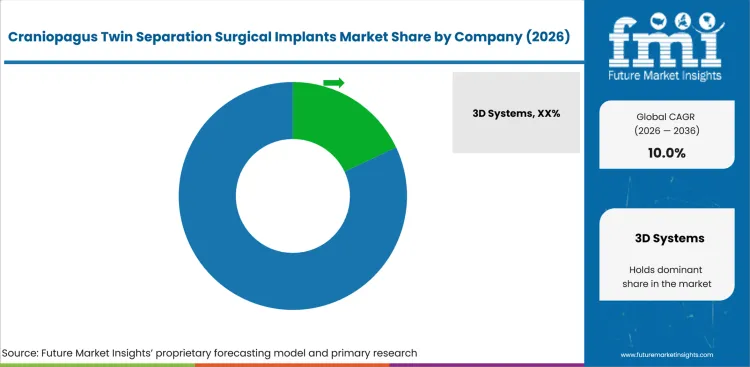
- Established patient-specific implant companies hold an advantage through documented design files and surgeon-facing planning support.
- Digital planning suppliers gain stronger acceptance by connecting CT review with implant geometry and anatomical models.
- Regional manufacturers win in country markets by offering local documentation and surgeon access.
- Service-ready suppliers improve renewal chances through case review and revision planning support.
Patient-specific cranial implant companies compete by combining material portfolios and planning services. 3D Systems has a strong position through FDA-cleared additively manufactured PEEK cranial implants. Materialize competes through CMF planning support and custom PEEK implant workflows. KLS Martin has deep craniofacial implant capability through PEEK and solid titanium patient-specific cranial implants.
Manufacturing and documentation depth have become stronger competitive separators as rare pediatric cases require more than implant supply. CGBIO and Kelyniam Global compete through FDA-cleared patient-specific cranial implant pathways. BioArchitects, MedCAD, Stryker, and DePuy Synthes strengthen competition depending on cranial reconstruction portfolios and hospital relationships. Buyers compare supplier performance through CT data handling and revision readiness.
Smaller and regional suppliers can win through local craniofacial knowledge and faster engineering response. India, South Korea, and Germany create opportunities for suppliers with local design teams and implant production support. United States and Europe create stronger demand for compliance documentation and technical validation. Companies that prove implant fit and planning support under rare surgical timelines should gain more durable hospital relationships.
How do top Craniopagus Twin Separation Surgical Implants companies compare?
3D Systems and Materialise score considerably on digital planning while KLS Martin leads through craniofacial implant engineering capability.
| Company | Relevance to Market Title | Custom Implant Portfolio Depth | Planning Support Strength | Material Capability | Channel Reach | Geographic Footprint |
|---|---|---|---|---|---|---|
| 3D Systems | Very High | Very Strong | Very Strong | Strong | Strong | Global |
| Materialise | Very High | Strong | Very Strong | Strong | Very Strong | Global |
| KLS Martin | Very High | Very Strong | Strong | Very Strong | Strong | Global |
| CGBIO | High | Strong | Moderate | Strong | Moderate | South Korea and International |
| Kelyniam Global | High | Strong | Strong | Strong | Moderate | United States |
| BioArchitects | High | Strong | Moderate | Strong | Moderate | United States and Selected International Markets |
| MedCAD | High | Strong | Moderate | Strong | Moderate | United States |
| Stryker | Moderate to High | Strong | Moderate | Strong | Very Strong | Global |
| DePuy Synthes | Moderate to High | Strong | Moderate | Strong | Very Strong | Global |
| Meticuly | Moderate to High | Strong | Strong | Strong | Moderate | Asia and International |
Source: Future Market Insights competitive analysis, 2026.
Who are the key players in the Craniopagus Twin Separation Surgical Implants Market?
3D Systems, Materialise, and KLS Martin are listed with CGBIO and Kelyniam Global among other suppliers.
Key global companies leading the Craniopagus Twin Separation Surgical Implants Market include:
- 3D Systems
- Materialise
- KLS Martin
- CGBIO
- Kelyniam Global
- BioArchitects
- MedCAD
- Stryker
- DePuy Synthes
- Meticuly
Key Developments in Craniopagus Twin Separation Surgical Implants Market
- In April 2024, 3D Systems announced FDA clearance for VSP PEEK Cranial Implant, strengthening its additively manufactured cranial implant workflow for cranioplasty procedures.
- In September 2025, Kelyniam Global announced FDA clearance for Fusion material for cranial and craniofacial implant applications, expanding its patient-specific reconstruction portfolio.
- In April 2026, CGBIO received FDA clearance for EASYMADE TI, a patient-specific titanium implant for cranial and non-load-bearing craniofacial defect reconstruction.
Key Players in the Craniopagus Twin Separation Surgical Implants Market
Patient-Specific Cranial Implant Leaders
- 3D Systems
- KLS Martin
- Kelyniam Global
- BioArchitects
- MedCAD
Digital Planning and Clinical Engineering Companies
- Materialise
- Axial3D
- 3D LifePrints
- Osteo3D
- Anatomiz3D Healthcare
Craniofacial and Neurosurgical Device Companies
- Stryker
- DePuy Synthes
- Aesculap
- Jeil Medical Corporation
- HOYA Technosurgical
Regional Custom Implant and Biomaterial Suppliers
- CGBIO
- Lucid Implants
- AK Medical
- Serf
- Teijin Nakashima Medical
Craniopagus Twin Separation Surgical Implants Market - Report Scope
| Parameter | Details |
|---|---|
| Forecast period | 2026 to 2036 |
| Historical period | 2021 to 2025 |
| Quantitative unit | Revenue in USD million |
| By procedure type | Craniopagus Twin Separation, complex cranial reconstruction, pediatric neurosurgery |
| By technology | AI-designed patient-specific implants, 3D Printing, XR surgical visualization |
| By material | Titanium and alloys, PEEK, bioceramics |
| By end user | Specialized pediatric hospitals, academic medical centers, research institutes |
| By planning support | CT-based design review, anatomical model support, surgical simulation support |
| Regions covered | North America, Latin America, Europe, East Asia, South Asia and Pacific, Middle East and Africa |
| Countries covered | India, China, South Korea, United Kingdom, Germany, United States, France, Japan |
| Key companies profiled | 3D Systems, Materialise, KLS Martin, CGBIO, Kelyniam Global, BioArchitects, MedCAD, Stryker, DePuy Synthes, Meticuly |
| Approach | Bottom-up procedure-linked implant value approach using rare-case procedure demand, complex cranioplasty proxy demand, material mix, design service intensity, and country-level specialty hospital access |
Source: Future Market Insights competitive analysis, 2026.
Craniopagus Twin Separation Surgical Implants Market - Scope & Definition
| Attribute | Detail |
|---|---|
| Market Definition | Patient-specific cranial and craniofacial implants used in craniopagus twin separation and adjacent complex pediatric cranial reconstruction, including implant design and planning support. |
| Functions Covered | Cranial defect reconstruction, skull stabilization, anatomical model preparation, CT-based design review, surgical guide preparation, and case planning support. |
| Applications Covered | Craniopagus twin separation, complex cranioplasty, pediatric neurosurgery, craniofacial reconstruction, and surgical simulation. |
| End-Use Industries | Specialized pediatric hospitals, academic medical centers, research institutes, surgical planning firms, and craniofacial implant suppliers. |
| Grades Covered | Medical-grade titanium alloys, implant-grade PEEK, BCP-PEEK materials, bioceramic materials, patient-specific plates, and anatomical model materials. |
| Inclusions | Commercially traded patient-specific cranial implants, craniofacial implants, anatomical models, surgical guides, CT-based design review, and planning support across covered countries. |
| Exclusions | Routine skull fixation plates, dental implants, adult trauma plates, spine implants, cosmetic facial implants, generic 3D Printing services without cranial implant use, and non-cranial orthopedic implants. |
Craniopagus Twin Separation Surgical Implants Market - Research Methodology
| Method | Description |
|---|---|
| Primary Research | FMI analyst interviews with pediatric neurosurgery teams, craniofacial surgeons, hospital value-analysis teams, custom implant suppliers, 3D planning firms, and clinical engineering providers across selected markets. |
| Desk Research | Review of regulator databases, official healthcare statistics, hospital specialty pages, company product disclosures, medical device summaries, craniofacial implant references, and public surgical planning evidence. |
| Market Sizing & Forecasting | Bottom-up procedure-linked implant value approach using rare-case procedure demand, complex cranioplasty proxy demand, custom implant pricing, material mix, service intensity, and regional adoption timing. |
| Data Validation | Cross-verification using company portfolios, official healthcare capacity data, country medical device activity, FDA summaries, hospital specialty workload, and parent cranial implant demand checks. |
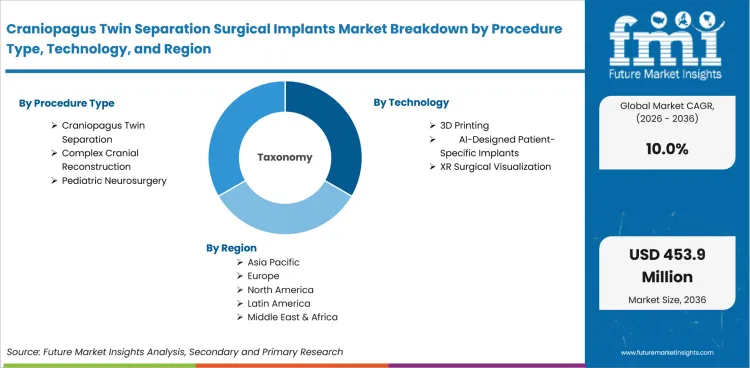
Craniopagus Twin Separation Surgical Implants Market Breakdown by Procedure Type, Technology, Material, End User, Planning Support, and Region
Craniopagus Twin Separation Surgical Implants Market Segmented by Procedure Type
- Craniopagus Twin Separation
- Complex Cranial Reconstruction
- Pediatric Neurosurgery
Craniopagus Twin Separation Surgical Implants Market Segmented by Technology
- AI-Designed Patient-Specific Implants
- 3D Printing
- XR Surgical Visualization
Craniopagus Twin Separation Surgical Implants Market Segmented by Material
- Titanium and Alloys
- PEEK
- Bioceramics
Craniopagus Twin Separation Surgical Implants Market Segmented by End User
- Specialized Pediatric Hospitals
- Academic Medical Centers
- Research Institutes
Craniopagus Twin Separation Surgical Implants Market Segmented by Planning Support
- CT-Based Design Review
- Anatomical Model Support
- Surgical Simulation Support
Craniopagus Twin Separation Surgical Implants Market by Region
- North America
- Latin America
- Europe
- East Asia
- South Asia and Pacific
- Middle East and Africa
Research Sources and Bibliography
- 3D Systems. (2024, April 15). 3D Systems announces FDA clearance for additively manufactured PEEK cranial implants.
- Axial3D. (2025). Medical 3D Printing and anatomical modeling services.
- British Association of Oral and Maxillofacial Surgeons. (2025, September). Craniofacial.
- CG Bio Co., Ltd. (2026, April 9). EASYMADE TI 510(k) summary.
- Directorate for Research, Studies, Evaluation and Statistics. (2025, October 27). Health expenditure in 2024: Results of the health accounts.
- European Commission. (2025, November 17). Ten percent of the EU’s GDP went to healthcare in 2023.
- Gemini Untwined. (2024, September 19). Rare conjoined twin girls separated after 14-hour operation.
- Great Ormond Street Hospital. (2025). Craniofacial unit.
- India Ministry of Health and Family Welfare. (2024, September 9). Health Dynamics of India infrastructure statistics.
- India Ministry of Health and Family Welfare. (2024, December 3). Status of public health beds and health infrastructure.
- Invest India. (2025, May 16). Why India is poised to become a global hub for MedTech manufacturing.
- Kelyniam Global. (2025, September 18). Kelyniam receives FDA clearance for Fusion material in cranial and craniofacial implant use.
- KLS Martin. (2025). IPS implants cranium.
- Materialise. (2026, February 17). Materialise expands CMF portfolio with custom-made PEEK implants.
- National Bureau of Statistics of China. (2025, February 28). Statistical communiqué of the People’s Republic of China on the 2024 national economic and social development.
- National Bureau of Statistics of China. (2026, February 28). Statistical communiqué of the People’s Republic of China on the 2025 national economic and social development.
- Organisation for Economic Co-operation and Development. (2025, November 13). Health at a Glance 2025: OECD indicators.
- Organisation for Economic Co-operation and Development. (2025, November 13). Health at a Glance 2025: Country notes.
- Pharmaceuticals and Medical Devices Agency. (2025, July 22). PMDA Updates, Summer 2025.
- USA Food and Drug Administration. (2024, April 4). VSP PEEK Cranial Implant 510(k) summary.
- USA Food and Drug Administration. (2025, July 25). Fusion BCP-PEEK cranial and craniofacial implants 510(k) summary.
- USA Food and Drug Administration. (2026, April 9). EASYMADE TI 510(k) summary.
- USA National Library of Medicine. (2025). Conjoined twins. StatPearls.
This bibliography is provided for reader reference and is not exhaustive. The full report contains the complete reference list and detailed citations.
This Report Answers
- Market size estimates for 2026 and forecasts through 2036 for the Craniopagus Twin Separation Surgical Implants Market.
- Insights across regional and country-level pediatric cranial reconstruction markets.
- Analysis of demand drivers and hospital purchasing behavior.
- Evaluation of procedure types, technologies, materials, end users, and planning support models.
- Assessment of CT-based design review and patient-specific implant production impacts.
- Identification of opportunities across titanium and planning-led cranial implant services.
- Evaluation of service-linked implant design models and technical sales channels.
- Country-level analysis covering India, China, South Korea, United Kingdom, Germany, United States, France, and Japan.
- Assessment of competition, including leading patient-specific cranial implant suppliers and surgical planning companies.
- Analysis of hospital decision drivers and case approval criteria.
- Regional outlooks across North America, Europe, East Asia, South Asia and Pacific, Latin America, and Middle East and Africa.
- Delivery of market data, forecasts, and supporting analysis in report-ready format.
Frequently Asked Questions
What is the growth prospect for Craniopagus Twin Separation Surgical Implants?
Demand for Craniopagus Twin Separation Surgical Implants is expected to rise at a considerable pace as pediatric referral hospitals adopt patient-specific cranial reconstruction pathways.
Which companies are expected to shape the Craniopagus Twin Separation Surgical Implants Market?
3D Systems, Materialise, KLS Martin, CGBIO, Kelyniam Global, BioArchitects, and MedCAD are expected to shape competition through implant design and planning support.
Why are medical device companies investing in patient-specific cranial implants?
Medical device companies are investing in patient-specific cranial implants to support complex cranial reconstruction programs that require CT-derived geometry and documented design controls.
Why are planning-led sales channels important in the Craniopagus Twin Separation Surgical Implants Market?
Planning-led sales channels support surgeon review and implant fit evaluation before rare pediatric reconstruction procedures.
Which material formats are gaining attention in Craniopagus Twin Separation Surgical Implants?
PEEK and titanium alloy implants are gaining attention as hospitals compare imaging clarity and patient-specific design flexibility.
How do regulations influence Craniopagus Twin Separation Surgical Implants demand?
Regulations influence demand through design documentation and device clearance pathways.
Why is CT-based design review important for Craniopagus Twin Separation Surgical Implants?
CT-based design review is important since patient anatomy guides implant shape and surgical planning before reconstruction.
What role does 3D printing play in Craniopagus Twin Separation Surgical Implants adoption?
3D printing supports adoption by creating anatomical models and patient-matched implants for complex cranial reconstruction planning.
Preview the report firsthand - request a free sample
Get SampleGet the brochure for pricing and purchase details.
Get PDFTable of Content
- Key Takeaways
- Market Size and CAGR
- Top Growth Driver
- Fastest Growing Segment
- Leading Region
- Key Companies
- Emerging Opportunities
- Executive Summary
- Global Market Outlook
- Demand-side Trends
- Supply-side Trends
- Technology Roadmap Analysis
- Analysis and Recommendations
- Analyst Perspective (What is happening? Why now? What should investors know?)
- Key Questions Answered
- How large is the market?
- What is the CAGR?
- What are key trends?
- Which region dominates?
- Who are the leaders?
- Market Overview
- Market Coverage / Taxonomy
- Market Definition / Scope / Limitations
- Research Methodology
- Chapter Orientation
- Analytical Lens and Working Hypotheses
- Market Structure, Signals, and Trend Drivers
- Benchmarking and Cross-market Comparability
- Market Sizing, Forecasting, and Opportunity Mapping
- Research Design and Evidence Framework
- Desk Research Programme (Secondary Evidence)
- Expert Input and Fieldwork (Primary Evidence)
- Tooling, Models, and Reference Databases
- Data Engineering and Model Build
- Quality Assurance and Audit Trail
- Market Background
- Market Dynamics (Drivers, Restraints, Opportunity, Trends)
- Scenario Forecast (Optimistic, Likely, Conservative)
- Impact Analysis
- AI Impact
- Sustainability Impact
- Regulatory Impact
- Technology Impact
- Consumer / Buyer Analysis
- Purchase Drivers
- Adoption Barriers
- Buyer Journey
- Opportunity Map Analysis
- Product Life Cycle Analysis
- Supply Chain Analysis
- Investment Feasibility Matrix
- Value Chain Analysis
- PESTLE and Porter's Analysis
- Regulatory Landscape
- Regional Parent Market Outlook
- Production and Consumption Statistics
- Import and Export Statistics
- Global Market Analysis and Forecast, 2021 to 2036
- Historical Market Size Value (USD Million) Analysis, 2021 to 2025
- Current and Future Market Size Value (USD Million) Projections, 2026 to 2036
- Y-o-Y Growth Trend Analysis
- Absolute $ Opportunity Analysis
- Global Market Pricing Analysis, 2021 to 2036
- Global Market Analysis and Forecast, By Procedure Type, 2021 to 2036
- Introduction / Key Findings
- Historical Market Size Value (USD Million) Analysis By Procedure Type, 2021 to 2025
- Current and Future Market Size Value (USD Million) Analysis and Forecast By Procedure Type, 2026 to 2036
- Craniopagus Twin Separation
- Complex Cranial Reconstruction
- Pediatric Neurosurgery
- Craniopagus Twin Separation
- Y-o-Y Growth Trend Analysis By Procedure Type, 2021 to 2025
- Absolute $ Opportunity Analysis By Procedure Type, 2026 to 2036
- Global Market Analysis and Forecast, By Technology, 2021 to 2036
- Introduction / Key Findings
- Historical Market Size Value (USD Million) Analysis By Technology, 2021 to 2025
- Current and Future Market Size Value (USD Million) Analysis and Forecast By Technology, 2026 to 2036
- 3D Printing
- AI-Designed Patient-Specific Implants
- XR Surgical Visualization
- 3D Printing
- Y-o-Y Growth Trend Analysis By Technology, 2021 to 2025
- Absolute $ Opportunity Analysis By Technology, 2026 to 2036
- Global Market Analysis and Forecast, By Material, 2021 to 2036
- Introduction / Key Findings
- Historical Market Size Value (USD Million) Analysis By Material, 2021 to 2025
- Current and Future Market Size Value (USD Million) Analysis and Forecast By Material, 2026 to 2036
- Titanium and Alloys
- PEEK
- Bioceramics
- Titanium and Alloys
- Y-o-Y Growth Trend Analysis By Material, 2021 to 2025
- Absolute $ Opportunity Analysis By Material, 2026 to 2036
- Global Market Analysis and Forecast, By End User, 2021 to 2036
- Introduction / Key Findings
- Historical Market Size Value (USD Million) Analysis By End User, 2021 to 2025
- Current and Future Market Size Value (USD Million) Analysis and Forecast By End User, 2026 to 2036
- Specialized Pediatric Hospitals
- Academic Medical Centers
- Research Institutes
- Specialized Pediatric Hospitals
- Y-o-Y Growth Trend Analysis By End User, 2021 to 2025
- Absolute $ Opportunity Analysis By End User, 2026 to 2036
- Global Market Analysis and Forecast, By Planning Support, 2021 to 2036
- Introduction / Key Findings
- Historical Market Size Value (USD Million) Analysis By Planning Support, 2021 to 2025
- Current and Future Market Size Value (USD Million) Analysis and Forecast By Planning Support, 2026 to 2036
- CT-Based Design Review
- Anatomical Model Support
- Surgical Simulation Support
- CT-Based Design Review
- Y-o-Y Growth Trend Analysis By Planning Support, 2021 to 2025
- Absolute $ Opportunity Analysis By Planning Support, 2026 to 2036
- Global Market Analysis and Forecast, By Region, 2021 to 2036
- Introduction
- Historical Market Size Value (USD Million) Analysis By Region, 2021 to 2025
- Current Market Size Value (USD Million) Analysis and Forecast By Region, 2026 to 2036
- North America
- Latin America
- Western Europe
- Eastern Europe
- East Asia
- South Asia and Pacific
- Middle East & Africa
- Market Attractiveness Analysis By Region
- North America Market Analysis and Forecast, By Country, 2021 to 2036
- Historical Market Size Value (USD Million) Trend Analysis By Market Taxonomy, 2021 to 2025
- Market Size Value (USD Million) Forecast By Market Taxonomy, 2026 to 2036
- By Country
- USA
- Canada
- Mexico
- By Procedure Type
- By Technology
- By Material
- By End User
- By Planning Support
- By Country
- Market Attractiveness Analysis
- By Country
- By Procedure Type
- By Technology
- By Material
- By End User
- By Planning Support
- Key Takeaways
- Latin America Market Analysis and Forecast, By Country
- Historical Market Size Value (USD Million) Trend Analysis By Market Taxonomy, 2021 to 2025
- Market Size Value (USD Million) Forecast By Market Taxonomy, 2026 to 2036
- By Country
- Brazil
- Chile
- Rest of Latin America
- By Procedure Type
- By Technology
- By Material
- By End User
- By Planning Support
- By Country
- Market Attractiveness Analysis
- By Country
- By Procedure Type
- By Technology
- By Material
- By End User
- By Planning Support
- Key Takeaways
- Western Europe Market Analysis and Forecast, By Country
- Historical Market Size Value (USD Million) Trend Analysis By Market Taxonomy, 2021 to 2025
- Market Size Value (USD Million) Forecast By Market Taxonomy, 2026 to 2036
- By Country
- Germany
- UK
- Italy
- Spain
- France
- Nordic
- BENELUX
- Rest of Western Europe
- By Procedure Type
- By Technology
- By Material
- By End User
- By Planning Support
- By Country
- Market Attractiveness Analysis
- By Country
- By Procedure Type
- By Technology
- By Material
- By End User
- By Planning Support
- Key Takeaways
- Eastern Europe Market Analysis and Forecast, By Country
- Historical Market Size Value (USD Million) Trend Analysis By Market Taxonomy, 2021 to 2025
- Market Size Value (USD Million) Forecast By Market Taxonomy, 2026 to 2036
- By Country
- Russia
- Poland
- Hungary
- Balkan & Baltic
- Rest of Eastern Europe
- By Procedure Type
- By Technology
- By Material
- By End User
- By Planning Support
- By Country
- Market Attractiveness Analysis
- By Country
- By Procedure Type
- By Technology
- By Material
- By End User
- By Planning Support
- Key Takeaways
- East Asia Market Analysis and Forecast, By Country
- Historical Market Size Value (USD Million) Trend Analysis By Market Taxonomy, 2021 to 2025
- Market Size Value (USD Million) Forecast By Market Taxonomy, 2026 to 2036
- By Country
- China
- Japan
- South Korea
- By Procedure Type
- By Technology
- By Material
- By End User
- By Planning Support
- By Country
- Market Attractiveness Analysis
- By Country
- By Procedure Type
- By Technology
- By Material
- By End User
- By Planning Support
- Key Takeaways
- South Asia and Pacific Market Analysis and Forecast, By Country
- Historical Market Size Value (USD Million) Trend Analysis By Market Taxonomy, 2021 to 2025
- Market Size Value (USD Million) Forecast By Market Taxonomy, 2026 to 2036
- By Country
- India
- ASEAN
- Australia & New Zealand
- Rest of South Asia and Pacific
- By Procedure Type
- By Technology
- By Material
- By End User
- By Planning Support
- By Country
- Market Attractiveness Analysis
- By Country
- By Procedure Type
- By Technology
- By Material
- By End User
- By Planning Support
- Key Takeaways
- Middle East & Africa Market Analysis and Forecast, By Country
- Historical Market Size Value (USD Million) Trend Analysis By Market Taxonomy, 2021 to 2025
- Market Size Value (USD Million) Forecast By Market Taxonomy, 2026 to 2036
- By Country
- Kingdom of Saudi Arabia
- Other GCC Countries
- Türkiye
- South Africa
- Other African Union
- Rest of Middle East & Africa
- By Procedure Type
- By Technology
- By Material
- By End User
- By Planning Support
- By Country
- Market Attractiveness Analysis
- By Country
- By Procedure Type
- By Technology
- By Material
- By End User
- By Planning Support
- Key Takeaways
- Key Countries Market Analysis
- USA
- Pricing Analysis
- Market Share Analysis, 2025
- By Procedure Type
- By Technology
- By Material
- By End User
- By Planning Support
- Canada
- Pricing Analysis
- Market Share Analysis, 2025
- By Procedure Type
- By Technology
- By Material
- By End User
- By Planning Support
- Mexico
- Pricing Analysis
- Market Share Analysis, 2025
- By Procedure Type
- By Technology
- By Material
- By End User
- By Planning Support
- Brazil
- Pricing Analysis
- Market Share Analysis, 2025
- By Procedure Type
- By Technology
- By Material
- By End User
- By Planning Support
- Chile
- Pricing Analysis
- Market Share Analysis, 2025
- By Procedure Type
- By Technology
- By Material
- By End User
- By Planning Support
- Germany
- Pricing Analysis
- Market Share Analysis, 2025
- By Procedure Type
- By Technology
- By Material
- By End User
- By Planning Support
- UK
- Pricing Analysis
- Market Share Analysis, 2025
- By Procedure Type
- By Technology
- By Material
- By End User
- By Planning Support
- Italy
- Pricing Analysis
- Market Share Analysis, 2025
- By Procedure Type
- By Technology
- By Material
- By End User
- By Planning Support
- Spain
- Pricing Analysis
- Market Share Analysis, 2025
- By Procedure Type
- By Technology
- By Material
- By End User
- By Planning Support
- France
- Pricing Analysis
- Market Share Analysis, 2025
- By Procedure Type
- By Technology
- By Material
- By End User
- By Planning Support
- India
- Pricing Analysis
- Market Share Analysis, 2025
- By Procedure Type
- By Technology
- By Material
- By End User
- By Planning Support
- ASEAN
- Pricing Analysis
- Market Share Analysis, 2025
- By Procedure Type
- By Technology
- By Material
- By End User
- By Planning Support
- Australia & New Zealand
- Pricing Analysis
- Market Share Analysis, 2025
- By Procedure Type
- By Technology
- By Material
- By End User
- By Planning Support
- China
- Pricing Analysis
- Market Share Analysis, 2025
- By Procedure Type
- By Technology
- By Material
- By End User
- By Planning Support
- Japan
- Pricing Analysis
- Market Share Analysis, 2025
- By Procedure Type
- By Technology
- By Material
- By End User
- By Planning Support
- South Korea
- Pricing Analysis
- Market Share Analysis, 2025
- By Procedure Type
- By Technology
- By Material
- By End User
- By Planning Support
- Russia
- Pricing Analysis
- Market Share Analysis, 2025
- By Procedure Type
- By Technology
- By Material
- By End User
- By Planning Support
- Poland
- Pricing Analysis
- Market Share Analysis, 2025
- By Procedure Type
- By Technology
- By Material
- By End User
- By Planning Support
- Hungary
- Pricing Analysis
- Market Share Analysis, 2025
- By Procedure Type
- By Technology
- By Material
- By End User
- By Planning Support
- Kingdom of Saudi Arabia
- Pricing Analysis
- Market Share Analysis, 2025
- By Procedure Type
- By Technology
- By Material
- By End User
- By Planning Support
- Türkiye
- Pricing Analysis
- Market Share Analysis, 2025
- By Procedure Type
- By Technology
- By Material
- By End User
- By Planning Support
- South Africa
- Pricing Analysis
- Market Share Analysis, 2025
- By Procedure Type
- By Technology
- By Material
- By End User
- By Planning Support
- USA
- Market Structure Analysis
- Competition Dashboard
- Competition Benchmarking
- Market Share Analysis of Top Players
- By Regional
- By Procedure Type
- By Technology
- By Material
- By End User
- By Planning Support
- Emerging Startups
- Innovation Benchmarking
- Competition Analysis
- Competition Deep Dive
- 3D Systems
- Overview
- Product Portfolio
- Profitability by Market Segments (Product/Region/Sales Channel)
- Sales Footprint
- Strategy Overview
- Marketing Strategy
- Product Strategy
- Channel Strategy
- Materialise
- KLS Martin
- CGBIO
- Kelyniam Global
- BioArchitects
- MedCAD
- 3D Systems
- Case Studies
- Success Stories
- Recent Developments
- Competition Deep Dive
- Assumptions & Acronyms Used


