

- Market Size (2026)
- USD 11.8 Bn
- Forecast (2036)
- USD 24.7 Bn
- CAGR (2026 to 2036)
- 7.6%
How big is Cruelty-Free Cosmetics Market in 2026?
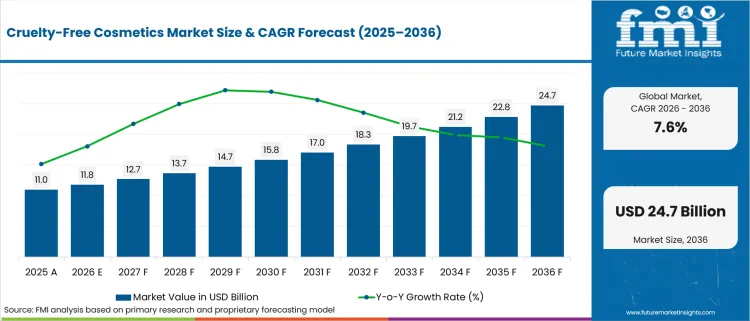
USD 11.8 billion in 2026 and USD 24.7 billion by 2036 at a 7.6% CAGR.
Demand for Cruelty-Free Cosmetics Market is projected to expand at 7.6% CAGR between 2026 and 2036. FMI estimates that demand will move from USD 11.8 billion in 2026 to USD 24.7 billion by 2036. The forecast reflects more frequent claim verification, wider availability of certified mass-market products, and stronger online discovery. Headline values are rounded, and the CAGR is stated to one decimal place.
Cruelty-free and vegan positioning are not interchangeable. A cruelty-free product may contain animal-derived ingredients, while a vegan standard normally examines ingredients as well as testing. Brands that explain the boundary clearly reduce consumer confusion and give retailers a cleaner basis for assortment decisions.
Key Takeaways of Cruelty-Free Cosmetics Market
- FMI estimates place the market at USD 11.8 billion in 2026, with a forecast value of USD 24.7 billion by 2036 at a 7.6% CAGR.
- Skin Care Products lead Product Type with a 34.0% share because daily routines create repeat purchase and require extensive safety substantiation.
- Personal Use accounts for 56.0% of Application demand, while Women hold 52.0% of End User demand.
- Online Retail leads Distribution Channel at 38.0% because shoppers can compare policies, certifications, ingredients and reviews before purchase.
- Mass Market holds 39.0% of Price Range demand as cruelty-free claims move into drugstore and affordable beauty assortments.
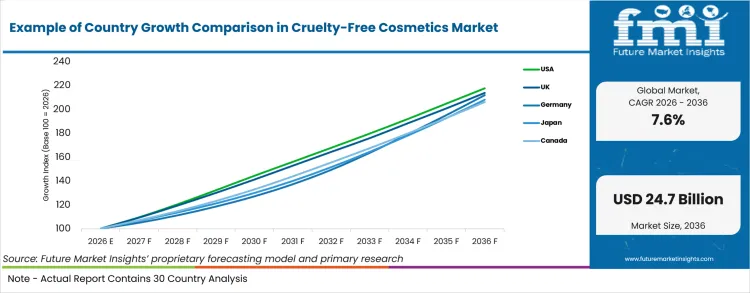
- The profiled country CAGRs form a narrow 7.1% to 8.1% band. Regulatory maturity changes the work needed to support a claim more than the direction of demand.
- e.l.f. Beauty, Lush Cosmetics, The Body Shop and Milk Makeup and Pacifica Beauty and Hourglass Cosmetics and Rare Beauty and Anastasia Beverly Hills and Tarte Cosmetics shape competition across mass and specialty and direct and prestige channels.
Analyst Perspective
"A cruelty-free claim is only as strong as the newest ingredient file. A brand can have a clear policy, then lose control when a pigment, preservative or fragrance supplier changes its safety data. Buyers will favor companies that connect supplier attestations, formula change control, and market-specific claim review before a product reaches the shelf."
- Rahul Pandita Principal Consultant, Future Market Insights
How is the Cruelty-Free Cosmetics Market segmented?
The Cruelty-Free Cosmetics Market is segmented by Product Type, Application, End User, Distribution Channel, Price Range, and Region.
Product Type covers Skin Care Products, Color Cosmetics, Hair Care Products and Personal Care Products and Fragrances. Application includes Personal Use, Professional Beauty Services, Dermatology & Skincare Clinics and Retail Demonstration & Sampling and Hospitality & Wellness. End User includes Women, Men, Beauty Professionals and Gender-Neutral Consumers and Teen Consumers. Distribution Channel covers Online Retail, Specialty Beauty Stores, Supermarkets & Hypermarkets and Pharmacies & Drug Stores and Direct Sales. Price Range includes Mass Market, Premium, Luxury and Professional products.
Why do Skin Care Products lead the Product Type category?
Skin care is used in recurring routines, so every cleanser, moisturizer and serum creates repeated demand.
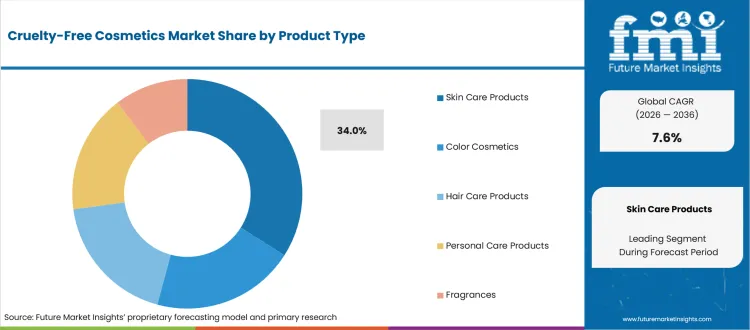
- Skin Care Products hold a 34.0% share in 2026. Facial Cleansers benefit from high-use frequency, while Moisturizers & Serums support higher-value routines and targeted claims.
- Color Cosmetics require shade breadth and pigment documentation. Hair Care Products must balance scalp compatibility with conditioning or styling performance. Personal Care Products compete on convenience, while Fragrances require disciplined fragrance-house declarations for complex supplier compositions.
Why does Personal Use lead the Application category?
Personal use is embedded in daily self-care and generates regular replacement cycles across basic grooming and higher-value beauty routines.
- Personal Use represents 56.0% of Application demand in 2026. Daily Grooming supports steady replacement, while Premium Beauty Care raises average order value through serums, treatment products and prestige color items.
- Professional Beauty Services prioritize wear, hygiene, kit breadth and shade matching. Dermatology & Skincare Clinics require tolerability evidence. Retail Demonstration & Sampling must carry the same assurance as the sellable unit, while Hospitality & Wellness buyers require bulk consistency.
Why do Women lead the End User category?
Women participate across skin care, hair care, color cosmetics and personal care and fragrance and creating a broad base of routine and premium demand.
- Women hold a 52.0% share in 2026. Adult Women participate across the full category mix, while Teenage Girls add early routine formation that requires age-appropriate claims, price points and product education.
- Men contribute through grooming and skincare. Beauty Professionals influence downstream trial. Gender-Neutral Consumers support unisex and inclusive positioning, while Teen Consumers discover products online and remain sensitive to affordability.
Why does Online Retail lead the Distribution Channel category?
Online channels allow product policies, certification status, ingredient information and frequently asked questions to appear beside the product before purchase.
- Online Retail accounts for 38.0% of Distribution Channel demand in 2026. Brand Websites provide policy detail, while E-Commerce Marketplaces add search filters and reviews.
- Specialty Beauty Stores retain value through trials and staff guidance. Supermarkets & Hypermarkets support reach, Pharmacies & Drug Stores support trust for functional skin care, and Direct Sales gives brands more control over education and claim consistency.
Why does Mass Market lead the Price Range category?
Cruelty-free positioning has moved beyond specialist shelves and is now available across drugstore and affordable beauty assortments.
- Mass Market holds a 39.0% share in 2026 because Drugstore Cosmetics and Affordable Beauty Products can spread certification and supplier-assurance costs across larger volumes.
- Premium products combine ethical claims with formula performance or professional endorsement. Luxury products must justify packaging, service, and sensory experience. Professional products require reliable wear, sanitation compatibility, and replenishment. The proof burden remains material across every price tier.
What are the drivers, restraints, and opportunities in the Cruelty-Free Cosmetics Market?
- Driver: Cosmetics animal-testing bans, retailer standards, and consumer verification push brands toward auditable cruelty-free claims.
- Restraint: Definitions differ by country, while mixed-use ingredients and supplier changes can create gaps in evidence.
- Opportunity: Human-relevant safety methods, digital supplier records, and affordable certified products can lower qualification friction.
The European Union applies testing and marketing bans for cosmetics, Canada has prohibited cosmetic animal testing, and Brazil enacted a federal restriction in July 2025. These rules reduce the commercial space for cosmetic-purpose animal testing. They do not remove the manufacturer's duty to establish product safety. The US FDA does not specifically require animal testing for cosmetics, yet it holds manufacturers responsible for safety substantiation.
One raw material may be used in cosmetics and industrial applications, while a regulator may request data for worker or environmental protection. A fixed cut-off date, supplier attestation, or certification audit must therefore define which tests are covered and who controls the decision. The absence of a single US legal definition for terms such as cruelty-free increases the value of clear policies, but it also leaves room for inconsistent self-declared claims.
OECD guidance directs serious eye-damage and irritation assessment toward in vitro information before animal testing is considered as a last resort. Brands can connect such methods with supplier monitoring, independent audit, and formula change control. Mass-market availability then expands because the ethical claim is supported by a repeatable operating system rather than a one-time packaging statement.
Which country CAGRs are profiled in the Cruelty-Free Cosmetics Market?
| Country | CAGR, 2026 to 2036 |
|---|---|
| USA | 8.1% |
| UK | 7.9% |
| Germany | 7.8% |
| Japan | 7.6% |
| Canada | 7.5% |
| Australia | 7.3% |
| Brazil | 7.1% |
How do country-level CAGRs compare in the Cruelty-Free Cosmetics Market?
The country comparison spans 1.0 percentage point and reveals three distinct growth groups across the Cruelty-Free Cosmetics Market. The United States and the United Kingdom form the upper tier with a 0.2-point difference, while Germany, Japan and Canada create a closely aligned middle group with only 0.3 percentage points separating the highest and lowest markets. Australia and Brazil remain at the lower end with a 0.2-point difference.
- The United States leads the comparison at an 8.1% CAGR through 2036, supported by strong consumer interest in ethical beauty, established cruelty-free product availability and broad adoption across cosmetic categories.
- The United Kingdom follows at a 7.9% CAGR, remaining 0.2 percentage points below the United States. Established ethical-consumption preferences and retailer emphasis on responsible beauty products support continued market expansion.
- Germany records a 7.8% CAGR, only 0.1 percentage points below the United Kingdom. Strong sustainability preferences, established beauty retail channels and demand for transparent product positioning support cruelty-free cosmetics adoption.
- Japan grows at a 7.6% CAGR, remaining 0.2 percentage points below Germany. Quality-focused consumers, established skincare demand and growing interest in ethical product attributes support market development.
- Canada records a 7.5% CAGR, 0.1 percentage points below Japan. Consumer interest in responsible beauty products and established cosmetic retail channels support steady adoption.
- Australia grows at a 7.3% CAGR, remaining 0.2 percentage points below Canada. Sustainability-conscious consumers and expanding availability of cruelty-free beauty products support demand.
- Brazil records a 7.1% CAGR, creating a 0.2-percentage-point gap from Australia. Expanding beauty consumption and growing awareness of ethical product attributes support the market's development.
- Comparable CAGRs can still produce different market conditions. Differences in consumer preferences, sustainability awareness, retail availability, regulatory expectations, product transparency and ethical beauty adoption influence demand across countries. The full report provides country-level CAGR analysis across major regions and individual markets within the Cruelty-Free Cosmetics Market.
How does the Cruelty-Free Cosmetics Market vary by country?
- USA: The FDA states that cruelty-free and not-tested-on-animals have no legal definitions under federal cosmetics law. The agency also states that animal testing is not specifically required, while manufacturers remain responsible for safety. California's Cruelty-Free Cosmetics Act adds a state-level sales restriction. Brands therefore use third-party certification, supplier attestations, and retailer review to create a more consistent national claim. FMI estimates an 8.1% CAGR.
- UK: The UK banned animal testing for finished cosmetic products and ingredients for consumer safety. Claims must remain accurate under cosmetics rules, while chemicals legislation can still create worker-safety edge cases. Brands need to separate cosmetic-purpose testing from data generated for another legal duty. FMI estimates a 7.9% CAGR.
- Germany: Germany operates within the EU cosmetics testing and marketing bans. REACH obligations can apply to ingredient manufacturers where human health or environmental evidence is required. Retailers and responsible persons therefore examine ingredient purpose, dossier timing, and supplier control before accepting a claim. FMI estimates a 7.8% CAGR.
- Japan: The Japan Cosmetic Industry Association has supported alternative-method development since 1991 and established a working group on next-generation risk assessment in 2022. Commercial progress depends on validated methods, safety-assessor acceptance, and coordination with domestic suppliers. FMI estimates a 7.6% CAGR.
- Canada: Canada's ban took effect on December 22, 2023 and applies to domestic as well as imported cosmetics. Health Canada guidance states that companies may need to retain proof for cruelty-free claims. The requirement moves documentation from brand messaging into compliance operations. FMI estimates a 7.5% CAGR.
- Australia: AICIS restricts the use of new animal-test data for ingredients introduced solely for cosmetics from July 1, 2020, with defined exceptions and separate treatment for mixed-use chemicals. Brands must classify ingredient use correctly and understand what data an overseas supplier generated. FMI estimates a 7.3% CAGR.
- Brazil: Federal Law No. 15,183 of July 30, 2025 prohibits live-vertebrate testing for cosmetic, personal-hygiene and perfume products. It includes ingredients used exclusively in those products. A narrow serious-safety exception remains. Local manufacturers and importers now have a clearer national baseline for reformulation and claims. FMI estimates a 7.1% CAGR.
Who are the notable companies in the Cruelty-Free Cosmetics Market?
e.l.f. Beauty, Inc.; Lush Cosmetics Ltd.; The Body Shop International Limited.
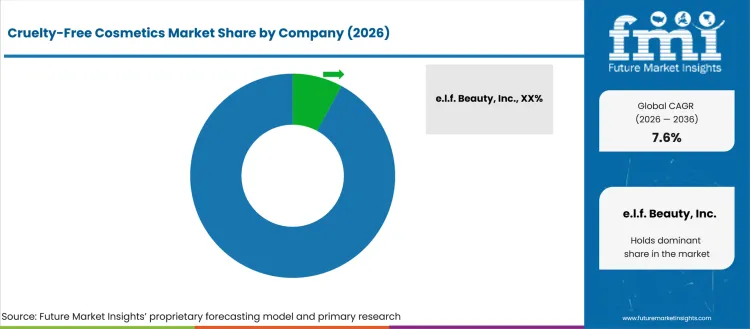
Competition is shaped by the scope of a company's testing policy, the depth of supplier verification, formula ownership and channel control. Mass and digitally scaled brands compete on price access and launch speed. Specialist ethical retailers use direct customer education and visible policy commitments. Prestige brands must support the same claim across complex pigments, high-performance textures, and international retail doors.
- Digitally led mass and prestige brands include e.l.f. Beauty, Inc., Milk Makeup, Pacifica Beauty LLC and Rare Beauty LLC and Tarte Cosmetics.
- Specialist ethical retail platforms include Lush Cosmetics Ltd. and The Body Shop International Limited.
- Prestige and professional cosmetics brands include Hourglass Cosmetics, Anastasia Beverly Hills,
Competitive Benchmarking: How do leading companies compare in the Cruelty-Free Cosmetics Market?
| Company | Documented cruelty-free position | Portfolio signal | Commercial implication |
|---|---|---|---|
| e.l.f. Beauty, Inc. | Company policy states 100% cruelty-free worldwide and double certification through PETA and Leaping Bunny across named brands. | Value-led makeup and skin care within a multi-brand portfolio. | A broad certification policy supports mass retail, direct commerce, and international expansion. |
| Lush Cosmetics Ltd. | Lush states that its product safety approach is animal-free and uses human-relevant data, volunteers, and non-animal models. | Bath, body, skin care and hair care and fragrance with direct retail control. | Formulation ownership and store education strengthen claim traceability and customer explanation. |
| The Body Shop International Limited | The Vegan Society's August 2025 update states that all products would remain Cruelty Free International certified. | Skin care, body care, hair care and makeup and fragrance. | A broad category footprint makes supplier review and clear separation of vegan versus cruelty-free claims commercially important. |
| Pacifica Beauty LLC | Pacifica states that its formulas are 100% vegan and cruelty-free. | Skin care, hair care, makeup and body care and fragrance. | One ethical platform can support cross-category baskets, provided ingredient and testing records stay aligned. |
| Hourglass Cosmetics | Hourglass states that it is cruelty-free and has been fully vegan since 2020. | Prestige complexion and color cosmetics with reported international retail reach. | Prestige scale requires consistent pigment and formula assurance across many markets. |
| Rare Beauty LLC | Rare Beauty states that its products are cruelty-free, vegan, and PETA certified. | Color cosmetics and related beauty products. | Clear consumer-facing standards support online discovery and specialty retail consideration. |
Benchmarking reflects documented cruelty-free positions, portfolio signals, and commercial implications. It does not represent a market-share ranking.
What are the key developments in the Cruelty-Free Cosmetics Market?
- In January 2025, e.l.f. Beauty launched the "e.l.f. von zehn" campaign in Germany. The move localized its value and quality message for German makeup buyers.
- In August 2025, e.l.f. Beauty completed the acquisition of rhode. The transaction expanded the company's skin-focused brand portfolio and added a platform for further retail distribution.
- In August 2025, The Body Shop informed The Vegan Society that it would bring back a limited number of formulas containing non-vegan ingredients in response to customer feedback. The company stated that all products would remain vegetarian and Cruelty Free International certified, showing that vegan and cruelty-free are separate portfolio controls.
- In April 2026, Lush updated its safety and efficacy disclosure. The company reported animal-free, human-relevant data on more than 1,000 ingredients and a testing community of over 450 volunteers.
- In April 2026, e.l.f. Beauty announced that rhode would expand into Sephora online and most stores across Europe from September 2026, following earlier launches in the USA, Canada and the UK.
What does the Cruelty-Free Cosmetics Market report cover?
| Coverage field | Report scope |
|---|---|
| Market breakdown | Product Type, Application, End User and Distribution Channel and Price Range and Region |
| Quantitative Units | Revenue in USD Billion and CAGR in %. |
| Market Definition | Revenue includes first-sale brand-owner or manufacturer revenue from finished cosmetic and personal-care products marketed with a documented cruelty-free or no-animal-testing position within the defined segmentation universe. |
| Exclusions | Raw cosmetic ingredients sold independently, household cleaning products, medical products and cosmetics without a cruelty-free positioning are outside the defined revenue scope. |
| Regions Covered | North America; Latin America; Western Europe; Eastern Europe; East Asia; South Asia and Pacific; Middle East and Africa |
| Countries Covered | USA, UK, Germany and Japan and Canada and Australia and Brazil and more than thirty additional countries in the full report |
| Key Companies Profiled | e.l.f. Beauty, Inc.; Lush Cosmetics Ltd.; The Body Shop International Limited; Milk Makeup; Pacifica Beauty LLC; Hourglass Cosmetics; Rare Beauty LLC; Anastasia Beverly Hills; Tarte Cosmetics |
| Forecast Period | 2026 to 2036 |
| Approach | Hybrid bottom-up and top-down sizing using category revenue, channel mix, price points and claim coverage and certification evidence and country regulation and buyer-side validation. Market values are FMI estimates. |
How was the Cruelty-Free Cosmetics Market researched?
| Method | Approach |
|---|---|
| Primary Research | FMI engages cosmetics brand owners, contract manufacturers, ingredient suppliers and safety assessors and non-animal testing laboratories and certification bodies and specialty retailers and mass retailers and e-commerce teams and beauty professionals and procurement specialists. |
| Desk Research | The review covers official cosmetics regulation, government guidance, national legislation and OECD methods and trade-body technical material and company filings and first-party policies and product documentation and certification criteria and official company announcements. |
| Market Sizing and Forecasting | The model reconciles brand and manufacturer revenue, cruelty-free claim coverage, product mix and price range and online and offline channel structure and retailer availability and country regulation and category replacement cycles. Headline values and CAGR are rounded. |
| Data Validation | Supplier-side findings are cross-checked with brand policy, retailer evidence, certification documentation and safety-method evidence and country rules and buyer interviews. High-risk claims are removed when primary evidence is insufficient. |
How is the Cruelty-Free Cosmetics Market segmented by category?
Cruelty-Free Cosmetics Market segmented by Product Type:
- Skin Care Products
- Facial Cleansers
- Moisturizers & Serums
- Color Cosmetics
- Face Makeup
- Eye & Lip Makeup
- Hair Care Products
- Shampoos & Conditioners
- Hair Styling Products
- Personal Care Products
- Bath & Body Care
- Deodorants
- Fragrances
- Eau de Parfum
- Body Mists
Cruelty-Free Cosmetics Market segmented by Application:
- Personal Use
- Daily Grooming
- Premium Beauty Care
- Professional Beauty Services
- Beauty Salons
- Makeup Studios
- Dermatology & Skincare Clinics
- Post-Treatment Skincare
- Sensitive Skin Care
- Retail Demonstration & Sampling
- In-Store Testing
- Brand Promotion
- Hospitality & Wellness
- Spas
- Wellness Centers
Cruelty-Free Cosmetics Market segmented by End User:
- Women
- Adult Women
- Teenage Girls
- Men
- Grooming Products
- Skincare Products
- Beauty Professionals
- Makeup Artists
- Salon Professionals
- Gender-Neutral Consumers
- Unisex Cosmetics
- Inclusive Beauty Products
- Teen Consumers
- School & College Users
- Young Adults
Cruelty-Free Cosmetics Market segmented by Distribution Channel:
- Online Retail
- Brand Websites
- E-Commerce Marketplaces
- Specialty Beauty Stores
- Beauty Retail Chains
- Independent Beauty Stores
- Supermarkets & Hypermarkets
- Hypermarkets
- Supermarkets
- Pharmacies & Drug Stores
- Retail Pharmacies
- Health & Wellness Stores
- Direct Sales
- Brand-Owned Stores
- Beauty Consultants
Cruelty-Free Cosmetics Market segmented by Price Range:
- Mass Market
- Drugstore Cosmetics
- Affordable Beauty Products
- Premium
- Prestige Cosmetics
- Dermatologist-Recommended Products
- Luxury
- High-End Makeup
- Luxury Skincare
- Professional
- Salon Exclusive Products
- Professional Makeup Lines
Which regions are covered in the Cruelty-Free Cosmetics Market?
- North America
- United States
- Canada
- Mexico
- Latin America
- Brazil
- Chile
- Rest of Latin America
- Western Europe
- Germany
- United Kingdom
- Italy
- Spain
- France
- Nordics
- Benelux
- Rest of Western Europe
- Eastern Europe
- Russia
- Poland
- Hungary
- Balkan and Baltic States
- Rest of Eastern Europe
- East Asia
- China
- Japan
- South Korea
- South Asia and Pacific
- India
- ASEAN
- Australia and New Zealand
- Rest of South Asia and Pacific
- Middle East and Africa
- Kingdom of Saudi Arabia
- Other GCC Countries
- Türkiye
- South Africa
- Other African Union Countries
- Rest of Middle East and Africa
Which sources support the Cruelty-Free Cosmetics Market analysis?
- European Commission. Ban on Animal Testing for Cosmetics. Accessed July 31, 2026.
- US Food and Drug Administration. Cruelty Free/Not Tested on Animals. Accessed July 31, 2026.
- US Food and Drug Administration. Animal Testing and Cosmetics. Accessed July 31, 2026.
- Health Canada. Animal Testing Ban on Cosmetics. Effective December 22, 2023. Accessed July 31, 2026.
- Health Canada. Guidance Document: Animal Testing Ban on Cosmetics. Accessed July 31, 2026.
- Australian Industrial Chemicals Introduction Scheme. Use of Animal Test Data. Accessed July 31, 2026.
- UK Government. Replacing Animals in Science: A Strategy to Support Alternative Methods. Accessed July 31, 2026.
- UK Government. Regulation 2009/1223 and the Cosmetic Products Enforcement Regulations 2013. Accessed July 31, 2026.
- Japan Cosmetic Industry Association. Alternatives to Animal Testing. Accessed July 31, 2026.
- Presidency of the Republic of Brazil. Law No. 15,183, July 30, 2025.
- California Legislative Information. Senate Bill 1249, California Cruelty-Free Cosmetics Act.
- Cruelty Free International. Approval Programme for Brands. Accessed July 31, 2026.
- OECD. Guidance Document on Integrated Approaches to Testing and Assessment for Serious Eye Damage and Eye Irritation, Third Edition, 2024.
- e.l.f. Beauty, Inc. Animal Welfare and Testing Policy, September 2024.
- e.l.f. Beauty, Inc. e.l.f. Beauty Launches "e.l.f. von zehn" in Germany, January 21, 2025.
- e.l.f. Beauty, Inc. Completion of the rhode Acquisition, August 6, 2025.
- e.l.f. Beauty, Inc. rhode Global Retail Expansion into Sephora Europe, April 30, 2026.
- Lush Cosmetics. How Lush Tests Products for Safety and Efficacy, updated April 2026.
- The Vegan Society. The Body Shop Becomes the First Global Beauty Brand with 100% Vegan Product Formulations, January 9, 2024. August 2025 update.
- Pacifica Beauty LLC. About Us. Accessed July 31, 2026.
- Hourglass Cosmetics. About Hourglass. Accessed July 31, 2026.
- Rare Beauty LLC. Frequently Asked Questions. Accessed July 31, 2026.
This bibliography is provided for reader reference and is not exhaustive. The full report contains the complete reference list and detailed citations.
What questions does this report answer?
- What is the Cruelty-Free Cosmetics Market size in 2026 and what value is forecast for 2036?
- Why do Skin Care Products hold the leading Product Type position?
- How do cruelty-free and vegan claims differ at ingredient and testing level?
- Why does Personal Use account for the largest Application share?
- How does Online Retail influence claim verification and product discovery?
- What documentation should brand owners collect from ingredient suppliers?
- How do regulatory mechanisms differ across USA, UK, Germany and Japan and Canada and Australia and Brazil?
- Which named companies compete across mass, ethical retail, prestige and professional channels?
- How can non-animal safety methods reduce qualification risk without weakening product-safety obligations?
Frequently Asked Questions
How big is the Cruelty-Free Cosmetics Market in 2026?
The cruelty-free cosmetics market is valued at USD 11.8 billion in 2026 and is forecast to reach USD 24.7 billion by 2036, growing at a 7.6% CAGR as claim verification, certified mass-market products and stronger online discovery expand adoption across skin care, color cosmetics and personal care categories worldwide.
What is the CAGR of the Cruelty-Free Cosmetics Market from 2026 to 2036?
The cruelty-free cosmetics market grows at a CAGR of 7.6% between 2026 and 2036, rising from USD 11.8 billion to USD 24.7 billion as brands adopt third-party certification, supplier attestations and formula change control to support consistent cruelty-free claims across mass, specialty and prestige retail channels.
Which product type leads the Cruelty-Free Cosmetics Market?
Skin Care Products lead the cruelty-free cosmetics market by product type with a 34.0% share in 2026, as daily cleansing, moisturizing and serum routines create repeat purchase demand and require extensive safety substantiation across facial cleansers and targeted treatment products.
How much will the Cruelty-Free Cosmetics Market add between 2026 and 2036?
The cruelty-free cosmetics market is set to add USD 12.9 billion between 2026 and 2036, growing from USD 11.8 billion to USD 24.7 billion as certified products expand across mass, specialty and online retail channels and consumer verification of ethical claims increases worldwide.
Who are the leading companies in the Cruelty-Free Cosmetics Market?
Nine companies lead the cruelty-free cosmetics market, including e.l.f. Beauty, Lush Cosmetics, The Body Shop, Milk Makeup and Pacifica Beauty, competing through mass, specialty, direct and prestige positioning with certified cruelty-free and vegan claims across skin care, color cosmetics and personal care categories.
Preview the report firsthand - request a free sample
Get SampleGet the brochure for pricing and purchase details.
Get PDFTable of Content
- Key Takeaways
- Market Size and CAGR
- Top Growth Driver
- Fastest Growing Segment
- Leading Region
- Key Companies
- Emerging Opportunities
- Executive Summary
- Global Market Outlook
- Demand-side Trends
- Supply-side Trends
- Technology Roadmap Analysis
- Analysis and Recommendations
- Analyst Perspective (What is happening? Why now? What should investors know?)
- Key Questions Answered
- How large is the market?
- What is the CAGR?
- What are key trends?
- Which region dominates?
- Who are the leaders?
- Market Overview
- Market Coverage / Taxonomy
- Market Definition / Scope / Limitations
- Research Methodology
- Chapter Orientation
- Analytical Lens and Working Hypotheses
- Market Structure, Signals, and Trend Drivers
- Benchmarking and Cross-market Comparability
- Market Sizing, Forecasting, and Opportunity Mapping
- Research Design and Evidence Framework
- Desk Research Programme (Secondary Evidence)
- Expert Input and Fieldwork (Primary Evidence)
- Tooling, Models, and Reference Databases
- Data Engineering and Model Build
- Quality Assurance and Audit Trail
- Market Background
- Market Dynamics (Drivers, Restraints, Opportunity, Trends)
- Scenario Forecast (Optimistic, Likely, Conservative)
- Impact Analysis
- AI Impact
- Sustainability Impact
- Regulatory Impact
- Technology Impact
- Consumer / Buyer Analysis
- Purchase Drivers
- Adoption Barriers
- Buyer Journey
- Opportunity Map Analysis
- Product Life Cycle Analysis
- Supply Chain Analysis
- Investment Feasibility Matrix
- Value Chain Analysis
- PESTLE and Porter's Analysis
- Regulatory Landscape
- Regional Parent Market Outlook
- Production and Consumption Statistics
- Import and Export Statistics
- Global Market Analysis and Forecast, 2021 to 2036
- Historical Market Size Value (USD Billion) Analysis, 2021 to 2025
- Current and Future Market Size Value (USD Billion) Projections, 2026 to 2036
- Y-o-Y Growth Trend Analysis
- Absolute $ Opportunity Analysis
- Global Market Pricing Analysis, 2021 to 2036
- Global Market Analysis and Forecast, By Product Type, 2021 to 2036
- Introduction / Key Findings
- Historical Market Size Value (USD Billion) Analysis By Product Type, 2021 to 2025
- Current and Future Market Size Value (USD Billion) Analysis and Forecast By Product Type, 2026 to 2036
- Skin Care Products
- Facial Cleansers
- Moisturizers & Serums
- Color Cosmetics
- Face Makeup
- Eye & Lip Makeup
- Hair Care Products
- Shampoos & Conditioners
- Hair Styling Products
- Personal Care Products
- Bath & Body Care
- Deodorants
- Fragrances
- Eau de Parfum
- Body Mists
- Skin Care Products
- Y-o-Y Growth Trend Analysis By Product Type, 2021 to 2025
- Absolute $ Opportunity Analysis By Product Type, 2026 to 2036
- Global Market Analysis and Forecast, By Application, 2021 to 2036
- Introduction / Key Findings
- Historical Market Size Value (USD Billion) Analysis By Application, 2021 to 2025
- Current and Future Market Size Value (USD Billion) Analysis and Forecast By Application, 2026 to 2036
- Personal Use
- Daily Grooming
- Premium Beauty Care
- Professional Beauty Services
- Beauty Salons
- Makeup Studios
- Dermatology & Skincare Clinics
- Post-Treatment Skincare
- Sensitive Skin Care
- Retail Demonstration & Sampling
- In-Store Testing
- Brand Promotion
- Hospitality & Wellness
- Spas
- Wellness Centers
- Personal Use
- Y-o-Y Growth Trend Analysis By Application, 2021 to 2025
- Absolute $ Opportunity Analysis By Application, 2026 to 2036
- Global Market Analysis and Forecast, By End User, 2021 to 2036
- Introduction / Key Findings
- Historical Market Size Value (USD Billion) Analysis By End User, 2021 to 2025
- Current and Future Market Size Value (USD Billion) Analysis and Forecast By End User, 2026 to 2036
- Women
- Adult Women
- Teenage Girls
- Men
- Grooming Products
- Skincare Products
- Beauty Professionals
- Makeup Artists
- Salon Professionals
- Gender-Neutral Consumers
- Unisex Cosmetics
- Inclusive Beauty Products
- Teen Consumers
- School & College Users
- Young Adults
- Women
- Y-o-Y Growth Trend Analysis By End User, 2021 to 2025
- Absolute $ Opportunity Analysis By End User, 2026 to 2036
- Global Market Analysis and Forecast, By Distribution Channel, 2021 to 2036
- Introduction / Key Findings
- Historical Market Size Value (USD Billion) Analysis By Distribution Channel, 2021 to 2025
- Current and Future Market Size Value (USD Billion) Analysis and Forecast By Distribution Channel, 2026 to 2036
- Online Retail
- Brand Websites
- E-Commerce Marketplaces
- Specialty Beauty Stores
- Beauty Retail Chains
- Independent Beauty Stores
- Supermarkets & Hypermarkets
- Hypermarkets
- Supermarkets
- Pharmacies & Drug Stores
- Retail Pharmacies
- Health & Wellness Stores
- Direct Sales
- Brand-Owned Stores
- Beauty Consultants
- Online Retail
- Y-o-Y Growth Trend Analysis By Distribution Channel, 2021 to 2025
- Absolute $ Opportunity Analysis By Distribution Channel, 2026 to 2036
- Global Market Analysis and Forecast, By Price Range, 2021 to 2036
- Introduction / Key Findings
- Historical Market Size Value (USD Billion) Analysis By Price Range, 2021 to 2025
- Current and Future Market Size Value (USD Billion) Analysis and Forecast By Price Range, 2026 to 2036
- Mass Market
- Drugstore Cosmetics
- Affordable Beauty Products
- Premium
- Prestige Cosmetics
- Dermatologist-Recommended Products
- Luxury
- High-End Makeup
- Luxury Skincare
- Professional
- Salon Exclusive Products
- Professional Makeup Lines
- Mass Market
- Y-o-Y Growth Trend Analysis By Price Range, 2021 to 2025
- Absolute $ Opportunity Analysis By Price Range, 2026 to 2036
- Global Market Analysis and Forecast, By Region, 2021 to 2036
- Introduction
- Historical Market Size Value (USD Billion) Analysis By Region, 2021 to 2025
- Current Market Size Value (USD Billion) Analysis and Forecast By Region, 2026 to 2036
- North America
- Latin America
- Western Europe
- Eastern Europe
- East Asia
- South Asia and Pacific
- Middle East & Africa
- Market Attractiveness Analysis By Region
- North America Market Analysis and Forecast, By Country, 2021 to 2036
- Historical Market Size Value (USD Billion) Trend Analysis By Market Taxonomy, 2021 to 2025
- Market Size Value (USD Billion) Forecast By Market Taxonomy, 2026 to 2036
- By Country
- USA
- Canada
- By Product Type
- By Application
- By End User
- By Distribution Channel
- By Price Range
- By Country
- Market Attractiveness Analysis
- By Country
- By Product Type
- By Application
- By End User
- By Distribution Channel
- By Price Range
- Key Takeaways
- Latin America Market Analysis and Forecast, By Country
- Historical Market Size Value (USD Billion) Trend Analysis By Market Taxonomy, 2021 to 2025
- Market Size Value (USD Billion) Forecast By Market Taxonomy, 2026 to 2036
- By Country
- Brazil
- Mexico
- Chile
- Rest of Latin America
- By Product Type
- By Application
- By End User
- By Distribution Channel
- By Price Range
- By Country
- Market Attractiveness Analysis
- By Country
- By Product Type
- By Application
- By End User
- By Distribution Channel
- By Price Range
- Key Takeaways
- Western Europe Market Analysis and Forecast, By Country
- Historical Market Size Value (USD Billion) Trend Analysis By Market Taxonomy, 2021 to 2025
- Market Size Value (USD Billion) Forecast By Market Taxonomy, 2026 to 2036
- By Country
- Germany
- UK
- Italy
- Spain
- France
- Nordic
- BENELUX
- Rest of Western Europe
- By Product Type
- By Application
- By End User
- By Distribution Channel
- By Price Range
- By Country
- Market Attractiveness Analysis
- By Country
- By Product Type
- By Application
- By End User
- By Distribution Channel
- By Price Range
- Key Takeaways
- Eastern Europe Market Analysis and Forecast, By Country
- Historical Market Size Value (USD Billion) Trend Analysis By Market Taxonomy, 2021 to 2025
- Market Size Value (USD Billion) Forecast By Market Taxonomy, 2026 to 2036
- By Country
- Russia
- Poland
- Hungary
- Balkan & Baltic
- Rest of Eastern Europe
- By Product Type
- By Application
- By End User
- By Distribution Channel
- By Price Range
- By Country
- Market Attractiveness Analysis
- By Country
- By Product Type
- By Application
- By End User
- By Distribution Channel
- By Price Range
- Key Takeaways
- East Asia Market Analysis and Forecast, By Country
- Historical Market Size Value (USD Billion) Trend Analysis By Market Taxonomy, 2021 to 2025
- Market Size Value (USD Billion) Forecast By Market Taxonomy, 2026 to 2036
- By Country
- China
- Japan
- South Korea
- By Product Type
- By Application
- By End User
- By Distribution Channel
- By Price Range
- By Country
- Market Attractiveness Analysis
- By Country
- By Product Type
- By Application
- By End User
- By Distribution Channel
- By Price Range
- Key Takeaways
- South Asia and Pacific Market Analysis and Forecast, By Country
- Historical Market Size Value (USD Billion) Trend Analysis By Market Taxonomy, 2021 to 2025
- Market Size Value (USD Billion) Forecast By Market Taxonomy, 2026 to 2036
- By Country
- India
- ASEAN
- Australia & New Zealand
- Rest of South Asia and Pacific
- By Product Type
- By Application
- By End User
- By Distribution Channel
- By Price Range
- By Country
- Market Attractiveness Analysis
- By Country
- By Product Type
- By Application
- By End User
- By Distribution Channel
- By Price Range
- Key Takeaways
- Middle East & Africa Market Analysis and Forecast, By Country
- Historical Market Size Value (USD Billion) Trend Analysis By Market Taxonomy, 2021 to 2025
- Market Size Value (USD Billion) Forecast By Market Taxonomy, 2026 to 2036
- By Country
- Kingdom of Saudi Arabia
- Other GCC Countries
- Türkiye
- South Africa
- Other African Union
- Rest of Middle East & Africa
- By Product Type
- By Application
- By End User
- By Distribution Channel
- By Price Range
- By Country
- Market Attractiveness Analysis
- By Country
- By Product Type
- By Application
- By End User
- By Distribution Channel
- By Price Range
- Key Takeaways
- Key Countries Market Analysis
- USA
- Pricing Analysis
- Market Share Analysis, 2025
- By Product Type
- By Application
- By End User
- By Distribution Channel
- By Price Range
- Canada
- Pricing Analysis
- Market Share Analysis, 2025
- By Product Type
- By Application
- By End User
- By Distribution Channel
- By Price Range
- Mexico
- Pricing Analysis
- Market Share Analysis, 2025
- By Product Type
- By Application
- By End User
- By Distribution Channel
- By Price Range
- Brazil
- Pricing Analysis
- Market Share Analysis, 2025
- By Product Type
- By Application
- By End User
- By Distribution Channel
- By Price Range
- Chile
- Pricing Analysis
- Market Share Analysis, 2025
- By Product Type
- By Application
- By End User
- By Distribution Channel
- By Price Range
- Germany
- Pricing Analysis
- Market Share Analysis, 2025
- By Product Type
- By Application
- By End User
- By Distribution Channel
- By Price Range
- UK
- Pricing Analysis
- Market Share Analysis, 2025
- By Product Type
- By Application
- By End User
- By Distribution Channel
- By Price Range
- Italy
- Pricing Analysis
- Market Share Analysis, 2025
- By Product Type
- By Application
- By End User
- By Distribution Channel
- By Price Range
- Spain
- Pricing Analysis
- Market Share Analysis, 2025
- By Product Type
- By Application
- By End User
- By Distribution Channel
- By Price Range
- France
- Pricing Analysis
- Market Share Analysis, 2025
- By Product Type
- By Application
- By End User
- By Distribution Channel
- By Price Range
- India
- Pricing Analysis
- Market Share Analysis, 2025
- By Product Type
- By Application
- By End User
- By Distribution Channel
- By Price Range
- ASEAN
- Pricing Analysis
- Market Share Analysis, 2025
- By Product Type
- By Application
- By End User
- By Distribution Channel
- By Price Range
- Australia & New Zealand
- Pricing Analysis
- Market Share Analysis, 2025
- By Product Type
- By Application
- By End User
- By Distribution Channel
- By Price Range
- China
- Pricing Analysis
- Market Share Analysis, 2025
- By Product Type
- By Application
- By End User
- By Distribution Channel
- By Price Range
- Japan
- Pricing Analysis
- Market Share Analysis, 2025
- By Product Type
- By Application
- By End User
- By Distribution Channel
- By Price Range
- South Korea
- Pricing Analysis
- Market Share Analysis, 2025
- By Product Type
- By Application
- By End User
- By Distribution Channel
- By Price Range
- Russia
- Pricing Analysis
- Market Share Analysis, 2025
- By Product Type
- By Application
- By End User
- By Distribution Channel
- By Price Range
- Poland
- Pricing Analysis
- Market Share Analysis, 2025
- By Product Type
- By Application
- By End User
- By Distribution Channel
- By Price Range
- Hungary
- Pricing Analysis
- Market Share Analysis, 2025
- By Product Type
- By Application
- By End User
- By Distribution Channel
- By Price Range
- Kingdom of Saudi Arabia
- Pricing Analysis
- Market Share Analysis, 2025
- By Product Type
- By Application
- By End User
- By Distribution Channel
- By Price Range
- Türkiye
- Pricing Analysis
- Market Share Analysis, 2025
- By Product Type
- By Application
- By End User
- By Distribution Channel
- By Price Range
- South Africa
- Pricing Analysis
- Market Share Analysis, 2025
- By Product Type
- By Application
- By End User
- By Distribution Channel
- By Price Range
- USA
- Market Structure Analysis
- Competition Dashboard
- Competition Benchmarking
- Market Share Analysis of Top Players
- By Regional
- By Product Type
- By Application
- By End User
- By Distribution Channel
- By Price Range
- Emerging Startups
- Innovation Benchmarking
- Competition Analysis
- Competition Deep Dive
- e.l.f. Beauty, Inc.
- Overview
- Product Portfolio
- Profitability by Market Segments
- Sales Footprint
- Strategy Overview
- Marketing Strategy
- Product Strategy
- Channel Strategy
- Lush Cosmetics Ltd.
- The Body Shop International Limited
- Milk Makeup
- Pacifica Beauty LLC
- Hourglass Cosmetics
- Rare Beauty LLC
- Anastasia Beverly Hills
- Tarte Cosmetics
- e.l.f. Beauty, Inc.
- Case Studies
- Success Stories
- Recent Developments
- Competition Deep Dive
- Assumptions & Acronyms Used


