

- Market Size (2026)
- USD 108.0 Mn
- Forecast (2036)
- USD 214.3 Mn
- CAGR (2026 to 2036)
- 7.1%
Freeze Dried Raspberry Market Size, Market Forecast and Outlook By FMI
USD 108.0 million in 2026 and USD 214.3 million by 2036 at a 7.1% CAGR.
The freeze dried raspberry market is estimated to increase from USD 100.8 million in 2025 to USD 214.3 million by 2036 as bakery, cereal, dairy, and dry beverage manufacturers expand premium berry inclusions. Pieces are forecast to represent 38.0% share in 2026 because visible fruit identity matters most in baked goods and breakfast products. Conventional raspberry is expected to hold 72.0% share in 2026 because industrial buyers balance fruit cost, cut size, and sensory performance before they move into certified lots.
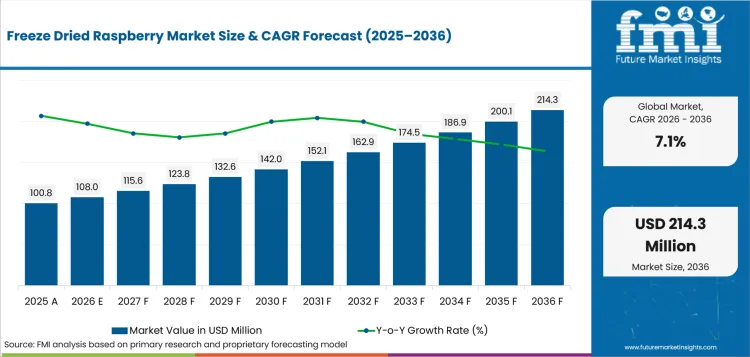
Freeze Dried Raspberry Market Overview: Size and Forecast
- 2026 Market Size: USD 108.0 million
- 2036 Market Size: USD 214.3 million
- Forecast CAGR: 7.1% from 2026 to 2036
- Leading Form: Pieces
- Pieces Share in 2026: 38.0%
- Leading Nature: Conventional
- Conventional Share in 2026: 72.0%
- Leading Application: Bakery
- Bakery Share in 2026: 29.0%
- Fastest-growing Country: India
- India CAGR: 9.1% by 2036
Summary of the Freeze Dried Raspberry Market
- Demand and Growth Drivers
- Rising demand from food and beverage manufacturers is driving sales of freeze-dried raspberries, particularly for use in cereals, bakery products, snacks, dairy, and functional beverages due to their long shelf life and intense flavor profile.
- Adoption is increasing in the nutraceutical and health food segments, where freeze-dried raspberries are used in powders, supplements, and superfood blends because they retain antioxidants, vitamins, and natural color.
- Sales growth is supported by premium and clean-label product trends, as brands prefer freeze-dried raspberries over artificial flavors and colors to meet consumer expectations for natural ingredients.
- Expanding use in e-commerce and direct-to-consumer channels is accelerating market penetration, especially among consumers seeking lightweight, shelf-stable, and minimally processed fruit products.
- Product and Segment View
- Pieces are projected to lead Form with 38.0% share in 2026 as visible berry identity supports premium positioning.
- Conventional products are expected to lead Nature with 72.0% share in 2026 because bulk programs need stable pricing.
- Bakery is forecast to lead Application with 29.0% share in 2026 as raspberry acidity fits cookies, bars, and fillings.
- Food manufacturers are estimated to lead Buyer Type with 46.0% share in 2026 because formulation trials drive repeat orders.
- Geography and Competitive Outlook
- The United States is projected to record 6.9% CAGR through 2036 with berry ingredient use in snacks and cereals.
- Germany is forecast to grow at 6.4% CAGR through 2036 as ingredient distributors serve bakery and muesli makers.
- Japan is expected to expand at 6.6% CAGR through 2036 as compact premium packs fit gifting and dessert use.
- Chaucer Foods, Van Drunen Farms, Mercer Foods, European Freeze Dry, Döhler, OFD Foods, and LYOFOOD form the benchmark supplier group.
- Analyst Opinion
- Nandini Roy Choudhury, Principal Consultant for Food and Beverage at FMI, observes, “Freeze dried raspberry is now a specification-led fruit ingredient rather than a simple garnish. Buyers are asking whether pieces survive handling, whether powder keeps color in dry mixes, and whether the processor can prove lot control. Suppliers with stable berry sourcing, low moisture discipline, and multiple cut sizes should hold an advantage.”
USDA NASS reported in May 2026 that USA raspberry utilized production reached 188 million pounds in 2025 and increased 9.0% from 2024. That supply signal supports domestic ingredient planning for processors serving bakery and cereal accounts. FDA traceability planning is another pressure point because the agency stated that Food Traceability Rule enforcement is not expected before July 20, 2028. Berry processors can use the transition period to tighten lot records across receiving, drying, blending, and shipment events.
Which factors support expansion in the freeze dried raspberry market?
Visible berry inclusion demand and dry powder formulation support market value across bakery, cereal, dairy, and beverage systems.
- Market value is supported by finished food programs that need raspberry identity without fresh fruit moisture.
- Supplier pricing reflects berry input cost and energy-intensive drying before cut size affects final margins.
- Revenue improves as food manufacturers convert premium snack and cereal ideas into repeat plant runs.
- Retail trust rises when processors provide allergen statements, pesticide records, microbiology results, and traceability documents.
Why is the freeze dried raspberry market growing?
Food manufacturers are using raspberry pieces and powder because the formats help finished products carry fruit identity without shortening shelf life. A peer-reviewed red raspberry powder study published in April 2024 supports the need to characterize freeze dried berry powder for nutrients and phytochemicals before food companies use it in finished products. USDA ERS stated in January 2026 that produce accounted for 33.0% of USA organic food sales in 2024. This supports organic raspberry demand where retailers want fruit-based clean-label products, but bulk programs still rely on conventional lots. Adjacent fruit powders and freeze dried fruit powder demand also supports the market because beverage, supplement, and dessert buyers require dry inputs that can be handled without refrigerated fruit systems.
How is the freeze dried raspberry market segmented?
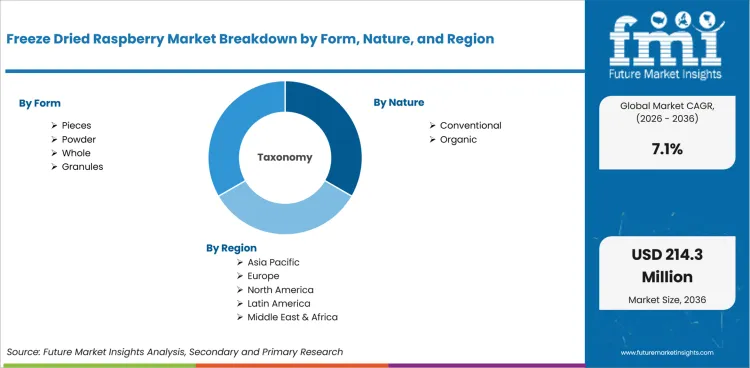
The freeze dried raspberry industry is segmented by form, nature, application, buyer type, sales channel, and region.
- Pieces are projected to secure 38.0% share in 2026 because cereal and bakery buyers need visible raspberry identity.
- Conventional products are anticipated to hold 72.0% share in 2026 since larger food programs need stable fruit cost.
- Bakery is expected to capture 29.0% share in 2026 due to raspberry acidity and color use in cookies, bars, and fillings.
- Food manufacturers are forecast to represent 46.0% share in 2026 because repeat plant runs need stable specifications.
- Direct B2B sales are projected to account for 42.0% share in 2026 because large buyers negotiate cut size and moisture limits directly.
Why do pieces lead the freeze dried raspberry market?
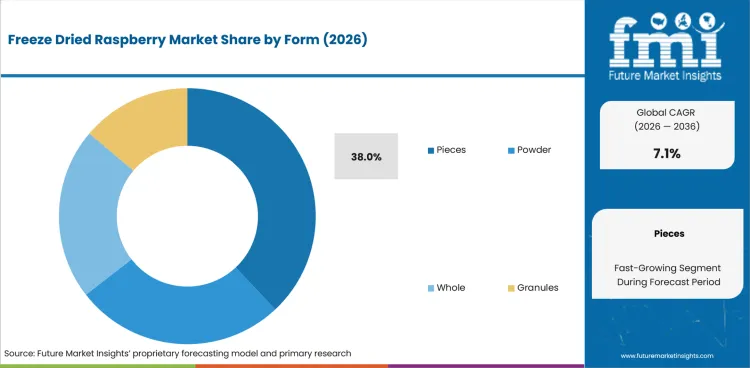
- Pieces are projected to account for 38.0% share in 2026 as cereal and bakery makers need fruit that stays visible after mixing.
- Powder gains use when beverage and supplement buyers need raspberry color and acidity in dry blends.
Which nature leads the freeze dried raspberry market?
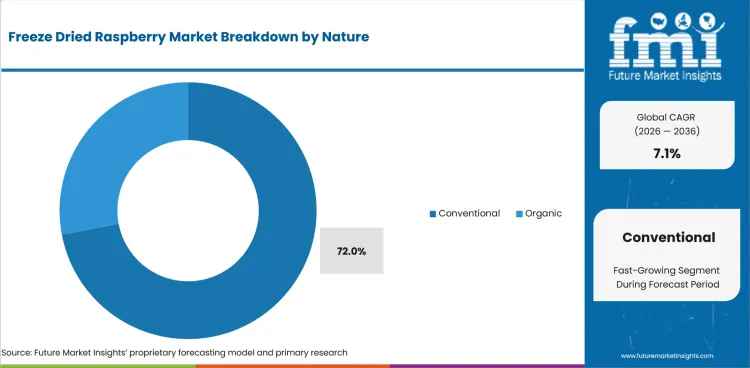
- Conventional raspberry is expected to hold 72.0% share in 2026 because industrial buyers use larger lots and tighter price targets.
- Organic raspberry gains value in premium retail packs where certified fruit claims support higher shelf prices.
Which application leads the freeze dried raspberry market?
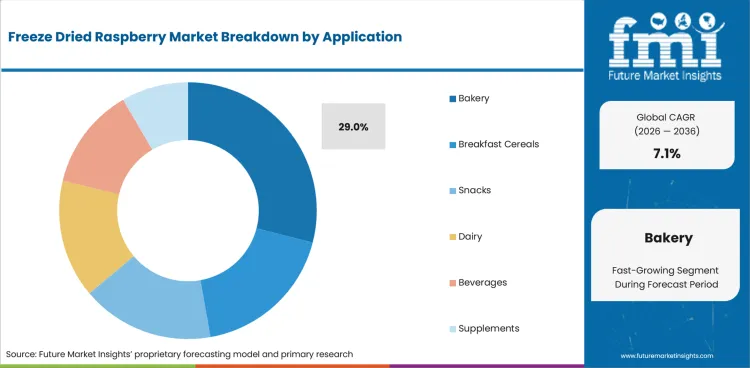
- Bakery is anticipated to hold 29.0% share in 2026 as raspberry acidity balances sweet dough, bars, and chocolate formats.
- Breakfast cereals gain share where visible pieces help brands show fruit content without softening the base product.
Which buyer type leads the freeze dried raspberry market?
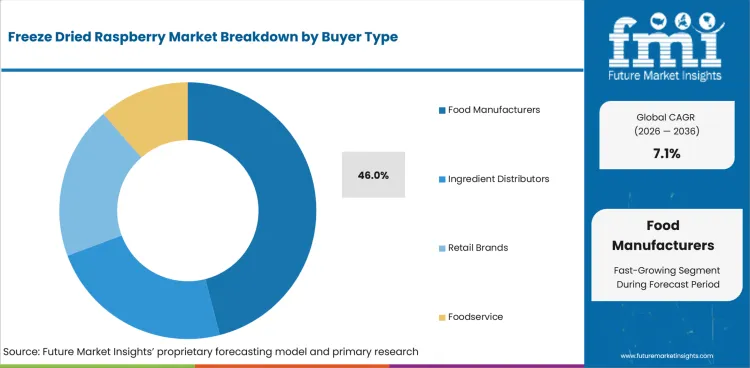
- Food manufacturers are estimated to account for 46.0% share in 2026 as repeat line trials become contracted ingredient demand.
- Ingredient distributors remain useful for smaller brands that need lower order sizes before moving into direct processor contracts.
Which sales channel leads the freeze dried raspberry market?
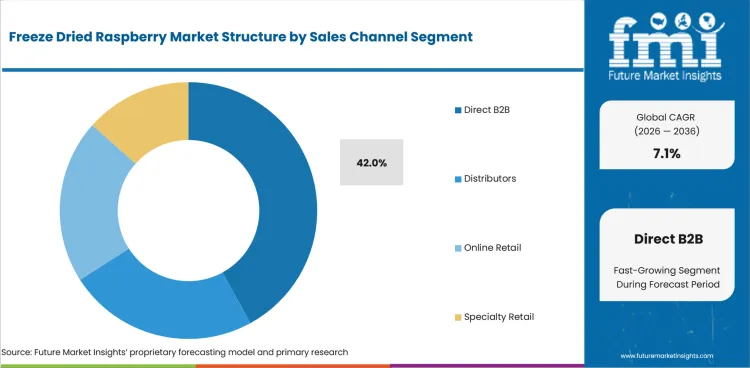
- Direct B2B is projected to represent 42.0% share in 2026 as large buyers require moisture limits and repeatable cut size.
- Online retail gains use in small packs for bakers, home formulators, and premium snack buyers.
What are the drivers, restraints, and opportunities in the freeze dried raspberry market?
Industrial fruit inclusion demand supports growth while drying cost and crop volatility limit wider use in mainstream products.
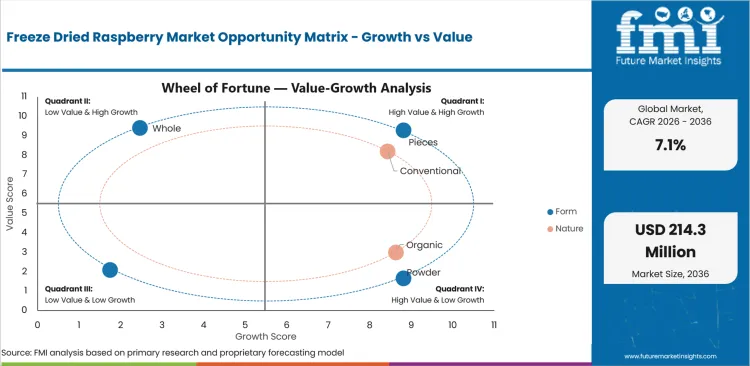
- Driver: Berry inclusion design supports demand as food makers need visible fruit markers in dry products.
- Driver: Powder format growth is supported by dry blending as beverage and supplement brands avoid refrigerated fruit inputs.
- Restraint: Energy-intensive drying limits margin because processors must manage freezing, vacuum drying, and final moisture testing.
- Opportunity: Co-manufacturing creates room for qualified processors as brands without drying assets launch private-label berry SKUs.
Freeze Dried Raspberry Market Demand Outlook
Demand outlook is moving toward ingredient programs that can prove moisture control and traceability before channel expansion. In March 2026, the Organic Trade Association reported USA certified organic product sales of USD 76.6 billion in 2025 and organic food sales of USD 70.1 billion. Organic produce remained the largest category, which supports certified raspberry options in premium processed foods. The market impact is concentrated in products that need real fruit identity such as cereals, bars, toppings, and ready-to-eat food products.
Application Route and Format-led Buying Analysis
Purchase behavior is shaped by the format in which raspberry enters the finished product. Industrial buyers choose pieces for cereal, chocolate and bakery inclusions where color retention and breakage control affect finished-product appearance. Retail buyers compare whole fruit and powder through flavor clarity, pack size and label simplicity. In May 2026, USDA National Agricultural Statistics Service reported 101.0 million pounds of USA raspberries for the fresh market and 87.8 million pounds for processing in 2025. This split matters because freeze-dried raspberry suppliers must compete for fruit that can serve both premium retail packs and processing-grade ingredient channels. Suppliers become more valuable when they can convert the same fruit pool into whole pieces, broken formats and powder without losing color consistency.
Processing Performance and Audit-readiness Analysis
Customer decisions are shaped by three checks that happen before repeat orders. Buyers test whether raspberry pieces remain visible after cereal or bakery mixing. They check whether powder keeps color after blending into dairy, beverages or nutrition mixes. They also confirm whether supplier documentation can pass food safety audits. In January 2025, FDA issued draft guidance for low-moisture ready-to-eat foods and included powdered drink mixes, snack foods, granola bars and dry cereal among covered examples. This matters because freeze-dried raspberry suppliers are selling into applications where low moisture does not remove the need for sanitation controls. Suppliers serving freeze dried fruits and vegetables can position raspberry as a repeatable ingredient when they prove low fines, clean paperwork and stable color after processing.
Which countries are growing fastest in the freeze dried raspberry market?
India 9.1% CAGR, China 8.4% CAGR, South Korea 7.2% CAGR, United States 6.9% CAGR, Japan 6.6% CAGR, Germany 6.4% CAGR, France 6.1% CAGR, and United Kingdom 5.8% CAGR through 2036.
.webp "Top Country Growth Comparison Freeze Dried Raspberry Market Cagr (2026 2036)")
| Country | CAGR |
|---|---|
| India | 9.1% |
| China | 8.4% |
| South Korea | 7.2% |
| United States | 6.9% |
| Japan | 6.6% |
| Germany | 6.4% |
| France | 6.1% |
| United Kingdom | 5.8% |
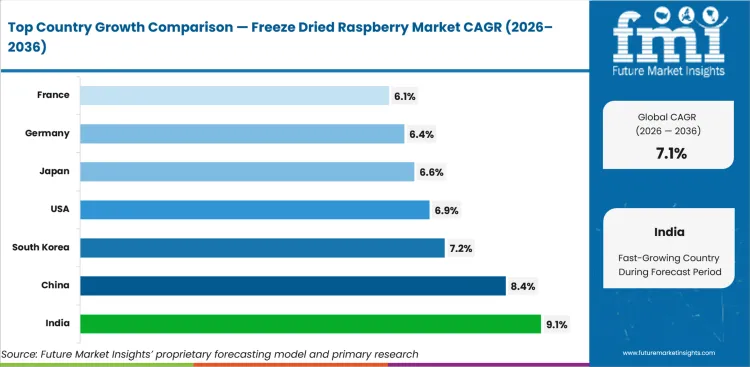
Source: Future Market Insights, 2026.
How do country-level CAGRs compare in the freeze dried raspberry market?
India leads country growth while the United Kingdom records the most cautious expansion outlook among profiled markets.
- India is forecast to record 9.1% CAGR by 2036 as food processing capacity and online premium food channels expand.
- China is expected to expand at 8.4% CAGR from 2026 to 2036 due to online food sales and premium bakery demand.
- South Korea is projected to grow at 7.2% CAGR through 2036 as convenience retail and cafe channels support compact premium foods.
- The United States is estimated to rise at 6.9% CAGR by 2036 with berry ingredient use in snacks and cereals.
- Japan is expected to advance at 6.6% CAGR over the forecast period as shelf-stable premium fruit ingredients fit gifting and dessert use.
- Germany is forecast to grow at 6.4% CAGR through 2036 because bakery and muesli programs need controlled fruit inclusions.
- France is projected to post 6.1% CAGR by 2036 as patisserie and yogurt makers use raspberry color and acidity.
- The United Kingdom is forecast to grow at 5.8% CAGR through 2036 as import dependence and price pressure slow wider rollout.
How fast is the freeze dried raspberry market growing in United States?
A 6.9% CAGR through 2036 reflects premium ingredient demand and controlled fruit inclusion use.
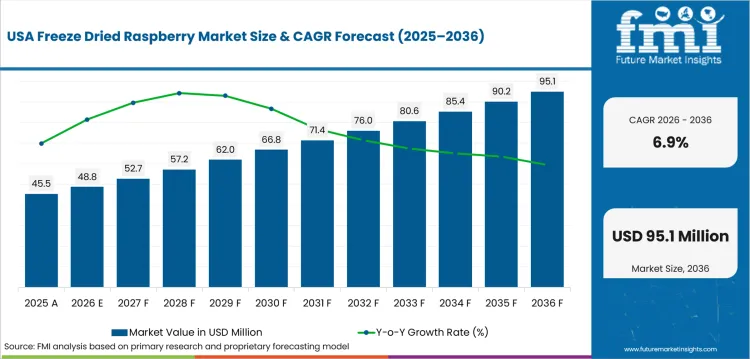
Country Market Snapshot Table
| Parameter | Value |
|---|---|
| Market Size in 2025 (Value) | USD 26.2 million |
| Market Size in 2026 (Value) | USD 28.0 million |
| Market Forecast in 2036 (Value) | USD 54.6 million |
| CAGR (2026 to 2036) | 6.9% |
| Years Considered | 2021 to 2036 |
| Base Year | 2025 |
| Forecast Period | 2026 to 2036 |
| Units Considered | Value (USD million) |
| Leading Sub-Region | California, Pacific Northwest, Midwest bakery hubs, Northeast natural retail corridors |
United States Freeze Dried Raspberry Market Outlook
United States freeze dried raspberry demand is influenced by a large berry base, snack manufacturing scale, and premium cereal formulation. Buyers already use raspberry as a visible fruit cue in bars, granola, chocolate, and dairy toppings.
Processors are expected to support direct B2B programs where traceability paperwork and microbiology certificates are checked before purchase orders move into repeat supply.
Key Growth Drivers
- USDA NASS reported raspberry utilized production of 188 million pounds in 2025, giving processors a measurable domestic feedstock base for raspberry ingredients.
- USDA ERS reported that produce accounted for 33.0% of USA organic food sales in 2024, supporting certified raspberry use in premium processed foods.
- Snack and cereal makers are expected to use pieces where visible fruit identity helps products justify premium pricing.
- Direct supplier contracts are expected to grow as large buyers ask for moisture limits and repeatable particle-size ranges.
Key Restraints
- FDA stated that Food Traceability Rule enforcement is not expected before July 20, 2028, keeping record-system transition work active for berry processors.
- Freeze drying cost is expected to limit use in lower-priced cookies and cereal lines where air-dried fruit remains cheaper.
- Crop volatility can reduce usable berry lots when processors need color, seed texture, and low breakage within the same specification.
What makes United States unique
The United States is unique because domestic raspberry output, organic food demand, and national snack manufacturing meet in one large buyer base.
Key Companies
- Van Drunen Farms
- Mercer Foods
- OFD Foods
- Thrive Freeze Dry
- Sow Good
- North Bay Trading Co.
Sales & Marketing Channels
- Direct B2B contracts
- Ingredient distributors
- Natural food retail
- Online specialty stores
- Bakery suppliers
- Club and mass retail
Country Segment Breakdown Table
| Segment | Sub-Segments |
|---|---|
| By Form | Pieces · Powder · Whole · Granules |
| By Nature | Conventional · Organic |
| By Application | Bakery · Breakfast Cereals · Snacks · Dairy · Beverages · Supplements |
| By Buyer Type | Food Manufacturers · Ingredient Distributors · Retail Brands · Foodservice |
| By Sales Channel | Direct B2B · Distributors · Online Retail · Specialty Retail |
| Key Sub-Regions Covered, Urban Retail Clusters | California, Pacific Northwest, Midwest bakery hubs, Northeast natural retail corridors |
Frequently Asked Questions
How fast is United States freeze dried raspberry market growing?
Sales in United States are forecast to expand at 6.9% CAGR from 2026 to 2036, supported by premium food manufacturing and specification-led buying.
Who leads United States freeze dried raspberry market?
Van Drunen Farms, Mercer Foods, OFD Foods, Thrive Freeze Dry compete through ingredient coverage, retail access, and premium food channel reach.
How fast is the freeze dried raspberry market growing in United Kingdom?
A 5.8% CAGR through 2036 reflects premium ingredient demand and controlled fruit inclusion use.
Country Market Snapshot Table
| Parameter | Value |
|---|---|
| Market Size in 2025 (Value) | USD 7.6 million |
| Market Size in 2026 (Value) | USD 8.0 million |
| Market Forecast in 2036 (Value) | USD 14.1 million |
| CAGR (2026 to 2036) | 5.8% |
| Years Considered | 2021 to 2036 |
| Base Year | 2025 |
| Forecast Period | 2026 to 2036 |
| Units Considered | Value (USD million) |
| Leading Sub-Region | London, Midlands bakery corridor, Manchester, Yorkshire food clusters, Scotland premium retail channels |
United Kingdom Freeze Dried Raspberry Market Outlook
United Kingdom freeze dried raspberry demand is tied to bakery mixes, cereal inclusions, premium desserts, and online ingredient retail. The country has strong finished food manufacturing but limited local raspberry drying capacity.
Brands are expected to use imported raspberry pieces and powders where color stability and pack convenience outweigh higher landed cost.
Key Growth Drivers
- DEFRA reported total fruit supply of 3.8 million tonnes in 2024, giving UK ingredient buyers a large fruit consumption and import base.
- The Office for National Statistics reported that food manufacture represented 21.0% of UK manufacturers’ product sales in 2024.
- Premium bakery and dessert brands are expected to use raspberry pieces where tartness and color support small-batch positioning.
- Specialty ingredient distributors are expected to support smaller brands that need trial quantities before direct processor contracts.
Key Restraints
- The UK Food Security Report stated that domestic fresh fruit production covered 16.0% of supply in 2023, keeping berry ingredient buyers exposed to imports.
- Currency-sensitive import costs are expected to limit wider use of freeze dried raspberry in price-led grocery products.
- Moisture and breakage risk can raise rejection rates when distributors repack pieces for smaller foodservice and retail accounts.
What makes United Kingdom unique
The United Kingdom is unique because premium bakery demand is active but the supply route depends heavily on imported dried fruit inputs.
Key Companies
- European Freeze Dry
- Chaucer Foods
- Healthy Supplies
- RealFoodSource
- Buy Whole Foods Online
- The Freeze Dried Candy Company
Sales & Marketing Channels
- Ingredient distributors
- Online specialty retail
- Bakery ingredient suppliers
- Premium grocery
- Foodservice wholesalers
- Natural food stores
Country Segment Breakdown Table
| Segment | Sub-Segments |
|---|---|
| By Form | Pieces · Powder · Whole · Granules |
| By Nature | Conventional · Organic |
| By Application | Bakery · Breakfast Cereals · Snacks · Dairy · Beverages · Supplements |
| By Buyer Type | Food Manufacturers · Ingredient Distributors · Retail Brands · Foodservice |
| By Sales Channel | Direct B2B · Distributors · Online Retail · Specialty Retail |
| Key Sub-Regions Covered, Urban Retail Clusters | London, Midlands bakery corridor, Manchester, Yorkshire food clusters, Scotland premium retail channels |
Frequently Asked Questions
How fast is United Kingdom freeze dried raspberry market growing?
Sales in United Kingdom are forecast to expand at 5.8% CAGR from 2026 to 2036, supported by premium food manufacturing and specification-led buying.
Who leads United Kingdom freeze dried raspberry market?
European Freeze Dry, Chaucer Foods, Healthy Supplies, RealFoodSource compete through ingredient coverage, retail access, and premium food channel reach.
How fast is the freeze dried raspberry market growing in Germany?
A 6.4% CAGR through 2036 reflects premium ingredient demand and controlled fruit inclusion use.
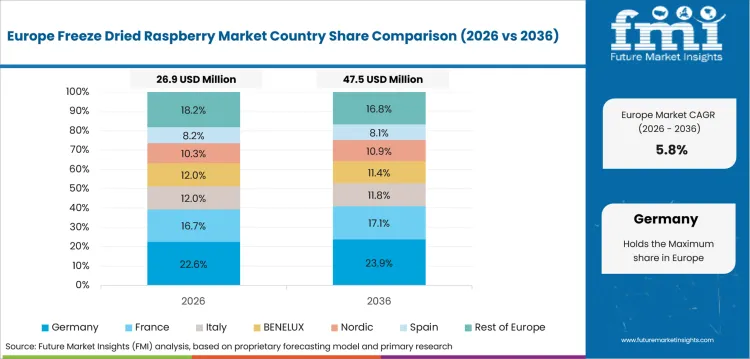
Country Market Snapshot Table
| Parameter | Value |
|---|---|
| Market Size in 2025 (Value) | USD 8.6 million |
| Market Size in 2026 (Value) | USD 9.2 million |
| Market Forecast in 2036 (Value) | USD 17.1 million |
| CAGR (2026 to 2036) | 6.4% |
| Years Considered | 2021 to 2036 |
| Base Year | 2025 |
| Forecast Period | 2026 to 2036 |
| Units Considered | Value (USD million) |
| Leading Sub-Region | North Rhine-Westphalia, Bavaria, Baden-Wurttemberg, Hamburg import corridors, Berlin premium retail |
Germany Freeze Dried Raspberry Market Outlook
Germany freeze dried raspberry demand is supported by bakery, muesli, chocolate, and snack applications. Buyers place high weight on specification sheets, food safety records, and predictable distributor coverage.
Ingredient distributors are expected to remain important because many bakery and cereal manufacturers need smaller certified lots before direct contracting.
Key Growth Drivers
- USDA FAS reported Germany’s food processing sector produced an estimated USD 270.1 billion in 2024, creating a broad base for fruit ingredients.
- Eurostat reported EU production of fruits, berries, and nuts at 24.3 million tonnes in 2024, supporting regional sourcing and trading activity.
- Muesli and bakery makers are expected to use raspberry pieces where visible red fruit signals premium cereal quality.
- Distributor-led sales are expected to support certified organic and conventional lots across small and medium food processors.
Key Restraints
- Destatis reported Germany’s consumer prices rose 2.2% in 2025, keeping procurement discipline tight for premium berry inclusions.
- Energy-intensive drying is expected to limit mainstream adoption when bakery buyers compare raspberry against lower-cost dried inclusions.
- Strict quality expectations can increase testing cost when buyers require color, moisture, pesticide, and microbiology checks together.
What makes Germany unique
Germany is unique because bakery and cereal applications combine with strict buyer documentation and broad ingredient distribution.
Key Companies
- Döhler
- Paradise Fruits
- NutriPur
- KoRo
- Freeze Dry Foods GmbH
- European Freeze Dry
Sales & Marketing Channels
- Ingredient distributors
- Direct processor contracts
- Organic retail
- Bakery suppliers
- Online food retail
- Foodservice distributors
Country Segment Breakdown Table
| Segment | Sub-Segments |
|---|---|
| By Form | Pieces · Powder · Whole · Granules |
| By Nature | Conventional · Organic |
| By Application | Bakery · Breakfast Cereals · Snacks · Dairy · Beverages · Supplements |
| By Buyer Type | Food Manufacturers · Ingredient Distributors · Retail Brands · Foodservice |
| By Sales Channel | Direct B2B · Distributors · Online Retail · Specialty Retail |
| Key Sub-Regions Covered, Urban Retail Clusters | North Rhine-Westphalia, Bavaria, Baden-Wurttemberg, Hamburg import corridors, Berlin premium retail |
Frequently Asked Questions
How fast is Germany freeze dried raspberry market growing?
Sales in Germany are forecast to expand at 6.4% CAGR from 2026 to 2036, supported by premium food manufacturing and specification-led buying.
Who leads Germany freeze dried raspberry market?
Döhler, Paradise Fruits, NutriPur, KoRo compete through ingredient coverage, retail access, and premium food channel reach.
How fast is the freeze dried raspberry market growing in France?
A 6.1% CAGR through 2036 reflects premium ingredient demand and controlled fruit inclusion use.
Country Market Snapshot Table
| Parameter | Value |
|---|---|
| Market Size in 2025 (Value) | USD 6.8 million |
| Market Size in 2026 (Value) | USD 7.2 million |
| Market Forecast in 2036 (Value) | USD 13.0 million |
| CAGR (2026 to 2036) | 6.1% |
| Years Considered | 2021 to 2036 |
| Base Year | 2025 |
| Forecast Period | 2026 to 2036 |
| Units Considered | Value (USD million) |
| Leading Sub-Region | Paris region, Brittany dairy clusters, Auvergne-Rhone-Alpes, Provence premium food channels, Loire bakery corridors |
France Freeze Dried Raspberry Market Outlook
France freeze dried raspberry demand is shaped by patisserie, dairy desserts, chocolate, and premium retail formats. Raspberry acidity and color fit products where fruit identity is central to the finished food.
Buyers are expected to favor suppliers that offer stable color and low breakage because visual quality matters in pastries, yogurt toppings, and confectionery.
Key Growth Drivers
- USDA FAS reported France’s food processing sector included more than 19,000 companies in 2024, creating a broad base for fruit ingredients.
- Eurostat reported that France accounted for 17.0% of EU apple production in 2024, showing the country’s role in fruit-linked processing chains.
- Patisserie and chocolate makers are expected to use raspberry pieces where acidity balances sweet fillings and toppings.
- Premium dairy and dessert brands are expected to use raspberry powder where color and flavor must be delivered without extra moisture.
Key Restraints
- INSEE reported raspberry prices fell 1.6% year on year in July 2025 after rising 1.8% in June, showing continued price movement.
- Imported freeze dried material is expected to face price scrutiny when private-label desserts set tight cost ceilings.
- Fragile pieces can lose value when repacking creates fines that no longer meet visible-inclusion specifications.
What makes France unique
France is unique because raspberry works across patisserie, dairy desserts, and chocolate formats that depend on visible fruit quality.
Key Companies
- Döhler France
- Nactis Flavours
- Givaudan France
- Sevarome
- Berrifine
- European Freeze Dry
Sales & Marketing Channels
- Direct B2B contracts
- Ingredient distributors
- Patisserie suppliers
- Premium grocery
- Foodservice wholesalers
- Online specialty retail
Country Segment Breakdown Table
| Segment | Sub-Segments |
|---|---|
| By Form | Pieces · Powder · Whole · Granules |
| By Nature | Conventional · Organic |
| By Application | Bakery · Breakfast Cereals · Snacks · Dairy · Beverages · Supplements |
| By Buyer Type | Food Manufacturers · Ingredient Distributors · Retail Brands · Foodservice |
| By Sales Channel | Direct B2B · Distributors · Online Retail · Specialty Retail |
| Key Sub-Regions Covered, Urban Retail Clusters | Paris region, Brittany dairy clusters, Auvergne-Rhone-Alpes, Provence premium food channels, Loire bakery corridors |
Frequently Asked Questions
How fast is France freeze dried raspberry market growing?
Sales in France are forecast to expand at 6.1% CAGR from 2026 to 2036, supported by premium food manufacturing and specification-led buying.
Who leads France freeze dried raspberry market?
Döhler France, Nactis Flavours, Givaudan France, Sevarome compete through ingredient coverage, retail access, and premium food channel reach.
How fast is the freeze dried raspberry market growing in Japan?
A 6.6% CAGR through 2036 reflects premium ingredient demand and controlled fruit inclusion use.
Country Market Snapshot Table
| Parameter | Value |
|---|---|
| Market Size in 2025 (Value) | USD 5.6 million |
| Market Size in 2026 (Value) | USD 6.0 million |
| Market Forecast in 2036 (Value) | USD 11.4 million |
| CAGR (2026 to 2036) | 6.6% |
| Years Considered | 2021 to 2036 |
| Base Year | 2025 |
| Forecast Period | 2026 to 2036 |
| Units Considered | Value (USD million) |
| Leading Sub-Region | Tokyo, Osaka, Nagoya, Fukuoka, Hokkaido dairy and dessert clusters |
Japan Freeze Dried Raspberry Market Outlook
Japan freeze dried raspberry demand is linked to premium dessert packs, compact gifting formats, yogurt toppings, and health-oriented dry mixes. Buyers value consistency, safety records, and small pack sizes.
Trading firms and ingredient distributors are expected to remain important because imported fruit ingredients require quality checks before they reach dessert and confectionery brands.
Key Growth Drivers
- USDA FAS reported Japan’s food processing sector was USD 174 billion in 2025, with growth in health foods and shelf-stable products.
- MAFF’s 2025 basic plan reference showed Japan’s calorie-based food self-sufficiency ratio at 38.0% in FY2023, which keeps imported ingredients central to supply planning.
- Compact premium packs are expected to support whole and piece formats in gifting, dessert, and cafe applications.
- Health-oriented beverage and supplement brands are expected to test raspberry powder where dry color and fruit identity are needed.
Key Restraints
- USDA FAS reported Japan’s retail food and beverage sales totaled USD 193.0 billion in 2024, keeping shelf competition high for premium imported fruit ingredients.
- Import reliance is expected to raise lead-time risk for raspberry pieces when buyers require narrow cut size and low moisture.
- Small pack expectations can increase packaging and quality-control costs for suppliers serving premium retail channels.
What makes Japan unique
Japan is unique because small premium packs and imported ingredient discipline shape how raspberry formats are tested and listed.
Key Companies
- Kanematsu Corporation
- Mitsubishi Shokuhin
- Oisix ra daichi
- Tomizawa Shouten
- Kewpie Corporation
- Nippon Flour Mills
Sales & Marketing Channels
- Trading houses
- Ingredient distributors
- Department-store food halls
- Online specialty retail
- Cafe supply channels
- Convenience retail
Country Segment Breakdown Table
| Segment | Sub-Segments |
|---|---|
| By Form | Pieces · Powder · Whole · Granules |
| By Nature | Conventional · Organic |
| By Application | Bakery · Breakfast Cereals · Snacks · Dairy · Beverages · Supplements |
| By Buyer Type | Food Manufacturers · Ingredient Distributors · Retail Brands · Foodservice |
| By Sales Channel | Direct B2B · Distributors · Online Retail · Specialty Retail |
| Key Sub-Regions Covered, Urban Retail Clusters | Tokyo, Osaka, Nagoya, Fukuoka, Hokkaido dairy and dessert clusters |
Frequently Asked Questions
How fast is Japan freeze dried raspberry market growing?
Sales in Japan are forecast to expand at 6.6% CAGR from 2026 to 2036, supported by premium food manufacturing and specification-led buying.
Who leads Japan freeze dried raspberry market?
Kanematsu Corporation, Mitsubishi Shokuhin, Oisix ra daichi, Tomizawa Shouten compete through ingredient coverage, retail access, and premium food channel reach.
How fast is the freeze dried raspberry market growing in China?
A 8.4% CAGR through 2036 reflects premium ingredient demand and controlled fruit inclusion use.
Country Market Snapshot Table
| Parameter | Value |
|---|---|
| Market Size in 2025 (Value) | USD 6.3 million |
| Market Size in 2026 (Value) | USD 6.8 million |
| Market Forecast in 2036 (Value) | USD 15.2 million |
| CAGR (2026 to 2036) | 8.4% |
| Years Considered | 2021 to 2036 |
| Base Year | 2025 |
| Forecast Period | 2026 to 2036 |
| Units Considered | Value (USD million) |
| Leading Sub-Region | Shanghai, Beijing, Guangzhou, Shenzhen, Chengdu, Hangzhou e-commerce clusters |
China Freeze Dried Raspberry Market Outlook
China freeze dried raspberry demand is supported by online premium foods, bakery chains, dairy drinks, and snack launches. The market is still small compared with mainstream dried fruit but trial conditions are improving.
Suppliers are expected to target urban buyers that need imported berry identity, colorful toppings, and dry ingredients suited to online retail packs.
Key Growth Drivers
- China’s National Bureau of Statistics reported online retail sales of physical goods at 13,092.3 billion yuan in 2025, with food sales rising 14.5%.
- China’s National Bureau of Statistics reported grain, oil, and food retail sales by designated enterprises rose 9.3% in 2025.
- Bakery and dairy beverage brands are expected to test raspberry powder where color and tartness support premium new products.
- Urban e-commerce is expected to support small packs where consumers compare fruit snacks and baking ingredients online.
Key Restraints
- USDA FAS reported China removed quarantine access requirements for frozen fruit imports in August 2024, increasing supplier comparison pressure for berry inputs.
- Imported berry ingredients still need registration and documentation before they move through food manufacturing channels.
- Price-sensitive snack brands are expected to limit raspberry use when strawberry and blueberry formats offer wider recognition.
What makes China unique
China is unique because online food growth and premium bakery trials can scale demand quickly from a small base.
Key Companies
- Baicaowei
- Three Squirrels
- BESTORE
- COFCO Tunhe
- Angel Yeast
- Shanghai Laiyifen
Sales & Marketing Channels
- E-commerce platforms
- Bakery chains
- Ingredient distributors
- Direct B2B contracts
- Premium supermarkets
- Snack specialty stores
Country Segment Breakdown Table
| Segment | Sub-Segments |
|---|---|
| By Form | Pieces · Powder · Whole · Granules |
| By Nature | Conventional · Organic |
| By Application | Bakery · Breakfast Cereals · Snacks · Dairy · Beverages · Supplements |
| By Buyer Type | Food Manufacturers · Ingredient Distributors · Retail Brands · Foodservice |
| By Sales Channel | Direct B2B · Distributors · Online Retail · Specialty Retail |
| Key Sub-Regions Covered, Urban Retail Clusters | Shanghai, Beijing, Guangzhou, Shenzhen, Chengdu, Hangzhou e-commerce clusters |
Frequently Asked Questions
How fast is China freeze dried raspberry market growing?
Sales in China are forecast to expand at 8.4% CAGR from 2026 to 2036, supported by premium food manufacturing and specification-led buying.
Who leads China freeze dried raspberry market?
Baicaowei, Three Squirrels, BESTORE, COFCO Tunhe compete through ingredient coverage, retail access, and premium food channel reach.
How fast is the freeze dried raspberry market growing in South Korea?
A 7.2% CAGR through 2036 reflects premium ingredient demand and controlled fruit inclusion use.
Country Market Snapshot Table
| Parameter | Value |
|---|---|
| Market Size in 2025 (Value) | USD 3.4 million |
| Market Size in 2026 (Value) | USD 3.6 million |
| Market Forecast in 2036 (Value) | USD 7.2 million |
| CAGR (2026 to 2036) | 7.2% |
| Years Considered | 2021 to 2036 |
| Base Year | 2025 |
| Forecast Period | 2026 to 2036 |
| Units Considered | Value (USD million) |
| Leading Sub-Region | Seoul, Gyeonggi, Busan, Daegu, Daejeon, cafe and convenience retail clusters |
South Korea Freeze Dried Raspberry Market Outlook
South Korea freeze dried raspberry demand is linked to cafe desserts, convenience snacks, premium cereal, and compact online packs. Buyers value consistent color and small pack presentation.
Importers and distributors are expected to control trial volumes because many food brands need raspberry pieces for seasonal or limited-edition products before committing to larger lots.
Key Growth Drivers
- USDA FAS reported South Korean convenience-store food sales grew 5.0% year on year in 2024, supporting compact premium snack formats.
- Agriculture and Agri-Food Canada reported South Korean expenditure on food and non-alcoholic beverages at USD 106.1 billion in 2024.
- Cafe chains are expected to use raspberry powder and pieces in dessert toppings where color improves product visibility.
- Online specialty sellers are expected to support small freeze dried packs for home baking and premium snacking.
Key Restraints
- The Ministry of Data and Statistics reported South Korea’s online shopping transaction value reached 22.5974 trillion won in February 2026, increasing promotion pressure for premium small packs.
- Small seasonal orders can reduce processor efficiency when brands test raspberry products only for limited campaigns.
- Premium fruit pieces may face substitution risk when local buyers choose lower-cost strawberry or mixed berry formats.
What makes South Korea unique
South Korea is unique because convenience retail, cafe desserts, and online specialty channels create compact but premium raspberry applications.
Key Companies
- CJ CheilJedang
- Orion Corporation
- Lotte Wellfood
- Pulmuone
- Market Kurly
- No Brand
Sales & Marketing Channels
- Convenience stores
- Cafe supply chains
- Online grocery platforms
- Ingredient distributors
- Premium supermarkets
- Direct B2B contracts
Country Segment Breakdown Table
| Segment | Sub-Segments |
|---|---|
| By Form | Pieces · Powder · Whole · Granules |
| By Nature | Conventional · Organic |
| By Application | Bakery · Breakfast Cereals · Snacks · Dairy · Beverages · Supplements |
| By Buyer Type | Food Manufacturers · Ingredient Distributors · Retail Brands · Foodservice |
| By Sales Channel | Direct B2B · Distributors · Online Retail · Specialty Retail |
| Key Sub-Regions Covered, Urban Retail Clusters | Seoul, Gyeonggi, Busan, Daegu, Daejeon, cafe and convenience retail clusters |
Frequently Asked Questions
How fast is South Korea freeze dried raspberry market growing?
Sales in South Korea are forecast to expand at 7.2% CAGR from 2026 to 2036, supported by premium food manufacturing and specification-led buying.
Who leads South Korea freeze dried raspberry market?
CJ CheilJedang, Orion Corporation, Lotte Wellfood, Pulmuone compete through ingredient coverage, retail access, and premium food channel reach.
How fast is the freeze dried raspberry market growing in India?
A 9.1% CAGR through 2036 reflects premium food processing and urban online demand.
Country Market Snapshot Table
| Parameter | Value |
|---|---|
| Market Size in 2025 (Value) | USD 2.2 million |
| Market Size in 2026 (Value) | USD 2.4 million |
| Market Forecast in 2036 (Value) | USD 5.7 million |
| CAGR (2026 to 2036) | 9.1% |
| Years Considered | 2021 to 2036 |
| Base Year | 2025 |
| Forecast Period | 2026 to 2036 |
| Units Considered | Value (USD million) |
| Leading Sub-Region | Mumbai, Delhi NCR, Bengaluru, Pune, Hyderabad, urban premium bakery corridors |
India Freeze Dried Raspberry Market Outlook
India freeze dried raspberry demand is emerging from premium bakery, gourmet retail, online snacking, and dry beverage blends. The market grows from a low base but urban trial conditions are improving.
Brands are expected to use raspberry powder and pieces in imported-style bakery and gifting products where color and tartness carry premium value.
Key Growth Drivers
- India’s Press Information Bureau reported processed food exports reached 20.4% of agri-food exports in 2024-25.
- India’s Press Information Bureau reported PLISFPI created 34 lakh MT per year of processing and preservation capacity as of February 2026.
- Premium bakery chains are expected to test raspberry pieces where western dessert formats need fruit color and acidity.
- Fruit-trade capability is expected to help premium ingredient suppliers build export-grade documentation before larger berry programs scale.
Key Restraints
- APEDA reported fresh fruit and vegetable exports of USD 1,818.56 million in 2024-25, keeping premium fruit processors exposed to export documentation needs.
- Imported freeze dried raspberry remains expensive for mass bakery because landed cost competes against local fruit flavors.
- Cold-chain and storage variation can limit quality consistency before premium dry fruit ingredients reach smaller cities.
What makes India unique
India is unique because premium bakery adoption and food processing support are rising from a small freeze dried berry base.
Key Companies
- Wingreens Farms
- Happilo
- True Elements
- Epigamia
- Urban Platter
- Naturevibe Botanicals
Sales & Marketing Channels
- Online grocery
- Premium bakery chains
- Direct B2B contracts
- Ingredient distributors
- Gourmet retail
- Foodservice suppliers
Country Segment Breakdown Table
| Segment | Sub-Segments |
|---|---|
| By Form | Pieces · Powder · Whole · Granules |
| By Nature | Conventional · Organic |
| By Application | Bakery · Breakfast Cereals · Snacks · Dairy · Beverages · Supplements |
| By Buyer Type | Food Manufacturers · Ingredient Distributors · Retail Brands · Foodservice |
| By Sales Channel | Direct B2B · Distributors · Online Retail · Specialty Retail |
| Key Sub-Regions Covered, Urban Retail Clusters | Mumbai, Delhi NCR, Bengaluru, Pune, Hyderabad, urban premium bakery corridors |
Frequently Asked Questions
How fast is India freeze dried raspberry market growing?
Sales in India are forecast to expand at 9.1% CAGR from 2026 to 2036, supported by premium food manufacturing and specification-led buying.
Who leads India freeze dried raspberry market?
Wingreens Farms, Happilo, True Elements, Epigamia compete through ingredient coverage, retail access, and premium food channel reach.
Who are the leading companies in the freeze dried raspberry market?
Chaucer Foods, Van Drunen Farms, Mercer Foods, European Freeze Dry, Döhler, OFD Foods, LYOFOOD, Paradise Fruits, Sow Good, and Nim’s Fruit Crisps are key suppliers in the freeze dried raspberry market.
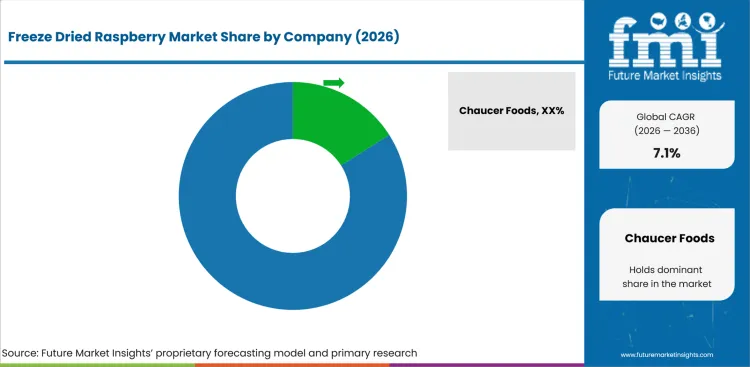
- Large freeze-dry processors hold an advantage through cut-size control, moisture discipline, and delivery reliability.
Specialist berry ingredient suppliers gain relevance through organic lots, premium fruit sourcing, and flexible order sizes.
Suppliers with whole, piece, granule, and powder formats are better placed to serve bakery, cereal, beverage, and snack buyers.
Documentation strength is important because food manufacturers require microbiology paperwork, traceability records, and allergen controls.
Competition in the freeze dried raspberry market is shaped by berry sourcing, cut-size consistency, and food safety documentation. Large processors compete with specialist berry ingredient firms on moisture control, organic certification, microbiology paperwork, and delivery reliability. Buyers in bakery, cereal, beverage, and snack applications prefer suppliers that can support several raspberry formats from one sourcing program.
Suppliers with whole, piece, granule, and powder formats are better positioned because they can serve visible fruit inclusion and powder blend requirements. Regional distributors also gain from wider freeze dried fruit demand when they already handle premium fruit ingredient portfolios. Companies with traceability discipline and controlled drying performance should gain stronger repeat contracts.
How do top freeze dried raspberry companies compare?
Chaucer Foods, Van Drunen Farms, and Döhler score strongest on broad ingredient coverage, while European Freeze Dry and Mercer Foods remain important for freeze-drying depth and contract ingredient supply.
| Company | Relevance to Market Title | Cut-Size Range | Moisture-Control Discipline | Traceability Documentation | Channel Reach | Geographic Footprint |
|---|---|---|---|---|---|---|
| Chaucer Foods | Very High | Very Strong | Strong | Strong | Very Strong | Global |
| Van Drunen Farms | Very High | Very Strong | Very Strong | Very Strong | Strong | North America, Europe |
| Mercer Foods | High | Strong | Very Strong | Strong | Medium | North America |
| European Freeze Dry | High | Strong | Very Strong | Strong | Medium | Europe, global exports |
| Döhler | High | Strong | Strong | Strong | Very Strong | Global |
| OFD Foods | High | Strong | Very Strong | Strong | Medium | North America |
| LYOFOOD | Moderate | Medium | Strong | Medium | Medium | Europe |
| Paradise Fruits | Moderate to High | Strong | Strong | Strong | Medium | Europe, global exports |
| Sow Good | Moderate | Medium | Medium | Medium | Medium | United States |
| Nim’s Fruit Crisps | Moderate | Medium | Medium | Medium | Medium | United Kingdom |
Source: Future Market Insights competitive analysis, 2026.
Key Developments in Freeze Dried Raspberry Market
- In May 2026, Chaucer Foods highlighted freeze-dried fruit for shelf-stable beverages and powdered smoothie mixes. The update matters for freeze dried raspberry suppliers because beverage brands need clean-label fruit color, shelf stability and easy blending without added liquid.
- In April 2026, Whole Food Earth promoted its freeze-dried fruit range with freeze-dried raspberries and newer powder formats. The move matters because retail buyers are using raspberry crumbs and powders for pantry snacks, baking decoration and clean-label color applications.
- In October 2025, Sadef Gida showcased a freeze-dried fruit mix at Anuga 2025 that included freeze-dried raspberry for yogurt and bakery plus confectionery use. The showcase matters because B2B buyers are comparing raspberry as an inclusion ingredient rather than only as a premium snack fruit.
Who are the key players in the freeze dried raspberry market?
Freeze-Dry Ingredient Suppliers
- Chaucer Foods
- Van Drunen Farms
- Mercer Foods
- European Freeze Dry
- OFD Foods
Fruit Ingredient and Application Support Companies
- Döhler
- Paradise Fruits
- LYOFOOD
Retail and Specialty Fruit Brands
- Sow Good
- Nim’s Fruit Crisps
Freeze Dried Raspberry Market - Scope & Definition
| Attribute | Detail |
|---|---|
| Market Definition | Commercial freeze dried raspberry products made by removing moisture from raspberries under frozen vacuum conditions. The scope includes whole fruit, pieces, granules, and powder used as dry fruit ingredients. |
| Functions Covered | Moisture removal, shelf-life extension, color retention, fruit-inclusion design, dry blend functionality, and premium visual marking in finished foods |
| Applications Covered | Bakery, breakfast cereals, snacks, dairy toppings, beverages, and supplement blends |
| End-Use Industries | Food processing, bakery, cereal, snack, dairy, beverage, supplement, retail food, and foodservice industries |
| Grades Covered | Whole, pieces, granules, powder, conventional formats, and organic formats |
| Inclusions | All commercially traded freeze dried raspberry products across form, nature, application, buyer type, sales channel, and geography |
| Exclusions | Fresh raspberries, frozen raspberries, raspberry purees, juice concentrates, jam fillings, artificial berry flavors, and home freeze-dryer equipment |
Freeze Dried Raspberry Market - Research Methodology
| Method | Description |
|---|---|
| Primary Research | FMI analyst interviews with fruit ingredient buyers, bakery R&D teams, cereal formulators, distributor sales teams, freeze-dry processors, and premium food retailers across key markets |
| Desk Research | Review of crop output data, food safety rules, company product portfolios, trade signals, peer-reviewed raspberry powder studies, and adjacent freeze dried fruit demand patterns |
| Market Sizing & Forecasting | Bottom-up product-boundary approach using raspberry feedstock availability, freeze-dried conversion ratios, average selling prices, application use rates, and country-level channel adoption |
| Data Validation | Cross-verification using berry production data, supplier portfolios, adjacent fruit powder demand, buyer interviews, distributor checks, and country-level food manufacturing indicators |
Key Segments
Freeze Dried Raspberry Market Segmented by Form
- Pieces
- Powder
- Whole
- Granules
Freeze Dried Raspberry Market Segmented by Nature
- Conventional
- Organic
Freeze Dried Raspberry Market Segmented by Application
- Bakery
- Breakfast Cereals
- Snacks
- Dairy
- Beverages
- Supplements
Freeze Dried Raspberry Market Segmented by Buyer Type
- Food Manufacturers
- Ingredient Distributors
- Retail Brands
- Foodservice
Freeze Dried Raspberry Market Segmented by Sales Channel
- Direct B2B
- Distributors
- Online Retail
- Specialty Retail
Freeze Dried Raspberry Market by Region
- North America
- United States
- Canada
- Mexico
- Latin America
- Brazil
- Argentina
- Rest of Latin America
- Europe
- Germany
- United Kingdom
- France
- Italy
- Spain
- Rest of Europe
- Asia Pacific
- China
- India
- Japan
- South Korea
- ASEAN
- Middle East & Africa
- GCC Countries
- South Africa
- UAE
- Rest of Middle East & Africa
Research Sources and Bibliography
- Agricultural and Processed Food Products Export Development Authority. (2026). Fresh fruits and vegetables.
- Agriculture and Agri-Food Canada. (2026, February 18). Consumer profile: South Korea.
- Department for Environment, Food & Rural Affairs. (2024, December 11). United Kingdom food security report 2024: Theme 2: UK food supply sources.
- Department for Environment, Food & Rural Affairs. (2025, June 26). Horticulture statistics 2024.
- Destatis. (2026, January 16). Correction: Inflation rate at +2.2% in 2025.
- Eurostat. (2025, August 25). How much fruit and vegetables does the EU harvest?
- Food and Drug Administration. (2026, June). FSMA final rule on requirements for additional traceability records for certain foods.
- Institut national de la statistique et des études économiques. (2025, July 31). In June 2025, agricultural producer prices bounced back by 0.9% year on year.
- Marino, M., Gardana, C., Rendine, M., Klimis-Zacas, D., Riso, P., Porrini, M., & Del Bo’, C. (2024, March 29). Nutritional and phytochemical characterization of freeze-dried raspberry (Rubus idaeus): A comprehensive analysis. Foods, 13(7), 1051.
- Ministry of Agriculture, Forestry and Fisheries. (2025). First basic plan for food, agriculture and rural areas: Reference material.
- Ministry of Agriculture and Farmers Welfare. (2026, January 9). Food processing sector: Growth in exports, GVA, employment, and PMFME loans.
- Ministry of Data and Statistics. (2026, April 1). Online shopping in February 2026.
- Ministry of Food Processing Industries. (2026, April 21). PLISFPI strengthens manufacturing, MSMEs, and global competitiveness.
- National Bureau of Statistics of China. (2026, January 20). Total retail sales of consumer goods in December 2025.
- National Bureau of Statistics of China. (2026, February 28). Statistical communiqué of the People’s Republic of China on the 2025 national economic and social development.
- Office for National Statistics. (2025, July 22). UK manufacturers’ sales by product: 2024.
- Organic Trade Association. (2026, March 4). USA organic marketplace achieved significant growth in 2025.
- USA Department of Agriculture, Economic Research Service. (2026, January 27). Organic agriculture.
- USA Department of Agriculture, Foreign Agricultural Service. (2024, September 23). China removes quarantine access requirements for frozen fruit imports.
- USA Department of Agriculture, Foreign Agricultural Service. (2025, April 2). Food processing ingredients annual: France.
- USA Department of Agriculture, Foreign Agricultural Service. (2025, November 19). Retail foods annual: Japan.
- USA Department of Agriculture, Foreign Agricultural Service. (2025, November 19). Retail foods annual: Korea.
- USA Department of Agriculture, Foreign Agricultural Service. (2026, April 1). Food processing ingredients annual: Japan.
- USA Department of Agriculture, Foreign Agricultural Service. (2026, March 30). Food processing ingredients annual: Germany.
- USA Department of Agriculture, National Agricultural Statistics Service. (2026, May 1). Noncitrus fruits and nuts 2025 summary.
This Report Answers
- Market size estimates for 2026 and forecasts through 2036 for the freeze dried raspberry market.
- Insights across regional and country-level markets using country CAGR and channel adoption checks.
- Analysis of demand drivers, buyer adoption patterns, ingredient usage trends, and purchasing behavior.
- Evaluation of leading forms, nature categories, applications, buyer types, and sales channels.
- Assessment of food safety, traceability, moisture-control, and import documentation impacts on market development.
- Identification of opportunities across raspberry pieces, powder, organic products, bakery, cereal, and premium snack applications.
- Evaluation of supplier positioning across cut size, color retention, traceability paperwork, and direct B2B coverage.
- Country-level growth analysis covering the United States, United Kingdom, Germany, France, Japan, China, South Korea, and India.
- Assessment of the competitive landscape, including freeze-dry processors, berry ingredient suppliers, and specialty fruit brands.
- Delivery of market data, forecasts, and supporting analysis in PDF and Excel formats.
Frequently Asked Questions
What is the freeze dried raspberry market size in 2026?
The freeze dried raspberry market size is estimated at USD 108.0 million in 2026.
What is the freeze dried raspberry market forecast for 2036?
The freeze dried raspberry industry revenue is projected to reach USD 214.3 million by 2036 as bakery and cereal inclusions expand.
What is the freeze dried raspberry market CAGR?
The freeze dried raspberry sector is projected to expand at 7.1% CAGR from 2026 to 2036.
What segment leads the freeze dried raspberry market?
Pieces are likely to capture 38.0% share in 2026 due to visible fruit identity in bakery and cereal products.
What country grows fastest in the freeze dried raspberry market?
India is set to record 9.1% CAGR by 2036, driven by premium bakery trials and food processing capacity expansion.
Preview the report firsthand - request a free sample
Get SampleGet the brochure for pricing and purchase details.
Get PDFTable of Content
- Executive Summary
- Global Market Outlook
- Demand to side Trends
- Supply to side Trends
- Technology Roadmap Analysis
- Analysis and Recommendations
- Market Overview
- Market Coverage / Taxonomy
- Market Definition / Scope / Limitations
- Research Methodology
- Chapter Orientation
- Analytical Lens and Working Hypotheses
- Market Structure, Signals, and Trend Drivers
- Benchmarking and Cross-market Comparability
- Market Sizing, Forecasting, and Opportunity Mapping
- Research Design and Evidence Framework
- Desk Research Programme (Secondary Evidence)
- Company Annual and Sustainability Reports
- Peer-reviewed Journals and Academic Literature
- Corporate Websites, Product Literature, and Technical Notes
- Earnings Decks and Investor Briefings
- Statutory Filings and Regulatory Disclosures
- Technical White Papers and Standards Notes
- Trade Journals, Industry Magazines, and Analyst Briefs
- Conference Proceedings, Webinars, and Seminar Materials
- Government Statistics Portals and Public Data Releases
- Press Releases and Reputable Media Coverage
- Specialist Newsletters and Curated Briefings
- Sector Databases and Reference Repositories
- FMI Internal Proprietary Databases and Historical Market Datasets
- Subscription Datasets and Paid Sources
- Social Channels, Communities, and Digital Listening Inputs
- Additional Desk Sources
- Expert Input and Fieldwork (Primary Evidence)
- Primary Modes
- Qualitative Interviews and Expert Elicitation
- Quantitative Surveys and Structured Data Capture
- Blended Approach
- Why Primary Evidence is Used
- Field Techniques
- Interviews
- Surveys
- Focus Groups
- Observational and In-context Research
- Social and Community Interactions
- Stakeholder Universe Engaged
- C-suite Leaders
- Board Members
- Presidents and Vice Presidents
- R&D and Innovation Heads
- Technical Specialists
- Domain Subject-matter Experts
- Scientists
- Physicians and Other Healthcare Professionals
- Governance, Ethics, and Data Stewardship
- Research Ethics
- Data Integrity and Handling
- Primary Modes
- Tooling, Models, and Reference Databases
- Desk Research Programme (Secondary Evidence)
- Data Engineering and Model Build
- Data Acquisition and Ingestion
- Cleaning, Normalisation, and Verification
- Synthesis, Triangulation, and Analysis
- Quality Assurance and Audit Trail
- Market Background
- Market Dynamics
- Drivers
- Restraints
- Opportunity
- Trends
- Scenario Forecast
- Demand in Optimistic Scenario
- Demand in Likely Scenario
- Demand in Conservative Scenario
- Opportunity Map Analysis
- Product Life Cycle Analysis
- Supply Chain Analysis
- Investment Feasibility Matrix
- Value Chain Analysis
- PESTLE and Porter’s Analysis
- Regulatory Landscape
- Regional Parent Market Outlook
- Production and Consumption Statistics
- Import and Export Statistics
- Market Dynamics
- Global Market Analysis 2021 to 2025 and Forecast, 2026 to 2036
- Historical Market Size Value (USD Million) Analysis, 2021 to 2025
- Current and Future Market Size Value (USD Million) Projections, 2026 to 2036
- Y to o to Y Growth Trend Analysis
- Absolute $ Opportunity Analysis
- Global Market Pricing Analysis 2021 to 2025 and Forecast 2026 to 2036
- Global Market Analysis 2021 to 2025 and Forecast 2026 to 2036, By Form
- Introduction / Key Findings
- Historical Market Size Value (USD Million) Analysis By Form , 2021 to 2025
- Current and Future Market Size Value (USD Million) Analysis and Forecast By Form , 2026 to 2036
- Pieces
- Powder
- Whole
- Granules
- Pieces
- Y to o to Y Growth Trend Analysis By Form , 2021 to 2025
- Absolute $ Opportunity Analysis By Form , 2026 to 2036
- Global Market Analysis 2021 to 2025 and Forecast 2026 to 2036, By Nature
- Introduction / Key Findings
- Historical Market Size Value (USD Million) Analysis By Nature, 2021 to 2025
- Current and Future Market Size Value (USD Million) Analysis and Forecast By Nature, 2026 to 2036
- Conventional
- Organic
- Conventional
- Y to o to Y Growth Trend Analysis By Nature, 2021 to 2025
- Absolute $ Opportunity Analysis By Nature, 2026 to 2036
- Global Market Analysis 2021 to 2025 and Forecast 2026 to 2036, By Application
- Introduction / Key Findings
- Historical Market Size Value (USD Million) Analysis By Application, 2021 to 2025
- Current and Future Market Size Value (USD Million) Analysis and Forecast By Application, 2026 to 2036
- Bakery
- Breakfast Cereals
- Snacks
- Dairy
- Beverages
- Supplements
- Bakery
- Y to o to Y Growth Trend Analysis By Application, 2021 to 2025
- Absolute $ Opportunity Analysis By Application, 2026 to 2036
- Global Market Analysis 2021 to 2025 and Forecast 2026 to 2036, By Buyer Type
- Introduction / Key Findings
- Historical Market Size Value (USD Million) Analysis By Buyer Type, 2021 to 2025
- Current and Future Market Size Value (USD Million) Analysis and Forecast By Buyer Type, 2026 to 2036
- Food Manufacturers
- Ingredient Distributors
- Retail Brands
- Foodservice
- Food Manufacturers
- Y to o to Y Growth Trend Analysis By Buyer Type, 2021 to 2025
- Absolute $ Opportunity Analysis By Buyer Type, 2026 to 2036
- Global Market Analysis 2021 to 2025 and Forecast 2026 to 2036, By Sales Channel
- Introduction / Key Findings
- Historical Market Size Value (USD Million) Analysis By Sales Channel, 2021 to 2025
- Current and Future Market Size Value (USD Million) Analysis and Forecast By Sales Channel, 2026 to 2036
- Direct B2B
- Distributors
- Online Retail
- Specialty Retail
- Direct B2B
- Y to o to Y Growth Trend Analysis By Sales Channel, 2021 to 2025
- Absolute $ Opportunity Analysis By Sales Channel, 2026 to 2036
- Global Market Analysis 2021 to 2025 and Forecast 2026 to 2036, By Region
- Introduction
- Historical Market Size Value (USD Million) Analysis By Region, 2021 to 2025
- Current Market Size Value (USD Million) Analysis and Forecast By Region, 2026 to 2036
- North America
- Latin America
- Western Europe
- Eastern Europe
- East Asia
- South Asia and Pacific
- Middle East & Africa
- Market Attractiveness Analysis By Region
- North America Market Analysis 2021 to 2025 and Forecast 2026 to 2036, By Country
- Historical Market Size Value (USD Million) Trend Analysis By Market Taxonomy, 2021 to 2025
- Market Size Value (USD Million) Forecast By Market Taxonomy, 2026 to 2036
- By Country
- USA
- Canada
- Mexico
- By Form
- By Nature
- By Application
- By Buyer Type
- By Sales Channel
- By Country
- Market Attractiveness Analysis
- By Country
- By Form
- By Nature
- By Application
- By Buyer Type
- By Sales Channel
- Key Takeaways
- Latin America Market Analysis 2021 to 2025 and Forecast 2026 to 2036, By Country
- Historical Market Size Value (USD Million) Trend Analysis By Market Taxonomy, 2021 to 2025
- Market Size Value (USD Million) Forecast By Market Taxonomy, 2026 to 2036
- By Country
- Brazil
- Chile
- Rest of Latin America
- By Form
- By Nature
- By Application
- By Buyer Type
- By Sales Channel
- By Country
- Market Attractiveness Analysis
- By Country
- By Form
- By Nature
- By Application
- By Buyer Type
- By Sales Channel
- Key Takeaways
- Western Europe Market Analysis 2021 to 2025 and Forecast 2026 to 2036, By Country
- Historical Market Size Value (USD Million) Trend Analysis By Market Taxonomy, 2021 to 2025
- Market Size Value (USD Million) Forecast By Market Taxonomy, 2026 to 2036
- By Country
- Germany
- UK
- Italy
- Spain
- France
- Nordic
- BENELUX
- Rest of Western Europe
- By Form
- By Nature
- By Application
- By Buyer Type
- By Sales Channel
- By Country
- Market Attractiveness Analysis
- By Country
- By Form
- By Nature
- By Application
- By Buyer Type
- By Sales Channel
- Key Takeaways
- Eastern Europe Market Analysis 2021 to 2025 and Forecast 2026 to 2036, By Country
- Historical Market Size Value (USD Million) Trend Analysis By Market Taxonomy, 2021 to 2025
- Market Size Value (USD Million) Forecast By Market Taxonomy, 2026 to 2036
- By Country
- Russia
- Poland
- Hungary
- Balkan & Baltic
- Rest of Eastern Europe
- By Form
- By Nature
- By Application
- By Buyer Type
- By Sales Channel
- By Country
- Market Attractiveness Analysis
- By Country
- By Form
- By Nature
- By Application
- By Buyer Type
- By Sales Channel
- Key Takeaways
- East Asia Market Analysis 2021 to 2025 and Forecast 2026 to 2036, By Country
- Historical Market Size Value (USD Million) Trend Analysis By Market Taxonomy, 2021 to 2025
- Market Size Value (USD Million) Forecast By Market Taxonomy, 2026 to 2036
- By Country
- China
- Japan
- South Korea
- By Form
- By Nature
- By Application
- By Buyer Type
- By Sales Channel
- By Country
- Market Attractiveness Analysis
- By Country
- By Form
- By Nature
- By Application
- By Buyer Type
- By Sales Channel
- Key Takeaways
- South Asia and Pacific Market Analysis 2021 to 2025 and Forecast 2026 to 2036, By Country
- Historical Market Size Value (USD Million) Trend Analysis By Market Taxonomy, 2021 to 2025
- Market Size Value (USD Million) Forecast By Market Taxonomy, 2026 to 2036
- By Country
- India
- ASEAN
- Australia & New Zealand
- Rest of South Asia and Pacific
- By Form
- By Nature
- By Application
- By Buyer Type
- By Sales Channel
- By Country
- Market Attractiveness Analysis
- By Country
- By Form
- By Nature
- By Application
- By Buyer Type
- By Sales Channel
- Key Takeaways
- Middle East & Africa Market Analysis 2021 to 2025 and Forecast 2026 to 2036, By Country
- Historical Market Size Value (USD Million) Trend Analysis By Market Taxonomy, 2021 to 2025
- Market Size Value (USD Million) Forecast By Market Taxonomy, 2026 to 2036
- By Country
- Kingdom of Saudi Arabia
- Other GCC Countries
- Turkiye
- South Africa
- Other African Union
- Rest of Middle East & Africa
- By Form
- By Nature
- By Application
- By Buyer Type
- By Sales Channel
- By Country
- Market Attractiveness Analysis
- By Country
- By Form
- By Nature
- By Application
- By Buyer Type
- By Sales Channel
- Key Takeaways
- Key Countries Market Analysis
- USA
- Pricing Analysis
- Market Share Analysis, 2025
- By Form
- By Nature
- By Application
- By Buyer Type
- By Sales Channel
- Canada
- Pricing Analysis
- Market Share Analysis, 2025
- By Form
- By Nature
- By Application
- By Buyer Type
- By Sales Channel
- Mexico
- Pricing Analysis
- Market Share Analysis, 2025
- By Form
- By Nature
- By Application
- By Buyer Type
- By Sales Channel
- Brazil
- Pricing Analysis
- Market Share Analysis, 2025
- By Form
- By Nature
- By Application
- By Buyer Type
- By Sales Channel
- Chile
- Pricing Analysis
- Market Share Analysis, 2025
- By Form
- By Nature
- By Application
- By Buyer Type
- By Sales Channel
- Germany
- Pricing Analysis
- Market Share Analysis, 2025
- By Form
- By Nature
- By Application
- By Buyer Type
- By Sales Channel
- UK
- Pricing Analysis
- Market Share Analysis, 2025
- By Form
- By Nature
- By Application
- By Buyer Type
- By Sales Channel
- Italy
- Pricing Analysis
- Market Share Analysis, 2025
- By Form
- By Nature
- By Application
- By Buyer Type
- By Sales Channel
- Spain
- Pricing Analysis
- Market Share Analysis, 2025
- By Form
- By Nature
- By Application
- By Buyer Type
- By Sales Channel
- France
- Pricing Analysis
- Market Share Analysis, 2025
- By Form
- By Nature
- By Application
- By Buyer Type
- By Sales Channel
- India
- Pricing Analysis
- Market Share Analysis, 2025
- By Form
- By Nature
- By Application
- By Buyer Type
- By Sales Channel
- ASEAN
- Pricing Analysis
- Market Share Analysis, 2025
- By Form
- By Nature
- By Application
- By Buyer Type
- By Sales Channel
- Australia & New Zealand
- Pricing Analysis
- Market Share Analysis, 2025
- By Form
- By Nature
- By Application
- By Buyer Type
- By Sales Channel
- China
- Pricing Analysis
- Market Share Analysis, 2025
- By Form
- By Nature
- By Application
- By Buyer Type
- By Sales Channel
- Japan
- Pricing Analysis
- Market Share Analysis, 2025
- By Form
- By Nature
- By Application
- By Buyer Type
- By Sales Channel
- South Korea
- Pricing Analysis
- Market Share Analysis, 2025
- By Form
- By Nature
- By Application
- By Buyer Type
- By Sales Channel
- Russia
- Pricing Analysis
- Market Share Analysis, 2025
- By Form
- By Nature
- By Application
- By Buyer Type
- By Sales Channel
- Poland
- Pricing Analysis
- Market Share Analysis, 2025
- By Form
- By Nature
- By Application
- By Buyer Type
- By Sales Channel
- Hungary
- Pricing Analysis
- Market Share Analysis, 2025
- By Form
- By Nature
- By Application
- By Buyer Type
- By Sales Channel
- Kingdom of Saudi Arabia
- Pricing Analysis
- Market Share Analysis, 2025
- By Form
- By Nature
- By Application
- By Buyer Type
- By Sales Channel
- Turkiye
- Pricing Analysis
- Market Share Analysis, 2025
- By Form
- By Nature
- By Application
- By Buyer Type
- By Sales Channel
- South Africa
- Pricing Analysis
- Market Share Analysis, 2025
- By Form
- By Nature
- By Application
- By Buyer Type
- By Sales Channel
- USA
- Market Structure Analysis
- Competition Dashboard
- Competition Benchmarking
- Market Share Analysis of Top Players
- By Regional
- By Form
- By Nature
- By Application
- By Buyer Type
- By Sales Channel
- Competition Analysis
- Competition Deep Dive
- Chaucer Foods
- Overview
- Product Portfolio
- Profitability by Market Segments (Product/Age /Sales Channel/Region)
- Sales Footprint
- Strategy Overview
- Marketing Strategy
- Product Strategy
- Channel Strategy
- Van Drunen Farms
- Mercer Foods
- European Freeze Dry
- Döhler
- OFD Foods
- LYOFOOD
- Paradise Fruits
- Sow Good
- Nim’s Fruit Crisps
- Chaucer Foods
- Competition Deep Dive
- Assumptions & Acronyms Used


