

- Market Size (2026)
- USD 128.4 Mn
- Forecast (2036)
- USD 264.6 Mn
- CAGR (2026 to 2036)
- 7.5%
How big is the cultured wheat-based mold inhibitors for bakery market in 2026?
USD 128.4 million in 2026 and USD 264.6 million by 2036 at a 7.5% CAGR.
The cultured wheat-based mold inhibitors for bakery market is forecast to grow from USD 119.4 million in 2025 to USD 264.6 million by 2036 at 7.5% CAGR. Powder formats are forecast to represent 78.0% share in 2026 because dry blending fits flour-stage dosing. Packaged bread is expected to hold 46.0% application share in 2026 due to the clear mold-free shelf-life need in sliced loaves.
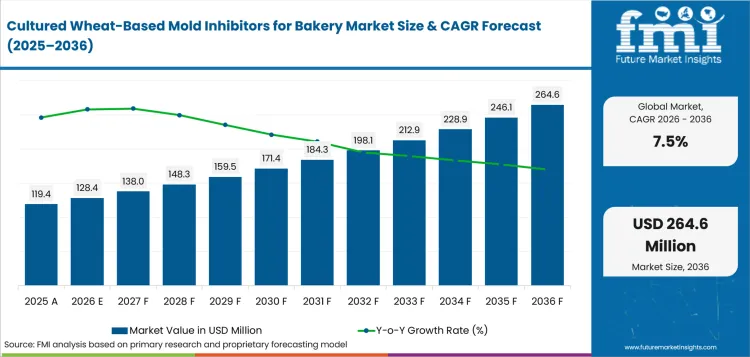
Cultured Wheat-Based Mold Inhibitors for Bakery Market Overview: Size and Forecast
- 2026 Market Size: USD 128.4 million
- 2036 Market Size: USD 264.6 million
- Forecast CAGR: 7.5% from 2026 to 2036
- Leading Form: Powder
- Powder Share in 2026: 78.0%
- Leading Application: Packaged Bread
- Packaged Bread Share in 2026: 46.0%
- Fastest-growing Country: India
- India CAGR: 9.2% by 2036
Summary of Cultured Wheat-Based Mold Inhibitors for Bakery Market
- Demand and Growth Drivers
- Commercial bakeries are testing cultured wheat as a replacement route for synthetic propionates in premium packaged bread.
- Wheat-based ingredient wording supports adoption where brands want bakery-native preservation claims.
- India is projected to record 9.2% CAGR by 2036 as packaged bakery expands beyond large metros.
- Product and Segment View
- Powder formats are forecast to represent 78.0% share in 2026 as dry handling fits flour systems.
- Packaged bread is expected to hold 46.0% application share in 2026 due to visible mold-return risk.
- Mold control is projected to account for 68.0% function share in 2026 as visible mold remains the core defect.
- Geography and Competitive Outlook
- China is expected to expand at 8.6% CAGR through 2036 due to bakery-chain scale and store density.
- The United States is forecast to grow at 6.4% CAGR by 2036 due to mature commercial bread capacity.
- Corbion and BDF Natural Ingredients show the clearest public evidence for cultured wheat-based bakery mold inhibition.
- Lallemand Baking and AB Mauri compete through broader bakery ingredient channels and technical support.
- Analyst Opinion
- Nandini Roy Choudhury observes, “Cultured wheat-based mold inhibitors are becoming a bakery process decision rather than a simple label swap. Buyers want mold-free days without losing bread volume or crumb color. Suppliers that prove acid profile consistency and help bakers adjust dough pH should gain stronger trial conversion.”
The market is moving from broad clean-label preservation into a more specific fermented-wheat formulation category. Corbion lists Verdad Essence WH150 as a cultured wheat-based powder for breads and flatbreads with a recommended use range of 1.25% to 2.5%. BDF Natural Ingredients introduced BDF PRESACTIVE BAKE in July 2024 as a fermented wheat flour inhibitor for bakery products. These launches show that bakery buyers are asking for wheat-based label wording and drop-in dough compatibility.
What supports value in the cultured wheat-based mold inhibitors for bakery market?
Powder dosing and packaged bread returns support market value alongside application support and clean-label substitution.
- Market value is supported as brands replace chemical-sounding mold inhibitors with fermented wheat ingredients in premium bread lines.
- Powder formats hold value because they fit existing flour silos and premix workflows in industrial bakeries.
- Supplier application labs support pricing since dough pH and yeast tolerance must be tested by formula.
- Price resistance limits use in low-margin bread unless suppliers prove lower returns or longer route coverage.
Why is the cultured wheat-based mold inhibitors for bakery market growing?
Industrial bakers use cultured wheat when label wording has to stay close to flour and fermentation.
Packaged bakery demand is changing how mold inhibitors are specified by plant teams. USDA NASS reported United States wheat production at 1.98 billion bushels in 2025. That scale gives ingredient suppliers enough plant trials to prove cultured wheat performance across bread and bun formulas. Buyers therefore test mold-free days and yeast response before switching from synthetic salts.
Clean-label pressure has a practical cost side in this market. The United States Bureau of Labor Statistics reported in April 2025 that the bakery products producer price index rose 10.5% from May 2022 to December 2023 after an earlier 10.2% increase. This makes cost-in-use more important than simple ingredient price. Cultured wheat becomes viable when it lowers returns or protects premium shelf placement.
How is the cultured wheat-based mold inhibitors for bakery market segmented?
The cultured wheat-based mold inhibitors for bakery industry is segmented by form and application. It is also segmented by label claim, sales channel and function.
- Powder is projected to secure 78.0% share in 2026 because dry handling suits flour dosing and premix blending.
- Packaged bread is expected to represent 46.0% application demand in 2026 as sliced bread carries high spoilage exposure.
- Clean Label is anticipated to hold 52.0% label-claim demand in 2026 with ingredient lists under retailer review.
- Direct sales are forecast to account for 52.0% channel demand in 2026 due to plant-level trials.
- Mold control is expected to lead function demand with 68.0% share in 2026 as visible mold drives rejections.
Why do powder formats lead the cultured wheat-based mold inhibitors for bakery market?
Powder dosing and packaged bread returns support market value alongside application support and clean-label substitution.
- Market value is supported as brands replace chemical-sounding mold inhibitors with fermented wheat ingredients in premium bread lines.
- Powder formats hold value because they fit existing flour silos and premix workflows in industrial bakeries.
- Supplier application labs support pricing since dough pH and yeast tolerance must be tested by formula.
- Price resistance limits use in low-margin bread unless suppliers prove lower returns or longer route coverage.
Why is the cultured wheat-based mold inhibitors for bakery market growing?
Industrial bakers use cultured wheat when label wording has to stay close to flour and fermentation.
Packaged bakery demand is changing how mold inhibitors are specified by plant teams. USDA NASS reported United States wheat production at 1.98 billion bushels in 2025. That scale gives ingredient suppliers enough plant trials to prove cultured wheat performance across bread and bun formulas. Buyers therefore test mold-free days and yeast response before switching from synthetic salts.
Clean-label pressure has a practical cost side in this market. The United States Bureau of Labor Statistics reported in April 2025 that the bakery products producer price index rose 10.5% from May 2022 to December 2023 after an earlier 10.2% increase. This makes cost-in-use more important than simple ingredient price. Cultured wheat becomes viable when it lowers returns or protects premium shelf placement.
How is the cultured wheat-based mold inhibitors for bakery market segmented?
The cultured wheat-based mold inhibitors for bakery industry is segmented by form and application. It is also segmented by label claim, sales channel and function.
- Powder is projected to secure 78.0% share in 2026 because dry handling suits flour dosing and premix blending.
- Packaged bread is expected to represent 46.0% application demand in 2026 as sliced bread carries high spoilage exposure.
- Clean Label is anticipated to hold 52.0% label-claim demand in 2026 with ingredient lists under retailer review.
- Direct sales are forecast to account for 52.0% channel demand in 2026 due to plant-level trials.
- Mold control is expected to lead function demand with 68.0% share in 2026 as visible mold drives rejections.
Why do powder formats lead the cultured wheat-based mold inhibitors for bakery market?
Powder holds 78.0% share in 2026 because most cultured wheat products are added during dry blending.
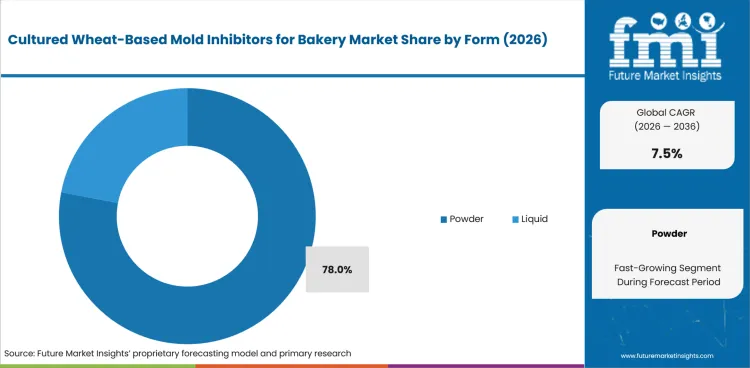
- Powder is projected to account for 78.0% of form demand in 2026 since dry handling fits flour-stage dosing.
- Buyers compare powder by flow behavior and acid profile consistency because caking risk can cause uneven mold control.
Which application leads the cultured wheat-based mold inhibitors for bakery market?
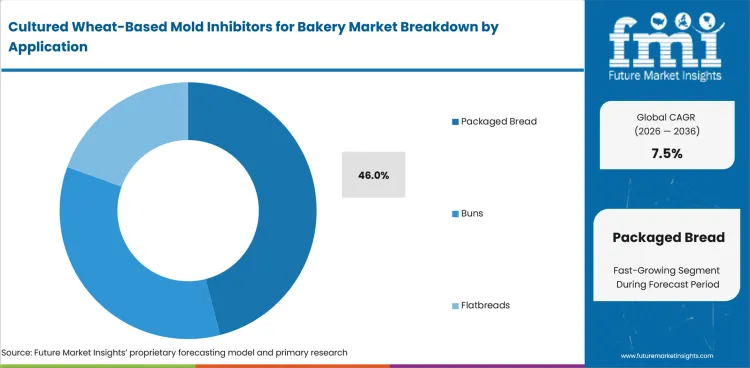
Packaged bread holds 46.0% share in 2026 because sliced loaves need mold-free days across retail routes.
- Packaged bread is expected to hold 46.0% of application demand in 2026 as sliced loaves carry high mold-return risk.
- Bakers test loaf volume and crumb color after adding fermented wheat to high-speed packaged bread formulas.
Which label claim leads the cultured wheat-based mold inhibitors for bakery market?
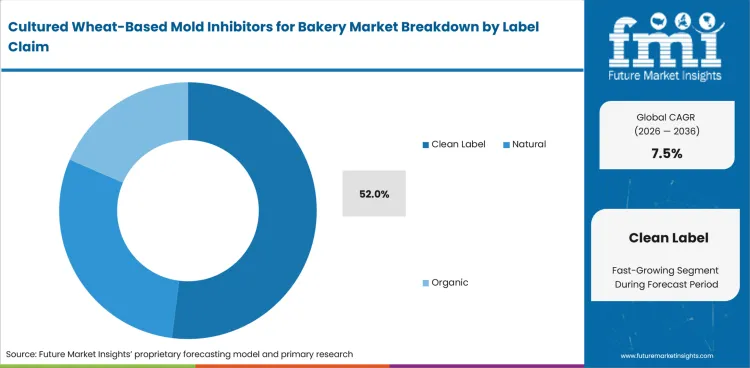
Clean Label holds 52.0% share in 2026 as retailers review chemical-sounding preservative names.
- Clean Label is anticipated to represent 52.0% of label-claim demand in 2026 as premium bakery brands screen ingredient wording.
- Cultured wheat gives brands a flour-based ingredient name when compared with plant-based preservatives in natural bakery ranges.
Which sales channel leads the cultured wheat-based mold inhibitors for bakery market?
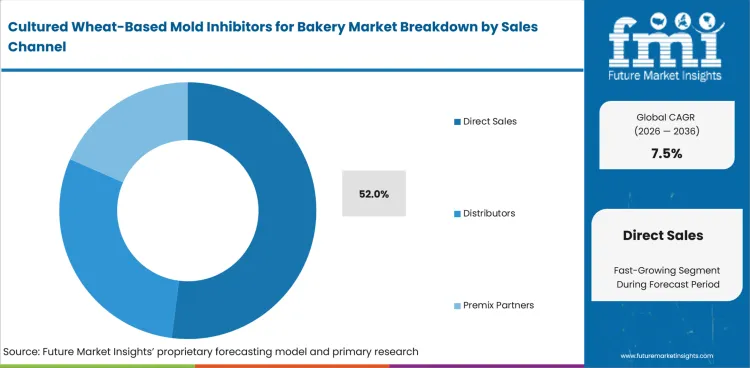
- Direct sales are projected to capture 52.0% of channel demand in 2026 as large bakeries need supplier technologists during trials.
- Distributor sales work better for artisan bakers while industrial plants usually require pH and proofing support.
Which function leads the cultured wheat-based mold inhibitors for bakery market?
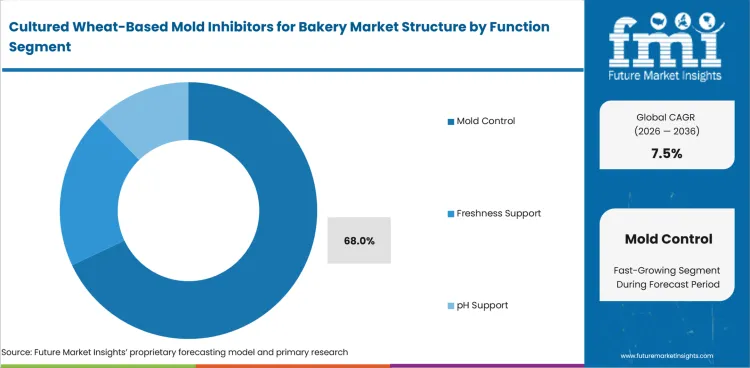
- Mold control is expected to account for 68.0% of function demand in 2026 since visible mold drives rejection and returns.
- Freshness claims are harder to prove while mold inhibition has clearer pass-fail tests through shelf-life panels.
What are the driver, restraints, and opportunities in the cultured wheat-based mold inhibitors for bakery market?
Clean-label reformulation supports adoption while dosing cost and pH trial burden limit faster conversion.
- Driver: Fermented wheat label wording gives bakers a clean-label route without moving fully into vinegar flavor systems.
- Restraint: Higher dosing can raise cost-in-use compared with synthetic salts in low-margin bread.
- Opportunity: Premix partners can expand use by bundling cultured wheat with flour treatment and softness systems.
Clean-label replacement is the central reason buyers test cultured wheat. Oklahoma State University Extension describes clean-label mold inhibitors as natural alternatives used in baking. Bakerpedia notes that cultured wheat can be used at 1.0% to 5.0% of flour weight in yeasted products. This creates a trial burden because the ingredient must inhibit mold without weakening yeast activity or lowering loaf volume.
Who are the key consumers of cultured wheat-based mold inhibitors for bakery?
Industrial bakeries and premix makers form the main buyer base alongside ingredient distributors. Buyer activity is concentrated in packaged bread plants and larger bakery groups that can measure mold returns by route. Premix partners matter because they can bring cultured wheat into regional bakeries without asking every bakery to run a full ingredient search. Direct sales remain important where formulation support and shelf-life validation decide purchase approval.
What influences cultured wheat-based mold inhibitor purchase decisions?
Cost per mold-free day and dough compatibility shape purchase decisions more than ingredient price alone.
Commercial bakers compare cultured wheat against calcium propionate and vinegar powder. They also assess cultured sugar systems. The final decision depends on use rate and flavor risk. It also depends on dough pH, proofing behavior and label wording. Suppliers with application labs can reduce trial failure and support repeat orders.
Which countries are growing fastest in the cultured wheat-based mold inhibitors for bakery market?
India reaches 9.2% CAGR followed by China at 8.6% through 2036.
.webp "Top Country Growth Comparison Cultured Wheat Based Mold Inhibitors For Bakery Market Cagr (2026 2036)")
| Country | CAGR |
|---|---|
| India | 9.2% |
| China | 8.6% |
| South Korea | 7.0% |
| United Kingdom | 6.7% |
| United States | 6.4% |
| Germany | 5.9% |
| France | 5.8% |
| Japan | 5.2% |
Source: Future Market Insights, 2026.
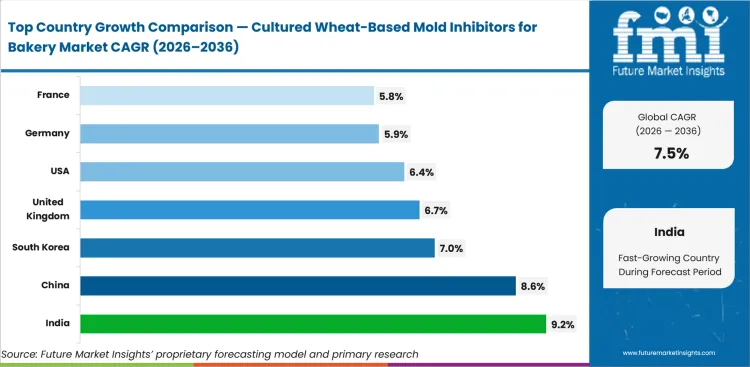
How do country-level CAGRs compare in the cultured wheat-based mold inhibitors for bakery market?
India and China lead country expansion while Japan records the most cautious growth outlook among profiled markets.
- India is forecast to record 9.2% CAGR by 2036 through packaged bakery growth and country-specific ingredient buying behavior.
- China is forecast to record 8.6% CAGR by 2036 through packaged bakery growth and country-specific ingredient buying behavior.
- South Korea is forecast to record 7.0% CAGR by 2036 through packaged bakery growth and country-specific ingredient buying behavior.
- United Kingdom is forecast to record 6.7% CAGR by 2036 through packaged bakery growth and country-specific ingredient buying behavior.
- United States is forecast to record 6.4% CAGR by 2036 through packaged bakery growth and country-specific ingredient buying behavior.
- Germany is forecast to record 5.9% CAGR by 2036 through packaged bakery growth and country-specific ingredient buying behavior.
- France is forecast to record 5.8% CAGR by 2036 through packaged bakery growth and country-specific ingredient buying behavior.
- Japan is forecast to record 5.2% CAGR by 2036 through packaged bakery growth and country-specific ingredient buying behavior.
What is driving cultured wheat-based mold inhibitors for bakery growth in India?
A 9.2% CAGR through 2036 reflects wheat production scale and modern retail bakery growth and bakery ingredient reformulation.
Country Market Snapshot Table
| Parameter | Value |
|---|---|
| Market Size in 2025 (Value) | USD 6.4 million |
| Market Size in 2026 (Value) | USD 7.0 million |
| Market Forecast in 2036 (Value) | USD 16.9 million |
| CAGR (2026 to 2036) | 9.2% |
| Years Considered | 2021 to 2036 |
| Base Year | 2025 |
| Forecast Period | 2026 to 2036 |
| Units Considered | Value (USD million) |
| Leading Sub-Region | Delhi NCR and modern retail bakery corridors |
India Cultured Wheat-Based Mold Inhibitors for Bakery Market Outlook
- India is the fastest-growing profiled country as packaged bakery moves beyond large metros. Sliced bread and buns are the clearest early use cases.
- Premix suppliers and regional distributors are expected to educate small and mid-sized bakeries. Price sensitivity will decide how far cultured wheat moves outside premium products.
Key Growth Drivers
- Local wheat scale supports ingredient familiarity. India estimated wheat production at 120.657 million tonnes in 2025-26.
- Food processing demand is expanding. FAS New Delhi projected India food processing sales to reach about USD 535.0 billion by the end of FY2026.
- Modern retail and quick-commerce are expected to increase the value of longer shelf life for packaged bread and snack cakes.
- Premix suppliers can move cultured wheat into regional bakeries faster than direct global supplier programs alone.
Key Restraints
- Price sensitivity remains high. FAS New Delhi identified strong price competition and sensitivity to final consumer prices as market challenges.
- Low-cost bread makers may not absorb premium fermented-wheat dosing outside modern retail and branded channels.
- Heat and humidity require regional formula validation before national rollout of clean-label mold inhibitors.
What makes India unique
India has the fastest growth outlook due to packaged bakery expansion and familiarity with wheat-based ingredients.
Key Companies
- AB Mauri India
- Vaishnavi Bio Tech
- Corbion
- Lallemand Baking
- Kemin Industries
- IFF India
Sales & Marketing Channels
- Bakery ingredient distributors
- Premix manufacturers
- Direct industrial sales
- Modern retail supplier programs
- Regional bakery associations
- E-commerce ingredient platforms
Market Taxonomy and Sub-Regions Covered
| Segment | Sub-Segments |
|---|---|
| By Form | Powder · Liquid |
| By Application | Packaged Bread · Buns · Flatbreads · Cakes · Others |
| By Label Claim | Clean Label · Natural · Organic |
| By Sales Channel | Direct Sales · Distributors · Premix Partners |
| By Function | Mold Control · Freshness Support · pH Support |
| Key Sub-Regions Covered, Bakery Ingredient Procurement Areas | Delhi NCR · Maharashtra · Karnataka · Tamil Nadu · Gujarat · Telangana |
Frequently Asked Questions
How fast is India cultured wheat-based mold inhibitors for bakery market growing?
India is projected to grow fastest at 9.2% CAGR from 2026 to 2036 through packaged bakery expansion.
Who leads India cultured wheat-based mold inhibitors for bakery market?
AB Mauri India and Vaishnavi Bio Tech show local relevance while Corbion and Lallemand compete through global ingredient channels.
What is driving adoption in India cultured wheat-based mold inhibitors for bakery market?
Wheat production scale and modern retail bakery growth are supporting cultured wheat-based mold inhibitor adoption.
What is the cultured wheat-based mold inhibitors for bakery market outlook in China?
A 8.6% CAGR through 2036 reflects bakery store density and premium packaged bakery formats and bakery ingredient reformulation.
Country Market Snapshot Table
| Parameter | Value |
|---|---|
| Market Size in 2025 (Value) | USD 16.6 million |
| Market Size in 2026 (Value) | USD 18.0 million |
| Market Forecast in 2036 (Value) | USD 41.1 million |
| CAGR (2026 to 2036) | 8.6% |
| Years Considered | 2021 to 2036 |
| Base Year | 2025 |
| Forecast Period | 2026 to 2036 |
| Units Considered | Value (USD million) |
| Leading Sub-Region | Yangtze River Delta and coastal bakery-chain corridors |
China Cultured Wheat-Based Mold Inhibitors for Bakery Market Outlook
- China demand is tied to chain bakeries and packaged baked snacks. Premium chains can use cultured wheat for cleaner labels while value players may select lower-cost systems.
- Domestic distributors and multinational ingredient suppliers will both shape trial activity. The market is large but price segmentation remains sharp.
Key Growth Drivers
- Bakery scale supports trial potential. FAS Guangzhou reported China baked food market size at up to USD 83.0 billion in 2025.
- Store density creates a wide test channel. FAS Guangzhou reported more than 338000 bakery stores nationwide by the end of May 2025.
- Packaged cakes and toast bread are expected to need mold control across warm and high-volume distribution routes.
- Imported premium ingredients can gain attention in coastal cities where clean-label and international bakery concepts are more visible.
Key Restraints
- Store density also intensifies price pressure. FAS Guangzhou reported more than 338000 bakery stores nationwide by the end of May 2025.
- Distributor qualification can slow new ingredient approval when customers require local documents and trial data.
- Budget bakery chains may prefer lower-cost vinegar or synthetic preservative systems for high-volume products.
What makes China unique
China is the largest scale-up opportunity among selected countries because bakery store density is high and chain formats are expanding.
Key Companies
-
Corbion China
- Lallemand Baking
- AB Mauri China
- Kemin Industries
- IFF China
- Angel Yeast
Sales & Marketing Channels
- Distributor networks
- Chain bakery direct sales
- Importer partnerships
- Food ingredient exhibitions
- OEM bakery accounts
- E-commerce ingredient channels
Market Taxonomy and Sub-Regions Covered
| Segment | Sub-Segments |
|---|---|
| By Form | Powder · Liquid |
| By Application | Packaged Bread · Buns · Flatbreads · Cakes · Others |
| By Label Claim | Clean Label · Natural · Organic |
| By Sales Channel | Direct Sales · Distributors · Premix Partners |
| By Function | Mold Control · Freshness Support · pH Support |
| Key Sub-Regions Covered, Bakery Ingredient Procurement Areas | Yangtze River Delta · Pearl River Delta · Beijing-Tianjin-Hebei · Sichuan · Shandong · Guangdong |
Frequently Asked Questions
How fast is China cultured wheat-based mold inhibitors for bakery market growing?
China is forecast to expand at 8.6% CAGR from 2026 to 2036 through bakery-chain scale and packaged snack growth.
Who leads China cultured wheat-based mold inhibitors for bakery market?
Corbion China and AB Mauri China compete with Lallemand Baking and local ingredient suppliers.
What is driving adoption in China cultured wheat-based mold inhibitors for bakery market?
Bakery store density and premium packaged bakery formats are moving buyers toward standardized mold-control systems.
How is the cultured wheat-based mold inhibitors for bakery market performing in South Korea?
A 7.0% CAGR through 2036 reflects food processing scale and packaged convenience bakery formats and bakery ingredient reformulation.
Country Market Snapshot Table
| Parameter | Value |
|---|---|
| Market Size in 2025 (Value) | USD 4.3 million |
| Market Size in 2026 (Value) | USD 4.6 million |
| Market Forecast in 2036 (Value) | USD 9.0 million |
| CAGR (2026 to 2036) | 7.0% |
| Years Considered | 2021 to 2036 |
| Base Year | 2025 |
| Forecast Period | 2026 to 2036 |
| Units Considered | Value (USD million) |
| Leading Sub-Region | Seoul Capital Area and convenience bakery corridors |
South Korea Cultured Wheat-Based Mold Inhibitors for Bakery Market Outlook
- South Korea demand links cafe bakery culture with packaged convenience formats. Premium baked goods and frozen bakery items create a focused shelf-life need.
- Importers and food ingredient distributors are expected to introduce cultured wheat with other specialty bakery systems. Cost scrutiny remains high due to imported input exposure.
Key Growth Drivers
- Industrial food processing scale gives suppliers a clear route. FAS Seoul reported 2024 food processing sales above KRW 111.9 trillion or about USD 82.1 billion.
- Wheat import demand supports bakery flour availability. FAS Seoul forecast total MY2026-27 wheat imports at 4.4 million MT including flour and pasta on a wheat-equivalent basis.
- Convenience-store bakery channels are expected to need predictable mold control for packaged pastries and filled bakery snacks.
- Cafe bakery chains can use clean-label positioning to separate premium products from commodity bread.
Key Restraints
- Import reliance raises cost exposure. FAS Seoul stated Korea relies heavily on imported raw materials for food and beverage manufacturing.
- Smaller bakeries may favor rapid fresh turnover instead of paying for reformulation and shelf-life validation.
- Regulatory and distributor checks can slow approval of new fermented wheat ingredients for industrial users.
What makes South Korea unique
South Korea links premium bakery culture with convenience retail more closely than most mature Asian markets.
Key Companies
- Corbion
- Lallemand Baking
- AB Mauri
- IFF Korea
- Kemin Industries
- CJ CheilJedang
Sales & Marketing Channels
- Food ingredient importers
- Convenience-store supplier programs
- Cafe chain procurement
- Distributor sampling
- Industrial bakery direct sales
- Ingredient trade exhibitions
Market Taxonomy and Sub-Regions Covered
| Segment | Sub-Segments |
|---|---|
| By Form | Powder · Liquid |
| By Application | Packaged Bread · Buns · Flatbreads · Cakes · Others |
| By Label Claim | Clean Label · Natural · Organic |
| By Sales Channel | Direct Sales · Distributors · Premix Partners |
| By Function | Mold Control · Freshness Support · pH Support |
| Key Sub-Regions Covered, Bakery Ingredient Procurement Areas | Seoul Capital Area · Busan · Incheon · Daegu · Ulsan · Gyeonggi-do |
Frequently Asked Questions
How fast is South Korea cultured wheat-based mold inhibitors for bakery market growing?
South Korea is expected to post 7.0% CAGR from 2026 to 2036 through convenience bakery and cafe formats.
Who leads South Korea cultured wheat-based mold inhibitors for bakery market?
Corbion and Lallemand Baking compete with AB Mauri and Korea-facing ingredient distributors.
What is driving adoption in South Korea cultured wheat-based mold inhibitors for bakery market?
Food processing scale and packaged convenience bakery formats are supporting clean-label mold inhibitor trials.
How is the cultured wheat-based mold inhibitors for bakery market performing in the United Kingdom?
A 6.7% CAGR through 2036 reflects grocery private label and sandwich bread programs and bakery ingredient reformulation.
Country Market Snapshot Table
| Parameter | Value |
|---|---|
| Market Size in 2025 (Value) | USD 8.0 million |
| Market Size in 2026 (Value) | USD 8.5 million |
| Market Forecast in 2036 (Value) | USD 16.3 million |
| CAGR (2026 to 2036) | 6.7% |
| Years Considered | 2021 to 2036 |
| Base Year | 2025 |
| Forecast Period | 2026 to 2036 |
| Units Considered | Value (USD million) |
| Leading Sub-Region | England grocery bakery and sandwich carrier corridors |
United Kingdom Cultured Wheat-Based Mold Inhibitors for Bakery Market Outlook
- United Kingdom demand is tied to grocery bread and sandwich carriers where retailers influence label wording. National brands and private-label suppliers need mold control that does not change flavor.
- The market is expected to use distributors for regional bakeries and direct trials for national plants. Cost-in-use will remain central before broad replacement of calcium propionate.
Key Growth Drivers
- Wheat recovery supports bakery ingredient planning. Defra estimated the 2025 UK wheat harvest at 12.0 million tonnes with a 7.3% increase from 2024.
- Domestic food security remains a policy concern. The UK Food Security Digest estimated the production-to-supply ratio at 65.0% for all food in 2024.
- Private-label bakery programs are expected to test fermented wheat where retailers prefer shorter ingredient decks.
- Sandwich bread producers can use cultured wheat when ambient route life is important across grocery and foodservice channels.
Key Restraints
- Harvest volatility can affect formula cost planning. UK wheat output was 11.1 million tonnes in 2024 and was 20.0% lower than 2023.
- Price-sensitive retailers may reject higher ingredient costs when shoppers do not see a clear label benefit.
- Formula transfer can slow when wheat quality changes between harvest seasons and supplier trials must be repeated.
What makes United Kingdom unique
The United Kingdom combines retailer control with mature packaged bread buying and detailed ingredient scrutiny.
Key Companies
- AB Mauri UK
- Lallemand Baking
- Corbion
- Kerry Group
- Bakels UK
- Kemin Industries
Sales & Marketing Channels
- National account sales
- Bakery ingredient wholesalers
- Retailer reformulation tenders
- Premix partnerships
- Technical bakery colleges
- Distributor sampling
Market Taxonomy and Sub-Regions Covered
| Segment | Sub-Segments |
|---|---|
| By Form | Powder · Liquid |
| By Application | Packaged Bread · Buns · Flatbreads · Cakes · Others |
| By Label Claim | Clean Label · Natural · Organic |
| By Sales Channel | Direct Sales · Distributors · Premix Partners |
| By Function | Mold Control · Freshness Support · pH Support |
| Key Sub-Regions Covered, Bakery Ingredient Procurement Areas | London · Midlands · Northwest England · Yorkshire · Scotland · Wales |
Frequently Asked Questions
How fast is United Kingdom cultured wheat-based mold inhibitors for bakery market growing?
United Kingdom demand is expected to rise at 6.7% CAGR from 2026 to 2036 through retailer-led reformulation.
Who leads United Kingdom cultured wheat-based mold inhibitors for bakery market?
AB Mauri UK and Bakels UK have local channel relevance while Corbion and Lallemand compete through broader ingredient supply.
What is driving adoption in United Kingdom cultured wheat-based mold inhibitors for bakery market?
Grocery private label and sandwich bread programs are moving buyers toward label-friendly mold control.
What is the cultured wheat-based mold inhibitors for bakery market outlook in the United States?
A 6.4% CAGR through 2036 reflects flour milling scale and premium clean-label bread programs and bakery ingredient reformulation.
Country Market Snapshot Table
| Parameter | Value |
|---|---|
| Market Size in 2025 (Value) | USD 29.1 million |
| Market Size in 2026 (Value) | USD 31.0 million |
| Market Forecast in 2036 (Value) | USD 57.6 million |
| CAGR (2026 to 2036) | 6.4% |
| Years Considered | 2021 to 2036 |
| Base Year | 2025 |
| Forecast Period | 2026 to 2036 |
| Units Considered | Value (USD million) |
| Leading Sub-Region | Midwest and national packaged bakery corridors |
United States Cultured Wheat-Based Mold Inhibitors for Bakery Market Outlook
- United States demand is shaped by large flour milling scale and commercial bread plants. National bakery groups can test cultured wheat across several routes before wider conversion.
- Buyers compare cost per mold-free day with calcium propionate and vinegar powder. Suppliers with application labs and documented dosing ranges gain an advantage in plant trials.
Key Growth Drivers
- Large flour milling scale supports plant-level trials. USDA NASS reported all wheat ground for flour at 907.0 million bushels in 2025.
- Domestic wheat supply gives ingredient buyers a stable base for flour-linked preservation systems. USDA NASS placed all wheat production at 1.98 billion bushels in 2025.
- Premium bread and bun brands are expected to test fermented wheat when retailer ingredient screens discourage synthetic preservative names.
- Application support is likely to influence adoption since bakers must test yeast response and crumb quality before formula conversion.
Key Restraints
- Input-cost pressure can slow switching from low-cost salts. USDA ERS reported farm-level wheat prices were 7.9% higher in April 2026 than in April 2025.
- Value bread brands may resist higher use rates when existing calcium propionate systems already protect shelf life.
- Low-pH shifts can delay adoption when proof time and loaf volume move outside plant tolerances.
What makes United States unique
The United States is a validation country because large commercial bakeries can test one inhibitor across many retail routes.
Key Companies
- Corbion
- AB Mauri North America
- Cain Food Industries
- J&K Ingredients
- Kemin Industries
- IFF
Sales & Marketing Channels
- Direct enterprise sales
- Bakery ingredient distributors
- Technical application labs
- Premix partnerships
- Trade-show sampling
- Retailer reformulation programs
Market Taxonomy and Sub-Regions Covered
| Segment | Sub-Segments |
|---|---|
| By Form | Powder · Liquid |
| By Application | Packaged Bread · Buns · Flatbreads · Cakes · Others |
| By Label Claim | Clean Label · Natural · Organic |
| By Sales Channel | Direct Sales · Distributors · Premix Partners |
| By Function | Mold Control · Freshness Support · pH Support |
| Key Sub-Regions Covered, Bakery Ingredient Procurement Areas | Midwest · Great Plains · Northeast · South Atlantic · California · Texas |
Frequently Asked Questions
How fast is United States cultured wheat-based mold inhibitors for bakery market growing?
United States demand is forecast to expand at 6.4% CAGR from 2026 to 2036 through premium bread reformulation.
Who leads United States cultured wheat-based mold inhibitors for bakery market?
Corbion and AB Mauri North America compete with Cain Food Industries and J&K Ingredients through bakery ingredient channels.
What is driving adoption in United States cultured wheat-based mold inhibitors for bakery market?
Flour milling scale and premium clean-label bread programs are supporting cultured wheat trial activity.
What is driving cultured wheat-based mold inhibitors for bakery growth in Germany?
A 5.9% CAGR through 2036 reflects wheat supply recovery and documentation-led industrial trials and bakery ingredient reformulation.
Country Market Snapshot Table
| Parameter | Value |
|---|---|
| Market Size in 2025 (Value) | USD 9.6 million |
| Market Size in 2026 (Value) | USD 10.2 million |
| Market Forecast in 2036 (Value) | USD 18.1 million |
| CAGR (2026 to 2036) | 5.9% |
| Years Considered | 2021 to 2036 |
| Base Year | 2025 |
| Forecast Period | 2026 to 2036 |
| Units Considered | Value (USD million) |
| Leading Sub-Region | North Rhine-Westphalia and southern industrial bakery corridors |
Germany Cultured Wheat-Based Mold Inhibitors for Bakery Market Outlook
- Germany demand is selective because many fresh bread formats do not require long ambient life. Industrial toast bread and packaged sandwich formats provide the main conversion route.
- Supplier documentation matters in Germany because ingredient buyers compare technical data and batch consistency before approving new preservative systems.
Key Growth Drivers
- Domestic wheat recovery supports wheat-based ingredient confidence. Destatis reported winter wheat output at 22.6 million tons in 2025 with a 27.0% rise from 2024.
- Grain availability improved in 2025. Destatis reported a 45.0 million ton grain harvest and an 11.0% yield increase versus 2024.
- Packaged toast bread and export bakery lines are expected to use cultured wheat when shelf life must extend beyond local fresh sale.
- Technical distributors can support controlled trials where bakers require documentation on acid profile and sensory effect.
Key Restraints
- Recent harvest volatility keeps cost assumptions under review. Eurostat reported Germany harvested 39.1 million tonnes of cereals in 2024.
- Fresh bakery culture limits preservative use in artisan outlets where same-day sale remains the core model.
- Strict sensory expectations can reduce acceptance when fermented ingredients change aroma or crumb profile.
What makes Germany unique
Germany is a technical proof market where documentation can influence wider European bakery ingredient buying.
Key Companies
- Lallemand Baking
- Corbion
- AB Mauri
- Kemin Industries
- IFF
- Stern-Wywiol Gruppe
Sales & Marketing Channels
- Industrial bakery direct sales
- Technical distributors
- Flour mill partnerships
- Premix houses
- Export bakery programs
- Bakery trade events
Market Taxonomy and Sub-Regions Covered
| Segment | Sub-Segments |
|---|---|
| By Form | Powder · Liquid |
| By Application | Packaged Bread · Buns · Flatbreads · Cakes · Others |
| By Label Claim | Clean Label · Natural · Organic |
| By Sales Channel | Direct Sales · Distributors · Premix Partners |
| By Function | Mold Control · Freshness Support · pH Support |
| Key Sub-Regions Covered, Bakery Ingredient Procurement Areas | North Rhine-Westphalia · Bavaria · Baden-Wuerttemberg · Lower Saxony · Berlin · Hesse |
Frequently Asked Questions
How fast is Germany cultured wheat-based mold inhibitors for bakery market growing?
Germany is forecast to grow at 5.9% CAGR from 2026 to 2036 through industrial toast bread and export bakery demand.
Who leads Germany cultured wheat-based mold inhibitors for bakery market?
Lallemand Baking and Corbion compete with AB Mauri and German ingredient groups through technical bakery channels.
What is driving adoption in Germany cultured wheat-based mold inhibitors for bakery market?
Wheat supply recovery and documentation-led industrial trials are supporting selective cultured wheat adoption.
How is the cultured wheat-based mold inhibitors for bakery market performing in France?
A 5.8% CAGR through 2036 reflects industrial packaged bakery and fermentation-friendly label language and bakery ingredient reformulation.
Country Market Snapshot Table
| Parameter | Value |
|---|---|
| Market Size in 2025 (Value) | USD 7.6 million |
| Market Size in 2026 (Value) | USD 8.0 million |
| Market Forecast in 2036 (Value) | USD 14.1 million |
| CAGR (2026 to 2036) | 5.8% |
| Years Considered | 2021 to 2036 |
| Base Year | 2025 |
| Forecast Period | 2026 to 2036 |
| Units Considered | Value (USD million) |
| Leading Sub-Region | Ile-de-France and packaged bakery production corridors |
France Cultured Wheat-Based Mold Inhibitors for Bakery Market Outlook
- France demand is tied to industrial sandwich bread and packaged brioche rather than fresh baguettes. Buyers are careful about taste and heritage cues.
- Cultured wheat is expected to fit packaged products where natural fermentation language supports label acceptance without weakening product identity.
Key Growth Drivers
- France remains a large agricultural base for food manufacturers. Agreste reported France accounted for 16.0% of EU-27 agricultural production value in its 2025 statistical book.
- Wheat recovery supports bakery ingredient supply. Agreste estimated 2025 soft wheat production at 32.6 million tonnes and nearly 7.0 million tonnes above 2024.
- Packaged brioche and sandwich loaves are expected to need mold protection across national grocery channels.
- Miller-baker networks can help suppliers explain cultured wheat as a fermentation-based bakery ingredient.
Key Restraints
- Recent wheat weakness increased quality sensitivity. Agreste reported 2024 soft wheat production at 25.6 million tonnes and its lowest level since 1986.
- Traditional bread identity limits preservative acceptance in artisan outlets and fresh bakery counters.
- Premium baked goods can reject cultured wheat if acidity creates vinegar-like notes or color drift.
What makes France unique
France offers a narrow high-value lane where fermented wheat fits packaged bakery without weakening heritage cues.
Key Companies
- Lallemand Baking
- Corbion
- AB Mauri
- Kemin Industries
- IFF
- Lesaffre
Sales & Marketing Channels
- Industrial bakery direct sales
- Mill-linked ingredient networks
- Retail brand reformulation briefs
- Distributor-led sampling
- Export bakery accounts
- Bakery trade shows
Market Taxonomy and Sub-Regions Covered
| Segment | Sub-Segments |
|---|---|
| By Form | Powder · Liquid |
| By Application | Packaged Bread · Buns · Flatbreads · Cakes · Others |
| By Label Claim | Clean Label · Natural · Organic |
| By Sales Channel | Direct Sales · Distributors · Premix Partners |
| By Function | Mold Control · Freshness Support · pH Support |
| Key Sub-Regions Covered, Bakery Ingredient Procurement Areas | Ile-de-France · Auvergne-Rhone-Alpes · Hauts-de-France · Nouvelle-Aquitaine · Occitanie · Grand Est |
Frequently Asked Questions
How fast is France cultured wheat-based mold inhibitors for bakery market growing?
France is expected to advance at 5.8% CAGR from 2026 to 2036 through packaged brioche and sandwich bread use.
Who leads France cultured wheat-based mold inhibitors for bakery market?
Lallemand Baking and Lesaffre have local relevance while Corbion and AB Mauri compete through European ingredient channels.
What is driving adoption in France cultured wheat-based mold inhibitors for bakery market?
Industrial packaged bakery and fermentation-friendly label language are supporting cultured wheat trials.
What is the cultured wheat-based mold inhibitors for bakery market outlook in Japan?
A 5.2% CAGR through 2036 reflects food wheat demand and convenience-store bakery quality standards and bakery ingredient reformulation.
Country Market Snapshot Table
| Parameter | Value |
|---|---|
| Market Size in 2025 (Value) | USD 5.0 million |
| Market Size in 2026 (Value) | USD 5.3 million |
| Market Forecast in 2036 (Value) | USD 8.8 million |
| CAGR (2026 to 2036) | 5.2% |
| Years Considered | 2021 to 2036 |
| Base Year | 2025 |
| Forecast Period | 2026 to 2036 |
| Units Considered | Value (USD million) |
| Leading Sub-Region | Tokyo and convenience-store bakery corridors |
Japan Cultured Wheat-Based Mold Inhibitors for Bakery Market Outlook
- Japan demand is quality-led and cautious. Soft bread and convenience-store bakery suppliers require mold inhibition that preserves texture and flavor.
- Specialty ingredient imports and trading-house routes will shape adoption. Suppliers need clear safety documents and repeatable trial data before broad store rollout.
Key Growth Drivers
- Food wheat demand provides a stable flour anchor. FAS Tokyo projected Japan FSI wheat consumption at 5.55 million MT for MY2025-26.
- Convenience and shelf-stable product channels remain relevant. FAS Tokyo reported Japan food processing sector value at USD 174.0 billion in 2025.
- Soft bread makers are expected to test cultured wheat where mold control does not compromise softness or mild flavor.
- Trading houses can help imported fermented wheat systems reach industrial bakers with documentation and technical support.
Key Restraints
- Local wheat production pressure can increase import dependence. FAS Tokyo estimated a 7.0% decrease in MY2025-26 wheat production due to Hokkaido weather stress.
- High texture standards make off-flavor and crumb change a barrier to fast adoption.
- Distributor qualification can slow approval when a new preservative changes dough pH or yeast behavior.
What makes Japan unique
Japan is a precision market where cultured wheat must protect shelf life and soft bread texture at the same time.
Key Companies
- Lallemand Baking
- Corbion
- AB Mauri
- Kemin Industries
- IFF Japan
- Nisshin Seifun Group
Sales & Marketing Channels
- Trading house import routes
- Direct sales to industrial bakeries
- Convenience-store supplier programs
- Technical distributor networks
- Flour mill partnerships
- Bakery ingredient exhibitions
Market Taxonomy and Sub-Regions Covered
| Segment | Sub-Segments |
|---|---|
| By Form | Powder · Liquid |
| By Application | Packaged Bread · Buns · Flatbreads · Cakes · Others |
| By Label Claim | Clean Label · Natural · Organic |
| By Sales Channel | Direct Sales · Distributors · Premix Partners |
| By Function | Mold Control · Freshness Support · pH Support |
| Key Sub-Regions Covered, Bakery Ingredient Procurement Areas | Tokyo · Osaka · Yokohama · Nagoya · Fukuoka · Sapporo |
Frequently Asked Questions
How fast is Japan cultured wheat-based mold inhibitors for bakery market growing?
Japan is projected to rise at 5.2% CAGR from 2026 to 2036 through measured adoption in soft bread and convenience bakery.
Who leads Japan cultured wheat-based mold inhibitors for bakery market?
Lallemand Baking and Corbion compete with AB Mauri and local flour-linked channels.
What is driving adoption in Japan cultured wheat-based mold inhibitors for bakery market?
Food wheat demand and convenience-store bakery quality standards are supporting selective cultured wheat testing.
Who are the leading companies in the cultured wheat-based mold inhibitors for bakery market?
Corbion and BDF Natural Ingredients lead the verified supplier field alongside Lallemand Baking and AB Mauri.
- Cultured wheat specialists compete on fermented wheat portfolio depth and bakery application support.
- Adjacent clean-label preservation suppliers compete where vinegar or cultured dextrose substitutes are accepted.
- Regional suppliers compete through distributor relationships and smaller plant trial support.
- Large bakery buyers compare shelf-life performance and off-flavor risk before approval. They also review label wording.
Supplier competition is defined by proof in dough rather than by ingredient claims alone. Corbion has visible evidence through Verdad Essence WH100 and WH150. BDF Natural Ingredients has direct fermented wheat flour evidence through BDF PRESACTIVE BAKE. Buyers treat this evidence as useful only after plant trials confirm mold-free days and bread quality.
Specialist suppliers compete by solving narrow formulation problems. AB Mauri and J&K Ingredients compete through cultured wheat or natural mold inhibitor portfolios. Cain Food Industries and Lallemand Baking compete in the same supplier field. Kemin and IFF remain relevant adjacent suppliers where broader clean-label preservation systems compete against wheat-based systems.
The main entry barrier is reliable fermentation output. Cultured wheat must deliver acids and metabolites without creating color or flavor problems. New entrants need documentation and food safety approvals before large bakeries switch. They also need application support.
How do top cultured wheat-based mold inhibitors for bakery companies compare?
Corbion and BDF Natural Ingredients score strongest on direct cultured wheat evidence and bakery relevance.
| Company | Fermented Wheat Portfolio Depth | Bakery Application Lab Support | Clean-Label Replacement Evidence | Geographic Footprint |
|---|---|---|---|---|
| Corbion | High | Strong | Strong | Global |
| BDF Natural Ingredients | High | Medium | Strong | Europe and export markets |
| Lallemand Baking | High | Strong | Medium | Global |
| AB Mauri | High | Strong | Medium | Global |
| Cain Food Industries | High | Medium | Medium | United States |
| J&K Ingredients | High | Medium | Medium | North America |
| Vaishnavi Bio Tech | Medium | Low | Medium | India and export markets |
| Kemin Industries | Low | Strong | Strong | Global |
| IFF | Low | Strong | Medium | Global |
Source: Future Market Insights competitive analysis, 2026.
Who are the key players in the cultured wheat-based mold inhibitors for bakery market?
Corbion and BDF Natural Ingredients are listed among core suppliers. Lallemand Baking and AB Mauri are also included with Cain Food Industries and J&K Ingredients.
Cultured Wheat Specialists
- Corbion
- BDF Natural Ingredients
- Lallemand Baking
- AB Mauri
- Cain Food Industries
- J&K Ingredients
- Vaishnavi Bio Tech
Adjacent Clean-Label Preservation Suppliers
- Kemin Industries
- IFF
Regional and Specialist Suppliers
- Vaishnavi Bio Tech
- BDF Natural Ingredients
- Cain Food Industries
- J&K Ingredients
Key Developments in Cultured Wheat-Based Mold Inhibitors for Bakery Market
- In April 2025, Corbion unveiled Verdad Essence WH100 for natural mold inhibition in bakery. The launch strengthened cultured wheat positioning for bread and bun makers.
- In July 2024, BDF Natural Ingredients introduced BDF PRESACTIVE BAKE as a fermented wheat flour mold inhibitor. The product targets packaged bread and enriched bakery products.
- In August 2025, Corbion bakery collateral listed Verdad Essence WH150 as a cultured wheat powder with 1.25% to 2.5% recommended use. That dosage range supports plant trial planning.
- In January 2026, J&K Ingredients published its Fresh-Mate toolkit with C14-based naturalness verification. That points to stricter proof standards for natural preservation claims.
- In 2025, AB Mauri highlighted BakeGard CWF as a natural functional replacement for calcium propionate. This supports competitive pressure in bakery mixes and premix-linked channels.
Cultured Wheat-Based Mold Inhibitors for Bakery Market - Scope & Definition
| Attribute | Detail |
|---|---|
| Market Definition | Fermented wheat flour and cultured wheat ingredients used to delay mold growth in bakery products sold to commercial bakery manufacturers |
| Functions Covered | Mold control, freshness support, pH support, shelf-life extension, and clean-label preservation |
| Applications Covered | Packaged bread, buns, flatbreads, cakes, tortillas, rolls, and selected sweet baked goods |
| End-Use Industries | Commercial bakeries, industrial bread producers, premix manufacturers, bakery ingredient distributors, and foodservice bakery suppliers |
| Grades Covered | Powder and liquid cultured wheat formats used in clean-label, natural, and organic-positioned bakery products |
| Inclusions | Commercial cultured wheat and fermented wheat flour mold inhibitors across forms, applications, label claims, sales channels, and functions |
| Exclusions | Synthetic calcium propionate, sorbates, benzoates, vinegar-only powders, cultured sugar systems, antimicrobial packaging, and home-use preservatives |
Cultured Wheat-Based Mold Inhibitors for Bakery Market - Research Methodology
| Method | Description |
|---|---|
| Primary Research | FMI analyst interviews with ingredient suppliers, commercial bakers, premix manufacturers, bakery distributors, and application technologists across key markets |
| Desk Research | Review of government bakery and grain data, food processing reports, company product information, and technical references on fermentates and bakery mold control |
| Market Sizing & Forecasting | Hybrid model using packaged bakery output, preservative use rates, clean-label substitution rates, estimated pricing, and country-level adoption patterns |
| Data Validation | Cross-verification using supplier portfolios, food processing data, wheat and flour statistics, shelf-life trial signals, and regional procurement behavior |
Cultured Wheat-Based Mold Inhibitors for Bakery Market - Report Scope
| Item | Value |
| Market size by 2036 | USD 264.6 million |
| Growth rate | 7.5% CAGR from 2026 to 2036 |
| Forecast period | 2026 to 2036 |
| Base year value (2025) | USD 119.4 million |
| By form | Powder, liquid |
| By application | Packaged bread, buns, flatbreads, cakes, others |
| By label claim | Clean label, natural, organic |
| By sales channel | Direct sales, distributors, premix partners |
| By function | Mold control, freshness support, pH support |
| Regions covered | North America, Latin America, Europe, East Asia, South Asia and Pacific, Middle East and Africa |
| Countries covered | United States, United Kingdom, Germany, France, Japan, China, South Korea, India |
| Key companies profiled | Corbion, BDF Natural Ingredients, Lallemand Baking, AB Mauri, Cain Food Industries, J&K Ingredients, Vaishnavi Bio Tech, Kemin Industries, IFF |
| Approach | Hybrid bottom-up and top-down model using bakery output, preservative use rates, supplier evidence, and country adoption velocity |
Source: Future Market Insights, 2026.
Powder holds 78.0% share in 2026 because most cultured wheat products are added during dry blending.
- Powder is projected to account for 78.0% of form demand in 2026 since dry handling fits flour-stage dosing.
- Buyers compare powder by flow behavior and acid profile consistency because caking risk can cause uneven mold control.
Which application leads the cultured wheat-based mold inhibitors for bakery market?
Packaged bread holds 46.0% share in 2026 because sliced loaves need mold-free days across retail routes.
- Packaged bread is expected to hold 46.0% of application demand in 2026 as sliced loaves carry high mold-return risk.
- Bakers test loaf volume and crumb color after adding fermented wheat to high-speed packaged bread formulas.
Which label claim leads the cultured wheat-based mold inhibitors for bakery market?
Clean Label holds 52.0% share in 2026 as retailers review chemical-sounding preservative names.
- Clean Label is anticipated to represent 52.0% of label-claim demand in 2026 as premium bakery brands screen ingredient wording.
- Cultured wheat gives brands a flour-based ingredient name when compared with plant-based preservatives in natural bakery ranges.
Which sales channel leads the cultured wheat-based mold inhibitors for bakery market?
- Direct sales are projected to capture 52.0% of channel demand in 2026 as large bakeries need supplier technologists during trials.
- Distributor sales work better for artisan bakers while industrial plants usually require pH and proofing support.
Which function leads the cultured wheat-based mold inhibitors for bakery market?
- Mold control is expected to account for 68.0% of function demand in 2026 since visible mold drives rejection and returns.
- Freshness claims are harder to prove while mold inhibition has clearer pass-fail tests through shelf-life panels.
What are the driver, restraints, and opportunities in the cultured wheat-based mold inhibitors for bakery market?
Clean-label reformulation supports adoption while dosing cost and pH trial burden limit faster conversion.
- Driver: Fermented wheat label wording gives bakers a clean-label route without moving fully into vinegar flavor systems.
- Restraint: Higher dosing can raise cost-in-use compared with synthetic salts in low-margin bread.
- Opportunity: Premix partners can expand use by bundling cultured wheat with flour treatment and softness systems.
Clean-label replacement is the central reason buyers test cultured wheat. Oklahoma State University Extension describes clean-label mold inhibitors as natural alternatives used in baking. Bakerpedia notes that cultured wheat can be used at 1.0% to 5.0% of flour weight in yeasted products. This creates a trial burden because the ingredient must inhibit mold without weakening yeast activity or lowering loaf volume.
Who are the key consumers of cultured wheat-based mold inhibitors for bakery?
Industrial bakeries and premix makers form the main buyer base alongside ingredient distributors. Buyer activity is concentrated in packaged bread plants and larger bakery groups that can measure mold returns by route. Premix partners matter because they can bring cultured wheat into regional bakeries without asking every bakery to run a full ingredient search. Direct sales remain important where formulation support and shelf-life validation decide purchase approval.
What influences cultured wheat-based mold inhibitor purchase decisions?
Cost per mold-free day and dough compatibility shape purchase decisions more than ingredient price alone.
Commercial bakers compare cultured wheat against calcium propionate and vinegar powder. They also assess cultured sugar systems. The final decision depends on use rate and flavor risk. It also depends on dough pH, proofing behavior and label wording. Suppliers with application labs can reduce trial failure and support repeat orders.
Which countries are growing fastest in the cultured wheat-based mold inhibitors for bakery market?
India reaches 9.2% CAGR followed by China at 8.6% through 2036.
| Country | CAGR |
|---|---|
| India | 9.2% |
| China | 8.6% |
| South Korea | 7.0% |
| United Kingdom | 6.7% |
| United States | 6.4% |
| Germany | 5.9% |
| France | 5.8% |
| Japan | 5.2% |
Source: Future Market Insights, 2026.
How do country-level CAGRs compare in the cultured wheat-based mold inhibitors for bakery market?
India and China lead country expansion while Japan records the most cautious growth outlook among profiled markets.
- India is forecast to record 9.2% CAGR by 2036 through packaged bakery growth and country-specific ingredient buying behavior.
- China is forecast to record 8.6% CAGR by 2036 through packaged bakery growth and country-specific ingredient buying behavior.
- South Korea is forecast to record 7.0% CAGR by 2036 through packaged bakery growth and country-specific ingredient buying behavior.
- United Kingdom is forecast to record 6.7% CAGR by 2036 through packaged bakery growth and country-specific ingredient buying behavior.
- United States is forecast to record 6.4% CAGR by 2036 through packaged bakery growth and country-specific ingredient buying behavior.
- Germany is forecast to record 5.9% CAGR by 2036 through packaged bakery growth and country-specific ingredient buying behavior.
- France is forecast to record 5.8% CAGR by 2036 through packaged bakery growth and country-specific ingredient buying behavior.
- Japan is forecast to record 5.2% CAGR by 2036 through packaged bakery growth and country-specific ingredient buying behavior.
What is driving cultured wheat-based mold inhibitors for bakery growth in India?
A 9.2% CAGR through 2036 reflects wheat production scale and modern retail bakery growth and bakery ingredient reformulation.
Country Market Snapshot Table
| Parameter | Value |
|---|---|
| Market Size in 2025 (Value) | USD 6.4 million |
| Market Size in 2026 (Value) | USD 7.0 million |
| Market Forecast in 2036 (Value) | USD 16.9 million |
| CAGR (2026 to 2036) | 9.2% |
| Years Considered | 2021 to 2036 |
| Base Year | 2025 |
| Forecast Period | 2026 to 2036 |
| Units Considered | Value (USD million) |
| Leading Sub-Region | Delhi NCR and modern retail bakery corridors |
India Cultured Wheat-Based Mold Inhibitors for Bakery Market Outlook
- India is the fastest-growing profiled country as packaged bakery moves beyond large metros. Sliced bread and buns are the clearest early use cases.
- Premix suppliers and regional distributors are expected to educate small and mid-sized bakeries. Price sensitivity will decide how far cultured wheat moves outside premium products.
Key Growth Drivers
- Local wheat scale supports ingredient familiarity. India estimated wheat production at 120.657 million tonnes in 2025-26.
- Food processing demand is expanding. FAS New Delhi projected India food processing sales to reach about USD 535.0 billion by the end of FY2026.
- Modern retail and quick-commerce are expected to increase the value of longer shelf life for packaged bread and snack cakes.
- Premix suppliers can move cultured wheat into regional bakeries faster than direct global supplier programs alone.
Key Restraints
- Price sensitivity remains high. FAS New Delhi identified strong price competition and sensitivity to final consumer prices as market challenges.
- Low-cost bread makers may not absorb premium fermented-wheat dosing outside modern retail and branded channels.
- Heat and humidity require regional formula validation before national rollout of clean-label mold inhibitors.
What makes India unique
India has the fastest growth outlook due to packaged bakery expansion and familiarity with wheat-based ingredients.
Key Companies
- AB Mauri India
- Vaishnavi Bio Tech
- Corbion
- Lallemand Baking
- Kemin Industries
- IFF India
Sales & Marketing Channels
- Bakery ingredient distributors
- Premix manufacturers
- Direct industrial sales
- Modern retail supplier programs
- Regional bakery associations
- E-commerce ingredient platforms
Market Taxonomy and Sub-Regions Covered
| Segment | Sub-Segments |
|---|---|
| By Form | Powder · Liquid |
| By Application | Packaged Bread · Buns · Flatbreads · Cakes · Others |
| By Label Claim | Clean Label · Natural · Organic |
| By Sales Channel | Direct Sales · Distributors · Premix Partners |
| By Function | Mold Control · Freshness Support · pH Support |
| Key Sub-Regions Covered, Bakery Ingredient Procurement Areas | Delhi NCR · Maharashtra · Karnataka · Tamil Nadu · Gujarat · Telangana |
Frequently Asked Questions
How fast is India cultured wheat-based mold inhibitors for bakery market growing?
India is projected to grow fastest at 9.2% CAGR from 2026 to 2036 through packaged bakery expansion.
Who leads India cultured wheat-based mold inhibitors for bakery market?
AB Mauri India and Vaishnavi Bio Tech show local relevance while Corbion and Lallemand compete through global ingredient channels.
What is driving adoption in India cultured wheat-based mold inhibitors for bakery market?
Wheat production scale and modern retail bakery growth are supporting cultured wheat-based mold inhibitor adoption.
What is the cultured wheat-based mold inhibitors for bakery market outlook in China?
A 8.6% CAGR through 2036 reflects bakery store density and premium packaged bakery formats and bakery ingredient reformulation.
Country Market Snapshot Table
| Parameter | Value |
|---|---|
| Market Size in 2025 (Value) | USD 16.6 million |
| Market Size in 2026 (Value) | USD 18.0 million |
| Market Forecast in 2036 (Value) | USD 41.1 million |
| CAGR (2026 to 2036) | 8.6% |
| Years Considered | 2021 to 2036 |
| Base Year | 2025 |
| Forecast Period | 2026 to 2036 |
| Units Considered | Value (USD million) |
| Leading Sub-Region | Yangtze River Delta and coastal bakery-chain corridors |
China Cultured Wheat-Based Mold Inhibitors for Bakery Market Outlook
- China demand is tied to chain bakeries and packaged baked snacks. Premium chains can use cultured wheat for cleaner labels while value players may select lower-cost systems.
- Domestic distributors and multinational ingredient suppliers will both shape trial activity. The market is large but price segmentation remains sharp.
Key Growth Drivers
- Bakery scale supports trial potential. FAS Guangzhou reported China baked food market size at up to USD 83.0 billion in 2025.
- Store density creates a wide test channel. FAS Guangzhou reported more than 338000 bakery stores nationwide by the end of May 2025.
- Packaged cakes and toast bread are expected to need mold control across warm and high-volume distribution routes.
- Imported premium ingredients can gain attention in coastal cities where clean-label and international bakery concepts are more visible.
Key Restraints
- Store density also intensifies price pressure. FAS Guangzhou reported more than 338000 bakery stores nationwide by the end of May 2025.
- Distributor qualification can slow new ingredient approval when customers require local documents and trial data.
- Budget bakery chains may prefer lower-cost vinegar or synthetic preservative systems for high-volume products.
What makes China unique
China is the largest scale-up opportunity among selected countries because bakery store density is high and chain formats are expanding.
Key Companies
-
Corbion China
- Lallemand Baking
- AB Mauri China
- Kemin Industries
- IFF China
- Angel Yeast
Sales & Marketing Channels
- Distributor networks
- Chain bakery direct sales
- Importer partnerships
- Food ingredient exhibitions
- OEM bakery accounts
- E-commerce ingredient channels
Market Taxonomy and Sub-Regions Covered
| Segment | Sub-Segments |
|---|---|
| By Form | Powder · Liquid |
| By Application | Packaged Bread · Buns · Flatbreads · Cakes · Others |
| By Label Claim | Clean Label · Natural · Organic |
| By Sales Channel | Direct Sales · Distributors · Premix Partners |
| By Function | Mold Control · Freshness Support · pH Support |
| Key Sub-Regions Covered, Bakery Ingredient Procurement Areas | Yangtze River Delta · Pearl River Delta · Beijing-Tianjin-Hebei · Sichuan · Shandong · Guangdong |
Frequently Asked Questions
How fast is China cultured wheat-based mold inhibitors for bakery market growing?
China is forecast to expand at 8.6% CAGR from 2026 to 2036 through bakery-chain scale and packaged snack growth.
Who leads China cultured wheat-based mold inhibitors for bakery market?
Corbion China and AB Mauri China compete with Lallemand Baking and local ingredient suppliers.
What is driving adoption in China cultured wheat-based mold inhibitors for bakery market?
Bakery store density and premium packaged bakery formats are moving buyers toward standardized mold-control systems.
How is the cultured wheat-based mold inhibitors for bakery market performing in South Korea?
A 7.0% CAGR through 2036 reflects food processing scale and packaged convenience bakery formats and bakery ingredient reformulation.
Country Market Snapshot Table
| Parameter | Value |
|---|---|
| Market Size in 2025 (Value) | USD 4.3 million |
| Market Size in 2026 (Value) | USD 4.6 million |
| Market Forecast in 2036 (Value) | USD 9.0 million |
| CAGR (2026 to 2036) | 7.0% |
| Years Considered | 2021 to 2036 |
| Base Year | 2025 |
| Forecast Period | 2026 to 2036 |
| Units Considered | Value (USD million) |
| Leading Sub-Region | Seoul Capital Area and convenience bakery corridors |
South Korea Cultured Wheat-Based Mold Inhibitors for Bakery Market Outlook
- South Korea demand links cafe bakery culture with packaged convenience formats. Premium baked goods and frozen bakery items create a focused shelf-life need.
- Importers and food ingredient distributors are expected to introduce cultured wheat with other specialty bakery systems. Cost scrutiny remains high due to imported input exposure.
Key Growth Drivers
- Industrial food processing scale gives suppliers a clear route. FAS Seoul reported 2024 food processing sales above KRW 111.9 trillion or about USD 82.1 billion.
- Wheat import demand supports bakery flour availability. FAS Seoul forecast total MY2026-27 wheat imports at 4.4 million MT including flour and pasta on a wheat-equivalent basis.
- Convenience-store bakery channels are expected to need predictable mold control for packaged pastries and filled bakery snacks.
- Cafe bakery chains can use clean-label positioning to separate premium products from commodity bread.
Key Restraints
- Import reliance raises cost exposure. FAS Seoul stated Korea relies heavily on imported raw materials for food and beverage manufacturing.
- Smaller bakeries may favor rapid fresh turnover instead of paying for reformulation and shelf-life validation.
- Regulatory and distributor checks can slow approval of new fermented wheat ingredients for industrial users.
What makes South Korea unique
South Korea links premium bakery culture with convenience retail more closely than most mature Asian markets.
Key Companies
- Corbion
- Lallemand Baking
- AB Mauri
- IFF Korea
- Kemin Industries
- CJ CheilJedang
Sales & Marketing Channels
- Food ingredient importers
- Convenience-store supplier programs
- Cafe chain procurement
- Distributor sampling
- Industrial bakery direct sales
- Ingredient trade exhibitions
Market Taxonomy and Sub-Regions Covered
| Segment | Sub-Segments |
|---|---|
| By Form | Powder · Liquid |
| By Application | Packaged Bread · Buns · Flatbreads · Cakes · Others |
| By Label Claim | Clean Label · Natural · Organic |
| By Sales Channel | Direct Sales · Distributors · Premix Partners |
| By Function | Mold Control · Freshness Support · pH Support |
| Key Sub-Regions Covered, Bakery Ingredient Procurement Areas | Seoul Capital Area · Busan · Incheon · Daegu · Ulsan · Gyeonggi-do |
Frequently Asked Questions
How fast is South Korea cultured wheat-based mold inhibitors for bakery market growing?
South Korea is expected to post 7.0% CAGR from 2026 to 2036 through convenience bakery and cafe formats.
Who leads South Korea cultured wheat-based mold inhibitors for bakery market?
Corbion and Lallemand Baking compete with AB Mauri and Korea-facing ingredient distributors.
What is driving adoption in South Korea cultured wheat-based mold inhibitors for bakery market?
Food processing scale and packaged convenience bakery formats are supporting clean-label mold inhibitor trials.
How is the cultured wheat-based mold inhibitors for bakery market performing in the United Kingdom?
A 6.7% CAGR through 2036 reflects grocery private label and sandwich bread programs and bakery ingredient reformulation.
Country Market Snapshot Table
| Parameter | Value |
|---|---|
| Market Size in 2025 (Value) | USD 8.0 million |
| Market Size in 2026 (Value) | USD 8.5 million |
| Market Forecast in 2036 (Value) | USD 16.3 million |
| CAGR (2026 to 2036) | 6.7% |
| Years Considered | 2021 to 2036 |
| Base Year | 2025 |
| Forecast Period | 2026 to 2036 |
| Units Considered | Value (USD million) |
| Leading Sub-Region | England grocery bakery and sandwich carrier corridors |
United Kingdom Cultured Wheat-Based Mold Inhibitors for Bakery Market Outlook
- United Kingdom demand is tied to grocery bread and sandwich carriers where retailers influence label wording. National brands and private-label suppliers need mold control that does not change flavor.
- The market is expected to use distributors for regional bakeries and direct trials for national plants. Cost-in-use will remain central before broad replacement of calcium propionate.
Key Growth Drivers
- Wheat recovery supports bakery ingredient planning. Defra estimated the 2025 UK wheat harvest at 12.0 million tonnes with a 7.3% increase from 2024.
- Domestic food security remains a policy concern. The UK Food Security Digest estimated the production-to-supply ratio at 65.0% for all food in 2024.
- Private-label bakery programs are expected to test fermented wheat where retailers prefer shorter ingredient decks.
- Sandwich bread producers can use cultured wheat when ambient route life is important across grocery and foodservice channels.
Key Restraints
- Harvest volatility can affect formula cost planning. UK wheat output was 11.1 million tonnes in 2024 and was 20.0% lower than 2023.
- Price-sensitive retailers may reject higher ingredient costs when shoppers do not see a clear label benefit.
- Formula transfer can slow when wheat quality changes between harvest seasons and supplier trials must be repeated.
What makes United Kingdom unique
The United Kingdom combines retailer control with mature packaged bread buying and detailed ingredient scrutiny.
Key Companies
- AB Mauri UK
- Lallemand Baking
- Corbion
- Kerry Group
- Bakels UK
- Kemin Industries
Sales & Marketing Channels
- National account sales
- Bakery ingredient wholesalers
- Retailer reformulation tenders
- Premix partnerships
- Technical bakery colleges
- Distributor sampling
Market Taxonomy and Sub-Regions Covered
| Segment | Sub-Segments |
|---|---|
| By Form | Powder · Liquid |
| By Application | Packaged Bread · Buns · Flatbreads · Cakes · Others |
| By Label Claim | Clean Label · Natural · Organic |
| By Sales Channel | Direct Sales · Distributors · Premix Partners |
| By Function | Mold Control · Freshness Support · pH Support |
| Key Sub-Regions Covered, Bakery Ingredient Procurement Areas | London · Midlands · Northwest England · Yorkshire · Scotland · Wales |
Frequently Asked Questions
How fast is United Kingdom cultured wheat-based mold inhibitors for bakery market growing?
United Kingdom demand is expected to rise at 6.7% CAGR from 2026 to 2036 through retailer-led reformulation.
Who leads United Kingdom cultured wheat-based mold inhibitors for bakery market?
AB Mauri UK and Bakels UK have local channel relevance while Corbion and Lallemand compete through broader ingredient supply.
What is driving adoption in United Kingdom cultured wheat-based mold inhibitors for bakery market?
Grocery private label and sandwich bread programs are moving buyers toward label-friendly mold control.
What is the cultured wheat-based mold inhibitors for bakery market outlook in the United States?
A 6.4% CAGR through 2036 reflects flour milling scale and premium clean-label bread programs and bakery ingredient reformulation.
Country Market Snapshot Table
| Parameter | Value |
|---|---|
| Market Size in 2025 (Value) | USD 29.1 million |
| Market Size in 2026 (Value) | USD 31.0 million |
| Market Forecast in 2036 (Value) | USD 57.6 million |
| CAGR (2026 to 2036) | 6.4% |
| Years Considered | 2021 to 2036 |
| Base Year | 2025 |
| Forecast Period | 2026 to 2036 |
| Units Considered | Value (USD million) |
| Leading Sub-Region | Midwest and national packaged bakery corridors |
United States Cultured Wheat-Based Mold Inhibitors for Bakery Market Outlook
- United States demand is shaped by large flour milling scale and commercial bread plants. National bakery groups can test cultured wheat across several routes before wider conversion.
- Buyers compare cost per mold-free day with calcium propionate and vinegar powder. Suppliers with application labs and documented dosing ranges gain an advantage in plant trials.
Key Growth Drivers
- Large flour milling scale supports plant-level trials. USDA NASS reported all wheat ground for flour at 907.0 million bushels in 2025.
- Domestic wheat supply gives ingredient buyers a stable base for flour-linked preservation systems. USDA NASS placed all wheat production at 1.98 billion bushels in 2025.
- Premium bread and bun brands are expected to test fermented wheat when retailer ingredient screens discourage synthetic preservative names.
- Application support is likely to influence adoption since bakers must test yeast response and crumb quality before formula conversion.
Key Restraints
- Input-cost pressure can slow switching from low-cost salts. USDA ERS reported farm-level wheat prices were 7.9% higher in April 2026 than in April 2025.
- Value bread brands may resist higher use rates when existing calcium propionate systems already protect shelf life.
- Low-pH shifts can delay adoption when proof time and loaf volume move outside plant tolerances.
What makes United States unique
The United States is a validation country because large commercial bakeries can test one inhibitor across many retail routes.
Key Companies
- Corbion
- AB Mauri North America
- Cain Food Industries
- J&K Ingredients
- Kemin Industries
- IFF
Sales & Marketing Channels
- Direct enterprise sales
- Bakery ingredient distributors
- Technical application labs
- Premix partnerships
- Trade-show sampling
- Retailer reformulation programs
Market Taxonomy and Sub-Regions Covered
| Segment | Sub-Segments |
|---|---|
| By Form | Powder · Liquid |
| By Application | Packaged Bread · Buns · Flatbreads · Cakes · Others |
| By Label Claim | Clean Label · Natural · Organic |
| By Sales Channel | Direct Sales · Distributors · Premix Partners |
| By Function | Mold Control · Freshness Support · pH Support |
| Key Sub-Regions Covered, Bakery Ingredient Procurement Areas | Midwest · Great Plains · Northeast · South Atlantic · California · Texas |
Frequently Asked Questions
How fast is United States cultured wheat-based mold inhibitors for bakery market growing?
United States demand is forecast to expand at 6.4% CAGR from 2026 to 2036 through premium bread reformulation.
Who leads United States cultured wheat-based mold inhibitors for bakery market?
Corbion and AB Mauri North America compete with Cain Food Industries and J&K Ingredients through bakery ingredient channels.
What is driving adoption in United States cultured wheat-based mold inhibitors for bakery market?
Flour milling scale and premium clean-label bread programs are supporting cultured wheat trial activity.
What is driving cultured wheat-based mold inhibitors for bakery growth in Germany?
A 5.9% CAGR through 2036 reflects wheat supply recovery and documentation-led industrial trials and bakery ingredient reformulation.
Country Market Snapshot Table
| Parameter | Value |
|---|---|
| Market Size in 2025 (Value) | USD 9.6 million |
| Market Size in 2026 (Value) | USD 10.2 million |
| Market Forecast in 2036 (Value) | USD 18.1 million |
| CAGR (2026 to 2036) | 5.9% |
| Years Considered | 2021 to 2036 |
| Base Year | 2025 |
| Forecast Period | 2026 to 2036 |
| Units Considered | Value (USD million) |
| Leading Sub-Region | North Rhine-Westphalia and southern industrial bakery corridors |
Germany Cultured Wheat-Based Mold Inhibitors for Bakery Market Outlook
- Germany demand is selective because many fresh bread formats do not require long ambient life. Industrial toast bread and packaged sandwich formats provide the main conversion route.
- Supplier documentation matters in Germany because ingredient buyers compare technical data and batch consistency before approving new preservative systems.
Key Growth Drivers
- Domestic wheat recovery supports wheat-based ingredient confidence. Destatis reported winter wheat output at 22.6 million tons in 2025 with a 27.0% rise from 2024.
- Grain availability improved in 2025. Destatis reported a 45.0 million ton grain harvest and an 11.0% yield increase versus 2024.
- Packaged toast bread and export bakery lines are expected to use cultured wheat when shelf life must extend beyond local fresh sale.
- Technical distributors can support controlled trials where bakers require documentation on acid profile and sensory effect.
Key Restraints
- Recent harvest volatility keeps cost assumptions under review. Eurostat reported Germany harvested 39.1 million tonnes of cereals in 2024.
- Fresh bakery culture limits preservative use in artisan outlets where same-day sale remains the core model.
- Strict sensory expectations can reduce acceptance when fermented ingredients change aroma or crumb profile.
What makes Germany unique
Germany is a technical proof market where documentation can influence wider European bakery ingredient buying.
Key Companies
- Lallemand Baking
- Corbion
- AB Mauri
- Kemin Industries
- IFF
- Stern-Wywiol Gruppe
Sales & Marketing Channels
- Industrial bakery direct sales
- Technical distributors
- Flour mill partnerships
- Premix houses
- Export bakery programs
- Bakery trade events
Market Taxonomy and Sub-Regions Covered
| Segment | Sub-Segments |
|---|---|
| By Form | Powder · Liquid |
| By Application | Packaged Bread · Buns · Flatbreads · Cakes · Others |
| By Label Claim | Clean Label · Natural · Organic |
| By Sales Channel | Direct Sales · Distributors · Premix Partners |
| By Function | Mold Control · Freshness Support · pH Support |
| Key Sub-Regions Covered, Bakery Ingredient Procurement Areas | North Rhine-Westphalia · Bavaria · Baden-Wuerttemberg · Lower Saxony · Berlin · Hesse |
Frequently Asked Questions
How fast is Germany cultured wheat-based mold inhibitors for bakery market growing?
Germany is forecast to grow at 5.9% CAGR from 2026 to 2036 through industrial toast bread and export bakery demand.
Who leads Germany cultured wheat-based mold inhibitors for bakery market?
Lallemand Baking and Corbion compete with AB Mauri and German ingredient groups through technical bakery channels.
What is driving adoption in Germany cultured wheat-based mold inhibitors for bakery market?
Wheat supply recovery and documentation-led industrial trials are supporting selective cultured wheat adoption.
How is the cultured wheat-based mold inhibitors for bakery market performing in France?
A 5.8% CAGR through 2036 reflects industrial packaged bakery and fermentation-friendly label language and bakery ingredient reformulation.
Country Market Snapshot Table
| Parameter | Value |
|---|---|
| Market Size in 2025 (Value) | USD 7.6 million |
| Market Size in 2026 (Value) | USD 8.0 million |
| Market Forecast in 2036 (Value) | USD 14.1 million |
| CAGR (2026 to 2036) | 5.8% |
| Years Considered | 2021 to 2036 |
| Base Year | 2025 |
| Forecast Period | 2026 to 2036 |
| Units Considered | Value (USD million) |
| Leading Sub-Region | Ile-de-France and packaged bakery production corridors |
France Cultured Wheat-Based Mold Inhibitors for Bakery Market Outlook
- France demand is tied to industrial sandwich bread and packaged brioche rather than fresh baguettes. Buyers are careful about taste and heritage cues.
- Cultured wheat is expected to fit packaged products where natural fermentation language supports label acceptance without weakening product identity.
Key Growth Drivers
- France remains a large agricultural base for food manufacturers. Agreste reported France accounted for 16.0% of EU-27 agricultural production value in its 2025 statistical book.
- Wheat recovery supports bakery ingredient supply. Agreste estimated 2025 soft wheat production at 32.6 million tonnes and nearly 7.0 million tonnes above 2024.
- Packaged brioche and sandwich loaves are expected to need mold protection across national grocery channels.
- Miller-baker networks can help suppliers explain cultured wheat as a fermentation-based bakery ingredient.
Key Restraints
- Recent wheat weakness increased quality sensitivity. Agreste reported 2024 soft wheat production at 25.6 million tonnes and its lowest level since 1986.
- Traditional bread identity limits preservative acceptance in artisan outlets and fresh bakery counters.
- Premium baked goods can reject cultured wheat if acidity creates vinegar-like notes or color drift.
What makes France unique
France offers a narrow high-value lane where fermented wheat fits packaged bakery without weakening heritage cues.
Key Companies
- Lallemand Baking
- Corbion
- AB Mauri
- Kemin Industries
- IFF
- Lesaffre
Sales & Marketing Channels
- Industrial bakery direct sales
- Mill-linked ingredient networks
- Retail brand reformulation briefs
- Distributor-led sampling
- Export bakery accounts
- Bakery trade shows
Market Taxonomy and Sub-Regions Covered
| Segment | Sub-Segments |
|---|---|
| By Form | Powder · Liquid |
| By Application | Packaged Bread · Buns · Flatbreads · Cakes · Others |
| By Label Claim | Clean Label · Natural · Organic |
| By Sales Channel | Direct Sales · Distributors · Premix Partners |
| By Function | Mold Control · Freshness Support · pH Support |
| Key Sub-Regions Covered, Bakery Ingredient Procurement Areas | Ile-de-France · Auvergne-Rhone-Alpes · Hauts-de-France · Nouvelle-Aquitaine · Occitanie · Grand Est |
Frequently Asked Questions
How fast is France cultured wheat-based mold inhibitors for bakery market growing?
France is expected to advance at 5.8% CAGR from 2026 to 2036 through packaged brioche and sandwich bread use.
Who leads France cultured wheat-based mold inhibitors for bakery market?
Lallemand Baking and Lesaffre have local relevance while Corbion and AB Mauri compete through European ingredient channels.
What is driving adoption in France cultured wheat-based mold inhibitors for bakery market?
Industrial packaged bakery and fermentation-friendly label language are supporting cultured wheat trials.
What is the cultured wheat-based mold inhibitors for bakery market outlook in Japan?
A 5.2% CAGR through 2036 reflects food wheat demand and convenience-store bakery quality standards and bakery ingredient reformulation.
Country Market Snapshot Table
| Parameter | Value |
|---|---|
| Market Size in 2025 (Value) | USD 5.0 million |
| Market Size in 2026 (Value) | USD 5.3 million |
| Market Forecast in 2036 (Value) | USD 8.8 million |
| CAGR (2026 to 2036) | 5.2% |
| Years Considered | 2021 to 2036 |
| Base Year | 2025 |
| Forecast Period | 2026 to 2036 |
| Units Considered | Value (USD million) |
| Leading Sub-Region | Tokyo and convenience-store bakery corridors |
Japan Cultured Wheat-Based Mold Inhibitors for Bakery Market Outlook
- Japan demand is quality-led and cautious. Soft bread and convenience-store bakery suppliers require mold inhibition that preserves texture and flavor.
- Specialty ingredient imports and trading-house routes will shape adoption. Suppliers need clear safety documents and repeatable trial data before broad store rollout.
Key Growth Drivers
- Food wheat demand provides a stable flour anchor. FAS Tokyo projected Japan FSI wheat consumption at 5.55 million MT for MY2025-26.
- Convenience and shelf-stable product channels remain relevant. FAS Tokyo reported Japan food processing sector value at USD 174.0 billion in 2025.
- Soft bread makers are expected to test cultured wheat where mold control does not compromise softness or mild flavor.
- Trading houses can help imported fermented wheat systems reach industrial bakers with documentation and technical support.
Key Restraints
- Local wheat production pressure can increase import dependence. FAS Tokyo estimated a 7.0% decrease in MY2025-26 wheat production due to Hokkaido weather stress.
- High texture standards make off-flavor and crumb change a barrier to fast adoption.
- Distributor qualification can slow approval when a new preservative changes dough pH or yeast behavior.
What makes Japan unique
Japan is a precision market where cultured wheat must protect shelf life and soft bread texture at the same time.
Key Companies
- Lallemand Baking
- Corbion
- AB Mauri
- Kemin Industries
- IFF Japan
- Nisshin Seifun Group
Sales & Marketing Channels
- Trading house import routes
- Direct sales to industrial bakeries
- Convenience-store supplier programs
- Technical distributor networks
- Flour mill partnerships
- Bakery ingredient exhibitions
Market Taxonomy and Sub-Regions Covered
| Segment | Sub-Segments |
|---|---|
| By Form | Powder · Liquid |
| By Application | Packaged Bread · Buns · Flatbreads · Cakes · Others |
| By Label Claim | Clean Label · Natural · Organic |
| By Sales Channel | Direct Sales · Distributors · Premix Partners |
| By Function | Mold Control · Freshness Support · pH Support |
| Key Sub-Regions Covered, Bakery Ingredient Procurement Areas | Tokyo · Osaka · Yokohama · Nagoya · Fukuoka · Sapporo |
Frequently Asked Questions
How fast is Japan cultured wheat-based mold inhibitors for bakery market growing?
Japan is projected to rise at 5.2% CAGR from 2026 to 2036 through measured adoption in soft bread and convenience bakery.
Who leads Japan cultured wheat-based mold inhibitors for bakery market?
Lallemand Baking and Corbion compete with AB Mauri and local flour-linked channels.
What is driving adoption in Japan cultured wheat-based mold inhibitors for bakery market?
Food wheat demand and convenience-store bakery quality standards are supporting selective cultured wheat testing.
Who are the leading companies in the cultured wheat-based mold inhibitors for bakery market?
Corbion and BDF Natural Ingredients lead the verified supplier field alongside Lallemand Baking and AB Mauri.
- Cultured wheat specialists compete on fermented wheat portfolio depth and bakery application support.
- Adjacent clean-label preservation suppliers compete where vinegar or cultured dextrose substitutes are accepted.
- Regional suppliers compete through distributor relationships and smaller plant trial support.
- Large bakery buyers compare shelf-life performance and off-flavor risk before approval. They also review label wording.
Supplier competition is defined by proof in dough rather than by ingredient claims alone. Corbion has visible evidence through Verdad Essence WH100 and WH150. BDF Natural Ingredients has direct fermented wheat flour evidence through BDF PRESACTIVE BAKE. Buyers treat this evidence as useful only after plant trials confirm mold-free days and bread quality.
Specialist suppliers compete by solving narrow formulation problems. AB Mauri and J&K Ingredients compete through cultured wheat or natural mold inhibitor portfolios. Cain Food Industries and Lallemand Baking compete in the same supplier field. Kemin and IFF remain relevant adjacent suppliers where broader clean-label preservation systems compete against wheat-based systems.
The main entry barrier is reliable fermentation output. Cultured wheat must deliver acids and metabolites without creating color or flavor problems. New entrants need documentation and food safety approvals before large bakeries switch. They also need application support.
How do top cultured wheat-based mold inhibitors for bakery companies compare?
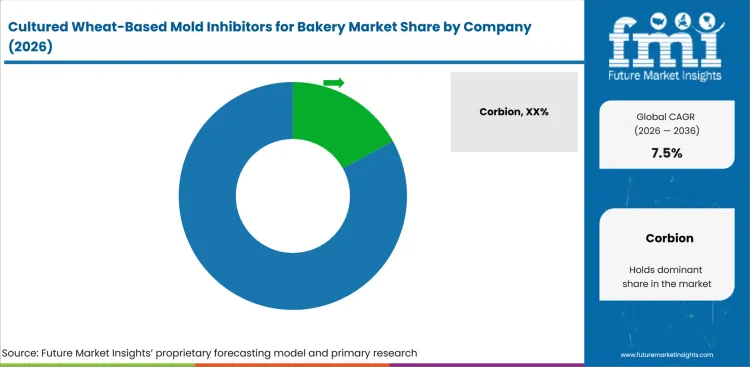
Corbion and BDF Natural Ingredients score strongest on direct cultured wheat evidence and bakery relevance.
| Company | Fermented Wheat Portfolio Depth | Bakery Application Lab Support | Clean-Label Replacement Evidence | Geographic Footprint |
|---|---|---|---|---|
| Corbion | High | Strong | Strong | Global |
| BDF Natural Ingredients | High | Medium | Strong | Europe and export markets |
| Lallemand Baking | High | Strong | Medium | Global |
| AB Mauri | High | Strong | Medium | Global |
| Cain Food Industries | High | Medium | Medium | United States |
| J&K Ingredients | High | Medium | Medium | North America |
| Vaishnavi Bio Tech | Medium | Low | Medium | India and export markets |
| Kemin Industries | Low | Strong | Strong | Global |
| IFF | Low | Strong | Medium | Global |
Source: Future Market Insights competitive analysis, 2026.
Who are the key players in the cultured wheat-based mold inhibitors for bakery market?
Corbion and BDF Natural Ingredients are listed among core suppliers. Lallemand Baking and AB Mauri are also included with Cain Food Industries and J&K Ingredients.
Cultured Wheat Specialists
- Corbion
- BDF Natural Ingredients
- Lallemand Baking
- AB Mauri
- Cain Food Industries
- J&K Ingredients
- Vaishnavi Bio Tech
Adjacent Clean-Label Preservation Suppliers
- Kemin Industries
- IFF
Regional and Specialist Suppliers
- Vaishnavi Bio Tech
- BDF Natural Ingredients
- Cain Food Industries
- J&K Ingredients
Key Developments in Cultured Wheat-Based Mold Inhibitors for Bakery Market
- In April 2025, Corbion unveiled Verdad Essence WH100 for natural mold inhibition in bakery. The launch strengthened cultured wheat positioning for bread and bun makers.
- In July 2024, BDF Natural Ingredients introduced BDF PRESACTIVE BAKE as a fermented wheat flour mold inhibitor. The product targets packaged bread and enriched bakery products.
- In August 2025, Corbion bakery collateral listed Verdad Essence WH150 as a cultured wheat powder with 1.25% to 2.5% recommended use. That dosage range supports plant trial planning.
- In January 2026, J&K Ingredients published its Fresh-Mate toolkit with C14-based naturalness verification. That points to stricter proof standards for natural preservation claims.
- In 2025, AB Mauri highlighted BakeGard CWF as a natural functional replacement for calcium propionate. This supports competitive pressure in bakery mixes and premix-linked channels.
Cultured Wheat-Based Mold Inhibitors for Bakery Market - Scope & Definition
| Attribute | Detail |
|---|---|
| Market Definition | Fermented wheat flour and cultured wheat ingredients used to delay mold growth in bakery products sold to commercial bakery manufacturers |
| Functions Covered | Mold control, freshness support, pH support, shelf-life extension, and clean-label preservation |
| Applications Covered | Packaged bread, buns, flatbreads, cakes, tortillas, rolls, and selected sweet baked goods |
| End-Use Industries | Commercial bakeries, industrial bread producers, premix manufacturers, bakery ingredient distributors, and foodservice bakery suppliers |
| Grades Covered | Powder and liquid cultured wheat formats used in clean-label, natural, and organic-positioned bakery products |
| Inclusions | Commercial cultured wheat and fermented wheat flour mold inhibitors across forms, applications, label claims, sales channels, and functions |
| Exclusions | Synthetic calcium propionate, sorbates, benzoates, vinegar-only powders, cultured sugar systems, antimicrobial packaging, and home-use preservatives |
Cultured Wheat-Based Mold Inhibitors for Bakery Market - Research Methodology
| Method | Description |
|---|---|
| Primary Research | FMI analyst interviews with ingredient suppliers, commercial bakers, premix manufacturers, bakery distributors, and application technologists across key markets |
| Desk Research | Review of government bakery and grain data, food processing reports, company product information, and technical references on fermentates and bakery mold control |
| Market Sizing & Forecasting | Hybrid model using packaged bakery output, preservative use rates, clean-label substitution rates, estimated pricing, and country-level adoption patterns |
| Data Validation | Cross-verification using supplier portfolios, food processing data, wheat and flour statistics, shelf-life trial signals, and regional procurement behavior |
Cultured Wheat-Based Mold Inhibitors for Bakery Market - Report Scope
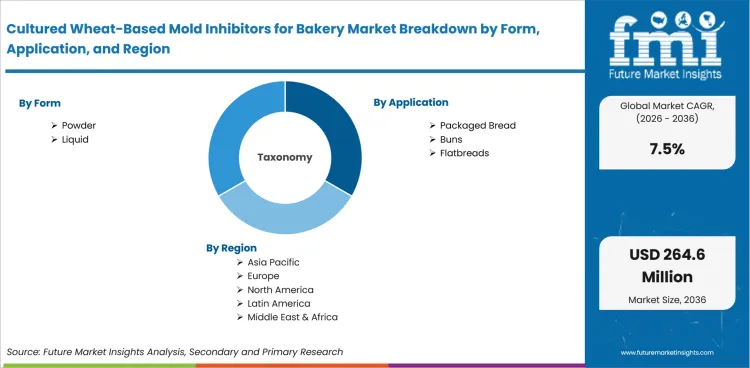
| Item | Value |
|---|---|
| Market size by 2036 | USD 264.6 million |
| Growth rate | 7.5% CAGR from 2026 to 2036 |
| Forecast period | 2026 to 2036 |
| Base year value (2025) | USD 119.4 million |
| By form | Powder, liquid |
| By application | Packaged bread, buns, flatbreads, cakes, others |
| By label claim | Clean label, natural, organic |
| By sales channel | Direct sales, distributors, premix partners |
| By function | Mold control, freshness support, pH support |
| Regions covered | North America, Latin America, Europe, East Asia, South Asia and Pacific, Middle East and Africa |
| Countries covered | United States, United Kingdom, Germany, France, Japan, China, South Korea, India |
| Key companies profiled | Corbion, BDF Natural Ingredients, Lallemand Baking, AB Mauri, Cain Food Industries, J&K Ingredients, Vaishnavi Bio Tech, Kemin Industries, IFF |
| Approach | Hybrid bottom-up and top-down model using bakery output, preservative use rates, supplier evidence, and country adoption velocity |
Source: Future Market Insights, 2026.
Cultured Wheat-Based Mold Inhibitors for Bakery Market Breakdown by Form Application Label Claim Sales Channel Function and Region
Cultured Wheat-Based Mold Inhibitors for Bakery Market Segmented by Form
- Powder
- Liquid
Cultured Wheat-Based Mold Inhibitors for Bakery Market Segmented by Application
- Packaged Bread
- Buns
- Flatbreads
- Cakes
- Others
Cultured Wheat-Based Mold Inhibitors for Bakery Market Segmented by Label Claim
- Clean Label
- Natural
- Organic
Cultured Wheat-Based Mold Inhibitors for Bakery Market Segmented by Sales Channel
- Direct Sales
- Distributors
- Premix Partners
Cultured Wheat-Based Mold Inhibitors for Bakery Market Segmented by Function
- Mold Control
- Freshness Support
- pH Support
Cultured Wheat-Based Mold Inhibitors for Bakery Market by Region
- North America
- Latin America
- Europe
- East Asia
- South Asia and Pacific
- Middle East and Africa
Research Sources and Bibliography
- AB Mauri North America. (2025). What’s New.
- Agreste. (2025). Statistical book 2025. French Ministry of Agriculture.
- Agreste. (2025, July 15). Grandes cultures. Avec des rendements en hausse.
- Bakerpedia. (2024, March 15). Improving your bakery products with mold inhibitors.
- BDF Natural Ingredients. (2024, July 11). Introducing BDF PRESACTIVE BAKE: Natural mold inhibitor for bakery products.
- Bureau of Labor Statistics. (2025, April 4). What is behind the rise in prices for bakery products?
- Corbion. (2025, April 21). Corbion unveils Verdad Essence WH100: Redefining natural mold inhibition for bakers.
- Corbion. (2025, August). Clean label mold inhibitors.
- Defra. (2026, January 20). Cereal and oilseed production in the United Kingdom 2025.
- Destatis. (2026, January 23). 2025 grain and potato harvest: 45 million tons of grain and 14 million tons of potatoes.
- FAS Guangzhou. (2026, January 16). Baking Ingredients Market Update 2025: China.
- FAS New Delhi. (2026, March 27). Food Processing Ingredients Annual: India.
- FAS Seoul. (2026, May 27). South Korea: Food Processing Ingredients Annual.
- FAS Tokyo. (2025, December 4). Grain and Feed Update: Japan.
- FAS Tokyo. (2026, April 1). Food Processing Ingredients Annual: Japan.
- Hernandez-Figueroa R. H. et al. (2025). Evaluation of clean-label additives to inhibit molds and extend shelf life in bakery products. Microbiology Research 16(8) 179.
- J&K Ingredients. (2026, January). Natural Verified Mold Inhibitor.
- Kemin Industries. (2025, June 6). Food brands shift away from synthetic ingredients.
- Lallemand Baking. (2024). Mold inhibitors.
- Ministry of Agriculture and Farmers Welfare. (2026, May 27). Third Advance Estimates reflect India’s agricultural strength. Press Information Bureau.
- Oklahoma State University Extension. (2024). Clean Label Mold Inhibitors for Baking.
- United States Department of Agriculture National Agricultural Statistics Service. (2025, September 30). Small Grains 2025 Summary.
- United States Department of Agriculture National Agricultural Statistics Service. (2026, May 1). Flour Milling Products 2025 Summary.
This bibliography is provided for reader reference and is not exhaustive. The full report contains the complete reference list and detailed citations.
This Report Answers
- What is the 2026 value and 2036 forecast for cultured wheat-based mold inhibitors for bakery market?
- Which form is projected to hold the leading share during the forecast period?
- Which bakery application is expected to account for the leading 2026 share?
- How do clean-label rules and retailer expectations affect supplier selection?
- Which companies compete in cultured wheat-based bakery mold inhibition?
Frequently Asked Questions
What is the cultured wheat-based mold inhibitors for bakery market size in 2026?
The cultured wheat-based mold inhibitors for bakery market size is anticipated to reach USD 128.4 million in 2026.
What is the cultured wheat-based mold inhibitors for bakery market forecast for 2036?
The cultured wheat-based mold inhibitors for bakery industry revenue is predicted to reach USD 264.6 million by 2036 as clean-label bakery preservation gains wider industrial use.
What is the cultured wheat-based mold inhibitors for bakery market CAGR?
The cultured wheat-based mold inhibitors for bakery sector is projected to expand at 7.5% CAGR from 2026 to 2036.
What segment leads the cultured wheat-based mold inhibitors for bakery market?
Powder is likely to capture 78.0% share in 2026 because it fits flour-stage dosing and premix blending.
What country grows fastest in the cultured wheat-based mold inhibitors for bakery market?
India is set to record 9.2% CAGR by 2036 driven by packaged bakery expansion and local wheat familiarity.
Preview the report firsthand - request a free sample
Get SampleGet the brochure for pricing and purchase details.
Get PDFTable of Content
- Key Takeaways
- Market Size and CAGR
- Top Growth Driver
- Fastest Growing Segment
- Leading Region
- Key Companies
- Emerging Opportunities
- Executive Summary
- Global Market Outlook
- Demand-side Trends
- Supply-side Trends
- Technology Roadmap Analysis
- Analysis and Recommendations
- Analyst Perspective (What is happening? Why now? What should investors know?)
- Key Questions Answered
- How large is the market?
- What is the CAGR?
- What are key trends?
- Which region dominates?
- Who are the leaders?
- Market Overview
- Market Coverage / Taxonomy
- Market Definition / Scope / Limitations
- Research Methodology
- Chapter Orientation
- Analytical Lens and Working Hypotheses
- Market Structure, Signals, and Trend Drivers
- Benchmarking and Cross-market Comparability
- Market Sizing, Forecasting, and Opportunity Mapping
- Research Design and Evidence Framework
- Desk Research Programme (Secondary Evidence)
- Expert Input and Fieldwork (Primary Evidence)
- Tooling, Models, and Reference Databases
- Data Engineering and Model Build
- Quality Assurance and Audit Trail
- Market Background
- Market Dynamics (Drivers, Restraints, Opportunity, Trends)
- Scenario Forecast (Optimistic, Likely, Conservative)
- Impact Analysis
- AI Impact
- Sustainability Impact
- Regulatory Impact
- Technology Impact
- Consumer / Buyer Analysis
- Purchase Drivers
- Adoption Barriers
- Buyer Journey
- Opportunity Map Analysis
- Product Life Cycle Analysis
- Supply Chain Analysis
- Investment Feasibility Matrix
- Value Chain Analysis
- PESTLE and Porter's Analysis
- Regulatory Landscape
- Regional Parent Market Outlook
- Production and Consumption Statistics
- Import and Export Statistics
- Global Market Analysis and Forecast, 2021 to 2036
- Historical Market Size Value (USD Million) & Volume (Unit) Analysis, 2021 to 2025
- Current and Future Market Size Value (USD Million) & Volume (Unit) Projections, 2026 to 2036
- Y-o-Y Growth Trend Analysis
- Absolute $ Opportunity Analysis
- Global Market Pricing Analysis, 2021 to 2036
- Global Market Analysis and Forecast, By Form, 2021 to 2036
- Introduction / Key Findings
- Historical Market Size Value (USD Million) & Volume (Unit) Analysis By Form, 2021 to 2025
- Current and Future Market Size Value (USD Million) & Volume (Unit) Analysis and Forecast By Form, 2026 to 2036
- Powder
- Liquid
- Powder
- Y-o-Y Growth Trend Analysis By Form, 2021 to 2025
- Absolute $ Opportunity Analysis By Form, 2026 to 2036
- Global Market Analysis and Forecast, By Application, 2021 to 2036
- Introduction / Key Findings
- Historical Market Size Value (USD Million) & Volume (Unit) Analysis By Application, 2021 to 2025
- Current and Future Market Size Value (USD Million) & Volume (Unit) Analysis and Forecast By Application, 2026 to 2036
- Packaged Bread
- Buns
- Flatbreads
- Cakes
- Others
- Packaged Bread
- Y-o-Y Growth Trend Analysis By Application, 2021 to 2025
- Absolute $ Opportunity Analysis By Application, 2026 to 2036
- Global Market Analysis and Forecast, By Label Claim, 2021 to 2036
- Introduction / Key Findings
- Historical Market Size Value (USD Million) & Volume (Unit) Analysis By Label Claim, 2021 to 2025
- Current and Future Market Size Value (USD Million) & Volume (Unit) Analysis and Forecast By Label Claim, 2026 to 2036
- Clean Label
- Natural
- Organic
- Clean Label
- Y-o-Y Growth Trend Analysis By Label Claim, 2021 to 2025
- Absolute $ Opportunity Analysis By Label Claim, 2026 to 2036
- Global Market Analysis and Forecast, By Sales Channel, 2021 to 2036
- Introduction / Key Findings
- Historical Market Size Value (USD Million) & Volume (Unit) Analysis By Sales Channel, 2021 to 2025
- Current and Future Market Size Value (USD Million) & Volume (Unit) Analysis and Forecast By Sales Channel, 2026 to 2036
- Direct Sales
- Distributors
- Premix Partners
- Direct Sales
- Y-o-Y Growth Trend Analysis By Sales Channel, 2021 to 2025
- Absolute $ Opportunity Analysis By Sales Channel, 2026 to 2036
- Global Market Analysis and Forecast, By Function, 2021 to 2036
- Introduction / Key Findings
- Historical Market Size Value (USD Million) & Volume (Unit) Analysis By Function, 2021 to 2025
- Current and Future Market Size Value (USD Million) & Volume (Unit) Analysis and Forecast By Function, 2026 to 2036
- Mold Control
- Freshness Support
- pH Support
- Mold Control
- Y-o-Y Growth Trend Analysis By Function, 2021 to 2025
- Absolute $ Opportunity Analysis By Function, 2026 to 2036
- Global Market Analysis and Forecast, By Region, 2021 to 2036
- Introduction
- Historical Market Size Value (USD Million) & Volume (Unit) Analysis By Region, 2021 to 2025
- Current Market Size Value (USD Million) & Volume (Unit) Analysis and Forecast By Region, 2026 to 2036
- North America
- Latin America
- Western Europe
- Eastern Europe
- East Asia
- South Asia and Pacific
- Middle East & Africa
- Market Attractiveness Analysis By Region
- North America Market Analysis and Forecast, By Country, 2021 to 2036
- Historical Market Size Value (USD Million) & Volume (Unit) Trend Analysis By Market Taxonomy, 2021 to 2025
- Market Size Value (USD Million) & Volume (Unit) Forecast By Market Taxonomy, 2026 to 2036
- By Country
- USA
- Canada
- Mexico
- By Form
- By Application
- By Label Claim
- By Sales Channel
- By Function
- By Country
- Market Attractiveness Analysis
- By Country
- By Form
- By Application
- By Label Claim
- By Sales Channel
- By Function
- Key Takeaways
- Latin America Market Analysis and Forecast, By Country
- Historical Market Size Value (USD Million) & Volume (Unit) Trend Analysis By Market Taxonomy, 2021 to 2025
- Market Size Value (USD Million) & Volume (Unit) Forecast By Market Taxonomy, 2026 to 2036
- By Country
- Brazil
- Chile
- Rest of Latin America
- By Form
- By Application
- By Label Claim
- By Sales Channel
- By Function
- By Country
- Market Attractiveness Analysis
- By Country
- By Form
- By Application
- By Label Claim
- By Sales Channel
- By Function
- Key Takeaways
- Western Europe Market Analysis and Forecast, By Country
- Historical Market Size Value (USD Million) & Volume (Unit) Trend Analysis By Market Taxonomy, 2021 to 2025
- Market Size Value (USD Million) & Volume (Unit) Forecast By Market Taxonomy, 2026 to 2036
- By Country
- Germany
- UK
- Italy
- Spain
- France
- Nordic
- BENELUX
- Rest of Western Europe
- By Form
- By Application
- By Label Claim
- By Sales Channel
- By Function
- By Country
- Market Attractiveness Analysis
- By Country
- By Form
- By Application
- By Label Claim
- By Sales Channel
- By Function
- Key Takeaways
- Eastern Europe Market Analysis and Forecast, By Country
- Historical Market Size Value (USD Million) & Volume (Unit) Trend Analysis By Market Taxonomy, 2021 to 2025
- Market Size Value (USD Million) & Volume (Unit) Forecast By Market Taxonomy, 2026 to 2036
- By Country
- Russia
- Poland
- Hungary
- Balkan & Baltic
- Rest of Eastern Europe
- By Form
- By Application
- By Label Claim
- By Sales Channel
- By Function
- By Country
- Market Attractiveness Analysis
- By Country
- By Form
- By Application
- By Label Claim
- By Sales Channel
- By Function
- Key Takeaways
- East Asia Market Analysis and Forecast, By Country
- Historical Market Size Value (USD Million) & Volume (Unit) Trend Analysis By Market Taxonomy, 2021 to 2025
- Market Size Value (USD Million) & Volume (Unit) Forecast By Market Taxonomy, 2026 to 2036
- By Country
- China
- Japan
- South Korea
- By Form
- By Application
- By Label Claim
- By Sales Channel
- By Function
- By Country
- Market Attractiveness Analysis
- By Country
- By Form
- By Application
- By Label Claim
- By Sales Channel
- By Function
- Key Takeaways
- South Asia and Pacific Market Analysis and Forecast, By Country
- Historical Market Size Value (USD Million) & Volume (Unit) Trend Analysis By Market Taxonomy, 2021 to 2025
- Market Size Value (USD Million) & Volume (Unit) Forecast By Market Taxonomy, 2026 to 2036
- By Country
- India
- ASEAN
- Australia & New Zealand
- Rest of South Asia and Pacific
- By Form
- By Application
- By Label Claim
- By Sales Channel
- By Function
- By Country
- Market Attractiveness Analysis
- By Country
- By Form
- By Application
- By Label Claim
- By Sales Channel
- By Function
- Key Takeaways
- Middle East & Africa Market Analysis and Forecast, By Country
- Historical Market Size Value (USD Million) & Volume (Unit) Trend Analysis By Market Taxonomy, 2021 to 2025
- Market Size Value (USD Million) & Volume (Unit) Forecast By Market Taxonomy, 2026 to 2036
- By Country
- Kingdom of Saudi Arabia
- Other GCC Countries
- Türkiye
- South Africa
- Other African Union
- Rest of Middle East & Africa
- By Form
- By Application
- By Label Claim
- By Sales Channel
- By Function
- By Country
- Market Attractiveness Analysis
- By Country
- By Form
- By Application
- By Label Claim
- By Sales Channel
- By Function
- Key Takeaways
- Key Countries Market Analysis
- USA
- Pricing Analysis
- Market Share Analysis, 2025
- By Form
- By Application
- By Label Claim
- By Sales Channel
- By Function
- Canada
- Pricing Analysis
- Market Share Analysis, 2025
- By Form
- By Application
- By Label Claim
- By Sales Channel
- By Function
- Mexico
- Pricing Analysis
- Market Share Analysis, 2025
- By Form
- By Application
- By Label Claim
- By Sales Channel
- By Function
- Brazil
- Pricing Analysis
- Market Share Analysis, 2025
- By Form
- By Application
- By Label Claim
- By Sales Channel
- By Function
- Chile
- Pricing Analysis
- Market Share Analysis, 2025
- By Form
- By Application
- By Label Claim
- By Sales Channel
- By Function
- Germany
- Pricing Analysis
- Market Share Analysis, 2025
- By Form
- By Application
- By Label Claim
- By Sales Channel
- By Function
- UK
- Pricing Analysis
- Market Share Analysis, 2025
- By Form
- By Application
- By Label Claim
- By Sales Channel
- By Function
- Italy
- Pricing Analysis
- Market Share Analysis, 2025
- By Form
- By Application
- By Label Claim
- By Sales Channel
- By Function
- Spain
- Pricing Analysis
- Market Share Analysis, 2025
- By Form
- By Application
- By Label Claim
- By Sales Channel
- By Function
- France
- Pricing Analysis
- Market Share Analysis, 2025
- By Form
- By Application
- By Label Claim
- By Sales Channel
- By Function
- India
- Pricing Analysis
- Market Share Analysis, 2025
- By Form
- By Application
- By Label Claim
- By Sales Channel
- By Function
- ASEAN
- Pricing Analysis
- Market Share Analysis, 2025
- By Form
- By Application
- By Label Claim
- By Sales Channel
- By Function
- Australia & New Zealand
- Pricing Analysis
- Market Share Analysis, 2025
- By Form
- By Application
- By Label Claim
- By Sales Channel
- By Function
- China
- Pricing Analysis
- Market Share Analysis, 2025
- By Form
- By Application
- By Label Claim
- By Sales Channel
- By Function
- Japan
- Pricing Analysis
- Market Share Analysis, 2025
- By Form
- By Application
- By Label Claim
- By Sales Channel
- By Function
- South Korea
- Pricing Analysis
- Market Share Analysis, 2025
- By Form
- By Application
- By Label Claim
- By Sales Channel
- By Function
- Russia
- Pricing Analysis
- Market Share Analysis, 2025
- By Form
- By Application
- By Label Claim
- By Sales Channel
- By Function
- Poland
- Pricing Analysis
- Market Share Analysis, 2025
- By Form
- By Application
- By Label Claim
- By Sales Channel
- By Function
- Hungary
- Pricing Analysis
- Market Share Analysis, 2025
- By Form
- By Application
- By Label Claim
- By Sales Channel
- By Function
- Kingdom of Saudi Arabia
- Pricing Analysis
- Market Share Analysis, 2025
- By Form
- By Application
- By Label Claim
- By Sales Channel
- By Function
- Türkiye
- Pricing Analysis
- Market Share Analysis, 2025
- By Form
- By Application
- By Label Claim
- By Sales Channel
- By Function
- South Africa
- Pricing Analysis
- Market Share Analysis, 2025
- By Form
- By Application
- By Label Claim
- By Sales Channel
- By Function
- USA
- Market Structure Analysis
- Competition Dashboard
- Competition Benchmarking
- Market Share Analysis of Top Players
- By Regional
- By Form
- By Application
- By Label Claim
- By Sales Channel
- By Function
- Emerging Startups
- Innovation Benchmarking
- Competition Analysis
- Competition Deep Dive
- Corbion
- Overview
- Product Portfolio
- Profitability by Market Segments (Product/Region/Sales Channel)
- Sales Footprint
- Strategy Overview
- Marketing Strategy
- Product Strategy
- Channel Strategy
- BDF Natural Ingredients
- Lallemand Baking
- AB Mauri
- Cain Food Industries
- J&K Ingredients
- Vaishnavi Bio Tech
- Kemin Industries
- IFF
- Vaishnavi Bio Tech
- BDF Natural Ingredients
- Cain Food Industries
- J&K Ingredients
- Corbion
- Case Studies
- Success Stories
- Recent Developments
- Competition Deep Dive
- Assumptions & Acronyms Used


