

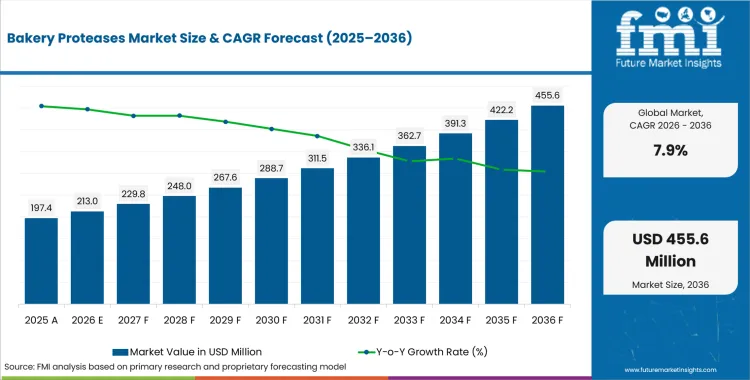
- Market Size (2026)
- USD 213.0 Mn
- Forecast (2036)
- USD 455.6 Mn
- CAGR (2026 to 2036)
- 7.9%
How big is Bakery Proteases Market in 2026?
USD 213.0 million in 2026 and USD 455.6 million by 2036 at a 7.9% CAGR.
Bakery protease demand is projected to expand at 7.9% CAGR from 2026 to 2036 as industrial bakery enzymes are specified against flour strength and line speed. USDA NASS measured second-quarter 2025 flour production at 103 million hundredweight in its August release. That volume makes small reductions in rest time or machining variability commercially meaningful over repeated flour runs.
Country conversion rates differ with bakery structure and technical qualification cost, which changes how quickly a validated enzyme becomes a recurring specification. Defra statistics published in July 2026 counted about 24,880 UK food-and-drink manufacturing SMEs and put SMEs at 98.8% of sector businesses. That fragmented manufacturing base increases the value of distributor training and local application support, while Gulf expansion places more weight on regional inventory and faster plant trials.
Key Takeaways of Bakery Proteases Market
- Demand rises as industrial bakers use controlled gluten relaxation to reduce rest time and stabilize dough handling between changing flour lots.
- By product type, standard grade is estimated to hold 45.0% in 2026 owing to routine processing programs that prioritize established activity specifications.
- In 2026, powder - dry is expected to lead form with 43.0% share because dry premixes fit existing flour-side dosing and distributor workflows.
- Bread & rolls are projected to hold 34.0% share in 2026 owing to frequent rheology adjustment on high-throughput dough lines.
- Qualification slows when a narrow dose window or regulatory status requires repeated plant trials before a bakery can standardize the new enzyme input.
- Some of the key players in this market include Novonesis, IFF, Kerry Group, AB Enzymes, Puratos, Corbion, dsm-firmenich, and Lallemand.
Analyst Perspective
“Bakery proteases earn their place only after a plant proves the usable dose window against its actual flour and line speed. Commercial value comes from reducing rest time or machining variability without weakening loaf structure or forcing repeated recipe qualification.”
- Nandini Roy Choudhury, Principal Consultant, Future Market Insights
How is the bakery proteases market segmented?
The market is analyzed by product type, form, application, claim, sales channel and region.
Product type covers standard grade, premium / specialty grade, organic certified and clean label grade. Form includes powder - dry, liquid, paste / semi-solid and granules / pieces. Application spans bread & rolls, cakes & muffins, biscuits & cookies, viennoiserie & pastry and other bakery & snacks. Claim includes conventional, clean label, organic and non-GMO / identity preserved. Sales channel covers direct to industrial bakeries, ingredient distributors, foodservice & artisan supply and online B2B.
What makes Standard grade central to the Product Type category?
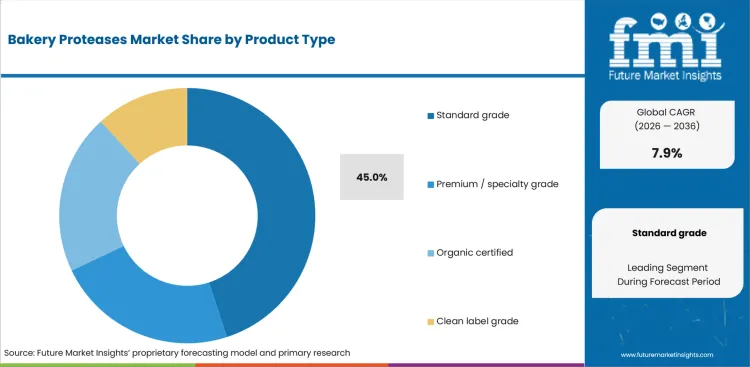
Standard grade fits protease demand because plant technologists usually solve a defined rheology problem before considering claim-specific certification and a flour-specific dose window.
- Based on product type, standard grade is projected to account for 45.0% in 2026 due to broad process fit in conventional bakery formulations.
- Qualification still turns on documented use conditions after a plant identifies the required dough effect. FDA closed AB Enzymes GRN 1197 in March 2025 with no questions for fructanase use up to 12 mg TOS/kg in baking, demonstrating how regulators review dosage conditions.
Why does Powder - dry lead the Form category?
Powder - dry formats fit premix operations that meter flour conditioners and bread improvers through existing dry systems. FDA closed AB Enzymes GRN 1196 in March 2025 with no questions for lipase use up to 4 mg TOS/kg flour in baked goods, defining documented dosage conditions.
- By form, powder - dry is forecast to represent 43.0% in 2026 driven by dry premix workflows and flour-side dosing routines.
- Dry premixes distribute low-dose enzyme activity with other flour conditioners before the blend reaches a bakery line, reducing separate additions during routine production.
How do Bread & rolls anchor the Application category?
Bread lines expose dough to mixing and forming steps where rheology errors are expensive, so protease selection belongs with dough improvers in one operating decision.
- Bread & rolls are set to lead the application category with 34.0% share in 2026 due to frequent rheology adjustment on high-throughput dough lines.
- Bread plants qualify enzyme systems against measurable product results before extending use to multiple SKUs. IFF launched POWERFRESH ACE 2000 in August 2025 for USA industrial bakeries and reported softness and resilience for up to 34 days, confirming performance-based enzyme qualification.
What drives Direct to industrial bakeries in the Sales Channel category?
Direct sales begin with flour-specific trials because protease response changes materially with flour strength and mixer conditions. FDA closed AB Enzymes GRN 1276 in April 2026 with no questions for cellulase use up to 19 mg TOS/kg in baked goods, showing why food enzymes need documented conditions.
- Direct to industrial bakeries is likely to capture 50.0% share in 2026 attributable to plant-specific qualification and application trials.
- Direct technical teams adjust enzyme dose against flour strength and mixer conditions before purchasing, making distributor replenishment easier after the plant fixes that operating window.
What are the drivers, restraints and opportunities in the Bakery Proteases Market?
Demand is supported by flour-standardization and dough-relaxation needs. Dose sensitivity and regulatory qualification restrain switching, while claim-led and cost-focused reformulation expands the value of application support.
- Driver: Industrial bread lines justify protease use once shorter rest time or steadier machining offsets the cost of qualification and flour variability.
- Restraint: An unsuitable protease dose can weaken gluten beyond the production target and extend plant trials before a recipe change is approved.
- Opportunity: Reformulation programs reward enzyme companies that preserve dough handling while bakeries reduce conventional conditioners or adapt to changing flour quality.
Large flour throughput makes small dough-handling gains visible in the operating economics of industrial bakeries that run high daily volumes. USDA ERS estimated USA wheat flour use at 126.6 pounds per person in 2025, indicating the scale of recurring flour processing. Industrial bakers can recover qualification costs after enzyme platforms prove a dose that shortens rest time or steadies machining under normal flour-lot changes.
Protease qualification slows because an unsuitable dose can weaken gluten beyond the current production target. UK government guidance updated in July 2026 kept food enzymes within the domestic authorization transition under assimilated Regulation 1332/2008, so plants must maintain current status records beside trial evidence. Technical teams also need proof that rheology gains survive normal line conditions without changing finished-product structure.
Reformulation work gives protease specialists a higher-value route when bakers reduce conventional conditioners without losing dough stability. Clean-label bakery programs therefore depend on application evidence under the customer’s flour and process conditions. dsm-firmenich opened its Princeton Baking Innovation Center in May 2025 and included enzymes among the bakery tools available for customer trials. Comparable programs favor protease companies that prove stable dose windows before commercial scale-up and routine specification.
Which country CAGRs are profiled in the Bakery Proteases Market?
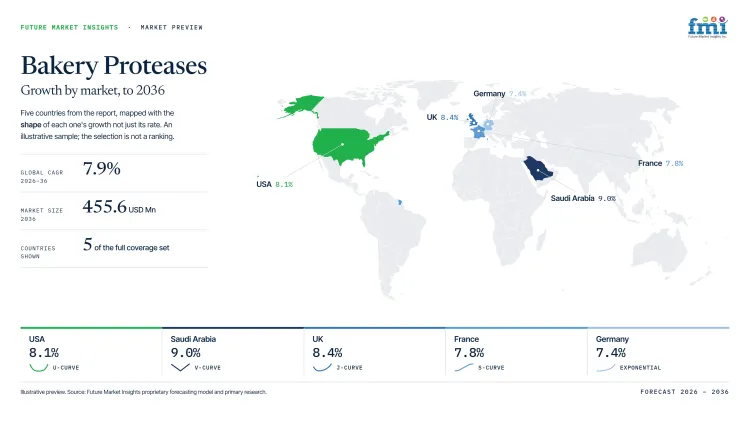
| Country | CAGR |
|---|---|
| Saudi Arabia | 9.0% |
| UK | 8.4% |
| USA | 8.1% |
| France | 7.8% |
| Germany | 7.4% |
How do country-level CAGRs compare in the Bakery Proteases Market?
The country profiles span 1.6 percentage points, from Saudi Arabia at 9.0% to Germany at 7.4%. Saudi Arabia and the UK represent the higher-growth markets, followed by the USA and France, while Germany records the lowest CAGR among the selected countries. This range supports differentiated sales sequencing while keeping qualification economics central to country prioritization.
- Saudi Arabia qualification cycles favor regional service models that extend technical coverage without requiring a full application laboratory locally.
- UK private-label bakeries weigh reformulation economics, line downtime, and traceability during enzyme supplier reviews.
- USA bakery groups favor standardized technical dossiers that enable multiple plant teams to evaluate specification changes efficiently.
- France bakery programs prioritize structured technical validation and formulation consistency before broader production adoption.
- Germany enzyme supplier selection emphasizes rigorous qualification, process reliability, and documented performance across production environments.
Commercial priority also depends on account concentration and qualification cost because the report's regional taxonomy provides wider country-level CAGR analysis.
Country-wise Analysis
- Saudi Arabia bakery processors prioritize enzyme solutions that meet audited production controls and established food-safety procedures. Bakery protease demand is forecast to grow at 9.0% CAGR through 2036, supported by local manufacturing growth. Complete specifications, handling records, and responsive technical support remain important for supplier qualification.
- UK industrial bakeries require consistent enzyme performance across flour and production-line variations, making technical validation important. Bakery protease demand is projected to grow at 8.4% CAGR during 2026–2036, supported by reformulation activity. Distributor training, traceability, and plant-level performance evidence remain key to supplier selection.
- USA multi-site bread companies typically require plant-scale evidence before adopting enzymes across high-throughput production lines. Bakery protease demand is forecast to expand at 8.1% CAGR through 2036, supported by recurring flour-standardization needs. Consistent dose response and responsive technical support are important for broader supplier adoption.
- France bakery processors emphasize consistent dough performance, regulatory documentation, and controlled formulation changes when evaluating protease suppliers. Bakery protease demand is projected to grow at 7.8% CAGR during 2026–2036, supported by product reformulation. Suppliers must demonstrate repeatable results across flour specifications and provide clear technical documentation.
- Germany bakery manufacturers prioritize process reliability, formulation consistency, and technical validation when assessing enzyme solutions. Bakery protease demand is forecast to increase at 7.4% CAGR through 2036, supported by demand for controlled dough processing. Stable enzyme performance and comprehensive technical evidence are important for supplier qualification..
Who are the notable companies in the Bakery Proteases Market?
Novonesis, IFF, Kerry Group, AB Enzymes, Puratos, Corbion, dsm-firmenich, and Lallemand are the notable companies profiled in this market.
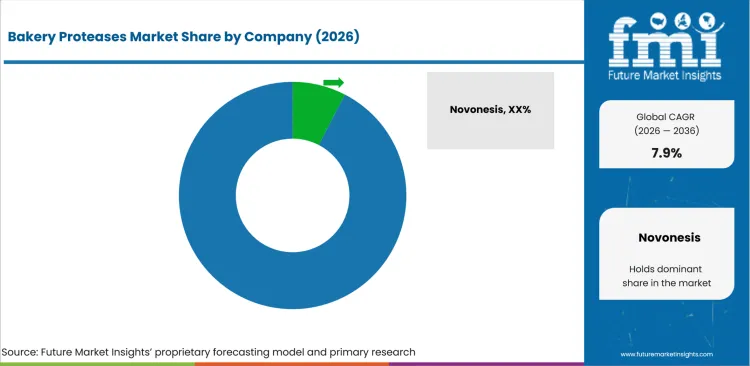
Industrial bakeries often qualify proteases inside broader flour improver programs because the dose decision must fit the same flour and line conditions as other dough conditioners. Diversified industrial enzyme groups therefore need bakery application teams that can turn enzyme activity into a stable customer specification.
- Novonesis, IFF and Kerry Group bring broad food-enzyme portfolios with dedicated bakery application resources and global customer coverage.
- AB Enzymes and Lallemand emphasize fermentation-derived enzyme expertise with direct baking support for formulators, millers and industrial bakery programs.
- Puratos, Corbion and dsm-firmenich use wider bakery formulation platforms that link enzymes with texture and flour-performance work.
Kerry and IFF also support fine-bakery programs, giving their cake enzyme teams experience with batter systems that require different texture and process targets from bread dough.
Competitive Benchmarking: Bakery Proteases Market
| Company | Bakery Enzyme Portfolio Depth | Plant-Scale Application Support | Reformulation & Specialty Support | Geographic Reach |
|---|---|---|---|---|
| Novonesis | High | High | High | Global |
| IFF | High | High | High | Global |
| Kerry Group | High | High | High | Global |
| AB Enzymes | High | High | Medium | Global with regional baking labs |
| Puratos | Medium | High | High | Global bakery network |
| Corbion | Medium | High | High | Global food customer base |
| dsm-firmenich | Medium | High | High | Global |
| Lallemand | Medium | High | High | Global bakery network |
Scoring basis: High portfolio depth requires multiple documented bakery-enzyme routes while Medium requires narrower evidence and Low identifies one documented route. High application support requires dedicated bakery trial infrastructure or repeated plant-scale evidence that reaches production conditions. Medium denotes documented application support without dedicated baking facilities, while Low identifies indirect or limited support. High reformulation support requires several documented bakery formulation routes, while Medium requires two routes and Low identifies one.
Key Developments in the Bakery Proteases Market
- In June 2026, AB Enzymes opened a new office and baking lab in Curitiba to run hands-on trials and provide closer application support for South American customers.
- In June 2025, Lallemand completed the acquisition of AIT Ingredients to expand its baking-solutions portfolio and application knowledge for bakery and flour-milling customers.
- In June 2026, Puratos opened a Flour Competence Center in Belgium to link flour analysis with bakery application guidance and improve response to flour variability.
Key Players in the Bakery Proteases Market
Global Bakery Enzyme Platforms
- Novonesis
- IFF
- Kerry Group
- dsm-firmenich
Enzyme and Baking Specialists
- AB Enzymes
- Lallemand
Bakery Formulation Platforms
- Puratos
- Corbion
Bakery Proteases Market - Report Scope
| Coverage field | Report scope |
|---|---|
| Market breakdown | By product type, form, application, claim, sales channel and region. |
| Quantitative Units | USD Million. |
| Market Definition | Commercial bakery protease products used to modify dough or flour performance within the defined bakery application and sales-channel boundary. |
| Regions Covered | North America, Latin America, Europe, East Asia, South Asia and Pacific, and Middle East and Africa. |
| Countries Covered | UAE, Saudi Arabia, South Korea, UK, USA, and 20+ countries included in the full report. |
| Key Companies Profiled | Novonesis, IFF, Kerry Group, AB Enzymes, Puratos, Corbion, dsm-firmenich, and Lallemand. |
| Forecast Period | 2026 to 2036. |
| Approach | Primary and secondary research with market triangulation. |
Bakery Proteases Market - Research Methodology
| Method | Approach |
|---|---|
| Primary Research | FMI analysts gathered input from manufacturers, service providers, technology developers, distributors, end users, procurement teams, and subject-matter experts. Interviews examined purchasing decisions, product or service evaluation, adoption barriers, approval requirements, pricing considerations, and expectations for technical or commercial support. Respondents were also asked what evidence is required before a trial, pilot, or initial order develops into regular purchasing. |
| Desk Research | Desk research covered government statistics, regulatory publications, trade data, industry associations, technical literature, standards, company filings, product information, and official corporate announcements. Sources were reviewed for relevance, publication date, geographic coverage, and consistency with the defined market scope. Claims relating to performance, applications, approvals, capacity, investment, and commercial activity were retained only when supported by credible public evidence. |
| Market Sizing and Forecasting | The market model combined the baseline value with historical performance, segment structure, pricing and volume indicators, adoption levels, company participation, and country-level demand conditions. Forecast assumptions considered economic activity, investment trends, regulatory developments, technology adoption, purchasing cycles, supply availability, and barriers to wider market use. Segment and regional estimates were reconciled before the final market total was calculated. |
| Data Validation | Estimates were checked against multiple independent indicators, including public data, company activity, trade patterns, industry developments, and findings from primary interviews. Validation also tested whether products, services, applications, and company revenues fell within the defined market boundaries. Adjacent categories, unsupported claims, overlapping revenues, and activities without direct market relevance were excluded to reduce double counting and maintain consistency across segments and countries. |
Bakery Proteases Market by Segments
Bakery Proteases Market segmented by Product Type:
- Standard grade
- Premium / specialty grade
- Organic certified
- Clean label grade
Bakery Proteases Market segmented by Form:
- Powder - dry
- Liquid
- Paste / semi-solid
- Granules / pieces
Bakery Proteases Market segmented by Application:
- Bread & rolls
- Cakes & muffins
- Biscuits & cookies
- Viennoiserie & pastry
- Other bakery & snacks
Bakery Proteases Market segmented by Claim:
- Conventional
- Clean label
- Organic
- Non-GMO / identity preserved
Bakery Proteases Market segmented by Sales Channel:
- Direct to industrial bakeries
- Ingredient distributors
- Foodservice & artisan supply
- Online B2B
Bakery Proteases Market by Region:
- North America
- United States
- Canada
- Latin America
- Brazil
- Mexico
- Chile
- Rest of Latin America
- Western Europe
- Germany
- United Kingdom
- Italy
- Spain
- France
- Nordics
- Benelux
- Rest of Western Europe
- Eastern Europe
- Russia
- Poland
- Hungary
- Balkan and Baltic States
- Rest of Eastern Europe
- East Asia
- China
- Japan
- South Korea
- South Asia and Pacific
- India
- ASEAN
- Australia and New Zealand
- Rest of South Asia and Pacific
- Middle East and Africa
- Kingdom of Saudi Arabia
- Other GCC Countries
- Türkiye
- South Africa
- Other African Union Countries
- Rest of Middle East and Africa
Research Sources and Bibliography
- USA Department of Agriculture, National Agricultural Statistics Service. (2025, August 1). Flour Milling Products.
- Department for Environment, Food & Rural Affairs. (2026, July 29). Food statistics in your pocket.
- USA Food and Drug Administration. (2025, March 14). GRN No. 1197: Fructanase enzyme preparation.
- USA Food and Drug Administration. (2025, March 3). GRN No. 1196: Triacylglycerol lipase enzyme preparation.
- IFF. (2025, August 13). IFF Launches POWERFRESH® ACE 2000, a Bread Fresh-Keeping Solution That “Aces” the Shelf-Life Test.
- USA Food and Drug Administration. (2026, April 8). GRN No. 1276: Cellulase enzyme preparation.
- USA Department of Agriculture, Economic Research Service. (2026, April 8). Wheat Sector at a Glance.
- UK Government. (2026, July 3). Reforms to the market authorisations process for regulated products.
- dsm-firmenich. (2025, May 20). On the rise: dsm-firmenich opens state-of-the-art Princeton Baking Innovation Center in Princeton, NJ.
- UAE Cabinet. (2026, April 26). Mohammed bin Rashid approves decisions to enhance industrial resilience, support national products.
- Saudi Food and Drug Authority. (2025, May 10). The SFDA Implements Expanded Inspection Campaigns on Food Factories Ahead of Hajj Season.
- Ministry of Food and Drug Safety, Republic of Korea. (2025, March 18). Food Additives Code incorporating Notice No. 2025-15.
- Office for National Statistics. (2025, November 13). 10.7:Manufacture of Bakery and Farinaceous Products: CVM: annual & monthly gr.
- USA Bureau of Labor Statistics. (2025, December). Table B-1a. Employees on nonfarm payrolls by industry sector and selected industry detail.
- Novonesis. (2025, January 2). The bromate era has faded. Here’s how to make your baked goods healthier and more sustainable.
- AB Enzymes. (2026, June 1). AB Enzymes Opens New Office and Baking Lab in Curitiba, Brazil.
- Lallemand. (2025, July 4). Lallemand Acquires AIT Ingredients.
- Puratos. (2026, June 15). Puratos opens new research center to tackle flour variability.
- Kerry. (2026, March 19). Kerry publishes 2025 Annual Report: A year defined by impact, innovation and purpose.
- Puratos. (2025, May 7). Puratos brings a trio of transformative innovations to iba 2025.
- Corbion. (2025, November 20). Capital Markets Day 2025.
- dsm-firmenich. (2025, October 2). dsm-firmenich opens global food innovation center in Delft, the Netherlands to accelerate diet transformation.
- Kerry. (2026, February 11). Kerry inaugurates its Customer Co-Creation Center in Medellín and boosts Collaborative Innovation in the Andean Region.
- AB Enzymes. (2026, May 12). AB Enzymes Strengthens Presence in Mexico, Central America & the Caribbean.
- International Flavors & Fragrances Inc. (2026, February 27). Annual report on Form 10-K for the year ended December 31, 2025.
- Lallemand. (2025, July 17). Lallemand acquires enzyme specialist Solyve.
- Novonesis. (2025, June 11). Novonesis launches Optiva® LS Prime, helping bakers cut up to 50% added sugar and create more cost-effective baked goods.
- Puratos. (2025, August 25). Puratos Announces Two New Hubs for Food Innovation: Montreal and Costa Rica.
- Corbion. (2026, June 15). Corbion launches LUMI™ Set to help bakers reformulate away from titanium dioxide without sacrificing visual appeal.
This bibliography is provided for reader reference and is not exhaustive. The full report contains the complete reference list and detailed citations
This Report Answers
- How large is the bakery proteases market in 2026 and what value is forecast by 2036?
- Which operating problems cause industrial bakers to qualify proteases for dough and flour control?
- Why does standard grade account for 45.0% of product type demand in 2026?
- Why does powder - dry hold 43.0% of form demand during the 2026 base year?
- Why do bread & rolls represent 34.0% of application demand in 2026?
- How do the five profiled country CAGRs differ from UAE through USA?
- Which qualification issues can delay a bakery protease from plant trial to regular specification?
- Which companies are benchmarked for bakery enzyme and application capability?
- How should industrial bakeries compare protease offers beyond enzyme price and activity units?
Frequently Asked Questions
How big is the bakery proteases market in 2026?
The bakery proteases market is valued at USD 213.0 million in 2026 and is projected to reach USD 455.6 million by 2036. Industrial bakers support growth by qualifying proteases for controlled dough relaxation and flour standardization.
What is the CAGR of the bakery proteases market from 2026 to 2036?
The bakery proteases market is projected to grow at a CAGR of 7.9% between 2026 and 2036. High-throughput bakery lines support expansion by seeking shorter rest time and more consistent dough handling.
Which product type leads the bakery proteases market?
The standard grade segment is expected to hold 45.0% of the bakery proteases market in 2026, attributable to routine processing programs that prioritize familiar activity specifications. Conventional bakery formulations also avoid the added certification requirements attached to specialty grades.
Which application leads the bakery proteases market?
The bread & rolls segment is expected to hold 34.0% of bakery protease application demand in 2026, driven by rheology adjustment on high-throughput dough lines. Controlled gluten modification is useful where stronger flour raises dough resistance or extends forming time.
Which companies are active in the bakery proteases market?
Key companies operating in the bakery proteases market include Novonesis, IFF, Kerry Group, AB Enzymes, Puratos, Corbion, dsm-firmenich, and Lallemand. Their positions differ by enzyme breadth, bakery application support and geographic service coverage.
Preview the report firsthand - request a free sample
Get SampleGet the brochure for pricing and purchase details.
Get PDFTable of Content
- Key Takeaways
- Market Size and CAGR
- Top Growth Driver
- Fastest Growing Segment
- Leading Region
- Key Companies
- Emerging Opportunities
- Executive Summary
- Global Market Outlook
- Demand-side Trends
- Supply-side Trends
- Technology Roadmap Analysis
- Analysis and Recommendations
- Analyst Perspective (What is happening? Why now? What should investors know?)
- Key Questions Answered
- How large is the market?
- What is the CAGR?
- What are key trends?
- Which region dominates?
- Who are the leaders?
- Market Overview
- Market Coverage / Taxonomy
- Market Definition / Scope / Limitations
- Research Methodology
- Chapter Orientation
- Analytical Lens and Working Hypotheses
- Market Structure, Signals, and Trend Drivers
- Benchmarking and Cross-market Comparability
- Market Sizing, Forecasting, and Opportunity Mapping
- Research Design and Evidence Framework
- Desk Research Programme (Secondary Evidence)
- Expert Input and Fieldwork (Primary Evidence)
- Tooling, Models, and Reference Databases
- Data Engineering and Model Build
- Quality Assurance and Audit Trail
- Market Background
- Market Dynamics (Drivers, Restraints, Opportunity, Trends)
- Scenario Forecast (Optimistic, Likely, Conservative)
- Impact Analysis
- AI Impact
- Sustainability Impact
- Regulatory Impact
- Technology Impact
- Consumer / Buyer Analysis
- Purchase Drivers
- Adoption Barriers
- Buyer Journey
- Opportunity Map Analysis
- Product Life Cycle Analysis
- Supply Chain Analysis
- Investment Feasibility Matrix
- Value Chain Analysis
- PESTLE and Porter's Analysis
- Regulatory Landscape
- Regional Parent Market Outlook
- Production and Consumption Statistics
- Import and Export Statistics
- Global Market Analysis and Forecast, 2021 to 2036
- Historical Market Size Value (USD Million) Analysis, 2021 to 2025
- Current and Future Market Size Value (USD Million) Projections, 2026 to 2036
- Y-o-Y Growth Trend Analysis
- Absolute $ Opportunity Analysis
- Global Market Pricing Analysis, 2021 to 2036
- Global Market Analysis and Forecast, By Product Type, 2021 to 2036
- Introduction / Key Findings
- Historical Market Size Value (USD Million) Analysis By Product Type, 2021 to 2025
- Current and Future Market Size Value (USD Million) Analysis and Forecast By Product Type, 2026 to 2036
- Standard grade
- Premium / specialty grade
- Organic certified
- Clean label grade
- Standard grade
- Y-o-Y Growth Trend Analysis By Product Type, 2021 to 2025
- Absolute $ Opportunity Analysis By Product Type, 2026 to 2036
- Global Market Analysis and Forecast, By Form, 2021 to 2036
- Introduction / Key Findings
- Historical Market Size Value (USD Million) Analysis By Form, 2021 to 2025
- Current and Future Market Size Value (USD Million) Analysis and Forecast By Form, 2026 to 2036
- Powder / dry
- Liquid
- Paste / semi-solid
- Granules / pieces
- Powder / dry
- Y-o-Y Growth Trend Analysis By Form, 2021 to 2025
- Absolute $ Opportunity Analysis By Form, 2026 to 2036
- Global Market Analysis and Forecast, By Application, 2021 to 2036
- Introduction / Key Findings
- Historical Market Size Value (USD Million) Analysis By Application, 2021 to 2025
- Current and Future Market Size Value (USD Million) Analysis and Forecast By Application, 2026 to 2036
- Bread & rolls
- Cakes & muffins
- Biscuits & cookies
- Viennoiserie & pastry
- Other bakery & snacks
- Bread & rolls
- Y-o-Y Growth Trend Analysis By Application, 2021 to 2025
- Absolute $ Opportunity Analysis By Application, 2026 to 2036
- Global Market Analysis and Forecast, By Claim, 2021 to 2036
- Introduction / Key Findings
- Historical Market Size Value (USD Million) Analysis By Claim, 2021 to 2025
- Current and Future Market Size Value (USD Million) Analysis and Forecast By Claim, 2026 to 2036
- Conventional
- Clean label
- Organic
- Non-GMO / identity preserved
- Conventional
- Y-o-Y Growth Trend Analysis By Claim, 2021 to 2025
- Absolute $ Opportunity Analysis By Claim, 2026 to 2036
- Global Market Analysis and Forecast, By Sales Channel, 2021 to 2036
- Introduction / Key Findings
- Historical Market Size Value (USD Million) Analysis By Sales Channel, 2021 to 2025
- Current and Future Market Size Value (USD Million) Analysis and Forecast By Sales Channel, 2026 to 2036
- Direct to industrial bakeries
- Ingredient distributors
- Foodservice & artisan supply
- Online B2B
- Direct to industrial bakeries
- Y-o-Y Growth Trend Analysis By Sales Channel, 2021 to 2025
- Absolute $ Opportunity Analysis By Sales Channel, 2026 to 2036
- Global Market Analysis and Forecast, By Region, 2021 to 2036
- Introduction
- Historical Market Size Value (USD Million) Analysis By Region, 2021 to 2025
- Current Market Size Value (USD Million) Analysis and Forecast By Region, 2026 to 2036
- North America
- Latin America
- Western Europe
- Eastern Europe
- East Asia
- South Asia and Pacific
- Middle East & Africa
- Market Attractiveness Analysis By Region
- North America Market Analysis and Forecast, By Country, 2021 to 2036
- Historical Market Size Value (USD Million) Trend Analysis By Market Taxonomy, 2021 to 2025
- Market Size Value (USD Million) Forecast By Market Taxonomy, 2026 to 2036
- By Country
- USA
- Canada
- By Product Type
- By Form
- By Application
- By Claim
- By Sales Channel
- By Country
- Market Attractiveness Analysis
- By Country
- By Product Type
- By Form
- By Application
- By Claim
- By Sales Channel
- Key Takeaways
- Latin America Market Analysis and Forecast, By Country
- Historical Market Size Value (USD Million) Trend Analysis By Market Taxonomy, 2021 to 2025
- Market Size Value (USD Million) Forecast By Market Taxonomy, 2026 to 2036
- By Country
- Brazil
- Mexico
- Chile
- Rest of Latin America
- By Product Type
- By Form
- By Application
- By Claim
- By Sales Channel
- By Country
- Market Attractiveness Analysis
- By Country
- By Product Type
- By Form
- By Application
- By Claim
- By Sales Channel
- Key Takeaways
- Western Europe Market Analysis and Forecast, By Country
- Historical Market Size Value (USD Million) Trend Analysis By Market Taxonomy, 2021 to 2025
- Market Size Value (USD Million) Forecast By Market Taxonomy, 2026 to 2036
- By Country
- Germany
- UK
- Italy
- Spain
- France
- Nordic
- BENELUX
- Rest of Western Europe
- By Product Type
- By Form
- By Application
- By Claim
- By Sales Channel
- By Country
- Market Attractiveness Analysis
- By Country
- By Product Type
- By Form
- By Application
- By Claim
- By Sales Channel
- Key Takeaways
- Eastern Europe Market Analysis and Forecast, By Country
- Historical Market Size Value (USD Million) Trend Analysis By Market Taxonomy, 2021 to 2025
- Market Size Value (USD Million) Forecast By Market Taxonomy, 2026 to 2036
- By Country
- Russia
- Poland
- Hungary
- Balkan & Baltic
- Rest of Eastern Europe
- By Product Type
- By Form
- By Application
- By Claim
- By Sales Channel
- By Country
- Market Attractiveness Analysis
- By Country
- By Product Type
- By Form
- By Application
- By Claim
- By Sales Channel
- Key Takeaways
- East Asia Market Analysis and Forecast, By Country
- Historical Market Size Value (USD Million) Trend Analysis By Market Taxonomy, 2021 to 2025
- Market Size Value (USD Million) Forecast By Market Taxonomy, 2026 to 2036
- By Country
- China
- Japan
- South Korea
- By Product Type
- By Form
- By Application
- By Claim
- By Sales Channel
- By Country
- Market Attractiveness Analysis
- By Country
- By Product Type
- By Form
- By Application
- By Claim
- By Sales Channel
- Key Takeaways
- South Asia and Pacific Market Analysis and Forecast, By Country
- Historical Market Size Value (USD Million) Trend Analysis By Market Taxonomy, 2021 to 2025
- Market Size Value (USD Million) Forecast By Market Taxonomy, 2026 to 2036
- By Country
- India
- ASEAN
- Australia & New Zealand
- Rest of South Asia and Pacific
- By Product Type
- By Form
- By Application
- By Claim
- By Sales Channel
- By Country
- Market Attractiveness Analysis
- By Country
- By Product Type
- By Form
- By Application
- By Claim
- By Sales Channel
- Key Takeaways
- Middle East & Africa Market Analysis and Forecast, By Country
- Historical Market Size Value (USD Million) Trend Analysis By Market Taxonomy, 2021 to 2025
- Market Size Value (USD Million) Forecast By Market Taxonomy, 2026 to 2036
- By Country
- Kingdom of Saudi Arabia
- Other GCC Countries
- Türkiye
- South Africa
- Other African Union
- Rest of Middle East & Africa
- By Product Type
- By Form
- By Application
- By Claim
- By Sales Channel
- By Country
- Market Attractiveness Analysis
- By Country
- By Product Type
- By Form
- By Application
- By Claim
- By Sales Channel
- Key Takeaways
- Key Countries Market Analysis
- USA
- Pricing Analysis
- Market Share Analysis, 2025
- By Product Type
- By Form
- By Application
- By Claim
- By Sales Channel
- Canada
- Pricing Analysis
- Market Share Analysis, 2025
- By Product Type
- By Form
- By Application
- By Claim
- By Sales Channel
- Mexico
- Pricing Analysis
- Market Share Analysis, 2025
- By Product Type
- By Form
- By Application
- By Claim
- By Sales Channel
- Brazil
- Pricing Analysis
- Market Share Analysis, 2025
- By Product Type
- By Form
- By Application
- By Claim
- By Sales Channel
- Chile
- Pricing Analysis
- Market Share Analysis, 2025
- By Product Type
- By Form
- By Application
- By Claim
- By Sales Channel
- Germany
- Pricing Analysis
- Market Share Analysis, 2025
- By Product Type
- By Form
- By Application
- By Claim
- By Sales Channel
- UK
- Pricing Analysis
- Market Share Analysis, 2025
- By Product Type
- By Form
- By Application
- By Claim
- By Sales Channel
- Italy
- Pricing Analysis
- Market Share Analysis, 2025
- By Product Type
- By Form
- By Application
- By Claim
- By Sales Channel
- Spain
- Pricing Analysis
- Market Share Analysis, 2025
- By Product Type
- By Form
- By Application
- By Claim
- By Sales Channel
- France
- Pricing Analysis
- Market Share Analysis, 2025
- By Product Type
- By Form
- By Application
- By Claim
- By Sales Channel
- India
- Pricing Analysis
- Market Share Analysis, 2025
- By Product Type
- By Form
- By Application
- By Claim
- By Sales Channel
- ASEAN
- Pricing Analysis
- Market Share Analysis, 2025
- By Product Type
- By Form
- By Application
- By Claim
- By Sales Channel
- Australia & New Zealand
- Pricing Analysis
- Market Share Analysis, 2025
- By Product Type
- By Form
- By Application
- By Claim
- By Sales Channel
- China
- Pricing Analysis
- Market Share Analysis, 2025
- By Product Type
- By Form
- By Application
- By Claim
- By Sales Channel
- Japan
- Pricing Analysis
- Market Share Analysis, 2025
- By Product Type
- By Form
- By Application
- By Claim
- By Sales Channel
- South Korea
- Pricing Analysis
- Market Share Analysis, 2025
- By Product Type
- By Form
- By Application
- By Claim
- By Sales Channel
- Russia
- Pricing Analysis
- Market Share Analysis, 2025
- By Product Type
- By Form
- By Application
- By Claim
- By Sales Channel
- Poland
- Pricing Analysis
- Market Share Analysis, 2025
- By Product Type
- By Form
- By Application
- By Claim
- By Sales Channel
- Hungary
- Pricing Analysis
- Market Share Analysis, 2025
- By Product Type
- By Form
- By Application
- By Claim
- By Sales Channel
- Kingdom of Saudi Arabia
- Pricing Analysis
- Market Share Analysis, 2025
- By Product Type
- By Form
- By Application
- By Claim
- By Sales Channel
- Türkiye
- Pricing Analysis
- Market Share Analysis, 2025
- By Product Type
- By Form
- By Application
- By Claim
- By Sales Channel
- South Africa
- Pricing Analysis
- Market Share Analysis, 2025
- By Product Type
- By Form
- By Application
- By Claim
- By Sales Channel
- USA
- Market Structure Analysis
- Competition Dashboard
- Competition Benchmarking
- Market Share Analysis of Top Players
- By Regional
- By Product Type
- By Form
- By Application
- By Claim
- By Sales Channel
- Emerging Startups
- Innovation Benchmarking
- Competition Analysis
- Competition Deep Dive
- Novonesis
- Overview
- Product Portfolio
- Profitability by Market Segments
- Sales Footprint
- Strategy Overview
- Marketing Strategy
- Product Strategy
- Channel Strategy
- IFF
- Kerry Group
- AB Enzymes
- Amano Enzyme
- Palsgaard
- Corbion
- BASF
- Puratos
- DSM-Firmenich
- Novonesis
- Case Studies
- Success Stories
- Recent Developments
- Competition Deep Dive
- Assumptions & Acronyms Used


