

- Market Size (2026)
- USD 21.7 Bn
- Forecast (2036)
- USD 44.3 Bn
- CAGR (2026 to 2036)
- 7.4%
How big is the Bakery Ingredients & Mixes (Industrial Bakery) Market in 2026?
USD 21.7 billion in 2026 and USD 44.3 billion by 2036 at a 7.4% CAGR.
Sales of bakery ingredients and mixes for industrial bakery use are projected to expand at a 7.4% CAGR from 2026 to 2036. The market is estimated at USD 21.7 billion in 2026 and is projected to reach USD 44.3 billion by 2036. Industrial bakeries approve mixes when one pre-blended input keeps dough handling and finished quality stable during repeat production. The result is a clearer production test before a company moves from plant trials to regular supply.
Retail channel scale is expected to keep packaged bakery programs active through the forecast period. The USA Census Bureau reported in July 2026 that retail and food services sales reached USD 768.6 billion in June 2026. Sales were 6.7% above June 2025. It shows why supermarket bakery and packaged bread programs need formulas that stay consistent across many stores and replenishment cycles.
-market-value-analysis.webp "Bakery Ingredients & Mixes (industrial Bakery) Market Value Analysis")
Key Takeaways of Bakery Ingredients & Mixes (Industrial Bakery) Market
- Demand for bakery ingredients and mixes is shaped by the need to reduce batch variation, simplify formula control, and maintain consistent dough handling and finished-product quality across industrial bakery production.
- By product, Mixes hold 34.1% share in 2026, while Bread accounts for 37.4% share in 2026 within application, reflecting simplified weighing and formulation control alongside frequent high-volume bread production.
- Hypermarkets/Supermarkets represent 35.9% share in 2026 within sales channel, reflecting the importance of packaged bakery replenishment and consistent product quality across broad retail networks.
- Brazil records the highest country CAGR at 7.2% through 2036, followed by the United States at 6.8% and the United Kingdom at 6.4%, with differences shaped by bakery production scale, retail structure, grain supply, and local qualification requirements.
- Competition centers on Puratos, Dawn Foods, Lesaffre, AB Mauri, Bakels, CSM Ingredients, and Corbion, with differentiation spanning bakery mixes, dough performance systems, yeast solutions, fillings, improvers, shelf-life technologies, and plant-scale application support.
- Allergen documentation, plant-scale validation, flour variability, formulation consistency, and performance across storage and distribution conditions remain key considerations for wider adoption of industrial bakery ingredients and mixes.
Analyst Perspective
"The bakery ingredients & mixes (industrial bakery) market is increasingly shaped by repeatable production performance rather than formulation claims alone. Industrial bakeries are assessing mix consistency across processing, storage, and distribution conditions because small variations can affect product quality and batch efficiency. Suppliers that provide stable specifications, compliance support, and dependable performance across routine production will strengthen long-term commercial adoption."
— Nandini Roy Choudhury, Principal Analyst at Future Market Insights
Source: FMI's proprietary forecasting model and primary research
How is the Bakery Ingredients & Mixes (Industrial Bakery) Market segmented?
The bakery ingredients & mixes (industrial bakery) market is segmented by product, application, sales channel, and region.
The segmentation framework separates the product format from the bakery application and the route to the customer. Product analysis covers Mixes, Fillings, Icings, Enzymes and Improvers, with Mixes as the leading category. Application analysis covers Bread, Cake, Patisserie and Biscuit, with Bread as the leading category. Sales Channel analysis covers Hypermarkets/Supermarkets, Convenience Stores, Specialty Stores, Online Retail and Foodservice/HoReCa, with Hypermarkets/Supermarkets as the leading category. Regional analysis checks whether grain supply, retail structure and food-safety approval work change the pace of adoption.
What supports demand for Mixes within the product category?
-market-analysis-by-product.webp "Bakery Ingredients & Mixes (industrial Bakery) Market Analysis By Product")
Industrial bakeries use mixes when repeated production has to stay stable across shifts and flour lots. A mix reduces separate weighing steps and gives plant staff one specification to test during trials. The commercial benefit appears when the same mix protects dough handling in routine batches. Approval therefore depends on finished-bake quality and not on ingredient identity alone.
- Mixes are projected to hold 34.1% share in 2026 with demand anchored in repeat dosing and plant-scale formula control.
- Bakery processors are expected to approve Mixes faster when trial results cover hydration, proofing behavior and finished-bake texture.
How does bread shape demand within the application category?
-market-analysis-by-application.webp "Bakery Ingredients & Mixes (industrial Bakery) Market Analysis By Application")
Bread leads the Application category because industrial plants run bread lines frequently and at high volume. Formula changes have to protect dough tolerance, loaf size and eating quality. A weak mix can create waste across a full production run. This makes bread applications a practical test for ingredient systems before broader use in cakes or patisserie.
- Bread is forecast to represent 37.4% share in 2026 due to daily production volume and tight limits for texture and loaf size.
- Ingredient companies serving Bread have to show how a mix behaves during mixing, proofing and distribution.
Why are hypermarkets/supermarkets central to the sales channel category?
-market-analysis-by-sales-channel.webp "Bakery Ingredients & Mixes (industrial Bakery) Market Analysis By Sales Channel")
Hypermarkets and supermarkets lead the Sales Channel category through regular packaged bakery replenishment. Retail chains need the same appearance and eating quality across many stores. Mixes help plant staff keep product output stable when orders rise or private-label specifications change. Shelf life matters because bakery products lose value quickly once quality starts to drift.
- Hypermarkets/Supermarkets are estimated to hold 35.9% share in 2026 with packaged bakery demand concentrated in repeat shelf programs.
- Retail chains are expected to favor mixes that protect appearance and eating quality across high-volume store networks.
What are the drivers, restraints and opportunities in the Bakery Ingredients & Mixes (Industrial Bakery) Market?
Industrial bakery demand is supported by repeatable formulation control, food-safety records and the need to protect baked quality through storage.
- Driver: Plant-scale bakeries use mixes to reduce batch variation in bread, cake and patisserie lines.
- Restraint: Allergen and food-safety records add approval work in plants that handle several common allergens.
- Opportunity: Frozen and chilled dough systems create room for mixes that protect proofing behavior after storage.
Demand is expected to rise where mixes solve a production problem that plant managers can measure on the line. Stable dosing reduces rework and helps finished products hold the same texture across routine batches. Bakery processors are expected to pay more for a mix when it lowers failed batches or reduces support time during launch.
The main restraint is the cost of proving that the product is safe and repeatable in the target plant. FDA announced final food allergen guidance in January 2025 for requirements that cover sesame and other major allergens. That guidance keeps allergen records central for dry-mix facilities handling several ingredients. Approval is expected to slow when sanitation records or label checks are incomplete.
The primary opportunity is expected to come from formulas that protect quality without adding plant steps. Frozen and chilled dough programs need mixes that hold yeast activity and texture after storage. Ingredient companies gain a clearer sales case when the product gives longer scheduling windows and fewer failed batches.
Which country CAGRs are profiled in the Bakery Ingredients & Mixes (Industrial Bakery) Market?
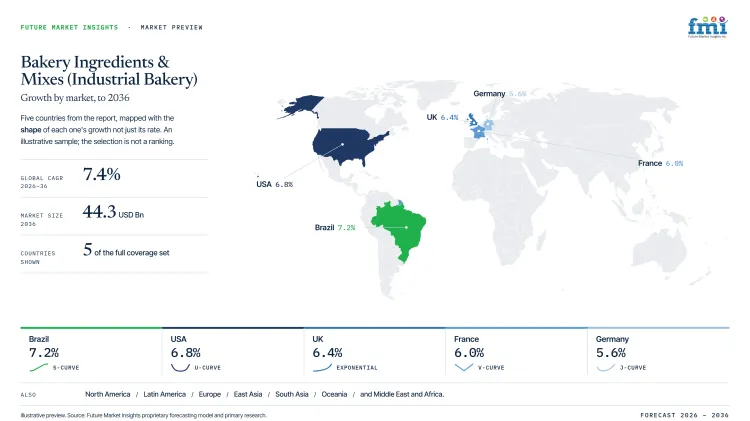
| Country | CAGR |
|---|---|
| USA | 6.8% |
| Germany | 5.6% |
| France | 6.0% |
| UK | 6.4% |
| Brazil | 7.2% |
How do country-level CAGRs compare in the Bakery Ingredients & Mixes (Industrial Bakery) Market?
A global growth rate represents the weighted average of all markets included in the analysis. It can remain above some profiled countries and below others depending on their market weights. The five countries presented are illustrative examples. Their comparison with the global figure shows that several markets outside this group may be expanding at different rates.
- The countries are distinguished less by their CAGRs and more by a compressed range of 1.6 percentage points. Brazil and the USA form a closely aligned upper group while the UK occupies a measured middle position.
- France and Germany create a compact lower group. Brazil benefits from distributed retail bakery demand while the USA follows a production-scale model supported by large bread and packaged bakery operations.
- The UK combines retail and foodservice demand with continued allergen documentation requirements. France follows a reformulation-led route while Germany faces more measured approval through local flour testing and label review.
- Markets with broadly similar CAGRs can therefore require different entry strategies. These differences affect trial design, qualification timing and the support needed before bakery mixes enter routine production.
The full report examines these conditions for every market included in the study. It provides country-level CAGR analysis across North America, Latin America, Europe, East Asia, South Asia, Oceania, and the Middle East and Africa.
Country-wise Analysis
- United States industrial bakeries operate with large bread and sweet goods lines that reward stable mix performance. The USA market is projected to rise at 6.8% CAGR from 2026 to 2036, aided by scale in flour-based production and retail bakery programs. USDA ERS estimated USA per capita wheat flour use at 126.6 pounds in 2025.
- German bakeries combine high bread standards with close scrutiny of ingredients and labels. Germany is forecast to advance at 5.6% CAGR through 2036, reflecting a measured pace for formula approval. Destatis reported that Germany harvested 45 million tons of grain in 2025. The harvest was 16% higher than the previous year. That supply context supports flour planning for bakery processors but does not remove the need for local mix testing. Ingredient companies should prove dough behavior with local flour sources before seeking wider customer approval.
- France has a strong bread culture and a retail structure that keeps supermarket bakery programs relevant. Demand is forecast to rise at 6.0% CAGR through 2036, shaped by retail food channels and reformulation needs. Insee reported in June 2026 that large food stores represented 58.6% of French food retail sales value in 2025. The French agriculture ministry reported in June 2026 that bread salt reduction cut average salt intake by 0.35 grams per day. Mix adoption is expected to favor products that maintain texture after salt or ingredient adjustments.
- United Kingdom bakery processors serve retail, foodservice and in-store bakery channels where consistent output matters during busy periods. The United Kingdom market is projected to expand at 6.4% CAGR from 2026 to 2036. The spending base helps packaged bakery products remain important across household food purchases and catering channels.
- Brazil combines food-retail expansion with an ingredient supply base that differs by region. The Brazilian market is estimated to record 7.2% CAGR through 2036. Conab reported in June 2026 that the 2025/26 grain crop was estimated at 358.6 million tons. IBGE reported in March 2026 that hypermarkets and supermarkets with food products grew 2.9% year over year in January 2026. These measures support demand for mixes that help industrial bakeries hold quality across distributed retail networks. Local trials remain important because humidity and flour quality vary across regions.
Who are the notable companies in the Bakery Ingredients & Mixes (Industrial Bakery) Market?
Puratos, Dawn Foods, Lesaffre, AB Mauri, Bakels, CSM Ingredients, and Corbion are the notable companies shaping this market.
-market-analysis-by-company.webp "Bakery Ingredients & Mixes (industrial Bakery) Market Analysis By Company")
The competitive outlook combines formulation know-how with plant support and local availability. Mix providers compete on repeat dough behavior and how quickly they help customers pass qualification trials. Yeast and improver specialists compete through process stability in bread lines. Companies with fillings and icings portfolios compete where retailers want finished bakery products that hold appearance and eating quality through distribution. Commercial success depends on practical support after the trial because one weak handoff can delay a launch.
- Puratos, AB Mauri and Lesaffre are evaluated through their ability to help bread producers control dough behavior. Their role is strongest where flour variation and yeast performance affect routine production.
- Dawn Foods and Bakels are evaluated through mix breadth and production support. Their portfolios are relevant for cake, icing and retail bakery programs that require repeat results.
- CSM Ingredients and Corbion are evaluated through application work for fillings, improvers and shelf-life systems. Their commercial value rises when customers need cleaner labels without losing texture or freshness.
Competitive Benchmarking: Bakery Ingredients & Mixes (Industrial Bakery) Market
| Company | Mix Portfolio | Application Support | Regulatory Readiness | Geographic Reach |
|---|---|---|---|---|
| Puratos | High | High | Medium | Global |
| Dawn Foods | High | Medium | Medium | North America and Europe |
| Lesaffre | Medium | High | Medium | Global |
| AB Mauri | Medium | High | Medium | Global |
| Bakels | High | Medium | Medium | International markets |
| CSM Ingredients | Medium | High | Medium | Europe and international markets |
| Corbion | Medium | High | High | North America and Europe |
Scoring basis: High indicates a visible core capability within the exact bakery ingredients and mixes workflow. Medium indicates direct support through an adjacent bakery platform or application service. Low indicates limited direct evidence that the company supports the named capability within industrial bakery mixes.
Key Developments in the Bakery Ingredients & Mixes (Industrial Bakery) Market
- In June 2026, Puratos opened its Flour Competence Center in Belgium to study flour variability and translate flour analysis into application guidance. The center supports bakery improvers, sourdough and patisserie mixes.
- In September 2025, Dawn Foods introduced Dawn Balance Cleaner Ingredients Colorful Buttercreme Style Icings. The launch expanded its cleaner ingredient icing portfolio for bakeries.
- In September 2025, Corbion announced plans to introduce Ultra Fresh Plus 100 at IBIE 2025. The company described the product as a label-friendly option for preserving softness and freshness.
- In April 2025, CSM Ingredients launched Egg 'n Easy Plus for bakery products such as cakes and muffins. The product focuses on egg reduction in cakes, muffins and brioches.
Key Players in the Bakery Ingredients & Mixes (Industrial Bakery) Market
Bakery Mix and Ingredient System Providers
- Puratos
- Bakels
- Dawn Foods
- CSM Ingredients
Yeast and Fermentation Solution Providers
- AB Mauri
- Lesaffre
Yeast and Dough Performance Providers
- Corbion
Bakery Ingredients & Mixes (Industrial Bakery) Market - Report Scope
-market-breakdown-by-product,-application,-and-region.webp "Bakery Ingredients & Mixes (industrial Bakery) Market Breakdown By Product, Application, And Region")
| Coverage field | Report scope |
|---|---|
| Market breakdown | Product, application, sales channel, and region. |
| Quantitative Units | Revenue in USD Billion, CAGR in %. |
| Market Definition | Industrial bakery ingredients and pre-formulated systems used in bread, cake, patisserie, and biscuit production. The scope includes mixes, fillings, icings, enzymes, improvers, and related formulation solutions supplied across retail and foodservice channels. |
| Regions Covered | North America, Latin America, Europe, East Asia, South Asia, Oceania, and Middle East and Africa. |
| Countries Covered | USA, Germany, France, UK, and Brazil, with more than 25 additional countries covered across the full report. |
| Key Companies Profiled | Puratos, Dawn Foods, Lesaffre, AB Mauri, Bakels, CSM Ingredients, and Corbion. |
| Forecast Period | 2026 to 2036. |
| Approach | Hybrid bottom-up and top-down market sizing supported by primary interviews and official desk research. |
Bakery Ingredients & Mixes (Industrial Bakery) Market - Research Methodology
| Method | Approach |
|---|---|
| Primary Research | FMI analysts gathered input from manufacturers, service providers, technology developers, distributors, end users, procurement teams, and subject-matter experts. Interviews examined purchasing decisions, product or service evaluation, adoption barriers, approval requirements, pricing considerations, and expectations for technical or commercial support. Respondents were also asked what evidence is required before a trial, pilot, or initial order develops into regular purchasing. |
| Desk Research | Desk research covered government statistics, regulatory publications, trade data, industry associations, technical literature, standards, company filings, product information, and official corporate announcements. Sources were reviewed for relevance, publication date, geographic coverage, and consistency with the defined market scope. Claims relating to performance, applications, approvals, capacity, investment, and commercial activity were retained only when supported by credible public evidence. |
| Market Sizing and Forecasting | The market model combined the baseline value with historical performance, segment structure, pricing and volume indicators, adoption levels, company participation, and country-level demand conditions. Forecast assumptions considered economic activity, investment trends, regulatory developments, technology adoption, purchasing cycles, supply availability, and barriers to wider market use. Segment and regional estimates were reconciled before the final market total was calculated. |
| Data Validation | Estimates were checked against multiple independent indicators, including public data, company activity, trade patterns, industry developments, and findings from primary interviews. Validation also tested whether products, services, applications, and company revenues fell within the defined market boundaries. Adjacent categories, unsupported claims, overlapping revenues, and activities without direct market relevance were excluded to reduce double counting and maintain consistency across segments and countries. |
Bakery Ingredients & Mixes (Industrial Bakery) Market by Segments
Bakery Ingredients & Mixes (Industrial Bakery) Market segmented by Product:
- Mixes
- Fillings
- Icings
- Enzymes
- Improvers
Bakery Ingredients & Mixes (Industrial Bakery) Market segmented by Application:
- Bread
- Cake
- Patisserie
- Biscuit
Bakery Ingredients & Mixes (Industrial Bakery) Market segmented by Sales Channel:
- Hypermarkets/Supermarkets
- Convenience Stores
- Specialty Stores
- Online Retail
- Foodservice/HoReCa
Bakery Ingredients & Mixes (Industrial Bakery) Market by Region:
- North America
- United States
- Canada
- Latin America
- Brazil
- Mexico
- Argentina
- Chile
- Western Europe
- Germany
- France
- United Kingdom
- Italy
- Spain
- Benelux
- Nordics
- Eastern Europe
- Poland
- Czech Republic
- Romania
- Hungary
- East Asia
- China
- Japan
- South Korea
- South Asia and Pacific
- India
- ASEAN
- Australia and New Zealand
- Middle East and Africa
- GCC Countries
- South Africa
- Türkiye
- Israel
Research Sources and Bibliography
- USA Census Bureau. (2026, July 16). Monthly Retail Trade - Sales Report.
- USA Department of Agriculture, Economic Research Service. (2026, April). Wheat Sector at a Glance.
- Ministère de l’Agriculture, de l’Agro-alimentaire et de la Souveraineté alimentaire. (2026, June 1). Accord collectif sur la réduction du sel dans le pain : un bilan positif pour la santé publique.
- Companhia Nacional de Abastecimento. (2026, June 11). Produção de grãos na safra 2025/26 deve atingir 358,6 milhões de toneladas, aponta estimativa da Conab.
- Instituto Brasileiro de Geografia e Estatística. (2026, March). In January, retail sales change 0.4%.
- Puratos. (2026, June 16). Puratos opens new research center to tackle flour variability.
- Dawn Foods. (2025, September). Dawn Foods introduces new Dawn Balance cleaner ingredients colorful buttercreme style icings.
- Corbion. (2025, September 2). Corbion leads clean-label reformulation forward at IBIE 2025.
- CSM Ingredients. (2025, April). CSM Ingredients launches Egg 'n Easy Plus: The new benchmark in egg reduction solutions.
This bibliography is provided for reader reference and is not exhaustive. The full report contains the complete reference list and detailed citations.
This Report Answers
- How large is the bakery ingredients & mixes (industrial bakery) market in 2026 and 2036?
- Which production and qualification pressures support spending in industrial bakery ingredients and mixes?
- Why do Mixes lead the Product category in 2026?
- How does Bread influence formulation needs across industrial bakeries?
- Why do Hypermarkets/Supermarkets account for leading Sales Channel share in 2026?
- How do growth rates differ across the five profiled countries?
- Which companies provide mix portfolios, dough performance systems or application support?
- What limits new mix approval across allergen handling and plant trials?
- How should procurement and R&D teams test mixes before wider deployment?
Frequently Asked Questions
How big is the Bakery Ingredients and Mixes (Industrial Bakery) Market in 2026?
The bakery ingredients and mixes (industrial bakery) market is valued at USD 21.7 billion in 2026 and is forecast to reach USD 44.3 billion by 2036, reflecting growing demand from industrial bakeries that use pre-blended mixes to keep dough handling and finished quality stable across repeat high-volume production cycles.
What is the CAGR of the Bakery Ingredients and Mixes (Industrial Bakery) Market from 2026 to 2036?
The bakery ingredients and mixes (industrial bakery) market is projected to grow at a CAGR of 7.4% between 2026 and 2036, supported by retail bakery programs that require formulas maintaining consistent texture and shelf life across packaged bread and sweet goods distribution networks.
Which application leads the Bakery Ingredients and Mixes (Industrial Bakery) Market?
Bread accounts for 37.4% of the bakery ingredients and mixes (industrial bakery) market by application in 2026, driven by daily high-volume production cycles where formula changes must protect dough tolerance, loaf size, and eating quality across every routine batch.
Which country is growing fastest in the Bakery Ingredients and Mixes (Industrial Bakery) Market?
The bakery ingredients and mixes (industrial bakery) market in Brazil is projected to expand at a CAGR of 7.2% through 2036, ahead of the USA at 6.8%, the UK at 6.4%, France at 6.0%, and Germany at 5.6%, reflecting food-retail expansion and growing demand for mixes that maintain quality across distributed regional bakery networks.
Who are the leading companies in the Bakery Ingredients and Mixes (Industrial Bakery) Market?
Leading companies in the bakery ingredients and mixes (industrial bakery) market include Puratos, Dawn Foods, Lesaffre, AB Mauri, Bakels, CSM Ingredients, and Corbion, spanning bakery mix and ingredient systems, yeast and fermentation solutions, fillings, icings, and clean-label shelf-life formulations for industrial bakery customers globally.
Preview the report firsthand - request a free sample
Get SampleGet the brochure for pricing and purchase details.
Get PDFTable of Content
- Key Takeaways
- Market Size and CAGR
- Top Growth Driver
- Fastest Growing Segment
- Leading Region
- Key Companies
- Emerging Opportunities
- Executive Summary
- Global Market Outlook
- Demand-side Trends
- Supply-side Trends
- Technology Roadmap Analysis
- Analysis and Recommendations
- Analyst Perspective (What is happening? Why now? What should investors know?)
- Key Questions Answered
- How large is the market?
- What is the CAGR?
- What are key trends?
- Which region dominates?
- Who are the leaders?
- Market Overview
- Market Coverage / Taxonomy
- Market Definition / Scope / Limitations
- Research Methodology
- Chapter Orientation
- Analytical Lens and Working Hypotheses
- Market Structure, Signals, and Trend Drivers
- Benchmarking and Cross-market Comparability
- Market Sizing, Forecasting, and Opportunity Mapping
- Research Design and Evidence Framework
- Desk Research Programme (Secondary Evidence)
- Expert Input and Fieldwork (Primary Evidence)
- Tooling, Models, and Reference Databases
- Data Engineering and Model Build
- Quality Assurance and Audit Trail
- Market Background
- Market Dynamics (Drivers, Restraints, Opportunity, Trends)
- Scenario Forecast (Optimistic, Likely, Conservative)
- Impact Analysis
- AI Impact
- Sustainability Impact
- Regulatory Impact
- Technology Impact
- Consumer / Buyer Analysis
- Purchase Drivers
- Adoption Barriers
- Buyer Journey
- Opportunity Map Analysis
- Product Life Cycle Analysis
- Supply Chain Analysis
- Investment Feasibility Matrix
- Value Chain Analysis
- PESTLE and Porter's Analysis
- Regulatory Landscape
- Regional Parent Market Outlook
- Production and Consumption Statistics
- Import and Export Statistics
- Global Market Analysis and Forecast, 2021 to 2036
- Historical Market Size Value (USD Billion) Analysis, 2021 to 2025
- Current and Future Market Size Value (USD Billion) Projections, 2026 to 2036
- Y-o-Y Growth Trend Analysis
- Absolute $ Opportunity Analysis
- Global Market Pricing Analysis, 2021 to 2036
- Global Market Analysis and Forecast, By Product, 2021 to 2036
- Introduction / Key Findings
- Historical Market Size Value (USD Billion) Analysis By Product, 2021 to 2025
- Current and Future Market Size Value (USD Billion) Analysis and Forecast By Product, 2026 to 2036
- Mixes
- Fillings
- Icings
- Enzymes
- Improvers
- Mixes
- Y-o-Y Growth Trend Analysis By Product, 2021 to 2025
- Absolute $ Opportunity Analysis By Product, 2026 to 2036
- Global Market Analysis and Forecast, By Application, 2021 to 2036
- Introduction / Key Findings
- Historical Market Size Value (USD Billion) Analysis By Application, 2021 to 2025
- Current and Future Market Size Value (USD Billion) Analysis and Forecast By Application, 2026 to 2036
- Bread
- Cake
- Patisserie
- Biscuit
- Bread
- Y-o-Y Growth Trend Analysis By Application, 2021 to 2025
- Absolute $ Opportunity Analysis By Application, 2026 to 2036
- Global Market Analysis and Forecast, By Sales Channel, 2021 to 2036
- Introduction / Key Findings
- Historical Market Size Value (USD Billion) Analysis By Sales Channel, 2021 to 2025
- Current and Future Market Size Value (USD Billion) Analysis and Forecast By Sales Channel, 2026 to 2036
- Hypermarkets/Supermarkets
- Convenience Stores
- Specialty Stores
- Online Retail
- Foodservice/HoReCa
- Hypermarkets/Supermarkets
- Y-o-Y Growth Trend Analysis By Sales Channel, 2021 to 2025
- Absolute $ Opportunity Analysis By Sales Channel, 2026 to 2036
- Global Market Analysis and Forecast, By Region, 2021 to 2036
- Introduction
- Historical Market Size Value (USD Billion) Analysis By Region, 2021 to 2025
- Current Market Size Value (USD Billion) Analysis and Forecast By Region, 2026 to 2036
- North America
- Latin America
- Western Europe
- Eastern Europe
- East Asia
- South Asia and Pacific
- Middle East & Africa
- Market Attractiveness Analysis By Region
- North America Market Analysis and Forecast, By Country, 2021 to 2036
- Historical Market Size Value (USD Billion) Trend Analysis By Market Taxonomy, 2021 to 2025
- Market Size Value (USD Billion) Forecast By Market Taxonomy, 2026 to 2036
- By Country
- USA
- Canada
- By Product
- By Application
- By Sales Channel
- By Country
- Market Attractiveness Analysis
- By Country
- By Product
- By Application
- By Sales Channel
- Key Takeaways
- Latin America Market Analysis and Forecast, By Country
- Historical Market Size Value (USD Billion) Trend Analysis By Market Taxonomy, 2021 to 2025
- Market Size Value (USD Billion) Forecast By Market Taxonomy, 2026 to 2036
- By Country
- Brazil
- Mexico
- Chile
- Rest of Latin America
- By Product
- By Application
- By Sales Channel
- By Country
- Market Attractiveness Analysis
- By Country
- By Product
- By Application
- By Sales Channel
- Key Takeaways
- Western Europe Market Analysis and Forecast, By Country
- Historical Market Size Value (USD Billion) Trend Analysis By Market Taxonomy, 2021 to 2025
- Market Size Value (USD Billion) Forecast By Market Taxonomy, 2026 to 2036
- By Country
- Germany
- UK
- Italy
- Spain
- France
- Nordic
- BENELUX
- Rest of Western Europe
- By Product
- By Application
- By Sales Channel
- By Country
- Market Attractiveness Analysis
- By Country
- By Product
- By Application
- By Sales Channel
- Key Takeaways
- Eastern Europe Market Analysis and Forecast, By Country
- Historical Market Size Value (USD Billion) Trend Analysis By Market Taxonomy, 2021 to 2025
- Market Size Value (USD Billion) Forecast By Market Taxonomy, 2026 to 2036
- By Country
- Russia
- Poland
- Hungary
- Balkan & Baltic
- Rest of Eastern Europe
- By Product
- By Application
- By Sales Channel
- By Country
- Market Attractiveness Analysis
- By Country
- By Product
- By Application
- By Sales Channel
- Key Takeaways
- East Asia Market Analysis and Forecast, By Country
- Historical Market Size Value (USD Billion) Trend Analysis By Market Taxonomy, 2021 to 2025
- Market Size Value (USD Billion) Forecast By Market Taxonomy, 2026 to 2036
- By Country
- China
- Japan
- South Korea
- By Product
- By Application
- By Sales Channel
- By Country
- Market Attractiveness Analysis
- By Country
- By Product
- By Application
- By Sales Channel
- Key Takeaways
- South Asia and Pacific Market Analysis and Forecast, By Country
- Historical Market Size Value (USD Billion) Trend Analysis By Market Taxonomy, 2021 to 2025
- Market Size Value (USD Billion) Forecast By Market Taxonomy, 2026 to 2036
- By Country
- India
- ASEAN
- Australia & New Zealand
- Rest of South Asia and Pacific
- By Product
- By Application
- By Sales Channel
- By Country
- Market Attractiveness Analysis
- By Country
- By Product
- By Application
- By Sales Channel
- Key Takeaways
- Middle East & Africa Market Analysis and Forecast, By Country
- Historical Market Size Value (USD Billion) Trend Analysis By Market Taxonomy, 2021 to 2025
- Market Size Value (USD Billion) Forecast By Market Taxonomy, 2026 to 2036
- By Country
- Kingdom of Saudi Arabia
- Other GCC Countries
- Türkiye
- South Africa
- Other African Union
- Rest of Middle East & Africa
- By Product
- By Application
- By Sales Channel
- By Country
- Market Attractiveness Analysis
- By Country
- By Product
- By Application
- By Sales Channel
- Key Takeaways
- Key Countries Market Analysis
- USA
- Pricing Analysis
- Market Share Analysis, 2025
- By Product
- By Application
- By Sales Channel
- Canada
- Pricing Analysis
- Market Share Analysis, 2025
- By Product
- By Application
- By Sales Channel
- Mexico
- Pricing Analysis
- Market Share Analysis, 2025
- By Product
- By Application
- By Sales Channel
- Brazil
- Pricing Analysis
- Market Share Analysis, 2025
- By Product
- By Application
- By Sales Channel
- Chile
- Pricing Analysis
- Market Share Analysis, 2025
- By Product
- By Application
- By Sales Channel
- Germany
- Pricing Analysis
- Market Share Analysis, 2025
- By Product
- By Application
- By Sales Channel
- UK
- Pricing Analysis
- Market Share Analysis, 2025
- By Product
- By Application
- By Sales Channel
- Italy
- Pricing Analysis
- Market Share Analysis, 2025
- By Product
- By Application
- By Sales Channel
- Spain
- Pricing Analysis
- Market Share Analysis, 2025
- By Product
- By Application
- By Sales Channel
- France
- Pricing Analysis
- Market Share Analysis, 2025
- By Product
- By Application
- By Sales Channel
- India
- Pricing Analysis
- Market Share Analysis, 2025
- By Product
- By Application
- By Sales Channel
- ASEAN
- Pricing Analysis
- Market Share Analysis, 2025
- By Product
- By Application
- By Sales Channel
- Australia & New Zealand
- Pricing Analysis
- Market Share Analysis, 2025
- By Product
- By Application
- By Sales Channel
- China
- Pricing Analysis
- Market Share Analysis, 2025
- By Product
- By Application
- By Sales Channel
- Japan
- Pricing Analysis
- Market Share Analysis, 2025
- By Product
- By Application
- By Sales Channel
- South Korea
- Pricing Analysis
- Market Share Analysis, 2025
- By Product
- By Application
- By Sales Channel
- Russia
- Pricing Analysis
- Market Share Analysis, 2025
- By Product
- By Application
- By Sales Channel
- Poland
- Pricing Analysis
- Market Share Analysis, 2025
- By Product
- By Application
- By Sales Channel
- Hungary
- Pricing Analysis
- Market Share Analysis, 2025
- By Product
- By Application
- By Sales Channel
- Kingdom of Saudi Arabia
- Pricing Analysis
- Market Share Analysis, 2025
- By Product
- By Application
- By Sales Channel
- Türkiye
- Pricing Analysis
- Market Share Analysis, 2025
- By Product
- By Application
- By Sales Channel
- South Africa
- Pricing Analysis
- Market Share Analysis, 2025
- By Product
- By Application
- By Sales Channel
- USA
- Market Structure Analysis
- Competition Dashboard
- Competition Benchmarking
- Market Share Analysis of Top Players
- By Regional
- By Product
- By Application
- By Sales Channel
- Emerging Startups
- Innovation Benchmarking
- Competition Analysis
- Competition Deep Dive
- Puratos
- Overview
- Product Portfolio
- Profitability by Market Segments
- Sales Footprint
- Strategy Overview
- Marketing Strategy
- Product Strategy
- Channel Strategy
- Dawn Foods
- Lesaffre
- AB Mauri
- Bakels
- CSM Ingredients
- Corbion
- Puratos
- Case Studies
- Success Stories
- Recent Developments
- Competition Deep Dive
- Assumptions & Acronyms Used


