

- Market Size (2026)
- USD 457.2 Mn
- Forecast (2036)
- USD 1382.4 Mn
- CAGR (2026 to 2036)
- 11.7%
How big is Bakery Xylanase Market in 2026?
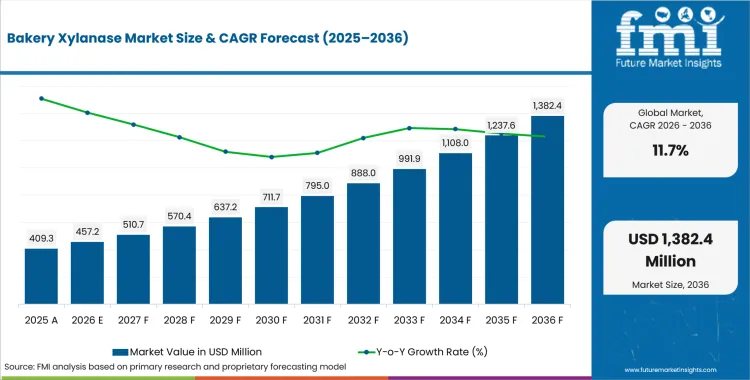
USD 457.2 million in 2026 and USD 1,382.4 million by 2036 at an 11.7% CAGR.
Bakery xylanase demand is projected to expand at 11.7% CAGR between 2026 and 2036 from USD 457.2 million to USD 1,382.4 million. Industrial bakers purchase xylanase for line stability once trials show that arabinoxylan breakdown improves water distribution and dough handling. In May 2025 dsm-firmenich opened its Princeton Baking Innovation Center with facilities for breads and rolls. The site gives application teams a dedicated route for realistic enzyme trials ahead of customer-line validation.
Country growth diverges as food-manufacturing investment changes the payoff from formulation control between Gulf and mature bakery markets. UAE and UK mark a 1.3-point CAGR spread at 12.9% and 11.6% respectively. Dubai Media Office reported in February 2025 that Dubai Industrial City added more than 25 food-and-beverage customers leasing 1.7 million square feet in 2024. New manufacturing capacity gives enzyme companies more UAE trial sites, whereas UK plants demand stronger savings evidence to justify changing existing formulas.
Key Takeaways
- Industrial bakeries purchase bakery xylanase to stabilize dough handling as flour arabinoxylan behavior changes water distribution during high-throughput production.
- By product type, standard grade is estimated to hold 39.0% in 2026 owing to familiar qualification specifications in mainstream industrial formulas.
- In 2026, powder - dry is expected to lead form with 49.0% share due to compatibility with existing premix and dry-dosing systems.
- By application, bread & rolls is forecast to represent 31.0% in 2026 attributable to the production economics of continuous high-volume dough lines.
- Product-specific qualification can delay switching as xylanase response changes with flour quality and dosage conditions during plant validation.
- Some of the key players in this market include Novonesis, IFF, AB Enzymes, dsm-firmenich, Kerry Group, Puratos, Corbion, and Advanced Enzyme Technologies Limited.
Analyst Perspective
"Bakery xylanase earns its place after a plant trial proves stable dough behavior at the intended flour specification and line speed. Commercial value depends on dose efficiency and application support because a lower-priced enzyme becomes costly if variability reaches proofing or packaging."
- Nandini Roy Choudhury, Principal Consultant, Future Market Insights
How is the bakery xylanase market segmented?
The market is assessed by product type, form, application, claim, sales channel and region.
Product type covers standard grade, premium / specialty grade, organic certified and clean label grade and form covers powder - dry, liquid, paste / semi-solid and granules / pieces. Application covers bread & rolls, cakes & muffins, biscuits & cookies, viennoiserie & pastry and other bakery & snacks. Claim covers conventional, clean label, organic and non-GMO / identity preserved programs and sales channel covers direct industrial sales, ingredient distributors, foodservice & artisan supply and online B2B.
What makes Standard grade central to the Product type category?
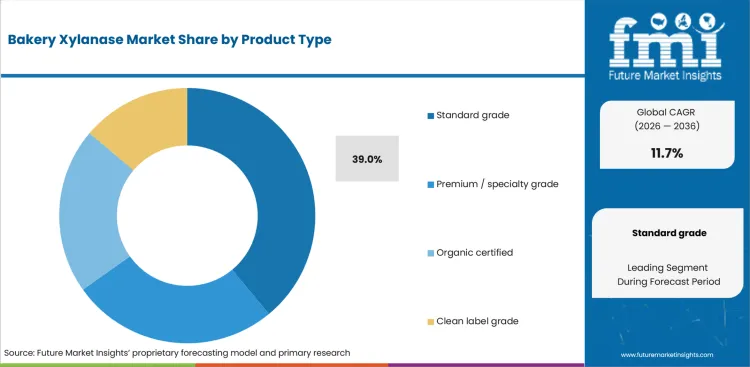
Standard grade fits industrial bakery programs that require repeatable dough control as narrower certification claims enter formulation review. Large flour runs expose small handling differences quickly, so technologists value stable dosage windows and familiar documentation.
- By product type, standard grade is estimated to hold 39.0% in 2026 owing to mainstream bakeries prioritizing familiar qualification specifications and workable cost-in-use.
- Food enzyme systems operate inside a large flour base that makes repeatability commercially visible. USDA NASS reported in May 2025 that USA mills ground 916 million bushels of wheat for flour during 2024. The production base gives industrial bakery programs enough throughput to penalize inconsistent enzyme response.
Why does Powder - dry lead the Form category?
Powder - dry xylanase fits plants that already meter flour improvers by weight and want the enzyme incorporated before dough mixing. Existing dry-premix equipment controls small additions without a separate liquid dosing route, which limits handling changes.
- In 2026, powder - dry is expected to lead form with 49.0% share because premix workflows simplify compact dosing and ingredient handling.
- Bakery ingredients in concentrated formats reduce weighing steps and make small-dose handling easier during routine plant production. In May 2025 Puratos introduced Cubease as a premeasured bakery improver cube for ten kilograms of flour to reduce handling work.
How does Bread & Rolls shape demand within the Application category?
Bread and roll lines expose xylanase performance through mixing tolerance and proof stability during repeated production runs. A small change in water distribution can affect machinability during transfer to high-speed makeup or packaging equipment.
- The bread & rolls segment is likely to capture 31.0% share in 2026 attributable to high-volume dough lines that expose handling inconsistency quickly.
- Baking enzymes make performance measurable through dough handling and loaf volume against one production formula. In March 2026 Lallemand Bio-Ingredients signed an Indonesian distribution agreement covering Nutrilife dough-improver enzymes, including xylanases for industrial bread and related commercial baking customers.
Why does Direct to industrial bakeries lead the Sales channel category?
Direct industrial selling suits xylanase programs that require plant-specific dosage trials for any change to an existing industrial bakery formula. Technical teams can test flour response and line behavior beside the commercial discussion instead of separating qualification from supply.
- Direct to industrial bakeries is set to lead the sales channel with 50.0% share in 2026 due to dedicated trials and technical service for high-volume accounts.
- Industrial bakery mixes require close application work since formulation changes can alter dough behavior ahead of commercial release. AB Enzymes opened a Curitiba baking lab in June 2026 to run application trials and expand regional support for baking customers.
What are the drivers, restraints and opportunities in the Bakery Xylanase Market?
Industrial bakeries use xylanase to reduce dough variability. Product-specific qualification slows switching. Better flour analysis and application testing can expand adoption in difficult formulations.
- Driver: Industrial bakeries value xylanase programs that prevent small flour differences from disrupting high-speed dough processing and routine line throughput.
- Restraint: Enzyme substitution requires product-specific documentation and line validation since flour composition can change the response to a fixed dosage.
- Opportunity: Better flour characterization gives bakery technologists a clearer basis for selecting xylanase activity ahead of full plant trials and commercial approval.
Industrial Flour Throughput Raises the Cost of Dough Variability
High flour throughput turns small dough variation into measurable downtime once one unstable batch disrupts several downstream line stages. USDA NASS recorded 103 million hundredweight of flour production during second-quarter 2025. Industrial enzymes earn a stronger cost case if low dosages stabilize large flour volumes, so bakery xylanase producers need trials that link arabinoxylan treatment to normal line behavior.
Qualification Work Slows Enzyme Switching
Qualification slows switching because a bakery xylanase dossier must match the production organism and intended processing use before plant performance becomes relevant. EFSA reviewed its food enzyme application procedure in May 2026 and requires safety assessment before a new food enzyme enters the EU market. Enzyme technology reaches commercial trials after the regulatory file covers the intended use and local approval route.
Flour Analysis Can Shorten the Trial Route
Flour variability gives xylanase producers a commercial opening to pair enzyme selection with flour analysis ahead of proposing one dosage range for every customer. Puratos opened its Flour Competence Center in June 2026 to measure variables including protein content and enzyme activity ahead of application guidance. Flour improvers qualify faster if flour data narrows the starting dosage range, which reduces failed trial iterations without removing customer-line validation.
Which country CAGRs are profiled in the Bakery Xylanase Market?
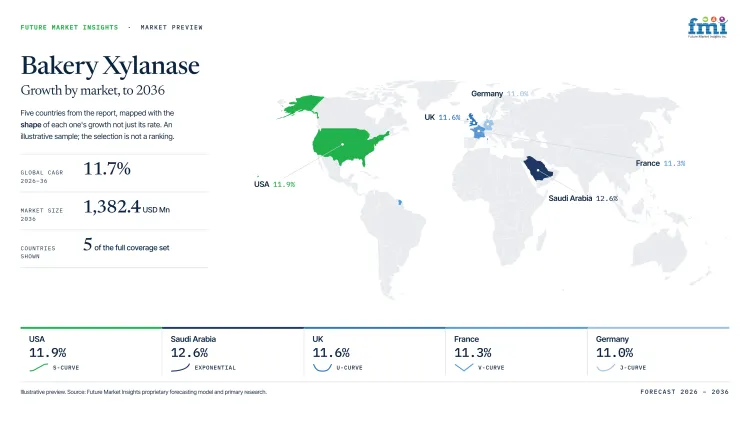
| Country | CAGR |
|---|---|
| Saudi Arabia | 12.6% |
| USA | 11.9% |
| UK | 11.6% |
| France | 11.3% |
| Germany | 11% |
How do country-level CAGRs compare in the Bakery Xylanase Market?
Import exposure makes formulation consistency valuable to commercial bakeries, placing USA and Saudi Arabia in the upper growth group. UK and France cluster behind them with processing bases that support enzyme trials at commercial scale. Saudi Arabiais 1.6 percentage points below Germany despite tighter packaged-bread economics and a higher payback threshold for formulation changes.
- Saudi retail concentration gives large bakeries a practical route for standardizing enzyme programs between production plants.
- USA flour scale supports large trials but regional specifications complicate national dosing programs between bakery plants.
- UK packaged-bread margins raise the payback threshold for enzyme changes on existing high-volume production lines.
- France flour scale supports broad trials but regional specifications complicate standardized enzyme dosing programs across bakery plants.
- Germany packaged-bread margins raise the payback threshold for enzyme changes on established high-volume production lines.
The full report provides country-level CAGR analysis for North America, Latin America, Europe, East Asia, South Asia, Oceania and the Middle East and Africa.
Country-wise Analysis
- Serving modern retail and foodservice accounts requires Saudi industrial bakeries to standardize output between large production sites. USDA FAS recorded 1,300 registered food companies in September 2025 and stated that about 80% employed more than 100 people. Saudi Arabia is estimated to post 12.6% CAGR over the forecast period, tied to processors large enough to fund formal enzyme trials and extend one approved formula through substantial production volume. Regional distributors can hold enzyme stock near major processors and shorten replenishment between qualification runs. Imported enzyme supply still complicates replenishment, although the concentration of larger plants gives technical teams a faster qualification route than fragmented accounts can offer.
- For national bakery accounts, a deep domestic flour base gives USA plants enough national production scale to test small enzyme effects under commercial conditions. USDA NASS measured daily wheat-flour milling capacity at 1.59 million hundredweight during second-quarter 2025. Bakery xylanase demand in USA is forecast to rise at 11.9% CAGR over the forecast period because large lines make modest handling gains economically visible. USA bakery ingredients give application teams many formulation routes but regional flour specifications weaken any fixed-dose national strategy. Companies that document a workable dosage window can standardize one preparation between plants without assuming identical flour behavior in every region.
- Cost pressure defines UK packaged bread production because national distribution carries high fixed expenses and staple prices remain intensely competitive. Bakery xylanase sales in UK are forecast to expand at 11.6% CAGR by 2036, given the value of process consistency under narrow manufacturing margins. The Competition and Markets Authority documented in June 2026 that Allied Bakeries had made significant losses over the preceding fourteen years. Home baking ingredients remain commercially separate from industrial enzyme purchasing and do not remove plant-level qualification hurdles. Growth therefore depends on operating savings that justify switching risk, leaving technical validation as the main near-term limitation.
- For national bakery accounts, France’s established flour base gives plants sufficient production scale to test incremental enzyme effects under commercial conditions. Bakery xylanase demand in France is forecast to rise at 11.3% CAGR over the forecast period as larger production lines make modest handling gains economically visible. Regional flour specifications create formulation differences across plants, limiting fixed-dose national strategies. Companies that validate a workable dosage window can standardize enzyme preparations across facilities without assuming identical flour behavior.
- Cost pressure shapes Germany’s packaged-bread production because established retail channels and competitive pricing raise the hurdle for formulation changes. Bakery xylanase sales in Germany are forecast to expand at 11% CAGR by 2036, supported by demand for process consistency and improved dough handling. Industrial bakery operations remain sensitive to qualification costs and production disruption. Growth therefore depends on measurable operating savings that justify switching risk, making technical validation and dosage consistency important near-term adoption factors.
Who are the notable companies in the Bakery Xylanase Market?
Novonesis, IFF, AB Enzymes, dsm-firmenich, Kerry Group, Puratos, Corbion, and Advanced Enzyme Technologies Limited are the notable companies profiled in this market.
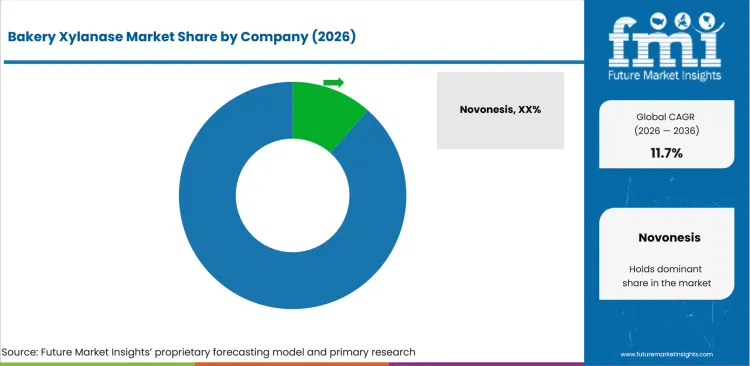
Competition separates direct enzyme technology from bakery formulation platforms that influence how xylanase enters an industrial recipe. Novonesis and IFF have the clearest public bakery-enzyme positions among the eight companies reviewed. AB Enzymes and dsm-firmenich reinforce application testing with dedicated bakery laboratories and regional technical teams. Kerry Group develops enzyme engineering through BIOBAKE and biotechnology research that supports bakery application work at industrial scale. Puratos and Corbion influence improver selection through bakery formulation systems that shape plant-level recipe decisions. Advanced Enzyme Technologies Limited supplies food-processing enzymes and bakery applications with narrower public development disclosure than the multinational enzyme groups.
- Direct enzyme platforms: Novonesis, IFF, AB Enzymes and dsm-firmenich maintain enzyme-led bakery positions with technical development or application infrastructure.
- Integrated bakery platforms: Kerry Group, Puratos and Corbion place enzyme selection beside broader formulation work for industrial bread and bakery products.
- Specialist enzyme participation: Advanced Enzyme Technologies Limited serves fermented food enzymes and bakery processing through a wider industrial enzyme manufacturing base.
Competitive Benchmarking: Bakery Xylanase Market
| Company | Xylanase-specific evidence | Bakery application breadth | Application-support depth | Geographic Reach |
|---|---|---|---|---|
| Novonesis | Medium | High | High | Global |
| IFF | High | High | High | Global |
| AB Enzymes | Medium | High | High | Global |
| dsm-firmenich | Medium | High | High | Global |
| Kerry Group | Medium | High | High | Global |
| Puratos | Low | High | High | Global |
| Corbion | Low | High | High | North America, Europe and Asia-Pacific |
| Advanced Enzyme Technologies Limited | Low | Medium | Medium | Asia, North America and Europe |
Scoring basis: High xylanase evidence requires a current named bakery xylanase or regulator record. Medium denotes a documented bakery-enzyme platform without equivalent current xylanase detail and Low marks a verified adjacent bakery formulation role. High bakery breadth covers at least three bakery formats or functions and Medium covers two documented routes. High application support requires dedicated laboratories or field service and Medium reflects narrower documented support with Low reserved for limited service roles.
Key Developments in the Bakery Xylanase Market
- In March 2026, IFF subsidiary Genencor International B.V. received an EFSA safety opinion for an endo-1,4-beta-xylanase intended for cereal processing applications, including baked products.
- In September 2025, Kerry opened its Leipzig Biotechnology Centre, supporting biotechnology and enzyme-based application development for bakery and other food-processing customers.
- In June 2025, Novonesis launched Optiva LS Prime to support sugar reduction in bakery products, expanding its enzyme-based formulation portfolio for industrial baked goods.
Key Players in the Bakery Xylanase Market
Direct Bakery Enzyme Technology Platforms
- Novonesis
- IFF
- AB Enzymes
- dsm-firmenich
Integrated Bakery Performance Platforms
- Kerry Group
- Puratos
- Corbion
Specialist Enzyme Manufacturer
- Advanced Enzyme Technologies Limited
Bakery Xylanase Market - Report Scope
| Coverage field | Report scope |
|---|---|
| Market breakdown | By product type, form, application, claim, sales channel and region. |
| Quantitative Units | USD Million. |
| Market Definition | Revenue includes bakery-grade xylanase preparations sold for bakery processing. It excludes finished baked goods, non-bakery xylanase uses and adjacent ingredients without attributable xylanase revenue. |
| Regions Covered | North America, Latin America, Western Europe, Eastern Europe, East Asia, South Asia and Pacific, Middle East and Africa. |
| Countries Covered | UAE, Saudi Arabia, South Korea, USA, UK and more than twenty-five additional countries in the full report. |
| Key Companies Profiled | Novonesis, IFF, AB Enzymes, dsm-firmenich, Kerry Group, Puratos, Corbion, Advanced Enzyme Technologies Limited. |
| Forecast Period | 2026 to 2036. |
Bakery Xylanase Market - Research Methodology
| Method | Approach |
|---|---|
| Primary Research | FMI analysts gathered input from manufacturers, service providers, technology developers, distributors, end users, procurement teams, and subject-matter experts. Interviews examined purchasing decisions, product or service evaluation, adoption barriers, approval requirements, pricing considerations, and expectations for technical or commercial support. Respondents were also asked what evidence is required before a trial, pilot, or initial order develops into regular purchasing. |
| Desk Research | Desk research covered government statistics, regulatory publications, trade data, industry associations, technical literature, standards, company filings, product information, and official corporate announcements. Sources were reviewed for relevance, publication date, geographic coverage, and consistency with the defined market scope. Claims relating to performance, applications, approvals, capacity, investment, and commercial activity were retained only when supported by credible public evidence. |
| Market Sizing and Forecasting | The market model combined the baseline value with historical performance, segment structure, pricing and volume indicators, adoption levels, company participation, and country-level demand conditions. Forecast assumptions considered economic activity, investment trends, regulatory developments, technology adoption, purchasing cycles, supply availability, and barriers to wider market use. Segment and regional estimates were reconciled before the final market total was calculated. |
| Data Validation | Estimates were checked against multiple independent indicators, including public data, company activity, trade patterns, industry developments, and findings from primary interviews. Validation also tested whether products, services, applications, and company revenues fell within the defined market boundaries. Adjacent categories, unsupported claims, overlapping revenues, and activities without direct market relevance were excluded to reduce double counting and maintain consistency across segments and countries. |
Bakery Xylanase Market by Segments
Bakery Xylanase Market segmented by Product Type:
- standard grade
- premium / specialty grade
- organic certified
- clean label grade
Bakery Xylanase Market segmented by Form:
- powder - dry
- liquid
- paste / semi-solid
- granules / pieces
Bakery Xylanase Market segmented by Application:
- bread & rolls
- cakes & muffins
- biscuits & cookies
- viennoiserie & pastry
- other bakery & snacks
Bakery Xylanase Market segmented by Claim:
- conventional
- clean label
- organic
- non-GMO / identity preserved
Bakery Xylanase Market segmented by Sales Channel:
- direct to industrial bakeries
- ingredient distributors
- foodservice & artisan supply
- online B2B
Bakery Xylanase Market by Region:
- North America
- United States
- Canada
- Latin America
- Brazil
- Mexico
- Argentina
- Chile
- Western Europe
- Germany
- France
- United Kingdom
- Italy
- Spain
- Benelux
- Nordics
- Eastern Europe
- Poland
- Czech Republic
- Romania
- Hungary
- East Asia
- China
- Japan
- South Korea
- South Asia and Pacific
- India
- ASEAN
- Australia and New Zealand
- Middle East and Africa
- GCC Countries
- South Africa
- Türkiye
- Israel
Research Sources and Bibliography
- Kerry. (2025, September 24). Kerry establishes new biotechnology centre in Leipzig.
- USA Kerry. (2025, September 24). Kerry establishes new biotechnology centre in Leipzig.
- USA Department of Agriculture, Foreign Agricultural Service. (2025, September 24). Saudi Arabia: Retail Foods Annual.
- USA Department of Agriculture, National Agricultural Statistics Service. (2025, August 1). Flour Milling Products.
- Puratos. (2025, May 7). Puratos brings a trio of transformative innovations to iba 2025.
- Competition and Markets Authority. (2026, June 16). CMA clears ABF's deal to buy bread maker Hovis.
- dsm-firmenich. (2025, May 20). On the rise: dsm-firmenich opens state-of-the-art Princeton Baking Innovation Center in Princeton, NJ.
- USA Department of Agriculture, Foreign Agricultural Service. (2025, May 5). South Korea: Food Processing Ingredients Annual.
- Puratos. (2026, June 16). Puratos Opens Flour Competence Center to Address Flour Variability.
- USA Department of Agriculture, Foreign Agricultural Service. (2025, June 9). United Arab Emirates: Food Processing Ingredients Annual.
- European Food Safety Authority. (2026, March 31). Safety evaluation of the food enzyme endo-1,4-beta-xylanase from the genetically modified Trichoderma reesei strain Dp-Nzd66.
- AB Enzymes. (2026, June 1). AB Enzymes Opens New Office and Baking Lab in Curitiba, Brazil.
- Novonesis. (2025, June 11). Novonesis launches Optiva LS Prime, helping bakers cut up to 50% added sugar and create more cost-effective baked goods.
- Novonesis. (2025, February 26). Novonesis delivers strong full-year results and expects continued growth in 2025.
- IFF. (2025, August 13). IFF Launches POWERFRESH ACE 2000, a Bread Fresh-Keeping Solution That Aces the Shelf-Life Test.
- AB Enzymes. (2026, May 12). AB Enzymes Strengthens Presence in Mexico, Central America & the Caribbean.
- dsm-firmenich. (2025, October 2). dsm-firmenich opens global food innovation center in Delft, the Netherlands to accelerate diet transformation.
- Kerry. (2026, April 20). Kerry Opens Expanded Biotechnology Manufacturing Hub in Ireland to Meet Growing Global Demand for Lactase Enzymes.
- Puratos. (2025, August 25). Puratos Announces Two New Hubs for Food Innovation: Montreal and Costa Rica.
- Corbion. (2026, June 15). Corbion launches LUMI Set to help bakers reformulate away from titanium dioxide without sacrificing visual appeal.
- USA Food and Drug Administration. (2025, September 29). GRN No. 1250: Alternansucrase enzyme preparation.
- Corbion. (2025, April 7). Corbion Launches Innovative Egg Replacers to Empower Bakeries Amid Supply Challenges.
- Lallemand Bio-Ingredients Food Enzymes. (2026, March 3). Lallemand Bio-Ingredients Food Enzymes Announces Distribution Partnership with United Chemicals Inter Aneka (Member of Omya Group) in Indonesia.
- USA Department of Agriculture, National Agricultural Statistics Service. (2025, May 1). Flour Milling Products 2024 Summary.
- Dubai Media Office. (2025, February 19). Dubai Industrial City attracts more than AED 350 million F&B investments in 2024.
- European Food Safety Authority. (2026, May 6). Food enzyme application procedure.
This bibliography is provided for reader reference and is not exhaustive. The full report contains the complete reference list and detailed citations.
This Report Answers
- What is the bakery xylanase market size in 2026 and what value is forecast for 2036?
- What operating pressures make industrial bakers evaluate bakery xylanase?
- Why does standard grade hold the leading position within product type?
- Why does powder - dry lead the form category for bakery xylanase?
- Why does bread & rolls hold the leading position within application?
- How do bakery xylanase growth rates compare in UAE, Saudi Arabia, South Korea, USA and UK?
- Which companies are active in the bakery xylanase market?
- What qualification issues can delay bakery xylanase switching?
- How should industrial bakeries compare application support before changing a xylanase program?
Frequently Asked Questions
How big is the bakery xylanase market in 2026?
The bakery xylanase market is valued at USD 457.2 million in 2026 and is projected to reach USD 1,382.4 million by 2036. Growth follows industrial demand for more repeatable dough handling under changing flour conditions.
What is the CAGR of the bakery xylanase market from 2026 to 2036?
The bakery xylanase market is projected to grow at a CAGR of 11.7% between 2026 and 2036. Expansion follows larger industrial bakery output and greater use of enzymes for flour correction and line consistency.
Which product type leads the bakery xylanase market?
The standard grade segment is expected to hold 39.0% of the bakery xylanase market in 2026, attributable to broad compatibility with mainstream industrial formulas. Standard specifications also reduce qualification work for bakery plants that run routine formulas at commercial scale.
Which form holds the largest share of the bakery xylanase market?
The powder - dry segment is expected to hold 49.0% of the bakery xylanase market in 2026, driven by compatibility with flour and premix dosing systems. Dry handling also limits additional equipment requirements for plants that already meter flour improvers through premix systems.
Which countries are projected to record the highest growth in the bakery xylanase market?
UAE is projected to grow at 12.9% CAGR followed by Saudi Arabia at 12.6% and South Korea at 12.2% through 2036. Their growth paths benefit from industrial food processing and imported ingredient channels.
Which companies are active in the bakery xylanase market?
Key companies operating in the market include Novonesis, IFF, AB Enzymes, dsm-firmenich, Kerry Group, Puratos, Corbion, and Advanced Enzyme Technologies Limited. These companies compete through enzyme technology, bakery application support and formulation reach.
Preview the report firsthand - request a free sample
Get SampleGet the brochure for pricing and purchase details.
Get PDFTable of Content
- Key Takeaways
- Market Size and CAGR
- Top Growth Driver
- Fastest Growing Segment
- Leading Region
- Key Companies
- Emerging Opportunities
- Executive Summary
- Global Market Outlook
- Demand-side Trends
- Supply-side Trends
- Technology Roadmap Analysis
- Analysis and Recommendations
- Analyst Perspective (What is happening? Why now? What should investors know?)
- Key Questions Answered
- How large is the market?
- What is the CAGR?
- What are key trends?
- Which region dominates?
- Who are the leaders?
- Market Overview
- Market Coverage / Taxonomy
- Market Definition / Scope / Limitations
- Research Methodology
- Chapter Orientation
- Analytical Lens and Working Hypotheses
- Market Structure, Signals, and Trend Drivers
- Benchmarking and Cross-market Comparability
- Market Sizing, Forecasting, and Opportunity Mapping
- Research Design and Evidence Framework
- Desk Research Programme (Secondary Evidence)
- Expert Input and Fieldwork (Primary Evidence)
- Tooling, Models, and Reference Databases
- Data Engineering and Model Build
- Quality Assurance and Audit Trail
- Market Background
- Market Dynamics (Drivers, Restraints, Opportunity, Trends)
- Scenario Forecast (Optimistic, Likely, Conservative)
- Impact Analysis
- AI Impact
- Sustainability Impact
- Regulatory Impact
- Technology Impact
- Consumer / Buyer Analysis
- Purchase Drivers
- Adoption Barriers
- Buyer Journey
- Opportunity Map Analysis
- Product Life Cycle Analysis
- Supply Chain Analysis
- Investment Feasibility Matrix
- Value Chain Analysis
- PESTLE and Porter's Analysis
- Regulatory Landscape
- Regional Parent Market Outlook
- Production and Consumption Statistics
- Import and Export Statistics
- Global Market Analysis and Forecast, 2021 to 2036
- Historical Market Size Value (USD Million) Analysis, 2021 to 2025
- Current and Future Market Size Value (USD Million) Projections, 2026 to 2036
- Y-o-Y Growth Trend Analysis
- Absolute $ Opportunity Analysis
- Global Market Pricing Analysis, 2021 to 2036
- Global Market Analysis and Forecast, By Product Type, 2021 to 2036
- Introduction / Key Findings
- Historical Market Size Value (USD Million) Analysis By Product Type, 2021 to 2025
- Current and Future Market Size Value (USD Million) Analysis and Forecast By Product Type, 2026 to 2036
- Standard grade
- Premium / specialty grade
- Organic certified
- Clean label grade
- Standard grade
- Y-o-Y Growth Trend Analysis By Product Type, 2021 to 2025
- Absolute $ Opportunity Analysis By Product Type, 2026 to 2036
- Global Market Analysis and Forecast, By Form, 2021 to 2036
- Introduction / Key Findings
- Historical Market Size Value (USD Million) Analysis By Form, 2021 to 2025
- Current and Future Market Size Value (USD Million) Analysis and Forecast By Form, 2026 to 2036
- Powder / dry
- Liquid
- Paste / semi-solid
- Granules / pieces
- Powder / dry
- Y-o-Y Growth Trend Analysis By Form, 2021 to 2025
- Absolute $ Opportunity Analysis By Form, 2026 to 2036
- Global Market Analysis and Forecast, By Application, 2021 to 2036
- Introduction / Key Findings
- Historical Market Size Value (USD Million) Analysis By Application, 2021 to 2025
- Current and Future Market Size Value (USD Million) Analysis and Forecast By Application, 2026 to 2036
- Bread & rolls
- Cakes & muffins
- Biscuits & cookies
- Viennoiserie & pastry
- Other bakery & snacks
- Bread & rolls
- Y-o-Y Growth Trend Analysis By Application, 2021 to 2025
- Absolute $ Opportunity Analysis By Application, 2026 to 2036
- Global Market Analysis and Forecast, By Claim, 2021 to 2036
- Introduction / Key Findings
- Historical Market Size Value (USD Million) Analysis By Claim, 2021 to 2025
- Current and Future Market Size Value (USD Million) Analysis and Forecast By Claim, 2026 to 2036
- Conventional
- Clean label
- Organic
- Non-GMO / identity preserved
- Conventional
- Y-o-Y Growth Trend Analysis By Claim, 2021 to 2025
- Absolute $ Opportunity Analysis By Claim, 2026 to 2036
- Global Market Analysis and Forecast, By Sales Channel, 2021 to 2036
- Introduction / Key Findings
- Historical Market Size Value (USD Million) Analysis By Sales Channel, 2021 to 2025
- Current and Future Market Size Value (USD Million) Analysis and Forecast By Sales Channel, 2026 to 2036
- Direct to industrial bakeries
- Ingredient distributors
- Foodservice & artisan supply
- Online B2B
- Direct to industrial bakeries
- Y-o-Y Growth Trend Analysis By Sales Channel, 2021 to 2025
- Absolute $ Opportunity Analysis By Sales Channel, 2026 to 2036
- Global Market Analysis and Forecast, By Region, 2021 to 2036
- Introduction
- Historical Market Size Value (USD Million) Analysis By Region, 2021 to 2025
- Current Market Size Value (USD Million) Analysis and Forecast By Region, 2026 to 2036
- North America
- Latin America
- Western Europe
- Eastern Europe
- East Asia
- South Asia and Pacific
- Middle East & Africa
- Market Attractiveness Analysis By Region
- North America Market Analysis and Forecast, By Country, 2021 to 2036
- Historical Market Size Value (USD Million) Trend Analysis By Market Taxonomy, 2021 to 2025
- Market Size Value (USD Million) Forecast By Market Taxonomy, 2026 to 2036
- By Country
- USA
- Canada
- By Product Type
- By Form
- By Application
- By Claim
- By Sales Channel
- By Country
- Market Attractiveness Analysis
- By Country
- By Product Type
- By Form
- By Application
- By Claim
- By Sales Channel
- Key Takeaways
- Latin America Market Analysis and Forecast, By Country
- Historical Market Size Value (USD Million) Trend Analysis By Market Taxonomy, 2021 to 2025
- Market Size Value (USD Million) Forecast By Market Taxonomy, 2026 to 2036
- By Country
- Brazil
- Mexico
- Chile
- Rest of Latin America
- By Product Type
- By Form
- By Application
- By Claim
- By Sales Channel
- By Country
- Market Attractiveness Analysis
- By Country
- By Product Type
- By Form
- By Application
- By Claim
- By Sales Channel
- Key Takeaways
- Western Europe Market Analysis and Forecast, By Country
- Historical Market Size Value (USD Million) Trend Analysis By Market Taxonomy, 2021 to 2025
- Market Size Value (USD Million) Forecast By Market Taxonomy, 2026 to 2036
- By Country
- Germany
- UK
- Italy
- Spain
- France
- Nordic
- BENELUX
- Rest of Western Europe
- By Product Type
- By Form
- By Application
- By Claim
- By Sales Channel
- By Country
- Market Attractiveness Analysis
- By Country
- By Product Type
- By Form
- By Application
- By Claim
- By Sales Channel
- Key Takeaways
- Eastern Europe Market Analysis and Forecast, By Country
- Historical Market Size Value (USD Million) Trend Analysis By Market Taxonomy, 2021 to 2025
- Market Size Value (USD Million) Forecast By Market Taxonomy, 2026 to 2036
- By Country
- Russia
- Poland
- Hungary
- Balkan & Baltic
- Rest of Eastern Europe
- By Product Type
- By Form
- By Application
- By Claim
- By Sales Channel
- By Country
- Market Attractiveness Analysis
- By Country
- By Product Type
- By Form
- By Application
- By Claim
- By Sales Channel
- Key Takeaways
- East Asia Market Analysis and Forecast, By Country
- Historical Market Size Value (USD Million) Trend Analysis By Market Taxonomy, 2021 to 2025
- Market Size Value (USD Million) Forecast By Market Taxonomy, 2026 to 2036
- By Country
- China
- Japan
- South Korea
- By Product Type
- By Form
- By Application
- By Claim
- By Sales Channel
- By Country
- Market Attractiveness Analysis
- By Country
- By Product Type
- By Form
- By Application
- By Claim
- By Sales Channel
- Key Takeaways
- South Asia and Pacific Market Analysis and Forecast, By Country
- Historical Market Size Value (USD Million) Trend Analysis By Market Taxonomy, 2021 to 2025
- Market Size Value (USD Million) Forecast By Market Taxonomy, 2026 to 2036
- By Country
- India
- ASEAN
- Australia & New Zealand
- Rest of South Asia and Pacific
- By Product Type
- By Form
- By Application
- By Claim
- By Sales Channel
- By Country
- Market Attractiveness Analysis
- By Country
- By Product Type
- By Form
- By Application
- By Claim
- By Sales Channel
- Key Takeaways
- Middle East & Africa Market Analysis and Forecast, By Country
- Historical Market Size Value (USD Million) Trend Analysis By Market Taxonomy, 2021 to 2025
- Market Size Value (USD Million) Forecast By Market Taxonomy, 2026 to 2036
- By Country
- Kingdom of Saudi Arabia
- Other GCC Countries
- Türkiye
- South Africa
- Other African Union
- Rest of Middle East & Africa
- By Product Type
- By Form
- By Application
- By Claim
- By Sales Channel
- By Country
- Market Attractiveness Analysis
- By Country
- By Product Type
- By Form
- By Application
- By Claim
- By Sales Channel
- Key Takeaways
- Key Countries Market Analysis
- USA
- Pricing Analysis
- Market Share Analysis, 2025
- By Product Type
- By Form
- By Application
- By Claim
- By Sales Channel
- Canada
- Pricing Analysis
- Market Share Analysis, 2025
- By Product Type
- By Form
- By Application
- By Claim
- By Sales Channel
- Mexico
- Pricing Analysis
- Market Share Analysis, 2025
- By Product Type
- By Form
- By Application
- By Claim
- By Sales Channel
- Brazil
- Pricing Analysis
- Market Share Analysis, 2025
- By Product Type
- By Form
- By Application
- By Claim
- By Sales Channel
- Chile
- Pricing Analysis
- Market Share Analysis, 2025
- By Product Type
- By Form
- By Application
- By Claim
- By Sales Channel
- Germany
- Pricing Analysis
- Market Share Analysis, 2025
- By Product Type
- By Form
- By Application
- By Claim
- By Sales Channel
- UK
- Pricing Analysis
- Market Share Analysis, 2025
- By Product Type
- By Form
- By Application
- By Claim
- By Sales Channel
- Italy
- Pricing Analysis
- Market Share Analysis, 2025
- By Product Type
- By Form
- By Application
- By Claim
- By Sales Channel
- Spain
- Pricing Analysis
- Market Share Analysis, 2025
- By Product Type
- By Form
- By Application
- By Claim
- By Sales Channel
- France
- Pricing Analysis
- Market Share Analysis, 2025
- By Product Type
- By Form
- By Application
- By Claim
- By Sales Channel
- India
- Pricing Analysis
- Market Share Analysis, 2025
- By Product Type
- By Form
- By Application
- By Claim
- By Sales Channel
- ASEAN
- Pricing Analysis
- Market Share Analysis, 2025
- By Product Type
- By Form
- By Application
- By Claim
- By Sales Channel
- Australia & New Zealand
- Pricing Analysis
- Market Share Analysis, 2025
- By Product Type
- By Form
- By Application
- By Claim
- By Sales Channel
- China
- Pricing Analysis
- Market Share Analysis, 2025
- By Product Type
- By Form
- By Application
- By Claim
- By Sales Channel
- Japan
- Pricing Analysis
- Market Share Analysis, 2025
- By Product Type
- By Form
- By Application
- By Claim
- By Sales Channel
- South Korea
- Pricing Analysis
- Market Share Analysis, 2025
- By Product Type
- By Form
- By Application
- By Claim
- By Sales Channel
- Russia
- Pricing Analysis
- Market Share Analysis, 2025
- By Product Type
- By Form
- By Application
- By Claim
- By Sales Channel
- Poland
- Pricing Analysis
- Market Share Analysis, 2025
- By Product Type
- By Form
- By Application
- By Claim
- By Sales Channel
- Hungary
- Pricing Analysis
- Market Share Analysis, 2025
- By Product Type
- By Form
- By Application
- By Claim
- By Sales Channel
- Kingdom of Saudi Arabia
- Pricing Analysis
- Market Share Analysis, 2025
- By Product Type
- By Form
- By Application
- By Claim
- By Sales Channel
- Türkiye
- Pricing Analysis
- Market Share Analysis, 2025
- By Product Type
- By Form
- By Application
- By Claim
- By Sales Channel
- South Africa
- Pricing Analysis
- Market Share Analysis, 2025
- By Product Type
- By Form
- By Application
- By Claim
- By Sales Channel
- USA
- Market Structure Analysis
- Competition Dashboard
- Competition Benchmarking
- Market Share Analysis of Top Players
- By Regional
- By Product Type
- By Form
- By Application
- By Claim
- By Sales Channel
- Emerging Startups
- Innovation Benchmarking
- Competition Analysis
- Competition Deep Dive
- Novonesis
- Overview
- Product Portfolio
- Profitability by Market Segments
- Sales Footprint
- Strategy Overview
- Marketing Strategy
- Product Strategy
- Channel Strategy
- IFF
- Kerry Group
- AB Enzymes
- Amano Enzyme
- Palsgaard
- Corbion
- BASF
- Puratos
- DSM-Firmenich
- Novonesis
- Case Studies
- Success Stories
- Recent Developments
- Competition Deep Dive
- Assumptions & Acronyms Used


