

- Market Size (2026)
- USD 98.5 Mn
- Forecast (2036)
- USD 212.7 Mn
- CAGR (2026 to 2036)
- 8.0%
How big is Bakery Racks & Trolleys Market in 2026?
USD 98.5 million in 2026 and USD 212.7 million by 2036 at an 8.0% CAGR.
The bakery racks & trolleys market is valued at USD 98.5 million in 2026 and is projected to reach USD 212.7 million by 2036 at an 8.0% CAGR. Industrial plants spend on rack handling once carrier flow must keep proofing and oven feeding synchronized. AMF Bakery Systems included its Workhorse gantry pan stacking system in its May 2025 IBA equipment program. The display placed pan handling beside proofing and baking equipment during line-interface specification for bakery processing equipment projects.
Country economics change the point at which carrier automation clears capital approval in industrial bakery plants. Greenfield Gulf projects can set rack routes early, whereas German plants often retrofit existing trays and controls. Destatis reported in October 2025 that 54% of food-production employees had an immigration background during 2024. That staffing profile strengthens Germany's automation case without removing retrofit engineering costs for food processing equipment.
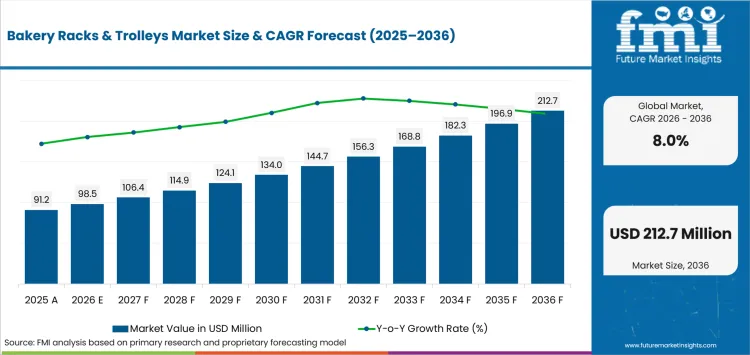
Key Takeaways of Bakery Racks & Trolleys Market
- Demand rises as industrial bakeries replace repeated manual carrier transfers with controlled rack loading that protects oven utilization and staffing continuity.
- By equipment type, mid-capacity lines are estimated to hold 39.0% in 2026 owing to modular layouts that fit brownfield bakery floors without maximum-scale line architecture.
- In 2026, 500-2,000 kg/hr is expected to lead capacity with 44.0% share because production rates justify automation and preserve recipe or product changeovers.
- Fully automatic / robotic systems are set to lead the automation level with 41.0% share in 2026 due to repeatable carrier sequencing between proofing and baking.
- Retrofit geometry and sanitation access can delay automation because plant engineers must prove carrier tolerances and cleaning routines before commissioning begins.
- Some of the key players in this market include AMF Bakery Systems, Rademaker, Mecatherm, Kaak Group, Bühler Group, Midera Food Processing, FRITSCH Group, and Rheon Automatic Machinery.
Analyst Perspective
"Bakery rack projects earn their return at oven and proofer interfaces because carrier delays turn directly into lost line time. Strong offers pair cleanable rack geometry with controls integration and field service that keeps existing trays usable during retrofit."
- Nikhil Kaitwade, Principal Consultant, Future Market Insights
How is the Bakery Racks & Trolleys Market segmented?
The market is assessed by equipment type, capacity, automation level, end user, sales channel and region.
Equipment type separates compact, mid-capacity and high-capacity handling layouts according to production scale and available floor space. Capacity groups systems below 500 kg/hr, 500-2,000 kg/hr and above 2,000 kg/hr based on sustained bakery throughput. Automation level distinguishes manual, semi-automatic and fully automatic / robotic carrier movement based on direct operator intervention. End user covers industrial bakeries, retail-chain bakeries, artisan bakeries and foodservice operations within the defined taxonomy. Sales channel separates direct OEM sales from dealers, distributors and aftermarket equipment.
How does Fully Automatic / robotic shape the Automation level category?
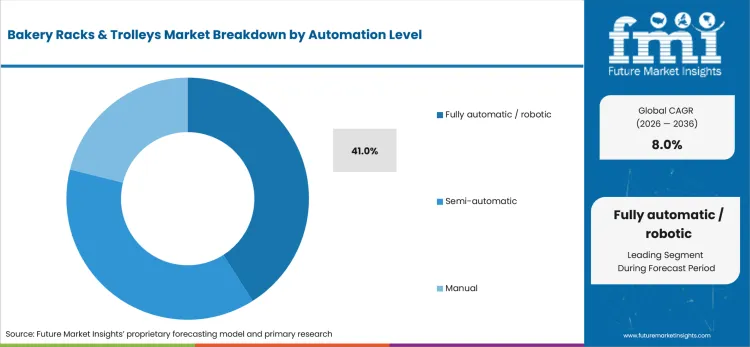
Fully automatic or robotic handling earns a stronger case as carrier queues begin limiting line rate or increasing repeated operator contact. Consistent transfer timing protects the hand-off between proofing, baking and cooling without treating automation as a standalone purchase.
- Fully automatic / robotic systems are set to lead the automation level with 41.0% share in 2026 due to synchronized carrier flow and lower direct handling labor.
- Mecatherm announced the KATANA II robotic scoring system for IBIE in August 2025 beside new automated bakery equipment. The release treats robotic scoring as a routine industrial line function instead of a separate automation layer.
What makes Mid-capacity lines central to the Equipment type category?
Mid-capacity lines fit bakeries that need automated carrier transfer without rebuilding the complete production floor. Their modular layout lets engineering teams stage loaders or buffers beside existing ovens and make-up equipment. Staged modules confine capital to the transfer bottleneck and keep existing baking assets in service.
- By equipment type, mid-capacity lines are estimated to hold 39.0% in 2026 owing to phased automation that fits mixed schedules in brownfield plants.
- FRITSCH Group introduced PROGRESSA bread in January 2025 after adapting industrial forming concepts for mid-sized retail bakers. The platform shows how industrial operating logic can fit smaller footprints without requiring maximum-throughput line architecture.
Why does 500-2,000 kg/hr lead the Capacity category?
The 500-2,000 kg/hr range is large enough for carrier buffers that protect line continuity during recipe changes. Plants in this band can justify bakery depanners without specifying a purpose-built maximum-throughput facility. Changes between industrial bakery mixes also make stable carrier buffering more useful between make-up and baking stages.
- In 2026, 500-2,000 kg/hr is expected to lead capacity with 44.0% share because the range serves scaled retail production and industrial bakery applications.
- FRITSCH Group presented PROGRESSA pastry in May 2025 with hygienic access and faster cleaning for retail bakers. Frequent product changes make shorter cleaning time commercially important at this production scale.
What supports Industrial bakeries in the End user category?
Industrial bakeries carry the highest cost from blocked transfer points because one delayed carrier can affect several machines in sequence. Engineering teams therefore evaluate racks beside dough processing systems and ovens as one production-flow problem. A carrier fault can reduce oven utilization before maintenance isolates the affected handling equipment.
- Based on end user, industrial bakeries are projected to account for 39.0% in 2026 due to production-continuity requirements that justify carrier movement.
- Mecatherm launched MyMecatherm in May 2025 for real-time monitoring of industrial bakery lines and equipment status. Digital visibility raises the commercial value of carrier handling because transfer delays appear in line-level uptime records.
What are the drivers, restraints and opportunities in the Bakery Racks & Trolleys Market?
Labor pressure increases automated carrier handling, retrofit fit can delay projects, and modular upgrades widen the addressable installed base.
- Driver: Industrial bakeries approve automated rack movement after manual transfer begins limiting usable line speed or dependable shift staffing.
- Restraint: Existing carriers and cleaning routines can raise engineering work because new loaders must fit real tray tolerances and sanitation access.
- Opportunity: Modular handling upgrades let mid-sized bakeries automate one transfer point before extending controls to additional process stages.
Labor Pressure Raises the Value of Predictable Carrier Transfer
Repeated trolley movement becomes expensive once staffing shortages interrupt fixed bakery production windows for industrial bakeries. Japan established the RING Project in June 2025 to accelerate regional robot adoption and included food-factory support among its examples. Industrial bakeries approve conveyor systems more readily once operators can quantify line-rate losses from manual carrier movement and missed oven utilization.
Retrofit Fit and Cleaning Access Extend Engineering Approval
Brownfield plants face approval risk if new conveyor drives or pan-handling hardware obstruct existing guarding and cleaning access during a limited shutdown. At IBA in May 2025 AMF Bakery Systems showed its Workhorse gantry pan stacking system beside industrial bakery equipment. Project economics weaken if added sanitation or commissioning work extends beyond the planned outage for the plant.
Modular Upgrades Expand the Retrofit Revenue Route
A staged upgrade preserves ovens and existing product formats by replacing one unreliable transfer step before a plant commits to a complete line. Royal Kaak documented DrieM sheeting-line upgrades in June 2026 that improve automation and cleaning on modular bakery equipment. For rack OEMs, the comparable revenue route is a loader or control upgrade that preserves commercial bakery ovens and surrounding equipment.
Which country CAGRs are profiled in the Bakery Racks & Trolleys Market?
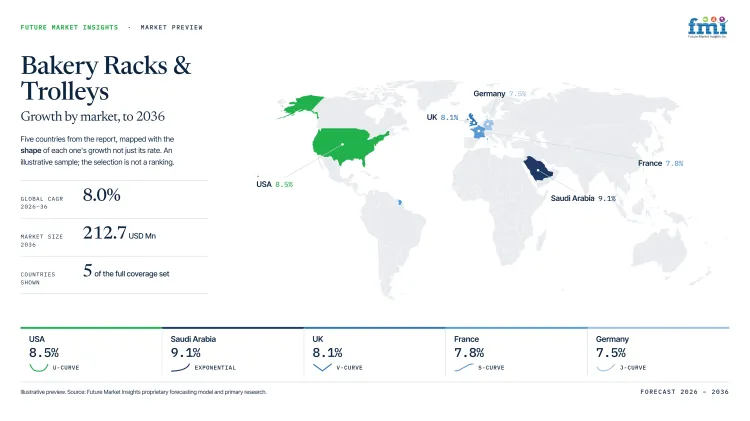
| Country | CAGR |
|---|---|
| Saudi Arabia | 9.1% |
| USA | 8.5% |
| UK | 8.1% |
| France | 7.8% |
| Germany | 7.5% |
How do country-level CAGRs compare in the Bakery Racks & Trolleys Market?
The 1.6-point spread highlights differences in bakery expansion, automation adoption, and replacement economics. Saudi Arabia leads as new bakery capacity integrates handling equipment into complete production lines, while the USA benefits from modernization across high-output facilities. UK and France show steady demand from equipment upgrades, whereas Germany's mature industrial base supports a more measured growth trajectory
- Saudi Arabia benefits from bakery-line investments where handling systems are incorporated during new facility development.
- USA is supported by modernization needs across large bakeries seeking reliable rack and trolley performance.
- UK benefits from planned upgrades that improve material movement without requiring extensive production-line changes.
- France follows steady bakery equipment investment as producers improve workflow efficiency and capacity utilization.
- Germany reflects demand for durable handling equipment within established bakery operations focused on productivity improvements.
The full report provides country-level CAGR analysis for North America, Latin America, Europe, East Asia, South Asia, Oceania and the Middle East and Africa.
Country-wise Analysis
- Saudi Arabia: Industrial bakery projects increasingly specify complete production packages because commissioning, hygiene, and equipment documentation must align with licensed food-manufacturing facilities. Expanding factory capacity is supporting demand for locally commissioned racks and trolleys, while regional engineering teams can accelerate installation, operator training, and post-installation support. However, reliance on imported controls may extend spare-parts response times. Suppliers with stronger local service coverage therefore have an advantage as new bakery projects move forward.
- USA: Industrial bakeries operate extensive brownfield equipment bases, making rack and trolley upgrades closely tied to maintenance schedules and planned shutdowns. High line utilization encourages producers to improve carrier movement while minimizing production interruptions. Regional service networks can support retrofit execution, parts availability, and restart activities across high-output facilities. Mixed pan fleets remain a key constraint because automated handling systems must integrate with existing carriers and installed production equipment.
- UK: Bakery modernization generally advances through staged projects because established facilities have limited production windows for major equipment replacement. Demand is supported by manufacturers seeking gradual automation and improved material movement without disrupting established operations. However, controls integration, cleaning requirements, and installation periods can weaken retrofit economics. Suppliers that quantify labor savings, downtime exposure, and implementation requirements before specification can identify projects with stronger investment potential.
- France: Bakery producers are increasingly focused on improving workflow efficiency and production capacity within established manufacturing environments. Rack and trolley investments can support smoother movement between baking, cooling, storage, and dispatch stages while reducing manual handling requirements. Retrofit projects remain sensitive to plant layouts and sanitation requirements, encouraging suppliers to offer equipment that can integrate with existing bakery infrastructure. Local technical support can further strengthen adoption by reducing installation and maintenance complexity.
- Germany: Mature bakery operations emphasize durable handling systems that improve productivity without requiring extensive changes to established production lines. Demand for racks and trolleys is supported by efforts to streamline internal material movement and maintain consistent throughput across automated and semi-automated processes. Equipment reliability, compatibility with existing carriers, and ease of cleaning remain important purchasing considerations. Suppliers offering robust designs and responsive technical support are better positioned within this established market.
Who are the notable companies in the Bakery Racks & Trolleys Market?
AMF Bakery Systems, Rademaker, Mecatherm, Kaak Group, Bühler Group, Midera Food Processing, FRITSCH Group and Rheon Automatic Machinery are the notable companies serving this market.
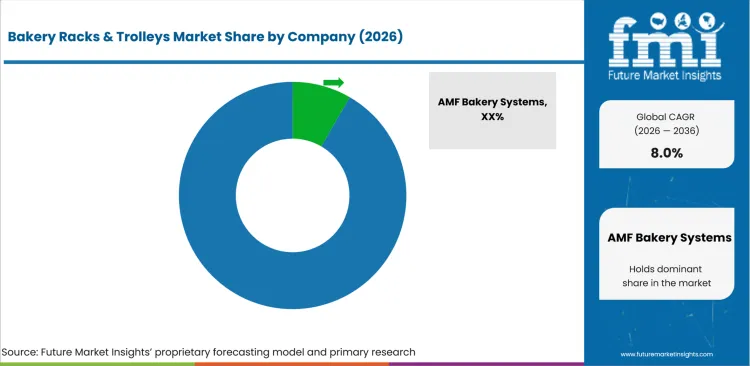
Competition is fragmented because rack handling is sold either as a dedicated carrier function or as part of a wider bakery line. Entry barriers rise with interface engineering and field service more than corporate scale alone in brownfield projects. Companies that already commission conveying equipment beside proofers and ovens hold an advantage in retrofit projects.
- AMF Bakery Systems, Rademaker, Mecatherm and Kaak Group provide the clearest carrier-handling or complete-line integration routes for industrial bakery projects.
- Bühler Group and Midera Food Processing compete from broader processing platforms where bakery equipment and frozen bakery production can be specified within larger plant programs.
- FRITSCH Group and Rheon Automatic Machinery are stronger in forming and line automation, which places them at the edge of rack-specific scope but inside integrated bakery capital programs.
Competitive Benchmarking: Bakery Racks & Trolleys Market
| Company | Rack & Carrier Handling Depth | Bakery Line Integration | Lifecycle Service Support | Geographic Reach |
|---|---|---|---|---|
| AMF Bakery Systems | High | High | High | Global |
| Rademaker | High | High | High | Europe, Americas and Asia |
| Mecatherm | High | High | High | Global |
| Kaak Group | High | High | High | Europe, Americas, Asia and Africa |
| Bühler Group | Medium | High | High | Global |
| Midera Food Processing | Medium | High | Medium | Global |
| FRITSCH Group | Low | High | Medium | Europe and Americas |
| Rheon Automatic Machinery | Low | Medium | Medium | Asia, Americas and Europe |
Scoring basis: High rack and carrier handling depth requires at least three directly documented handling functions in bakery applications. Medium requires two documented functions and Low identifies one directly verified rack or carrier-handling route. High bakery line integration requires multiple connected process stages within one documented commercial bakery platform. Medium requires an integrated sub-line and Low identifies one mainly standalone bakery processing function. High lifecycle support requires regional service coverage plus documented digital support for installed bakery equipment. Medium requires documented parts or training coverage and Low identifies a specific recorded service limitation.
Key Developments in the Bakery Racks & Trolleys Market
- In September 2025, Kaak Group launched Kaak Africa in Johannesburg to provide local bakery-equipment sales, service and spare-parts support in the region.
- In June 2025, AMF Bakery Systems partnered with Puratos to launch a pilot bakery in New Jersey for integrated commercial baking trials.
- In July 2026, Midera Food Processing completed its spin-off from Middleby and began operating as an independent public food-processing company with bakery brands.
Key Players in the Bakery Racks & Trolleys Market
Carrier Handling and Line Integration Platforms
- AMF Bakery Systems
- Rademaker
- Mecatherm
- Kaak Group
Broader Bakery Process Platforms
- Bühler Group
- Midera Food Processing
Forming and Automation Specialists
- FRITSCH Group
- Rheon Automatic Machinery
Bakery Racks & Trolleys Market - Report Scope
| Coverage field | Report scope |
|---|---|
| Market breakdown | By equipment type, capacity, automation level, end user, sales channel and region. |
| Quantitative Units | USD Million. |
| Market Definition | Commercial bakery racks, trolleys, automated rack loading and unloading modules, tray or pan carrier movement assemblies, and rack-linked handling systems. |
| Regions Covered | North America, Latin America, Europe, East Asia, South Asia and Pacific and Middle East and Africa. |
| Countries Covered | UAE, Saudi Arabia, South Korea, USA, UK, and 30+ countries included in the full report. |
| Key Companies Profiled | AMF Bakery Systems, Rademaker, Mecatherm, Kaak Group, Bühler Group, Midera Food Processing, FRITSCH Group, Rheon Automatic Machinery. |
| Forecast Period | 2026 to 2036. |
| Approach | Primary and secondary research with market triangulation. |
Bakery Racks & Trolleys Market - Research Methodology
| Method | Approach |
|---|---|
| Primary Research | FMI analysts gathered input from manufacturers, service providers, technology developers, distributors, end users, procurement teams, and subject-matter experts. Interviews examined purchasing decisions, product or service evaluation, adoption barriers, approval requirements, pricing considerations, and expectations for technical or commercial support. Respondents were also asked what evidence is required before a trial, pilot, or initial order develops into regular purchasing. |
| Desk Research | Desk research covered government statistics, regulatory publications, trade data, industry associations, technical literature, standards, company filings, product information, and official corporate announcements. Sources were reviewed for relevance, publication date, geographic coverage, and consistency with the defined market scope. Claims relating to performance, applications, approvals, capacity, investment, and commercial activity were retained only when supported by credible public evidence. |
| Market Sizing and Forecasting | The market model combined the baseline value with historical performance, segment structure, pricing and volume indicators, adoption levels, company participation, and country-level demand conditions. Forecast assumptions considered economic activity, investment trends, regulatory developments, technology adoption, purchasing cycles, supply availability, and barriers to wider market use. Segment and regional estimates were reconciled before the final market total was calculated. |
| Data Validation | Estimates were checked against multiple independent indicators, including public data, company activity, trade patterns, industry developments, and findings from primary interviews. Validation also tested whether products, services, applications, and company revenues fell within the defined market boundaries. Adjacent categories, unsupported claims, overlapping revenues, and activities without direct market relevance were excluded to reduce double counting and maintain consistency across segments and countries. |
Bakery Racks & Trolleys Market by Segments
Bakery Racks & Trolleys Market segmented by Equipment Type:
- Compact / Entry Systems
- Mid-capacity lines
- High-capacity Industrial Lines
Bakery Racks & Trolleys Market segmented by Capacity:
- Below 500 kg/hr
- 500-2,000 kg/hr
- Above 2,000 kg/hr
Bakery Racks & Trolleys Market segmented by Automation Level:
- Manual
- Semi-automatic
- Fully automatic / robotic
Bakery Racks & Trolleys Market segmented by End User:
- Industrial bakeries
- Retail / Chain bakeries
- Artisan bakeries
- Foodservice / QSR central kitchens
Bakery Racks & Trolleys Market segmented by Sales Channel:
- Direct OEM sales
- Dealers & distributors
- Aftermarket / refurbished equipment
Bakery Racks & Trolleys Market by Region:
- North America
- United States
- Canada
- Latin America
- Brazil
- Mexico
- Chile
- Rest of Latin America
- Western Europe
- Germany
- United Kingdom
- Italy
- Spain
- France
- Nordics
- Benelux
- Rest of Western Europe
- Eastern Europe
- Russia
- Poland
- Hungary
- Balkan and Baltic States
- Rest of Eastern Europe
- East Asia
- China
- Japan
- South Korea
- South Asia and Pacific
- India
- ASEAN
- Australia and New Zealand
- Rest of South Asia and Pacific
- Middle East and Africa
- Kingdom of Saudi Arabia
- Other GCC Countries
- Türkiye
- South Africa
- Other African Union Countries
- Rest of Middle East and Africa
Research Sources and Bibliography
- AMF Bakery Systems. (2025, May 18). IBA 2025.
- Federal Statistical Office of Germany. (2025, October 22). Beschäftigte mit Einwanderungsgeschichte 2024 in vielen Mangelberufen überdurchschnittlich stark vertreten.
- FRITSCH Bakery Technologies. (2025, January 16). Compact and versatile - the new bread line for retail bakers.
- FRITSCH Bakery Technologies. (2025, May 13). PROGRESSA pastry - the new pastry line for retail bakers.
- Mecatherm. (2025, August 6). IBIE 2025: Comprehensive solutions to meet the challenges of the Bakery, Pastry, and Sweet Goods sector.
- Mecatherm. (2025, May 18). MECATHERM facilitates production line operations with MyMecatherm Digital Platform.
- Ministry of Economy, Trade and Industry, Japan. (2025, June 30). Robotics & Regional Initiative Networking Group (RING Project) Established to Solve Regional Labor Shortages.
- Royal Kaak. (2026, June 8). Royal Kaak introduces new innovations for DrieM sheeting lines.
- UAE Ministry of Industry and Advanced Technology. (2026, May 20). Make it in the Emirates concludes largest edition yet.
- Saudi Food and Drug Authority. (2026, January 26). SFDA Reports 18% Growth in Licensed Factories and Warehouses During 2025.
- Ministry of Agriculture, Food and Rural Affairs, Republic of Korea. (2026, July 20). S. Korea Unveils Master Plan to Integrate Advanced Technologies into the Food Sector.
- USA Bureau of Labor Statistics. (2026, January 9). Table B-1a. Employees on nonfarm payrolls by industry sector and selected industry detail, seasonally adjusted: December 2025.
- Department for Business and Trade. (2026, July 30). Made Smarter Adoption: impact and process evaluation.
- Rademaker. (2026, June 22). Aladdin Bakery: A Customer Testimonial.
- Royal Kaak. (2025, September 18). Kaak Africa has officially started!.
- AMF Bakery Systems. (2025, June 9). AMF and Puratos launch joint pilot bakery facility to accelerate commercial baking innovation.
- Midera Food Processing, Inc. (2026, July 6). Midera Food Processing Completes Spin-Off, Begins Trading Tomorrow as Independent, Public Company.
- Lesaffre. (2025, December 15). Lesaffre opens new Industrial Baking Center™ in Shanghai.
- Bühler Group. (2026, May 7). Bühler launches innovations and releases major upgrades to its Grains & Food portfolio.
- FRITSCH Bakery Technologies. (2025, November 11). The CSV compact has everything under control.
- Rheon Automatic Machinery Co., Ltd. (2025, May 14). Update on Previous Disclosures: Notice Concerning Commencement of Consideration of Construction of New Plant at Consolidated Subsidiary.
- Mecatherm. (2026, March 19). Driving sustainability into our Demo Center.
- Midera Food Processing, Inc. (2026, August 13). Midera Food Processing Reports Second Quarter 2026 Results in First Report as an Independent Public Company.
- Royal Kaak. (2026, April 27). How we use generative AI to better understand production lines.
- Reading Bakery Systems. (2026, March 18). Visit RBS at Interpack 2026. New Tech. Live Demos. Better Baking.
- Midera Food Processing, Inc. (2026, May 27). Form 10-12B/A registration statement.
- The Middleby Corporation. (2026, May 11). The Middleby Corporation Announces the Launch of Midera Food Processing.
This bibliography is provided for reader reference and is not exhaustive. The full report contains the complete reference list and detailed citations.
This Report Answers
- How large is the bakery racks & trolleys market in 2026 and how far is it projected to expand by 2036?
- Which operating conditions increase demand for automated rack loading and carrier transfer in industrial bakeries?
- Why do mid-capacity lines account for 39.0% of equipment type demand in 2026?
- Why does the 500-2,000 kg/hr capacity band account for 44.0% of demand in 2026?
- How does fully automatic / robotic handling change line continuity and direct labor requirements?
- Which five countries record the highest authorized CAGRs in the bakery racks & trolleys market?
- Which companies provide carrier handling, broader bakery process platforms and line automation for commercial projects?
- What retrofit conditions can delay bakery rack and trolley automation despite a positive labor-saving case?
Frequently Asked Questions
How big is the Bakery Racks & Trolleys Market in 2026?
The bakery racks & trolleys market is valued at USD 98.5 million in 2026 and is projected to reach USD 212.7 million by 2036. Automated carrier transfer supports growth by reducing repeated handling and protecting oven utilization in industrial plants.
What is the CAGR of the Bakery Racks & Trolleys Market from 2026 to 2036?
The bakery racks & trolleys market is projected to grow at a CAGR of 8.0% between 2026 and 2036. Labor pressure and line-integration spending support expansion as industrial bakeries replace manual carrier movement at production bottlenecks.
Which equipment type leads the Bakery Racks & Trolleys Market?
The mid-capacity lines segment is expected to hold 39.0% of the bakery racks & trolleys market in 2026, driven by modular layouts that fit brownfield plants and phased automation programs. The format limits capital exposure and leaves room for later loader or controls upgrades.
Which capacity segment leads the Bakery Racks & Trolleys Market?
The 500-2,000 kg/hr segment is expected to hold 44.0% of the bakery racks & trolleys market in 2026, supported by production rates that justify automation and changeover flexibility. Plants in this range can protect line continuity without specifying maximum-capacity architecture.
Which companies are active in the Bakery Racks & Trolleys Market?
Key companies operating in the market include AMF Bakery Systems, Rademaker, Mecatherm, Kaak Group, Bühler Group, Midera Food Processing, FRITSCH Group, and Rheon Automatic Machinery. Their positions differ through carrier handling depth, complete-line engineering and lifecycle service coverage.
Preview the report firsthand - request a free sample
Get SampleGet the brochure for pricing and purchase details.
Get PDFTable of Content
- Key Takeaways
- Market Size and CAGR
- Top Growth Driver
- Fastest Growing Segment
- Leading Region
- Key Companies
- Emerging Opportunities
- Executive Summary
- Global Market Outlook
- Demand-side Trends
- Supply-side Trends
- Technology Roadmap Analysis
- Analysis and Recommendations
- Analyst Perspective (What is happening? Why now? What should investors know?)
- Key Questions Answered
- How large is the market?
- What is the CAGR?
- What are key trends?
- Which region dominates?
- Who are the leaders?
- Market Overview
- Market Coverage / Taxonomy
- Market Definition / Scope / Limitations
- Research Methodology
- Chapter Orientation
- Analytical Lens and Working Hypotheses
- Market Structure, Signals, and Trend Drivers
- Benchmarking and Cross-market Comparability
- Market Sizing, Forecasting, and Opportunity Mapping
- Research Design and Evidence Framework
- Desk Research Programme (Secondary Evidence)
- Expert Input and Fieldwork (Primary Evidence)
- Tooling, Models, and Reference Databases
- Data Engineering and Model Build
- Quality Assurance and Audit Trail
- Market Background
- Market Dynamics (Drivers, Restraints, Opportunity, Trends)
- Scenario Forecast (Optimistic, Likely, Conservative)
- Impact Analysis
- AI Impact
- Sustainability Impact
- Regulatory Impact
- Technology Impact
- Consumer / Buyer Analysis
- Purchase Drivers
- Adoption Barriers
- Buyer Journey
- Opportunity Map Analysis
- Product Life Cycle Analysis
- Supply Chain Analysis
- Investment Feasibility Matrix
- Value Chain Analysis
- PESTLE and Porter's Analysis
- Regulatory Landscape
- Regional Parent Market Outlook
- Production and Consumption Statistics
- Import and Export Statistics
- Global Market Analysis and Forecast, 2021 to 2036
- Historical Market Size Value (USD Million) Analysis, 2021 to 2025
- Current and Future Market Size Value (USD Million) Projections, 2026 to 2036
- Y-o-Y Growth Trend Analysis
- Absolute $ Opportunity Analysis
- Global Market Pricing Analysis, 2021 to 2036
- Global Market Analysis and Forecast, By Equipment Type, 2021 to 2036
- Introduction / Key Findings
- Historical Market Size Value (USD Million) Analysis By Equipment Type, 2021 to 2025
- Current and Future Market Size Value (USD Million) Analysis and Forecast By Equipment Type, 2026 to 2036
- Mid-capacity lines
- Compact / entry systems
- High-capacity industrial lines
- Mid-capacity lines
- Y-o-Y Growth Trend Analysis By Equipment Type, 2021 to 2025
- Absolute $ Opportunity Analysis By Equipment Type, 2026 to 2036
- Global Market Analysis and Forecast, By Capacity, 2021 to 2036
- Introduction / Key Findings
- Historical Market Size Value (USD Million) Analysis By Capacity, 2021 to 2025
- Current and Future Market Size Value (USD Million) Analysis and Forecast By Capacity, 2026 to 2036
- 500-2,000 kg/hr
- Below 500 kg/hr
- Above 2,000 kg/hr
- 500-2,000 kg/hr
- Y-o-Y Growth Trend Analysis By Capacity, 2021 to 2025
- Absolute $ Opportunity Analysis By Capacity, 2026 to 2036
- Global Market Analysis and Forecast, By Automation Level, 2021 to 2036
- Introduction / Key Findings
- Historical Market Size Value (USD Million) Analysis By Automation Level, 2021 to 2025
- Current and Future Market Size Value (USD Million) Analysis and Forecast By Automation Level, 2026 to 2036
- Fully automatic / robotic
- Semi-automatic
- Manual
- Fully automatic / robotic
- Y-o-Y Growth Trend Analysis By Automation Level, 2021 to 2025
- Absolute $ Opportunity Analysis By Automation Level, 2026 to 2036
- Global Market Analysis and Forecast, By End User, 2021 to 2036
- Introduction / Key Findings
- Historical Market Size Value (USD Million) Analysis By End User, 2021 to 2025
- Current and Future Market Size Value (USD Million) Analysis and Forecast By End User, 2026 to 2036
- Industrial bakeries
- In-store & retail bakeries
- Artisan bakeries
- Foodservice / QSR central kitchens
- Industrial bakeries
- Y-o-Y Growth Trend Analysis By End User, 2021 to 2025
- Absolute $ Opportunity Analysis By End User, 2026 to 2036
- Global Market Analysis and Forecast, By Sales Channel, 2021 to 2036
- Introduction / Key Findings
- Historical Market Size Value (USD Million) Analysis By Sales Channel, 2021 to 2025
- Current and Future Market Size Value (USD Million) Analysis and Forecast By Sales Channel, 2026 to 2036
- Direct OEM sales
- Dealers & distributors
- Aftermarket & refurbished
- Direct OEM sales
- Y-o-Y Growth Trend Analysis By Sales Channel, 2021 to 2025
- Absolute $ Opportunity Analysis By Sales Channel, 2026 to 2036
- Global Market Analysis and Forecast, By Region, 2021 to 2036
- Introduction
- Historical Market Size Value (USD Million) Analysis By Region, 2021 to 2025
- Current Market Size Value (USD Million) Analysis and Forecast By Region, 2026 to 2036
- North America
- Latin America
- Western Europe
- Eastern Europe
- East Asia
- South Asia and Pacific
- Middle East & Africa
- Market Attractiveness Analysis By Region
- North America Market Analysis and Forecast, By Country, 2021 to 2036
- Historical Market Size Value (USD Million) Trend Analysis By Market Taxonomy, 2021 to 2025
- Market Size Value (USD Million) Forecast By Market Taxonomy, 2026 to 2036
- By Country
- USA
- Canada
- By Equipment Type
- By Capacity
- By Automation Level
- By End User
- By Sales Channel
- By Country
- Market Attractiveness Analysis
- By Country
- By Equipment Type
- By Capacity
- By Automation Level
- By End User
- By Sales Channel
- Key Takeaways
- Latin America Market Analysis and Forecast, By Country
- Historical Market Size Value (USD Million) Trend Analysis By Market Taxonomy, 2021 to 2025
- Market Size Value (USD Million) Forecast By Market Taxonomy, 2026 to 2036
- By Country
- Brazil
- Mexico
- Chile
- Rest of Latin America
- By Equipment Type
- By Capacity
- By Automation Level
- By End User
- By Sales Channel
- By Country
- Market Attractiveness Analysis
- By Country
- By Equipment Type
- By Capacity
- By Automation Level
- By End User
- By Sales Channel
- Key Takeaways
- Western Europe Market Analysis and Forecast, By Country
- Historical Market Size Value (USD Million) Trend Analysis By Market Taxonomy, 2021 to 2025
- Market Size Value (USD Million) Forecast By Market Taxonomy, 2026 to 2036
- By Country
- Germany
- UK
- Italy
- Spain
- France
- Nordic
- BENELUX
- Rest of Western Europe
- By Equipment Type
- By Capacity
- By Automation Level
- By End User
- By Sales Channel
- By Country
- Market Attractiveness Analysis
- By Country
- By Equipment Type
- By Capacity
- By Automation Level
- By End User
- By Sales Channel
- Key Takeaways
- Eastern Europe Market Analysis and Forecast, By Country
- Historical Market Size Value (USD Million) Trend Analysis By Market Taxonomy, 2021 to 2025
- Market Size Value (USD Million) Forecast By Market Taxonomy, 2026 to 2036
- By Country
- Russia
- Poland
- Hungary
- Balkan & Baltic
- Rest of Eastern Europe
- By Equipment Type
- By Capacity
- By Automation Level
- By End User
- By Sales Channel
- By Country
- Market Attractiveness Analysis
- By Country
- By Equipment Type
- By Capacity
- By Automation Level
- By End User
- By Sales Channel
- Key Takeaways
- East Asia Market Analysis and Forecast, By Country
- Historical Market Size Value (USD Million) Trend Analysis By Market Taxonomy, 2021 to 2025
- Market Size Value (USD Million) Forecast By Market Taxonomy, 2026 to 2036
- By Country
- China
- Japan
- South Korea
- By Equipment Type
- By Capacity
- By Automation Level
- By End User
- By Sales Channel
- By Country
- Market Attractiveness Analysis
- By Country
- By Equipment Type
- By Capacity
- By Automation Level
- By End User
- By Sales Channel
- Key Takeaways
- South Asia and Pacific Market Analysis and Forecast, By Country
- Historical Market Size Value (USD Million) Trend Analysis By Market Taxonomy, 2021 to 2025
- Market Size Value (USD Million) Forecast By Market Taxonomy, 2026 to 2036
- By Country
- India
- ASEAN
- Australia & New Zealand
- Rest of South Asia and Pacific
- By Equipment Type
- By Capacity
- By Automation Level
- By End User
- By Sales Channel
- By Country
- Market Attractiveness Analysis
- By Country
- By Equipment Type
- By Capacity
- By Automation Level
- By End User
- By Sales Channel
- Key Takeaways
- Middle East & Africa Market Analysis and Forecast, By Country
- Historical Market Size Value (USD Million) Trend Analysis By Market Taxonomy, 2021 to 2025
- Market Size Value (USD Million) Forecast By Market Taxonomy, 2026 to 2036
- By Country
- Kingdom of Saudi Arabia
- Other GCC Countries
- Türkiye
- South Africa
- Other African Union
- Rest of Middle East & Africa
- By Equipment Type
- By Capacity
- By Automation Level
- By End User
- By Sales Channel
- By Country
- Market Attractiveness Analysis
- By Country
- By Equipment Type
- By Capacity
- By Automation Level
- By End User
- By Sales Channel
- Key Takeaways
- Key Countries Market Analysis
- USA
- Pricing Analysis
- Market Share Analysis, 2025
- By Equipment Type
- By Capacity
- By Automation Level
- By End User
- By Sales Channel
- Canada
- Pricing Analysis
- Market Share Analysis, 2025
- By Equipment Type
- By Capacity
- By Automation Level
- By End User
- By Sales Channel
- Mexico
- Pricing Analysis
- Market Share Analysis, 2025
- By Equipment Type
- By Capacity
- By Automation Level
- By End User
- By Sales Channel
- Brazil
- Pricing Analysis
- Market Share Analysis, 2025
- By Equipment Type
- By Capacity
- By Automation Level
- By End User
- By Sales Channel
- Chile
- Pricing Analysis
- Market Share Analysis, 2025
- By Equipment Type
- By Capacity
- By Automation Level
- By End User
- By Sales Channel
- Germany
- Pricing Analysis
- Market Share Analysis, 2025
- By Equipment Type
- By Capacity
- By Automation Level
- By End User
- By Sales Channel
- UK
- Pricing Analysis
- Market Share Analysis, 2025
- By Equipment Type
- By Capacity
- By Automation Level
- By End User
- By Sales Channel
- Italy
- Pricing Analysis
- Market Share Analysis, 2025
- By Equipment Type
- By Capacity
- By Automation Level
- By End User
- By Sales Channel
- Spain
- Pricing Analysis
- Market Share Analysis, 2025
- By Equipment Type
- By Capacity
- By Automation Level
- By End User
- By Sales Channel
- France
- Pricing Analysis
- Market Share Analysis, 2025
- By Equipment Type
- By Capacity
- By Automation Level
- By End User
- By Sales Channel
- India
- Pricing Analysis
- Market Share Analysis, 2025
- By Equipment Type
- By Capacity
- By Automation Level
- By End User
- By Sales Channel
- ASEAN
- Pricing Analysis
- Market Share Analysis, 2025
- By Equipment Type
- By Capacity
- By Automation Level
- By End User
- By Sales Channel
- Australia & New Zealand
- Pricing Analysis
- Market Share Analysis, 2025
- By Equipment Type
- By Capacity
- By Automation Level
- By End User
- By Sales Channel
- China
- Pricing Analysis
- Market Share Analysis, 2025
- By Equipment Type
- By Capacity
- By Automation Level
- By End User
- By Sales Channel
- Japan
- Pricing Analysis
- Market Share Analysis, 2025
- By Equipment Type
- By Capacity
- By Automation Level
- By End User
- By Sales Channel
- South Korea
- Pricing Analysis
- Market Share Analysis, 2025
- By Equipment Type
- By Capacity
- By Automation Level
- By End User
- By Sales Channel
- Russia
- Pricing Analysis
- Market Share Analysis, 2025
- By Equipment Type
- By Capacity
- By Automation Level
- By End User
- By Sales Channel
- Poland
- Pricing Analysis
- Market Share Analysis, 2025
- By Equipment Type
- By Capacity
- By Automation Level
- By End User
- By Sales Channel
- Hungary
- Pricing Analysis
- Market Share Analysis, 2025
- By Equipment Type
- By Capacity
- By Automation Level
- By End User
- By Sales Channel
- Kingdom of Saudi Arabia
- Pricing Analysis
- Market Share Analysis, 2025
- By Equipment Type
- By Capacity
- By Automation Level
- By End User
- By Sales Channel
- Türkiye
- Pricing Analysis
- Market Share Analysis, 2025
- By Equipment Type
- By Capacity
- By Automation Level
- By End User
- By Sales Channel
- South Africa
- Pricing Analysis
- Market Share Analysis, 2025
- By Equipment Type
- By Capacity
- By Automation Level
- By End User
- By Sales Channel
- USA
- Market Structure Analysis
- Competition Dashboard
- Competition Benchmarking
- Market Share Analysis of Top Players
- By Regional
- By Equipment Type
- By Capacity
- By Automation Level
- By End User
- By Sales Channel
- Emerging Startups
- Innovation Benchmarking
- Competition Analysis
- Competition Deep Dive
- AMF Bakery Systems
- Overview
- Product Portfolio
- Profitability by Market Segments
- Sales Footprint
- Strategy Overview
- Marketing Strategy
- Product Strategy
- Channel Strategy
- Buhler Group
- Baker Perkins
- Rademaker
- FRITSCH Group
- Rheon Automatic Machinery
- Mecatherm
- Middleby
- Reading Bakery Systems
- Kaak Group
- AMF Bakery Systems
- Case Studies
- Success Stories
- Recent Developments
- Competition Deep Dive
- Assumptions & Acronyms Used


