

- Industry Size (2026)
- USD 7.5 Bn
- Forecast (2036)
- USD 11.32 Bn
- CAGR (2026 to 2036)
- 4.2%
Conveyor Drives Market Size, Market Forecast and Outlook By FMI
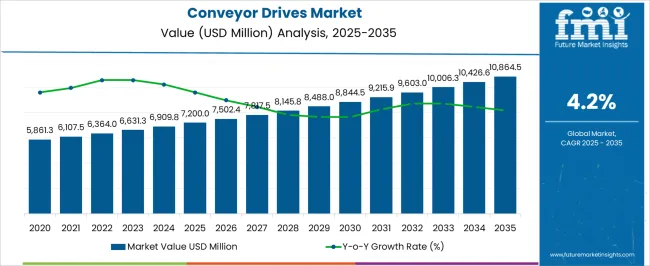
The conveyor drives market was valued at USD 7.2 billion in 2025, projected to reach USD 7.5 billion in 2026, and is forecast to expand to USD 11.32 billion by 2036 at a 4.2% CAGR. Industrial demand for energy-efficient conveyor propulsion systems is sustaining growth as facilities upgrade from fixed-speed drives to variable frequency drive (VFD) and integrated drive units that reduce electricity consumption and extend mechanical component lifespan. Mining, warehousing, and manufacturing sectors continue to invest in conveyor drive technology that delivers precise speed and torque control across varying load conditions.
Summary of Conveyor Drives Market
- The market is forecast to reach USD 11.32 billion by 2036.
- The market is expected to grow at a CAGR of 4.2% from 2026 to 2036.
- The market was estimated at USD 7.2 billion in 2025.
- The forecast period represents an incremental opportunity of USD 3.82 billion.
- The market is projected to reach USD 7.5 billion in 2026, indicating steady growth momentum.
- Growth is driven by rising demand for energy-efficient conveyor propulsion systems across industries.
- Industrial facilities are shifting from fixed-speed drives to variable frequency drives (VFDs) to reduce energy consumption and improve performance.
- Integrated drive units combining motor, gearbox, and controller are gaining adoption due to faster installation and compact design.
- Key end-use sectors include mining, warehousing, manufacturing, and food & beverage industries.
- Gear motors dominate the product segment with a 48% market share in 2026.
- New system installations lead demand with a 65% share, supported by greenfield industrial projects.
- India and China are the fastest-growing markets, driven by industrial expansion and automation investments.
- Key companies in the market include SEW-EURODRIVE, ABB, Bonfiglioli, Interroll, Lenze, NORD DRIVESYSTEMS, and Regal Rexnord.
Conveyor Drives Market Key Takeaways
| Metric | Details |
|---|---|
| Industry Size (2026) | USD 7.5 billion |
| Industry Value (2036) | USD 11.32 billion |
| CAGR (2026-2036) | 4.2% |
Source: Future Market Insights, 2026
FMI is of the opinion that the conveyor drives market is transitioning from a replacement-cycle-driven procurement model to an efficiency-driven specification model, where facility planners select drives based on lifecycle energy cost rather than initial purchase price alone. Gear motor combinations remain the largest product category, but VFD drives are gaining specification share as energy cost pressures and carbon reduction mandates make variable-speed operation a procurement requirement rather than an optional upgrade. Integrated drive units that combine motor, gearbox, and controller in a single housing are growing in warehouse and logistics applications where installation footprint and commissioning speed are competitive differentiators.
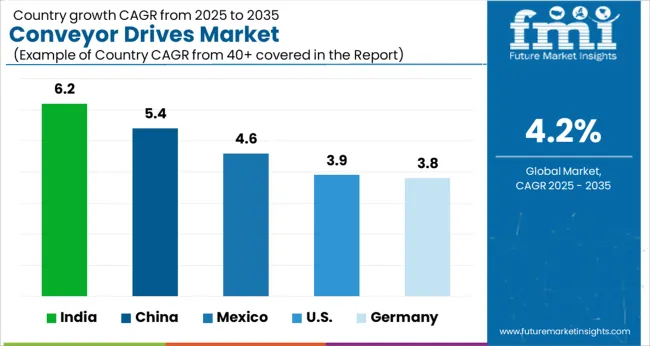
Regional growth reflects industrial automation and energy efficiency investment patterns. India leads at 6.2% CAGR, driven by manufacturing expansion under the production-linked incentive scheme and mining infrastructure modernization. China follows at 5.4% as industrial motor efficiency standards tighten. Mexico advances at 4.6%, supported by nearshoring manufacturing investment requiring new conveyor systems. The United States maintains 3.9% growth anchored by warehouse automation and energy efficiency mandates, and Germany registers 3.8% expansion driven by Industry 4.0 conveyor system upgrades.
Conveyor Drives Market Definition
Conveyor drives are mechanical and electronic propulsion systems that provide motive force to conveyor belts, rollers, and chain systems within industrial material handling installations. Primary product categories include gear motors, variable frequency drives (VFDs), and integrated drive units combining motor, reducer, and controller assemblies. These drives serve belt, roller, and chain conveyor configurations across new installation and retrofit applications.
Conveyor Drives Market Inclusions
Market scope includes gear motors, variable frequency drives, and integrated drive units for conveyor applications. End-use verticals covering mining and quarrying, food and beverage, warehousing and logistics, and manufacturing and assembly are included. Revenue from new system installations and retrofit upgrades across belt, roller, chain, and other conveyor types falls within defined boundaries.
Conveyor Drives Market Exclusions
General industrial motors not specifically configured for conveyor applications are excluded. Conveyor structural components (frames, rollers, belts), standalone programmable logic controllers without drive integration, and pneumatic conveyor blowers fall outside analytical parameters.
Conveyor Drives Market Research Methodology
Primary Research
Analysts engaged with conveyor system design engineers, drive application specialists, and industrial procurement managers to map drive selection criteria across conveyor types and end-use environments.
Desk Research
Data collection aggregated industrial motor efficiency regulation databases, conveyor system shipment statistics, and energy consumption benchmarking studies for material handling operations.
Market-Sizing and Forecasting
Baseline values derive from bottom-up aggregation of conveyor drive shipments by product type, applying industrial capacity expansion and retrofit cycle rates to project future demand.
Data Validation and Update Cycle
Projections are tested against publicly reported drive and motor division revenue guidance from leading industrial automation companies.
Why the Conveyor Drives Market is Growing?
The conveyor drives market is experiencing sustained growth driven by several key factors. Industrial automation continues to be a primary catalyst, as manufacturers across sectors seek to improve operational efficiency, reduce labor costs, and enhance production reliability. The increasing focus on workplace safety regulations has also accelerated the adoption of automated conveyor systems, particularly in hazardous environments such as mining and chemical processing facilities.
The expansion of the global e-commerce sector has significantly boosted demand for sophisticated material handling systems in distribution centers and fulfillment facilities. Modern logistics operations require high-speed, reliable conveyor systems capable of handling diverse product types and volumes, driving innovation in drive technologies. Additionally, the growing emphasis on energy efficiency and sustainability has led to increased adoption of variable frequency drives (VFDs) and other energy-saving technologies.
Infrastructure development in emerging economies, particularly in Asia-Pacific and Latin America, has created substantial demand for conveyor systems in construction, mining, and manufacturing applications. The modernization of existing industrial facilities in developed markets has also contributed to market growth, as companies upgrade aging conveyor systems with more efficient and technologically advanced drive solutions.
Segmental Analysis
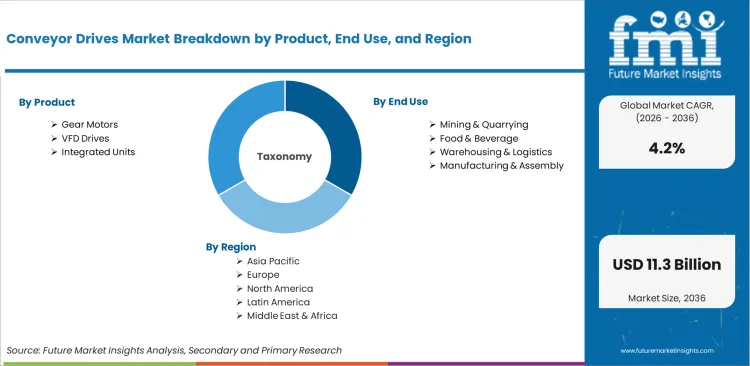
The market is segmented by product type, end use, installation, conveyor type, and region. By product type, the market is divided into gear motors, VFD drives, and integrated units. Based on end-use, the market is classified into mining and quarrying, food and beverage processing, warehousing and logistics, and manufacturing and assembly operations. By installation type, the market is bifurcated into new system installations and retrofit applications. Based on conveyor type, the market is segmented into belt, roller, chain, and others. Regionally, the market is divided into North America, Latin America, Europe, East Asia, South Asia & Pacific, Middle East & Africa.
By Product Type, Gear Motors Segment Accounts for 48% Market Share
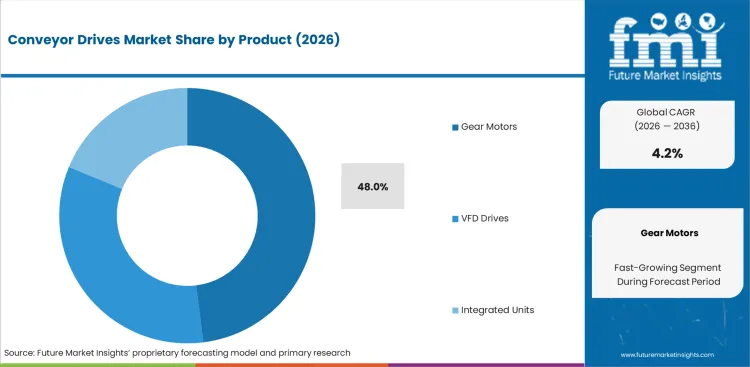
Gear motors are projected to account for 48% of the conveyor drives market in 2026, maintaining their position as the preferred drive solution across various industrial applications. Their dominance stems from the combination of motor and gearbox functionality in a single integrated unit, providing compact design, reliable operation, and cost-effective maintenance. Gear motors offer excellent torque characteristics and speed control capabilities, making them ideal for heavy-duty applications in mining, manufacturing, and material handling operations.
The segment's leadership is further reinforced by continuous technological advancements, including improved gear designs, enhanced lubrication systems, and integration with smart monitoring technologies. Manufacturers have been focusing on developing energy-efficient gear motor solutions that comply with international efficiency standards while providing superior performance in demanding industrial environments.
By End-Use, Mining & Quarrying Segment Accounts for 30% Market Share
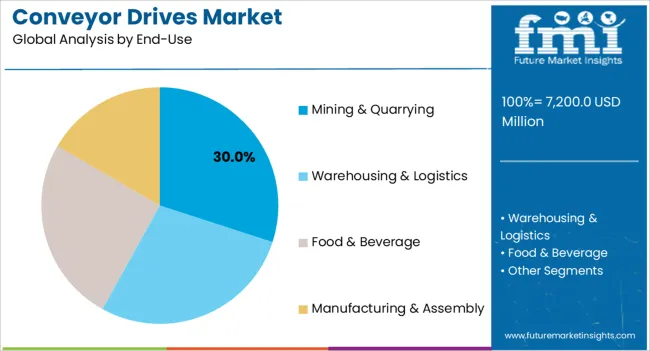
The mining and quarrying sector is anticipated to account for 30% of conveyor drives demand in 2026, reflecting the industry's heavy reliance on material handling systems for ore transportation, processing, and storage operations. Mining operations require robust, high-capacity conveyor systems capable of handling abrasive materials in challenging environmental conditions, driving demand for heavy-duty drive solutions.
The sector's growth is supported by increasing mineral extraction activities, particularly in developing economies, and the ongoing modernization of existing mining facilities. The trend toward larger-scale mining operations and the need for improved operational efficiency have led to increased adoption of advanced conveyor drive technologies.
By Conveyor Type, Belt Segment Accounts for 45% Market Share
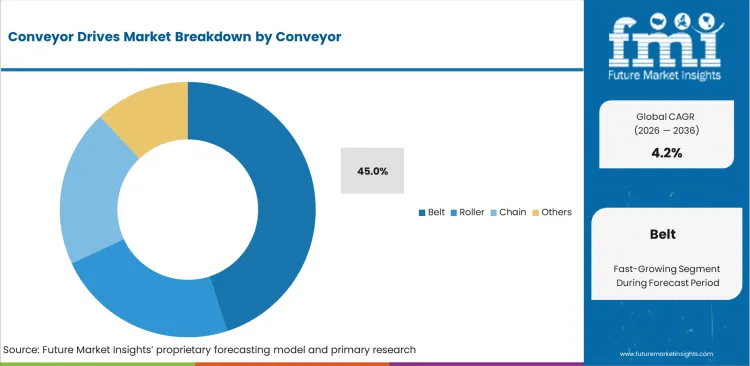
Belt conveyors are projected to maintain a dominant 45% share of the conveyor systems market, underlining their versatility across industries such as manufacturing, logistics, mining, and food processing. Their ability to efficiently transport a wide range of materials over varying distances, inclines, and declines makes them the preferred option in both heavy-duty and light-duty applications. The design flexibility of belt conveyors, coupled with lower operating costs and continuous advancements in materials, ensures they remain a go-to choice for diverse industrial requirements.
By Installation, New System Segment Accounts for 65% Market Share
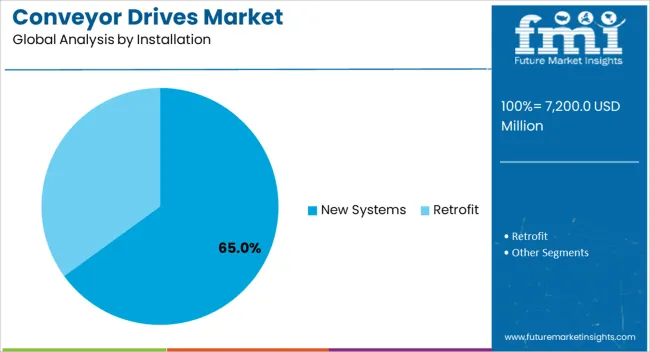
In terms of installation, new system setups are expected to capture around 65% of the market, while retrofit solutions account for the remaining 35%. The dominance of new installations reflects growing industrial expansion, particularly in emerging economies where modern manufacturing plants, warehouses, and distribution hubs are being built. Investment in advanced conveyor infrastructure is being driven by automation, e-commerce growth, and supply chain optimization. Meanwhile, retrofits continue to serve businesses modernizing existing facilities, but the stronger demand stems from greenfield industrial development projects.
What are the Drivers, Restraints, and Key Trends of the Conveyor Drives Market?
The conveyor drives market is experiencing several transformative trends that are reshaping industry dynamics. The integration of Internet of Things (IoT) technologies and predictive maintenance capabilities is becoming increasingly prevalent, enabling real-time monitoring of drive performance and proactive maintenance scheduling. This technological evolution is improving system reliability while reducing operational costs.
Digitalization and Smart Drive Technologies
The adoption of digital technologies is revolutionizing conveyor drive systems, with manufacturers incorporating advanced sensors, connectivity features, and data analytics capabilities into their products. Smart drive systems can monitor operational parameters, detect potential issues, and optimize performance automatically. This trend is particularly strong in high-value applications where system downtime can result in significant operational losses.
Energy Efficiency and Sustainability Focus
Growing environmental consciousness and rising energy costs are driving increased adoption of energy-efficient drive technologies. VFD drives, high-efficiency motors, and regenerative braking systems are becoming standard features in new installations. Manufacturers are developing drive solutions that not only reduce energy consumption but also minimize environmental impact throughout the product lifecycle.
Modular and Flexible System Designs
The trend toward modular conveyor systems is gaining momentum, driven by the need for flexible manufacturing environments and rapid system reconfiguration. Modular drive systems allow for easier installation, maintenance, and expansion, making them attractive to industries with changing production requirements.
Analysis of Conveyor Drives Market by Key Countries
.webp "Top Country Growth Comparison Conveyor Drives Market Cagr (2026 2036)")
| Countries | CAGR |
|---|---|
| India | 6.2 |
| China | 5.4 |
| Mexico | 4.6 |
| USA | 3.9 |
| Germany | 3.8 |
India Industrial Surge Fuels Record Conveyor Drive Growth
India is projected to record the fastest growth in the conveyor drives market with a CAGR of 6.2% through 2036. The country's rapid industrial expansion, driven by government initiatives such as "Make in India" and substantial infrastructure development projects, is creating strong demand for material handling systems. The growing manufacturing sector, particularly in automotive, pharmaceuticals, and consumer goods, is adopting automated conveyor systems to improve productivity and meet increasing production demands. India's mining industry, including coal, iron ore, and other mineral extraction operations, continues to expand and modernize, requiring advanced conveyor drive technologies for efficient material transport. The food processing industry in India is experiencing significant growth, supported by rising domestic consumption and export opportunities.
- Government infrastructure initiatives and industrial policy support are accelerating automation adoption across manufacturing sectors
- Expanding mining operations and modernization of existing facilities create sustained demand for heavy-duty conveyor drive systems
Automation and Industry 4.0 Accelerate Market Adoption in China
China maintains robust growth prospects with a projected CAGR of 5.4% for the conveyor drives market through 2036. The country's ongoing industrial modernization and the transition toward high-tech manufacturing are driving demand for advanced material handling systems. China's position as a global manufacturing hub necessitates continuous investment in production efficiency and automation technologies. The government's focus on industrial upgrading and the implementation of Industry 4.0 principles are accelerating the adoption of smart conveyor systems across various sectors. The country's extensive mining operations, including coal, metals, and rare earth extraction, require sophisticated conveyor systems capable of handling large volumes and operating in demanding conditions. The food and beverage processing industry in China is expanding rapidly to meet domestic demand and export requirements.
- Manufacturing sector transformation toward higher value-added production requires advanced automation and material handling solutions
- Extensive infrastructure development and urbanization projects create ongoing demand for construction and mining conveyor applications
Mexico Strategic Manufacturing Hub Drives Material Handling Expansion
Revenue from conveyor drives in Mexico is expected to achieve a CAGR of 4.6% in the conveyor drives market, supported by its strategic position as a manufacturing hub for North American markets. The country's proximity to the United States, competitive labor costs, and favorable trade agreements make it an attractive location for manufacturing investments. Mexico's automotive industry, one of the world's largest, continues to expand with new production facilities requiring sophisticated material handling systems. The aerospace sector is also growing, with international manufacturers establishing operations that demand precision conveyor systems. The mining industry, particularly precious metals and industrial minerals, represents a significant market for heavy-duty conveyor drives. The food processing sector in Mexico is modernizing to meet export standards and domestic demand for processed foods.
- Strategic geographic position and trade advantages attract manufacturing investments requiring advanced material handling systems
- Diversified industrial base across automotive, aerospace, and mining sectors sustains demand for specialized conveyor drive applications
United States Technological Leadership Shapes Market Evolution
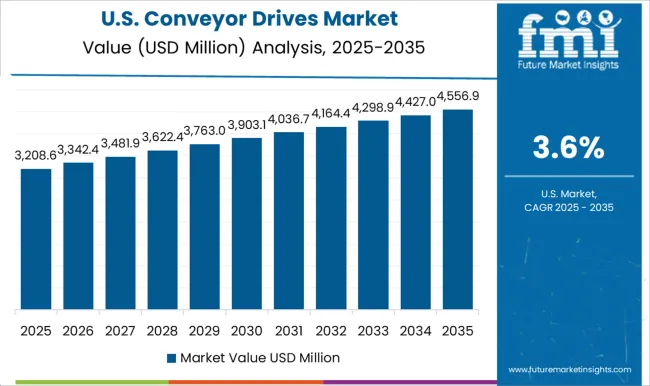
The United States conveyor drives market is projected to grow at a CAGR of 3.9%, reflecting the maturity of the industrial base and focus on technological advancement rather than capacity expansion. The country's emphasis on manufacturing reshoring and automation is driving demand for sophisticated conveyor systems in both new facilities and retrofitted operations. The mining sector, including coal, metals, and aggregates, continues to modernize with advanced material handling technologies that improve efficiency and safety. The food and beverage processing industry, one of the world's largest, is adopting advanced conveyor systems with specialized drives that meet strict regulatory requirements and support sustainable operations. The e-commerce and logistics sector in the United States is experiencing unprecedented growth, driving substantial investment in automated distribution centers and fulfillment facilities.
- Manufacturing reshoring initiatives and automation investments create demand for advanced conveyor drive technologies in modern production facilities
- Mature industrial base emphasizes system upgrades and technology integration rather than greenfield capacity expansion
Germany Engineering Excellence Powers Intelligent Conveyor Systems
Demand for conveyor drives in Germany is anticipated to achieve a CAGR of 3.8%, driven by the country's position as a global leader in industrial automation and engineering innovation. The nation's strong manufacturing sector, particularly automotive, machinery, and chemical industries, continues to invest in advanced production technologies. Germany's Industry 4.0 initiative has accelerated the adoption of smart manufacturing systems, including intelligent conveyor drives with connectivity and monitoring capabilities. The country's mining and quarrying operations, while smaller in scale compared to other major markets, demand high-quality, technologically advanced systems that emphasize efficiency and environmental responsibility. The food and beverage processing industry in Germany is characterized by high automation levels and strict quality standards. Modern processing facilities require conveyor systems with specialized drives that ensure product safety while maintaining high operational efficiency.
- Industry 4.0 leadership and engineering expertise drive adoption of advanced, connected conveyor drive technologies across manufacturing sectors
- High-quality standards and environmental regulations necessitate premium drive solutions with superior performance and efficiency characteristics
Competitive Landscape of Conveyor Drives Market
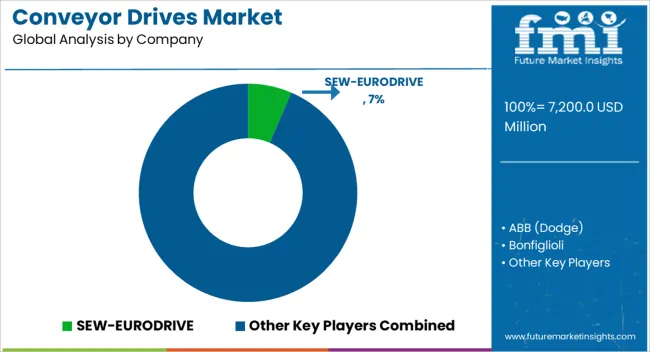
The conveyor drives market is characterized by intense competition among established global players and emerging regional manufacturers. Leading companies are focusing on technological innovation, expanding their product portfolios, and strengthening their global presence through strategic acquisitions and partnerships. The competitive landscape is shaped by continuous product development, with emphasis on energy efficiency, digitalization, and application-specific solutions.
ABB (Dodge), based in Switzerland and the USA, maintains a strong market position through its comprehensive portfolio of industrial drive solutions and global service network. The company's focus on digitalization and energy efficiency has resulted in advanced conveyor drive products that incorporate smart monitoring and control capabilities.
Bonfiglioli, the Italian manufacturer, has established a strong presence in the global market through its extensive range of gear motors and drive solutions. The company's focus on application-specific products and regional manufacturing capabilities has enabled it to serve diverse industrial sectors effectively.
Interroll, specializing in drum motors from Switzerland, has carved out a niche in the material handling market with innovative motorized roller solutions that offer compact design and easy integration into conveyor systems.
German manufacturers Lenze, NORD DRIVESYSTEMS, and SEW-EURODRIVE leverage their engineering expertise and technological innovation to provide advanced drive solutions. These companies have established strong positions in various industrial segments through their focus on quality, reliability, and customer-specific solutions.
Regal Rexnord from the USA combines extensive industrial experience with innovative technologies to serve the North American market and beyond. The company's broad product portfolio addresses diverse application requirements across multiple industries.
Siemens (Flender), the German industrial giant, leverages its global presence and technological capabilities to provide comprehensive drive solutions for large-scale industrial applications. The company's focus on digitalization and Industry 4.0 has resulted in advanced drive systems with integrated monitoring and control features.
Sumitomo Drive Technologies from Japan brings precision engineering and reliability to the global market, particularly in applications requiring high performance and durability. The company's focus on continuous improvement and customer support has established strong relationships across various industrial sectors.
WEG, the Brazilian manufacturer, has emerged as a significant global player through its cost-effective solutions and expanding international presence. The company's focus on energy efficiency and emerging market applications has enabled rapid growth and market expansion.
Key Players in the Conveyor Drives Market
- ABB (Dodge)
- Bonfiglioli
- Interroll (Drum Motors)
- Lenze
- NORD DRIVESYSTEMS
- Regal Rexnord
- SEW-EURODRIVE
- Siemens (Flender)
- Sumitomo Drive Technologies
- WEG
Scope of the Report
| Metric | Value |
|---|---|
| Quantitative Units | USD 7.5 billion to USD 11.32 billion, at a CAGR of 4.2% |
| Market Definition | Conveyor drives are mechanical and electronic propulsion systems that provide motive force to conveyor belts, rollers, and chain systems within industrial material handling installations. Primary prod... |
| Segmentation | Product: Gear Motors, VFD Drives, Integrated Units | End Use: Mining & Quarrying, Food & Beverage, Warehousing & Logistics, Manufacturing & Assembly | Installation: New Systems, Retrofit | Conveyor: Belt, Roller, Chain, Others |
| Regions Covered | North America, Latin America, Europe, East Asia, South Asia, Oceania, Middle East and Africa |
| Countries Covered | India, China, Mexico, USA, Germany, and 40 plus countries |
| Key Companies Profiled | SEW-EURODRIVE, ABB (Dodge), Bonfiglioli, Interroll (Drum Motors), Lenze, NORD DRIVESYSTEMS, Regal Rexnord, Siemens (Flender), Sumitomo Drive Technologies, WEG |
| Forecast Period | 2026 to 2036 |
| Approach | Forecasting models apply a bottom-up methodology starting with global installed base metrics and cross-validate projections against quarterly revenue volumes and public expenditure guidance. |
Conveyor Drives Market by Segments
By Product Type:
- Gear Motors
- VFD Drives
- Integrated Units
By End-Use:
- Mining & Quarrying
- Food & Beverage
- Warehousing & Logistics
- Manufacturing & Assembly
By Installation:
- New Systems
- Retrofit
By Conveyor Type:
- Belt
- Roller
- Chain
- Others
By Region:
- North America
- United States
- Canada
- Mexico
- Europe
- Germany
- United Kingdom
- France
- Italy
- Spain
- Nordic
- BENELUX
- Rest of Europe
- East Asia
- China
- Japan
- South Korea
- South Asia & Pacific
- India
- ASEAN
- Australia & New Zealand
- Rest of South Asia & Pacific
- Latin America
- Brazil
- Chile
- Rest of Latin America
- Middle East & Africa
- Kingdom of Saudi Arabia
- Other GCC Countries
- Turkiye
- South Africa
- Other African Union
- Rest of Middle East & Africa
Bibliography
- 1. International Electrotechnical Commission. (2025). IEC 60034-30-1: Rotating electrical machines, efficiency classes of line operated AC motors. IEC.
- 2. USA Department of Energy. (2025). Motor systems tip sheet: Variable frequency drives. DOE.
- 3. European Committee of Manufacturers of Electrical Machines and Power Electronics. (2025). CEMEP motor efficiency guide. CEMEP.
- 4. Bureau of Energy Efficiency, Government of India. (2025). Standards and labelling programme: Electric motors. BEE.
- 5. International Organization for Standardization. (2025). ISO 5048: Belt conveyors, calculation of operating power. ISO.
- 6. German Engineering Federation. (2025). VDMA market statistics: Power transmission and fluid power. VDMA.
This bibliography is provided for reader reference. The full Future Market Insights report contains the complete reference list with primary research documentation.
Frequently Asked Questions
How large is the demand for Conveyor Drives in the global market in 2026?
Demand for Conveyor Drives in the global market is estimated to be valued at USD 7.5 billion in 2026.
What will be the market size of Conveyor Drives in the global market by 2036?
Market size for Conveyor Drives is projected to reach USD 11.32 billion by 2036.
What is the expected demand growth for Conveyor Drives in the global market between 2026 and 2036?
Demand for Conveyor Drives is expected to grow at a CAGR of 4.2% between 2026 and 2036.
Which Product is poised to lead global sales by 2026?
Gear Motors accounts for 48% share in 2026 based on established deployment and operational adoption across major end-use categories.
What is driving demand in India?
India leads with a 6.2% CAGR through 2036, driven by infrastructure investment, policy mandates, and growing domestic demand.
What is Conveyor Drives and what is it mainly used for?
Conveyor drives are mechanical and electronic propulsion systems that provide motive force to conveyor belts, rollers, and chain systems within industrial material handling installations. Primary product categories include gear motors, variable frequency drives (VFDs), and integrated drive units combining motor, reducer, and controller assemblies.
How does FMI build and validate the Conveyor Drives forecast?
Forecasting models apply a bottom-up methodology starting with global installed base metrics and cross-validate projections against publicly reported expenditure volumes and primary research findings.
Preview the report firsthand - request a free sample
Get SampleGet the brochure for pricing and purchase details.
Get PDFTable of Content
- Executive Summary
- Global Market Outlook
- Demand-side Trends
- Supply-side Trends
- Technology Roadmap Analysis
- Analysis and Recommendations
- Market Overview
- Market Coverage / Taxonomy
- Market Definition / Scope / Limitations
- Research Methodology
- Chapter Orientation
- Analytical Lens and Working Hypotheses
- Market Structure, Signals, and Trend Drivers
- Benchmarking and Cross-market Comparability
- Market Sizing, Forecasting, and Opportunity Mapping
- Research Design and Evidence Framework
- Desk Research Programme (Secondary Evidence)
- Company Annual and Sustainability Reports
- Peer-reviewed Journals and Academic Literature
- Corporate Websites, Product Literature, and Technical Notes
- Earnings Decks and Investor Briefings
- Statutory Filings and Regulatory Disclosures
- Technical White Papers and Standards Notes
- Trade Journals, Industry Magazines, and Analyst Briefs
- Conference Proceedings, Webinars, and Seminar Materials
- Government Statistics Portals and Public Data Releases
- Press Releases and Reputable Media Coverage
- Specialist Newsletters and Curated Briefings
- Sector Databases and Reference Repositories
- FMI Internal Proprietary Databases and Historical Market Datasets
- Subscription Datasets and Paid Sources
- Social Channels, Communities, and Digital Listening Inputs
- Additional Desk Sources
- Expert Input and Fieldwork (Primary Evidence)
- Primary Modes
- Qualitative Interviews and Expert Elicitation
- Quantitative Surveys and Structured Data Capture
- Blended Approach
- Why Primary Evidence is Used
- Field Techniques
- Interviews
- Surveys
- Focus Groups
- Observational and In-context Research
- Social and Community Interactions
- Stakeholder Universe Engaged
- C-suite Leaders
- Board Members
- Presidents and Vice Presidents
- R&D and Innovation Heads
- Technical Specialists
- Domain Subject-matter Experts
- Scientists
- Physicians and Other Healthcare Professionals
- Governance, Ethics, and Data Stewardship
- Research Ethics
- Data Integrity and Handling
- Primary Modes
- Tooling, Models, and Reference Databases
- Desk Research Programme (Secondary Evidence)
- Data Engineering and Model Build
- Data Acquisition and Ingestion
- Cleaning, Normalisation, and Verification
- Synthesis, Triangulation, and Analysis
- Quality Assurance and Audit Trail
- Market Background
- Market Dynamics
- Drivers
- Restraints
- Opportunity
- Trends
- Scenario Forecast
- Demand in Optimistic Scenario
- Demand in Likely Scenario
- Demand in Conservative Scenario
- Opportunity Map Analysis
- Product Life Cycle Analysis
- Supply Chain Analysis
- Investment Feasibility Matrix
- Value Chain Analysis
- PESTLE and Porter’s Analysis
- Regulatory Landscape
- Regional Parent Market Outlook
- Production and Consumption Statistics
- Import and Export Statistics
- Market Dynamics
- Global Market Analysis 2021 to 2025 and Forecast, 2026 to 2036
- Historical Market Size Value (USD Million) Analysis, 2021 to 2025
- Current and Future Market Size Value (USD Million) Projections, 2026 to 2036
- Y-o-Y Growth Trend Analysis
- Absolute $ Opportunity Analysis
- Global Market Pricing Analysis 2021 to 2025 and Forecast 2026 to 2036
- Global Market Analysis 2021 to 2025 and Forecast 2026 to 2036, By Product
- Introduction / Key Findings
- Historical Market Size Value (USD Million) Analysis By Product , 2021 to 2025
- Current and Future Market Size Value (USD Million) Analysis and Forecast By Product , 2026 to 2036
- Gear Motors
- VFD Drives
- Integrated Value (USD Million)s
- Gear Motors
- Y-o-Y Growth Trend Analysis By Product , 2021 to 2025
- Absolute $ Opportunity Analysis By Product , 2026 to 2036
- Global Market Analysis 2021 to 2025 and Forecast 2026 to 2036, By End Use
- Introduction / Key Findings
- Historical Market Size Value (USD Million) Analysis By End Use, 2021 to 2025
- Current and Future Market Size Value (USD Million) Analysis and Forecast By End Use, 2026 to 2036
- Mining & Quarrying
- Food & Beverage
- Warehousing & Logistics
- Manufacturing & Assembly
- Mining & Quarrying
- Y-o-Y Growth Trend Analysis By End Use, 2021 to 2025
- Absolute $ Opportunity Analysis By End Use, 2026 to 2036
- Global Market Analysis 2021 to 2025 and Forecast 2026 to 2036, By Installation
- Introduction / Key Findings
- Historical Market Size Value (USD Million) Analysis By Installation, 2021 to 2025
- Current and Future Market Size Value (USD Million) Analysis and Forecast By Installation, 2026 to 2036
- New Systems
- Retrofit
- New Systems
- Y-o-Y Growth Trend Analysis By Installation, 2021 to 2025
- Absolute $ Opportunity Analysis By Installation, 2026 to 2036
- Global Market Analysis 2021 to 2025 and Forecast 2026 to 2036, By Conveyor
- Introduction / Key Findings
- Historical Market Size Value (USD Million) Analysis By Conveyor, 2021 to 2025
- Current and Future Market Size Value (USD Million) Analysis and Forecast By Conveyor, 2026 to 2036
- Belt
- Roller
- Chain
- Others
- Belt
- Y-o-Y Growth Trend Analysis By Conveyor, 2021 to 2025
- Absolute $ Opportunity Analysis By Conveyor, 2026 to 2036
- Global Market Analysis 2021 to 2025 and Forecast 2026 to 2036, By Region
- Introduction
- Historical Market Size Value (USD Million) Analysis By Region, 2021 to 2025
- Current Market Size Value (USD Million) Analysis and Forecast By Region, 2026 to 2036
- North America
- Latin America
- Western Europe
- Eastern Europe
- East Asia
- South Asia and Pacific
- Middle East & Africa
- Market Attractiveness Analysis By Region
- North America Market Analysis 2021 to 2025 and Forecast 2026 to 2036, By Country
- Historical Market Size Value (USD Million) Trend Analysis By Market Taxonomy, 2021 to 2025
- Market Size Value (USD Million) Forecast By Market Taxonomy, 2026 to 2036
- By Country
- USA
- Canada
- Mexico
- By Product
- By End Use
- By Installation
- By Conveyor
- By Country
- Market Attractiveness Analysis
- By Country
- By Product
- By End Use
- By Installation
- By Conveyor
- Key Takeaways
- Latin America Market Analysis 2021 to 2025 and Forecast 2026 to 2036, By Country
- Historical Market Size Value (USD Million) Trend Analysis By Market Taxonomy, 2021 to 2025
- Market Size Value (USD Million) Forecast By Market Taxonomy, 2026 to 2036
- By Country
- Brazil
- Chile
- Rest of Latin America
- By Product
- By End Use
- By Installation
- By Conveyor
- By Country
- Market Attractiveness Analysis
- By Country
- By Product
- By End Use
- By Installation
- By Conveyor
- Key Takeaways
- Western Europe Market Analysis 2021 to 2025 and Forecast 2026 to 2036, By Country
- Historical Market Size Value (USD Million) Trend Analysis By Market Taxonomy, 2021 to 2025
- Market Size Value (USD Million) Forecast By Market Taxonomy, 2026 to 2036
- By Country
- Germany
- UK
- Italy
- Spain
- France
- Nordic
- BENELUX
- Rest of Western Europe
- By Product
- By End Use
- By Installation
- By Conveyor
- By Country
- Market Attractiveness Analysis
- By Country
- By Product
- By End Use
- By Installation
- By Conveyor
- Key Takeaways
- Eastern Europe Market Analysis 2021 to 2025 and Forecast 2026 to 2036, By Country
- Historical Market Size Value (USD Million) Trend Analysis By Market Taxonomy, 2021 to 2025
- Market Size Value (USD Million) Forecast By Market Taxonomy, 2026 to 2036
- By Country
- Russia
- Poland
- Hungary
- Balkan & Baltic
- Rest of Eastern Europe
- By Product
- By End Use
- By Installation
- By Conveyor
- By Country
- Market Attractiveness Analysis
- By Country
- By Product
- By End Use
- By Installation
- By Conveyor
- Key Takeaways
- East Asia Market Analysis 2021 to 2025 and Forecast 2026 to 2036, By Country
- Historical Market Size Value (USD Million) Trend Analysis By Market Taxonomy, 2021 to 2025
- Market Size Value (USD Million) Forecast By Market Taxonomy, 2026 to 2036
- By Country
- China
- Japan
- South Korea
- By Product
- By End Use
- By Installation
- By Conveyor
- By Country
- Market Attractiveness Analysis
- By Country
- By Product
- By End Use
- By Installation
- By Conveyor
- Key Takeaways
- South Asia and Pacific Market Analysis 2021 to 2025 and Forecast 2026 to 2036, By Country
- Historical Market Size Value (USD Million) Trend Analysis By Market Taxonomy, 2021 to 2025
- Market Size Value (USD Million) Forecast By Market Taxonomy, 2026 to 2036
- By Country
- India
- ASEAN
- Australia & New Zealand
- Rest of South Asia and Pacific
- By Product
- By End Use
- By Installation
- By Conveyor
- By Country
- Market Attractiveness Analysis
- By Country
- By Product
- By End Use
- By Installation
- By Conveyor
- Key Takeaways
- Middle East & Africa Market Analysis 2021 to 2025 and Forecast 2026 to 2036, By Country
- Historical Market Size Value (USD Million) Trend Analysis By Market Taxonomy, 2021 to 2025
- Market Size Value (USD Million) Forecast By Market Taxonomy, 2026 to 2036
- By Country
- Kingdom of Saudi Arabia
- Other GCC Countries
- Turkiye
- South Africa
- Other African Union
- Rest of Middle East & Africa
- By Product
- By End Use
- By Installation
- By Conveyor
- By Country
- Market Attractiveness Analysis
- By Country
- By Product
- By End Use
- By Installation
- By Conveyor
- Key Takeaways
- Key Countries Market Analysis
- USA
- Pricing Analysis
- Market Share Analysis, 2025
- By Product
- By End Use
- By Installation
- By Conveyor
- Canada
- Pricing Analysis
- Market Share Analysis, 2025
- By Product
- By End Use
- By Installation
- By Conveyor
- Mexico
- Pricing Analysis
- Market Share Analysis, 2025
- By Product
- By End Use
- By Installation
- By Conveyor
- Brazil
- Pricing Analysis
- Market Share Analysis, 2025
- By Product
- By End Use
- By Installation
- By Conveyor
- Chile
- Pricing Analysis
- Market Share Analysis, 2025
- By Product
- By End Use
- By Installation
- By Conveyor
- Germany
- Pricing Analysis
- Market Share Analysis, 2025
- By Product
- By End Use
- By Installation
- By Conveyor
- UK
- Pricing Analysis
- Market Share Analysis, 2025
- By Product
- By End Use
- By Installation
- By Conveyor
- Italy
- Pricing Analysis
- Market Share Analysis, 2025
- By Product
- By End Use
- By Installation
- By Conveyor
- Spain
- Pricing Analysis
- Market Share Analysis, 2025
- By Product
- By End Use
- By Installation
- By Conveyor
- France
- Pricing Analysis
- Market Share Analysis, 2025
- By Product
- By End Use
- By Installation
- By Conveyor
- India
- Pricing Analysis
- Market Share Analysis, 2025
- By Product
- By End Use
- By Installation
- By Conveyor
- ASEAN
- Pricing Analysis
- Market Share Analysis, 2025
- By Product
- By End Use
- By Installation
- By Conveyor
- Australia & New Zealand
- Pricing Analysis
- Market Share Analysis, 2025
- By Product
- By End Use
- By Installation
- By Conveyor
- China
- Pricing Analysis
- Market Share Analysis, 2025
- By Product
- By End Use
- By Installation
- By Conveyor
- Japan
- Pricing Analysis
- Market Share Analysis, 2025
- By Product
- By End Use
- By Installation
- By Conveyor
- South Korea
- Pricing Analysis
- Market Share Analysis, 2025
- By Product
- By End Use
- By Installation
- By Conveyor
- Russia
- Pricing Analysis
- Market Share Analysis, 2025
- By Product
- By End Use
- By Installation
- By Conveyor
- Poland
- Pricing Analysis
- Market Share Analysis, 2025
- By Product
- By End Use
- By Installation
- By Conveyor
- Hungary
- Pricing Analysis
- Market Share Analysis, 2025
- By Product
- By End Use
- By Installation
- By Conveyor
- Kingdom of Saudi Arabia
- Pricing Analysis
- Market Share Analysis, 2025
- By Product
- By End Use
- By Installation
- By Conveyor
- Turkiye
- Pricing Analysis
- Market Share Analysis, 2025
- By Product
- By End Use
- By Installation
- By Conveyor
- South Africa
- Pricing Analysis
- Market Share Analysis, 2025
- By Product
- By End Use
- By Installation
- By Conveyor
- USA
- Market Structure Analysis
- Competition Dashboard
- Competition Benchmarking
- Market Share Analysis of Top Players
- By Regional
- By Product
- By End Use
- By Installation
- By Conveyor
- Competition Analysis
- Competition Deep Dive
- SEW-EURODRIVE
- Overview
- Product Portfolio
- Profitability by Market Segments (Product/Age /Sales Channel/Region)
- Sales Footprint
- Strategy Overview
- Marketing Strategy
- Product Strategy
- Channel Strategy
- ABB (Dodge)
- Bonfiglioli
- Interroll (Drum Motors)
- Lenze
- NORD DRIVESYSTEMS
- Regal Rexnord
- Siemens (Flender)
- Sumitomo Drive Technologies
- WEG
- SEW-EURODRIVE
- Competition Deep Dive
- Assumptions & Acronyms Used


