

- Market Size (2026)
- USD 211.9 Mn
- Forecast (2036)
- USD 492.6 Mn
- CAGR (2026 to 2036)
- 8.8%
How big is Microbial Spoilage Inhibitors Market in 2026?
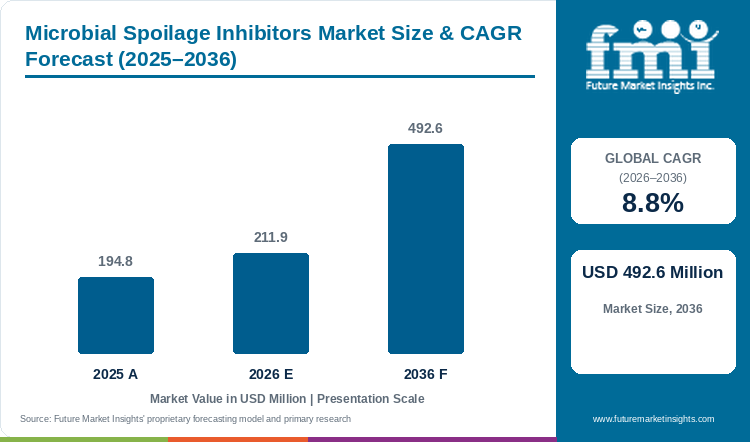
FMI projects demand for microbial spoilage inhibitors to expand at 8.8% CAGR between 2026 and 2036. Industry value grows from USD 194.8 million in 2025 to USD 211.9 million in 2026 and is projected to reach USD 492.6 million by 2036.
Increasing movement of produce through packhouses is boosting demand for microbial spoilage inhibitors. USDA Economic Research Service reported in April 2025 that per-capita vegetable and pulse availability declined to 376 pounds in 2024, while fresh vegetables accounted for 148 pounds per person. [5] Microbial spoilage inhibitors market is anticipated to increase from USD 211.9 million in 2026 to USD 492.6 million by 2036 at 8.8% CAGR. The category is becoming more mature as packhouses use coatings, wash and drench treatments, storage-room treatments and active packaging according to crop and holding period. Application is spreading from packhouse to storage and transit & retail when produce requires longer protection. Microbial spoilage inhibitors market is anticipated to increase from USD 211.9 million in 2026 to USD 492.6 million by 2036 at 8.8% CAGR. The category is becoming more mature as packhouses use coatings, wash and drench treatments, storage-room treatments and active packaging according to crop and holding period. Application is spreading from packhouse to storage and transit & retail when produce requires longer protection.
Shifting preference towards lower-residue systems and edible coatings is increasing demand for premium-grade microbial spoilage inhibitors. MAFRA reported in April 2026 that Korean grape, strawberry, pear and paprika exports reached 590 tonnes in 2025, with 10% growth targeted for 2026. [4] Regional buying differs by route and operating requirement, as South Korean operators require longer export protection whereas USA packhouses compare products with sanitation and audit controls. However, product performance alone does not complete the purchase decision. Crop authorization, residue condition, treatment-waste disposal, line compatibility and documented operating practice are some of the major factors considered before an inhibitor moves from trial into packhouse use.
Key Takeaways
- Increasing produce loss is boosting the spending on microbial spoilage inhibitors when the treatment helps in keeping more fruits and vegetables suitable for sale.
- Edible coatings are expected to hold 46.4% of product type revenue in 2026 owing to its barrier protection and treatment properties in one application.
- Pome & stone fruit are projected to account for 35.4% of commodity demand in 2026 due to longer storage period and increasing exposure towards decay.
- Packhouse application is estimated to hold 41.6% share in 2026 as treatment timing, dose and surface coverage can be controlled at the packing stage.
- South Korea microbial spoilage inhibitors market is forecast to grow at 8.5% CAGR owing to longer export routes, whereas USA is projected to register 8.2% CAGR under warehouse sanitation controls.
- FMI analysis identifies DECCO (UPL), AgroFresh, Xeda International, Citrosol, JBT Marel, StePacPPC, and Janssen PMP as notable companies in the Microbial Spoilage Inhibitors Market.
Analyst Perspective
“Microbial spoilage inhibitors helps packhouses in protecting saleable fruits and vegetables without addition of a separate work on the packing line. Consistent performance on different crops and clear residue requirements will further increase the adoption of these products.”
- Nandini Roy Choudhury, Principal Consultant, Future Market Insights.
How is the microbial spoilage inhibitors market segmented?
Microbial Spoilage Inhibitors Market is segmented by five primary commercial axes and region: product type, commodity, application point, technology base, sales channel, and region. In 2026, edible coatings are estimated at 46.4% of product type; pome & stone fruit at 35.4% of commodity; packhouse at 41.6% of application point; biological / microbial at 48.6% of technology base; and packhouse suppliers at 45.6% of sales channel.
Based on product type, microbial spoilage inhibitors market is segmented into edible coatings, active sachets & liners, wash & drench treatments, storage-room treatments and others.
Commodity includes microbial spoilage inhibitors market is segmented into pome & stone fruit, citrus, berries & grapes, tropical fruit, vegetables and others.
Based on application point, microbial spoilage inhibitors market is segmented into packhouse, storage facility, transit & retail and others.
By technology base, microbial spoilage inhibitors market is segmented into biological / microbial, plant-extract-based, mineral & wax-based and others.
Based on sales channel, microbial spoilage inhibitors market is segmented into packhouse suppliers, post-harvest service providers, direct sales and others.
On the basis of region, microbial spoilage inhibitors market is segmented into North America, Latin America, Western Europe, Eastern Europe, East Asia, South Asia and Pacific, and Middle East and Africa.
Why do edible coatings retain demand within the product type category?
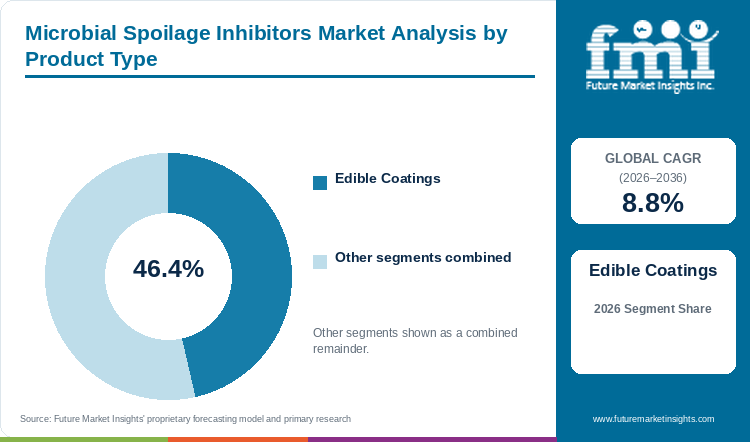
Edible coatings are projected to hold 46.4% of product type revenue in 2026, supported by barrier and treatment functions.
Edible coatings are thin layers which are applied on the surface of fruits and vegetables during washing or finishing process. These coatings reduces moisture loss from the produce and can also carry an approved spoilage treatment. As a result, packhouses can provide barrier protection and microbial treatment through one application without adding a separate preservation step. Edible films and coatings are selected according to drying time, surface feel and crop requirement. These advantages of edible coatings are expected to drive the segment growth during the forecast period.
- Edible coatings are projected to hold 46.4% of product type revenue in 2026 due to its increasing application for surface protection and spoilage treatment.
- However, longer drying time, unsuitable surface feel and crop residue requirement may limiting the adoption of edible coatings in some packhouses.
What supports pome & stone fruit demand within the commodity category?
Pome & stone fruit are estimated at 35.4% of commodity demand in 2026, owing to longer storage and decay exposure.
Pome and stone fruits are commonly stored for a longer period after packing, due to which microbial decay can continue before the produce reaches the consumer. Food coating ingredients are used for providing surface protection when the formulation remains suitable for the fruit and required holding period. Decay occurring at the later stage results in higher loss as packing and storage cost has already been spent. Increasing requirement to reduce such late storage losses is expected to support the pome & stone fruit segment.Pome and stone fruits are commonly stored for a longer period after packing, due to which microbial decay can continue before the produce reaches the consumer. Food coating ingredients are used for providing surface protection when the formulation remains suitable for the fruit and required holding period. Decay occurring at the later stage results in higher loss as packing and storage cost has already been spent. Increasing requirement to reduce such late storage losses is expected to support the pome & stone fruit segment.
- Pome & stone fruit are estimated to account for 35.4% of commodity demand in 2026 owing to longer storage period and higher cost associated with late decay losses.
- Long storage period increases the effect of treatment failure as microbial decay may appear after packing and storage cost has already been incurred.
How does packhouse use shape demand within the application point category?
Packhouse is expected to represent 41.6% of application point demand in 2026, enabled by controlled treatment timing and coverage.
Packhouse is a prominent application point for microbial spoilage inhibitors as treatment can be applied before the produce enters storage or dispatch. The packhouse operators can adjust treatment dose and coverage during the same stage used for produce packaging. For instance, in September 2025, Citrosol presented CATsystem for adjusting treatment-bath concentration in real time when crop load changes. Increasing use of dosing and treatment-control systems is expected to drive the packhouse segment over the forecast period.
- Packhouse is projected to hold 41.6% of application point demand in 2026 owing to better control over treatment timing, dose and coverage.
- Real-time dosing control reduces variation in treatment when crop load and bath concentration changes during the packing operation.
Why are biological / microbial systems selected within the technology base category?
Biological / microbial systems are forecast at 48.6% of technology base demand in 2026, linked to lower-residue treatment preferences.
Biological / microbial systems are preservation products which uses biological agents for controlling post-harvest decay. These systems has gained popularity among packers owing to increasing preference for lower-residue products and limited use of some active ingredients. For instance, AgroFresh and Biotalys announced a collaboration in May 2025 for post-harvest biological fungicides. Antimicrobial packaging ingredients controls microbial activity through packaging, whereas biological treatments are applied directly on the produce. Rising demand for lower-residue treatment is expected to fuel the biological / microbial systems segment.Biological / microbial systems are preservation products which uses biological agents for controlling post-harvest decay. These systems has gained popularity among packers owing to increasing preference for lower-residue products and limited use of some active ingredients. For instance, AgroFresh and Biotalys announced a collaboration in May 2025 for post-harvest biological fungicides. Antimicrobial packaging ingredients controls microbial activity through packaging, whereas biological treatments are applied directly on the produce. Rising demand for lower-residue treatment is expected to fuel the biological / microbial systems segment.
- Biological / microbial systems are forecast to account for 48.6% of technology base demand in 2026 owing to increasing preference for lower-residue preservation products.
- In May 2025, AgroFresh and Biotalys entered into collaboration for biological fungicides used in post-harvest fresh-produce treatment.
Which conditions support packhouse suppliers within the sales channel category?
Packhouse suppliers are projected to hold 45.6% of sales channel demand in 2026, reinforced by bundled products and service.
Packhouse suppliers provide spoilage-treatment products along with dosing adjustment, treatment-line support and training to the operators. Change in seasonal crops can require different product dose and line setting, due to which supplier support becomes important for packhouses. Smaller packhouses having limited technical staff are mainly dependent on these suppliers, while larger operators may conduct product trial and direct purchasing. Availability of products and service from one supplier is anticipated to support the packhouse supplier sales channel.
- Packhouse suppliers are projected to hold 45.6% of sales channel demand in 2026 owing to bundled treatment products, line support and operator training.
- Direct sales are mainly preferred by large packhouses having internal teams for treatment dosing, product trial and purchasing activities.
What are the drivers, restraints, and opportunities in the microbial spoilage inhibitors market?
In the microbial spoilage inhibitors market the key driver is produce loss while qualification is the restraint and lower-residue preservation is the opportunity.
- Driver: Packers spend on spoilage control if the extra saleable output covers treatment cost and added line work.
- Driver: Increasing loss of fresh fruits and vegetables is one of the primary factor driving the demand for microbial spoilage inhibitors.
- Restraint: Crop authorization, residue requirement and disposal of treatment waste may hamper the adoption of new microbial spoilage inhibitor products.
- Opportunity: Rising preference for lower-residue and biological treatment is expected to create new avenues for microbial spoilage inhibitors market.
Mold, pests and poor storage condition reduces the quantity of fruits and vegetables which remains suitable for sale after harvesting. In January 2025, USDA Economic Research Service updated its food-loss system and included mold, pests and poor climate control after harvest among the causes of food loss. Freshness control packaging protects produce quality during distribution, whereas microbial spoilage inhibitors are used at the packhouse stage for controlling decay. The treatment is adopted when the additional saleable produce can cover its cost and line work. Increasing requirement to reduce rejected cartons is anticipated to drive the microbial spoilage inhibitors market.
A new treatment can perform well in laboratory tests and still move slowly into commercial use. UK Health and Safety Executive guidance requires applicants to assess exposure from warehouse venting and industrial processing. The guidance also covers waste from dipping or drenching solutions. Packers must confirm crop authorization and disposal practice before changing a program. Qualification work can consume much of a short packing season.
Crop authorization and treatment-waste disposal are some of the major challenges for new microbial spoilage inhibitors. A product can perform well in laboratory test; however, its commercial adoption requires approval for the respective crop and a suitable method for handling the remaining solution. UK Health and Safety Executive guidance covers exposure from warehouse venting and industrial processing along with waste generated from dipping or drenching treatments. The packing season of many crops is short and longer approval work can delay the replacement of an existing treatment. These factors may hamper the adoption of new microbial spoilage inhibitor products.
Lower-residue and biological routes gain interest among packers that need to meet residue limits without replacing core line equipment. The UK Pesticides National Action Plan 2025 gives preference to biological or other non-chemical methods that are effective. Modified atmosphere packaging manages storage conditions around fresh produce during distribution. According to FMI analysis, adoption can broaden as biological programs match established decay control and fit existing packhouse equipment.
Which country CAGRs are included in the Microbial Spoilage Inhibitors Market?
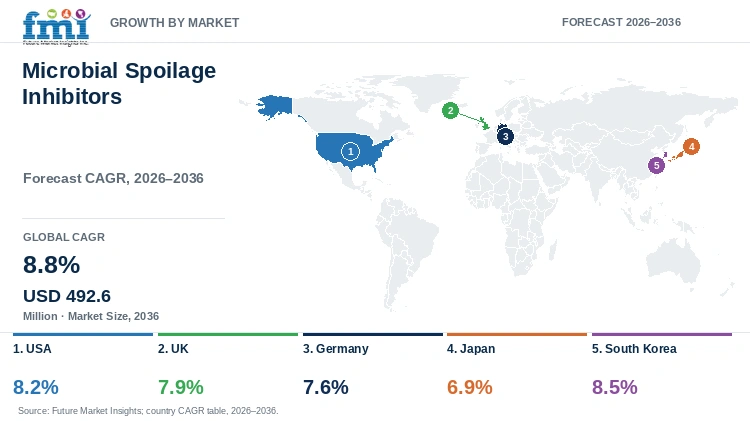
| Country | CAGR |
|---|---|
| USA | 8.2% |
| UK | 7.9% |
| Germany | 7.6% |
| Japan | 6.9% |
| South Korea | 8.5% |
How do country-level CAGRs compare in the microbial spoilage inhibitors market?
Country demand differs because distribution length and local rules change what packers need from a preservation program. Export-heavy systems place more value on protection that lasts through longer storage. Domestic packhouses place more weight on crop authorization and documented operating practice before replacing an established program.
- USA packers compare treatment performance with warehouse sanitation and audit controls before changing established programs.
- On the basis of country, microbial spoilage inhibitors demand differs according to fresh-produce production, storage period, export route and treatment regulation. Exporting countries requires preservation products for longer storage and transportation, while domestic packhouses largely select products according to crop authorization and existing treatment operation. USA, UK, Germany, Japan and South Korea are expected to witness different growth rates owing to these factors during the forecast period.
- German packers track residue-limit changes because revised limits can remove treatment options for high-volume fruit crops.
- Japanese handlers protect appearance and firmness because longer holding periods increase the cost of quality loss.
- South Korean operators pair atmosphere management with cold-chain handling to protect produce during longer export routes.
Full report country CAGRs cover: North America; Latin America; Western Europe; Eastern Europe; East Asia; South Asia and Pacific; Middle East and Africa.
Country-wise Analysis
- USA packers handle large fresh-market fruit volumes, so small decay losses can remove many saleable cartons from warehouse programs. Demand is forecast to expand at 8.2% CAGR during the forecast period as established handling systems keep treatment use tied to daily packout. USDA NASS reported in May 2026 that 7.27 billion pounds of the 2025 apple crop went to the fresh market. The volume raises the cost of inconsistent decay control because treatment failures can affect many cartons quickly. Freshness-indicating packaging can signal quality changes later in distribution networks. Spoilage inhibitors act earlier by limiting microbial decay at the packhouse stage. Packers are more likely to change programs once crop performance is clear and cleaning remains practical.
- USA microbial spoilage inhibitors market is expected to grow at 8.2% CAGR during the forecast period. Large quantity of fresh-market apples are handled in the country, due to which microbial decay in a small portion can also reduce several saleable cartons. According to USDA NASS, 7.27 billion pounds of the 2025 apple crop went to fresh market, which was reported in May 2026. Freshness-indicating packaging shows quality change later in distribution, whereas microbial spoilage inhibitors are applied earlier during packhouse treatment. Presence of large apple production and established packhouse systems is anticipated to drive the market growth in USA.
- UK microbial spoilage inhibitors market is projected to register 7.9% CAGR over the assessment period. The country has commercial fruit production which requires protection during packing and storage. In June 2026, Defra reported that UK fruit production reached 577 thousand tonnes in 2025. Packhouses selects spoilage treatments according to crop authorization, residue condition and disposal requirement for dipping or drenching solution. Availability of authorized products and practical disposal method is expected to support the microbial spoilage inhibitors market in UK.
- Germany microbial spoilage inhibitors market is anticipated to grow at 7.6% CAGR by 2036. Germany has large apple production and changing residue requirements around pome fruit, which affects the selection of decay-control products. Destatis reported in December 2025 that Germany harvested 1.138 million tonnes of apples in 2025. In April 2025, BVL restricted several penconazole uses in pome fruit following new residue limits. The restriction covered field uses and did not include post-harvest treatment. However, changing residue limits increases the need for crop-specific evidence, which is expected to influence the microbial spoilage inhibitors demand in Germany.
- Japan microbial spoilage inhibitors market is estimated to expand at 6.9% CAGR between 2026 and 2036. Appearance and firmness are important factors for fresh produce in Japan, due to which quality retention is required during longer storage. In May 2026, NARO reported that genome-edited melons retained green rinds and firm flesh for more than one month following harvest. The study was related to shelf-life traits and did not test microbial spoilage inhibitors. Increasing demand for longer selling period is expected to support crop-specific preservation products in Japan.
Who are the notable companies in the microbial spoilage inhibitors market?
DECCO (UPL), AgroFresh, Xeda International, Citrosol, JBT Marel, StePacPPC, and Janssen PMP are notable companies in the Microbial Spoilage Inhibitors Market.
The global microbial spoilage inhibitors market is fragmented owing to presence of several regional and global players offering different post-harvest preservation products. A 2025 N2OFF filing also described the wider post-harvest sector as fragmented and identified five large global players. AgroFresh and DECCO are engaged in decay-control chemistry and packhouse support. Citrosol and JBT Marel offers preservation products with dosing or coating equipment, whereas smaller specialists are focusing on crop-specific products and application methods. The market players are expanding its product portfolio and technical service in order to increase customer base and market share.The global microbial spoilage inhibitors market is fragmented owing to presence of several regional and global players offering different post-harvest preservation products. A 2025 N2OFF filing also described the wider post-harvest sector as fragmented and identified five large global players. AgroFresh and DECCO are engaged in decay-control chemistry and packhouse support. Citrosol and JBT Marel offers preservation products with dosing or coating equipment, whereas smaller specialists are focusing on crop-specific products and application methods. The market players are expanding its product portfolio and technical service in order to increase customer base and market share.
- Packhouse treatment platforms: DECCO (UPL), AgroFresh, and Citrosol combine decay-control products with application support for commercial packhouses.
- Coating and application specialists: Xeda International and JBT Marel supply coatings, fogging systems, dosing equipment, and line-based preservation tools.
- Controlled-environment formats: StePacPPC supplies atmosphere-control packaging, while Janssen PMP supplies post-harvest crop-management products.
Competitive Benchmarking: Microbial Spoilage Inhibitors Market
| Company | Decay-Control Chemistry | Coating / Active Formats | Application & Storage Integration | Geographic Reach |
|---|---|---|---|---|
| DECCO (UPL) | High | High | High | High |
| AgroFresh | High | High | High | High |
| Xeda International | High | High | Medium | Medium |
| Citrosol | Medium | High | High | High |
| JBT Marel | Medium | High | High | High |
| StePacPPC | Low | High | Medium | High |
| Janssen PMP | High | Medium | Medium | Medium |
High rating shows broad documented capability in the respective benchmark area. Medium rating indicates a comparatively narrower but supported role, whereas Low rating means limited direct evidence for the area. The ratings are based on documented products, present company activity and geographic reach and does not represent product quality or company market share.
Key Developments in the Microbial Spoilage Inhibitors Market
- In March 2026, AgroFresh presented SmartCitrus program at Citrus Showcase with fungicides, coatings, treatment equipment and digital quality tools for citrus packhouses. Expansion of the program is expected to support the company product portfolio for citrus preservation.
- In March 2026, StePacPPC announced a regional office in Hermosillo, Mexico with local inventory and technical support for produce customers. The office started operation in November 2025 and provides growers and packers in northern Mexico with closer access to products and services.
- In September 2025, DECCO announced a new production plant in Valencia, Spain, with operations planned for October 2025. The expansion of production facility is expected to support the supply and delivery of post-harvest products.
Key Players in the Microbial Spoilage Inhibitors Market
Packhouse Treatment & Application Platforms
- DECCO (UPL)
- AgroFresh
- Citrosol
Coatings, Fogging & Application Specialists
- Xeda International
- JBT Marel
Controlled-Environment & Active-Packaging Specialists
- StePacPPC
- Janssen PMP
Microbial Spoilage Inhibitors Market - Report scope
| Coverage field | Report scope |
|---|---|
| Market breakdown | By product type, commodity, application point, technology base, sales channel and region. |
| Quantitative Units | USD million. |
| Market Definition | Revenue includes microbial spoilage inhibitor products sold for post-harvest fresh-produce preservation within the stated segmentation universe. It excludes downstream produce revenue, preharvest crop protection, ordinary packaging without a spoilage-inhibiting function, general cold-chain equipment, processed-food preservatives, and adjacent substitute products. |
| Regions Covered | North America, Latin America, Western Europe, Eastern Europe, East Asia, South Asia and Pacific, and Middle East and Africa. |
| Countries Covered | USA, UK, Germany, Japan, South Korea, and more than twenty-five additional countries in the full report. |
| Key Companies Profiled | DECCO (UPL), AgroFresh, Xeda International, Citrosol, JBT Marel, StePacPPC, Janssen PMP. |
| Forecast Period | 2026 to 2036. |
| Approach | Primary and secondary research with market triangulation. |
Microbial Spoilage Inhibitors Market - Research Methodology
| Method | Approach |
|---|---|
| Primary Research | FMI analysts gathered input from manufacturers, service providers, technology developers, distributors, end users, procurement teams, and subject-matter experts. Interviews examined purchasing decisions, product or service evaluation, adoption barriers, approval requirements, pricing considerations, and expectations for technical or commercial support. Respondents were also asked what evidence is required before a trial, pilot, or initial order develops into regular purchasing. |
| Desk Research | Desk research covered government statistics, regulatory publications, trade data, industry associations, technical literature, standards, company filings, product information, and official corporate announcements. Sources were reviewed for relevance, publication date, geographic coverage, and consistency with the defined market scope. Claims relating to performance, applications, approvals, capacity, investment, and commercial activity were retained only when supported by credible public evidence. |
| Market Sizing and Forecasting | The market model combined the baseline value with historical performance, segment structure, pricing and volume indicators, adoption levels, company participation, and country-level demand conditions. Forecast assumptions considered economic activity, investment trends, regulatory developments, technology adoption, purchasing cycles, supply availability, and barriers to wider market use. Segment and regional estimates were reconciled before the final market total was calculated. |
| Data Validation | Estimates were checked against multiple independent indicators, including public data, company activity, trade patterns, industry developments, and findings from primary interviews. Validation also tested whether products, services, applications, and company revenues fell within the defined market boundaries. Adjacent categories, unsupported claims, overlapping revenues, and activities without direct market relevance were excluded to reduce double counting and maintain consistency across segments and countries. |
Microbial Spoilage Inhibitors Market by Segments
Microbial Spoilage Inhibitors Market segmented by Product Type:
- Edible Coatings
- Active Sachets & Liners
- Wash & Drench Treatments
- Storage-Room Treatments
- Others
Microbial Spoilage Inhibitors Market segmented by Commodity:
- Pome & Stone Fruit
- Citrus
- Berries & Grapes
- Tropical Fruit
- Vegetables
- Others
Microbial Spoilage Inhibitors Market segmented by Application Point:
- Packhouse
- Storage Facility
- Transit & Retail
- Others
Microbial Spoilage Inhibitors Market segmented by Technology Base:
- Biological / Microbial
- Plant-Extract-Based
- Mineral & Wax-Based
- Others
Microbial Spoilage Inhibitors Market segmented by Sales Channel:
- Packhouse Suppliers
- Post-Harvest Service Providers
- Direct Sales
- Others
Microbial Spoilage Inhibitors Market by Region:
- North America
- United States
- Canada
- Latin America
- Brazil
- Mexico
- Argentina
- Chile
- Western Europe
- Germany
- France
- United Kingdom
- Italy
- Spain
- Benelux
- Nordics
- Eastern Europe
- Poland
- Czech Republic
- Romania
- Hungary
- East Asia
- China
- Japan
- South Korea
- South Asia and Pacific
- India
- ASEAN
- Australia and New Zealand
- Middle East and Africa
- GCC Countries
- South Africa
- Türkiye
- Israel
Research Sources and Bibliography
- [1] Food and Agriculture Organization of the United Nations. (2025, September 29). On the International Day of Awareness of Food Loss and Waste, learn how FAO is leveraging data to save food and advance the 2030 Agenda.
- [2] U.S. Department of Agriculture, Agricultural Marketing Service. (2025, July 3). Harmonized GAP.
- [3] Health and Safety Executive. (2025, January 8). Post-harvest treatments: Environmental fate considerations for pesticide registration in Great Britain and Northern Ireland.
- [4] Ministry of Agriculture, Food and Rural Affairs, Republic of Korea. (2026, April 3). Korean-developed New Varieties of Agricultural Produce Boost Export Market Diversification.
- [5] U.S. Department of Agriculture, Economic Research Service. (2025, April 24). Vegetables and Pulses Outlook: April 2025.
- U.S. Department of Agriculture, National Agricultural Statistics Service. (2026, May 1). Noncitrus Fruits and Nuts 2025 Summary.
- Department for Environment, Food & Rural Affairs. (2026, June 25). Horticulture statistics 2025.
- Department for Environment, Food & Rural Affairs, Scottish Government, Welsh Government, & Northern Ireland Executive. (2025, October 24). UK Pesticides National Action Plan 2025: Working for a more sustainable future.
- Federal Statistical Office (Destatis). (2025, December 19). Areas and quantities harvested (production for the market).
- Bundesamt für Verbraucherschutz und Lebensmittelsicherheit. (2025, April 25). Teilwiderruf und Einschränkung der Zulassung von Pflanzenschutzmitteln mit dem Wirkstoff Penconazol hinsichtlich der Anwendungen in Kernobst.
- National Agriculture and Food Research Organization. (2026, May 26). Long-lasting melons developed through genome editing.
- Rural Development Administration, Republic of Korea. (2025, September 26). [Korean fresh grapes enter Vietnam distribution network using controlled-atmosphere technology].
- AgroFresh Solutions, Inc., & Biotalys. (2025, May 20). Biotalys and AgroFresh Partner to Protect Fresh Produce.
- AgroFresh Solutions, Inc. (2026, March 10). AgroFresh to Demonstrate Leading Portfolio of Citrus Protection Solutions at Citrus Showcase.
- AgroFresh Solutions, Inc., & Nabaco, Inc. (2025, June 18). AgroFresh Expands Global Post-Harvest Solutions Portfolio with NatuWrap® in Exclusive Distribution Agreement with Nabaco®.
- DECCO. (2025, September 23). DECCO Expands Global Footprint with New Plant in Valencia, Spain.
- DECCO. (2025, January 21). DECCO Ibérica receives the registration for DECCO Zox: First Product formulated with Azoxystrobin in Europe in Postharvest Citrus Protection.
- Citrosol. (2025, September 11). Citrosol renews itself at Fruit Attraction 2025 and premieres location in Hall 10.
- JBT Marel. (2026, January 26). Inside the mind of a postharvest expert.
- JBT Marel Corporation. (2026, March 2). Annual report on Form 10-K for the year ended December 31, 2025.
- StePacPPC. (2026, March 6). StePacPPC Opens New Regional Office in Hermosillo, Mexico.
- StePacPPC. (2026, January 19). StePacPPC’s Advanced Packaging Extends Global Access of Dragon Fruit.
- Janssen PMP. (2025, September 25). Janssen PMP announces Leadership Transition: Retirement of Joan Jørgensen and Appointment of New General Manager.
- Agence nationale de sécurité sanitaire de l’alimentation, de l’environnement et du travail. (2026, July 6). XEDATHANE-HN XEDA INTERNATIONAL.
- N2OFF, Inc. (2025, March 31). Form 10-K: Annual report for the fiscal year ended December 31, 2024. U.S. Securities and Exchange Commission.
This bibliography is provided for reader reference. The full report contains the complete reference list and detailed citations.
This Report Answers
- What is the Microbial Spoilage Inhibitors Market value expected in 2026?
- What market value is projected for microbial spoilage inhibitors by 2036?
- Which product type holds a notable microbial spoilage inhibitor share?
- Which countries show notable microbial spoilage inhibitor expansion through 2036?
- Which companies are active in the microbial spoilage inhibitors market?
- What does the microbial spoilage inhibitors market scope include and exclude?
Frequently Asked Questions
How big is the Microbial Spoilage Inhibitors Market in 2026?
The Microbial Spoilage Inhibitors Market is expected to reach USD 211.9 million in 2026.
What CAGR is projected for microbial spoilage inhibitors through 2036?
The Microbial Spoilage Inhibitors Market is projected to expand at 8.8% CAGR from 2026 through 2036.
Which product type holds a notable inhibitor share in 2026?
Edible coatings are expected to hold 46.4% of product type revenue in 2026 because one step combines barrier protection with treatment.
Which application point holds a notable inhibitor share in 2026?
Packhouse is expected to represent 41.6% of application point demand in 2026 because treatment timing and coverage are easier to control.
Which country has a notable microbial spoilage inhibitor growth outlook?
South Korea is forecast to expand at 8.5% CAGR through 2036 as controlled-atmosphere logistics support longer distribution programs.
Which companies are notable in the Microbial Spoilage Inhibitors Market?
DECCO (UPL), AgroFresh, Xeda International, Citrosol, JBT Marel, StePacPPC, and Janssen PMP are notable companies in the defined market scope.
Preview the report firsthand - request a free sample
Get SampleGet the brochure for pricing and purchase details.
Get PDFTable of Content
- Key Takeaways
- Market Size and CAGR
- Top Growth Driver
- Fastest Growing Segment
- Leading Region
- Key Companies
- Emerging Opportunities
- Executive Summary
- Global Market Outlook
- Demand-side Trends
- Supply-side Trends
- Technology Roadmap Analysis
- Analysis and Recommendations
- Analyst Perspective (What is happening? Why now? What should investors know?)
- Key Questions Answered
- How large is the market?
- What is the CAGR?
- What are key trends?
- Which region dominates?
- Who are the leaders?
- Market Overview
- Market Coverage / Taxonomy
- Market Definition / Scope / Limitations
- Research Methodology
- Chapter Orientation
- Analytical Lens and Working Hypotheses
- Market Structure, Signals, and Trend Drivers
- Benchmarking and Cross-market Comparability
- Market Sizing, Forecasting, and Opportunity Mapping
- Research Design and Evidence Framework
- Desk Research Programme (Secondary Evidence)
- Expert Input and Fieldwork (Primary Evidence)
- Tooling, Models, and Reference Databases
- Data Engineering and Model Build
- Quality Assurance and Audit Trail
- Market Background
- Market Dynamics (Drivers, Restraints, Opportunity, Trends)
- Scenario Forecast (Optimistic, Likely, Conservative)
- Impact Analysis
- AI Impact
- Sustainability Impact
- Regulatory Impact
- Technology Impact
- Consumer / Buyer Analysis
- Purchase Drivers
- Adoption Barriers
- Buyer Journey
- Opportunity Map Analysis
- Product Life Cycle Analysis
- Supply Chain Analysis
- Investment Feasibility Matrix
- Value Chain Analysis
- PESTLE and Porter's Analysis
- Regulatory Landscape
- Regional Parent Market Outlook
- Production and Consumption Statistics
- Import and Export Statistics
- Global Market Analysis and Forecast, 2021 to 2036
- Historical Market Size Value (USD Million) Analysis, 2021 to 2025
- Current and Future Market Size Value (USD Million) Projections, 2026 to 2036
- Y-o-Y Growth Trend Analysis
- Absolute $ Opportunity Analysis
- Global Market Pricing Analysis, 2021 to 2036
- Global Market Analysis and Forecast, By Product Type, 2021 to 2036
- Introduction / Key Findings
- Historical Market Size Value (USD Million) Analysis By Product Type, 2021 to 2025
- Current and Future Market Size Value (USD Million) Analysis and Forecast By Product Type, 2026 to 2036
- Edible Coatings
- Active Sachets & Liners
- Wash & Drench Treatments
- Storage-Room Treatments
- Others
- Y-o-Y Growth Trend Analysis By Product Type, 2021 to 2025
- Absolute $ Opportunity Analysis By Product Type, 2026 to 2036
- Global Market Analysis and Forecast, By Commodity, 2021 to 2036
- Introduction / Key Findings
- Historical Market Size Value (USD Million) Analysis By Commodity, 2021 to 2025
- Current and Future Market Size Value (USD Million) Analysis and Forecast By Commodity, 2026 to 2036
- Pome & Stone Fruit
- Citrus
- Berries & Grapes
- Tropical Fruit
- Vegetables
- Others
- Y-o-Y Growth Trend Analysis By Commodity, 2021 to 2025
- Absolute $ Opportunity Analysis By Commodity, 2026 to 2036
- Global Market Analysis and Forecast, By Application Point, 2021 to 2036
- Introduction / Key Findings
- Historical Market Size Value (USD Million) Analysis By Application Point, 2021 to 2025
- Current and Future Market Size Value (USD Million) Analysis and Forecast By Application Point, 2026 to 2036
- Packhouse
- Storage Facility
- Transit & Retail
- Others
- Y-o-Y Growth Trend Analysis By Application Point, 2021 to 2025
- Absolute $ Opportunity Analysis By Application Point, 2026 to 2036
- Global Market Analysis and Forecast, By Technology Base, 2021 to 2036
- Introduction / Key Findings
- Historical Market Size Value (USD Million) Analysis By Technology Base, 2021 to 2025
- Current and Future Market Size Value (USD Million) Analysis and Forecast By Technology Base, 2026 to 2036
- Biological / Microbial
- Plant-Extract-Based
- Mineral & Wax-Based
- Others
- Y-o-Y Growth Trend Analysis By Technology Base, 2021 to 2025
- Absolute $ Opportunity Analysis By Technology Base, 2026 to 2036
- Global Market Analysis and Forecast, By Sales Channel, 2021 to 2036
- Introduction / Key Findings
- Historical Market Size Value (USD Million) Analysis By Sales Channel, 2021 to 2025
- Current and Future Market Size Value (USD Million) Analysis and Forecast By Sales Channel, 2026 to 2036
- Packhouse Suppliers
- Post-Harvest Service Providers
- Direct Sales
- Others
- Y-o-Y Growth Trend Analysis By Sales Channel, 2021 to 2025
- Absolute $ Opportunity Analysis By Sales Channel, 2026 to 2036
- Global Market Analysis and Forecast, By Region, 2021 to 2036
- Introduction
- Historical Market Size Value (USD Million) Analysis By Region, 2021 to 2025
- Current Market Size Value (USD Million) Analysis and Forecast By Region, 2026 to 2036
- North America
- Latin America
- Western Europe
- Eastern Europe
- East Asia
- South Asia and Pacific
- Middle East and Africa
- Market Attractiveness Analysis By Region
- North America Market Analysis and Forecast, By Country, 2021 to 2036
- Historical Market Size Value (USD Million) Trend Analysis By Market Taxonomy, 2021 to 2025
- Market Size Value (USD Million) Forecast By Market Taxonomy, 2026 to 2036
- By Country
- United States
- Canada
- By Product Type
- By Commodity
- By Application Point
- By Technology Base
- By Sales Channel
- By Country
- Market Attractiveness Analysis
- By Country
- By Product Type
- By Commodity
- By Application Point
- By Technology Base
- By Sales Channel
- Key Takeaways
- Latin America Market Analysis and Forecast, By Country
- Historical Market Size Value (USD Million) Trend Analysis By Market Taxonomy, 2021 to 2025
- Market Size Value (USD Million) Forecast By Market Taxonomy, 2026 to 2036
- By Country
- Brazil
- Mexico
- Argentina
- Chile
- By Product Type
- By Commodity
- By Application Point
- By Technology Base
- By Sales Channel
- By Country
- Market Attractiveness Analysis
- By Country
- By Product Type
- By Commodity
- By Application Point
- By Technology Base
- By Sales Channel
- Key Takeaways
- Western Europe Market Analysis and Forecast, By Country
- Historical Market Size Value (USD Million) Trend Analysis By Market Taxonomy, 2021 to 2025
- Market Size Value (USD Million) Forecast By Market Taxonomy, 2026 to 2036
- By Country
- Germany
- France
- United Kingdom
- Italy
- Spain
- Benelux
- Nordics
- By Product Type
- By Commodity
- By Application Point
- By Technology Base
- By Sales Channel
- By Country
- Market Attractiveness Analysis
- By Country
- By Product Type
- By Commodity
- By Application Point
- By Technology Base
- By Sales Channel
- Key Takeaways
- Eastern Europe Market Analysis and Forecast, By Country
- Historical Market Size Value (USD Million) Trend Analysis By Market Taxonomy, 2021 to 2025
- Market Size Value (USD Million) Forecast By Market Taxonomy, 2026 to 2036
- By Country
- Poland
- Czech Republic
- Romania
- Hungary
- By Product Type
- By Commodity
- By Application Point
- By Technology Base
- By Sales Channel
- By Country
- Market Attractiveness Analysis
- By Country
- By Product Type
- By Commodity
- By Application Point
- By Technology Base
- By Sales Channel
- Key Takeaways
- East Asia Market Analysis and Forecast, By Country
- Historical Market Size Value (USD Million) Trend Analysis By Market Taxonomy, 2021 to 2025
- Market Size Value (USD Million) Forecast By Market Taxonomy, 2026 to 2036
- By Country
- China
- Japan
- South Korea
- By Product Type
- By Commodity
- By Application Point
- By Technology Base
- By Sales Channel
- By Country
- Market Attractiveness Analysis
- By Country
- By Product Type
- By Commodity
- By Application Point
- By Technology Base
- By Sales Channel
- Key Takeaways
- South Asia and Pacific Market Analysis and Forecast, By Country
- Historical Market Size Value (USD Million) Trend Analysis By Market Taxonomy, 2021 to 2025
- Market Size Value (USD Million) Forecast By Market Taxonomy, 2026 to 2036
- By Country
- India
- ASEAN
- Australia and New Zealand
- By Product Type
- By Commodity
- By Application Point
- By Technology Base
- By Sales Channel
- By Country
- Market Attractiveness Analysis
- By Country
- By Product Type
- By Commodity
- By Application Point
- By Technology Base
- By Sales Channel
- Key Takeaways
- Middle East and Africa Market Analysis and Forecast, By Country
- Historical Market Size Value (USD Million) Trend Analysis By Market Taxonomy, 2021 to 2025
- Market Size Value (USD Million) Forecast By Market Taxonomy, 2026 to 2036
- By Country
- GCC Countries
- South Africa
- Türkiye
- Israel
- By Product Type
- By Commodity
- By Application Point
- By Technology Base
- By Sales Channel
- By Country
- Market Attractiveness Analysis
- By Country
- By Product Type
- By Commodity
- By Application Point
- By Technology Base
- By Sales Channel
- Key Takeaways
- Key Countries Market Analysis
- United States
- Pricing Analysis
- Market Share Analysis, 2025
- By Product Type
- By Commodity
- By Application Point
- By Technology Base
- By Sales Channel
- Canada
- Pricing Analysis
- Market Share Analysis, 2025
- By Product Type
- By Commodity
- By Application Point
- By Technology Base
- By Sales Channel
- Mexico
- Pricing Analysis
- Market Share Analysis, 2025
- By Product Type
- By Commodity
- By Application Point
- By Technology Base
- By Sales Channel
- Brazil
- Pricing Analysis
- Market Share Analysis, 2025
- By Product Type
- By Commodity
- By Application Point
- By Technology Base
- By Sales Channel
- Chile
- Pricing Analysis
- Market Share Analysis, 2025
- By Product Type
- By Commodity
- By Application Point
- By Technology Base
- By Sales Channel
- Germany
- Pricing Analysis
- Market Share Analysis, 2025
- By Product Type
- By Commodity
- By Application Point
- By Technology Base
- By Sales Channel
- United Kingdom
- Pricing Analysis
- Market Share Analysis, 2025
- By Product Type
- By Commodity
- By Application Point
- By Technology Base
- By Sales Channel
- Italy
- Pricing Analysis
- Market Share Analysis, 2025
- By Product Type
- By Commodity
- By Application Point
- By Technology Base
- By Sales Channel
- Spain
- Pricing Analysis
- Market Share Analysis, 2025
- By Product Type
- By Commodity
- By Application Point
- By Technology Base
- By Sales Channel
- France
- Pricing Analysis
- Market Share Analysis, 2025
- By Product Type
- By Commodity
- By Application Point
- By Technology Base
- By Sales Channel
- India
- Pricing Analysis
- Market Share Analysis, 2025
- By Product Type
- By Commodity
- By Application Point
- By Technology Base
- By Sales Channel
- ASEAN
- Pricing Analysis
- Market Share Analysis, 2025
- By Product Type
- By Commodity
- By Application Point
- By Technology Base
- By Sales Channel
- Australia and New Zealand
- Pricing Analysis
- Market Share Analysis, 2025
- By Product Type
- By Commodity
- By Application Point
- By Technology Base
- By Sales Channel
- China
- Pricing Analysis
- Market Share Analysis, 2025
- By Product Type
- By Commodity
- By Application Point
- By Technology Base
- By Sales Channel
- Japan
- Pricing Analysis
- Market Share Analysis, 2025
- By Product Type
- By Commodity
- By Application Point
- By Technology Base
- By Sales Channel
- South Korea
- Pricing Analysis
- Market Share Analysis, 2025
- By Product Type
- By Commodity
- By Application Point
- By Technology Base
- By Sales Channel
- Poland
- Pricing Analysis
- Market Share Analysis, 2025
- By Product Type
- By Commodity
- By Application Point
- By Technology Base
- By Sales Channel
- Hungary
- Pricing Analysis
- Market Share Analysis, 2025
- By Product Type
- By Commodity
- By Application Point
- By Technology Base
- By Sales Channel
- Türkiye
- Pricing Analysis
- Market Share Analysis, 2025
- By Product Type
- By Commodity
- By Application Point
- By Technology Base
- By Sales Channel
- South Africa
- Pricing Analysis
- Market Share Analysis, 2025
- By Product Type
- By Commodity
- By Application Point
- By Technology Base
- By Sales Channel
- United States
- Market Structure Analysis
- Competition Dashboard
- Competition Benchmarking
- Market Share Analysis of Top Players
- By Regional
- By Product Type
- By Commodity
- By Application Point
- By Technology Base
- By Sales Channel
- Emerging Startups
- Innovation Benchmarking
- Competition Analysis
- Competition Deep Dive
- DECCO (UPL)
- Overview
- Product Portfolio
- Profitability by Market Segments
- Sales Footprint
- Strategy Overview
- Marketing Strategy
- Product Strategy
- Channel Strategy
- AgroFresh
- Xeda International
- Citrosol
- JBT Marel
- StePacPPC
- Janssen PMP
- DECCO (UPL)
- Case Studies
- Success Stories
- Recent Developments
- Competition Deep Dive
- Assumptions & Acronyms Used


