

- Industry Size (2026)
- USD 124.0 Mn
- Forecast (2036)
- USD 418.0 Mn
- CAGR (2026 to 2036)
- 12.9%
Bio-sensor Spoilage Labels Market Forecast and Outlook 2026 to 2036
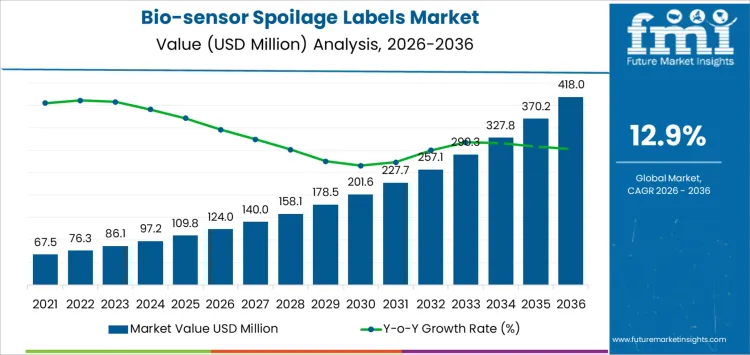
The bio-sensor spoilage labels market is valued at USD 124 million in 2026 and is projected to reach USD 418 million by 2036, reflecting a CAGR of 12.9%. From 2026 to 2031, demand undergoes rapid acceleration, with annual absolute additions rising from approximately USD 14 million to USD 43 million. This phase is driven by increasing regulatory scrutiny and food safety requirements in cold-chain logistics, coupled with growing consumer demand for transparency and real-time product quality monitoring.
Early adoption is concentrated in high-value perishables such as seafood, ready-to-eat meals, and temperature-sensitive pharmaceuticals, where peel-and-stick sensor labels and enzyme-based bio-sensor technologies are deployed in controlled pilot programs. Technological validation, integration with packaging systems, and awareness campaigns by leading brands reinforce adoption during this period, creating a high-growth early-mover phase.
Quick Stats of the Bio-sensor Spoilage Labels Market
- Bio-sensor Spoilage Labels Market Value (2026): USD 124.0 million
- Bio-sensor Spoilage Labels Market Forecast Value (2036): USD 418.0 million
- Bio-sensor Spoilage Labels Market Forecast CAGR (2026 to 2036): 12.9%
- Leading Packaging Format: Peel-and-stick Sensor Labels (55%)
- Key Growth Regions: India, China, USA, Brazil, Germany, Japan
- Top Players: Berlinger / Timestrip, Toppan, Schreiner, Local innovators, UFlex
What is the Growth Forecast for the Bio-sensor Spoilage Labels Market through 2036?
Between 2031 and 2036, the market continues its expansion, increasing from approximately USD 247 million to USD 418 million. Growth in this period reflects broader commercialization across mainstream retail, e-commerce perishables, and large-scale cold-chain operators. The relative acceleration moderates as adoption moves beyond early adopters to wider market segments, including grocery chains, meal kit services, and integrated supply chain operators.
Production scale-up, standardization of label formats, and cost optimization for enzyme-based and colorimetric technologies support high-volume deployment. Furthermore, integration with IoT-enabled monitoring systems enhances real-time traceability, driving repeat orders and sustained procurement. This period reflects a transition from adoption-driven growth to volume-led expansion, with structural market maturity balancing absolute value gains and stabilized acceleration rates.
From 2026 to 2031, the bio-sensor spoilage labels market rises from USD 124 million to USD 220 million, representing the early growth curve characterized by gradual adoption and selective deployment. Growth in this phase is driven primarily by high-value perishables, premium food products, and pharmaceutical packaging where real-time spoilage monitoring is critical. Uptake is cautious, with brands validating label accuracy, adhesive compatibility, and integration with existing packaging lines. Year-on-year gains increase steadily but remain controlled, reflecting measured scaling rather than widespread adoption.
Between 2031 and 2036, the market expands from USD 220 million to USD 418 million, illustrating the late growth curve, where broader commercialization and structural adoption define momentum. Growth accelerates as bio-sensor labels move into mass-market perishables, cold-chain distribution, and larger pharmaceutical portfolios. Annual value additions widen significantly as labels become embedded in standard quality assurance protocols, SKU coverage increases, and procurement becomes repeatable. Early growth relied on selective validation, whereas late-stage expansion is driven by portfolio-wide integration, higher unit penetration, and consistent deployment across global supply chains.
Bio sensor Spoilage Labels Market Key Takeaways
| Metric | Value |
|---|---|
| Sales Value (2026) | USD 124 million |
| Forecast Value (2036) | USD 418 million |
| Forecast CAGR (2026 to 2036) | 12.9% |
What Is Driving the Demand for Bio Sensor Spoilage Labels?
The demand for bio sensor spoilage labels developed historically from persistent limitations in date based expiration systems across food and pharmaceutical supply chains. Traditional labels estimated shelf life without accounting for real storage conditions, leading to avoidable waste and safety risks. Early adoption focused on high value perishables, including meat, seafood, dairy, and temperature sensitive medicines. Biosensor labels offered visual or chemical indicators tied to microbial activity, gas release, or temperature exposure. Growth was supported by stricter food safety enforcement, expansion of cold chain logistics, and retailer accountability for quality losses. Adoption remained selective due to higher unit costs and limited large scale manufacturing capability during earlier commercialization stages.
Future growth for bio sensor spoilage labels is expected to be driven by structural changes rather than experimental adoption. Regulatory pressure to reduce food waste and improve traceability is increasing across major economies. Manufacturers are integrating biosensors into scalable printed electronics platforms, lowering per unit costs and improving consistency. Retailers and logistics operators seek real time condition monitoring to support automated inventory decisions and liability management. Unlike historical growth driven by niche applications, future demand will be volume oriented and compliance driven. Broader use across packaged foods, ready meals, and pharmaceuticals reflects operational needs rather than pilot testing, positioning spoilage labels as functional packaging components rather than optional add ons.
What Factors Are Affecting the Demand for Bio Sensor Spoilage Labels Market in Terms of Packaging Format and Packaging Type?
Packaging format and packaging type jointly structure demand for bio sensor spoilage labels. Simpler attachment formats gain wider adoption due to ease of deployment and minimal workflow disruption. More complex formats address niche monitoring needs where packaging geometry or handling conditions vary. Packaging type acts as a constraint on adoption, favoring materials that support reliable adhesion and sensor visibility. Demand follows existing packaging practices rather than driving packaging change. These factors limit substitution and stabilize usage patterns. Adoption remains concentrated where spoilage risk, handling frequency, and material compatibility align. As a result, demand growth reflects operational fit within established packaging systems rather than rapid shifts in packaging design or monitoring behavior.
What Role Does Packaging Format Play in Shaping Demand for Bio sensor Spoilage Labels Market?
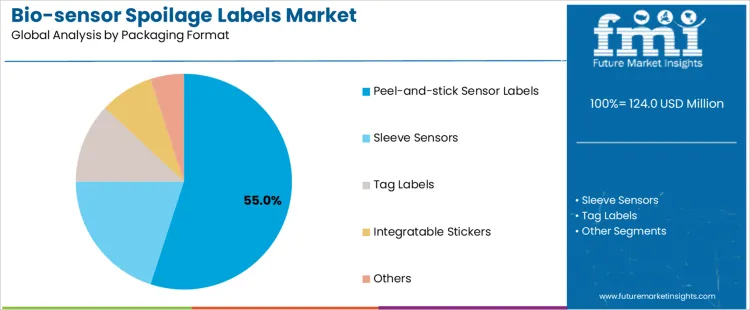
Packaging format demand for bio sensor spoilage labels varies based on attachment method, handling frequency, and monitoring duration. Peel and stick sensor labels account for about 55% of total demand, making them the most widely adopted format. Their usage is driven by compatibility with flat packaging surfaces and post packing application. Sleeve sensors are applied where full container coverage is required, particularly for cylindrical or flexible packs. Tag labels are used in logistics and retail environments where labels must be removable or reassigned. Integratable stickers support applications requiring placement within packaging layers. Format selection reflects ease of deployment and operational efficiency. These formats address differing requirements across food processing, transport, and retail handling stages nationwide.
Peel and stick formats dominate due to minimal disruption to existing packaging workflows. Application does not require changes to packing equipment or material specifications. Sleeve sensors are preferred where labels must remain visible despite condensation or surface irregularities. Tag labels support selective monitoring across batches and temporary tracking needs. Integratable stickers are adopted where permanent placement is required for continuous condition assessment. Format choice depends on handling intensity and monitoring responsibility across supply chain participants. Adoption remains highest where scalability and speed outweigh customization. These dynamics explain why simpler attachment formats maintain higher penetration. Packaging format demand therefore aligns with operational convenience and deployment flexibility rather than performance differentiation alone.
How Does Packaging Type Influence the Adoption of Bio Sensor Spoilage Labels Market?
Packaging type influences spoilage label adoption based on material compatibility and structural design. Rigid packaging supports consistent label adhesion and visibility throughout transport and storage. Flexible packaging requires formats that conform without compromising sensor accuracy. Semi rigid containers used in ready meals and seafood applications demand adaptable placement options. Packaging type determines exposure to moisture, temperature fluctuation, and handling stress. Labels must function reliably across these conditions. Adoption varies by food category and packaging material selection. Packaging type segmentation reflects the physical environment in which spoilage indicators operate rather than end user preference. Demand is therefore shaped by material performance and durability requirements across food supply chains.
Rigid packaging environments show higher adoption due to predictable surface properties. Flexible packaging adoption increases where spoilage risk outweighs application complexity. Semi rigid formats require balance between adhesion strength and sensor readability. Packaging materials influence replacement frequency and monitoring duration. Selection decisions prioritize functional compatibility with packaging materials already in use. Producers avoid formats that introduce packaging redesign or compliance risk. This constrains adoption to compatible label designs. Packaging type therefore acts as a structural filter on demand rather than a growth driver. These factors explain why adoption follows packaging material trends across food categories and distribution models in the market.
How Are Bio Sensor Spoilage Labels Being Used to Monitor Product Quality in Supply Chains?
Use appears in packaging where visual detection of spoilage enhances safety and reduces waste. Food distributors apply bio sensor labels on perishable items such as meat, seafood, and dairy to indicate exposure to temperature abuse. Retailers place them on display units to quickly identify compromised products before sale. Meal kit providers integrate labels to reassure consumers regarding freshness during last mile delivery. These applications reflect operational quality control needs rather than branding or decorative purposes, with adoption grounded in timely spoilage detection and supply chain visibility.
What Operational Conditions Support Adoption of Bio Sensor Spoilage Labels?
Selection aligns with environments requiring passive, easily interpreted indicators. Cold chain operators value labels that respond to cumulative thermal exposure without additional equipment. Retail stores benefit from visual cues that simplify staff inspections and reduce manual sampling. Packaging engineers select labels compatible with carton and flexible packaging surfaces to avoid adhesion or readability issues. Food safety managers rely on labels to supplement HACCP and internal monitoring protocols. These conditions emerge from efficiency, regulatory compliance, and consumer protection priorities within structured distribution and retail systems.
Which Practical Factors Limit Wider Use of Bio Sensor Spoilage Labels?
Accuracy depends on calibration to storage temperature ranges and exposure duration. Cost per label is higher than traditional shelf life indicators, affecting adoption in high volume, low margin products. Label sensitivity can vary with packaging type or humidity. Shelf life before activation is limited, requiring careful storage. Integration with existing packaging lines may require adjustments to prevent damage or misalignment. These factors lead to selective deployment where spoilage visibility, risk mitigation, and operational monitoring outweigh additional cost and complexity.
What is the Demand for Bio Sensor Spoilage Labels by Country?
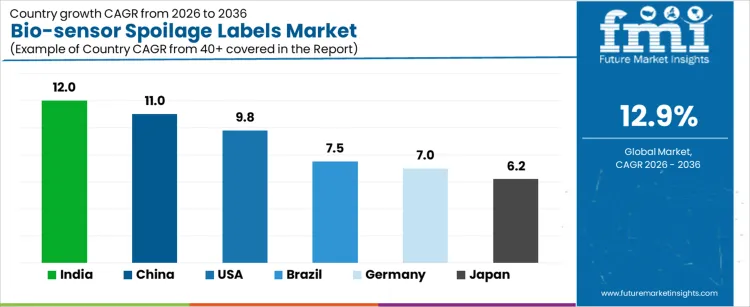
| Country | CAGR (%) |
|---|---|
| USA | 9.8% |
| Japan | 6.2% |
| Germany | 7.0% |
| China | 11.0% |
| India | 12.0% |
| Brazil | 7.5% |
The demand for bio sensor spoilage labels shows varied growth across countries, driven by cold chain monitoring, food safety regulations, and perishable goods distribution. India leads with a 12.0% CAGR, supported by expanding processed food and pharmaceutical logistics, alongside increasing adoption of smart packaging. China follows at 11.0%, driven by large scale food manufacturing and export oriented cold chain systems. The USA grows at 9.8%, reflecting adoption in retail, healthcare, and frozen food sectors. Brazil records 7.5%, shaped by growing packaged food distribution. Germany posts 7.0%, supported by regulated logistics standards, while Japan grows at 6.2%, reflecting mature markets and stable adoption of spoilage monitoring solutions.
How Is Intelligent Packaging Adoption Driving Growth in the United States?
In the United States, revenue from the Bio-sensor Spoilage Labels Market is expanding at a CAGR of 9.80% through 2035, driven by adoption of smart spoilage detection systems in food and beverage packaging. Brands are using bio-sensor labels to monitor freshness, temperature exposure, and microbial spoilage for perishable products. Demand is concentrated in dairy, meat, seafood, and ready-to-eat packaged foods distributed through retail and food service channels. Domestic label manufacturers are integrating bio-sensor technology while maintaining compatibility with standard packaging operations. High consumer safety awareness and recurring replenishment cycles are sustaining predictable procurement across packaging users nationwide.
- Dairy, meat, and seafood producers are adopting bio-sensor labels to monitor product freshness and safety
- Temperature and spoilage detection improves quality assurance and consumer confidence
- Domestic manufacturers integrate bio-sensors compatible with standard packaging lines
- Recurring product replenishment sustains predictable procurement volumes
How Do Precision and Safety Standards Shape Demand in Japan?
Japan is maintaining measured growth in the Bio-sensor Spoilage Labels Market at a CAGR of 6.20% through 2035, supported by strict food safety regulations and quality standards. Manufacturers are using bio-sensor labels for perishable food products such as seafood, dairy, and ready-to-eat meals. Demand remains focused on retail and food service segments where traceability and spoilage detection are critical. Technical expertise in bio-sensor integration ensures reliability and label accuracy. Stable consumption patterns and compliance-driven procurement practices are sustaining predictable adoption across packaging operations nationwide.
- Regulatory standards encourage adoption of bio-sensor labels for perishable products
- Seafood, dairy, and ready-to-eat meals anchor demand
- Technical integration ensures label reliability and accuracy
- Compliance-driven procurement sustains steady adoption levels
How Is Food Supply Chain Expansion Accelerating Adoption in Germany?
Germany continues to record steady growth in the Bio-sensor Spoilage Labels Market at a CAGR of 7.00% through 2035, driven by organized food production and cold chain logistics. Producers are integrating bio-sensor labels to monitor spoilage, temperature fluctuations, and microbial activity in perishable food items. Demand is concentrated in dairy, bakery, meat, and ready-to-eat products distributed through retail networks. Domestic label manufacturers are scaling production with precise bio-sensor integration. Structured supply chains and compliance practices are sustaining measured adoption across packaging operations nationwide.
- Food supply chain expansion supports adoption of spoilage detection labels
- Dairy, bakery, and meat products drive consistent usage
- Domestic production ensures accurate bio-sensor integration
- Structured procurement and compliance sustain adoption
How Is Processed Food Manufacturing Supporting Growth in China?
In China, revenue from the Bio-sensor Spoilage Labels Market is growing at a CAGR of 11.00% through 2035, driven by expansion of processed food manufacturing and modern retail distribution. Manufacturers are adopting bio-sensor labels for perishable foods such as ready-to-eat meals, dairy, and fresh produce to improve quality monitoring. Demand is strong across urban centers and e-commerce channels. Domestic label producers are scaling bio-sensor production and integration. High output volumes and structured procurement practices are sustaining rapid adoption nationwide.
- Processed food manufacturing growth increases demand for bio-sensor spoilage labels
- Ready-to-eat meals, dairy, and fresh produce anchor usage
- Domestic producers scale production with integrated bio-sensor technology
- Urban retail and e-commerce channels sustain consistent adoption
How Is Organized Food Production Driving Growth in India?
India is witnessing strong expansion in the Bio-sensor Spoilage Labels Market at a CAGR of 12.00% through 2035, supported by growth in organized food production and cold chain distribution. Manufacturers are adopting bio-sensor labels for dairy, packaged meat, and ready-to-eat food products. Demand is rising across urban retail, online channels, and institutional supply. Domestic suppliers are offering cost-aligned bio-sensor solutions suited for high volume production. Expanding cold chain infrastructure and rising consumer safety awareness are sustaining robust procurement across packaging operations nationwide.
- Organized food production increases demand for bio-sensor spoilage labels
- Dairy, packaged meat, and ready-to-eat foods drive high volume usage
- Domestic suppliers provide cost-aligned integration solutions
- Cold chain expansion sustains predictable procurement
How Are Perishable Goods Shipments Supporting Adoption in Brazil?
Brazil is seeing steady growth in the Bio-sensor Spoilage Labels Market at a CAGR of 7.50% through 2035, supported by rising shipments of perishable foods and packaged products. Manufacturers are using bio-sensor labels for dairy, meat, seafood, and ready-to-eat items to monitor freshness and reduce spoilage. Demand is concentrated in organized retail and distribution hubs. Imports supply specialized label materials, while domestic converters expand bio-sensor integration capacity. Growth in perishable food distribution and retail networks is sustaining recurring procurement across packaging operations nationwide.
- Perishable food distribution drives adoption of bio-sensor spoilage labels
- Dairy, meat, and seafood products anchor baseline demand
- Domestic converters expand integration capacity for bio-sensor labels
- Retail network growth sustains recurring procurement volumes
Which companies are shaping competition in the Bio Sensor Spoilage Labels Market across food and pharmaceutical packaging uses?
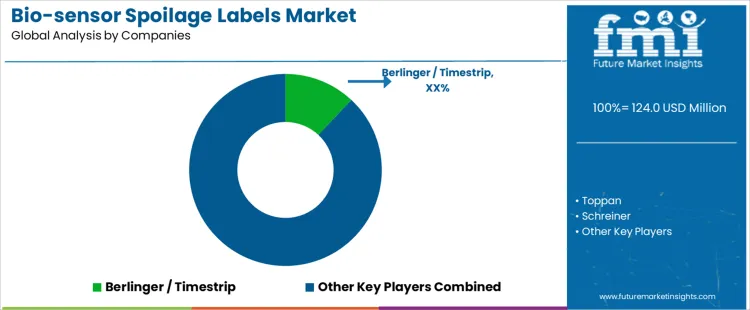
Competition in the Bio Sensor Spoilage Labels Market is defined by a combination of specialist indicator label developers and large scale packaging solution providers. Berlinger and Timestrip are widely recognized for time temperature and spoilage indication labels used in pharmaceutical logistics and perishable food distribution. Schreiner Group holds a strong position in Europe, where smart label integration, traceability requirements, and regulatory alignment support steady adoption. Toppan operates from the advanced printing and functional materials segment, supplying biosensor enabled labels through established relationships with food, beverage, and consumer goods manufacturers. UFlex participates primarily through flexible packaging offerings, targeting price sensitive applications and private label food brands in emerging and export oriented markets.
Local innovators influence competitive dynamics through application specific biosensor development rather than volume leadership. Research driven firms and early stage companies in Japan, Germany, South Korea, and United States focus on gas sensing, enzymatic reaction, and color change indicators linked to microbial activity. These companies typically engage through pilot projects, limited commercial runs, or licensing arrangements with packaging converters and food processors. Their presence accelerates technical validation and use case expansion, even where commercial scale remains limited. Competitive differentiation centers on detection accuracy, response time, compatibility with existing packaging lines, and food safety approvals. Entry barriers are shaped by validation requirements, customer qualification cycles, and regulatory acceptance rather than manufacturing scale alone.
Key Players in the Bio Sensor Spoilage Labels Market
- Berlinger / Timestrip
- Toppan
- Schreiner
- Local innovators
- UFlex
Scope of the Report
| Items | Values |
|---|---|
| Quantitative Units (2026) | USD million |
| Packaging Format / Type | Peel-and-stick Sensor Labels; Sleeve Sensors; Tag Labels; Integratable Stickers; Others |
| Material | PET / Biopolymer Films; Synthetic Paper; PET + Coating; Polymer Films; Others |
| Technology | Enzyme-based Bio-sensors; Microfluidic Bio-sensors; Optical Enzyme Indicators; Colorimetric Bio-reaction; Others |
| End-use / Application | Perishable Foods (meat, seafood, dairy, ready-to-eat meals); Pharmaceuticals; Cold-chain logistics; Retail display monitoring; Meal kit services; Others |
| Regions Covered | Asia Pacific; Europe; North America; Latin America; Middle East & Africa |
| Countries Covered | China; Japan; South Korea; India; Australia & New Zealand; ASEAN; Germany; United Kingdom; France; Italy; Spain; Nordic; BENELUX; United States; Canada; Mexico; Brazil; Chile; Kingdom of Saudi Arabia; Other GCC Countries; Turkey; South Africa; Other African Union; plus other countries across each region |
| Key Companies Profiled | Berlinger / Timestrip; Toppan; Schreiner; Local innovators; UFlex |
| Additional Attributes | Dollar by sales across packaging formats, materials, and bio-sensor technologies; adoption across food, beverage, and pharmaceutical cold chains; integration with IoT-enabled monitoring and supply chain management; operational fit with rigid, flexible, and semi-rigid packaging; peel-and-stick formats dominate for minimal workflow disruption; sleeve and tag sensors used for cylindrical or temporary monitoring; colorimetric and enzyme-based indicators support visual spoilage detection; adoption driven by regulatory compliance, food safety enforcement, and real-time traceability; specification control on adhesion, sensor accuracy, shelf life, and handling durability; deployment across retail, e-commerce, and institutional cold chains; repeat procurement driven by volume, compliance, and operational efficiency; integration with existing packaging lines without redesign requirements |
Bio Sensor Spoilage Labels Market Segmentation
Packaging Format / Type:
- Peel-and-stick Sensor Labels
- Sleeve Sensors
- Tag Labels
- Integratable Stickers
- Others
Material:
- PET / Biopolymer Films
- Synthetic Paper
- PET + Coating
- Polymer Films
- Others
Technology:
- Enzyme-based Bio-sensors
- Microfluidic Bio-sensors
- Optical Enzyme Indicators
- Colorimetric Bio-reaction
- Others
Region
Asia Pacific
- China
- Japan
- South Korea
- India
- Australia & New Zealand
- ASEAN
- Rest of Asia Pacific
Europe
- Germany
- United Kingdom
- France
- Italy
- Spain
- Nordic
- BENELUX
- Rest of Europe
North America
- United States
- Canada
- Mexico
Latin America
- Brazil
- Chile
- Rest of Latin America
Middle East & Africa
- Kingdom of Saudi Arabia
- Other GCC Countries
- Turkey
- South Africa
- Other African Union
- Rest of Middle East & Africa
Frequently Asked Questions
How big is the bio-sensor spoilage labels market in 2026?
The global bio-sensor spoilage labels market is estimated to be valued at USD 124.0 million in 2026.
What will be the size of bio-sensor spoilage labels market in 2036?
The market size for the bio-sensor spoilage labels market is projected to reach USD 418.0 million by 2036.
How much will be the bio-sensor spoilage labels market growth between 2026 and 2036?
The bio-sensor spoilage labels market is expected to grow at a 12.9% CAGR between 2026 and 2036.
What are the key product types in the bio-sensor spoilage labels market?
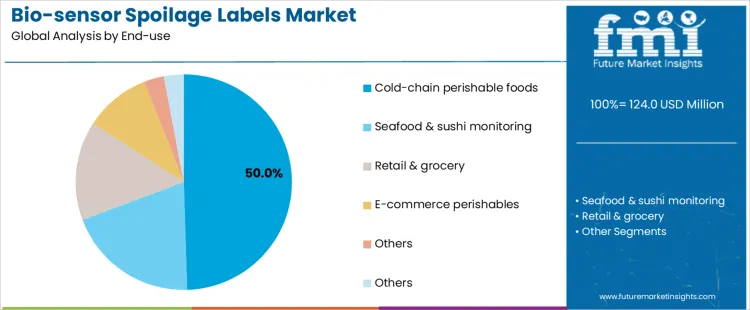
The key product types in bio-sensor spoilage labels market are cold-chain perishable foods, seafood & sushi monitoring, retail & grocery, e-commerce perishables, others and others.
Which packaging format segment to contribute significant share in the bio-sensor spoilage labels market in 2026?
In terms of packaging format, peel-and-stick sensor labels segment to command 55.0% share in the bio-sensor spoilage labels market in 2026.
Preview the report firsthand - request a free sample
Get SampleGet the brochure for pricing and purchase details.
Get PDFTable of Content
- Executive Summary
- Global Market Outlook
- Demand-side Trends
- Supply-side Trends
- Technology Roadmap Analysis
- Analysis and Recommendations
- Market Overview
- Market Coverage / Taxonomy
- Market Definition / Scope / Limitations
- Market Background
- Market Dynamics
- Drivers
- Restraints
- Opportunity
- Trends
- Scenario Forecast
- Demand in Optimistic Scenario
- Demand in Likely Scenario
- Demand in Conservative Scenario
- Opportunity Map Analysis
- Product Life Cycle Analysis
- Supply Chain Analysis
- Investment Feasibility Matrix
- Value Chain Analysis
- PESTLE and Porter’s Analysis
- Regulatory Landscape
- Regional Parent Market Outlook
- Production and Consumption Statistics
- Import and Export Statistics
- Market Dynamics
- Global Market Analysis 2021 to 2025 and Forecast, 2026 to 2036
- Historical Market Size Value (USD Million) Analysis, 2021 to 2025
- Current and Future Market Size Value (USD Million) Projections, 2026 to 2036
- Y-o-Y Growth Trend Analysis
- Absolute $ Opportunity Analysis
- Global Market Pricing Analysis 2021 to 2025 and Forecast 2026 to 2036
- Global Market Analysis 2021 to 2025 and Forecast 2026 to 2036, By End-use
- Introduction / Key Findings
- Historical Market Size Value (USD Million) Analysis By End-use , 2021 to 2025
- Current and Future Market Size Value (USD Million) Analysis and Forecast By End-use , 2026 to 2036
- Cold-chain perishable foods
- Seafood & sushi monitoring
- Retail & grocery
- E-commerce perishables
- Others
- Others
- Y-o-Y Growth Trend Analysis By End-use , 2021 to 2025
- Absolute $ Opportunity Analysis By End-use , 2026 to 2036
- Global Market Analysis 2021 to 2025 and Forecast 2026 to 2036, By Packaging Format
- Introduction / Key Findings
- Historical Market Size Value (USD Million) Analysis By Packaging Format, 2021 to 2025
- Current and Future Market Size Value (USD Million) Analysis and Forecast By Packaging Format, 2026 to 2036
- Peel-and-stick Sensor Labels
- Sleeve Sensors
- Tag Labels
- Integratable Stickers
- Others
- Y-o-Y Growth Trend Analysis By Packaging Format, 2021 to 2025
- Absolute $ Opportunity Analysis By Packaging Format, 2026 to 2036
- Global Market Analysis 2021 to 2025 and Forecast 2026 to 2036, By Material
- Introduction / Key Findings
- Historical Market Size Value (USD Million) Analysis By Material, 2021 to 2025
- Current and Future Market Size Value (USD Million) Analysis and Forecast By Material, 2026 to 2036
- PET / Biopolymer Films
- Synthetic Paper
- PET + Coating
- Polymer Films
- Others
- Y-o-Y Growth Trend Analysis By Material, 2021 to 2025
- Absolute $ Opportunity Analysis By Material, 2026 to 2036
- Global Market Analysis 2021 to 2025 and Forecast 2026 to 2036, By Technology
- Introduction / Key Findings
- Historical Market Size Value (USD Million) Analysis By Technology, 2021 to 2025
- Current and Future Market Size Value (USD Million) Analysis and Forecast By Technology, 2026 to 2036
- Enzyme-based Bio-sensors
- Microfluidic Bio-sensors
- Optical Enzyme Indicators
- Colorimetric Bio-reaction
- Others
- Y-o-Y Growth Trend Analysis By Technology, 2021 to 2025
- Absolute $ Opportunity Analysis By Technology, 2026 to 2036
- Global Market Analysis 2021 to 2025 and Forecast 2026 to 2036, By Region
- Introduction
- Historical Market Size Value (USD Million) Analysis By Region, 2021 to 2025
- Current Market Size Value (USD Million) Analysis and Forecast By Region, 2026 to 2036
- North America
- Latin America
- Western Europe
- Eastern Europe
- East Asia
- South Asia and Pacific
- Middle East & Africa
- Market Attractiveness Analysis By Region
- North America Market Analysis 2021 to 2025 and Forecast 2026 to 2036, By Country
- Historical Market Size Value (USD Million) Trend Analysis By Market Taxonomy, 2021 to 2025
- Market Size Value (USD Million) Forecast By Market Taxonomy, 2026 to 2036
- By Country
- USA
- Canada
- Mexico
- By End-use
- By Packaging Format
- By Material
- By Technology
- By Country
- Market Attractiveness Analysis
- By Country
- By End-use
- By Packaging Format
- By Material
- By Technology
- Key Takeaways
- Latin America Market Analysis 2021 to 2025 and Forecast 2026 to 2036, By Country
- Historical Market Size Value (USD Million) Trend Analysis By Market Taxonomy, 2021 to 2025
- Market Size Value (USD Million) Forecast By Market Taxonomy, 2026 to 2036
- By Country
- Brazil
- Chile
- Rest of Latin America
- By End-use
- By Packaging Format
- By Material
- By Technology
- By Country
- Market Attractiveness Analysis
- By Country
- By End-use
- By Packaging Format
- By Material
- By Technology
- Key Takeaways
- Western Europe Market Analysis 2021 to 2025 and Forecast 2026 to 2036, By Country
- Historical Market Size Value (USD Million) Trend Analysis By Market Taxonomy, 2021 to 2025
- Market Size Value (USD Million) Forecast By Market Taxonomy, 2026 to 2036
- By Country
- Germany
- UK
- Italy
- Spain
- France
- Nordic
- BENELUX
- Rest of Western Europe
- By End-use
- By Packaging Format
- By Material
- By Technology
- By Country
- Market Attractiveness Analysis
- By Country
- By End-use
- By Packaging Format
- By Material
- By Technology
- Key Takeaways
- Eastern Europe Market Analysis 2021 to 2025 and Forecast 2026 to 2036, By Country
- Historical Market Size Value (USD Million) Trend Analysis By Market Taxonomy, 2021 to 2025
- Market Size Value (USD Million) Forecast By Market Taxonomy, 2026 to 2036
- By Country
- Russia
- Poland
- Hungary
- Balkan & Baltic
- Rest of Eastern Europe
- By End-use
- By Packaging Format
- By Material
- By Technology
- By Country
- Market Attractiveness Analysis
- By Country
- By End-use
- By Packaging Format
- By Material
- By Technology
- Key Takeaways
- East Asia Market Analysis 2021 to 2025 and Forecast 2026 to 2036, By Country
- Historical Market Size Value (USD Million) Trend Analysis By Market Taxonomy, 2021 to 2025
- Market Size Value (USD Million) Forecast By Market Taxonomy, 2026 to 2036
- By Country
- China
- Japan
- South Korea
- By End-use
- By Packaging Format
- By Material
- By Technology
- By Country
- Market Attractiveness Analysis
- By Country
- By End-use
- By Packaging Format
- By Material
- By Technology
- Key Takeaways
- South Asia and Pacific Market Analysis 2021 to 2025 and Forecast 2026 to 2036, By Country
- Historical Market Size Value (USD Million) Trend Analysis By Market Taxonomy, 2021 to 2025
- Market Size Value (USD Million) Forecast By Market Taxonomy, 2026 to 2036
- By Country
- India
- ASEAN
- Australia & New Zealand
- Rest of South Asia and Pacific
- By End-use
- By Packaging Format
- By Material
- By Technology
- By Country
- Market Attractiveness Analysis
- By Country
- By End-use
- By Packaging Format
- By Material
- By Technology
- Key Takeaways
- Middle East & Africa Market Analysis 2021 to 2025 and Forecast 2026 to 2036, By Country
- Historical Market Size Value (USD Million) Trend Analysis By Market Taxonomy, 2021 to 2025
- Market Size Value (USD Million) Forecast By Market Taxonomy, 2026 to 2036
- By Country
- Kingdom of Saudi Arabia
- Other GCC Countries
- Turkiye
- South Africa
- Other African Union
- Rest of Middle East & Africa
- By End-use
- By Packaging Format
- By Material
- By Technology
- By Country
- Market Attractiveness Analysis
- By Country
- By End-use
- By Packaging Format
- By Material
- By Technology
- Key Takeaways
- Key Countries Market Analysis
- USA
- Pricing Analysis
- Market Share Analysis, 2025
- By End-use
- By Packaging Format
- By Material
- By Technology
- Canada
- Pricing Analysis
- Market Share Analysis, 2025
- By End-use
- By Packaging Format
- By Material
- By Technology
- Mexico
- Pricing Analysis
- Market Share Analysis, 2025
- By End-use
- By Packaging Format
- By Material
- By Technology
- Brazil
- Pricing Analysis
- Market Share Analysis, 2025
- By End-use
- By Packaging Format
- By Material
- By Technology
- Chile
- Pricing Analysis
- Market Share Analysis, 2025
- By End-use
- By Packaging Format
- By Material
- By Technology
- Germany
- Pricing Analysis
- Market Share Analysis, 2025
- By End-use
- By Packaging Format
- By Material
- By Technology
- UK
- Pricing Analysis
- Market Share Analysis, 2025
- By End-use
- By Packaging Format
- By Material
- By Technology
- Italy
- Pricing Analysis
- Market Share Analysis, 2025
- By End-use
- By Packaging Format
- By Material
- By Technology
- Spain
- Pricing Analysis
- Market Share Analysis, 2025
- By End-use
- By Packaging Format
- By Material
- By Technology
- France
- Pricing Analysis
- Market Share Analysis, 2025
- By End-use
- By Packaging Format
- By Material
- By Technology
- India
- Pricing Analysis
- Market Share Analysis, 2025
- By End-use
- By Packaging Format
- By Material
- By Technology
- ASEAN
- Pricing Analysis
- Market Share Analysis, 2025
- By End-use
- By Packaging Format
- By Material
- By Technology
- Australia & New Zealand
- Pricing Analysis
- Market Share Analysis, 2025
- By End-use
- By Packaging Format
- By Material
- By Technology
- China
- Pricing Analysis
- Market Share Analysis, 2025
- By End-use
- By Packaging Format
- By Material
- By Technology
- Japan
- Pricing Analysis
- Market Share Analysis, 2025
- By End-use
- By Packaging Format
- By Material
- By Technology
- South Korea
- Pricing Analysis
- Market Share Analysis, 2025
- By End-use
- By Packaging Format
- By Material
- By Technology
- Russia
- Pricing Analysis
- Market Share Analysis, 2025
- By End-use
- By Packaging Format
- By Material
- By Technology
- Poland
- Pricing Analysis
- Market Share Analysis, 2025
- By End-use
- By Packaging Format
- By Material
- By Technology
- Hungary
- Pricing Analysis
- Market Share Analysis, 2025
- By End-use
- By Packaging Format
- By Material
- By Technology
- Kingdom of Saudi Arabia
- Pricing Analysis
- Market Share Analysis, 2025
- By End-use
- By Packaging Format
- By Material
- By Technology
- Turkiye
- Pricing Analysis
- Market Share Analysis, 2025
- By End-use
- By Packaging Format
- By Material
- By Technology
- South Africa
- Pricing Analysis
- Market Share Analysis, 2025
- By End-use
- By Packaging Format
- By Material
- By Technology
- USA
- Market Structure Analysis
- Competition Dashboard
- Competition Benchmarking
- Market Share Analysis of Top Players
- By Regional
- By End-use
- By Packaging Format
- By Material
- By Technology
- Competition Analysis
- Competition Deep Dive
- Berlinger / Timestrip
- Overview
- Product Portfolio
- Profitability by Market Segments (Product/Age /Sales Channel/Region)
- Sales Footprint
- Strategy Overview
- Marketing Strategy
- Product Strategy
- Channel Strategy
- Toppan
- Schreiner
- Local innovators
- UFlex
- Berlinger / Timestrip
- Competition Deep Dive
- Assumptions & Acronyms Used
- Research Methodology


