

- Market Size (2026)
- USD 258.9 Mn
- Forecast (2036)
- USD 768.9 Mn
- CAGR (2026 to 2036)
- 11.5%
How big is Bakery Humectants Market in 2026?
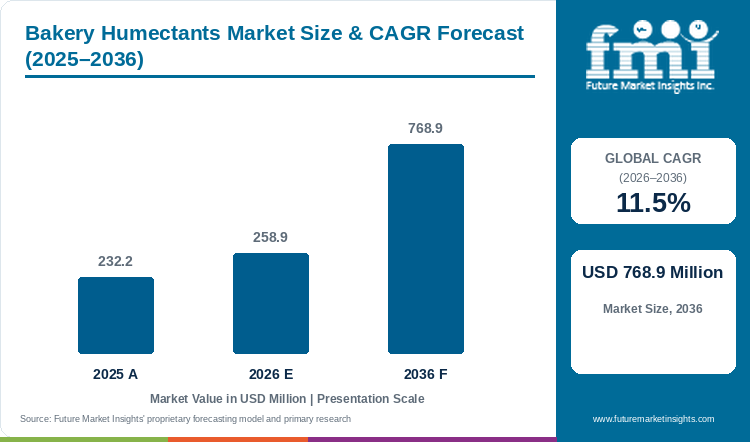
Starting from USD 232.2 million in 2025, the bakery humectants market valuation advanced to USD 258.9 million in 2026, with projections pointing toward USD 768.9 million by 2036 at a CAGR of 11.5%.
The global bakery humectants market was valued at USD 232.2 million in 2025 and is estimated to reach USD 258.9 million in 2026. The market is projected to reach USD 768.9 million by 2036, expanding at a compound annual growth rate (CAGR) of 11.5% between 2026 and 2036. Standard grade is projected to account for 41.0% of 2026 type demand, as established polyol specifications lower batch qualification time for moisture binding in sweet breads. Humectant demand is driven by water-activity economics, since every point of crumb water activity held below the mold threshold buys shelf days that retailers price into the planogram, and every point lost returns the pallet [1]. That moisture control function puts the category far ahead of the humectants market overall at 4.7% CAGR, because general humectant volume follows personal care and feed while bakery demand follows the clean-label shelf-life rebuild now replacing synthetic preservatives [20]. Ingredient moves confirm the pressure, as Puratos unveiled Softgrain and Intens Fresh 3-30 at IBIE in September 2025 to hold sweet-bread moisture while cutting sugar costs [19], Corbion's Verdad Essence WH100 launched in April 2025 to balance crumb water activity against eleven spoilage mold strains [20], and BASF's food ingredients business transferred to Louis Dreyfus in September 2025 to reorganize glycerin supply [21]. Bakers sign humectant contracts against mold-free shelf life without a preservative line, and formulators holding both polyol supply and predictive mold models win those tenders through 2036.
Key Market Trends & Insights
- By product type: Standard Grade is projected to account for 41.0% of the product type segment in 2026 because established polyol specifications lower batch qualification costs.
- By form: Powder / Dry formats are estimated to hold 39.0% of the form segment in 2026 due to smooth integration with automated dry premix silos.
- By application: Bread & Rolls are expected to represent 28.0% of the application segment in 2026 because daily retail shelf-life targets penalize early crumb drying.
- By claim: Conventional formulations are forecast to capture 51.0% of the claim segment in 2026 owing to broad regulatory tolerances across continuous oven lines.
- By sales channel: Direct to Industrial Bakeries is anticipated to command 54.0% of the sales channel segment in 2026 through plant-level water-activity validation contracts.
Regional Highlights
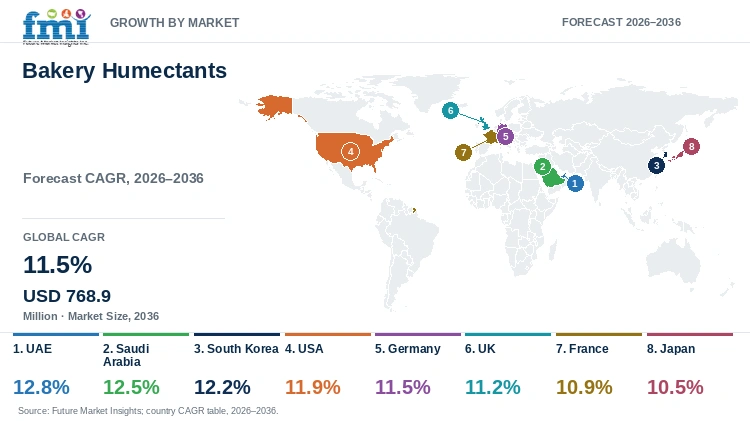
- Top national expansion: The UAE is projected to lead evaluated national markets at a 12.8% CAGR through 2036 under hot-climate distribution and port traceability rules.
- Broader country progression: Saudi Arabia is expected to expand at a 12.5% CAGR ahead of South Korea at a 12.2% CAGR and the USA at an 11.9% CAGR, while Japan is forecast to advance at a 10.5% CAGR.
Market Size & Forecast
Table 1: Market Size and Forecast for the Bakery Humectants Market (USD million and CAGR percentage), 2025 to 2036
| Metric | Value |
|---|---|
| 2025 Market Size | USD 232.2 million |
| Estimated Market Size in 2026 | USD 258.9 million |
| Projected Market Size by 2036 | USD 768.9 million |
| CAGR, 2026 to 2036 | 11.5% |
| Added Value Opportunity, 2026 to 2036 | USD 510.0 million |
Expansion of centralized supermarket commissaries has lengthened the transit time between oven cooling spirals and household consumption. During multi-day storage, moisture migrates from the moist interior crumb toward the drier crust and accelerates starch recrystallization within 72 hours of slicing. This physical drying directly hurts bakery profitability, as Kerry Group reported in July 2025 that roughly 10% of global bread output is wasted and 46% of consumer bread disposal stems from staleness and moisture loss [2]. To protect retail margins and reduce stale returns, production managers combine bakery ingredients with calibrated water-binding polyols that hold equilibrium relative humidity steady inside sealed packages.
Production-Volume and Batch-Formulation Sizing
Table 2: Production-Volume and Batch-Formulation Sizing for the Bakery Humectants Market (USD million and operational ranges), 2025 to 2036
| Metric | 2025 | 2026 | 2036 |
|---|---|---|---|
| Market size (USD million) | 232.2 | 258.9 | 768.9 |
| Treated bakery output (million metric tons) | 16.8 to 19.2 | 18.5 to 21.0 | 42.0 to 48.5 |
| Active humectant dosage (% flour weight) | 1.0% to 3.0% | 1.0% to 3.0% | 1.2% to 3.5% |
| Average humectant spend per ton of dough (USD) | 12.1 to 13.8 | 12.3 to 14.0 | 15.8 to 18.3 |
Operational note: Batch-formulation ranges reflect commercial polyol and oligosaccharide inclusion rates between 1.0% and 3.5% on a flour-weight basis to hold finished crumb water activity between 0.82 and 0.90.
Automated tunnel ovens require consistent bound-water retention so baked loaves exit the cooler at target weight without extending baking time. Formulators therefore blend polyol sweeteners with soluble dietary fibers to bind free water and prevent condensation droplets inside film wrappers.
Per Capita & Commercial Bakery Facility Sizing
Table 3: Per Capita and Facility Spending Indicators for the Bakery Humectants Market (USD), 2025 to 2036
| Metric | 2025 | 2026 | 2036 |
|---|---|---|---|
| World population (million) | 8,200 | 8,300 | 9,000 |
| Spend per 1,000 people (USD) | 28.3 | 31.2 | 85.4 |
| Annual spend per industrial bakery line (USD) | 14,200 to 16,800 | 15,500 to 18,400 | 38,000 to 44,500 |
| Direct industrial contract share (%) | 52.0% to 55.0% | 53.0% to 56.0% | 58.0% to 62.0% |
Table 4: Facility & Industrial Bakery Spending Indicators for the Bakery Humectants Market (USD and percentages), 2026
| Metric | Value | Institutional Reference Basis |
|---|---|---|
| Market size, 2026 | USD 258.9 million | 2026 global market value baseline |
| Commercial bakery establishments | 185,000 | Global industrial and craft bakery plant registry |
| Market spend per bakery establishment | USD 1,399.5 | Annualized moisture-control ingredient expenditure |
| Direct industrial bakery allocation, 2026 | USD 139.8 million | 54.0% sales-channel segment allocation |
Control of microbial water activity while keeping cake and bread crumb soft requires careful balance between hydroxyl water-binding groups and starch gelatinization. Centralized commissaries routinely pair liquid or powdered humectants with baking enzymes to preserve soft bite across 14-to-30-day retail distribution cycles.
Analyst Perspective
"Industrial bakeries no longer evaluate moisture-retention ingredients solely by raw polyol price per kilogram. Suppliers that prove stable water activity below 0.88 without inducing dough stickiness on high-speed dividers secure multi-year plant specifications."
- Nandini Roy Choudhury, Principal Consultant, Future Market Insights.
How is the bakery humectants market segmented?
The bakery humectants market is segmented by product type, form, application, claim, and sales channel. In 2026, Standard Grade is projected at 41.0%, Powder / Dry at 39.0%, Bread & Rolls at 28.0%, Conventional at 51.0%, and Direct to Industrial Bakeries at 54.0%.
By product type: Standard Grade, Premium Specialty Grade, Organic Certified, and Clean Label Grade.
By form: Powder / Dry, Liquid, Semi-Solid Paste, and Granular Pieces.
By application: Bread & Rolls, Cakes & Muffins, Biscuits & Cookies, Viennoiserie & Pastry, and Specialty Bakery Snacks.
By claim: Conventional, Clean Label, Organic, and Identity-Preserved Non-GMO.
By sales channel: Direct to Industrial Bakeries, Ingredient Distributors, Foodservice & Artisan, and Online B2B.
Why does Standard Grade lead the product type segment?
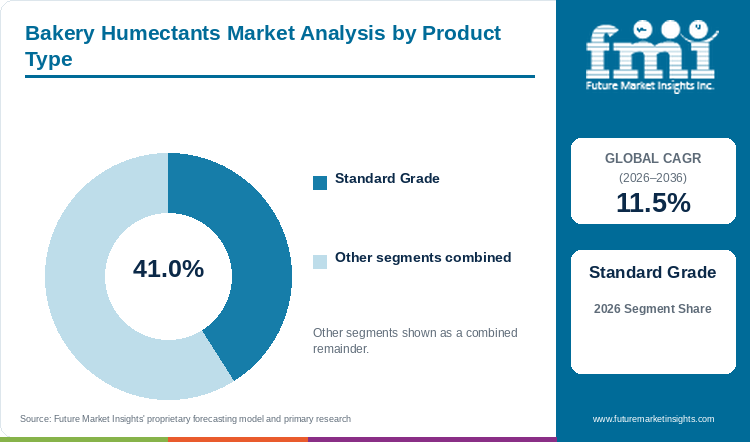
Standard Grade is projected to capture 41.0% of the product type segment in 2026, supported by established food-grade polyol specifications.
Table 5: Product Type Share for the Bakery Humectants Market (percentage share), 2026
| Product Type | Share (2026) |
|---|---|
| Standard Grade | 41.0% |
| Other Segments Combined | 59.0%* |
| Total | 100.0% |
*Note: Remaining product type subsegments sum to 100.0% of 2026 bakery humectants volume.
Table 6: Product Type Leadership and Market Growth for the Bakery Humectants Market (segment and CAGR percentage), 2026 to 2036
| Metric | Value |
|---|---|
| Global CAGR (2026 to 2036) | 11.5% |
| Leading Segment | Standard Grade |
High-volume pan bread and snack-cake manufacturers rely on Standard Grade glycerin and sorbitol because standardized purity levels allow drop-in dosing at 1.0% to 3.0% flour weight without resetting mixer hydration timers. Adoption of established polyol grades also avoids the raw-material cost premiums of specialty fractions while working smoothly with food bulking agents in commercial batters.
- Standard Grade is projected to secure 41.0% of the product type segment in 2026 by delivering reliable moisture retention at a predictable cost per batch.
- Title 21 Code of Federal Regulations Section 184.1835 affirms food-grade sorbitol for baked goods and baking mixes at levels up to 30%, giving industrial bakers clear regulatory latitude.
What keeps Powder / Dry ahead in the form segment?
Powder / Dry formats are estimated to secure 39.0% of the form segment in 2026, driven by dry premix blending compatibility.
Centralized bakery premix mills prefer crystalline sorbitol powders and spray-dried carbohydrate humectants because dry ingredients meter directly into flour hoppers without heated liquid storage tanks. Dry powders also eliminate sticky pump-line flushing during recipe changeovers and blend evenly into bakery mixes supplied to multi-plant baking groups.
- Powder / Dry options are estimated to command 39.0% of the form segment in 2026 because automated dry feeders maintain tight batch-to-batch weighing accuracy.
- Experimental trials published in the Journal of the Science of Food and Agriculture in June 2026 showed that spray-dried palmyra sap powder with inulin carriers cut moisture by 98.57% while stabilizing brownie water activity [4].
Why do Bread & Rolls anchor the application segment?
Bread & Rolls are expected to command 28.0% of the application segment in 2026, reflecting continuous anti-staling demand across packaged loaves.
Packaged sandwich loaves and hamburger buns experience rapid starch retrogradation and moisture migration between crumb and crust during supermarket display. Addition of water-binding humectants preserves crumb softness and slice flexibility across long-haul grocery routes when combined with bread improvers in continuous pan lines.
- Bread & Rolls are expected to hold 28.0% of the application segment in 2026 because supermarket supply contracts penalize dry or crumbly loaves.
- IFF launched POWERFRESH ACE 2000 in August 2025 for commercial bakeries in the USA to maintain white and whole-wheat bread softness and resilience for up to 34 days [5].
Why does Conventional lead the claim segment?
Conventional formulations are forecast to generate 51.0% of the claim segment in 2026, owing to broad regulatory approval and lower input cost.
Mainstream grocery bread and packaged cake brands retain Conventional humectant specifications because synthetic and hydrogenation-derived polyols deliver consistent water-binding capacity per gram. Conversion to certified organic or clean-label botanical humectants requires lengthy sensory requalification and raises ingredient costs on price-sensitive retail contracts.
- Conventional claims are forecast to account for 51.0% of the claim segment in 2026 as high-throughput bakeries prioritize proven water-activity control.
- January 2026 research in the Journal of the Science of Food and Agriculture confirmed that a 0.5% chitosan and 0.5% fermented whey blend lifted bread specific volume by 12.4% while extending moisture stability across 42 days [6].
What gives Direct to Industrial Bakeries the leading position in the sales channel segment?
Direct to Industrial Bakeries is anticipated to account for 54.0% of the sales channel segment in 2026, reinforced by plant-level technical qualification.
Large commercial bakeries purchase humectant systems directly from ingredient manufacturers because polyol dosage interacts with flour damaged-starch levels and oven humidity profiles. Direct technical service agreements allow suppliers to test water-activity curves on pilot lines before finalizing annual bulk-tote and tank-truck supply contracts.
- Direct to Industrial Bakeries is anticipated to capture 54.0% of the sales channel segment in 2026 because enterprise baking groups require custom dough-rheology validation.
- Palsgaard inaugurated its advanced application center with industrial-scale bakery pilot plants in Navi Mumbai in July 2025 to accelerate local shelf-life and moisture-retention trials [7].
What are the drivers, restraints, and opportunities in the bakery humectants market?
In the bakery humectants market, extended retail distribution networks expand water-binding ingredient procurement whereas dough-softening limits restrain over-dosing and fermented hydrocolloid blends create clean-label opportunities.
- Driver: Centralization of commercial commissaries and longer regional transport windows compel bakeries to specify humectants that curb staling returns.
- Restraint: Excessive polyol addition weakens gluten viscoelasticity and triggers mandatory laxative or additive declarations across regulated food categories.
- Opportunity: Co-formulating botanical polysaccharides with enzymatic starch modifiers unlocks clean-label moisture retention in frozen and par-baked doughs.
Growth Analysis and Future Potential: Qualitative Demand Catalysts
Consolidation of supermarket bake-off commissaries and centralized frozen-dough hubs has lengthened the time between oven exit and consumer purchase. When free water migrates out of starch granules during cold-chain storage or ambient trucking, loaves lose elasticity and suffer mechanical slicing tear. Cross-checking commercial bakery return logs indicates that moisture-binding systems are expanding in parallel with par-baked bread distribution networks. In February 2025, an International Journal of Biological Macromolecules study demonstrated that adding 1.2% Dendrobium officinale polysaccharide raised dough water absorption to 68.63% and inhibited freezable water migration during frozen storage [8]. Industrial procurement teams consequently lock in multi-quarter humectant contracts to protect packaged loaf softness.
Risk Assessment of the Bakery Humectants Market: Operational and Formulation Friction
Rheological softening of wheat gluten networks and strict regulatory additive ceilings represent the primary technical barriers restricting higher humectant inclusion rates. When polyol or hydrocolloid dosages exceed optimal hydration windows, competition for free water delays gluten development and causes sticky dough buildup on high-speed rounder belts. In October 2025, a Food Science & Nutrition study on 2% hydrocolloid blends in gluten-free bread found that hydroxypropyl methylcellulose with xanthan gum lowered crumb hardness to 1.31 N whereas guar gum blends yielded hard loaves [3]. Similarly, November 2025 research in Foods showed that balancing konjac glucomannan with water content is required to prevent gummy crumb collapse in rice breads [9]. Plant quality directors therefore mandate full-scale line trials before approving alternative food emulsifiers or moisture binders.
Commercial Opportunity Analysis: Formulation Differentiation and Value-Add Formats
Bakery ingredient processors capture higher gross margins by engineering dual-function fermented and botanical humectant systems that replace synthetic additives on front-of-pack labels. Shoppers scrutinizing packaged sweet breads and tortillas favor recognizable fermentation or grain-derived ingredients over chemical E-number declarations. Suppliers combining pre-hydrated grains with sourdough ingredients allow bakers to maintain crumb moisture without separate liquid polyol tanks. In May 2026, a Journal of Food Science dose-response study across 5% to 50% compound sourdough inclusions proved that a 20% addition window raised specific loaf volume by 17% and lowered Day-7 retrogradation enthalpy to 2.6 J/g [10]. Supply of pre-calibrated dry moisture systems enables formulators to win premium retail reformulation briefs.
Bakery Humectants Market by Country (2026 to 2036)
As per FMI, the UAE is projected to lead bakery humectants demand across evaluated national markets at a 12.8% CAGR through 2036, whereas Japan is forecast to progress at a 10.5% CAGR. Commercial uptake across Gulf hospitality hubs and Western European or East Asian bakery networks depends on national food-additive registries and ambient distribution temperatures.
Table 7: Country CAGR and Primary Growth Levers for the Bakery Humectants Market (CAGR percentage and operational drivers), 2026 to 2036
| Country | CAGR (2026 to 2036) | Primary Growth Lever |
|---|---|---|
| UAE | 12.8% | High-heat retail logistics and Dubai Municipality digital food product registration |
| Saudi Arabia | 12.5% | SFDA nutrition labeling rules and packaged flatbread shelf-life extension |
| South Korea | 12.2% | Enzymatic branching starch modification and chilled convenience-cake softness |
| USA | 11.9% | Whole-wheat bread glycemic reformulation and 34-day interstate grocery shelf life |
| Germany | 11.5% | High-fiber rye bread moisture retention and centralized bake-off dough staging |
| UK | 11.2% | Factory-gate producer price discipline and retail bread waste-reduction commitments |
| France | 10.9% | INRAE wheat hydration modeling and clean-label brioche reformulation |
| Japan | 10.5% | Modified-starch rice-bread moisture control and soft convenience-store buns |
Source: Future Market Insights analysis
UAE Bakery Humectants Market Outlook (2026 to 2036)
The UAE bakery humectants market is projected to expand at a leading 12.8% CAGR from 2026 to 2036 across hotel commissaries and automated flatbread bakeries. Unlike temperate European distribution networks, summer ambient temperatures exceeding 42 degrees Celsius across Dubai and Abu Dhabi accelerate moisture vapor loss through polyethylene bread bags. During July 2025 Dubai Municipality reported 34.7 thousand food-establishment inspections and 2,336 new food outlets plus 77,700 newly registered food products in the first half of 2025 [11]. While rapid hospitality and airline catering expansion drives bulk orders for heat-stable polyol and hydrocolloid blends, strict municipal digital registration requires halal certification and full additive dossiers before port clearance.
Key takeaway: In the UAE, high-temperature retail distribution and rapid hospitality outlet openings are projected to anchor demand for halal-certified bakery moisture systems.
Saudi Arabia Bakery Humectants Market Outlook (2026 to 2036)
Industrial bakeries in Saudi Arabia are expanding packaged samoon rolls and filled croissants to serve modern supermarkets and quick-service restaurant chains across Riyadh and Jeddah. Sales of bakery humectants in Saudi Arabia are forecast to advance at a 12.5% CAGR over the 2026 to 2036 forecast period. In February 2025, the Saudi Food and Drug Authority issued three community nutrition regulations effective July 2025 mandating salt icons above 2,000 mg sodium and physical-activity calorie labeling across commercial restaurant menus [12]. Because menu reformulation toward lower-salt and lower-sugar buns reduces natural osmotic water binding, bakeries adopt polyol-fiber humectants while complying with Gulf additive standard SFDA.FD 2500.
Key takeaway: In Saudi Arabia, packaged bakery capacity expansion and SFDA menu reformulation rules are forecast to drive adoption of compliant moisture-retention blends.
South Korea Bakery Humectants Market Outlook (2026 to 2036)
High-velocity convenience-store chains and franchise bakery cafes in South Korea require single-serve cakes and cream-filled rolls that remain soft under chilled display. In August 2026, researchers at Sejong University in Seoul reported in the International Journal of Biological Macromolecules that modifying pea starch and cake batters with mutant 1,4-alpha-glucan branching enzyme S321D cut 7-day chilled storage retrogradation enthalpy by 0.63 J/g and lowered cake hardness [13]. Demand for bakery humectants in South Korea is anticipated to rise at a 12.2% CAGR between 2026 and 2036 across industrial baking groups. Even so, clean-label substitution toward enzymatic and oligosaccharide moisture binders requires careful sensory testing to prevent sticky crumb textures.
Key takeaway: In South Korea, chilled convenience-store cake distribution and enzymatic starch-branching advances are anticipated to sustain demand for precision moisture-control systems.
USA Bakery Humectants Market Outlook (2026 to 2036)
Interstate grocery distribution across the USA exposes packaged whole-wheat sandwich loaves and tortillas to multi-day warehouse staging and household pantry holding cycles. In August 2026, a controlled feeding trial at The Ohio State University published in Frontiers in Nutrition demonstrated that whole-wheat bread reduced postprandial glucose excursion by 27% in adults with prediabetes compared to refined white bread [14]. Because coarse wheat bran particles puncture gas cells and accelerate crumb drying, commercial bakers in the USA pair glycerin and sorbitol with fresh-keeping enzymes to keep whole-wheat loaves soft for 30 days. Market value in the USA is estimated to progress at an 11.9% CAGR through 2036, moderated by Title 21 CFR Section 184.1835 sorbitol labeling rules.
Key takeaway: In the USA, whole-wheat bread reformulation and long-haul supermarket replenishment routes are estimated to drive direct industrial humectant contracting.
Germany Bakery Humectants Market Outlook (2026 to 2036)
Germany is projected to record an 11.5% CAGR in the bakery humectants market from 2026 to 2036 across industrial bake-off plants and multi-branch craft bakeries. Consumer preference in Germany favors dense whole-grain rye loaves and seeded rolls that undergo centralized par-baking and cold-room staging before in-store finishing. In December 2025, a University of Hohenheim study funded by the federal research ministry in Germany and published in Molecular Nutrition & Food Research confirmed that high-fiber whole-grain rye bread improved plasma HDL cholesterol and lowered hepatic lipids compared to refined wheat [15]. Dry powdered humectants prevent arabinoxylan water loss during frozen par-baked storage in Germany, though strict crust-crispness standards restrain over-dosing.
Key takeaway: In Germany, high-fiber rye bread consumption and centralized par-baked dough staging are projected to support steady uptake of dry powdered humectants.
UK Bakery Humectants Market Outlook (2026 to 2036)
Supermarket private-label wrapped bread and morning-goods contracts dominate commercial baking volume across the UK, placing intense pressure on per-loaf unit economics and waste reduction. Bakery humectants market value in the UK is expected to grow at an 11.2% CAGR between 2026 and 2036 across high-speed commercial plant bakeries and retail commissaries. In October 2026, the Office for National Statistics reported that UK producer input prices rose 8.3% and factory-gate output prices rose 4.6% in the year to September 2026, squeezing processor operating margins [16]. While extending wrapped-loaf softness by two days cuts supermarket markdown waste, strict retail clean-label specifications require full ingredient audit trails on compound premixes.
Key takeaway: In the UK, factory-gate margin pressure and supermarket waste-reduction targets are expected to favor cost-effective humectant blends that extend wrapped-loaf freshness.
France Bakery Humectants Market Outlook (2026 to 2036)
France exhibits a dual market structure divided between daily crusty artisanal baguettes and packaged industrial brioche or pain de mie sold in hypermarkets. In January 2025, a Food Chemistry study by INRAE researchers in Nantes across 150 wheat samples from France established that soluble starch (1.11 to 6.21 g/100 g) and water-extractable arabinoxylans govern flour water absorption [17]. Demand for bakery humectants in France is slated to advance at a 10.9% CAGR from 2026 to 2036 across packaged industrial pastry and long-life sandwich-bread production lines. Clean-label retailer charters across hypermarkets in France penalize synthetic E420 sorbitol in brioche, steering formulators toward pre-fermented wheat and fiber moisture binders.
Key takeaway: In France, hypermarket clean-label charters and flour hydration variability are slated to steer industrial viennoiserie producers toward fermentation-based moisture systems.
Japan Bakery Humectants Market Outlook (2026 to 2036)
Packaged shokupan pullman loaves and gluten-free rice breads sold in convenience stores across Japan require ultra-moist crumb structures that resist firming during ambient display. In November 2025, researchers at Yamagata University in Japan reported in the Journal of Applied Glycoscience that incorporating high-substitution hydroxypropylated potato starch lowered gelatinization onset temperature and suppressed internal bubble coalescence in pure rice bread [18]. Co-formulation of modified-starch and oligosaccharide humectants with glycosyltransferase enzymes enables wholesale bakeries in Japan to retain bound moisture without creating a sticky mouthfeel. Commercial bakery humectants market value in Japan is predicted to expand at a 10.5% CAGR through 2036 across national wholesale plant bakeries and convenience-store foodservice distribution channels.
Key takeaway: In Japan, rice-bread texture optimization and strict convenience-store crumb softness standards are predicted to sustain demand for high-yield moisture-binding formulations.
Full report country CAGRs cover: North America; Latin America; Western Europe; Eastern Europe; East Asia; South Asia and Pacific; Middle East and Africa.
Who are the notable companies in the bakery humectants market?
Novonesis, IFF, Kerry Group, AB Enzymes, Amano Enzyme, Palsgaard, Corbion, BASF, Puratos, and DSM-Firmenich are the notable companies evaluated in this market.
FMI's competitive audit divides the supplier base between integrated bakery moisture-system formulators and specialized enzymatic or upstream polyol manufacturers. Corporate M&A reshaped upstream supply on September 30, 2025 when BASF completed the divestiture of its Food and Health Performance Ingredients business in Illertissen to Louis Dreyfus Company while retaining upstream chemical glycerin and micronutrient operations.
- Integrated Bakery Texture & Moisture System Providers: Puratos and Kerry Group along with Palsgaard formulate ready-to-dose improver bases and emulsifier-humectant premixes.
- Enzymatic Crumb-Softness & Hydration Specialists: Novonesis and IFF supply maltogenic amylases and xylanases that lock bound water inside starch matrices. DSM-Firmenich and AB Enzymes also provide specialized baking enzymes with Amano Enzyme.
- Complementary Preservation & Upstream Polyol Participants: Corbion supplies cultured-wheat preservation and emulsifier-replacement systems, while BASF produces GMP+ certified upstream glycerin following its September 2025 food-performance divestiture to Louis Dreyfus Company.
Competitive Benchmarking: Bakery Humectants Market
Table 8: Competitive Benchmarking for the Bakery Humectants Market (qualitative capability ratings), 2026
| Company | Moisture / Crumb Retention | Bakery Application Support | Label Reformulation Support | Geographic Reach |
|---|---|---|---|---|
| Novonesis | High | High | High | High |
| IFF | High | High | High | High |
| Kerry Group | High | High | High | High |
| AB Enzymes | Medium | High | High | Medium |
| Amano Enzyme | High | Medium | Medium | Medium |
| Palsgaard | Medium | High | High | High |
| Corbion | Medium | High | High | High |
| BASF | Medium | Medium | Medium | High |
| Puratos | High | High | High | High |
| DSM-Firmenich | High | High | Medium | High |
Scoring basis: Capability ratings evaluate documented water-activity suppression and anti-staling crumb softness retention across 7-to-34-day shelf-life windows. Scores also reflect pilot-scale baking laboratory infrastructure and clean-label polyol or emulsifier substitution support.
Key Developments in the Bakery Humectants Market
- Puratos unveiled Softgrain Ancient Grain Clean Label and Intens Fresh 3-30 Premium at IBIE in September 2025, enabling industrial bakers to incorporate sourdough-soaked grains and extend sweet-bread moisture while cutting sugar costs [19].
- Corbion introduced Verdad Essence WH100 and its upgraded Natural Mold Inhibition Model in April 2025, allowing formulators to balance crumb water activity against 11 spoilage mold strains [20].
- BASF and Louis Dreyfus Company completed the sale and transfer of BASF's Food and Health Performance Ingredients business and three application laboratories to Louis Dreyfus Company in September 2025, refocusing BASF on upstream glycerin and nutrition ingredients [21].
Key Players in the Bakery Humectants Market
Integrated Bakery Texture and Moisture System Providers
- Puratos
- Kerry Group
- Palsgaard
Enzymatic Crumb-Softness and Hydration Specialists
- Novonesis
- IFF
- DSM-Firmenich
- AB Enzymes
- Amano Enzyme
Complementary Preservation and Upstream Polyol Participants
- Corbion
- BASF
Bakery Humectants Market - Report Scope
Table 9: Report Scope for the Bakery Humectants Market (coverage fields and definitions), 2026 to 2036
| Coverage field | Report scope |
|---|---|
| Market breakdown | Product Type; Form; Application; Claim; Sales Channel |
| Quantitative Units | USD Million |
| Market Definition | Includes commercial supplier sales of food-grade humectant ingredients (glycerin, sorbitol, specialty polyols, and pre-hydrated carbohydrate moisture binders) and dedicated moisture-retention bakery systems. Category Scope Note: Excludes finished baked-goods retail value, standalone antimicrobial preservatives sold without moisture-binding function, and unblended commodity flour. |
| Regions Covered | North America; Latin America; Western Europe; Eastern Europe; East Asia; South Asia and Pacific; Middle East and Africa |
| Countries Covered | UAE, Saudi Arabia, South Korea, USA, Germany, UK, France, Japan, and additional countries in the full report |
| Key Companies Covered | Novonesis, IFF, Kerry Group, AB Enzymes, Amano Enzyme, Palsgaard, Corbion, BASF, Puratos, DSM-Firmenich |
| Forecast Period | 2026 to 2036 |
| Approach | Primary and secondary research with top-down and bottom-up market triangulation. |
Bakery Humectants Market - Research Methodology
Table 10: Research Methodology for the Bakery Humectants Market (research methods and approach), 2026 edition
| Method | Approach |
|---|---|
| Primary Research | Structured interviews with industrial bakery QA directors, tunnel-oven process engineers, and polyol/hydrocolloid formulators to verify 1.0% to 3.5% flour-weight dosage bands and water-activity targets (aw 0.82 to 0.90). |
| Secondary Research | Audit of Title 21 CFR Section 184.1835 sorbitol caps, SFDA.FD 2500 Gulf additive lists, UK ONS producer price bulletins, and peer-reviewed rheology studies in Carbohydrate Polymers and Foods. |
| Market Sizing and Forecasting | Bottom-up mass-balance modeling of commercial bread, cake, and pastry tonnage multiplied by verified humectant inclusion rates and B2B contract realizations from 2025 to 2036. |
| Country Forecasting Model | Econometric national models weight ambient distribution temperatures, packaged-to-artisan bakery ratios, supermarket private-label return penalties, and national additive registration gates across eight countries. |
| Operational Benchmark Traceability | Batch dosage and facility spending indicators in Tables 2, 3, and 4 trace to commercial bakery establishment registries, ZDH bakery counts in Germany, and INSEE boulangerie inventories in France. |
| Data Triangulation and Validation | Supplier allocations are cross-checked against polyol refinery food-grade shipments and blended bakery system contracts, strictly excluding standalone calcium propionate preservatives and downstream finished bread retail value. |
Bakery Humectants Market by Segments
Bakery Humectants Market segmented by Product Type:
- Standard Grade
- Premium Specialty Grade
- Organic Certified
- Clean Label Grade
Bakery Humectants Market segmented by Form:
- Powder / Dry
- Liquid
- Semi-Solid Paste
- Granular Pieces
Bakery Humectants Market segmented by Application:
- Bread & Rolls
- Cakes & Muffins
- Biscuits & Cookies
- Viennoiserie & Pastry
- Specialty Bakery Snacks
Bakery Humectants Market segmented by Claim:
- Conventional
- Clean Label
- Organic
- Identity-Preserved Non-GMO
Bakery Humectants Market segmented by Sales Channel:
- Direct to Industrial Bakeries
- Ingredient Distributors
- Foodservice & Artisan
- Online B2B
Bakery Humectants Market by Region
- North America
- United States
- Canada
- Latin America
- Brazil
- Mexico
- Argentina
- Chile
- Western Europe
- Germany
- France
- United Kingdom
- Italy
- Spain
- Benelux
- Nordics
- Eastern Europe
- Poland
- Czech Republic
- Romania
- Hungary
- East Asia
- China
- Japan
- South Korea
- South Asia and Pacific
- India
- ASEAN
- Australia and New Zealand
- Middle East and Africa
- GCC Countries
- South Africa
- Türkiye
- Israel
Research Sources and Bibliography
- [1] Du, L.-H., Guo, X.-N., Sun, X.-H., & Zhu, K.-X. (2026, August 11). Enhancing bread storage stability with chitosan oligosaccharides of different molecular weights: inhibiting spoilage microorganisms and retarding starch retrogradation. Carbohydrate Polymers, 390, 125754 (PubMed PMID 42692626).
- [2] O'Rourke, T. (2025, July 11). Fresh Thinking: How to Improve Bakery Shelf Life and Reduce Waste. Kerry Group plc.
- [3] Parsamajd, M., Fazaeli, M., Majdinasab, M., & Golmakani, M.-T. (2025, October 21). Synergistic Effects of Hydrocolloid Combinations on Gluten-Free Batter and Bread Characteristics. Food Science & Nutrition, 13(10), e71107 (PubMed PMID 41132584).
- [4] Benjamin, J., Djuharto, J. M., Dewi, D. P. A. P., Tadtan, A., Chaimahawan, N., Sangpimpa, W., Renaldi, G., & Samakradhamrongthai, R. S. (2026, June 24). Palmyra palm (Borassus flabellifer) sap powder as a functional ingredient for the development of low-glycemic index brownies. Journal of the Science of Food and Agriculture (PubMed PMID 42339978).
- [5] International Flavors & Fragrances Inc. (2025, August 13). IFF Launches POWERFRESH ACE 2000, a Bread Fresh-Keeping Solution That 'Aces' the Shelf-Life Test. IFF Media Center.
- [6] Li, Y., Chen, Y., Liu, H., Zheng, T., He, N., Yuan, Y., & Wang, S. (2026, January 24). Improving properties of dough and bread through the synergistic effect of chitosan and fermented whey. Journal of the Science of Food and Agriculture (PubMed PMID 41578835).
- [7] Palsgaard A/S. (2025, July 8). Palsgaard Inaugurates State-of-the-Art Application Centre in Navi Mumbai to Strengthen Regional Customer Support. Palsgaard Newsroom.
- [8] Su, J.-P., Fang, J.-Q., Liu, C., Liu, S.-P., Tan, C.-P., Wang, P.-P., Fu, X., & Chen, C. (2025, February 6). Alleviative effects of Dendrobium officinale polysaccharide on the quality deterioration of frozen dough and corresponding bread. International Journal of Biological Macromolecules, 304(Pt 1), 140705 (PubMed PMID 39920928).
- [9] Jiang, J.-K., Chen, S.-Y., Yang, C.-W., Shen, H.-S., & Lin, S.-D. (2025, November 8). Effects of Indica Black Rice, Konjac Powder and Water on the Quality Characteristics of Gluten-Free Taichung Sen 17 Rice Bread. Foods, 14(22), 3831 (PubMed PMID 41299989).
- [10] Wu, Y., Wang, T., Xu, D., & Xu, X. (2026, May 1). Fructilactobacillus sanfranciscensis-Propionibacterium freudenreichii Compound Sourdough: An Operational Addition Window (5%-50%) for Bread Quality and Shelf Life. Journal of Food Science, 91(5), e71042 (PubMed PMID 42143571).
- [11] Dubai Municipality. (2025, July 30). Over 34,000 food inspections conducted in first half of 2025. Government of Dubai Media Center.
- [12] Saudi Food and Drug Authority. (2025, February 27). The SFDA Issues Three New Regulations to Promote Healthy Community Nutrition. Kingdom of Saudi Arabia General Authority for Food and Drug.
- [13] Li, D., Su, Y., Meng, Y., Duan, C., Ma, F., Lee, B.-H., & Li, X. (2026, August 3). Enhanced resistance of pea starch and cake to retrogradation and digestion by mutant 1,4-alpha-glucan branching enzyme from Bifidobacterium longum. International Journal of Biological Macromolecules, 153880 (PubMed PMID 42546941).
- [14] Pierson, J. T., Bond, A. H., Cao, S., Zhang, S., Gold, A., Zhang, H., Zamary, K. M., Gurer, A., Guo, C., Bhandari, M., Teegarden, M. D., Peterson, D. G., Mo, X., Zhu, J., & Bruno, R. S. (2026, August 28). Whole wheat bread improves postprandial glucose tolerance in adults with prediabetes: a controlled-feeding randomized crossover trial with microbiome-associated variation in response. Frontiers in Nutrition, 13, 1907908 (PubMed PMID 42729417).
- [15] Almasri, F., Aimaretti, E., Sus, N., Schéle, E., Dickson, S. L., Landberg, R., Collino, M., & Frank, J. (2025, December 13). Unfermented High-Fiber Rye Crispbread Increases Plasma HDL and Reduces Hepatic Lipids Compared to Refined Wheat in Rats Fed a High-Fat Diet. Molecular Nutrition & Food Research, 70(1), e70352 (PubMed PMID 41388979).
- [16] Office for National Statistics. (2026, October 21). Producer price inflation, UK: September 2026, including services July to September 2026. UK Statistical Bulletin.
- [17] Rezette, L., Kansou, K., Della Valle, G., Le Gall, S., & Saulnier, L. (2025, January 15). The role of wheat flour minor components in predicting water absorption. Food Chemistry, 463(Pt 2), 141232 (PubMed PMID 39317101).
- [18] Yano, H., Murashita, K., Sato, R., Koda, T., & Nishioka, A. (2025, November 20). Development of a Rice Bread Baking Method via Gelatinization Temperature Control Using Modified Starch. Journal of Applied Glycoscience, 72(4), 7204104 (PubMed PMID 41357773).
- [19] Puratos U.S. (2025, September 23). Puratos Unveils Award-Winning Innovations and New Product Launches at IBIE 2025. Puratos Newsroom.
- [20] Corbion N.V. (2025, April 21). Corbion Unveils Verdad Essence WH100: Redefining Natural Mold Inhibition for Bakers. Corbion Press Releases.
- [21] BASF SE & Louis Dreyfus Company. (2025, September 30). Joint News Release: BASF and Louis Dreyfus Company Complete Sale and Purchase Transaction for BASF's Food and Health Performance Ingredients Business. BASF Corporate Media.
- [22] Novonesis Group. (2025, June 11). Novonesis launches Optiva LS Prime, helping bakers cut up to 50% added sugar and create more cost-effective baked goods. Novonesis Media & News.
- [23] dsm-firmenich AG. (2025, May 20). On the rise: dsm-firmenich opens state-of-the-art Princeton Baking Innovation Center in Princeton, NJ. dsm-firmenich Press Releases.
This bibliography is provided for reader reference and is not exhaustive. The full report contains the complete reference list and detailed citations.
This Report Answers
- How large is the bakery humectants market in 2026 and what is forecast for 2036?
- Which distribution and staling pressures support demand for bakery humectants?
- Why does Standard Grade lead the product type segment?
- Why does Powder / Dry lead the form segment globally?
- How do growth rates differ across the UAE and Saudi Arabia versus the USA?
- Which leading companies supply moisture-retention systems and enabling enzymes today?
- What limits adoption or supplier switching in the bakery humectants market?
- What should buyers evaluate before purchasing a bakery humectant system?
Frequently Asked Questions
How big is the bakery humectants market in 2026, and what is forecast for 2036?
FMI estimates indicate that the global bakery humectants market size will reach USD 258.9 million in 2026 from USD 232.2 million in 2025. The market valuation is forecast to hit USD 768.9 million by 2036 as commercial bakeries extend packaged shelf life.
What is the CAGR for the bakery humectants market from 2026 to 2036?
Future Market Insights projects an 11.5% compound annual growth rate between 2026 and 2036, generating an anticipated USD 510.0 million in incremental market value across industrial and foodservice bakery channels.
Which product type segment leads the bakery humectants market?
Standard Grade is projected to capture 41.0% of the product type segment in 2026 because food-grade glycerin and sorbitol fit established dough hydration specifications at low batch cost.
Which form segment leads the bakery humectants market?
Powder / Dry formats are estimated to secure 39.0% of the form segment in 2026 as centralized premix plants favor gravimetric dry dosing over heated liquid storage loops.
Which country has the fastest growth outlook during the assessment period?
The UAE is projected to lead national expansion at a 12.8% CAGR through 2036, supported by high-temperature distribution requirements and rapid hospitality foodservice growth.
Who are the key players in the market?
Novonesis, IFF, Kerry Group, AB Enzymes, Amano Enzyme, Palsgaard, Corbion, BASF, Puratos, and DSM-Firmenich participate across integrated moisture systems and fresh-keeping enzymes.
Preview the report firsthand - request a free sample
Get SampleGet the brochure for pricing and purchase details.
Get PDFTable of Content
- Key Takeaways
- Market Size and CAGR
- Top Growth Driver
- Fastest Growing Segment
- Leading Region
- Key Companies
- Emerging Opportunities
- Executive Summary
- Global Market Outlook
- Demand-side Trends
- Supply-side Trends
- Technology Roadmap Analysis
- Analysis and Recommendations
- Analyst Perspective (What is happening? Why now? What should investors know?)
- Key Questions Answered
- How large is the market?
- What is the CAGR?
- What are key trends?
- Which region dominates?
- Who are the leaders?
- Market Overview
- Market Coverage / Taxonomy
- Market Definition / Scope / Limitations
- Research Methodology
- Chapter Orientation
- Analytical Lens and Working Hypotheses
- Market Structure, Signals, and Trend Drivers
- Benchmarking and Cross-market Comparability
- Market Sizing, Forecasting, and Opportunity Mapping
- Research Design and Evidence Framework
- Desk Research Programme (Secondary Evidence)
- Expert Input and Fieldwork (Primary Evidence)
- Tooling, Models, and Reference Databases
- Data Engineering and Model Build
- Quality Assurance and Audit Trail
- Market Background
- Market Dynamics (Drivers, Restraints, Opportunity, Trends)
- Scenario Forecast (Optimistic, Likely, Conservative)
- Impact Analysis
- AI Impact
- Sustainability Impact
- Regulatory Impact
- Technology Impact
- Consumer / Buyer Analysis
- Purchase Drivers
- Adoption Barriers
- Buyer Journey
- Opportunity Map Analysis
- Product Life Cycle Analysis
- Supply Chain Analysis
- Investment Feasibility Matrix
- Value Chain Analysis
- PESTLE and Porter's Analysis
- Regulatory Landscape
- Regional Parent Market Outlook
- Production and Consumption Statistics
- Import and Export Statistics
- Global Market Analysis and Forecast, 2021 to 2036
- Historical Market Size Value (USD Million) Analysis, 2021 to 2025
- Current and Future Market Size Value (USD Million) Projections, 2026 to 2036
- Y-o-Y Growth Trend Analysis
- Absolute $ Opportunity Analysis
- Global Market Pricing Analysis, 2021 to 2036
- Global Market Analysis and Forecast, By Product Type, 2021 to 2036
- Introduction / Key Findings
- Historical Market Size Value (USD Million) Analysis By Product Type, 2021 to 2025
- Current and Future Market Size Value (USD Million) Analysis and Forecast By Product Type, 2026 to 2036
- Standard Grade
- Premium Specialty Grade
- Organic Certified
- Clean Label Grade
- Y-o-Y Growth Trend Analysis By Product Type, 2021 to 2025
- Absolute $ Opportunity Analysis By Product Type, 2026 to 2036
- Global Market Analysis and Forecast, By Form, 2021 to 2036
- Introduction / Key Findings
- Historical Market Size Value (USD Million) Analysis By Form, 2021 to 2025
- Current and Future Market Size Value (USD Million) Analysis and Forecast By Form, 2026 to 2036
- Powder / Dry
- Liquid
- Semi-Solid Paste
- Granular Pieces
- Y-o-Y Growth Trend Analysis By Form, 2021 to 2025
- Absolute $ Opportunity Analysis By Form, 2026 to 2036
- Global Market Analysis and Forecast, By Application, 2021 to 2036
- Introduction / Key Findings
- Historical Market Size Value (USD Million) Analysis By Application, 2021 to 2025
- Current and Future Market Size Value (USD Million) Analysis and Forecast By Application, 2026 to 2036
- Bread & Rolls
- Cakes & Muffins
- Biscuits & Cookies
- Viennoiserie & Pastry
- Specialty Bakery Snacks
- Y-o-Y Growth Trend Analysis By Application, 2021 to 2025
- Absolute $ Opportunity Analysis By Application, 2026 to 2036
- Global Market Analysis and Forecast, By Claim, 2021 to 2036
- Introduction / Key Findings
- Historical Market Size Value (USD Million) Analysis By Claim, 2021 to 2025
- Current and Future Market Size Value (USD Million) Analysis and Forecast By Claim, 2026 to 2036
- Conventional
- Clean Label
- Organic
- Identity-Preserved Non-GMO
- Y-o-Y Growth Trend Analysis By Claim, 2021 to 2025
- Absolute $ Opportunity Analysis By Claim, 2026 to 2036
- Global Market Analysis and Forecast, By Sales Channel, 2021 to 2036
- Introduction / Key Findings
- Historical Market Size Value (USD Million) Analysis By Sales Channel, 2021 to 2025
- Current and Future Market Size Value (USD Million) Analysis and Forecast By Sales Channel, 2026 to 2036
- Direct to Industrial Bakeries
- Ingredient Distributors
- Foodservice & Artisan
- Online B2B
- Y-o-Y Growth Trend Analysis By Sales Channel, 2021 to 2025
- Absolute $ Opportunity Analysis By Sales Channel, 2026 to 2036
- Global Market Analysis and Forecast, By Region, 2021 to 2036
- Introduction
- Historical Market Size Value (USD Million) Analysis By Region, 2021 to 2025
- Current Market Size Value (USD Million) Analysis and Forecast By Region, 2026 to 2036
- North America
- Latin America
- Western Europe
- Eastern Europe
- East Asia
- South Asia and Pacific
- Middle East and Africa
- Market Attractiveness Analysis By Region
- North America Market Analysis and Forecast, By Country, 2021 to 2036
- Historical Market Size Value (USD Million) Trend Analysis By Market Taxonomy, 2021 to 2025
- Market Size Value (USD Million) Forecast By Market Taxonomy, 2026 to 2036
- By Country
- United States
- Canada
- By Product Type
- By Form
- By Application
- By Claim
- By Sales Channel
- By Country
- Market Attractiveness Analysis
- By Country
- By Product Type
- By Form
- By Application
- By Claim
- By Sales Channel
- Key Takeaways
- Latin America Market Analysis and Forecast, By Country
- Historical Market Size Value (USD Million) Trend Analysis By Market Taxonomy, 2021 to 2025
- Market Size Value (USD Million) Forecast By Market Taxonomy, 2026 to 2036
- By Country
- Brazil
- Mexico
- Argentina
- Chile
- By Product Type
- By Form
- By Application
- By Claim
- By Sales Channel
- By Country
- Market Attractiveness Analysis
- By Country
- By Product Type
- By Form
- By Application
- By Claim
- By Sales Channel
- Key Takeaways
- Western Europe Market Analysis and Forecast, By Country
- Historical Market Size Value (USD Million) Trend Analysis By Market Taxonomy, 2021 to 2025
- Market Size Value (USD Million) Forecast By Market Taxonomy, 2026 to 2036
- By Country
- Germany
- France
- United Kingdom
- Italy
- Spain
- Benelux
- Nordics
- By Product Type
- By Form
- By Application
- By Claim
- By Sales Channel
- By Country
- Market Attractiveness Analysis
- By Country
- By Product Type
- By Form
- By Application
- By Claim
- By Sales Channel
- Key Takeaways
- Eastern Europe Market Analysis and Forecast, By Country
- Historical Market Size Value (USD Million) Trend Analysis By Market Taxonomy, 2021 to 2025
- Market Size Value (USD Million) Forecast By Market Taxonomy, 2026 to 2036
- By Country
- Poland
- Czech Republic
- Romania
- Hungary
- By Product Type
- By Form
- By Application
- By Claim
- By Sales Channel
- By Country
- Market Attractiveness Analysis
- By Country
- By Product Type
- By Form
- By Application
- By Claim
- By Sales Channel
- Key Takeaways
- East Asia Market Analysis and Forecast, By Country
- Historical Market Size Value (USD Million) Trend Analysis By Market Taxonomy, 2021 to 2025
- Market Size Value (USD Million) Forecast By Market Taxonomy, 2026 to 2036
- By Country
- China
- Japan
- South Korea
- By Product Type
- By Form
- By Application
- By Claim
- By Sales Channel
- By Country
- Market Attractiveness Analysis
- By Country
- By Product Type
- By Form
- By Application
- By Claim
- By Sales Channel
- Key Takeaways
- South Asia and Pacific Market Analysis and Forecast, By Country
- Historical Market Size Value (USD Million) Trend Analysis By Market Taxonomy, 2021 to 2025
- Market Size Value (USD Million) Forecast By Market Taxonomy, 2026 to 2036
- By Country
- India
- ASEAN
- Australia and New Zealand
- By Product Type
- By Form
- By Application
- By Claim
- By Sales Channel
- By Country
- Market Attractiveness Analysis
- By Country
- By Product Type
- By Form
- By Application
- By Claim
- By Sales Channel
- Key Takeaways
- Middle East and Africa Market Analysis and Forecast, By Country
- Historical Market Size Value (USD Million) Trend Analysis By Market Taxonomy, 2021 to 2025
- Market Size Value (USD Million) Forecast By Market Taxonomy, 2026 to 2036
- By Country
- GCC Countries
- South Africa
- Türkiye
- Israel
- By Product Type
- By Form
- By Application
- By Claim
- By Sales Channel
- By Country
- Market Attractiveness Analysis
- By Country
- By Product Type
- By Form
- By Application
- By Claim
- By Sales Channel
- Key Takeaways
- Key Countries Market Analysis
- United States
- Pricing Analysis
- Market Share Analysis, 2025
- By Product Type
- By Form
- By Application
- By Claim
- By Sales Channel
- Canada
- Pricing Analysis
- Market Share Analysis, 2025
- By Product Type
- By Form
- By Application
- By Claim
- By Sales Channel
- Mexico
- Pricing Analysis
- Market Share Analysis, 2025
- By Product Type
- By Form
- By Application
- By Claim
- By Sales Channel
- Brazil
- Pricing Analysis
- Market Share Analysis, 2025
- By Product Type
- By Form
- By Application
- By Claim
- By Sales Channel
- Chile
- Pricing Analysis
- Market Share Analysis, 2025
- By Product Type
- By Form
- By Application
- By Claim
- By Sales Channel
- Germany
- Pricing Analysis
- Market Share Analysis, 2025
- By Product Type
- By Form
- By Application
- By Claim
- By Sales Channel
- United Kingdom
- Pricing Analysis
- Market Share Analysis, 2025
- By Product Type
- By Form
- By Application
- By Claim
- By Sales Channel
- Italy
- Pricing Analysis
- Market Share Analysis, 2025
- By Product Type
- By Form
- By Application
- By Claim
- By Sales Channel
- Spain
- Pricing Analysis
- Market Share Analysis, 2025
- By Product Type
- By Form
- By Application
- By Claim
- By Sales Channel
- France
- Pricing Analysis
- Market Share Analysis, 2025
- By Product Type
- By Form
- By Application
- By Claim
- By Sales Channel
- India
- Pricing Analysis
- Market Share Analysis, 2025
- By Product Type
- By Form
- By Application
- By Claim
- By Sales Channel
- ASEAN
- Pricing Analysis
- Market Share Analysis, 2025
- By Product Type
- By Form
- By Application
- By Claim
- By Sales Channel
- Australia and New Zealand
- Pricing Analysis
- Market Share Analysis, 2025
- By Product Type
- By Form
- By Application
- By Claim
- By Sales Channel
- China
- Pricing Analysis
- Market Share Analysis, 2025
- By Product Type
- By Form
- By Application
- By Claim
- By Sales Channel
- Japan
- Pricing Analysis
- Market Share Analysis, 2025
- By Product Type
- By Form
- By Application
- By Claim
- By Sales Channel
- South Korea
- Pricing Analysis
- Market Share Analysis, 2025
- By Product Type
- By Form
- By Application
- By Claim
- By Sales Channel
- Poland
- Pricing Analysis
- Market Share Analysis, 2025
- By Product Type
- By Form
- By Application
- By Claim
- By Sales Channel
- Hungary
- Pricing Analysis
- Market Share Analysis, 2025
- By Product Type
- By Form
- By Application
- By Claim
- By Sales Channel
- Türkiye
- Pricing Analysis
- Market Share Analysis, 2025
- By Product Type
- By Form
- By Application
- By Claim
- By Sales Channel
- South Africa
- Pricing Analysis
- Market Share Analysis, 2025
- By Product Type
- By Form
- By Application
- By Claim
- By Sales Channel
- UAE
- Pricing Analysis
- Market Share Analysis, 2025
- By Product Type
- By Form
- By Application
- By Claim
- By Sales Channel
- Saudi Arabia
- Pricing Analysis
- Market Share Analysis, 2025
- By Product Type
- By Form
- By Application
- By Claim
- By Sales Channel
- United States
- Market Structure Analysis
- Competition Dashboard
- Competition Benchmarking
- Market Share Analysis of Top Players
- By Regional
- By Product Type
- By Form
- By Application
- By Claim
- By Sales Channel
- Emerging Startups
- Innovation Benchmarking
- Competition Analysis
- Competition Deep Dive
- Novonesis
- Overview
- Product Portfolio
- Profitability by Market Segments
- Sales Footprint
- Strategy Overview
- Marketing Strategy
- Product Strategy
- Channel Strategy
- IFF
- Kerry Group
- AB Enzymes
- Amano Enzyme
- Palsgaard
- Corbion
- BASF
- Puratos
- DSM-Firmenich
- Novonesis
- Case Studies
- Success Stories
- Recent Developments
- Competition Deep Dive
- Assumptions & Acronyms Used


