

- Market Size (2026)
- USD 312.6 Mn
- Forecast (2036)
- USD 740.0 Mn
- CAGR (2026 to 2036)
- 9.0%
How big is Transglutaminase for Bakery Market in 2026?
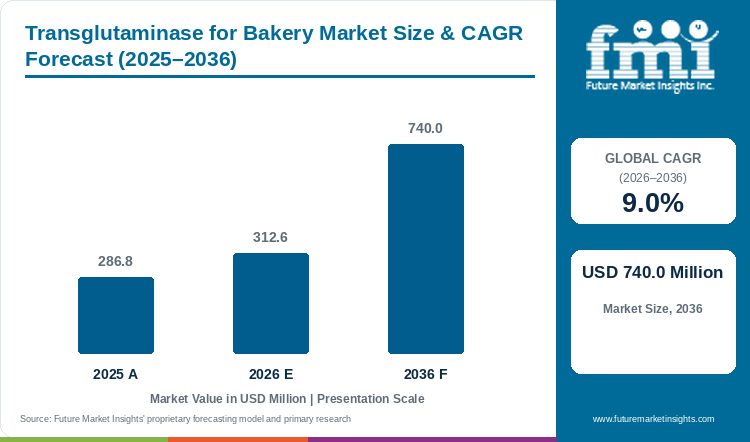
Starting from USD 286.8 million in 2025, the transglutaminase for bakery market valuation advanced to USD 312.6 million in 2026, with projections pointing toward USD 740.0 million by 2036 at a CAGR of 9.0%.
The global transglutaminase for bakery market was valued at USD 286.8 million in 2025 and is estimated to reach USD 312.6 million in 2026. The market is projected to reach USD 740.0 million by 2036, expanding at a compound annual growth rate (CAGR) of 9.0% between 2026 and 2036. Standard grade is projected to capture 41.0% of 2026 demand because baseline 100 U/g microbial preparations satisfy high-volume pan-bread cross-linking without cold-chain handling. Demand for enzyme crosslinking is supported by protein fortification pressure, as bakers raising dough protein for satiety claims need glutamine-lysine bonds to keep crumb structure from collapsing under the extra load [6]. That structural role lifts the niche above the general food enzymes market at 4.9% CAGR, since broad enzyme sales track flour tonnage while microbial transglutaminase sales track reformulation projects that clean-label lists forbid egg white and chemical oxidizers from handling [4]. Enzyme supply is consolidating toward bakery systems, as Lallemand acquired enzyme specialist Solyve and baking ingredients producer AIT Ingredients in July 2025 to broaden formulation and distribution reach [26], IFF launched POWERFRESH ACE 2000 in August 2025 with anti-staling conditioning shown at IBIE 2025 [11], and dsm-firmenich opened its Princeton baking center for pilot-scale rheology in May 2025 [10]. Bakeries award enzyme contracts on slice strength at reduced cost-per-loaf, and suppliers holding GRAS documentation and rheology proof keep those lines running through 2036.
Key Market Trends & Insights
- By product type: Standard Grade is projected to capture 41.0% in 2026 because baseline 100 U/g microbial preparations satisfy high-volume pan-bread cross-linking at minimal batch cost.
- By form: Powder & Dry formulations are estimated to command 42.0% in 2026 as flour mills and dry-blend houses co-meter free-flowing enzyme carriers into bulk silo streams.
- By application: Bread & Rolls are expected to concentrate 32.0% in 2026 because continuous tin-bread and hamburger-bun lines require high shock tolerance during mechanical proofing.
- By claim: Conventional offerings are forecast to generate 53.0% in 2026 owing to cost-sensitive procurement across mainstream supermarket sandwich loaves and QSR buns.
- By sales channel: Direct Industrial Sales are anticipated to account for 60.0% in 2026 through multi-year technical supply agreements between fermentation producers and plant bakeries.
Regional Highlights
- Top national expansion: The UAE is projected to lead national growth at a 10.4% CAGR through 2036 under automated Gulf bakery capacity investments and hotel catering expansion.
- Broader country progression: Saudi Arabia is expected to expand at 10.1% CAGR ahead of South Korea at 9.7% CAGR and the UK at 9.4% CAGR as millers offset imported high-protein wheat costs.
Market Size & Forecast
Table 1: Market Size and Forecast for the Transglutaminase for Bakery Market (USD million and CAGR percentage), 2025 to 2036
| Metric | Value |
|---|---|
| 2025 Market Size | USD 286.8 million |
| Estimated Market Size in 2026 | USD 312.6 million |
| Projected Market Size by 2036 | USD 740.0 million |
| CAGR, 2026 to 2036 | 9.0% |
| Added Revenue, 2026 to 2036 | USD 427.4 million |
Commercial plant bakeries face wide seasonal wet-gluten swings in delivered wheat flour while managing high spot prices for added wheat gluten. Untreated low-protein doughs suffer gas-cell rupture during high-shear dividing and moulding, which directly lowers loaf volume and causes uneven crumb slicing. To overcome this raw-material bottleneck, a July 2025 molecular study published in Molecules demonstrated that combining enzymatic modification with ultrasound treatment reorganizes gliadin-glutenin complexes and improves thermal gelling in weak wheat matrices [2]. so industrial bakery formulators are integrating microbial transglutaminase into baking enzymes systems so automated pan-bread lines maintain oven spring while reducing supplemental wheat gluten additions by 1.0% to 2.5% of flour weight.
Treated Flour Volume and Dosage-Requirement Sizing
Table 2: Treated Bakery Flour Volume and Enzyme Dosage Sizing for the Transglutaminase for Bakery Market (USD million and metric tons), 2025 to 2036
| Metric | 2025 | 2026 | 2036 |
|---|---|---|---|
| Market size (USD million) | 286.8 | 312.6 | 740.0 |
| TG-treated bakery flour volume (million MT) | 11.5 to 13.8 | 12.5 to 15.0 | 29.6 to 35.2 |
| Commercial enzyme preparation volume (MT) | 2,850 to 3,420 | 3,100 to 3,720 | 7,250 to 8,680 |
| Effective enzyme spend per MT treated flour (USD) | 20.8 to 24.9 | 20.8 to 25.0 | 21.0 to 25.0 |
Operational note: Treated flour and preparation volume ranges apply commercial bakery inclusion benchmarks of 10 to 30 ppm (0.5 to 1.5 U per gram of flour on a standard 100 U/g maltodextrin carrier basis) across industrial bread and gluten-free batter lines.
Gluten-free and composite-grain bakeries face an even steeper formulation challenge because rice and pseudocereal flours lack native viscoelastic glutenin films to hold carbon dioxide during proofing. Without covalent protein bridging, gluten-free batters collapse in the oven and produce dense loaves with crumbly texture. In September 2025, response surface optimization research in Food Science & Nutrition verified that pairing microbial transglutaminase at 0.5% to 1.5% with hydroxypropyl methylcellulose (HPMC) rebuilds gas-retaining protein matrices in quinoa-based gluten-free bread [3]. Due to these structural gains, bakery R&D teams co-formulate transglutaminase with alpha-amylase baking enzymes and fungal xylanases to balance protein cross-linking against starch softness.
Per-Ton Flour Economics & Industrial Bakery Plant Sizing
Table 3: Per Capita and Industrial Flour Spending Indicators for the Transglutaminase for Bakery Market (USD and percentage), 2025 to 2036
| Metric | 2025 | 2026 | 2036 |
|---|---|---|---|
| World population (billion) | 8.2 | 8.3 | 9.0 |
| Spend per 1,000 people (USD) | 35.0 | 37.7 | 82.2 |
| Annual enzyme spend per industrial bakery line (USD) | 14,200 to 18,500 | 15,400 to 20,100 | 31,500 to 41,000 |
| Direct mill and plant contract share (%) | 58.0% to 61.0% | 59.0% to 62.0% | 64.0% to 68.0% |
Table 4: Industrial Bakery Plant & Segment Spending Indicators for the Transglutaminase for Bakery Market (USD million and facility benchmarks), 2026
| Metric | Value | Institutional Reference Basis |
|---|---|---|
| Market size, 2026 | USD 312.6 million | 2026 global commercial bakery enzyme baseline |
| Qualified industrial & commercial bakeries | 18,500 facilities | Global high-speed pan-bread and pastry plants |
| Average annual spend per qualified bakery | USD 16,897 | Annualized plant procurement of TG preparations |
| Direct Industrial Sales revenue, 2026 | USD 187.6 million | 60.0% sales-channel segment allocation |
Adoption of enzymatic cross-linkers across retail sandwich-bread brands also depends on clean thermal inactivation during baking so no active enzyme remains in the finished loaf. If an enzyme remains active after oven cooling, progressive protein cross-linking toughens the crumb during supermarket shelf storage and triggers regulatory labeling hurdles. A January 2026 review in Applied Microbiology and Biotechnology documented that Streptomyces mobaraensis transglutaminase operates between pH 5.0 and 8.0 during mixing and inactivates completely above 70 degrees Celsius inside the oven [5]. Because of this predictable thermal cutoff, plant engineers can blend transglutaminase into dough conditioners and bread improvers that qualify as processing aids in major baking markets.
Analyst Perspective
"Industrial bakery procurement teams no longer evaluate microbial transglutaminase as a standalone specialty additive. Suppliers that pair dust-free 100 U/g powder preparations with application-tested xylanase and lipase balances capture multi-plant contracts because they allow bakeries to cut supplemental wheat gluten usage without sacrificing loaf symmetry."
- Nandini Roy Choudhury, Principal Consultant, Future Market Insights.
How is the transglutaminase for bakery market segmented?
The transglutaminase for bakery market is segmented by product type, form, application, claim, and sales channel. In 2026, Standard Grade is projected at 41.0%, Powder & Dry at 42.0%, Bread & Rolls at 32.0%, Conventional at 53.0%, and Direct Industrial Sales at 60.0%.
By product type: Standard Grade, Premium & Specialty Grade, Organic Certified Grade, and Clean Label Grade.
By form: Powder & Dry, Liquid, Paste & Semi-Solid, and Granules & Pieces.
By application: Bread & Rolls, Cakes & Muffins, Biscuits & Cookies, Viennoiserie & Pastry, and Other Bakery.
By claim: Conventional, Clean Label, Organic, and Non-GMO.
By sales channel: Direct Industrial Sales, Ingredient Distributors, Foodservice & Artisan, and Online B2B.
Why does Standard Grade lead the product type category?
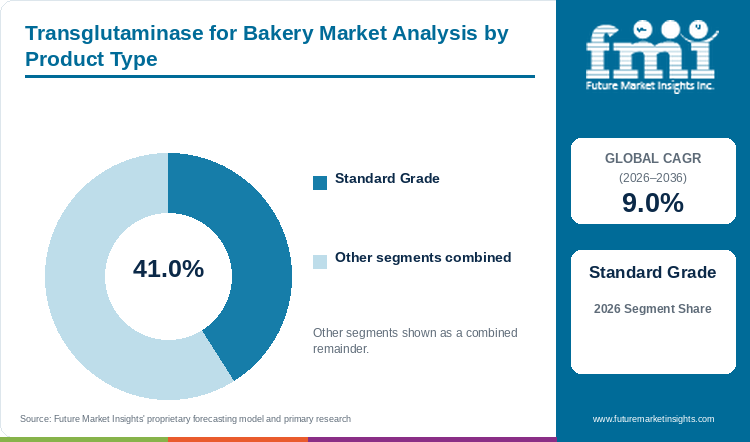
Standard Grade preparations are projected to capture 41.0% of product type demand in 2026, supported by standardized 100 U/g activity and broad pan-bread compatibility.
Table 5: Product Type Share for the Transglutaminase for Bakery Market (percentage share), 2026
| Product Type | Share (2026) |
|---|---|
| Standard Grade | 41.0% |
| Other Segments Combined | 59.0%* |
| Total | 100.0% |
*Note: Remaining product type categories sum to 100.0% of 2026 commercial bakery transglutaminase market value.
Table 6: Product Type Leadership and Market Growth for the Transglutaminase for Bakery Market (segment and CAGR percentage), 2026 to 2036
| Metric | Value |
|---|---|
| Global CAGR (2026 to 2036) | 9.0% |
| Leading Segment | Standard Grade |
High-volume pan-bread and hamburger-bun plants operate on tight per-ton flour budgets that favor standardized, cost-efficient enzyme activity over specialty encapsulated grades. Standard Grade microbial transglutaminase formulated at 80 to 120 U/g on maltodextrin carriers feeds directly into existing mill and bakery micro-dosers without equipment modification. As a result, commercial bakeries use Standard Grade preparations with bakery improvers to restore dough extensibility whenever local wheat harvests show lower wet-gluten levels. However, specialty gluten-free and organic lines still require higher-priced custom grades where carrier certification restricts standard maltodextrin blends.
- Standard Grade is projected to secure 41.0% of the product type segment in 2026 by offering predictable cost-per-ton dough strengthening across automated bread plants.
- A February 2026 Food Chemistry investigation confirmed that microbial transglutaminase modification of sorghum-wheat composite flour elevates dough viscoelasticity and steamed-bread specific volume without requiring specialty carrier encapsulation [6].
Why does Powder & Dry define the largest form segment?
Powder & Dry formulations are estimated to secure 42.0% of the form category in 2026, driven by ambient shelf stability and dry premix compatibility.
Flour millers and dry-improver blenders require moisture-stable enzyme formats that mix uniformly into 25-kilogram flour sacks and pneumatic silo conveyors without caking. Liquid enzyme solutions require chilled transport and separate peristaltic dosing pumps at the dough mixer, which increases capital expenditure and microbial spoilage risk in warm plants. so Powder & Dry preparations dried below 6.0% residual moisture dominate commercial procurement because they remain stable for 12 months in ambient warehouses. In addition to this, formulators blend Powder & Dry transglutaminase directly into gluten-free bakery premixes with hydrocolloids and rice proteins for turnkey batch dosing.
- Powder & Dry options are estimated to command 42.0% of the form segment in 2026 because dry maltodextrin-standardized powders maintain 12-month ambient activity stability.
- Puratos Group introduced its compact Cubease concentrated improver technology at iba 2025 in May 2025, demonstrating how pre-dosed solid bakery formats streamline dry ingredient handling on industrial mixing floors [12].
What keeps Bread & Rolls ahead by application?
Bread & Rolls are expected to command 32.0% of application volume in 2026, reflecting continuous high-speed production of sandwich loaves and QSR buns.
Continuous tin-bread and fast-food bun lines subject fermented dough pieces to intense mechanical dividing and moulding shear forces that tear weak protein films. When dough sheets lose gas-retention capacity during transfer into proofer boxes, finished loaves suffer flat tops and coarse interior cell structure. Because microbial transglutaminase forms heat-stable isopeptide bonds across glutenin chains, Bread & Rolls manufacturers rely on the enzyme to protect shock tolerance during high-speed proofing. Besides this, bakers combine transglutaminase with xylanases and clean-label bread conditioners to preserve slice resilience across five-to-seven-day supermarket shelf life.
- Bread & Rolls are expected to hold 32.0% of the application segment in 2026 because high-throughput pan loaves and buns represent the largest daily flour tonnage in industrial baking.
- U.S. Department of Agriculture National Agricultural Statistics Service data published in May 2025 reported that United States wheat flour milling output reached 422.1 million hundredweight in 2024, anchoring baseline commercial bread flour volume [13].
Why does Conventional lead the claim category?
Conventional formulations are forecast to generate 53.0% of claim demand in 2026, owing to cost-driven procurement across mainstream supermarket and foodservice bakeries.
Private-label supermarket sandwich bread and institutional foodservice buns compete under strict retail price ceilings that leave little margin for organic or specialty-certified enzyme surcharges. Conventional fermentation-derived transglutaminase meets food-grade purity standards across North America and East Asia while delivering the lowest cost per active enzyme unit. Due to these cost advantages, industrial bakeries use Conventional preparations to partially replace expensive wheat gluten without raising per-loaf ingredient expenditure. Clean Label and Non-GMO claims are expanding faster in premium European retail chains, yet Conventional grades retain majority volume across wholesale pan-bread plants.
- Conventional products are forecast to account for 53.0% of the claim segment in 2026 as high-volume plant bakeries prioritize unit-cost efficiency over specialty label certifications.
- A January 2026 Food Chemistry study demonstrated that microbial transglutaminase paired with epsilon-poly-L-lysine and prolyl endopeptidase modifies wheat gluten epitopes efficiently using standard food-grade fermentation preparations [4].
What gives Direct Industrial Sales the leading position in sales channel?
Direct Industrial Sales channels are anticipated to account for 60.0% of sales channel demand in 2026, reinforced by plant-level pilot trials and custom enzyme-blend qualification.
Enzymatic protein cross-linking cannot be sold as a generic plug-and-play commodity to large bakeries because over-dosing by even 10 ppm causes excessive dough stiffness and mixer overload. Wholesale bakery groups therefore procure transglutaminase through Direct Industrial Sales so supplier cereal chemists can calibrate enzyme activity against the customer's exact flour ash content and proof-box humidity. Through direct technical accounts, enzyme manufacturers run farinograph and extensograph pilot trials before locking in annual multi-plant supply contracts. This direct model also allows suppliers to bundle transglutaminase with wheat protein texturizers and anti-staling amylases under a single quality-assurance specification.
- Direct Industrial Sales are anticipated to capture 60.0% of the sales channel segment in 2026 because enterprise bakery accounts require custom activity standardization and on-site line trials.
- dsm-firmenich inaugurated its advanced Princeton Baking Innovation Center in New Jersey in May 2025 to accelerate direct customer pilot testing and enzymatic recipe reformulation across North America [10].
What are the drivers, restraints, and opportunities in the transglutaminase for bakery market?
In the transglutaminase for bakery market, supplemental wheat gluten cost substitution and gluten-free matrix engineering are projected to expand adoption whereas over-crosslinking crumb rigidity restrains uncalibrated dosing and synergistic xylanase-lipase blends create clean-label reformulation opportunities.
- Driver: Supplemental wheat gluten price volatility and seasonal wheat protein variability compel industrial bakeries to adopt transglutaminase cross-linking for consistent dough extensibility.
- Restraint: Narrow dosing tolerances cause excessive crumb toughness when fermentation times drift, while celiac immunoreactivity debates and European labeling scrutiny slow retail qualification.
- Opportunity: Co-formulating microbial transglutaminase with bacterial xylanases and hydrocolloids unlocks high-volume gluten-free loaves and high-fiber composite breads.
Growth Analysis and Future Potential: Qualitative Demand Catalysts
Climate-driven volatility in wheat protein quality and high supplemental wheat gluten prices are compelling commercial bakeries to adopt catalytic protein cross-linking. When heat waves or erratic rainfall strike Northern Hemisphere grain belts during kernel filling, harvested wheat exhibits weaker glutenin polymer assembly and lower dough tenacity. In May 2026, a review in the Journal of Experimental Botany documented how temperature spikes during grain filling disrupt wheat storage protein synthesis and commercial baking performance [18]. Similarly, a July 2026 study in Foods showed that particle-size-fractionated wheat flours suffer wide swings in water absorption and loaf volume unless stabilized by protein-network modifiers [19]. As a result, dosing 15 to 25 ppm of microbial transglutaminase allows millers and bakeries to standardize weak flour lots without purchasing costly imported high-protein wheat.
Risk Assessment of the Transglutaminase for Bakery Market: Operational and Formulation Friction
Narrow operational dosing tolerances on the bakery floor and clinical scrutiny surrounding cross-linked gluten peptides remain the primary barriers to faster market expansion. Unlike alpha-amylases that tolerate moderate overdosing, transglutaminase dosed above 30 ppm or held too long in retarder-proofers builds an overly rigid covalent network that restricts oven spring and yields a tough, chewy crumb. In addition to this operational sensitivity, unmodified transglutaminase cross-linking in wheat bread faces ongoing scientific and regulatory scrutiny regarding celiac epitope reactivity. Although a January 2026 Food Chemistry study demonstrated that pairing microbial transglutaminase with epsilon-poly-L-lysine and prolyl endopeptidase reduces gluten immunoreactivity [4], European retail bakeries still require extensive thermal-inactivation testing [5] before approving new enzyme blends.
Commercial Opportunity Analysis: Formulation Differentiation and Value-Add Formats
Multi-enzyme improver formulation that combine transglutaminase cross-linking with arabinoxylan solubilization and starch anti-staling offers lucrative growth avenues for ingredient suppliers. Single-enzyme transglutaminase addition to high-fiber or composite doughs can increase dough stiffness, whereas pairing it with bacterial or fungal xylanases relaxes cell-wall fibers while preserving gas-cell strength. A February 2026 study in the Journal of Food Science confirmed that commercial bacterial and fungal xylanases cleave insoluble arabinoxylans to improve dough extensibility and loaf volume [7], while a December 2025 study demonstrated parallel volume gains in high-protein rice-flour gluten-free bread using alpha-amylase [8]. Recent commercial launches—including Novonesis Optiva LS Prime in June 2025 [9] and IFF POWERFRESH ACE 2000 in August 2025 [11]—demonstrate how integrated enzyme platforms capture long-term industrial bakery contracts.
Transglutaminase for Bakery Market by Country (2026 to 2036)
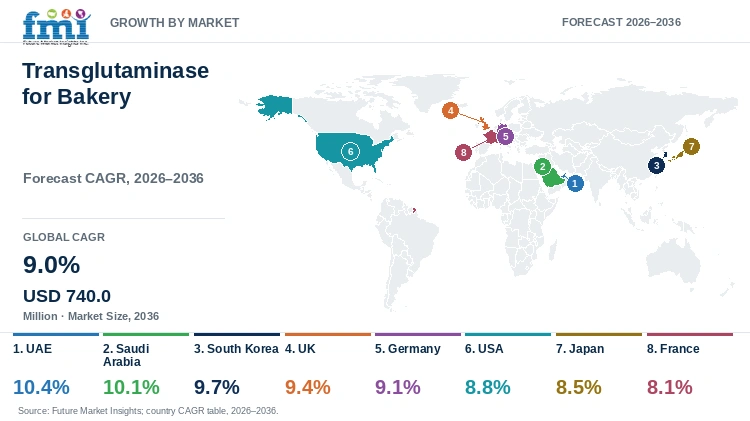
As per FMI, the UAE is projected to lead transglutaminase for bakery growth across tracked national markets at a 10.4% CAGR from 2026 to 2036. Saudi Arabia follows at 10.1% and South Korea reaches 9.7% ahead of the UK at 9.4% and Germany at 9.1%. Meanwhile, the USA (8.8%) and Japan (8.5%) as well as France (8.1%) record steady industrial progression.
Table 7: Country CAGR and Primary Growth Levers for the Transglutaminase for Bakery Market (CAGR percentage), 2026 to 2036
| Country | CAGR (2026 to 2036) | Primary Growth Lever |
|---|---|---|
| UAE | 10.4% | Automated Gulf plant bakeries and hospitality catering expansion |
| Saudi Arabia | 10.1% | Domestic wheat breeding modernization and industrial flatbread-to-pan-bread scaling |
| South Korea | 9.7% | Accelerated domestic wheat cultivar breeding and premium rice-bakery reformulation |
| UK | 9.4% | Supermarket plant-bread automation and clean-label wheat gluten cost substitution |
| Germany | 9.1% | Industrial par-baked roll exports and rye-wheat composite dough stabilization |
| USA | 8.8% | High-speed pan-bread and bun milling integration and gluten-free bakery premixes |
| Japan | 8.5% | Imported hard-wheat protein optimization and convenience-store sandwich bread softness |
| France | 8.1% | Grain-characterization standardization and industrial viennoiserie lamination resilience |
Source: Future Market Insights analysis
UAE Transglutaminase for Bakery Market Outlook (2026 to 2036)
Transglutaminase for bakery demand in the UAE is projected to expand at a 10.4% CAGR from 2026 to 2036. What separates the UAE from traditional European baking markets is its complete reliance on imported milling wheat processed inside centralized, climate-controlled industrial bakeries serving aviation catering and luxury hotels. In February 2025, the Government of Dubai Media Office reported that Dubai Industrial City attracted over AED 350 million in food and beverage manufacturing investments during 2024 [14]. To prevent high ambient warehouse temperatures from degrading flour gluten strength, Gulf plant bakeries dose microbial transglutaminase into frozen-dough and hotel bun premixes, though high cold-chain electricity costs restrain smaller artisan bakeries.
Key takeaway: In the UAE, automated food-zone bakery investments and expanding hospitality catering volumes are projected to anchor high-speed enzymatic dough conditioning.
Saudi Arabia Transglutaminase for Bakery Market Outlook (2026 to 2036)
Saudi Arabia diverges from import-only Gulf neighbors because the Kingdom combines state-backed domestic arid-wheat cultivation with massive religious-tourism and quick-service restaurant bun manufacturing across Riyadh and Jeddah. Bakery transglutaminase sales in Saudi Arabia are forecast to grow at a 10.1% CAGR through 2036. Domestic wheat grown under intense desert heat frequently suffers glutenin protein degradation, which prompted a February 2026 PeerJ field study in Al-Dawadmi, Saudi Arabia evaluating foliar silicon nanoparticles to protect wheat yields under drought stress [16]. Combined with General Authority for Statistics data in January 2026 showing rapid Q3 2025 growth in licensed hospitality establishments [21], privatized flour mills in Saudi Arabia blend transglutaminase directly into commercial bakery flour to standardize loaf volume.
Key takeaway: In Saudi Arabia, arid-climate wheat protein variability and expanding hospitality bakery contracts are forecast to accelerate enzymatic flour standardization.
South Korea Transglutaminase for Bakery Market Outlook (2026 to 2036)
Unlike Western pan-bread markets built on uniform hard red winter wheat, South Korea is actively pushing commercial bakeries to replace imported grain with domestic wheat cultivars and rice-flour blends for national food security. Because domestic wheat and rice flours in South Korea have lower native gluten tenacity, a June 2026 study in BMC Plant Biology detailed an integrated speed-breeding framework in South Korea to accelerate hexaploid wheat cultivar release for commercial baking [17]. National transglutaminase for bakery market value in South Korea is anticipated to advance at a 9.7% CAGR between 2026 and 2036. Retail bakery franchises in Seoul and Gyeonggi Province rely on transglutaminase cross-linking to prevent hybrid rice-wheat doughs from collapsing during humid proofing cycles.
Key takeaway: In South Korea, domestic wheat cultivar commercialization and hybrid rice-wheat bakery reformulation are expected to sustain enzymatic cross-linker adoption.
UK Transglutaminase for Bakery Market Outlook (2026 to 2036)
Demand for transglutaminase in the UK bakery sector is estimated to progress at a 9.4% CAGR from 2026 through 2036. The UK market is uniquely structured around ultra-high-speed Chorleywood Bread Process (CBP) plant bakeries that produce 80% of national wrapped sandwich bread using intense mechanical mixer energy and short fermentation times. UK Office for National Statistics data released in July 2026 confirmed that bakery and farinaceous products remain one of the largest manufacturing segments within national food output [22]. Whenever wet summers in the UK depress domestic Group 1 wheat protein content, CBP plant managers use microbial transglutaminase with fungal xylanases to cut imported wheat gluten costs while preserving high loaf side-wall height.
Key takeaway: In the UK, high-speed Chorleywood plant-bread economics and domestic wheat protein fluctuations are estimated to drive enzymatic gluten reinforcement.
Germany Transglutaminase for Bakery Market Outlook (2026 to 2036)
Germany differs fundamentally from Anglo-Saxon sandwich-bread markets because industrial production centers on frozen par-baked wheat rolls (Brötchen) and rye-wheat mixed loaves supplied to discount supermarket bake-off stations across Europe. Market value for bakery transglutaminase in Germany is projected to rise at a 9.1% CAGR over the 2026 to 2036 assessment period. Rye pentosans and sub-zero ice crystal growth weaken gluten films during frozen storage, causing flat roll volume and crust flaking during in-store re-baking unless reinforced by covalent protein cross-linking. In March 2025, Darmstadt-headquartered AB Enzymes launched a modernized corporate platform to expand technical baking enzyme support across European industrial accounts [20] to accelerate multi-enzyme roll qualification despite strict clean-label retail rules.
Key takeaway: In Germany, industrial par-baked roll production and discount retail bake-off expansion are projected to support steady transglutaminase procurement.
USA Transglutaminase for Bakery Market Outlook (2026 to 2036)
Commercial baking demand in the USA is shaped by two distinct forces: multi-state wholesale hamburger-bun and sandwich-loaf automation and the world's largest retail market for gluten-free and keto baked goods. USDA National Agricultural Statistics Service milling-sector reporting published in May 2025 confirmed industrial flour capacity concentrated across 160 surveyed facilities [24]. Industry valuation in the USA transglutaminase for bakery market is forecast to expand at an 8.8% CAGR from 2026 to 2036. After dsm-firmenich opened its Princeton Baking Innovation Center in New Jersey in May 2025 [10] and IFF launched POWERFRESH ACE 2000 in August 2025 [11], wholesale bakeries in the USA expanded transglutaminase adoption across high-protein rice-flour and low-carb bread lines [8].
Key takeaway: In the USA, wholesale bun line automation and gluten-free premix innovation are forecast to sustain direct industrial enzyme contracts.
Japan Transglutaminase for Bakery Market Outlook (2026 to 2036)
Japan originated industrial fermentation of microbial transglutaminase and exhibits a unique consumption pattern centered on ultra-soft, high-moisture convenience-store sandwich bread (shokupan) and filled sweet buns. Demand for bakery transglutaminase in Japan is expected to grow at an 8.5% CAGR between 2026 and 2036. Because Japan relies heavily on imported hard wheat from North America and Australia, domestic flour millers and plant bakeries in Tokyo and Osaka calibrate transglutaminase dosing to maintain silky crumb elasticity across changing import lots. A March 2026 study in the Journal of the Science of Food and Agriculture on Australian Hard 2 wheat genetics used in Japan [23] and Amano Enzyme's February 2026 enzyme updates [24] reflect intense domestic focus on precision protein modification.
Key takeaway: In Japan, ultra-soft shokupan crumb standards and imported wheat protein optimization are expected to maintain high technical enzyme penetration.
France Transglutaminase for Bakery Market Outlook (2026 to 2036)
Whereas traditional artisan boulangeries in France are legally restricted from adding improvers to classic baguettes, France operates a massive industrial export sector for packaged sandwich bread (pain de mie) and frozen laminated viennoiserie. A February 2025 dataset published in Data in Brief by INRAE researchers in France characterized 90 common wheat grain and flour samples across harvest years, revealing wide harvest-to-harvest swings in glutenin-to-gliadin ratios and alveograph tenacity [25]. Transglutaminase for bakery market value in France is projected to increase at an 8.1% CAGR through 2036. Industrial brioche and frozen pastry plants in France use processing-aid transglutaminase blends to stabilize dough sheet extensibility during high-speed lamination without triggering retail additive declarations.
Key takeaway: In France, industrial pain de mie standardization and frozen pastry export production are projected to support targeted processing-aid enzyme demand.
Full report country CAGRs cover: North America; Latin America; Western Europe; Eastern Europe; East Asia; South Asia and Pacific; Middle East and Africa.
Who are the notable companies in the transglutaminase for bakery market?
Novonesis, IFF, Kerry Group, AB Enzymes, Amano Enzyme, Palsgaard, Corbion, Lallemand Inc. (Nutrilife), Puratos, and dsm-firmenich are the notable companies in the transglutaminase for bakery market.
FMI analysis indicates that commercial competition divides between primary fermentation enzyme producers with proprietary microbial transglutaminase strains and global bakery ingredient formulators that integrate cross-linking activity into custom dough-conditioning systems.
- Primary Fermentation & Biosolutions Leaders: Novonesis and AB Enzymes as well as Amano Enzyme and dsm-firmenich operate industrial submerged fermentation facilities that supply standardized microbial transglutaminase and baking enzyme toolkits.
- Integrated Bakery Enzyme & Preservation Formulators: IFF and Kerry Group as well as Lallemand Inc. (Nutrilife) and Corbion combine enzymatic protein modification with maltogenic amylases and cultured-wheat shelf-life systems for wholesale bakeries.
- Specialty Application & Improver House Platforms: Puratos and Palsgaard operate regional baking innovation centers and supply concentrated improver cubes and emulsifier-enzyme blends tailored to local flour rheology.
Competitive Benchmarking: Transglutaminase for Bakery Market
Table 8: Competitive Benchmarking for the Transglutaminase for Bakery Market (qualitative capability ratings across key players), 2026
| Company | Bakery TG Portfolio | Complementary Baking Enzymes | Bakery Application Centers | Geographic Reach |
|---|---|---|---|---|
| Novonesis | High | High | High | Global biosolutions network across North America and Europe plus Asia-Pacific |
| IFF | Medium | High | High | North America and Europe plus global industrial bakery accounts |
| Kerry Group | Medium | High | High | Global food-ingredient and bakery taste-and-nutrition footprint |
| AB Enzymes | High | High | Medium | Europe and the Americas plus Asia-Pacific industrial baking enzyme distribution |
| Amano Enzyme | High | Medium | Medium | Japan and the USA plus European and Asian food-enzyme channels |
| Palsgaard | Low | Medium | High | Denmark and India (Navi Mumbai) plus Mexico and global bakery application hubs |
| Corbion | Low | Medium | High | North America and Europe plus Latin America bakery preservation accounts |
| Lallemand Inc. (Nutrilife) | Medium | High | High | Canada and the USA plus European yeast and baking-enzyme networks |
| Puratos | Medium | High | High | 100+ countries with regional bakery innovation centers |
| dsm-firmenich | Medium | High | High | Europe and the USA (Princeton, NJ) plus global milling and bakery clients |
Scoring basis: Capability tiers evaluate documented microbial transglutaminase fermentation capacity (such as AB Enzymes VERON TG and Amano Enzyme microbial TG preparations) as well as complementary xylanase and amylase breadth. Application support and geographic ratings reflect verified baking pilot plants and post-divestiture portfolio integration (including Lallemand's ownership of the former BASF Nutrilife enzyme line and July 2025 acquisition of Solyve) across multi-region technical sales networks.
Key Developments in the Transglutaminase for Bakery Market
- Lallemand Inc. acquired France-based enzyme specialist Solyve in July 2025 and baking ingredients producer AIT Ingredients in July 2025 to broaden its industrial baking enzyme formulation and technical distribution capabilities [26].
- IFF launched POWERFRESH ACE 2000 in August 2025 and presented integrated dough-conditioning and anti-staling enzyme solutions at IBIE 2025 in September 2025 to help commercial bakeries maintain loaf softness and resilience [11].
- dsm-firmenich opened its Princeton Baking Innovation Center in Princeton, New Jersey in May 2025, providing wholesale bakeries in North America with pilot-scale rheological testing and custom enzyme formulation support [10].
- Palsgaard inaugurated a advanced application center in Navi Mumbai, India in July 2025 equipped with pilot bakery lines to test enzyme-emulsifier interactions across regional wheat flours [27].
Key Players in the Transglutaminase for Bakery Market
Primary Fermentation & Biosolutions Leaders
- Novonesis
- AB Enzymes
- Amano Enzyme
- dsm-firmenich
Integrated Bakery Enzyme & Preservation Formulators
- IFF
- Kerry Group
- Lallemand Inc. (Nutrilife)
- Corbion
Specialty Application & Improver House Platforms
- Puratos
- Palsgaard
Transglutaminase for Bakery Market - Report Scope
Table 9: Report Scope for the Transglutaminase for Bakery Market (coverage fields and definitions), 2026 to 2036
| Coverage field | Report scope |
|---|---|
| Market breakdown | Product Type; Form; Application; Claim; Sales Channel |
| Quantitative Units | USD Million |
| Market Definition | Includes commercial supplier revenue from microbial transglutaminase enzyme preparations and identifiable transglutaminase value within multi-enzyme bakery improvers sold for pan bread and sweet baked goods as well as laminated pastry and gluten-free bakery production. Category Scope Note: Excludes finished baked-good retail sales and meat/seafood Restructuring TG applications as well as standalone wheat gluten and non-enzymatic chemical oxidants. |
| Regions Covered | North America; Latin America; Western Europe; Eastern Europe; East Asia; South Asia and Pacific; Middle East and Africa |
| Countries Covered | UAE, Saudi Arabia, South Korea, UK, Germany, USA, Japan, France, and additional countries in the full report |
| Key Companies Covered | Novonesis, IFF, Kerry Group, AB Enzymes, Amano Enzyme, Palsgaard, Corbion, Lallemand Inc. (Nutrilife), Puratos, dsm-firmenich |
| Forecast Period | 2026 to 2036 |
| Approach | Primary and secondary research with top-down food-enzyme parent reconciliation and bottom-up flour-tonnage dosage triangulation. |
Transglutaminase for Bakery Market - Research Methodology
Table 10: Research Methodology for the Transglutaminase for Bakery Market (research methods and analytical approach), 2026 to 2036
| Method | Approach |
|---|---|
| Primary Research | Structured interviews with fermentation bioprocess directors and flour-mill head cereal chemists as well as wholesale bakery R&D managers and improver-house formulators to validate 10 to 30 ppm inclusion rates and supplemental wheat gluten substitution ratios. |
| Secondary Research | Analysis of USDA NASS Flour Milling Products summaries and UK ONS manufacturer sales releases paired with INRAE wheat flour characterization datasets and peer-reviewed rheology studies in Food Chemistry and International Journal of Biological Macromolecules. |
| Market Sizing and Forecasting | Top-down reconciliation against the global food enzymes market (USD 3,600.0 million in 2026) and bakery enzymes parent pool (USD 1,200.0 million in 2026) cross-checked against bottom-up treated flour tonnage (12.5 to 15.0 million MT in 2026) and enzyme spend per ton. |
| Country Forecasting Model | Econometric national projections weight industrial pan-bread flour milling volumes and gluten-free bakery retail growth paired with domestic wheat protein volatility and processing-aid regulatory frameworks across eight core countries. |
| Operational Benchmark Traceability | Treated flour volumes and per-line enzyme spend benchmarks in Tables 2 through 4 trace to USDA NASS milling statistics and PubMed rheological cross-linking cohorts paired with industrial bakery pilot plant dosing protocols. |
| Data Triangulation and Validation | Supplier revenues are isolated to transglutaminase active preparations and pro-rata multi-enzyme improver content while strictly excluding meat-binding transglutaminase and standalone wheat gluten turnover to prevent double counting. |
Transglutaminase for Bakery Market by Segments
Transglutaminase for Bakery Market segmented by Product Type:
- Standard Grade
- Premium & Specialty Grade
- Organic Certified Grade
- Clean Label Grade
Transglutaminase for Bakery Market segmented by Form:
- Powder & Dry
- Liquid
- Paste & Semi-Solid
- Granules & Pieces
Transglutaminase for Bakery Market segmented by Application:
- Bread & Rolls
- Cakes & Muffins
- Biscuits & Cookies
- Viennoiserie & Pastry
- Other Bakery
Transglutaminase for Bakery Market segmented by Claim:
- Conventional
- Clean Label
- Organic
- Non-GMO
Transglutaminase for Bakery Market segmented by Sales Channel:
- Direct Industrial Sales
- Ingredient Distributors
- Foodservice & Artisan
- Online B2B
Transglutaminase for Bakery Market by Region
- North America
- United States
- Canada
- Latin America
- Brazil
- Mexico
- Argentina
- Chile
- Western Europe
- Germany
- France
- United Kingdom
- Italy
- Spain
- Benelux
- Nordics
- Eastern Europe
- Poland
- Czech Republic
- Romania
- Hungary
- East Asia
- China
- Japan
- South Korea
- South Asia and Pacific
- India
- ASEAN
- Australia and New Zealand
- Middle East and Africa
- GCC Countries
- South Africa
- Türkiye
- Israel
Research Sources and Bibliography
- [1] Yu, Y., Wang, F., Yang, Y., Zhang, J., Liu, H., Liang, Y., & Wang, J. (2025, January 7). Changes in rheological properties and structure of wheat gluten proteins induced by transglutaminase. International Journal of Biological Macromolecules, 295, 139599 (PubMed PMID 39788262).
- [2] Zadeike, D., Zvirdauskiene, R., & Basinskiene, L. (2025, July 19). Gluten Functionality Modification: The Effect of Enzymes and Ultrasound on the Structure of the Gliadin-Glutenin Complex and Gelling Properties. Molecules, 30(14), 3036 (PubMed PMID 40733302).
- [3] Ghodosipoor, Z., Zahed, O., Fallahzadeh, H., Mollakhalili-Meybodi, N., & Nematollahi, A. (2025, September 1). Optimization of Quinoa-Based Gluten-Free Bread Production Using Microbial Transglutaminase Enzyme and Hydroxypropyl Methyl Cellulose (HPMC) by Response Surface Methodology. Food Science & Nutrition, 13(9), e70891 (PubMed PMID 40901655).
- [4] Ribeiro, M., Siopa, J., & Nunes, F. M. (2026, January 8). Enhancing gluten modification for celiac patients: harnessing microbial transglutaminase, ε-poly-l-lysine, and prolyl endopeptidase. Food Chemistry, 505, 147908 (PubMed PMID 41539261).
- [5] Kieliszek, M. (2026, January 24). Microbial transglutaminase in food biotechnology: from biochemical mechanisms to industrial applications. Applied Microbiology and Biotechnology, 110(1), 38 (PubMed PMID 41580581).
- [6] Zhang, L., Wang, H., Gao, H., Li, J., Zeng, J., Song, M., & Xu, J. (2026, February 26). Effects of different modifiers on the properties of sorghum-wheat flour, dough, and steamed bread. Food Chemistry, 510, 148667 (PubMed PMID 41785754).
- [7] Souza, P., Quadros, A., Dogan, H., Li, Y., Shi, Y.-C., & Karkle, E. (2026, February 10). Exploring Bread Quality through the Use of Commercial Bacterial and Fungal Xylanases: Effects on Dough Rheology, Loaf Volume, and Arabinoxylan Structure. Journal of Food Science, 91(2), e70940 (PubMed PMID 41709635).
- [8] Freire, B., Prinyawiwatkul, W., Muela Negrete, A., Golub, E., & King, J. M. (2025, December 1). Development of Gluten-Free Bread With High-Protein Rice Flour and Effects of Alpha-Amylase Enzyme on Bread Properties. Journal of Food Science, 90(12), e70733 (PubMed PMID 41373172).
- [9] Novonesis. (2025, June 11). Novonesis launches Optiva® LS Prime, helping bakers cut up to 50% added sugar and create more cost-effective baked goods. Novonesis Group.
- [10] dsm-firmenich. (2025, May 20). On the rise: dsm-firmenich opens state-of-the-art Princeton Baking Innovation Center in Princeton, NJ. dsm-firmenich Press Releases.
- [11] International Flavors & Fragrances Inc. (2025, August 13). IFF Launches POWERFRESH® ACE 2000, a Bread Fresh-Keeping Solution That 'Aces' the Shelf-Life Test. IFF Newsroom.
- [12] Puratos Group. (2025, May 7). Puratos brings a trio of transformative innovations to iba 2025. Puratos Press Releases.
- [13] U.S. Department of Agriculture, National Agricultural Statistics Service. (2025, May 1). Flour Milling Products 2024 Summary. USDA NASS.
- [14] Government of Dubai Media Office. (2025, February 19). Dubai Industrial City attracts more than AED 350 million F&B investments in 2024. Government of Dubai.
- [15] Dubai Department of Economy and Tourism. (2026, February 9). Dubai welcomes 19.59 million visitors in third record year. Government of Dubai.
- [16] Alqahtani, M. M. (2026, February 24). Improving drought tolerance in some wheat genotypes with foliar application of silicon nanoparticles in Al-Dawadmi, Saudi Arabia. PeerJ, 14, e20823 (PubMed PMID 41769396).
- [17] Cha, J.-K., Park, H., Kwon, Y., Lee, S.-M., Kim, W.-J., & Lee, J.-H. (2026, June 8). From lab to field: accelerated cultivar release via integrated speed breeding framework in wheat (Triticum aestivum L.). BMC Plant Biology, 26(1), 1364 (PubMed PMID 42252417).
- [18] Shewry, P. R. (2026, May 5). Wheat in 2025: challenges for sustainable production and consumption. Journal of Experimental Botany, 77(9), 2617-2625 (PubMed PMID 41269894).
- [19] Oyeyinka, S. A., Ajayi, O. M., Dudu, O. E., Ellis, J., & Adebo, O. A. (2026, July 28). Physical, Chemical, and Bioactive Properties of Bread Made from Particle-Size-Fractionated Wheat Flour. Foods, 15(15), 2644 (PubMed PMID 42587904).
- [20] AB Enzymes GmbH. (2025, March 19). AB Enzymes Launches New Corporate Design, Reflecting Heritage, Growth and Innovation. AB Enzymes News.
- [21] General Authority for Statistics. (2026, January 8). GASTAT: Publishes Tourism Establishments Statistics for Q3 of 2025. Kingdom of Saudi Arabia.
- [22] Office for National Statistics. (2026, July 24). UK manufacturers' sales by product: 2025. UK Office for National Statistics.
- [23] Siah, S. D., Shinkai, Y., Lu, M., Edwards, J., Quail, K., & Okusu, H. (2026, March 15). Australian Hard 2 (AH2) wheat class with null4A genetic basis to produce high-quality Japanese ramen noodle. Journal of the Science of Food and Agriculture, 106(4), 2211-2221 (PubMed PMID 41261959).
- [24] Amano Enzyme Inc. (2026, February 7). Amano Enzyme USA to Showcase Food, Beverage, and Diagnostic Enzyme Solutions at IFT FIRST and ADLM 2026. Amano Enzyme News.
- [25] Munch, M., Rezette, L., Buche, P., Chambrey, B., Deborde, C., Dervaux, S., et al. (2025, February 7). Dataset for common wheat (Triticum aestivum L.) grain and flour characterization using classical and advanced analyses. Data in Brief, 59, 111375 (PubMed PMID 40034728).
- [26] Lallemand Inc. (2025, July 17). Lallemand acquires enzyme specialist Solyve. Lallemand News.
- [27] Palsgaard A/S. (2025, July 8). Palsgaard Inaugurates State-of-the-Art Application Centre in Navi Mumbai to Strengthen Regional Customer Support. Palsgaard News.
- [28] Corbion NV. (2025, April 21). Corbion Unveils Verdad® Essence WH100: Redefining Natural Mold Inhibition for Bakers. Corbion Media.
This bibliography is provided for reader reference and is not exhaustive. The full report contains the complete list of sources and detailed citations.
This Report Answers
- How large is the transglutaminase for bakery market in 2026 and what is forecast for 2036?
- Which flour-quality and wheat-gluten cost pressures support demand for bakery transglutaminase?
- Why does Standard Grade lead the product type category?
- Why does Powder & Dry lead the form category globally?
- How do growth rates differ across the UAE and Saudi Arabia versus South Korea and the UK?
- Which leading fermentation and bakery-ingredient companies supply relevant enzyme systems today?
- What limits adoption or supplier switching in the transglutaminase for bakery market?
- What should industrial bakeries evaluate before qualifying a transglutaminase preparation?
Frequently Asked Questions
How big is the transglutaminase for bakery market in 2026, and what is forecast for 2036?
According to FMI, the global transglutaminase for bakery market value is estimated to reach USD 312.6 million in 2026 and is projected to climb to an industry valuation of USD 740.0 million by 2036, up from USD 286.8 million in 2025.
What is the CAGR for the transglutaminase for bakery market from 2026 to 2036?
Future Market Insights projects a 9.0% compound annual growth rate between 2026 and 2036, representing USD 427.4 million in incremental market value over the decade.
Which product type segment leads the transglutaminase for bakery market?
Standard Grade preparations are projected to capture 41.0% of product type demand in 2026 because 100 U/g maltodextrin-carried powders integrate directly into industrial pan-bread dosing systems.
Which form segment leads the transglutaminase for bakery market?
Powder & Dry formulations are estimated to secure 42.0% of the form category in 2026 owing to ambient warehouse stability and direct dry-blending compatibility at flour mills.
Which country has a notable growth outlook during the assessment period?
The UAE is projected to lead national growth at a 10.4% CAGR through 2036, supported by Dubai Industrial City food-zone plant investments and record hospitality bakery demand.
Who are the key players in the market?
Novonesis, IFF, Kerry Group, AB Enzymes, Amano Enzyme, Palsgaard, Corbion, Lallemand Inc. (Nutrilife), Puratos, and dsm-firmenich are the notable companies in the market.
Preview the report firsthand - request a free sample
Get SampleGet the brochure for pricing and purchase details.
Get PDFTable of Content
- Key Takeaways
- Market Size and CAGR
- Top Growth Driver
- Fastest Growing Segment
- Leading Region
- Key Companies
- Emerging Opportunities
- Executive Summary
- Global Market Outlook
- Demand-side Trends
- Supply-side Trends
- Technology Roadmap Analysis
- Analysis and Recommendations
- Analyst Perspective (What is happening? Why now? What should investors know?)
- Key Questions Answered
- How large is the market?
- What is the CAGR?
- What are key trends?
- Which region dominates?
- Who are the leaders?
- Market Overview
- Market Coverage / Taxonomy
- Market Definition / Scope / Limitations
- Research Methodology
- Chapter Orientation
- Analytical Lens and Working Hypotheses
- Market Structure, Signals, and Trend Drivers
- Benchmarking and Cross-market Comparability
- Market Sizing, Forecasting, and Opportunity Mapping
- Research Design and Evidence Framework
- Desk Research Programme (Secondary Evidence)
- Expert Input and Fieldwork (Primary Evidence)
- Tooling, Models, and Reference Databases
- Data Engineering and Model Build
- Quality Assurance and Audit Trail
- Market Background
- Market Dynamics (Drivers, Restraints, Opportunity, Trends)
- Scenario Forecast (Optimistic, Likely, Conservative)
- Impact Analysis
- AI Impact
- Sustainability Impact
- Regulatory Impact
- Technology Impact
- Consumer / Buyer Analysis
- Purchase Drivers
- Adoption Barriers
- Buyer Journey
- Opportunity Map Analysis
- Product Life Cycle Analysis
- Supply Chain Analysis
- Investment Feasibility Matrix
- Value Chain Analysis
- PESTLE and Porter's Analysis
- Regulatory Landscape
- Regional Parent Market Outlook
- Production and Consumption Statistics
- Import and Export Statistics
- Global Market Analysis and Forecast, 2021 to 2036
- Historical Market Size Value (USD Million) Analysis, 2021 to 2025
- Current and Future Market Size Value (USD Million) Projections, 2026 to 2036
- Y-o-Y Growth Trend Analysis
- Absolute $ Opportunity Analysis
- Global Market Pricing Analysis, 2021 to 2036
- Global Market Analysis and Forecast, By Product Type, 2021 to 2036
- Introduction / Key Findings
- Historical Market Size Value (USD Million) Analysis By Product Type, 2021 to 2025
- Current and Future Market Size Value (USD Million) Analysis and Forecast By Product Type, 2026 to 2036
- Standard Grade
- Premium & Specialty Grade
- Organic Certified Grade
- Clean Label Grade
- Y-o-Y Growth Trend Analysis By Product Type, 2021 to 2025
- Absolute $ Opportunity Analysis By Product Type, 2026 to 2036
- Global Market Analysis and Forecast, By Form, 2021 to 2036
- Introduction / Key Findings
- Historical Market Size Value (USD Million) Analysis By Form, 2021 to 2025
- Current and Future Market Size Value (USD Million) Analysis and Forecast By Form, 2026 to 2036
- Powder & Dry
- Liquid
- Paste & Semi-Solid
- Granules & Pieces
- Y-o-Y Growth Trend Analysis By Form, 2021 to 2025
- Absolute $ Opportunity Analysis By Form, 2026 to 2036
- Global Market Analysis and Forecast, By Application, 2021 to 2036
- Introduction / Key Findings
- Historical Market Size Value (USD Million) Analysis By Application, 2021 to 2025
- Current and Future Market Size Value (USD Million) Analysis and Forecast By Application, 2026 to 2036
- Bread & Rolls
- Cakes & Muffins
- Biscuits & Cookies
- Viennoiserie & Pastry
- Other Bakery
- Y-o-Y Growth Trend Analysis By Application, 2021 to 2025
- Absolute $ Opportunity Analysis By Application, 2026 to 2036
- Global Market Analysis and Forecast, By Claim, 2021 to 2036
- Introduction / Key Findings
- Historical Market Size Value (USD Million) Analysis By Claim, 2021 to 2025
- Current and Future Market Size Value (USD Million) Analysis and Forecast By Claim, 2026 to 2036
- Conventional
- Clean Label
- Organic
- Non-GMO
- Y-o-Y Growth Trend Analysis By Claim, 2021 to 2025
- Absolute $ Opportunity Analysis By Claim, 2026 to 2036
- Global Market Analysis and Forecast, By Sales Channel, 2021 to 2036
- Introduction / Key Findings
- Historical Market Size Value (USD Million) Analysis By Sales Channel, 2021 to 2025
- Current and Future Market Size Value (USD Million) Analysis and Forecast By Sales Channel, 2026 to 2036
- Direct Industrial Sales
- Ingredient Distributors
- Foodservice & Artisan
- Online B2B
- Y-o-Y Growth Trend Analysis By Sales Channel, 2021 to 2025
- Absolute $ Opportunity Analysis By Sales Channel, 2026 to 2036
- Global Market Analysis and Forecast, By Region, 2021 to 2036
- Introduction
- Historical Market Size Value (USD Million) Analysis By Region, 2021 to 2025
- Current Market Size Value (USD Million) Analysis and Forecast By Region, 2026 to 2036
- North America
- Latin America
- Western Europe
- Eastern Europe
- East Asia
- South Asia and Pacific
- Middle East and Africa
- Market Attractiveness Analysis By Region
- North America Market Analysis and Forecast, By Country, 2021 to 2036
- Historical Market Size Value (USD Million) Trend Analysis By Market Taxonomy, 2021 to 2025
- Market Size Value (USD Million) Forecast By Market Taxonomy, 2026 to 2036
- By Country
- United States
- Canada
- By Product Type
- By Form
- By Application
- By Claim
- By Sales Channel
- By Country
- Market Attractiveness Analysis
- By Country
- By Product Type
- By Form
- By Application
- By Claim
- By Sales Channel
- Key Takeaways
- Latin America Market Analysis and Forecast, By Country
- Historical Market Size Value (USD Million) Trend Analysis By Market Taxonomy, 2021 to 2025
- Market Size Value (USD Million) Forecast By Market Taxonomy, 2026 to 2036
- By Country
- Brazil
- Mexico
- Argentina
- Chile
- By Product Type
- By Form
- By Application
- By Claim
- By Sales Channel
- By Country
- Market Attractiveness Analysis
- By Country
- By Product Type
- By Form
- By Application
- By Claim
- By Sales Channel
- Key Takeaways
- Western Europe Market Analysis and Forecast, By Country
- Historical Market Size Value (USD Million) Trend Analysis By Market Taxonomy, 2021 to 2025
- Market Size Value (USD Million) Forecast By Market Taxonomy, 2026 to 2036
- By Country
- Germany
- France
- United Kingdom
- Italy
- Spain
- Benelux
- Nordics
- By Product Type
- By Form
- By Application
- By Claim
- By Sales Channel
- By Country
- Market Attractiveness Analysis
- By Country
- By Product Type
- By Form
- By Application
- By Claim
- By Sales Channel
- Key Takeaways
- Eastern Europe Market Analysis and Forecast, By Country
- Historical Market Size Value (USD Million) Trend Analysis By Market Taxonomy, 2021 to 2025
- Market Size Value (USD Million) Forecast By Market Taxonomy, 2026 to 2036
- By Country
- Poland
- Czech Republic
- Romania
- Hungary
- By Product Type
- By Form
- By Application
- By Claim
- By Sales Channel
- By Country
- Market Attractiveness Analysis
- By Country
- By Product Type
- By Form
- By Application
- By Claim
- By Sales Channel
- Key Takeaways
- East Asia Market Analysis and Forecast, By Country
- Historical Market Size Value (USD Million) Trend Analysis By Market Taxonomy, 2021 to 2025
- Market Size Value (USD Million) Forecast By Market Taxonomy, 2026 to 2036
- By Country
- China
- Japan
- South Korea
- By Product Type
- By Form
- By Application
- By Claim
- By Sales Channel
- By Country
- Market Attractiveness Analysis
- By Country
- By Product Type
- By Form
- By Application
- By Claim
- By Sales Channel
- Key Takeaways
- South Asia and Pacific Market Analysis and Forecast, By Country
- Historical Market Size Value (USD Million) Trend Analysis By Market Taxonomy, 2021 to 2025
- Market Size Value (USD Million) Forecast By Market Taxonomy, 2026 to 2036
- By Country
- India
- ASEAN
- Australia and New Zealand
- By Product Type
- By Form
- By Application
- By Claim
- By Sales Channel
- By Country
- Market Attractiveness Analysis
- By Country
- By Product Type
- By Form
- By Application
- By Claim
- By Sales Channel
- Key Takeaways
- Middle East and Africa Market Analysis and Forecast, By Country
- Historical Market Size Value (USD Million) Trend Analysis By Market Taxonomy, 2021 to 2025
- Market Size Value (USD Million) Forecast By Market Taxonomy, 2026 to 2036
- By Country
- GCC Countries
- South Africa
- Türkiye
- Israel
- By Product Type
- By Form
- By Application
- By Claim
- By Sales Channel
- By Country
- Market Attractiveness Analysis
- By Country
- By Product Type
- By Form
- By Application
- By Claim
- By Sales Channel
- Key Takeaways
- Key Countries Market Analysis
- United States
- Pricing Analysis
- Market Share Analysis, 2025
- By Product Type
- By Form
- By Application
- By Claim
- By Sales Channel
- Canada
- Pricing Analysis
- Market Share Analysis, 2025
- By Product Type
- By Form
- By Application
- By Claim
- By Sales Channel
- Mexico
- Pricing Analysis
- Market Share Analysis, 2025
- By Product Type
- By Form
- By Application
- By Claim
- By Sales Channel
- Brazil
- Pricing Analysis
- Market Share Analysis, 2025
- By Product Type
- By Form
- By Application
- By Claim
- By Sales Channel
- Chile
- Pricing Analysis
- Market Share Analysis, 2025
- By Product Type
- By Form
- By Application
- By Claim
- By Sales Channel
- Germany
- Pricing Analysis
- Market Share Analysis, 2025
- By Product Type
- By Form
- By Application
- By Claim
- By Sales Channel
- United Kingdom
- Pricing Analysis
- Market Share Analysis, 2025
- By Product Type
- By Form
- By Application
- By Claim
- By Sales Channel
- Italy
- Pricing Analysis
- Market Share Analysis, 2025
- By Product Type
- By Form
- By Application
- By Claim
- By Sales Channel
- Spain
- Pricing Analysis
- Market Share Analysis, 2025
- By Product Type
- By Form
- By Application
- By Claim
- By Sales Channel
- France
- Pricing Analysis
- Market Share Analysis, 2025
- By Product Type
- By Form
- By Application
- By Claim
- By Sales Channel
- India
- Pricing Analysis
- Market Share Analysis, 2025
- By Product Type
- By Form
- By Application
- By Claim
- By Sales Channel
- ASEAN
- Pricing Analysis
- Market Share Analysis, 2025
- By Product Type
- By Form
- By Application
- By Claim
- By Sales Channel
- Australia and New Zealand
- Pricing Analysis
- Market Share Analysis, 2025
- By Product Type
- By Form
- By Application
- By Claim
- By Sales Channel
- China
- Pricing Analysis
- Market Share Analysis, 2025
- By Product Type
- By Form
- By Application
- By Claim
- By Sales Channel
- Japan
- Pricing Analysis
- Market Share Analysis, 2025
- By Product Type
- By Form
- By Application
- By Claim
- By Sales Channel
- South Korea
- Pricing Analysis
- Market Share Analysis, 2025
- By Product Type
- By Form
- By Application
- By Claim
- By Sales Channel
- Poland
- Pricing Analysis
- Market Share Analysis, 2025
- By Product Type
- By Form
- By Application
- By Claim
- By Sales Channel
- Hungary
- Pricing Analysis
- Market Share Analysis, 2025
- By Product Type
- By Form
- By Application
- By Claim
- By Sales Channel
- Türkiye
- Pricing Analysis
- Market Share Analysis, 2025
- By Product Type
- By Form
- By Application
- By Claim
- By Sales Channel
- South Africa
- Pricing Analysis
- Market Share Analysis, 2025
- By Product Type
- By Form
- By Application
- By Claim
- By Sales Channel
- UAE
- Pricing Analysis
- Market Share Analysis, 2025
- By Product Type
- By Form
- By Application
- By Claim
- By Sales Channel
- Saudi Arabia
- Pricing Analysis
- Market Share Analysis, 2025
- By Product Type
- By Form
- By Application
- By Claim
- By Sales Channel
- United States
- Market Structure Analysis
- Competition Dashboard
- Competition Benchmarking
- Market Share Analysis of Top Players
- By Regional
- By Product Type
- By Form
- By Application
- By Claim
- By Sales Channel
- Emerging Startups
- Innovation Benchmarking
- Competition Analysis
- Competition Deep Dive
- Novonesis
- Overview
- Product Portfolio
- Profitability by Market Segments
- Sales Footprint
- Strategy Overview
- Marketing Strategy
- Product Strategy
- Channel Strategy
- IFF
- Kerry Group
- AB Enzymes
- Amano Enzyme
- Palsgaard
- Corbion
- Lallemand Inc. (Nutrilife)
- Puratos
- dsm-firmenich
- Novonesis
- Case Studies
- Success Stories
- Recent Developments
- Competition Deep Dive
- Assumptions & Acronyms Used


