

- Market Size (2026)
- USD 915.6 Mn
- Forecast (2036)
- USD 2894.9 Mn
- CAGR (2026 to 2036)
- 12.2%
How big is Bakery Inclusions Market in 2026?
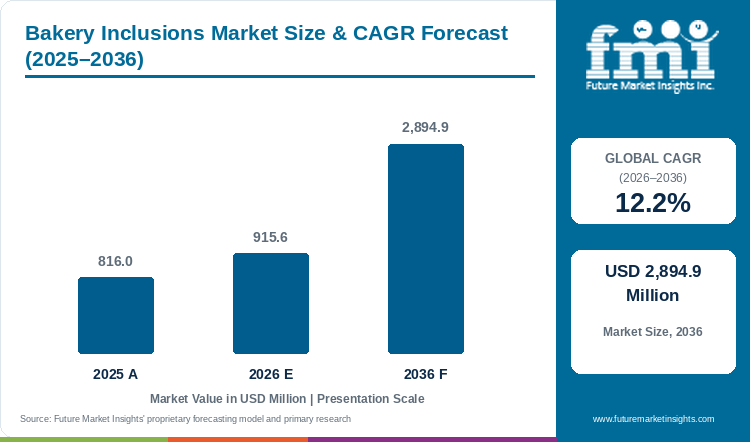
Assessed at USD 816.0 million in 2025 and progressing to USD 915.6 million in 2026, the bakery inclusions market valuation is on course to reach USD 2,894.9 million by 2036, supported by a forecast-period CAGR of 12.2%.
The global bakery inclusions market was valued at USD 816.0 million in 2025 and is estimated to reach USD 1,979.3 million in 2026. The market is projected to reach USD 2,894.9 million by 2036, expanding at a compound annual growth rate (CAGR) of 12.2% between 2026 and 2036. Chocolate pieces are projected to capture 32.0% of 2026 type demand, as bake-stable chips and chunks deliver visible flavor without melting through dough during proof and bake cycles. Demand for inclusions is supported by snackification of bakery aisles, since sweet-bread brands now compete with confectionery for the same afternoon occasion and inclusions are the difference on the wrapper photograph [8]. That confectionery crossover lifts the category above the bakery ingredients market at 7.0% CAGR, because general ingredient sales follow bread volume while inclusion sales follow treat-product launches [1]. The supplier map is being redrawn to fund that demand, as Puratos agreed in March 2026 to acquire Dawn Foods after taking nut-paste specialist Ver Foods in January 2026 [7] [16], and CVC Capital Partners moved for inclusion maker Irca Group in June 2026 across 19 facilities and EUR 1.5 billion in revenue [17] [23]. Fabbri answered the clean-label side in January 2026 with moisture-resistant gluten-free crunchy inclusions launched at SIGEP [11]. Bakeries award inclusion contracts on crunch retention through 48-hour shelf life, and the groups combining chocolate, fruit and nut platforms under one qualification file own the treat-bakery pipeline through 2036.
Key Market Trends & Insights
- By product type: The Chocolate Pieces segment is projected to capture 32.0% of the product type segment in 2026 because bake-stable chips and chunks provide immediate visual differentiation.
- By form: The Powder / Dry segment is estimated to command 45.0% of the form segment in 2026 because free-flowing dry particulates integrate directly into automated loss-in-weight feeders.
- By application: The Bread & Rolls segment is expected to concentrate 42.0% of the application segment in 2026 because continuous pan-bread and brioche lines sustain recurring bulk orders.
- By claim: The Conventional segment is forecast to generate 54.0% of the claim segment in 2026 owing to wider stabilizer and sugar latitude during thermal qualification.
- By sales channel: The Direct to Industrial Bakeries segment is anticipated to account for 53.0% of the sales channel segment in 2026 through plant-level rheology trials and multi-year contracts.
Regional Highlights
- Top national expansion: The UAE is projected to lead evaluated national markets at a 13.6% CAGR through 2036 under luxury hospitality patisserie and climate-resilient inclusion demand.
- Broader country progression: Saudi Arabia is expected to expand at a 13.2% CAGR ahead of South Korea at 12.9% and the USA at 12.6%, while Japan is forecast to advance at an 11.3% CAGR.
Market Size & Forecast
Table 1: Market Size and Forecast for the Bakery Inclusions Market (USD million and CAGR percentage), 2025 to 2036
| Metric | Value |
|---|---|
| 2025 Market Size | USD 816.0 million |
| Estimated Market Size in 2026 | USD 915.6 million |
| Projected Market Size by 2036 | USD 2,894.9 million |
| CAGR, 2026 to 2036 | 12.2% |
| Incremental Market Value, 2026 to 2036 | USD 1,979.3 million |
Commercial bakeries expand SKU variety by dosing discrete fruit and chocolate particulates into standardized base batters rather than commissioning new oven lines. However, cocoa price spikes have forced R&D teams to audit inclusion dosage rates and test carob or caramel pieces with bake-stable chocolate fillings. In August 2025, the International Cocoa Organization reported in its Quarterly Bulletin of Cocoa Statistics that the 2023/24 cocoa season closed with a 494,000-tonne global supply deficit while world grindings fell 4.8% to 4.818 million tonnes [2]. Industrial procurement officers consequently lock in multi-quarter contracts for calibrated inclusions that maintain piece count per loaf at lower weight loading.
Particulate Tonnage and Bakery Line Dosing Sizing
Table 2: Particulate Tonnage and Dosing Sizing for the Bakery Inclusions Market (USD million and operational ranges), 2025 to 2036
| Metric | 2025 | 2026 | 2036 |
|---|---|---|---|
| Market size (USD million) | 816.0 | 915.6 | 2,894.9 |
| Commercial inclusion volume shipped (thousand metric tons) | 185.0 to 205.0 | 205.0 to 228.0 | 580.0 to 645.0 |
| Average inclusion dosage in finished dough (% weight) | 8.0% to 14.0% | 8.5% to 14.5% | 10.0% to 16.0% |
| Average B2B contract price per kilogram (USD) | 4.0 to 4.4 | 4.1 to 4.5 | 4.5 to 5.0 |
Operational note: Tonnage and dosage benchmarks reflect 8% to 16% particulate addition rates across industrial pan breads and sweet baked goods at 0.35 to 0.65 water activity.
Preventing anthocyanin color bleeding and moisture migration from fruit pieces into surrounding cake batter requires tight control of Brix and water activity below 0.60 prior to depositor dosing. Industrial formulators pair low-water-activity fruit cubes and chocolate drops with baking chocolate coatings to preserve crisp edges across 6-month ambient shelf lives.
Per Capita & Commercial Bakery Plant Sizing
Table 3: Per Capita and Plant Spending Indicators for the Bakery Inclusions Market (USD), 2025 to 2036
| Metric | 2025 | 2026 | 2036 |
|---|---|---|---|
| World population (billion) | 8.2 | 8.3 | 9.0 |
| Spend per 1,000 people (USD) | 99.5 | 110.3 | 321.7 |
| Annual inclusion spend per industrial bakery plant (USD thousand) | 31.5 to 35.0 | 34.8 to 38.5 | 98.0 to 112.0 |
| Direct plant contract procurement share (%) | 51.5% to 53.5% | 52.0% to 54.0% | 57.0% to 60.0% |
Table 4: Bakery Plant & Segment Spending Indicators for the Bakery Inclusions Market (USD and percentages), 2026
| Metric | Value | Institutional Reference Basis |
|---|---|---|
| Market size, 2026 | USD 915.6 million | 2026 global market value baseline |
| Commercial & artisan bakery buyers globally | 24,500 plants & commissaries | Global commercial bakery manufacturing registry |
| Market spend per buyer account | USD 37,371.4 | Annualized B2B inclusion expenditure |
| Direct to industrial bakeries value, 2026 | USD 485.3 million | 53.0% sales-channel segment allocation |
High-speed planetary and spiral mixers subject particulate inclusions to mechanical shear that fractures brittle cookie crumbs or smears un-tempered fat drops. R&D teams co-specify particulate hardness with caramel ingredients and hydrocolloid matrices so pieces remain suspended evenly from top crust to bottom pan.
Analyst Perspective
"Bakery inclusion suppliers win multi-year industrial contracts when their chocolate and fruit particulates survive high-shear mixing and tunnel-oven heat without bleeding moisture or sinking to the pan floor. Manufacturers that pair calibrated particle granulometry with local application centers convert pilot bench trials into standing plant orders."
- Nandini Roy Choudhury, Principal Consultant, Future Market Insights.
How is the bakery inclusions market segmented?
The bakery inclusions market is segmented by product type, form, application, claim, and sales channel. In 2026, Chocolate Pieces are projected at 32.0%, Powder / Dry at 45.0%, Bread & Rolls at 42.0%, Conventional at 54.0%, and Direct to Industrial Bakeries at 53.0%.
By product type: Chocolate Pieces, Fruit Pieces, Caramel & Toffee, and Crunchy Cereal & Cookie.
By form: Powder / Dry, Liquid, Paste / Semi-Solid, and Granules / Pieces.
By application: Bread & Rolls, Cakes & Muffins, Biscuits & Cookies, Viennoiserie & Pastry, and Other Bakery & Snacks.
By claim: Conventional, Clean Label, Organic, and Non-GMO / Identity Preserved.
By sales channel: Direct to Industrial Bakeries, Ingredient Distributors, Foodservice & Artisan Supply, and Online B2B.
Why do Chocolate Pieces lead the product type segment?
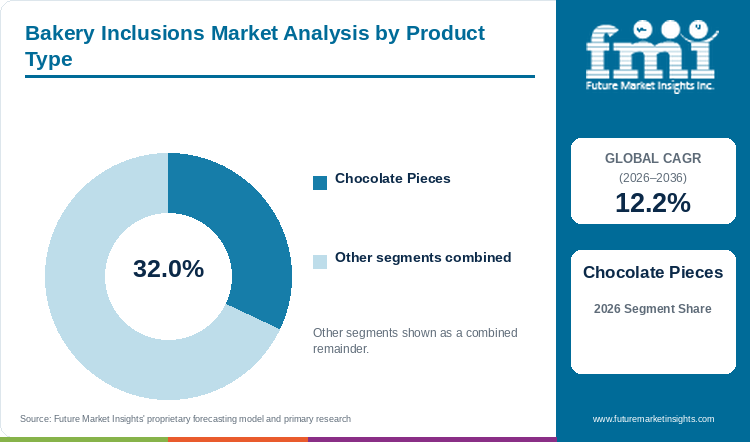
Chocolate Pieces are projected to capture 32.0% of the product type segment in 2026, supported by high-contrast piece visibility and controlled dextrose-stabilized melt curves.
Table 5: Product Type Share for the Bakery Inclusions Market (percentage share), 2026
| Product Type | Share (2026) |
|---|---|
| Chocolate Pieces | 32.0% |
| Other Segments Combined | 68.0%* |
| Total | 100.0% |
*Note: Remaining product type subsegments (Fruit Pieces, Caramel & Toffee, and Crunchy Cereal & Cookie) sum to 100.0% of 2026 bakery inclusions market value.
Table 6: Product Type Leadership and Market Growth for the Bakery Inclusions Market (segment and CAGR percentage), 2026 to 2036
| Metric | Value |
|---|---|
| Global CAGR (2026 to 2036) | 12.2% |
| Leading Segment | Chocolate Pieces |
Industrial bakers rely on calibrated chocolate chips and chunks as the primary visual quality cue across brioche loaves and soft-baked cookies. Adjusting dextrose-to-cocoa-butter ratios prevents oven smearing while allowing developers to balance genuine couverture chunks against compound chocolate particulates when bean prices surge.
- Chocolate Pieces are projected to account for 32.0% of the product type segment in 2026 because discrete cocoa particulates deliver high consumer value perception across sweet bakery lines.
- In November 2025, Barry Callebaut opened its third Canadian chocolate factory in Brantford, Ontario after a USD 104 million investment focused on molded chocolate products and specialty bakery inclusions for North America [3].
What supports Powder / Dry leadership in the form segment?
Powder / Dry formulations are estimated to secure 45.0% of the form segment in 2026, driven by ambient silo stability and automated gravimetric feeder compatibility.
Dry-handled inclusion systems allow high-throughput bakeries to meter particulates through overhead vibratory hoppers and loss-in-weight screw feeders without heated jacketed tanks or liquid pump sanitation. Maintaining low surface moisture prevents bridging and particle clumping with sugar and chocolate decorations on multi-shift packaging lines.
- Powder / Dry options are estimated to command 45.0% of the form segment in 2026 because dry-flow handling eliminates wet-pump changeover downtime across automated mixing lines.
- In its June 2025 Issue 176 technical review, Bakels documented powder-blending facility upgrades in Malaysia featuring automated form-fill-seal dosing down to 250-gram sachets and enhanced allergen hygiene [4].
Why do Bread & Rolls anchor the application segment?
Bread & Rolls are expected to command 42.0% of the application segment in 2026, reflecting continuous high-tonnage runs of fruited loaves and chocolate brioche.
Sweet pan breads and chocolate-chip brioche rolls run on continuous multi-ton tunnel ovens that generate predictable weekly reorders for calibrated inclusions. Inclusions must exhibit rounded edges and controlled density so pieces do not shear gluten strands during spiral kneading or sink before bread improvers set the crumb matrix.
- Bread & Rolls are expected to hold 42.0% of the application segment in 2026 because year-round breakfast bread and sweet-roll schedules consume bulk tote shipments.
- Breadmaking trials published in Life in October 2025 demonstrated that incorporating 10% carob pulp functional inclusions with selected starter cultures balanced loaf volume with extended microbial shelf life [5].
How does Conventional retain its lead in the claim segment?
Conventional specifications are forecast to generate 54.0% of the claim segment in 2026, owing to wider stabilizer and glazing latitude.
Formulating fruit cubes and caramel pieces that resist Maillard browning and moisture migration at 200 degrees Celsius requires precise pectin amidates and sunflower or soy lecithins. Conventional claims give procurement teams multi-origin sourcing flexibility without paying three-year organic transition premiums or segregated allergen-line washdown fees.
- Conventional products are forecast to account for 54.0% of the claim segment in 2026 because standard emulsifier and humectant systems protect piece integrity at lower bill-of-materials cost.
- Biscuit fortification trials published in Molecules in July 2026 evaluating 5% to 15% fruit pomace inclusions confirmed significant mineral enrichment with optimal sensory scores at 5% to 10% inclusion [6].
Why is Direct to Industrial Bakeries the leading sales channel segment?
Direct to Industrial Bakeries is anticipated to account for 53.0% of the sales channel segment in 2026, reinforced by plant-specific depositor trials and custom particle sizing.
Large-scale bread and cake manufacturers qualify inclusions through joint pilot-plant runs where supplier food technologists calibrate piece count per kilogram and melt viscosity directly on the buyer's line. Direct B2B contracting locks in multi-plant volume schedules and rapid batch-traceability escalation.
- Direct to Industrial Bakeries is anticipated to capture 53.0% of the sales channel segment in 2026 because custom particle-size tolerances require direct manufacturer-to-plant engineering.
- In March 2026, Puratos and Dawn Foods announced a definitive agreement for Puratos to acquire Dawn Foods, pairing Puratos ingredient R&D across 87 countries with Dawn Foods industrial bakery distribution in North America [7].
What are the drivers, restraints, and opportunities in the bakery inclusions market?
In the bakery inclusions market, SKU renovation on existing oven lines propels particulate demand whereas cocoa and fruit price volatility restrains formulation margins and moisture-locked crunchy or fruit inclusions create clean-label growth opportunities.
- Driver: Commercial bakeries dose visible chocolate and fruit or crunchy pieces into base doughs to launch premium variants without new oven capital expenditure.
- Restraint: Cocoa bean deficits and fruit harvest swings combine with strict allergen-labeling audits to raise reformulation and line-validation costs for bakery buyers.
- Opportunity: Low-water-activity semi-candied fruits and lipid-coated crunchy inclusions unlock clean-label and extended-shelf-life bakery briefs.
Growth Analysis and Future Potential: Qualitative Demand Catalysts
Supermarket in-store bakeries and packaged snack brands rely on particulate inclusions to refresh core bread and cookie lines without altering tunnel-oven footprints. Switching from plain batter to a dual-inclusion recipe containing dark chocolate chunks and salted caramel nibs lifts retail unit realization while running on identical mixer-to-wrapper equipment. Reconciling supplier shipment logs with confectionery fillings demand confirms that multi-texture contrast is the top commercial brief in sweet baked goods. In May 2025, AGRANA reported in its 2024/25 annual results that Fruit segment revenue grew 4.1% year over year to EUR 1,630.4 million while Fruit operating profit (EBIT) surged 65.6% to EUR 99.7 million on higher fruit-preparation volumes [8]. Steady volume expansion in heat-stable fruit and chocolate preparations underpins recurring bulk contracting across industrial bakeries.
Risk Assessment of the Bakery Inclusions Market: Operational and Formulation Friction
Severe cocoa cost swings and strict multi-allergen cross-contact rules lengthen qualification cycles and restrain rapid inclusion substitution. When cocoa butter and liquor prices spike, lowering inclusion dosage or switching to compound pieces requires full shelf-life and sensory re-validation across retail private-label accounts. In January 2025, the U.S. Food and Drug Administration released Edition 5 of its Final Guidance for Industry on Food Allergen Labeling to tighten declaration standards for milk and tree nuts as well as sesame across multi-unit bakery packs [9]. Simultaneously, baked-bar formulation studies published in Molecules in July 2025 showed that balancing psyllium and apple fiber inclusions against NFC juice hydration is critical to keep acrylamide levels low and prevent crumb hardening [10]. Until a replacement particulate passes both thermal rheology and clean-label flavors labeling audits, plant QA directors delay vendor switching.
Commercial Opportunity Analysis: Formulation Differentiation and Value-Add Formats
Ingredient processors are capturing higher gross margins by engineering moisture-barrier crunchy particulates and candied fruit inclusions that stay crisp inside high-moisture cakes and laminated pastries. In January 2026, Fabbri 1905 unveiled its gluten-free and lactose-free Crumblé moisture-resistant crunchy inclusion line with Snackolosi Raspberry Crunchy containing real raspberry pieces and chia seeds at SIGEP in Rimini [11]. In September 2025, Dawn Foods expanded its Royal Steensma product line in North America with four bake-stable almond and marzipan-adjacent pastry ingredients with candied fruit inclusions [12]. Pairing localized application validation with chocolate couverture and fruit-piece customization allows suppliers to win differentiated clean-label tenders.
Bakery Inclusions Market by Country (2026 to 2036)
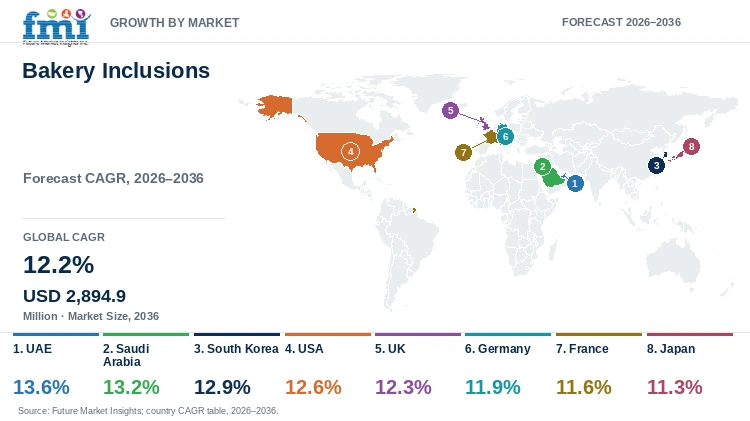
As per FMI, the UAE is projected to lead bakery inclusions expansion across evaluated countries at a 13.6% CAGR through 2036, whereas Japan is forecast to advance at an 11.3% CAGR. National growth dispersion reflects differences between high-velocity Gulf hospitality patisserie demand and cost-disciplined industrial baking in Europe and Japan.
Table 7: Country CAGR and Primary Growth Levers for the Bakery Inclusions Market (CAGR percentage and operational drivers), 2026 to 2036
| Country | CAGR (2026 to 2036) | Primary Growth Lever |
|---|---|---|
| UAE | 13.6% | Five-star hotel patisserie expansion and climate-resilient chocolate and nut inclusion demand |
| Saudi Arabia | 13.2% | SFDA-licensed food factory expansion and standardized foodservice pastry tenders |
| South Korea | 12.9% | Functional fruit-fiber baking trials and rapid café inclusion recipe rotation |
| USA | 12.6% | High-volume commercial bread and cookie lines paired with domestic inclusion plants |
| UK | 12.3% | Retail private-label sweet-bakery renovation and caramel or fruit inclusion upgrades |
| Germany | 11.9% | Defined sourdough and Stollen fermentation regimes paired with fruit-piece contracting |
| France | 11.6% | Artisan boulangerie and industrial brioche formulation supported by INRAE bread research |
| Japan | 11.3% | Strict particle-size uniformity and moisture-controlled fruit and chocolate inclusions |
Source: Future Market Insights analysis
UAE Bakery Inclusions Market Outlook (2026 to 2036)
The UAE leads evaluated countries with a projected 13.6% CAGR from 2026 to 2036. Unlike Western markets centered on ambient grocery bread, inclusion demand in the UAE is propelled by hotel pastry kitchens and pistachio-and-chocolate dessert innovation across Dubai and Abu Dhabi. In April 2026, the USDA Foreign Agricultural Service reported that Cote d’Ivoire’s imports of food processing ingredients and related products rose almost 24% to roughly USD 1 billion in 2025, the supply gateway for West African cocoa inclusion chains [24]. High ambient warehouse temperatures above 40 degrees Celsius during summer transit penalize low-melting-point fat drops, requiring suppliers such as Bakels Middle East FZCO in Dubai to supply bloom-resistant chocolate and stabilized fruit inclusions.
Key takeaway: In the UAE, record luxury hotel visitation and viral Middle Eastern pastry formats are projected to drive premium chocolate and fruit inclusion imports.
Saudi Arabia Bakery Inclusions Market Outlook (2026 to 2036)
Demand in the Saudi Arabia bakery inclusions market is expected to expand at a 13.2% CAGR over the 2026 to 2036 forecast period. Domestic industrial bakeries and central catering commissaries are scaling packaged sweet-roll and muffin production to serve expanding urban retail and hospitality networks across Riyadh and Jeddah. In January 2026, the Saudi Food and Drug Authority reported an 18% increase in licensed factories and warehouses during 2025 to reach 7,610 facilities with 55,616 compliance inspection visits [14]. Extended Red Sea port clearance checks and temperature-controlled inland freight to Riyadh still require foreign ingredient houses to maintain bonded distributor stock and Arabic allergen documentation.
Key takeaway: In Saudi Arabia, SFDA-licensed factory expansion and hospitality catering growth are expected to sustain bulk procurement of heat-stable bakery inclusions.
South Korea Bakery Inclusions Market Outlook (2026 to 2036)
Rapid product-cycle turnover across franchise bakery cafés and functional fruit-fiber baking initiatives distinguish South Korea from slower-moving Western bread markets. In February 2025, sponge-cake formulation trials published in Food Science and Technology International demonstrated that replacing 25% of refined sugar with dehydrated apple-peel flour inclusions boosted dietary fiber and polyphenol density while achieving top sensory preference [15]. Valuation in the South Korea bakery inclusions market is forecast to rise at a 12.9% CAGR from 2026 to 2036 across commercial bakeries in Seoul and Busan. Altered starch gelatinization in gluten-free and rice-flour batters forces suppliers to adjust fruit-piece density so inclusions do not settle during proofing.
Key takeaway: In South Korea, rapid café menu renovation and functional fruit-fiber baking trials are forecast to accelerate specialty inclusion adoption.
USA Bakery Inclusions Market Outlook (2026 to 2036)
Multi-plant industrial cookie and pan-bread lines make the USA the largest single-country volume anchor in North America, where automated depositor accuracy governs vendor selection. In November 2025, Barry Callebaut opened its USD 104 million Brantford chocolate factory in North America to supply molded chocolate and specialty inclusions for commercial bakery buyers [3]. The USA bakery inclusions market value is anticipated to advance at a 12.6% CAGR between 2026 and 2036, supported by domestic capacity investments from Puratos (via its January 2026 acquisition of Vör Foods in Pennsylvania) and Irca Group in Missouri [16] [17]. Compliance with January 2025 FDA Edition 5 allergen rules for tree nuts and dairy inputs keeps line-segregation costs high [9].
Key takeaway: In the USA, domestic chocolate and nut-inclusion manufacturing investments with supermarket bakery renovation are anticipated to drive recurring bulk orders.
UK Bakery Inclusions Market Outlook (2026 to 2036)
Supermarket in-store bakeries and private-label cake manufacturers shape inclusion demand in the UK, where retail price ceilings force formulators to maximize visual piece impact per gram dosed. In November 2025, UK DEFRA reported in Family Food FYE 2024 that real household expenditure on food and non-alcoholic drinks rose 3.2% year over year to GBP 32.30 per person per week [18]. To help UK bakers refresh seasonal assortments without halting factory lines, Zeelandia UK introduced cuttable salted caramel and fruit-filled bakery concepts in June 2025 while Dawn Foods expanded Royal Steensma pastry ingredients [12] [19]. The UK bakery inclusions market is estimated to grow at a 12.3% CAGR through 2036.
Key takeaway: In the UK, supermarket private-label bakery renovation and caramel or fruit inclusion upgrades are estimated to offset cocoa cost pressure across retail lines.
Germany Bakery Inclusions Market Outlook (2026 to 2036)
Elevated cocoa and confectionery wholesale costs in Germany are pushing industrial bread and Stollen manufacturers to re-engineer inclusion geometry and dough fermentation efficiency. In July 2026, investigators at Evonik Operations in Hanau-Wolfgang in Germany published sourdough fermentation trials in Food Chemistry demonstrating how defined lactic acid bacteria consortia optimize bread volatile profiles and nutritional density [20]. Rather than stripping visible chocolate or fruit cues from premium baked goods, R&D teams in Germany specify flatter chocolate chunks and calibrated Zentis or AGRANA fruit pieces that preserve top-crust visibility at 15% lower weight loading. Under this reformulation discipline, the Germany bakery inclusions market is projected to expand at an 11.9% CAGR from 2026 to 2036.
Key takeaway: In Germany, precision fermentation regimes and geometry-optimized chocolate or fruit preparations are projected to sustain industrial bakery contracting.
France Bakery Inclusions Market Outlook (2026 to 2036)
France combines a dense network of craft boulangeries with centralized industrial brioche and viennoiserie plants, requiring suppliers to offer both 5-kilogram artisan cartons and 500-kilogram industrial totes. In January 2026, bread-digestion metabolomics researchers at Université Clermont Auvergne and INRAE in France demonstrated in the Journal of Proteome Research how industrial versus artisan yeast and sourdough processes reshape wheat bread peptide digestibility [21]. Craft pastry chefs prioritize Cesarin semi-candied fruit cubes and dark chocolate batons that hold clean cross-sections in leavened brioche, whereas industrial plants in France demand free-flowing dry particulates for automated hoppers. Supported by both channels, the France bakery inclusions market is slated to progress at an 11.6% CAGR over 2026 to 2036.
Key takeaway: In France, serving both craft boulangeries and high-speed industrial brioche plants is slated to sustain demand for pack-tailored fruit and chocolate inclusions.
Japan Bakery Inclusions Market Outlook (2026 to 2036)
Japan is evaluated at an 11.3% CAGR from 2026 to 2036, reflecting a mature and quality-intensive bakery sector where visual symmetry and exact water-activity equilibrium govern supplier approval. Unlike Western bulk loaf production, convenience-store and retail bakeries in Japan emphasize individually wrapped single-serve sweet buns and seasonal fruit pastries across metropolitan prefectures. In February 2025, the Statistics Bureau of Japan released its 2024 Yearly Average Family Income and Expenditure Survey Results tracking monthly household spending across bread and confectionery categories [22]. Ingredient suppliers must prove zero anthocyanin color migration and consistent soft bite compatibility after extended chilled convenience-store display holding before winning national multi-year commercial bakery listings across retail chains in Japan.
Key takeaway: In Japan, convenience-store single-serve bakery standards and strict moisture-migration tolerances are forecast to reward precision-graded fruit and chocolate inclusions.
Full report country CAGRs cover: North America; Latin America; Western Europe; Eastern Europe; East Asia; South Asia and Pacific; Middle East and Africa.
Who are the notable companies in the bakery inclusions market?
Barry Callebaut, Puratos, Dawn Foods, Zeelandia, CSM Ingredients, Bakels, AGRANA, Zentis, Fabbri 1905, and Irca Group are the notable companies in the bakery inclusions market.
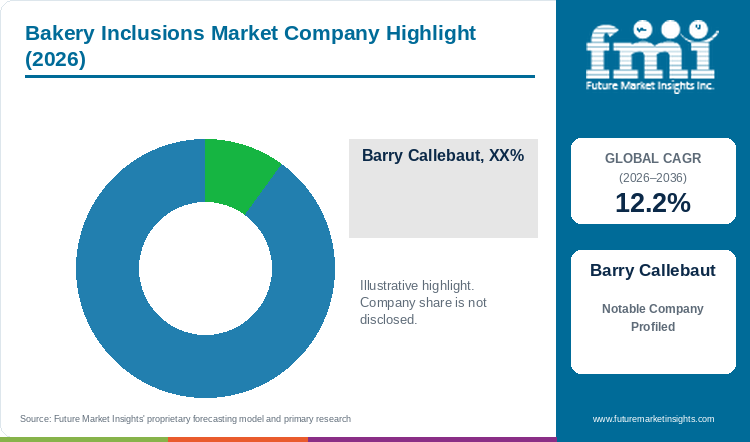
FMI analysis indicates that the competitive arena divides between global chocolate and specialty-texture manufacturers and integrated bakery or fruit-preparation specialists. Barry Callebaut and Puratos with Irca Group (via Cesarin semi-candied fruits and domestic U.S. chocolate lines) supply engineered chocolate and fruit particulates directly to industrial bakeries. Dawn Foods and Zeelandia with CSM Ingredients and Bakels integrate inclusions with broader bakery mixes, whereas AGRANA and Zentis with Fabbri 1905 specialize in thermally stable fruit and crunchy dessert inclusions.
- Chocolate and Specialty-Texture Systems: Barry Callebaut and Puratos with Irca Group engineer bake-stable chocolate chunks and compound drops with semi-candied fruit particulates.
- Integrated Bakery Ingredient & Formulation Houses: Dawn Foods and Zeelandia with CSM Ingredients and Bakels pair inclusion supply with pilot test bakeries and dough-system support.
- Fruit-Based Inclusions and Crunchy Preparation Specialists: AGRANA and Zentis with Fabbri 1905 formulate controlled-Brix fruit pieces and moisture-resistant crunchy inclusions for leavened and pastry goods.
Competitive Benchmarking: Bakery Inclusions Market
Table 8: Competitive Benchmarking for the Bakery Inclusions Market (qualitative capability ratings), 2026
| Company | Chocolate & Crunch Formats | Fruit Piece Formulation | Industrial Bakery Integration | Geographic Reach |
|---|---|---|---|---|
| Barry Callebaut | High | Medium | High | High |
| Puratos | High | High | High | High |
| Dawn Foods | Medium | Medium | High | High |
| Zeelandia | Medium | High | High | Medium |
| CSM Ingredients | Medium | High | High | High |
| Bakels | Medium | High | High | High |
| AGRANA | Medium | High | High | High |
| Zentis | Medium | High | Medium | Medium |
| Fabbri 1905 | Medium | High | Medium | Medium |
| Irca Group | High | High | High | High |
Scoring basis: Capability tiers assess documented SKU breadth across bake-stable chocolate pieces and semi-candied or low-water-activity fruit particulates. Industrial integration and geographic ratings reflect pilot test-bakery support and multi-region manufacturing footprints.
Key Developments in the Bakery Inclusions Market
- In March 2026, Puratos and Dawn Foods entered a definitive agreement for Puratos to acquire Dawn Foods (expected to close by late 2026 subject to regulatory approvals), following Puratos's January 2026 acquisition of U.S. nut-paste specialist Vör Foods [7] [16].
- In June 2026, CVC Capital Partners agreed to acquire Irca Group (operating 19 facilities and generating EUR 1.5 billion in revenue across IRCA Since 1919 and Cesarin) from Advent following Irca's February 2025 St. Louis chocolate plant opening [17] [23].
- In January 2026, Fabbri 1905 launched its gluten-free and lactose-free Crumblé moisture-resistant crunchy inclusions and Snackolosi Raspberry Crunchy with real raspberry pieces and chia seeds at SIGEP in Rimini [11].
Key Players in the Bakery Inclusions Market
Chocolate and Specialty-Texture Systems
- Barry Callebaut
- Puratos
- Irca Group
Integrated Bakery Ingredient and Formulation Support
- Dawn Foods
- Zeelandia
- CSM Ingredients
- Bakels
Fruit-Based Inclusions and Specialty Fruit Systems
- AGRANA
- Zentis
- Fabbri 1905
Bakery Inclusions Market - Report Scope
Table 9: Report Scope for the Bakery Inclusions Market (coverage fields and definitions), 2026 to 2036
| Coverage field | Report scope |
|---|---|
| Market breakdown | Product Type; Form; Application; Claim; Sales Channel |
| Quantitative Units | USD Million |
| Market Definition | Includes commercial B2B supplier value from discrete chocolate pieces, fruit pieces, caramel and toffee particulates, and crunchy cereal, cookie, or nut inclusions sold for incorporation into baked goods. Category Scope Note: Excludes finished retail bakery product value, standalone dough improvers, homogeneous smooth fillings or glazes without discrete particulates, and non-bakery ice-cream toppings. |
| Regions Covered | North America; Latin America; Western Europe; Eastern Europe; East Asia; South Asia and Pacific; Middle East and Africa |
| Countries Covered | UAE, Saudi Arabia, South Korea, USA, UK, Germany, France, Japan, and additional countries in the full report |
| Key Companies Covered | Barry Callebaut, Puratos, Dawn Foods, Zeelandia, CSM Ingredients, Bakels, AGRANA, Zentis, Fabbri 1905, Irca Group |
| Forecast Period | 2026 to 2036 |
| Approach | Primary and secondary research with top-down and bottom-up market triangulation. |
Bakery Inclusions Market - Research Methodology
Table 10: Research Methodology for the Bakery Inclusions Market (research methods and approach), 2026 edition
| Method | Approach |
|---|---|
| Primary Research | Structured interviews with industrial bakery R&D directors, tunnel-oven process engineers, procurement heads, and inclusion formulators to verify particulate dosage rates (8% to 16% dough weight), mixer fracture losses, and B2B contract pricing. |
| Secondary Research | Audit of corporate annual filings (AGRANA 2024/25 report, Barry Callebaut, Puratos, Irca Group), ICCO cocoa bulletins, FDA Edition 5 allergen labeling guidance, national statistical releases (DEFRA, SFDA, Dubai DET, Statistics Bureau of Japan), and PubMed food-chemistry studies. |
| Market Sizing and Forecasting | Top-down global bakery ingredient budgets (USD 27.6 billion parent market in 2026) reconciled against bottom-up particulate tonnage across chocolate, fruit, caramel, and crunchy inclusions from 2026 to 2036. |
| Country Forecasting Model | Econometric national models weight commercial bread and sweet-bakery shipment volumes, licensed food-factory counts, hospitality tourist arrivals, and cocoa or fruit wholesale price indices across eight countries. |
| Operational Benchmark Traceability | Particulate tonnage, dosage percentages, and per-plant spending indicators in Tables 2, 3, and 4 trace to Food Chemistry and Molecules baking trials, SFDA and DEFRA registries, and supplier technical sheets. |
| Data Triangulation and Validation | Component values are isolated strictly to discrete bake-stable inclusions, excluding standalone smooth jams, homogeneous ganaches, bread improvers, and finished retail baked goods to prevent parent-child double counting. |
Bakery Inclusions Market by Segments
Bakery Inclusions Market segmented by Product Type:
- Chocolate Pieces
- Fruit Pieces
- Caramel & Toffee
- Crunchy Cereal & Cookie
Bakery Inclusions Market segmented by Form:
- Powder / Dry
- Liquid
- Paste / Semi-Solid
- Granules / Pieces
Bakery Inclusions Market segmented by Application:
- Bread & Rolls
- Cakes & Muffins
- Biscuits & Cookies
- Viennoiserie & Pastry
- Other Bakery & Snacks
Bakery Inclusions Market segmented by Claim:
- Conventional
- Clean Label
- Organic
- Non-GMO / Identity Preserved
Bakery Inclusions Market segmented by Sales Channel:
- Direct to Industrial Bakeries
- Ingredient Distributors
- Foodservice & Artisan Supply
- Online B2B
Bakery Inclusions Market by Region
- North America
- United States
- Canada
- Latin America
- Brazil
- Mexico
- Argentina
- Chile
- Western Europe
- Germany
- France
- United Kingdom
- Italy
- Spain
- Benelux
- Nordics
- Eastern Europe
- Poland
- Czech Republic
- Romania
- Hungary
- East Asia
- China
- Japan
- South Korea
- South Asia and Pacific
- India
- ASEAN
- Australia and New Zealand
- Middle East and Africa
- GCC Countries
- South Africa
- Türkiye
- Israel
Research Sources and Bibliography
- [1] Stampini, M., Disca, V., Carrà, F., Scardino, S., Piana, G., Travaglia, F., Coïsson, J. D., Locatelli, M., & Arlorio, M. (2026, March 15). Cocoa bean shells as a source of functional fiber in a muffin model. Food Chemistry, 505, 148073 (PubMed PMID 41579543).
- [2] International Cocoa Organization (ICCO). (2025, August 29). August 2025 Quarterly Bulletin of Cocoa Statistics. ICCO Volume LI, Issue No. 3, Abidjan.
- [3] Barry Callebaut. (2025, November 13). Barry Callebaut Opens Third Canadian Chocolate Factory in Brantford, Ontario. Barry Callebaut Media News Stories.
- [4] Bakels Group. (2025, June). Bakels Worldwide Review, Issue 176: Strategic Investments and Industrial Solutions. EMU AG / Bakels Group, Rothenburg.
- [5] Rosati, S., Gaeta, I., Maiuro, L., Trivisonno, M. C., Messia, M. C., & Sorrentino, E. (2025, October 8). Carob Pulp Flour as a Sustainable and Functional Ingredient in the Bakery: Effects of Leavening Typologies on Dough and Bread Properties. Life, 15(10), 1571 (PubMed PMID 41157244).
- [6] Cosmulescu, S., & Mandache, M. B. (2026, July 29). Fruit Pomace as a Functional Ingredient in Wheat Biscuits: Mineral Composition, Colour Characteristics, and Quality Evaluation of Peach Pomace-Enriched Biscuits. Molecules, 31(15), 2633 (PubMed PMID 42588482).
- [7] Puratos Group. (2026, March 10). Puratos to Acquire Dawn Foods, Bringing Together Complementary Capabilities in Professional Bakery. Puratos Official Newsroom.
- [8] AGRANA Beteiligungs-AG. (2025, May 9). AGRANA presents annual results for 2024|25. AGRANA Corporate Press Release PR-2642.
- [9] U.S. Food and Drug Administration. (2025, January 6). FDA Releases Allergen, Food Safety, and Plant-Based Alternative Labeling Guidances. FDA HFP Constituent Updates.
- [10] Kowalska, H., Masiarz, E., Hać-Szymańczuk, E., Żbikowska, A., Marzec, A., Salamon, A., Kozłowska, M., Ignaczak, A., Chobot, M., Sobocińska, W., & Kowalska, J. (2025, July 29). The Influence of Recipe Modification and the Technological Method on the Properties of Multigrain Snack Bars. Molecules, 30(15), 3160 (PubMed PMID 40807335).
- [11] Fabbri 1905 S.p.A. (2026, January 16). Fabbri 1905 entra nel mondo dello street food e ridefinisce il fuoricasa Made in Italy. Fabbri 1905 Area Stampa Comunicati Stampa.
- [12] Dawn Foods. (2025, September 13). Dawn Foods Expands Royal Steensma Product Line in North America With Four New Premium, Easy-to-use Products. Dawn Foods Official News & Press.
- [13] Dubai Department of Economy and Tourism. (2026, February 9). Dubai welcomes 19.59 million visitors in third record year. Government of Dubai Media Office / DET Press Releases.
- [14] Saudi Food and Drug Authority (SFDA). (2026, January 26). SFDA Reports 18% Growth in Licensed Factories and Warehouses During 2025. SFDA Official Regulatory News.
- [15] Quitral, V., Cueto, M., Pérez, M.-T., Sepúlveda, M., & Flores, M. (2025, February 25). Apple peel flour instead of sugar in sponge cake: Nutritional, sensory, physical, and microbiological evaluation. Food Science and Technology International (PubMed PMID 40007073).
- [16] Puratos Group. (2026, January 21). Puratos acquires Vör Foods, accelerating U.S. nut-based innovation. Puratos Official Newsroom.
- [17] IRCA Group. (2025, February 18). Crafted in Italy, Produced in the USA: IRCA Group Strengthens Its Presence in the Americas with Investment in U.S. Factory and the Launch of Domestic RENO X Chocolate Range. IRCA Group Inside News.
- [18] UK Department for Environment, Food & Rural Affairs (DEFRA). (2025, November 6). Family Food FYE 2024. GOV.UK Accredited Official Statistics.
- [19] Zeelandia UK. (2025, June). The latest bakery flavour trends: Zeelandia UK explores Summers 2025's sweetest treats. Zeelandia UK Limited Inspiration.
- [20] Mushtaq, B. S., Baumgartner, B., & Gobbetti, M. [Evonik Operations GmbH, Germany & Free University of Bolzano]. (2026, July 30). Impact of fermentation regime and metabolically defined LAB consortia on sourdough bread nutritional and volatile composition. Food Chemistry, 518, 149589 (PubMed PMID 42143512).
- [21] Zhour, H., Savary, A., & Comte, B. [Université Clermont Auvergne & INRAE, France]. (2026, January 2). Untargeted Metabolomics for Wheat Bread In Vitro Digestate Assessment. Journal of Proteome Research, 25(1), 84-98 (PubMed PMID 41359829).
- [22] Statistics Bureau of Japan. (2025, February 7). 2024 Yearly Average Survey Results - Total Households (Family Income and Expenditure Survey). Ministry of Internal Affairs and Communications, Tokyo.
- [23] IRCA Group / CVC Capital Partners. (2026, June 29). CVC Capital Partners agrees to acquire Irca from Advent. IRCA Group Official Newsroom.
- [24] U.S. Department of Agriculture, Foreign Agricultural Service. (2026, April). Cote d’Ivoire: Food Processing Ingredients Annual. Global Agriculture Information Networkhttps://www.fas.usda.gov/data/gain/2026/04/cote-divoire-food-processing-ingredients-annual
This bibliography is provided for reader reference and is not exhaustive. The full report contains the complete reference list and detailed citations.
This Report Answers
- How large is the bakery inclusions market in 2026 and what is forecast for 2036?
- Which high-speed mixing and tunnel-oven stability pressures govern inclusion demand?
- Why do Chocolate Pieces lead the product type segment?
- Why does Powder / Dry lead the form segment globally?
- How do growth rates compare across the UAE and Saudi Arabia versus the USA?
- Which leading companies supply chocolate particulates and fruit or crunchy inclusions?
- What limits reformulation or supplier switching in the bakery inclusions market?
- What rheology and allergen evidence should buyers evaluate before approving an inclusion?
Frequently Asked Questions
How big is the bakery inclusions market in 2026 and what is forecast for 2036?
According to FMI, the bakery inclusions market valuation reached USD 915.6 million in 2026 from USD 816.0 million in 2025. The market value is forecast to hit USD 2,894.9 million by 2036 as commercial bakeries expand particulate-differentiated bread and cookie lines.
What is the CAGR for the bakery inclusions market from 2026 to 2036?
Future Market Insights projects a 12.2% CAGR between 2026 and 2036, representing an anticipated USD 1,979.3 million increase in annual market value across industrial and artisan bakery channels.
Which product type segment leads the bakery inclusions market?
Chocolate Pieces are projected to capture 32.0% of the product type segment in 2026 because bake-stable chips and chunks deliver immediate visual contrast and recognizable flavor across sweet bakery formats.
Which form segment leads the bakery inclusions market?
Powder / Dry formulations are estimated to secure 45.0% of the form segment in 2026 because free-flowing dry particulates simplify automated hopper dosing and ambient warehouse storage.
Which country has the fastest growth outlook during the assessment period?
The UAE is projected to lead national expansion at a 13.6% CAGR through 2036, followed by Saudi Arabia at 13.2% and South Korea at 12.9% under luxury hospitality patisserie and rapid café menu innovation.
Who are the key players in the market?
Barry Callebaut and Puratos with Irca Group lead commercial supply of chocolate chunks and semi-candied fruit particulates. Dawn Foods and Zeelandia with CSM Ingredients and Bakels provide integrated bakery support, while AGRANA and Zentis with Fabbri 1905 supply fruit and crunchy inclusions.
Preview the report firsthand - request a free sample
Get SampleGet the brochure for pricing and purchase details.
Get PDFTable of Content
- Key Takeaways
- Market Size and CAGR
- Top Growth Driver
- Fastest Growing Segment
- Leading Region
- Key Companies
- Emerging Opportunities
- Executive Summary
- Global Market Outlook
- Demand-side Trends
- Supply-side Trends
- Technology Roadmap Analysis
- Analysis and Recommendations
- Analyst Perspective (What is happening? Why now? What should investors know?)
- Key Questions Answered
- How large is the market?
- What is the CAGR?
- What are key trends?
- Which region dominates?
- Who are the leaders?
- Market Overview
- Market Coverage / Taxonomy
- Market Definition / Scope / Limitations
- Research Methodology
- Chapter Orientation
- Analytical Lens and Working Hypotheses
- Market Structure, Signals, and Trend Drivers
- Benchmarking and Cross-market Comparability
- Market Sizing, Forecasting, and Opportunity Mapping
- Research Design and Evidence Framework
- Desk Research Programme (Secondary Evidence)
- Expert Input and Fieldwork (Primary Evidence)
- Tooling, Models, and Reference Databases
- Data Engineering and Model Build
- Quality Assurance and Audit Trail
- Market Background
- Market Dynamics (Drivers, Restraints, Opportunity, Trends)
- Scenario Forecast (Optimistic, Likely, Conservative)
- Impact Analysis
- AI Impact
- Sustainability Impact
- Regulatory Impact
- Technology Impact
- Consumer / Buyer Analysis
- Purchase Drivers
- Adoption Barriers
- Buyer Journey
- Opportunity Map Analysis
- Product Life Cycle Analysis
- Supply Chain Analysis
- Investment Feasibility Matrix
- Value Chain Analysis
- PESTLE and Porter's Analysis
- Regulatory Landscape
- Regional Parent Market Outlook
- Production and Consumption Statistics
- Import and Export Statistics
- Global Market Analysis and Forecast, 2021 to 2036
- Historical Market Size Value (USD Million) Analysis, 2021 to 2025
- Current and Future Market Size Value (USD Million) Projections, 2026 to 2036
- Y-o-Y Growth Trend Analysis
- Absolute $ Opportunity Analysis
- Global Market Pricing Analysis, 2021 to 2036
- Global Market Analysis and Forecast, By Product Type, 2021 to 2036
- Introduction / Key Findings
- Historical Market Size Value (USD Million) Analysis By Product Type, 2021 to 2025
- Current and Future Market Size Value (USD Million) Analysis and Forecast By Product Type, 2026 to 2036
- Chocolate Pieces
- Fruit Pieces
- Caramel & Toffee
- Crunchy Cereal & Cookie
- Y-o-Y Growth Trend Analysis By Product Type, 2021 to 2025
- Absolute $ Opportunity Analysis By Product Type, 2026 to 2036
- Global Market Analysis and Forecast, By Form, 2021 to 2036
- Introduction / Key Findings
- Historical Market Size Value (USD Million) Analysis By Form, 2021 to 2025
- Current and Future Market Size Value (USD Million) Analysis and Forecast By Form, 2026 to 2036
- Powder / Dry
- Liquid
- Paste / Semi-Solid
- Granules / Pieces
- Y-o-Y Growth Trend Analysis By Form, 2021 to 2025
- Absolute $ Opportunity Analysis By Form, 2026 to 2036
- Global Market Analysis and Forecast, By Application, 2021 to 2036
- Introduction / Key Findings
- Historical Market Size Value (USD Million) Analysis By Application, 2021 to 2025
- Current and Future Market Size Value (USD Million) Analysis and Forecast By Application, 2026 to 2036
- Bread & Rolls
- Cakes & Muffins
- Biscuits & Cookies
- Viennoiserie & Pastry
- Other Bakery & Snacks
- Y-o-Y Growth Trend Analysis By Application, 2021 to 2025
- Absolute $ Opportunity Analysis By Application, 2026 to 2036
- Global Market Analysis and Forecast, By Claim, 2021 to 2036
- Introduction / Key Findings
- Historical Market Size Value (USD Million) Analysis By Claim, 2021 to 2025
- Current and Future Market Size Value (USD Million) Analysis and Forecast By Claim, 2026 to 2036
- Conventional
- Clean Label
- Organic
- Non-GMO / Identity Preserved
- Y-o-Y Growth Trend Analysis By Claim, 2021 to 2025
- Absolute $ Opportunity Analysis By Claim, 2026 to 2036
- Global Market Analysis and Forecast, By Sales Channel, 2021 to 2036
- Introduction / Key Findings
- Historical Market Size Value (USD Million) Analysis By Sales Channel, 2021 to 2025
- Current and Future Market Size Value (USD Million) Analysis and Forecast By Sales Channel, 2026 to 2036
- Direct to Industrial Bakeries
- Ingredient Distributors
- Foodservice & Artisan Supply
- Online B2B
- Y-o-Y Growth Trend Analysis By Sales Channel, 2021 to 2025
- Absolute $ Opportunity Analysis By Sales Channel, 2026 to 2036
- Global Market Analysis and Forecast, By Region, 2021 to 2036
- Introduction
- Historical Market Size Value (USD Million) Analysis By Region, 2021 to 2025
- Current Market Size Value (USD Million) Analysis and Forecast By Region, 2026 to 2036
- North America
- Latin America
- Western Europe
- Eastern Europe
- East Asia
- South Asia and Pacific
- Middle East and Africa
- Market Attractiveness Analysis By Region
- North America Market Analysis and Forecast, By Country, 2021 to 2036
- Historical Market Size Value (USD Million) Trend Analysis By Market Taxonomy, 2021 to 2025
- Market Size Value (USD Million) Forecast By Market Taxonomy, 2026 to 2036
- By Country
- United States
- Canada
- By Product Type
- By Form
- By Application
- By Claim
- By Sales Channel
- By Country
- Market Attractiveness Analysis
- By Country
- By Product Type
- By Form
- By Application
- By Claim
- By Sales Channel
- Key Takeaways
- Latin America Market Analysis and Forecast, By Country
- Historical Market Size Value (USD Million) Trend Analysis By Market Taxonomy, 2021 to 2025
- Market Size Value (USD Million) Forecast By Market Taxonomy, 2026 to 2036
- By Country
- Brazil
- Mexico
- Argentina
- Chile
- By Product Type
- By Form
- By Application
- By Claim
- By Sales Channel
- By Country
- Market Attractiveness Analysis
- By Country
- By Product Type
- By Form
- By Application
- By Claim
- By Sales Channel
- Key Takeaways
- Western Europe Market Analysis and Forecast, By Country
- Historical Market Size Value (USD Million) Trend Analysis By Market Taxonomy, 2021 to 2025
- Market Size Value (USD Million) Forecast By Market Taxonomy, 2026 to 2036
- By Country
- Germany
- France
- United Kingdom
- Italy
- Spain
- Benelux
- Nordics
- By Product Type
- By Form
- By Application
- By Claim
- By Sales Channel
- By Country
- Market Attractiveness Analysis
- By Country
- By Product Type
- By Form
- By Application
- By Claim
- By Sales Channel
- Key Takeaways
- Eastern Europe Market Analysis and Forecast, By Country
- Historical Market Size Value (USD Million) Trend Analysis By Market Taxonomy, 2021 to 2025
- Market Size Value (USD Million) Forecast By Market Taxonomy, 2026 to 2036
- By Country
- Poland
- Czech Republic
- Romania
- Hungary
- By Product Type
- By Form
- By Application
- By Claim
- By Sales Channel
- By Country
- Market Attractiveness Analysis
- By Country
- By Product Type
- By Form
- By Application
- By Claim
- By Sales Channel
- Key Takeaways
- East Asia Market Analysis and Forecast, By Country
- Historical Market Size Value (USD Million) Trend Analysis By Market Taxonomy, 2021 to 2025
- Market Size Value (USD Million) Forecast By Market Taxonomy, 2026 to 2036
- By Country
- China
- Japan
- South Korea
- By Product Type
- By Form
- By Application
- By Claim
- By Sales Channel
- By Country
- Market Attractiveness Analysis
- By Country
- By Product Type
- By Form
- By Application
- By Claim
- By Sales Channel
- Key Takeaways
- South Asia and Pacific Market Analysis and Forecast, By Country
- Historical Market Size Value (USD Million) Trend Analysis By Market Taxonomy, 2021 to 2025
- Market Size Value (USD Million) Forecast By Market Taxonomy, 2026 to 2036
- By Country
- India
- ASEAN
- Australia and New Zealand
- By Product Type
- By Form
- By Application
- By Claim
- By Sales Channel
- By Country
- Market Attractiveness Analysis
- By Country
- By Product Type
- By Form
- By Application
- By Claim
- By Sales Channel
- Key Takeaways
- Middle East and Africa Market Analysis and Forecast, By Country
- Historical Market Size Value (USD Million) Trend Analysis By Market Taxonomy, 2021 to 2025
- Market Size Value (USD Million) Forecast By Market Taxonomy, 2026 to 2036
- By Country
- GCC Countries
- South Africa
- Türkiye
- Israel
- By Product Type
- By Form
- By Application
- By Claim
- By Sales Channel
- By Country
- Market Attractiveness Analysis
- By Country
- By Product Type
- By Form
- By Application
- By Claim
- By Sales Channel
- Key Takeaways
- Key Countries Market Analysis
- United States
- Pricing Analysis
- Market Share Analysis, 2025
- By Product Type
- By Form
- By Application
- By Claim
- By Sales Channel
- Canada
- Pricing Analysis
- Market Share Analysis, 2025
- By Product Type
- By Form
- By Application
- By Claim
- By Sales Channel
- Mexico
- Pricing Analysis
- Market Share Analysis, 2025
- By Product Type
- By Form
- By Application
- By Claim
- By Sales Channel
- Brazil
- Pricing Analysis
- Market Share Analysis, 2025
- By Product Type
- By Form
- By Application
- By Claim
- By Sales Channel
- Chile
- Pricing Analysis
- Market Share Analysis, 2025
- By Product Type
- By Form
- By Application
- By Claim
- By Sales Channel
- Germany
- Pricing Analysis
- Market Share Analysis, 2025
- By Product Type
- By Form
- By Application
- By Claim
- By Sales Channel
- United Kingdom
- Pricing Analysis
- Market Share Analysis, 2025
- By Product Type
- By Form
- By Application
- By Claim
- By Sales Channel
- Italy
- Pricing Analysis
- Market Share Analysis, 2025
- By Product Type
- By Form
- By Application
- By Claim
- By Sales Channel
- Spain
- Pricing Analysis
- Market Share Analysis, 2025
- By Product Type
- By Form
- By Application
- By Claim
- By Sales Channel
- France
- Pricing Analysis
- Market Share Analysis, 2025
- By Product Type
- By Form
- By Application
- By Claim
- By Sales Channel
- India
- Pricing Analysis
- Market Share Analysis, 2025
- By Product Type
- By Form
- By Application
- By Claim
- By Sales Channel
- ASEAN
- Pricing Analysis
- Market Share Analysis, 2025
- By Product Type
- By Form
- By Application
- By Claim
- By Sales Channel
- Australia and New Zealand
- Pricing Analysis
- Market Share Analysis, 2025
- By Product Type
- By Form
- By Application
- By Claim
- By Sales Channel
- China
- Pricing Analysis
- Market Share Analysis, 2025
- By Product Type
- By Form
- By Application
- By Claim
- By Sales Channel
- Japan
- Pricing Analysis
- Market Share Analysis, 2025
- By Product Type
- By Form
- By Application
- By Claim
- By Sales Channel
- South Korea
- Pricing Analysis
- Market Share Analysis, 2025
- By Product Type
- By Form
- By Application
- By Claim
- By Sales Channel
- Poland
- Pricing Analysis
- Market Share Analysis, 2025
- By Product Type
- By Form
- By Application
- By Claim
- By Sales Channel
- Hungary
- Pricing Analysis
- Market Share Analysis, 2025
- By Product Type
- By Form
- By Application
- By Claim
- By Sales Channel
- Türkiye
- Pricing Analysis
- Market Share Analysis, 2025
- By Product Type
- By Form
- By Application
- By Claim
- By Sales Channel
- South Africa
- Pricing Analysis
- Market Share Analysis, 2025
- By Product Type
- By Form
- By Application
- By Claim
- By Sales Channel
- UAE
- Pricing Analysis
- Market Share Analysis, 2025
- By Product Type
- By Form
- By Application
- By Claim
- By Sales Channel
- Saudi Arabia
- Pricing Analysis
- Market Share Analysis, 2025
- By Product Type
- By Form
- By Application
- By Claim
- By Sales Channel
- United States
- Market Structure Analysis
- Competition Dashboard
- Competition Benchmarking
- Market Share Analysis of Top Players
- By Regional
- By Product Type
- By Form
- By Application
- By Claim
- By Sales Channel
- Emerging Startups
- Innovation Benchmarking
- Competition Analysis
- Competition Deep Dive
- Barry Callebaut
- Overview
- Product Portfolio
- Profitability by Market Segments
- Sales Footprint
- Strategy Overview
- Marketing Strategy
- Product Strategy
- Channel Strategy
- Puratos
- Dawn Foods
- Zeelandia
- CSM Ingredients
- Bakels
- AGRANA
- Zentis
- Fabbri 1905
- Irca Group
- Barry Callebaut
- Case Studies
- Success Stories
- Recent Developments
- Competition Deep Dive
- Assumptions & Acronyms Used


