

- Market Size (2026)
- USD 253.4 Mn
- Forecast (2036)
- USD 752.6 Mn
- CAGR (2026 to 2036)
- 11.5%
How big is the bakery spice blends market in 2026?
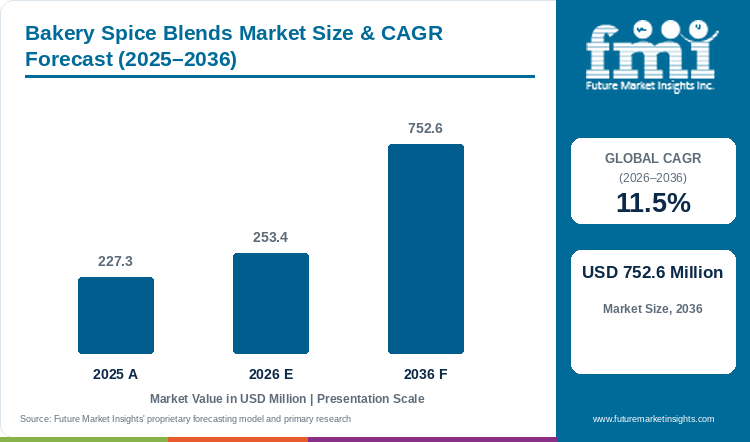
The market was valued at USD 227.3 million in 2025 and is expected to reach USD 253.4 million in 2026. It is projected to reach USD 752.6 million by 2036 at a CAGR of 11.5% from 2026 to 2036.
The bakery spice blends market was valued at USD 227.3 million in 2025 and is estimated at USD 253.4 million in 2026. Revenue is forecast to reach USD 752.6 million by 2036, a CAGR of 11.5% over the forecast period. Cinnamon-forward blends represent 34.0% of product type demand in 2026, supported by recipes that use a familiar spice profile across bread and seasonal cakes. Large supplier figures offer context for the purchasing environment: McCormick's Flavor Solutions organic sales rose 3.0% in the third quarter of 2026, of which volume and mix contributed 0.8%.[5] For bakery blends, repeat orders depend more directly on bakeries moving recurring recipes from separately weighed spices to specified preparations, then retaining those preparations when ingredients or production schedules change. That conversion requires the blend to deliver the same flavor despite normal variation in raw spices and oven conditions, making supplier consistency as important as its nominal price.
Key Market Trends & Insights
- By product type: Cinnamon-Forward Blends represented 34.0% of 2026 product type demand. One recognisable profile carries across bread and seasonal cakes, so the dose is rarely rebuilt. The test is whether a change of cinnamon source leaves the flavour after baking unchanged.
- By form: Powder / Dry accounted for 40.0% of 2026 form demand. Dry blends fit flour-room weighing and can be packed to batch size. It's tested by whether every portion of a pack delivers the same flavour after handling.
- By application: Bread & Rolls held 41.0% of 2026 application demand. Orders follow how often a spiced recipe runs, not how many flavours are launched. The test is how many recipes stay in production all year at a fixed dose.
Regional Highlights
- Saudi Arabia leads the eight profiled countries at a projected 12.8% CAGR from 2026 to 2036, a pace that would put particular weight on reliable spice specifications as bakeries expand recurring recipes.
- The UAE follows at 12.5%, with South Korea at 12.2% and the USA at 11.8%; Japan's 10.5% forecast is slower, though still implies continued adoption of prepared blends.
Market Size & Forecast
Table 1: Bakery Spice Blends Market Size and Forecast (USD million), 2025 to 2036
| Market size and forecast | Value |
|---|---|
| 2025 Value (actual) | USD 227.3 million |
| Estimated market size in 2026 | USD 253.4 million |
| Projected market size by 2036 | USD 752.6 million |
| CAGR (2026-2036) | 11.5% |
The practical opportunity depends on whether a purchased blend keeps its agreed dose and flavour after baking when raw-material lots change. The FDA updated its ground-cinnamon lead alert on 28 September 2026 and names affected products and lots,[1] while BfR distinguishes lower-coumarin Ceylon from higher-coumarin Cassia.[2] Fuchs offers a Sweet Creations collection for sweet bakery,[3] and Royal Polak supplies cinnamon products and blends.[4] These show where suppliers are positioned, not how many recipes bakeries have converted. Lot acceptance can also interrupt supply independently of recipe demand. Consequently, actual demand will depend on whether suppliers can keep one traceable, accepted cinnamon source in each recurring recipe.
Bakery Spice Blends Market is segmented by Product Type, Form, Application, Claim, Sales Channel and Region. The forecast period runs from 2026 to 2036.
Prepared blends compete with separately purchased cinnamon, ginger and other spices, as well as flavour systems that provide a similar warm-spice character. Buying a blend transfers the task of balancing those ingredients to a specialist supplier. The bakery gains a single addition for a recurring recipe, while the blender takes responsibility for maintaining the agreed profile as raw materials change. McCormick’s third-quarter results illustrate the difference between supplier value growth and ingredient volume: pricing contributed 2.2% to Flavor Solutions organic growth, compared with 0.8% from volume and mix.[5] New recipes and wider use within existing accounts provide additional routes to bakery-blend sales alongside price changes.
Cinnamon sourcing can complicate those account gains. BfR distinguishes relatively low-coumarin Ceylon cinnamon from higher-coumarin Cassia varieties, while the FDA’s lead alert identifies particular ground-cinnamon products and lots.[1][2] Botanical identity, sensory strength and contaminant records answer different questions in a purchasing specification. A lower quotation is less attractive if a source change forces the bakery to revise its established dose or postpone production. Once a blend has passed the customer’s checks, retaining its flavour profile gives the incumbent supplier an advantage during contract renewal. Delivery performance and documented material controls give that relationship substance when a new quotation arrives.
New blends create an opening for suppliers when a bakery extends its range. Fuchs’ Sweet Creations collection addresses sweet bakery applications, and Royal Polak offers cinnamon products and blends.[3][4] A seasonal cake can introduce a formulation to a customer, but the length of its selling season limits the first order. Permanent recipes and returning seasonal lines create a different stock commitment because the bakery can plan replenishment against an established production calendar. Suppliers benefit when a development sample becomes a specified ingredient across several products or sites. Range breadth has less commercial value when each flavour remains a short trial with no scheduled return.
Table 2: Supporting Industry Indicators for the Bakery Spice Blends Market, 2025 to 2026 and current product specifications
| Indicator | Data point | Why it matters | Source |
|---|---|---|---|
| Broad flavour-market activity | McCormick Flavor Solutions organic sales rose 3.0% in Q3 2026. | A diversified supplier provides context for the narrower bakery-blend forecast. | [5] |
| Underlying sales drivers | Flavor Solutions volume and mix increased 0.8%; pricing added 2.2% in Q3 2026. | Reported value growth includes changes beyond physical ingredient demand. | [5] |
| Cinnamon sourcing | FDA updated its ground-cinnamon lead alert on 28 September 2026. | Lot acceptance can interrupt supply independently of recipe demand. | [1] |
| Botanical differences | BfR distinguishes higher-coumarin Cassia and lower-coumarin Ceylon cinnamon. | Raw-material identity affects the formulation and its intended use. | [2] |
| Application development | Fuchs offers a Sweet Creations collection for sweet bakery development. | Prepared seasonings can enter recipes through range extensions. | [3] |
| Supplier specialisation | Royal Polak supplies cinnamon products and blends. | Specialist sourcing and blending remain distinct elements of the offer. | [4] |
Demand Intensity Analysis
The bakery spice blends market is forecast to generate an additional USD 499.2 million in annual revenue between 2026 and 2036, growing at an 11.5% value CAGR. Orders come from three places: recipes that move from separately weighed spices into a purchased blend, further recipes added to an existing contract, and more factories served under the same specification. Seasonal launches add trial volume, and the ones that return each year add repeat orders. Pricing also affects reported value, as McCormick’s latest sales breakdown shows,[5] so a larger market in dollars does not require the same rise in spice tonnage. Recurring production at an agreed dose links the forecast to physical ingredient demand.
A bakery choosing between weighing its own spices and buying a blend is deciding who carries the balancing work. A bakery that buys a blend creates ingredient revenue for the blender without making more bread or cake, which is how the 11.5% outlook can run ahead of bakery output. McCormick’s Flavor Solutions business grew organic sales by 3.0% in the third quarter of 2026, with 0.8% from volume and mix,[5] a broader supplier comparison that covers more than bakery. Closing the gap between 3.0% and 11.5% depends on recipes that are not yet bought as blends. How much of the seasoned assortment moves into blend contracts sets the opening opportunity.
Bread & rolls contribute USD 103.9 million in 2026, 41.0% of Application revenue. Orders follow the output of spiced recipes and the blend dose in each batch. A cinnamon-roll programme running throughout the year creates a different purchasing pattern from a short seasonal bread range, and a customer’s total flour volume can hide that difference. A contract covering a few frequently produced recipes may be more dependable than one covering many occasional products. Production calendars and repeat orders therefore give a clearer reading of blend consumption than the number of new flavour concepts presented. Cinnamon-forward blends add USD 86.2 million of Product Type revenue.
Direct supply to industrial bakeries accounts for USD 121.6 million in 2026. A blend contract can combine raw-material specifications, sensory limits and planned deliveries across factories. These arrangements take work to establish because purchasing, technical and production teams all have an interest in the result, and they are costly to replace if a new ingredient changes the finished product. For suppliers, the value lies in extending an existing specification to further sites while keeping the original recipe reproducible. A sourcing disruption that forces reformulation can interrupt both the current order and the planned expansion. Long-term sales are ultimately determined by whether a supplier delivers acceptable lots at an agreed dose, on schedule, with a flavour that survives baking.
Table 3: Demand Intensity Metrics for the Bakery Spice Blends Market, 2026 to 2036 with relevant industry comparisons
| Demand intensity metric | Value | Basis |
|---|---|---|
| Bakery spice blends value CAGR | 11.5% | Global value forecast, 2026 to 2036. |
| Flavor Solutions organic sales growth | 3.0% | McCormick Q3 2026; diversified ingredients business, not bakery blends alone.[5] |
| Flavor Solutions volume and mix | +0.8% | McCormick Q3 2026 organic sales components.[5] |
| Flavor Solutions pricing contribution | +2.2% | McCormick Q3 2026 organic sales components.[5] |
| Bread & rolls revenue, 2026 | USD 103.9 million | Bread & rolls Application category; 41.0% share in 2026. |
| Direct industrial-bakery revenue, 2026 | USD 121.6 million | Direct to industrial bakeries Sales Channel; 48.0% share in 2026. |
| Added revenue, 2026 to 2036 | USD 499.2 million | Change in forecast market value between 2026 and 2036. |
Analyst Perspective
A spice blend earns a lasting place when it holds flavour after baking without forcing the bakery to change its dose. Suppliers that document each lot and keep the agreed profile win renewals, while those quoting on price alone invite a new trial.
- Nandini Roy Choudhury, Principal Analyst at Future Market Insights
How is the bakery spice blends market segmented?
The bakery spice blends market is segmented by Product Type (Cinnamon-forward blends, Pumpkin spice, Gingerbread & chai, Custom blends), Form (Powder / dry, Liquid, Paste / semi-solid, Granules / pieces), Application (Bread & rolls, Cakes & muffins, Biscuits & cookies, Viennoiserie & pastry, Other bakery & snacks), Claim (Conventional, Clean label, Organic, Non-GMO / identity preserved), and Sales Channel (Direct to industrial bakeries, Ingredient distributors, Foodservice & artisan supply, Online B2B). Regionally, the market is segmented into North America, Latin America, Western Europe, Eastern Europe, East Asia, South Asia and Pacific, and Middle East and Africa.
What keeps Cinnamon-forward blends ahead in Product Type?
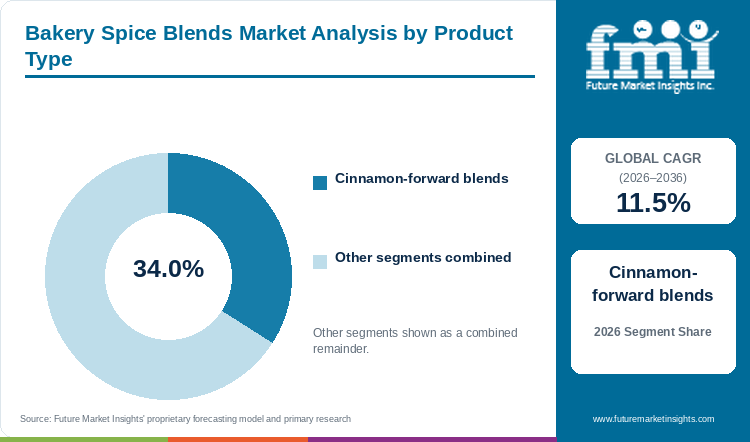
Cinnamon-forward blends lead with 34.0% of Product Type revenue in 2026.
Cinnamon-forward blends generate USD 86.2 million in 2026. A recognisable profile carries across recurring bread and seasonal cake recipes. A source change still requires care: Cassia and Ceylon differ in coumarin content, and the FDA’s ground-cinnamon alert was updated in September 2026.[1][2] The accepted botanical identity and dose form part of the continuing supply specification.
- Cinnamon-forward blends account for 34.0% of Product Type revenue in 2026.
- Botanical identity and the accepted dose need to stay fixed in the supply specification.
Why does Powder / dry remain the preferred Form?
Powder / dry leads with 40.0% of Form revenue in 2026.
Dry blends generate USD 101.4 million in 2026. They fit flour-room weighing routines and can be delivered in packs matched to batch size. Segregation during handling can change the flavour delivered by different portions of a pack. A consistent blend protects the bakery’s existing instructions and reduces the need to adjust individual batches.
- Powder / dry accounts for 40.0% of Form revenue in 2026.
- Blends need to resist segregation so that every portion of a pack delivers the same flavour.
How do Bread & rolls anchor Application demand?
Bread & rolls lead with 41.0% of Application revenue in 2026.
Bread and rolls account for USD 103.9 million in 2026. A blend added to dough faces different conditions from one used in a spiralled filling, so these uses can create separate specifications within the same customer account. Demand becomes recurring when the finished recipe remains on the production schedule at a stable dose.
- Bread & rolls hold 41.0% of Application revenue in 2026.
- Dough additions and spiralled fillings need separate blend specifications where conditions differ.
What sustains Conventional use across Claim categories?
Conventional leads with 50.0% of Claim revenue in 2026.
Conventional formulations account for USD 126.7 million in 2026. The category lets sourcing decisions balance flavour, traceability and cost without the extra restrictions of a specialised claim. McCormick cited higher commodity costs in its 2026 results.[5] Switching origin may ease purchasing pressure, although the saving has to survive any change in dose, qualification work or ingredient declaration.
- Conventional represents 50.0% of Claim revenue in 2026.
- A proposed source change needs review against the bakery’s existing ingredient declaration.
Why does Direct to industrial bakeries lead Sales Channel procurement?
Direct to industrial bakeries leads with 48.0% of Sales Channel revenue in 2026.
Direct supply to industrial bakeries accounts for USD 121.6 million in 2026. The contract can cover more than delivery of a blend: it can hold together sensory tolerances, material records and production planning across factories. A supplier gains a route to additional sites once a formulation is established, while unexplained changes to an existing blend become commercially disruptive.
- Direct to industrial bakeries captures 48.0% of Sales Channel revenue in 2026.
- A common specification needs to extend an established blend to additional factories.
What are the drivers, restraints and opportunities in the bakery spice blends market?
Recurring bakery ranges support contracted flavour specifications
Recurring cinnamon-roll and cake ranges turn an accepted bakery ingredient specification into scheduled orders, and a prepared blend replaces several spice additions with one purchase. The opportunity grows when the same customer moves other recipes into that arrangement. McCormick’s Flavor Solutions business recorded 3.0% organic sales growth in the third quarter of 2026, which shows wider food-manufacturing demand.[5] A supplier gains where each converted recipe stays in production at the agreed dose.
Contaminant control and cinnamon selection slow supplier changes
Sourcing checks can delay a move to a cheaper cinnamon. The FDA’s September 2026 alert identifies affected ground-cinnamon products and lots, while BfR’s guidance distinguishes the coumarin content of cinnamon varieties,[1][2] and both enter the review alongside flavour. The constraint is the time and production risk of approving a replacement for a recipe already on sale. A supplier gains where its lot records let the bakery keep producing while alternatives are checked.
Application-specific blends can extend beyond seasonal launches
Fuchs’ Sweet Creations collection shows how a supplier can organise blends around particular bakery uses.[3] A seasoning for roll fillings has a different role from one dispersed through biscuit dough. Tailored specifications can extend a supplier’s share of an account when the bakery adds products, creating orders beyond its original blend. A supplier gains where each new product carries its own specification and a place on the production calendar.
Which country CAGRs are profiled in the bakery spice blends market?
Table 4: Country growth outlook for the bakery spice blends market
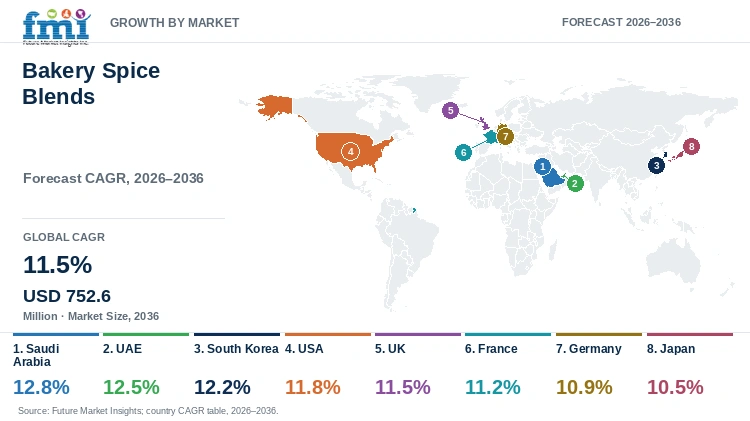
| Country | CAGR, 2026 to 2036 |
|---|---|
| Saudi Arabia | 12.8% |
| UAE | 12.5% |
| South Korea | 12.2% |
| USA | 11.8% |
| UK | 11.5% |
| France | 11.2% |
| Germany | 10.9% |
| Japan | 10.5% |
Saudi Arabia
Saudi Arabia has the highest profiled CAGR at 12.8% for 2026 to 2036, above the global rate of 11.5%. The USDA Foreign Agricultural Service’s August 2026 retail report listed baked goods third among its top ten Saudi growth products in 2025. It put food service sales at USD 30 billion, growing about 8.0% a year. The ranking does not cover spice blends or bakery ingredient purchases. Food service growth gives a blender a route through café and artisan suppliers, where several spices become one purchased blend. However, the report also describes pressure toward low-sugar products, which weighs on sweet spiced lines. Demand will depend on how many food service bakeries buy blends under a fixed specification.
UAE
The UAE is forecast at 12.5% CAGR over 2026 to 2036, above the global rate of 11.5%. The USDA Foreign Agricultural Service’s August 2026 report ranked spices ninth among consumer-oriented imports in 2025, at USD 676 million. Bakery goods, cereals and pasta imports were USD 937 million. Both are trade values, and the UAE re-exports to the GCC, Africa and South Asia, so neither measures spice use in local bakeries. Spices arrive in volume, so a blender can compete on a fixed profile and pack size rather than on access. However, a re-export hub also gives every bakery many alternative sources. Demand will depend on how many bakeries choose a specified blend over loose imported spices.
South Korea
South Korea is forecast at 12.2% CAGR over 2026 to 2036, above the global rate of 11.5%. The USDA Foreign Agricultural Service’s May 2026 report put growth in spice imports at 8.0% between 2024 and 2025. Sales of seasonings, sauces and spices fell to USD 5.7 billion in 2024 from USD 6.1 billion in 2023. The two series measure different things, so neither shows blend demand in bakeries. Confectionery, breads and rice cakes reached USD 7.0 billion in 2024, which gives a blender a bakery base. However, the report notes that some ingredients approved in the United States are not approved in Korea. Demand will depend on whether a blend can be declared and approved without reformulation.
USA
The USA is forecast at 11.8% CAGR over 2026 to 2036, above the global rate of 11.5%. The FDA’s ground-cinnamon alert, issued in July 2024, was updated on 28 September 2026 with another brand at 2.18 ppm lead, and no illnesses have been reported.[1] The alert covers retail products, not the cinnamon bought by bakeries, so it does not size the risk inside blends. Traceable lots and an established sensory reference help a bakery keep a recurring recipe in production while it reviews affected sources. However, FDA also says it will keep adding firms and products to import alert where appropriate. Demand will depend on whether suppliers can show lot-level lead results for the cinnamon in each blend.
UK
The UK forecast of 11.5% is in line with the global rate of 11.5%. The Netherlands’ Centre for the Promotion of Imports, known as CBI, reported in January 2026 that UK cinnamon imports from developing countries held near 2,500 tonnes a year across 2020 to 2024, growing 1.5% annually. The series covers raw cinnamon from those countries only and does not separate bakery use. With tonnage growing at 1.5%, an 11.5% value CAGR has to come from recipe conversion and price. An annual relaunch creates a concentrated order window, while a year-round recipe supports regular replenishment. However, keeping a blend available between seasons ties up stock. Demand will depend on how many seasonal lines become permanent listings.
France
France is projected at 11.2% CAGR over 2026 to 2036, below the global rate of 11.5%. CBI reported in January 2026 that French cinnamon imports from developing countries stayed above 1,000 tonnes a year across 2020 to 2024, growing 1.4% annually. It also noted that demand peaks in winter and the festive season. The figures cover raw cinnamon, not blends or bakery recipes. Festive pastry and pain d’épices fit a cinnamon-forward blend, and a dose embedded in a finished pastry’s cost and flavour makes the blend hard to replace once chosen. However, a seasonal peak concentrates orders in a few months. Demand will depend on whether bakeries keep their festive blend specifications from one season to the next.
Germany
Germany is forecast at 10.9% CAGR during 2026 to 2036, below the global rate of 11.5%. Destatis reported on 13 October 2026 that gingerbread production fell 10.0% to about 72,800 tonnes in 2025, the lowest in seven years, with 36.0% made between July and September. Just under 20,000 tonnes were exported, mostly in the second half. The release covers finished gingerbread, not the spice blends inside it. A spiced seasonal product gives a blender a defined recipe, and BfR’s guidance on Cassia and Ceylon sets the cinnamon specification.[2] However, lower output leaves fewer batches over which to spread a blend contract. Demand will depend on whether gingerbread makers hold blend volumes at a lower level of production.
Japan
Japan has the lowest profiled CAGR at 10.5% over 2026 to 2036, below the global rate of 11.5%. The USDA Foreign Agricultural Service’s April 2026 report put fats, oils and seasonings production at USD 13.75 billion in 2025, up 2.0% on 2024 but below the USD 15.34 billion of 2023. The category is broader than baking and does not isolate spice blends. The report says yen depreciation raised import costs and put pricing pressure on buyers, and most spices are imported. Suppliers can still build sales by adding applications for an established blend. However, buyers facing higher costs may favour fewer, simpler recipes. Demand will depend on whether suppliers can hold prices through currency swings.
Who are the notable companies in the bakery spice blends market?
Royal Polak Spices; McCormick & Company; Fuchs Gruppe; Euroma; British Pepper & Spice
Royal Polak Spices specialises in cinnamon products and blends, while McCormick and Fuchs combine spices with wider flavour development.[3][4][5] McCormick reported third-quarter 2026 net sales of USD 2,024.8 million, including USD 809.0 million in Flavor Solutions.[5] Euroma and British Pepper & Spice add blending and milling capabilities to the profiled supplier field.
Competition continues after the first formulation is accepted. A supplier that maintains the agreed sensory profile when raw materials change protects the customer’s production method. The cost of switching includes renewed trials and ingredient review, which can give a dependable incumbent more room in contract discussions.
Competitive Benchmarking: Bakery Spice Blends Market
Table 5: Company capabilities in the bakery spice blends market
| Company | Relevant offer | Commercial capability |
|---|---|---|
| Royal Polak Spices | Cinnamon varieties and cinnamon spice blends | Blending and bakery application support |
| McCormick & Company | Spices and bakery flavour solutions | Ingredient sourcing and formulation breadth |
| Fuchs Gruppe | Custom seasonings and sweet-bakery blends | Application development for cakes, cookies and breads |
| Euroma | Herb and spice blends | Customised flavour development |
| British Pepper & Spice | Milled spices and seasoning blends | Spice processing and product development |
Key Developments in the Bakery Spice Blends Market
- The FDA updated its public health alert on elevated lead in certain ground-cinnamon products on 28 September 2026.[1]
- In January 2026, McCormick consolidated McCormick de Mexico after increasing its stake to 75.0%[5].
- McCormick’s Flavor Solutions business recorded 3.0% organic sales growth in Q3 2026, with 0.8% from volume and mix and 2.2% from pricing.[5]
- In October 2026, McCormick reported a 17.4% rise in third-quarter net sales and reaffirmed its 2026 outlook[5].
- Fuchs’ Sweet Creations collection provides blends for sweet bakery applications, including cakes, cookies and swirl breads.[3]
Key Players in the Bakery Spice Blends Market
- Royal Polak Spices
- McCormick & Company
- Fuchs Gruppe
- Euroma
- British Pepper & Spice
Bakery Spice Blends Market - Report Scope
Table 6: Report scope for the bakery spice blends market
| Coverage field | Report scope |
|---|---|
| Market breakdown | Product Type, Form, Application, Claim, Sales Channel |
| Quantitative Units | USD Million |
| Market Definition | Revenue from commercially sold bakery spice blends and seasoning preparations assigned to the specified product, form, application, claim and channel categories. Excludes the revenue of finished baked goods and separately sold unblended spices, fruit fillings, bakery premixes and other adjacent ingredients; bundled products count only where the spice-blend component is separately identifiable. |
| Regions Covered | North America, Latin America, Western Europe, Eastern Europe, East Asia, South Asia and Pacific, Middle East and Africa |
| Countries Covered | Saudi Arabia; UAE; South Korea; USA; UK; France; Germany; Japan |
| Key Companies Profiled | Royal Polak Spices; McCormick & Company; Fuchs Gruppe; Euroma; British Pepper & Spice |
| Forecast Period | 2026 to 2036 |
| Approach | Market assessment supported by official technical and regulatory publications, company product information and country operating conditions. |
Bakery Spice Blends Market - Research Methodology
Table 7: Research approach for the bakery spice blends market
| Method | Approach |
|---|---|
| Market coverage | Coverage follows commercially sold spice blends used in bakery recipes and excludes unblended spices and finished baked goods. |
| Secondary evidence | Government and technical publications are considered alongside first-party product information and dated corporate announcements. |
| Commercial analysis | Purchasing requirements, operating constraints, service needs and country-specific routes to market inform the interpretation of demand. |
| Forecast presentation | Global values, leading segment shares and country growth rates are stated for the 2026 to 2036 forecast period. |
Bakery Spice Blends Market by Segments
Product Type
- Cinnamon-forward blends
- Pumpkin spice
- Gingerbread & chai
- Custom blends
Form
- Powder / dry
- Liquid
- Paste / semi-solid
- Granules / pieces
Application
- Bread & rolls
- Cakes & muffins
- Biscuits & cookies
- Viennoiserie & pastry
- Other bakery & snacks
Claim
- Conventional
- Clean label
- Organic
- Non-GMO / identity preserved
Sales Channel
- Direct to industrial bakeries
- Ingredient distributors
- Foodservice & artisan supply
- Online B2B
Bakery Spice Blends Market by Region
- North America
- United States
- Canada
- Latin America
- Brazil
- Mexico
- Argentina
- Chile
- Western Europe
- Germany
- France
- United Kingdom
- Italy
- Spain
- Benelux
- Nordics
- Eastern Europe
- Poland
- Czech Republic
- Romania
- Hungary
- East Asia
- China
- Japan
- South Korea
- South Asia and Pacific
- India
- ASEAN
- Australia and New Zealand
- Middle East and Africa
- GCC Countries
- South Africa
- Türkiye
- Israel
Research Sources and Bibliography
- [1] U.S. Food and Drug Administration. (2026, September 28). More ground cinnamon products added to FDA public health alert due to presence of elevated levels of lead.
- [2] German Federal Institute for Risk Assessment. (n.d.). FAQ on coumarin in cinnamon and other foods.
- [3] Fuchs Gruppe North America. (2026). Sweet Creations collection.
- [4] Royal Polak Spices. (n.d.). Products.
- [5] McCormick & Company. (2026, October 1). McCormick reports solid third quarter performance and reaffirms 2026 outlook (Form 8-K, Exhibit 99).
This Report Answers
- How large is the bakery spice blends market in 2026 and what value is forecast by 2036?
- Which operational and seasonal pressures support demand for formulated bakery spice blends?
- Why do Cinnamon-forward blends lead the Product Type category?
- Why does Powder / dry hold the leading Form position?
- How do the profiled country CAGRs differ between 2026 and 2036?
- Which profiled companies offer bakery formulation systems or adjacent flavour ingredients?
Frequently Asked Questions
How big is the bakery spice blends market in 2026, and what is forecast for 2036?
The market is valued at USD 253.4 million in 2026 and is expected to reach USD 752.6 million by 2036.
What is the bakery spice blends market CAGR from 2026 to 2036?
The market is forecast to grow at a CAGR of 11.5% from 2026 to 2036.
Which Product Type leads the bakery spice blends market in 2026?
Cinnamon-forward blends lead Product Type with a 34.0% share in 2026, with use spanning recurring bread recipes and seasonal ranges.
Which Form has the largest share in the bakery spice blends market?
Powder / dry leads Form with a 40.0% share in 2026, as dry formats align with flour-room logistics and dosing systems.
Which profiled countries have the highest bakery spice blends CAGRs?
Saudi Arabia leads at 12.8%, followed by the UAE at 12.5% from 2026 to 2036.
Which companies participate in the bakery spice blends market?
The report profiles Royal Polak Spices, McCormick & Company, Fuchs Gruppe, Euroma and British Pepper & Spice.
Preview the report firsthand - request a free sample
Get SampleGet the brochure for pricing and purchase details.
Get PDFTable of Content
- Key Takeaways
- Market Size and CAGR
- Top Growth Driver
- Fastest Growing Segment
- Leading Region
- Key Companies
- Emerging Opportunities
- Executive Summary
- Global Market Outlook
- Demand-side Trends
- Supply-side Trends
- Technology Roadmap Analysis
- Analysis and Recommendations
- Analyst Perspective (What is happening? Why now? What should investors know?)
- Key Questions Answered
- How large is the market?
- What is the CAGR?
- What are key trends?
- Which region dominates?
- Who are the leaders?
- Market Overview
- Market Coverage / Taxonomy
- Market Definition / Scope / Limitations
- Research Methodology
- Chapter Orientation
- Analytical Lens and Working Hypotheses
- Market Structure, Signals, and Trend Drivers
- Benchmarking and Cross-market Comparability
- Market Sizing, Forecasting, and Opportunity Mapping
- Research Design and Evidence Framework
- Desk Research Programme (Secondary Evidence)
- Expert Input and Fieldwork (Primary Evidence)
- Tooling, Models, and Reference Databases
- Data Engineering and Model Build
- Quality Assurance and Audit Trail
- Market Background
- Market Dynamics (Drivers, Restraints, Opportunity, Trends)
- Scenario Forecast (Optimistic, Likely, Conservative)
- Impact Analysis
- AI Impact
- Sustainability Impact
- Regulatory Impact
- Technology Impact
- Consumer / Buyer Analysis
- Purchase Drivers
- Adoption Barriers
- Buyer Journey
- Opportunity Map Analysis
- Product Life Cycle Analysis
- Supply Chain Analysis
- Investment Feasibility Matrix
- Value Chain Analysis
- PESTLE and Porter's Analysis
- Regulatory Landscape
- Regional Parent Market Outlook
- Production and Consumption Statistics
- Import and Export Statistics
- Global Market Analysis and Forecast, 2021 to 2036
- Historical Market Size Value (USD Million) Analysis, 2021 to 2025
- Current and Future Market Size Value (USD Million) Projections, 2026 to 2036
- Y-o-Y Growth Trend Analysis
- Absolute $ Opportunity Analysis
- Global Market Pricing Analysis, 2021 to 2036
- Global Market Analysis and Forecast, By Product Type, 2021 to 2036
- Introduction / Key Findings
- Historical Market Size Value (USD Million) Analysis By Product Type, 2021 to 2025
- Current and Future Market Size Value (USD Million) Analysis and Forecast By Product Type, 2026 to 2036
- Cinnamon-forward blends
- Pumpkin spice
- Gingerbread & chai
- Custom blends
- Y-o-Y Growth Trend Analysis By Product Type, 2021 to 2025
- Absolute $ Opportunity Analysis By Product Type, 2026 to 2036
- Global Market Analysis and Forecast, By Form, 2021 to 2036
- Introduction / Key Findings
- Historical Market Size Value (USD Million) Analysis By Form, 2021 to 2025
- Current and Future Market Size Value (USD Million) Analysis and Forecast By Form, 2026 to 2036
- Powder / dry
- Liquid
- Paste / semi-solid
- Granules / pieces
- Y-o-Y Growth Trend Analysis By Form, 2021 to 2025
- Absolute $ Opportunity Analysis By Form, 2026 to 2036
- Global Market Analysis and Forecast, By Application, 2021 to 2036
- Introduction / Key Findings
- Historical Market Size Value (USD Million) Analysis By Application, 2021 to 2025
- Current and Future Market Size Value (USD Million) Analysis and Forecast By Application, 2026 to 2036
- Bread & rolls
- Cakes & muffins
- Biscuits & cookies
- Viennoiserie & pastry
- Other bakery & snacks
- Y-o-Y Growth Trend Analysis By Application, 2021 to 2025
- Absolute $ Opportunity Analysis By Application, 2026 to 2036
- Global Market Analysis and Forecast, By Claim, 2021 to 2036
- Introduction / Key Findings
- Historical Market Size Value (USD Million) Analysis By Claim, 2021 to 2025
- Current and Future Market Size Value (USD Million) Analysis and Forecast By Claim, 2026 to 2036
- Conventional
- Clean label
- Organic
- Non-GMO / identity preserved
- Y-o-Y Growth Trend Analysis By Claim, 2021 to 2025
- Absolute $ Opportunity Analysis By Claim, 2026 to 2036
- Global Market Analysis and Forecast, By Sales Channel, 2021 to 2036
- Introduction / Key Findings
- Historical Market Size Value (USD Million) Analysis By Sales Channel, 2021 to 2025
- Current and Future Market Size Value (USD Million) Analysis and Forecast By Sales Channel, 2026 to 2036
- Direct to industrial bakeries
- Ingredient distributors
- Foodservice & artisan supply
- Online B2B
- Y-o-Y Growth Trend Analysis By Sales Channel, 2021 to 2025
- Absolute $ Opportunity Analysis By Sales Channel, 2026 to 2036
- Global Market Analysis and Forecast, By Region, 2021 to 2036
- Introduction
- Historical Market Size Value (USD Million) Analysis By Region, 2021 to 2025
- Current Market Size Value (USD Million) Analysis and Forecast By Region, 2026 to 2036
- North America
- Latin America
- Western Europe
- Eastern Europe
- East Asia
- South Asia and Pacific
- Middle East and Africa
- Market Attractiveness Analysis By Region
- North America Market Analysis and Forecast, By Country, 2021 to 2036
- Historical Market Size Value (USD Million) Trend Analysis By Market Taxonomy, 2021 to 2025
- Market Size Value (USD Million) Forecast By Market Taxonomy, 2026 to 2036
- By Country
- United States
- Canada
- By Product Type
- By Form
- By Application
- By Claim
- By Sales Channel
- By Country
- Market Attractiveness Analysis
- By Country
- By Product Type
- By Form
- By Application
- By Claim
- By Sales Channel
- Key Takeaways
- Latin America Market Analysis and Forecast, By Country
- Historical Market Size Value (USD Million) Trend Analysis By Market Taxonomy, 2021 to 2025
- Market Size Value (USD Million) Forecast By Market Taxonomy, 2026 to 2036
- By Country
- Brazil
- Mexico
- Argentina
- Chile
- By Product Type
- By Form
- By Application
- By Claim
- By Sales Channel
- By Country
- Market Attractiveness Analysis
- By Country
- By Product Type
- By Form
- By Application
- By Claim
- By Sales Channel
- Key Takeaways
- Western Europe Market Analysis and Forecast, By Country
- Historical Market Size Value (USD Million) Trend Analysis By Market Taxonomy, 2021 to 2025
- Market Size Value (USD Million) Forecast By Market Taxonomy, 2026 to 2036
- By Country
- Germany
- France
- United Kingdom
- Italy
- Spain
- Benelux
- Nordics
- By Product Type
- By Form
- By Application
- By Claim
- By Sales Channel
- By Country
- Market Attractiveness Analysis
- By Country
- By Product Type
- By Form
- By Application
- By Claim
- By Sales Channel
- Key Takeaways
- Eastern Europe Market Analysis and Forecast, By Country
- Historical Market Size Value (USD Million) Trend Analysis By Market Taxonomy, 2021 to 2025
- Market Size Value (USD Million) Forecast By Market Taxonomy, 2026 to 2036
- By Country
- Poland
- Czech Republic
- Romania
- Hungary
- By Product Type
- By Form
- By Application
- By Claim
- By Sales Channel
- By Country
- Market Attractiveness Analysis
- By Country
- By Product Type
- By Form
- By Application
- By Claim
- By Sales Channel
- Key Takeaways
- East Asia Market Analysis and Forecast, By Country
- Historical Market Size Value (USD Million) Trend Analysis By Market Taxonomy, 2021 to 2025
- Market Size Value (USD Million) Forecast By Market Taxonomy, 2026 to 2036
- By Country
- China
- Japan
- South Korea
- By Product Type
- By Form
- By Application
- By Claim
- By Sales Channel
- By Country
- Market Attractiveness Analysis
- By Country
- By Product Type
- By Form
- By Application
- By Claim
- By Sales Channel
- Key Takeaways
- South Asia and Pacific Market Analysis and Forecast, By Country
- Historical Market Size Value (USD Million) Trend Analysis By Market Taxonomy, 2021 to 2025
- Market Size Value (USD Million) Forecast By Market Taxonomy, 2026 to 2036
- By Country
- India
- ASEAN
- Australia and New Zealand
- By Product Type
- By Form
- By Application
- By Claim
- By Sales Channel
- By Country
- Market Attractiveness Analysis
- By Country
- By Product Type
- By Form
- By Application
- By Claim
- By Sales Channel
- Key Takeaways
- Middle East and Africa Market Analysis and Forecast, By Country
- Historical Market Size Value (USD Million) Trend Analysis By Market Taxonomy, 2021 to 2025
- Market Size Value (USD Million) Forecast By Market Taxonomy, 2026 to 2036
- By Country
- GCC Countries
- South Africa
- Türkiye
- Israel
- By Product Type
- By Form
- By Application
- By Claim
- By Sales Channel
- By Country
- Market Attractiveness Analysis
- By Country
- By Product Type
- By Form
- By Application
- By Claim
- By Sales Channel
- Key Takeaways
- Key Countries Market Analysis
- United States
- Pricing Analysis
- Market Share Analysis, 2025
- By Product Type
- By Form
- By Application
- By Claim
- By Sales Channel
- Canada
- Pricing Analysis
- Market Share Analysis, 2025
- By Product Type
- By Form
- By Application
- By Claim
- By Sales Channel
- Mexico
- Pricing Analysis
- Market Share Analysis, 2025
- By Product Type
- By Form
- By Application
- By Claim
- By Sales Channel
- Brazil
- Pricing Analysis
- Market Share Analysis, 2025
- By Product Type
- By Form
- By Application
- By Claim
- By Sales Channel
- Chile
- Pricing Analysis
- Market Share Analysis, 2025
- By Product Type
- By Form
- By Application
- By Claim
- By Sales Channel
- Germany
- Pricing Analysis
- Market Share Analysis, 2025
- By Product Type
- By Form
- By Application
- By Claim
- By Sales Channel
- United Kingdom
- Pricing Analysis
- Market Share Analysis, 2025
- By Product Type
- By Form
- By Application
- By Claim
- By Sales Channel
- Italy
- Pricing Analysis
- Market Share Analysis, 2025
- By Product Type
- By Form
- By Application
- By Claim
- By Sales Channel
- Spain
- Pricing Analysis
- Market Share Analysis, 2025
- By Product Type
- By Form
- By Application
- By Claim
- By Sales Channel
- France
- Pricing Analysis
- Market Share Analysis, 2025
- By Product Type
- By Form
- By Application
- By Claim
- By Sales Channel
- India
- Pricing Analysis
- Market Share Analysis, 2025
- By Product Type
- By Form
- By Application
- By Claim
- By Sales Channel
- ASEAN
- Pricing Analysis
- Market Share Analysis, 2025
- By Product Type
- By Form
- By Application
- By Claim
- By Sales Channel
- Australia and New Zealand
- Pricing Analysis
- Market Share Analysis, 2025
- By Product Type
- By Form
- By Application
- By Claim
- By Sales Channel
- China
- Pricing Analysis
- Market Share Analysis, 2025
- By Product Type
- By Form
- By Application
- By Claim
- By Sales Channel
- Japan
- Pricing Analysis
- Market Share Analysis, 2025
- By Product Type
- By Form
- By Application
- By Claim
- By Sales Channel
- South Korea
- Pricing Analysis
- Market Share Analysis, 2025
- By Product Type
- By Form
- By Application
- By Claim
- By Sales Channel
- Poland
- Pricing Analysis
- Market Share Analysis, 2025
- By Product Type
- By Form
- By Application
- By Claim
- By Sales Channel
- Hungary
- Pricing Analysis
- Market Share Analysis, 2025
- By Product Type
- By Form
- By Application
- By Claim
- By Sales Channel
- Türkiye
- Pricing Analysis
- Market Share Analysis, 2025
- By Product Type
- By Form
- By Application
- By Claim
- By Sales Channel
- South Africa
- Pricing Analysis
- Market Share Analysis, 2025
- By Product Type
- By Form
- By Application
- By Claim
- By Sales Channel
- Saudi Arabia
- Pricing Analysis
- Market Share Analysis, 2025
- By Product Type
- By Form
- By Application
- By Claim
- By Sales Channel
- UAE
- Pricing Analysis
- Market Share Analysis, 2025
- By Product Type
- By Form
- By Application
- By Claim
- By Sales Channel
- United States
- Market Structure Analysis
- Competition Dashboard
- Competition Benchmarking
- Market Share Analysis of Top Players
- By Regional
- By Product Type
- By Form
- By Application
- By Claim
- By Sales Channel
- Emerging Startups
- Innovation Benchmarking
- Competition Analysis
- Competition Deep Dive
- Royal Polak Spices
- Overview
- Product Portfolio
- Profitability by Market Segments
- Sales Footprint
- Strategy Overview
- Marketing Strategy
- Product Strategy
- Channel Strategy
- McCormick & Company
- Fuchs Gruppe
- Euroma
- British Pepper & Spice
- Royal Polak Spices
- Case Studies
- Success Stories
- Recent Developments
- Competition Deep Dive
- Assumptions & Acronyms Used


