

- Market Size (2026)
- USD 204.3 Mn
- Forecast (2036)
- USD 497.1 Mn
- CAGR (2026 to 2036)
- 9.3%
How big is Bakery Butter Blends Market in 2026?
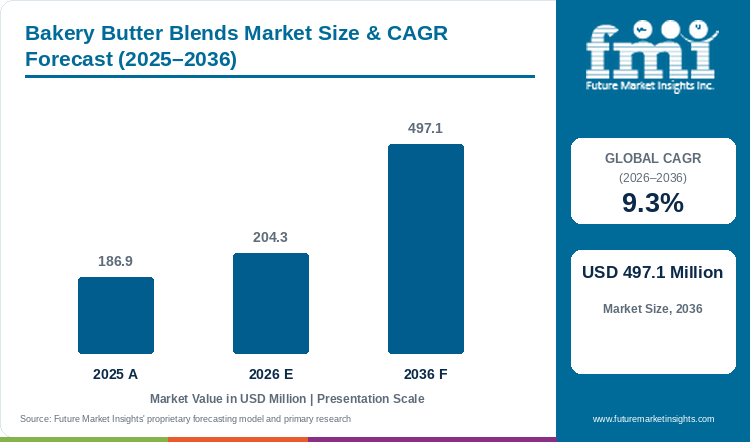
Assessed at USD 186.9 million in 2025 and progressing to USD 204.3 million in 2026, the bakery butter blends market valuation is on course to reach USD 497.1 million by 2036, supported by a forecast-period CAGR of 9.3%.
The global bakery butter blends market was valued at USD 186.9 million in 2025 and is estimated to reach USD 204.3 million in 2026. The market is projected to reach USD 497.1 million by 2036, expanding at a compound annual growth rate (CAGR) of 9.3% between 2026 and 2036. Sheet and plaque formats are projected to capture 36.0% of 2026 type demand, as pre-extruded roll-in slabs prevent dough-layer rupture during multi-shift lamination. Demand for butter blends is supported by dairy cost hedging on one side and lactone aroma retention on the other, since pure dairy butter softens under infrared sheeting room temperatures while blends hold working range without the label penalty [9]. That dual requirement puts the category well ahead of the butter market growing at 3.7% CAGR, because blends sell a processing window while butter sells a commodity block. Supply-side conviction shows in the consolidation, as Bunge completed its Viterra merger in July 2025 to integrate oilseed refining with specialty bakery fat chains [2], and Arla Foods Ingredients extended Southeast Asia distribution with Brenntag across Vietnam, Thailand and Indonesia in May 2025 [4]. Viennoiserie plants price the switch against scrapped dough carts per shift, and the fat suppliers that pair allergen-clean dairy notes with sheeting stability win the laminated programs through 2036.
Key Market Trends & Insights
- By type: Sheet & Plaque Format is projected to account for 36.0% of the type segment in 2026 because pre-extruded roll-in slabs prevent dough-layer rupture during automated croissant lamination.
- By form: Powder & Dry formulations are estimated to command 48.0% of the form segment in 2026 as centralized premix plants dose encapsulated butter blends directly into dry flour silos.
- By application: Bread & Rolls is expected to represent 39.0% of the application segment in 2026 because continuous tunnel-oven bread lines require repeatable crumb softening and dairy flavor notes.
- By claim: Conventional products are forecast to hold 52.0% of the claim segment in 2026 owing to broader enzymatic and fractionated fat flexibility within standard industrial specifications.
- By sales channel: Direct Industrial Bakeries are anticipated to capture 49.0% of the sales channel segment in 2026 through co-developed slip-melting-point contracts and bulk shipment schedules.
Regional Highlights
- Top national expansion: The UAE is projected to lead evaluated national growth at a 10.7% CAGR through 2036 as airline catering hubs and luxury hotels expand laminated pastry output.
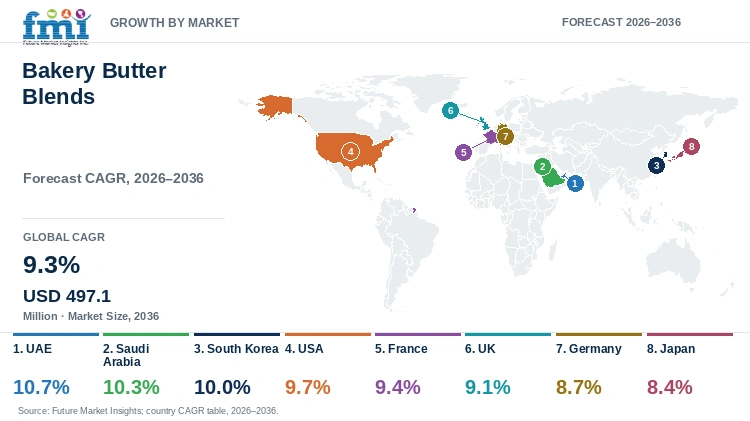
- Broader country progression: Saudi Arabia is expected to expand at a 10.3% CAGR ahead of South Korea at a 10.0% CAGR and the USA at a 9.7% CAGR, while Japan is forecast to progress at an 8.4% CAGR.
Market Size & Forecast
Table 1: Market Size and Forecast for the Bakery Butter Blends Market (USD million and CAGR percentage), 2025 to 2036
| Metric | Value |
|---|---|
| 2025 Market Size | USD 186.9 million |
| Estimated Market Size in 2026 | USD 204.3 million |
| Projected Market Size by 2036 | USD 497.1 million |
| CAGR, 2026 to 2036 | 9.3% |
| Added Revenue, 2026 to 2036 | USD 292.8 million |
Commercial pastry manufacturers must keep solid fat content stable between 18 and 24 degrees Celsius so roll-in fat layers deform smoothly without bleeding into fermenting dough. Pure dairy butter softens rapidly above 20 degrees Celsius, which prompts high-speed bakeries to specify tailored butter-and-vegetable-fat blends beside pastry margarine roll-in slabs. In July 2025, Bunge Global SA completed its merger with Viterra Limited to expand integrated oilseed refining and specialty bakery fat supply chains across North America and Europe [2]. Strict European Union spreadable-fat marketing standards still prohibit bakeries from labeling finished pastries as pure-butter goods when blended fats are used.
Bakery-Plant and Tonnage-Requirement Sizing
Table 2: Bakery-Plant and Tonnage-Requirement Sizing for the Bakery Butter Blends Market (USD million and operational ranges), 2025 to 2036
| Metric | 2025 | 2026 | 2036 |
|---|---|---|---|
| Market size (USD million) | 186.9 | 204.3 | 497.1 |
| Active industrial & commissary bakery accounts | 14,200 to 15,800 | 15,100 to 16,900 | 28,500 to 32,000 |
| Formulated butter-blend volume (thousand MT) | 48.5 to 53.2 | 52.4 to 57.6 | 114.0 to 126.5 |
| Contract realization per kilogram (USD) | 3.50 to 3.85 | 3.55 to 3.90 | 3.95 to 4.35 |
Operational note: Volume and pricing benchmarks reconcile industrial 10-kilogram laminating plaque cartons and 25-kilogram spray-dried butter-blend powder bags across formulation tiers containing 5% to 50% real milk fat.
High-throughput croissant and puff-pastry plants require laminating fats that maintain crystal elasticity after retarder-proofer freezing. Ingredient formulators combine fractionated palm and shea stearins with anhydrous milk fat to deliver clean palate melt without post-bake waxiness.
Per Capita & Industrial Bakery Plant Sizing
Table 3: Per Capita and Bakery Plant Spending Indicators for the Bakery Butter Blends Market (USD), 2025 to 2036
| Metric | 2025 | 2026 | 2036 |
|---|---|---|---|
| World population (million) | 8,200.0 | 8,300.0 | 9,000.0 |
| Spend per 1,000 people (USD) | 22.8 | 24.6 | 55.2 |
| Annual spend per qualified bakery plant (USD) | 11,830 to 13,160 | 12,090 to 13,530 | 15,530 to 17,440 |
| Direct B2B contract procurement share (%) | 47.0% to 50.0% | 48.0% to 51.0% | 53.0% to 57.0% |
Table 4: Industrial & Artisan Bakery Spending Indicators for the Bakery Butter Blends Market (USD and percentages), 2026
| Metric | Value | Institutional Reference Basis |
|---|---|---|
| Market size, 2026 | USD 204.3 million | 2026 global valuation baseline |
| Qualified industrial & artisan bakery buyers | 16,000 facilities | Midpoint commercial bakery plant universe |
| Average annual blend procurement per plant | USD 12,768.8 | Annualized B2B contract & distributor realization |
| Direct Industrial Bakeries revenue, 2026 | USD 100.1 million | 49.0% sales channel segment allocation |
Partial substitution of block dairy butter in industrial brioche and sandwich-carrier lines cuts raw-material cost volatility by 15% to 30% depending on the declared milk-fat ratio. Technical procurement teams evaluate dairy blends on measured loaf specific volume and 14-day crumb compression softness.
Analyst Perspective
"Pilot baking demonstrations convert into multi-year supply contracts only when a butter blend holds its β'-crystal plasticity across summer plant temperatures and delivers an auditable milk-fat percentage. Suppliers that pair enzymatic zero-trans structuring with application-center line trials will win direct industrial bakery accounts."
- Nandini Roy Choudhury, Principal Analyst at Future Market Insights
How is the bakery butter blends market segmented?
The bakery butter blends market is segmented by type, form, application, claim, and sales channel. In 2026, Sheet & Plaque Format is projected at 36.0%, Powder & Dry at 48.0%, Bread & Rolls at 39.0%, Conventional at 52.0%, and Direct Industrial Bakeries at 49.0%.
By type: Sheet & Plaque Format, Block Format, Concentrated Butter, and Cultured & Flavored.
By form: Powder & Dry, Liquid Blend, Paste & Semi-Solid, and Granules & Pieces.
By application: Bread & Rolls, Cakes & Muffins, Biscuits & Cookies, Viennoiserie & Pastry, and Other Bakery & Snacks.
By claim: Conventional, Clean Label, Organic, and Non-GMO Identity Preserved.
By sales channel: Direct Industrial Bakeries, Ingredient Distributors, Foodservice & Artisan Supply, and Online B2B.
Why does Sheet & Plaque Format lead the type segment?
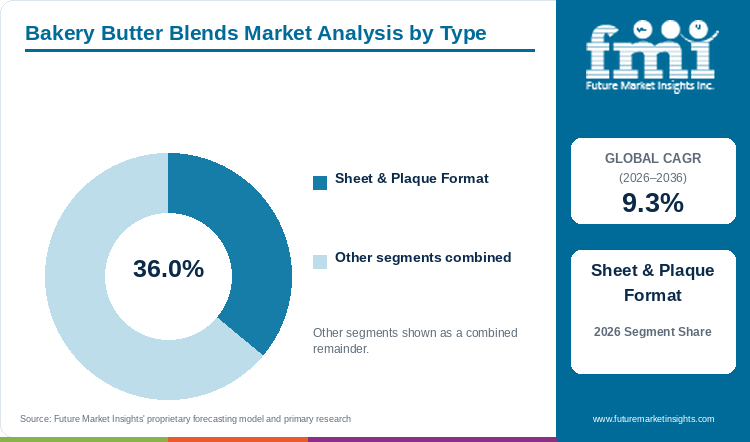
Sheet & Plaque Format is projected to capture 36.0% of the type segment in 2026, supported by pre-calibrated lamination thickness and reduced dough-sheeting waste.
Table 5: Type Share for the Bakery Butter Blends Market (percentage share), 2026
| Type | Share (2026) |
|---|---|
| Sheet & Plaque Format | 36.0% |
| Other Segments Combined | 64.0%* |
| Total | 100.0% |
*Note: Remaining type subsegments (Block Format, Concentrated Butter, and Cultured & Flavored) sum to 100.0% of 2026 revenue.
Table 6: Type Leadership and Market Growth for the Bakery Butter Blends Market (segment and CAGR percentage), 2026 to 2036
| Metric | Value |
|---|---|
| Global CAGR (2026 to 2036) | 9.3% |
| Leading Segment | Sheet & Plaque Format |
Pre-extruded 2-kilogram to 10-kilogram laminating plaques eliminate manual block pounding and prevent fat-layer fracturing during three-fold croissant and puff-pastry sheeting. Engineered slip melting points allow bakeries to run higher line speeds than unblended dairy butter within the wider butter and margarine sector.
- Sheet & Plaque Format is projected to account for 36.0% of the type segment in 2026 because pre-calibrated thickness and wide working-temperature windows reduce laminator scrap.
- Croissant baking trials published in Food Research International in March 2026 demonstrated that replacing 50% of dairy butter with lecithin- and sucrose-ester-modified specialty fats elevated β'-crystal content and increased loaf specific volume while lowering crumb hardness [3].
Why does Powder & Dry define the largest form segment?
Powder & Dry formulations are estimated to secure 48.0% of the form segment in 2026, driven by automated dry-mix dosing and ambient storage efficiency.
Spray-dried butter-blend powders encapsulated on dairy or carbohydrate carriers flow freely through pneumatic conveyors and ribbon blenders without chilled storage. Industrial premix manufacturers integrate dry butter blends into cake and waffle mixes beside low-fat butter derivatives to deliver authentic dairy aroma upon water hydration.
- Powder & Dry options are estimated to command 48.0% of the form segment in 2026 as centralized dry-mix plants prioritize ambient shelf stability and automated batch dosing.
- In May 2025, Arla Foods Ingredients expanded its distribution partner with Brenntag Specialties across Vietnam and Thailand as well as Indonesia to supply dairy and bakery functionality ingredients to regional food manufacturers [4].
What keeps Bread & Rolls ahead in the application segment?
Bread & Rolls is expected to hold 39.0% of the application segment in 2026 through continuous high-volume loaf and bun production.
High-speed pan-bread and brioche bun lines operate 24-hour schedules where uniform fat dispersion governs gas-cell stabilization and slicing softness. Standard 3% to 8% butter blend dosing on flour weight imparts rich dairy flavor and delays amylopectin retrogradation more cost-effectively than pure butter across normal and specialty fats applications.
- Bread & Rolls is expected to capture 39.0% of the application segment in 2026 because everyday sandwich loaves and burger buns generate predictable year-round fat tonnage.
- Enzymatic interesterification research published in the Journal of Food Science in September 2025 established that a 7:3 cottonseed-oil-to-palm-stearin blend achieved 59.49% β'-crystal morphology, which surpassed commercial margarines at 50.39% and improved dough plasticity [5].
Why does Conventional lead the claim segment?
Conventional products are forecast to generate 52.0% of the claim segment in 2026 by balancing melt-profile precision against landed ingredient cost.
Industrial procurement specifications for par-baked rolls and supermarket cookies prioritize tight solid-fat-content curves and oxidative stability over organic certification. Conventional blends allow formulators to pair dairy butterfat with mono- and diglycerides and enzymatically structured vegetable oils across the yellow fats value chain.
- Conventional formulations are forecast to represent 52.0% of the claim segment in 2026 as contract bakers avoid the 30%+ raw-material premium of certified organic dairy and oil inputs.
- In September 2025, Corbion introduced its fermentation-based Ultra Fresh Plus 100 solution at IBIE 2025 to help commercial bakeries preserve crumb softness and sliceability during fat-system reformulations [6].
What gives Direct Industrial Bakeries the leading sales channel share?
Direct Industrial Bakeries are anticipated to account for 49.0% of the sales channel segment in 2026 through custom technical qualification and contract volume.
Large plant bakeries purchase butter blends in full-pallet plaques or heated liquid tankers tied to quarterly dairy and vegetable-oil price indices. Before switching an incumbent fat, bakery R&D directors run multi-week shear and baking trials at supplier innovation centers and fat replacers specialists.
- Direct Industrial Bakeries are anticipated to secure 49.0% of the sales channel segment in 2026 because custom melting-point tuning requires direct technical partner between fat refiners and plant engineers.
- Synchrotron X-ray scattering and differential scanning calorimetry trials published in Crystal Growth & Design in April 2025 proved that matching POP and SOS triglyceride ratios in plant-based fat blends replicates the solid fat content and β' polymorphic stability of anhydrous milk fat [7].
What are the drivers, restraints, and opportunities in the bakery butter blends market?
In the bakery butter blends market, dairy-butter cost hedging and lamination plasticity stability propel demand while milk-allergen labeling and plant-fat competition restrain switching; meanwhile, enzymatically interesterified zero-trans blends unlock growth.
- Driver: Industrial bakeries adopt dairy-and-vegetable butter blends to insulate operating margins from wholesale butterfat spikes while widening dough-sheeting temperature tolerances.
- Restraint: Mandatory milk-allergen declarations and EU pure-butter naming rules slow customer switching with competition from 100% plant-based laminating fats.
- Opportunity: Enzymatically interesterified zero-trans plaques and cultured-butter flavor concentrates enable suppliers to win clean-label viennoiserie and export baking-mix contracts.
Growth Analysis and Future Potential: Qualitative Demand Drivers
High-speed industrial laminators subject roll-in fats to intense mechanical shear that ruptures pure dairy butter layers whenever ambient dough-room temperatures exceed 20 degrees Celsius. Formulations combining 10% to 40% dairy butter or anhydrous milk fat with high-stability vegetable stearins create a plastic fat matrix that resists oil-out during proofing and baking. This functional advantage complements industrial demand for frying shortening and specialty bakery fats across automated commissaries. In March 2025, Leibniz University Hannover researchers published croissant lamination trials in Current Research in Food Science showing that 100% wax-based bigel replacements caused irregular fat layering and flatter croissants compared to control laminating fats [8]. Bakeries therefore retain genuine milk-fat blends that preserve honeycomb lift and authentic buttery aroma.
Risk Assessment of the Bakery Butter Blends Market: Operational and Formulation Friction
Strict allergen-segregation protocols and statutory dairy-labeling regulations represent the primary commercial hurdles restricting broader blend adoption. Line conversions to a butter blend in a bakery that previously ran 100% vegetable shortening trigger mandatory milk-allergen washdowns and front-of-pack allergen disclosures. In September 2025, differential scanning calorimetry research from North Carolina State University and Cornell University published in the Journal of Dairy Science demonstrated that variations in de novo and unsaturated fatty acids shift bilayer and trilayer triglyceride crystallization during temperature cycling [9]. Specialty oil processors are also launching 100% plant-based butter alternatives such as Cargill's NatureFresh Professional Lite butter-flavored vegetable fat presented at AAHAR in March 2025 [10], which compete directly for price-sensitive pastry briefs.
Commercial Opportunity Analysis: Formulation Differentiation and Value-Add Formats
Bakery ingredient formulators can capture premium margins by pairing immobilized-lipase interesterification with controlled enzymatic lipolysis of milk fat to amplify buttery volatile lactones and methyl ketones at lower total dairy inclusion. In October 2026, lipidomics and headspace GC-MS research from Jiangnan University published in Food Research International mapped 50 volatile features and over 1,000 lipid molecular species during lipase treatment of anhydrous milk fat and identified a 30-minute hydrolysis window that maximizes balanced dairy aroma [19]. Lipolyzed milk-fat concentrates paired with zero-trans enzymatically structured sunflower-and-palm stearin plaques allow suppliers to deliver authentic European-style pastry flavor that satisfies strict trans-fat and clean-label retail audits.
Bakery Butter Blends Market by Country (2026 to 2036)
According to FMI, the UAE is projected to lead bakery butter blends expansion across evaluated countries at a 10.7% CAGR through 2036, whereas Japan is forecast to advance at an 8.4% CAGR. Revenue progression across the Middle East and East Asia as well as North America and Western Europe depends on trans-fat bans as well as ambient kitchen heat tolerances and dairy import quotas.
Table 7: Country CAGR and Primary Growth Levers for the Bakery Butter Blends Market (CAGR percentage and operational drivers), 2026 to 2036
| Country | CAGR (2026 to 2036) | Primary Commercial Growth Lever |
|---|---|---|
| UAE | 10.7% | Luxury hotel & airline catering high-melting-point pastry plaques |
| Saudi Arabia | 10.3% | SFDA zero-trans PHO ban and industrial croissant/brioche commissaries |
| South Korea | 10.0% | Franchise café viennoiserie chains and frozen laminated dough scaling |
| USA | 9.7% | Industrial pan-bread and biscuit butterfat cost hedging |
| France | 9.4% | Industrial viennoiserie export lines and summer plasticity control |
| UK | 9.1% | Supermarket in-store bakery private-label cost optimization |
| Germany | 8.7% | Industrial bake-off roll and pastry cost-in-use reformulation |
| Japan | 8.4% | MAFF state butter import quotas and cultured-butter blend sheets |
Source: Future Market Insights analysis
UAE Bakery Butter Blends Market Outlook (2026 to 2036)
The UAE bakery butter blends market is projected to expand at a leading 10.7% CAGR from 2026 to 2036, driven by year-round luxury hotel and airline catering bakery procurement. High ambient warehouse temperatures across Gulf logistics corridors cause conventional dairy butter to oil out, which compels commissary pastry chefs to specify high-melting-point laminating plaques containing 15% to 30% milk fat. In February 2025, Dubai Municipality announced at Gulfood 2025 that its Montaji+ platform registered over 1.7 million food products and cut import permit approval times by 75% to 10 minutes [11]. Refrigerated container surcharges and strict halal dairy-origin documentation nevertheless require suppliers to maintain audited regional cold stores.
Key takeaway: In the UAE, high-temperature pastry lamination requirements and digitized municipal import clearance are projected to drive a 10.7% CAGR.
Saudi Arabia Bakery Butter Blends Market Outlook (2026 to 2036)
In Saudi Arabia, statutory prohibitions on partially hydrogenated oils under standard SFDA.FD 2483 have reshaped industrial bakery fat procurement across Riyadh and Jeddah commissaries. Commercial bakery butter blends sales in Saudi Arabia are forecast to rise at a 10.3% CAGR between 2026 and 2036 through packaged croissant and maamoul production. A December 2025 study in Food Chemistry demonstrated that solvent-free enzymatic interesterification of high-oleic sunflower oil and palm stearin using immobilized Pichia pastoris lipase achieved a 99.67% degree of interesterification and a 33.5-degree Celsius slip melting point with zero trans fats [12]. Mandatory Arabic ingredient declarations and halal dairy certificates still lengthen onboarding for new foreign fat blenders.
Key takeaway: In Saudi Arabia, strict zero-trans fat regulations and expanding industrial pastry manufacturing are forecast to sustain a 10.3% CAGR through 2036.
South Korea Bakery Butter Blends Market Outlook (2026 to 2036)
South Korea features a highly consolidated franchise café and in-store bakery sector that relies on centralized frozen laminated dough and premix distribution. Domestic pastry formulators combine imported anhydrous milk fat with specialty vegetable stearins to protect flaky crust lift after frozen dough retarder-proofer cycles. Revenue from bakery butter blends in South Korea is expected to climb at a 10.0% CAGR over the 2026 to 2036 forecast period. In May 2025, the Ministry of Food and Drug Safety reported that South Korea's total food industry production reached KRW 114 trillion in 2024 with 5.8% annual growth [13], although high import tariffs on pure dairy butter continue to pressure formulator margins.
Key takeaway: In South Korea, franchise bakery frozen-dough scaling and domestic food manufacturing growth are expected to support a 10.0% CAGR.
USA Bakery Butter Blends Market Outlook (2026 to 2036)
What distinguishes the USA market is the scale of automated pan-bread and foodservice biscuit plants seeking insulation from Chicago Mercantile Exchange spot butter volatility. Suppliers such as Bunge market European-style bakery blends containing real dairy butter as well as 100% plant-based laminating fats for cost-sensitive supermarket in-store bakeries. In December 2025, Pennsylvania State University dairy scientists reported in the Journal of Dairy Science that elevated palmitic acid feeding increases milk-fat solid fat content at 20 degrees Celsius by 5.3 percentage units and raises room-temperature butter hardness [14]. so bakery butter blends turnover in the USA is estimated to advance at a 9.7% CAGR from 2026 to 2036.
Key takeaway: In the USA, industrial bakery cost-in-use hedging and standardized fat-plasticity requirements are estimated to generate a 9.7% CAGR through 2036.
France Bakery Butter Blends Market Outlook (2026 to 2036)
France's bakery butter blends market is anticipated to grow at a 9.4% CAGR between 2026 and 2036, shaped by the coexistence of 48,351 artisan bakery-pastry shops and large industrial viennoiserie exporters. While traditional artisan boulangeries defend pure-butter AOC claims, industrial brioche and foodservice pastry manufacturers use concentrated butter and tailored dairy-plant blends to stabilize summer sheeting performance. partner research involving Institut Agro Rennes-Angers and Université Laval published in the Journal of Dairy Science in September 2025 confirmed that fatty-acid spreadability indices directly govern butter resistance to spreading at 4 and 20 degrees Celsius [15]. Strict EU Regulation 1308/2013 labeling rules still bar blended products from using pure-butter front-of-pack titles.
Key takeaway: In France, industrial viennoiserie export production and summer sheeting stability needs are anticipated to sustain a 9.4% CAGR through 2036.
UK Bakery Butter Blends Market Outlook (2026 to 2036)
Production in the UK is concentrated among high-volume plant bakeries and chilled savory-pastry manufacturers supplying national supermarket private-label ranges. Commercial bakery butter blends demand in the UK is slated to expand at a 9.1% CAGR from 2026 to 2036 across crumpet and sausage-roll lines. In September 2026, researchers at Queen's University Belfast and Shandong Academy of Agricultural Sciences reported in Food Chemistry that incorporating 3% whey-protein-isolate and beta-glucan complexes into 30%-fat dairy cream replicated the firmness and sensory scores of 35%-fat cream [16]. Mandatory UK Food Standards Agency milk-allergen bolding rules and strict supermarket HFSS saturated-fat ceilings nevertheless require rigorous industrial recipe validation before commercial switching.
Key takeaway: In the UK, supermarket private-label bakery cost engineering and saturated-fat reduction briefs are slated to support a 9.1% CAGR.
Germany Bakery Butter Blends Market Outlook (2026 to 2036)
Germany's industrial bake-off stations and discount supermarket chains prioritize predictable dough machinability and per-ton fat economy across pretzel croissants and sliced pan breads. Cumulative retail bread and roll price increases across grocery channels in Germany have prompted contract bakers to test butter-containing blends and dry fat powders to control recipe costs without losing dairy crumb aroma. Sales of bakery butter blends in Germany are predicted to progress at an 8.7% CAGR over the 2026 to 2036 window. In September 2026, food technologists at the DIL Institute of Food Technologies and the University of Hohenheim published butter processing trials in the Journal of Dairy Science validating raw-milk fat consistency [17].
Key takeaway: In Germany, discount retail bake-off expansion and industrial fat cost-in-use discipline are predicted to anchor an 8.7% CAGR through 2036.
Japan Bakery Butter Blends Market Outlook (2026 to 2036)
Unlike Western markets with unrestricted dairy trade, Japan manages domestic butter supply through statutory import quotas administered by the Ministry of Agriculture, Forestry and Fisheries (MAFF) and the Agriculture and Livestock Industries Corporation. In September 2025, MAFF conducted its formal fiscal 2025 review of butter and skimmed milk powder import allocations to balance domestic Hokkaido dairy output against industrial bakery demand [18]. To secure uninterrupted laminating supply and delicate flavor release, domestic manufacturers such as Fuji Oil Co., Ltd. formulate cultured-butter-containing sheeted margarines and compound bakery fats tailored to domestic white-bread and pastry textures. so Japan's bakery butter blends market is projected to expand at an 8.4% CAGR through 2036.
Key takeaway: In Japan, state-managed butter import quotas and specialized sheeted compound-fat engineering are projected to sustain an 8.4% CAGR through 2036.
Full report country CAGRs cover: North America; Latin America; Western Europe; Eastern Europe; East Asia; South Asia and Pacific; Middle East and Africa.
Who are the notable companies in the bakery butter blends market?
AAK, Bunge, Cargill, Fuji Oil Holdings, Wilmar International, Lactalis Ingredients, FrieslandCampina Ingredients, Arla Foods Ingredients, Michael Foods, and Corbion are the notable companies in the bakery butter blends market.
Commercial participation in the bakery butter blends market divides between specialty oil-and-dairy blend formulators and upstream bakery-fat and dairy-butter producers as well as functional dairy/preservation ingredient specialists. AAK and Bunge along with Fuji Oil Holdings manufacture pre-sheeted laminating plaques and cultured-butter blends tailored to industrial pastry lines. Cargill and Wilmar International as well as Lactalis Ingredients supply bulk bakery shortenings and concentrated milk-fat inputs. FrieslandCampina Ingredients and Arla Foods Ingredients along with Michael Foods and Corbion provide spray-dried fat powders and crumb-softening enzyme systems.
- Butter-Blend and Laminating-Format Specialists: AAK and Bunge along with Fuji Oil Holdings engineer pre-crystallized roll-in plaques and dairy-containing bakery blends.
- Bakery Fats and Dairy-Butter Formulation Inputs: Cargill and Wilmar International as well as Lactalis Ingredients supply structured bakery fats and anhydrous milk fat as well as pastry butter blocks.
- Complementary Bakery and Dairy Ingredient Suppliers: FrieslandCampina Ingredients and Arla Foods Ingredients along with Michael Foods and Corbion deliver encapsulated dairy powders and clean-label crumb softeners.
Competitive Benchmarking: Bakery Butter Blends Market
Table 8: Competitive Benchmarking for the Bakery Butter Blends Market (qualitative capability ratings), 2026
| Company | Participation Tier | Blend & Fat Portfolio | Format Capability | Geographic Reach |
|---|---|---|---|---|
| AAK | Butter-Blend & Laminating Specialist | High (sheeted butter blends & pastry fats) | High (plaques, blocks & liquid) | Europe & North America global bakery network |
| Bunge | Butter-Blend & Specialty Oils Leader | High (Old World European-style butter blends) | High (roll-in sheets, cubes & shortenings) | North America & Europe global oilseed hubs |
| Cargill | Bakery Fats & Formulation Inputs | High (bakery shortenings & butter alternatives) | High (blocks, sheets & bulk liquid) | North America & Europe plus Asia-Pacific plants |
| Fuji Oil Holdings | Compound Butter & Pastry Fat Specialist | High (fermented-butter sheeted margarines) | High (sheets, blocks & whipping fats) | Japan, China, Southeast Asia & North America |
| Wilmar International | Specialty Bakery Fats Producer | Medium-High (butter blends & bakery margarines) | High (industrial blocks & laminating sheets) | Asia-Pacific & Middle East plus Africa network |
| Lactalis Ingredients | Dairy Butter & AMF Input Supplier | High (sheet butter, concentrated butter & AMF) | High (2kg sheets, 10kg/25kg blocks) | France/Europe HQ; global dairy bakery export |
| FrieslandCampina Ingredients | Encapsulated Fat Powder Specialist | Medium-High (Kievit encapsulated fat powders) | High (spray-dried dry-mix powders) | Europe & Asia-Pacific plus North America channels |
| Arla Foods Ingredients | Functional Dairy Bakery Ingredients | Medium (whey protein & MFGM fat-system aids) | High (dry powder bakery functionality) | Europe & Southeast Asia global functionality |
| Michael Foods | Foodservice Dairy-Blend Supplier | Medium (clarified butter blends & B2B dairy) | Medium (blocks & foodservice tubs) | USA foodservice & industrial bakery supply |
| Corbion | Clean-Label Crumb & Fat-System Enabler | Medium (enzymatic crumb softeners & emulsifiers) | High (dry powder & functional systems) | North America & Europe plus Latin America |
Scoring basis: Capability ratings evaluate documented dairy-and-vegetable butter-blend SKUs and pilot bakery innovation centers across roll-in plaque and spray-dried powder formats. Geographic reach reflects verified refinery and dairy fractionation facilities as well as B2B distributor coverage across industrial bakery markets.
Key Developments in the Bakery Butter Blends Market
- In July 2025, Bunge Global SA completed its merger with Viterra Limited to integrate global oilseed refining and specialty bakery fat supply chains across North America and Europe [2].
- In May 2025, Arla Foods Ingredients expanded its Southeast Asia distribution partnership with Brenntag Specialties across Vietnam and Thailand as well as Indonesia to supply dairy-based bakery functionality ingredients [4].
- In September 2025, Corbion launched Ultra Fresh Plus 100 at IBIE 2025 to help commercial bakeries replace synthetic emulsifiers and maintain crumb softness during clean-label fat reformulations [6].
Key Players in the Bakery Butter Blends Market
Butter-Blend and Laminating-Format Specialists
- AAK
- Bunge
- Fuji Oil Holdings
Bakery Fats and Dairy-Butter Formulation Inputs
- Cargill
- Wilmar International
- Lactalis Ingredients
Complementary Bakery and Dairy Ingredient Suppliers
- FrieslandCampina Ingredients
- Arla Foods Ingredients
- Michael Foods
- Corbion
Bakery Butter Blends Market - Report Scope
Table 9: Report Scope for the Bakery Butter Blends Market (coverage fields and definitions), 2026 to 2036
| Coverage field | Report scope |
|---|---|
| Market breakdown | Type; Form; Application; Claim; Sales Channel |
| Quantitative Units | USD Million |
| Market Definition | Includes B2B supplier revenue from formulated bakery butter blends containing declared dairy butter or anhydrous milk fat combined with structured vegetable oils or functional carriers across sheet and block formats as well as dry powders. Category Scope Note: Excludes 100% pure dairy butter and 100% dairy-free vegetable margarines as well as unblended dairy powders and finished baked goods. |
| Regions Covered | North America; Latin America; Western Europe; Eastern Europe; East Asia; South Asia and Pacific; Middle East and Africa |
| Countries Covered | UAE, Saudi Arabia, South Korea, USA, France, UK, Germany, Japan, and additional countries in the full report |
| Key Companies Covered | AAK, Bunge, Cargill, Fuji Oil Holdings, Wilmar International, Lactalis Ingredients, FrieslandCampina Ingredients, Arla Foods Ingredients, Michael Foods, Corbion |
| Forecast Period | 2026 to 2036 |
| Approach | Primary and secondary research with top-down and bottom-up market triangulation. |
Bakery Butter Blends Market - Research Methodology
Table 10: Research Methodology for the Bakery Butter Blends Market (research methods and approach), 2026 edition
| Method | Approach |
|---|---|
| Primary Research | Structured interviews with industrial bakery R&D directors and lipid crystallization scientists as well as B2B ingredient distributors to validate milk-fat inclusion ratios and per-kilogram contract pricing. |
| Secondary Research | Analysis of corporate filings from Bunge Global SA and AAK AB as well as Journal of Dairy Science and Food Chemistry rheology studies and USDA FAS and MAFF dairy trade registries. |
| Market Sizing and Forecasting | Hybrid top-down pastry-fat and dairy-blend reconciliation and bottom-up bakery line consumption modeling anchored on 10-kilogram plaques and 25-kilogram dry-blend sacks from 2026 to 2036. |
| Country Forecasting Model | Econometric national models weight commercial bakery establishment counts and statutory trans-fat prohibitions as well as dairy butter import quota spreads across eight key countries. |
| Operational Benchmark Traceability | Bakery-plant and tonnage indicators in Tables 2 through 4 trace to MFDS South Korea production releases and MAFF Japan quota reviews. |
| Data Triangulation and Validation | Contract price realizations and fat-inclusion ratios are audited against wholesale butter and palm-stearin spreads while excluding 100% pure butter and 100% plant margarines. |
Bakery Butter Blends Market by Segments
Bakery Butter Blends Market segmented by Type:
- Sheet & Plaque Format
- Block Format
- Concentrated Butter
- Cultured & Flavored
Bakery Butter Blends Market segmented by Form:
- Powder & Dry
- Liquid Blend
- Paste & Semi-Solid
- Granules & Pieces
Bakery Butter Blends Market segmented by Application:
- Bread & Rolls
- Cakes & Muffins
- Biscuits & Cookies
- Viennoiserie & Pastry
- Other Bakery & Snacks
Bakery Butter Blends Market segmented by Claim:
- Conventional
- Clean Label
- Organic
- Non-GMO Identity Preserved
Bakery Butter Blends Market segmented by Sales Channel:
- Direct Industrial Bakeries
- Ingredient Distributors
- Foodservice & Artisan Supply
- Online B2B
Bakery Butter Blends Market by Region
- North America
- United States
- Canada
- Latin America
- Brazil
- Mexico
- Argentina
- Chile
- Western Europe
- Germany
- France
- United Kingdom
- Italy
- Spain
- Benelux
- Nordics
- Eastern Europe
- Poland
- Czech Republic
- Romania
- Hungary
- East Asia
- China
- Japan
- South Korea
- South Asia and Pacific
- India
- ASEAN
- Australia and New Zealand
- Middle East and Africa
- Saudi Arabia
- UAE
- Rest of GCC
- South Africa
Research Sources and Bibliography
- [1] Chai, X., Su, Y., & Liu, Y. (2025, November 30). Tailoring whipped cream properties through fat composition design: Crystallization behavior and emulsion stability. Food Chemistry, 493(Pt 4), 146035 (PubMed PMID 40858044).
- [2] Bunge Global SA (2025, July 2). Bunge and Viterra Complete Merger to Create Premier Global Agribusiness Solutions Company. Bunge Global SA.
- [3] An, Y., Han, Y., Liu, Z., Su, J., Zhang, J., Liu, K., & Li, L. (2026, March 31). Tailoring monoglyceride oleogel crystallization by eutectic and crystal nucleation disturbance: functional frozen specialty fat for use in croissants. Food Research International, 228, 118357 (PubMed PMID 41703828).
- [4] Arla Foods Ingredients (2025, May 20). Arla Foods Ingredients and Brenntag expand collaboration into Southeast Asia. Arla Foods Ingredients Group P/S.
- [5] Zhan, X., Zhang, X., Zhang, T., Liu, W., Wu, H., & Wei, C. (2025, September 15). Preparation and Characterization of Low-Saturated Fat Margarine Through Enzymatic Interesterification: A Study on Physicochemical Properties, Crystalline Morphology, and In Vitro Digestive Behavior. Journal of Food Science, 90(9), e70558 (PubMed PMID 40985239).
- [6] Corbion N.V. (2025, September 2). Corbion leads clean-label reformulation forward at IBIE 2025. Corbion Media.
- [7] Fiore, C., Rutherford, T., Giuffrida, F., Marmet, C., & Simone, E. (2025, April 4). Crystallization Behavior of Plant-Based Fat Blends Formulated as an Alternative for Anhydrous Milk Fat in Milk Chocolate. Crystal Growth & Design, 25(8), 2700-2716 (PubMed PMID 40256755).
- [8] Steinkellner, C., Kroll, L., & Franke, K. (2025, March 25). Bigels containing different wax-based oleogels as laminating fat replacers in croissants. Current Research in Food Science, 10, 101042 (PubMed PMID 40231316).
- [9] Nelson, C., Barbano, D. M., & Drake, M. (2025, September 1). Interaction of fatty acid composition and temperature cycling on melting properties of milk fat. Journal of Dairy Science, 108(9), 9129-9143 (PubMed PMID 40513862).
- [10] Cargill, Incorporated (2025, March 4). Cargill Showcases Full Range of Innovative Food Solutions at AAHAR 2025. Cargill Newsroom.
- [11] Dubai Municipality (2025, February 17). Latest digital food safety services showcased at Gulfood 2025. Dubai Municipality.
- [12] Guan, X.-Y., Zhang, J., Chen, X.-W., Zhang, L.-S., & Sun, S.-D. (2025, December 25). Biocatalytic synthesis of margarine fat with zero-trans and low saturated fatty acids by Pichia pastoris lipase immobilized on resin. Food Chemistry, 496(Pt 1), 146620 (PubMed PMID 41092624).
- [13] Ministry of Food and Drug Safety, South Korea (2025, May 29). 2024 Food Industry Production Results: KRW 114 Trillion, Up 5.8%. Ministry of Food and Drug Safety.
- [14] Homan, A. N., Ziegler, G., Kaylegian, K. E., & Harvatine, K. J. (2025, December 1). The effect of increasing dietary palmitic and stearic acid on melting properties of milk fat from Holstein cows. Journal of Dairy Science, 108(12), 13381-13398 (PubMed PMID 41076249).
- [15] Landry, M., Gareau-Vignola, M., Guyard, M., Lebeuf, Y., Chamberland, J., Brisson, G., Chouinard, P. Y., & Gervais, R. (2025, September 1). Effect of dietary palmitic acid supplementation and milking frequency: 2. Butter manufacture and properties. Journal of Dairy Science, 108(9), 9615-9626 (PubMed PMID 40701512).
- [16] Sun, C., Li, J., Wang, H., Hu, J., Jiang, Z., Campbell, K., & Wu, Y. (2026, September 20). Reducing fat cream using whey protein isolate/β-glucan complexes as partial fat substitute. Food Chemistry, 530, 151219 (PubMed PMID 42777633).
- [17] Witte, F., Garvels, L., Weinberg, A., Lingens, J. B., Schubert, D. C., Visscher, C., Juadjur, A., Heinz, V., Weiss, J., & Terjung, N. (2026, September 28). Effects of dietary biochar supplementation in dairy cows on milk composition, processing characteristics, and butter quality. Journal of Dairy Science, 109(11), S0022-0302(26)03319-9 (PubMed PMID 42805379).
- [18] Ministry of Agriculture, Forestry and Fisheries, Japan (2025, September 12). Review of FY2025 Butter and Skimmed Milk Powder Import Quotas. Ministry of Agriculture, Forestry and Fisheries.
- [19] Chen, A., Xu, Q., Li, J., Chen, Y., Shen, Q., Du, G., Li, J., & Chen, J. (2026, October 31). Time-resolved volatile profiles and molecular-species lipid remodeling during lipase treatment of anhydrous milk fat. Food Research International, 242(Pt 4), 120178 (PubMed PMID 42637486).
- [20] Che, J., Guo, W., Møbjerg, M. M. F., Nielsen, S. D.-H., Poulsen, N. A., & Larsen, L. B. (2026, June 22). A comparative structural and proteomic analysis of bovine milk fat globule membrane (MFGM) ingredients: Industrial vs laboratory isolation approaches. Food Chemistry, 523, 150153 (PubMed PMID 42341669).
- [21] United States Department of Agriculture, Foreign Agricultural Service (2025, October 15). European Union: Dairy and Products Annual (Report No. E42025-0032). USDA Foreign Agricultural Service.
This bibliography is provided for reader reference and is not exhaustive. The full report contains the complete reference list and detailed citations.
This Report Answers
- How large is the bakery butter blends market in 2026 and what is forecast for 2036?
- Which production and cost pressures support demand for dairy-containing bakery blends?
- Why does Sheet & Plaque Format lead the type segment?
- Why does Powder & Dry lead the form segment globally?
- How do growth rates compare across the UAE and Saudi Arabia as well as South Korea?
- Which leading companies supply verified butter blends and functional bakery fat inputs today?
- What limits adoption or supplier switching in the bakery butter blends market?
- What should buyers evaluate before purchasing a new bakery butter blend?
Frequently Asked Questions
How big is the bakery butter blends market in 2026, and what is forecast for 2036?
According to FMI, global bakery butter blends market value is estimated to reach USD 204.3 million in 2026 from USD 186.9 million in 2025. The industry valuation is forecast to hit USD 497.1 million by 2036 as industrial bakeries balance dairy flavor against lamination line speed.
What is the CAGR for the bakery butter blends market from 2026 to 2036?
Future Market Insights projects a 9.3% CAGR between 2026 and 2036, which generates an anticipated USD 292.8 million incremental expansion in annual market value across industrial and foodservice bakery channels.
Which type segment leads the bakery butter blends market?
Sheet & Plaque Format is projected to capture 36.0% of the type segment in 2026 because pre-extruded roll-in slabs maintain uniform lamination thickness and prevent dough-layer tearing.
Which form segment leads the bakery butter blends market?
Powder & Dry formulations are estimated to secure 48.0% of the form segment in 2026 as centralized dry-mix plants automate gravimetric fat dosing with flour.
Which country has a notable growth outlook during the assessment period?
The UAE is projected to lead national growth at a 10.7% CAGR through 2036, supported by high-melting-point hotel and airline pastry requirements and digitized Montaji+ import clearance.
Who are the key players in the market?
AAK, Bunge, Cargill, Fuji Oil Holdings, Wilmar International, Lactalis Ingredients, FrieslandCampina Ingredients, Arla Foods Ingredients, Michael Foods, and Corbion lead commercial supply across industrial bakery and ingredient distribution networks.
Preview the report firsthand - request a free sample
Get SampleGet the brochure for pricing and purchase details.
Get PDFTable of Content
- Key Takeaways
- Market Size and CAGR
- Top Growth Driver
- Fastest Growing Segment
- Leading Region
- Key Companies
- Emerging Opportunities
- Executive Summary
- Global Market Outlook
- Demand-side Trends
- Supply-side Trends
- Technology Roadmap Analysis
- Analysis and Recommendations
- Analyst Perspective (What is happening? Why now? What should investors know?)
- Key Questions Answered
- How large is the market?
- What is the CAGR?
- What are key trends?
- Which region dominates?
- Who are the leaders?
- Market Overview
- Market Coverage / Taxonomy
- Market Definition / Scope / Limitations
- Research Methodology
- Chapter Orientation
- Analytical Lens and Working Hypotheses
- Market Structure, Signals, and Trend Drivers
- Benchmarking and Cross-market Comparability
- Market Sizing, Forecasting, and Opportunity Mapping
- Research Design and Evidence Framework
- Desk Research Programme (Secondary Evidence)
- Expert Input and Fieldwork (Primary Evidence)
- Tooling, Models, and Reference Databases
- Data Engineering and Model Build
- Quality Assurance and Audit Trail
- Market Background
- Market Dynamics (Drivers, Restraints, Opportunity, Trends)
- Scenario Forecast (Optimistic, Likely, Conservative)
- Impact Analysis
- AI Impact
- Sustainability Impact
- Regulatory Impact
- Technology Impact
- Consumer / Buyer Analysis
- Purchase Drivers
- Adoption Barriers
- Buyer Journey
- Opportunity Map Analysis
- Product Life Cycle Analysis
- Supply Chain Analysis
- Investment Feasibility Matrix
- Value Chain Analysis
- PESTLE and Porter's Analysis
- Regulatory Landscape
- Regional Parent Market Outlook
- Production and Consumption Statistics
- Import and Export Statistics
- Global Market Analysis and Forecast, 2021 to 2036
- Historical Market Size Value (USD Million) Analysis, 2021 to 2025
- Current and Future Market Size Value (USD Million) Projections, 2026 to 2036
- Y-o-Y Growth Trend Analysis
- Absolute $ Opportunity Analysis
- Global Market Pricing Analysis, 2021 to 2036
- Global Market Analysis and Forecast, By Type, 2021 to 2036
- Introduction / Key Findings
- Historical Market Size Value (USD Million) Analysis By Type, 2021 to 2025
- Current and Future Market Size Value (USD Million) Analysis and Forecast By Type, 2026 to 2036
- Sheet & Plaque Format
- Block Format
- Concentrated Butter
- Cultured & Flavored
- Y-o-Y Growth Trend Analysis By Type, 2021 to 2025
- Absolute $ Opportunity Analysis By Type, 2026 to 2036
- Global Market Analysis and Forecast, By Form, 2021 to 2036
- Introduction / Key Findings
- Historical Market Size Value (USD Million) Analysis By Form, 2021 to 2025
- Current and Future Market Size Value (USD Million) Analysis and Forecast By Form, 2026 to 2036
- Powder & Dry
- Liquid Blend
- Paste & Semi-Solid
- Granules & Pieces
- Y-o-Y Growth Trend Analysis By Form, 2021 to 2025
- Absolute $ Opportunity Analysis By Form, 2026 to 2036
- Global Market Analysis and Forecast, By Application, 2021 to 2036
- Introduction / Key Findings
- Historical Market Size Value (USD Million) Analysis By Application, 2021 to 2025
- Current and Future Market Size Value (USD Million) Analysis and Forecast By Application, 2026 to 2036
- Bread & Rolls
- Cakes & Muffins
- Biscuits & Cookies
- Viennoiserie & Pastry
- Other Bakery & Snacks
- Y-o-Y Growth Trend Analysis By Application, 2021 to 2025
- Absolute $ Opportunity Analysis By Application, 2026 to 2036
- Global Market Analysis and Forecast, By Claim, 2021 to 2036
- Introduction / Key Findings
- Historical Market Size Value (USD Million) Analysis By Claim, 2021 to 2025
- Current and Future Market Size Value (USD Million) Analysis and Forecast By Claim, 2026 to 2036
- Conventional
- Clean Label
- Organic
- Non-GMO Identity Preserved
- Y-o-Y Growth Trend Analysis By Claim, 2021 to 2025
- Absolute $ Opportunity Analysis By Claim, 2026 to 2036
- Global Market Analysis and Forecast, By Sales Channel, 2021 to 2036
- Introduction / Key Findings
- Historical Market Size Value (USD Million) Analysis By Sales Channel, 2021 to 2025
- Current and Future Market Size Value (USD Million) Analysis and Forecast By Sales Channel, 2026 to 2036
- Direct Industrial Bakeries
- Ingredient Distributors
- Foodservice & Artisan Supply
- Online B2B
- Y-o-Y Growth Trend Analysis By Sales Channel, 2021 to 2025
- Absolute $ Opportunity Analysis By Sales Channel, 2026 to 2036
- Global Market Analysis and Forecast, By Region, 2021 to 2036
- Introduction
- Historical Market Size Value (USD Million) Analysis By Region, 2021 to 2025
- Current Market Size Value (USD Million) Analysis and Forecast By Region, 2026 to 2036
- North America
- Latin America
- Western Europe
- Eastern Europe
- East Asia
- South Asia and Pacific
- Middle East and Africa
- Market Attractiveness Analysis By Region
- North America Market Analysis and Forecast, By Country, 2021 to 2036
- Historical Market Size Value (USD Million) Trend Analysis By Market Taxonomy, 2021 to 2025
- Market Size Value (USD Million) Forecast By Market Taxonomy, 2026 to 2036
- By Country
- United States
- Canada
- By Type
- By Form
- By Application
- By Claim
- By Sales Channel
- By Country
- Market Attractiveness Analysis
- By Country
- By Type
- By Form
- By Application
- By Claim
- By Sales Channel
- Key Takeaways
- Latin America Market Analysis and Forecast, By Country
- Historical Market Size Value (USD Million) Trend Analysis By Market Taxonomy, 2021 to 2025
- Market Size Value (USD Million) Forecast By Market Taxonomy, 2026 to 2036
- By Country
- Brazil
- Mexico
- Argentina
- Chile
- By Type
- By Form
- By Application
- By Claim
- By Sales Channel
- By Country
- Market Attractiveness Analysis
- By Country
- By Type
- By Form
- By Application
- By Claim
- By Sales Channel
- Key Takeaways
- Western Europe Market Analysis and Forecast, By Country
- Historical Market Size Value (USD Million) Trend Analysis By Market Taxonomy, 2021 to 2025
- Market Size Value (USD Million) Forecast By Market Taxonomy, 2026 to 2036
- By Country
- Germany
- France
- United Kingdom
- Italy
- Spain
- Benelux
- Nordics
- By Type
- By Form
- By Application
- By Claim
- By Sales Channel
- By Country
- Market Attractiveness Analysis
- By Country
- By Type
- By Form
- By Application
- By Claim
- By Sales Channel
- Key Takeaways
- Eastern Europe Market Analysis and Forecast, By Country
- Historical Market Size Value (USD Million) Trend Analysis By Market Taxonomy, 2021 to 2025
- Market Size Value (USD Million) Forecast By Market Taxonomy, 2026 to 2036
- By Country
- Poland
- Czech Republic
- Romania
- Hungary
- By Type
- By Form
- By Application
- By Claim
- By Sales Channel
- By Country
- Market Attractiveness Analysis
- By Country
- By Type
- By Form
- By Application
- By Claim
- By Sales Channel
- Key Takeaways
- East Asia Market Analysis and Forecast, By Country
- Historical Market Size Value (USD Million) Trend Analysis By Market Taxonomy, 2021 to 2025
- Market Size Value (USD Million) Forecast By Market Taxonomy, 2026 to 2036
- By Country
- China
- Japan
- South Korea
- By Type
- By Form
- By Application
- By Claim
- By Sales Channel
- By Country
- Market Attractiveness Analysis
- By Country
- By Type
- By Form
- By Application
- By Claim
- By Sales Channel
- Key Takeaways
- South Asia and Pacific Market Analysis and Forecast, By Country
- Historical Market Size Value (USD Million) Trend Analysis By Market Taxonomy, 2021 to 2025
- Market Size Value (USD Million) Forecast By Market Taxonomy, 2026 to 2036
- By Country
- India
- ASEAN
- Australia and New Zealand
- By Type
- By Form
- By Application
- By Claim
- By Sales Channel
- By Country
- Market Attractiveness Analysis
- By Country
- By Type
- By Form
- By Application
- By Claim
- By Sales Channel
- Key Takeaways
- Middle East and Africa Market Analysis and Forecast, By Country
- Historical Market Size Value (USD Million) Trend Analysis By Market Taxonomy, 2021 to 2025
- Market Size Value (USD Million) Forecast By Market Taxonomy, 2026 to 2036
- By Country
- Saudi Arabia
- UAE
- Rest of GCC
- South Africa
- By Type
- By Form
- By Application
- By Claim
- By Sales Channel
- By Country
- Market Attractiveness Analysis
- By Country
- By Type
- By Form
- By Application
- By Claim
- By Sales Channel
- Key Takeaways
- Key Countries Market Analysis
- United States
- Pricing Analysis
- Market Share Analysis, 2025
- By Type
- By Form
- By Application
- By Claim
- By Sales Channel
- Canada
- Pricing Analysis
- Market Share Analysis, 2025
- By Type
- By Form
- By Application
- By Claim
- By Sales Channel
- Mexico
- Pricing Analysis
- Market Share Analysis, 2025
- By Type
- By Form
- By Application
- By Claim
- By Sales Channel
- Brazil
- Pricing Analysis
- Market Share Analysis, 2025
- By Type
- By Form
- By Application
- By Claim
- By Sales Channel
- Chile
- Pricing Analysis
- Market Share Analysis, 2025
- By Type
- By Form
- By Application
- By Claim
- By Sales Channel
- Germany
- Pricing Analysis
- Market Share Analysis, 2025
- By Type
- By Form
- By Application
- By Claim
- By Sales Channel
- United Kingdom
- Pricing Analysis
- Market Share Analysis, 2025
- By Type
- By Form
- By Application
- By Claim
- By Sales Channel
- Italy
- Pricing Analysis
- Market Share Analysis, 2025
- By Type
- By Form
- By Application
- By Claim
- By Sales Channel
- Spain
- Pricing Analysis
- Market Share Analysis, 2025
- By Type
- By Form
- By Application
- By Claim
- By Sales Channel
- France
- Pricing Analysis
- Market Share Analysis, 2025
- By Type
- By Form
- By Application
- By Claim
- By Sales Channel
- India
- Pricing Analysis
- Market Share Analysis, 2025
- By Type
- By Form
- By Application
- By Claim
- By Sales Channel
- ASEAN
- Pricing Analysis
- Market Share Analysis, 2025
- By Type
- By Form
- By Application
- By Claim
- By Sales Channel
- Australia and New Zealand
- Pricing Analysis
- Market Share Analysis, 2025
- By Type
- By Form
- By Application
- By Claim
- By Sales Channel
- China
- Pricing Analysis
- Market Share Analysis, 2025
- By Type
- By Form
- By Application
- By Claim
- By Sales Channel
- Japan
- Pricing Analysis
- Market Share Analysis, 2025
- By Type
- By Form
- By Application
- By Claim
- By Sales Channel
- South Korea
- Pricing Analysis
- Market Share Analysis, 2025
- By Type
- By Form
- By Application
- By Claim
- By Sales Channel
- Poland
- Pricing Analysis
- Market Share Analysis, 2025
- By Type
- By Form
- By Application
- By Claim
- By Sales Channel
- Hungary
- Pricing Analysis
- Market Share Analysis, 2025
- By Type
- By Form
- By Application
- By Claim
- By Sales Channel
- South Africa
- Pricing Analysis
- Market Share Analysis, 2025
- By Type
- By Form
- By Application
- By Claim
- By Sales Channel
- UAE
- Pricing Analysis
- Market Share Analysis, 2025
- By Type
- By Form
- By Application
- By Claim
- By Sales Channel
- Saudi Arabia
- Pricing Analysis
- Market Share Analysis, 2025
- By Type
- By Form
- By Application
- By Claim
- By Sales Channel
- United States
- Market Structure Analysis
- Competition Dashboard
- Competition Benchmarking
- Market Share Analysis of Top Players
- By Regional
- By Type
- By Form
- By Application
- By Claim
- By Sales Channel
- Emerging Startups
- Innovation Benchmarking
- Competition Analysis
- Competition Deep Dive
- AAK
- Overview
- Product Portfolio
- Profitability by Market Segments
- Sales Footprint
- Strategy Overview
- Marketing Strategy
- Product Strategy
- Channel Strategy
- Bunge
- Cargill
- Fuji Oil Holdings
- Wilmar International
- Lactalis Ingredients
- FrieslandCampina Ingredients
- Arla Foods Ingredients
- Michael Foods
- Corbion
- AAK
- Case Studies
- Success Stories
- Recent Developments
- Competition Deep Dive
- Assumptions & Acronyms Used


