

- Market Size (2026)
- USD 250.0 Mn
- Forecast (2036)
- USD 654.4 Mn
- CAGR (2026 to 2036)
- 10.1%
How big is Bake-Stable Chocolate Fillings Market in 2026?
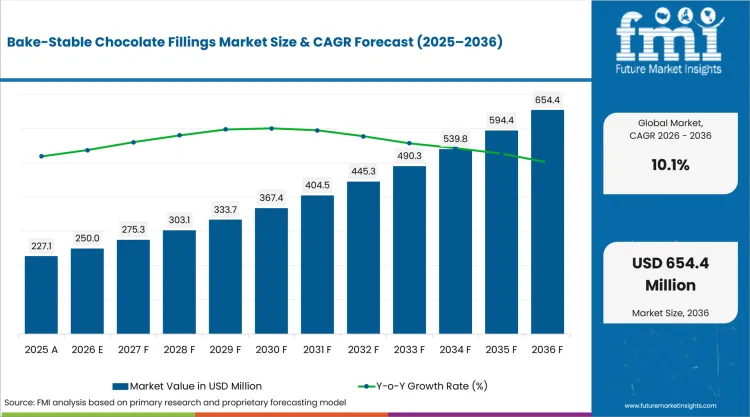
USD 250.0 million in 2026 and USD 654.4 million by 2036 at a 10.1% CAGR.
Sales in the bake-stable chocolate fillings market is projected to expand from USD 250.0 million in 2026 to USD 654.4 million by 2036 at a 10.1% CAGR. Industrial bakers pay for fillings that meter cleanly before baking and keep the chocolate center inside the product during oven expansion. Barry Callebaut opened its third Canadian chocolate factory in November 2025 with production lines for liquid chocolate and industrial molding. The Brantford investment strengthens the manufacturing base serving chocolate inputs used by large bakery customers.
Input economics shape qualification because cocoa and bakery costs can change faster than a customer can reformulate a filled product. Germany’s Federal Statistical Office reported in January 2026 that December 2025 wholesale prices for sugar plus confectionery and bakery products were 12.8% above December 2024. The 12.8% increase makes dosage control more important for European bakery teams reviewing cocoa procurement. USA plants place more weight on allergen documentation, so the same filling specification can face different approval thresholds despite serving comparable baked formats.
Key Takeaways
- Industrial bakeries purchase bake-stable chocolate fillings to protect throughput from leakage or viscosity drift that can interrupt continuous depositing and baking.
- In 2026, dark is expected to lead product type with 39.0% share because cocoa-forward flavor remains recognizable after baking.
- By form, powder - dry is estimated to hold 52.0% in 2026 owing to efficient storage and controlled paste preparation at the bakery.
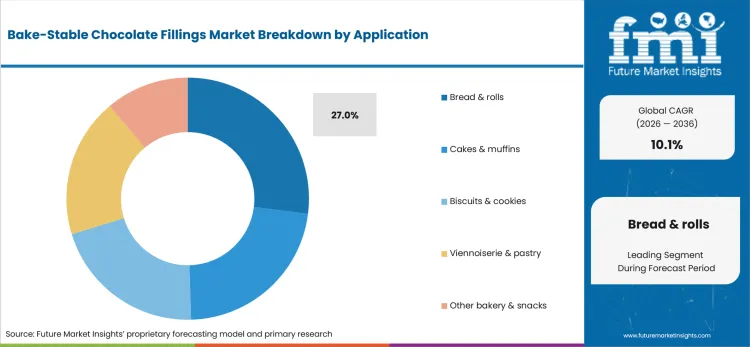
- Bread & rolls is projected to hold 27.0% share in 2026 owing to stable pre-bake dosing in enclosed bakery formats.
- Cocoa-cost volatility and plant-specific trials can delay reformulation since a lower ingredient price has little value if the filling fails the customer’s oven profile.
- Some of the key players in this market include Barry Callebaut, Puratos, Dawn Foods, CSM Ingredients, IRCA Group, Royal Zeelandia Group, Bakels, and AGRANA.
Analyst Perspective
"Industrial bakers qualify bake-stable fillings by depositability and oven retention then compare finished-product economics with unit price. A filling company earns repeat business by proving those conditions on the customer's line without forcing changes to dough handling or oven settings."
- Nandini Roy Choudhury, Principal Consultant, Future Market Insights
How is the Bake-Stable Chocolate Fillings Market segmented?
The bake-stable chocolate fillings market is segmented by product type, form, application, claim, sales channel and region.
The taxonomy covers product type, form, application, claim and sales channel alongside region for analysis. Product type includes dark, milk, white & blond and sugar-free & specialty, whereas form covers powder - dry, liquid, paste / semi-solid and granules / pieces. Applications span bread & rolls, cakes & muffins, biscuits & cookies, viennoiserie & pastry and other bakery & snacks used in industrial and specialist bakery programs. Claim options include conventional, clean label, organic and non-GMO / identity preserved, and sales channels include direct to industrial bakeries, ingredient distributors, foodservice & artisan supply and online B2B.
How does Bread & Rolls lead the Application category?
Filled breads and rolls expose chocolate centers to compression during forming and rapid expansion during baking, so leakage control becomes central to line qualification. The application also ties filling viscosity to dough handling and bread emulsifiers, since one change can alter sealing pressure and final center placement during trials.
- In 2026, bread & rolls is expected to lead the application category with 27.0% share due to stable pre-bake placement in enclosed formats at scale.
- CSM Ingredients launched Creami in May 2026 with cocoa and white-chocolate bake-stable options for bakery teams seeking another documented route to heat-resistant filling performance.
What makes Dark central to the Product type category?
Dark fillings must retain cocoa intensity after oven exposure and remain fluid enough for clean depositing on industrial lines serving several dough systems. IRCA Group introduced the CREME Collection in November 2025 with documented pre-bake options for bakery ingredients designed for stable baking performance in pastry production.
- Based on product type, dark is projected to account for 39.0% in 2026 owing to its recognizable cocoa profile in finished bakery products.
- Industrial trials compare depositor flow during filling with center retention after baking since leakage can erase cocoa intensity and force costly adjustments to equipment settings during qualification.
Why does Powder - dry lead the Form category?
Powder - dry formats reduce transported water and let bakery plants set final viscosity near the depositor without storing several ready-made consistencies during storage. Bakels' June 2025 Worldwide Review documented a powder-blending upgrade in Malaysia that raised capacity and tightened hygiene plus allergen control during dry handling at scale.
- Powder - dry is set to lead the form category with 52.0% share in 2026 due to storage efficiency and controlled hydration.
- Plants already metering flour-side ingredients can adjust water addition for several recipes, and each approved filling specification must define hydration discipline during scale-up.
Why is direct to Industrial bakeries central to the Sales channel category?
Direct selling fits industrial accounts that require equipment trials and formula adjustments until purchase orders settle into a repeat production schedule for each new filling. Those accounts often coordinate fillings with bakery fats and dough systems, so one accountable technical contact becomes useful during plant scale-up for several recipes.
- By sales channel, direct to industrial bakeries is forecast to represent 48.0% in 2026 owing to trial-heavy approval and technical adaptation requirements.
- Puratos opened innovation centers in Montreal and Cartago during August 2025 and expanded its network to 120 centers that support local product-development work.
What are the drivers, restraints and opportunities in the bake-stable chocolate fillings market?
One-pass bakery production supports demand despite cocoa and qualification costs, and tailored texture or claim systems give ingredient companies higher-value projects.
- Driver: Industrial bakeries use pre-bake fillings to place chocolate centers inside differentiated products without introducing a separate post-bake filling stage.
- Restraint: Cocoa and bakery-input volatility raises formulation risk as new recipes must still pass line trials and finished-product cost approval.
- Opportunity: Ingredient companies can win higher-value work by tailoring viscosity, cocoa intensity and claim requirements to a customer’s specific bakery process.
Pre-bake production ties filling demand to line economics
Demand is strongest on bakery lines that deposit the chocolate center into dough and retain it during baking. In February 2025, IRCA Group said its new St. Louis chocolate facility was operating and planned domestic filling and cream production later that year. Domestic output reduces import complexity for USA bakeries that need repeatable pre-bake filling supply during launches and qualification work.
Cocoa and bakery-input costs constrain formulation changes
Cost pressure becomes a restraint once an ingredient saving requires another plant trial or changes the finished product's sensory profile. Barry Callebaut reported in April 2025 that cocoa bean prices rose 95% year over year and higher prices delayed customer orders. Extra trial work can erase a nominal ingredient saving, so bakery manufacturers compare dosage efficiency with specialty fats and cocoa intensity.
Specialty claims justify higher-value qualification work
Claim-led projects pay once the formulation restriction matches a finished product that can justify the added qualification work. IRCA Group presented vegan pastry solutions in April 2025 with vegan hazelnut and pistachio creams suitable for use before baking. Those formats give developers another route to pair multifunctional ingredients with dairy-free programs without treating the claim itself as the product premium.
Which country CAGRs are profiled in the bake-stable chocolate fillings market?
| Country | CAGR |
|---|---|
| Saudi Arabia | 11.0% |
| USA | 10.4% |
| Germany | 10.0% |
| France | 9.7% |
| UK | 9.4% |
How do country-level CAGRs compare in the bake-stable chocolate fillings market?
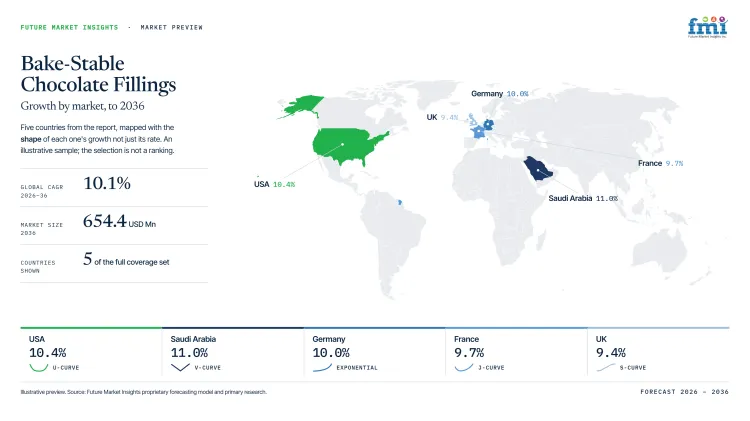
The five profiled markets occupy a narrow 1.3 percentage-point range between UAE at 11.3% and Germany at 10.0% CAGR, with Saudi Arabia close behind overall. UAE and Saudi Arabia form the upper band, and South Korea separates them from closely grouped USA and Germany under distinct qualification costs by country.
- Saudi centralized bakery plants value recipes that scale into retail programs without repeated line adjustments.
- USA national bakery accounts use contracts, making batch economics a stronger filter during ingredient negotiations.
- German high-volume bakery lines place deposit consistency ahead of minor formulation changes during filling trials.
- French bakery companies increasingly use online procurement, prioritizing transparent pricing, reliable supply.
- Japanese bakery companies increasingly use online supplier channels, prioritizing consistent specifications, filling performance.
The full report provides country-level CAGR analysis across North America, Latin America, Europe, East Asia, South Asia, Oceania and the Middle East and Africa.
Country-wise Analysis
- Arabic labeling requirements and formal product controls shape imported filling approval for Saudi bakery manufacturers moving a recipe into regular production at full industrial scale. The General Authority for Statistics documented 12.9% year-over-year growth in food-product manufacturing during September 2025. The increase means local filling companies are serving a faster-expanding factory base during commercial qualification programs nationwide. The Saudi Arabia bake-stable chocolate fillings sector is projected to record 11.0% CAGR during the assessment period, tied to food-manufacturing investment and industrial bakery expansion. Imported cocoa exposure and document review still consume production time even as higher factory output raises demand for faster technical responses during qualification.
- For national retail programs, USA industrial bakeries qualify chocolate fillings beside other USA bakery inputs against allergen controls and multi-site line performance during initial trials. The FDA's January 2025 guidance addresses nine major food allergens. It gives bakery groups a common national reference for recipe changes and ingredient documentation during approval. The USA bake-stable chocolate fillings outlook is anticipated to advance at 10.4% CAGR over the assessment period, aided by large sweet-bakery production networks. Volume converts faster once ingredient companies document formula changes clearly enough to keep depositor settings consistent from one plant to the next during national recipe transfers at scale.
- Elevated ingredient prices have moved dosage efficiency into German filling reviews that once focused more heavily on flavor and oven behavior during recipe changes and seasonal launches. Germany is projected to grow at 10.0% CAGR through 2036, given its dense industrial bakery base and continued demand for cocoa-forward sweet goods. Destatis stated in January 2026 that average 2025 wholesale prices for sugar plus confectionery and bakery products were 14.7% above 2024. Purchasing teams require application specialists to prove lower cocoa loading preserves the intended chocolate profile during industrial trials and production reviews for every reformulated center entering a commercial launch.
- In France, industrial bakery groups are placing greater emphasis on bake-stable chocolate fillings that deliver consistent texture, flavor, and machinability across high-volume production lines. France is projected to grow at 9.7% CAGR through 2036, supported by its established industrial bakery sector and demand for chocolate-based sweet bakery products. Ingredient suppliers increasingly need to demonstrate filling stability, depositor compatibility, and consistent performance during plant-scale trials before new formulations are approved for commercial production.
- In the UK, industrial bakeries are prioritizing formulation efficiency and process consistency as ingredient costs influence recipe-development decisions. The UK is projected to grow at 9.4% CAGR through 2036, supported by demand for convenient and indulgent bakery products. Purchasing and technical teams increasingly require suppliers to demonstrate that bake-stable chocolate fillings maintain the desired chocolate profile, viscosity, and oven performance while supporting consistent processing across commercial bakery lines.
Who are the notable companies in the bake-stable chocolate fillings market?
Barry Callebaut, Puratos, Dawn Foods, CSM Ingredients, IRCA Group, Royal Zeelandia Group, Bakels, and AGRANA are the notable companies serving this market.
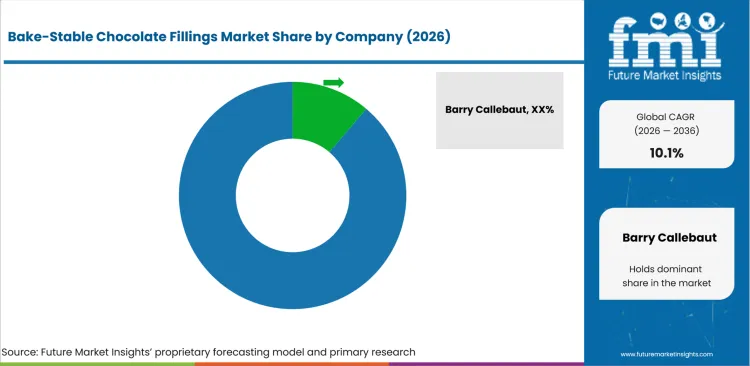
Global chocolate groups compete beside bakery ingredient houses that can support formula design and line trials for the same industrial account. Entry barriers come from oven-performance records and regional application support plus the ability to adjust cake emulsifiers or fat systems without destabilizing the filling.
- Barry Callebaut, Puratos and IRCA Group bring broad chocolate or pastry platforms with technical teams able to support industrial applications in several regions.
- Dawn Foods, CSM Ingredients and Royal Zeelandia Group concentrate on bakery systems that test fillings beside mixes and creams under plant conditions.
- Bakels and AGRANA operate regional production networks that support EU food emulsifiers users and bakery customers needing tailored sweet-goods formulations.
Competitive Benchmarking: Bake-Stable Chocolate Fillings Market
| Company | Pre-bake Filling Breadth | Process Adaptation Support | Claim Flexibility | Geographic Reach |
|---|---|---|---|---|
| Barry Callebaut | High | High | High | Global |
| Puratos | High | High | High | Global |
| Dawn Foods | Medium | High | Medium | North America, Europe, Latin America and AMEAP |
| CSM Ingredients | High | High | High | Europe and international markets |
| IRCA Group | High | High | High | Global |
| Royal Zeelandia Group | Medium | High | Medium | Europe and international markets |
| Bakels | Medium | High | Medium | Global |
| AGRANA | Medium | Medium | High | Europe, Americas, Asia and international sales |
Scoring basis: High pre-bake filling breadth requires documented chocolate or sweet filling routes covering at least three relevant bakery applications. Medium requires two verified routes and Low identifies one documented route that fits the defined market boundary. High process adaptation support requires dedicated test facilities or technical centers plus documented customer application work during trials and scale-up. High claim flexibility requires several documented formulation routes that include allergen and clean-label options plus specialty alternatives. Medium requires two claim routes and Low identifies one verified route within the stated market scope.
Key Developments in the Bake-Stable Chocolate Fillings Market
- In January 2026, Puratos acquired Vör Foods with a USA facility producing clean-label nut pastes and fillings for sweet-goods manufacturers.
- In September 2025, IRCA Group’s Gallarate production site received IFS Food certification covering filling creams and chocolate products under verified manufacturing controls.
- In September 2025, Dawn Foods expanded its Royal Steensma portfolio in North America with premium bakery products including ready-to-use dark chocolate ganache.
Key Players in the Bake-Stable Chocolate Fillings Market
Chocolate and Pastry Platforms
- Barry Callebaut
- Puratos
- IRCA Group
Industrial Bakery Ingredient Systems
- Dawn Foods
- CSM Ingredients
- Royal Zeelandia Group
Regional Formulation and Manufacturing Networks
- Bakels
- AGRANA
Bake-Stable Chocolate Fillings Market - Report Scope
| Coverage field | Report scope |
|---|---|
| Market breakdown | By product type, form, application, claim, sales channel and region. |
| Quantitative Units | USD Million. |
| Market Definition | Commercial chocolate-based fillings formulated to retain intended texture, location and sensory profile through bakery heating processes. |
| Regions Covered | North America, Latin America, Europe, East Asia, South Asia and Pacific and Middle East and Africa. |
| Countries Covered | UAE, Saudi Arabia, South Korea, USA, Germany, and 20+ countries included in the full report. |
| Key Companies Profiled | Barry Callebaut, Puratos, Dawn Foods, CSM Ingredients, IRCA Group, Royal Zeelandia Group, Bakels, AGRANA. |
| Forecast Period | 2026 to 2036. |
| Approach | Primary and secondary research with market triangulation. |
Bake-Stable Chocolate Fillings Market - Research Methodology
| Method | Approach |
|---|---|
| Primary Research | FMI analysts gathered input from manufacturers, service providers, technology developers, distributors, end users, procurement teams, and subject-matter experts. Interviews examined purchasing decisions, product or service evaluation, adoption barriers, approval requirements, pricing considerations, and expectations for technical or commercial support. Respondents were also asked what evidence is required before a trial, pilot, or initial order develops into regular purchasing. |
| Desk Research | Desk research covered government statistics, regulatory publications, trade data, industry associations, technical literature, standards, company filings, product information, and official corporate announcements. Sources were reviewed for relevance, publication date, geographic coverage, and consistency with the defined market scope. Claims relating to performance, applications, approvals, capacity, investment, and commercial activity were retained only when supported by credible public evidence. |
| Market Sizing and Forecasting | The market model combined the baseline value with historical performance, segment structure, pricing and volume indicators, adoption levels, company participation, and country-level demand conditions. Forecast assumptions considered economic activity, investment trends, regulatory developments, technology adoption, purchasing cycles, supply availability, and barriers to wider market use. Segment and regional estimates were reconciled before the final market total was calculated. |
| Data Validation | Estimates were checked against multiple independent indicators, including public data, company activity, trade patterns, industry developments, and findings from primary interviews. Validation also tested whether products, services, applications, and company revenues fell within the defined market boundaries. Adjacent categories, unsupported claims, overlapping revenues, and activities without direct market relevance were excluded to reduce double counting and maintain consistency across segments and countries. |
Bake-Stable Chocolate Fillings Market by Segments
Bake-Stable Chocolate Fillings Market segmented by Product Type:
- Dark
- Milk
- White & blond
- Sugar-free & specialty
Bake-Stable Chocolate Fillings Market segmented by Form:
- Powder - dry
- Liquid
- Paste / semi-solid
- Granules / pieces
Bake-Stable Chocolate Fillings Market segmented by Application:
- Bread & rolls
- Cakes & muffins
- Biscuits & cookies
- Viennoiserie & pastry
- Other bakery & snacks
Bake-Stable Chocolate Fillings Market segmented by Claim:
- Conventional
- Clean label
- Organic
- Non-GMO / identity preserved
Bake-Stable Chocolate Fillings Market segmented by Sales Channel:
- Direct to industrial bakeries
- Ingredient distributors
- Foodservice & artisan supply
- Online B2B
Bake-Stable Chocolate Fillings Market by Region:
- North America
- USA
- Canada
- Mexico
- Latin America
- Brazil
- Chile
- Rest of Latin America
- Western Europe
- Germany
- UK
- Italy
- Spain
- France
- Nordic
- BENELUX
- Rest of Western Europe
- Eastern Europe
- Russia
- Poland
- Hungary
- Balkan & Baltic
- Rest of Eastern Europe
- East Asia
- China
- Japan
- South Korea
- South Asia and Pacific
- India
- ASEAN
- Australia & New Zealand
- Rest of South Asia and Pacific
- Middle East and Africa
- Kingdom of Saudi Arabia
- Other GCC Countries
- Turkiye
- South Africa
- Other African Union
- Rest of Middle East and Africa
Research Sources and Bibliography
- Barry Callebaut. (2025, November 13). Barry Callebaut Opens Third Canadian Chocolate Factory in Brantford, Ontario.
- German Federal Statistical Office. (2026, January 14). Wholesale prices in December 2025: +1.2% on December 2024.
- IRCA Group. (2025, November 17). The CREME Collection.
- Bakels. (2025, June). Bakels Worldwide Review.
- CSM Ingredients. (2026, May 12). CSM Ingredients launches Creami®, a comprehensive range of indulgent fillings for bakery, pastry and confectionery professionals.
- Puratos. (2025, August 25). Puratos Announces Two New Hubs for Food Innovation: Montreal and Costa Rica.
- IRCA Group. (2025, February 18). Crafted in Italy, Produced in the USA.
- Barry Callebaut. (2025, April 10). Barry Callebaut Group - Half-Year Results, Fiscal Year 2024/25.
- IRCA Group. (2025, April 23). Vegan Pastry.
- Ministry of Industry and Advanced Technology. (2026, May 7). Make it in the Emirates concludes largest edition yet.
- General Authority for Statistics. (2025, November 10). Industrial Production Index - September 2025.
- Statistics Korea. (2025, June 30). Monthly Industrial Statistics, May 2025.
- USA Food and Drug Administration. (2025, January). Guidance for Industry: Questions and Answers Regarding Food Allergen Labeling (Edition 5).
- Puratos. (2026, January 21). Puratos acquires Vör Foods, accelerating USA nut-based innovation.
- Dawn Foods. (2025, September 15). Dawn Foods Expands Royal Steensma Product Line in North America With Four New Premium, Easy-to-use Products.
- Barry Callebaut. (2026, February 5). Barry Callebaut reinforces commitment to Wieze with detailed investment plan.
- Puratos. (2026, February 24). Puratos Launches World’s First Professional Chocolate with Cultured Cocoa.
- Puratos. (2026, March 10). Puratos to Acquire Dawn Foods, Bringing Together Complementary Capabilities in Professional Bakery.
- CSM Ingredients. (2025, November 18). CSM Ingredients - a Nexture company - opens new £3m state-of-the-art customer focused product development centre in the UK.
- IRCA Group. (2026, June 29). CVC Capital Partners agrees to acquire Irca from Advent.
- IRCA Group. (2025, September 24). IFS Food certification for IRCA SPA.
- AGRANA Beteiligungs-AG. (2026, May). Annual Report 2025|26.
- CSM Ingredients. (2025, November 13). CSM Ingredients Group launches Nuaré, a range of cocoa alternatives which opens new creative possibilities in bakery and ice cream.
- Puratos. (2026, June 15). Puratos Opens Flour Competence Center to Address Flour Variability.
- Barry Callebaut. (2026, February 10). Barry Callebaut Opens Global Innovation Center in Singapore, Pioneering the Future of Chocolate Through AI and Advanced Innovation.
- Barry Callebaut. (2025, November 5). Barry Callebaut and Planet A Foods Partner to Pioneer Sustainable Chocolate Alternatives Without Cocoa.
- Puratos. (2025, April 30). Puratos has opened its brand-new Innovation Center in Budapest (Hungary).
- Cargill. (2025, March 4). Cargill Showcases Full Range of Innovative Food Solutions at AAHAR 2025.
This bibliography is provided for reader reference and is not exhaustive. The full report contains the complete reference list and detailed citations.
This Report Answers
- How large is the bake-stable chocolate fillings market in 2026 and 2036?
- Which production conditions make oven-stable chocolate fillings valuable to industrial bakeries?
- Why does dark hold the largest product-type share in 2026?
- Why does powder - dry hold the largest form share in 2026?
- How does the bread & rolls application shape filling qualification requirements?
- Which five countries show the strongest profiled growth through 2036?
- What limits supplier switching as cocoa and bakery-input prices change?
- Which companies compete through chocolate expertise, bakery systems and regional application support?
- How are companies compared on pre-bake filling breadth, process adaptation support and claim flexibility?
Frequently Asked Questions
How big is the bake-stable chocolate fillings market in 2026?
The bake-stable chocolate fillings market is valued at USD 250.0 million in 2026 and is projected to reach USD 654.4 million by 2036. Growth is supported by industrial bakery lines that require chocolate centers to survive oven exposure without disrupting throughput.
What is the CAGR of the bake-stable chocolate fillings market from 2026 to 2036?
The bake-stable chocolate fillings market is projected to grow at a CAGR of 10.1% between 2026 and 2036. Expansion is supported by filled bakery launches and plant-level demand for predictable viscosity, leakage control and repeatable dosing.
Which product type leads the bake-stable chocolate fillings market?
The dark segment is expected to hold 39.0% of the bake-stable chocolate fillings market in 2026, attributable to its recognizable cocoa profile at oven exit. Industrial bakers still require line trials that confirm leakage control and stable depositing as part of routine production approval.
Which countries are projected to record the highest growth in the bake-stable chocolate fillings market?
UAE is projected to grow at 11.3% CAGR, followed by Saudi Arabia at 11.0% and South Korea at 10.7% through 2036. Growth is supported by expanding food manufacturing and bakery investment even as documentation and imported ingredient logistics differ by country.
Which companies are active in the bake-stable chocolate fillings market?
Key companies operating in the bake-stable chocolate fillings market include Barry Callebaut, Puratos, Dawn Foods, CSM Ingredients, IRCA Group, Royal Zeelandia Group, Bakels, and AGRANA. These companies compete through chocolate expertise and bakery application support with different strengths in formulation breadth and regional manufacturing coverage.
Preview the report firsthand - request a free sample
Get SampleGet the brochure for pricing and purchase details.
Get PDFTable of Content
- Key Takeaways
- Market Size and CAGR
- Top Growth Driver
- Fastest Growing Segment
- Leading Region
- Key Companies
- Emerging Opportunities
- Executive Summary
- Global Market Outlook
- Demand-side Trends
- Supply-side Trends
- Technology Roadmap Analysis
- Analysis and Recommendations
- Analyst Perspective (What is happening? Why now? What should investors know?)
- Key Questions Answered
- How large is the market?
- What is the CAGR?
- What are key trends?
- Which region dominates?
- Who are the leaders?
- Market Overview
- Market Coverage / Taxonomy
- Market Definition / Scope / Limitations
- Research Methodology
- Chapter Orientation
- Analytical Lens and Working Hypotheses
- Market Structure, Signals, and Trend Drivers
- Benchmarking and Cross-market Comparability
- Market Sizing, Forecasting, and Opportunity Mapping
- Research Design and Evidence Framework
- Desk Research Programme (Secondary Evidence)
- Expert Input and Fieldwork (Primary Evidence)
- Tooling, Models, and Reference Databases
- Data Engineering and Model Build
- Quality Assurance and Audit Trail
- Market Background
- Market Dynamics (Drivers, Restraints, Opportunity, Trends)
- Scenario Forecast (Optimistic, Likely, Conservative)
- Impact Analysis
- AI Impact
- Sustainability Impact
- Regulatory Impact
- Technology Impact
- Consumer / Buyer Analysis
- Purchase Drivers
- Adoption Barriers
- Buyer Journey
- Opportunity Map Analysis
- Product Life Cycle Analysis
- Supply Chain Analysis
- Investment Feasibility Matrix
- Value Chain Analysis
- PESTLE and Porter's Analysis
- Regulatory Landscape
- Regional Parent Market Outlook
- Production and Consumption Statistics
- Import and Export Statistics
- Global Market Analysis and Forecast, 2021 to 2036
- Historical Market Size Value (USD Million) Analysis, 2021 to 2025
- Current and Future Market Size Value (USD Million) Projections, 2026 to 2036
- Y-o-Y Growth Trend Analysis
- Absolute $ Opportunity Analysis
- Global Market Pricing Analysis, 2021 to 2036
- Global Market Analysis and Forecast, By Product Type, 2021 to 2036
- Introduction / Key Findings
- Historical Market Size Value (USD Million) Analysis By Product Type, 2021 to 2025
- Current and Future Market Size Value (USD Million) Analysis and Forecast By Product Type, 2026 to 2036
- Dark
- Milk
- White & blond
- Sugar-free & specialty
- Dark
- Y-o-Y Growth Trend Analysis By Product Type, 2021 to 2025
- Absolute $ Opportunity Analysis By Product Type, 2026 to 2036
- Global Market Analysis and Forecast, By Form, 2021 to 2036
- Introduction / Key Findings
- Historical Market Size Value (USD Million) Analysis By Form, 2021 to 2025
- Current and Future Market Size Value (USD Million) Analysis and Forecast By Form, 2026 to 2036
- Powder / dry
- Liquid
- Paste / semi-solid
- Granules / pieces
- Powder / dry
- Y-o-Y Growth Trend Analysis By Form, 2021 to 2025
- Absolute $ Opportunity Analysis By Form, 2026 to 2036
- Global Market Analysis and Forecast, By Application, 2021 to 2036
- Introduction / Key Findings
- Historical Market Size Value (USD Million) Analysis By Application, 2021 to 2025
- Current and Future Market Size Value (USD Million) Analysis and Forecast By Application, 2026 to 2036
- Bread & rolls
- Cakes & muffins
- Biscuits & cookies
- Viennoiserie & pastry
- Other bakery & snacks
- Bread & rolls
- Y-o-Y Growth Trend Analysis By Application, 2021 to 2025
- Absolute $ Opportunity Analysis By Application, 2026 to 2036
- Global Market Analysis and Forecast, By Claim, 2021 to 2036
- Introduction / Key Findings
- Historical Market Size Value (USD Million) Analysis By Claim, 2021 to 2025
- Current and Future Market Size Value (USD Million) Analysis and Forecast By Claim, 2026 to 2036
- Conventional
- Clean label
- Organic
- Non-GMO / identity preserved
- Conventional
- Y-o-Y Growth Trend Analysis By Claim, 2021 to 2025
- Absolute $ Opportunity Analysis By Claim, 2026 to 2036
- Global Market Analysis and Forecast, By Sales Channel, 2021 to 2036
- Introduction / Key Findings
- Historical Market Size Value (USD Million) Analysis By Sales Channel, 2021 to 2025
- Current and Future Market Size Value (USD Million) Analysis and Forecast By Sales Channel, 2026 to 2036
- Direct to industrial bakeries
- Ingredient distributors
- Foodservice & artisan supply
- Online B2B
- Direct to industrial bakeries
- Y-o-Y Growth Trend Analysis By Sales Channel, 2021 to 2025
- Absolute $ Opportunity Analysis By Sales Channel, 2026 to 2036
- Global Market Analysis and Forecast, By Region, 2021 to 2036
- Introduction
- Historical Market Size Value (USD Million) Analysis By Region, 2021 to 2025
- Current Market Size Value (USD Million) Analysis and Forecast By Region, 2026 to 2036
- North America
- Latin America
- Western Europe
- Eastern Europe
- East Asia
- South Asia and Pacific
- Middle East & Africa
- Market Attractiveness Analysis By Region
- North America Market Analysis and Forecast, By Country, 2021 to 2036
- Historical Market Size Value (USD Million) Trend Analysis By Market Taxonomy, 2021 to 2025
- Market Size Value (USD Million) Forecast By Market Taxonomy, 2026 to 2036
- By Country
- USA
- Canada
- By Product Type
- By Form
- By Application
- By Claim
- By Sales Channel
- By Country
- Market Attractiveness Analysis
- By Country
- By Product Type
- By Form
- By Application
- By Claim
- By Sales Channel
- Key Takeaways
- Latin America Market Analysis and Forecast, By Country
- Historical Market Size Value (USD Million) Trend Analysis By Market Taxonomy, 2021 to 2025
- Market Size Value (USD Million) Forecast By Market Taxonomy, 2026 to 2036
- By Country
- Brazil
- Mexico
- Chile
- Rest of Latin America
- By Product Type
- By Form
- By Application
- By Claim
- By Sales Channel
- By Country
- Market Attractiveness Analysis
- By Country
- By Product Type
- By Form
- By Application
- By Claim
- By Sales Channel
- Key Takeaways
- Western Europe Market Analysis and Forecast, By Country
- Historical Market Size Value (USD Million) Trend Analysis By Market Taxonomy, 2021 to 2025
- Market Size Value (USD Million) Forecast By Market Taxonomy, 2026 to 2036
- By Country
- Germany
- UK
- Italy
- Spain
- France
- Nordic
- BENELUX
- Rest of Western Europe
- By Product Type
- By Form
- By Application
- By Claim
- By Sales Channel
- By Country
- Market Attractiveness Analysis
- By Country
- By Product Type
- By Form
- By Application
- By Claim
- By Sales Channel
- Key Takeaways
- Eastern Europe Market Analysis and Forecast, By Country
- Historical Market Size Value (USD Million) Trend Analysis By Market Taxonomy, 2021 to 2025
- Market Size Value (USD Million) Forecast By Market Taxonomy, 2026 to 2036
- By Country
- Russia
- Poland
- Hungary
- Balkan & Baltic
- Rest of Eastern Europe
- By Product Type
- By Form
- By Application
- By Claim
- By Sales Channel
- By Country
- Market Attractiveness Analysis
- By Country
- By Product Type
- By Form
- By Application
- By Claim
- By Sales Channel
- Key Takeaways
- East Asia Market Analysis and Forecast, By Country
- Historical Market Size Value (USD Million) Trend Analysis By Market Taxonomy, 2021 to 2025
- Market Size Value (USD Million) Forecast By Market Taxonomy, 2026 to 2036
- By Country
- China
- Japan
- South Korea
- By Product Type
- By Form
- By Application
- By Claim
- By Sales Channel
- By Country
- Market Attractiveness Analysis
- By Country
- By Product Type
- By Form
- By Application
- By Claim
- By Sales Channel
- Key Takeaways
- South Asia and Pacific Market Analysis and Forecast, By Country
- Historical Market Size Value (USD Million) Trend Analysis By Market Taxonomy, 2021 to 2025
- Market Size Value (USD Million) Forecast By Market Taxonomy, 2026 to 2036
- By Country
- India
- ASEAN
- Australia & New Zealand
- Rest of South Asia and Pacific
- By Product Type
- By Form
- By Application
- By Claim
- By Sales Channel
- By Country
- Market Attractiveness Analysis
- By Country
- By Product Type
- By Form
- By Application
- By Claim
- By Sales Channel
- Key Takeaways
- Middle East & Africa Market Analysis and Forecast, By Country
- Historical Market Size Value (USD Million) Trend Analysis By Market Taxonomy, 2021 to 2025
- Market Size Value (USD Million) Forecast By Market Taxonomy, 2026 to 2036
- By Country
- Kingdom of Saudi Arabia
- Other GCC Countries
- Türkiye
- South Africa
- Other African Union
- Rest of Middle East & Africa
- By Product Type
- By Form
- By Application
- By Claim
- By Sales Channel
- By Country
- Market Attractiveness Analysis
- By Country
- By Product Type
- By Form
- By Application
- By Claim
- By Sales Channel
- Key Takeaways
- Key Countries Market Analysis
- USA
- Pricing Analysis
- Market Share Analysis, 2025
- By Product Type
- By Form
- By Application
- By Claim
- By Sales Channel
- Canada
- Pricing Analysis
- Market Share Analysis, 2025
- By Product Type
- By Form
- By Application
- By Claim
- By Sales Channel
- Mexico
- Pricing Analysis
- Market Share Analysis, 2025
- By Product Type
- By Form
- By Application
- By Claim
- By Sales Channel
- Brazil
- Pricing Analysis
- Market Share Analysis, 2025
- By Product Type
- By Form
- By Application
- By Claim
- By Sales Channel
- Chile
- Pricing Analysis
- Market Share Analysis, 2025
- By Product Type
- By Form
- By Application
- By Claim
- By Sales Channel
- Germany
- Pricing Analysis
- Market Share Analysis, 2025
- By Product Type
- By Form
- By Application
- By Claim
- By Sales Channel
- UK
- Pricing Analysis
- Market Share Analysis, 2025
- By Product Type
- By Form
- By Application
- By Claim
- By Sales Channel
- Italy
- Pricing Analysis
- Market Share Analysis, 2025
- By Product Type
- By Form
- By Application
- By Claim
- By Sales Channel
- Spain
- Pricing Analysis
- Market Share Analysis, 2025
- By Product Type
- By Form
- By Application
- By Claim
- By Sales Channel
- France
- Pricing Analysis
- Market Share Analysis, 2025
- By Product Type
- By Form
- By Application
- By Claim
- By Sales Channel
- India
- Pricing Analysis
- Market Share Analysis, 2025
- By Product Type
- By Form
- By Application
- By Claim
- By Sales Channel
- ASEAN
- Pricing Analysis
- Market Share Analysis, 2025
- By Product Type
- By Form
- By Application
- By Claim
- By Sales Channel
- Australia & New Zealand
- Pricing Analysis
- Market Share Analysis, 2025
- By Product Type
- By Form
- By Application
- By Claim
- By Sales Channel
- China
- Pricing Analysis
- Market Share Analysis, 2025
- By Product Type
- By Form
- By Application
- By Claim
- By Sales Channel
- Japan
- Pricing Analysis
- Market Share Analysis, 2025
- By Product Type
- By Form
- By Application
- By Claim
- By Sales Channel
- South Korea
- Pricing Analysis
- Market Share Analysis, 2025
- By Product Type
- By Form
- By Application
- By Claim
- By Sales Channel
- Russia
- Pricing Analysis
- Market Share Analysis, 2025
- By Product Type
- By Form
- By Application
- By Claim
- By Sales Channel
- Poland
- Pricing Analysis
- Market Share Analysis, 2025
- By Product Type
- By Form
- By Application
- By Claim
- By Sales Channel
- Hungary
- Pricing Analysis
- Market Share Analysis, 2025
- By Product Type
- By Form
- By Application
- By Claim
- By Sales Channel
- Kingdom of Saudi Arabia
- Pricing Analysis
- Market Share Analysis, 2025
- By Product Type
- By Form
- By Application
- By Claim
- By Sales Channel
- Türkiye
- Pricing Analysis
- Market Share Analysis, 2025
- By Product Type
- By Form
- By Application
- By Claim
- By Sales Channel
- South Africa
- Pricing Analysis
- Market Share Analysis, 2025
- By Product Type
- By Form
- By Application
- By Claim
- By Sales Channel
- USA
- Market Structure Analysis
- Competition Dashboard
- Competition Benchmarking
- Market Share Analysis of Top Players
- By Regional
- By Product Type
- By Form
- By Application
- By Claim
- By Sales Channel
- Emerging Startups
- Innovation Benchmarking
- Competition Analysis
- Competition Deep Dive
- Barry Callebaut
- Overview
- Product Portfolio
- Profitability by Market Segments
- Sales Footprint
- Strategy Overview
- Marketing Strategy
- Product Strategy
- Channel Strategy
- Puratos
- Dawn Foods
- Zeelandia
- CSM Ingredients
- Bakels
- AGRANA
- Zentis
- Fabbri 1905
- Irca Group
- Barry Callebaut
- Case Studies
- Success Stories
- Recent Developments
- Competition Deep Dive
- Assumptions & Acronyms Used


