

- Market Size (2026)
- USD 289.2 Mn
- Forecast (2036)
- USD 678.4 Mn
- CAGR (2026 to 2036)
- 8.9%
How big is Sugar & Chocolate Decorations Market in 2026?
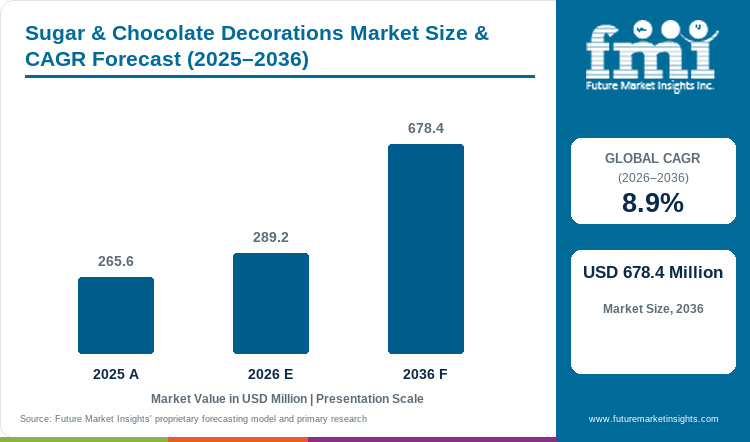
USD 289.2 million in 2026 and USD 678.4 million by 2036, expanding at 8.9% CAGR.
Demand for sugar & chocolate decorations is projected to expand at 8.9% CAGR between 2026 and 2036, growing from USD 265.6 million in 2025 to USD 289.2 million in 2026, and escalating to USD 678.4 million by 2036. Industrial bakeries buy decorative systems that repeat a finish without changing the underlying dough or cake process. Dawn Foods’ September 2025 expansion of its Royal Steensma glaze and ganache range for bakery and foodservice operators illustrates how easy-to-apply bakery ingredients help producers create consistent finishes and differentiate products by flavor.
Country conversion conditions differ because regulation and input economics change qualification work before repeat orders begin. The United States Food and Drug Administration revoked authorization for FD&C Red No. 3 in January 2025 and gave manufacturers until January 15, 2027 to reformulate. German buyers face a different pressure because cocoa-linked costs can reset faster than finished-product prices. Documentation and cost-in-use become central to supplier selection even where forecast growth remains similar.
Key Takeaways
- Industrial bakeries buy decorations when one finishing system repeats differentiation without changing existing recipes.
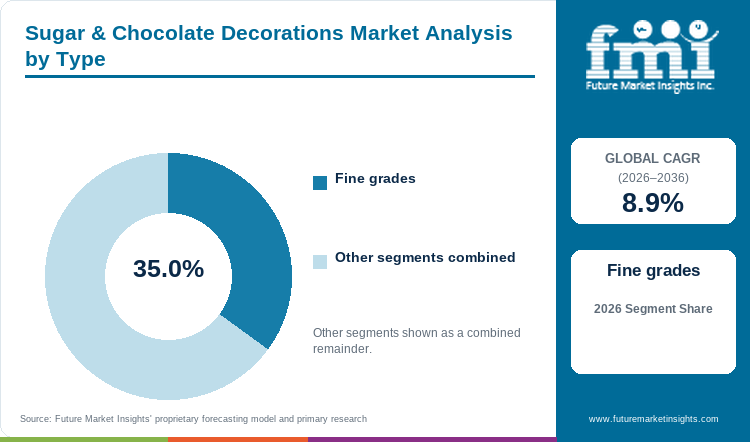
- Fine grades hold 35.0% of type demand in 2026 because controlled particles simplify coverage.
- Powder - dry formats hold 44.0% of form demand in 2026 because metering suits bakery lines.
- Bread & rolls hold 27.0% of application demand in 2026 because frequent runs repeat finishing.
- Cocoa-cost volatility and color-rule changes extend trials because replacements must preserve appearance and cost.
- Some of the key players in this market include Barry Callebaut, Puratos, Dawn Foods, Zeelandia, CSM Ingredients, Bakels, AGRANA, Zentis, Fabbri 1905, and Irca Group.
Analyst Perspective
“Industrial bakers value decorations that reproduce finishes at line speed without repeated recipe changes. Suppliers retain accounts when color documentation and application support shorten qualification before regular purchasing.”
- Nandini Roy Choudhury, Principal Consultant, Future Market Insights
How is the sugar & chocolate decorations market segmented?
The market is segmented by type, form, application, claim, sales channel, and region.
Type covers fine grades, coarse & decorative products, organic grades, and blends while form includes powder - dry, liquid, paste - semi-solid, and granules - pieces. Application includes bread & rolls, cakes & muffins, biscuits & cookies, viennoiserie & pastry, and other bakery & snacks. Claim covers conventional, clean label, organic, and non-GMO - identity preserved while sales channel includes direct bakeries, distributors, foodservice & artisan supply, and online B2B.
How do fine grades shape demand within the type category?
Industrial bakers use fine particles when surface coverage must remain even without creating a visually heavy finish across repeated production runs. Their predictable flow during dusting and controlled sweet finishing allows bakery processing equipment to apply decorations consistently at line speed.
- Based on type, fine grades are projected to account for 35.0% in 2026, as controlled particle size supports even coverage and simpler dosing across repeated production runs.
- Fine particles reduce surface variation during line trials where industrial bakers require repeatable visual coverage.
What operating condition supports powder - dry demand within the form category?
Powder - dry decorations fit bakeries needing ambient storage and frequent changeovers without pumps or heated transfer systems. Operators meter these formats into dusting or sprinkling steps with limited cleaning between production changes. CSM Ingredients launched Tiger Granulat in March 2026 for artisanal and industrial bakery use, reflecting demand for industrial bakery mixes that simplify handling during scheduled production runs.
- By form, powder - dry formats are estimated to hold 44.0% in 2026, supported by ambient storage and straightforward metering during frequent bakery production runs.
- Dry formats reduce transfer-equipment requirements where bakery lines use loose dusting or sprinkling finishes repeatedly.
What supports bread & rolls within the application category?
Bread and roll lines repeat finishing steps because decoration can change appearance without altering the underlying dough system. Bakeries can refresh seasonal SKUs with a smaller production change than full recipe replacement during routine high-volume scheduling, while bakery enzymes must likewise be qualified for consistent behavior before routine line use.
- In 2026, bread & rolls are expected to lead the application category with 27.0% share, as frequent production runs create recurring requirements for dusting, topping, and other surface finishes.
- Bread lines create recurring dusting and topping occasions without requiring a separate base recipe for each finish.
How does conventional formulation influence selection within the claim category?
Conventional formulations give bakery teams wider color and texture choices without organic or identity-preserved sourcing restrictions during commercial trials. The FDA decision on FD&C Red No. 3 shows that permitted color systems can still change, prompting manufacturers to evaluate decoration recipes alongside food colors that can preserve the intended appearance during commercial reformulation.
- By claim, conventional formulations are forecast to represent 45.0% in 2026, as wider ingredient choices allow bakery teams to qualify colors and textures without organic or identity-preserved sourcing restrictions.
- Clean-label and organic claims narrow ingredient choices and can lengthen reformulation work for bakery application teams.
Why do industrial bakeries use direct supply for decorated products?
Large bakeries use direct suppliers when a decoration must match line speed or finished-product specifications during repeated runs. Application teams can adjust color strength or particle behavior before recurring volume is committed, particularly when decorative systems are applied to chocolate products or other temperature-sensitive finishes during enrobing and cooling.
- Direct to industrial bakeries is set to lead the sales-channel category with 52.0% share in 2026, because coordinated technical support helps suppliers match decorations to plant specifications and line-speed requirements.
- Direct programs suit repeated trials where plant teams need stable specifications and faster technical feedback from ingredient suppliers.
What are the drivers, restraints and opportunities in the Sugar & Chocolate Decorations Market?
Repeatable finishing expands industrial use while cocoa and color changes lengthen qualification for cleaner-label supplier offers.
- Driver: Industrial bakeries use repeatable finishes to vary visible SKUs without rebuilding current production recipes or line settings.
- Restraint: Cocoa-cost volatility and color-rule changes raise reformulation expense before a new decoration reaches regular purchasing volumes.
- Opportunity: Cleaner-label decoration systems gain orders where suppliers preserve visual performance and document ingredient identity during industrial trials.
Repeatable finishing expands purchases because industrial bakeries can create several visual SKUs from one stable production base. Decoration changes require less disruption than replacing a full dough or cake formulation on current lines. Bakery teams can refresh seasonal products without rebuilding upstream process settings or retraining operators for every variant.
Input volatility can delay decoration approval even when a concept meets the visual brief. Destatis reported in February 2025 that German import prices for cocoa plus chocolate and sugar confectionery were 70.7% higher year-on-year in January. A bakery facing that reset must compare dosing yield and scrap before accepting a richer chocolate finish. Color-rule changes can require another formulation trial on the production line before commercial release. Buyers may retest appearance and shelf behavior before approving a replacement for bakery production. Cost sensitivity enters qualification before commercial volumes and favors decorative systems with predictable application rates.
Cleaner-label decoration becomes useful only when a replacement performs reliably on existing bakery equipment. The FDA color decision increased attention to alternative color systems used in United States foods. Suppliers can pair natural pigments with documented heat and storage behavior before changing a visible finish. Bakery teams need evidence that replacements survive mixing and distribution without shifting the intended product appearance, so broader clean-label ingredients programs must combine simpler declarations with reliable performance throughout production and distribution.
Which country CAGRs are profiled in the Sugar & Chocolate Decorations Market?
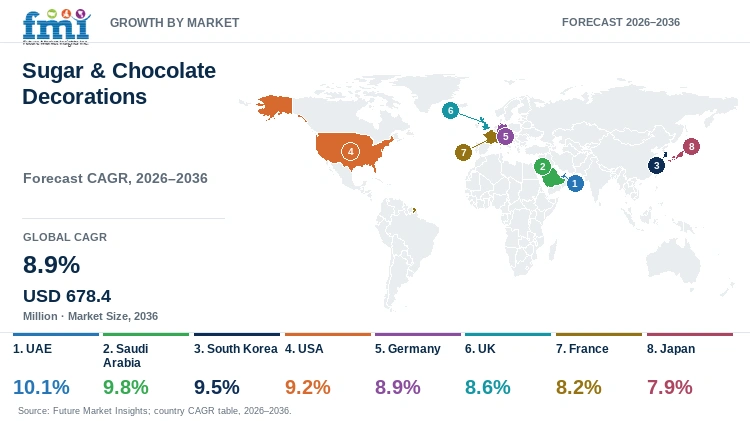
| Country | CAGR |
|---|---|
| UAE | 10.1% |
| Saudi Arabia | 9.8% |
| South Korea | 9.5% |
| USA | 9.2% |
| Germany | 8.9% |
| UK | 8.6% |
| France | 8.2% |
| Japan | 7.9% |
How do country-level CAGRs compare in the Sugar & Chocolate Decorations Market?
The country range spans 2.2 percentage points from UAE at 10.1% to Japan at 7.9%. Hospitality capacity shapes the upper Gulf forecasts while South Korea and USA face reformulation work that changes technical-support needs. European forecasts carry cost and nutrition-policy pressure even where commercial bakery purchasing remains stable.
- Hotel and restaurant expansion broadens UAE accounts purchasing decorative toppings for frequently refreshed menus.
- New hospitality facilities increase Saudi kitchens requiring repeatable bakery presentation and reliable stocking.
- Nutrition-label rules make sugar contribution a formulation issue for South Korean bakery chains and confectioners.
- Color reformulation deadlines make USA technical support important for decorative finishes that must retain identity.
- Cocoa-linked import inflation keeps finished-unit economics central to German chocolate-decoration qualification and dosing decisions.
- Advertising restrictions increase UK pressure to balance visible bakery indulgence with nutrition-focused reformulation decisions.
- Different channel price resets can delay French food processors from recovering higher decoration costs.
- Food-additive use standards make Japanese documentation important before new decorative colors enter production.
Comparable CAGRs can produce different account economics because qualification work and input exposure differ by country. The full report provides country-level CAGR analysis across North America, Latin America, Western Europe, Eastern Europe, East Asia, South Asia and Pacific, and the Middle East and Africa.
Country-wise Analysis
- UAE hotels and restaurants make bakery presentation a repeat foodservice requirement for visitor volumes. The sugar & chocolate decorations outlook is projected to expand at 10.1% CAGR through 2036 as hospitality capacity broadens the buyer base. The UAE Ministry of Economy and Tourism reported 32.34 million hotel guests for 2025 nationwide. Imported decorative formats can lose commercial value when menu changes outrun replenishment lead times, while compliance with food additives rules remains essential before routine stocking decisions. Local distributors favor versatile finishes that work in hotel pastry and professional bakery workflows.
- Saudi hospitality expansion is increasing commercial foodservice kitchens that purchase bakery finishing products on a repeat schedule. Demand is forecast to grow at 9.8% CAGR from 2026 to 2036 because licensed facilities expand the buyer base. GASTAT reported 5,622 licensed tourism hospitality facilities in the third quarter of 2025 with 40.6% year-over-year growth. The commercial constraint is service consistency across a national buyer network adding locations quickly. Suppliers need dependable distributor stocks and application support that lets hotel pastry teams reproduce the same finish at different sites.
- South Korean bakery and confectionery chains operate under nutrition-label rules that make sugar contribution visible at SKU level. The market is anticipated to record 9.5% CAGR through 2036 as chains rotate products under those requirements. MFDS amended food labeling standards in April 2025 to cover breads and chocolates with sugar among mandatory nutrients. When seasonal products are reformulated, natural colors must preserve the intended appearance while supporting the revised ingredient profile. Decoration suppliers need formulation data that lets chain customers compare visual impact with the declared nutrient effect before scaling a seasonal item.
- USA industrial bakeries qualify decorations against line performance and finished-product identity before replacing existing color systems commercially. Demand is projected to expand at 9.2% CAGR between 2026 and 2036 as reformulation increases technical evaluation. In January 2025 the FDA revoked authorization for FD&C Red No. 3 in food and set January 15, 2027 as the manufacturer deadline. A replacement must preserve appearance during processing and shelf life without complicating ingredient declarations. Suppliers providing application trials and compliant alternatives can shorten the path from reformulation brief to regular orders.
- German bakery buyers give significant weight to dosing economics when cocoa-linked inputs move sharply. Sales are forecast to grow at 8.9% CAGR through 2036 with cost control shaping qualification decisions. Destatis reported import prices for cocoa, chocolate, and sugar confectionery were 70.7% higher year over year in January 2025. The increase does not remove demand for chocolate decoration but changes how buyers compare coating weight and waste. Suppliers can protect account economics by proving the intended visual result at lower dosing levels and limiting avoidable production loss during changeovers.
- UK bakeries evaluate decoration beside nutrition and promotion rules for commercial cakes and biscuits. The market is expected to advance at 8.6% CAGR from 2026 to 2036 as suppliers adapt finishing systems to reformulated products. Government guidance published in June 2025 confirmed less-healthy-food advertising restrictions would apply from January 5, 2026 and include cakes and biscuits. Heavy sweet finishing can conflict with a product team’s reformulation target even when visual differentiation remains valuable. Suppliers can respond with portion-efficient decoration and lower-sugar formats that still produce a shelf-facing finish.
- French food processors serve customer groups that pass agricultural cost changes at different speeds. Demand is predicted to expand at 8.2% CAGR through 2036 as industrial and distributor channels manage those resets. INSEE reported in July 2026 that agricultural input cost increases passed through more slowly to distributors than other French food-processing clients. Decoration suppliers face a margin timing issue when cocoa or sugar costs rise before customers accept revised prices. Direct technical relationships and waste-reducing packs can protect finished-unit economics during longer reset cycles and preserve customer margins.
- Japanese bakery buyers work within additive standards that make documentation part of decoration qualification. The market is set to post 7.9% CAGR through 2036 with compliance review limiting conversion of unfamiliar colors. Japan’s Consumer Affairs Agency updated English materials for the 10th edition of its food-additive specifications in February 2025 and maintains use standards for target foods. Suppliers must confirm permitted uses before a new decorative color enters a commercial recipe. Clear Japanese-language guidance can reduce repeated review and make industrial trials easier to convert into routine purchasing.
Who are the notable companies in the Sugar & Chocolate Decorations Market?
Barry Callebaut, Puratos, Dawn Foods, Zeelandia, CSM Ingredients, Bakels, AGRANA, Zentis, Fabbri 1905, and Irca Group are notable companies serving this market.
Chocolate-decoration platforms compete beside bakery-finishing specialists and topping suppliers serving professional industrial bakery accounts. Buyers test each finish under local ingredient rules before approving repeat commercial production-scale deliveries. Application teams defend accounts by solving line behavior during reformulation instead of competing on ingredient price.
- Barry Callebaut plus Puratos and Irca Group supply chocolate-centered finishing routes to professional bakery customers.
- Dawn Foods plus Zeelandia, CSM Ingredients and Bakels serve bakery production with coatings and application support.
- AGRANA plus Zentis and Fabbri 1905 supply fruit preparations, toppings and specialist decorative formats.
Competitive Benchmarking: Sugar & Chocolate Decorations Market
| Company | Decoration Breadth | Production-Scale Fit | Formulation Support | Geographic Reach |
|---|---|---|---|---|
| Barry Callebaut | High | High | High | Global multi-region network |
| Puratos | High | High | High | Global bakery and patisserie network |
| Dawn Foods | Medium | High | High | North America, Europe, and selected international markets |
| Zeelandia | Medium | High | High | Europe-centered network with worldwide bakery activity |
| CSM Ingredients | High | High | Medium | Europe-centered with international ingredient reach |
| Bakels | Medium | High | High | Multi-region group network |
| AGRANA | Medium | Medium | High | Global food-ingredient network |
| Zentis | Medium | Medium | Medium | Europe and North America with international industrial sales |
| Fabbri 1905 | Medium | Medium | Medium | Europe-led professional channel with international distribution |
| Irca Group | High | High | High | Global network serving professional bakery markets |
Scoring basis: High decoration breadth requires several documented families and Medium represents narrower exact-market coverage. High production-scale fit requires industrial formats plus application support and formulation support reflects documented customization routes.
Key Developments in the Sugar & Chocolate Decorations Market
- In May 2026, Irca Group reported Dobla Asia earned BRC A+ certification at its Vietnam decoration plant.
- In March 2026, CSM Ingredients launched Tiger Granulat as powdered decoration for artisanal and industrial bakeries.
- In September 2025, Dawn Foods expanded Royal Steensma in North America with glazes and chocolate ganache.
Key Players in the Sugar & Chocolate Decorations Market
Chocolate Decoration and Specialty Platforms
- Barry Callebaut
- Puratos
- Irca Group
Bakery Finishing and Industrial Application Systems
- Dawn Foods
- Zeelandia
- CSM Ingredients
- Bakels
Specialist Toppings and Decorative Ingredients
- AGRANA
- Zentis
- Fabbri 1905
Sugar & Chocolate Decorations Market - Report Scope
| Coverage field | Report scope |
|---|---|
| Market breakdown | By type, form, application, claim, sales channel, and region. |
| Quantitative Units | USD million. |
| Market Definition | Commercial edible sugar- or chocolate-based decoration ingredients sold for visible finishing in bakery, pastry, confectionery, and professional foodservice applications. |
| Regions Covered | North America, Latin America, Western Europe, Eastern Europe, East Asia, South Asia and Pacific, and Middle East and Africa. |
| Countries Covered | UAE, Saudi Arabia, South Korea, USA, Germany, UK, France, Japan, and 20+ countries included in the full report. |
| Key Companies Profiled | Barry Callebaut, Puratos, Dawn Foods, Zeelandia, CSM Ingredients, Bakels, AGRANA, Zentis, Fabbri 1905, Irca Group. |
| Forecast Period | 2026 to 2036. |
| Approach | Primary and secondary research with market triangulation. |
Sugar & Chocolate Decorations Market - Research Methodology
| Method | Approach |
|---|---|
| Primary Research | FMI analysts gathered input from manufacturers, service providers, technology developers, distributors, end users, procurement teams, and subject-matter experts. Interviews examined purchasing decisions, product or service evaluation, adoption barriers, approval requirements, pricing considerations, and expectations for technical or commercial support. Respondents were also asked what evidence is required before a trial, pilot, or initial order develops into regular purchasing. |
| Desk Research | Desk research covered government statistics, regulatory publications, trade data, industry associations, technical literature, standards, company filings, product information, and official corporate announcements. Sources were reviewed for relevance, publication date, geographic coverage, and consistency with the defined market scope. Claims relating to performance, applications, approvals, capacity, investment, and commercial activity were retained only when supported by credible public evidence. |
| Market Sizing and Forecasting | The market model combined the baseline value with historical performance, segment structure, pricing and volume indicators, adoption levels, company participation, and country-level demand conditions. Forecast assumptions considered economic activity, investment trends, regulatory developments, technology adoption, purchasing cycles, supply availability, and barriers to wider market use. Segment and regional estimates were reconciled before the final market total was calculated. |
| Data Validation | Estimates were checked against multiple independent indicators, including public data, company activity, trade patterns, industry developments, and findings from primary interviews. Validation also tested whether products, services, applications, and company revenues fell within the defined market boundaries. Adjacent categories, unsupported claims, overlapping revenues, and activities without direct market relevance were excluded to reduce double counting and maintain consistency across segments and countries. |
Sugar & Chocolate Decorations Market by Segments
Sugar & Chocolate Decorations Market segmented by Type:
- Fine grades
- Coarse & decorative
- Organic
- Blends
Sugar & Chocolate Decorations Market segmented by Form:
- Powder - dry
- Liquid
- Paste - semi-solid
- Granules - pieces
Sugar & Chocolate Decorations Market segmented by Application:
- Bread & rolls
- Cakes & muffins
- Biscuits & cookies
- Viennoiserie & pastry
- Other bakery & snacks
Sugar & Chocolate Decorations Market segmented by Claim:
- Conventional
- Clean label
- Organic
- Non-GMO - identity preserved
Sugar & Chocolate Decorations Market segmented by Sales Channel:
- Direct to industrial bakeries
- Ingredient distributors
- Foodservice & artisan supply
- Online B2B
Sugar & Chocolate Decorations Market by Region:
- North America
- United States
- Canada
- Latin America
- Brazil
- Mexico
- Argentina
- Chile
- Western Europe
- Germany
- France
- United Kingdom
- Italy
- Spain
- Benelux
- Nordics
- Eastern Europe
- Poland
- Czech Republic
- Romania
- Hungary
- East Asia
- China
- Japan
- South Korea
- South Asia and Pacific
- India
- ASEAN
- Australia and New Zealand
- Middle East and Africa
- GCC Countries
- South Africa
- Türkiye
- Israel
Research Sources and Bibliography
- USA Food and Drug Administration. (2025, January 15). Revoking Authorization for the Use of Red No. 3 in Food and Ingested Drugs.
- Federal Statistical Office of Germany (Destatis). (2025, February 28). Import prices in January 2025: +3.1% on January 2024.
- INSEE. (2026, July 22). Au moins trois quarts des hausses de coûts agricoles sont répercutées sur les prix de production des industriels de l’agroalimentaire sur le marché français.
- UK Department of Health and Social Care. (2025, June 4). Restricting advertising of less healthy food or drink on TV and online: products in scope.
- General Authority for Statistics, Saudi Arabia. (2026, January 8). GASTAT publishes tourism establishments statistics for Q3 of 2025.
- UAE Ministry of Economy and Tourism. (2026, April 13). UAE tourism performance results for 2025.
- Consumer Affairs Agency, Government of Japan. (2025, February 5). Food additives: Japan’s Specifications and Standards for Food Additives, 10th edition.
- Ministry of Food and Drug Safety, Republic of Korea. (2025, April 21). Partial amendment to the labeling standards for foods, etc. (Notice No. 2025-27).
- Irca Group. (2026, May 8). Dobla Asia achieves BRC A+ rating in Vietnam.
- CSM Ingredients. (2026, March 10). CSM Ingredients launches Tiger Granulat.
- Dawn Foods. (2025, September 13). Dawn Foods expands Royal Steensma product line in North America with four new premium, easy-to-use products.
- Barry Callebaut. (2026, June 2). Barry Callebaut launches Focus for Growth action plan.
- Puratos. (2026, February 24). Puratos launches world’s first professional chocolate with cultured cocoa.
- Dawn Foods. (2025, April 3). Dawn Foods introduces seasonal cake program with three new cake mixes and two new icings.
- Zeelandia UK. (2025). The latest bakery flavour trends: Zeelandia UK explores Summer 2025’s sweetest treats.
- CSM Ingredients. (2025, November 18). CSM Ingredients opens new customer-focused product development center in the UK.
- Bakels. (2025, June). Bakels Worldwide Review, Issue 176.
- AGRANA. (2026, April 23). AGRANA launch in Slovenia: acquisition of food company Mercator-Emba successfully concluded.
- AGRANA. (2026). Annual Report 2025/26.
- Zentis North America. (2025, March 4). USA-made popping boba production expands at Zentis North America.
- Fabbri 1905. (2026, January). Fabbri 1905 enters street food and redefines Italian out-of-home service at SIGEP.
- Irca Group. (2025). Crafted in Italy, produced in the USA.
- Puratos. (2026, January 23). Puratos strengthens Italian presence with Puratos Cascarano.
- Fabbri 1905. (2025, November 17). Fabbri Gelato System: a new taste experience at Host Milano 2025.
- CSM Ingredients. (2026, May 12). CSM Ingredients launches Creami, a range of indulgent fillings for bakery, pastry and confectionery professionals.
- AGRANA. (2026). Annual Report 2025/26: full ownership of AUSTRIA JUICE and integration of flavors into Food & Beverage Solutions.
This bibliography is provided for reader reference and is not exhaustive. The full report contains the complete reference list and detailed citations.
This Report Answers
- How large is the sugar & chocolate decorations market through 2036?
- Which operating conditions support repeatable decoration purchases at industrial scale?
- Why do fine grades hold 35.0% of type demand in 2026?
- How do powder - dry formats affect handling during bakery production?
- Why do bread & rolls account for 27.0% of application demand?
- How do color rules and cocoa costs change decoration qualification?
- Why do country growth rates differ across the eight profiled markets?
- Which companies supply chocolate decorations and industrial bakery finishing systems?
Frequently Asked Questions
How big is the sugar & chocolate decorations market in 2026?
The sugar & chocolate decorations market reaches USD 289.2 million in 2026 and USD 678.4 million by 2036. Industrial bakeries expand use where finishes repeat without changing existing recipes or line settings.
What CAGR is forecast for the sugar & chocolate decorations market?
The sugar & chocolate decorations market is projected at 8.9% CAGR from 2026 through 2036. Industrial qualification favors finishes combining visual consistency with clear documentation during commercial production trials.
Which type segment accounts for 35.0% of authorized demand in 2026?
Fine grades account for 35.0% of type demand in the sugar & chocolate decorations market during 2026. Controlled particles support even surface coverage during repeated bakery batches at normal production speed.
Which form segment accounts for 44.0% of authorized demand in 2026?
Powder - dry formats account for 44.0% of form demand in the sugar & chocolate decorations market during 2026. Ambient storage and simple metering reduce operator handling during frequent production-line bakery changeovers for bakeries.
Which companies are active in the sugar & chocolate decorations market?
Key companies include Barry Callebaut, Puratos, Dawn Foods, Zeelandia, CSM Ingredients, Bakels, AGRANA, Zentis, Fabbri 1905, and Irca Group. Their positions differ by decoration breadth and application support for professional or industrial bakery customers.
Preview the report firsthand - request a free sample
Get SampleGet the brochure for pricing and purchase details.
Get PDFTable of Content
- Key Takeaways
- Market Size and CAGR
- Top Growth Driver
- Fastest Growing Segment
- Leading Region
- Key Companies
- Emerging Opportunities
- Executive Summary
- Global Market Outlook
- Demand-side Trends
- Supply-side Trends
- Technology Roadmap Analysis
- Analysis and Recommendations
- Analyst Perspective (What is happening? Why now? What should investors know?)
- Key Questions Answered
- How large is the market?
- What is the CAGR?
- What are key trends?
- Which region dominates?
- Who are the leaders?
- Market Overview
- Market Coverage / Taxonomy
- Market Definition / Scope / Limitations
- Research Methodology
- Chapter Orientation
- Analytical Lens and Working Hypotheses
- Market Structure, Signals, and Trend Drivers
- Benchmarking and Cross-market Comparability
- Market Sizing, Forecasting, and Opportunity Mapping
- Research Design and Evidence Framework
- Desk Research Programme (Secondary Evidence)
- Expert Input and Fieldwork (Primary Evidence)
- Tooling, Models, and Reference Databases
- Data Engineering and Model Build
- Quality Assurance and Audit Trail
- Market Background
- Market Dynamics (Drivers, Restraints, Opportunity, Trends)
- Scenario Forecast (Optimistic, Likely, Conservative)
- Impact Analysis
- AI Impact
- Sustainability Impact
- Regulatory Impact
- Technology Impact
- Consumer / Buyer Analysis
- Purchase Drivers
- Adoption Barriers
- Buyer Journey
- Opportunity Map Analysis
- Product Life Cycle Analysis
- Supply Chain Analysis
- Investment Feasibility Matrix
- Value Chain Analysis
- PESTLE and Porter's Analysis
- Regulatory Landscape
- Regional Parent Market Outlook
- Production and Consumption Statistics
- Import and Export Statistics
- Global Market Analysis and Forecast, 2021 to 2036
- Historical Market Size Value (USD Million) Analysis, 2021 to 2025
- Current and Future Market Size Value (USD Million) Projections, 2026 to 2036
- Y-o-Y Growth Trend Analysis
- Absolute $ Opportunity Analysis
- Global Market Pricing Analysis, 2021 to 2036
- Global Market Analysis and Forecast, By Type, 2021 to 2036
- Introduction / Key Findings
- Historical Market Size Value (USD Million) Analysis By Type, 2021 to 2025
- Current and Future Market Size Value (USD Million) Analysis and Forecast By Type, 2026 to 2036
- Fine grades
- Coarse & decorative
- Organic
- Blends
- Y-o-Y Growth Trend Analysis By Type, 2021 to 2025
- Absolute $ Opportunity Analysis By Type, 2026 to 2036
- Global Market Analysis and Forecast, By Form, 2021 to 2036
- Introduction / Key Findings
- Historical Market Size Value (USD Million) Analysis By Form, 2021 to 2025
- Current and Future Market Size Value (USD Million) Analysis and Forecast By Form, 2026 to 2036
- Powder - dry
- Liquid
- Paste - semi-solid
- Granules - pieces
- Y-o-Y Growth Trend Analysis By Form, 2021 to 2025
- Absolute $ Opportunity Analysis By Form, 2026 to 2036
- Global Market Analysis and Forecast, By Application, 2021 to 2036
- Introduction / Key Findings
- Historical Market Size Value (USD Million) Analysis By Application, 2021 to 2025
- Current and Future Market Size Value (USD Million) Analysis and Forecast By Application, 2026 to 2036
- Bread & rolls
- Cakes & muffins
- Biscuits & cookies
- Viennoiserie & pastry
- Other bakery & snacks
- Y-o-Y Growth Trend Analysis By Application, 2021 to 2025
- Absolute $ Opportunity Analysis By Application, 2026 to 2036
- Global Market Analysis and Forecast, By Claim, 2021 to 2036
- Introduction / Key Findings
- Historical Market Size Value (USD Million) Analysis By Claim, 2021 to 2025
- Current and Future Market Size Value (USD Million) Analysis and Forecast By Claim, 2026 to 2036
- Conventional
- Clean label
- Organic
- Non-GMO - identity preserved
- Y-o-Y Growth Trend Analysis By Claim, 2021 to 2025
- Absolute $ Opportunity Analysis By Claim, 2026 to 2036
- Global Market Analysis and Forecast, By Sales Channel, 2021 to 2036
- Introduction / Key Findings
- Historical Market Size Value (USD Million) Analysis By Sales Channel, 2021 to 2025
- Current and Future Market Size Value (USD Million) Analysis and Forecast By Sales Channel, 2026 to 2036
- Direct to industrial bakeries
- Ingredient distributors
- Foodservice & artisan supply
- Online B2B
- Y-o-Y Growth Trend Analysis By Sales Channel, 2021 to 2025
- Absolute $ Opportunity Analysis By Sales Channel, 2026 to 2036
- Global Market Analysis and Forecast, By Region, 2021 to 2036
- Introduction
- Historical Market Size Value (USD Million) Analysis By Region, 2021 to 2025
- Current Market Size Value (USD Million) Analysis and Forecast By Region, 2026 to 2036
- North America
- Latin America
- Western Europe
- Eastern Europe
- East Asia
- South Asia and Pacific
- Middle East and Africa
- Market Attractiveness Analysis By Region
- North America Market Analysis and Forecast, By Country, 2021 to 2036
- Historical Market Size Value (USD Million) Trend Analysis By Market Taxonomy, 2021 to 2025
- Market Size Value (USD Million) Forecast By Market Taxonomy, 2026 to 2036
- By Country
- United States
- Canada
- By Type
- By Form
- By Application
- By Claim
- By Sales Channel
- By Country
- Market Attractiveness Analysis
- By Country
- By Type
- By Form
- By Application
- By Claim
- By Sales Channel
- Key Takeaways
- Latin America Market Analysis and Forecast, By Country
- Historical Market Size Value (USD Million) Trend Analysis By Market Taxonomy, 2021 to 2025
- Market Size Value (USD Million) Forecast By Market Taxonomy, 2026 to 2036
- By Country
- Brazil
- Mexico
- Argentina
- Chile
- By Type
- By Form
- By Application
- By Claim
- By Sales Channel
- By Country
- Market Attractiveness Analysis
- By Country
- By Type
- By Form
- By Application
- By Claim
- By Sales Channel
- Key Takeaways
- Western Europe Market Analysis and Forecast, By Country
- Historical Market Size Value (USD Million) Trend Analysis By Market Taxonomy, 2021 to 2025
- Market Size Value (USD Million) Forecast By Market Taxonomy, 2026 to 2036
- By Country
- Germany
- France
- United Kingdom
- Italy
- Spain
- Benelux
- Nordics
- By Type
- By Form
- By Application
- By Claim
- By Sales Channel
- By Country
- Market Attractiveness Analysis
- By Country
- By Type
- By Form
- By Application
- By Claim
- By Sales Channel
- Key Takeaways
- Eastern Europe Market Analysis and Forecast, By Country
- Historical Market Size Value (USD Million) Trend Analysis By Market Taxonomy, 2021 to 2025
- Market Size Value (USD Million) Forecast By Market Taxonomy, 2026 to 2036
- By Country
- Poland
- Czech Republic
- Romania
- Hungary
- By Type
- By Form
- By Application
- By Claim
- By Sales Channel
- By Country
- Market Attractiveness Analysis
- By Country
- By Type
- By Form
- By Application
- By Claim
- By Sales Channel
- Key Takeaways
- East Asia Market Analysis and Forecast, By Country
- Historical Market Size Value (USD Million) Trend Analysis By Market Taxonomy, 2021 to 2025
- Market Size Value (USD Million) Forecast By Market Taxonomy, 2026 to 2036
- By Country
- China
- Japan
- South Korea
- By Type
- By Form
- By Application
- By Claim
- By Sales Channel
- By Country
- Market Attractiveness Analysis
- By Country
- By Type
- By Form
- By Application
- By Claim
- By Sales Channel
- Key Takeaways
- South Asia and Pacific Market Analysis and Forecast, By Country
- Historical Market Size Value (USD Million) Trend Analysis By Market Taxonomy, 2021 to 2025
- Market Size Value (USD Million) Forecast By Market Taxonomy, 2026 to 2036
- By Country
- India
- ASEAN
- Australia and New Zealand
- By Type
- By Form
- By Application
- By Claim
- By Sales Channel
- By Country
- Market Attractiveness Analysis
- By Country
- By Type
- By Form
- By Application
- By Claim
- By Sales Channel
- Key Takeaways
- Middle East and Africa Market Analysis and Forecast, By Country
- Historical Market Size Value (USD Million) Trend Analysis By Market Taxonomy, 2021 to 2025
- Market Size Value (USD Million) Forecast By Market Taxonomy, 2026 to 2036
- By Country
- GCC Countries
- South Africa
- Türkiye
- Israel
- By Type
- By Form
- By Application
- By Claim
- By Sales Channel
- By Country
- Market Attractiveness Analysis
- By Country
- By Type
- By Form
- By Application
- By Claim
- By Sales Channel
- Key Takeaways
- Key Countries Market Analysis
- United States
- Pricing Analysis
- Market Share Analysis, 2025
- By Type
- By Form
- By Application
- By Claim
- By Sales Channel
- Canada
- Pricing Analysis
- Market Share Analysis, 2025
- By Type
- By Form
- By Application
- By Claim
- By Sales Channel
- Mexico
- Pricing Analysis
- Market Share Analysis, 2025
- By Type
- By Form
- By Application
- By Claim
- By Sales Channel
- Brazil
- Pricing Analysis
- Market Share Analysis, 2025
- By Type
- By Form
- By Application
- By Claim
- By Sales Channel
- Chile
- Pricing Analysis
- Market Share Analysis, 2025
- By Type
- By Form
- By Application
- By Claim
- By Sales Channel
- Germany
- Pricing Analysis
- Market Share Analysis, 2025
- By Type
- By Form
- By Application
- By Claim
- By Sales Channel
- United Kingdom
- Pricing Analysis
- Market Share Analysis, 2025
- By Type
- By Form
- By Application
- By Claim
- By Sales Channel
- Italy
- Pricing Analysis
- Market Share Analysis, 2025
- By Type
- By Form
- By Application
- By Claim
- By Sales Channel
- Spain
- Pricing Analysis
- Market Share Analysis, 2025
- By Type
- By Form
- By Application
- By Claim
- By Sales Channel
- France
- Pricing Analysis
- Market Share Analysis, 2025
- By Type
- By Form
- By Application
- By Claim
- By Sales Channel
- India
- Pricing Analysis
- Market Share Analysis, 2025
- By Type
- By Form
- By Application
- By Claim
- By Sales Channel
- ASEAN
- Pricing Analysis
- Market Share Analysis, 2025
- By Type
- By Form
- By Application
- By Claim
- By Sales Channel
- Australia and New Zealand
- Pricing Analysis
- Market Share Analysis, 2025
- By Type
- By Form
- By Application
- By Claim
- By Sales Channel
- China
- Pricing Analysis
- Market Share Analysis, 2025
- By Type
- By Form
- By Application
- By Claim
- By Sales Channel
- Japan
- Pricing Analysis
- Market Share Analysis, 2025
- By Type
- By Form
- By Application
- By Claim
- By Sales Channel
- South Korea
- Pricing Analysis
- Market Share Analysis, 2025
- By Type
- By Form
- By Application
- By Claim
- By Sales Channel
- Poland
- Pricing Analysis
- Market Share Analysis, 2025
- By Type
- By Form
- By Application
- By Claim
- By Sales Channel
- Hungary
- Pricing Analysis
- Market Share Analysis, 2025
- By Type
- By Form
- By Application
- By Claim
- By Sales Channel
- Türkiye
- Pricing Analysis
- Market Share Analysis, 2025
- By Type
- By Form
- By Application
- By Claim
- By Sales Channel
- South Africa
- Pricing Analysis
- Market Share Analysis, 2025
- By Type
- By Form
- By Application
- By Claim
- By Sales Channel
- UAE
- Pricing Analysis
- Market Share Analysis, 2025
- By Type
- By Form
- By Application
- By Claim
- By Sales Channel
- Saudi Arabia
- Pricing Analysis
- Market Share Analysis, 2025
- By Type
- By Form
- By Application
- By Claim
- By Sales Channel
- United States
- Market Structure Analysis
- Competition Dashboard
- Competition Benchmarking
- Market Share Analysis of Top Players
- By Regional
- By Type
- By Form
- By Application
- By Claim
- By Sales Channel
- Emerging Startups
- Innovation Benchmarking
- Competition Analysis
- Competition Deep Dive
- Barry Callebaut
- Overview
- Product Portfolio
- Profitability by Market Segments
- Sales Footprint
- Strategy Overview
- Marketing Strategy
- Product Strategy
- Channel Strategy
- Puratos
- Dawn Foods
- Zeelandia
- CSM Ingredients
- Bakels
- AGRANA
- Zentis
- Fabbri 1905
- Irca Group
- Barry Callebaut
- Case Studies
- Success Stories
- Recent Developments
- Competition Deep Dive
- Assumptions & Acronyms Used


