

- Market Size (2026)
- USD 3.0 Bn
- Forecast (2036)
- USD 5.6 Bn
- CAGR (2026 to 2036)
- 6.4%
How big is the Sugar-Free & Reduced-Sugar Confectionery Ingredients Market in 2026?
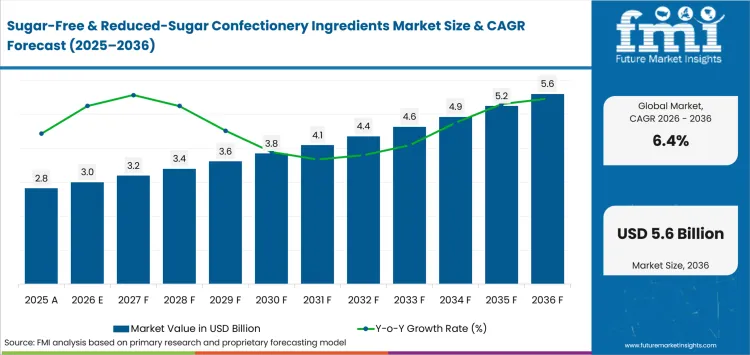
USD 3.0 billion in 2026 and USD 5.6 billion by 2036 at a 6.4% CAGR.
Sales of sugar-free and reduced-sugar confectionery ingredients are forecast to increase from USD 3.0 billion in 2026 to USD 5.6 billion by 2036 at a 6.4% CAGR. Confectionery manufacturers use polyol sweeteners to replace physical mass as high-intensity sweeteners adjust sweetness without restoring structure. Cargill explains that sugar supports bulking and flavor balance while contributing moisture retention and shelf life within finished formulations. The commercial test therefore extends beyond sweetness equivalence and requires repeatable cooking and storage performance. Broader confectionery ingredients create value once technical teams assign every sucrose function to a measured component instead of expecting one ingredient to reproduce the complete system.
Commercial routes differ across countries since nutrition labels and polyol warnings shape package design beside product claims. The FDA proposed a front-of-package label in January 2025 that would classify added sugars as Low, Med or High on most packaged foods if finalized. The proposal does not change current sugar-alcohol declaration rules but shows why United States launches may require another packaging review during the forecast period. European products face a separate polyol-warning threshold and Asian standards use their own nutrient calculations. Manufacturers gain confidence once formulation records connect sweetness targets with serving size and process limits under the exact rules governing each selling market.
Key Takeaways of Sugar-Free & Reduced-Sugar Confectionery Ingredients Market
- Demand for sugar-free and reduced-sugar confectionery ingredients is driven by broader reduced-sugar portfolio expansion, with sugar replacement creating value when ingredients preserve sweetness and structural performance across regular confectionery production conditions.
- Isomalt holds the leading share at 38.0% in 2026, owing to reliable bulking and moisture-control performance, with fibers and high-intensity sweeteners complementing polyols by rebuilding mouthfeel and adjusting sweetness across reduced-sugar formulas.
- Candy leads the application category at 38.0% share in 2026, driven by demanding texture and cooking requirements where repeat orders depend on consistent shelf stability across regular batches rather than one successful laboratory sample.
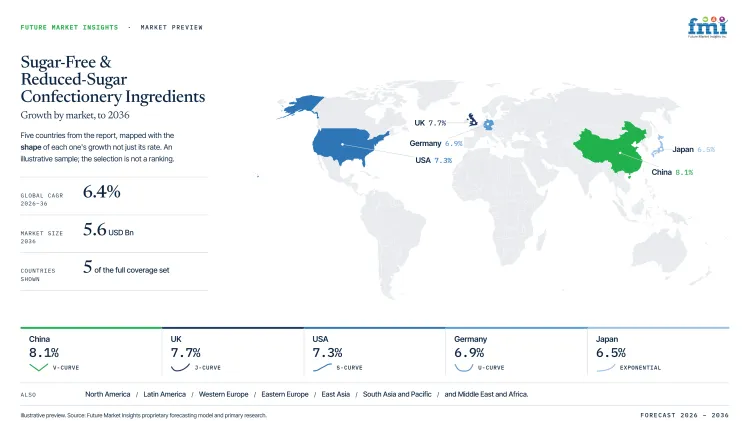
- China, the United Kingdom, and the United States record CAGRs of 8.1%, 7.7%, and 7.3% respectively through 2036, shaped by revised national nutrition-label requirements, advertising exclusions for qualifying sugar-free products, and established confectionery demand alongside accessible ingredient supply.
- Competition combines bulk sweetener manufacturers with formulation specialists, with BENEO and Roquette focusing on dedicated polyol portfolios, Cargill and ADM combining broad sweetener ranges with scaled manufacturing, and Tate & Lyle and Ingredion connecting high-intensity sweeteners with fibers and regional formulation resources.
Analyst Perspective
"The sugar-free & reduced-sugar confectionery ingredients market is increasingly defined by formulation performance rather than sugar replacement alone. Food manufacturers are prioritizing ingredients that preserve taste, texture, and shelf stability while fitting existing production processes. Suppliers that demonstrate consistent application performance, regulatory compliance, and technical formulation support will be better positioned to strengthen long-term commercial adoption."
- Nandini Roy Choudhury, Principal Analyst at Future Market Insights
Source: FMI's proprietary forecasting model and primary research
How is the Sugar-Free & Reduced-Sugar Confectionery Ingredients Market segmented?
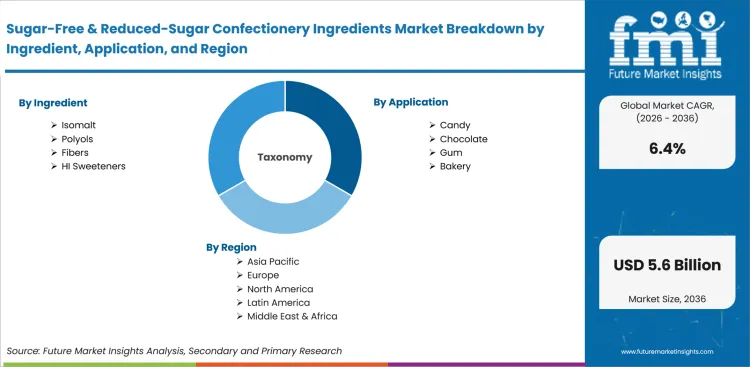
The sugar-free and reduced-sugar confectionery ingredients industry is segmented by Ingredient, Application, and Region.
The segmentation framework separates ingredient functions from confectionery formats that receive those functions during commercial production. Ingredient analysis covers Isomalt and other polyols together with fibers and high-intensity sweeteners that replace bulk or adjust sweetness. A November 2025 technical article described modern sugar reduction as a multi-sweetener system rather than a single-ingredient substitution. The same article stated that commercial scale-up requires staged validation of processing conditions and quality parameters. Application analysis covers candy and chocolate alongside gum and bakery products with distinct cooking and moisture requirements. Regional analysis compares regulatory treatment and technical support across countries with different commercialization routes and distribution conditions.
Why is Isomalt central to the Ingredient category?
Hard candy requires a bulk sweetener that supports glass formation and resists moisture during normal storage conditions. A January 2025 Middle East Technical University study tested twenty-seven isomalt-based formulations across crystallinity and glass-transition behavior. The study found that higher isomalt concentration increased glass-transition temperature while crystalline structures reduced product stability. The measured results explain why Isomalt qualification must control formulation ratios and cooling conditions instead of relying on sweetness equivalence. Production teams should confirm the target glass state across every flavor system and planned distribution environment.
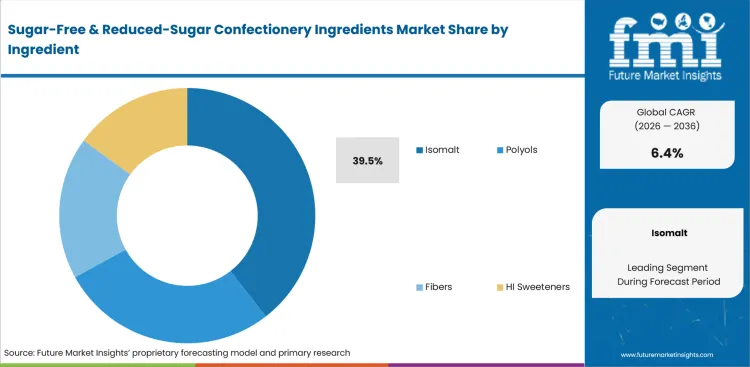
- The Ingredient category is forecast to be led by Isomalt at 39.5% share in 2026 due to its combined bulking and moisture-control functions. The ingredient replaces substantial sucrose mass while supporting clear appearance and stable texture across boiled confectionery. The segment position reflects repeatable production performance rather than sweetness intensity or consumer familiarity with one ingredient name.
- Confectionery manufacturers adopt sugar alcohol systems through application trials that compare cooking behavior with the existing sucrose formula. Qualification should measure stickiness and flavor release across the packaging conditions planned for regular commercial distribution. Broader purchasing becomes practical once production teams reproduce the target texture without repeated temperature adjustments or unusually protective packaging.
Why is Candy central to the Application category?
Candy manufacturing places demanding requirements on sugar replacement because each formula must control solids balance during heating and cooling. Candy formulas often pair bulk sweetener systems with gelling ingredients to control texture across commercial processing. A July 2025 IFT FIRST prototype demonstrated a no-sugar-added gummy lollipop with separate gelled and aerated texture layers. The prototype showed how reduced-sugar candy can combine several structural ingredients instead of assigning every function to one sweetener. Commercial acceptance depends on reproducing those textures without crystallization defects or costly packaging changes during production.
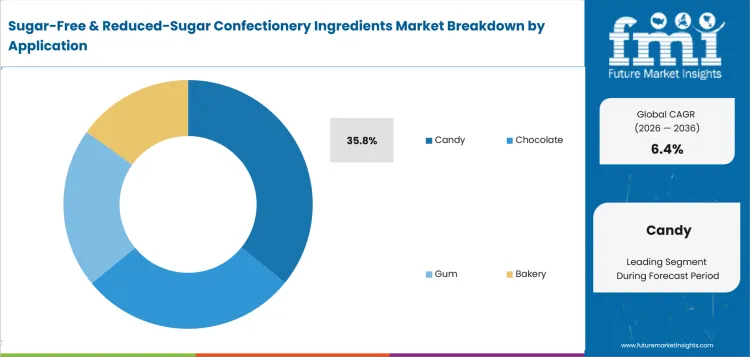
- In 2026, candy is expected to lead the application category with 35.8% share because commercial recipes depend directly on bulking sweeteners for structure. Hard candies and gummies use different moisture systems yet both formats require precise solids balance throughout processing. The segment position reflects repeated ingredient qualification across diverse recipes and production lines serving established confectionery brands.
- Manufacturers expand reduced-sugar candy lines through pilot cooking and accelerated shelf-life tests that expose stickiness or texture drift. Erythritol blends and intense sweeteners can improve sweetness balance within systems that retain bulk through other ingredients. Production approval should follow measured performance across humidity ranges and packaging formats that match the planned sales channel.
What are the drivers, restraints, and opportunities in the Sugar-Free & Reduced-Sugar Confectionery Ingredients Market?
Demand expands as confectionery manufacturers replace sucrose functions without weakening established production performance across familiar candy and gum formats. Commercial progress remains constrained by labeling and tolerance requirements yet blended ingredients create practical openings for better formulation control.
- Driver: Manufacturers need ingredients that reduce sugar while preserving bulk and texture across candy and chocolate production.
- Restraint: Polyol warnings and jurisdiction-specific nutrition labels can complicate claims and package communication across major commercial markets.
- Opportunity: Blended sweetener systems can separate bulk replacement from sweetness adjustment and improve formulation control across distinct confectionery formats.
Confectionery manufacturers invest in sugar-reduction systems since sucrose removal changes sweetness and texture beside production behavior within the same recipe. Cargill identifies texture balance and sweetness perception as technical challenges for reduced-sugar confectionery together with product stability and mouthfeel. The evidence supports multi-ingredient trials rather than simple one-for-one substitution across commercial recipe development and production conditions. Dietary fibers can rebuild structural body while separate sweeteners restore intensity across specific candy and chocolate formulas. Ingredient manufacturers gain repeat orders once formulation results survive pilot work and regular factory production.
Polyol use creates a labeling burden that can remain material despite strong processing performance in the finished recipe. Regulation (EU) No 1169/2011 requires a laxative-effects statement for foods containing more than 10% added polyols. Manufacturers must account for warning placement during package design and consumer communication across every intended selling jurisdiction. Commercialization slows if a reformulated product needs another label review or a lower serving recommendation. Ingredient selection must therefore consider serving size and claim language alongside processing performance during commercial qualification.
Blended systems create an opening for manufacturers that cannot reproduce sucrose performance with one ingredient class. Tate & Lyle states that its fibers can replace sugar bulk and work beside high-intensity sweeteners during reformulation. Stevia sweeteners can provide intensity while fibers rebuild mouthfeel and structural body within one recipe. Ingredient manufacturers strengthen the commercial case by documenting how every component consistently affects cooking behavior and shelf stability under factory processing conditions.
Which country CAGRs are profiled in the Sugar-Free & Reduced-Sugar Confectionery Ingredients Market?
| Country | CAGR |
|---|---|
| USA | 7.3% |
| Germany | 6.9% |
| UK | 7.7% |
| China | 8.1% |
| Japan | 6.5% |
How do country-level CAGRs compare in the Sugar-Free & Reduced-Sugar Confectionery Ingredients Market?
The country comparison shows a relatively narrow spread in projected growth rates across the sugar-free & reduced-sugar confectionery ingredients market. China and the UK form a closely aligned upper group with only a modest gap between their forecasts. The USA follows nearby and remains connected to the upper cluster through a limited difference in projected expansion. Germany and Japan create a lower pair and are separated by only a small margin. The overall gap between the first and last country is 1.6 percentage points which indicates a concentrated growth outlook across the markets profiled. These differences reflect the pace of sugar reduction initiatives, ingredient reformulation activity and consumer demand for lower-sugar confectionery products.
- China shows a notable position within the comparison as confectionery manufacturers continue to expand the use of alternative sweeteners and sugar reduction ingredients in response to changing consumer preferences.
- The UK remains close to China in CAGR terms but follows a different market path through ongoing product reformulation efforts and greater emphasis on reducing sugar content across packaged foods.
- The USA occupies a central position within the comparison as demand for better-for-you confectionery products supports the adoption of reduced-sugar ingredient solutions.
- Germany remains relatively close to the USA yet market development is shaped by steady innovation in sweetener systems and ingredient blends that maintain product taste and texture.
- Japan forms part of the lower group while continuing to support market expansion through demand for portion-controlled and health-oriented confectionery products.
Comparable CAGRs do not create identical market conditions across countries. Differences in consumer taste preferences, regulatory requirements, reformulation priorities and ingredient sourcing strategies can influence how quickly sugar-free and reduced-sugar confectionery ingredients are adopted. As a result, suppliers may face different commercialization and product development requirements despite relatively similar growth forecasts. The full report provides country-level CAGR analysis across North America, Latin America, Europe, East Asia, South Asia, Oceania and the Middle East and Africa.
Country-wise Analysis
- FDA guidance requires United States confectionery products to declare added sugars within Nutrition Facts and permits named sugar alcohols under defined conditions. Demand for sugar-free and reduced-sugar confectionery ingredients in the United States is projected to expand at a 7.3% CAGR through 2036 supported by a defined federal declaration route. Products containing one sugar alcohol may use its specific name within the carbohydrate declaration for clearer consumer information. The established route helps formulation teams prepare labels for reduced-sugar candy and gum across national retail channels. Domestic application resources can combine soluble fiber systems with sweeteners during structured recipe testing and factory scale-up. Commercial friction remains material since calorie calculations and claim language must match the final blend and serving size.
- German confectionery manufacturers operate under European Union rules that govern polyol warnings and nutrition claims across finished products. German sales of sugar-free and reduced-sugar confectionery ingredients are estimated to rise at a 6.9% CAGR through 2036 underpinned by an established sugar-confectionery production base. BDSI reported in January 2026 that Germany produced 653,000 tonnes of sugar confectionery during 2025 and output increased 0.1% from 2024. The stable production base gives ingredient manufacturers access to existing cooking and packaging lines for structured reformulation projects. Destatis reported in January 2026 that wholesale prices for sugar and confectionery products averaged 14.7% higher during 2025 than 2024. Cost pressure can delay trials or favor formulations that minimize ingredient changes across commercial production.
- United Kingdom rules now restrict paid online and television advertising for products classified as less healthy. Sugar-free and reduced-sugar confectionery ingredient sales in the United Kingdom are forecast to expand at a 7.7% CAGR through 2036 enabled by a defined exclusion for qualifying products. Sugar-free sweets and sugar-free chewing gum are excluded from category four under restrictions effective January 5, 2026. The exclusion can improve promotional flexibility for products that satisfy the guidance and retain full sugar-free status. Reduced-sugar products may require nutrient-profile assessment and therefore receive no automatic advertising benefit under the current framework. Ingredient manufacturers must support complete recipe calculations rather than assume lower sugar content secures advertising access.
- Chinese launches require compliant Chinese-language labels and nutrient calculations under national prepackaged-food standards before commercial sale. In China, sugar-free and reduced-sugar confectionery ingredient sales are projected to record an 8.1% CAGR through 2036 shaped by revised nutrition-label requirements. Manufacturers must revise recipe calculations and packaging records across domestic and imported products before the new requirements take effect. The National Health Commission published guidance for GB 28050-2025 in September 2025 and set implementation for March 16, 2027. The standard makes sugar a mandatory nutrition-panel item and recommends zero kilojoules per gram for erythritol. Other polyols receive a recommended energy factor of ten kilojoules per gram under the same national standard. Defined factors support consistent calculations but packaging transitions create material conversion work across commercial product portfolios.
- Japanese confectionery products require nutrition panels and claim wording that follow national food-labeling standards before commercial sale. Japan's sugar-free and reduced-sugar confectionery ingredients market is estimated to post a 6.5% CAGR through 2036 influenced by disciplined claim review and established formulation practices. The Consumer Affairs Agency published the fifth edition of its nutrition-labeling guideline during April 2025 for packaged foods and food additives. The guideline covers mandatory nutrient declarations and includes conditions for claims that sugars have not been added. The defined claim route supports reduced-sugar confectionery launches but requires defensible recipe calculations and retained evidence for displayed values. No-added-sugar claims create material friction because recipes must satisfy every condition stated in the national guidance. Local application support remains important for preserving familiar taste and texture within the final documented formula.
Who are the notable companies in the Sugar-Free & Reduced-Sugar Confectionery Ingredients Market?
BENEO, Cargill, Roquette, Tate & Lyle, ADM, Ingredion and Jungbunzlauer are the notable companies profiled in this market.
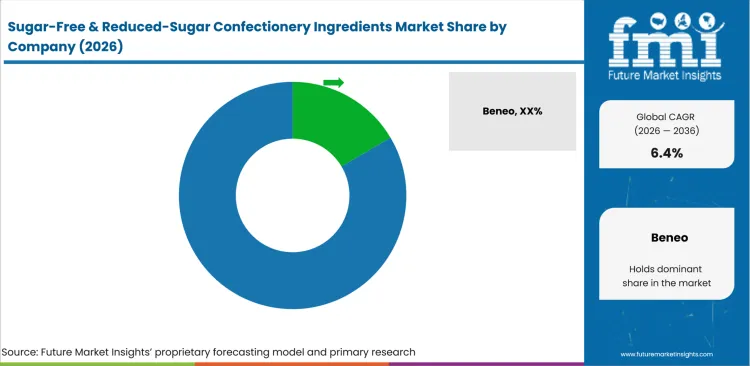
The competitive field combines bulk sweetener producers with specialists that rebuild taste and mouthfeel across several confectionery formats. BENEO and Roquette provide dedicated polyol portfolios for candy and chocolate formulation under commercial processing conditions. Cargill and ADM combine scaled manufacturing with broad sweetener platforms and confectionery application resources across multiple regions. Tate & Lyle and Ingredion integrate high-intensity sweeteners with fibers that support mouthfeel and solids reconstruction during recipe development. Jungbunzlauer supplies fermentation-based erythritol and technical guidance for sugar-free candy applications across Europe and other commercial regions. Manufacturers compare documented application performance with regional support and supply consistency before approving regular volumes.
- BENEO and Roquette together with Jungbunzlauer form a specialist group centered on bulk polyol and carbohydrate systems. Their commercial position depends on documented sugar-replacement performance across confectionery uses and clearly defined formulation limits. Selection turns on moisture behavior and texture performance under the finished product's intended cooking and storage conditions.
- Integrated platforms from Cargill, Tate & Lyle and Ingredion combine high-intensity sweetness with fibers and application resources for multi-format reformulation. Their portfolios support customer qualification across several confectionery formats and regional production settings during scale-up. Manufacturers value a coordinated platform that links taste adjustment with structural rebuilding during product development.
- ADM forms a scaled sweetener and confectionery supplier group with broad manufacturing and technical capabilities across major regions. Its documented role combines sweeteners and texture systems with confectionery laboratory support for customer formulation and scale-up work. Commercial selection depends on whether technical guidance translates across the manufacturer's equipment and planned distribution conditions.
Competitive Benchmarking: Sugar-Free & Reduced-Sugar Confectionery Ingredients Market
| Company | Bulk Sugar Replacement | Confectionery Application Support | Multi-Region Supply and Documentation | Geographic Reach |
|---|---|---|---|---|
| BENEO | High | High | High | Global |
| Cargill | High | High | High | Global |
| Roquette | High | High | High | Europe, Americas and Asia |
| Tate & Lyle | Medium | High | High | Global |
| ADM | High | High | High | Global |
| Ingredion | Medium | High | High | Americas, Europe and Asia-Pacific |
| Jungbunzlauer | Medium | Medium | High | Global |
Key Developments in the Sugar-Free & Reduced-Sugar Confectionery Ingredients Market
- In June 2026, BENEO introduced the Sweets Box, featuring sugar-free hard-candy prototypes built around Isomalt and complementary functional ingredients. The collection includes liquid-filled concepts and multilayer designs that demonstrate color stability and controlled processing. Physical samples and application guidance give confectionery teams current reference products for structured trials across multiple recipe formats. Manufacturers can reduce early development uncertainty but must reproduce prototype performance on their own cooking lines and packaging systems.
- In February 2026, Tate & Lyle established an all-Americas supply of Yume M Stevia Sweetener produced in Georgia. The official announcement described end-to-end traceability and improved supply security for food manufacturers across the Americas. The regional ingredient source expands access to high-intensity sweetness for reduced-sugar confectionery development across nearby technical and manufacturing networks. Manufacturers must pair Yume with bulking components that preserve candy structure during processing and distribution.
- In June 2026, Ingredion announced that Tate & Lyle had agreed to a recommended cash acquisition through a United Kingdom scheme of arrangement. The official announcement describes a proposed transaction and does not record a completed transfer of legal ownership. A completed combination could join two profiled sugar-reduction platforms but cannot be assumed during current ingredient-platform evaluation. Manufacturers should assess each company separately until an official completion announcement confirms legal ownership and operating changes.
- In March 2026, Roquette expanded its Lianyungang pilot center by adding more than one thousand square meters dedicated to starch and polyol development. The center connects customer concepts with prototype work and pilot validation before industrial scale-up for customer development programs. Confectionery teams can use the regional capability for relevant polyol trials after confirming recipe scope and processing conditions.
Key Players in the Sugar-Free & Reduced-Sugar Confectionery Ingredients Market
Bulk Polyol and Carbohydrate Specialists
- BENEO
- Roquette
- Jungbunzlauer
Integrated Sugar-Reduction Platforms
- Cargill
- Tate & Lyle
- Ingredion
Scaled Sweetener and Confectionery Supplier
- ADM
Sugar-Free & Reduced-Sugar Confectionery Ingredients Market - Report Scope
| Coverage field | Report scope |
|---|---|
| Market breakdown | Ingredient, Application, and Region. |
| Quantitative Units | Revenue in USD Billion, CAGR in %. |
| Market Definition | Revenue from bulk sweeteners and high-intensity sweeteners together with functional fibers used directly in sugar-free or reduced-sugar confectionery formulation. The scope includes ingredients sold for candy and chocolate as well as gum and bakery applications. Finished confectionery products and adjacent ingredients without a direct sugar-reduction function are excluded. |
| Regions Covered | North America, Latin America, Western Europe, Eastern Europe, East Asia, South Asia and Pacific, and Middle East and Africa. |
| Countries Covered | USA, Germany, UK, China, Japan, and additional countries within a 30+ country model. |
| Key Companies Profiled | BENEO, Cargill, Roquette, Tate & Lyle, ADM, Ingredion and Jungbunzlauer. |
| Forecast Period | 2026 to 2036. |
| Approach | Hybrid bottom-up and top-down market sizing supported by primary interviews and official desk research. |
Sugar-Free & Reduced-Sugar Confectionery Ingredients Market - Research Methodology
| Method | Approach |
|---|---|
| Primary Research | FMI analysts gathered input from manufacturers, service providers, technology developers, distributors, end users, procurement teams, and subject-matter experts. Interviews examined purchasing decisions, product or service evaluation, adoption barriers, approval requirements, pricing considerations, and expectations for technical or commercial support. Respondents were also asked what evidence is required before a trial, pilot, or initial order develops into regular purchasing. |
| Desk Research | Desk research covered government statistics, regulatory publications, trade data, industry associations, technical literature, standards, company filings, product information, and official corporate announcements. Sources were reviewed for relevance, publication date, geographic coverage, and consistency with the defined market scope. Claims relating to performance, applications, approvals, capacity, investment, and commercial activity were retained only when supported by credible public evidence. |
| Market Sizing and Forecasting | The market model combined the baseline value with historical performance, segment structure, pricing and volume indicators, adoption levels, company participation, and country-level demand conditions. Forecast assumptions considered economic activity, investment trends, regulatory developments, technology adoption, purchasing cycles, supply availability, and barriers to wider market use. Segment and regional estimates were reconciled before the final market total was calculated. |
| Data Validation | Estimates were checked against multiple independent indicators, including public data, company activity, trade patterns, industry developments, and findings from primary interviews. Validation also tested whether products, services, applications, and company revenues fell within the defined market boundaries. Adjacent categories, unsupported claims, overlapping revenues, and activities without direct market relevance were excluded to reduce double counting and maintain consistency across segments and countries. |
Sugar-Free & Reduced-Sugar Confectionery Ingredients Market by Segments
Sugar-Free & Reduced-Sugar Confectionery Ingredients Market segmented by Ingredient:
- Isomalt
- Polyols
- Fibers
- HI Sweeteners
Sugar-Free & Reduced-Sugar Confectionery Ingredients Market segmented by Application:
- Candy
- Chocolate
- Gum
- Bakery
Sugar-Free & Reduced-Sugar Confectionery Ingredients Market by Region:
- North America
- United States
- Canada
- Latin America
- Brazil
- Mexico
- Argentina
- Chile
- Western Europe
- Germany
- France
- United Kingdom
- Italy
- Spain
- Benelux
- Nordics
- Eastern Europe
- Poland
- Czech Republic
- Romania
- Hungary
- East Asia
- China
- Japan
- South Korea
- South Asia and Pacific
- India
- ASEAN
- Australia and New Zealand
- Middle East and Africa
- GCC Countries
- South Africa
- Türkiye
- Israel
Research Sources and Bibliography
- USA Food and Drug Administration. (n.d.). Industry Resources on the Changes to the Nutrition Facts Label.
- USA Food and Drug Administration. (2025, January 14). FDA Proposes Requiring At-a-Glance Nutrition Information on the Front of Packaged Foods.
- European Parliament and Council of the European Union. (2011, October 25). Regulation (EU) No 1169/2011 on the provision of food information to consumers.
- Cargill. (n.d.). Sugar Reduction in Sweet Confectionery | Meet our Experts | Cargill.
- Department of Health and Social Care. (2025, June 4). Restricting advertising of less healthy food or drink on TV and online: products in scope.
- National Health Commission of the People's Republic of China. (2025, September 25). 《食品安全国家标准 预包装食品营养标签通则》(GB 28050-2025)问答.
- Consumer Affairs Agency. (2025, April). 事業者向け食品表示法に基づく栄養成分表示のためのガイドライン第5版.
- Bundesverband der Deutschen Süßwarenindustrie. (2026, January 28). Arbeitsplätze in der Süßwarenindustrie in Gefahr.
- Federal Statistical Office of Germany. (2026, January 15). Wholesale prices in December 2025: +1.2% on December 2024.
- BENEO. (n.d.). Ingredients for confectionery | Sugar-free and just as sweet.
- Roquette. (n.d.). Polyols in Food: Sweetness, Functionality, and Nutritional Balance.
- Jungbunzlauer. (n.d.). ERYLITE® | Erythritol | Sugar replacer | 0-calorie | SWEETENERS.
- BENEO. (n.d.). About BENEO: Experts in natural ingredients.
- Cargill. (n.d.). Company overview of global supply chain partner | Cargill.
- BENEO. (2026, June 25). BENEO launches collection of inspirational sugar-free confectionery concepts to boost category innovation.
- Tate & Lyle. (2026, February 23). Introducing Yume™: A new standard for sweetness.
- Tate & Lyle PLC. (2026, June 8). RECOMMENDED ACQUISITION of TATE & LYLE PLC by INGREDION INCORPORATED.
- Roquette. (2026, April 6). Roquette Inaugurates its New Pilot Center at Lianyungang.
- Berzins, A. (2025, November 14). Solutions for reduced-sugar products: Meeting consumer trends at scale. Ingredion.
- Doğdu, S. (2025). Formulation and characterization of isomalt based hard candy [Master's thesis, Middle East Technical University]. OpenMETU.
- Tate & Lyle. (2025, July 7). Tate & Lyle debuts expanded portfolio and mouthfeel leadership at IFT FIRST 2025.
This bibliography is provided for reader reference and is not exhaustive. The full report contains the complete reference list and detailed citations.
This Report Answers
- How large is the Sugar-Free & Reduced-Sugar Confectionery Ingredients Market in 2026 and 2036?
- Which formulation and regulatory pressures support spending on sugar-reduction ingredients across confectionery production?
- Why does Isomalt hold the leading Ingredient share during 2026?
- Why does Candy hold the leading Application share during 2026?
- How do country growth rates differ across the United States, Germany, the United Kingdom, China and Japan?
- Which companies provide polyols and high-intensity sweeteners alongside formulation support and regional supply?
- What limits qualification and commercial scale-up across sugar-free and reduced-sugar confectionery formulas?
- What should formulation teams test before approving broader production and regular ingredient purchasing?
Frequently Asked Questions
How big is the Sugar-Free & Reduced-Sugar Confectionery Ingredients Market in 2026?
The sugar-free & reduced-sugar confectionery ingredients market is valued at USD 3.0 billion in 2026 and is forecast to reach USD 5.6 billion by 2036, reflecting growing demand from confectionery manufacturers replacing sucrose functions while preserving bulk, texture, and shelf stability across candy, chocolate, and gum production.
What is the CAGR of the Sugar-Free & Reduced-Sugar Confectionery Ingredients Market from 2026 to 2036?
The sugar-free & reduced-sugar confectionery ingredients market is projected to grow at a CAGR of 6.4% between 2026 and 2036, supported by manufacturers needing ingredients that reduce sugar while preserving bulk and texture across candy and chocolate production without weakening established processing performance.
Which ingredient leads the Sugar-Free & Reduced-Sugar Confectionery Ingredients Market?
Isomalt accounts for 38.0% of the sugar-free & reduced-sugar confectionery ingredients market by ingredient in 2026, driven by its combined bulking and moisture-control functions that replace substantial sucrose mass while supporting clear appearance and stable texture across boiled confectionery production.
Which country segment is growing fastest in the Sugar-Free & Reduced-Sugar Confectionery Ingredients Market?
China is the fastest-growing country segment in the sugar-free & reduced-sugar confectionery ingredients market, expanding at an 8.1% CAGR through 2036, ahead of the market average of 6.4%, shaped by revised national nutrition-label requirements under GB 28050-2025 and growing confectionery manufacturer adoption of alternative sweetener systems.
Who are the leading companies in the Sugar-Free & Reduced-Sugar Confectionery Ingredients Market?
Leading companies in the sugar-free & reduced-sugar confectionery ingredients market include BENEO, Cargill, Roquette, Tate & Lyle, ADM, Ingredion, and Jungbunzlauer, competing across dedicated polyol portfolios, integrated high-intensity sweetener and fiber platforms, and scaled manufacturing with confectionery application support across major regions.
Preview the report firsthand - request a free sample
Get SampleGet the brochure for pricing and purchase details.
Get PDFTable of Content
- Key Takeaways
- Market Size and CAGR
- Top Growth Driver
- Fastest Growing Segment
- Leading Region
- Key Companies
- Emerging Opportunities
- Executive Summary
- Global Market Outlook
- Demand-side Trends
- Supply-side Trends
- Technology Roadmap Analysis
- Analysis and Recommendations
- Analyst Perspective (What is happening? Why now? What should investors know?)
- Key Questions Answered
- How large is the market?
- What is the CAGR?
- What are key trends?
- Which region dominates?
- Who are the leaders?
- Market Overview
- Market Coverage / Taxonomy
- Market Definition / Scope / Limitations
- Research Methodology
- Chapter Orientation
- Analytical Lens and Working Hypotheses
- Market Structure, Signals, and Trend Drivers
- Benchmarking and Cross-market Comparability
- Market Sizing, Forecasting, and Opportunity Mapping
- Research Design and Evidence Framework
- Desk Research Programme (Secondary Evidence)
- Expert Input and Fieldwork (Primary Evidence)
- Tooling, Models, and Reference Databases
- Data Engineering and Model Build
- Quality Assurance and Audit Trail
- Market Background
- Market Dynamics (Drivers, Restraints, Opportunity, Trends)
- Scenario Forecast (Optimistic, Likely, Conservative)
- Impact Analysis
- AI Impact
- Sustainability Impact
- Regulatory Impact
- Technology Impact
- Consumer / Buyer Analysis
- Purchase Drivers
- Adoption Barriers
- Buyer Journey
- Opportunity Map Analysis
- Product Life Cycle Analysis
- Supply Chain Analysis
- Investment Feasibility Matrix
- Value Chain Analysis
- PESTLE and Porter's Analysis
- Regulatory Landscape
- Regional Parent Market Outlook
- Production and Consumption Statistics
- Import and Export Statistics
- Global Market Analysis and Forecast, 2021 to 2036
- Historical Market Size Value (USD Billion) Analysis, 2021 to 2025
- Current and Future Market Size Value (USD Billion) Projections, 2026 to 2036
- Y-o-Y Growth Trend Analysis
- Absolute $ Opportunity Analysis
- Global Market Pricing Analysis, 2021 to 2036
- Global Market Analysis and Forecast, By Ingredient, 2021 to 2036
- Introduction / Key Findings
- Historical Market Size Value (USD Billion) Analysis By Ingredient, 2021 to 2025
- Current and Future Market Size Value (USD Billion) Analysis and Forecast By Ingredient, 2026 to 2036
- Isomalt
- Polyols
- Fibers
- HI Sweeteners
- Isomalt
- Y-o-Y Growth Trend Analysis By Ingredient, 2021 to 2025
- Absolute $ Opportunity Analysis By Ingredient, 2026 to 2036
- Global Market Analysis and Forecast, By Application, 2021 to 2036
- Introduction / Key Findings
- Historical Market Size Value (USD Billion) Analysis By Application, 2021 to 2025
- Current and Future Market Size Value (USD Billion) Analysis and Forecast By Application, 2026 to 2036
- Candy
- Chocolate
- Gum
- Bakery
- Candy
- Y-o-Y Growth Trend Analysis By Application, 2021 to 2025
- Absolute $ Opportunity Analysis By Application, 2026 to 2036
- Global Market Analysis and Forecast, By Region, 2021 to 2036
- Introduction
- Historical Market Size Value (USD Billion) Analysis By Region, 2021 to 2025
- Current Market Size Value (USD Billion) Analysis and Forecast By Region, 2026 to 2036
- North America
- Latin America
- Western Europe
- Eastern Europe
- East Asia
- South Asia and Pacific
- Middle East & Africa
- Market Attractiveness Analysis By Region
- North America Market Analysis and Forecast, By Country, 2021 to 2036
- Historical Market Size Value (USD Billion) Trend Analysis By Market Taxonomy, 2021 to 2025
- Market Size Value (USD Billion) Forecast By Market Taxonomy, 2026 to 2036
- By Country
- USA
- Canada
- By Ingredient
- By Application
- By Country
- Market Attractiveness Analysis
- By Country
- By Ingredient
- By Application
- Key Takeaways
- Latin America Market Analysis and Forecast, By Country
- Historical Market Size Value (USD Billion) Trend Analysis By Market Taxonomy, 2021 to 2025
- Market Size Value (USD Billion) Forecast By Market Taxonomy, 2026 to 2036
- By Country
- Brazil
- Mexico
- Chile
- Rest of Latin America
- By Ingredient
- By Application
- By Country
- Market Attractiveness Analysis
- By Country
- By Ingredient
- By Application
- Key Takeaways
- Western Europe Market Analysis and Forecast, By Country
- Historical Market Size Value (USD Billion) Trend Analysis By Market Taxonomy, 2021 to 2025
- Market Size Value (USD Billion) Forecast By Market Taxonomy, 2026 to 2036
- By Country
- Germany
- UK
- Italy
- Spain
- France
- Nordic
- BENELUX
- Rest of Western Europe
- By Ingredient
- By Application
- By Country
- Market Attractiveness Analysis
- By Country
- By Ingredient
- By Application
- Key Takeaways
- Eastern Europe Market Analysis and Forecast, By Country
- Historical Market Size Value (USD Billion) Trend Analysis By Market Taxonomy, 2021 to 2025
- Market Size Value (USD Billion) Forecast By Market Taxonomy, 2026 to 2036
- By Country
- Russia
- Poland
- Hungary
- Balkan & Baltic
- Rest of Eastern Europe
- By Ingredient
- By Application
- By Country
- Market Attractiveness Analysis
- By Country
- By Ingredient
- By Application
- Key Takeaways
- East Asia Market Analysis and Forecast, By Country
- Historical Market Size Value (USD Billion) Trend Analysis By Market Taxonomy, 2021 to 2025
- Market Size Value (USD Billion) Forecast By Market Taxonomy, 2026 to 2036
- By Country
- China
- Japan
- South Korea
- By Ingredient
- By Application
- By Country
- Market Attractiveness Analysis
- By Country
- By Ingredient
- By Application
- Key Takeaways
- South Asia and Pacific Market Analysis and Forecast, By Country
- Historical Market Size Value (USD Billion) Trend Analysis By Market Taxonomy, 2021 to 2025
- Market Size Value (USD Billion) Forecast By Market Taxonomy, 2026 to 2036
- By Country
- India
- ASEAN
- Australia & New Zealand
- Rest of South Asia and Pacific
- By Ingredient
- By Application
- By Country
- Market Attractiveness Analysis
- By Country
- By Ingredient
- By Application
- Key Takeaways
- Middle East & Africa Market Analysis and Forecast, By Country
- Historical Market Size Value (USD Billion) Trend Analysis By Market Taxonomy, 2021 to 2025
- Market Size Value (USD Billion) Forecast By Market Taxonomy, 2026 to 2036
- By Country
- Kingdom of Saudi Arabia
- Other GCC Countries
- Türkiye
- South Africa
- Other African Union
- Rest of Middle East & Africa
- By Ingredient
- By Application
- By Country
- Market Attractiveness Analysis
- By Country
- By Ingredient
- By Application
- Key Takeaways
- Key Countries Market Analysis
- USA
- Pricing Analysis
- Market Share Analysis, 2025
- By Ingredient
- By Application
- Canada
- Pricing Analysis
- Market Share Analysis, 2025
- By Ingredient
- By Application
- Mexico
- Pricing Analysis
- Market Share Analysis, 2025
- By Ingredient
- By Application
- Brazil
- Pricing Analysis
- Market Share Analysis, 2025
- By Ingredient
- By Application
- Chile
- Pricing Analysis
- Market Share Analysis, 2025
- By Ingredient
- By Application
- Germany
- Pricing Analysis
- Market Share Analysis, 2025
- By Ingredient
- By Application
- UK
- Pricing Analysis
- Market Share Analysis, 2025
- By Ingredient
- By Application
- Italy
- Pricing Analysis
- Market Share Analysis, 2025
- By Ingredient
- By Application
- Spain
- Pricing Analysis
- Market Share Analysis, 2025
- By Ingredient
- By Application
- France
- Pricing Analysis
- Market Share Analysis, 2025
- By Ingredient
- By Application
- India
- Pricing Analysis
- Market Share Analysis, 2025
- By Ingredient
- By Application
- ASEAN
- Pricing Analysis
- Market Share Analysis, 2025
- By Ingredient
- By Application
- Australia & New Zealand
- Pricing Analysis
- Market Share Analysis, 2025
- By Ingredient
- By Application
- China
- Pricing Analysis
- Market Share Analysis, 2025
- By Ingredient
- By Application
- Japan
- Pricing Analysis
- Market Share Analysis, 2025
- By Ingredient
- By Application
- South Korea
- Pricing Analysis
- Market Share Analysis, 2025
- By Ingredient
- By Application
- Russia
- Pricing Analysis
- Market Share Analysis, 2025
- By Ingredient
- By Application
- Poland
- Pricing Analysis
- Market Share Analysis, 2025
- By Ingredient
- By Application
- Hungary
- Pricing Analysis
- Market Share Analysis, 2025
- By Ingredient
- By Application
- Kingdom of Saudi Arabia
- Pricing Analysis
- Market Share Analysis, 2025
- By Ingredient
- By Application
- Türkiye
- Pricing Analysis
- Market Share Analysis, 2025
- By Ingredient
- By Application
- South Africa
- Pricing Analysis
- Market Share Analysis, 2025
- By Ingredient
- By Application
- USA
- Market Structure Analysis
- Competition Dashboard
- Competition Benchmarking
- Market Share Analysis of Top Players
- By Regional
- By Ingredient
- By Application
- Emerging Startups
- Innovation Benchmarking
- Competition Analysis
- Competition Deep Dive
- Beneo
- Overview
- Product Portfolio
- Profitability by Market Segments
- Sales Footprint
- Strategy Overview
- Marketing Strategy
- Product Strategy
- Channel Strategy
- Cargill
- Roquette
- Tate & Lyle
- ADM
- SÜDZUCKER
- Ingredion
- Beneo
- Case Studies
- Success Stories
- Recent Developments
- Competition Deep Dive
- Assumptions & Acronyms Used


