

- Industry Size (2025)
- USD 18.2 Mn
- Forecast (2035)
- USD 43.3 Mn
- CAGR (2025 to 2035)
- 9.0%
Cyclodextrin Complexes Market Forecast and Outlook 2025 to 2035
The global cyclodextrin complexes market is expected to grow from USD 18.2 million in 2025 to USD 43.3 million by 2035, at a compound annual growth rate (CAGR) of 9.0%. This growth reflects an absolute increase of USD 25.1 million over the forecast period, representing nearly a 2.4-fold expansion. The pharmaceutical industry is the primary driver of this growth, as cyclodextrins are used extensively as excipients to improve the solubility, stability, and bioavailability of poorly soluble drugs. Their ability to enhance drug delivery systems is particularly valuable for treating chronic diseases and other therapeutic applications, driving their increased adoption across the sector. The expanding pharmaceutical pipeline and growing need for more effective drug formulations are expected to further fuel demand for cyclodextrin complexes.
In addition to pharmaceuticals, cyclodextrins are seeing rising demand in the food and beverage sector, where they are used to encapsulate flavors, colors, and preservatives, thereby improving product stability and shelf life. Their use in food formulations helps protect sensitive ingredients during processing and storage, further increasing their adoption across the industry. The cosmetics industry is also a significant contributor to this market, with cyclodextrins being incorporated into skin care products to enhance the delivery of active ingredients. This is particularly beneficial in formulations targeting anti-aging, moisturizing, and skin rejuvenation. As the market grows, advancements in cyclodextrin production and increased regulatory clarity will drive further growth across these key sectors.
Quick Stats for Cyclodextrin Complexes Market
- Cyclodextrin Complexes Market Value (2025): USD 18.2 million
- Cyclodextrin Complexes Market Forecast Value (2035): USD 43.3 million
- Cyclodextrin Complexes Market Forecast CAGR: 9.0%
- Leading End Use Application in Cyclodextrin Complexes Market: Skin Care
- Key Growth Regions in Cyclodextrin Complexes Market: Asia Pacific, Europe, and North America
- Top Players in Cyclodextrin Complexes Market: BASF SE, Croda International, Evonik Industries, Symrise (incl. IFF/Givaudan actives), Dow / Dow Inc., Ashland, Clariant
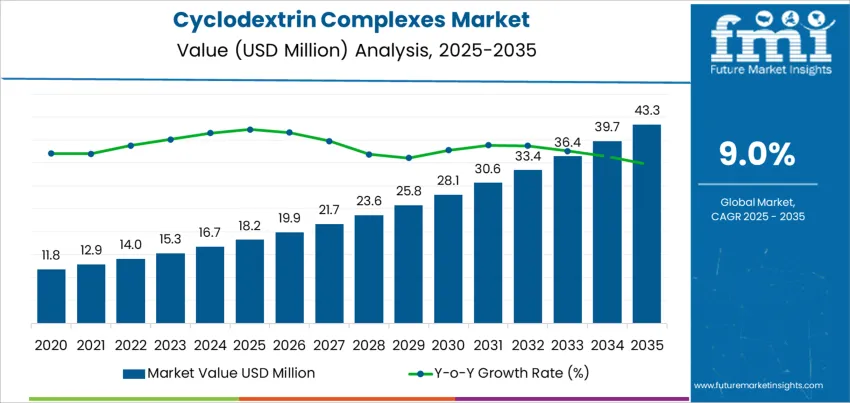
Cyclodextrin Complexes Market Year-over-Year Forecast (2025 to 2035)
Between 2025 and 2030, the cyclodextrin complexes market is projected to grow from USD 18.2 million to USD 30.6 million, resulting in a value increase of USD 12.4 million, representing 46.7% of the total forecast growth for the decade. This growth will be driven by the increasing demand for cyclodextrin complexes in pharmaceutical applications for improving drug solubility, stability, and bioavailability. The food and beverage sector is also contributing significantly as cyclodextrins are used for encapsulating flavors and preservatives. Technological advancements in cyclodextrin production and growing regulatory acceptance will further fuel this phase of growth. Manufacturers will focus on expanding their market presence through investments in production technologies and strategic partnerships across key industries.
From 2030 to 2035, the market is forecast to grow from USD 30.6 million to USD 43.3 million, adding another USD 12.7 million, which constitutes 53.3% of the overall ten-year expansion. This period is expected to see continued growth in pharmaceutical and food applications, alongside expanding uses in the cosmetics industry, where cyclodextrins improve the delivery of active ingredients in skincare products. As consumer demand for more sustainable and effective formulations grows, cyclodextrin complexes are expected to play an increasingly vital role. The industry will see innovation in product applications and further market penetration, driven by technological advancements and increasing collaborations between cyclodextrin producers and end-use industries.
Cyclodextrin Complexes Market Key Takeaways
| Metric | Value |
|---|---|
| Market Value (2025) | USD 18.2 million |
| Market Forecast Value (2035) | USD 43.3 million |
| Forecast CAGR (2025-2035) | 9.0% |
Why is the Cyclodextrin Complexes Market Growing?
The cyclodextrin complexes market is expanding due to the rising demand for advanced applications in pharmaceuticals, food, and cosmetics. Cyclodextrins are highly valued for their ability to enhance the solubility, stability, and bioavailability of active ingredients. Pharmaceutical companies utilize these complexes to improve drug delivery systems, as they enable the encapsulation of hydrophobic compounds, enhancing their therapeutic efficacy. In the food and beverage sector, cyclodextrin complexes are increasingly used to improve product stability and preserve flavor integrity, which is driving demand across various industries.
Technological advancements in cyclodextrin production are also playing a crucial role in the market's growth. Innovations in synthesis and formulation techniques have made the production of cyclodextrin complexes more efficient, reducing costs and expanding their potential applications. As a result, these complexes are being adopted in a wide range of industries beyond pharmaceuticals, including personal care and food preservation, where they enhance product performance. Increased regulatory support and consumer awareness of the benefits of cyclodextrin complexes in improving product functionality are further supporting their adoption.
Despite these growth drivers, challenges remain. High production costs and the complexity of large-scale manufacturing can limit the accessibility of cyclodextrin complexes, particularly for smaller businesses or regions with limited technical infrastructure. These constraints could hinder the market's growth in certain sectors and regions, limiting the widespread adoption of these innovative solutions. As technological advancements continue and production becomes more cost-effective, however, these challenges are expected to diminish, fueling further growth in the market.
How are End Use Segments and Product Forms Structuring the Global Cyclodextrin Complexes Landscape?
Global demand for cyclodextrin complexes spans pharmaceuticals, food, and cosmetics, with key markets in East Asia, Western Europe, and North America. Skin care holds a 9.8% share, driven by cyclodextrins’ ability to enhance active ingredient delivery in anti-aging and moisturizing products. Other sectors, like body care, hair care, sun care, and color cosmetics, also benefit from cyclodextrins’ ability to encapsulate and stabilize ingredients. Powder form dominates with a 15.9% share, valued for stability and versatility in formulations like liquids, emulsions, and gels. Other forms, such as granules and flakes, are used for controlled release and encapsulation, serving both pharmaceutical and cosmetic applications effectively.
Why Does Skin Care Hold the Largest Share in Global Cyclodextrin Complex Usage?
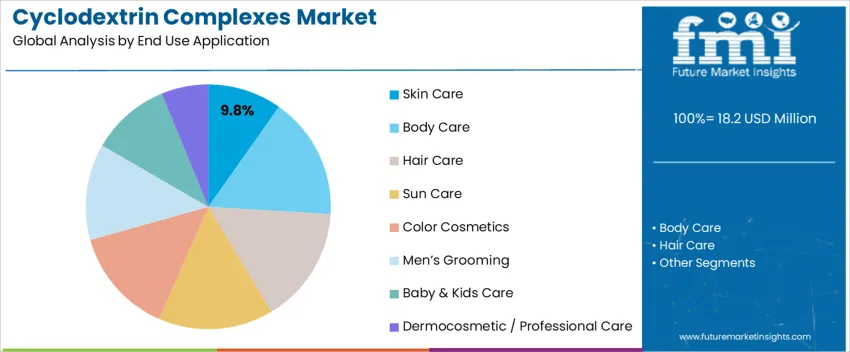
Skin care accounts for 9.8% of global cyclodextrin complex usage. This share is supported by the growing demand for advanced skin care formulations, where cyclodextrins are used to encapsulate active ingredients like vitamins, peptides, and antioxidants, improving their stability and delivery to deeper layers of the skin. Cyclodextrins’ ability to enhance ingredient bioavailability and ensure controlled release is a key factor in their increasing adoption in facial cleansers, serums, toners, and creams. The demand for skin care products featuring cyclodextrin complexes is strongest in South Korea, Japan, the USA, and Western Europe, where there is a high level of innovation in dermocosmetics and both clinical and mass retail segments.
Cyclodextrins in skin care also allow for higher ingredient loading compared to traditional formulations, improving the efficacy of active compounds. Dermocosmetic brands and professional care products, especially those targeting acne care, post-procedure recovery, and sensitive skin, benefit from these complexes' ability to stabilize and deliver ingredients more effectively. These formulation advantages are expected to drive further growth in the skin care segment, reinforcing it as the leading global application for cyclodextrin complexes.
Why Does Powder Form Dominate Product Positioning in the Global Cyclodextrin Complexes Market?
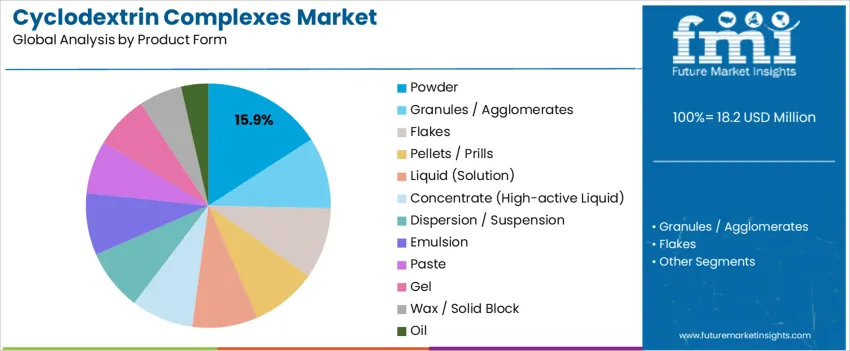
Powder form holds a 15.9% share of global cyclodextrin complex demand, largely due to its stability, ease of incorporation into various formulations, and ability to preserve the efficacy of active ingredients. Powders are particularly favored for their superior shelf stability and precise dosing capabilities across different applications, such as emulsions, gels, and masks. This form also facilitates consistent batch performance in high-volume production, particularly in regions like Asia, Europe, and North America, where large-scale manufacturing is common.
Powder forms of cyclodextrins improve transport efficiency in global supply chains by reducing leakage risks and lowering refrigeration dependencies during cross-border shipping. Contract manufacturers prefer powders due to their compatibility with automated blending systems, ensuring predictable quality retention across varying climate conditions. Regulatory documentation and microbial specification controls are also more standardized for powdered inputs, especially in export markets. These logistical, processing, and compliance advantages make powder the dominant product form for cyclodextrin complexes, maintaining its leadership in the global market.
What is Shaping the Cyclodextrin Complexes Market Worldwide?
The cyclodextrin complexes market is shaped by growing demand for enhanced solubility and bioavailability of active ingredients in pharmaceuticals, cosmetics, and food products. Cyclodextrins, with their ability to encapsulate molecules, are increasingly used to improve the stability and delivery of drugs, fragrances, and nutraceuticals. The development of cyclodextrin complexes is accelerating due to advances in nanotechnology and encapsulation techniques, which allow for more efficient use of active ingredients. The market is further influenced by the rising trend of clean label formulations, which promotes the use of natural ingredients and eco-friendly production processes. Challenges in formulating stable cyclodextrin complexes and ensuring regulatory compliance across regions are factors that need to be addressed for broader adoption.
Which Factors are Driving Global Demand for Cyclodextrin Complexes?
Global demand for cyclodextrin complexes is growing as industries seek improved delivery systems for poorly soluble compounds. In pharmaceuticals, cyclodextrins enhance the bioavailability of drugs, especially those with low water solubility. In the food and beverage sector, cyclodextrins are used to encapsulate flavors, preservatives, and functional ingredients, improving product shelf life and stability. The increasing consumer preference for effective and natural ingredients in personal care products is also boosting the demand for cyclodextrins in cosmetics. E-commerce platforms and research-driven innovations are further encouraging the use of cyclodextrin complexes, as manufacturers focus on enhancing product formulations to meet consumer expectations for performance and quality.
What Constraints are Limiting Growth in the Cyclodextrin Complexes Market?
Growth in the cyclodextrin complexes market is hindered by technical and regulatory challenges. The process of forming stable cyclodextrin complexes that maintain their properties throughout storage and use can be complex and costly. The cost of raw materials and production techniques can limit the scalability of certain cyclodextrin-based formulations, especially in emerging markets. In addition, regulatory hurdles around claims related to the health benefits of cyclodextrin complexes, particularly in food and pharmaceutical applications, are restricting growth. Variations in regional regulations also complicate the global expansion of cyclodextrin-based products, requiring additional time and investment to navigate.
Which Key Trends are Redefining Cyclodextrin Complexes Globally?
Key trends shaping the cyclodextrin complexes sector include the growing preference for multifunctional formulations that combine cyclodextrins with other ingredients such as essential oils, vitamins, and minerals. The food and pharmaceutical industries are focusing on the use of cyclodextrins in clean label products, with an emphasis on natural and non-GMO sources. There is also a shift toward personalized healthcare, with cyclodextrin complexes being utilized in targeted drug delivery systems and supplements tailored to individual needs. Innovations in cyclodextrin production, including the use of renewable resources and sustainable practices, are gaining momentum. The rise of digital platforms and direct-to-consumer models is helping brands increase awareness and adoption of cyclodextrin-based products, particularly in nutraceuticals and personal care products.
What is the Global Growth Outlook for the Cyclodextrin Complexes Industry by Country?
| Country | CAGR (%) |
|---|---|
| India | 12.2% |
| China | 11.3% |
| Japan | 10.4% |
| UK | 9.5% |
| Germany | 8.6% |
| USA | 7.7% |
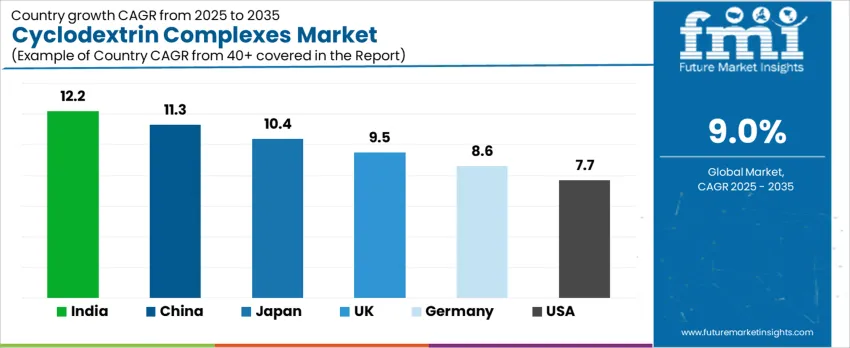
The cyclodextrin complexes industry is witnessing global growth, led by India with a 12.2% CAGR, driven by the expanding pharmaceutical sector and increasing demand for drug delivery systems. China follows with 11.3%, bolstered by the booming manufacturing sector and advancements in food and beverage applications. Japan's 10.4% growth reflects a steady adoption of cyclodextrins in pharmaceuticals and food industries. The UK and Germany report growth rates of 9.5% and 8.6%, respectively, driven by the growing interest in functional foods and pharmaceutical applications. The USA shows moderate growth at 7.7%, with established industries driving steady demand in both pharmaceutical and food sectors.
What is Powering the Growth of Cyclodextrin Complexes in India?
India is seeing a CAGR of 12.2% for cyclodextrin complexes, fueled by the booming pharmaceutical industry and the increasing use of cyclodextrins for drug solubility enhancement and controlled release. The demand for advanced drug delivery systems and functional foods is rising in both urban and rural areas. Pharmaceutical companies are integrating cyclodextrins into drug formulations to improve bioavailability and efficacy. Furthermore, rising disposable incomes and healthcare access in India are driving the adoption of cyclodextrin-based products. The growth is further supported by domestic manufacturing and the increasing penetration of online healthcare and wellness retail platforms.
- Strong pharmaceutical sector drives cyclodextrin adoption
- Increased demand for drug solubility enhancement
- Growing food and beverage sector integrates cyclodextrins
- Online retail expansion supports consumer access
How is China Driving Growth in Cyclodextrin Complexes?
China's cyclodextrin complexes industry is growing at a CAGR of 11.3%, driven by strong demand in the pharmaceutical, food, and beverage industries. Cyclodextrins are increasingly used for drug delivery systems and enhancing food formulations, especially in the nutraceutical and functional food sectors. As China's manufacturing capabilities expand, more cyclodextrin-based products are being produced domestically, enhancing affordability and supply chain efficiency. The government's support for healthcare innovation and rising consumer interest in health-conscious products further drive demand. Retail channels, including pharmacies and online platforms, are playing a significant role in the distribution of cyclodextrin-based products.
- Growing pharmaceutical and food sectors boost demand
- Advancements in drug delivery drive pharmaceutical use
- Increased production capacity meets rising demand
- Retail and online platforms expand product access
What is Supporting Japan’s Strong Growth in Cyclodextrin Complexes?
Japan's cyclodextrin complexes market is experiencing steady growth with a CAGR of 10.4%, driven by innovations in drug delivery technologies and food applications. Proficiency in pharmaceutical research and development has led to the adoption of cyclodextrins for controlled drug release and improving solubility. In the food sector, Japan's preference for functional and health-conscious foods supports the demand for cyclodextrin-based products. Aging population trends further boost the need for health supplements and nutraceuticals, with cyclodextrins enhancing product formulations. Product quality and scientific validation are central to consumer trust, with continuous research fueling sustained demand.
- Innovation in pharmaceutical and food applications drives growth
- Controlled drug release systems gain traction
- Functional food and nutraceutical demand rises
- Quality and scientific validation foster trust
What Factors Are Driving Growth for Cyclodextrin Complexes in the UK?
The UK reports a CAGR of 9.5% for cyclodextrin complexes, supported by the growing demand for functional foods and drug delivery systems. Increasing awareness of digestive health, coupled with a rising interest in nutraceuticals and specialty ingredients, is fueling adoption. Cyclodextrins are used in the pharmaceutical industry for drug formulation enhancement and improving bioavailability. The UK also sees a steady rise in the use of cyclodextrins in the food and beverage industry, particularly in the development of low-calorie and sugar-free products. Regulatory frameworks and healthcare trends, particularly in preventive medicine, further support market growth.
- Growing interest in functional foods boosts adoption
- Drug formulation enhancement drives pharmaceutical use
- Rise in nutraceutical and health product demand
- Preventive health trends sustain long-term usage
Why is the USA Experiencing Stable Growth in Cyclodextrin Complexes?
The USA is experiencing steady growth in the cyclodextrin complexes industry, with a CAGR of 7.7%. The mature pharmaceutical market in the USA continues to drive demand for cyclodextrins, particularly for drug solubility and controlled release applications. The increasing demand for functional foods and health supplements is supporting growth. The USA's high healthcare standards and rigorous regulatory environment ensure quality products, while the focus on innovation and research leads to continued advancements in drug delivery systems. However, growth remains moderate due to the saturated market and high competition in both the pharmaceutical and food sectors.
- Strong pharmaceutical industry supports steady demand
- Functional food sector integrates cyclodextrins for enhanced formulations
- Regulatory standards ensure high product quality
- Saturated market limits rapid growth acceleration
What is Driving the Demand for Cyclodextrin Complexes Globally and Who Are the Key Players Shaping the Industry?
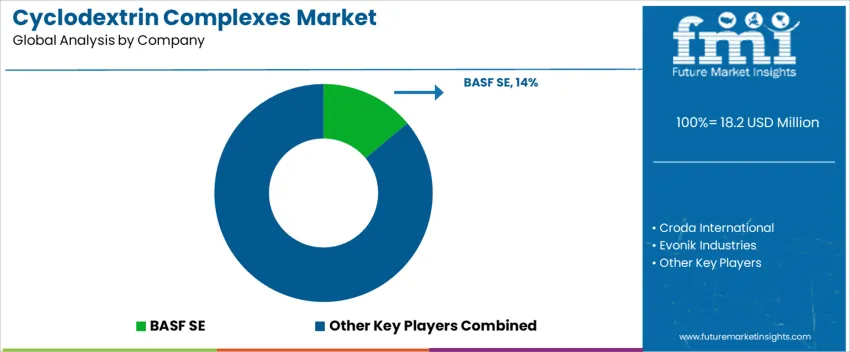
The demand for cyclodextrin complexes is growing due to their ability to enhance solubility, stability, and bioavailability of various compounds, making them essential across multiple sectors, including food, pharmaceuticals, cosmetics, and agriculture. These complexes are increasingly used in applications such as controlled drug release, functional foods, and cosmetic formulations. As consumers seek health-conscious products with improved effectiveness, cyclodextrins provide innovative solutions, driving their adoption. Advances in cyclodextrin chemistry and improved manufacturing methods are making these complexes more accessible and tailored to meet specific industry needs.
Key players in the cyclodextrin complexes market include BASF SE, Croda International, Evonik Industries, Symrise (including IFF/Givaudan active ingredient businesses), Dow Inc., Ashland, Clariant, and Seppic. BASF SE leads the market with a significant share of 14.0%. These industry leaders capitalize on their scale, manufacturing capabilities, and regulatory expertise to maintain a competitive edge. Smaller niche players offer specialized and custom formulations, ensuring a diversified landscape within the market.
The growth of the cyclodextrin complexes sector is further fueled by research into their potential benefits in drug delivery systems, functional foods, and consumer goods. As the focus on bioactive ingredient delivery systems intensifies, cyclodextrins are becoming critical in developing formulations that enhance the performance and efficacy of products. Improved processing technologies and a deeper understanding of the role of cyclodextrins in various applications support the growing demand for customized solutions, expanding their reach in different industries.
Key Players in the Cyclodextrin Complexes Market
- BASF SE
- Croda International
- Evonik Industries
- Symrise (incl. IFF/Givaudan actives)
- Dow / Dow Inc.
- Ashland
- Clariant
Scope of Report
| Items | Values |
|---|---|
| Quantitative Units (2025) | USD million |
| End Use Application | Skin Care, Body Care, Hair Care, Sun Care, Color Cosmetics, Men’s Grooming, Baby & Kids Care, Dermocosmetic / Professional Care |
| Product Form | Powder, Granules / Agglomerates, Flakes, Pellets / Prills, Liquid (Solution), Concentrate (High-active Liquid), Dispersion / Suspension, Emulsion, Paste, Gel, Wax / Solid Block, Oil |
| Regions Covered | North America, Europe, East Asia, South Asia, Latin America, Middle East & Africa, Eastern Europe |
| Countries Covered | USA, China, Japan, South Korea, India, Germany, UK, France, Italy, Brazil, Argentina, Mexico, Saudi Arabia, South Africa, Russia, others |
| Key Companies Profiled | BASF SE, Croda International, Evonik Industries, Symrise (including IFF/Givaudan actives), Dow / Dow Inc., Ashland, Clariant, Seppic / Others (Lubrizol, Lonza, Inolex), Other regional and niche suppliers |
| Additional Attributes | Dollar by sales by end use application and product form; regional CAGR and growth outlook; multi-strain formulation adoption; clinical validation and regulatory compliance tracking; distribution channels including retail, DTC, e-commerce, and institutional buyers; product form prevalence in powders, liquids, and emulsions; regional preference for strain libraries; supply chain logistics for cold chain and ambient stability; strain survivability, CFU consistency, and shelf-life performance; innovation trends including prebiotic/postbiotic combinations, non-dairy matrices, and personalized nutrition; competitive positioning of global vs regional suppliers. |
Cyclodextrin Complexes Market by Segments
End Use Application:
- Skin Care
- Body Care
- Hair Care
- Sun Care
- Color Cosmetics
- Men’s Grooming
- Baby & Kids Care
- Dermocosmetic / Professional Care
Product Form:
- Powder
- Granules / Agglomerates
- Flakes
- Pellets / Prills
- Liquid (Solution)
- Concentrate (High-active Liquid)
- Dispersion / Suspension
- Emulsion
- Paste
- Gel
- Wax / Solid Block
- Oil
Region:
- Asia Pacific
- China
- Japan
- South Korea
- India
- Australia & New Zealand
- ASEAN
- Rest of Asia Pacific
- Europe
- Germany
- United Kingdom
- France
- Italy
- Spain
- Nordic
- BENELUX
- Rest of Europe
- North America
- United States
- Canada
- Mexico
- Latin America
- Brazil
- Chile
- Rest of Latin America
- Middle East & Africa
- Kingdom of Saudi Arabia
- Other GCC Countries
- Turkey
- South Africa
- Other African Union
- Rest of Middle East & Africa
Frequently Asked Questions
How big is the cyclodextrin complexes market in 2025?
The global cyclodextrin complexes market is estimated to be valued at USD 18.2 million in 2025.
What will be the size of cyclodextrin complexes market in 2035?
The market size for the cyclodextrin complexes market is projected to reach USD 43.3 million by 2035.
How much will be the cyclodextrin complexes market growth between 2025 and 2035?
The cyclodextrin complexes market is expected to grow at a 9.0% CAGR between 2025 and 2035.
What are the key product types in the cyclodextrin complexes market?
The key product types in cyclodextrin complexes market are skin care, body care, hair care, sun care, color cosmetics, men’s grooming, baby & kids care and dermocosmetic / professional care.
Which product form segment to contribute significant share in the cyclodextrin complexes market in 2025?
In terms of product form , powder segment to command 15.9% share in the cyclodextrin complexes market in 2025.
Preview the report firsthand - request a free sample
Get SampleGet the brochure for pricing and purchase details.
Get PDFTable of Content
- Executive Summary
- Global Market Outlook
- Demand-side Trends
- Supply-side Trends
- Technology Roadmap Analysis
- Analysis and Recommendations
- Market Overview
- Market Coverage / Taxonomy
- Market Definition / Scope / Limitations
- Market Background
- Market Dynamics
- Drivers
- Restraints
- Opportunity
- Trends
- Scenario Forecast
- Demand in Optimistic Scenario
- Demand in Likely Scenario
- Demand in Conservative Scenario
- Opportunity Map Analysis
- Product Life Cycle Analysis
- Supply Chain Analysis
- Investment Feasibility Matrix
- Value Chain Analysis
- PESTLE and Porter’s Analysis
- Regulatory Landscape
- Regional Parent Market Outlook
- Production and Consumption Statistics
- Import and Export Statistics
- Market Dynamics
- Global Market Analysis 2020 to 2024 and Forecast, 2025 to 2035
- Historical Market Size Value (USD Million) Analysis, 2020 to 2024
- Current and Future Market Size Value (USD Million) Projections, 2025 to 2035
- Y-o-Y Growth Trend Analysis
- Absolute $ Opportunity Analysis
- Global Market Pricing Analysis 2020 to 2024 and Forecast 2025 to 2035
- Global Market Analysis 2020 to 2024 and Forecast 2025 to 2035, By End Use Application
- Introduction / Key Findings
- Historical Market Size Value (USD Million) Analysis By End Use Application , 2020 to 2024
- Current and Future Market Size Value (USD Million) Analysis and Forecast By End Use Application , 2025 to 2035
- Skin Care
- Body Care
- Hair Care
- Sun Care
- Color Cosmetics
- Men’s Grooming
- Baby & Kids Care
- Dermocosmetic / Professional Care
- Y-o-Y Growth Trend Analysis By End Use Application , 2020 to 2024
- Absolute $ Opportunity Analysis By End Use Application , 2025 to 2035
- Global Market Analysis 2020 to 2024 and Forecast 2025 to 2035, By Product Form
- Introduction / Key Findings
- Historical Market Size Value (USD Million) Analysis By Product Form, 2020 to 2024
- Current and Future Market Size Value (USD Million) Analysis and Forecast By Product Form, 2025 to 2035
- Powder
- Granules / Agglomerates
- Flakes
- Pellets / Prills
- Liquid (Solution)
- Concentrate (High-active Liquid)
- Dispersion / Suspension
- Emulsion
- Paste
- Gel
- Wax / Solid Block
- Y-o-Y Growth Trend Analysis By Product Form, 2020 to 2024
- Absolute $ Opportunity Analysis By Product Form, 2025 to 2035
- Global Market Analysis 2020 to 2024 and Forecast 2025 to 2035, By Region
- Introduction
- Historical Market Size Value (USD Million) Analysis By Region, 2020 to 2024
- Current Market Size Value (USD Million) Analysis and Forecast By Region, 2025 to 2035
- North America
- Latin America
- Western Europe
- Eastern Europe
- East Asia
- South Asia and Pacific
- Middle East & Africa
- Market Attractiveness Analysis By Region
- North America Market Analysis 2020 to 2024 and Forecast 2025 to 2035, By Country
- Historical Market Size Value (USD Million) Trend Analysis By Market Taxonomy, 2020 to 2024
- Market Size Value (USD Million) Forecast By Market Taxonomy, 2025 to 2035
- By Country
- USA
- Canada
- Mexico
- By End Use Application
- By Product Form
- By Country
- Market Attractiveness Analysis
- By Country
- By End Use Application
- By Product Form
- Key Takeaways
- Latin America Market Analysis 2020 to 2024 and Forecast 2025 to 2035, By Country
- Historical Market Size Value (USD Million) Trend Analysis By Market Taxonomy, 2020 to 2024
- Market Size Value (USD Million) Forecast By Market Taxonomy, 2025 to 2035
- By Country
- Brazil
- Chile
- Rest of Latin America
- By End Use Application
- By Product Form
- By Country
- Market Attractiveness Analysis
- By Country
- By End Use Application
- By Product Form
- Key Takeaways
- Western Europe Market Analysis 2020 to 2024 and Forecast 2025 to 2035, By Country
- Historical Market Size Value (USD Million) Trend Analysis By Market Taxonomy, 2020 to 2024
- Market Size Value (USD Million) Forecast By Market Taxonomy, 2025 to 2035
- By Country
- Germany
- UK
- Italy
- Spain
- France
- Nordic
- BENELUX
- Rest of Western Europe
- By End Use Application
- By Product Form
- By Country
- Market Attractiveness Analysis
- By Country
- By End Use Application
- By Product Form
- Key Takeaways
- Eastern Europe Market Analysis 2020 to 2024 and Forecast 2025 to 2035, By Country
- Historical Market Size Value (USD Million) Trend Analysis By Market Taxonomy, 2020 to 2024
- Market Size Value (USD Million) Forecast By Market Taxonomy, 2025 to 2035
- By Country
- Russia
- Poland
- Hungary
- Balkan & Baltic
- Rest of Eastern Europe
- By End Use Application
- By Product Form
- By Country
- Market Attractiveness Analysis
- By Country
- By End Use Application
- By Product Form
- Key Takeaways
- East Asia Market Analysis 2020 to 2024 and Forecast 2025 to 2035, By Country
- Historical Market Size Value (USD Million) Trend Analysis By Market Taxonomy, 2020 to 2024
- Market Size Value (USD Million) Forecast By Market Taxonomy, 2025 to 2035
- By Country
- China
- Japan
- South Korea
- By End Use Application
- By Product Form
- By Country
- Market Attractiveness Analysis
- By Country
- By End Use Application
- By Product Form
- Key Takeaways
- South Asia and Pacific Market Analysis 2020 to 2024 and Forecast 2025 to 2035, By Country
- Historical Market Size Value (USD Million) Trend Analysis By Market Taxonomy, 2020 to 2024
- Market Size Value (USD Million) Forecast By Market Taxonomy, 2025 to 2035
- By Country
- India
- ASEAN
- Australia & New Zealand
- Rest of South Asia and Pacific
- By End Use Application
- By Product Form
- By Country
- Market Attractiveness Analysis
- By Country
- By End Use Application
- By Product Form
- Key Takeaways
- Middle East & Africa Market Analysis 2020 to 2024 and Forecast 2025 to 2035, By Country
- Historical Market Size Value (USD Million) Trend Analysis By Market Taxonomy, 2020 to 2024
- Market Size Value (USD Million) Forecast By Market Taxonomy, 2025 to 2035
- By Country
- Kingdom of Saudi Arabia
- Other GCC Countries
- Turkiye
- South Africa
- Other African Union
- Rest of Middle East & Africa
- By End Use Application
- By Product Form
- By Country
- Market Attractiveness Analysis
- By Country
- By End Use Application
- By Product Form
- Key Takeaways
- Key Countries Market Analysis
- USA
- Pricing Analysis
- Market Share Analysis, 2024
- By End Use Application
- By Product Form
- Canada
- Pricing Analysis
- Market Share Analysis, 2024
- By End Use Application
- By Product Form
- Mexico
- Pricing Analysis
- Market Share Analysis, 2024
- By End Use Application
- By Product Form
- Brazil
- Pricing Analysis
- Market Share Analysis, 2024
- By End Use Application
- By Product Form
- Chile
- Pricing Analysis
- Market Share Analysis, 2024
- By End Use Application
- By Product Form
- Germany
- Pricing Analysis
- Market Share Analysis, 2024
- By End Use Application
- By Product Form
- UK
- Pricing Analysis
- Market Share Analysis, 2024
- By End Use Application
- By Product Form
- Italy
- Pricing Analysis
- Market Share Analysis, 2024
- By End Use Application
- By Product Form
- Spain
- Pricing Analysis
- Market Share Analysis, 2024
- By End Use Application
- By Product Form
- France
- Pricing Analysis
- Market Share Analysis, 2024
- By End Use Application
- By Product Form
- India
- Pricing Analysis
- Market Share Analysis, 2024
- By End Use Application
- By Product Form
- ASEAN
- Pricing Analysis
- Market Share Analysis, 2024
- By End Use Application
- By Product Form
- Australia & New Zealand
- Pricing Analysis
- Market Share Analysis, 2024
- By End Use Application
- By Product Form
- China
- Pricing Analysis
- Market Share Analysis, 2024
- By End Use Application
- By Product Form
- Japan
- Pricing Analysis
- Market Share Analysis, 2024
- By End Use Application
- By Product Form
- South Korea
- Pricing Analysis
- Market Share Analysis, 2024
- By End Use Application
- By Product Form
- Russia
- Pricing Analysis
- Market Share Analysis, 2024
- By End Use Application
- By Product Form
- Poland
- Pricing Analysis
- Market Share Analysis, 2024
- By End Use Application
- By Product Form
- Hungary
- Pricing Analysis
- Market Share Analysis, 2024
- By End Use Application
- By Product Form
- Kingdom of Saudi Arabia
- Pricing Analysis
- Market Share Analysis, 2024
- By End Use Application
- By Product Form
- Turkiye
- Pricing Analysis
- Market Share Analysis, 2024
- By End Use Application
- By Product Form
- South Africa
- Pricing Analysis
- Market Share Analysis, 2024
- By End Use Application
- By Product Form
- USA
- Market Structure Analysis
- Competition Dashboard
- Competition Benchmarking
- Market Share Analysis of Top Players
- By Regional
- By End Use Application
- By Product Form
- Competition Analysis
- Competition Deep Dive
- BASF SE
- Overview
- Product Portfolio
- Profitability by Market Segments (Product/Age /Sales Channel/Region)
- Sales Footprint
- Strategy Overview
- Marketing Strategy
- Product Strategy
- Channel Strategy
- Croda International
- Evonik Industries
- Symrise (incl. IFF/Givaudan actives)
- Dow / Dow Inc.
- Ashland
- Clariant
- Seppic
- BASF SE
- Competition Deep Dive
- Assumptions & Acronyms Used
- Research Methodology


