
- Market Size (2026)
- USD 23.7 Bn
- Forecast (2036)
- USD 41.3 Bn
- CAGR (2026 to 2036)
- 5.7%
How big is Die-Cutter Market in 2026?
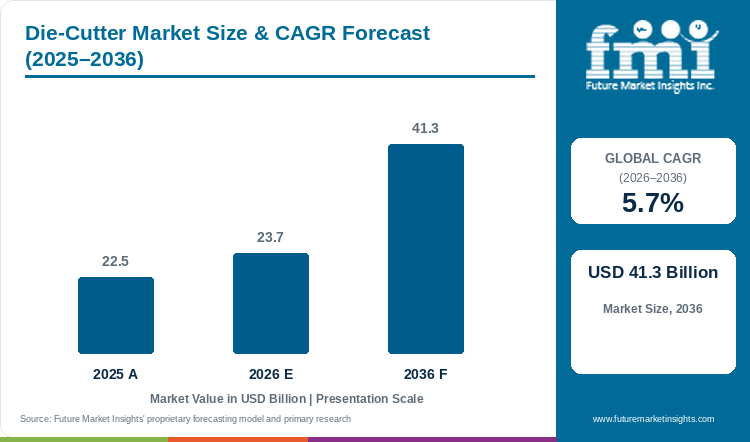
The die-cutter market demonstrated steady progress from USD 22.5 billion in 2025 to USD 23.7 billion in 2026, building toward a targeted valuation of USD 41.3 billion by 2036 at a CAGR of 5.7%.
Valuation of the global die-cutter market progressed from USD 22.5 billion in 2025 to USD 23.7 billion in 2026 and is forecast to climb to USD 41.3 billion by 2036, reflecting a 5.7% CAGR over the decade. Carton and box converters are replacing older hand-fed platen presses with automated flatbed and rotary die-cutters because shorter retail promotional runs and high pressroom wages make manual setup and stripping unprofitable. At its June 2026 Summit, the European Federation of Corrugated Board Manufacturers documented 52 billion square meters of annual European corrugated board output protecting more than 75% of shipped goods [1]. Flatbed Die-Cutting Machines represent 39.2% of 2026 demand as carton plants rely on quick-lock flat dies, moving in step with corrugated box packaging equipment demand at a 6.6% CAGR. Machinery builders are launching faster, wider presses to meet this replacement demand, and in July 2026 Koenig & Bauer AG introduced its CutPRO 2.1 flatbed die-cutter running 7,000 sheets per hour on 1,300 by 2,100 millimeter board [2]. FMI survey insights suggest that turnkey machine prices above USD 1.2 million remain a significant capital hurdle for smaller regional print shops.
Key Market Trends & Insights
- By machine architecture: Flatbed Die-Cutting Machines hold an estimated 39.2% share in 2026 because flat steel-rule dies deliver superior crease definition on folding cartons and micro-flute displays.
- By automation level: Fully Automated High-Speed Lines represent 59.6% in 2026 as optical print-to-cut registration and automated waste stripping offset skilled press operator shortages.
- By substrate processed: Corrugated Board and Solid Fiber accounts for 46.7% in 2026 because e-commerce mailers and retail-ready trays require perforated tear strips and locking tabs.
- By end-use industry: Dedicated packaging converting plants secure 50.4% in 2026 owing to continuous multi-shift carton, corrugated, and label blank production.
- By distribution channel: Direct OEM Turnkey Sales command 64.5% in 2026 through factory acceptance testing, custom feeder integration, and remote predictive maintenance contracts.
Regional Highlights
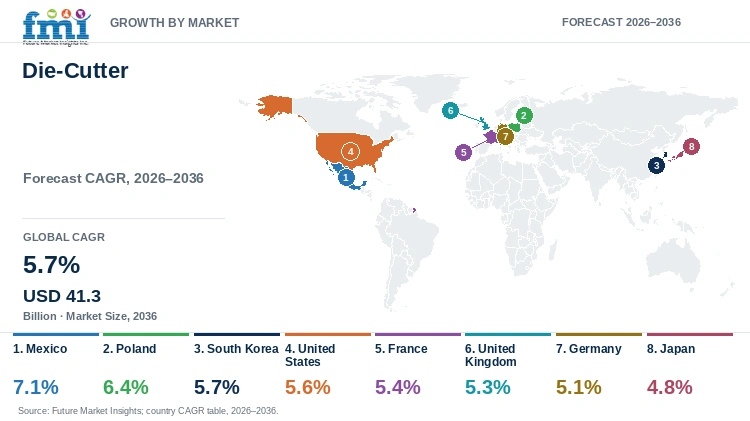
- Top national expansion: Mexico leads national growth projections at a 7.1% CAGR through 2036 under near-shored appliance, automotive, and food-export corrugated converting investments.
- Broader country progression: Poland tracks at a 6.4% CAGR ahead of South Korea at 5.7% and the United States at 5.6%, whereas France records a 5.4% CAGR and the United Kingdom advances at a 5.3% CAGR.
Market Size & Forecast
Table 1: Market Size and Forecast for the Die-Cutter Market (USD billion and CAGR percentage), 2025 to 2036
| Metric | Value |
|---|---|
| 2025 Market Size | USD 22.5 billion |
| Estimated Market Size in 2026 | USD 23.7 billion |
| Projected Market Size by 2036 | USD 41.3 billion |
| CAGR, 2026 to 2036 | 5.7% |
| Added Valuation, 2026 to 2036 | USD 17.6 billion |
Smaller average order sizes across food, beverage, and cosmetics packaging are forcing folding carton and corrugated plants to change cutting dies eight to twelve times per day. On older mechanical presses, bolting steel-rule dies and aligning stripping pins can take over forty minutes per job, which leaves expensive press crews idle between short runs. To solve this setup bottleneck, in July 2026 Bobst Group SA highlighted how its large-format Mastercut 165 PER flatbed die-cutter enables rapid single-operator job changeovers across solid board and corrugated sheets [3]. As a result, converting plants evaluating sheet die cutters steadily invest in motorized die lockup and automated stripping stations that maximize sellable blanks per shift.
Installed Press Fleet and Annual Unit Shipment Sizing
Table 2: Installed Fleet and Annual Unit Shipment Sizing for the Die-Cutter Market (USD billion and operational ranges), 2025 to 2036
| Metric | 2025 | 2026 | 2036 |
|---|---|---|---|
| Market size (USD billion) | 22.5 | 23.7 | 41.3 |
| Annual industrial die-cutter unit shipments (thousand units) | 38.5 to 42.0 | 40.2 to 44.0 | 64.0 to 70.5 |
| Active global commercial press fleet (thousand machines) | 410.0 to 435.0 | 425.0 to 450.0 | 580.0 to 620.0 |
| Mean realized system price per industrial unit (USD thousand) | 535.0 to 585.0 | 540.0 to 590.0 | 585.0 to 645.0 |
Operational note: Unit shipment and system price ranges cover automatic flatbed platens, wide-format rotary corrugated die-cutters, and galvo laser converting lines with inline stripping and blanking modules.
Retail brands demanding photorealistic graphics on shelf-ready boxes and folding cartons are pushing converters to eliminate trim registration errors during high-speed cutting. If a die-cutter drifts by even half a millimeter on pre-printed board, visible white edges appear along carton flaps and trigger costly customer rejections. In June 2026, industrial vision researchers writing in Scientific Reports confirmed that a modified YOLOv8 inspection model achieved 98.1% precision in catching outer carton packaging defects on production lines [4]. Box makers buying flatbed die cutters therefore specify camera-guided optical register systems that measure printed sheet marks rather than mechanical sheet edges.
Per Capita & Converting Facility Capital Allocation
Table 3: Per Capita and Converting Facility Allocation Indicators for the Die-Cutter Market (USD), 2025 to 2036
| Metric | 2025 | 2026 | 2036 |
|---|---|---|---|
| World population (billion) | 8.2 | 8.3 | 9.0 |
| Market value per 1,000 people (USD) | 2,743.9 | 2,855.4 | 4,588.9 |
| Annual die-cutting capex per converting plant (USD thousand) | 480.0 to 540.0 | 505.0 to 565.0 | 810.0 to 905.0 |
| Fully automated and digital cutting share (%) | 57.0% to 60.0% | 59.0% to 62.0% | 74.0% to 78.0% |
Table 4: Converting Plant & Channel Indicators for the Die-Cutter Market (USD and percentages), 2026
| Metric | Value | Institutional Reference Basis |
|---|---|---|
| Market size, 2026 | USD 23.7 billion | 2026 global valuation baseline |
| Active packaging, print & gasket converting plants global | 44,500 plants | Corrugated, folding carton, label & industrial die plants |
| Mean machinery allocation per plant | USD 532,584.3 | Annualized die-cutting capital and tooling allocation |
| Direct OEM Turnkey Sales value, 2026 | USD 15.3 billion | 64.5% distribution channel allocation |
Higher production of electric-vehicle battery thermal pads, acoustic automotive seals, and medical dressings is expanding industrial demand for precision rotary kiss-cutting and flatbed gasket presses. Unlike paperboard boxes, multi-layer adhesive foams and thin polymer films deform easily if cutting rule pressure fluctuates across the anvil roll. In June 2025, manufacturing engineers reporting in the International Journal of Oral and Maxillofacial Implants showed through microscopy that uncalibrated mechanical die forming increases dimensional variation and edge debris [5]. Industrial converters investing in corrugated box machines and gasket presses consequently specify servo-controlled anvil depth compensation to hold micron-level tolerances.
Analyst Perspective
"Carton and box converters no longer evaluate a die-cutter by its nameplate top speed alone because they calculate net sellable blanks delivered per shift across eight or ten job changes. Machinery builders that combine camera-guided optical register, tool-less stripping frames, and inline pallet blanking will capture turnkey line replacements as box plants automate end-of-line converting."
- Nandini Roy Choudhury, Principal Consultant, Future Market Insights.
How is the die-cutter market segmented?
The die-cutter market is segmented by machine architecture, automation level, substrate processed, end-use industry, and distribution channel. In 2026, Flatbed Die-Cutting Machines is projected at 39.2%, Fully Automated High-Speed Lines at 59.6%, Corrugated Board and Solid Fiber at 46.7%, Packaging Converting Plants at 50.4%, and Direct OEM Turnkey Sales at 64.5%.
By machine architecture: Flatbed Die-Cutting Machines, Rotary Die-Cutting Machines, and Laser and Digital Cutting Systems.
By automation level: Fully Automated High-Speed Lines and Semi-Automated Modular Units.
By substrate processed: Corrugated Board and Solid Fiber, Folding Paperboard Cartons, and Polymer Films and Foils.
By end-use industry: Dedicated packaging converting plants, commercial printing facilities, and automotive and industrial gaskets.
By distribution channel: Direct OEM Turnkey Sales, Authorized Machinery Integrators and Dealers, and Certified Retrofit and Rebuild Channels.
Why do Flatbed Die-Cutting Machines lead the machine architecture category?
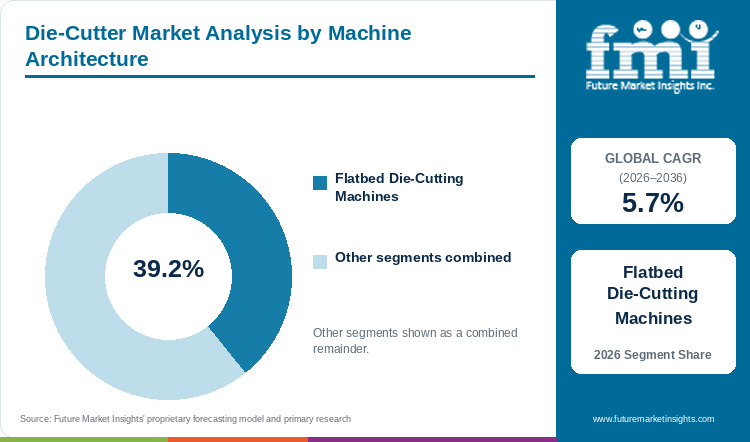
Flatbed Die-Cutting Machines hold an estimated 39.2% of machine architecture demand in 2026, anchored by superior creasing accuracy and low steel-rule tooling cost.
Table 5: Machine Architecture Share for the Die-Cutter Market (percentage share), 2026
| Machine Architecture | Share (2026) |
|---|---|
| Flatbed Die-Cutting Machines | 39.2% |
| Other Segments Combined | 60.8%* |
| Total | 100.0% |
*Note: Remaining machine architecture categories (Rotary Die-Cutting Machines at 36.5% and Laser and Digital Cutting Systems at 24.3%) account for the balance of 2026 global die-cutter demand.
Table 6: Machine Architecture Leadership and Market Growth for the Die-Cutter Market (segment and CAGR percentage), 2026 to 2036
| Metric | Value |
|---|---|
| Global CAGR (2026 to 2036) | 5.7% |
| Leading Segment | Flatbed Die-Cutting Machines |
Lower tooling costs and versatile creasing performance keep Flatbed Die-Cutting Machines in the lead across the machine architecture category. Carton and display converters prefer flatbed platen presses because flat laser-cut plywood steel-rule dies cost 60% to 75% less than curved rotary dies and can cut, crease, and emboss in a single vertical stroke. Rotary Die-Cutting Machines hold 36.5% of 2026 demand for high-volume corrugated shipping cases, while Laser and Digital Cutting Systems capture 24.3% for tool-free short runs. Plants purchasing paper cup blank and die-cutting machinery rely on flatbed platens to handle frequent structural design changes without high tooling write-offs.
- Flatbed Die-Cutting Machines hold 39.2% of machine architecture value in 2026 because flat steel-rule tooling lowers per-job die expenditure across frequent carton redesigns.
- In October 2025, Koenig & Bauer AG announced that converter Morrisette Packaging invested in two new corrugated converting machines combining flatbed and rotary cutting for June 2026 commissioning [6].
What sustains Fully Automated High-Speed Lines leadership in automation level?
Fully Automated High-Speed Lines represent 59.6% of the automation level category in 2026, supported by non-stop pallet logistics and robotic waste stripping.
Persistent shortages of skilled press operators and rising factory wages explain why Fully Automated High-Speed Lines dominate the automation level segment. Manual pneumatic-hammer stripping of die-cut carton stacks requires three to four workers per press and creates ergonomic injury risks, whereas automated blanking lines deliver separated, palletized bundles with one operator. Semi-Automated Modular Units account for the remaining 40.4% share in 2026 among smaller job shops producing oversized point-of-sale displays. Box plants upgrading corrugated box printer slotter machines connect fully automated die-cutters to pre-feeders and robotic palletizers for continuous three-shift output.
- Fully Automated High-Speed Lines represent 59.6% of the automation level segment in 2026 as inline blank separation eliminates manual pneumatic hammer stripping.
- In February 2025, Bobst Group SA detailed how closed-loop register automation and connected workflow software reduce setup waste and labor dependency across packaging converters [7].
How does Corrugated Board and Solid Fiber lead the substrate processed category?
Corrugated Board and Solid Fiber accounts for 46.7% of substrate processed volume in 2026, driven by e-commerce frustation-free mailers and shelf-ready retail trays.
Rapid growth in e-commerce parcel shipments and supermarket requirements for shelf-ready retail trays make Corrugated Board and Solid Fiber the largest substrate processed segment. Online retailers require right-sized corrugated mailers with tear-strip openers and locking tabs, while grocers demand perforated display cases that open cleanly on store shelves without box knives. Paperboard folding cartons account for 34.8% of 2026 demand across food and healthcare cartons, and Polymer Films and Foils hold 18.5% for labels and technical gaskets. Converters running corrugated fiberboard substrates specify vacuum-belt feeders that pull warped corrugated sheets into the die-cutter without crushing flute walls.
- Corrugated Board and Solid Fiber accounts for 46.7% of substrate processed demand in 2026 because e-commerce and supermarket display cases require complex die-cut ventilation and locking slots.
- In September 2025, DS Smith plc reported that replacing plastic industrial packaging with die-cut corrugated structures for Bosch Home Comfort Group reduced delivery truck volume by nearly 60% [8].
Why do Packaging Converting Plants lead the end-use industry category?
Packaging Converting Plants secure 50.4% of end-use industry value in 2026, supported by continuous three-shift carton and corrugated box production.
High equipment utilization across multi-shift carton, corrugated, and label factories keeps Packaging Converting Plants as the leading end-use industry. Dedicated packaging plants run flatbed and rotary die-cutters over 6,000 hours per year, requiring heavy-duty cast-iron frames that hold cutting pressure across millions of impressions. Commercial Printing Facilities hold 28.2% of 2026 demand as book and commercial printers add carton converting lines, while Automotive and Industrial Gaskets represent 21.4%. Multi-plant converters processing coated recycled paperboard sheets replace older presses on seven-to-ten-year depreciation cycles to protect plant throughput.
- Dedicated packaging converting plants secure 50.4% of end-use industry demand in 2026 because multi-plant carton and corrugated groups run die-cutters across 6,000+ operating hours annually.
- In October 2026, Smurfit Westrock plc won the Paperboard Packaging Council Richard DePaul Award for Creative Converting and Design for its rapid-turnaround die-cut beverage pack [9].
What gives Direct OEM Turnkey Sales the leading position in distribution channel?
Direct OEM Turnkey Sales commands 64.5% of distribution channel share in 2026, anchored by custom factory engineering and multi-year service telemetry.
Need for custom factory floor integration, operator training, and guaranteed spare-parts response drives the dominance of Direct OEM Turnkey Sales in the distribution channel category. Installation of a 35-ton automated die-cutter requires synchronizing upstream pre-feeders, under-floor scrap conveyors, and cloud diagnostic sensors directly with the press manufacturer. Authorized Machinery Integrators and Dealers account for 24.0% of 2026 sales among mid-sized regional printers, while Certified Retrofit and Rebuild Channels hold 11.5%. Direct OEM contracts give multi-plant converters single-point warranty coverage and remote predictive maintenance.
- Direct OEM Turnkey Sales commands 64.5% of distribution channel value in 2026 because integrated pre-feeder, die-cutter, and palletizer lines require single-vendor warranty accountability.
- In April 2026, Bobst Group SA presented its turnkey corrugated converting platforms and connected quality control systems to box makers in the United States and Canada at the Corrugated 2026 conference [10].
What are the drivers, restraints, and opportunities in the die-cutter market?
In the die-cutter market, retail SKU proliferation and pressroom automation mandates are projected to drive adoption whereas high capital installation costs and heat-affected edge tolerances on polymer substrates restrain uncalibrated systems and CO2 laser and digital crease-cut platforms unlock tool-free converting.
- Driver: Shorter promotional packaging runs and pressroom operator shortages push converters to buy automated quick-change flatbed and rotary die-cutters.
- Restraint: High upfront capital cost above USD 1.2 million for turnkey lines and thermal edge melting during laser polymer cutting limit smaller converters.
- Opportunity: Digital galvo CO2 laser cutters paired with AI parameter tuning enable zero-tooling short-run packaging and instant e-commerce box customization.
Growth Analysis and Future Potential: Qualitative Demand Catalysts
Rapid SKU proliferation in grocery retail and rising demand for custom-fit e-commerce boxes are compelling packaging plants to replace manual platens with automated quick-change die-cutters. When a consumer brand launches ten regional promotional carton designs instead of one national box, converters only earn a profit if die changeovers take less than five minutes. Box makers producing paper edge protectors and retail trays therefore invest in servo-driven presses with stored digital job recipes and motorized chase locks. In August 2026, Mondi Group plc unveiled its Deutscher Verpackungspreis-winning e-commerce packaging concept that integrates inline laser marking to eliminate printing plates and speed up converting [11].
Risk Assessment of the Die-Cutter Market: Operational and Thermal Friction
High capital expenditure for turnkey automated presses and thermal edge defects during laser cutting of plastics and coated boards remain the primary restraints on market growth. Smaller commercial printers often delay buying USD 1.2 million automated flatbed lines when borrowing rates are high, while converters testing CO2 lasers on polymer blisters face melted kerf edges if beam speed is not precisely matched to material thickness. In July 2025, manufacturing researchers reporting in Polymers showed across 45 CO2 laser cutting trials on thermoplastic sheets that surface roughness rose to 5.454 micrometers when heat accumulated along the cut edge [12]. Plant directors evaluating tissue paper converting machines and digital laser cutters consequently require closed-loop beam control before replacing steel-rule dies on heat-sensitive films.
Commercial Opportunity Analysis: Digital Laser Tool-Free Converting and AI Optimization
Integration of machine-learning software and digital laser cutting into hybrid converting lines creates a lucrative growth opportunity for machinery builders serving short-run packaging and label converters. Digital laser die-cutters eliminate the two-day wait and USD 800 tooling fee of physical steel-rule dies, allowing converters to sell 500-box personalized promotional runs at high margins. In June 2025, an industrial engineering study in Polymers demonstrated that a deep-learning model predicted CO2 laser cutting kerf width and heat-affected zones with a 0.9905 determination coefficient across polymer sheets [13]. Press manufacturers that embed automated parameter tuning into digital cutting modules can capture rapid adoption among web-to-pack and display converters.
Die-Cutter Market by Country (2026 to 2036)
Country-level capital equipment projections place Mexico at the front of die-cutter growth with a 7.1% CAGR to 2036, ahead of Poland at 6.4%, South Korea at 5.7% and Japan at 4.8%. Machinery installation rates follow regional factory near-shoring, corrugated box plant automation, and automotive gasket fabrication.
Table 7: Country CAGR and Primary Growth Levers for the Die-Cutter Market (CAGR percentage and operational drivers), 2026 to 2036
| Country | CAGR (2026 to 2036) | Primary Growth Lever |
|---|---|---|
| Mexico | 7.1% | Near-shored appliance, automotive gasket, and USD 30.6B agri-food export box plants |
| Poland | 6.4% | Automated Central European folding carton and corrugated converting investments |
| South Korea | 5.7% | High-speed rotary ChromaCUT corrugated lines and electronics precision die-cutting |
| United States | 5.6% | Turnkey automated flatbed and rotary press replacements offsetting labor shortages |
| France | 5.4% | Luxury cosmetics, pharmaceutical, and beverage carton converting modernization |
| United Kingdom | 5.3% | Supermarket shelf-ready corrugated tray automation and plastic-free pack redesigns |
| Germany | 5.1% | Domestic OEM machinery engineering and high-speed PPWR-compliant box converting |
| Japan | 4.8% | Ultra-precision flatbed carton cutting and electronic film kiss-cutting automation |
Source: Future Market Insights analysis
Mexico Die-Cutter Market Outlook (2026 to 2036)
Orders for industrial die-cutting presses in Mexico are projected to rise at a leading 7.1% CAGR from 2026 through 2036 as appliance, automotive and food-export factories expand in Nuevo Leon, Jalisco and Guanajuato. Corrugated box plants and automotive gasket converters across Mexico are retiring hand-fed clam-shell platens in favor of servo-driven rotary and flatbed machines to meet cross-border delivery schedules into the United States. Data from the April 2026 USDA Foreign Agricultural Service Food Processing Ingredients report on Mexico, the country ranked as the 13th largest global economy and imported a record USD 30.6 billion in U.S. agricultural products in 2025 [14]. Higher packaged food and industrial exports directly fuel turnkey pressroom installations across northern Mexico.
Key takeaway: In Mexico, near-shored automotive and appliance converting with record packaged food trade are projected to drive a 7.1% CAGR.
Poland Die-Cutter Market Outlook (2026 to 2036)
Die-cutter demand in Poland is slated to climb at a 6.4% CAGR during the ten-year forecast because multinational carton and corrugated groups run their largest Central European converting plants around Warsaw, Poznan, and Lodz. Box factories in Poland export printed pharmaceutical cartons, frozen food sleeves, and e-commerce mailers into Germany and Scandinavia using automated flatbed platens with inline waste stripping. In July 2026, engineering researchers at Koszalin University of Technology in Poland publishing in Scientific Reports developed response-surface optimization models with a 0.9203 determination coefficient for industrial packaging machine parameters [15]. Plant managers in Poland pair high-speed die-cutters with robotic palletizers to keep three-shift export lines running.
Key takeaway: In Poland, Central European carton converting hub expansion and automated blanking lines are slated to sustain a 6.4% CAGR.
South Korea Die-Cutter Market Outlook (2026 to 2036)
Machinery valuation in South Korea is forecast to post a 5.7% CAGR across the 2026 to 2036 span, driven by overnight e-commerce parcel box demand and precision kiss-cutting of display films and battery separators. Corrugated box plants serving online grocery fulfillment in South Korea buy wide-format rotary die-cutters with vacuum belt transport and infrared dryers for high-graphics coated board. Figures from the October 2026 USDA Foreign Agricultural Service Retail Foods report on South Korea confirm that rapid e-commerce grocery delivery helped absorb USD 6.0 billion in U.S. consumer food imports during 2025 [16]. Domestic converters continue replacing older mechanical presses with servo-driven European and Asian rotary lines.
Key takeaway: In South Korea, overnight e-commerce parcel box volume and electronics film converting are forecast to support a 5.7% CAGR.
United States Die-Cutter Market Outlook (2026 to 2036)
Capital investment in die-cutters in the United States should record a 5.6% CAGR during the 2026 to 2036 period as pressroom labor shortages push corrugated and folding carton plants toward full end-of-line automation. Converters across the Midwest, Southeast, and Pacific Coast are trading two-operator semi-automatic presses for single-operator flatbed and rotary lines equipped with motorized die locks and robotic bundle stackers. In its first-quarter 2026 Form 10-Q filed with the U.S. Securities and Exchange Commission, Smurfit Westrock plc detailed ongoing capital upgrades across its United States and Canada corrugated and consumer packaging plants [17]. Buyers in the United States demand backward compatibility with existing flat and rotary die libraries to protect prior tooling investments.
Key takeaway: In the United States, pressroom labor constraints and multi-plant corrugated converting modernization are estimated to drive a 5.6% CAGR.
France Die-Cutter Market Outlook (2026 to 2036)
Sales of die-cutting equipment in France are anticipated to grow at a 5.4% CAGR through 2036 as folding carton, champagne carrier, and cosmetics packaging plants re-tool for plastic-free paperboard structures. Substitution of molded plastic blisters with folded paperboard inserts across luxury cosmetics and beverage lines requires heavy-tonnage flatbed platens that perform micro-embossing, reverse creasing, and window cutting in one pass. Statistics from the September 2026 USDA Foreign Agricultural Service Retail Foods report on France show that hypermarkets and supermarkets controlled 58.6% of national food retailing in 2025 while enforcing strict recyclable packaging rules [18]. Carton converters in France favor quick-change flatbed presses that handle frequent seasonal design updates without downtime.
Key takeaway: In France, plastic-free luxury and grocery carton complexity under national anti-waste rules is anticipated to maintain a 5.4% CAGR.
United Kingdom Die-Cutter Market Outlook (2026 to 2036)
Die-cutter installations in the United Kingdom are projected to scale at a 5.3% CAGR throughout the ten-year horizon because major supermarket chains require shelf-ready corrugated display cases across grocery aisles. Production of clean-tear perforated retail trays at high speed requires flatbed and rotary machines with precise anvil depth control so outer kraft liners separate cleanly without weakening box stacking strength. In June 2025, Heidelberger Druckmaschinen AG unveiled its Cartonmaster CX 145 large-format packaging system with its 9,000-sheet-per-hour Mastermatrix CSB 106 die-cutter to serve high-volume European food and beverage carton converters [19]. Regional box plants in the United Kingdom also add digital laser cutters for fast supermarket promotional prototypes.
Key takeaway: In the United Kingdom, supermarket shelf-ready corrugated tray specifications and fiber pack transitions are projected to support a 5.3% CAGR.
Germany Die-Cutter Market Outlook (2026 to 2036)
Equipment demand in Germany is expected to achieve a 5.1% CAGR from 2026 through 2036, supported by Europe's largest packaged goods manufacturing base and domestic press engineering centers in Radebeul and Heidelberg. Carton and corrugated plants in Germany face high industrial electricity rates and strict PPWR recyclability rules, prompting technical directors to replace older mechanical presses with energy-efficient servo flatbed die-cutters. Findings in the September 2026 USDA Foreign Agricultural Service Retail Foods report on Germany confirm that Germany represents Europe's largest consumer food market with high demand for automated retail-ready packaging [20]. Private-label carton factories across Germany standardize on inline camera registration and automated waste ejection.
Key takeaway: In Germany, energy-saving servo press upgrades across a USD 323.8 billion food retail packaging base are expected to drive a 5.1% CAGR.
Japan Die-Cutter Market Outlook (2026 to 2036)
Valuation of the die-cutter market in Japan is predicted to rise at a 4.8% CAGR from 2026 to 2036 because pharmaceutical, confectionery, and electronics converters require micron-level cutting accuracy for tear-open cartons and optical films. An aging factory workforce in Osaka, Tokyo, and Aichi compels converting shops in Japan to install compact automated flatbed platens and rotary kiss-cutting units with robotic blank unloading. Review of the June 2026 USDA Foreign Agricultural Service Exporter Guide for Japan confirms that domestic retail and convenience store chains enforce zero-defect packaging standards across domestic and imported foods [21]. Press buyers in Japan prioritize nick-free blanking tools and low-vibration platen drives.
Key takeaway: In Japan, pressroom labor automation and micron-tolerance pharmaceutical and confectionery carton standards are predicted to sustain a 4.8% CAGR.
Full report country CAGRs cover: North America and Latin America and Western Europe and Eastern Europe, East Asia, South Asia and Pacific and Middle East and Africa.
Who are the notable companies in the die-cutter market?
Stora Enso Oyj, Huhtamaki Oyj, DS Smith plc, Tetra Pak International SA, Smurfit Westrock plc, Bobst Group SA, Koenig & Bauer AG, Heidelberger Druckmaschinen AG, Masterwork Group Co., Ltd., and Asahi Machinery Limited are the notable companies in the die-cutter market.
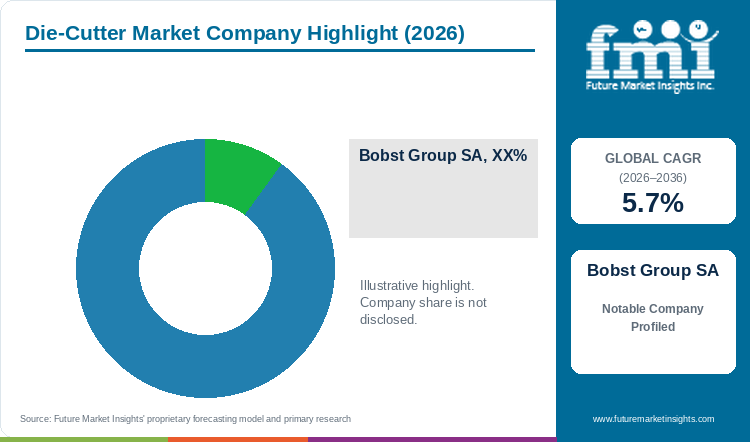
Competitive positioning in the die-cutter industry links primary flatbed, rotary, and digital converting machinery builders with global integrated packaging converters that engineer proprietary inline converting systems and anchor global equipment demand. Bobst Group SA and Koenig & Bauer AG and Heidelberger Druckmaschinen AG and Masterwork Group Co., Ltd. and Asahi Machinery Limited design and manufacture commercial flatbed platens, rotary die-cutters and digital laser converting lines. Smurfit Westrock plc and DS Smith plc and Stora Enso Oyj, Huhtamaki Oyj and Tetra Pak International SA operate high-speed automated die-cutting, creasing and blanking platforms across hundreds of global packaging plants while co-developing next-generation converting automation.
- Primary Flatbed and Rotary Die-Cutter OEMs: Bobst Group SA and Koenig & Bauer AG, Heidelberger Druckmaschinen AG and Masterwork Group Co., Ltd. engineer high-speed automatic flatbed die-cutters, rotary corrugated die-cutters, and inline blanking systems.
- Integrated Corrugated and Carton Converting Leaders: Smurfit Westrock plc and DS Smith plc, Stora Enso Oyj and Huhtamaki Oyj deploy and co-engineer automated die-cutting, slotting and fiber-forming lines across global packaging converting networks.
- Precision Japan Platen and Aseptic Converting Specialists: Asahi Machinery Limited and Tetra Pak International SA supply precision computer-controlled platen die-cutters and high-speed web-fed carton blanking and converting architectures.
Competitive Benchmarking: Die-Cutter Market
Table 8: Competitive Benchmarking for the Die-Cutter Market (qualitative capability ratings), 2026
| Company | High-Speed Press Architecture | Inline Automation & Register | Multi-Substrate Versatility | Geographic Reach |
|---|---|---|---|---|
| Bobst Group SA | High | High | High | Global competence centers; Mastercut 165 PER for solid and corrugated board |
| Koenig & Bauer AG | High | High | High | Global sheetfed and corrugated OEM; launched CutPRO 2.1 flatbed in July 2026 |
| Heidelberger Druckmaschinen AG | High | High | High | Global folding carton platen network in partnership with Masterwork Group |
| Masterwork Group Co., Ltd. | High | High | Medium | Asia-Pacific and global automated platen die-cutters and robotic blankers |
| Asahi Machinery Limited | High | Medium | High | Japan, Europe, and North America precision CARTONMASTER platen systems |
| Smurfit Westrock plc | High | High | High | 500+ global converting plants; AI-assisted packaging and glueline-free pilots |
| DS Smith plc | Medium | High | High | European automated corrugated converting and end-of-line machinery network |
| Stora Enso Oyj | Medium | High | High | European integrated packaging solutions and high-yield board converting |
| Huhtamaki Oyj | Medium | High | High | 35 countries and 105 locations; EUR 4.0 billion 2025 packaging converting sales |
| Tetra Pak International SA | High | High | Medium | Global high-speed web carton blanking; won 2026 MIMA Factory OS automation award |
Evaluation basis: High-Speed Press Architecture evaluates documented sheet-per-hour or web-speed throughput across flatbed and rotary platforms, whereas Inline Automation & Register rates optical print-to-cut alignment and automatic stripping. Multi-Substrate Versatility measures capability across corrugated flutes, solid paperboard, and polymer films.
Key Developments in the Die-Cutter Market
- Koenig & Bauer AG introduced its CutPRO 2.1 flatbed die-cutter on July 23, 2026, engineered with Varioplan gripper transport and existing-tool compatibility to process corrugated and solid board up to 1,300 by 2,100 millimeters at 7,000 sheets per hour [22].
- Smurfit Westrock plc unveiled three AI-based packaging optimization tools and its ActiBlu water-mist glueline-free converting technology at its 2026 Innovation Event on May 5, 2026 to streamline packing-line converting and PPWR recyclability [23].
- Tetra Pak International SA won the Microsoft Intelligent Manufacturing Award in the Scale category on April 22, 2026 for its Factory OS digital automation platform deployed across high-speed food and beverage packaging plants [24].
Key Players in the Die-Cutter Market
Primary Flatbed and Rotary Die-Cutter OEMs
- Bobst Group SA
- Koenig & Bauer AG
- Heidelberger Druckmaschinen AG
- Masterwork Group Co., Ltd.
Integrated Corrugated and Carton Converting Leaders
- Smurfit Westrock plc
- DS Smith plc
- Stora Enso Oyj
- Huhtamaki Oyj
Precision Japan Platen and Aseptic Converting Specialists
- Asahi Machinery Limited
- Tetra Pak International SA
Die-Cutter Market - Report Scope
Table 9: Report Scope for the Die-Cutter Market (coverage fields and definitions), 2026 to 2036
| Coverage field | Report scope |
|---|---|
| Market breakdown | Machine Architecture, Automation Level, Substrate Processed, End-Use Industry, Distribution Channel |
| Quantitative Units | USD Billion |
| Market Definition | Includes commercial capital equipment and inline tooling module valuation from flatbed platen die-cutters, rotary cylindrical die-cutters, and digital/laser cutting and creasing systems used to convert corrugated board, folding paperboard cartons, polymer films, labels, and industrial gaskets. Category Scope Note: Excludes standalone metal stamping presses, primary paper mill winders, and manual hobby craft cutters. |
| Regions Covered | North America, Latin America, Western Europe, Eastern Europe, East Asia, South Asia and Pacific, Middle East and Africa |
| Countries Covered | Mexico, Poland, South Korea, United States, France, United Kingdom, Germany, Japan, and additional countries in the full report |
| Key Companies Covered | Stora Enso Oyj, Huhtamaki Oyj, DS Smith plc, Tetra Pak International SA, Smurfit Westrock plc, Bobst Group SA, Koenig & Bauer AG, Heidelberger Druckmaschinen AG, Masterwork Group Co., Ltd., Asahi Machinery Limited |
| Forecast Period | 2026 to 2036 |
| Approach | Primary and secondary research with top-down and bottom-up market triangulation. |
Die-Cutter Market - Research Methodology
Table 10: Research Methodology for the Die-Cutter Market (research methods and approach), 2026 edition
| Method | Approach |
|---|---|
| Primary Research | Structured interviews with folding carton and corrugated plant engineering directors, flatbed and rotary press OEM product managers, steel-rule die makers, and automotive gasket converters to validate machine ASP and replacement cycles. |
| Secondary Research | Analysis of FEFCO European corrugated production reports, USDA FAS national food and retail packaging filings, SEC Form 10-Q/10-K disclosures, and peer-reviewed laser cutting and machine-vision studies. |
| Market Sizing and Forecasting | Top-down Global Industrial and Consumer Packaging baseline (where die-cutters represent 3.7% share) reconciled against bottom-up annual machinery shipments (40.2K to 44.0K units in 2026) and system ASPs from 2026 to 2036. |
| Country Forecasting Model | Econometric national models weight corrugated and carton plant capex, pressroom wage inflation, near-shored appliance and automotive manufacturing, and e-commerce box demand across eight countries. |
| Operational Benchmark Traceability | Fleet and plant capex indicators in Tables 2, 3, and 4 trace to OEM sheets-per-hour specifications, FEFCO corrugated output balances, and peer-reviewed CO2 laser kerf and YOLOv8 inspection benchmarks. |
| Data Triangulation and Validation | Valuation figures isolate commercial sheet-fed and web-fed packaging, print, and gasket die-cutting systems while excluding upstream printing presses, standalone folder-gluers, and metalworking punch presses. |
Die-Cutter Market by Segments
Die-Cutter Market segmented by Machine Architecture:
- Flatbed Die-Cutting Machines
- Rotary Die-Cutting Machines
- Laser and Digital Cutting Systems
Die-Cutter Market segmented by Automation Level:
- Fully Automated High-Speed Lines
- Semi-Automated Modular Units
Die-Cutter Market segmented by Substrate Processed:
- Corrugated Board and Solid Fiber
- Commercial Folding Paperboard Cartons
- Polymer Films and Foils
Die-Cutter Market segmented by End-Use Industry:
- Commercial Packaging Converting Plants
- Commercial Printing Facilities
- Automotive and Industrial Gaskets
Die-Cutter Market segmented by Distribution Channel:
- Direct OEM Turnkey Sales
- Authorized Machinery Integrators and Dealers
- Certified Retrofit and Rebuild Channels
Die-Cutter Market by Region
- North America
- United States
- Canada
- Latin America
- Brazil
- Mexico
- Argentina
- Chile
- Western Europe
- Germany
- France
- United Kingdom
- Italy
- Spain
- Benelux
- Nordics
- Eastern Europe
- Poland
- Czech Republic
- Romania
- Hungary
- East Asia
- China
- Japan
- South Korea
- South Asia and Pacific
- India
- ASEAN
- Australia and New Zealand
- Middle East and Africa
- GCC Countries
- South Africa
- Türkiye
- Israel
Research Sources and Bibliography
- [1] European Federation of Corrugated Board Manufacturers. (2026, June 1). Corrugated packaging advancing circularity and competitiveness at FEFCO Summit 2026 and 52 billion square meter annual output. FEFCO Brussels.
- [2] Koenig & Bauer AG. (2026, July 23). Corrugated Board Processing With Maximum Net Output on New CutPRO 2.1 Flatbed Die-Cutter. Koenig & Bauer Newsroom.
- [3] Bobst Group SA. (2026, July 2). Faster job changes in diecutting large-format solid board and corrugated board sheets on MASTERCUT 165 PER. BOBST Newsroom.
- [4] Hou, Q. & Liu, J. (2026, June 3). Modified YOLO for tape-sealing defects in outer packaging of cigarette carton. Scientific Reports, 16(1), 25253 (PubMed PMID 42236986).
- [5] Aktas, S. & Kisioglu, Y. (2025, June 23). Impact of Thread Fabrication Methods and Die Cutting on Abutment Screw Loosening. International Journal of Oral & Maxillofacial Implants, 1-28 (PubMed PMID 40553088).
- [6] Koenig & Bauer AG. (2025, October 20). Morrisette Packaging Makes Major Investment In Two New Koenig & Bauer Corrugated Machines. Koenig & Bauer US Newsroom.
- [7] Bobst Group SA. (2025, February 25). Label and packaging converting automation technologies in 2025. BOBST Newsroom.
- [8] DS Smith plc. (2025, September 1). DS Smith develops plastic-free industrial corrugated packaging for Bosch Home Comfort Group. DS Smith Media Stories.
- [9] Smurfit Westrock plc. (2026, October 14). Smurfit Westrock fast-tracks Corona Cero launch and wins 2026 PPC Creative Converting Award. Smurfit Westrock Newsroom.
- [10] Bobst Group SA. (2026, April 22). BOBST to bring market-leading converting insights to Corrugated 2026 conference. BOBST Newsroom.
- [11] Mondi Group plc. (2026, August 5). Mondi unveils Deutscher Verpackungspreis 2026 concept that simplifies eCommerce packaging through laser marking. Mondi Group Newsroom.
- [12] Der, O. (2025, July 10). Multi-Output Prediction and Optimization of CO2 Laser Cutting Quality in FFF-Printed ASA Thermoplastics. Polymers, 17(14), 1910 (PMC12298168).
- [13] Basar, G. (2025, June 20). Experimental Evaluation and Machine Learning-Based Prediction of Laser Cutting Quality in FFF-Printed ABS Thermoplastics. Polymers, 17(13), 1728 (PMC12251932).
- [14] USDA Foreign Agricultural Service. (2026, April 6). Mexico Food Processing Ingredients Annual Report MX2026-0022. U.S. Department of Agriculture GAIN.
- [15] Patyk, R. & Bohdal, L. (2026, July 9). Selection of technological parameters for the polypropylene film impulse sealing process based on seal strength. Scientific Reports (PubMed PMID 42426178).
- [16] USDA Foreign Agricultural Service. (2026, October 5). South Korea Retail Foods Annual Report KS2026-0028. U.S. Department of Agriculture GAIN.
- [17] Smurfit Westrock plc. (2026, May 8). Quarterly Report Pursuant to Section 13 or 15(d) of the Securities Exchange Act of 1934 for Period Ended March 31, 2026. U.S. Securities and Exchange Commission EDGAR.
- [18] USDA Foreign Agricultural Service. (2026, September 30). France Retail Foods Annual Report FR2026-0014. U.S. Department of Agriculture GAIN.
- [19] Heidelberger Druckmaschinen AG. (2025, June 2). Heidelberg expands folding carton packaging portfolio with Cartonmaster CX 145 and Mastermatrix CSB 106 die cutter at 9,000 sheets per hour. Heidelberg Press Relations.
- [20] USDA Foreign Agricultural Service. (2026, September 25). Germany Retail Foods Annual Report GM2026-0015. U.S. Department of Agriculture GAIN.
- [21] USDA Foreign Agricultural Service. (2026, June 30). Japan Exporter Guide Annual Report JA2026-0024. U.S. Department of Agriculture GAIN.
- [22] Bobst Group SA. (2026, March 15). MASTERCUT 165 PER Flatbed Die-Cutter Technical Specifications for Folding Carton and Corrugated Board. BOBST Product Documentation.
- [23] Smurfit Westrock plc. (2026, May 5). Smurfit Westrock launches prototype of ActiBlu glueline-free packaging solution and AI design tools. Smurfit Westrock Newsroom.
- [24] Tetra Pak International SA. (2026, April 22). Tetra Pak Factory OS wins MIMA 2026 Scale Award for cost-efficient food and beverage manufacturing. Tetra Pak News Archive.
- [25] Heidelberger Druckmaschinen AG. (2026, August 13). Cardbox Packaging boosts efficiency in postpress with Heidelberg MK Duopress Power and three Mastermatrix 106 CSB die cutters. Heidelberg Press Relations.
- [26] Koenig & Bauer AG. (2025, February 7). Petit and Koenig & Bauer Durst Agree to Start the Digitalization of POS and Packaging Production. Koenig & Bauer Investor Publications.
- [27] Huhtamaki Oyj. (2026, October 29). Huhtamaki Q1 to Q3 2026 Interim Report on Comparable Net Growth Across Flexible and Fiber Packaging. Huhtamaki Stock Exchange Releases.
- [28] Stora Enso Oyj. (2026, March 25). Stora Enso updates comparative figures following changes to Consumer and Integrated Packaging segment reporting. Stora Enso Investor Releases.
This bibliography is provided for reader reference and is not exhaustive. The full report contains the complete reference list and detailed citations.
This Report Answers
- How large is the die-cutter market in 2026 and what is forecast for 2036?
- Which pressroom automation and short-run SKU trends support demand for die-cutters?
- Why do Flatbed Die-Cutting Machines lead the machine architecture category?
- Why do Fully Automated High-Speed Lines lead the automation level category globally?
- How do growth rates differ across Mexico and Poland and South Korea, the United States, France and the United Kingdom?
- Which leading companies manufacture primary die-cutting presses versus operating global converting networks?
- What capital cost and laser thermal kerf tolerances restrain uncalibrated converting adoption?
- What should box converters evaluate before choosing between flatbed platen, rotary, and digital laser die-cutters?
Table of Content
- Key Takeaways
- Market Size and CAGR
- Top Growth Driver
- Fastest Growing Segment
- Leading Region
- Key Companies
- Emerging Opportunities
- Executive Summary
- Global Market Outlook
- Demand-side Trends
- Supply-side Trends
- Technology Roadmap Analysis
- Analysis and Recommendations
- Analyst Perspective (What is happening? Why now? What should investors know?)
- Key Questions Answered
- How large is the market?
- What is the CAGR?
- What are key trends?
- Which region dominates?
- Who are the leaders?
Read More...
- Market Overview
- Market Coverage / Taxonomy
- Market Definition / Scope / Limitations
- Research Methodology
- Chapter Orientation
- Analytical Lens and Working Hypotheses
- Market Structure, Signals, and Trend Drivers
- Benchmarking and Cross-market Comparability
- Market Sizing, Forecasting, and Opportunity Mapping
- Research Design and Evidence Framework
- Desk Research Programme (Secondary Evidence)
- Expert Input and Fieldwork (Primary Evidence)
- Tooling, Models, and Reference Databases
- Data Engineering and Model Build
- Quality Assurance and Audit Trail
- Market Background
- Market Dynamics (Drivers, Restraints, Opportunity, Trends)
- Scenario Forecast (Optimistic, Likely, Conservative)
- Impact Analysis
- AI Impact
- Sustainability Impact
- Regulatory Impact
- Technology Impact
- Consumer / Buyer Analysis
- Purchase Drivers
- Adoption Barriers
- Buyer Journey
- Opportunity Map Analysis
- Product Life Cycle Analysis
- Supply Chain Analysis
- Investment Feasibility Matrix
- Value Chain Analysis
- PESTLE and Porter's Analysis
- Regulatory Landscape
- Regional Parent Market Outlook
- Production and Consumption Statistics
- Import and Export Statistics
- Global Market Analysis and Forecast, 2021 to 2036
- Historical Market Size Value (USD Billion) Analysis, 2021 to 2025
- Current and Future Market Size Value (USD Billion) Projections, 2026 to 2036
- Y-o-Y Growth Trend Analysis
- Absolute $ Opportunity Analysis
- Global Market Pricing Analysis, 2021 to 2036
- Global Market Analysis and Forecast, By Machine Architecture, 2021 to 2036
- Introduction / Key Findings
- Historical Market Size Value (USD Billion) Analysis By Machine Architecture, 2021 to 2025
- Current and Future Market Size Value (USD Billion) Analysis and Forecast By Machine Architecture, 2026 to 2036
- Flatbed Die-Cutting Machines
- Rotary Die-Cutting Machines
- Laser and Digital Cutting Systems
- Y-o-Y Growth Trend Analysis By Machine Architecture, 2021 to 2025
- Absolute $ Opportunity Analysis By Machine Architecture, 2026 to 2036
- Global Market Analysis and Forecast, By Automation Level, 2021 to 2036
- Introduction / Key Findings
- Historical Market Size Value (USD Billion) Analysis By Automation Level, 2021 to 2025
- Current and Future Market Size Value (USD Billion) Analysis and Forecast By Automation Level, 2026 to 2036
- Fully Automated High-Speed Lines
- Semi-Automated Modular Units
- Y-o-Y Growth Trend Analysis By Automation Level, 2021 to 2025
- Absolute $ Opportunity Analysis By Automation Level, 2026 to 2036
- Global Market Analysis and Forecast, By Substrate Processed, 2021 to 2036
- Introduction / Key Findings
- Historical Market Size Value (USD Billion) Analysis By Substrate Processed, 2021 to 2025
- Current and Future Market Size Value (USD Billion) Analysis and Forecast By Substrate Processed, 2026 to 2036
- Corrugated Board and Solid Fiber
- Commercial Folding Paperboard Cartons
- Polymer Films and Foils
- Y-o-Y Growth Trend Analysis By Substrate Processed, 2021 to 2025
- Absolute $ Opportunity Analysis By Substrate Processed, 2026 to 2036
- Global Market Analysis and Forecast, By End-Use Industry, 2021 to 2036
- Introduction / Key Findings
- Historical Market Size Value (USD Billion) Analysis By End-Use Industry, 2021 to 2025
- Current and Future Market Size Value (USD Billion) Analysis and Forecast By End-Use Industry, 2026 to 2036
- Commercial Packaging Converting Plants
- Commercial Printing Facilities
- Automotive and Industrial Gaskets
- Y-o-Y Growth Trend Analysis By End-Use Industry, 2021 to 2025
- Absolute $ Opportunity Analysis By End-Use Industry, 2026 to 2036
- Global Market Analysis and Forecast, By Distribution Channel, 2021 to 2036
- Introduction / Key Findings
- Historical Market Size Value (USD Billion) Analysis By Distribution Channel, 2021 to 2025
- Current and Future Market Size Value (USD Billion) Analysis and Forecast By Distribution Channel, 2026 to 2036
- Direct OEM Turnkey Sales
- Authorized Machinery Integrators and Dealers
- Certified Retrofit and Rebuild Channels
- Y-o-Y Growth Trend Analysis By Distribution Channel, 2021 to 2025
- Absolute $ Opportunity Analysis By Distribution Channel, 2026 to 2036
- Global Market Analysis and Forecast, By Region, 2021 to 2036
- Introduction
- Historical Market Size Value (USD Billion) Analysis By Region, 2021 to 2025
- Current Market Size Value (USD Billion) Analysis and Forecast By Region, 2026 to 2036
- North America
- Latin America
- Western Europe
- Eastern Europe
- East Asia
- South Asia and Pacific
- Middle East and Africa
- Market Attractiveness Analysis By Region
- North America Market Analysis and Forecast, By Country, 2021 to 2036
- Historical Market Size Value (USD Billion) Trend Analysis By Market Taxonomy, 2021 to 2025
- Market Size Value (USD Billion) Forecast By Market Taxonomy, 2026 to 2036
- By Country
- United States
- Canada
- By Machine Architecture
- By Automation Level
- By Substrate Processed
- By End-Use Industry
- By Distribution Channel
- By Country
- Market Attractiveness Analysis
- By Country
- By Machine Architecture
- By Automation Level
- By Substrate Processed
- By End-Use Industry
- By Distribution Channel
- Key Takeaways
- Latin America Market Analysis and Forecast, By Country
- Historical Market Size Value (USD Billion) Trend Analysis By Market Taxonomy, 2021 to 2025
- Market Size Value (USD Billion) Forecast By Market Taxonomy, 2026 to 2036
- By Country
- Brazil
- Mexico
- Argentina
- Chile
- By Machine Architecture
- By Automation Level
- By Substrate Processed
- By End-Use Industry
- By Distribution Channel
- By Country
- Market Attractiveness Analysis
- By Country
- By Machine Architecture
- By Automation Level
- By Substrate Processed
- By End-Use Industry
- By Distribution Channel
- Key Takeaways
- Western Europe Market Analysis and Forecast, By Country
- Historical Market Size Value (USD Billion) Trend Analysis By Market Taxonomy, 2021 to 2025
- Market Size Value (USD Billion) Forecast By Market Taxonomy, 2026 to 2036
- By Country
- Germany
- France
- United Kingdom
- Italy
- Spain
- Benelux
- Nordics
- By Machine Architecture
- By Automation Level
- By Substrate Processed
- By End-Use Industry
- By Distribution Channel
- By Country
- Market Attractiveness Analysis
- By Country
- By Machine Architecture
- By Automation Level
- By Substrate Processed
- By End-Use Industry
- By Distribution Channel
- Key Takeaways
- Eastern Europe Market Analysis and Forecast, By Country
- Historical Market Size Value (USD Billion) Trend Analysis By Market Taxonomy, 2021 to 2025
- Market Size Value (USD Billion) Forecast By Market Taxonomy, 2026 to 2036
- By Country
- Poland
- Czech Republic
- Romania
- Hungary
- By Machine Architecture
- By Automation Level
- By Substrate Processed
- By End-Use Industry
- By Distribution Channel
- By Country
- Market Attractiveness Analysis
- By Country
- By Machine Architecture
- By Automation Level
- By Substrate Processed
- By End-Use Industry
- By Distribution Channel
- Key Takeaways
- East Asia Market Analysis and Forecast, By Country
- Historical Market Size Value (USD Billion) Trend Analysis By Market Taxonomy, 2021 to 2025
- Market Size Value (USD Billion) Forecast By Market Taxonomy, 2026 to 2036
- By Country
- China
- Japan
- South Korea
- By Machine Architecture
- By Automation Level
- By Substrate Processed
- By End-Use Industry
- By Distribution Channel
- By Country
- Market Attractiveness Analysis
- By Country
- By Machine Architecture
- By Automation Level
- By Substrate Processed
- By End-Use Industry
- By Distribution Channel
- Key Takeaways
- South Asia and Pacific Market Analysis and Forecast, By Country
- Historical Market Size Value (USD Billion) Trend Analysis By Market Taxonomy, 2021 to 2025
- Market Size Value (USD Billion) Forecast By Market Taxonomy, 2026 to 2036
- By Country
- India
- ASEAN
- Australia and New Zealand
- By Machine Architecture
- By Automation Level
- By Substrate Processed
- By End-Use Industry
- By Distribution Channel
- By Country
- Market Attractiveness Analysis
- By Country
- By Machine Architecture
- By Automation Level
- By Substrate Processed
- By End-Use Industry
- By Distribution Channel
- Key Takeaways
- Middle East and Africa Market Analysis and Forecast, By Country
- Historical Market Size Value (USD Billion) Trend Analysis By Market Taxonomy, 2021 to 2025
- Market Size Value (USD Billion) Forecast By Market Taxonomy, 2026 to 2036
- By Country
- GCC Countries
- South Africa
- Türkiye
- Israel
- By Machine Architecture
- By Automation Level
- By Substrate Processed
- By End-Use Industry
- By Distribution Channel
- By Country
- Market Attractiveness Analysis
- By Country
- By Machine Architecture
- By Automation Level
- By Substrate Processed
- By End-Use Industry
- By Distribution Channel
- Key Takeaways
- Key Countries Market Analysis
- United States
- Pricing Analysis
- Market Share Analysis, 2025
- By Machine Architecture
- By Automation Level
- By Substrate Processed
- By End-Use Industry
- By Distribution Channel
- Canada
- Pricing Analysis
- Market Share Analysis, 2025
- By Machine Architecture
- By Automation Level
- By Substrate Processed
- By End-Use Industry
- By Distribution Channel
- Mexico
- Pricing Analysis
- Market Share Analysis, 2025
- By Machine Architecture
- By Automation Level
- By Substrate Processed
- By End-Use Industry
- By Distribution Channel
- Brazil
- Pricing Analysis
- Market Share Analysis, 2025
- By Machine Architecture
- By Automation Level
- By Substrate Processed
- By End-Use Industry
- By Distribution Channel
- Chile
- Pricing Analysis
- Market Share Analysis, 2025
- By Machine Architecture
- By Automation Level
- By Substrate Processed
- By End-Use Industry
- By Distribution Channel
- Germany
- Pricing Analysis
- Market Share Analysis, 2025
- By Machine Architecture
- By Automation Level
- By Substrate Processed
- By End-Use Industry
- By Distribution Channel
- United Kingdom
- Pricing Analysis
- Market Share Analysis, 2025
- By Machine Architecture
- By Automation Level
- By Substrate Processed
- By End-Use Industry
- By Distribution Channel
- Italy
- Pricing Analysis
- Market Share Analysis, 2025
- By Machine Architecture
- By Automation Level
- By Substrate Processed
- By End-Use Industry
- By Distribution Channel
- Spain
- Pricing Analysis
- Market Share Analysis, 2025
- By Machine Architecture
- By Automation Level
- By Substrate Processed
- By End-Use Industry
- By Distribution Channel
- France
- Pricing Analysis
- Market Share Analysis, 2025
- By Machine Architecture
- By Automation Level
- By Substrate Processed
- By End-Use Industry
- By Distribution Channel
- India
- Pricing Analysis
- Market Share Analysis, 2025
- By Machine Architecture
- By Automation Level
- By Substrate Processed
- By End-Use Industry
- By Distribution Channel
- ASEAN
- Pricing Analysis
- Market Share Analysis, 2025
- By Machine Architecture
- By Automation Level
- By Substrate Processed
- By End-Use Industry
- By Distribution Channel
- Australia and New Zealand
- Pricing Analysis
- Market Share Analysis, 2025
- By Machine Architecture
- By Automation Level
- By Substrate Processed
- By End-Use Industry
- By Distribution Channel
- China
- Pricing Analysis
- Market Share Analysis, 2025
- By Machine Architecture
- By Automation Level
- By Substrate Processed
- By End-Use Industry
- By Distribution Channel
- Japan
- Pricing Analysis
- Market Share Analysis, 2025
- By Machine Architecture
- By Automation Level
- By Substrate Processed
- By End-Use Industry
- By Distribution Channel
- South Korea
- Pricing Analysis
- Market Share Analysis, 2025
- By Machine Architecture
- By Automation Level
- By Substrate Processed
- By End-Use Industry
- By Distribution Channel
- Poland
- Pricing Analysis
- Market Share Analysis, 2025
- By Machine Architecture
- By Automation Level
- By Substrate Processed
- By End-Use Industry
- By Distribution Channel
- Hungary
- Pricing Analysis
- Market Share Analysis, 2025
- By Machine Architecture
- By Automation Level
- By Substrate Processed
- By End-Use Industry
- By Distribution Channel
- Türkiye
- Pricing Analysis
- Market Share Analysis, 2025
- By Machine Architecture
- By Automation Level
- By Substrate Processed
- By End-Use Industry
- By Distribution Channel
- South Africa
- Pricing Analysis
- Market Share Analysis, 2025
- By Machine Architecture
- By Automation Level
- By Substrate Processed
- By End-Use Industry
- By Distribution Channel
- United States
- Market Structure Analysis
- Competition Dashboard
- Competition Benchmarking
- Market Share Analysis of Top Players
- By Regional
- By Machine Architecture
- By Automation Level
- By Substrate Processed
- By End-Use Industry
- By Distribution Channel
- Emerging Startups
- Innovation Benchmarking
- Competition Analysis
- Competition Deep Dive
- Bobst Group SA
- Overview
- Product Portfolio
- Profitability by Market Segments
- Sales Footprint
- Strategy Overview
- Marketing Strategy
- Product Strategy
- Channel Strategy
- Koenig & Bauer AG
- Heidelberger Druckmaschinen AG
- Masterwork Group Co., Ltd.
- Asahi Machinery Limited
- Smurfit Westrock plc
- DS Smith plc
- Stora Enso Oyj
- Huhtamaki Oyj
- Tetra Pak International SA
- Bobst Group SA
- Case Studies
- Success Stories
- Recent Developments
- Competition Deep Dive
- Assumptions & Acronyms Used
List of Tables
- Table 1: Global Market Value (USD Billion) Forecast by Region, 2021 to 2036
- Table 2: Global Market Value (USD Billion) Forecast by Machine Architecture, 2021 to 2036
- Table 3: Global Market Value (USD Billion) Forecast by Automation Level, 2021 to 2036
- Table 4: Global Market Value (USD Billion) Forecast by Substrate Processed, 2021 to 2036
- Table 5: Global Market Value (USD Billion) Forecast by End-Use Industry, 2021 to 2036
- Table 6: Global Market Value (USD Billion) Forecast by Distribution Channel, 2021 to 2036
- Table 7: North America Market Value (USD Billion) Forecast by Country, 2021 to 2036
- Table 8: North America Market Value (USD Billion) Forecast by Machine Architecture, 2021 to 2036
- Table 9: North America Market Value (USD Billion) Forecast by Automation Level, 2021 to 2036
- Table 10: North America Market Value (USD Billion) Forecast by Substrate Processed, 2021 to 2036
- Table 11: North America Market Value (USD Billion) Forecast by End-Use Industry, 2021 to 2036
- Table 12: North America Market Value (USD Billion) Forecast by Distribution Channel, 2021 to 2036
- Table 13: Latin America Market Value (USD Billion) Forecast by Country, 2021 to 2036
- Table 14: Latin America Market Value (USD Billion) Forecast by Machine Architecture, 2021 to 2036
- Table 15: Latin America Market Value (USD Billion) Forecast by Automation Level, 2021 to 2036
- Table 16: Latin America Market Value (USD Billion) Forecast by Substrate Processed, 2021 to 2036
- Table 17: Latin America Market Value (USD Billion) Forecast by End-Use Industry, 2021 to 2036
- Table 18: Latin America Market Value (USD Billion) Forecast by Distribution Channel, 2021 to 2036
- Table 19: Western Europe Market Value (USD Billion) Forecast by Country, 2021 to 2036
- Table 20: Western Europe Market Value (USD Billion) Forecast by Machine Architecture, 2021 to 2036
- Table 21: Western Europe Market Value (USD Billion) Forecast by Automation Level, 2021 to 2036
- Table 22: Western Europe Market Value (USD Billion) Forecast by Substrate Processed, 2021 to 2036
- Table 23: Western Europe Market Value (USD Billion) Forecast by End-Use Industry, 2021 to 2036
- Table 24: Western Europe Market Value (USD Billion) Forecast by Distribution Channel, 2021 to 2036
- Table 25: Eastern Europe Market Value (USD Billion) Forecast by Country, 2021 to 2036
- Table 26: Eastern Europe Market Value (USD Billion) Forecast by Machine Architecture, 2021 to 2036
- Table 27: Eastern Europe Market Value (USD Billion) Forecast by Automation Level, 2021 to 2036
- Table 28: Eastern Europe Market Value (USD Billion) Forecast by Substrate Processed, 2021 to 2036
- Table 29: Eastern Europe Market Value (USD Billion) Forecast by End-Use Industry, 2021 to 2036
- Table 30: Eastern Europe Market Value (USD Billion) Forecast by Distribution Channel, 2021 to 2036
- Table 31: East Asia Market Value (USD Billion) Forecast by Country, 2021 to 2036
- Table 32: East Asia Market Value (USD Billion) Forecast by Machine Architecture, 2021 to 2036
- Table 33: East Asia Market Value (USD Billion) Forecast by Automation Level, 2021 to 2036
- Table 34: East Asia Market Value (USD Billion) Forecast by Substrate Processed, 2021 to 2036
- Table 35: East Asia Market Value (USD Billion) Forecast by End-Use Industry, 2021 to 2036
- Table 36: East Asia Market Value (USD Billion) Forecast by Distribution Channel, 2021 to 2036
- Table 37: South Asia and Pacific Market Value (USD Billion) Forecast by Country, 2021 to 2036
- Table 38: South Asia and Pacific Market Value (USD Billion) Forecast by Machine Architecture, 2021 to 2036
- Table 39: South Asia and Pacific Market Value (USD Billion) Forecast by Automation Level, 2021 to 2036
- Table 40: South Asia and Pacific Market Value (USD Billion) Forecast by Substrate Processed, 2021 to 2036
- Table 41: South Asia and Pacific Market Value (USD Billion) Forecast by End-Use Industry, 2021 to 2036
- Table 42: South Asia and Pacific Market Value (USD Billion) Forecast by Distribution Channel, 2021 to 2036
- Table 43: Middle East and Africa Market Value (USD Billion) Forecast by Country, 2021 to 2036
- Table 44: Middle East and Africa Market Value (USD Billion) Forecast by Machine Architecture, 2021 to 2036
- Table 45: Middle East and Africa Market Value (USD Billion) Forecast by Automation Level, 2021 to 2036
- Table 46: Middle East and Africa Market Value (USD Billion) Forecast by Substrate Processed, 2021 to 2036
- Table 47: Middle East and Africa Market Value (USD Billion) Forecast by End-Use Industry, 2021 to 2036
- Table 48: Middle East and Africa Market Value (USD Billion) Forecast by Distribution Channel, 2021 to 2036
List of Figures
- Figure 1: Global Market Pricing Analysis
- Figure 2: Global Market Value (USD Billion) Forecast 2021-2036
- Figure 3: Global Market Value Share and BPS Analysis by Machine Architecture, 2026 and 2036
- Figure 4: Global Market Y-o-Y Growth Comparison by Machine Architecture, 2026-2036
- Figure 5: Global Market Attractiveness Analysis by Machine Architecture
- Figure 6: Global Market Value Share and BPS Analysis by Automation Level, 2026 and 2036
- Figure 7: Global Market Y-o-Y Growth Comparison by Automation Level, 2026-2036
- Figure 8: Global Market Attractiveness Analysis by Automation Level
- Figure 9: Global Market Value Share and BPS Analysis by Substrate Processed, 2026 and 2036
- Figure 10: Global Market Y-o-Y Growth Comparison by Substrate Processed, 2026-2036
- Figure 11: Global Market Attractiveness Analysis by Substrate Processed
- Figure 12: Global Market Value Share and BPS Analysis by End-Use Industry, 2026 and 2036
- Figure 13: Global Market Y-o-Y Growth Comparison by End-Use Industry, 2026-2036
- Figure 14: Global Market Attractiveness Analysis by End-Use Industry
- Figure 15: Global Market Value Share and BPS Analysis by Distribution Channel, 2026 and 2036
- Figure 16: Global Market Y-o-Y Growth Comparison by Distribution Channel, 2026-2036
- Figure 17: Global Market Attractiveness Analysis by Distribution Channel
- Figure 18: Global Market Value (USD Billion) Share and BPS Analysis by Region, 2026 and 2036
- Figure 19: Global Market Y-o-Y Growth Comparison by Region, 2026-2036
- Figure 20: Global Market Attractiveness Analysis by Region
- Figure 21: North America Market Incremental Dollar Opportunity, 2026-2036
- Figure 22: Latin America Market Incremental Dollar Opportunity, 2026-2036
- Figure 23: Western Europe Market Incremental Dollar Opportunity, 2026-2036
- Figure 24: Eastern Europe Market Incremental Dollar Opportunity, 2026-2036
- Figure 25: East Asia Market Incremental Dollar Opportunity, 2026-2036
- Figure 26: South Asia and Pacific Market Incremental Dollar Opportunity, 2026-2036
- Figure 27: Middle East and Africa Market Incremental Dollar Opportunity, 2026-2036
- Figure 28: North America Market Value Share and BPS Analysis by Country, 2026 and 2036
- Figure 29: North America Market Value Share and BPS Analysis by Machine Architecture, 2026 and 2036
- Figure 30: North America Market Y-o-Y Growth Comparison by Machine Architecture, 2026-2036
- Figure 31: North America Market Attractiveness Analysis by Machine Architecture
- Figure 32: North America Market Value Share and BPS Analysis by Automation Level, 2026 and 2036
- Figure 33: North America Market Y-o-Y Growth Comparison by Automation Level, 2026-2036
- Figure 34: North America Market Attractiveness Analysis by Automation Level
- Figure 35: North America Market Value Share and BPS Analysis by Substrate Processed, 2026 and 2036
- Figure 36: North America Market Y-o-Y Growth Comparison by Substrate Processed, 2026-2036
- Figure 37: North America Market Attractiveness Analysis by Substrate Processed
- Figure 38: North America Market Value Share and BPS Analysis by End-Use Industry, 2026 and 2036
- Figure 39: North America Market Y-o-Y Growth Comparison by End-Use Industry, 2026-2036
- Figure 40: North America Market Attractiveness Analysis by End-Use Industry
- Figure 41: North America Market Value Share and BPS Analysis by Distribution Channel, 2026 and 2036
- Figure 42: North America Market Y-o-Y Growth Comparison by Distribution Channel, 2026-2036
- Figure 43: North America Market Attractiveness Analysis by Distribution Channel
- Figure 44: Latin America Market Value Share and BPS Analysis by Country, 2026 and 2036
- Figure 45: Latin America Market Value Share and BPS Analysis by Machine Architecture, 2026 and 2036
- Figure 46: Latin America Market Y-o-Y Growth Comparison by Machine Architecture, 2026-2036
- Figure 47: Latin America Market Attractiveness Analysis by Machine Architecture
- Figure 48: Latin America Market Value Share and BPS Analysis by Automation Level, 2026 and 2036
- Figure 49: Latin America Market Y-o-Y Growth Comparison by Automation Level, 2026-2036
- Figure 50: Latin America Market Attractiveness Analysis by Automation Level
- Figure 51: Latin America Market Value Share and BPS Analysis by Substrate Processed, 2026 and 2036
- Figure 52: Latin America Market Y-o-Y Growth Comparison by Substrate Processed, 2026-2036
- Figure 53: Latin America Market Attractiveness Analysis by Substrate Processed
- Figure 54: Latin America Market Value Share and BPS Analysis by End-Use Industry, 2026 and 2036
- Figure 55: Latin America Market Y-o-Y Growth Comparison by End-Use Industry, 2026-2036
- Figure 56: Latin America Market Attractiveness Analysis by End-Use Industry
- Figure 57: Latin America Market Value Share and BPS Analysis by Distribution Channel, 2026 and 2036
- Figure 58: Latin America Market Y-o-Y Growth Comparison by Distribution Channel, 2026-2036
- Figure 59: Latin America Market Attractiveness Analysis by Distribution Channel
- Figure 60: Western Europe Market Value Share and BPS Analysis by Country, 2026 and 2036
- Figure 61: Western Europe Market Value Share and BPS Analysis by Machine Architecture, 2026 and 2036
- Figure 62: Western Europe Market Y-o-Y Growth Comparison by Machine Architecture, 2026-2036
- Figure 63: Western Europe Market Attractiveness Analysis by Machine Architecture
- Figure 64: Western Europe Market Value Share and BPS Analysis by Automation Level, 2026 and 2036
- Figure 65: Western Europe Market Y-o-Y Growth Comparison by Automation Level, 2026-2036
- Figure 66: Western Europe Market Attractiveness Analysis by Automation Level
- Figure 67: Western Europe Market Value Share and BPS Analysis by Substrate Processed, 2026 and 2036
- Figure 68: Western Europe Market Y-o-Y Growth Comparison by Substrate Processed, 2026-2036
- Figure 69: Western Europe Market Attractiveness Analysis by Substrate Processed
- Figure 70: Western Europe Market Value Share and BPS Analysis by End-Use Industry, 2026 and 2036
- Figure 71: Western Europe Market Y-o-Y Growth Comparison by End-Use Industry, 2026-2036
- Figure 72: Western Europe Market Attractiveness Analysis by End-Use Industry
- Figure 73: Western Europe Market Value Share and BPS Analysis by Distribution Channel, 2026 and 2036
- Figure 74: Western Europe Market Y-o-Y Growth Comparison by Distribution Channel, 2026-2036
- Figure 75: Western Europe Market Attractiveness Analysis by Distribution Channel
- Figure 76: Eastern Europe Market Value Share and BPS Analysis by Country, 2026 and 2036
- Figure 77: Eastern Europe Market Value Share and BPS Analysis by Machine Architecture, 2026 and 2036
- Figure 78: Eastern Europe Market Y-o-Y Growth Comparison by Machine Architecture, 2026-2036
- Figure 79: Eastern Europe Market Attractiveness Analysis by Machine Architecture
- Figure 80: Eastern Europe Market Value Share and BPS Analysis by Automation Level, 2026 and 2036
- Figure 81: Eastern Europe Market Y-o-Y Growth Comparison by Automation Level, 2026-2036
- Figure 82: Eastern Europe Market Attractiveness Analysis by Automation Level
- Figure 83: Eastern Europe Market Value Share and BPS Analysis by Substrate Processed, 2026 and 2036
- Figure 84: Eastern Europe Market Y-o-Y Growth Comparison by Substrate Processed, 2026-2036
- Figure 85: Eastern Europe Market Attractiveness Analysis by Substrate Processed
- Figure 86: Eastern Europe Market Value Share and BPS Analysis by End-Use Industry, 2026 and 2036
- Figure 87: Eastern Europe Market Y-o-Y Growth Comparison by End-Use Industry, 2026-2036
- Figure 88: Eastern Europe Market Attractiveness Analysis by End-Use Industry
- Figure 89: Eastern Europe Market Value Share and BPS Analysis by Distribution Channel, 2026 and 2036
- Figure 90: Eastern Europe Market Y-o-Y Growth Comparison by Distribution Channel, 2026-2036
- Figure 91: Eastern Europe Market Attractiveness Analysis by Distribution Channel
- Figure 92: East Asia Market Value Share and BPS Analysis by Country, 2026 and 2036
- Figure 93: East Asia Market Value Share and BPS Analysis by Machine Architecture, 2026 and 2036
- Figure 94: East Asia Market Y-o-Y Growth Comparison by Machine Architecture, 2026-2036
- Figure 95: East Asia Market Attractiveness Analysis by Machine Architecture
- Figure 96: East Asia Market Value Share and BPS Analysis by Automation Level, 2026 and 2036
- Figure 97: East Asia Market Y-o-Y Growth Comparison by Automation Level, 2026-2036
- Figure 98: East Asia Market Attractiveness Analysis by Automation Level
- Figure 99: East Asia Market Value Share and BPS Analysis by Substrate Processed, 2026 and 2036
- Figure 100: East Asia Market Y-o-Y Growth Comparison by Substrate Processed, 2026-2036
- Figure 101: East Asia Market Attractiveness Analysis by Substrate Processed
- Figure 102: East Asia Market Value Share and BPS Analysis by End-Use Industry, 2026 and 2036
- Figure 103: East Asia Market Y-o-Y Growth Comparison by End-Use Industry, 2026-2036
- Figure 104: East Asia Market Attractiveness Analysis by End-Use Industry
- Figure 105: East Asia Market Value Share and BPS Analysis by Distribution Channel, 2026 and 2036
- Figure 106: East Asia Market Y-o-Y Growth Comparison by Distribution Channel, 2026-2036
- Figure 107: East Asia Market Attractiveness Analysis by Distribution Channel
- Figure 108: South Asia and Pacific Market Value Share and BPS Analysis by Country, 2026 and 2036
- Figure 109: South Asia and Pacific Market Value Share and BPS Analysis by Machine Architecture, 2026 and 2036
- Figure 110: South Asia and Pacific Market Y-o-Y Growth Comparison by Machine Architecture, 2026-2036
- Figure 111: South Asia and Pacific Market Attractiveness Analysis by Machine Architecture
- Figure 112: South Asia and Pacific Market Value Share and BPS Analysis by Automation Level, 2026 and 2036
- Figure 113: South Asia and Pacific Market Y-o-Y Growth Comparison by Automation Level, 2026-2036
- Figure 114: South Asia and Pacific Market Attractiveness Analysis by Automation Level
- Figure 115: South Asia and Pacific Market Value Share and BPS Analysis by Substrate Processed, 2026 and 2036
- Figure 116: South Asia and Pacific Market Y-o-Y Growth Comparison by Substrate Processed, 2026-2036
- Figure 117: South Asia and Pacific Market Attractiveness Analysis by Substrate Processed
- Figure 118: South Asia and Pacific Market Value Share and BPS Analysis by End-Use Industry, 2026 and 2036
- Figure 119: South Asia and Pacific Market Y-o-Y Growth Comparison by End-Use Industry, 2026-2036
- Figure 120: South Asia and Pacific Market Attractiveness Analysis by End-Use Industry
- Figure 121: South Asia and Pacific Market Value Share and BPS Analysis by Distribution Channel, 2026 and 2036
- Figure 122: South Asia and Pacific Market Y-o-Y Growth Comparison by Distribution Channel, 2026-2036
- Figure 123: South Asia and Pacific Market Attractiveness Analysis by Distribution Channel
- Figure 124: Middle East and Africa Market Value Share and BPS Analysis by Country, 2026 and 2036
- Figure 125: Middle East and Africa Market Value Share and BPS Analysis by Machine Architecture, 2026 and 2036
- Figure 126: Middle East and Africa Market Y-o-Y Growth Comparison by Machine Architecture, 2026-2036
- Figure 127: Middle East and Africa Market Attractiveness Analysis by Machine Architecture
- Figure 128: Middle East and Africa Market Value Share and BPS Analysis by Automation Level, 2026 and 2036
- Figure 129: Middle East and Africa Market Y-o-Y Growth Comparison by Automation Level, 2026-2036
- Figure 130: Middle East and Africa Market Attractiveness Analysis by Automation Level
- Figure 131: Middle East and Africa Market Value Share and BPS Analysis by Substrate Processed, 2026 and 2036
- Figure 132: Middle East and Africa Market Y-o-Y Growth Comparison by Substrate Processed, 2026-2036
- Figure 133: Middle East and Africa Market Attractiveness Analysis by Substrate Processed
- Figure 134: Middle East and Africa Market Value Share and BPS Analysis by End-Use Industry, 2026 and 2036
- Figure 135: Middle East and Africa Market Y-o-Y Growth Comparison by End-Use Industry, 2026-2036
- Figure 136: Middle East and Africa Market Attractiveness Analysis by End-Use Industry
- Figure 137: Middle East and Africa Market Value Share and BPS Analysis by Distribution Channel, 2026 and 2036
- Figure 138: Middle East and Africa Market Y-o-Y Growth Comparison by Distribution Channel, 2026-2036
- Figure 139: Middle East and Africa Market Attractiveness Analysis by Distribution Channel
- Figure 140: Global Market - Tier Structure Analysis
- Figure 141: Global Market - Company Share Analysis
Frequently Asked Questions
How big is the die-cutter market in 2026, and what is forecast for 2036?
Global die-cutter valuation moved from USD 22.5 billion in 2025 to USD 23.7 billion in 2026. Equipment market size is slated to reach USD 41.3 billion by 2036 as converting plants replace manual platens with automated flatbed, rotary, and laser lines.
What is the CAGR for the die-cutter market from 2026 to 2036?
Machinery valuation expands at a 5.7% CAGR between 2026 and 2036, creating USD 17.6 billion in net new equipment opportunity for carton, corrugated and gasket plants.
Which machine architecture segment leads the die-cutter market?
Flatbed Die-Cutting Machines hold 39.2% of machine architecture demand in 2026 because flat steel-rule dies provide sharp creasing, embossing, and waste stripping at low tooling cost per carton design.
Which automation level segment leads the die-cutter market?
Fully Automated High-Speed Lines account for 59.6% of the automation level category in 2026 as non-stop pallet feeders, camera registration, and automated blanking offset skilled operator shortages.
Which country has a notable growth outlook during the assessment period?
Mexico records the fastest country growth at a 7.1% CAGR through 2036 due to near-shored appliance, automotive gasket, and food-export box plants.
Who are the key players in the market?
Prominent participants span Bobst Group SA and Koenig & Bauer AG plus Heidelberger Druckmaschinen AG and Masterwork Group Co., Ltd. Asahi Machinery Limited also competes beside converting leaders Stora Enso Oyj and Huhtamaki Oyj plus DS Smith plc, Tetra Pak International SA, and Smurfit Westrock plc.
Preview the report firsthand - request a free sample
Get SampleGet the brochure for pricing and purchase details.
Get PDF
