

- Market Size (2026)
- USD 10.5 Bn
- Forecast (2036)
- USD 19.9 Bn
- CAGR (2026 to 2036)
- 6.6%
How big is Corrugated Box Packaging Equipment Market in 2026?
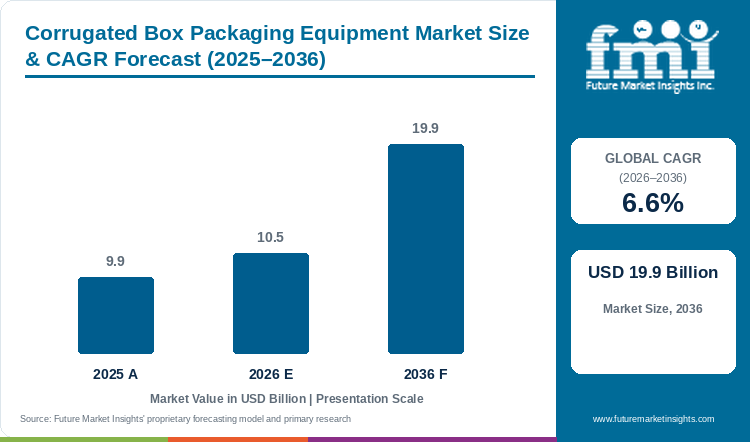
Demand for corrugated box packaging equipment is projected to expand at 6.6% CAGR between 2026 and 2036. Industry value grows from USD 9.9 billion in 2025 to USD 10.5 billion in 2026 and is projected to reach USD 19.9 billion by 2036.
Corrugated box plants are preferring corrugators and converting equipment for converting containerboard into finished corrugated boxes, which is driving the adoption. According to FMI, the market was valued at USD 9.9 billion in 2025 and is projected to rise from USD 10.5 billion in 2026 to USD 19.9 billion by 2036, at 6.6% CAGR. Flexo folder-gluers hold 38.2% of machine type revenue in 2026, as printing, slotting, folding and gluing are completed through one production route. In March 2026, BHS Corrugated introduced the SR-C which can prepare new order settings within two seconds.[1] FEFCO reported European corrugated board production of 51 billion square metres in its 2025 activity report, protecting over 75% of regionally transported goods.[2] Apart from speed, stable register and gluing remain important because damaged sheets cannot be sold. These operating improvements are expected to support adoption of automatic equipment during mixed production runs.
Key Market Trends & Insights
- By machine type, flexo folder-gluers led with 38.2% share in 2026, supported by printing, folding and gluing within one line.
- By automation level, fully automatic equipment accounted for 47.0% of revenue in 2026, owing to continuous feeding, inspection and stacking.
- By end user, food and beverage represented 34.0% of revenue in 2026, attributed to recurring demand for transport and retail cases.
- By production capacity, 10-50 t/hr lines held 41.0% share in 2026 as converters balance daily output with changing board grades and box dimensions.
Regional Highlights
- Fastest-growing profiled country: Taiwan (6.9% CAGR, 2026 to 2036). Export manufacturing and changing protective packaging orders supports flexible converting demand.
- South Korea (6.8%) and Japan (6.5%) follow, while Germany records the lowest profiled CAGR at 5.8% from 2026 to 2036.
Market Size & Forecast
Table 1: Market Size and Forecast for the Corrugated Box Packaging Equipment Market (USD billion and percentage), 2025 to 2036
| Metric | Value |
|---|---|
| 2025 Market Size | USD 9.9 billion |
| Estimated Market Size in 2026 | USD 10.5 billion |
| Projected Market Size by 2036 | USD 19.9 billion |
| CAGR, 2026 to 2036 | 6.6% |
| Added Revenue, 2026 to 2036 | USD 9.4 billion |
| Market Expansion Multiple | 1.9x |
Selection of corrugated equipment depends upon expected board volume, order size and number of changes completed during one shift. BHS Corrugated rates the SPEED Line at up to 56,000 square metres per hour, making it suitable for plants supplying large and longer orders.[3] BW Papersystems states that Value Corrugator can produce about 7 million to 9 million square metres per month, whereas Performance Corrugator reaches about 14 million to 18 million square metres.[4] Thus, a converter serving regional volume cannot use the same line configuration as converter supplying small local orders. In the United States, containerboard production decreased by 4% during 2025, although operating rate remained above 91%.[5] Active capacity with lower production is shifting attention towards board waste, set-up time and maintenance. As a result, controls, finishing sections and replacement units are expected to gain demand along with complete corrugators.
Corrugator Capacity and Operating Economics
Complete corrugator lines require higher investment and are generally selected where continuous board volume can use the available capacity. Modular investment in modern packaging machinery is preferred by existing plants which need to improve one production section without changing the complete line. Value and Performance configurations show large difference in monthly output, whereas the market itself adds USD 9.4 billion between 2026 and 2036. Such difference creates separate buying requirements for local converters and large regional plants. Line speed, board quality, order mix and service support will therefore decide whether investment moves towards a complete corrugator or selected machine sections.
Table 2: Corrugator Capacity and Operating Indicators for the Corrugated Box Packaging Equipment Market (metres per minute, square metres, percentage, and USD billion), mixed reporting years from 2025 to 2036
| Indicator | Data Point | Why It Matters | Source or Basis |
|---|---|---|---|
| Market expansion | USD 10.5 billion in 2026 to USD 19.9 billion by 2036 | Adds USD 9.4 billion and expands the market by about 1.9x. | Report value |
| BHS SPEED Line | Up to 56,000 m²/hour | Represents a high-volume corrugator benchmark for longer production runs. | [3] |
| BW Value Corrugator | 200-350 metres per minute; about 7-9 million m²/month | Supports moderate output where flexibility and investment level remain important. | [4] |
| BW Performance Corrugator | 300-460 metres per minute; about 14-18 million m²/month | Shows the monthly output available for high-capacity plants. | [4] |
| U.S. containerboard operation | 2025 production down 4%; operating rate above 91% | Supports modernization where active plants focus on waste and output from installed equipment. | [5] |
*Basis: Equipment figures represent published manufacturer specifications and are not directly interchangeable with t/hr production categories. Monthly capacity varies with board grade, width, operating time, order mix and plant conditions.*
Analyst Perspective
“Short-run orders will favour equipment that changes jobs quickly without wasting board during repeated daily set-ups. Connected inspection will gain adoption where converters must hold print, fold and glue quality with fewer operators.”
- Nandini Roy Choudhury, Principal Consultant, Future Market Insights.
How is the corrugated box packaging equipment market segmented?
Corrugated box packaging equipment market is segmented by four primary commercial axes and region: machine type, automation level, end user, production capacity, and region. In 2026, flexo folder-gluers are projected at 38.2%, fully automatic equipment at 47.0%, food and beverage at 34.0%, and 10-50 t/hr lines at 41.0%.
As per the analysis from FMI, machine type covers flexo folder-gluer, rotary die-cutter, corrugator wet-end, post-print finishing and ancillary equipment.
By automation level: manual, semi-automatic, and fully automatic or lights-out.
By end user: food and beverage, e-commerce and retail fulfilment, electronics and appliances, pharmaceutical and healthcare, and industrial and automotive.
By production capacity: below 10 t/hr, 10-50 t/hr, 51-100 t/hr, and above 100 t/hr.
By region: North America, Latin America, Western Europe, Eastern Europe, East Asia, South Asia and Pacific, and Middle East and Africa.
Why do flexo folder-gluers retain a notable machine type share?
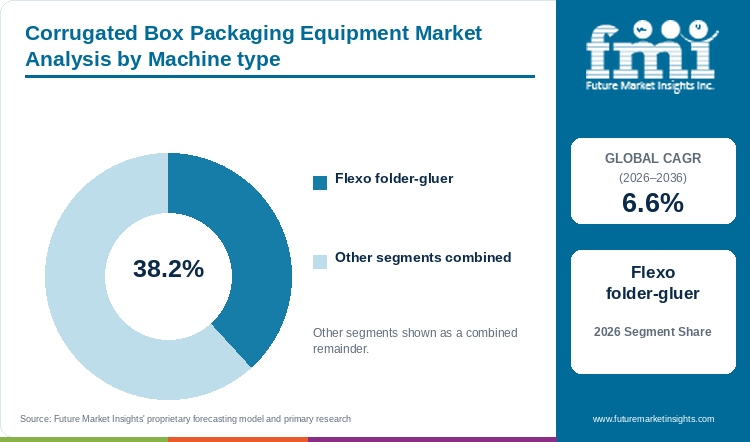
Based on machine type, flexo folder-gluers are projected to account for 38.2% in 2026, driven by combined converting functions.
Table 3: Machine Type Share for the Corrugated Box Packaging Equipment Market (percentage share), 2026
| Machine Type | Share (2026) |
|---|---|
| Flexo folder-gluer | 38.2% |
| Other Segments Combined | 61.8%* |
| Total | 100.0% |
*Calculated as the balance remaining after deducting the leading segment's reported share from 100.0%.
Table 4: Machine Type Leadership and Market Growth for the Corrugated Box Packaging Equipment Market (segment and CAGR percentage), 2026 to 2036
| Metric | Value |
|---|---|
| Global CAGR (2026 to 2036) | 6.6% |
| Leading Segment | Flexo folder-gluer |
Flexo folder-gluers are used for printing, slotting, folding and gluing corrugated sheets within one production route. Movement of sheets between separate equipment is reduced, due to which these lines are preferred for folding carton and paperboard packaging and regular shipping-case orders. In August 2025, EMBA reported that its 295 QS Ultima can produce up to 24,000 sheets per hour using twin feeding.[6] Such output has commercial value when print register, fold and glue quality remain stable during order changes.
- Flexo folder-gluers account for 38.2% share in 2026 as one line completes several box-forming stages.
- Higher output has value when register, fold accuracy, and glue control remain stable during order changes.
How does full automation meet changing box plant requirements?
In 2026, fully automatic equipment is expected to lead automation level with 47.0% share, supported by integrated material handling.
Fully automatic equipment moves corrugated sheets through feeding, transfer, inspection and stacking with lower manual handling. This supports box plants where shorter orders require regular set-up and similar output needs to be maintained after every change. BOBST states that automated corrugated converting systems can lower overall workload by up to 90%.[7] Integrated handling also connects directly with automated case packing machines at packaging facilities. Operator availability is therefore becoming important along with line speed, especially where night shifts and mixed production are operated.
- Fully automatic equipment holds 47.0% share in 2026 as integrated handling keeps sheets moving between controlled process stages.
- Connected inspection and set-up data can reduce the variation that appears when jobs are changed manually.
What supports food and beverage as the preferred end user?
By end user, food and beverage is forecast to represent 34.0% in 2026, owing to recurring case requirements.
Food and beverage manufacturers use corrugated cases for moving packed products from filling lines to warehouses and retail stores. Case requirement repeats with daily production and therefore creates regular demand for printed boxes having consistent size and strength. An Italian packaging machinery survey reported that food and beverage represented 55.4% of sector sales in 2025.[8] High demand from grocery channels also mirrors trends in e-commerce packaging, supporting flexo printing, die-cutting, and case-forming installations.
- Food and beverage contributes 34.0% of end-user revenue in 2026, reflecting recurring case demand through production and distribution schedules.
- Regular orders favour equipment that can hold print and dimensional consistency over long campaigns.
Why are mid-capacity lines selected for mixed order books?
Within production capacity, 10-50 t/hr lines are anticipated to command 41.0% share in 2026, underpinned by flexible batch converting.
Production lines rated at 10-50 t/hr are used by converters supplying food, retail and industrial customers with different box sizes. These lines provide useful daily output while allowing changes in flute, board grade and print requirement. BW Papersystems offers corrugators from 200 to 460 metres per minute according to plant requirement and selected configuration.[9] Modular wet-end and dry-end equipment also allows a converter to expand one section without replacing every stage, complementing investments across flexible packaging machinery.
- 10-50 t/hr lines are projected to hold 41.0% share in 2026 as converters balance daily volume with order flexibility.
- Modular wet-end and dry-end choices allow capacity to grow without replacing every production stage at once.
What are the drivers, restraints, and opportunities in the corrugated box packaging equipment market?
In the corrugated box packaging equipment market, shorter changeovers drive adoption, capital intensity restrains replacement, and digital retrofits create opportunity.
- Driver: Shorter runs and varied box formats expand demand for automatic set-up, inspection, and material handling.
- Restraint: High installation cost and production interruption can delay complete-line replacement for smaller converters.
- Opportunity: Digital controls, predictive service, and modular retrofits can raise output from the installed equipment base.
Shorter Runs Reward Faster Set-ups
Online orders and wider product SKUs are increasing the number of box changes completed within one production shift. Automatic set-up, stored job recipes and sheet inspection reduce the time between two saleable orders, complementing automated intelligent packaging formats. Statistics Korea recorded online shopping transactions of 24.2118 trillion won in August 2026.[10] Parcel movement generated from these orders requires smaller batches of different box sizes rather than one long production campaign. This is expected to drive adoption of equipment having faster set-up, controlled feeding and automatic stacking.
Capital And Downtime Delay Replacement
Complete-line replacement requires building modification, utilities, commissioning and operator training apart from the equipment cost. Production also needs to be stopped during installation, which creates an additional burden for converters having limited spare capacity. German machinery exports declined by 1.8% in nominal terms during 2025, whereas uncertainty continued in capital equipment demand.[11] Smaller box plants may therefore purchase feeders, controls and inspection systems instead of replacing the complete corrugator. High capital requirement and production interruption is expected to restrain the new equipment market.
Retrofits Extend Installed Equipment Value
Digital controls and retrofit packages are being used for raising the output of corrugating and converting lines already operating inside box plants. In August 2026, BHS Corrugated moved its iCorr solutions to the openpack platform for connecting digital products and services.[12] Such systems provide production monitoring without requiring replacement of every mechanical section. Retrofit packages also allow a plant to correct one repeated production loss before investing in a new line, supporting broader efficiency across corrugated and folding carton packaging. This is expected to create opportunity for controls, inspection, remote service and modular equipment upgrades.
Which country CAGRs are profiled in the corrugated box packaging equipment market?
Table 5: Country CAGR Comparison for the Corrugated Box Packaging Equipment Market (CAGR percentage), 2026 to 2036
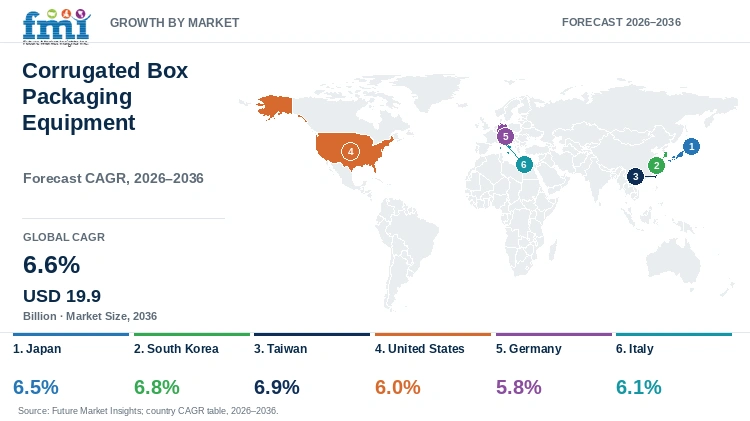
| Country | CAGR |
|---|---|
| Japan | 6.5% |
| South Korea | 6.8% |
| Taiwan | 6.9% |
| United States | 6.0% |
| Germany | 5.8% |
| Italy | 6.1% |
How do country-level CAGRs compare in the corrugated box packaging equipment market?
Country demand conditions differ across the profiled countries as export production, online retail and installed equipment are not at the same stage. FMI data suggests Taiwan at 6.9% CAGR and South Korea at 6.8%, supported by box plant equipment modernizations, higher corrugator line speeds, and converter machinery investments to handle export cases and parcel packaging volumes. Japan follows at 6.5% as box plants seek compact equipment and controls linked with artificial intelligence in packaging to improve output per operator. Italy, the United States and Germany are projected at 6.1%, 6.0% and 5.8%, respectively, where replacement of existing equipment forms a larger part of investment. These rates indicate different expansion conditions rather than national market size.
- Japan combines a large domestic manufacturing base with demand for labour-saving controls and compact production layouts.
- South Korea links high online-shopping activity with fast dispatch and short-run corrugated converting.
- Taiwan’s export-led manufacturing base supports protective packaging and flexible order changes.
- United States investment centres on installed-base productivity, automation, and recurring corrugated shipments.
- Germany benefits from a developed packaging-machinery supply chain but faces selective capital spending.
- Italy combines domestic packaging machinery demand with a large export-oriented equipment industry.
Full report country CAGRs cover: North America; Latin America; Western Europe; Eastern Europe; East Asia; South Asia and Pacific; Middle East and Africa.
Country-wise Analysis
- Japan corrugated box packaging equipment market is anticipated to expand at 6.5% CAGR through 2036. The country has a mature converting industry serving food, electronics and parcel distribution, due to which box dimensions and printed information change across production schedules. Availability of factory workers also remains limited in several manufacturing activities. Compact equipment, automatic quality control and remote service can increase the output handled by each operator without adding similar labour. The 2025 Japan Statistical Yearbook covers manufacturing, trade, retail, transport and business activity under the national statistical system.[13] Demand for labour-saving controls and compact production layouts is expected to support the Japan market.
- South Korea corrugated box packaging equipment market is projected to grow at 6.8% CAGR during the forecast period. The Ministry of Trade, Industry and Energy reported in August 2025 that South Korea's online retail sales surged 15.3% year-on-year, with online food categories expanding 24.2%.[14] Every parcel order does not require the same box size, which raises short-run printing, sheet feeding and stacking requirements among corrugated converters. Faster printing alone cannot improve dispatch where downstream stacking and pallet movement remains slow. Box plants are therefore expected to increase adoption of automatic feeding, inspection and handling equipment. Expansion of online retail and connected production is anticipated to support the South Korea market.
- Taiwan corrugated box packaging equipment market is estimated to expand at 6.9% CAGR through 2036. Taiwan Paper Industry Association reported apparent paper and paperboard consumption of 3,852,838 tonnes during 2025.[15] Export of electronics and industrial products requires protective corrugated cases having controlled size, board strength and printed identification. Converters also serve different export customers, due to which board grade and box dimension change frequently. Automatic set-up, digital print connection and inspection equipment can help plants in maintaining these delivery schedules. Export manufacturing and available paperboard consumption is expected to drive equipment demand in Taiwan.
- United States corrugated box packaging equipment market is projected to record 6.0% CAGR during the assessment period. The country has a large installed base of corrugators and converting lines, supporting high demand across rigid industrial packaging and converting sectors. Fibre Box Association tracks box shipments, containerboard production, consumption and inventory for the industry.[16] Purchase decisions are also affected by downtime, labour requirement and board waste from installed machinery. Expansion of parts, remote diagnostics and equipment service is expected to support plant modernization. These factors are anticipated to drive the United States market through 2036.
- Germany corrugated box packaging equipment market is forecast to grow at 5.8% CAGR through 2036. VDMA reported that food and packaging machinery production increased by 4.9% in 2025, while packaging machinery output rose by 8% to about USD 9.7 billion.[17] Presence of an established machinery industry provides converters access to automation, components and technical support. However, energy cost and selective capital spending can delay complete-line replacement. Plants are therefore expected to invest in waste control, energy reduction and repeatable changeovers before adding unnecessary capacity. Replacement of older sections will continue supporting equipment demand in Germany.
- Italy corrugated box packaging equipment market is expected to progress at 6.1% CAGR between 2026 and 2036. UCIMA survey covered 629 companies and 40,611 employees during 2025, whereas packaging machinery revenue reached about USD 12.0 billion.[18] Domestic machinery sales increased by 9.9%, and food and pharmaceutical demand each grew by more than 15%. This manufacturing base supports availability of components, controls and specialist service for corrugated converters. Domestic users and export-oriented machinery suppliers will continue creating demand for flexo printing, die-cutting, handling and corrugator upgrades. These conditions are expected to support Italy market revenue.
Who are the notable companies in the corrugated box packaging equipment market?
BOBST, BHS Corrugated, BW Papersystems, Mitsubishi Heavy Industries Printing & Packaging Machinery, Fosber Group, Koenig & Bauer Celmacch, EMBA Machinery, and Göpfert Maschinen are notable companies profiled in this market.
Competition in corrugated box packaging equipment market is divided between complete-line manufacturers, converting equipment suppliers and companies offering digital controls and retrofit service. Complete corrugator suppliers compete through line output, board quality and integration of wet-end and dry-end sections. Printing and converting suppliers focus on print register, die-cut accuracy, folding and shorter job changes. Buyers also compare parts availability and service response because failure of one section can stop the wider line. Due to this, product performance alone does not decide equipment selection. Availability of installation, training and upgrade support is expected to remain important during the forecast period.
- Integrated corrugator and lifecycle platforms: BHS Corrugated, BW Papersystems, and Fosber Group.
- Printing, die-cutting, and folder-gluer platforms: BOBST, Koenig & Bauer Celmacch, EMBA Machinery, and Göpfert Maschinen.
- Industrial printing and packaging systems: Mitsubishi Heavy Industries Printing & Packaging Machinery.
Competitive Benchmarking: Corrugated Box Packaging Equipment Market
Table 6: Competitive Benchmarking for the Corrugated Box Packaging Equipment Market (qualitative capability ratings), 2026
| Company | Portfolio breadth | Digital depth | Current activity | Geographic reach |
|---|---|---|---|---|
| BOBST | High | High | High | High |
| BHS Corrugated | High | High | High | High |
| BW Papersystems | High | High | High | High |
| Mitsubishi Heavy Industries Printing & Packaging Machinery | High | Medium | Medium | High |
| Fosber Group | High | High | High | High |
| Koenig & Bauer Celmacch | High | Medium | High | High |
| EMBA Machinery | High | Medium | Medium | Medium |
| Göpfert Maschinen | High | Medium | Medium | High |
High indicates broad public evidence across the rated aspect, Medium indicates a focused or more limited public record, and Low indicates narrow evidence. Ratings do not represent product quality, market share, or company rank.
Key Developments in the Corrugated Box Packaging Equipment Market
- In September 2026, BW Papersystems secured an order from Sahara Paper Industries for a 2.5-metre double-level doublewall intelligent corrugator.[19]
- In June 2026, TRG Packaging and Display Solutions and BHS Corrugated launched the first BHS Jetliner Xceed digital printing line in the United States.
- In May 2026, Fosber completed its acquisition of the remaining 40% of Quantum Corrugated, bringing the business fully into Fosber Group.
- In April 2026, Koenig & Bauer Celmacch introduced the Prima and PrimaCUT series through a manufacturing partnership for the mid-tech market.
Key Players in the Corrugated Box Packaging Equipment Market
Corrugator And Wet-end Platforms
- BHS Corrugated
- BW Papersystems
- Fosber Group
- Mitsubishi Heavy Industries Printing & Packaging Machinery
Printing And Converting Platforms
- BOBST
- Koenig & Bauer Celmacch
- EMBA Machinery
- Göpfert Maschinen
Corrugated Box Packaging Equipment Market - Report Scope
Table 7: Report Scope for the Corrugated Box Packaging Equipment Market (coverage fields and definitions), 2026 to 2036
| Coverage field | Report scope |
|---|---|
| Market breakdown | Machine type; automation level; end user; production capacity; region |
| Quantitative units | USD billion |
| Market definition | First-sale revenue from equipment used to corrugate, print, die-cut, fold, glue, inspect, and handle corrugated box production. Board, inks, adhesives, used machinery, and general warehouse equipment are excluded. |
| Regions covered | North America; Latin America; Western Europe; Eastern Europe; East Asia; South Asia and Pacific; Middle East and Africa |
| Countries covered | Japan; South Korea; Taiwan; United States; Germany; Italy |
| Key companies profiled | BOBST, BHS Corrugated, BW Papersystems, Mitsubishi Heavy Industries Printing & Packaging Machinery, Fosber Group, Koenig & Bauer Celmacch, EMBA Machinery, Göpfert Maschinen |
| Forecast period | 2026 to 2036 |
| Approach | Hybrid bottom-up and top-down sizing using equipment categories, installed-base replacement, new-line activity, serviceable demand, and country operating conditions. |
Corrugated Box Packaging Equipment Market - Research Methodology
Table 8: Corrugated Box Packaging Equipment Market - Research Methodology
| Method | Approach |
|---|---|
| Primary Research | The research study includes interviews with equipment manufacturers, service providers, distributors, converters, procurement teams and industry experts. Interviews cover purchasing decisions, equipment evaluation, pricing, adoption barriers, approval requirements and technical support. |
| Desk Research | Desk research includes government statistics, trade data, industry associations, technical publications, company announcements, product information and filings. Sources are reviewed on the basis of publication date, market relevance and geographic coverage. |
| Market Sizing and Forecasting | Market sizing combines the base value with equipment categories, installed base, replacement activity, pricing, company participation and country demand conditions. Forecast considers investment trends, technology adoption, purchasing cycles and supply availability. |
| Data Validation | Market estimates are checked with public data, company activity, trade patterns and primary research. Products and company revenue outside the defined equipment market are excluded in order to reduce overlapping revenue. |
Corrugated Box Packaging Equipment Market by Segments
Corrugated Box Packaging Equipment Market segmented by Machine type:
- Flexo folder-gluer
- Rotary die-cutter
- Single-facer and corrugator wet-end
- Finishing and folder-gluer post-print
- Ancillary equipment
Corrugated Box Packaging Equipment Market segmented by Automation level:
- Manual
- Semi-automatic
- Fully automatic or lights-out
Corrugated Box Packaging Equipment Market segmented by End user:
- Food and beverage
- E-commerce and retail fulfilment
- Electronics and appliances
- Pharmaceutical and healthcare
- Industrial and automotive
Corrugated Box Packaging Equipment Market segmented by Production capacity:
- Below 10 t/hr
- 10-50 t/hr
- 51-100 t/hr
- Above 100 t/hr
Corrugated Box Packaging Equipment Market by Region
- North America
- United States
- Canada
- Latin America
- Brazil
- Mexico
- Argentina
- Chile
- Western Europe
- Germany
- France
- United Kingdom
- Italy
- Spain
- Benelux
- Nordics
- Eastern Europe
- Poland
- Czech Republic
- Romania
- Hungary
- East Asia
- Japan
- South Korea
- Taiwan
- South Asia and Pacific
- India
- ASEAN
- Australia and New Zealand
- Middle East and Africa
- GCC Countries
- South Africa
- Türkiye
- Israel
Research Sources and Bibliography
- [1] BHS Corrugated. (2026, March 20). New Slitter Scorer SR-C boosts efficiency in the corrugator.
- [2] European Federation of Corrugated Board Manufacturers (FEFCO). (2025). Annual activity report and European corrugated industry statistics. https://www.fefco.org/
- [3] BHS Corrugated. (2026). Corrugator lines: SPEED Line production information.
- [4] BW Papersystems. (2026). Value and Performance corrugator production specifications.
- [5] American Forest & Paper Association (AF&PA). (2026, January 30). AF&PA releases Q4 2025 containerboard quarterly report. https://www.afandpa.org/
- [6] EMBA Machinery. (2025, August 25). 295 QS Ultima to McElroy Packaging.
- [7] BOBST. (2026). Corrugated board equipment and performance information.
- [8] UCIMA MECS Research Centre. (2026, July 6). Italian packaging machinery manufacturers continue to grow: 2025 revenue up 4%.
- [9] BW Papersystems. (2026). Corrugators: production and capacity configurations.
- [10] Statistics Korea. (2026, October 1). Online shopping in August 2026. https://kostat.go.kr/
- [11] VDMA. (2026). German machine trade, January-December 2025.
- [12] BHS Corrugated. (2026, August 24). iCorr x openpack hub: The next step toward the connected box plant.
- [13] Statistics Bureau of Japan. (2025). Japan statistical yearbook 2025.
- [14] Ministry of Trade, Industry and Energy (MOTIE), Republic of Korea. (2025, August 27). Retail sales trends: Online commerce expands 15.3% in July 2025.
- [15] Taiwan Paper Industry Association. (2026). Annual paper and paperboard statistics, 2025.
- [16] Fibre Box Association. (2025). Data services reports.
- [17] VDMA Food Processing and Packaging Machinery Association. (2026, May 20). Packaging machinery construction reaches record value 2025.
- [18] UCIMA MECS Research Centre. (2026, July 6). 14th national statistical survey of the Italian packaging machinery industry.
- [19] BW Papersystems. (2026, September 21). BW Papersystems secures new order with Sahara Paper Industries at PAPER ME Egypt.
This bibliography is provided for reader reference. The full report contains the complete reference list and detailed citations.
This Report Answers
- How large is the corrugated box packaging equipment market in 2026?
- What value is projected for the equipment market by 2036?
- Which machine type holds a notable share during 2026?
- Which automation level accounts for notable revenue in 2026?
- Which countries show a notable expansion outlook through 2036?
- Which companies are notable in corrugated box packaging equipment?
Frequently Asked Questions
How large is the corrugated box packaging equipment market in 2026?
Future Market Insights estimates that the corrugated box packaging equipment market will reach USD 10.5 billion in 2026. Market value is projected at USD 19.9 billion by 2036 as automation and replacement activity increases.
What CAGR is projected for the equipment market through 2036?
As per FMI, corrugated box packaging equipment demand is projected to grow at a 6.6% CAGR from 2026 to 2036. Short orders, board-waste control and faster changeovers are expected to support market expansion.
Which machine type holds a notable share in 2026?
Flexo folder-gluers are projected to account for 38.2% of machine type revenue in 2026. Combined printing, slotting, folding and gluing is expected to support the segment demand.
Which automation level holds a notable share in 2026?
Fully automatic or lights-out equipment is projected to hold 47.0% of automation-level revenue in 2026. Automatic feeding, inspection and stacking reduces sheet handling between controlled production stages.
Which country has a notable expansion outlook through 2036?
Taiwan is projected to record 6.9% CAGR from 2026 to 2036. Export manufacturing and frequent changes in protective box formats are anticipated to support country demand.
Who are the notable corrugated box equipment companies?
Notable companies include BOBST, BHS Corrugated, BW Papersystems, Mitsubishi Heavy Industries Printing & Packaging Machinery, Fosber Group, Koenig & Bauer Celmacch, EMBA Machinery, and Göpfert Maschinen. These companies participate through corrugators, converting equipment, controls, upgrades and technical service.
Preview the report firsthand - request a free sample
Get SampleGet the brochure for pricing and purchase details.
Get PDFTable of Content
- Key Takeaways
- Market Size and CAGR
- Top Growth Driver
- Fastest Growing Segment
- Leading Region
- Key Companies
- Emerging Opportunities
- Executive Summary
- Global Market Outlook
- Demand-side Trends
- Supply-side Trends
- Technology Roadmap Analysis
- Analysis and Recommendations
- Analyst Perspective (What is happening? Why now? What should investors know?)
- Key Questions Answered
- How large is the market?
- What is the CAGR?
- What are key trends?
- Which region dominates?
- Who are the leaders?
- Market Overview
- Market Coverage / Taxonomy
- Market Definition / Scope / Limitations
- Research Methodology
- Chapter Orientation
- Analytical Lens and Working Hypotheses
- Market Structure, Signals, and Trend Drivers
- Benchmarking and Cross-market Comparability
- Market Sizing, Forecasting, and Opportunity Mapping
- Research Design and Evidence Framework
- Desk Research Programme (Secondary Evidence)
- Expert Input and Fieldwork (Primary Evidence)
- Tooling, Models, and Reference Databases
- Data Engineering and Model Build
- Quality Assurance and Audit Trail
- Market Background
- Market Dynamics (Drivers, Restraints, Opportunity, Trends)
- Scenario Forecast (Optimistic, Likely, Conservative)
- Impact Analysis
- AI Impact
- Sustainability Impact
- Regulatory Impact
- Technology Impact
- Consumer / Buyer Analysis
- Purchase Drivers
- Adoption Barriers
- Buyer Journey
- Opportunity Map Analysis
- Product Life Cycle Analysis
- Supply Chain Analysis
- Investment Feasibility Matrix
- Value Chain Analysis
- PESTLE and Porter's Analysis
- Regulatory Landscape
- Regional Parent Market Outlook
- Production and Consumption Statistics
- Import and Export Statistics
- Global Market Analysis and Forecast, 2021 to 2036
- Historical Market Size Value (USD Billion) Analysis, 2021 to 2025
- Current and Future Market Size Value (USD Billion) Projections, 2026 to 2036
- Y-o-Y Growth Trend Analysis
- Absolute $ Opportunity Analysis
- Global Market Pricing Analysis, 2021 to 2036
- Global Market Analysis and Forecast, By Machine type, 2021 to 2036
- Introduction / Key Findings
- Historical Market Size Value (USD Billion) Analysis By Machine type, 2021 to 2025
- Current and Future Market Size Value (USD Billion) Analysis and Forecast By Machine type, 2026 to 2036
- Flexo folder-gluer
- Rotary die-cutter
- Single-facer and corrugator wet-end
- Finishing and folder-gluer post-print
- Ancillary equipment
- Y-o-Y Growth Trend Analysis By Machine type, 2021 to 2025
- Absolute $ Opportunity Analysis By Machine type, 2026 to 2036
- Global Market Analysis and Forecast, By Automation level, 2021 to 2036
- Introduction / Key Findings
- Historical Market Size Value (USD Billion) Analysis By Automation level, 2021 to 2025
- Current and Future Market Size Value (USD Billion) Analysis and Forecast By Automation level, 2026 to 2036
- Manual
- Semi-automatic
- Fully automatic or lights-out
- Y-o-Y Growth Trend Analysis By Automation level, 2021 to 2025
- Absolute $ Opportunity Analysis By Automation level, 2026 to 2036
- Global Market Analysis and Forecast, By End user, 2021 to 2036
- Introduction / Key Findings
- Historical Market Size Value (USD Billion) Analysis By End user, 2021 to 2025
- Current and Future Market Size Value (USD Billion) Analysis and Forecast By End user, 2026 to 2036
- Food and beverage
- E-commerce and retail fulfilment
- Electronics and appliances
- Pharmaceutical and healthcare
- Industrial and automotive
- Y-o-Y Growth Trend Analysis By End user, 2021 to 2025
- Absolute $ Opportunity Analysis By End user, 2026 to 2036
- Global Market Analysis and Forecast, By Production capacity, 2021 to 2036
- Introduction / Key Findings
- Historical Market Size Value (USD Billion) Analysis By Production capacity, 2021 to 2025
- Current and Future Market Size Value (USD Billion) Analysis and Forecast By Production capacity, 2026 to 2036
- Below 10 t/hr
- 10-50 t/hr
- 51-100 t/hr
- Above 100 t/hr
- Y-o-Y Growth Trend Analysis By Production capacity, 2021 to 2025
- Absolute $ Opportunity Analysis By Production capacity, 2026 to 2036
- Global Market Analysis and Forecast, By Region, 2021 to 2036
- Introduction
- Historical Market Size Value (USD Billion) Analysis By Region, 2021 to 2025
- Current Market Size Value (USD Billion) Analysis and Forecast By Region, 2026 to 2036
- North America
- Latin America
- Western Europe
- Eastern Europe
- East Asia
- South Asia and Pacific
- Middle East and Africa
- Market Attractiveness Analysis By Region
- North America Market Analysis and Forecast, By Country, 2021 to 2036
- Historical Market Size Value (USD Billion) Trend Analysis By Market Taxonomy, 2021 to 2025
- Market Size Value (USD Billion) Forecast By Market Taxonomy, 2026 to 2036
- By Country
- United States
- Canada
- By Machine type
- By Automation level
- By End user
- By Production capacity
- By Country
- Market Attractiveness Analysis
- By Country
- By Machine type
- By Automation level
- By End user
- By Production capacity
- Key Takeaways
- Latin America Market Analysis and Forecast, By Country
- Historical Market Size Value (USD Billion) Trend Analysis By Market Taxonomy, 2021 to 2025
- Market Size Value (USD Billion) Forecast By Market Taxonomy, 2026 to 2036
- By Country
- Brazil
- Mexico
- Argentina
- Chile
- By Machine type
- By Automation level
- By End user
- By Production capacity
- By Country
- Market Attractiveness Analysis
- By Country
- By Machine type
- By Automation level
- By End user
- By Production capacity
- Key Takeaways
- Western Europe Market Analysis and Forecast, By Country
- Historical Market Size Value (USD Billion) Trend Analysis By Market Taxonomy, 2021 to 2025
- Market Size Value (USD Billion) Forecast By Market Taxonomy, 2026 to 2036
- By Country
- Germany
- France
- United Kingdom
- Italy
- Spain
- Benelux
- Nordics
- By Machine type
- By Automation level
- By End user
- By Production capacity
- By Country
- Market Attractiveness Analysis
- By Country
- By Machine type
- By Automation level
- By End user
- By Production capacity
- Key Takeaways
- Eastern Europe Market Analysis and Forecast, By Country
- Historical Market Size Value (USD Billion) Trend Analysis By Market Taxonomy, 2021 to 2025
- Market Size Value (USD Billion) Forecast By Market Taxonomy, 2026 to 2036
- By Country
- Poland
- Czech Republic
- Romania
- Hungary
- By Machine type
- By Automation level
- By End user
- By Production capacity
- By Country
- Market Attractiveness Analysis
- By Country
- By Machine type
- By Automation level
- By End user
- By Production capacity
- Key Takeaways
- East Asia Market Analysis and Forecast, By Country
- Historical Market Size Value (USD Billion) Trend Analysis By Market Taxonomy, 2021 to 2025
- Market Size Value (USD Billion) Forecast By Market Taxonomy, 2026 to 2036
- By Country
- Japan
- South Korea
- Taiwan
- By Machine type
- By Automation level
- By End user
- By Production capacity
- By Country
- Market Attractiveness Analysis
- By Country
- By Machine type
- By Automation level
- By End user
- By Production capacity
- Key Takeaways
- South Asia and Pacific Market Analysis and Forecast, By Country
- Historical Market Size Value (USD Billion) Trend Analysis By Market Taxonomy, 2021 to 2025
- Market Size Value (USD Billion) Forecast By Market Taxonomy, 2026 to 2036
- By Country
- India
- ASEAN
- Australia and New Zealand
- By Machine type
- By Automation level
- By End user
- By Production capacity
- By Country
- Market Attractiveness Analysis
- By Country
- By Machine type
- By Automation level
- By End user
- By Production capacity
- Key Takeaways
- Middle East and Africa Market Analysis and Forecast, By Country
- Historical Market Size Value (USD Billion) Trend Analysis By Market Taxonomy, 2021 to 2025
- Market Size Value (USD Billion) Forecast By Market Taxonomy, 2026 to 2036
- By Country
- GCC Countries
- South Africa
- Türkiye
- Israel
- By Machine type
- By Automation level
- By End user
- By Production capacity
- By Country
- Market Attractiveness Analysis
- By Country
- By Machine type
- By Automation level
- By End user
- By Production capacity
- Key Takeaways
- Key Countries Market Analysis
- United States
- Pricing Analysis
- Market Share Analysis, 2025
- By Machine type
- By Automation level
- By End user
- By Production capacity
- Canada
- Pricing Analysis
- Market Share Analysis, 2025
- By Machine type
- By Automation level
- By End user
- By Production capacity
- Mexico
- Pricing Analysis
- Market Share Analysis, 2025
- By Machine type
- By Automation level
- By End user
- By Production capacity
- Brazil
- Pricing Analysis
- Market Share Analysis, 2025
- By Machine type
- By Automation level
- By End user
- By Production capacity
- Chile
- Pricing Analysis
- Market Share Analysis, 2025
- By Machine type
- By Automation level
- By End user
- By Production capacity
- Germany
- Pricing Analysis
- Market Share Analysis, 2025
- By Machine type
- By Automation level
- By End user
- By Production capacity
- United Kingdom
- Pricing Analysis
- Market Share Analysis, 2025
- By Machine type
- By Automation level
- By End user
- By Production capacity
- Italy
- Pricing Analysis
- Market Share Analysis, 2025
- By Machine type
- By Automation level
- By End user
- By Production capacity
- Spain
- Pricing Analysis
- Market Share Analysis, 2025
- By Machine type
- By Automation level
- By End user
- By Production capacity
- France
- Pricing Analysis
- Market Share Analysis, 2025
- By Machine type
- By Automation level
- By End user
- By Production capacity
- India
- Pricing Analysis
- Market Share Analysis, 2025
- By Machine type
- By Automation level
- By End user
- By Production capacity
- ASEAN
- Pricing Analysis
- Market Share Analysis, 2025
- By Machine type
- By Automation level
- By End user
- By Production capacity
- Australia and New Zealand
- Pricing Analysis
- Market Share Analysis, 2025
- By Machine type
- By Automation level
- By End user
- By Production capacity
- Japan
- Pricing Analysis
- Market Share Analysis, 2025
- By Machine type
- By Automation level
- By End user
- By Production capacity
- South Korea
- Pricing Analysis
- Market Share Analysis, 2025
- By Machine type
- By Automation level
- By End user
- By Production capacity
- Poland
- Pricing Analysis
- Market Share Analysis, 2025
- By Machine type
- By Automation level
- By End user
- By Production capacity
- Hungary
- Pricing Analysis
- Market Share Analysis, 2025
- By Machine type
- By Automation level
- By End user
- By Production capacity
- Türkiye
- Pricing Analysis
- Market Share Analysis, 2025
- By Machine type
- By Automation level
- By End user
- By Production capacity
- South Africa
- Pricing Analysis
- Market Share Analysis, 2025
- By Machine type
- By Automation level
- By End user
- By Production capacity
- Taiwan
- Pricing Analysis
- Market Share Analysis, 2025
- By Machine type
- By Automation level
- By End user
- By Production capacity
- United States
- Market Structure Analysis
- Competition Dashboard
- Competition Benchmarking
- Market Share Analysis of Top Players
- By Regional
- By Machine type
- By Automation level
- By End user
- By Production capacity
- Emerging Startups
- Innovation Benchmarking
- Competition Analysis
- Competition Deep Dive
- BOBST
- Overview
- Product Portfolio
- Profitability by Market Segments
- Sales Footprint
- Strategy Overview
- Marketing Strategy
- Product Strategy
- Channel Strategy
- BHS Corrugated
- BW Papersystems
- Mitsubishi Heavy Industries Printing & Packaging Machinery
- Fosber Group
- Koenig & Bauer Celmacch
- EMBA Machinery
- Göpfert Maschinen
- BOBST
- Case Studies
- Success Stories
- Recent Developments
- Competition Deep Dive
- Assumptions & Acronyms Used


