

- Market Size (2026)
- USD 8.7 Bn
- Forecast (2036)
- USD 13.7 Bn
- CAGR (2026 to 2036)
- 4.6%
How big is Sheet Die Cutters Market in 2026?
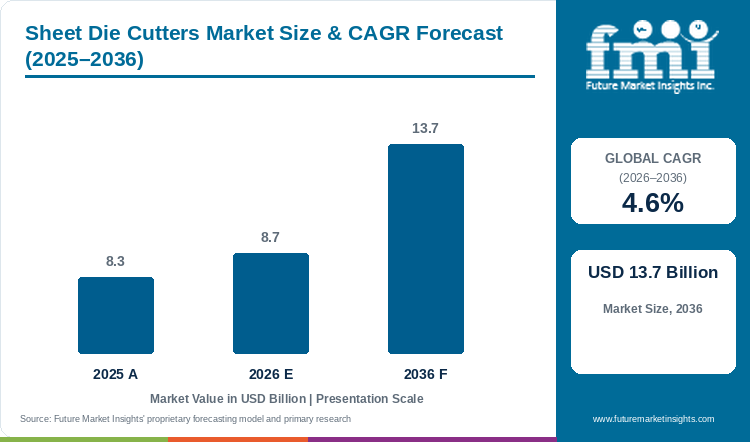
Revenue from sheet die cutters totalled USD 8.3 billion in 2025, rises to USD 8.7 billion in 2026 and is forecast to reach USD 13.7 billion by 2036. Sales are projected to expand at a 4.6% CAGR between 2026 and 2036, as converters replace older platen presses with automated, quick-change lines.
Online orders are adding short carton and shipping box jobs, with e-commerce reaching 17.1% of U.S. retail sales in the second quarter of 2026 [1]. Large machine orders, however, remain weak, as Bobst Group's 2025 sales fell 14.2% to CHF 1,622.3 million [2]. Due to this, buyers of packaging machinery are choosing quick-changeover upgrades over new lines. In January 2025, BOBST said the ACCUPLATEN platen cuts patching time on the EXPERTCUT 106 PER by up to 80% [3]. As per FMI, flatbed die cutters hold the leading 34% share in 2026, as one machine cuts, creases and strips both cartons and boxes. Sales of die cutting and creasing machines are anticipated to track the number of short jobs per plant, favouring models that set up in minutes.
Key Market Trends & Insights
- Flatbed die cutters lead machine type with a 34% share in 2026, since converters cut cartons and boxes on the same platform.
- Paperboard accounts for 37% of sheet material use in 2026. Corrugated board is closing the gap in Europe, with Cepi reporting cartonboard output down 5.6% in 2025 [4].
- Folding cartons form the largest end use with 34% of 2026 revenue, owing to steady short print runs for food, health and beauty brands.
- Fully automatic systems hold 55% of 2026 revenue by automation, a lead set to widen as plants short of operators automate feeding, stripping and stacking. BOBST said in January 2025 that an optional energy pack on the EXPERTCUT 106 PER lowers power use from 5 kWh to 4 kWh per 1,000 sheets [3].
- Packaging machinery OEMs take 43% of 2026 sales by channel, ahead of direct sales, dealers and refurbished machines.
Regional Highlights
- Fastest-growing profiled country: Czech Republic (5.8% CAGR, 2026 to 2036).
- By country: Italy (4.8%) and USA (4.5%) follow, and Japan grows slowest with a 3.8% CAGR by 2036.
- CzechInvest mediated 25 projects worth about USD 1.21 billion in 2025, led by a USD 775.76 million Toyota expansion in Kolín [5]. Due to this, Czech converters are gaining box and carton work from new car and electronics plants.
Market Size & Forecast
Table 1: Market Size and Forecast for the Sheet Die Cutters Market (USD billion and percentage), 2025 to 2036
| Metric | Value |
|---|---|
| 2025 Market Size | USD 8.3 billion |
| Estimated Market Size in 2026 | USD 8.7 billion |
| Projected Market Size by 2036 | USD 13.7 billion |
| CAGR, 2026 to 2036 | 4.6% |
| Added Revenue, 2026 to 2036 | USD 5.0 billion |
| Market Expansion Multiple | 1.6x |
Most sales of die cutting presses now come from converters replacing older machines. Converters handle more short runs for online retail and branded packs, so machines with long setup times are retired first. Box tonnage remains soft, with U.S. corrugated box shipments in the third quarter of 2025 at the lowest third-quarter level since 2015 [6]. Bobst still held a backlog 11% above the end-2025 level at the 2026 half-year mark, which should keep die cutter deliveries running into 2027 [7]. Tariffs and borrowing costs, however, are delaying large purchases at many box and carton plants. New machine orders are anticipated to recover once converters gain cost clarity, with automated models taking most of the rebound.
Supplier Order Cycle and Replacement Readiness
Demand for sheet die cutters follows the number of packaging jobs per plant more closely than board tonnage. China's express parcel volume rose 13.7% to 199 billion in 2025, adding box work across East Asia [8]. In Europe, Cepi reported containerboard output up 1.7% in 2025, cartonboard down 5.6% and total paper and board down 1.5% to 77.6 million tonnes [4]. The EU Packaging and Packaging Waste Regulation applies from 12 August 2026 and targets per-person packaging waste cuts of 5% by 2030 and 15% by 2040 against 2018 [9]. Brands redesigning packs for these targets will order new dies and fresh cutter settings. New factories add work too, and Czech investment is shifting toward more automated manufacturing [5]. Italy adds corrugated work as well, with national board output up 1.6% in 2025 [10]. FMI expects flatbed and corrugated cutters with quick job changes to gain most from this job mix through 2036.
Machine orders at large die cutter suppliers are falling, yet service income and backlogs hold firm. Bobst's Printing and Converting unit sold CHF 938.6 million of machines in 2025, down 23.1%, as merging corrugated groups ordered fewer lines [2]. The Bobst service unit grew 2% to CHF 683.7 million in the same year [2]. In the first half of 2026, Bobst sales fell 11.6% to CHF 589.9 million, mainly on lower equipment sales [7]. Koenig & Bauer ended 2025 with a group order backlog of EUR 970.6 million [11]. The Koenig & Bauer Paper and Packaging Sheetfed segment booked EUR 704 million of orders against EUR 741.5 million of revenue [11]. At Heidelberg, which sells MK Masterwork die cutters outside China, Print and Packaging Equipment sales rose 17.2% to EUR 463 million during the first half of 2025/26 [12] [13]. Group order intake at Heidelberg slipped 12.7% to EUR 1,111 million, following a prior year boosted by drupa orders [12]. Faster setup is the main supplier response, with ACCUPLATEN adding up to 15 minutes of uptime per job on the BOBST EXPERTCUT 106 PER [3]. Koenig & Bauer's CutPRO 2.1 runs up to 7,000 sheets per hour on corrugated sheets up to 1,300 x 2,100 mm [14]. Japanese buyers want fewer but higher-value machines, with packaging machinery output at JPY 531 billion in 2025 as units fell 0.8% to 257,373 [15]. FMI anticipates steadier machine value in 2026, with orders recovering once tariff and borrowing costs settle.
Table 2: Supplier Order Cycle and Replacement Readiness Indicators for the Sheet Die Cutters Market (USD, CHF, EUR and JPY values, parcels, machine units, tonnes and percentages), mixed reporting years from 2024 to 2026
| Indicator | Data Point | Market Relevance | Source |
|---|---|---|---|
| U.S. e-commerce sales, second quarter 2026 | USD 340.2 billion; 17.1% of retail; up 12.2% year on year | Online orders add shipper boxes and short carton runs. | [1] |
| China express parcels, 2025 | 199 billion parcels; up 13.7% | Parcel growth adds box converting work in East Asia. | [8] |
| U.S. corrugated box shipments, third quarter 2025 | Lowest third-quarter level since 2015 | Weak box tonnage slows orders for new corrugated cutters. | [6] |
| Bobst Group sales, 2025 | CHF 1,622.3 million, down 14.2%; Services and Performance up 2% to CHF 683.7 million | Converters keep paying for service and upgrades as new machine orders fall. | [2] |
| Bobst Group, first half 2026 | Sales CHF 589.9 million, down 11.6%; orders down 11%; backlog 11% above end-2025 | Die cutter deliveries continue into 2027 even as new orders slow. | [7] |
| Koenig & Bauer order backlog, end-2025 | EUR 970.6 million | Sheet-fed and postpress deliveries keep running through 2026. | [11] |
| Heidelberg Print and Packaging Equipment, first half 2025/26 | EUR 463 million against EUR 395 million a year earlier | Heidelberg sales of packaging equipment, including MK die cutters, are rising. | [12] |
| BOBST EXPERTCUT 106 PER upgrades | Patching time cut by up to 80%; up to 1 tonne of carton saved per 1 million sheets | Make-ready and board savings drive replacement orders. | [3] |
| European paper and board output, 2025 | 77.6 million tonnes, down 1.5%; containerboard up 1.7%; cartonboard down 5.6% | Cutting work is shifting toward corrugated board. | [4] |
| EU Packaging and Packaging Waste Regulation | Applies from 12 August 2026; packaging waste per person down 5% by 2030 and 15% by 2040 | Brands are moving packs toward recyclable fibre formats. | [9] |
| Japan packaging machinery production, 2025 | JPY 531 billion, up from JPY 507 billion; 257,373 units | Japanese converters are buying fewer but higher-value machines. | [15] |
| drupa 2024 trade fair | 1,643 exhibitors; 170,000 visitors from 174 countries | Die cutter suppliers take many machine orders at drupa. | [16] |
Table 3: Supplier Sales and Order Benchmarks for the Sheet Die Cutters Market (USD, CHF, EUR and JPY values, machine units, ratios and percentages), mixed reporting periods from 2025 to 2026
| Indicator | Reported value | Related figure | Source |
|---|---|---|---|
| Sheet die cutters market, 2025 to 2026 | USD 8.3 billion (2025), USD 8.7 billion (2026) | 4.6% CAGR, 2026 to 2036 | Future Market Insights |
| Bobst Group sales, 2025 | CHF 1,622.3 million | -14.2% | [2] |
| Bobst Printing and Converting sales, 2025 | CHF 938.6 million | -23.1% | [2] |
| Bobst Services and Performance sales, 2025 | CHF 683.7 million | +2% | [2] |
| Bobst Group sales, first half 2026 | CHF 589.9 million | -11.6%; orders -11%; backlog +11% vs end-2025 | [7] |
| Heidelberg Print and Packaging Equipment, first half 2025/26 | EUR 463 million (prior EUR 395 million) | +17.2% | [12] |
| Heidelberg group order intake, first half 2025/26 | EUR 1,111 million (prior EUR 1,273 million) | -12.7% | [12] |
| Koenig & Bauer Paper and Packaging Sheetfed, 2025 | Revenue EUR 741.5 million | Orders EUR 704 million | [11] |
| Koenig & Bauer group backlog, end-2025 | EUR 970.6 million | 2025 group targets met | [11] |
| Japan packaging machinery production, 2025 | JPY 531 billion; 257,373 units | Units -0.8%; up from JPY 507 billion | [15] |
Analyst Perspective
“Converters will place the next round of die cutter orders with suppliers whose machines change jobs in minutes and waste less board per run. Service contracts, robot handling and workflow links will shape supplier choice as older platen presses retire over the forecast period.”
- Nikhil Kaitwade, Principal Consultant, Future Market Insights.
How is the sheet die cutters market segmented?
The sheet die cutters market is split into five commercial segments plus region, covering machine type, sheet material, end use, automation and sales channel. Shares for 2026 stand at 34% for flatbed die cutters, 37% for paperboard, 34% for folding cartons, 55% for fully automatic systems and 43% for packaging machinery OEMs.
By machine type: flatbed die cutters, rotary die cutters, automatic platen die cutters, digital sheet die cutters, and blanking-integrated die cutters.
By sheet material: paperboard, corrugated board, paper, plastic sheets, and foam/rubber sheets.
By end use: folding cartons, corrugated packaging, commercial print, labels/tags, and specialty converting.
By automation: fully automatic, semi-automatic, manual, and digital workflow integrated.
By sales channel: packaging machinery OEMs, converters direct, equipment dealers, and aftermarket/refurbished.
By region: North America, Latin America, Western Europe, Eastern Europe, East Asia, South Asia and Pacific, and Middle East and Africa.
Why do flatbed die cutters stay ahead in machine type demand?
Flatbed die cutters take 34% of 2026 machine type sales, as one platform handles both carton and box work.
Table 4: Machine Type Share for the Sheet Die Cutters Market (percentage share), 2026
| Machine Type | Share (2026) |
|---|---|
| Flatbed die cutters | 34% |
| Other Segments Combined | 66% |
| Total | 100% |
Table 5: Machine Type Leadership and Market Growth for the Sheet Die Cutters Market (segment and CAGR percentage), 2026 to 2036
| Metric | Value |
|---|---|
| Global CAGR (2026 to 2036) | 4.6% |
| Leading Segment | Flatbed die cutters |
Demand for flatbed die cutters is rising, as converters cut, crease and strip cartons and boxes on one machine with existing steel-rule dies. Flatbed die cutters hold 34% of 2026 machine type sales, according to FMI. Rotary die cutters still take very long box runs, and automatic platen, digital and blanking-integrated models serve narrower jobs. Flatbed die cutter manufacturers are widening formats, and in July 2026 Koenig & Bauer announced the CutPRO 2.1 for corrugated board at up to 7,000 sheets per hour [14]. A pilot machine is due before the end of 2026 [14]. Flatbed models built for larger corrugated sheets are anticipated to keep flatbed cutters at the top of converter shortlists through 2036.
- Flatbed die cutters hold a 34% share in 2026, as converters run cartons and boxes on one platform.
- Buyers comparing flatbed models should check the largest sheet size, as corrugated formats now reach 1,300 x 2,100 mm [14].
What keeps paperboard central to sheet material use?
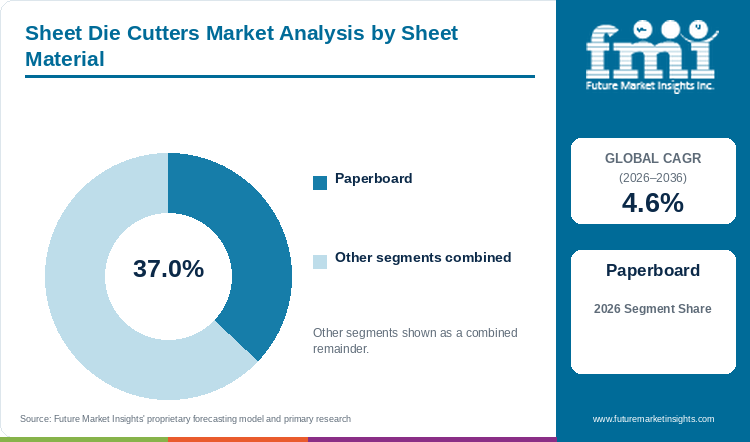
Paperboard makes up 37% of sheet material use in 2026, supported by printed carton work.
Sales of carton die cutting machines lean on paperboard, as printed carton board needs exact cut and crease register before folding and gluing. Paperboard represents 37% of sheet material use in 2026, as per FMI. Corrugated board ranks second and is gaining ground, and paper, plastic sheets and foam or rubber sheets remain small niches. Cepi reported in February 2026 that European containerboard production rose 1.7% in 2025 as cartonboard production fell 5.6% [4]. Paperboard is anticipated to stay ahead through 2036, although corrugated board will claim a growing slice of European cutter orders.
- Printed carton jobs need exact cut and crease register, keeping paperboard at 37% of sheet material use in 2026.
- Converters cutting both board types gain from machines that switch quickly between carton and corrugated settings.
Why are folding cartons the main end use for sheet die cutters?
Folding cartons generate 34% of end use revenue in 2026, backed by frequent short print runs for consumer brands.
Food, health and beauty brands order many short carton runs, keeping folding carton plants active buyers of die cutters. FMI notes that folding cartons generate 34% of end use revenue in 2026. Corrugated packaging follows, and commercial print, labels and tags and specialty converting rely on smaller machines. In October 2026, Ultimate Paper Box installed a Koenig & Bauer CutPRO Q 106 linked to presses and a folder gluer through one operator interface [17]. Adoption of connected lines in folding carton plants is set to raise carton die cutter sales over the forecast period.
- Folding cartons hold 34% of end use revenue in 2026, and short print runs for food, health and beauty packs will keep this share firm through 2036.
- Carton converters gain most from cutters sharing job data with the press and folder gluer, since setup errors fall.
Why do converters favour fully automatic die cutters?
Fully automatic die cutters command 55% of automation revenue in 2026, reflecting operator shortages at converting plants.
Adoption of fully automatic die cutters is growing fast in plants short of skilled operators. FMI estimates that fully automatic systems hold 55% of automation revenue in 2026. Buyers of automatic die cutting machines also weigh setup and energy savings alongside speed. In January 2025, BOBST said POWER REGISTER Plus can save up to 1 tonne of carton per 1 million sheets on the EXPERTCUT 106 PER [3]. Semi-automatic and manual machines still suit small shops with low machine use. Fully automatic systems are anticipated to gain further share as robot sheet handling becomes standard on new lines.
- Fully automatic systems reach 55% in 2026 and are set to gain more as robot sheet handling spreads across new installations.
- Plants running with fewer operators should compare make-ready time per job, not only top speed.
Why do packaging machinery OEMs handle the most die cutter sales?
Packaging machinery OEMs handle 43% of sheet die cutter sales in 2026, as large converters buy complete lines.
Large converters prefer buying presses, die cutters, folder gluers and service from one supplier, keeping sales flowing through packaging machinery OEMs. In FMI's assessment, this channel handles 43% of sheet die cutter sales in 2026. Heidelberg said in October 2025 that about 1,500 MK Masterwork systems had been installed worldwide over ten years of partnership [13]. Direct sales still matter for specialist makers, dealers serve mid-sized plants, and refurbished machines compete in low-use shops. Service revenue tied to OEM sales is expected to keep this channel in front through 2036.
- Packaging machinery OEMs book 43% of die cutter orders in 2026, as converters buy complete lines and service from one source.
- Buyers of refurbished machines should confirm spare parts supply and service cover before purchase.
What are the drivers, restraints, and opportunities in the sheet die cutters market?
Short-run packaging jobs and fewer operators push converters toward automated sheet die cutters, delayed machine budgets hold back new orders, and robot handling with connected workflow opens the widest retrofit market.
- Driver: Sales of sheet die cutters are rising, as converters handle more short-run jobs with fewer operators and faster presses.
- Restraint: Unsettled tariffs, borrowing costs and customer mergers are leading converters to postpone large die cutter purchases until costs become clearer.
- Opportunity: Key opportunities in the sheet die cutters market include robotics, stored job settings and retrofit kits for installed machines, bringing suppliers revenue between new line orders.
Short Runs Lift Cutter Upgrades
Online retail is adding many small carton and shipping box orders to converting plants. The U.S. Census Bureau put second-quarter 2026 e-commerce sales at USD 340.2 billion, up 12.2% year on year [1]. Each extra job needs a new die and fresh machine settings, so converters favour cutters that set up fast. Plants facing more changeovers each week are likely to replace slow-setup cutters first through 2036.
Delayed Budgets Slow New Orders
Machine budgets at many converters are on hold until tariff and borrowing costs become clearer. In July 2026, Bobst reported first-half group order intake 11% below 2025 and said investment cycles are becoming longer [7]. Weak orders may slow new model launches at smaller suppliers through 2027.
Robotics and Retrofits Open New Sales
Converters delaying new lines still buy robots and upgrade kits for machines already on the floor. In October 2025, Heidelberg and MK Masterwork added MK robotics for in-plant material handling to the packaging partnership [13]. Rising containerboard output in Europe also adds corrugated work for upgraded lines, with production up 1.7% in 2025 [4]. Retrofit and robot sales are anticipated to bridge the gap until orders for complete lines return.
Which country CAGRs are profiled in the sheet die cutters market?
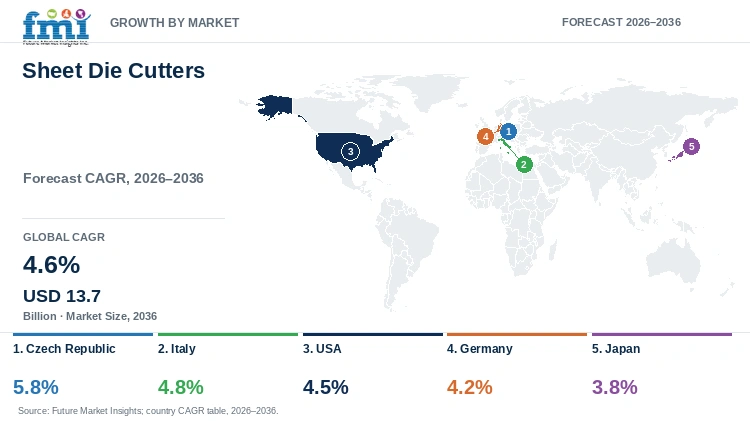
The Czech Republic posts the quickest rise in sheet die cutter sales of the five countries covered, a 5.8% CAGR over 2026 to 2036. Japan records the lowest growth of the group, a 3.8% CAGR through 2036. In all five countries, die cutter orders will come from new box and carton plants and from converters replacing older presses.
Table 6: Country CAGRs and Primary Growth Levers for the Sheet Die Cutters Market (CAGR percentage), 2026 to 2036
| Country | CAGR (2026-2036) | Primary Growth Lever |
|---|---|---|
| Czech Republic | 5.8% | Packaging lines for new car and electronics plants |
| Italy | 4.8% | Rising box output and firm home machinery sales |
| USA | 4.5% | Quick job changes for short parcel and carton runs |
| Germany | 4.2% | Recyclable board packs under the EU packaging rule |
| Japan | 3.8% | Replacing older presses with automated domestic models |
Source: Future Market Insights
Czech Republic Sheet Die Cutters Market Outlook (2026-2036)
Car and electronics plants are bringing new packaging work to Czech converters. CzechInvest mediated 25 investment projects worth about USD 1.21 billion in 2025, led by a USD 775.76 million Toyota expansion for electric vehicle production in Kolín [5]. Box and carton plants serving these factories need more cutting capacity, giving the Czech Republic the top country rate, a 5.8% CAGR over 2026 to 2036. Cardbox Packaging put EUR 6.5 million into a Czech subsidiary in March 2024, including a BOBST VISIONCUT 106 LER die cutter to reduce waste [18]. The value of mediated projects fell 53% from a 2024 total boosted by one large chip project, so new die cutter orders may arrive in uneven waves [5].
Key takeaway: Czech converters buy die cutters to serve the new car and electronics plants nearby.
Italy Sheet Die Cutters Market Outlook (2026-2036)
Italy ranks second of the five for growth, with a 4.8% CAGR in sheet die cutter sales through 2036. Italian corrugated board output rose 1.6% to about 8 billion square metres in 2025, according to GIFCO data reported in May 2026 [10]. Domestic sales of packaging machinery are also firm, as UCIMA put the Italian total at EUR 2.27 billion in 2025, up 9.9% [19]. European machine orders remain weak, however, and Bobst trimmed staff in Italy, Switzerland and France during 2025 [2].
Key takeaway: Firm domestic sales of packaging machinery keep Italian box and carton converters investing.
USA Sheet Die Cutters Market Outlook (2026-2036)
Box volumes in the USA are soft, with Fibre Box Association data putting third-quarter 2025 corrugated box shipments at the lowest third-quarter level since 2015 [6]. Job counts still rise, as e-commerce reached 17.1% of U.S. retail sales in the June 2026 quarter [1]. American converters therefore want cutters that switch between short runs quickly. Ultimate Paper Box installed a Koenig & Bauer CutPRO Q 106 flatbed die cutter in October 2026 to cut make-ready time [17]. Tariff uncertainty is slowing machine orders, and Bobst sales in the Americas fell 18.8% to CHF 500.4 million in 2025 [2]. The USA outlook stands at a 4.5% CAGR through 2036, just under the 4.6% global rate.
Key takeaway: Machines with quick job changes will steer American die cutter spending.
Germany Sheet Die Cutters Market Outlook (2026-2036)
From 12 August 2026, the EU Packaging and Packaging Waste Regulation applies in Germany, with a target to cut packaging waste per person by 5% by 2030 [9]. The rule pushes brands toward recyclable board packs, and each new pack design needs fresh dies and machine settings. Growth is held to a 4.2% CAGR through 2036, as German converters already run a large base of modern machines. The drupa 2028 fair in Düsseldorf, set for 9 to 17 May 2028, gives German converters a home event for ordering cutters from Heidelberg, Koenig & Bauer and Bobst [20].
Key takeaway: Pack redesigns under the EU packaging rule bring most new die cutter work to German plants.
Japan Sheet Die Cutters Market Outlook (2026-2036)
Japanese packaging machine makers are building fewer but higher-value machines, with the Japan Packaging Institute estimating 2025 production at JPY 531 billion as unit output fell 0.8% to 257,373 [15]. Japan ranks last on the country table with a 3.8% CAGR through 2036, as most local converters already run modern equipment. Converters replacing older presses can turn to domestic models such as the Sanwa TRP-1300-SC FRESKO, running at up to 7,200 sheets per hour [21].
Key takeaway: Automated domestic models replacing older presses set the pace in Japan.
Who are the notable companies in the sheet die cutters market?
Bobst, Heidelberg, Koenig & Bauer, Masterwork Group, Sanwa, SBL Group, DGM, Young Shin Machinery, BW Papersystems, and Asahi Machinery form the key supplier group profiled for sheet die cutters.
Bobst, Heidelberg, Koenig & Bauer and Masterwork Group sell die cutters as part of complete packaging lines with presses, folder gluers and service. Die cutting machine manufacturers such as Sanwa, SBL Group, DGM and Young Shin Machinery compete on die cutting machine price, format range and stripping or blanking options. BW Papersystems and Asahi Machinery serve plants handling heavy corrugated board and large sheets. Asian makers are reaching more converters through partners, as Heidelberg distributes MK Masterwork die cutters outside China [13].
- Integrated packaging line suppliers: Bobst, Heidelberg, Koenig & Bauer, and Masterwork Group sell die cutters together with presses, folder gluers and service.
- Specialist sheet-fed die cutter makers: Sanwa, SBL Group, DGM, and Young Shin Machinery offer flatbed and platen models with stripping and blanking options.
- Corrugated and large-format converting specialists: BW Papersystems and Asahi Machinery serve converters handling heavy board and large sheets.
Competitive Benchmarking: Sheet Die Cutters Market
Table 7: Competitive Benchmarking for the Sheet Die Cutters Market (qualitative capability ratings), 2026
| Company | Automation | Stripping | Workflow | Reach |
|---|---|---|---|---|
| Bobst | High | High | High | High |
| Heidelberg | High | High | High | High |
| Koenig & Bauer | High | High | High | High |
| Masterwork Group | High | High | High | Medium |
| Sanwa | Medium | Medium | Low | Medium |
| SBL Group | Medium | High | Medium | Medium |
| DGM | High | High | Medium | Medium |
| Young Shin Machinery | Medium | High | Medium | Medium |
| BW Papersystems | Medium | Medium | High | High |
| Asahi Machinery | Low | Low | Low | Low |
High marks capability documented across the current die cutter range, and Medium marks capability for some models or markets. A Low grade reflects limited public documentation for that die cutter capability.
Key Developments in the Sheet Die Cutters Market
- In July 2026, Koenig & Bauer announced the CutPRO 2.1 flatbed die cutter for corrugated board, with a first machine due at a pilot customer before the end of 2026 [14].
- In October 2025, Heidelberg and MK Masterwork extended the packaging partnership, presenting the Mastermatrix 106 CSB die cutter and adding MK robotics for material handling [13].
- In August 2025, DGM introduced the Technocut TE, a dual-station machine that die cuts and deep embosses in one production cycle [22].
- In January 2025, BOBST released ACCUPLATEN, ZERO PATCHING and POWER REGISTER Plus upgrades for the EXPERTCUT 106 PER, saving up to 1 tonne of carton per 1 million sheets [3].
Key Players in the Sheet Die Cutters Market
Integrated Packaging Line Suppliers
- Bobst Group SA
- Heidelberger Druckmaschinen AG
- Koenig & Bauer AG
- Masterwork Group Co., Ltd.
Specialist Sheet-fed Die Cutter Makers
- Sanwa Manufacturing Co., Ltd.
- SBL Machinery Co., Ltd.
- DGM
- Young Shin Industries
Corrugated and Large-format Converting Specialists
- BW Papersystems
- Asahi Machinery
Sheet Die Cutters Market - Report Scope
Table 8: Report Scope for the Sheet Die Cutters Market (coverage fields and definitions), 2026 to 2036
| Coverage field | Report scope |
|---|---|
| Market breakdown | Machine type; sheet material; end use; automation; sales channel; region |
| Quantitative units | USD billion |
| Market definition | First-sale revenue from sheet-fed die cutting and creasing machines and configured die cutting lines, including flatbed, rotary, platen, digital and blanking-integrated models sold new or refurbished. Cutting dies, consumables, printing presses and finished packaging revenue are excluded. |
| Regions covered | North America; Latin America; Western Europe; Eastern Europe; East Asia; South Asia and Pacific; Middle East and Africa |
| Countries covered | Czech Republic; Italy; USA; Germany; Japan |
| Key companies profiled | Bobst, Heidelberg, Koenig & Bauer, Masterwork Group, Sanwa, SBL Group, DGM, Young Shin Machinery, BW Papersystems, Asahi Machinery |
| Forecast period | 2026 to 2036 |
| Approach | Bottom-up estimates by machine type, automation level and end use, checked top-down against supplier results, installed-base replacement and packaging output in each profiled country. |
Sheet Die Cutters Market - Research Methodology
Table 9: Research Methodology for the Sheet Die Cutters Market (research methods and approach), 2026 edition
| Method | Approach |
|---|---|
| Primary Research | Discussions with die cutter manufacturers, distributors, folding carton and corrugated converters, die makers and plant engineers covered machine prices, make-ready times, replacement cycles and service terms. |
| Desk Research | Sources reviewed include supplier annual and half-year results, paper and packaging industry statistics, e-commerce data, EU packaging rules and machine specifications. |
| Market Sizing and Forecasting | Machine type and automation shares, average die cutter prices, installed-base replacement and country converting capacity are applied to the 2025 base value. |
| Data Validation | Die cutter estimates are tested against Bobst, Heidelberg and Koenig & Bauer order and backlog disclosures, trade association output figures and interview findings. Cutting dies, consumables and printing presses are excluded from machine revenue, so no value is counted twice. |
Sheet Die Cutters Market by Segments
Sheet Die Cutters Market segmented by Machine Type:
- Flatbed die cutters
- Rotary die cutters
- Automatic platen die cutters
- Digital sheet die cutters
- Blanking-integrated die cutters
Sheet Die Cutters Market segmented by Sheet Material:
- Paperboard
- Corrugated board
- Paper
- Plastic sheets
- Foam/rubber sheets
Sheet Die Cutters Market segmented by End Use:
- Folding cartons
- Corrugated packaging
- Commercial print
- Labels/tags
- Specialty converting
Sheet Die Cutters Market segmented by Automation:
- Fully automatic
- Semi-automatic
- Manual
- Digital workflow integrated
Sheet Die Cutters Market segmented by Sales Channel:
- Packaging machinery OEMs
- Converters direct
- Equipment dealers
- Aftermarket/refurbished
Sheet Die Cutters Market by Region
- North America
- United States
- Canada
- Latin America
- Brazil
- Mexico
- Argentina
- Chile
- Western Europe
- Germany
- France
- United Kingdom
- Italy
- Spain
- Benelux
- Nordics
- Eastern Europe
- Poland
- Czech Republic
- Romania
- Hungary
- East Asia
- Japan
- South Korea
- South Asia and Pacific
- ASEAN
- Australia and New Zealand
- Middle East and Africa
- GCC Countries
- South Africa
- Türkiye
- Israel
Research Sources and Bibliography
- [1] U.S. Census Bureau. (2026, August 18). Quarterly Retail E-Commerce Sales, 2nd Quarter 2026.https://www.census.gov/retail/eCommerce.html
- [2] Bobst Group SA. (2026, February 27). Bobst Group 2025 results impacted by lower sales and US tariffs.https://investors.bobst.com/en/ad-hoc-releases/detail/article/1772112246-bobst-group-2025-results-impacted-by-lower-sales-and-us-tariffs
- [3] BOBST. (2025, January 23). BOBST boosts efficiency and productivity with game-changing innovations on the EXPERTCUT 106 PER.https://www.bobst.com/in/en/news/1736257802-bobst-boosts-efficiency-and-productivity-with-game-changing-innovations-on-the-expertcut-106-per
- [4] Confederation of European Paper Industries (Cepi). (2026, February). Preliminary Statistics 2025.https://www.cepi.org/wp-content/uploads/2026/02/FINAL-Cepi-Preliminary-Statistics-2025.pdf
- [5] CzechInvest. (2026, February 23). CzechInvest mediated investments worth USD 1.2 billion in 2025; the projects will bolster the growth.https://czechinvest.gov.cz/en/Homepage/News/February-2026/CzechInvest-mediated-investments-worth-USD-1-2-billion-in-2025-The-projects-will-bolster-the-growth
- [6] Packaging Gateway (reporting Fibre Box Association data). (2025, November 13). Falling cardboard demand in US casts shadow on holiday sales.https://www.packaging-gateway.com/news/falling-cardboard-demand-in-us-casts-shadow-on-holiday-sales/
- [7] The Packaging Portal. (2026, July 29). Bobst Group reports lower first-half 2026 sales.https://www.thepackagingportal.com/industry-news/bobst-group-reports-lower-first-half-2026-sales/
- [8] China Daily (reporting State Post Bureau of China data). (2026, January 8). Nation's annual parcel volume hits nearly 200 billion.https://www.chinadaily.com.cn/a/202601/08/WS695f1a79a310d6866eb32a3e.html
- [9] German Federal Ministry for the Environment. (2026, June 26). European law on packaging and packaging waste.https://www.bundesumweltministerium.de/en/topics/circular-economy/types-of-waste-and-waste-flows/packaging-waste/translate-to-english-europaeisches-recht-ueber-verpackungen-und-verpackungsabfaelle
- [10] EUWID Pulp and Paper. (2026, May 20). GIFCO reports 2025 another year of growth for Italy's corrugated board industry.https://www.euwid-paper.com/news/markets/gifco-reports-2025-another-year-of-growth-for-italys-corrugated-board-industry-200526/
- [11] Print21. (2026, February 27). Koenig & Bauer improves earnings, meets 2025 targets.https://www.print21.com.au/industry/latest/koenig-and-bauer-improves-earnings-meets-2025-targets
- [12] Heidelberger Druckmaschinen AG (via Presseportal). (2025, November 12). Encouraging first half of financial year 2025/2026 for HEIDELBERG thanks to much improved profitability.https://www.presseportal.de/en/pm/6678/6156537
- [13] Heidelberger Druckmaschinen AG and MK Masterwork. (2025, October 15). HEIDELBERG and MK Masterwork extend and expand strategic partnership in packaging.https://www.heidelberg.com/global/media/en/global_media/company___press_lounge/corporate/general/2025/20251015_10_Years_Partner_HDM_MK.pdf
- [14] Packaging Europe. (2026, July 27). Koenig & Bauer introduces flatbed die-cutter for corrugated board.https://packagingeurope.com/news/koenig-and-bauer-introduces-flatbed-die-cutter-for-corrugated-board/14537.article
- [15] Japan Packaging Institute. (2026). Statistics on the Scale of Japanese Packaging Industry in 2025.https://www.jpi.or.jp/english/static2025/staticties2025.htm
- [16] Textile World (reporting Messe Duesseldorf). (2024, June). Celebrating The Printing Industry: Record Number Of Deals Signed At drupa 2024.https://www.textileworld.com/textile-world/2024/06/celebrating-the-printing-industry-record-number-of-deals-signed-at-drupa-2024
- [17] Packaging Gateway. (2026, October 1). Ultimate Paper Box installs Koenig & Bauer CutPRO Q 106 die-cutter.https://www.packaging-gateway.com/?p=135196
- [18] The Packaging Portal. (2024, March 7). Cardbox Packaging invest €6.5m in Czech Republic.https://www.thepackagingportal.com/?p=28154
- [19] PETplanet Insider (reporting UCIMA data). (2026, July 7). UCIMA: Italian packaging machinery manufacturers maintain growth.https://petpla.net/2026/07/07/ucima-italian-packaging-machinery-manufacturers-maintain-growth/
- [20] Messe Düsseldorf. (n.d.). drupa 2028, 9 to 17 May 2028, Düsseldorf.https://www.drupa.com/
- [21] Sanwa Manufacturing Co., Ltd. (n.d.). TRP-1300-SC FRESKO.https://www.sanwa-trp.com/en/product/trp-1300-sc-fresko/
- [22] DGM. (2025, August 15). Technocut TE: High-Efficiency Dual-Station Die-Cutting and Deep Embossing Integration.https://www.dgm-global.com/news/technocut-te-high-efficiency-dual-station-die-cutting-deep-embossing-integration/
- [23] The Packaging Portal. (2026, January 9). Linney installs a high-spec die-cutter from Friedheim International.https://www.thepackagingportal.com/?p=35772
- [24] SBL Machinery Co., Ltd. (n.d.). SBL-1050SE Automatic Platen Die Cutting and Creasing Machine.https://www.sblmachinery.com/die-cutting-machine/sbl-1050se/
- [25] Young Shin USA. (n.d.). REVOTEC Series 106SB Automatic Flatbed Diecutter.https://youngshinusa.com/products/young-shin/revotec/series-106sb/
This bibliography is provided for reader reference. The full report contains the complete reference list and detailed citations.
This Report Answers
- What value does the sheet die cutters market hold in 2026?
- What will sheet die cutter sales be worth by 2036?
- Which machine type leads sales of sheet die cutters in 2026?
- What share of 2026 revenue goes to fully automatic die cutters, and which end use leads?
- Among the profiled countries, which market will expand fastest for die cutters?
- Which packaging machinery suppliers compete for die cutter orders from converters?
Frequently Asked Questions
How large is the sheet die cutters market expected in 2026?
FMI values sheet die cutter sales at USD 8.7 billion for 2026. The market is forecast to reach USD 13.7 billion by 2036, as converters replace older platen presses with automated lines.
What CAGR is projected for the sheet die cutters market through 2036?
Sheet die cutter sales will expand at a 4.6% CAGR over 2026 to 2036, according to Future Market Insights. Machines that cut setup time and board waste will carry most of this gain.
Which machine type holds a notable market share in 2026?
Flatbed die cutters will hold 34% of 2026 machine type sales. Converters favour flatbed models because one machine can cut, crease and strip both cartons and boxes.
Which automation level leads die cutter sales in 2026?
Fully automatic die cutters capture 55% of automation revenue in 2026, per FMI estimates. Plants short of skilled operators will keep paying more for automatic feeding, stripping and stacking.
Which country has a notable expansion outlook through 2036?
The Czech Republic will post a 5.8% CAGR in sheet die cutter sales from 2026 to 2036. New car and electronics plants will keep bringing box and carton work to Czech converters.
Who are the key companies in the sheet die cutters market?
The profiled companies are Bobst, Heidelberg, Koenig & Bauer, Masterwork Group, Sanwa, SBL Group, DGM, Young Shin Machinery, BW Papersystems, and Asahi Machinery. These suppliers will compete on make-ready time, stripping and blanking options, workflow links and service cover.
Preview the report firsthand - request a free sample
Get SampleGet the brochure for pricing and purchase details.
Get PDFTable of Content
- Key Takeaways
- Market Size and CAGR
- Top Growth Driver
- Fastest Growing Segment
- Leading Region
- Key Companies
- Emerging Opportunities
- Executive Summary
- Global Market Outlook
- Demand-side Trends
- Supply-side Trends
- Technology Roadmap Analysis
- Analysis and Recommendations
- Analyst Perspective (What is happening? Why now? What should investors know?)
- Key Questions Answered
- How large is the market?
- What is the CAGR?
- What are key trends?
- Which region dominates?
- Who are the leaders?
- Market Overview
- Market Coverage / Taxonomy
- Market Definition / Scope / Limitations
- Research Methodology
- Chapter Orientation
- Analytical Lens and Working Hypotheses
- Market Structure, Signals, and Trend Drivers
- Benchmarking and Cross-market Comparability
- Market Sizing, Forecasting, and Opportunity Mapping
- Research Design and Evidence Framework
- Desk Research Programme (Secondary Evidence)
- Expert Input and Fieldwork (Primary Evidence)
- Tooling, Models, and Reference Databases
- Data Engineering and Model Build
- Quality Assurance and Audit Trail
- Market Background
- Market Dynamics (Drivers, Restraints, Opportunity, Trends)
- Scenario Forecast (Optimistic, Likely, Conservative)
- Impact Analysis
- AI Impact
- Sustainability Impact
- Regulatory Impact
- Technology Impact
- Consumer / Buyer Analysis
- Purchase Drivers
- Adoption Barriers
- Buyer Journey
- Opportunity Map Analysis
- Product Life Cycle Analysis
- Supply Chain Analysis
- Investment Feasibility Matrix
- Value Chain Analysis
- PESTLE and Porter's Analysis
- Regulatory Landscape
- Regional Parent Market Outlook
- Production and Consumption Statistics
- Import and Export Statistics
- Global Market Analysis and Forecast, 2021 to 2036
- Historical Market Size Value (USD Billion) Analysis, 2021 to 2025
- Current and Future Market Size Value (USD Billion) Projections, 2026 to 2036
- Y-o-Y Growth Trend Analysis
- Absolute $ Opportunity Analysis
- Global Market Pricing Analysis, 2021 to 2036
- Global Market Analysis and Forecast, By Machine Type, 2021 to 2036
- Introduction / Key Findings
- Historical Market Size Value (USD Billion) Analysis By Machine Type, 2021 to 2025
- Current and Future Market Size Value (USD Billion) Analysis and Forecast By Machine Type, 2026 to 2036
- Flatbed die cutters
- Rotary die cutters
- Automatic platen die cutters
- Digital sheet die cutters
- Blanking-integrated die cutters
- Y-o-Y Growth Trend Analysis By Machine Type, 2021 to 2025
- Absolute $ Opportunity Analysis By Machine Type, 2026 to 2036
- Global Market Analysis and Forecast, By Sheet Material, 2021 to 2036
- Introduction / Key Findings
- Historical Market Size Value (USD Billion) Analysis By Sheet Material, 2021 to 2025
- Current and Future Market Size Value (USD Billion) Analysis and Forecast By Sheet Material, 2026 to 2036
- Paperboard
- Corrugated board
- Paper
- Plastic sheets
- Foam/rubber sheets
- Y-o-Y Growth Trend Analysis By Sheet Material, 2021 to 2025
- Absolute $ Opportunity Analysis By Sheet Material, 2026 to 2036
- Global Market Analysis and Forecast, By End Use, 2021 to 2036
- Introduction / Key Findings
- Historical Market Size Value (USD Billion) Analysis By End Use, 2021 to 2025
- Current and Future Market Size Value (USD Billion) Analysis and Forecast By End Use, 2026 to 2036
- Folding cartons
- Corrugated packaging
- Commercial print
- Labels/tags
- Specialty converting
- Y-o-Y Growth Trend Analysis By End Use, 2021 to 2025
- Absolute $ Opportunity Analysis By End Use, 2026 to 2036
- Global Market Analysis and Forecast, By Automation, 2021 to 2036
- Introduction / Key Findings
- Historical Market Size Value (USD Billion) Analysis By Automation, 2021 to 2025
- Current and Future Market Size Value (USD Billion) Analysis and Forecast By Automation, 2026 to 2036
- Fully automatic
- Semi-automatic
- Manual
- Digital workflow integrated
- Y-o-Y Growth Trend Analysis By Automation, 2021 to 2025
- Absolute $ Opportunity Analysis By Automation, 2026 to 2036
- Global Market Analysis and Forecast, By Sales Channel, 2021 to 2036
- Introduction / Key Findings
- Historical Market Size Value (USD Billion) Analysis By Sales Channel, 2021 to 2025
- Current and Future Market Size Value (USD Billion) Analysis and Forecast By Sales Channel, 2026 to 2036
- Packaging machinery OEMs
- Converters direct
- Equipment dealers
- Aftermarket/refurbished
- Y-o-Y Growth Trend Analysis By Sales Channel, 2021 to 2025
- Absolute $ Opportunity Analysis By Sales Channel, 2026 to 2036
- Global Market Analysis and Forecast, By Region, 2021 to 2036
- Introduction
- Historical Market Size Value (USD Billion) Analysis By Region, 2021 to 2025
- Current Market Size Value (USD Billion) Analysis and Forecast By Region, 2026 to 2036
- North America
- Latin America
- Western Europe
- Eastern Europe
- East Asia
- South Asia and Pacific
- Middle East and Africa
- Market Attractiveness Analysis By Region
- North America Market Analysis and Forecast, By Country, 2021 to 2036
- Historical Market Size Value (USD Billion) Trend Analysis By Market Taxonomy, 2021 to 2025
- Market Size Value (USD Billion) Forecast By Market Taxonomy, 2026 to 2036
- By Country
- United States
- Canada
- By Machine Type
- By Sheet Material
- By End Use
- By Automation
- By Sales Channel
- By Country
- Market Attractiveness Analysis
- By Country
- By Machine Type
- By Sheet Material
- By End Use
- By Automation
- By Sales Channel
- Key Takeaways
- Latin America Market Analysis and Forecast, By Country
- Historical Market Size Value (USD Billion) Trend Analysis By Market Taxonomy, 2021 to 2025
- Market Size Value (USD Billion) Forecast By Market Taxonomy, 2026 to 2036
- By Country
- Brazil
- Mexico
- Argentina
- Chile
- By Machine Type
- By Sheet Material
- By End Use
- By Automation
- By Sales Channel
- By Country
- Market Attractiveness Analysis
- By Country
- By Machine Type
- By Sheet Material
- By End Use
- By Automation
- By Sales Channel
- Key Takeaways
- Western Europe Market Analysis and Forecast, By Country
- Historical Market Size Value (USD Billion) Trend Analysis By Market Taxonomy, 2021 to 2025
- Market Size Value (USD Billion) Forecast By Market Taxonomy, 2026 to 2036
- By Country
- Germany
- France
- United Kingdom
- Italy
- Spain
- Benelux
- Nordics
- By Machine Type
- By Sheet Material
- By End Use
- By Automation
- By Sales Channel
- By Country
- Market Attractiveness Analysis
- By Country
- By Machine Type
- By Sheet Material
- By End Use
- By Automation
- By Sales Channel
- Key Takeaways
- Eastern Europe Market Analysis and Forecast, By Country
- Historical Market Size Value (USD Billion) Trend Analysis By Market Taxonomy, 2021 to 2025
- Market Size Value (USD Billion) Forecast By Market Taxonomy, 2026 to 2036
- By Country
- Poland
- Czech Republic
- Romania
- Hungary
- By Machine Type
- By Sheet Material
- By End Use
- By Automation
- By Sales Channel
- By Country
- Market Attractiveness Analysis
- By Country
- By Machine Type
- By Sheet Material
- By End Use
- By Automation
- By Sales Channel
- Key Takeaways
- East Asia Market Analysis and Forecast, By Country
- Historical Market Size Value (USD Billion) Trend Analysis By Market Taxonomy, 2021 to 2025
- Market Size Value (USD Billion) Forecast By Market Taxonomy, 2026 to 2036
- By Country
- Japan
- South Korea
- By Machine Type
- By Sheet Material
- By End Use
- By Automation
- By Sales Channel
- By Country
- Market Attractiveness Analysis
- By Country
- By Machine Type
- By Sheet Material
- By End Use
- By Automation
- By Sales Channel
- Key Takeaways
- South Asia and Pacific Market Analysis and Forecast, By Country
- Historical Market Size Value (USD Billion) Trend Analysis By Market Taxonomy, 2021 to 2025
- Market Size Value (USD Billion) Forecast By Market Taxonomy, 2026 to 2036
- By Country
- ASEAN
- Australia and New Zealand
- By Machine Type
- By Sheet Material
- By End Use
- By Automation
- By Sales Channel
- By Country
- Market Attractiveness Analysis
- By Country
- By Machine Type
- By Sheet Material
- By End Use
- By Automation
- By Sales Channel
- Key Takeaways
- Middle East and Africa Market Analysis and Forecast, By Country
- Historical Market Size Value (USD Billion) Trend Analysis By Market Taxonomy, 2021 to 2025
- Market Size Value (USD Billion) Forecast By Market Taxonomy, 2026 to 2036
- By Country
- GCC Countries
- South Africa
- Türkiye
- Israel
- By Machine Type
- By Sheet Material
- By End Use
- By Automation
- By Sales Channel
- By Country
- Market Attractiveness Analysis
- By Country
- By Machine Type
- By Sheet Material
- By End Use
- By Automation
- By Sales Channel
- Key Takeaways
- Key Countries Market Analysis
- United States
- Pricing Analysis
- Market Share Analysis, 2025
- By Machine Type
- By Sheet Material
- By End Use
- By Automation
- By Sales Channel
- Canada
- Pricing Analysis
- Market Share Analysis, 2025
- By Machine Type
- By Sheet Material
- By End Use
- By Automation
- By Sales Channel
- Mexico
- Pricing Analysis
- Market Share Analysis, 2025
- By Machine Type
- By Sheet Material
- By End Use
- By Automation
- By Sales Channel
- Brazil
- Pricing Analysis
- Market Share Analysis, 2025
- By Machine Type
- By Sheet Material
- By End Use
- By Automation
- By Sales Channel
- Chile
- Pricing Analysis
- Market Share Analysis, 2025
- By Machine Type
- By Sheet Material
- By End Use
- By Automation
- By Sales Channel
- Germany
- Pricing Analysis
- Market Share Analysis, 2025
- By Machine Type
- By Sheet Material
- By End Use
- By Automation
- By Sales Channel
- United Kingdom
- Pricing Analysis
- Market Share Analysis, 2025
- By Machine Type
- By Sheet Material
- By End Use
- By Automation
- By Sales Channel
- Italy
- Pricing Analysis
- Market Share Analysis, 2025
- By Machine Type
- By Sheet Material
- By End Use
- By Automation
- By Sales Channel
- Spain
- Pricing Analysis
- Market Share Analysis, 2025
- By Machine Type
- By Sheet Material
- By End Use
- By Automation
- By Sales Channel
- France
- Pricing Analysis
- Market Share Analysis, 2025
- By Machine Type
- By Sheet Material
- By End Use
- By Automation
- By Sales Channel
- ASEAN
- Pricing Analysis
- Market Share Analysis, 2025
- By Machine Type
- By Sheet Material
- By End Use
- By Automation
- By Sales Channel
- Australia and New Zealand
- Pricing Analysis
- Market Share Analysis, 2025
- By Machine Type
- By Sheet Material
- By End Use
- By Automation
- By Sales Channel
- Japan
- Pricing Analysis
- Market Share Analysis, 2025
- By Machine Type
- By Sheet Material
- By End Use
- By Automation
- By Sales Channel
- South Korea
- Pricing Analysis
- Market Share Analysis, 2025
- By Machine Type
- By Sheet Material
- By End Use
- By Automation
- By Sales Channel
- Poland
- Pricing Analysis
- Market Share Analysis, 2025
- By Machine Type
- By Sheet Material
- By End Use
- By Automation
- By Sales Channel
- Hungary
- Pricing Analysis
- Market Share Analysis, 2025
- By Machine Type
- By Sheet Material
- By End Use
- By Automation
- By Sales Channel
- Türkiye
- Pricing Analysis
- Market Share Analysis, 2025
- By Machine Type
- By Sheet Material
- By End Use
- By Automation
- By Sales Channel
- South Africa
- Pricing Analysis
- Market Share Analysis, 2025
- By Machine Type
- By Sheet Material
- By End Use
- By Automation
- By Sales Channel
- Czech Republic
- Pricing Analysis
- Market Share Analysis, 2025
- By Machine Type
- By Sheet Material
- By End Use
- By Automation
- By Sales Channel
- United States
- Market Structure Analysis
- Competition Dashboard
- Competition Benchmarking
- Market Share Analysis of Top Players
- By Regional
- By Machine Type
- By Sheet Material
- By End Use
- By Automation
- By Sales Channel
- Emerging Startups
- Innovation Benchmarking
- Competition Analysis
- Competition Deep Dive
- Bobst
- Overview
- Product Portfolio
- Profitability by Market Segments
- Sales Footprint
- Strategy Overview
- Marketing Strategy
- Product Strategy
- Channel Strategy
- Heidelberg
- Koenig & Bauer
- Masterwork Group
- Sanwa
- SBL Group
- DGM
- Young Shin Machinery
- BW Papersystems
- Asahi Machinery
- Bobst Group SA
- Heidelberger Druckmaschinen AG
- Koenig & Bauer AG
- Masterwork Group Co., Ltd.
- Sanwa Manufacturing Co., Ltd.
- SBL Machinery Co., Ltd.
- Young Shin Industries
- Bobst
- Case Studies
- Success Stories
- Recent Developments
- Competition Deep Dive
- Assumptions & Acronyms Used


