

- Market Size (2026)
- USD 5.8 Bn
- Forecast (2036)
- USD 18.2 Bn
- CAGR (2026 to 2036)
- 12.1%
How big is the Diet Nutrition Apps Market in 2026?
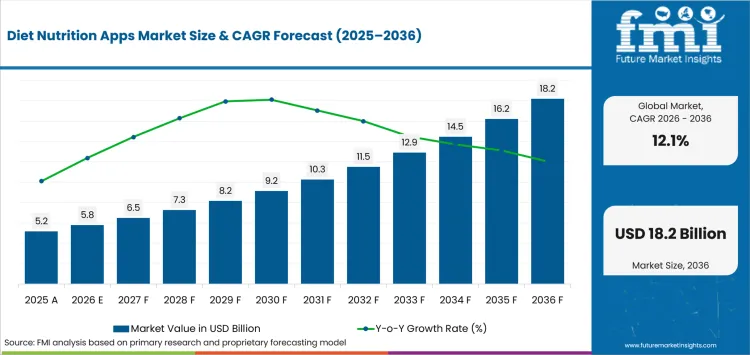
USD 5.8 billion in 2026 and USD 18.2 billion by 2036 at a 12.1% CAGR.
Sales in the diet nutrition apps market are projected to grow at 12.1% CAGR through 2036, driving valuation to USD 18.2 billion by 2036 from USD 5.8 billion in 2026. Consumers combine personalized nutrition platforms with daily fitness applications across recurring weight-management routines and goals.
Daily use reflects nutrition needs that persist beyond a short diet cycle and require repeated food decisions. The World Health Organization reported in December 2025 that 2.5 billion adults were overweight during 2022, including 890 million living with obesity. That continuing need supports repeated app use, although paid retention depends on useful guidance and manageable logging effort.
Key Takeaways of Diet Nutrition Apps Market
- Mobile tools connect meal records with weight goals and personalized guidance across everyday consumer routines.
- Android is projected to represent 46.0% of platform demand in 2026 due to broad access across varied phone prices.
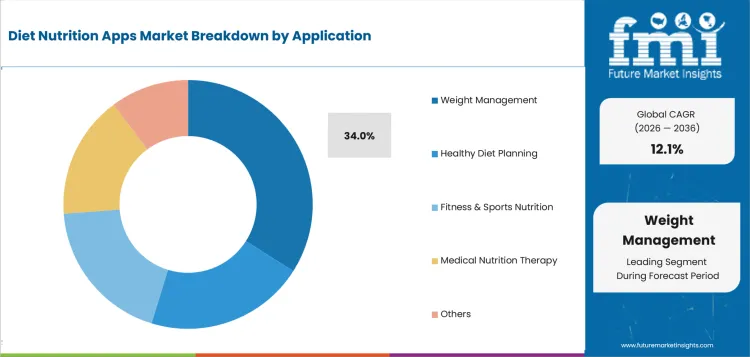
- Weight management is estimated to account for 34.0% of application demand in 2026 owing to goal-centered tracking and progress feedback.
- Freemium is forecast to capture 44.0% of subscription model demand in 2026 driven by lower initial commitment for new users.
- Repetitive entry and sensitive health-data collection restrict sustained engagement across crowded nutrition and wellness application choices.
- MyFitnessPal, Noom, WW International, YAZIO, Lifesum, Cronometer and HealthifyMe compete through distinct tracking and coaching routes alongside Lose It!
Analyst Perspective
"Nutrition apps lose commercial value when food records take too long to enter or cannot guide the next meal. Providers earn durable subscriptions by pairing accurate logging with useful coaching and clear controls for sensitive weight or medication data."
- Rahul Pandita, Principal Consultant, FMI
How is the Diet Nutrition Apps Market segmented?
The diet nutrition apps industry is segmented by platform, application, subscription model, end user, feature type and region.
The diet nutrition apps market is segmented by platform, application, subscription model, end user, feature type and region. Platform covers Android, iOS and web access, while applications include weight management, diet planning, sports nutrition and medical nutrition. Subscription models cover freemium, premium, one-time purchase and enterprise programs, while end users include individuals, healthcare providers, fitness centers and employers. Feature types cover calorie tracking, personalized planning, fitness integration and health analytics across consumer and clinical use.
Why does weight management remain central to the application category? Weight-management applications connect meal records with progress goals and activity data through one recurring personal routine. Users can align those records with home fitness applications as each logged meal influences a visible weekly target and the next food choice. Based on application, weight management is projected to account for 34.0% in 2026 due to its direct connection between meal choices and measurable goals. CDC reported in December 2025 that every reporting United States jurisdiction recorded adult obesity prevalence of at least 25% during 2024, supporting recurring application need despite logging fatigue and repeated meal entry.
Why does weight management remain central to the application category?
Weight-management applications connect meal records with progress goals and activity data through one recurring personal routine. Users can align those records with home fitness applications as each logged meal influences a visible weekly target and the next food choice.
- Based on application, weight management is projected to account for 34.0% in 2026 due to its direct connection between meal choices and measurable goals.
- CDC reported in December 2025 that every reporting United States jurisdiction recorded adult obesity prevalence of at least 25% during 2024, supporting recurring application need despite logging fatigue and repeated meal entry.
What supports Android within the platform category?
Android reaches consumers across wide device price ranges through established mobile application distribution and familiar payment systems. Google reported in May 2025 that Android supported more than three billion active devices across over 190 countries, giving publishers a wide addressable base for localized releases.
- Android is projected to hold 46.0% share in 2026 owing to broad device access across varied phone prices and national markets.
- Publishers can spread localization costs across a large installed base, although varied hardware and operating-system versions require extensive testing for stable performance across devices and languages for each worldwide release.
How does freemium shape the subscription model category?
Freemium access lets consumers test basic logging before paying for coaching or deeper insights from smart fitness systems. MyFitnessPal reported in March 2026 that its advertising network reached 5.7 million free monthly active users in the United States, proving that unpaid use can support material engagement.
- In 2026, freemium is expected to lead the subscription model with 44.0% share because free entry lowers initial commitment for new users.
- Advertising can finance trial access and conversion testing, but intrusive placements may weaken trust around personal nutrition records during early evaluation and recurring use across crowded application choices.
What drives individual consumers within the end user category?
Individual consumers usually choose nutrition applications around personal goals without employer or clinician involvement during the first adoption decision. Direct control over meal records and wireless fitness devices supports self-directed use across changing schedules, personal priorities and household budgets throughout the year.
- The end user category is forecast to be led by individual consumers at 68.0% share in 2026 due to self-directed adoption.
- Pew Research Center reported in November 2025 that 91% of United States adults owned smartphones. Broad access supports application discovery, although consumers compare several free alternatives and service bundles while considering recurring payment.
What are the drivers, restraints and opportunities in the Diet Nutrition Apps Market?
Mobile access supports recurring nutrition tracking, but logging burden limits retention as clinical integration broadens paid service routes.
- Driver: Smartphone access connects meal logging with useful feedback across recurring weight-management routines and changing food choices.
- Restraint: Repetitive entry and privacy concerns weaken retention across applications that offer similar basic tracking functions and subscription plans.
- Opportunity: Integrated food data and medical support serve people requiring structured nutrition guidance during medication-supported weight treatment.
Publishers use digital healthcare transformation to turn meal records into timely actions within weight-management routines. Recurring value depends on feedback that changes the next food choice instead of storing past entries.
Retention weakens as consumers repeat food entry across similar free applications and recurring daily meals. Weight and medication records carry higher privacy expectations, so clear consent controls and understandable subscription terms remain necessary.
Medication-supported digital therapeutics need nutrition guidance that reflects appetite changes and protein requirements during treatment. Lifesum partnered with Consupedia in April 2025 to expand food-database detail across varied meal choices. More complete records strengthen clinical nutrition platforms without directly replacing clinical judgment in medication-related care.
Which country CAGRs are profiled in the Diet Nutrition Apps Market?
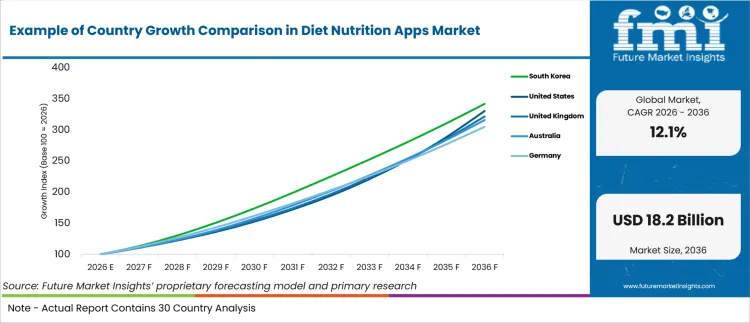
| Country | CAGR |
|---|---|
| South Korea | 13.1% |
| United States | 12.7% |
| United Kingdom | 12.4% |
| Australia | 12.2% |
| Germany | 11.8% |
How do country-level CAGRs compare in the Diet Nutrition Apps Market?
The country CAGRs span 1.3 percentage points across five digitally mature markets, describing forecast pace rather than current spending or user bases.
- South Korea combines extensive smartphone access with subscription purchasing that supports frequent application engagement among connected urban consumers.
- The United States combines broad smartphone ownership with weight-management need and several paid coaching models serving national consumers.
- The United Kingdom supports frequent mobile engagement, although consumers compare subscription value across numerous wellness applications.
- Australia provides broad mobile internet access, but geographic distance complicates clinician-supported nutrition services for remote communities.
- Germany combines high internet use and online purchasing with demanding privacy expectations for personal nutrition records.
Comparable CAGRs can produce different market entry conditions. The full report provides country-level CAGR analysis across North America, Latin America, Europe, East Asia, South Asia and Pacific, and the Middle East and Africa.
Country-wise Analysis
- South Korea combines dense mobile connectivity with established subscription purchasing across urban consumers, although Korean-language support and locally relevant food records remain necessary for sustained daily use across competitive national wellness applications. The Ministry of Science and ICT reported in April 2025 that smartphone ownership reached 97.3% in 2024 and 49.4% of internet users purchased subscription services online, supporting direct payment through established digital commerce channels. South Korea is estimated to post 13.1% CAGR over the forecast period owing to accessible payments and mobile engagement, while publishers must fund localization and food-data maintenance until downloads convert into durable paid use.
- United States consumers access nutrition applications through mature mobile payment and telehealth routes, although crowded free alternatives and differing state privacy rules complicate subscription design across national household budgets and employer benefit plans. Adoption of diet nutrition apps in the United States is estimated to expand at 12.7% CAGR through 2036 supported by broad smartphone access and established paid coaching routes across consumer and clinical programs. CDC reported in September 2025 that four in ten adults had obesity, reinforcing sustained weight-management need while providers must prove that clinical support and daily logging justify higher subscription prices across varied income groups.
- United Kingdom consumers use smartphones intensively through familiar subscription channels, although data-protection expectations and subscription fatigue require clear membership value inside a crowded wellness category with numerous competing free mobile application alternatives. Ofcom reported in December 2025 that adults spent 4.5 hours online daily and used 41 smartphone applications during an average month, confirming broad digital access but intense competition for recurring consumer attention and payment. The United Kingdom's diet nutrition apps outlook is anticipated to advance at 12.4% CAGR over the assessment period driven by mobile activity, while publishers need transparent practices and premium benefits to sustain paid engagement.
- Australia combines digitally experienced consumers with widely dispersed communities, although long service distances limit clinician-supported nutrition programs outside major cities and increase dependence on self-guided tools across remote and regional household settings nationwide. Diet nutrition app sales in Australia are forecast to expand at 12.2% CAGR by 2036 aided by direct mobile delivery and familiar subscription payments across regional households with limited local specialist support access. The Australian Communications and Media Authority reported in February 2026 that 97% of adults accessed internet services through mobile phones during 2025 and 92% used mobile internet daily, supporting reach despite care coordination barriers.
- Germany combines high internet use with established online purchasing in a privacy-conscious consumer environment, although demanding consent expectations require transparent data handling and accurate localized food information across regional meals and common packaged products. The Federal Statistical Office reported in November 2025 that 95% of people had recently used the internet and 70% had purchased online, confirming digital transaction familiarity across national households and age groups. The German diet nutrition apps sector is projected to record 11.8% CAGR during the assessment period reinforced by online purchasing habits, while providers must demonstrate privacy controls and local food data for recurring payment.
Who are the notable companies in the Diet Nutrition Apps Market?
MyFitnessPal, Noom, WW International (WeightWatchers), YAZIO, Lifesum, Cronometer, Lose It! and HealthifyMe are the notable companies serving this market.
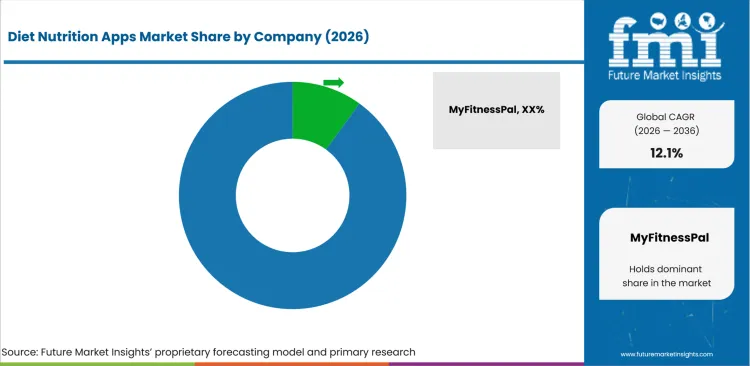
Competition remains fragmented between self-guided trackers and clinician-supported weight platforms serving different user needs today. Entry barriers center on food-data accuracy, logging effort and privacy controls that determine recurring engagement rather than company scale.
- Food-database and meal-capture competition across self-guided consumer tracking involves MyFitnessPal, YAZIO, Lifesum, Cronometer and Lose It!
- Noom, Weight Watchers and HealthifyMe combine behavior support with coaches or medical routes through GLP-1 nutrition coaching and structured weight-management programs. WW International filed for Chapter 11 bankruptcy on May 6, 2025, to restructure over USD 1 billion in debt, and successfully emerged from bankruptcy on June 24, 2025, continuing operations under its reorganized capital structure.
Competitive Benchmarking: Diet Nutrition Apps Market
| Company | Logging inputs | Human support | Institutional access | Geographic reach |
|---|---|---|---|---|
| MyFitnessPal | High | Low | Low | Global |
| Noom | Medium | High | High | United States |
| WW International (WeightWatchers) | Medium | High | High | Global |
| YAZIO | Medium | Low | Low | 150+ countries |
| Lifesum | High | Low | Medium | Global |
| Cronometer | High | Low | Medium | Global |
| Lose It! | Medium | Low | Medium | Global |
| HealthifyMe | Medium | High | Medium | India and international services |
Scoring basis: Logging inputs are High for four verified methods, Medium for two or three and Low for one documented route. Human support is High for integrated clinicians and coaches, Medium for one credentialed service and Low for software-led delivery. Institutional access is High for employer and clinical channels, Medium for one organizational route and Low for direct-consumer access. Geographic reach uses official operating claims, with Low always meaning verified limited scope instead of missing evidence.
Key Developments in the Diet Nutrition Apps Market
- In December 2025, WW International launched an integrated platform combining GLP-1 prescribing with personalized nutrition and coaching alongside community support inside a redesigned digital experience.
- In September 2025, Cronometer released Photo Logging for Gold subscribers and enabled meal images to generate editable ingredient suggestions as records enter the nutrition diary.
- In August 2025, Noom launched its Microdose GLP-1 Program with medication access and clinical care alongside coaching and personalized habit support for eligible United States members.
Key Players in the Diet Nutrition Apps Market
Consumer Food-Tracking Platforms
- MyFitnessPal
- YAZIO
- Cronometer
- Lose It!
Coaching and Medical Weight Platforms
- Noom
- WW International (WeightWatchers)
- HealthifyMe
Personalized Nutrition and Workplace Platforms
- Lifesum
Diet Nutrition Apps Market - Report Scope
| Coverage field | Report scope |
|---|---|
| Market breakdown | By platform, application, subscription model, end user, feature type and region. |
| Market Definition | Commercial mobile and web applications used for nutrition tracking, diet planning, weight management and related coaching services. |
| Regions Covered | North America, Latin America, Europe, East Asia, South Asia and Pacific, and Middle East and Africa. |
| Countries Covered | South Korea, United States, United Kingdom, Australia, Germany, and 20+ countries included in the full report. |
| Key Companies Profiled | MyFitnessPal, Noom, WW International (WeightWatchers), YAZIO, Lifesum, Cronometer, Lose It! and HealthifyMe. |
| Forecast Period | 2026 to 2036. |
| Approach | Primary and secondary research with market triangulation. |
Diet Nutrition Apps Market - Research Methodology
| Method | Approach |
|---|---|
| Primary Research | FMI analysts gathered input from manufacturers, service providers, technology developers, distributors, end users, procurement teams, and subject-matter experts. Interviews examined purchasing decisions, product or service evaluation, adoption barriers, approval requirements, pricing considerations, and expectations for technical or commercial support. Respondents were also asked what evidence is required before a trial, pilot, or initial order develops into regular purchasing. |
| Desk Research | Desk research covered government statistics, regulatory publications, trade data, industry associations, technical literature, standards, company filings, product information, and official corporate announcements. Sources were reviewed for relevance, publication date, geographic coverage, and consistency with the defined market scope. Claims relating to performance, applications, approvals, capacity, investment, and commercial activity were retained only when supported by credible public evidence. |
| Market Sizing and Forecasting | The market model combined the baseline value with historical performance, segment structure, pricing and volume indicators, adoption levels, company participation, and country-level demand conditions. Forecast assumptions considered economic activity, investment trends, regulatory developments, technology adoption, purchasing cycles, supply availability, and barriers to wider market use. Segment and regional estimates were reconciled before the final market total was calculated. |
| Data Validation | Estimates were checked against multiple independent indicators, including public data, company activity, trade patterns, industry developments, and findings from primary interviews. Validation also tested whether products, services, applications, and company revenues fell within the defined market boundaries. Adjacent categories, unsupported claims, overlapping revenues, and activities without direct market relevance were excluded to reduce double counting and maintain consistency across segments and countries. |
Diet Nutrition Apps Market by Segments
Diet Nutrition Apps Market segmented by Platform:
- Android
- Google Play Applications
- Android Tablets
- iOS
- iPhone Applications
- iPad Applications
- Web-Based
- Browser Applications
- Desktop Access
Diet Nutrition Apps Market segmented by Application:
- Weight Management
- Calorie Tracking
- Weight Loss Programs
- Healthy Diet Planning
- Meal Planning
- Nutrition Monitoring
- Fitness & Sports Nutrition
- Macro Tracking
- Performance Nutrition
- Medical Nutrition Therapy
- Diabetes Nutrition
- Heart Health Nutrition
- Others
- Pregnancy Nutrition
- Pediatric Nutrition
Diet Nutrition Apps Market segmented by Subscription Model:
- Freemium
- Free Access
- In-App Purchases
- Premium Subscription
- Monthly Plans
- Annual Plans
- One-Time Purchase
- Lifetime Access
- Premium Features
- Enterprise & Wellness Programs
- Corporate Wellness
- Healthcare Partnerships
Diet Nutrition Apps Market segmented by End User:
- Individual Consumers
- Fitness Enthusiasts
- Weight Management Users
- Healthcare Providers
- Dietitians
- Nutrition Clinics
- Fitness Centers & Trainers
- Gyms
- Personal Trainers
- Corporate Wellness Programs
- Employers
- Insurance Wellness Programs
Diet Nutrition Apps Market segmented by Feature Type:
- Calorie & Nutrition Tracking
- Food Database
- Barcode Scanning
- Personalized Diet Planning
- AI Meal Recommendations
- Custom Meal Plans
- Fitness Integration
- Wearable Device Sync
- Exercise Tracking
- Health Analytics
- Progress Reports
- Health Score Dashboard
- Others
- Community Support
- Recipe Recommendations
Diet Nutrition Apps Market by Region:
- North America
- United States
- Canada
- Mexico
- Latin America
- Brazil
- Chile
- Rest of Latin America
- Western Europe
- Germany
- United Kingdom
- Italy
- Spain
- France
- Nordics
- Benelux
- Rest of Western Europe
- Eastern Europe
- Russia
- Poland
- Hungary
- Balkan and Baltic States
- Rest of Eastern Europe
- East Asia
- China
- Japan
- South Korea
- South Asia and Pacific
- India
- ASEAN
- Australia and New Zealand
- Rest of South Asia and Pacific
- Middle East and Africa
- Kingdom of Saudi Arabia
- Other GCC Countries
- Türkiye
- South Africa
- Other African Union Countries
- Rest of Middle East and Africa
Research Sources and Bibliography
- World Health Organization. (2025, December 8). Obesity and overweight.
- Google. (2025, May 13). Android announces new design, Gemini updates and more.
- Centers for Disease Control and Prevention. (2025, December 3). Adult obesity prevalence maps.
- MyFitnessPal. (2026, March 17). MyFitnessPal launches advertising media network, connecting brands with millions of health-conscious consumers.
- Pew Research Center. (2025, November 20). Mobile fact sheet.
- Lifesum. (2025, April). Lifesum and Consupedia partner to build the world’s most informed and inclusive AI-powered food database.
- Ministry of Science and ICT. (2025, April 4). MSIT unveils 2024 internet usage trends.
- Centers for Disease Control and Prevention. (2025, September 18). About the Division of Nutrition, Physical Activity, and Obesity.
- Ofcom. (2025, December 10). From apps to AI search: How the UK goes online in 2025.
- Australian Communications and Media Authority. (2026, February 19). Mobile phone internet use soars as landline use keeps falling, ACMA research shows.
- Federal Statistical Office of Germany. (2025, November 27). Internet users and online shoppers.
- MyFitnessPal. (2026, June 10). Twenty years of nutrition data, and one AI coach that puts it all to work for you.
- Noom. (2025, August 4). Noom launches Microdose GLP-1 Program, including medication and microhabits program.
- WW International. (2025, December 16). Weight Watchers launches a fully integrated platform for the GLP-1 era.
- YAZIO. (2026). About us. Retrieved August 4, 2026.
- Noom Health. (2026, April 23). Noom Health’s SmartRx program on track to cut employer’s GLP-1 spend by nearly 80%.
- Lifesum. (2025, March). Lifesum and FIIT launch wellness solution to combat employee burnout and $47.6 billion in lost productivity.
- Cronometer. (2025, September 8). Photo logging: The easiest way to track your meals in Cronometer.
- Cronometer. (2025, February 3). New and improved: The latest Cronometer updates.
- Lose It! / Ziff Davis, Inc. (2025, April 22). Lose It! finds AI-powered logging boosts weight loss success and greater nutritional mindfulness.
- Lose It! / Ziff Davis, Inc. (2026). Lose It! privacy policy. Retrieved August 4, 2026.
- Lose It! / Ziff Davis, Inc. (2026). Partners and press. Retrieved August 4, 2026.
- HealthifyMe Wellness Private Limited. (2026, February 24). Terms of use and privacy policy.
- MyFitnessPal. (2026, March 2). MyFitnessPal expands its position as the leading player in digital nutrition tracking with Cal AI acquisition.
- Noom. (2026, April 1). Noom acquires licensed 503A pharmacy, accelerating the next era of preventive care and enabling Noom’s expansion beyond weight health.
- WW International, Inc. (2026, June 16). Weight Watchers and CheqUp expand partnership to deliver holistic support for weight health in the UK.
- Cronometer. (2026, May 14). 4 ways to log food on Cronometer.
- HealthifyMe Wellness Private Limited. (2026). Healthify: Health made easy with AI. Retrieved August 4, 2026.
- Cronometer. (2026). Cronometer Pro. Retrieved August 4, 2026.
- HealthifyMe Wellness Private Limited. (2026). Corporate wellness. Retrieved August 4, 2026.
- YAZIO. (2026). Healthy weight loss and eating. Retrieved August 4, 2026.
This bibliography is provided for reader reference and is not exhaustive. The full report contains the complete reference list and detailed citations.
This Report Answers
- What are the market values?
- What supports recurring nutrition tracking?
- Why does Android lead platform demand?
- How do leading segments shape demand?
- How do country growth rates compare?
- How do provider capabilities differ?
- Which developments affect competition?
- What does the report cover?
Frequently Asked Questions
How big is the diet nutrition apps market in 2026?
The diet nutrition apps market is valued at USD 5.8 billion in the 2026 base year. It is projected to reach USD 18.2 billion by 2036 through recurring nutrition and weight-management use.
What is the projected CAGR for the diet nutrition apps market through 2036?
The diet nutrition apps market is forecast to expand at 12.1% CAGR through the 2036 forecast endpoint. Smartphone access and recurring food logging support wider use of personalized nutrition guidance across consumer applications.
Which platform holds the largest share of the diet nutrition apps market?
Android is projected to account for 46.0% of the market’s total platform demand during 2026. Its installed device base supports application distribution across varied phone prices and numerous national consumer markets.
How much absolute opportunity does the diet nutrition apps market create by 2036?
The diet nutrition apps market is expected to add USD 12.4 billion in absolute opportunity by 2036. That opportunity equals the difference between the USD 5.8 billion base value and USD 18.2 billion endpoint.
Which companies are active in the diet nutrition apps market?
Active providers across consumer and clinical routes include MyFitnessPal, Noom, Weight Watchers, YAZIO, Lifesum, Cronometer and Lose It! HealthifyMe competes through food databases, coaching and subscription designs that support personalized weight-management services globally.
Preview the report firsthand - request a free sample
Get SampleGet the brochure for pricing and purchase details.
Get PDFTable of Content
- Key Takeaways
- Market Size and CAGR
- Top Growth Driver
- Fastest Growing Segment
- Leading Region
- Key Companies
- Emerging Opportunities
- Executive Summary
- Global Market Outlook
- Demand-side Trends
- Supply-side Trends
- Technology Roadmap Analysis
- Analysis and Recommendations
- Analyst Perspective (What is happening? Why now? What should investors know?)
- Key Questions Answered
- How large is the market?
- What is the CAGR?
- What are key trends?
- Which region dominates?
- Who are the leaders?
- Market Overview
- Market Coverage / Taxonomy
- Market Definition / Scope / Limitations
- Research Methodology
- Chapter Orientation
- Analytical Lens and Working Hypotheses
- Market Structure, Signals, and Trend Drivers
- Benchmarking and Cross-market Comparability
- Market Sizing, Forecasting, and Opportunity Mapping
- Research Design and Evidence Framework
- Desk Research Programme (Secondary Evidence)
- Expert Input and Fieldwork (Primary Evidence)
- Tooling, Models, and Reference Databases
- Data Engineering and Model Build
- Quality Assurance and Audit Trail
- Market Background
- Market Dynamics (Drivers, Restraints, Opportunity, Trends)
- Scenario Forecast (Optimistic, Likely, Conservative)
- Impact Analysis
- AI Impact
- Sustainability Impact
- Regulatory Impact
- Technology Impact
- Consumer / Buyer Analysis
- Purchase Drivers
- Adoption Barriers
- Buyer Journey
- Opportunity Map Analysis
- Product Life Cycle Analysis
- Supply Chain Analysis
- Investment Feasibility Matrix
- Value Chain Analysis
- PESTLE and Porter's Analysis
- Regulatory Landscape
- Regional Parent Market Outlook
- Production and Consumption Statistics
- Import and Export Statistics
- Global Market Analysis and Forecast, 2021 to 2036
- Historical Market Size Value (USD Billion) Analysis, 2021 to 2025
- Current and Future Market Size Value (USD Billion) Projections, 2026 to 2036
- Y-o-Y Growth Trend Analysis
- Absolute $ Opportunity Analysis
- Global Market Pricing Analysis, 2021 to 2036
- Global Market Analysis and Forecast, By Platform, 2021 to 2036
- Introduction / Key Findings
- Historical Market Size Value (USD Billion) Analysis By Platform, 2021 to 2025
- Current and Future Market Size Value (USD Billion) Analysis and Forecast By Platform, 2026 to 2036
- Android
- Google Play Applications
- Android Tablets
- iOS
- iPhone Applications
- iPad Applications
- Web-Based
- Browser Applications
- Desktop Access
- Android
- Y-o-Y Growth Trend Analysis By Platform, 2021 to 2025
- Absolute $ Opportunity Analysis By Platform, 2026 to 2036
- Global Market Analysis and Forecast, By Application, 2021 to 2036
- Introduction / Key Findings
- Historical Market Size Value (USD Billion) Analysis By Application, 2021 to 2025
- Current and Future Market Size Value (USD Billion) Analysis and Forecast By Application, 2026 to 2036
- Weight Management
- Calorie Tracking
- Weight Loss Programs
- Healthy Diet Planning
- Meal Planning
- Nutrition Monitoring
- Fitness & Sports Nutrition
- Macro Tracking
- Performance Nutrition
- Medical Nutrition Therapy
- Diabetes Nutrition
- Heart Health Nutrition
- Others
- Pregnancy Nutrition
- Pediatric Nutrition
- Weight Management
- Y-o-Y Growth Trend Analysis By Application, 2021 to 2025
- Absolute $ Opportunity Analysis By Application, 2026 to 2036
- Global Market Analysis and Forecast, By Subscription Model, 2021 to 2036
- Introduction / Key Findings
- Historical Market Size Value (USD Billion) Analysis By Subscription Model, 2021 to 2025
- Current and Future Market Size Value (USD Billion) Analysis and Forecast By Subscription Model, 2026 to 2036
- Freemium
- Free Access
- In-App Purchases
- Premium Subscription
- Monthly Plans
- Annual Plans
- One-Time Purchase
- Lifetime Access
- Premium Features
- Enterprise & Wellness Programs
- Corporate Wellness
- Healthcare Partnerships
- Freemium
- Y-o-Y Growth Trend Analysis By Subscription Model, 2021 to 2025
- Absolute $ Opportunity Analysis By Subscription Model, 2026 to 2036
- Global Market Analysis and Forecast, By End User, 2021 to 2036
- Introduction / Key Findings
- Historical Market Size Value (USD Billion) Analysis By End User, 2021 to 2025
- Current and Future Market Size Value (USD Billion) Analysis and Forecast By End User, 2026 to 2036
- Individual Consumers
- Fitness Enthusiasts
- Weight Management Users
- Healthcare Providers
- Dietitians
- Nutrition Clinics
- Fitness Centers & Trainers
- Gyms
- Personal Trainers
- Corporate Wellness Programs
- Employers
- Insurance Wellness Programs
- Individual Consumers
- Y-o-Y Growth Trend Analysis By End User, 2021 to 2025
- Absolute $ Opportunity Analysis By End User, 2026 to 2036
- Global Market Analysis and Forecast, By Feature Type, 2021 to 2036
- Introduction / Key Findings
- Historical Market Size Value (USD Billion) Analysis By Feature Type, 2021 to 2025
- Current and Future Market Size Value (USD Billion) Analysis and Forecast By Feature Type, 2026 to 2036
- Calorie & Nutrition Tracking
- Food Database
- Barcode Scanning
- Personalized Diet Planning
- AI Meal Recommendations
- Custom Meal Plans
- Fitness Integration
- Wearable Device Sync
- Exercise Tracking
- Health Analytics
- Progress Reports
- Health Score Dashboard
- Others
- Community Support
- Recipe Recommendations
- Calorie & Nutrition Tracking
- Y-o-Y Growth Trend Analysis By Feature Type, 2021 to 2025
- Absolute $ Opportunity Analysis By Feature Type, 2026 to 2036
- Global Market Analysis and Forecast, By Region, 2021 to 2036
- Introduction
- Historical Market Size Value (USD Billion) Analysis By Region, 2021 to 2025
- Current Market Size Value (USD Billion) Analysis and Forecast By Region, 2026 to 2036
- North America
- Latin America
- Western Europe
- Eastern Europe
- East Asia
- South Asia and Pacific
- Middle East & Africa
- Market Attractiveness Analysis By Region
- North America Market Analysis and Forecast, By Country, 2021 to 2036
- Historical Market Size Value (USD Billion) Trend Analysis By Market Taxonomy, 2021 to 2025
- Market Size Value (USD Billion) Forecast By Market Taxonomy, 2026 to 2036
- By Country
- USA
- Canada
- By Platform
- By Application
- By Subscription Model
- By End User
- By Feature Type
- By Country
- Market Attractiveness Analysis
- By Country
- By Platform
- By Application
- By Subscription Model
- By End User
- By Feature Type
- Key Takeaways
- Latin America Market Analysis and Forecast, By Country
- Historical Market Size Value (USD Billion) Trend Analysis By Market Taxonomy, 2021 to 2025
- Market Size Value (USD Billion) Forecast By Market Taxonomy, 2026 to 2036
- By Country
- Brazil
- Mexico
- Chile
- Rest of Latin America
- By Platform
- By Application
- By Subscription Model
- By End User
- By Feature Type
- By Country
- Market Attractiveness Analysis
- By Country
- By Platform
- By Application
- By Subscription Model
- By End User
- By Feature Type
- Key Takeaways
- Western Europe Market Analysis and Forecast, By Country
- Historical Market Size Value (USD Billion) Trend Analysis By Market Taxonomy, 2021 to 2025
- Market Size Value (USD Billion) Forecast By Market Taxonomy, 2026 to 2036
- By Country
- Germany
- UK
- Italy
- Spain
- France
- Nordic
- BENELUX
- Rest of Western Europe
- By Platform
- By Application
- By Subscription Model
- By End User
- By Feature Type
- By Country
- Market Attractiveness Analysis
- By Country
- By Platform
- By Application
- By Subscription Model
- By End User
- By Feature Type
- Key Takeaways
- Eastern Europe Market Analysis and Forecast, By Country
- Historical Market Size Value (USD Billion) Trend Analysis By Market Taxonomy, 2021 to 2025
- Market Size Value (USD Billion) Forecast By Market Taxonomy, 2026 to 2036
- By Country
- Russia
- Poland
- Hungary
- Balkan & Baltic
- Rest of Eastern Europe
- By Platform
- By Application
- By Subscription Model
- By End User
- By Feature Type
- By Country
- Market Attractiveness Analysis
- By Country
- By Platform
- By Application
- By Subscription Model
- By End User
- By Feature Type
- Key Takeaways
- East Asia Market Analysis and Forecast, By Country
- Historical Market Size Value (USD Billion) Trend Analysis By Market Taxonomy, 2021 to 2025
- Market Size Value (USD Billion) Forecast By Market Taxonomy, 2026 to 2036
- By Country
- China
- Japan
- South Korea
- By Platform
- By Application
- By Subscription Model
- By End User
- By Feature Type
- By Country
- Market Attractiveness Analysis
- By Country
- By Platform
- By Application
- By Subscription Model
- By End User
- By Feature Type
- Key Takeaways
- South Asia and Pacific Market Analysis and Forecast, By Country
- Historical Market Size Value (USD Billion) Trend Analysis By Market Taxonomy, 2021 to 2025
- Market Size Value (USD Billion) Forecast By Market Taxonomy, 2026 to 2036
- By Country
- India
- ASEAN
- Australia & New Zealand
- Rest of South Asia and Pacific
- By Platform
- By Application
- By Subscription Model
- By End User
- By Feature Type
- By Country
- Market Attractiveness Analysis
- By Country
- By Platform
- By Application
- By Subscription Model
- By End User
- By Feature Type
- Key Takeaways
- Middle East & Africa Market Analysis and Forecast, By Country
- Historical Market Size Value (USD Billion) Trend Analysis By Market Taxonomy, 2021 to 2025
- Market Size Value (USD Billion) Forecast By Market Taxonomy, 2026 to 2036
- By Country
- Kingdom of Saudi Arabia
- Other GCC Countries
- Türkiye
- South Africa
- Other African Union
- Rest of Middle East & Africa
- By Platform
- By Application
- By Subscription Model
- By End User
- By Feature Type
- By Country
- Market Attractiveness Analysis
- By Country
- By Platform
- By Application
- By Subscription Model
- By End User
- By Feature Type
- Key Takeaways
- Key Countries Market Analysis
- USA
- Pricing Analysis
- Market Share Analysis, 2025
- By Platform
- By Application
- By Subscription Model
- By End User
- By Feature Type
- Canada
- Pricing Analysis
- Market Share Analysis, 2025
- By Platform
- By Application
- By Subscription Model
- By End User
- By Feature Type
- Mexico
- Pricing Analysis
- Market Share Analysis, 2025
- By Platform
- By Application
- By Subscription Model
- By End User
- By Feature Type
- Brazil
- Pricing Analysis
- Market Share Analysis, 2025
- By Platform
- By Application
- By Subscription Model
- By End User
- By Feature Type
- Chile
- Pricing Analysis
- Market Share Analysis, 2025
- By Platform
- By Application
- By Subscription Model
- By End User
- By Feature Type
- Germany
- Pricing Analysis
- Market Share Analysis, 2025
- By Platform
- By Application
- By Subscription Model
- By End User
- By Feature Type
- UK
- Pricing Analysis
- Market Share Analysis, 2025
- By Platform
- By Application
- By Subscription Model
- By End User
- By Feature Type
- Italy
- Pricing Analysis
- Market Share Analysis, 2025
- By Platform
- By Application
- By Subscription Model
- By End User
- By Feature Type
- Spain
- Pricing Analysis
- Market Share Analysis, 2025
- By Platform
- By Application
- By Subscription Model
- By End User
- By Feature Type
- France
- Pricing Analysis
- Market Share Analysis, 2025
- By Platform
- By Application
- By Subscription Model
- By End User
- By Feature Type
- India
- Pricing Analysis
- Market Share Analysis, 2025
- By Platform
- By Application
- By Subscription Model
- By End User
- By Feature Type
- ASEAN
- Pricing Analysis
- Market Share Analysis, 2025
- By Platform
- By Application
- By Subscription Model
- By End User
- By Feature Type
- Australia & New Zealand
- Pricing Analysis
- Market Share Analysis, 2025
- By Platform
- By Application
- By Subscription Model
- By End User
- By Feature Type
- China
- Pricing Analysis
- Market Share Analysis, 2025
- By Platform
- By Application
- By Subscription Model
- By End User
- By Feature Type
- Japan
- Pricing Analysis
- Market Share Analysis, 2025
- By Platform
- By Application
- By Subscription Model
- By End User
- By Feature Type
- South Korea
- Pricing Analysis
- Market Share Analysis, 2025
- By Platform
- By Application
- By Subscription Model
- By End User
- By Feature Type
- Russia
- Pricing Analysis
- Market Share Analysis, 2025
- By Platform
- By Application
- By Subscription Model
- By End User
- By Feature Type
- Poland
- Pricing Analysis
- Market Share Analysis, 2025
- By Platform
- By Application
- By Subscription Model
- By End User
- By Feature Type
- Hungary
- Pricing Analysis
- Market Share Analysis, 2025
- By Platform
- By Application
- By Subscription Model
- By End User
- By Feature Type
- Kingdom of Saudi Arabia
- Pricing Analysis
- Market Share Analysis, 2025
- By Platform
- By Application
- By Subscription Model
- By End User
- By Feature Type
- Türkiye
- Pricing Analysis
- Market Share Analysis, 2025
- By Platform
- By Application
- By Subscription Model
- By End User
- By Feature Type
- South Africa
- Pricing Analysis
- Market Share Analysis, 2025
- By Platform
- By Application
- By Subscription Model
- By End User
- By Feature Type
- USA
- Market Structure Analysis
- Competition Dashboard
- Competition Benchmarking
- Market Share Analysis of Top Players
- By Regional
- By Platform
- By Application
- By Subscription Model
- By End User
- By Feature Type
- Emerging Startups
- Innovation Benchmarking
- Competition Analysis
- Competition Deep Dive
- MyFitnessPal
- Overview
- Product Portfolio
- Profitability by Market Segments
- Sales Footprint
- Strategy Overview
- Marketing Strategy
- Product Strategy
- Channel Strategy
- Noom
- Weight Watchers
- YAZIO
- Lifesum
- Cronometer
- Lose It!
- HealthifyMe
- MyFitnessPal
- Case Studies
- Success Stories
- Recent Developments
- Competition Deep Dive
- Assumptions & Acronyms Used


