

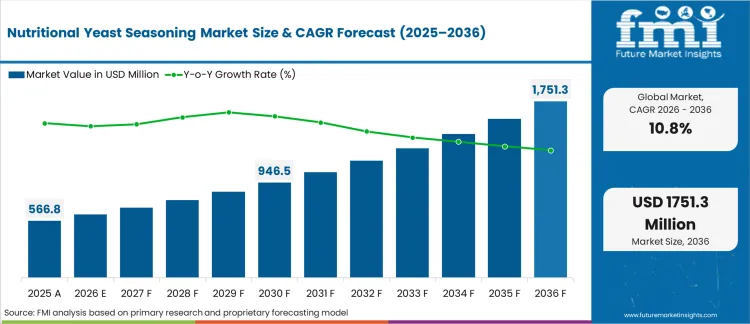
- Industry Size (2026)
- USD 628.0 Mn
- Forecast (2036)
- USD 1735.0 Mn
- CAGR (2026 to 2036)
- 10.8%
Nutritional Yeast Seasoning Market Size, Market Forecast and Outlook
In 2025, nutritional yeast seasoning revenue surpassed a valued of USD 580.0 million, is projected at USD 628.0 million in 2026 and USD 1,735.0 million by 2036, implying a 10.8% CAGR, with momentum tied to clean-label umami substitution in packaged goods. Rising consumer avoidance of synthetic additives accelerates formulation upgrades across savory ingredients portfolios.
Emerging plant-based food categories present significant untapped potential for functional flavor pairings. Dollar sales of plant-based foods reached USD 8.1 billion in 2024, expanding the addressable base for complementary vegan condiments [1]. Buyers move where fortified nutritional profiles align with familiar cheese-like palatability, prompting ingredient brands to overhaul retail shelf strategy.
Summary of Nutritional Yeast Seasoning
- Nutritional Yeast Seasoning Market Definition
- Deactivated yeast products function as primary savory flavor enhancers and functional nutrient carriers for household and industrial food applications.
- Demand Drivers in the Market
- Rising consumer preference for clean label umami substitutes accelerates substitution away from synthetic additives.
- High repeat purchase rates among plant based shoppers sustain recurring retail volume growth.
- Public and private investments in fermentation infrastructure lower unit production costs for yeast derivatives.
- Key Segments Analyzed in the FMI Report
- Product Form: Flakes hold 47% share driven by direct consumer familiarity.
- Application: Home Cooking & Dining accounts for 44% of total consumption volume.
- Geography: Asian markets show rapid B2B adoption while Western regions rely on established vegan demographics.
- Analyst Opinion at FMI
- Nandini Roy Choudhury, Principal Consultant for Food & Beverage at Future Market Insights, opines, “In our latest Nutritional Yeast Seasoning Market analysis, my team and I have identified flavor economics as the decisive growth lever. As sodium-reduction mandates tighten and MSG perception remains polarized in certain regions, manufacturers are leveraging nutritional yeast to deliver depth, mouthfeel, and label-friendly positioning simultaneously. However, scalability will depend on fermentation efficiency and cost discipline. Suppliers that combine strain innovation with reliable bulk supply will transition nutritional yeast from specialty seasoning into a core savory formulation component.”
- Strategic Implications/Executive Takeaways
- Prioritize fortification to capture health conscious buyers seeking specific micronutrient profiles.
- Expand B2B partnerships to integrate yeast seasonings into mainstream processed snack formulations.
- Localize production nodes to mitigate supply chain volatility and reduce raw material import reliance.
- Methodology
- Validated through first-hand corporate production and capacity data.
- Zero reliance on speculative third-party market research reports.
- Based on verifiable industrial benchmarks and verified sources.
“Nutritional yeast has been a staple in the vegan and dairy-free community for years, but most options on the market contain synthetic additives,” says Bailey Petrucelli, Founder. [2]
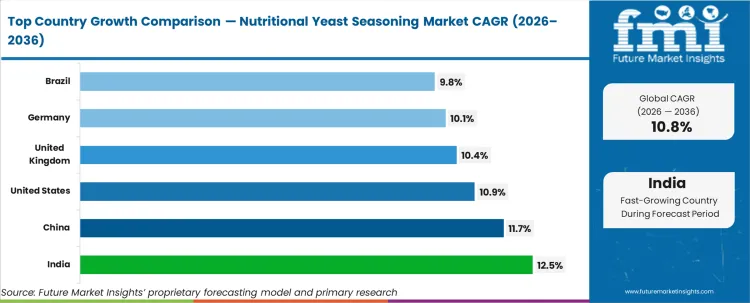
Dispersion mirrors regulatory openness to fortification claims and B2B umami demand across India, China, the United States, the United Kingdom, Germany, and Brazil. Plant-based dollar sales grew 79% over recent years, establishing high-growth corridors where consumers prioritize dairy-free substitution [3]. Procurement clusters around pre-qualified vendors capable of delivering consistent flake integrity without utilizing synthetic additives.
Nutritional Yeast Seasoning Market Key Takeaways
| Metric | Details |
|---|---|
| Industry Size (2026) | USD 628.0 million |
| Industry Value (2036) | USD 1,735.0 million |
| CAGR (2026-2036) | 10.8% |
Nutritional Yeast Seasoning Market Definition
Nutritional yeast seasoning encompasses deactivated yeast products formulated specifically for savory flavor enhancement and dietary fortification. Vendors supply these ingredients directly to retail consumers and industrial food manufacturers seeking non-animal umami profiles. Application spans daily household cooking, commercial food service, and large scale snack processing. Formulations often include added B vitamins to target specific nutritional deficits in end users.
Nutritional Yeast Seasoning Market Inclusions
The Nutritional Yeast Seasoning category includes deactivated yeast flakes marketed for retail seasoning use and home recipe applications. It also covers powdered nutritional yeast supplied for commercial snack coating systems and savory formulations. Fortified yeast blends enriched with added vitamins and minerals targeting health-oriented consumers are included, along with yeast-derived savory ingredients positioned as direct cheese substitutes in vegan product development.
Nutritional Yeast Seasoning Market Exclusions
The scope excludes active baking yeast used for dough leavening and bread production, as well as brewing yeast dedicated to alcohol fermentation. Liquid yeast extracts without dry flake or powder presentation are not considered. Animal-derived savory flavorings and conventional dairy-based cheese powders are also excluded.
Nutritional Yeast Seasoning Market Research Methodology
- Primary Research: Analysts conduct interviews with yeast fermentation facility managers, retail category buyers, and food formulation scientists to validate capacity and off-take volumes.
- Desk Research: Statutory filings from major ingredient conglomerates and national dietary supplement databases provide baseline production and deficiency statistics.
- Market-Sizing and Forecasting: Macro food expenditure metrics combine with bottom up plant based household penetration rates to project consumption trajectories.
- Data Validation and Update Cycle: Pricing anomalies undergo cross verification against raw molasses feedstock costs and localized import tariffs before finalizing models.
Segmental Analysis
Nutritional Yeast Seasoning Market Analysis by Product Form
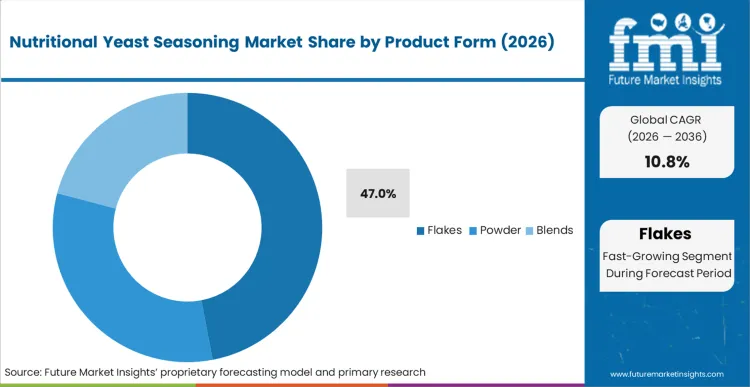
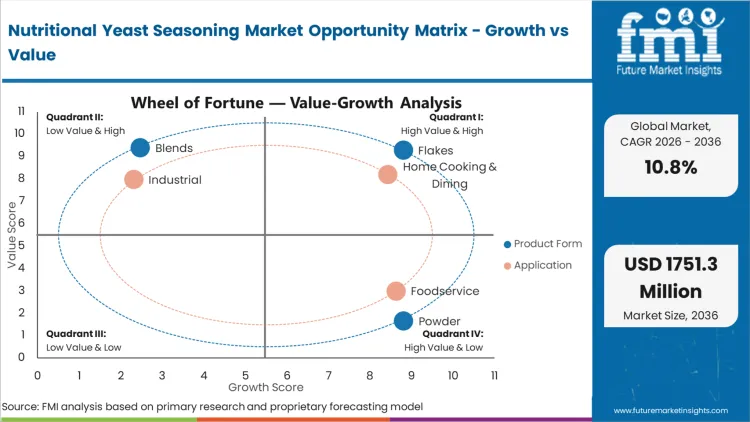
Flakes command 47% of volume in 2026, serving as primary choice for direct consumer application. Buyers favor flakes for visible texture and easy integration into home recipes, especially as cheese substitutes. As per FMI's projection, manufacturers cater to consumer preference by optimizing drum drying techniques to retain flake integrity during transit. Industrial users also utilize flakes for visual appeal in specialized bakery items, avoiding complete powder breakdown. Formulators continue refining flake solubility to broaden usage occasions across delicate sauces and dressings.
- Procurement trigger: Visual appeal dictates consumer selection at retail shelves, forcing brands to launch minimally processed options. Goldie’s Superfoods introduced a high-protein, USDA organic nutritional yeast in March 2025 to satisfy clean-label requirements, raising the premium price ceiling [4].
- Supply-side move: Adoption accelerates where manufacturers optimize drying parameters to minimize flake breakage during transit. Angel Yeast's operational 11,000-ton yeast-protein line expands base capabilities, ensuring bulk flake structural integrity for industrial buyers [5].
- Buyer priority: Growth is anchored in health-conscious shoppers seeking familiar visual cues for dairy substitution. An 81% repeat rate for plant-based buyers in 2023 incentivizes supermarkets to allocate dedicated shelf space for high-velocity savory boosters [6].
Nutritional Yeast Seasoning Market Analysis by Application
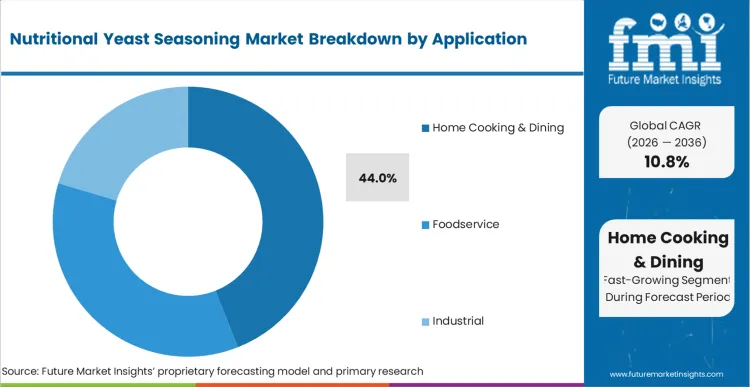
Everyday meal preparation continues to drive steady demand as consumers experiment with new flavors and plant-based ingredients at home. FMI estimates that b of households purchased plant-based foods in 2024, reinforcing a strong foundation for home-use umami enhancers [7]. Yeast-based seasonings are increasingly used to recreate savory depth in sauces, popcorn, and roasted vegetables. Digital food creators further accelerate adoption by demonstrating versatile applications across simple recipes, while foodservice operators gradually respond to these consumer-led trends. As this pattern strengthens, home cooking and dining account for 44% of total share in 2026.
- Culinary adoption: Online recipe platforms and food creators are accelerating everyday use of nutritional yeast in home kitchens. Companies are strengthening formulation capabilities through strategic acquisitions to enhance texture performance across diverse cooking applications.
- Nutritional trigger: Nutritional triggers prompt home cooks to utilize fortified yeast to supplement family diets proactively. Approximately 3.6% of United States adults exhibit a B12 deficiency, accelerating at-home fortification through everyday meal enhancement [9].
- Usage frequency: Usage frequency guarantees steady replenishment cycles as consumers replace traditional cheese toppings. Products providing up to 24 mcg of B12 per serving encourage multiple usage occasions per week and drive retail volume velocity [10].
Nutritional Yeast Seasoning Market Drivers, Restraints, and Opportunities
Expanding mainstream acceptance of dairy-free diets forces consumers to seek alternative savory ingredients for daily cooking. Shoppers purchase nutritional yeast to mimic cheese textures and umami depth in vegan recipes. FMI analysts opine that out-of-home culinary trends heavily influence retail adoption, with 48% of United States restaurants featuring plant-based foods in 2024, normalizing savory flavor profiles [11]. Behavioral shifts transition yeast from a niche health store item into a mandatory pantry staple, driving sustained retail volume as flexitarians experiment with new flavor systems.
Processing bottlenecks and import dependencies constrain margin expansion for regional packers. Producing high-quality deactivated yeast requires sophisticated fermentation infrastructure and energy-intensive drying processes. Angel Yeast initiated a 60,000-ton capacity expansion in May 2024 to address exact supply limitations plaguing independent formulators [12]. Without local fermentation facilities, brands must import bulk yeast, exposing balance sheets to currency fluctuations and volatile freight costs, which ultimately limits competitive retail pricing against traditional dairy alternatives.
- Ingredient synergy: Savory snack manufacturers can integrate yeast extract to reduce sodium content across product portfolios. An expanding food-at-home spending base of USD 1.06 trillion in 2024 provides a massive consumer demographic eager for healthier processed foods [13].
- Functional fortification: Aging populations present a massive market for bioavailable nutrient sources integrated into regular diets. Consolidations such as the June 2025 acquisition of AIT Ingredients by Lallemand streamline regional fermentation expertise, ensuring brands can develop advanced fortified blends [14].
- Corporate consolidation: Large ingredient suppliers have an opportunity to acquire specialized fermentation startups to broaden their savory portfolios. Since approximately 12.5% of adults face B12 insufficiency, acquiring tech capable of high-yield vitamin fortification secures lucrative institutional contracts [15].
Regional Analysis
Based on the regional analysis, the Nutritional Yeast Seasoning market is segmented into North America, Latin America, Europe, East Asia, South Asia, Oceania and Middle East & Africa across 40+ countries. The full report also offers market attractiveness analysis based on regional trends.
.webp "Top Country Growth Comparison Nutritional Yeast Seasoning Market Cagr (2026 2036)")
| Country | CAGR (2026 to 2036) |
|---|---|
| India | 12.5% |
| China | 11.7% |
| United States | 10.9% |
| United Kingdom | 10.4% |
| Germany | 10.1% |
| Brazil | 9.8 |
Source: Future Market Insights (FMI) analysis, based on proprietary forecasting model and primary research
South Asia Nutritional Yeast Seasoning Analysis
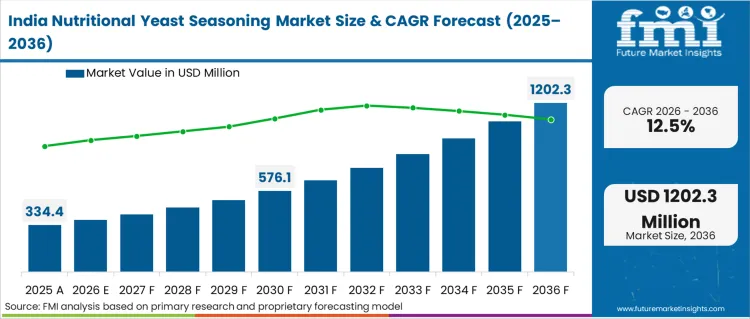
South Asia registers rapid adoption as urbanization alters traditional cooking habits. Consumers seek convenient flavor enhancers aligning with vegetarian dietary preferences prevalent across major cities. Local packing of imported bulk yeast dominates current supply models, exposing brands to forex volatility. Modern retail expansion provides necessary shelf space for premium pantry items to reach middle class shoppers. Brands compete fiercely on price while attempting to educate consumers on functional benefits.
- India: Demand for nutritional yeast seasoning in India is set to grow at 12.5% CAGR through 2036, supported by rapid modern trade expansion before procurement and budgeting cycles translate into higher deployment volumes. Exclusive global partnerships, such as Lesaffre's tie-up with MicroBioGen in June 2025, provide cost-effective alternatives to imports, stabilizing prices for regional food processors [16].
FMI’s report includes an extensive evaluation of South Asia dynamics. Bangladesh and Sri Lanka offer emerging opportunities as urban supermarkets stock imported vegan pantry staples. Procurement teams must navigate fluctuating import tariffs while securing reliable bulk yeast shipments to maintain consistent retail pricing across savoury flavour blends.
East Asia Nutritional Yeast Seasoning Analysis
East Asia functions as a massive industrial engine for yeast derivative production. B2B utilization of yeast extracts in savory snacks and instant noodles dwarfs direct retail nutritional yeast sales. Manufacturers leverage vast fermentation infrastructure to supply domestic food processors and international export markets. Regulatory bodies increasingly scrutinize health claims, forcing brands to standardize fortification levels across regional outputs.
- China: Industrial snack fortification is gaining traction in China as manufacturers look for clean-label flavor enhancers that align with evolving consumer preferences. Public investment in fermentation technologies reached USD 203 million in 2024, strengthening large-scale production capacity and enabling processors to replace conventional MSG with yeast-based alternatives [17]. As policy support and capital deployment increasingly translate into commercial procurement, nutritional yeast seasoning sales in China are projected to grow at an 11.7% CAGR from 2026 to 2036.
FMI’s report includes comprehensive metrics for East Asia dynamics. Japan and South Korea represent mature consumer markets demanding clean label umami solutions. Suppliers should monitor shifting sodium reduction regulations compelling food manufacturers to reformulate recipes using torula yeast flavor enhancers.
North America Nutritional Yeast Seasoning Analysis
North America exhibits mature, high value demand driven by entrenched plant based dietary habits. High disposable incomes allow consumers to purchase premium, fortified seasonings for daily home cooking. Retail shelves feature diverse yeast variants, including specific flavor blends and organic certifications. Large scale distributors consolidate brands to optimize supermarket category management and prevent stockouts during peak buying seasons.
- United States: The United States nutritional yeast seasoning sector is poised to expand at 10.9% CAGR during 2026 to 2036 because flexitarian cooking mainstreams, which lifts utilization rates and justifies technology refresh decisions. Plant-based proteins received USD 146 million in new public investment in 2024, highlighting strong institutional support for sector expansion and securing supply lines for dairy-free umami solutions [18].
FMI’s report includes a deep dive into North American consumption patterns. Canada and Mexico present distinct retail landscapes, with Canadian shoppers mirroring U.S. plant based purchasing behaviors. Distributors should secure prominent shelf placement near complimentary dietary items to maximize impulse cross purchasing volumes for beta glucan from yeast supplements.
Europe Nutritional Yeast Seasoning Analysis
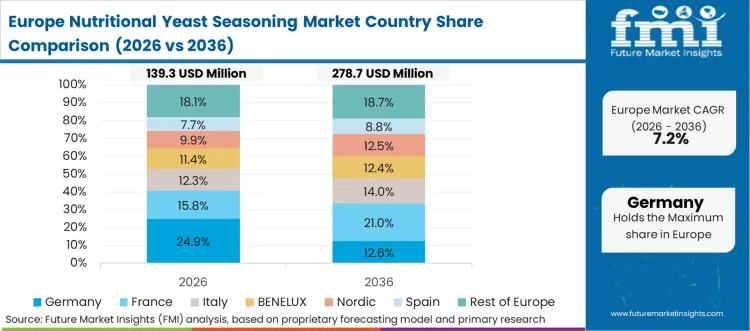
Europe leads in clean label formulation and stringent organic certification standards. Consumers demand nutritional yeast products free from synthetic additives and genetically modified organisms. High inflation and cost of living pressures occasionally force shoppers to substitute pure yeast with cheaper yeast extract blends. Major ingredient conglomerates execute strategic acquisitions to control regional savory ingredient supply chains and mitigate raw material shortages.
- United Kingdom: United Kingdom is expected to record 10.4% CAGR in nutritional yeast seasoning demand over 2026 to 2036 as vegan menu culture permeates foodservice, tightening the link between operational constraints and adoption-led investment. Consolidations such as Lesaffre's agreement to acquire dsm-firmenich’s yeast extract business in June 2024 allow major suppliers to dominate specialty yeast distribution across European retail networks [19].
- Germany: In Germany, strong penetration of organic retail channels continues to support steady demand for clean-label seasoning ingredients. As budget allocations increasingly align with this preference for minimally processed nutrition, the nutritional yeast seasoning market in Germany is projected to grow at a 10.1% CAGR through 2036.
FMI’s report includes detailed tracking of European market shifts. France and Italy demonstrate rising flexitarian populations seeking traditional savory profiles without animal ingredients. Formulators must navigate complex local labeling laws regarding vitamin fortification to ensure compliant retail distribution across seasoning aisles.
Latin America Nutritional Yeast Seasoning Analysis
Latin America emerges as an important node for global yeast derivative manufacturing. Multinational companies invest in local facilities to utilize abundant sugar cane molasses feedstocks for fermentation. Domestic retail consumption remains concentrated in affluent urban centers where modern supermarkets allocate shelf space for health foods. Economic volatility frequently impacts imported retail brands, pushing consumers toward locally produced alternatives.
- Brazil: Nutritional yeast seasoning uptake in Brazil is anticipated to climb at 9.8% CAGR over the forecast period as local derivative ecosystems mature, helping suppliers align positioning with local buying triggers.
FMI’s report includes a robust analysis of Latin American developments. Argentina and Chile offer concentrated pockets of vegan consumer demand within major metropolitan areas. Foreign brands must establish local joint ventures to bypass import tariffs and achieve competitive pricing on retail shelves.
Competitive Aligners for Market Players
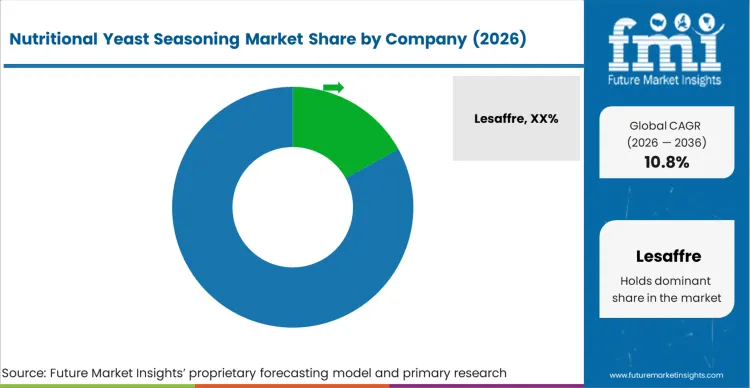
Consolidation reshapes the supplier landscape as major conglomerates acquire specialized fermentation capabilities. Large entities leverage economies of scale to dictate bulk pricing, forcing smaller independent producers to focus on niche, organic, or highly fortified retail product lines to maintain viable margins. This structural shift elevates the baseline quality of yeast ingredients available to mid-tier snack manufacturers.
Product innovation pivots toward specialized flavor profiles to overcome category commoditization. Formulators invest heavily in creating specific savory blends, such as nacho or smoky bacon flavors, to capture flexitarian consumers who prioritize taste alongside nutritional benefits. Advanced milling technologies allow these smoked yeast blends to adhere seamlessly to extruded snacks and popcorn.
Capacity expansion dictates long term market share capture. Ingredient suppliers must localize production to mitigate global freight volatility and secure uninterrupted raw material access, ensuring consistent fulfillment for major food processing clients. Scaling fermentation outputs remains the primary defense against unexpected surges in molasses feedstock pricing.
Recent Developments
The report includes full coverage of key trends from competitive benchmarking. Some of the recent developments covered in the reports:
- In June 2025, Lesaffre acquired a 70% stake in Biorigin to form a joint venture enhancing yeast-derivative and savory ingredient solutions globally. [20]
- In July 2025, Lallemand acquired enzyme specialist Solyve to expand functional ingredient portfolios and improve fermentation processing capabilities. [8]
Key Players in Nutritional Yeast Seasoning
- Lesaffre
- Lallemand
- Angel Yeast
- dsm-firmenich
- Biospringer
- Foods Alive
- Goldie’s Superfoods
- Biorigin
Scope of the Report
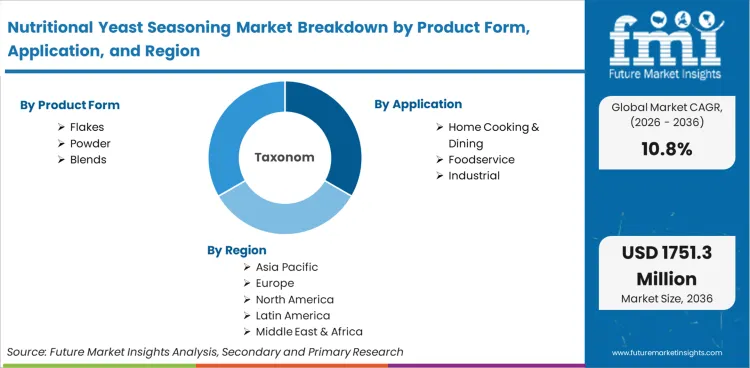
| Metric | Value |
|---|---|
| Quantitative Units | USD 628.0 million (2026) to USD 1,735.0 million (2036), at a CAGR of 10.8% |
| Market Definition | Nutritional yeast seasoning encompasses deactivated yeast products formulated specifically for savory flavor enhancement and dietary fortification. |
| Product Form Segmentation | Flakes, Powder, Blends |
| Application Coverage | Home Cooking & Dining, Foodservice, Industrial |
| Regions Covered | North America, Latin America, Europe, East Asia, South Asia, Oceania, Middle East and Africa |
| Countries Covered | United States, Canada, Mexico, Brazil, Argentina, Germany, France, United Kingdom, Italy, Spain, China, India, Japan, South Korea, Indonesia, Australia and 40 plus countries |
| Key Companies Profiled | Lesaffre, Lallemand, Angel Yeast, dsm-firmenich, Biospringer, Foods Alive, Goldie’s Superfoods, Biorigin |
| Forecast Period | 2026 to 2036 |
| Approach | Macro food expenditure metrics combine with bottom up plant based household penetration rates to project consumption trajectories |
Nutritional Yeast Seasoning Market Analysis by Segments
Product Form:
- Flakes
- Powder
- Blends
Application:
- Home Cooking & Dining
- Foodservice
- Industrial
Region:
- Asia Pacific
- India
- China
- Japan
- South Korea
- Indonesia
- Australia & New Zealand
- ASEAN
- Rest of Asia Pacific
- Europe
- Germany
- Italy
- France
- United Kingdom
- Spain
- Benelux
- Nordics
- Central & Eastern Europe
- Rest of Europe
- North America
- United States
- Canada
- Mexico
- Latin America
- Brazil
- Argentina
- Chile
- Rest of Latin America
- Middle East & Africa
- Kingdom of Saudi Arabia
- United Arab Emirates
- South Africa
- Turkey
- Rest of Middle East & Africa
Bibliography
- [1] Plant Based Foods Association. (2024). Plant-based foods dollar sales reached $8.1B in 2024.
- [2] Nooch It! (2025, March). March 2025 press release: Organic nutritional yeast.
- [3] Plant Based Foods Association. (2024). Plant-based dollar sales grew 79% over recent years.
- [4] Noocha Superfoods. (2025). Goldie’s Superfoods launched high-protein, USDA organic nutritional yeast.
- [5] Angel Yeast. (2024). Operating 11,000-ton yeast-protein line.
- [6] Plant Based Foods Association. (2024). Repeat rate for plant-based buyers in 2023.
- [7] Plant Based Foods Association. (2024). Household penetration rates for plant-based foods.
- [8] Lallemand. (2025). Acquired enzyme specialist Solyve in July 2025.
- [9] Office of Dietary Supplements. (2025). U.S. adults B12 deficiency analysis.
- [10] Office of Dietary Supplements. (2024). Fortified nutritional yeast provides B12 per serving.
- [11] Plant Based Foods Association. (2024). U.S. restaurants feature plant-based foods.
- [12] Angel Yeast. (2024). 60,000 tons/year expansion in May 2024.
- [13] Economic Research Service. (2024). U.S. food-at-home spending in 2024.
- [14] Lallemand. (2025). Acquired AIT Ingredients in June 2025.
- [15] Office of Dietary Supplements. (2024). U.S. adults B12 insufficiency data.
- [16] Lesaffre. (2025). Exclusive global partnership with MicroBioGen.
- [17] The Good Food Institute. (2024). Public investments in fermentation technologies in 2024.
- [18] The Good Food Institute. (2024). Plant-based proteins received $146M public investment.
- [19] Lesaffre. (2024). Agreed to acquire dsm-firmenich’s yeast extract business.
- [20] Lesaffre. (2025). Acquired 70% stake in Biorigin in June 2025.
This bibliography is provided for reader reference and is not exhaustive. The full report contains the complete reference list and detailed citations.
This Report Addresses
- Market intelligence to enable structured strategic decision making across mature and emerging savory ingredient markets
- Market size estimation and 10 year revenue forecasts from 2026 to 2036, supported by validated capacity and retail benchmarks
- Growth opportunity mapping across flakes and powder formats with emphasis on clean-label and fortified grade transitions
- Segment and regional revenue forecasts covering home cooking, foodservice, and industrial food processing applications
- Competition strategy assessment including integration models, fermentation capacity positioning, and product formulation benchmarking
- Product reformulation and nutritional compliance tracking including B12 fortification levels and non-GMO aligned grades
- Regulatory impact analysis covering labeling mandates, dietary supplement thresholds, and export driven specification upgrades
- Market report delivery in PDF, Excel, PPT, and interactive dashboard formats for executive and operational use
Frequently Asked Questions
How large is the demand for Nutritional Yeast Seasoning in the global market in 2026?
Demand for Nutritional Yeast Seasoning in the global market is estimated to be valued at USD 628.0 million in 2026.
What will be the market size of Nutritional Yeast Seasoning in the global market by 2036?
Market size for Nutritional Yeast Seasoning is projected to reach USD 1,735.0 million by 2036.
What is the expected demand growth for Nutritional Yeast Seasoning in the global market between 2026 and 2036?
Demand for Nutritional Yeast Seasoning in the global market is expected to grow at a CAGR of 10.8% between 2026 and 2036.
Which Product Form is poised to lead global sales by 2026?
Flakes command approximately 47% of volume in 2026 due to direct consumer familiarity and versatile application in home recipes.
How significant is the role of Home Cooking & Dining in driving Nutritional Yeast Seasoning adoption in 2026?
Home Cooking & Dining represents a critical segment, projected to hold a substantial 44% share in 2026 as culinary experimentation fuels continuous volume depletion.
What is driving demand in India?
Demand scales through modern trade expansion and rising flexitarian diets requiring functional umami enhancers.
What compliance standards or regulations are referenced for India?
Import tariffs and packaging regulations mandate localized bulk processing to maintain competitive retail pricing.
What is the India growth outlook in this report?
India is projected to grow at a CAGR of 12.5% during 2026 to 2036.
Why is East Asia described as a priority region in this report?
East Asia functions as a massive industrial engine for yeast derivative production, driven by immense B2B utilization in savory snacks.
What type of demand dominates in East Asia?
Industrial bulk demand for sodium reduction in packaged foods dominates regional volume consumption.
What is China growth outlook in this report?
China is projected to expand at a CAGR of 11.7% during 2026 to 2036.
Does the report cover United States in its regional analysis?
Yes, United States is included within North America under the regional scope of analysis.
What are the sources referred to for analyzing United States?
Plant Based Foods Association spending metrics and public investment datasets are cited as primary reference sources.
What is the main demand theme linked to United States in its region coverage?
Demand is associated with entrenched plant based dietary habits demanding dairy free umami solutions.
Does the report cover United Kingdom in its regional analysis?
Yes, United Kingdom is included within Europe under the regional coverage framework.
What is the main United Kingdom related demand theme in its region coverage?
Vegan menu culture permeating foodservice drives parallel retail demand for consumers replicating meals at home.
Which product formats or configurations are strategically important for North America supply chains?
Fortified flake variants are prioritized due to high consumer preference for visual texture and clear health claims.
What is Nutritional Yeast Seasoning and what is it mainly used for?
Nutritional yeast seasoning encompasses deactivated yeast products utilized for savory flavor enhancement and dietary B12 fortification.
What does Nutritional Yeast Seasoning mean in this report?
Nutritional yeast seasoning refers to global production, trade, and consumption of deactivated yeast flakes, powders, and blends.
What is included in the scope of this Nutritional Yeast Seasoning report?
Scope covers deactivated yeast forms applied directly in retail cooking and industrial snack processing.
What is excluded from the scope of this report?
Active baking yeasts, brewing yeasts, and liquid yeast extracts are excluded from scope.
What does market forecast mean on this page?
Market forecast represents a model based projection built on defined dietary and food expenditure assumptions for strategic planning.
How does FMI build and validate the Nutritional Yeast Seasoning forecast?
Forecast is developed using macro food expenditure metrics combined with plant based household penetration rates validated through capacity checks.
What does zero reliance on speculative third party market research mean here?
Primary interviews and verifiable corporate datasets are used instead of unverified syndicated market estimates.
Preview the report firsthand - request a free sample
Get SampleGet the brochure for pricing and purchase details.
Get PDFTable of Content
- Executive Summary
- Global Market Outlook
- Demand-side Trends
- Supply-side Trends
- Technology Roadmap Analysis
- Analysis and Recommendations
- Market Overview
- Market Coverage / Taxonomy
- Market Definition / Scope / Limitations
- Research Methodology
- Chapter Orientation
- Analytical Lens and Working Hypotheses
- Market Structure, Signals, and Trend Drivers
- Benchmarking and Cross-market Comparability
- Market Sizing, Forecasting, and Opportunity Mapping
- Research Design and Evidence Framework
- Desk Research Programme (Secondary Evidence)
- Company Annual and Sustainability Reports
- Peer-reviewed Journals and Academic Literature
- Corporate Websites, Product Literature, and Technical Notes
- Earnings Decks and Investor Briefings
- Statutory Filings and Regulatory Disclosures
- Technical White Papers and Standards Notes
- Trade Journals, Industry Magazines, and Analyst Briefs
- Conference Proceedings, Webinars, and Seminar Materials
- Government Statistics Portals and Public Data Releases
- Press Releases and Reputable Media Coverage
- Specialist Newsletters and Curated Briefings
- Sector Databases and Reference Repositories
- FMI Internal Proprietary Databases and Historical Market Datasets
- Subscription Datasets and Paid Sources
- Social Channels, Communities, and Digital Listening Inputs
- Additional Desk Sources
- Expert Input and Fieldwork (Primary Evidence)
- Primary Modes
- Qualitative Interviews and Expert Elicitation
- Quantitative Surveys and Structured Data Capture
- Blended Approach
- Why Primary Evidence is Used
- Field Techniques
- Interviews
- Surveys
- Focus Groups
- Observational and In-context Research
- Social and Community Interactions
- Stakeholder Universe Engaged
- C-suite Leaders
- Board Members
- Presidents and Vice Presidents
- R&D and Innovation Heads
- Technical Specialists
- Domain Subject-matter Experts
- Scientists
- Physicians and Other Healthcare Professionals
- Governance, Ethics, and Data Stewardship
- Research Ethics
- Data Integrity and Handling
- Primary Modes
- Tooling, Models, and Reference Databases
- Desk Research Programme (Secondary Evidence)
- Data Engineering and Model Build
- Data Acquisition and Ingestion
- Cleaning, Normalisation, and Verification
- Synthesis, Triangulation, and Analysis
- Quality Assurance and Audit Trail
- Market Background
- Market Dynamics
- Drivers
- Restraints
- Opportunity
- Trends
- Scenario Forecast
- Demand in Optimistic Scenario
- Demand in Likely Scenario
- Demand in Conservative Scenario
- Opportunity Map Analysis
- Product Life Cycle Analysis
- Supply Chain Analysis
- Investment Feasibility Matrix
- Value Chain Analysis
- PESTLE and Porter’s Analysis
- Regulatory Landscape
- Regional Parent Market Outlook
- Production and Consumption Statistics
- Import and Export Statistics
- Market Dynamics
- Global Market Analysis 2021 to 2025 and Forecast, 2026 to 2036
- Historical Market Size Value (USD Million) Analysis, 2021 to 2025
- Current and Future Market Size Value (USD Million) Projections, 2026 to 2036
- Y-o-Y Growth Trend Analysis
- Absolute $ Opportunity Analysis
- Global Market Pricing Analysis 2021 to 2025 and Forecast 2026 to 2036
- Global Market Analysis 2021 to 2025 and Forecast 2026 to 2036, By Product Form
- Introduction / Key Findings
- Historical Market Size Value (USD Million) Analysis By Product Form , 2021 to 2025
- Current and Future Market Size Value (USD Million) Analysis and Forecast By Product Form , 2026 to 2036
- Flakes
- Powder
- Blends
- Flakes
- Y-o-Y Growth Trend Analysis By Product Form , 2021 to 2025
- Absolute $ Opportunity Analysis By Product Form , 2026 to 2036
- Global Market Analysis 2021 to 2025 and Forecast 2026 to 2036, By Application
- Introduction / Key Findings
- Historical Market Size Value (USD Million) Analysis By Application, 2021 to 2025
- Current and Future Market Size Value (USD Million) Analysis and Forecast By Application, 2026 to 2036
- Home Cooking & Dining
- Foodservice
- Industrial
- Home Cooking & Dining
- Y-o-Y Growth Trend Analysis By Application, 2021 to 2025
- Absolute $ Opportunity Analysis By Application, 2026 to 2036
- Global Market Analysis 2021 to 2025 and Forecast 2026 to 2036, By Region
- Introduction
- Historical Market Size Value (USD Million) Analysis By Region, 2021 to 2025
- Current Market Size Value (USD Million) Analysis and Forecast By Region, 2026 to 2036
- North America
- Latin America
- Western Europe
- Eastern Europe
- East Asia
- South Asia and Pacific
- Middle East & Africa
- Market Attractiveness Analysis By Region
- North America Market Analysis 2021 to 2025 and Forecast 2026 to 2036, By Country
- Historical Market Size Value (USD Million) Trend Analysis By Market Taxonomy, 2021 to 2025
- Market Size Value (USD Million) Forecast By Market Taxonomy, 2026 to 2036
- By Country
- USA
- Canada
- Mexico
- By Product Form
- By Application
- By Country
- Market Attractiveness Analysis
- By Country
- By Product Form
- By Application
- Key Takeaways
- Latin America Market Analysis 2021 to 2025 and Forecast 2026 to 2036, By Country
- Historical Market Size Value (USD Million) Trend Analysis By Market Taxonomy, 2021 to 2025
- Market Size Value (USD Million) Forecast By Market Taxonomy, 2026 to 2036
- By Country
- Brazil
- Chile
- Rest of Latin America
- By Product Form
- By Application
- By Country
- Market Attractiveness Analysis
- By Country
- By Product Form
- By Application
- Key Takeaways
- Western Europe Market Analysis 2021 to 2025 and Forecast 2026 to 2036, By Country
- Historical Market Size Value (USD Million) Trend Analysis By Market Taxonomy, 2021 to 2025
- Market Size Value (USD Million) Forecast By Market Taxonomy, 2026 to 2036
- By Country
- Germany
- UK
- Italy
- Spain
- France
- Nordic
- BENELUX
- Rest of Western Europe
- By Product Form
- By Application
- By Country
- Market Attractiveness Analysis
- By Country
- By Product Form
- By Application
- Key Takeaways
- Eastern Europe Market Analysis 2021 to 2025 and Forecast 2026 to 2036, By Country
- Historical Market Size Value (USD Million) Trend Analysis By Market Taxonomy, 2021 to 2025
- Market Size Value (USD Million) Forecast By Market Taxonomy, 2026 to 2036
- By Country
- Russia
- Poland
- Hungary
- Balkan & Baltic
- Rest of Eastern Europe
- By Product Form
- By Application
- By Country
- Market Attractiveness Analysis
- By Country
- By Product Form
- By Application
- Key Takeaways
- East Asia Market Analysis 2021 to 2025 and Forecast 2026 to 2036, By Country
- Historical Market Size Value (USD Million) Trend Analysis By Market Taxonomy, 2021 to 2025
- Market Size Value (USD Million) Forecast By Market Taxonomy, 2026 to 2036
- By Country
- China
- Japan
- South Korea
- By Product Form
- By Application
- By Country
- Market Attractiveness Analysis
- By Country
- By Product Form
- By Application
- Key Takeaways
- South Asia and Pacific Market Analysis 2021 to 2025 and Forecast 2026 to 2036, By Country
- Historical Market Size Value (USD Million) Trend Analysis By Market Taxonomy, 2021 to 2025
- Market Size Value (USD Million) Forecast By Market Taxonomy, 2026 to 2036
- By Country
- India
- ASEAN
- Australia & New Zealand
- Rest of South Asia and Pacific
- By Product Form
- By Application
- By Country
- Market Attractiveness Analysis
- By Country
- By Product Form
- By Application
- Key Takeaways
- Middle East & Africa Market Analysis 2021 to 2025 and Forecast 2026 to 2036, By Country
- Historical Market Size Value (USD Million) Trend Analysis By Market Taxonomy, 2021 to 2025
- Market Size Value (USD Million) Forecast By Market Taxonomy, 2026 to 2036
- By Country
- Kingdom of Saudi Arabia
- Other GCC Countries
- Turkiye
- South Africa
- Other African Union
- Rest of Middle East & Africa
- By Product Form
- By Application
- By Country
- Market Attractiveness Analysis
- By Country
- By Product Form
- By Application
- Key Takeaways
- Key Countries Market Analysis
- USA
- Pricing Analysis
- Market Share Analysis, 2025
- By Product Form
- By Application
- Canada
- Pricing Analysis
- Market Share Analysis, 2025
- By Product Form
- By Application
- Mexico
- Pricing Analysis
- Market Share Analysis, 2025
- By Product Form
- By Application
- Brazil
- Pricing Analysis
- Market Share Analysis, 2025
- By Product Form
- By Application
- Chile
- Pricing Analysis
- Market Share Analysis, 2025
- By Product Form
- By Application
- Germany
- Pricing Analysis
- Market Share Analysis, 2025
- By Product Form
- By Application
- UK
- Pricing Analysis
- Market Share Analysis, 2025
- By Product Form
- By Application
- Italy
- Pricing Analysis
- Market Share Analysis, 2025
- By Product Form
- By Application
- Spain
- Pricing Analysis
- Market Share Analysis, 2025
- By Product Form
- By Application
- France
- Pricing Analysis
- Market Share Analysis, 2025
- By Product Form
- By Application
- India
- Pricing Analysis
- Market Share Analysis, 2025
- By Product Form
- By Application
- ASEAN
- Pricing Analysis
- Market Share Analysis, 2025
- By Product Form
- By Application
- Australia & New Zealand
- Pricing Analysis
- Market Share Analysis, 2025
- By Product Form
- By Application
- China
- Pricing Analysis
- Market Share Analysis, 2025
- By Product Form
- By Application
- Japan
- Pricing Analysis
- Market Share Analysis, 2025
- By Product Form
- By Application
- South Korea
- Pricing Analysis
- Market Share Analysis, 2025
- By Product Form
- By Application
- Russia
- Pricing Analysis
- Market Share Analysis, 2025
- By Product Form
- By Application
- Poland
- Pricing Analysis
- Market Share Analysis, 2025
- By Product Form
- By Application
- Hungary
- Pricing Analysis
- Market Share Analysis, 2025
- By Product Form
- By Application
- Kingdom of Saudi Arabia
- Pricing Analysis
- Market Share Analysis, 2025
- By Product Form
- By Application
- Turkiye
- Pricing Analysis
- Market Share Analysis, 2025
- By Product Form
- By Application
- South Africa
- Pricing Analysis
- Market Share Analysis, 2025
- By Product Form
- By Application
- USA
- Market Structure Analysis
- Competition Dashboard
- Competition Benchmarking
- Market Share Analysis of Top Players
- By Regional
- By Product Form
- By Application
- Competition Analysis
- Competition Deep Dive
- Lesaffre
- Overview
- Product Portfolio
- Profitability by Market Segments (Product/Age /Sales Channel/Region)
- Sales Footprint
- Strategy Overview
- Marketing Strategy
- Product Strategy
- Channel Strategy
- Lallemand
- Angel Yeast
- dsm-firmenich
- Biospringer
- Foods Alive
- Lesaffre
- Competition Deep Dive
- Assumptions & Acronyms Used


