

- Industry Size (2026)
- USD 362.5 Mn
- Forecast (2036)
- USD 845.0 Mn
- CAGR (2026 to 2036)
- 9.0%
Beta-glucans from Yeast Market Size, Market Forecast and Outlook By FMI
In 2025, the beta-glucans from Yeast market crossed a valuation of USD 338.0 million. Based on Future Market Insights’ analysis, demand is estimated to grow to USD 362.5 million in 2026 and USD 845.0 million by 2036. FMI projects a CAGR of 9.0% during the forecast period. According to FMI's estimates, procurement shifts toward verified yeast beta glucan suppliers capable of passing strict safety reviews. Buyers prioritize clinical substantiation over generic botanical extracts.
Stricter compliance standards are redefining baseline formulation requirements across the nutrition industry. The U.S. Food and Drug Administration set a 200 mg per serving threshold for baker’s yeast beta glucan extracts [3], creating clearer guidance for manufacturers. This regulatory clarity simplifies sourcing decisions and lowers uncertainty for formulators seeking compliant, clinically supported ingredients. As a result, companies with integrated supply chains and scalable bio-fermented beta glucan production are well positioned to capture greater value in premium dietary supplement segments.
Summary of Beta-glucans from Yeast
- Beta-glucans from Yeast Market Definition
- Sector encompasses commercial extraction and distribution of Saccharomyces cerevisiae cell wall polysaccharides for immune-modulating applications.
- Demand Drivers in the Market
- Clinical substantiation mandates force brands toward verified extracts.
- Rising aquaculture production demands specialized animal feed additives.
- Pharmacy-led distribution channels require standardized medical-grade ingredients.
- Key Segments Analyzed in the FMI Report
- Source: Yeast-derived beta-glucans hold 71% share.
- Application: Dietary Supplements capture 40% share.
- Distribution Channel: Specialty Stores & Pharmacies represent 36% share.
- End-User: Adults command 55% share.
- Geography: Asia Pacific shows highest consumption volume.
- Analyst Opinion at FMI
- Nandini Roy Choudhury, Principal Consultant for Food & Beverage at Future Market Insights, opines, "In the updated Beta-glucans from Yeast Market report for 2026 to 2036, my team and I have analyzed how immune modulation strategies are replacing prophylactic antibiotic use across aquaculture and livestock. MacroGard’s yeast-derived beta-glucans are gaining commercial momentum because they activate innate immune pathways without contributing to antimicrobial resistance concerns. Producers that document measurable health and survival rate improvements will secure long-term integration into feed premix portfolios."
- Strategic Implications/Executive Takeaways
- Shift raw material sourcing to localized extraction facilities to mitigate import risks.
- Formulate finished goods incorporating medical-grade safety dossiers to enter pharmacy channels.
- Expand veterinary applications within high-yield aquaculture sectors.
- Methodology
- Validated through first-hand corporate production and capacity data.
- Zero reliance on speculative third-party market research reports.
- Based on verifiable industrial benchmarks and verified sources.
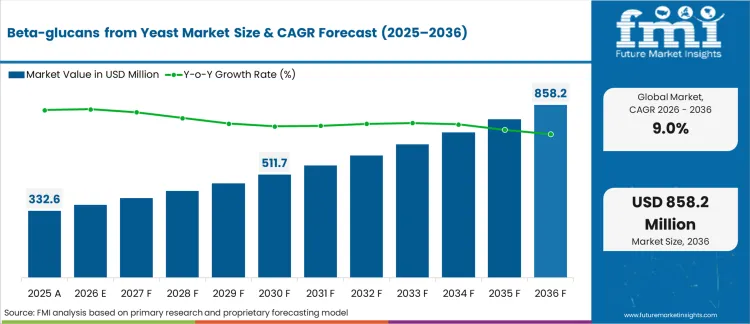
Beta-glucans from Yeast Market Key Takeaways
| Metric | Details |
| Industry Size (2026) | USD 362.5 million |
| Industry Value (2036) | USD 845.0 million |
| CAGR (2026-2036) | 9.0% |
"The expansion through our biotechnology facility marks a new era for Layn Natural Ingredients, allowing us to push the boundaries of precision fermentation and enzyme production," said James Roza, chief scientific officer at Layn Natural Ingredients.1 "With Galacan, we are redefining beta glucan innovation, offering enhanced bioavailability and functional benefits for supplements, foods and beverages, as well as excellent applications in beauty, personal care and animal nutrition." [11]
Geographic expansion aligns with escalating immunomodulatory ingredient requirements across human and animal nutrition. Global aquaculture production reached 130.9 million tonnes recently, elevating veterinary additive consumption. [5] Across India, China, United States, United Kingdom, Brazil, and Germany, adoption accelerates where local safety audits align with capacity. FMI analysts opine that procurement clusters around framework agreements, favoring beta glucans alternatives and incumbent manufacturers.
Beta-glucans from Yeast Market Definition
Beta-glucans from Yeast sector comprises production and commercialization of complex polysaccharides extracted primarily from Saccharomyces cerevisiae cell walls. Operations involve fermentation, extraction, and purification processes yielding bioactive yeast compounds. Buyers integrate specialized extracts into nutritional supplements, functional foods, and animal feed for immunomodulatory purposes.
Beta-glucans from Yeast Market Inclusions
Coverage incorporates pure cell wall extracts, commercial formulations like MacroGard, and derived blends containing verified chemical profiles. Revenue tracking captures sales across dietary supplements, functional foods, pharmaceuticals, and specified united states yeast aquaculture applications. Analysis includes bulk powder and liquid dispersion formats.
Beta-glucans from Yeast Market Exclusions
Analysis omits compounds derived from cereals, mushrooms, or bacteria unless explicitly co-formulated with yeast-based primary active ingredients. Coverage excludes unprocessed brewer by-products lacking standardized immunomodulatory specifications. Downstream finished retail consumer goods are not quantified within chemical intermediate revenues.
Beta-glucans from Yeast Market Research Methodology
- Primary Research: Analysts conduct structured interviews with formulation directors, extraction facility managers, and regulatory compliance officers.
- Desk Research: Investigators pull official GRAS notifications, FAO aquaculture production statistics, and regional health ministry import logs.
- Market-Sizing and Forecasting: Models integrate local japan beta glucans consumption data with plant-level extraction capacity verification.
- Data Validation and Update Cycle: Senior consultants review anomalies against publicly traded ingredient manufacturer quarterly earnings reports before final publication.
Segmental Analysis
Beta-glucans from Yeast Market Analysis by Source
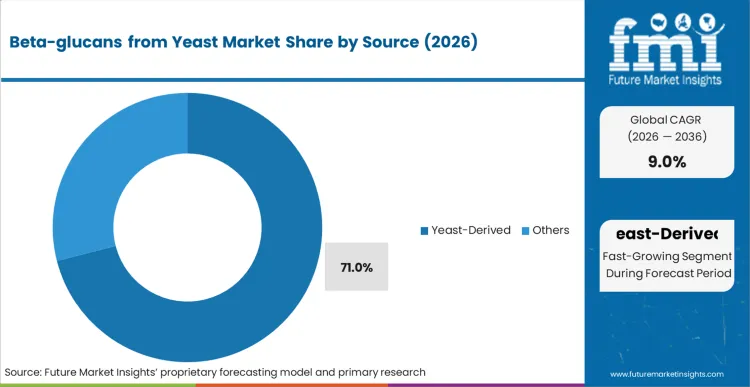
Yeast-derived beta-glucans account for 71% of total share in 2026. Manufacturers favor Saccharomyces cerevisiae extracts because of their high concentration of beta-1,3/1,6 linkages, which deliver well-documented immune-modulating benefits. Producers continue to invest in advanced precision fermentation to maintain batch-to-batch consistency and meet stringent pharmaceutical-grade standards. COSCIENS Biopharma expanded its PGX manufacturing platform with commercialization targeted for the second half of 2025 [15]. Using validated beta-glucan extracts helps brands clear compliance audits more efficiently, and procurement teams prioritize standardized actives to minimize variability in finished formulations.
- Regulatory signal: Health ministries demand reproducible chemical profiles. Regulators require strict documentation for novel ingredients to clear retail shelving barriers.
- Supply-side move: Manufacturers expand proprietary extraction capacity. Localized precision fermentation bypasses international shipping delays and stabilizes bulk pricing contracts.
- Buyer priority: Formulators require soluble formats for liquid integration. Advanced extraction yields non-particulate dispersions, allowing companies to launch beverage applications.
Beta-glucans from Yeast Market Analysis by Application
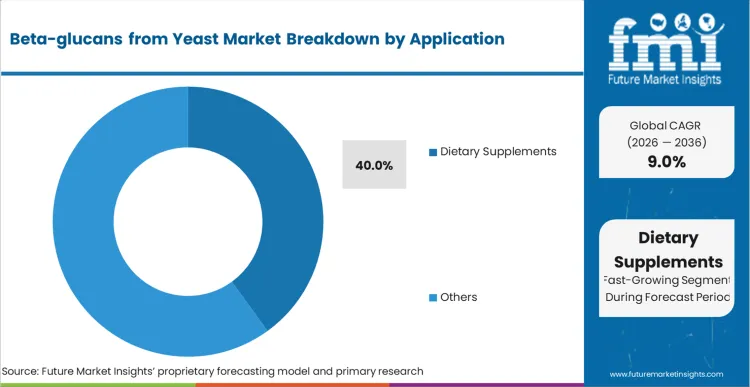
Formulators are responding to aging demographics and preventive health trends by incorporating concentrated polysaccharides into daily capsule formats. This sustained shift toward routine supplementation positions dietary supplements as a core demand center, accounting for 40% of total consumption in 2026. Ingredient suppliers support this expansion with documented clinical trials that validate structure-function claims on retail packaging. Recent figures show that 57.6% of U.S. adults use dietary supplements [1], reinforcing predictable volume turnover for upstream extractors. Developing specialized microbiome-focused fiber actives further strengthens exclusive vendor relationships and secures long-term supply agreements with leading brands.
- Procurement trigger: Preventive health routines mandate daily dosage formats. Capsule integration forces steady bulk volume purchases, guaranteeing recurring raw material orders. [2]
- Technology shift: Brands move toward multi-ingredient functional gummies. Extracts must withstand high-heat pectin manufacturing processes to win lucrative confectionary contracts.
- Clinical requirement: Retailers request specific immune-support documentation. Extractors fund localized human clinical trials to justify premium consumer price positioning.
Beta-glucans from Yeast Market Analysis by Distribution Channel
Consumers seeking therapeutic outcomes increasingly bypass mass grocery outlets and turn to specialty stores and pharmacies, where trained professionals provide product guidance. These retailers require rigorous quality assurance documentation and clinical substantiation before approving shelf placement for functional supplements. Shanghai alone registered 51,536 active special food business entities [6], underscoring the scale and regulatory oversight within this channel. Elevated compliance standards effectively filter out low-quality commodity ingredients, favoring suppliers with medical-grade positioning. As a result, specialty stores and pharmacies account for 36% of total distribution share in 2026.
- Retail mandate: Pharmacies require exhaustive product safety dossiers. Presenting clinical data accelerates listing approvals, warranting higher consumer pricing.
- Buyer behavior: Consumers prioritize pharmacist recommendations over brand marketing. End-users demand transparent ingredient origins, preferring trusted extracts boasting verified efficacy.
- Supply chain evolution: Distributors consolidate vendor networks. Wholesalers prefer extractors capable of supplying multiple regions simultaneously, reducing administrative overhead.
Beta-glucans from Yeast Market Drivers, Restraints, and Opportunities
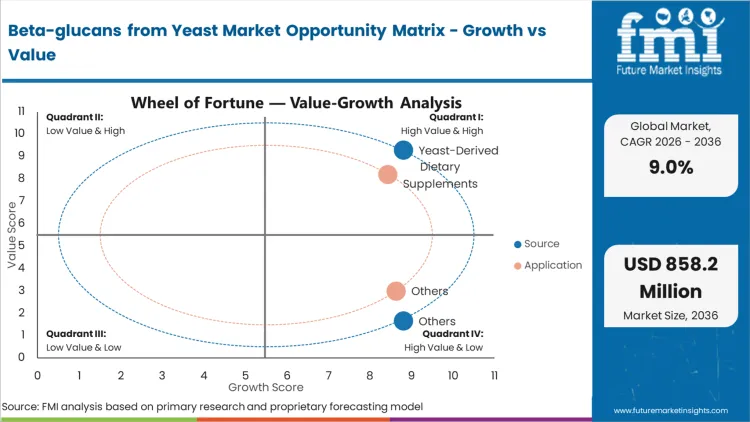
Preventive health adoption generates consistent bulk ingredient demand. Consumers shift away from reactive medical treatments toward daily immune-modulating routines, forcing consumer packaged goods companies to reformulate legacy product lines. Formulators require stable, documented inputs to satisfy label claims. Kerry demonstrated a cumulative dietary exposure estimate of 1.73 g/person/day for specific populations. [4] High daily intake rates create reliable baseline consumption for raw material suppliers. Extractors respond by building dedicated pharmaceutical-grade facilities to secure lucrative long-term refined functional carbohydrates supply contracts.
Strict regulatory compliance costs restrict mid-tier manufacturers from expanding cross-border operations. Diverging international safety standards force ingredient suppliers to fund separate clinical dossiers for individual regions. Navigating distinct regulations delays commercialization timelines. United Kingdom authorities reported 95,000 overdue food standards inspections in 2024, creating administrative bottlenecks. [8] Companies mitigate delays by standardizing global safety protocols and acquiring pre-certified local extraction facilities. Smaller extractors face margin compression when attempting to fund mandated localized safety trials.
- Capacity tag: Extractors expanding specialized precision fermentation secure dominant supplier status. Localized infrastructure bypasses global shipping constraints.
- Formulation tag: Brands developing clear liquid beverage applications capture younger demographics. Beverage-grade extracts solve historical solubility limitations.
- Veterinary tag: Aquaculture producers adopting immuno-stimulant feed additives reduce mortality rates. High-yield farming environments demand specialized cell-wall extracts.
Regional Analysis
Based on the regional analysis, Beta-glucans from Yeast market is segmented into North America, Latin America, Europe, East Asia, South Asia, Oceania and Middle East & Africa across 40+ countries. The full report also offers market attractiveness analysis based on regional trends.
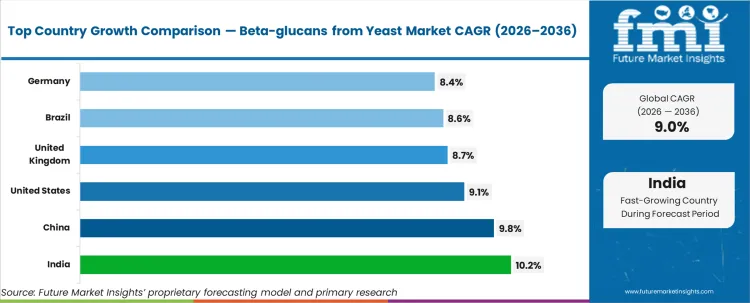
.webp "Top Country Growth Comparison Beta Glucans From Yeast Market Cagr (2026 2036)")
| Country | CAGR (2026 to 2036) |
|---|---|
| India | 10.2% |
| China | 9.8% |
| United States | 9.1% |
| United Kingdom | 8.7% |
| Brazil | 8.6% |
| Germany | 8.4% |
Source: Future Market Insights (FMI) analysis, based on proprietary forecasting model and primary research
Asia Pacific Beta-glucans from Yeast Market Analysis
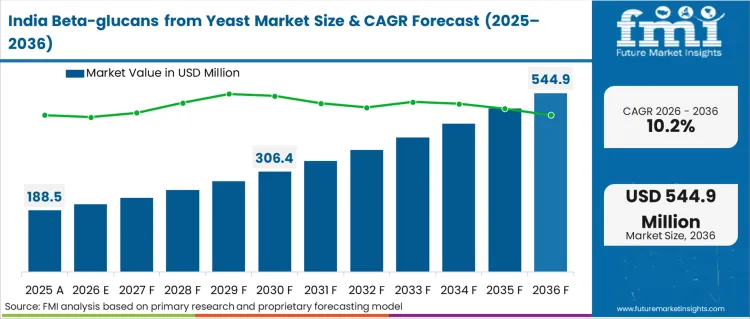
Regional demand expands rapidly as regulatory bodies formalize functional food licensing pathways. Health ministries implement strict approval frameworks, favoring established manufacturers possessing complete safety dossiers. As per FMI's projection, procurement shifts toward compliant local extractors to bypass complex import restrictions. High retailer density forces brands to differentiate utilizing premium, clinically backed ingredients. Localized manufacturing capability reduces raw material lead times for domestic supplement brands.
- India: Demand for dietary extracts in India is set to grow at 10.2% CAGR through 2036, stemming from pharmacy-led distribution channels. Angel Yeast promoted full ranges of yeast cell wall products at SPACE 2025, raising quality expectations for local procurement. [18]
- China: Tightened regulatory screening and structured licensing frameworks continue to reshape supplier participation across mainland channels. With 26,874 active health food sales licenses registered in Shanghai alone, compliant brands gain access to expansive, well-regulated retail networks while generic operators face increasing barriers to entry. [7] As a result, sales across mainland China are forecast to grow at a 9.8% CAGR between 2026 and 2036.
FMI's report includes detailed growth analysis and country-wise assessment across Asia Pacific. Japan and South Korea present lucrative expansion zones due to surging functional food requirements. Suppliers must monitor localized veterinary feed regulations to capture high-volume animal nutrition contracts. Analyzing regional adoption reveals shifting brand priorities.
North America Beta-glucans from Yeast Market Analysis
Market shifts from generic immune support toward regulatory-grade substantiation and formulation convenience. Brands request specialized variants suitable for gummies and ready-to-drink beverages. Ceapro and Aeterna Zentaris approved a merger in March 2024 to re-prioritize commercialization pathways. [16] Clear regulatory guidelines reduce adoption friction for beverage formulators. Extractor companies fund clinical trials to maintain premium pricing structures.
- United States: United States is expected to record 9.1% CAGR in ingredient demand over 2026 to 2036, anchoring in clear intake guidelines. Regulatory updates clarify intended uses and specifications, supporting broader dietary fiber adoption among mass-market formulators.
FMI's report includes detailed growth analysis and country-wise assessment across North America. Canada and Mexico present strong expansion potential due to rising functional beverage consumption. Suppliers must monitor localized approval timelines to capture emerging retail shelf space.
Europe Beta-glucans from Yeast Market Analysis
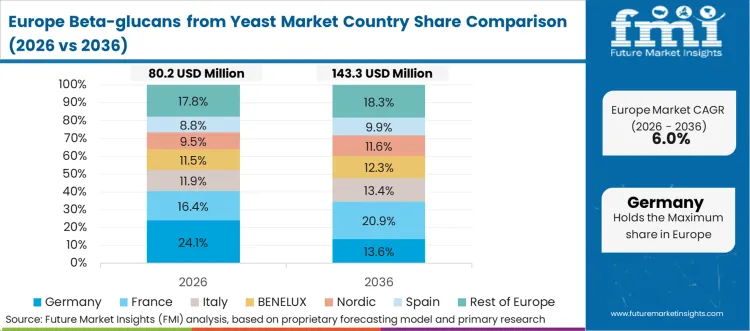
High trust environments reward standardized, reproducible actives and robust documentation for claims and safety. Retailers prefer ingredients possessing strong quality assurance and traceability records. Yeastup secured CHF 8.9 million funding to scale upcycled brewer extract production. [13] Expanding local capacity satisfies strict European traceability mandates and reduces brand liability risks.
- United Kingdom: Strict enforcement across high-risk food businesses continues to influence ingredient sourcing decisions, particularly as authorities flagged 871 high-risk establishments within the overdue inspection backlog. [9] This heightened scrutiny pushes manufacturers to prioritize fully audited, premium extract suppliers to safeguard compliance and brand credibility. Consequently, British formulation revenues are projected to expand at an 8.7% CAGR between 2026 and 2036.
- Germany: Germany's ingredient landscape is forecast to expand at 8.4% CAGR through 2036, as retailers demand proof dossiers. Yeastup celebrated the launch of its industrial-scale production, ensuring consistent batch quality for local tenders. [14]
FMI's report includes detailed growth analysis and country-wise assessment across Europe. France and Italy present lucrative expansion zones due to surging dermocosmetic ingredient requirements. Suppliers must monitor localized regulations to capture high-volume topical formulation contracts.
Latin America Beta-glucans from Yeast Market Analysis
Market growth coexists with heightened enforcement and complaint volumes, elevating regulatory trust into a competitive advantage. Local brands require Anvisa-aligned quality and transparent labeling protocols. Consolidating regional infrastructure guarantees batch consistency for local supplement manufacturers.
- Brazil: Brazil is forecast to register 8.6% CAGR in extract sales through 2036 as consumer scrutiny raises addressable pipelines for vendors. Anvisa reported 8,386 user manifestations, highlighting the need for transparent sourcing to avoid formulation penalties. [10]
FMI's report includes detailed growth analysis and country-wise assessment across Latin America. Mexico and Chile present strong expansion potential due to rising functional food consumption. Suppliers must monitor localized import regulations to capture emerging retail shelf space. Analyzing regional adoption reveals shifting brand priorities.
Competitive Aligners for Market Players
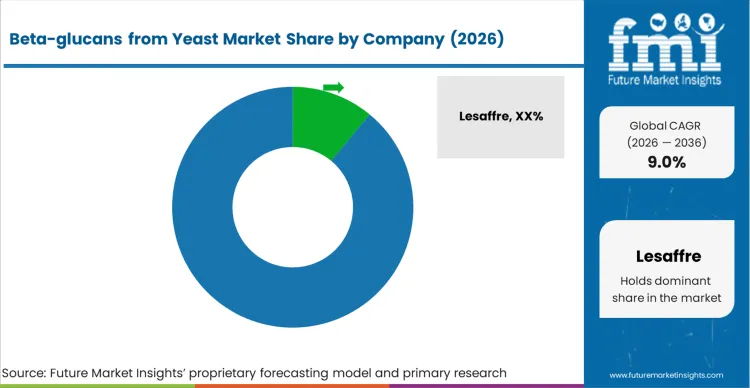
Extractor companies prioritize vertical integration to bypass volatile international shipping networks. Expanding localized precision fermentation facilities allows suppliers to guarantee batch consistency and stabilize bulk pricing. Building regional capacity secures lucrative long-term contracts with regional pharmaceutical brands and animal nutrition conglomerates.
Regulatory compliance capabilities separate premium vendors from commodity suppliers. Extractors funding proprietary clinical trials and securing GRAS notifications command higher profit margins. Presenting updated safety dossiers accelerates retail formulation adoption and justifies elevated wholesale pricing models.
Consolidation reshapes vendor networks as major conglomerates acquire specialized regional players. Acquiring established brands provides instant access to lucrative animal nutrition and dietary supplement channels. Mergers reduce administrative overhead and expand global distribution footprints rapidly.
Recent Developments
The report includes full coverage of key trends from competitive benchmarking. Some of the recent developments covered in the reports:
- In February 2026, Angel Yeast opened high-altitude probiotic and yeast infrastructure to expand specialized ingredient supply networks. [17]
- In February 2025, Layn Natural Ingredients expanded its biotechnology facility and launched Galacan next-generation formats. [12]
Key Players in Beta-glucans from Yeast Market
- Lesaffre
- Kerry Group
- Angel Yeast
- Lallemand
- Biorigin
- Layn Natural Ingredients
- Yeastup
- COSCIENS Biopharma
- Associated British Foods
- DSM
Scope of the Report
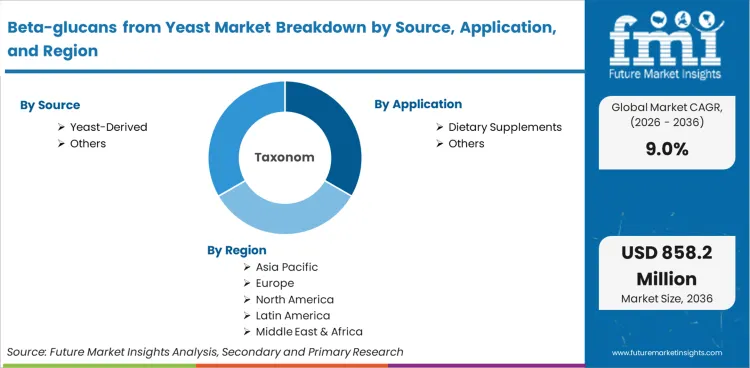
| Metric | Value |
|---|---|
| Quantitative Units | USD 362.5 million (2026) to USD 845.0 million (2036), at a CAGR of 9.0% |
| Market Definition | Sector comprises production and commercialization of complex polysaccharides extracted primarily from Saccharomyces cerevisiae cell walls for immunomodulatory purposes. |
| Source Segmentation | Yeast-derived beta-glucans, Others |
| Application Segmentation | Dietary Supplements, Others |
| Distribution Channel Segmentation | Specialty Stores & Pharmacies, Others |
| End-User Segmentation | Adults, Others |
| Regions Covered | North America, Latin America, Europe, East Asia, South Asia, Oceania, Middle East & Africa |
| Countries Covered | United States, United Kingdom, Germany, Brazil, India, China, and 40 plus countries |
| Key Companies Profiled | Lesaffre, Kerry Group, Angel Yeast, Lallemand, Biorigin, Layn Natural Ingredients, Yeastup, COSCIENS Biopharma, Associated British Foods, DSM |
| Forecast Period | 2026 to 2036 |
| Approach | Hybrid top down and bottom up market modeling validated through primary interviews with extractor producers, supported by trade data benchmarking and plant level capacity verification |
Beta-glucans from Yeast Market Analysis by Segments
Source:
- Yeast-derived beta-glucans
- Others
Application:
- Dietary Supplements
- Others
Distribution Channel:
- Specialty Stores & Pharmacies
- Others
End-User:
- Adults
- Others
Region:
- Asia Pacific
- India
- China
- Japan
- South Korea
- Indonesia
- Australia & New Zealand
- ASEAN
- Rest of Asia Pacific
- Europe
- Germany
- Italy
- France
- United Kingdom
- Spain
- Benelux
- Nordics
- Central & Eastern Europe
- Rest of Europe
- North America
- United States
- Canada
- Mexico
- Latin America
- Brazil
- Argentina
- Chile
- Rest of Latin America
- Middle East & Africa
- Kingdom of Saudi Arabia
- United Arab Emirates
- South Africa
- Turkey
- Rest of Middle East & Africa
Bibliography
- [1] CDC. Data Brief 399: U.S. adults using dietary supplements in past 30 days. Centers for Disease Control and Prevention.
- [2] CDC. Data Brief 399: Women using dietary supplements. Centers for Disease Control and Prevention.
- [3] U.S. Food and Drug Administration. GRAS Notice for baker's yeast beta-glucan (200 mg/serving).
- [4] U.S. Food and Drug Administration. GRAS Notice: Kerry cumulative dietary exposure estimate.
- [5] FAO. SOFIA 2024 Report: Global aquaculture production.
- [6] International Services Shanghai. Registered special food business entities by end-2024.
- [7] International Services Shanghai. Entities holding special food sales licenses.
- [8] Food Standards Agency. UK Our Food 2024: Backlog of overdue inspections.
- [9] Food Standards Agency. UK Our Food 2024: High-risk businesses in backlog.
- [10] Serviços e Informações do Brasil. Anvisa Ombudsman recorded user manifestations in 2024.
- [11] Layn Natural Ingredients. (2025, February 28). Nutritional Outlook [PDF].
- [12] Layn Corp. Layn Natural Ingredients expands facility and launches Galacan.
- [13] FoodBev Media. Yeastup secures CHF 8.9m funding.
- [14] Protein Report. Yeastup celebrates launch of industrial-scale production.
- [15] Nasdaq. COSCIENS Biopharma YBG powder scale-up.
- [16] BioSpace. Ceapro and Aeterna Zentaris merger approval.
- [17] Angel Yeast. High-altitude probiotic production facility opens.
- [18] Angel Yeast. Animal nutrition showcase at SPACE 2025.
This bibliography is provided for reader reference and is not exhaustive. The full report contains the complete reference list and detailed citations.
This Report Addresses
- Market intelligence to enable structured strategic decision making across mature and emerging nutritional ingredient economies
- Market size estimation and 10 year revenue forecasts from 2026 to 2036, supported by validated capacity and trade benchmarks
- Growth opportunity mapping across powder and liquid dispersion formats with emphasis on pharmaceutical-grade transitions
- Segment and regional revenue forecasts covering dietary supplements, functional foods, and veterinary applications
- Competition strategy assessment including vertical integration models, extraction survivability positioning, and compliance capability benchmarking
- Product reformulation and safety compliance tracking aligned to EFSA and FDA standards
- Regulatory impact analysis covering GRAS mandates, clinical documentation thresholds, and export-driven specification upgrades
- Market report delivery in PDF, Excel, PPT, and interactive dashboard formats for executive and operational use
Frequently Asked Questions
How large is the demand for Beta-glucans from Yeast in the global market in 2026?
Demand for Beta-glucans from Yeast in the global market is estimated to be valued at USD 362.5 million in 2026.
What will be the market size of Beta-glucans from Yeast in the global market by 2036?
Market size for Beta-glucans from Yeast is projected to reach USD 845.0 million by 2036.
What is the expected demand growth for Beta-glucans from Yeast in the global market between 2026 and 2036?
Demand for Beta-glucans from Yeast in the global market is expected to grow at a CAGR of 9.0% between 2026 and 2036.
Which Source is poised to lead global sales by 2026?
Yeast-derived beta-glucans is expected to be the dominant form, capturing 71% of global market share in 2026 due to clinical substantiation.
How significant is the role of Dietary Supplements in driving Beta-glucans from Yeast adoption in 2026?
Dietary Supplements represent a critical segment, projected to hold 40% share of total volume in 2026 as preventive health activity prioritizes cost-effective materials.
What is driving demand in India?
Pharmacy-led distribution channels and professional medical recommendations are driving growth.
What compliance standards or regulations are referenced for United States?
FDA GRAS emission regulations are referenced as key compliance benchmarks.
What is the United States growth outlook in this report?
United States is projected to grow at a CAGR of 9.1% during 2026 to 2036.
Why is Europe described as a priority region in this report?
Growth is constrained by elevated compliance costs and increasing penetration of audited extraction alternatives in premium applications.
What type of demand dominates in Europe?
Replacement driven demand for premium grade, high consistency extracts dominates regional consumption.
What is China growth outlook in this report?
China is projected to expand at a CAGR of 9.8% during 2026 to 2036.
Does the report cover United Kingdom in its regional analysis?
United Kingdom is included within Europe under the regional scope of analysis.
What are the sources referred to for analyzing United Kingdom?
Official statistics published by Food Standards Agency covering facility output, capacity utilization, and export trade flows are cited as primary reference sources.
What is the main demand theme linked to United Kingdom in its region coverage?
Europe demand is associated with export oriented product upgrading to satisfy stringent Western ingredient quality regulations.
Does the report cover Brazil in its regional analysis?
Brazil is included within Latin America under the regional coverage framework.
What is the main Brazil related demand theme in its region coverage?
Export driven product upgrading to meet North American and European safety standards is emphasized.
Which product formats or configurations are strategically important for Asia Pacific supply chains?
Powder formats and soluble extracts are prioritized due to lower storage risk and reduced logistics constraints across export channels.
What is Beta-glucans from Yeast and what is it mainly used for?
Beta-glucans from Yeast is a complex polysaccharide primarily used as an immunomodulatory ingredient in supplements, functional foods, and cosmetics manufacturing.
What does Beta-glucans from Yeast mean in this report?
Beta-glucans from Yeast refers to global production, trade, and industrial consumption of cell wall extracts in liquid, powder, and modified forms.
What is included in the scope of this Beta-glucans from Yeast report?
Scope covers extracts by form, key applications such as supplements and cosmetics, and end use industries including animal feed and nutrition.
What is excluded from the scope of this report?
Cereal and mushroom extracts, finished goods, and non industrial uses are excluded unless part of yeast hybrid blends.
What does market forecast mean on this page?
Market forecast represents a model based projection built on defined assumptions for strategic planning purposes.
How does FMI build and validate the Beta-glucans from Yeast forecast?
Forecast is developed using hybrid top down and bottom up modeling validated through trade data, capacity checks, and industry review.
What does zero reliance on speculative third party market research mean here?
Primary interviews and verifiable public datasets are used instead of unverified syndicated market estimates.
Preview the report firsthand - request a free sample
Get SampleGet the brochure for pricing and purchase details.
Get PDFTable of Content
- Executive Summary
- Global Market Outlook
- Demand-side Trends
- Supply-side Trends
- Technology Roadmap Analysis
- Analysis and Recommendations
- Market Overview
- Market Coverage / Taxonomy
- Market Definition / Scope / Limitations
- Research Methodology
- Chapter Orientation
- Analytical Lens and Working Hypotheses
- Market Structure, Signals, and Trend Drivers
- Benchmarking and Cross-market Comparability
- Market Sizing, Forecasting, and Opportunity Mapping
- Research Design and Evidence Framework
- Desk Research Programme (Secondary Evidence)
- Company Annual and Sustainability Reports
- Peer-reviewed Journals and Academic Literature
- Corporate Websites, Product Literature, and Technical Notes
- Earnings Decks and Investor Briefings
- Statutory Filings and Regulatory Disclosures
- Technical White Papers and Standards Notes
- Trade Journals, Industry Magazines, and Analyst Briefs
- Conference Proceedings, Webinars, and Seminar Materials
- Government Statistics Portals and Public Data Releases
- Press Releases and Reputable Media Coverage
- Specialist Newsletters and Curated Briefings
- Sector Databases and Reference Repositories
- FMI Internal Proprietary Databases and Historical Market Datasets
- Subscription Datasets and Paid Sources
- Social Channels, Communities, and Digital Listening Inputs
- Additional Desk Sources
- Expert Input and Fieldwork (Primary Evidence)
- Primary Modes
- Qualitative Interviews and Expert Elicitation
- Quantitative Surveys and Structured Data Capture
- Blended Approach
- Why Primary Evidence is Used
- Field Techniques
- Interviews
- Surveys
- Focus Groups
- Observational and In-context Research
- Social and Community Interactions
- Stakeholder Universe Engaged
- C-suite Leaders
- Board Members
- Presidents and Vice Presidents
- R&D and Innovation Heads
- Technical Specialists
- Domain Subject-matter Experts
- Scientists
- Physicians and Other Healthcare Professionals
- Governance, Ethics, and Data Stewardship
- Research Ethics
- Data Integrity and Handling
- Primary Modes
- Tooling, Models, and Reference Databases
- Desk Research Programme (Secondary Evidence)
- Data Engineering and Model Build
- Data Acquisition and Ingestion
- Cleaning, Normalisation, and Verification
- Synthesis, Triangulation, and Analysis
- Quality Assurance and Audit Trail
- Market Background
- Market Dynamics
- Drivers
- Restraints
- Opportunity
- Trends
- Scenario Forecast
- Demand in Optimistic Scenario
- Demand in Likely Scenario
- Demand in Conservative Scenario
- Opportunity Map Analysis
- Product Life Cycle Analysis
- Supply Chain Analysis
- Investment Feasibility Matrix
- Value Chain Analysis
- PESTLE and Porter’s Analysis
- Regulatory Landscape
- Regional Parent Market Outlook
- Production and Consumption Statistics
- Import and Export Statistics
- Market Dynamics
- Global Market Analysis 2021 to 2025 and Forecast, 2026 to 2036
- Historical Market Size Value (USD Million) Analysis, 2021 to 2025
- Current and Future Market Size Value (USD Million) Projections, 2026 to 2036
- Y-o-Y Growth Trend Analysis
- Absolute $ Opportunity Analysis
- Global Market Pricing Analysis 2021 to 2025 and Forecast 2026 to 2036
- Global Market Analysis 2021 to 2025 and Forecast 2026 to 2036, By Source
- Introduction / Key Findings
- Historical Market Size Value (USD Million) Analysis By Source , 2021 to 2025
- Current and Future Market Size Value (USD Million) Analysis and Forecast By Source , 2026 to 2036
- Yeast-Derived
- Others
- Yeast-Derived
- Y-o-Y Growth Trend Analysis By Source , 2021 to 2025
- Absolute $ Opportunity Analysis By Source , 2026 to 2036
- Global Market Analysis 2021 to 2025 and Forecast 2026 to 2036, By Application
- Introduction / Key Findings
- Historical Market Size Value (USD Million) Analysis By Application, 2021 to 2025
- Current and Future Market Size Value (USD Million) Analysis and Forecast By Application, 2026 to 2036
- Dietary Supplements
- Others
- Dietary Supplements
- Y-o-Y Growth Trend Analysis By Application, 2021 to 2025
- Absolute $ Opportunity Analysis By Application, 2026 to 2036
- Global Market Analysis 2021 to 2025 and Forecast 2026 to 2036, By End-User
- Introduction / Key Findings
- Historical Market Size Value (USD Million) Analysis By End-User, 2021 to 2025
- Current and Future Market Size Value (USD Million) Analysis and Forecast By End-User, 2026 to 2036
- Adults
- Others
- Adults
- Y-o-Y Growth Trend Analysis By End-User, 2021 to 2025
- Absolute $ Opportunity Analysis By End-User, 2026 to 2036
- Global Market Analysis 2021 to 2025 and Forecast 2026 to 2036, By Region
- Introduction
- Historical Market Size Value (USD Million) Analysis By Region, 2021 to 2025
- Current Market Size Value (USD Million) Analysis and Forecast By Region, 2026 to 2036
- North America
- Latin America
- Western Europe
- Eastern Europe
- East Asia
- South Asia and Pacific
- Middle East & Africa
- Market Attractiveness Analysis By Region
- North America Market Analysis 2021 to 2025 and Forecast 2026 to 2036, By Country
- Historical Market Size Value (USD Million) Trend Analysis By Market Taxonomy, 2021 to 2025
- Market Size Value (USD Million) Forecast By Market Taxonomy, 2026 to 2036
- By Country
- USA
- Canada
- Mexico
- By Source
- By Application
- By End-User
- By Country
- Market Attractiveness Analysis
- By Country
- By Source
- By Application
- By End-User
- Key Takeaways
- Latin America Market Analysis 2021 to 2025 and Forecast 2026 to 2036, By Country
- Historical Market Size Value (USD Million) Trend Analysis By Market Taxonomy, 2021 to 2025
- Market Size Value (USD Million) Forecast By Market Taxonomy, 2026 to 2036
- By Country
- Brazil
- Chile
- Rest of Latin America
- By Source
- By Application
- By End-User
- By Country
- Market Attractiveness Analysis
- By Country
- By Source
- By Application
- By End-User
- Key Takeaways
- Western Europe Market Analysis 2021 to 2025 and Forecast 2026 to 2036, By Country
- Historical Market Size Value (USD Million) Trend Analysis By Market Taxonomy, 2021 to 2025
- Market Size Value (USD Million) Forecast By Market Taxonomy, 2026 to 2036
- By Country
- Germany
- UK
- Italy
- Spain
- France
- Nordic
- BENELUX
- Rest of Western Europe
- By Source
- By Application
- By End-User
- By Country
- Market Attractiveness Analysis
- By Country
- By Source
- By Application
- By End-User
- Key Takeaways
- Eastern Europe Market Analysis 2021 to 2025 and Forecast 2026 to 2036, By Country
- Historical Market Size Value (USD Million) Trend Analysis By Market Taxonomy, 2021 to 2025
- Market Size Value (USD Million) Forecast By Market Taxonomy, 2026 to 2036
- By Country
- Russia
- Poland
- Hungary
- Balkan & Baltic
- Rest of Eastern Europe
- By Source
- By Application
- By End-User
- By Country
- Market Attractiveness Analysis
- By Country
- By Source
- By Application
- By End-User
- Key Takeaways
- East Asia Market Analysis 2021 to 2025 and Forecast 2026 to 2036, By Country
- Historical Market Size Value (USD Million) Trend Analysis By Market Taxonomy, 2021 to 2025
- Market Size Value (USD Million) Forecast By Market Taxonomy, 2026 to 2036
- By Country
- China
- Japan
- South Korea
- By Source
- By Application
- By End-User
- By Country
- Market Attractiveness Analysis
- By Country
- By Source
- By Application
- By End-User
- Key Takeaways
- South Asia and Pacific Market Analysis 2021 to 2025 and Forecast 2026 to 2036, By Country
- Historical Market Size Value (USD Million) Trend Analysis By Market Taxonomy, 2021 to 2025
- Market Size Value (USD Million) Forecast By Market Taxonomy, 2026 to 2036
- By Country
- India
- ASEAN
- Australia & New Zealand
- Rest of South Asia and Pacific
- By Source
- By Application
- By End-User
- By Country
- Market Attractiveness Analysis
- By Country
- By Source
- By Application
- By End-User
- Key Takeaways
- Middle East & Africa Market Analysis 2021 to 2025 and Forecast 2026 to 2036, By Country
- Historical Market Size Value (USD Million) Trend Analysis By Market Taxonomy, 2021 to 2025
- Market Size Value (USD Million) Forecast By Market Taxonomy, 2026 to 2036
- By Country
- Kingdom of Saudi Arabia
- Other GCC Countries
- Turkiye
- South Africa
- Other African Union
- Rest of Middle East & Africa
- By Source
- By Application
- By End-User
- By Country
- Market Attractiveness Analysis
- By Country
- By Source
- By Application
- By End-User
- Key Takeaways
- Key Countries Market Analysis
- USA
- Pricing Analysis
- Market Share Analysis, 2025
- By Source
- By Application
- By End-User
- Canada
- Pricing Analysis
- Market Share Analysis, 2025
- By Source
- By Application
- By End-User
- Mexico
- Pricing Analysis
- Market Share Analysis, 2025
- By Source
- By Application
- By End-User
- Brazil
- Pricing Analysis
- Market Share Analysis, 2025
- By Source
- By Application
- By End-User
- Chile
- Pricing Analysis
- Market Share Analysis, 2025
- By Source
- By Application
- By End-User
- Germany
- Pricing Analysis
- Market Share Analysis, 2025
- By Source
- By Application
- By End-User
- UK
- Pricing Analysis
- Market Share Analysis, 2025
- By Source
- By Application
- By End-User
- Italy
- Pricing Analysis
- Market Share Analysis, 2025
- By Source
- By Application
- By End-User
- Spain
- Pricing Analysis
- Market Share Analysis, 2025
- By Source
- By Application
- By End-User
- France
- Pricing Analysis
- Market Share Analysis, 2025
- By Source
- By Application
- By End-User
- India
- Pricing Analysis
- Market Share Analysis, 2025
- By Source
- By Application
- By End-User
- ASEAN
- Pricing Analysis
- Market Share Analysis, 2025
- By Source
- By Application
- By End-User
- Australia & New Zealand
- Pricing Analysis
- Market Share Analysis, 2025
- By Source
- By Application
- By End-User
- China
- Pricing Analysis
- Market Share Analysis, 2025
- By Source
- By Application
- By End-User
- Japan
- Pricing Analysis
- Market Share Analysis, 2025
- By Source
- By Application
- By End-User
- South Korea
- Pricing Analysis
- Market Share Analysis, 2025
- By Source
- By Application
- By End-User
- Russia
- Pricing Analysis
- Market Share Analysis, 2025
- By Source
- By Application
- By End-User
- Poland
- Pricing Analysis
- Market Share Analysis, 2025
- By Source
- By Application
- By End-User
- Hungary
- Pricing Analysis
- Market Share Analysis, 2025
- By Source
- By Application
- By End-User
- Kingdom of Saudi Arabia
- Pricing Analysis
- Market Share Analysis, 2025
- By Source
- By Application
- By End-User
- Turkiye
- Pricing Analysis
- Market Share Analysis, 2025
- By Source
- By Application
- By End-User
- South Africa
- Pricing Analysis
- Market Share Analysis, 2025
- By Source
- By Application
- By End-User
- USA
- Market Structure Analysis
- Competition Dashboard
- Competition Benchmarking
- Market Share Analysis of Top Players
- By Regional
- By Source
- By Application
- By End-User
- Competition Analysis
- Competition Deep Dive
- Lesaffre
- Overview
- Product Portfolio
- Profitability by Market Segments (Product/Age /Sales Channel/Region)
- Sales Footprint
- Strategy Overview
- Marketing Strategy
- Product Strategy
- Channel Strategy
- Kerry Group
- Angel Yeast
- Lallemand
- Biorigin
- Layn Natural Ingredients
- Yeastup
- Lesaffre
- Competition Deep Dive
- Assumptions & Acronyms Used


