

- Market Size (2026)
- USD 3.7 Bn
- Forecast (2036)
- USD 6.3 Bn
- CAGR (2026 to 2036)
- 5.4%
How big is Dietary Supplement Excipients & Delivery Systems Market in 2026?
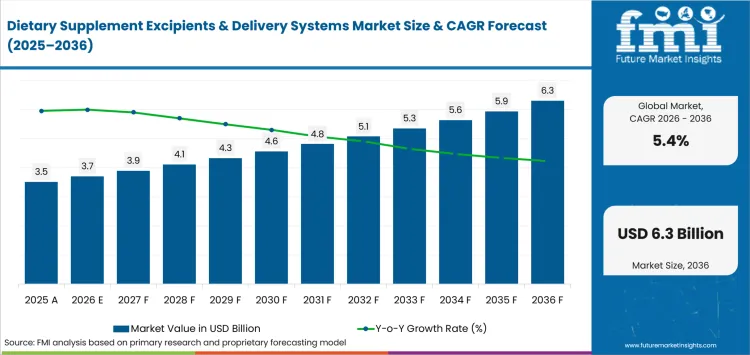
USD 3.7 billion in 2026 and USD 6.3 billion by 2036 at a 5.4% CAGR.
Sales in dietary supplement excipients & delivery systems market is predicted to increase valuation from USD 3.7 billion in 2026 to USD 6.3 billion by 2036. The expansion represents a 5.4% CAGR over the forecast period and reflects dietary supplement demand for dosage systems that protect sensitive ingredients during manufacturing and storage. Tablet and capsule manufacturers need nutraceutical excipients that preserve powder flow and finished-product strength across commercial equipment. Roquette launched a coatings platform in February 2025 for prescription products and nutraceuticals with immediate-release and enteric options. Ready-to-use coatings can reduce process time but manufacturers must confirm compatibility and release performance for each formulation.
United States manufacturers can use contract formulators and testing laboratories to transfer products from pilot batches into commercial production. Lonza Capsugel launched Organicaps capsules for North American nutraceutical brands at SupplySide Global in October 2025. The plant-based pullulan shell carries USDA organic certification and provides a high oxygen barrier for sensitive ingredients. Japanese brands face more detailed filing requirements for functional claims and must align manufacturing records with the declared dosage form. Specialized empty capsule supply can improve product positioning but each formula requires stability work under its intended storage conditions. Regional plans should match shell selection with testing access and regulatory support before launch schedules are fixed.
Key Takeaways of Dietary Supplement Excipients & Delivery Systems Market
- Demand for dietary supplement excipients and delivery systems expands as manufacturers require repeatable processing and active protection across several finished dosage formats.
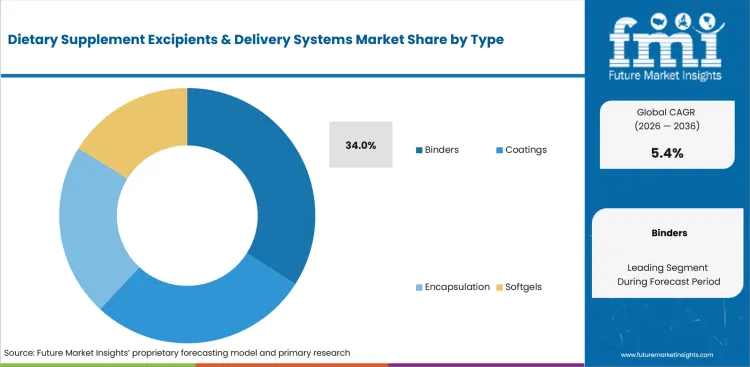
- By type, binders are expected to account for 34.0% share in 2026 due to their direct influence on tablet strength and granule consistency.
- Microencapsulation is projected to capture 66.6% of technology revenue in 2026 owing to its protection and release-control functions for sensitive active ingredients.
- Food and beverages are estimated to represent 31.5% in 2026 as formulations require stable dispersion and acceptable sensory performance.
- Matrix-specific compatibility and stability testing remains the principal restraint for active and excipient combinations that require separate commercial qualification.
- Roquette and BASF support several oral dosage formats through broad excipient portfolios and international technical teams. Colorcon and Lonza (Capsugel) add coating and capsule systems through regional formulation support from IMCD and delivery specialists.
Analyst Perspective
"The decisive commercial issue is whether a delivery system protects sensitive actives through blending and storage without creating a new release failure. Binders and encapsulation technologies must preserve flow and potency after transfer from pilot equipment to commercial lines. Excipient and delivery-system providers that pair regional inventory with formulation support and change-control records are more likely to secure repeat programs for complex tablets and capsules as well as functional beverages."
- Nandini Roy Choudhury, Principal Analyst, Future Market Insights
How is the Dietary Supplement Excipients & Delivery Systems Market segmented?
The market is segmented by type, technology, application, and region.
The market is segmented by type, technology, application, and region to reflect distinct formulation and operating requirements. Type includes binders, coatings, encapsulation materials, and softgel formats based on their role in powder flow, compaction, film formation, and dosage construction. Technology compares microencapsulation and liposomal delivery through active protection, release control, dispersion performance, and compatibility with finished dosage formats. Application covers food and beverages, nutraceuticals, personal care, and industrial uses according to processing conditions and finished-product requirements. Regional analysis reflects regulatory pathways, local formulation support, manufacturing capacity, and access to qualified pharmaceutical excipients.
What makes binders central to the type category?
Tablet production needs binders that create enough mechanical strength without delaying disintegration or active release. The same formulations often use food coating ingredients to reduce moisture exposure or mask an unpleasant taste. Colorcon announced an exclusive partnership with ASHA Cellulose in May 2025 for ethylcellulose polymers used as binders and film formers. The agreement expanded regional access to materials for binding and sustained release across pharmaceutical and dietary supplement applications.
- Binders are set to lead the type category with 34.0% share in 2026 due to their direct role in tablet strength and granule consistency. Formulators assess compression and disintegration together so stronger tablets do not delay the intended release profile. Their position also reflects widespread use across direct compression and wet granulation processes for commercial supplement tablets.
- Contract manufacturers prefer binder systems that tolerate several active blends without repeated changes to granulation and compression settings. Adoption depends on technical support that resolves moisture sensitivity and ingredient interactions during commercial scale-up programs. A wider processing window reduces validation work across product families and preserves separate specifications for each finished formula.
Why does microencapsulation lead the technology category?
Microencapsulation technologies protect sensitive actives from oxygen and heat and reduce flavors that weaken consumer acceptance. SEPPIC explained in January 2025 that dietary supplement microcapsules can protect actives from temperature and pH exposure and control release over time. The technical guidance identifies a direct formulation role but does not establish commercial adoption across every active ingredient. Supplement manufacturers must compare payload retention and release performance under actual processing conditions instead of relying on initial laboratory results.
- By technology, microencapsulation is estimated to hold 66.6% share in 2026 owing to its ability to protect sensitive ingredients and control release. The segment serves powders and beverages as well as tablets that require flavor masking or delayed exposure. Manufacturers also compare encapsulation efficiency across repeated commercial batches and scheduled storage conditions during product qualification.
- Food and supplement manufacturers adopt microencapsulation to reduce flavor impact and preserve active concentration throughout processing. Demand increases as documented stability results remain consistent across production lots and scheduled storage intervals. The technology gains wider use as one validated process supports several product formats without changing the intended release profile.
How do food and beverages shape the application category?
Food encapsulation requires delivery materials that disperse evenly without changing texture or adding an unwanted flavor. Manufacturers must match excipients with processing temperature and water activity across powders and functional beverages. Ashland appointed Tilley Distribution in October 2025 as its exclusive United States partner for cellulosic food and beverage ingredients. The agreement expanded domestic access to cellulose gum and modified cellulose grades used for binding and viscosity control.
- Food and beverages are likely to capture 31.5% share in 2026 attributable to repeated use across functional powders and drinks. Excipients must support suspension and taste control without reducing the active level delivered in each serving. The segment also benefits from frequent reformulation across products with distinct texture and flavor requirements.
- Manufacturers use delivery systems to protect vitamins and lipids during mixing and packaging across shelf-stable beverages. Repeat purchasing depends on measurable improvements in dispersibility and oxidation control rather than broad absorption claims. Adoption strengthens as the same platform performs reliably across package sizes and serving concentrations without changing product texture.
What are the drivers, restraints, and opportunities in the Dietary Supplement Excipients & Delivery Systems Market?
Sensitive active ingredients support controlled processing; matrix-specific qualification delays launches; and integrated formulation support creates a practical route to faster commercial transfer.
- Driver: Sensitive active ingredients require excipients that preserve stability and reproduce release performance across commercial production batches.
- Restraint: Novel ingredient combinations require separate safety evidence and compatibility testing for each intended formula and processing route.
- Opportunity: Integrated formulation support can shorten the transfer from pilot development into validated production across several supplement dosage formats.
Sensitive enzymes and oxidation-prone ingredients create a clear growth driver for delivery systems that protect actives until the intended release point. Lonza Capsugel reported in May 2026 that a peer-reviewed DUOCAP study produced up to four times higher enzyme activity than standard immediate-release capsules. The result demonstrates how staged protection can preserve measurable enzyme activity under defined digestive conditions during controlled testing. Commercial demand strengthens as manufacturers confirm that the same performance remains stable through production and scheduled storage.
Novel ingredient combinations are a notable factor that limit market expansion through separate safety evidence and compatibility work for each intended use. FDA released educational materials in June 2025 to help companies prepare complete new dietary ingredient notifications and avoid preventable review delays. The guidance cannot replace product-specific evidence for ingredient identity or safety across each intended supplement use. Qualification timelines lengthen as material changes require new stability work or a revised regulatory assessment for the finished product.
Integrated formulation support creates an opportunity to connect excipient selection with pilot testing and commercial transfer under one technical program. Roquette launched KLEPTOSE Crysmeb in October 2025 to improve solubility and stability across oral formulations that include nutraceutical applications. The cyclodextrin supports liquid and solid dispersions through documented quality and traceability controls across production stages. Technical support reduces transfer risk by translating pilot results into production specifications and clarifying whether liposomal delivery or another specialized format better suits the active.
Which country CAGRs are profiled in the Dietary Supplement Excipients & Delivery Systems Market?
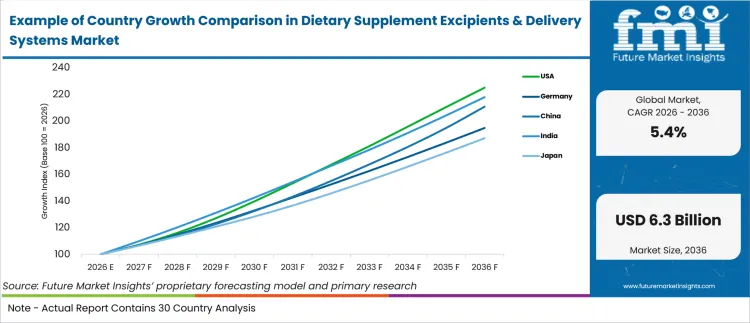
| Country | CAGR |
|---|---|
| USA | 7.3% |
| Germany | 6.9% |
| China | 7.7% |
| India | 8.1% |
| Japan | 6.5% |
How do country-level CAGRs compare in the Dietary Supplement Excipients & Delivery Systems Market?
The country comparison in the dietary supplement excipients & delivery systems market spans 1.6 percentage points and reflects a relatively concentrated growth outlook. India, China and the USA form a closely aligned upper group with only 0.8 percentage points separating the three markets. Germany and Japan create a lower pair and remain within 0.4 percentage points of each other. The difference between the upper and lower groups is gradual rather than pronounced, indicating broadly similar market momentum across the countries profiled.
- India shows a notable position within the comparison as expanding supplement consumption and increasing demand for convenient dosage formats support the use of advanced excipients and delivery systems.
- China remains closely aligned with India as manufacturers continue to develop differentiated supplement products that require specialized formulation and ingredient delivery technologies.
- The USA benefits from a well-established dietary supplement industry where innovation in gummies, chewables and bioavailability-enhancing systems supports market expansion.
- Germany reflects steady demand for high-quality nutraceutical formulations and continued adoption of excipients that improve product stability, efficacy and consumer acceptance.
- Japan maintains a meaningful position within the comparison as functional nutrition products and premium supplement formulations encourage the use of specialized delivery technologies.
Comparable CAGRs do not create identical market conditions across countries. Differences in consumer preferences, regulatory requirements, formulation practices and product delivery trends can influence the adoption of excipients and delivery systems. Similar growth forecasts may therefore reflect different commercialization strategies and product development priorities. The full report provides country-level CAGR analysis across North America, Latin America, Europe, East Asia, South Asia, Oceania and the Middle East and Africa.
Country-wise Analysis
- United States supplement manufacturers must define ingredient identity and finished-product specifications for each commercial formula under federal requirements. Adoption of dietary supplement excipients and delivery systems in the USA is estimated to expand at 7.3% CAGR through 2036, supported by extensive contract formulation and testing capacity. Contract laboratories provide a direct enabler for development and release testing across several dosage formats. FDA held a public meeting in March 2026 to examine emerging ingredient categories and new production methods for dietary supplements. Unresolved identity expectations create a material friction for delivery systems that change an ingredient's form or manufacturing route. Commercial programs should assign responsibility for stability evidence and regulator communication at the start of scale-up.
- Germany dietary supplement excipients and delivery systems sector is projected to record 6.9% CAGR during the assessment period, aided by mature quality systems and regional distribution. German supplement companies market products as foods and must maintain defensible ingredient levels under national and European requirements. The German Federal Institute for Risk Assessment clarified in July 2025 that supplements are legally foodstuffs and cannot carry illness-related claims. Established testing laboratories provide a direct enabler for premium formulations that require detailed release documentation. Borderline classification remains a material friction for capsules or powders presented through medicinal language during commercial promotion. Commercial planning should separate permitted food claims from therapeutic wording during formulation and packaging development.
- Chinese health-food products follow registration or filing routes that depend on ingredient status and the intended product composition. By 2036, China's dietary supplement excipients and delivery systems market is projected to grow at 7.7% CAGR due to active health-food filings and local formulation capacity. Regional application teams provide a direct enabler for foreign excipient companies that need local documentation and formulation support. SAMR recorded 405 submissions and 168 registrations or filings during December 2025 for specified health foods using new raw materials or first imports. Detailed dossiers remain a material friction for delivery systems without established regulatory assistance and local application teams. Commercial entry requires local partners that translate formulation specifications into registration records and dependable production controls.
- Indian nutraceutical manufacturers must align ingredients and additives with FSSAI categories for central licensing and commercial production. FSSAI's Food Product Identity Verification System organizes ingredient statements and non-specified food approval routes for health supplements and nutraceuticals. The digital route provides a direct enabler for companies that need documented composition during licensing decisions. India's dietary supplement excipients and delivery systems outlook is anticipated to advance at 8.1% CAGR over the assessment period, underpinned by digital classification tools and expanding formulation services. Changing schedules remain a material friction for delivery materials without an established classification or permitted use level. Successful programs require contaminant limits and stability evidence that match the licensed product and intended dosage form.
- Japanese functional supplement brands must file safety and function evidence under the Foods with Function Claims framework prior to sale. Dietary supplement excipient and delivery-system demand in Japan is forecast to rise at 6.5% CAGR over the forecast period, influenced by precise dosage formats and detailed filing requirements. The public filing route provides a direct enabler for brands that maintain traceable scientific and manufacturing records. The Consumer Affairs Agency revised its Foods with Function Claims information in October 2025 and maintained detailed forms for manufacturing and production oversight. Detailed submissions remain a material friction for smaller producers with limited quality resources and external testing access. Delivery partners should provide release data and change-control support that remain traceable across the product life cycle.
Who are the notable companies in the Dietary Supplement Excipients & Delivery Systems Market?
Roquette, BASF, Colorcon, Lonza (Capsugel), IMCD, Gattefossé, SEPPIC, and Balchem are the notable companies shaping this market.
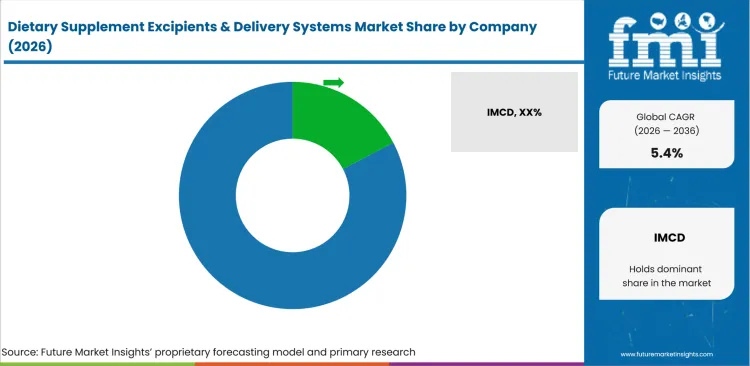
Competition spans broad excipient portfolios and specialized platforms for coatings and capsules with dedicated specialists focusing on microencapsulation or lipid-based delivery. IMCD reported in September 2025 that its network covered more than 60 countries through 86 laboratories and technical centres and a comprehensive network of outsourced warehouses. Roquette and BASF support several oral dosage formats through broad material portfolios and international technical teams. Colorcon and Lonza (Capsugel) concentrate on coatings and capsule systems with dedicated support for commercial transfer. Gattefossé provides lipid systems; SEPPIC offers sustained-release matrices; and Balchem adds microencapsulation capacity for specialized formulations. Regional inventory and application laboratories shorten troubleshooting and make production transfer more dependable across commercial supplement programs.
- Roquette and BASF provide broad excipient platforms that connect binders and coatings with formulation development across several oral dosage formats. Balchem adds microencapsulation scale for food and nutraceutical actives that require protection during commercial processing and storage.
- Colorcon and Lonza (Capsugel) focus on coatings and capsule systems that support release control and sensitive ingredient protection. Gattefossé and SEPPIC extend delivery choices through lipid excipients and sustained-release matrices for oral formulations.
- IMCD connects ingredient producers with regional formulators through distribution and application laboratories across established and emerging markets. Its network supports local inventory and technical coordination during commercial transfer without requiring every brand to build a dedicated laboratory.
Competitive Benchmarking: Dietary Supplement Excipients & Delivery Systems Market
| Company | Binder and Coating Fit | Encapsulation and Delivery Support | Formulation and Scale Support | Geographic Reach |
|---|---|---|---|---|
| Roquette | High | High | High | Global |
| BASF | High | High | High | Global |
| Colorcon | High | High | High | Global |
| Lonza (Capsugel) | Low | High | High | Global |
| IMCD | Medium | Medium | High | 60+ countries |
| Gattefossé | Low | High | High | 90 countries |
| SEPPIC | Medium | High | Medium | 100 countries |
| Balchem | Low | High | High | United States and Europe |
Key Developments in the Dietary Supplement Excipients & Delivery Systems Market
- In October 2025, Roquette presented its unified Health and Pharma Solutions portfolio following the completed IFF Pharma Solutions acquisition and Qualicaps integration. The combined business added excipients and capsules and delivery technologies alongside nutraceutical solutions for several oral dosage formats. Supplement manufacturers gained one technical route for matching coating and capsule functions with defined release requirements.
- In October 2025, Balchem reported approvals for a new food ingredient and nutraceutical microencapsulation facility within New York's Orange County. The project is expected to more than double capacity for the company's commercial microencapsulation technology portfolio. The expansion increases domestic scale for protected ingredients that require stable processing and controlled release across commercial nutrition programs.
- In January 2026, IMCD reopened its modernized Food and Nutrition laboratory in Cologne within a combined Life Science Hub. The site supports dietary supplement development across solid and liquid formats through formulation and regulatory assistance. Regional laboratory access can shorten technical transfer for programs that require coordinated material selection and production testing.
- In July 2026, Lonza confirmed that its agreement to divest Capsules and Health Ingredients remained scheduled for completion during 2026. The company continued to report the business as discontinued operations through the July 2026 publication cutoff. Supplement customers therefore remained with Lonza (Capsugel) under existing arrangements and prepared for a later ownership change, with Lonza retaining a 40% stake in the business following the expected H2 2026 close.
Key Players in the Dietary Supplement Excipients & Delivery Systems Market
Integrated Excipient Platforms
- Roquette
- BASF
- Balchem
Delivery and Dosage Specialists
- Colorcon
- Lonza (Capsugel)
- Gattefossé
- SEPPIC
Formulation and Distribution Networks
- IMCD
Dietary Supplement Excipients & Delivery Systems Market - Report Scope
| Coverage field | Report scope |
|---|---|
| Market breakdown | Type, technology, application, and region. |
| Quantitative Units | Revenue in USD Billion and CAGR in %. |
| Market Definition | Excipients and delivery systems used to manufacture dietary supplements with controlled processing, stability, protection, and release performance. |
| Regions Covered | North America, Latin America, Western Europe, Eastern Europe, East Asia, South Asia and Pacific, and Middle East and Africa. |
| Countries Covered | USA, Germany, China, India, and Japan, with additional countries assessed across the covered regions. |
| Key Companies Profiled | Roquette, BASF, Colorcon, Lonza (Capsugel), IMCD, Gattefossé, SEPPIC, and Balchem |
| Forecast Period | 2026 to 2036. |
| Approach | Hybrid bottom-up and top-down market sizing supported by primary research and authoritative public and corporate sources. |
Dietary Supplement Excipients & Delivery Systems Market - Research Methodology
| Method | Approach |
|---|---|
| Primary Research | FMI analysts gathered input from manufacturers, service providers, technology developers, distributors, end users, procurement teams, and subject-matter experts. Interviews examined purchasing decisions, product or service evaluation, adoption barriers, approval requirements, pricing considerations, and expectations for technical or commercial support. Respondents were also asked what evidence is required before a trial, pilot, or initial order develops into regular purchasing. |
| Desk Research | Desk research covered government statistics, regulatory publications, trade data, industry associations, technical literature, standards, company filings, product information, and official corporate announcements. Sources were reviewed for relevance, publication date, geographic coverage, and consistency with the defined market scope. Claims relating to performance, applications, approvals, capacity, investment, and commercial activity were retained only when supported by credible public evidence. |
| Market Sizing and Forecasting | The market model combined the baseline value with historical performance, segment structure, pricing and volume indicators, adoption levels, company participation, and country-level demand conditions. Forecast assumptions considered economic activity, investment trends, regulatory developments, technology adoption, purchasing cycles, supply availability, and barriers to wider market use. Segment and regional estimates were reconciled before the final market total was calculated. |
| Data Validation | Estimates were checked against multiple independent indicators, including public data, company activity, trade patterns, industry developments, and findings from primary interviews. Validation also tested whether products, services, applications, and company revenues fell within the defined market boundaries. Adjacent categories, unsupported claims, overlapping revenues, and activities without direct market relevance were excluded to reduce double counting and maintain consistency across segments and countries. |
Dietary Supplement Excipients & Delivery Systems Market by Segments
Dietary Supplement Excipients & Delivery Systems Market segmented by Type:
- Binders
- Coatings
- Encapsulation
- Softgels
Dietary Supplement Excipients & Delivery Systems Market segmented by Technology:
- Microencapsulation
- Liposomal
Dietary Supplement Excipients & Delivery Systems Market segmented by Application:
- Food & Beverages
- Nutraceuticals
- Personal Care
- Industrial
Dietary Supplement Excipients & Delivery Systems Market by Region:
- North America
- United States
- Canada
- Latin America
- Brazil
- Mexico
- Argentina
- Chile
- Western Europe
- Germany
- France
- United Kingdom
- Italy
- Spain
- Benelux
- Nordics
- Eastern Europe
- Poland
- Czech Republic
- Romania
- Hungary
- East Asia
- China
- Japan
- South Korea
- South Asia and Pacific
- India
- ASEAN
- Australia and New Zealand
- Middle East and Africa
- GCC Countries
- South Africa
- Türkiye
- Israel
Research Sources and Bibliography
- Roquette. (2025, February 11). Innovative and High-Performance Coatings Platform.
- Lonza Capsugel. (2025, October 15). Lonza Capsugel Launches New Market-First Organic Capsule Solution at SupplySide Global 2025.
- Colorcon. (2025, May 8). Colorcon & ASHA Cellulose Announce New Partnership.
- Balchem Corporation. (2025, October 21). Balchem Reports Third Quarter 2025 Financial Results.
- Ashland Inc. (2025, October 6). Ashland Announces New USA Food and Beverage Ingredient Distributor.
- Lonza Capsugel. (2026, May 28). Lonza Capsugel’s Licaps® DUOCAP® Technology Delivers Up to Four Times the Enzyme Activity of Standard Capsules in Peer-Reviewed Study.
- USA Food and Drug Administration. (2025, June 11). FDA Releases Educational Materials on the New Dietary Ingredient Notification Process for Dietary Supplements.
- Roquette. (2025, October 8). Roquette Boosts Extensive Cyclodextrins Portfolio with Launch of KLEPTOSE® Crysmeb Methyl-Beta-Cyclodextrin for Oral and Parenteral Formulations.
- USA Food and Drug Administration. (2026, March 27). Public Meeting Exploring the Scope of Dietary Supplement Ingredients.
- German Federal Institute for Risk Assessment. (2025, July 18). Between Hype and Misconception: Common Misunderstandings About Food Supplements.
- State Administration for Market Regulation. (2026, January 26).[December 2025 Online Service Statistics].
- Food Safety and Standards Authority of India. (n.d.). About Food Product Identity Verification System (FPIVS), FSSAI. Retrieved July 23, 2026.
- Consumer Affairs Agency. (2025, October 1).[Notifications for Foods with Function Claims for Food-Related Businesses].
- IMCD N.V. (2025, September 25). IMCD Celebrates 30 Years of Growth, Partnership and Innovation.
- Roquette. (2025, October 14). Roquette Marks New Chapter at CPHI 2025 After Key Acquisitions.
- IMCD N.V. (2026, January 6). IMCD Opens a Food & Nutrition Laboratory in Cologne.
- Lonza Group Ltd. (2026, July 22). Lonza Delivered Strong H1 2026 Performance Across All Business Platforms and Upgrades Full-Year 2026 Margin Outlook.
- SEPPIC. (2025, January 24). Advanced Sustained Release Delivery Systems for Improved Dietary Supplement Performance.
This bibliography is provided for reader reference and is not exhaustive. The full report contains the complete reference list and detailed citations.
This Report Answers
- How large is the dietary supplement excipients and delivery systems market in 2026 and 2036?
- Which formulation pressures support recurring demand for binders and delivery technologies?
- Why do binders account for the significant type share in 2026?
- How does microencapsulation protect sensitive dietary supplement ingredients?
- Why do food and beverage applications represent the dominant application share?
- How do country growth conditions differ across the USA, Germany, China, India, and Japan?
- Which companies provide excipients, capsules, coatings, and microencapsulation technologies?
- What qualification barriers delay commercial adoption across new supplement formulations?
- How can formulation support improve transfer from pilot work to repeat production?
Frequently Asked Questions
How big is the Dietary Supplement Excipients & Delivery Systems Market in 2026?
The dietary supplement excipients & delivery systems market is valued at USD 3.7 billion in 2026 and is forecast to reach USD 6.3 billion by 2036. Growth is supported by rising demand for dosage systems that protect sensitive ingredients during manufacturing and storage across established tablet, capsule, and functional beverage pathways.
What is the CAGR of the Dietary Supplement Excipients & Delivery Systems Market from 2026 to 2036?
The dietary supplement excipients & delivery systems market grows at a CAGR of 5.4% between 2026 and 2036, supported by manufacturers adopting binder and encapsulation systems once those systems preserve active stability and reproduce release performance within defined commercial production and storage conditions across supplement dosage programs.
Which type leads the Dietary Supplement Excipients & Delivery Systems Market?
Binders account for 34.0% of the dietary supplement excipients & delivery systems market by type in 2026, driven by their direct role in tablet strength and granule consistency across direct compression and wet granulation processes that serve commercial supplement tablet programs at scale.
How much will the Dietary Supplement Excipients & Delivery Systems Market add between 2026 and 2036?
The dietary supplement excipients & delivery systems market is set to add USD 2.6 billion between 2026 and 2036, growing from USD 3.7 billion to USD 6.3 billion as binder, coating, and encapsulation systems enter funded clinical and commercial pathways across a widening base of supplement dosage programs.
Who are the leading companies in the Dietary Supplement Excipients & Delivery Systems Market?
Five companies lead the dietary supplement excipients & delivery systems market, including Roquette, BASF, Colorcon, Lonza (Capsugel), and IMCD, competing through broad excipient portfolios, coating and capsule systems, and regional formulation support across tablet, encapsulation, and functional beverage dosage programs worldwide.
Preview the report firsthand - request a free sample
Get SampleGet the brochure for pricing and purchase details.
Get PDFTable of Content
- Key Takeaways
- Market Size and CAGR
- Top Growth Driver
- Fastest Growing Segment
- Leading Region
- Key Companies
- Emerging Opportunities
- Executive Summary
- Global Market Outlook
- Demand-side Trends
- Supply-side Trends
- Technology Roadmap Analysis
- Analysis and Recommendations
- Analyst Perspective (What is happening? Why now? What should investors know?)
- Key Questions Answered
- How large is the market?
- What is the CAGR?
- What are key trends?
- Which region dominates?
- Who are the leaders?
- Market Overview
- Market Coverage / Taxonomy
- Market Definition / Scope / Limitations
- Research Methodology
- Chapter Orientation
- Analytical Lens and Working Hypotheses
- Market Structure, Signals, and Trend Drivers
- Benchmarking and Cross-market Comparability
- Market Sizing, Forecasting, and Opportunity Mapping
- Research Design and Evidence Framework
- Desk Research Programme (Secondary Evidence)
- Expert Input and Fieldwork (Primary Evidence)
- Tooling, Models, and Reference Databases
- Data Engineering and Model Build
- Quality Assurance and Audit Trail
- Market Background
- Market Dynamics (Drivers, Restraints, Opportunity, Trends)
- Scenario Forecast (Optimistic, Likely, Conservative)
- Impact Analysis
- AI Impact
- Sustainability Impact
- Regulatory Impact
- Technology Impact
- Consumer / Buyer Analysis
- Purchase Drivers
- Adoption Barriers
- Buyer Journey
- Opportunity Map Analysis
- Product Life Cycle Analysis
- Supply Chain Analysis
- Investment Feasibility Matrix
- Value Chain Analysis
- PESTLE and Porter's Analysis
- Regulatory Landscape
- Regional Parent Market Outlook
- Production and Consumption Statistics
- Import and Export Statistics
- Global Market Analysis and Forecast, 2021 to 2036
- Historical Market Size Value (USD Billion) Analysis, 2021 to 2025
- Current and Future Market Size Value (USD Billion) Projections, 2026 to 2036
- Y-o-Y Growth Trend Analysis
- Absolute $ Opportunity Analysis
- Global Market Pricing Analysis, 2021 to 2036
- Global Market Analysis and Forecast, By Type, 2021 to 2036
- Introduction / Key Findings
- Historical Market Size Value (USD Billion) Analysis By Type, 2021 to 2025
- Current and Future Market Size Value (USD Billion) Analysis and Forecast By Type, 2026 to 2036
- Binders
- Coatings
- Encapsulation
- Softgels
- Binders
- Y-o-Y Growth Trend Analysis By Type, 2021 to 2025
- Absolute $ Opportunity Analysis By Type, 2026 to 2036
- Global Market Analysis and Forecast, By Technology, 2021 to 2036
- Introduction / Key Findings
- Historical Market Size Value (USD Billion) Analysis By Technology, 2021 to 2025
- Current and Future Market Size Value (USD Billion) Analysis and Forecast By Technology, 2026 to 2036
- Microencapsulation
- Liposomal
- Microencapsulation
- Y-o-Y Growth Trend Analysis By Technology, 2021 to 2025
- Absolute $ Opportunity Analysis By Technology, 2026 to 2036
- Global Market Analysis and Forecast, By Application, 2021 to 2036
- Introduction / Key Findings
- Historical Market Size Value (USD Billion) Analysis By Application, 2021 to 2025
- Current and Future Market Size Value (USD Billion) Analysis and Forecast By Application, 2026 to 2036
- Food & Beverages
- Nutraceuticals
- Personal Care
- Industrial
- Food & Beverages
- Y-o-Y Growth Trend Analysis By Application, 2021 to 2025
- Absolute $ Opportunity Analysis By Application, 2026 to 2036
- Global Market Analysis and Forecast, By Region, 2021 to 2036
- Introduction
- Historical Market Size Value (USD Billion) Analysis By Region, 2021 to 2025
- Current Market Size Value (USD Billion) Analysis and Forecast By Region, 2026 to 2036
- North America
- Latin America
- Western Europe
- Eastern Europe
- East Asia
- South Asia and Pacific
- Middle East & Africa
- Market Attractiveness Analysis By Region
- North America Market Analysis and Forecast, By Country, 2021 to 2036
- Historical Market Size Value (USD Billion) Trend Analysis By Market Taxonomy, 2021 to 2025
- Market Size Value (USD Billion) Forecast By Market Taxonomy, 2026 to 2036
- By Country
- USA
- Canada
- By Type
- By Technology
- By Application
- By Country
- Market Attractiveness Analysis
- By Country
- By Type
- By Technology
- By Application
- Key Takeaways
- Latin America Market Analysis and Forecast, By Country
- Historical Market Size Value (USD Billion) Trend Analysis By Market Taxonomy, 2021 to 2025
- Market Size Value (USD Billion) Forecast By Market Taxonomy, 2026 to 2036
- By Country
- Brazil
- Mexico
- Chile
- Rest of Latin America
- By Type
- By Technology
- By Application
- By Country
- Market Attractiveness Analysis
- By Country
- By Type
- By Technology
- By Application
- Key Takeaways
- Western Europe Market Analysis and Forecast, By Country
- Historical Market Size Value (USD Billion) Trend Analysis By Market Taxonomy, 2021 to 2025
- Market Size Value (USD Billion) Forecast By Market Taxonomy, 2026 to 2036
- By Country
- Germany
- UK
- Italy
- Spain
- France
- Nordic
- BENELUX
- Rest of Western Europe
- By Type
- By Technology
- By Application
- By Country
- Market Attractiveness Analysis
- By Country
- By Type
- By Technology
- By Application
- Key Takeaways
- Eastern Europe Market Analysis and Forecast, By Country
- Historical Market Size Value (USD Billion) Trend Analysis By Market Taxonomy, 2021 to 2025
- Market Size Value (USD Billion) Forecast By Market Taxonomy, 2026 to 2036
- By Country
- Russia
- Poland
- Hungary
- Balkan & Baltic
- Rest of Eastern Europe
- By Type
- By Technology
- By Application
- By Country
- Market Attractiveness Analysis
- By Country
- By Type
- By Technology
- By Application
- Key Takeaways
- East Asia Market Analysis and Forecast, By Country
- Historical Market Size Value (USD Billion) Trend Analysis By Market Taxonomy, 2021 to 2025
- Market Size Value (USD Billion) Forecast By Market Taxonomy, 2026 to 2036
- By Country
- China
- Japan
- South Korea
- By Type
- By Technology
- By Application
- By Country
- Market Attractiveness Analysis
- By Country
- By Type
- By Technology
- By Application
- Key Takeaways
- South Asia and Pacific Market Analysis and Forecast, By Country
- Historical Market Size Value (USD Billion) Trend Analysis By Market Taxonomy, 2021 to 2025
- Market Size Value (USD Billion) Forecast By Market Taxonomy, 2026 to 2036
- By Country
- India
- ASEAN
- Australia & New Zealand
- Rest of South Asia and Pacific
- By Type
- By Technology
- By Application
- By Country
- Market Attractiveness Analysis
- By Country
- By Type
- By Technology
- By Application
- Key Takeaways
- Middle East & Africa Market Analysis and Forecast, By Country
- Historical Market Size Value (USD Billion) Trend Analysis By Market Taxonomy, 2021 to 2025
- Market Size Value (USD Billion) Forecast By Market Taxonomy, 2026 to 2036
- By Country
- Kingdom of Saudi Arabia
- Other GCC Countries
- Türkiye
- South Africa
- Other African Union
- Rest of Middle East & Africa
- By Type
- By Technology
- By Application
- By Country
- Market Attractiveness Analysis
- By Country
- By Type
- By Technology
- By Application
- Key Takeaways
- Key Countries Market Analysis
- USA
- Pricing Analysis
- Market Share Analysis, 2025
- By Type
- By Technology
- By Application
- Canada
- Pricing Analysis
- Market Share Analysis, 2025
- By Type
- By Technology
- By Application
- Mexico
- Pricing Analysis
- Market Share Analysis, 2025
- By Type
- By Technology
- By Application
- Brazil
- Pricing Analysis
- Market Share Analysis, 2025
- By Type
- By Technology
- By Application
- Chile
- Pricing Analysis
- Market Share Analysis, 2025
- By Type
- By Technology
- By Application
- Germany
- Pricing Analysis
- Market Share Analysis, 2025
- By Type
- By Technology
- By Application
- UK
- Pricing Analysis
- Market Share Analysis, 2025
- By Type
- By Technology
- By Application
- Italy
- Pricing Analysis
- Market Share Analysis, 2025
- By Type
- By Technology
- By Application
- Spain
- Pricing Analysis
- Market Share Analysis, 2025
- By Type
- By Technology
- By Application
- France
- Pricing Analysis
- Market Share Analysis, 2025
- By Type
- By Technology
- By Application
- India
- Pricing Analysis
- Market Share Analysis, 2025
- By Type
- By Technology
- By Application
- ASEAN
- Pricing Analysis
- Market Share Analysis, 2025
- By Type
- By Technology
- By Application
- Australia & New Zealand
- Pricing Analysis
- Market Share Analysis, 2025
- By Type
- By Technology
- By Application
- China
- Pricing Analysis
- Market Share Analysis, 2025
- By Type
- By Technology
- By Application
- Japan
- Pricing Analysis
- Market Share Analysis, 2025
- By Type
- By Technology
- By Application
- South Korea
- Pricing Analysis
- Market Share Analysis, 2025
- By Type
- By Technology
- By Application
- Russia
- Pricing Analysis
- Market Share Analysis, 2025
- By Type
- By Technology
- By Application
- Poland
- Pricing Analysis
- Market Share Analysis, 2025
- By Type
- By Technology
- By Application
- Hungary
- Pricing Analysis
- Market Share Analysis, 2025
- By Type
- By Technology
- By Application
- Kingdom of Saudi Arabia
- Pricing Analysis
- Market Share Analysis, 2025
- By Type
- By Technology
- By Application
- Türkiye
- Pricing Analysis
- Market Share Analysis, 2025
- By Type
- By Technology
- By Application
- South Africa
- Pricing Analysis
- Market Share Analysis, 2025
- By Type
- By Technology
- By Application
- USA
- Market Structure Analysis
- Competition Dashboard
- Competition Benchmarking
- Market Share Analysis of Top Players
- By Regional
- By Type
- By Technology
- By Application
- Emerging Startups
- Innovation Benchmarking
- Competition Analysis
- Competition Deep Dive
- IMCD
- Overview
- Product Portfolio
- Profitability by Market Segments
- Sales Footprint
- Strategy Overview
- Marketing Strategy
- Product Strategy
- Channel Strategy
- Roquette
- BASF
- Colorcon
- Lonza (Capsugel)
- Gattefossé
- SEPPIC
- IMCD
- Case Studies
- Success Stories
- Recent Developments
- Competition Deep Dive
- Assumptions & Acronyms Used


