

- Market Size (2026)
- USD 2.6 Bn
- Forecast (2036)
- USD 13.0 Bn
- CAGR (2026 to 2036)
- 17.5%
How big is driver and Occupant Monitoring Systems (DMS-OMS) Market size?
USD 2.6 billion in 2026 and USD 13.0 billion by 2036 at a 17.5% CAGR.
The driver & occupant monitoring systems (DMS-OMS) market is projected to expand at 17.5% CAGR between 2026 and 2036, increasing valuation from USD 2.6 billion in 2026 to USD 13.0 billion by 2036. Integrating smart cameras and cabin software directly into standard vehicle platforms helps keep both drivers and passengers safe without cluttering the dashboard. Widespread installation is accelerating quickly due to strict mandatory safety frameworks. European Commission rules published in June 2026 apply advanced driver distraction warning requirements to unlimited-series new vehicles starting July 7, 2026. Meeting these rigid compliance deadlines makes eye-tracking and attention detection essential for securing official type approval across the continent.
Design priorities follow different paths depending on local safety standards and market speeds. Car companies in the European Union and Japan favor multi-driver testing and platform longevity. Engineering teams in China and South Korea prioritize localized sensors and fast vehicle launches. Consumer safety ratings promote these interior upgrades even further. Euro NCAP’s October 2025 Driver Engagement protocol places direct driver monitoring inside its 2026 Safe Driving assessment, prompting manufacturers to combine gaze tracking and driver availability into one validated system.
-market-value-analysis.webp "Driver & Occupant Monitoring Systems (dms Oms) Market Value Analysis")
Key Takeaways of Driver & Occupant Monitoring Systems (DMS-OMS) Market
- Demand for driver and occupant monitoring systems is driven by regulatory timing across Europe and China, with safety-rating programs adding commercial pressure beyond legal compliance requirements.
- By integration type, OEM-integrated systems are expected to lead with 62.0% share in 2026, driven by type-approval control and factory calibration.
- Passenger cars are the dominant vehicle segment, projected to hold 58.0% share in 2026, aided by regulatory exposure across high-volume vehicle lines.
- Driver monitoring is estimated to lead the function category with 46.0% share in 2026, led by direct requirements for fatigue and distraction detection.
- Software validation, calibration accuracy, and system compatibility remain critical to platform selection, with camera and radar functions extending into child presence detection and occupant-position assessment.
- China, the European Union, and the United States are expected to form the higher-growth region tier, advancing at 20.5%, 18.5%, and 17.0% CAGR respectively through 2036, supported by connected-cabin development, phased General Safety Regulation coverage, and rear-seat warning rules.
- Competition centers on Smart Eye, Seeing Machines, Robert Bosch, AUMOVIO, Cipia Vision, DENSO, Magna, FORVIA HELLA, and Valeo, with vendors differentiating through automotive software depth, sensing hardware integration, and cabin-sensing module access across vehicle platforms.
Analyst Perspective
"The Driver & Occupant Monitoring Systems (DMS-OMS) market is evolving from component sourcing to platform-level cabin intelligence, with automakers placing greater emphasis on software maturity and regulatory readiness than on camera hardware alone. Market adoption will be shaped by detection accuracy across diverse driving conditions, the ability to reuse software across vehicle platforms, and compliance with evolving safety requirements. Sensor fusion and scalable software architectures are expected to play a larger role as occupant monitoring expands beyond driver attention into broader in-cabin safety functions."
- Nikhil Kaitwade, Principal Consultant for Automotive at Future Market Insights
Source: Future Market Insights analysis, 2026.
How is Driver and Occupant Monitoring Systems (DMS-OMS) Market segmented?
The driver and occupant monitoring systems industry is segmented by technology, application, component, end use, sales channel, and region.
The driver and occupant monitoring systems market is segmented by technology, application, component, end use, sales channel, and region. Technology coverage includes driver monitoring, occupant monitoring, interior radar sensing, and health or impairment detection. Application coverage includes drowsiness and distraction detection, child presence detection, seatbelt and airbag optimization, and impairment detection. Component coverage includes software and IP, cameras and silicon, and services. End Use coverage includes passenger cars, trucks and fleets, buses, and aftermarket users. Sales Channel coverage includes OEM-integrated systems, Tier-1 bundled systems, aftermarket kits, and fleet retrofit programs. Regional coverage includes North America, Latin America, Western Europe, Eastern Europe, East Asia, South Asia and Pacific, Middle East, and Africa.
How does driver monitoring shape technology selection?
-market-analysis-by-technology.webp "Driver & Occupant Monitoring Systems (dms Oms) Market Analysis By Technology")
Driver monitoring guides technology selection as regulators and rating bodies require direct assessment of attention and availability. Camera placement and warning timing influence validation across vehicle variants. Euro NCAP’s October 2025 assisted-driving protocol allocates 25 points to non-transient driver-state assessment, reinforcing direct sensing for microsleep and unresponsive-driver responses.
- In 2026, driver monitoring is set to represent 46.0% share since it is led by dated distraction and drowsiness requirements. OEM teams assess calibration stability across head pose and cabin geometry.
- Occupant monitoring and impairment detection address passenger presence and cabin-state needs. Vehicle programs use both functions to assess seating position and unattended occupants through a shared cabin-sensing architecture.
How does drowsiness and distraction detection guide application demand?
-market-analysis-by-application.webp "Driver & Occupant Monitoring Systems (dms Oms) Market Analysis By Application")
The National Highway Traffic Safety Administration reported in April 2025 that an estimated 39,345 people died in traffic crashes in 2024. reinforcing vehicle-safety programs addressing preventable driver-state risk. Drowsiness and distraction detection is ready to lead application need as road-safety programs emphasize attention loss and fatigue. Timely classification and controlled warning frequency shape system performance across ordinary driver behavior.
- Based on application, drowsiness and distraction detection is anticipated to garner 42.0% share in 2026 as direct regulatory language and safety-rating tests support its use. Vehicle teams compare gaze-off-road thresholds and escalation timing during approval.
- Child presence detection and impairment detection support additional cabin functions. Defined evaluation procedures help engineering teams compare alert timing and detection consistency across varied passenger configurations.
Why does software and IP retain component leadership?
-market-analysis-by-component.webp "Driver & Occupant Monitoring Systems (dms Oms) Market Analysis By Component")
Software and IP retain component leadership as common camera hardware supports differentiated driver-state algorithms. OEM programs require calibration tools and safety documentation across several cabin layouts. State Council Information Office reported in September 2025 reflecting sales of 7.76 million new passenger cars equipped with Level-2 driving-assistance functions from January through July.
- Software and IP are projected to secure 44.0% share of component in 2026, helped by algorithm licensing and platform reuse. Engineering teams evaluate detection coverage and functional-safety evidence.
- Cameras and silicon provide image capture and processing foundations, and services support calibration or integration. Standardized hardware allows software teams to carry validated algorithms across several model families without rebuilding the complete sensing stack.
Why do passenger cars lead end use demand?
-market-analysis-by-end-use.webp "Driver & Occupant Monitoring Systems (dms Oms) Market Analysis By End Use")
Factory programs integrate driver monitoring beside assisted driving and cockpit controls. International Organization of Motor Vehicle Manufacturers reported in April 2026 announcing global vehicle production of 96.4 million units in 2025, reflecting an extensive production base for cabin-sensing integration. Passenger cars lead end use requirement as safety rules and consumer ratings focus heavily on high-volume light vehicles.
- By end use, passenger cars are estimated to capture 58.0% share in 2026, aided by series-production volume and regional safety obligations. Automakers review sensor packaging and software reuse across compact and executive vehicle lines.
- Trucks and fleets, and aftermarket users create additional demand led by fatigue management and retrofit needs. Commercial operators use monitoring systems to support fatigue oversight across long-duty cycles and mixed vehicle fleets.
How do OEM-integrated systems retain sales channel strength?
-market-analysis-by-sales-channel.webp "Driver & Occupant Monitoring Systems (dms Oms) Market Analysis By Sales Channel")
OEM-integrated systems retain sales channel strength based on factory calibration and type-approval ownership. Embedded systems allow vehicle makers to coordinate warning responses with driver assistance and cockpit interfaces. Seeing Machines reported in May 2026 noting automotive production volumes of 1,284,557 units during Q3 FY2026, illustrating scaled royalty-based deployment driven by OEM programs.
- OEM-integrated systems are predicted to account for 62.0% share in 2026, aided by production validation and controlled software releases. Purchasing teams assess Tier-1 readiness and model-launch timing.
- Tier-1 bundled systems and fleet retrofit programs address alternate installation paths. Alternate channels help fleets and vehicle programs add monitoring functions without redesigning the complete factory electronics package.
What are drivers, restraints, and opportunities in Driver and Occupant Monitoring Systems (DMS-OMS) Market?
Validated software performance supports DMS-OMS selection. Sensor costs and integration complexity may restrict deployment across price-sensitive vehicle programs.
- Driver: Driver-state requirements are projected to encourage factory integration across new passenger-vehicle programs.
- Restraint: Validation complexity is anticipated to slow launches across varied lighting conditions and privacy requirements.
- Opportunity: Centralized vehicle computing is likely to support combined driver and impairment functions through shared processing.
Safety scoring is expected to convert attention monitoring into a model-rating requirement across major vehicle programs. Euro NCAP’s June 2025 assessment protocol allocates 25 points each to Occupant Monitoring and Driver Engagement, encouraging integrated cabin-state evaluation across passenger vehicle ADAS programs.
Regulatory scope differs across regions and creates uneven validation priorities for occupant functions. National Highway Traffic Safety Administration reported in December 2024 estimating rear-seat belt reminder rules could save about 50 lives annually following full implementation, reflecting a narrower United States requirement than multi-function cabin monitoring.
Centralized compute architectures are projected to reduce separate electronic-control units and support combined DMS-OMS software. Smart Eye reported in April 2026 recording 368 automotive design wins, indicating expanding software reuse across global vehicle platforms.
What country CAGRs are profiled in Driver and Occupant Monitoring Systems (DMS-OMS) Market?
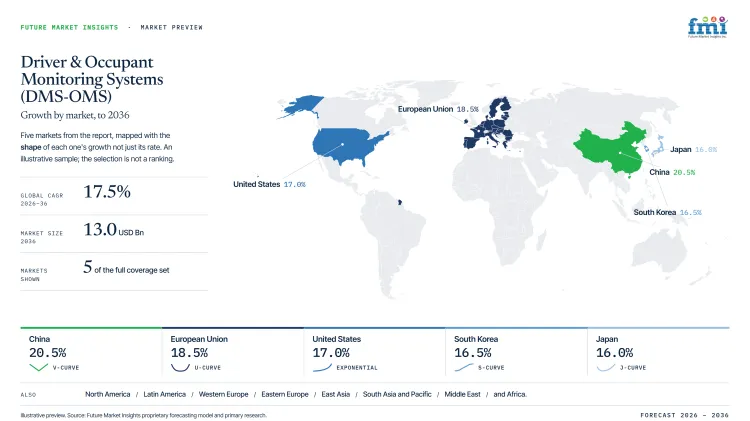
| Country | Forecast CAGR from 2026 to 2036 |
|---|---|
| China | 20.5% |
| European Union | 18.5% |
| United States | 17.0% |
| South Korea | 16.5% |
| Japan | 16.0% |
Source: Future Market Insights analysis, 2026.
How do country-level conditions shape Driver and Occupant Monitoring Systems (DMS-OMS) Market?
The comparison spans 4.5 percentage points across the driver and occupant monitoring systems (DMS-OMS) market. China records the highest CAGR at 20.5%, followed by the European Union at 18.5%. The United States reaches 17.0%, while South Korea and Japan post 16.5% and 16.0%, respectively. The ranking reflects different rates of adoption of in-cabin monitoring technologies across automotive markets.
- China leads with a CAGR of 20.5%. Vehicle manufacturers are increasing the integration of driver and occupant monitoring systems into new vehicle platforms, with greater emphasis on camera-based cabin sensing, driver attention monitoring and occupant detection technologies.
- The European Union follows at 18.5%, 2.0 percentage points below China. Automotive manufacturers are incorporating DMS-OMS technologies into passenger vehicles as in-cabin safety features become a larger part of vehicle development programs. Adoption differs across manufacturers because product strategies and vehicle portfolios are not identical.
- The United States records a CAGR of 17.0%, 1.5 percentage points behind the European Union. Vehicle developers continue expanding the use of cabin monitoring systems to improve driver awareness, occupant detection and integration with advanced driver assistance features.
- South Korea posts a CAGR of 16.5%, only 0.5 percentage points below the United States. Automotive companies are evaluating advanced in-cabin sensing technologies that combine driver monitoring with occupant recognition to strengthen vehicle safety capabilities.
- Japan records a CAGR of 16.0%, 0.5 percentage points behind South Korea. Market activity centers on integrating driver and occupant monitoring functions into next-generation vehicle platforms while improving compatibility with connected and automated vehicle technologies.
Comparable CAGRs do not indicate identical market conditions. Differences in vehicle production, safety technology integration, automotive development priorities and investment strategies influence deployment patterns and long-term commercial opportunities. The full report provides country-level CAGR analysis across North America, Latin America, Europe, East Asia, South Asia, Oceania and the Middle East and Africa.
Country-wise Analysis
- China is projected to advance at 20.5% CAGR from 2026 to 2036, guided by local OEM competition and accelerated Level-2 vehicle programs. Local platform scale gives software suppliers a larger test base across several passenger-vehicle lines. Government of China reported in January 2026 stating automobile output reached 34.531 million units in 2025, expanding production opportunities for localized driver and occupant monitoring software.
- Phased general safety regulation implementation supports European Union expansion at an anticipated 18.5% CAGR during the forecast period. Staged compliance schedules encourage automakers to coordinate sensor validation across shared regional platforms. Association of European Automobile Manufacturers reported in April 2026 for the European Union car production being just under 11.5 million units in 2025, sustaining a sizable platform base for compliant cabin-sensing integration.
- Sector in the United States is likely to scale at 17.0% CAGR during the study period, backed by rear-seat safety rules and OEM attention-monitoring packages. Federal safety actions keep in-cabin monitoring under review through separate rulemaking paths. National Highway Traffic Safety Administration reported in September 2025 estimating 17,140 traffic fatalities during January through June 2025, reinforcing continued safety investment across driver-state and occupant-alert functions.
- Industry in South Korea is expected to rise at 16.5% CAGR between 2026 to 2036, helped by benefitting from domestic OEM platform engineering and camera-module expertise. Domestic engineering programs create testing environments for camera modules and driver-state algorithms. Seoul Metropolitan Government reported in June 2025 operation of 27 autonomous vehicles, reflecting real-world testing for driver availability and cabin-state systems.
- Sector in Japan is anticipated to grow at 16.0% CAGR from 2026 to 2036, led by platform continuity across domestic OEMs. Stable production networks support multi-model calibration across established passenger-vehicle programs. Japan Automobile Manufacturers Association reported in September 2025 recording 8.23 million motor vehicles produced in 2024, sustaining multi-model validation requirements for driver monitoring and occupant safety systems.
Who are notable companies in Driver and Occupant Monitoring Systems (DMS-OMS) Market?
Smart Eye and Seeing Machines are expected to shape software competition. Cipia Vision and Robert Bosch GmbH add driver-state analytics and system-integration depth. AUMOVIO SE and DENSO Corporation support sensor and vehicle-compute coverage. Magna International, FORVIA HELLA, and Valeo add cabin-electronics and vehicle-platform access.
-market-analysis-by-company.webp "Driver & Occupant Monitoring Systems (dms Oms) Market Analysis By Company")
Competition in driver and occupant monitoring systems is anticipated to center on detection accuracy and cabin coverage. Account teams are likely to compare companies based on processor compatibility and validation support during final selection. Smart Eye and Seeing Machines are expected to receive review attention driven by automotive software depth. Cipia Vision is anticipated to add fleet and passenger-vehicle specialization. Robert Bosch GmbH and AUMOVIO SE are projected to compete through Tier-1 integration knowledge. DENSO Corporation and Magna International are estimated to support OEM programs through cabin-electronics experience. FORVIA HELLA and Valeo are likely to strengthen vehicle-platform access across regional automaker accounts.
- Smart Eye and Seeing Machines gain account attention led by driver-monitoring software and production-program experience. Automotive relationships support programs needing validated algorithms and repeat launch assistance.
- Cipia Vision and Robert Bosch GmbH compete depending on driver-state analytics and system-integration depth. Account review reflects software calibration and cabin-electronics support.
- AUMOVIO SE and DENSO Corporation support selection based on sensor systems and vehicle-compute knowledge. OEM teams compare platform compatibility and engineering ownership during program review.
- Magna International and Valeo gain review strength due to cabin-electronics experience and automaker access. Supplier attention improves as vehicle programs combine driver and occupant functions.
Competitive Benchmarking: Driver & Occupant Monitoring Systems (DMS-OMS) Market
| Company | Portfolio Depth | Cabin Match | Service Support | Service Reach |
|---|---|---|---|---|
| Smart Eye AB | High | High | High | Europe and global |
| Seeing Machines Limited | High | High | High | Australia and global |
| Cipia Vision Ltd. | Medium | High | Medium | Israel and global |
| Robert Bosch GmbH | High | High | High | Germany and global |
| AUMOVIO SE | High | High | High | Germany and global |
| DENSO Corporation | High | High | High | Japan and global |
| Magna International Inc. | High | High | High | North America and global |
| FORVIA HELLA (HELLA GmbH & Co. KGaA) | High | High | High | Germany and global |
| Valeo | High | High | High | France and global |
| Qualcomm Technologies, Inc. | High | Medium | High | United States and global |
| Renesas Electronics Corporation | High | Medium | High | Japan and global |
| STMicroelectronics N.V. | High | Medium | High | Europe and global |
Source: Future Market Insights competitive analysis, 2026.
Key Developments in Driver & Occupant Monitoring Systems (DMS-OMS) Market
- In February 2025, Smart Eye and Greater Than reported real-world fleet analysis showing ADDW alerts reduced crash risk by approximately 10% immediately following an alert. Findings supported improved warning calibration and measurable driver-risk assessment across fleet monitoring programs.
- In November 2025, Seeing Machines announced an initial order for 1,100 Guardian Generation 3 units from a United States multinational fleet operator. Installation planning through December 2025 expanded commercial evidence for fatigue-management systems across heavy distribution fleets.
- In January 2026, Smart Eye announced pre-integrated driver and occupant monitoring on Renesas’ R-Car Gen 5 platform. ASIL-B software availability within a centralized compute environment reduced integration requirements and separate controller needs.
Key Players in Driver & Occupant Monitoring Systems (DMS-OMS) Market
DMS and Interior-Sensing Software Specialists
- Smart Eye AB
- Seeing Machines Limited
- Cipia Vision Ltd.
Tier-1 Cabin-Sensing and Vehicle-System Suppliers
- Robert Bosch GmbH
- AUMOVIO SE
- DENSO Corporation
- Magna International Inc.
- FORVIA HELLA (HELLA GmbH & Co. KGaA)
- Valeo
Automotive Compute and Semiconductor Platform Providers
- Qualcomm Technologies, Inc.
- Renesas Electronics Corporation
- onsemi
- STMicroelectronics N.V.
Driver & Occupant Monitoring Systems (DMS-OMS) Market - Report Scope
-market-breakdown-by-technology,-application,-and-region.webp "Driver & Occupant Monitoring Systems (dms Oms) Market Breakdown By Technology, Application, And Region")
| Coverage Field | Report Scope |
|---|---|
| Market Breakdown | Driver & Occupant Monitoring Systems (DMS-OMS) Market breakdown by technology, application, component, End Use, Sales Channel, and region. |
| Market Definition | DMS-OMS includes camera, radar, software, processor, and service functions used to assess driver state, occupant presence, seating position, distraction, drowsiness, impairment, and cabin safety conditions. |
| Regions Covered | North America, Latin America, Western Europe, Eastern Europe, East Asia, South Asia and Pacific, Middle East, and Africa. |
| Countries Covered | United States, Canada, Brazil, Mexico, Germany, United Kingdom, France, Italy, Spain, China, Japan, South Korea, India, ASEAN, Australia, New Zealand, GCC countries, South Africa, and Türkiye. |
| Key Companies Profiled | Smart Eye, Seeing Machines, Cipia, Robert Bosch, AUMOVIO, DENSO, Magna, FORVIA HELLA, Valeo, Qualcomm Technologies, Renesas Electronics, onsemi, and STMicroelectronics. |
| Forecast Period | 2026 to 2036. |
| Approach | Hybrid bottom-up and top-down methodology using segment share, country CAGR, vehicle production, regulatory timing, platform integration, supplier program depth, and channel exposure. |
Source: Future Market Insights analysis, 2026.
Driver & Occupant Monitoring Systems (DMS-OMS) Market - Research Methodology
| Method | Approach |
|---|---|
| Primary Research | FMI analysts gathered input from manufacturers, service providers, technology developers, distributors, end users, procurement teams, and subject-matter experts. Interviews examined purchasing decisions, product or service evaluation, adoption barriers, approval requirements, pricing considerations, and expectations for technical or commercial support. Respondents were also asked what evidence is required before a trial, pilot, or initial order develops into regular purchasing. |
| Desk Research | Desk research covered government statistics, regulatory publications, trade data, industry associations, technical literature, standards, company filings, product information, and official corporate announcements. Sources were reviewed for relevance, publication date, geographic coverage, and consistency with the defined market scope. Claims relating to performance, applications, approvals, capacity, investment, and commercial activity were retained only when supported by credible public evidence. |
| Market Sizing and Forecasting | The market model combined the baseline value with historical performance, segment structure, pricing and volume indicators, adoption levels, company participation, and country-level demand conditions. Forecast assumptions considered economic activity, investment trends, regulatory developments, technology adoption, purchasing cycles, supply availability, and barriers to wider market use. Segment and regional estimates were reconciled before the final market total was calculated. |
| Data Validation | Estimates were checked against multiple independent indicators, including public data, company activity, trade patterns, industry developments, and findings from primary interviews. Validation also tested whether products, services, applications, and company revenues fell within the defined market boundaries. Adjacent categories, unsupported claims, overlapping revenues, and activities without direct market relevance were excluded to reduce double counting and maintain consistency across segments and countries. |
Source: Future Market Insights analysis, 2026.
Driver & Occupant Monitoring Systems (DMS-OMS) Market by Segments
Driver & Occupant Monitoring Systems (DMS-OMS) Market segmented by Technology:
- Driver monitoring (DMS)
- Occupant monitoring (OMS)
- Interior radar sensing
- Health and impairment detection
Driver & Occupant Monitoring Systems (DMS-OMS) Market segmented by Application:
- Drowsiness and distraction detection
- Child presence detection
- Seatbelt and airbag optimization
- Impairment detection
Driver & Occupant Monitoring Systems (DMS-OMS) Market segmented by Component:
- Software and IP
- Cameras and silicon
- Services
Driver & Occupant Monitoring Systems (DMS-OMS) Market segmented by End Use:
- Passenger cars
- Trucks and fleets
- Buses
- Aftermarket users
Driver & Occupant Monitoring Systems (DMS-OMS) Market segmented by Sales Channel:
- OEM-integrated systems
- Tier-1 bundled systems
- Aftermarket kits
- Fleet retrofit programs
Driver & Occupant Monitoring Systems (DMS-OMS) Market by Region:
- North America
- United States
- Canada
- Latin America
- Brazil
- Mexico
- Argentina
- Western Europe
- Germany
- United Kingdom
- France
- Italy
- Spain
- Eastern Europe
- Poland
- Czech Republic
- Romania
- East Asia
- China
- Japan
- South Korea
- South Asia and Pacific
- India
- ASEAN
- Australia and New Zealand
- Middle East and Africa
- GCC countries
- South Africa
- Türkiye
Research Sources and Bibliography
- Association of European Automobile Manufacturers. (2026, April 1). Economic and market report: Global and EU auto industry - Full year 2025.
- European Commission. (2026, June 2). Commission Delegated Regulation (EU) 2026/1188 amending technical requirements for advanced driver distraction warning systems.
- Euro NCAP. (2025, June). Overall assessment protocol, version 10.0.
- Euro NCAP. (2025, October 1). Safe driving driver engagement protocol, version 1.1.
- Euro NCAP. (2025, October 1). Assisted driving highway and interurban assist systems protocol, version 1.1.
- Government of China. (2026, January 14). China's auto output and sales reach new highs in 2025.
- International Organization of Motor Vehicle Manufacturers. (2026, April 27). OICA's five major news items summarized.
- Japan Automobile Manufacturers Association. (2025, September 26). The motor industry of Japan 2025.
- National Highway Traffic Safety Administration. (2024, December 16). NHTSA finalizes seat belt reminder rule to increase seat belt use and improve occupant protection.
- National Highway Traffic Safety Administration. (2025, April 8). NHTSA estimates 39,345 traffic fatalities in 2024.
- National Highway Traffic Safety Administration. (2025, September 16). NHTSA reports sharp drop in traffic fatalities in first half of 2025.
- Seeing Machines Limited. (2025, November 12). Seeing Machines announces initial Guardian order from a United States-based multinational company.
- Seeing Machines Limited. (2026, May 6). Q3 FY2026 quarterly KPIs.
- Seoul Metropolitan Government. (2025, June 27). Leading city of autonomous urban mobility.
- Smart Eye AB. (2025, February 26). Smart Eye and Greater Than reveal the extent to which ADDW alerts influence driver risk.
- Smart Eye AB. (2026, January 6). Smart Eye announces pre-integrated driver and occupant monitoring on Renesas' R-Car Gen 5 platform.
- Smart Eye AB. (2026, April 13). Annual report 2025.
- State Council Information Office of China. (2025, September 25). China establishes full industrial chain for key intelligent connected vehicle products.
This bibliography is provided for reader reference and is not exhaustive. The full report contains the complete reference list and detailed citations.
This Report Answers
- What segments shape driver and occupant monitoring systems demand across technology, application, component, End Use, and Sales Channel?
- How do automakers evaluate driver monitoring software across varied cabin layouts and driver conditions?
- How do country CAGRs differ across profiled vehicle-producing regions?
- What companies compete through software depth, sensor integration, and platform validation?
- How are forecasts validated through hybrid bottom-up and top-down analysis?
- What factors influence OEM-integrated system selection across new vehicle programs?
- How do camera and automotive radar inputs support combined cabin-state assessment?
- What limits return on investment for vehicle programs adding DMS-OMS functions?
- How do regulatory records and safety-rating tests influence supplier review?
- What capabilities support long-term program confidence across connected car platforms?
Frequently Asked Questions
What supports demand in driver and occupant monitoring systems (DMS-OMS) market?
Demand is expected to be supported by driver-state regulation and factory integration across passenger vehicles. OEM teams are likely to favor suppliers combining validated software with processor and sensor compatibility.
Who are key companies in driver and occupant monitoring systems (DMS-OMS) market?
Key companies are anticipated to include Smart Eye, Seeing Machines, Cipia, Robert Bosch, AUMOVIO, DENSO, Magna, FORVIA HELLA, and Valeo. Semiconductor competition is projected to include Qualcomm Technologies, Renesas Electronics, onsemi, and STMicroelectronics.
What restraint affects driver and occupant monitoring systems (DMS-OMS) market?
A central restraint involves validation across driver appearance and false-alert limits. Launch decisions may slow if supplier evidence does not cover regional safety protocols and vehicle-platform variation.
Why do executives track driver and occupant monitoring systems (DMS-OMS) market?
Executives are expected to track DMS-OMS as cabin sensing affects regulatory compliance and vehicle-compute planning. Segment shares and country CAGRs help teams compare commercial exposure across vehicle programs.
What business problem does driver and occupant monitoring systems (DMS-OMS) market address?
DMS-OMS addresses limited vehicle awareness of driver attention and occupant position. Integrated sensing supports earlier warnings and coordinated safety responses across cockpit and assistance systems.
What do account teams evaluate during vendor selection?
Account teams are likely to evaluate detection performance and model-launch support. Camera positioning and regional test coverage are expected to guide final reviews.
What limits return on investment for purchasing teams?
Return on investment weakens if integration cycles lengthen or warning accuracy creates rework across several vehicle models. Hardware duplication and fragmented software ownership may reduce expected platform savings.
How do vendors build long-term account confidence?
Vendors build account confidence through responsive engineering, and documented software controls. Multi-region compliance support and stable platform partnerships are expected to influence repeat program awards.
Preview the report firsthand - request a free sample
Get SampleGet the brochure for pricing and purchase details.
Get PDFTable of Content
- Key Takeaways
- Market Size and CAGR
- Top Growth Driver
- Fastest Growing Segment
- Leading Region
- Key Companies
- Emerging Opportunities
- Executive Summary
- Global Market Outlook
- Demand-side Trends
- Supply-side Trends
- Technology Roadmap Analysis
- Analysis and Recommendations
- Analyst Perspective (What is happening? Why now? What should investors know?)
- Key Questions Answered
- How large is the market?
- What is the CAGR?
- What are key trends?
- Which region dominates?
- Who are the leaders?
- Market Overview
- Market Coverage / Taxonomy
- Market Definition / Scope / Limitations
- Research Methodology
- Chapter Orientation
- Analytical Lens and Working Hypotheses
- Market Structure, Signals, and Trend Drivers
- Benchmarking and Cross-market Comparability
- Market Sizing, Forecasting, and Opportunity Mapping
- Research Design and Evidence Framework
- Desk Research Programme (Secondary Evidence)
- Expert Input and Fieldwork (Primary Evidence)
- Tooling, Models, and Reference Databases
- Data Engineering and Model Build
- Quality Assurance and Audit Trail
- Market Background
- Market Dynamics (Drivers, Restraints, Opportunity, Trends)
- Scenario Forecast (Optimistic, Likely, Conservative)
- Impact Analysis
- AI Impact
- Sustainability Impact
- Regulatory Impact
- Technology Impact
- Consumer / Buyer Analysis
- Purchase Drivers
- Adoption Barriers
- Buyer Journey
- Opportunity Map Analysis
- Product Life Cycle Analysis
- Supply Chain Analysis
- Investment Feasibility Matrix
- Value Chain Analysis
- PESTLE and Porter's Analysis
- Regulatory Landscape
- Regional Parent Market Outlook
- Production and Consumption Statistics
- Import and Export Statistics
- Global Market Analysis and Forecast, 2021 to 2036
- Historical Market Size Value (USD Bn) Analysis, 2021 to 2025
- Current and Future Market Size Value (USD Bn) Projections, 2026 to 2036
- Y-o-Y Growth Trend Analysis
- Absolute $ Opportunity Analysis
- Global Market Pricing Analysis, 2021 to 2036
- Global Market Analysis and Forecast, By Technology, 2021 to 2036
- Introduction / Key Findings
- Historical Market Size Value (USD Bn) Analysis By Technology, 2021 to 2025
- Current and Future Market Size Value (USD Bn) Analysis and Forecast By Technology, 2026 to 2036
- Driver monitoring (DMS)
- Occupant monitoring (OMS)
- Interior radar sensing
- Health - impairment detection
- Driver monitoring (DMS)
- Y-o-Y Growth Trend Analysis By Technology, 2021 to 2025
- Absolute $ Opportunity Analysis By Technology, 2026 to 2036
- Global Market Analysis and Forecast, By Application, 2021 to 2036
- Introduction / Key Findings
- Historical Market Size Value (USD Bn) Analysis By Application, 2021 to 2025
- Current and Future Market Size Value (USD Bn) Analysis and Forecast By Application, 2026 to 2036
- Drowsiness & distraction
- Child presence detection
- Seatbelt - airbag optimization
- Impairment detection
- Drowsiness & distraction
- Y-o-Y Growth Trend Analysis By Application, 2021 to 2025
- Absolute $ Opportunity Analysis By Application, 2026 to 2036
- Global Market Analysis and Forecast, By Component, 2021 to 2036
- Introduction / Key Findings
- Historical Market Size Value (USD Bn) Analysis By Component, 2021 to 2025
- Current and Future Market Size Value (USD Bn) Analysis and Forecast By Component, 2026 to 2036
- Software - IP
- Cameras & silicon
- Services
- Software - IP
- Y-o-Y Growth Trend Analysis By Component, 2021 to 2025
- Absolute $ Opportunity Analysis By Component, 2026 to 2036
- Global Market Analysis and Forecast, By End-use, 2021 to 2036
- Introduction / Key Findings
- Historical Market Size Value (USD Bn) Analysis By End-use, 2021 to 2025
- Current and Future Market Size Value (USD Bn) Analysis and Forecast By End-use, 2026 to 2036
- Passenger cars
- Trucks & fleets
- Buses
- Aftermarket
- Passenger cars
- Y-o-Y Growth Trend Analysis By End-use, 2021 to 2025
- Absolute $ Opportunity Analysis By End-use, 2026 to 2036
- Global Market Analysis and Forecast, By Sales Channel, 2021 to 2036
- Introduction / Key Findings
- Historical Market Size Value (USD Bn) Analysis By Sales Channel, 2021 to 2025
- Current and Future Market Size Value (USD Bn) Analysis and Forecast By Sales Channel, 2026 to 2036
- OEM-integrated
- Tier-1 bundled
- Aftermarket
- Fleet retrofit
- OEM-integrated
- Y-o-Y Growth Trend Analysis By Sales Channel, 2021 to 2025
- Absolute $ Opportunity Analysis By Sales Channel, 2026 to 2036
- Global Market Analysis and Forecast, By Region, 2021 to 2036
- Introduction
- Historical Market Size Value (USD Bn) Analysis By Region, 2021 to 2025
- Current Market Size Value (USD Bn) Analysis and Forecast By Region, 2026 to 2036
- North America
- Latin America
- Western Europe
- Eastern Europe
- East Asia
- South Asia and Pacific
- Middle East & Africa
- Market Attractiveness Analysis By Region
- North America Market Analysis and Forecast, By Country, 2021 to 2036
- Historical Market Size Value (USD Bn) Trend Analysis By Market Taxonomy, 2021 to 2025
- Market Size Value (USD Bn) Forecast By Market Taxonomy, 2026 to 2036
- By Country
- USA
- Canada
- By Technology
- By Application
- By Component
- By End-use
- By Sales Channel
- By Country
- Market Attractiveness Analysis
- By Country
- By Technology
- By Application
- By Component
- By End-use
- By Sales Channel
- Key Takeaways
- Latin America Market Analysis and Forecast, By Country
- Historical Market Size Value (USD Bn) Trend Analysis By Market Taxonomy, 2021 to 2025
- Market Size Value (USD Bn) Forecast By Market Taxonomy, 2026 to 2036
- By Country
- Brazil
- Mexico
- Chile
- Rest of Latin America
- By Technology
- By Application
- By Component
- By End-use
- By Sales Channel
- By Country
- Market Attractiveness Analysis
- By Country
- By Technology
- By Application
- By Component
- By End-use
- By Sales Channel
- Key Takeaways
- Western Europe Market Analysis and Forecast, By Country
- Historical Market Size Value (USD Bn) Trend Analysis By Market Taxonomy, 2021 to 2025
- Market Size Value (USD Bn) Forecast By Market Taxonomy, 2026 to 2036
- By Country
- Germany
- UK
- Italy
- Spain
- France
- Nordic
- BENELUX
- Rest of Western Europe
- By Technology
- By Application
- By Component
- By End-use
- By Sales Channel
- By Country
- Market Attractiveness Analysis
- By Country
- By Technology
- By Application
- By Component
- By End-use
- By Sales Channel
- Key Takeaways
- Eastern Europe Market Analysis and Forecast, By Country
- Historical Market Size Value (USD Bn) Trend Analysis By Market Taxonomy, 2021 to 2025
- Market Size Value (USD Bn) Forecast By Market Taxonomy, 2026 to 2036
- By Country
- Russia
- Poland
- Hungary
- Balkan & Baltic
- Rest of Eastern Europe
- By Technology
- By Application
- By Component
- By End-use
- By Sales Channel
- By Country
- Market Attractiveness Analysis
- By Country
- By Technology
- By Application
- By Component
- By End-use
- By Sales Channel
- Key Takeaways
- East Asia Market Analysis and Forecast, By Country
- Historical Market Size Value (USD Bn) Trend Analysis By Market Taxonomy, 2021 to 2025
- Market Size Value (USD Bn) Forecast By Market Taxonomy, 2026 to 2036
- By Country
- China
- Japan
- South Korea
- By Technology
- By Application
- By Component
- By End-use
- By Sales Channel
- By Country
- Market Attractiveness Analysis
- By Country
- By Technology
- By Application
- By Component
- By End-use
- By Sales Channel
- Key Takeaways
- South Asia and Pacific Market Analysis and Forecast, By Country
- Historical Market Size Value (USD Bn) Trend Analysis By Market Taxonomy, 2021 to 2025
- Market Size Value (USD Bn) Forecast By Market Taxonomy, 2026 to 2036
- By Country
- India
- ASEAN
- Australia & New Zealand
- Rest of South Asia and Pacific
- By Technology
- By Application
- By Component
- By End-use
- By Sales Channel
- By Country
- Market Attractiveness Analysis
- By Country
- By Technology
- By Application
- By Component
- By End-use
- By Sales Channel
- Key Takeaways
- Middle East & Africa Market Analysis and Forecast, By Country
- Historical Market Size Value (USD Bn) Trend Analysis By Market Taxonomy, 2021 to 2025
- Market Size Value (USD Bn) Forecast By Market Taxonomy, 2026 to 2036
- By Country
- Kingdom of Saudi Arabia
- Other GCC Countries
- Türkiye
- South Africa
- Other African Union
- Rest of Middle East & Africa
- By Technology
- By Application
- By Component
- By End-use
- By Sales Channel
- By Country
- Market Attractiveness Analysis
- By Country
- By Technology
- By Application
- By Component
- By End-use
- By Sales Channel
- Key Takeaways
- Key Countries Market Analysis
- USA
- Pricing Analysis
- Market Share Analysis, 2025
- By Technology
- By Application
- By Component
- By End-use
- By Sales Channel
- Canada
- Pricing Analysis
- Market Share Analysis, 2025
- By Technology
- By Application
- By Component
- By End-use
- By Sales Channel
- Mexico
- Pricing Analysis
- Market Share Analysis, 2025
- By Technology
- By Application
- By Component
- By End-use
- By Sales Channel
- Brazil
- Pricing Analysis
- Market Share Analysis, 2025
- By Technology
- By Application
- By Component
- By End-use
- By Sales Channel
- Chile
- Pricing Analysis
- Market Share Analysis, 2025
- By Technology
- By Application
- By Component
- By End-use
- By Sales Channel
- Germany
- Pricing Analysis
- Market Share Analysis, 2025
- By Technology
- By Application
- By Component
- By End-use
- By Sales Channel
- UK
- Pricing Analysis
- Market Share Analysis, 2025
- By Technology
- By Application
- By Component
- By End-use
- By Sales Channel
- Italy
- Pricing Analysis
- Market Share Analysis, 2025
- By Technology
- By Application
- By Component
- By End-use
- By Sales Channel
- Spain
- Pricing Analysis
- Market Share Analysis, 2025
- By Technology
- By Application
- By Component
- By End-use
- By Sales Channel
- France
- Pricing Analysis
- Market Share Analysis, 2025
- By Technology
- By Application
- By Component
- By End-use
- By Sales Channel
- India
- Pricing Analysis
- Market Share Analysis, 2025
- By Technology
- By Application
- By Component
- By End-use
- By Sales Channel
- ASEAN
- Pricing Analysis
- Market Share Analysis, 2025
- By Technology
- By Application
- By Component
- By End-use
- By Sales Channel
- Australia & New Zealand
- Pricing Analysis
- Market Share Analysis, 2025
- By Technology
- By Application
- By Component
- By End-use
- By Sales Channel
- China
- Pricing Analysis
- Market Share Analysis, 2025
- By Technology
- By Application
- By Component
- By End-use
- By Sales Channel
- Japan
- Pricing Analysis
- Market Share Analysis, 2025
- By Technology
- By Application
- By Component
- By End-use
- By Sales Channel
- South Korea
- Pricing Analysis
- Market Share Analysis, 2025
- By Technology
- By Application
- By Component
- By End-use
- By Sales Channel
- Russia
- Pricing Analysis
- Market Share Analysis, 2025
- By Technology
- By Application
- By Component
- By End-use
- By Sales Channel
- Poland
- Pricing Analysis
- Market Share Analysis, 2025
- By Technology
- By Application
- By Component
- By End-use
- By Sales Channel
- Hungary
- Pricing Analysis
- Market Share Analysis, 2025
- By Technology
- By Application
- By Component
- By End-use
- By Sales Channel
- Kingdom of Saudi Arabia
- Pricing Analysis
- Market Share Analysis, 2025
- By Technology
- By Application
- By Component
- By End-use
- By Sales Channel
- Türkiye
- Pricing Analysis
- Market Share Analysis, 2025
- By Technology
- By Application
- By Component
- By End-use
- By Sales Channel
- South Africa
- Pricing Analysis
- Market Share Analysis, 2025
- By Technology
- By Application
- By Component
- By End-use
- By Sales Channel
- USA
- Market Structure Analysis
- Competition Dashboard
- Competition Benchmarking
- Market Share Analysis of Top Players
- By Regional
- By Technology
- By Application
- By Component
- By End-use
- By Sales Channel
- Emerging Startups
- Innovation Benchmarking
- Competition Analysis
- Competition Deep Dive
- Smart Eye (SE)
- Overview
- Product Portfolio
- Profitability by Market Segments
- Sales Footprint
- Strategy Overview
- Marketing Strategy
- Product Strategy
- Channel Strategy
- Seeing Machines (AU)
- Bosch (DE)
- Cipia (IL)
- Smart Eye (SE)
- Case Studies
- Success Stories
- Recent Developments
- Competition Deep Dive
- Assumptions & Acronyms Used


