- Market Size (2026)
- USD 66.0 Bn
- Forecast (2036)
- USD 171.2 Bn
- CAGR (2026 to 2036)
- 10.0%
How Big Is the Dropshipping Market in 2026?
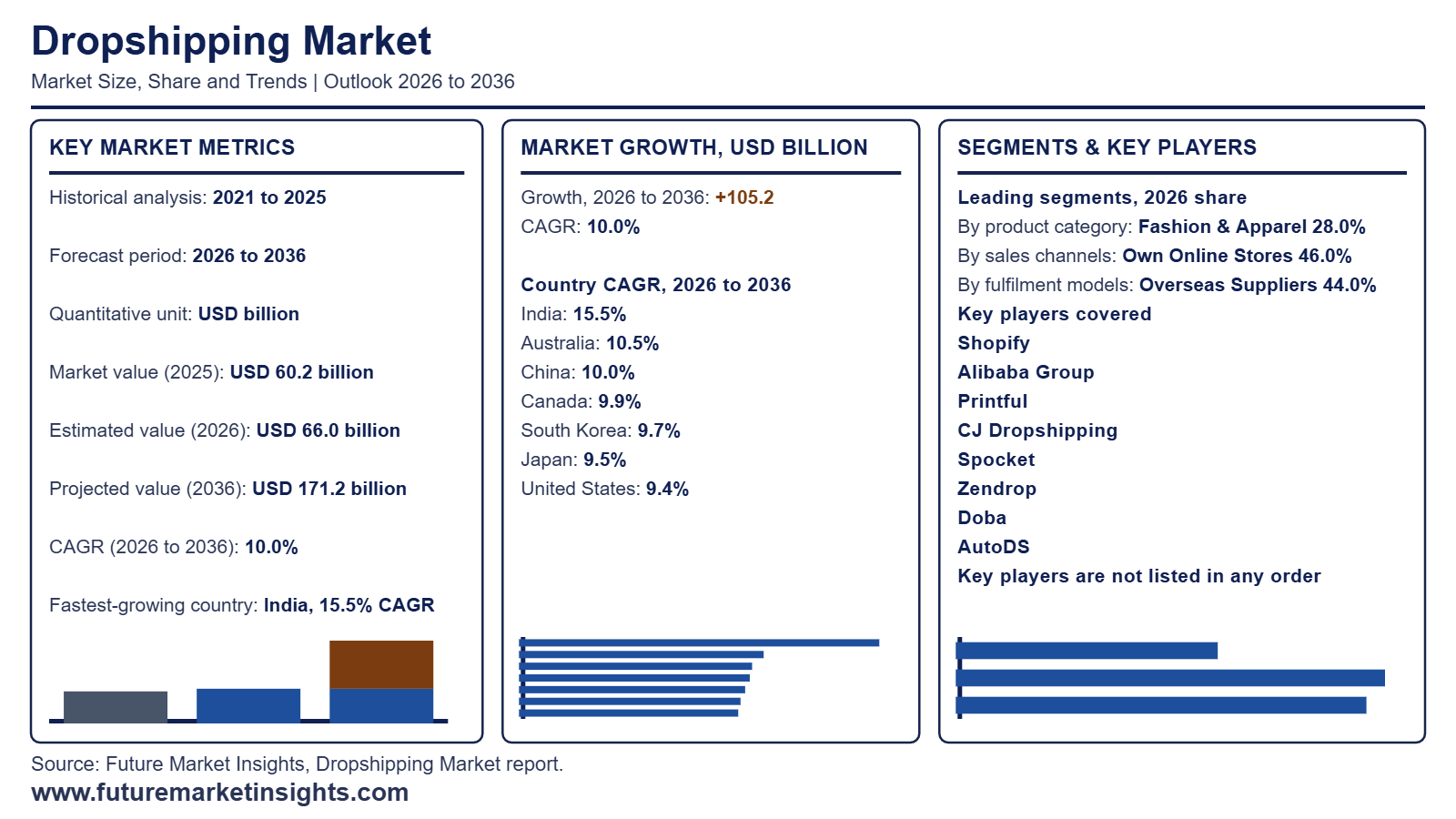
The global dropshipping market is valued at USD 66.0 billion in 2026, up from USD 60.2 billion in 2025, and is projected by Future Market Insights (FMI) to reach USD 171.2 billion by 2036, expanding at a 10.0% CAGR from 2026 to 2036 and generating USD 105.2 billion in incremental revenue over the 10-year forecast period.
| Market Metric | Valuation / Share / Forecast Benchmark |
|---|---|
| 2025 Market Size (Historical) | USD 60.2 billion |
| 2026 Market Size (Estimated) | USD 66.0 billion |
| 2036 Market Size (Projected) | USD 171.2 billion |
| Compound Annual Growth Rate (2026 to 2036) | 10.0% CAGR |
| Incremental Dollar Opportunity (2026 to 2036) | USD 105.2 billion |
| Dominant Product Category (2026 to 2036 Share) | Fashion & Apparel (28.0% in 2026, 25.6% by 2036) | Beauty fastest at 11.5% CAGR |
| Leading & Fastest-Growing Sales Channels | Own Online Stores (46.0% share in 2026; 10.8% CAGR) | Social Commerce (fastest, 12.5% CAGR) |
| Leading & Fastest-Growing Fulfilment Models | Overseas Suppliers (44.0% share in 2026; 8.0% CAGR) | Local Warehouses (fastest, 12.0% CAGR) |
| Largest Country Markets (2026 Global Share) | United States (34.0%), United Kingdom (7.0%), Germany and China (6.0% each) |
| Fastest-Growing Country Markets (2026 to 2036) | India (15.5% CAGR), Australia (10.5% CAGR), China (10.0% CAGR) |
| Leading Tier-1 Companies | Shopify, Alibaba Group, Printful, CJ Dropshipping, Spocket, Zendrop, Doba, AutoDS |
Source: Future Market Insights analysis of the dropshipping market, 2026.
Executive Market Overview
Sales of dropshipped goods are shifting toward suppliers that hold stock in local warehouses. New import duties are removing the cost advantage of shipping single low-value parcels from overseas. For example, the EU began charging a flat EUR 3 duty on parcels worth EUR 150 or less from July 2026. The United States, in turn, removed its duty-free threshold for small parcels in 2025. Local stock also gives buyers faster delivery and easier returns. Local warehouse fulfilment is therefore growing at about 12.0% a year. Direct shipping from overseas suppliers, however, is growing at about 8.0%, though it still holds around 44% of revenue in 2026.
Demand for own branded online stores is growing faster than marketplace sales. Sellers control prices, customer data and branding on own sites, which supports repeat sales. As a result, own online stores are taking about 46% of revenue in 2026 and growing at about 10.8% a year. Store-building platforms are also expanding. For instance, Shopify reported in November 2026 that gross merchandise volume rose 29% in the third quarter to USD 119.1 billion. Social commerce, meanwhile, is the fastest-growing channel at about 12.5% a year. The market as a whole is growing at about 10.0% a year through 2036.
Analyst Perspective
"Import duties on small parcels in the United States and Europe are pushing suppliers to move stock into local warehouses. Own branded stores and social video shopping will take a larger share of sales than marketplaces. AI tools will keep cutting the cost of running a store. Margins, however, will stay thin for sellers competing only on price."
- Anurag Sharma, Principal Consultant, Future Market Insights (FMI)
Major Market Trends and Insights
- Sellers Are Moving Stock Into Local Warehouses: Adoption of local warehouses is rising as duty-free small parcel rules end. The EU flat EUR 3 duty, for example, covers about 93% of e-commerce parcels entering the bloc. Low-value parcel imports into the EU had risen 26% in 2025 to 5.88 billion items. Each overseas order therefore costs more. As a result, suppliers such as CJ Dropshipping and Spocket are offering more stock from US and European warehouses.
- Shoppers Are Buying Through AI Assistants and Short Videos: Sales through AI shopping assistants and video apps are rising fast. For instance, Shopify said orders referred by AI shopping assistants rose more than threefold in 2026. Shopify is also adding features that let AI agents find and buy products. Short video apps such as TikTok Shop, in turn, are adding shopping features. As a result, small stores are reaching new buyers outside search engines and marketplaces.
- Platforms Are Lending to Small Sellers: Demand for built-in payments and loans is rising among the small businesses that run most dropshipping stores. For example, more than 68% of value sold on Shopify passed through its own payment service in the third quarter of 2026. Shopify also provided USD 1.70 billion in loans and merchant cash advances. Faster access to cash lets sellers buy stock in bulk for local warehouses. In turn, platforms are earning more per store.
What Are the Main Drivers, Restraints, and Opportunities?
Low start-up costs, easy store tools and online shopping growth are the main drivers of the dropshipping market. New import duties and long overseas delivery times restrain growth, while local warehouses and social commerce offer the largest new revenue.
Driver: Low Start-Up Costs and Easy Store Tools
Dropshippers sell before buying stock, so sellers can start with little money and test many products quickly. Store platforms such as Shopify, WooCommerce and Wix let sellers build a store in hours. Apps such as DSers, Spocket and AutoDS, in turn, link stores to suppliers automatically. Online shopping also keeps growing in every region. As a result, own online stores are set to add about USD 54.3 billion of revenue by 2036.
Restraint: Import Duties, Delivery Times and Quality
New duties in the United States and the EU raise the cost of small overseas parcels. This cuts margins for sellers that compete on low prices. Long delivery times from overseas suppliers, meanwhile, lead to complaints, refunds and chargebacks. Sellers often cannot check product quality before goods reach buyers. Advertising costs on social media have also risen, which makes it harder for new stores to attract customers.
Opportunity: Local Warehouses, Beauty and Social Commerce
Local and regional warehouse fulfilment offers the largest investment opportunity in the dropshipping market. This model is set to add about USD 47.3 billion by 2036 as sellers move stock closer to buyers. Beauty and personal care, in turn, is the fastest-growing product group at about 11.5% a year. Social commerce is growing at around 12.5% a year, as short video apps add shopping features. India, at about 15.5% a year, is the fastest-growing profiled country as online shopping spreads to smaller cities.
How Is the Dropshipping Market Segmented?
The dropshipping market is segmented into product category, sales channel, fulfilment model and region, with values shown in USD billion.
| Segmentation Axis | Sub-Segments Covered | 2026 Leading Segment & Share | Main Growth Benchmark (2026 to 2036) |
|---|---|---|---|
| Product Category | Fashion & Apparel, Electronics & Accessories, Home & Kitchen, Beauty & Personal Care, Toys Hobbies & Pets, Others | Fashion & Apparel (28.0% revenue share) | Beauty (11.5% CAGR) vs. Fashion (9.0% CAGR) |
| Sales Channel | Own Online Stores, Marketplaces, Social Commerce | Own Online Stores (46.0% revenue share) | Social Commerce (12.5% CAGR) vs. Marketplaces (7.6% CAGR) |
| Fulfilment Model | Overseas Suppliers, Local & Regional Warehouses, Print-on-Demand | Overseas Suppliers (44.0% revenue share) | Local Warehouses lead growth at a 12.0% CAGR vs. Overseas Suppliers at 8.0% |
| Region | North America, Europe, East Asia, South Asia & Pacific, Latin America, Middle East & Africa | North America (38.0% revenue share) | South Asia & Pacific leads regional growth at a 13.0% CAGR; India leads national growth at a 15.5% CAGR |
Source: Future Market Insights analysis of the dropshipping market, 2026.
Why Does the Fashion and Apparel Segment Lead by Product Category?
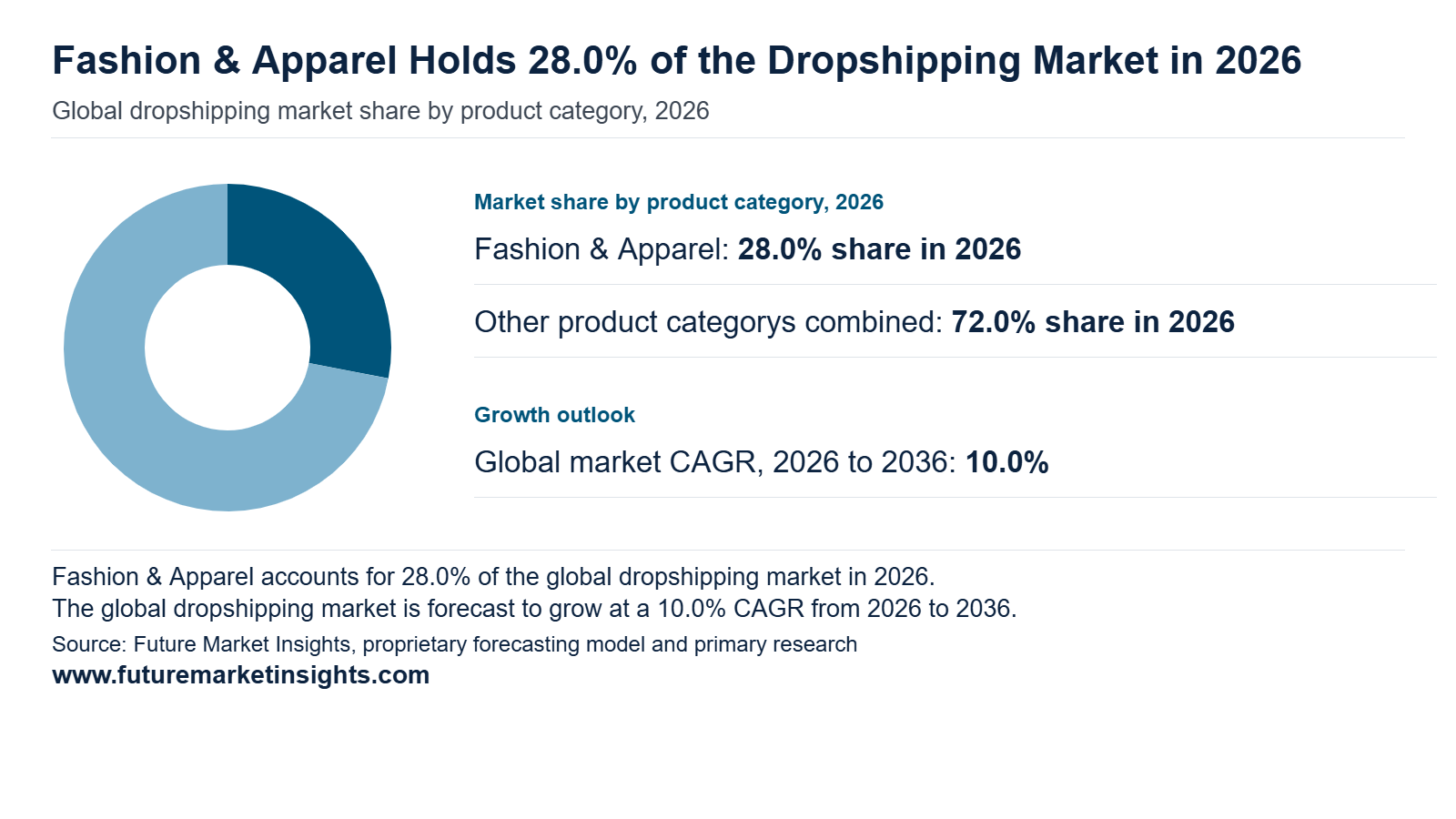
Fashion and apparel makes up about 28% of revenue in 2026, worth USD 18.5 billion. Clothing, shoes and accessories change quickly with trends and sell well through social media. High return rates, however, are slowing growth to about 9.0% a year, below the market rate. Beauty and personal care, at about 14%, is growing fastest at close to 11.5%. Buyers try new beauty brands after seeing short videos, which supports this growth. Home and kitchen products (18%) are rising at about 10.5%, while electronics and accessories (20%) are growing at around 9.5%. Toys, hobbies and pet products hold about 10%.
Why Does the Own Online Store Segment Lead by Sales Channel?
Sales through own branded stores lead, since sellers keep control of prices, customer data and repeat sales. Own online stores therefore hold about 46% of revenue in 2026, worth USD 30.4 billion. This channel is growing at about 10.8% a year. Marketplaces such as Amazon, eBay and Walmart, however, are growing more slowly at around 7.6%. Marketplace rules on delivery times and seller checks are becoming stricter. These channels hold about 38% of revenue. Social commerce through TikTok Shop and Instagram, meanwhile, holds about 16% and is growing fastest at close to 12.5% a year.
Why Does the Overseas Supplier Segment Lead by Fulfilment Model?
Most dropshipping stores still send orders to factories and wholesalers in Asia, which offer the widest range of low-cost products. Direct overseas shipping therefore holds about 44% of revenue in 2026, worth USD 29.0 billion. Import duties, however, are slowing this model to about 8.0% a year. Local and regional warehouses, at about 34%, are growing fastest at around 12.0%. As a result, local warehouses are set to become the largest model by 2036. Print-on-demand holds about 22% and is growing at close to 10.3% a year, as sellers add custom products.
Dropshipping Market by Region and Country (2026 to 2036)
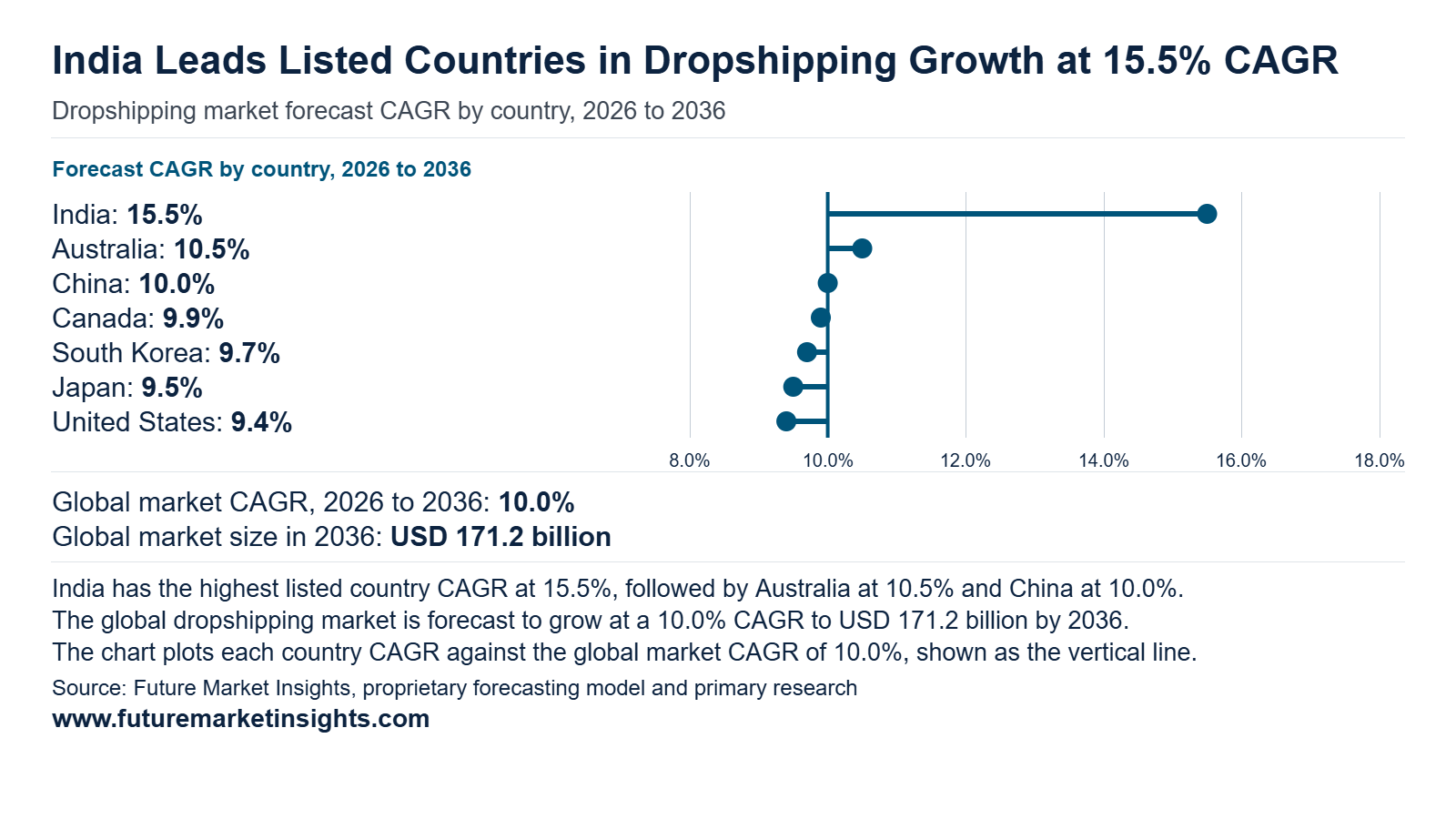
The largest number of online stores is keeping North America ahead in dropshipping. North America is likely to remain the highest market, with about 38% of global revenue in 2026. Growth in the region is about 9.4% a year. Europe, at about 26%, is growing at close to 8.8%, since the new EUR 3 duty raises overseas shipping costs. East Asia holds roughly 14% and is growing at around 11.0%. In contrast, South Asia and Pacific is the fastest-growing region at about 13.0% a year, led by India and Australia. Latin America is growing at about 11.0% and the Middle East and Africa at around 9.2%. The ten profiled countries make up around 71% of global revenue.
| Country | 2026 Revenue | 2036 Revenue | 10-Year Addition | 2026 to 2036 CAGR | Global Share (2026 → 2036) |
|---|---|---|---|---|---|
| United States | USD 22.44 billion | USD 55.11 billion | +USD 32.67 billion | 9.4% | 34.0% → 32.2% |
| United Kingdom | USD 4.62 billion | USD 10.94 billion | +USD 6.32 billion | 9.0% | 7.0% → 6.4% |
| Germany | USD 3.96 billion | USD 9.29 billion | +USD 5.33 billion | 8.9% | 6.0% → 5.4% |
| China | USD 3.96 billion | USD 10.27 billion | +USD 6.31 billion | 10.0% | 6.0% → 6.0% |
| Canada | USD 2.31 billion | USD 5.94 billion | +USD 3.63 billion | 9.9% | 3.5% → 3.5% |
| France | USD 2.31 billion | USD 5.22 billion | +USD 2.91 billion | 8.5% | 3.5% → 3.1% |
| Australia | USD 1.98 billion | USD 5.37 billion | +USD 3.39 billion | 10.5% | 3.0% → 3.1% |
| Japan | USD 1.98 billion | USD 4.91 billion | +USD 2.93 billion | 9.5% | 3.0% → 2.9% |
| South Korea | USD 1.65 billion | USD 4.16 billion | +USD 2.51 billion | 9.7% | 2.5% → 2.4% |
| India | USD 1.65 billion | USD 6.97 billion | +USD 5.32 billion | 15.5% | 2.5% → 4.1% |
Source: Future Market Insights analysis of the dropshipping market, 2026.
United States
Sales of dropshipped goods in the US are shifting to local warehouses after the duty-free small parcel threshold ended in 2025. Many sellers use US warehouses run by suppliers such as CJ Dropshipping and Spocket. Faster delivery from local stock, in turn, is reducing refunds and complaints. High online shopping rates and the largest number of Shopify stores keep the US the largest dropshipping market. The market, at USD 22.4 billion in 2026, is likely to reach USD 55.1 billion by 2036 at a 9.4% CAGR. Shopify, for example, reported 28% growth in North American sales volume in the third quarter of 2026. TikTok Shop, meanwhile, has become a fast-growing channel for small sellers. Fashion, home and beauty products are the most popular categories.
United Kingdom
High online shopping rates and wide use of social media shopping are projected to keep the UK the second largest dropshipping market. In 2026, the market in the UK is valued at USD 4.6 billion. Through 2036, it is likely to grow to USD 10.9 billion at a CAGR of 9.0%. Key trends to look for include a shift away from direct overseas shipping. The government has announced plans to end duty relief for low-value imports, following the US and the EU. Many UK sellers already use suppliers with warehouses in Britain or Europe for faster delivery. The UK also requires overseas marketplaces to collect VAT on small orders. Fashion and home products, meanwhile, are the most popular categories. Product safety and consumer rights rules apply to online sellers as well.
Germany
German buyers expect fast delivery and easy returns, which favours sellers with warehouses inside the EU. The EUR 3 duty on small parcels from 1 July 2026 has raised costs for stores shipping directly from Asia. Strict rules on product labelling, packaging waste and electronics recycling, in turn, add work for sellers. For example, sellers must register with national packaging and electronics schemes before selling. Home, electronics and fashion products sell well, and Amazon and Otto are the main marketplaces. The market in Germany, worth USD 4.0 billion in 2026, is projected to reach USD 9.3 billion by 2036. This represents a CAGR of 8.9%, below the global rate. Germany is also one of Europe's largest online shopping markets, which gives sellers a large base.
China
Chinese suppliers are opening warehouses in the United States and Europe as new import duties abroad raise costs. As a result, overseas sellers are getting shorter delivery times from Chinese stock. Large cross-border suppliers such as CJ Dropshipping and Alibaba's 1688 serve sellers worldwide. China is also the main source of products for dropshipping stores worldwide. Price competition among factories, however, keeps margins thin for small sellers. At home, platforms such as Pinduoduo and Douyin link small online sellers with factories that ship directly to buyers. Live-streaming sales on Douyin and Kuaishou, meanwhile, are a fast-growing channel. In 2026, domestic dropshipping in China is valued at USD 4.0 billion. By 2036, it is projected to reach USD 10.3 billion, growing at a CAGR of 10.0%.
Canada
Shopify is based in Canada, and Canadian online sellers use its tools widely. Many Canadian stores sell to buyers in the United States as well as at home. Changes to US duty rules, however, have raised costs for cross-border orders. Long distances and high delivery costs, in turn, make local warehouses in Ontario and British Columbia important. Fashion, pet and home products are popular. French-language stores in Quebec, meanwhile, serve a distinct group of buyers. Social media shopping is also growing among younger buyers in Toronto and Vancouver. In 2026, the market in Canada stands at USD 2.3 billion. Through 2036, it is likely to grow to USD 5.9 billion at a CAGR of 9.9%. Canada's share of global revenue stays steady at about 3.5% through 2036.
France
Rules aimed at ultra-low-cost online fashion are raising costs for overseas sellers in France. For example, France added its own fee on low-value parcels before the EU-wide EUR 3 duty began. The government has also passed rules to limit ultra-low-cost fast fashion sold online. French buyers, in turn, prefer sellers with clear return policies and local delivery. Parcel lockers and pickup points are a common delivery choice. Sellers with EU warehouses are gaining share as a result. Online fashion and beauty sales, meanwhile, remain strong among younger buyers. Valued at USD 2.3 billion in 2026, the market in France is expected to reach USD 5.2 billion by 2036. Growth, at a CAGR of 8.5%, is the slowest among the profiled countries.
Australia
Short delivery times from Asia keep direct overseas shipping more common in Australia than in other large markets. Australia charges goods and services tax on low-value imports, which online sellers collect at checkout. Many sellers, however, use local suppliers to offer faster delivery in Sydney and Melbourne. High online shopping rates and long distances from other markets also support local online stores. Home, outdoor and pet products sell well. Pay-later services such as Afterpay, in turn, are widely used at checkout, which supports larger orders. The market in Australia is valued at USD 2.0 billion in 2026. Through 2036, it is likely to grow to USD 5.4 billion at a CAGR of 10.5%. This is the second fastest rate among the profiled countries.
Japan
A weak yen is making Japanese products attractive to foreign buyers, which supports stores that export Japanese goods. Anime, hobby, stationery and beauty products sell well at home and overseas. Japanese buyers, however, expect high quality and quick delivery, which favours sellers with local stock. Japan has a large and mature online shopping market, which gives sellers a wide base of buyers. Price competition from Chinese platforms, in turn, is pushing local sellers toward niche products. Rakuten, Amazon Japan and Yahoo Shopping are the main marketplaces. Shopify, meanwhile, is growing among small brands. Convenience store pickup is also a popular delivery option. In 2026, the market in Japan is valued at USD 2.0 billion. By 2036, it is projected to reach USD 4.9 billion, growing at a CAGR of 9.5%.
South Korea
Coupang's next-day and same-day delivery has raised buyer expectations in South Korea. Sellers are therefore keeping more local stock, and fast delivery has become a basic requirement. Korean beauty and fashion products, meanwhile, are sold through dropshipping stores to buyers in the US, Europe and Southeast Asia. Cross-border platforms such as AliExpress and Temu, however, compete strongly on price. The government has increased product safety checks on low-cost imports as a result. Naver and Kakao run shopping services that small sellers use to reach buyers. Heavy mobile shopping also keeps most orders on smartphone apps. Worth USD 1.7 billion in 2026, the market is set to reach USD 4.2 billion by 2036. Growth is at a CAGR of 9.7%, close to the global rate.
India
Rapid growth of online shopping in smaller cities is making India the fastest-growing dropshipping market among the profiled countries. Low-cost smartphones and cheap mobile data have brought hundreds of millions of new online shoppers. Platforms such as Meesho let small sellers list products from suppliers without holding stock. Cash on delivery, however, remains popular, which raises return rates and ties up cash for sellers. New logistics networks, in turn, reach most postal codes in the country. As a result, orders from small towns are growing faster than orders from large cities. Indian sellers also export clothing, jewellery and home products to buyers abroad. In 2026, the market in India is worth USD 1.7 billion. By 2036, it is projected to reach USD 7.0 billion, growing at a CAGR of 15.5%.
Competitive Environment and Notable Companies
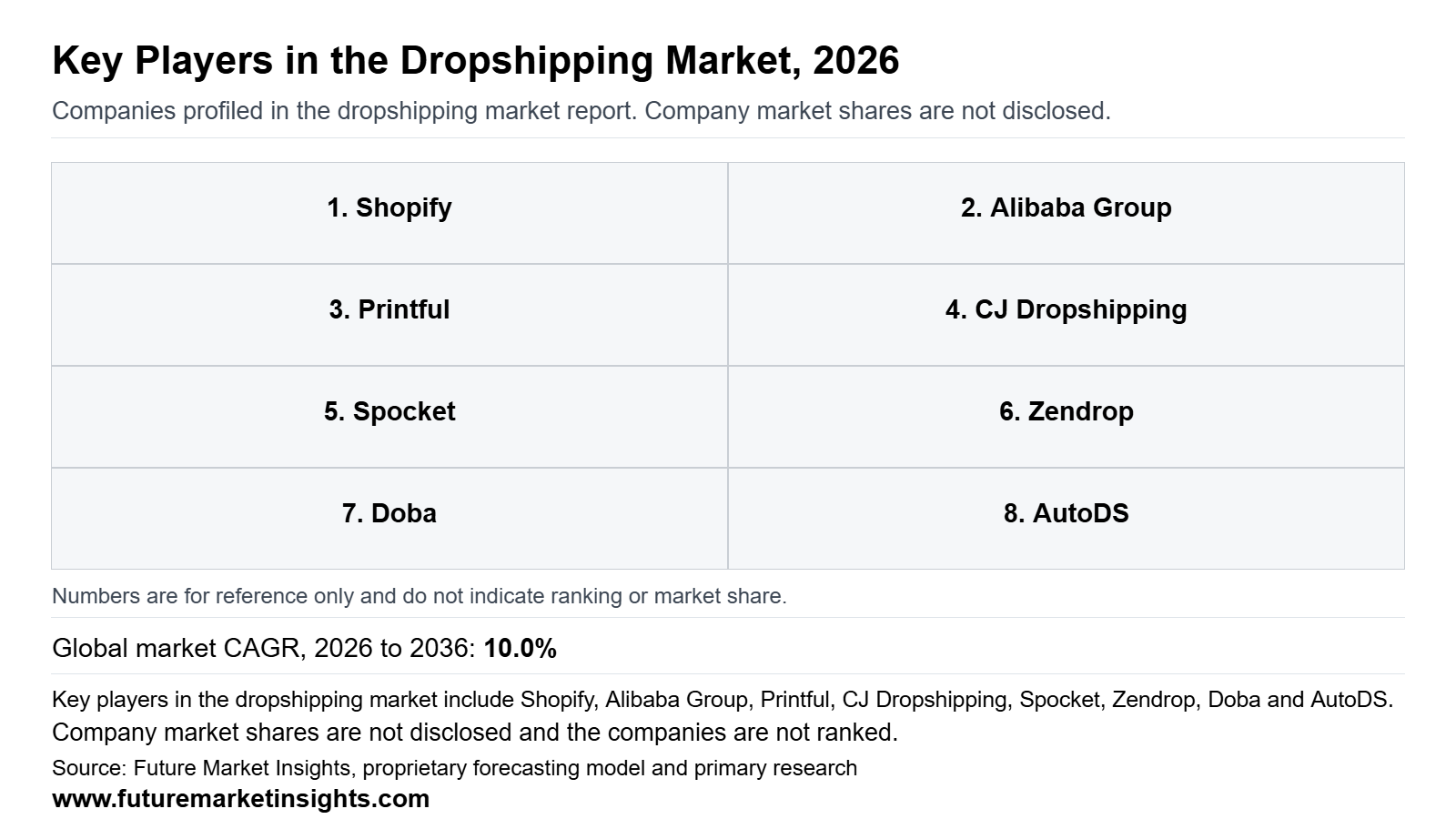
The dropshipping market is split between store platforms and supplier networks. Notable companies include Shopify, Alibaba Group, Printful, CJ Dropshipping and Spocket. Zendrop, Doba, SaleHoo, Syncee and AutoDS are also active, mainly in supplier sourcing and order automation. Store platforms provide tools to build shops and take payments, while supplier networks source, store and ship products. Since import duties are rising, suppliers with US and European warehouses are gaining sellers. As a result, competition is shifting toward delivery speed and local stock. Product range, automation and price, however, still matter to most small sellers.
How Are Companies Positioned in the Dropshipping Market?
Store platforms are adding payments, AI tools and loans to earn more per seller. For example, Shopify reported in November 2026 that sales volume on its platform rose 29%. Shopify also provided USD 1.70 billion in loans and merchant cash advances in the third quarter. Supplier networks, meanwhile, are opening more warehouses in the US and Europe. As a result, sellers can avoid new duties on small parcels. Print-on-demand providers are adding more custom products.
How Do Sellers Choose a Supplier or Platform?
Sellers compare suppliers first on product range and product cost. Delivery time comes next, since slow shipping leads to refunds and chargebacks. Stock reliability and automation tools then decide the final choice. Many sellers also check supplier ratings, order tracking and return handling before signing up. Large sellers, in turn, look for suppliers with warehouses in each target market.
Which Capabilities Distinguish Provider Offers?
Local warehouses in key markets are the main point of difference between supplier offers. Automated order routing, in turn, cuts errors for sellers with many products. Product quality checks also reduce refunds and complaints from buyers. Branded packaging and print-on-demand services, meanwhile, help sellers build own brands and charge higher prices.
How Does Geographic Reach Affect Competition?
Suppliers with warehouses close to buyers deliver faster and avoid duties on small parcels. As a result, supplier networks are opening sites in the US and Europe. Platforms that support many languages, currencies and payment methods, in turn, help sellers reach buyers in several countries. Asian factories, however, still offer the widest product range at the lowest cost. Most sellers therefore combine local stock for best-sellers with overseas shipping for other products.
| Verified Company Evidence (2026) | Commercial Effect | Buyer Action |
|---|---|---|
| 3 November 2026: Shopify reported Q3 revenue of USD 3.74 billion, up 32%, and gross merchandise volume of USD 119.1 billion, up 29%; payments penetration passed 68% (Shopify; Zacks, November 2026). | Shows continued growth in store-building platforms used by dropshippers. | Use built-in payments and analytics to track margins per product. |
| 1 July 2026: The EU began charging a flat EUR 3 customs duty per item on parcels worth EUR 150 or less, covering about 93% of e-commerce parcels (VATCalc; Logistics Manager, 2026). | Raises the cost of single overseas parcels into Europe. | Move best-selling products to EU-based warehouses. |
| 2026: EU imports of low-value e-commerce parcels rose 26% in 2025 to a record 5.88 billion items, mostly from China (Global Pet Industry, 2026). | Explains the push by regulators to tax small parcels. | Review landed costs for every overseas product line. |
Source: Verified corporate disclosures and Future Market Insights analysis, 2026.
| Company | Core Positioning | Verified Activity & Source Attribution |
| Shopify | Store-building and payments platform | Q3 2026 GMV of USD 119.1 billion, up 29% (Shopify, November 2026). |
| CJ Dropshipping | Sourcing and fulfilment network with overseas warehouses | Company information. |
| Printful | Print-on-demand production and fulfilment | Company information. |
| Spocket | Supplier marketplace focused on US and EU suppliers | Company information. |
Source: Verified corporate disclosures and Future Market Insights analysis, 2026.
Dropshipping Market Report Scope and Research Methodology
The value of goods sold through dropshipping by country forms the base of FMI's estimate. These sales are taken from platform data, supplier reports and e-commerce statistics. Sales are split by product category, sales channel and fulfilment model. Country totals are then added to give regional and global values. Forecasts are built on online shopping growth, import rules, delivery costs and seller numbers. New duty rules, such as the EU EUR 3 parcel duty from July 2026, are tracked, since these shift fulfilment models. As a final step, FMI checks the results against the reported sales volume of listed platforms and supplier networks. Any country where figures do not match is adjusted.
| Coverage Field | Report Scope |
|---|---|
| Market definition | Online retail sales in which the seller does not hold stock and the supplier ships goods directly to the buyer. |
| Product categories | Fashion and apparel, electronics and accessories, home and kitchen, beauty and personal care, toys hobbies and pets, and others. |
| Sales channels | Own online stores, marketplaces and social commerce. |
| Fulfilment models | Overseas suppliers, local and regional warehouses, and print-on-demand. |
| Seller types | Individual sellers, small businesses and brands. |
| Buyer types | Household consumers. |
| Revenue basis | Value of goods sold to buyers through dropshipping. |
| Exclusions | Online sales from retailer-owned stock, business-to-business wholesale orders and digital goods. |
| Quantitative units | USD billion for value. |
| Volume basis | Number of orders shipped, used to check value estimates. |
| Value basis | Sales value recognised in the country of the buyer. |
| Regions covered | North America, Europe, East Asia, South Asia & Pacific, Latin America, and Middle East & Africa. |
| National coverage | United States, United Kingdom, Germany, China, Canada, France, Australia, Japan, South Korea, India. |
| Companies covered | Shopify, Alibaba Group, Printful, CJ Dropshipping, Spocket, Zendrop, Doba, SaleHoo, Syncee and AutoDS. |
Source: Future Market Insights analysis of the dropshipping market, 2026.
Research Sources and Bibliography
- Shopify Inc. (2026, November 3). Shopify sustains rapid growth with revenue up 32% and free cash flow margin of 22%.
- PPC Land. (2026, November). Shopify revenue gains 32% to $3.7bn as AI-referred orders rise 3.3x.
- Zacks. (2026, November). Shopify Q3 earnings beat estimates.
- VATCalc. (2026). EU EUR 3 duty on low-value e-commerce parcel imports from 1 July 2026.
- Global Pet Industry. (2026). EU's new customs rules set to reshape cross-border e-commerce.
- Logistics Manager. (2026). EU levy on small parcels from July 2026.
Table of Content
- Key Takeaways
- Market Size and CAGR
- Top Growth Driver
- Fastest Growing Segment
- Leading Region
- Key Companies
- Emerging Opportunities
- Executive Summary
- Global Market Outlook
- Demand-side Trends
- Supply-side Trends
- Technology Roadmap Analysis
- Analysis and Recommendations
- Analyst Perspective (What is happening? Why now? What should investors know?)
- Key Questions Answered
- How large is the market?
- What is the CAGR?
- What are key trends?
- Which region dominates?
- Who are the leaders?
Read More...
- Market Overview
- Market Coverage / Taxonomy
- Market Definition / Scope / Limitations
- Research Methodology
- Chapter Orientation
- Analytical Lens and Working Hypotheses
- Market Structure, Signals, and Trend Drivers
- Benchmarking and Cross-market Comparability
- Market Sizing, Forecasting, and Opportunity Mapping
- Research Design and Evidence Framework
- Desk Research Programme (Secondary Evidence)
- Expert Input and Fieldwork (Primary Evidence)
- Tooling, Models, and Reference Databases
- Data Engineering and Model Build
- Quality Assurance and Audit Trail
- Market Background
- Market Dynamics (Drivers, Restraints, Opportunity, Trends)
- Scenario Forecast (Optimistic, Likely, Conservative)
- Impact Analysis
- AI Impact
- Sustainability Impact
- Regulatory Impact
- Technology Impact
- Consumer / Buyer Analysis
- Purchase Drivers
- Adoption Barriers
- Buyer Journey
- Opportunity Map Analysis
- Product Life Cycle Analysis
- Supply Chain Analysis
- Investment Feasibility Matrix
- Value Chain Analysis
- PESTLE and Porter's Analysis
- Regulatory Landscape
- Regional Parent Market Outlook
- Production and Consumption Statistics
- Import and Export Statistics
- Global Dropshipping Market Analysis and Forecast, 2021 to 2036
- Historical Market Size Value (USD Billion) Analysis, 2021 to 2025
- Current and Future Market Size Value (USD Billion) Projections, 2026 to 2036
- Y-o-Y Growth Trend Analysis
- Absolute $ Opportunity Analysis
- Global Dropshipping Market Pricing Analysis, 2021 to 2036
- Global Dropshipping Market Analysis and Forecast, By Product Category, 2021 to 2036
- Introduction / Key Findings
- Historical Market Size Value (USD Billion) Analysis By Product Category, 2021 to 2025
- Current and Future Market Size Value (USD Billion) Analysis and Forecast By Product Category, 2026 to 2036
- Fashion & Apparel
- Electronics & Accessories
- Home & Kitchen
- Beauty & Personal Care
- Toys Hobbies & Pets
- Others
- Y-o-Y Growth Trend Analysis By Product Category, 2021 to 2025
- Absolute $ Opportunity Analysis By Product Category, 2026 to 2036
- Global Dropshipping Market Analysis and Forecast, By Sales Channel, 2021 to 2036
- Introduction / Key Findings
- Historical Market Size Value (USD Billion) Analysis By Sales Channel, 2021 to 2025
- Current and Future Market Size Value (USD Billion) Analysis and Forecast By Sales Channel, 2026 to 2036
- Own Online Stores
- Marketplaces
- Social Commerce
- Y-o-Y Growth Trend Analysis By Sales Channel, 2021 to 2025
- Absolute $ Opportunity Analysis By Sales Channel, 2026 to 2036
- Global Dropshipping Market Analysis and Forecast, By Fulfilment Model, 2021 to 2036
- Introduction / Key Findings
- Historical Market Size Value (USD Billion) Analysis By Fulfilment Model, 2021 to 2025
- Current and Future Market Size Value (USD Billion) Analysis and Forecast By Fulfilment Model, 2026 to 2036
- Overseas Suppliers
- Local & Regional Warehouses
- Print-on-Demand
- Y-o-Y Growth Trend Analysis By Fulfilment Model, 2021 to 2025
- Absolute $ Opportunity Analysis By Fulfilment Model, 2026 to 2036
- Global Dropshipping Market Analysis and Forecast, By Region, 2021 to 2036
- Introduction
- Historical Market Size Value (USD Billion) Analysis By Region, 2021 to 2025
- Current Market Size Value (USD Billion) Analysis and Forecast By Region, 2026 to 2036
- North America
- Europe
- East Asia
- South Asia & Pacific
- Latin America
- Middle East & Africa
- Market Attractiveness Analysis By Region
- North America Dropshipping Market Analysis and Forecast, By Country, 2021 to 2036
- Historical Market Size Value (USD Billion) Trend Analysis By Market Taxonomy, 2021 to 2025
- Market Size Value (USD Billion) Forecast By Market Taxonomy, 2026 to 2036
- By Country
- United States
- Canada
- Rest of North America
- By Product Category
- By Sales Channel
- By Fulfilment Model
- By Country
- Market Attractiveness Analysis
- By Country
- By Product Category
- By Sales Channel
- By Fulfilment Model
- Key Takeaways
- Europe Dropshipping Market Analysis and Forecast, By Country, 2021 to 2036
- Historical Market Size Value (USD Billion) Trend Analysis By Market Taxonomy, 2021 to 2025
- Market Size Value (USD Billion) Forecast By Market Taxonomy, 2026 to 2036
- By Country
- United Kingdom
- Germany
- France
- Rest of Europe
- By Product Category
- By Sales Channel
- By Fulfilment Model
- By Country
- Market Attractiveness Analysis
- By Country
- By Product Category
- By Sales Channel
- By Fulfilment Model
- Key Takeaways
- East Asia Dropshipping Market Analysis and Forecast, By Country, 2021 to 2036
- Historical Market Size Value (USD Billion) Trend Analysis By Market Taxonomy, 2021 to 2025
- Market Size Value (USD Billion) Forecast By Market Taxonomy, 2026 to 2036
- By Country
- China
- Japan
- South Korea
- Rest of East Asia
- By Product Category
- By Sales Channel
- By Fulfilment Model
- By Country
- Market Attractiveness Analysis
- By Country
- By Product Category
- By Sales Channel
- By Fulfilment Model
- Key Takeaways
- South Asia & Pacific Dropshipping Market Analysis and Forecast, By Country, 2021 to 2036
- Historical Market Size Value (USD Billion) Trend Analysis By Market Taxonomy, 2021 to 2025
- Market Size Value (USD Billion) Forecast By Market Taxonomy, 2026 to 2036
- By Country
- Australia
- India
- Rest of South Asia & Pacific
- By Product Category
- By Sales Channel
- By Fulfilment Model
- By Country
- Market Attractiveness Analysis
- By Country
- By Product Category
- By Sales Channel
- By Fulfilment Model
- Key Takeaways
- Latin America Dropshipping Market Analysis and Forecast, By Country, 2021 to 2036
- Historical Market Size Value (USD Billion) Trend Analysis By Market Taxonomy, 2021 to 2025
- Market Size Value (USD Billion) Forecast By Market Taxonomy, 2026 to 2036
- By Country
- Rest of Latin America
- By Product Category
- By Sales Channel
- By Fulfilment Model
- By Country
- Market Attractiveness Analysis
- By Country
- By Product Category
- By Sales Channel
- By Fulfilment Model
- Key Takeaways
- Middle East & Africa Dropshipping Market Analysis and Forecast, By Country, 2021 to 2036
- Historical Market Size Value (USD Billion) Trend Analysis By Market Taxonomy, 2021 to 2025
- Market Size Value (USD Billion) Forecast By Market Taxonomy, 2026 to 2036
- By Country
- Rest of Middle East & Africa
- By Product Category
- By Sales Channel
- By Fulfilment Model
- By Country
- Market Attractiveness Analysis
- By Country
- By Product Category
- By Sales Channel
- By Fulfilment Model
- Key Takeaways
- Key Countries Market Analysis
- United States
- Pricing Analysis
- Market Share Analysis, 2025
- By Product Category
- By Sales Channel
- By Fulfilment Model
- United Kingdom
- Pricing Analysis
- Market Share Analysis, 2025
- By Product Category
- By Sales Channel
- By Fulfilment Model
- Germany
- Pricing Analysis
- Market Share Analysis, 2025
- By Product Category
- By Sales Channel
- By Fulfilment Model
- China
- Pricing Analysis
- Market Share Analysis, 2025
- By Product Category
- By Sales Channel
- By Fulfilment Model
- Canada
- Pricing Analysis
- Market Share Analysis, 2025
- By Product Category
- By Sales Channel
- By Fulfilment Model
- France
- Pricing Analysis
- Market Share Analysis, 2025
- By Product Category
- By Sales Channel
- By Fulfilment Model
- Australia
- Pricing Analysis
- Market Share Analysis, 2025
- By Product Category
- By Sales Channel
- By Fulfilment Model
- Japan
- Pricing Analysis
- Market Share Analysis, 2025
- By Product Category
- By Sales Channel
- By Fulfilment Model
- South Korea
- Pricing Analysis
- Market Share Analysis, 2025
- By Product Category
- By Sales Channel
- By Fulfilment Model
- India
- Pricing Analysis
- Market Share Analysis, 2025
- By Product Category
- By Sales Channel
- By Fulfilment Model
- United States
- Market Structure Analysis
- Competition Dashboard
- Competition Benchmarking
- Market Share Analysis of Top Players
- By Regional
- By Product Category
- By Sales Channel
- By Fulfilment Model
- Emerging Startups
- Innovation Benchmarking
- Competition Analysis
- Competition Deep Dive
- Shopify
- Overview
- Product Portfolio
- Profitability by Market Segments
- Sales Footprint
- Strategy Overview
- Marketing Strategy
- Product Strategy
- Channel Strategy
- Alibaba Group
- Printful
- CJ Dropshipping
- Spocket
- Zendrop
- Doba
- SaleHoo
- Syncee
- AutoDS
- Shopify
- Case Studies
- Success Stories
- Recent Developments
- Competition Deep Dive
- Assumptions & Acronyms Used
List of Tables
- Table 1: Global Dropshipping Market Value (USD Billion) Forecast by Region, 2021 to 2036
- Table 2: Global Dropshipping Market Value (USD Billion) Forecast by Product Category, 2021 to 2036
- Table 3: Global Dropshipping Market Value (USD Billion) Forecast by Sales Channel, 2021 to 2036
- Table 4: Global Dropshipping Market Value (USD Billion) Forecast by Fulfilment Model, 2021 to 2036
- Table 5: North America Dropshipping Market Value (USD Billion) Forecast by Country, 2021 to 2036
- Table 6: North America Dropshipping Market Value (USD Billion) Forecast by Product Category, 2021 to 2036
- Table 7: North America Dropshipping Market Value (USD Billion) Forecast by Sales Channel, 2021 to 2036
- Table 8: North America Dropshipping Market Value (USD Billion) Forecast by Fulfilment Model, 2021 to 2036
- Table 9: Europe Dropshipping Market Value (USD Billion) Forecast by Country, 2021 to 2036
- Table 10: Europe Dropshipping Market Value (USD Billion) Forecast by Product Category, 2021 to 2036
- Table 11: Europe Dropshipping Market Value (USD Billion) Forecast by Sales Channel, 2021 to 2036
- Table 12: Europe Dropshipping Market Value (USD Billion) Forecast by Fulfilment Model, 2021 to 2036
- Table 13: East Asia Dropshipping Market Value (USD Billion) Forecast by Country, 2021 to 2036
- Table 14: East Asia Dropshipping Market Value (USD Billion) Forecast by Product Category, 2021 to 2036
- Table 15: East Asia Dropshipping Market Value (USD Billion) Forecast by Sales Channel, 2021 to 2036
- Table 16: East Asia Dropshipping Market Value (USD Billion) Forecast by Fulfilment Model, 2021 to 2036
- Table 17: South Asia & Pacific Dropshipping Market Value (USD Billion) Forecast by Country, 2021 to 2036
- Table 18: South Asia & Pacific Dropshipping Market Value (USD Billion) Forecast by Product Category, 2021 to 2036
- Table 19: South Asia & Pacific Dropshipping Market Value (USD Billion) Forecast by Sales Channel, 2021 to 2036
- Table 20: South Asia & Pacific Dropshipping Market Value (USD Billion) Forecast by Fulfilment Model, 2021 to 2036
- Table 21: Latin America Dropshipping Market Value (USD Billion) Forecast by Country, 2021 to 2036
- Table 22: Latin America Dropshipping Market Value (USD Billion) Forecast by Product Category, 2021 to 2036
- Table 23: Latin America Dropshipping Market Value (USD Billion) Forecast by Sales Channel, 2021 to 2036
- Table 24: Latin America Dropshipping Market Value (USD Billion) Forecast by Fulfilment Model, 2021 to 2036
- Table 25: Middle East & Africa Dropshipping Market Value (USD Billion) Forecast by Country, 2021 to 2036
- Table 26: Middle East & Africa Dropshipping Market Value (USD Billion) Forecast by Product Category, 2021 to 2036
- Table 27: Middle East & Africa Dropshipping Market Value (USD Billion) Forecast by Sales Channel, 2021 to 2036
- Table 28: Middle East & Africa Dropshipping Market Value (USD Billion) Forecast by Fulfilment Model, 2021 to 2036
List of Figures
- Figure 1: Global Dropshipping Market Pricing Analysis
- Figure 2: Global Dropshipping Market Value (USD Billion) Forecast 2021-2036
- Figure 3: Global Dropshipping Market Value Share and BPS Analysis by Product Category, 2026 and 2036
- Figure 4: Global Dropshipping Market Y-o-Y Growth Comparison by Product Category, 2026-2036
- Figure 5: Global Dropshipping Market Attractiveness Analysis by Product Category
- Figure 6: Global Dropshipping Market Value Share and BPS Analysis by Sales Channel, 2026 and 2036
- Figure 7: Global Dropshipping Market Y-o-Y Growth Comparison by Sales Channel, 2026-2036
- Figure 8: Global Dropshipping Market Attractiveness Analysis by Sales Channel
- Figure 9: Global Dropshipping Market Value Share and BPS Analysis by Fulfilment Model, 2026 and 2036
- Figure 10: Global Dropshipping Market Y-o-Y Growth Comparison by Fulfilment Model, 2026-2036
- Figure 11: Global Dropshipping Market Attractiveness Analysis by Fulfilment Model
- Figure 12: Global Dropshipping Market Value (USD Billion) Share and BPS Analysis by Region, 2026 and 2036
- Figure 13: Global Dropshipping Market Y-o-Y Growth Comparison by Region, 2026-2036
- Figure 14: Global Dropshipping Market Attractiveness Analysis by Region
- Figure 15: North America Dropshipping Market Incremental Dollar Opportunity, 2026-2036
- Figure 16: Europe Dropshipping Market Incremental Dollar Opportunity, 2026-2036
- Figure 17: East Asia Dropshipping Market Incremental Dollar Opportunity, 2026-2036
- Figure 18: South Asia & Pacific Dropshipping Market Incremental Dollar Opportunity, 2026-2036
- Figure 19: Latin America Dropshipping Market Incremental Dollar Opportunity, 2026-2036
- Figure 20: Middle East & Africa Dropshipping Market Incremental Dollar Opportunity, 2026-2036
- Figure 21: North America Dropshipping Market Value Share and BPS Analysis by Country, 2026 and 2036
- Figure 22: North America Dropshipping Market Value Share and BPS Analysis by Product Category, 2026 and 2036
- Figure 23: North America Dropshipping Market Y-o-Y Growth Comparison by Product Category, 2026-2036
- Figure 24: North America Dropshipping Market Attractiveness Analysis by Product Category
- Figure 25: North America Dropshipping Market Value Share and BPS Analysis by Sales Channel, 2026 and 2036
- Figure 26: North America Dropshipping Market Y-o-Y Growth Comparison by Sales Channel, 2026-2036
- Figure 27: North America Dropshipping Market Attractiveness Analysis by Sales Channel
- Figure 28: North America Dropshipping Market Value Share and BPS Analysis by Fulfilment Model, 2026 and 2036
- Figure 29: North America Dropshipping Market Y-o-Y Growth Comparison by Fulfilment Model, 2026-2036
- Figure 30: North America Dropshipping Market Attractiveness Analysis by Fulfilment Model
- Figure 31: Europe Dropshipping Market Value Share and BPS Analysis by Country, 2026 and 2036
- Figure 32: Europe Dropshipping Market Value Share and BPS Analysis by Product Category, 2026 and 2036
- Figure 33: Europe Dropshipping Market Y-o-Y Growth Comparison by Product Category, 2026-2036
- Figure 34: Europe Dropshipping Market Attractiveness Analysis by Product Category
- Figure 35: Europe Dropshipping Market Value Share and BPS Analysis by Sales Channel, 2026 and 2036
- Figure 36: Europe Dropshipping Market Y-o-Y Growth Comparison by Sales Channel, 2026-2036
- Figure 37: Europe Dropshipping Market Attractiveness Analysis by Sales Channel
- Figure 38: Europe Dropshipping Market Value Share and BPS Analysis by Fulfilment Model, 2026 and 2036
- Figure 39: Europe Dropshipping Market Y-o-Y Growth Comparison by Fulfilment Model, 2026-2036
- Figure 40: Europe Dropshipping Market Attractiveness Analysis by Fulfilment Model
- Figure 41: East Asia Dropshipping Market Value Share and BPS Analysis by Country, 2026 and 2036
- Figure 42: East Asia Dropshipping Market Value Share and BPS Analysis by Product Category, 2026 and 2036
- Figure 43: East Asia Dropshipping Market Y-o-Y Growth Comparison by Product Category, 2026-2036
- Figure 44: East Asia Dropshipping Market Attractiveness Analysis by Product Category
- Figure 45: East Asia Dropshipping Market Value Share and BPS Analysis by Sales Channel, 2026 and 2036
- Figure 46: East Asia Dropshipping Market Y-o-Y Growth Comparison by Sales Channel, 2026-2036
- Figure 47: East Asia Dropshipping Market Attractiveness Analysis by Sales Channel
- Figure 48: East Asia Dropshipping Market Value Share and BPS Analysis by Fulfilment Model, 2026 and 2036
- Figure 49: East Asia Dropshipping Market Y-o-Y Growth Comparison by Fulfilment Model, 2026-2036
- Figure 50: East Asia Dropshipping Market Attractiveness Analysis by Fulfilment Model
- Figure 51: South Asia & Pacific Dropshipping Market Value Share and BPS Analysis by Country, 2026 and 2036
- Figure 52: South Asia & Pacific Dropshipping Market Value Share and BPS Analysis by Product Category, 2026 and 2036
- Figure 53: South Asia & Pacific Dropshipping Market Y-o-Y Growth Comparison by Product Category, 2026-2036
- Figure 54: South Asia & Pacific Dropshipping Market Attractiveness Analysis by Product Category
- Figure 55: South Asia & Pacific Dropshipping Market Value Share and BPS Analysis by Sales Channel, 2026 and 2036
- Figure 56: South Asia & Pacific Dropshipping Market Y-o-Y Growth Comparison by Sales Channel, 2026-2036
- Figure 57: South Asia & Pacific Dropshipping Market Attractiveness Analysis by Sales Channel
- Figure 58: South Asia & Pacific Dropshipping Market Value Share and BPS Analysis by Fulfilment Model, 2026 and 2036
- Figure 59: South Asia & Pacific Dropshipping Market Y-o-Y Growth Comparison by Fulfilment Model, 2026-2036
- Figure 60: South Asia & Pacific Dropshipping Market Attractiveness Analysis by Fulfilment Model
- Figure 61: Latin America Dropshipping Market Value Share and BPS Analysis by Country, 2026 and 2036
- Figure 62: Latin America Dropshipping Market Value Share and BPS Analysis by Product Category, 2026 and 2036
- Figure 63: Latin America Dropshipping Market Y-o-Y Growth Comparison by Product Category, 2026-2036
- Figure 64: Latin America Dropshipping Market Attractiveness Analysis by Product Category
- Figure 65: Latin America Dropshipping Market Value Share and BPS Analysis by Sales Channel, 2026 and 2036
- Figure 66: Latin America Dropshipping Market Y-o-Y Growth Comparison by Sales Channel, 2026-2036
- Figure 67: Latin America Dropshipping Market Attractiveness Analysis by Sales Channel
- Figure 68: Latin America Dropshipping Market Value Share and BPS Analysis by Fulfilment Model, 2026 and 2036
- Figure 69: Latin America Dropshipping Market Y-o-Y Growth Comparison by Fulfilment Model, 2026-2036
- Figure 70: Latin America Dropshipping Market Attractiveness Analysis by Fulfilment Model
- Figure 71: Middle East & Africa Dropshipping Market Value Share and BPS Analysis by Country, 2026 and 2036
- Figure 72: Middle East & Africa Dropshipping Market Value Share and BPS Analysis by Product Category, 2026 and 2036
- Figure 73: Middle East & Africa Dropshipping Market Y-o-Y Growth Comparison by Product Category, 2026-2036
- Figure 74: Middle East & Africa Dropshipping Market Attractiveness Analysis by Product Category
- Figure 75: Middle East & Africa Dropshipping Market Value Share and BPS Analysis by Sales Channel, 2026 and 2036
- Figure 76: Middle East & Africa Dropshipping Market Y-o-Y Growth Comparison by Sales Channel, 2026-2036
- Figure 77: Middle East & Africa Dropshipping Market Attractiveness Analysis by Sales Channel
- Figure 78: Middle East & Africa Dropshipping Market Value Share and BPS Analysis by Fulfilment Model, 2026 and 2036
- Figure 79: Middle East & Africa Dropshipping Market Y-o-Y Growth Comparison by Fulfilment Model, 2026-2036
- Figure 80: Middle East & Africa Dropshipping Market Attractiveness Analysis by Fulfilment Model
- Figure 81: Global Dropshipping Market - Tier Structure Analysis
- Figure 82: Global Dropshipping Market - Company Share Analysis
Frequently Asked Questions
How big is the dropshipping market in 2026?
Future Market Insights estimates the global dropshipping market at USD 66.0 billion in 2026, up from USD 60.2 billion in 2025. More online stores and social shopping are driving this growth.
How fast is the dropshipping market expected to grow through 2036?
FMI projects a 10.0% CAGR from 2026 to 2036, taking the market to USD 171.2 billion by 2036. This adds USD 105.2 billion in revenue, led by local warehouse fulfilment and own online stores.
Which product category leads the dropshipping market?
Fashion and apparel leads with 28.0% of 2026 revenue, as clothing sells well through social media. Beauty and personal care is growing fastest, at about 11.5% a year, as buyers follow short video trends.
Which sales channel leads the dropshipping market?
Own online stores hold 46.0% of 2026 revenue, as sellers keep control of prices and customer data. Social commerce is growing fastest, at about 12.5% a year, as video apps add shopping.
Which fulfilment model leads the dropshipping market?
Direct shipping from overseas suppliers accounts for 44.0% of 2026 revenue. Local and regional warehouses are growing fastest, at about 12.0% a year, as import duties raise overseas costs.
Which country is the largest dropshipping market?
The United States is the largest market, with 34.0% of global revenue in 2026, worth USD 22.4 billion. The UK follows at 7.0% (USD 4.6 billion), and Germany and China at 6.0% each.
Which countries are expected to grow fastest in the dropshipping market?
India is projected to grow fastest, at a 15.5% CAGR from 2026 to 2036, as online shopping spreads to smaller cities. Australia follows at 10.5% and China at 10.0%.
What drives demand for dropshipping?
Low start-up costs and easy store-building tools are the main drivers. Online and social shopping growth and access to large supplier networks are also adding new sellers.
Preview the report firsthand - request a free sample
Get SampleGet the brochure for pricing and purchase details.
Get PDF