

- Market Size (2026)
- USD 1339.5 Mn
- Forecast (2036)
- USD 6222.0 Mn
- CAGR (2026 to 2036)
- 16.6%
How big is ECG Biomarker Development Market in 2026?
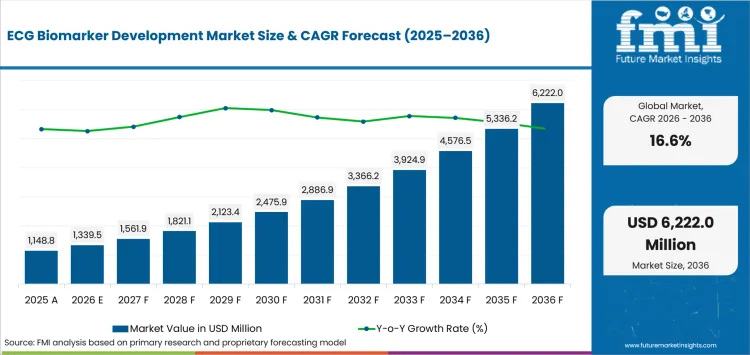
USD 1,339.5 million in 2026 and USD 6,222.0 million by 2036 at a 16.6% CAGR.
Sales of ECG biomarker development are projected to expand at 16.6% CAGR from 2026 to 2036. The industry valuation is estimated at USD 1339.5 million in 2026 and is projected to reach USD 6222.0 million by 2036. Growth is expected to come from cardiac teams and drug developers that use repeatable ECG signals for risk review, trial monitoring and treatment-safety checks. Customers are expected to approve tools when the result changes a named decision in diagnosis or patient follow-up. Clear clinical ownership remains more useful than a broad software claim.
ECG records are moving beyond the hospital exam room as remote care and clinical studies generate more heart rhythm data. The American Heart Association reported in January 2026 that 125.9 million USA adults were living with high blood pressure. This level of cardiovascular burden is expected to keep attention on tools that turn routine ECG records into simple risk signals. The commercial case is strongest when a biomarker improves triage without adding new work that clinicians cannot use.
Key Takeaways of ECG Biomarker Development Market
- Demand for ECG biomarker development is driven by the need to improve cardiac screening, monitoring, drug-safety assessment, and clinical trial decision-making through measurable ECG signals.
- By biomarker type, Electrophysiological Biomarkers are expected to lead with 40.7% share in 2026, supported by established use in rhythm assessment and cardiac-signal interpretation.
- Cardiovascular Disease Detection is projected to lead the application category with 36.0% share in 2026, reflecting the use of ECG biomarkers in screening, referral, and follow-up decisions.
- Pharmaceutical Companies are estimated to lead the end-user category with 40.1% share in 2026, driven by ECG biomarker use in drug-safety monitoring and clinical trials.
- Clinical validation, signal consistency, workflow integration, and reimbursement evidence remain key considerations for wider adoption of ECG biomarkers.
- Competition centers on AliveCor, Eko Health, Anumana, Cardiologs, GE HealthCare, Philips, and Siemens Healthineers, with companies differentiating through ECG capture, AI-based interpretation, and enterprise cardiology workflow integration.
Analyst Perspective
"Commercial adoption will depend on whether ECG biomarkers improve defined clinical decisions without adding workflow complexity. Healthcare providers are evaluating diagnostic accuracy, implementation burden, and pathway integration as interconnected factors. Developers that establish consistent biomarker definitions, validate performance across clinical settings, and use phased implementation to identify suitable patients and workflows will be better positioned to achieve sustained adoption."
- Anurag Sharma, Principal Analyst at Future Market Insights
Source: FMI's proprietary forecasting model and primary research
How is the ECG Biomarker Development Market segmented?
The ECG biomarker development industry is segmented by biomarker type, application, end user, technology, and region.
The segmentation framework separates the ECG signal from the clinical or research task that uses it. Biomarker Type covers electrophysiological and rhythm-based biomarkers. Coverage extends to ischemic, conduction and repolarization markers. Application analysis follows cardiovascular disease detection and drug safety assessment before moving into trial enrichment and remote patient monitoring. Risk stratification completes the application view. End User analysis compares pharmaceutical companies and hospitals with diagnostic laboratories, medical device companies and academic research centers. Technology separates AI analytics and cloud ECG platforms. Wearable ECG systems, signal processing and clinical decision-support tools complete the technology view. Regional analysis shows how reimbursement rules and cardiology capacity affect adoption across countries.
What supports demand for electrophysiological biomarkers within the biomarker type category?
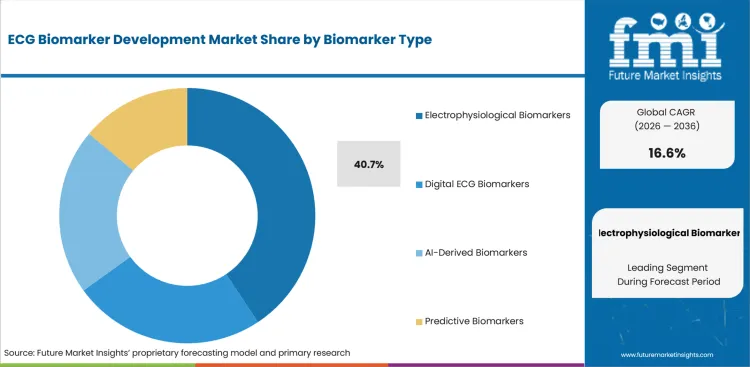
Electrophysiological biomarkers are expected to lead the Biomarker Type category because clinicians already review rhythm patterns and interval changes during ECG interpretation. The segment is projected to hold 40.7% share in 2026. Its lead is expected to continue where the biomarker explains a risk signal that a cardiac team already knows how to review and act upon.
- Electrophysiological biomarkers give trial teams a repeatable way to compare heart signals across visits. This makes the category useful in drug-safety monitoring and structured protocol review.
- Hospitals favor ECG measures that are easy to audit. Adoption is expected to rise when the marker shows a clear effect on referral decisions or follow-up timing.
How does cardiovascular disease detection shape demand within the application category?
Cardiovascular disease detection is forecast to represent 36.0% share in 2026. ECG biomarkers are expected to gain use when they help clinicians decide which patients require imaging, specialist referral or closer follow-up. The application is most useful when the output fits the same care pathway that already uses standard ECG review.
- Cardiovascular disease detection leads the Application category because ECG capture already occurs at routine screening points. This gives developers a practical route into existing care settings.
- Clinical use is expected to improve when the ECG result gives a direct referral path. Tools that only add a score are expected to gain approval more slowly.
Why do pharmaceutical companies lead the end user category?
Pharmaceutical companies are expected to hold 40.1% share in 2026. ECG biomarkers are useful in drug development when sponsors need consistent safety checks or patient selection measures across several trial sites. The category is expected to stay important when the ECG measure is defined before enrollment begins and remains comparable across visits.
- With 40.1% share in 2026, pharmaceutical companies are anticipated to lead End User spending. Their use case is strongest in cardiac safety review and protocol-based monitoring.
- Trial sponsors require consistent signal definitions before a biomarker is accepted across sites. A clear definition reduces disagreement when ECG records come from different devices.
How does AI analytics shape demand within the technology category?
AI analytics is anticipated to hold 35.6% share in 2026. The category is expected to expand when algorithms find ECG patterns that remain explainable to clinicians. FDA issued draft guidance in January 2025 covering lifecycle management and marketing submission recommendations for AI-enabled device software. The draft gives developers a clearer path for documenting performance, monitoring and user-facing information, pending finalization.
- AI analytics is forecast to lead the Technology category because it supports automated feature extraction and clearer clinical review. Hospitals still need evidence that the output matches a defined care decision.
- Commercial uptake depends on plain performance evidence. Hospitals are expected to compare screening value with confirmed diagnosis before approving routine use.
What are the drivers, restraints, and opportunities in the ECG Biomarker Development Market?
Cardiovascular burden and wider ECG capture are expected to strengthen validated biomarker programs. Reimbursement proof and workflow fit remain the main restraints.
- Driver: ECG biomarkers are expected to gain demand where screening teams need a clearer signal before referral or follow-up.
- Restraint: Adoption is expected to slow when a technically accurate result does not change a paid clinical action.
- Opportunity: Connected ECG records are expected to help biomarkers combine remote monitoring with trial endpoints.
The main demand driver is reduced uncertainty before a costly cardiology decision. The CDC reported in June 2026 that more than 850,000 Americans died of heart disease or stroke in 2024. This burden supports interest in ECG-based risk signals that fit screening programs and cardiology review. The market is expected to benefit when a biomarker guides the next care step without sending every patient into specialist review.
The main restraint is the gap between analytical performance and routine use. Hospitals need to know who acts on the result and who reviews an uncertain output. ECG biomarker tools are expected to face slower adoption when reimbursement is unclear or when the result adds review time. This issue is sharper for AI-enabled tools because performance monitoring and clinician responsibility must be explained in plain terms.
The primary opportunity is expected to develop in connected monitoring and trial enrichment. FDA finalized guidance in August 2025 on predetermined change control plans for AI-enabled device software. This helps developers plan software updates with clearer regulatory discipline. Companies that combine signal quality with clinical guidance are expected to stand out because their products support repeat use without leaving hospitals to interpret every exception alone.
Which country CAGRs are profiled in the ECG Biomarker Development Market?
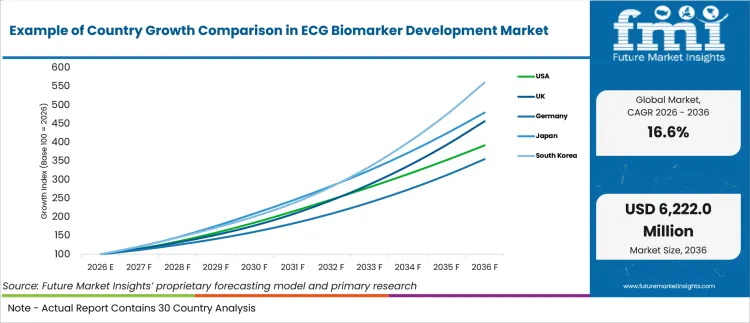
| Country | CAGR |
|---|---|
| USA | 14.7% |
| UK | 16.4% |
| Germany | 13.5% |
| Japan | 17.0% |
| South Korea | 18.8% |
How do country-level CAGRs compare in the ECG Biomarker Development Market?
The five profiled countries fall within a moderate range of 5.3 percentage points. South Korea sits apart from the lower group while Japan and the UK remain closely aligned. The USA and Germany form a more measured pair with only a limited gap between them. This pattern reflects differences in cardiology infrastructure and clinical validation rather than market size alone.
- South Korea’s position reflects rapid technology review and strong tertiary-care readiness.
- Japan remains close to the UK but depends more on disciplined hospital workflows and local clinical evidence.
- The UK follows a public-health route where adoption depends on referral efficiency and integration with NHS systems.
- The USA shows a more measured position because reimbursement evidence and payer acceptance remain important.
- Germany is positioned outside the main upper group as strict evidence standards and digital-health approval requirements can slow adoption.
- Comparable CAGRs may still create different entry conditions across these markets. Deployment timing will depend on hospital readiness and regulatory review as much as the growth rate itself.
The full report provides country-level CAGR analysis across North America, Latin America, Europe, East Asia, South Asia, Oceania and the Middle East and Africa.
Country-wise Analysis
- USA has a large cardiovascular patient base and a strong commercial route for ECG-based risk tools. The USA is projected to post 14.7% CAGR from 2026 to 2036, supported by demand for earlier screening and stronger follow-up decisions. NCHS reported in April 2026 that 11.3% of USA adults aged 45 and older had ever had heart disease in 2024. This patient pool gives ECG biomarker developers a broad testing base across hospitals, clinics and remote-monitoring channels. Adoption still depends on payer acceptance and evidence that the biomarker changes a clear clinical action.
- UK adoption is shaped by NHS pathway pressure and the need to move patients through cardiology review with fewer delays. The UK is forecast to expand at 16.4% CAGR from 2026 to 2036, supported by demand for tools that help clinicians decide which patients need faster review. OHID reported in December 2025 that around 1.9 million people in England had a GP diagnosis of coronary heart disease at the end of March 2025. ECG biomarker tools gain relevance when they reduce avoidable referrals and fit inside public-sector records. Procurement remains cautious when the service impact is not clearly measured.
- Germany has a strong hospital base, but the route into reimbursed digital care remains strict. The German market is estimated to record 13.5% CAGR from 2026 to 2036, shaped by evidence review and controlled use of clinical software. BfArM showed 246 applications for DiGA directory listing as of January 14, 2026. That figure shows why ECG biomarker developers need clear proof before wider use in reimbursed care. Hospitals can support validation studies, but routine adoption is expected to move slowly when clinical benefit and workflow responsibility are unclear.
- Japan combines high diagnostic capacity with careful clinical workflow discipline. ECG biomarker demand in Japan is anticipated to advance at 17.0% CAGR through 2036, supported by hospitals that already handle detailed diagnostic review. This clinical base supports ECG biomarker use when results help physicians decide which patients need imaging or specialist follow-up. Developers still need local-language validation and simple outputs that do not add more work for cardiology teams.
- South Korea leads the profiled group because hospitals can evaluate new clinical technology quickly. ECG biomarker sales in South Korea are projected to advance at 18.8% CAGR from 2026 to 2036, reinforced by tertiary-care strength and high diagnostic readiness. Adoption is expected to remain strongest where biomarkers reduce uncertainty in triage, trial selection and follow-up planning.
Who are the notable companies in the ECG Biomarker Development Market?
AliveCor, Anumana, Eko Health, GE HealthCare, Philips, Siemens Healthineers and Cardiologs are the notable companies shaping this market.
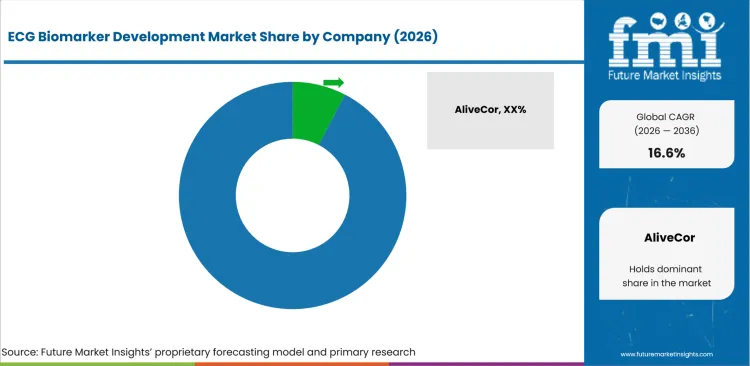
The competitive outlook combines ECG capture companies with algorithm developers and hospital workflow providers. Device companies compete through ease of capture and screening support at the point of care. AI interpretation developers compete through clinical evidence and clarity for cardiologists. Enterprise workflow companies compete through their ability to move ECG outputs through hospital records without creating extra work. Commercial success depends on clear ownership of uncertain results because one weak handoff reduces the value of a faster biomarker review.
- AliveCor and Eko Health compete through ECG capture and clinician-facing screening. Their test is whether device output fits a simple care pathway.
- Anumana and Cardiologs compete through algorithmic interpretation. Adoption is expected to depend on clinical evidence and transparent review.
- GE HealthCare, Philips and Siemens Healthineers compete through enterprise cardiology systems. Their role is strongest where ECG outputs must move through hospital records.
Competitive Benchmarking: ECG Biomarker Development Market
| Company | ECG Capture | AI Interpretation | Workflow Support | Geographic Reach |
|---|---|---|---|---|
| AliveCor | High | High | Medium | North America and selected global markets |
| Anumana | Low | High | Medium | USA-led with enterprise potential |
| Eko Health | High | High | Medium | USA-led with growing provider reach |
| GE HealthCare | Medium | Medium | High | Global |
| Philips | Medium | High | High | Global |
| Siemens Healthineers | Medium | Medium | High | Global |
| Cardiologs | Low | High | Medium | Europe and North America |
Key Developments in the ECG Biomarker Development Market
- In January 2026, AliveCor announced FDA clearance for KAI 12L powering Kardia 12L. The company stated that five new cardiac determinations raised its cleared total to 39.
- In September 2025, Eko Health announced FDA clearance for EFAST on the SENSORA platform. The release improves cardiac exam workflows that combine ECG and heart-sound review. In March 2026, Anumana secured FDA clearance for its ECG-AI pulmonary hypertension algorithm, the first PH algorithm cleared for use with standard 12-lead ECGs.
Key Players in the ECG Biomarker Development Market
ECG Device and Interpretation Providers
- AliveCor
- Anumana
- Eko Health
- Cardiologs
Enterprise Cardiology Workflow Providers
- GE HealthCare
- Philips
- Siemens Healthineers
ECG Biomarker Development Market - Report Scope
| Coverage field | Report scope |
|---|---|
| Market breakdown | Biomarker type, application, end user, technology, and region. |
| Quantitative Units | Revenue in USD Million, CAGR in %. |
| Market Definition | ECG biomarker development covers research, software, devices and workflow support used to identify measurable ECG-derived signals. These signals support diagnosis, monitoring, drug safety, trial enrichment and risk review. |
| Regions Covered | North America, Latin America, Europe, East Asia, South Asia, Oceania, and Middle East and Africa. |
| Countries Covered | USA, UK, Germany, Japan and South Korea are profiled. Additional countries are covered in the full report. |
| Key Companies Profiled | AliveCor, Anumana, Eko Health, GE HealthCare, Philips, Siemens Healthineers and Cardiologs. |
| Forecast Period | 2026 to 2036. |
| Approach | Hybrid bottom-up and top-down market sizing supported by primary interviews and official desk research. |
ECG Biomarker Development Market - Research Methodology
| Method | Approach |
|---|---|
| Primary Research | FMI analysts gathered input from manufacturers, service providers, technology developers, distributors, end users, procurement teams, and subject-matter experts. Interviews examined purchasing decisions, product or service evaluation, adoption barriers, approval requirements, pricing considerations, and expectations for technical or commercial support. Respondents were also asked what evidence is required before a trial, pilot, or initial order develops into regular purchasing. |
| Desk Research | Desk research covered government statistics, regulatory publications, trade data, industry associations, technical literature, standards, company filings, product information, and official corporate announcements. Sources were reviewed for relevance, publication date, geographic coverage, and consistency with the defined market scope. Claims relating to performance, applications, approvals, capacity, investment, and commercial activity were retained only when supported by credible public evidence. |
| Market Sizing and Forecasting | The market model combined the baseline value with historical performance, segment structure, pricing and volume indicators, adoption levels, company participation, and country-level demand conditions. Forecast assumptions considered economic activity, investment trends, regulatory developments, technology adoption, purchasing cycles, supply availability, and barriers to wider market use. Segment and regional estimates were reconciled before the final market total was calculated. |
| Data Validation | Estimates were checked against multiple independent indicators, including public data, company activity, trade patterns, industry developments, and findings from primary interviews. Validation also tested whether products, services, applications, and company revenues fell within the defined market boundaries. Adjacent categories, unsupported claims, overlapping revenues, and activities without direct market relevance were excluded to reduce double counting and maintain consistency across segments and countries. |
ECG Biomarker Development Market by Segments
ECG Biomarker Development Market segmented by Biomarker Type:
- Electrophysiological Biomarkers
- Rhythm-based Biomarkers
- Ischemic ECG Biomarkers
- Conduction Biomarkers
- Repolarization Biomarkers
ECG Biomarker Development Market segmented by Application:
- Cardiovascular Disease Detection
- Drug Safety Assessment
- Clinical Trial Enrichment
- Remote Patient Monitoring
- Risk Stratification
ECG Biomarker Development Market segmented by End User:
- Pharmaceutical Companies
- Hospitals
- Diagnostic Laboratories
- Medical Device Companies
- Academic and Research Centers
ECG Biomarker Development Market segmented by Technology:
- AI Analytics
- Cloud ECG Platforms
- Wearable ECG Systems
- Signal Processing Tools
- Clinical Decision-Support Tools
ECG Biomarker Development Market by Region:
- North America
- United States
- Canada
- Latin America
- Brazil
- Mexico
- Argentina
- Chile
- Western Europe
- Germany
- France
- United Kingdom
- Italy
- Spain
- Benelux
- Nordics
- Eastern Europe
- Poland
- Czech Republic
- Romania
- Hungary
- East Asia
- China
- Japan
- South Korea
- South Asia and Pacific
- India
- ASEAN
- Australia and New Zealand
- Middle East and Africa
- GCC Countries
- South Africa
- Türkiye
- Israel
Research Sources and Bibliography
- American Heart Association. (2026, January 21). 2026 heart disease and stroke statistics.
- Centers for Disease Control and Prevention. (2026, June). Fast facts: Health and economic costs of chronic conditions.
- National Center for Health Statistics. (2026, April). Prevalence of selected chronic conditions among adults age 45 and older, by age and urbanization level: United States, 2024.
- USA Food and Drug Administration. (2025, January 6). FDA issues comprehensive draft guidance for developers of artificial intelligence-enabled medical devices.
- Office for Health Improvement and Disparities. (2025, December). Cardiovascular disease profiles: Short statistical commentary.
- AliveCor. (2026, January 13). AliveCor announces FDA clearance of new cardiac determinations for Kardia 12L ECG System.
- Anumana. (2026, March 28). Anumana secures FDA clearance for ECG-AI algorithm for early detection of pulmonary hypertension.
- Eko Health. (2025, September 25). FDA clears EFAST algorithm for cardiovascular AI on SENSORA.
This bibliography is provided for reader reference and is not exhaustive. The full report contains the complete reference list and detailed citations.
This Report Answers
- How large is the ecg biomarker development market in 2026 and 2036?
- Which clinical and research needs support investment in ECG biomarker development?
- Why do electrophysiological biomarkers hold the leading Biomarker Type share in 2026?
- How does cardiovascular disease detection shape application demand?
- Why do pharmaceutical companies account for the leading End User share in 2026?
- How do AI analytics tools influence ECG biomarker development?
- How do country growth rates differ across the USA, UK, Germany, Japan and South Korea?
- Which companies provide ECG capture, AI interpretation or cardiology workflow support?
- What limits wider use of ECG biomarkers in routine care?
- How can connected ECG records support trial enrichment and remote monitoring?
Frequently Asked Questions
How big is the ECG Biomarker Development Market in 2026?
The ECG biomarker development market is valued at USD 1339.5 million in 2026 and is forecast to reach USD 6222.0 million by 2036, supported by cardiac teams and drug developers requiring repeatable ECG signals for risk review, trial monitoring, and treatment-safety checks across cardiovascular screening and pharmaceutical programs.
What is the CAGR of the ECG Biomarker Development Market from 2026 to 2036?
The ECG biomarker development market is projected to grow at a CAGR of 16.6% between 2026 and 2036, supported by rising cardiovascular disease burden, expanding remote ECG capture, and growing pharmaceutical demand for consistent biomarker definitions across multi-site clinical trial safety monitoring and patient selection programs.
Which biomarker type leads the ECG Biomarker Development Market?
Electrophysiological biomarkers account for 40.7% of the ECG biomarker development market by biomarker type in 2026, driven by established clinical use in rhythm assessment and cardiac-signal interpretation, giving trial teams a repeatable way to compare heart signals across visits in drug-safety monitoring and structured protocol review.
How much will the ECG Biomarker Development Market add between 2026 and 2036?
The ECG biomarker development market is set to add USD 4882.5 million between 2026 and 2036, growing from USD 1339.5 million to USD 6222.0 million as AI-enabled ECG interpretation, connected remote monitoring platforms, and expanding pharmaceutical cardiac safety requirements accelerate biomarker adoption across hospitals, clinical trials, and screening programs worldwide.
Who are the leading companies in the ECG Biomarker Development Market?
Leading companies in the ECG biomarker development market include AliveCor, Anumana, Eko Health, Cardiologs, GE HealthCare, Philips, and Siemens Healthineers, competing across ECG device capture and AI interpretation, algorithmic clinical evidence development, and enterprise cardiology workflow integration with global and regional reach.
Preview the report firsthand - request a free sample
Get SampleGet the brochure for pricing and purchase details.
Get PDFTable of Content
- Key Takeaways
- Market Size and CAGR
- Top Growth Driver
- Fastest Growing Segment
- Leading Region
- Key Companies
- Emerging Opportunities
- Executive Summary
- Global Market Outlook
- Demand-side Trends
- Supply-side Trends
- Technology Roadmap Analysis
- Analysis and Recommendations
- Analyst Perspective (What is happening? Why now? What should investors know?)
- Key Questions Answered
- How large is the market?
- What is the CAGR?
- What are key trends?
- Which region dominates?
- Who are the leaders?
- Market Overview
- Market Coverage / Taxonomy
- Market Definition / Scope / Limitations
- Research Methodology
- Chapter Orientation
- Analytical Lens and Working Hypotheses
- Market Structure, Signals, and Trend Drivers
- Benchmarking and Cross-market Comparability
- Market Sizing, Forecasting, and Opportunity Mapping
- Research Design and Evidence Framework
- Desk Research Programme (Secondary Evidence)
- Expert Input and Fieldwork (Primary Evidence)
- Tooling, Models, and Reference Databases
- Data Engineering and Model Build
- Quality Assurance and Audit Trail
- Market Background
- Market Dynamics (Drivers, Restraints, Opportunity, Trends)
- Scenario Forecast (Optimistic, Likely, Conservative)
- Impact Analysis
- AI Impact
- Sustainability Impact
- Regulatory Impact
- Technology Impact
- Consumer / Buyer Analysis
- Purchase Drivers
- Adoption Barriers
- Buyer Journey
- Opportunity Map Analysis
- Product Life Cycle Analysis
- Supply Chain Analysis
- Investment Feasibility Matrix
- Value Chain Analysis
- PESTLE and Porter's Analysis
- Regulatory Landscape
- Regional Parent Market Outlook
- Production and Consumption Statistics
- Import and Export Statistics
- Global Market Analysis and Forecast, 2021 to 2036
- Historical Market Size Value (USD Million) Analysis, 2021 to 2025
- Current and Future Market Size Value (USD Million) Projections, 2026 to 2036
- Y-o-Y Growth Trend Analysis
- Absolute $ Opportunity Analysis
- Global Market Pricing Analysis, 2021 to 2036
- Global Market Analysis and Forecast, By Biomarker Type, 2021 to 2036
- Introduction / Key Findings
- Historical Market Size Value (USD Million) Analysis By Biomarker Type, 2021 to 2025
- Current and Future Market Size Value (USD Million) Analysis and Forecast By Biomarker Type, 2026 to 2036
- Electrophysiological Biomarkers
- Rhythm-based Biomarkers
- Ischemic ECG Biomarkers
- Conduction Biomarkers
- Repolarization Biomarkers
- Y-o-Y Growth Trend Analysis By Biomarker Type, 2021 to 2025
- Absolute $ Opportunity Analysis By Biomarker Type, 2026 to 2036
- Global Market Analysis and Forecast, By Application, 2021 to 2036
- Introduction / Key Findings
- Historical Market Size Value (USD Million) Analysis By Application, 2021 to 2025
- Current and Future Market Size Value (USD Million) Analysis and Forecast By Application, 2026 to 2036
- Cardiovascular Disease Detection
- Drug Safety Assessment
- Clinical Trial Enrichment
- Remote Patient Monitoring
- Risk Stratification
- Y-o-Y Growth Trend Analysis By Application, 2021 to 2025
- Absolute $ Opportunity Analysis By Application, 2026 to 2036
- Global Market Analysis and Forecast, By End User, 2021 to 2036
- Introduction / Key Findings
- Historical Market Size Value (USD Million) Analysis By End User, 2021 to 2025
- Current and Future Market Size Value (USD Million) Analysis and Forecast By End User, 2026 to 2036
- Pharmaceutical Companies
- Hospitals
- Diagnostic Laboratories
- Medical Device Companies
- Academic and Research Centers
- Y-o-Y Growth Trend Analysis By End User, 2021 to 2025
- Absolute $ Opportunity Analysis By End User, 2026 to 2036
- Global Market Analysis and Forecast, By Technology, 2021 to 2036
- Introduction / Key Findings
- Historical Market Size Value (USD Million) Analysis By Technology, 2021 to 2025
- Current and Future Market Size Value (USD Million) Analysis and Forecast By Technology, 2026 to 2036
- AI Analytics
- Cloud ECG Platforms
- Wearable ECG Systems
- Signal Processing Tools
- Clinical Decision-Support Tools
- Y-o-Y Growth Trend Analysis By Technology, 2021 to 2025
- Absolute $ Opportunity Analysis By Technology, 2026 to 2036
- Global Market Analysis and Forecast, By Region, 2021 to 2036
- Introduction
- Historical Market Size Value (USD Million) Analysis By Region, 2021 to 2025
- Current Market Size Value (USD Million) Analysis and Forecast By Region, 2026 to 2036
- North America
- Latin America
- Western Europe
- Eastern Europe
- East Asia
- South Asia and Pacific
- Middle East & Africa
- Market Attractiveness Analysis By Region
- North America Market Analysis and Forecast, By Country, 2021 to 2036
- Historical Market Size Value (USD Million) Trend Analysis By Market Taxonomy, 2021 to 2025
- Market Size Value (USD Million) Forecast By Market Taxonomy, 2026 to 2036
- By Country
- USA
- Canada
- By Biomarker Type
- By Application
- By End User
- By Technology
- By Country
- Market Attractiveness Analysis
- By Country
- By Biomarker Type
- By Application
- By End User
- By Technology
- Key Takeaways
- Latin America Market Analysis and Forecast, By Country
- Historical Market Size Value (USD Million) Trend Analysis By Market Taxonomy, 2021 to 2025
- Market Size Value (USD Million) Forecast By Market Taxonomy, 2026 to 2036
- By Country
- Brazil
- Mexico
- Chile
- Rest of Latin America
- By Biomarker Type
- By Application
- By End User
- By Technology
- By Country
- Market Attractiveness Analysis
- By Country
- By Biomarker Type
- By Application
- By End User
- By Technology
- Key Takeaways
- Western Europe Market Analysis and Forecast, By Country
- Historical Market Size Value (USD Million) Trend Analysis By Market Taxonomy, 2021 to 2025
- Market Size Value (USD Million) Forecast By Market Taxonomy, 2026 to 2036
- By Country
- Germany
- UK
- Italy
- Spain
- France
- Nordic
- BENELUX
- Rest of Western Europe
- By Biomarker Type
- By Application
- By End User
- By Technology
- By Country
- Market Attractiveness Analysis
- By Country
- By Biomarker Type
- By Application
- By End User
- By Technology
- Key Takeaways
- Eastern Europe Market Analysis and Forecast, By Country
- Historical Market Size Value (USD Million) Trend Analysis By Market Taxonomy, 2021 to 2025
- Market Size Value (USD Million) Forecast By Market Taxonomy, 2026 to 2036
- By Country
- Russia
- Poland
- Hungary
- Balkan & Baltic
- Rest of Eastern Europe
- By Biomarker Type
- By Application
- By End User
- By Technology
- By Country
- Market Attractiveness Analysis
- By Country
- By Biomarker Type
- By Application
- By End User
- By Technology
- Key Takeaways
- East Asia Market Analysis and Forecast, By Country
- Historical Market Size Value (USD Million) Trend Analysis By Market Taxonomy, 2021 to 2025
- Market Size Value (USD Million) Forecast By Market Taxonomy, 2026 to 2036
- By Country
- China
- Japan
- South Korea
- By Biomarker Type
- By Application
- By End User
- By Technology
- By Country
- Market Attractiveness Analysis
- By Country
- By Biomarker Type
- By Application
- By End User
- By Technology
- Key Takeaways
- South Asia and Pacific Market Analysis and Forecast, By Country
- Historical Market Size Value (USD Million) Trend Analysis By Market Taxonomy, 2021 to 2025
- Market Size Value (USD Million) Forecast By Market Taxonomy, 2026 to 2036
- By Country
- India
- ASEAN
- Australia & New Zealand
- Rest of South Asia and Pacific
- By Biomarker Type
- By Application
- By End User
- By Technology
- By Country
- Market Attractiveness Analysis
- By Country
- By Biomarker Type
- By Application
- By End User
- By Technology
- Key Takeaways
- Middle East & Africa Market Analysis and Forecast, By Country
- Historical Market Size Value (USD Million) Trend Analysis By Market Taxonomy, 2021 to 2025
- Market Size Value (USD Million) Forecast By Market Taxonomy, 2026 to 2036
- By Country
- Kingdom of Saudi Arabia
- Other GCC Countries
- Türkiye
- South Africa
- Other African Union
- Rest of Middle East & Africa
- By Biomarker Type
- By Application
- By End User
- By Technology
- By Country
- Market Attractiveness Analysis
- By Country
- By Biomarker Type
- By Application
- By End User
- By Technology
- Key Takeaways
- Key Countries Market Analysis
- USA
- Pricing Analysis
- Market Share Analysis, 2025
- By Biomarker Type
- By Application
- By End User
- By Technology
- Canada
- Pricing Analysis
- Market Share Analysis, 2025
- By Biomarker Type
- By Application
- By End User
- By Technology
- Mexico
- Pricing Analysis
- Market Share Analysis, 2025
- By Biomarker Type
- By Application
- By End User
- By Technology
- Brazil
- Pricing Analysis
- Market Share Analysis, 2025
- By Biomarker Type
- By Application
- By End User
- By Technology
- Chile
- Pricing Analysis
- Market Share Analysis, 2025
- By Biomarker Type
- By Application
- By End User
- By Technology
- Germany
- Pricing Analysis
- Market Share Analysis, 2025
- By Biomarker Type
- By Application
- By End User
- By Technology
- UK
- Pricing Analysis
- Market Share Analysis, 2025
- By Biomarker Type
- By Application
- By End User
- By Technology
- Italy
- Pricing Analysis
- Market Share Analysis, 2025
- By Biomarker Type
- By Application
- By End User
- By Technology
- Spain
- Pricing Analysis
- Market Share Analysis, 2025
- By Biomarker Type
- By Application
- By End User
- By Technology
- France
- Pricing Analysis
- Market Share Analysis, 2025
- By Biomarker Type
- By Application
- By End User
- By Technology
- India
- Pricing Analysis
- Market Share Analysis, 2025
- By Biomarker Type
- By Application
- By End User
- By Technology
- ASEAN
- Pricing Analysis
- Market Share Analysis, 2025
- By Biomarker Type
- By Application
- By End User
- By Technology
- Australia & New Zealand
- Pricing Analysis
- Market Share Analysis, 2025
- By Biomarker Type
- By Application
- By End User
- By Technology
- China
- Pricing Analysis
- Market Share Analysis, 2025
- By Biomarker Type
- By Application
- By End User
- By Technology
- Japan
- Pricing Analysis
- Market Share Analysis, 2025
- By Biomarker Type
- By Application
- By End User
- By Technology
- South Korea
- Pricing Analysis
- Market Share Analysis, 2025
- By Biomarker Type
- By Application
- By End User
- By Technology
- Russia
- Pricing Analysis
- Market Share Analysis, 2025
- By Biomarker Type
- By Application
- By End User
- By Technology
- Poland
- Pricing Analysis
- Market Share Analysis, 2025
- By Biomarker Type
- By Application
- By End User
- By Technology
- Hungary
- Pricing Analysis
- Market Share Analysis, 2025
- By Biomarker Type
- By Application
- By End User
- By Technology
- Kingdom of Saudi Arabia
- Pricing Analysis
- Market Share Analysis, 2025
- By Biomarker Type
- By Application
- By End User
- By Technology
- Türkiye
- Pricing Analysis
- Market Share Analysis, 2025
- By Biomarker Type
- By Application
- By End User
- By Technology
- South Africa
- Pricing Analysis
- Market Share Analysis, 2025
- By Biomarker Type
- By Application
- By End User
- By Technology
- USA
- Market Structure Analysis
- Competition Dashboard
- Competition Benchmarking
- Market Share Analysis of Top Players
- By Regional
- By Biomarker Type
- By Application
- By End User
- By Technology
- Emerging Startups
- Innovation Benchmarking
- Competition Analysis
- Competition Deep Dive
- AliveCor
- Overview
- Product Portfolio
- Profitability by Market Segments
- Sales Footprint
- Strategy Overview
- Marketing Strategy
- Product Strategy
- Channel Strategy
- Anumana
- Eko Health
- GE HealthCare
- Philips
- Siemens Healthineers
- HeartFlow
- Tempus AI
- Biofourmis
- Cardiologs
- AliveCor
- Case Studies
- Success Stories
- Recent Developments
- Competition Deep Dive
- Assumptions & Acronyms Used


