

- Market Size (2026)
- USD 392.4 Mn
- Forecast (2036)
- USD 912.0 Mn
- CAGR (2026 to 2036)
- 8.8%
How big is Edible Glitter & Luster Dusts Market in 2026?
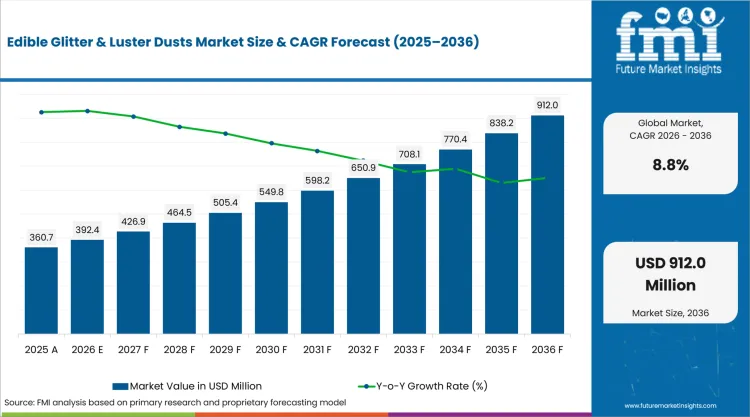
USD 392.4 million in 2026 and USD 912.0 million by 2036 at an 8.8% CAGR.
Demand for edible glitter & luster dusts is projected to expand at 8.8% CAGR between 2026 and 2036, increasing valuation from USD 392.4 million in 2026 to USD 912.0 million by 2036. Bakery producers pay for finishes that make familiar products look new without changing the base recipe. Dawn Foods' September 2025 North America trends drew on 2,500 consumer surveys and identified social-media-led discovery as a purchase influence. Social-media discovery raises the value of finishes that photograph well and withstand normal handling.
Color regulation is narrowing pigment choices for decorative food finishes used commercially. In April 2025, the USA FDA said it would work with manufacturers to remove six remaining certified dyes and accelerate natural-color approvals. The USA action does not govern other destinations, so exporters cannot assume one color palette will clear every market. Decoration producers need formulas that satisfy local additive rules and retain sparkle during dosing and packaging.
Key Takeaways
- Bakery producers purchase decorative finishes after the visual effect can be repeated on normal equipment without slowing routine production.
- By product type, standard grade is projected to account for 40.0% in 2026 owing to broad formulation choice and familiar qualification routes.
- Powder / dry is estimated to hold 53.0% of form demand in 2026, attributable to simple storage and flexible surface dosing.
- In 2026, bread & rolls are expected to lead application with 27.0% share because high throughput spreads small finish changes over large output.
- Different color-additive rules can force separate recipes and documentation, raising qualification work for one finish sold into several destinations.
- Some of the key players in this market include Barry Callebaut, Puratos, Dawn Foods, Zeelandia, CSM Ingredients, Bakels, AGRANA, Zentis, Fabbri 1905, and Irca Group.
Analyst Perspective
"Edible glitter and luster dust earn repeat orders after the approved color system reproduces the same sparkle on the bakery line. The stronger commercial offer pairs destination-ready ingredient files with application guidance that protects coverage during dosing, handling, and packaging."
- Nandini Roy Choudhury, Principal Consultant, Future Market Insights
How is the edible glitter & luster dusts market segmented?
The edible glitter & luster dusts market is segmented by product type, form, application, claim, sales channel and region.
The edible glitter & luster dusts market is segmented by product type, form, application, claim, sales channel, and region. Product type covers standard grade, premium / specialty grade, organic certified, and clean label grade. Form includes powder / dry, liquid, paste / semi-solid, and granules / pieces. Applications cover bread & rolls, cakes & muffins, biscuits & cookies, viennoiserie & pastry, and other bakery & snacks. Claim spans conventional, clean label, organic, and non-GMO / identity preserved, and sales channels include direct industrial supply, ingredient distributors, foodservice & artisan supply, and online B2B.
How does bread & rolls shape demand within the application category?
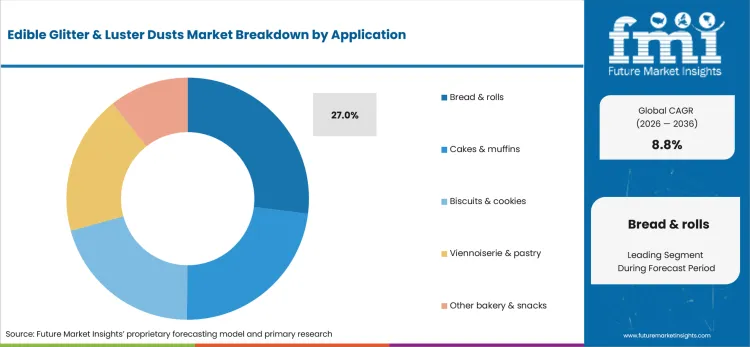
Bread & rolls give decorative finishes a large production base because small surface changes can be repeated over high unit volumes. The finish must also survive proofing, baking, or post-bake handling without transferring badly into packaging.
- In 2026, bread & rolls are expected to lead application with 27.0% share because high throughput spreads small finish changes over large output.
- Large flour throughput gives decorated bread a substantial production base in mature bakery markets. USDA NASS recorded 103 million hundredweight of USA flour production in Q2 2025, supporting high-volume runs for differentiated bread surfaces.
Why does standard grade lead demand within the product type category?
Standard grade gives bakery teams the widest working palette before a retailer or brand sets narrower organic or clean-label requirements. The category is easiest to qualify if selected colorants and carriers already fit the destination food-additive rules.
- By product type, standard grade is projected to account for 40.0% in 2026 owing to broader formulation choice and familiar qualification routes.
- Natural-color approvals are widening the working palette available to standard-grade formulations used in commercial bakery production. In May 2025, the USA FDA approved three colors from natural sources as future dye restrictions tighten.
What makes powder / dry central to the form category?
Powder / dry formats give decorators direct control over coverage and intensity without adding liquid to the finish system. Industrial lines can meter small dry doses, but dust control and even distribution need testing on the intended equipment.
- Powder / dry is estimated to hold 53.0% of form demand in 2026, attributable to simple storage and flexible surface dosing.
- In March 2026, CSM Ingredients launched Tiger Granulat as a powdered decoration for bread and savory bakery applications. The company specified artisanal and industrial production use, making line compatibility part of the format's commercial case.
How do industrial bakeries evaluate direct supply within the sales channel category?
Direct supply fits industrial bakeries because qualification covers the formula and application method together. Large accounts often need technical files, line trials, and troubleshooting before a decorative finish becomes a routine purchase.
- Direct to industrial bakeries is set to lead sales channels with 56.0% share in 2026 due to line trials, technical files, and scheduled supply planning.
- Puratos opened innovation centers in Montreal and Cartago in August 2025 and said its network then covered 120 centers. The facilities illustrate why industrial accounts value direct technical access during product development and line trials.
What are the drivers, restraints and opportunities in the Edible Glitter & Luster Dusts Market?
Visible bakery differentiation raises finish demand, food-color reviews limit formula reuse between countries, and reformulation-ready ranges provide the clearest route to repeat programs.
- Driver: Bakery producers use visible surface changes to refresh familiar products without rebuilding the full recipe.
- Restraint: Color-additive reviews can require new pigments, evidence files, and separate formulations for different destinations.
- Opportunity: Regulation-ready finishes shorten approval work after appearance and line performance are validated together.
Visible finishes let bakeries refresh familiar products without changing the cake, bread, or pastry base. In September 2025, Dawn Foods expanded Royal Steensma in North America with mirror fruit glaze, apricot glaze, and dark chocolate ganache. The launch confirms commercial appetite for surface differentiation, subject to separate proof that edible glitter survives the customer's dosing and handling process.
Metallic and bright effects are harder to standardize internationally because each pigment must remain permitted for the intended food use. EFSA's January 2026 food-colour register shows that follow-up work on silver E174 finished in 2025 and gold E175 remained under review. A workable EU finish may need a different pigment or evidence file before the same visual brief enters another jurisdiction.
Color-policy changes are shifting development work toward finishes that can be qualified without reformulating the whole bakery product. Dawn Foods launched cleaner-ingredient colorful buttercreme icings in September 2025 using plant-based colors without FD&C dyes or titanium dioxide. Edible glitter producers can address the same requirement directly by offering destination-ready color systems and proving appearance on the customer's application equipment.
Which country CAGRs are profiled in the Edible Glitter & Luster Dusts Market?
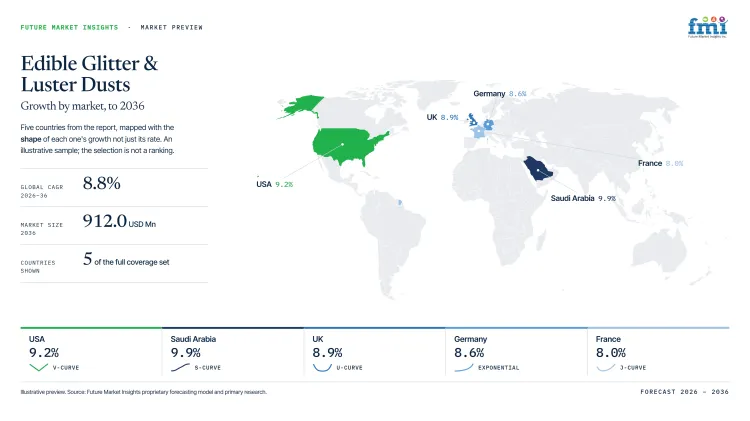
| Country | CAGR |
|---|---|
| UAE | 10.2% |
| Saudi Arabia | 9.9% |
| South Korea | 9.6% |
| USA | 9.2% |
| UK | 8.9% |
| Germany | 8.6% |
| Japan | 8.3% |
| France | 8.0% |
How do country-level CAGRs compare in the Edible Glitter & Luster Dusts Market?
The profiled CAGRs span 2.2 percentage points from UAE at 10.2% to France at 8.0%, creating three visible growth bands. UAE, Saudi Arabia, and South Korea form the upper group above 9.5%, with USA, UK, and Germany occupying a tighter middle band. Japan and France form the lower band, and the spacing tracks bakery premiumization and market access without representing current market size.
- UAE hospitality favors premium imported finishes.
- Saudi hotel calendars reward local stock.
- South Korean cafés rotate seasonal visuals.
- USA plants emphasize lot consistency.
- UK cross-border ranges complicate common SKUs.
- German bakeries value low-dose application.
- Japanese importers favor detailed specifications.
- French patisserie rewards finish traceability.
Comparable rates therefore carry different qualification costs and routes to repeat orders. The full report provides country-level CAGR analysis across North America, Latin America, Western Europe, Eastern Europe, East Asia, South Asia and Pacific, and Middle East and Africa.
Country-wise Analysis
- In Dubai, bakery and foodservice distributors clear imported decoration ingredients through product registration before supplying hotel, restaurant, or retail pastry programs, so complete formula and label files are a practical entry requirement. Dubai Municipality said in July 2025 that 77,700 new food products were registered during the first half, giving importers an active registration route but leaving little room for unclear color or carrier documentation. Edible glitter & luster dust demand in UAE is forecast to rise at 10.2% CAGR over the assessment period, aided by premium hospitality use despite registration work and formula localization raising the cost of converting imported ranges into repeat orders.
- SFDA clearance starts with each colorant and carrier used in a decorative finish, so Saudi bakery importers gain time by submitting clear additive identifiers with traceable formula records. Saudi Arabia is projected to grow at 9.9% CAGR through 2036, given premium bakery and hospitality programs that reward finish variety but still depend on import clearance. SFDA said in March 2025 that its Ramadan campaign inspected 1,891 facilities in Mecca and Al Madinah, which puts a practical premium on pre-screened formulas because incomplete records can delay approval and make a broad catalog less useful than a smaller range prepared for local review.
- Imported decorative formulas in South Korea need Korean records that match the current food-additive code before commercial sampling, so an overseas specification cannot replace local ingredient review. MFDS documented in June 2026 that South Korea processed about 870,000 food-import cases during 2025, making accurate files and importer screening routine market-entry work rather than a final check. Edible glitter & luster dust demand in South Korea is projected to record 9.6% CAGR during the forecast period, due to fast premium bakery rotation despite delays for companies that must correct translated overseas specifications before acceptable samples reach repeat purchasing in local bakery programs.
- For US industrial bakeries, edible status and color-additive legality are separate approval checks even though decoration products are widely available through professional and craft channels. The US edible glitter & luster dust market is expected to register 9.2% CAGR over the forecast period, tied to seasonal bakery programs that reward visual differentiation despite a larger color-reformulation qualification task. In January 2025 the FDA revoked authorization for FD&C Red No. 3 in food and set January 15 2027 for manufacturer reformulation, favoring companies that can replace a familiar bright color without forcing bakeries to repeat every commercial application test from the beginning.
- A bakery group selling in both Great Britain and Northern Ireland can face different color requirements for one decorative formula, so regional launches need destination-specific review before production planning. The Food Standards Agency changed the regulated-product authorisation process in April 2025 and confirmed that food additives and flavourings still require safety authorisation before sale, giving companies a clearer route without removing evidence requirements. Edible glitter & luster dust sales in UK are forecast to expand at 8.9% CAGR by 2036, supported by mature bakery channels, although unresolved color decisions can delay a common launch and make formula planning more useful than carrying the widest effect range.
- Higher confectionery input prices make German bakery producers more selective about decorative upgrades, and EU additive rules leave little room for a finish that needs costly reformulation after trials. Germany is expected to maintain 8.6% CAGR during the assessment period, owing to mature industrial baking and patisserie channels that provide a large qualification base for compliant finishes. Destatis said in January 2026 that sugar, jam, honey and other confectionery prices rose 5.9% on average in 2025, which puts pressure on finish producers to prove that sparkle or luster raises presentation value without adding avoidable formulation complexity or unnecessary material waste.
- Specification conformity carries more weight in Japan than a foreign approval alone, so importers expect local technical files that map each decorative color and carrier to national food-sanitation requirements. The Ministry of Health published in August 2026 that fiscal 2025 produced about 2.53 million food-import notifications, making document accuracy and importer review part of normal commercial preparation for a new decorative ingredient. Japan is projected to progress at 8.3% CAGR through 2036, because premium bakery and confectionery channels reward controlled presentation but poorly mapped additives can stop acceptable samples before launch and force the importer back into formula review with the local partner.
- Professional patisserie in France pairs strong visual presentation with active composition checks, so imported decorative ranges need French ingredient records that match the formula sold through each distributor. France is forecast to post 8.0% CAGR over the forecast period, attributable to a mature pastry base that keeps decorative finishes relevant even at a slower pace than Gulf markets. DGCCRF said in September 2025 that its flavouring investigation checked 294 establishments, so traceable formulas and accurate composition records carry more commercial weight than catalog breadth for companies positioning luster, color, or adjacent finishing ingredients in professional pastry and bakery channels nationwide.
Who are the notable companies in the Edible Glitter & Luster Dusts Market?
Barry Callebaut, Puratos, Dawn Foods, Zeelandia, CSM Ingredients, Bakels, AGRANA, Zentis, Fabbri 1905, Irca Group.
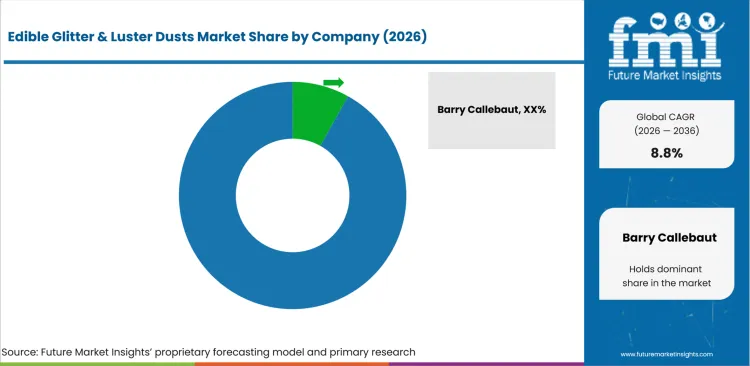
The competitive set reaches bakery finishing from different positions, with Irca Group and Barry Callebaut carrying the clearest direct decoration exposure. Dawn Foods and CSM Ingredients cover glazes, icings, fillings, and other finish systems inside broader bakery portfolios. Puratos, Zeelandia, and Bakels strengthen application support, whereas AGRANA, Zentis, and Fabbri 1905 operate nearer fruit preparations, toppings, and professional pastry. Market entry depends on food-use evidence and application support, not company scale alone.
- Global bakery and decoration platforms: Barry Callebaut, Puratos, and Dawn Foods.
- Bakery systems and application specialists: Zeelandia, CSM Ingredients, and Bakels.
- Fruit, pastry, and finishing specialists: AGRANA, Zentis, Fabbri 1905, and Irca Group.
Competitive Benchmarking: Edible Glitter & Luster Dusts Market
| Company | Decoration Scope | Industrial Bakery Support | Professional Channel Access | Geographic Reach |
|---|---|---|---|---|
| Barry Callebaut | High | High | High | Global |
| Puratos | Medium | High | High | Global |
| Dawn Foods | High | High | High | North America, Europe, and AMEAP |
| Zeelandia | Low | High | Medium | Europe and international markets |
| CSM Ingredients | Medium | High | Medium | Europe and selected international markets |
| Bakels | Low | High | High | Global |
| AGRANA | Low | Medium | Low | Global food ingredient markets |
| Zentis | Low | Medium | Low | Europe and North America |
| Fabbri 1905 | Low | Medium | High | Europe and international foodservice |
| Irca Group | High | High | High | Europe, Americas, and Asia |
Scoring basis: High decoration scope requires multiple documented finishing formats. Medium marks narrower toppings or coatings and Low marks an adjacent bakery role. High industrial support requires dedicated development resources. Medium requires documented bakery application support and Low identifies limited industrial support. Professional access is High for explicit artisan or foodservice reach. Medium marks broad B2B bakery access and Low indicates mainly industrial channels.
Key Developments in the Edible Glitter & Luster Dusts Market
- In May 2026, CSM Ingredients launched the Creami fillings range for bakery, pastry, and confectionery professionals in European markets, extending its portfolio within professional finishing accounts.
- In May 2026, Irca Group's Dobla Asia achieved a BRC A+ rating after an unannounced audit at its Vietnam plant, strengthening food-safety credentials for chocolate decoration production.
- In November 2025, Barry Callebaut opened its Brantford factory in Ontario with new chocolate lines and integrated warehousing, increasing regional capacity for chocolate and decorative applications.
Key Players in the Edible Glitter & Luster Dusts Market
Global Bakery and Decoration Platforms
- Barry Callebaut
- Puratos
- Dawn Foods
Bakery Systems and Application Specialists
- Zeelandia
- CSM Ingredients
- Bakels
Fruit, Pastry and Finishing Specialists
- AGRANA
- Zentis
- Fabbri 1905
- Irca Group
Edible Glitter & Luster Dusts Market - Report Scope
| Coverage field | Report scope |
|---|---|
| Market breakdown | By product type, form, application, claim, sales channel and region. |
| Quantitative Units | USD million. |
| Market Definition | Revenue includes food-grade edible glitter and luster dust sold for bakery, confectionery, and professional food decoration within the listed formats and channels. |
| Regions Covered | North America, Latin America, Western Europe, Eastern Europe, East Asia, South Asia and Pacific, and Middle East and Africa. |
| Countries Covered | UAE, Saudi Arabia, South Korea, USA, UK, Germany, Japan, France, and 20+ countries included in the full report. |
| Key Companies Profiled | Barry Callebaut, Puratos, Dawn Foods, Zeelandia, CSM Ingredients, Bakels, AGRANA, Zentis, Fabbri 1905, Irca Group. |
| Forecast Period | 2026 to 2036. |
| Approach | Primary and secondary research with market triangulation. |
Edible Glitter & Luster Dusts Market - Research Methodology
| Method | Approach |
|---|---|
| Primary Research | FMI analysts gathered input from manufacturers, service providers, technology developers, distributors, end users, procurement teams, and subject-matter experts. Interviews examined purchasing decisions, product or service evaluation, adoption barriers, approval requirements, pricing considerations, and expectations for technical or commercial support. Respondents were also asked what evidence is required before a trial, pilot, or initial order develops into regular purchasing. |
| Desk Research | Desk research covered government statistics, regulatory publications, trade data, industry associations, technical literature, standards, company filings, product information, and official corporate announcements. Sources were reviewed for relevance, publication date, geographic coverage, and consistency with the defined market scope. Claims relating to performance, applications, approvals, capacity, investment, and commercial activity were retained only when supported by credible public evidence. |
| Market Sizing and Forecasting | The market model combined the baseline value with historical performance, segment structure, pricing and volume indicators, adoption levels, company participation, and country-level demand conditions. Forecast assumptions considered economic activity, investment trends, regulatory developments, technology adoption, purchasing cycles, supply availability, and barriers to wider market use. Segment and regional estimates were reconciled before the final market total was calculated. |
| Data Validation | Estimates were checked against multiple independent indicators, including public data, company activity, trade patterns, industry developments, and findings from primary interviews. Validation also tested whether products, services, applications, and company revenues fell within the defined market boundaries. Adjacent categories, unsupported claims, overlapping revenues, and activities without direct market relevance were excluded to reduce double counting and maintain consistency across segments and countries. |
Edible Glitter & Luster Dusts Market by Segments
By Product Type
- Standard grade
- Premium / specialty grade
- Organic certified
- Clean label grade
By Form
- Powder / dry
- Liquid
- Paste / semi-solid
- Granules / pieces
By Application
- Bread & rolls
- Cakes & muffins
- Biscuits & cookies
- Viennoiserie & pastry
- Other bakery & snacks
By Claim
- Conventional
- Clean label
- Organic
- Non-GMO / identity preserved
By Sales Channel
- Direct to industrial bakeries
- Ingredient distributors
- Foodservice & artisan supply
- Online B2B
Edible Glitter & Luster Dusts Market by Region:
- North America
- United States
- Canada
- Latin America
- Brazil
- Mexico
- Argentina
- Chile
- Western Europe
- Germany
- France
- United Kingdom
- Italy
- Spain
- Benelux
- Nordics
- Eastern Europe
- Poland
- Czech Republic
- Romania
- Hungary
- East Asia
- China
- Japan
- South Korea
- South Asia and Pacific
- India
- ASEAN
- Australia and New Zealand
- Middle East and Africa
- GCC Countries
- South Africa
- Türkiye
- Israel
Research Sources and Bibliography
- Dawn Foods. (2025, September 11). Dawn Foods reveals North America bakery trends at IBIE 2025.
- USA Food and Drug Administration. (2025, April 22). HHS, FDA to phase out petroleum-based synthetic dyes in nation's food supply.
- USA Food and Drug Administration. (2025, May 9). FDA approves three food colors from natural sources.
- CSM Ingredients. (2026, March 10). CSM Ingredients launches Tiger Granulat.
- USA Department of Agriculture, National Agricultural Statistics Service. (2025, August 1). Flour milling products.
- Puratos. (2025, August 25). Puratos announces two new hubs for food innovation: Montreal and Costa Rica.
- Dawn Foods. (2025, September 15). Dawn Foods expands Royal Steensma product line in North America with four new premium, easy-to-use products.
- European Food Safety Authority. (2026, January 8). Food colours.
- Dawn Foods. (2025, September 15). Dawn Foods introduces new Dawn Balance cleaner ingredients colorful buttercreme style icings.
- Dubai Municipality. (2025, July 30). Over 34,000 food inspections conducted in first half of 2025.
- Saudi Food and Drug Authority. (2025, March 14). The SFDA, in collaboration with Municipalities and Commerce Ministries, intensify inspections in Mecca and Al Madinah to ensure product safety during Ramadan and in preparation for Hajj.
- Ministry of Food and Drug Safety, Republic of Korea. (2026, June 30). 2025
- USA Food and Drug Administration. (2025, January 15). FDA to revoke authorization for the use of Red No. 3 in food and ingested drugs.
- Food Standards Agency. (2025, April 1). Reforms to the market authorisation process for regulated products come into force.
- German Federal Statistical Office. (2026, January 16). Correction: Inflation rate at +2.2% in 2025.
- Ministry of Health, Labour and Welfare, Japan. (2026, August 28).
- Direction générale de la concurrence, de la consommation et de la répression des fraudes. (2025, September 1). Étiquetage et composition : les arômes et denrées aromatisées sous surveillance.
- CSM Ingredients. (2026, May 12). CSM Ingredients launches Creami, a comprehensive range of indulgent fillings for bakery, pastry and confectionery professionals.
- IRCA Group. (2026, May 8). Dobla Asia achieves BRC A+ rating in Vietnam.
- Barry Callebaut. (2025, November 13). Barry Callebaut opens third Canadian chocolate factory in Brantford, Ontario.
- Royal Zeelandia Group. (n.d.). Food safety and quality. Retrieved September 3, 2026.
- CSM Ingredients. (n.d.). About us. Retrieved September 3, 2026.
- Bakels Worldwide. (n.d.). About. Retrieved September 3, 2026.
- AGRANA. (2026). Facts & organisational structure.
- Zentis. (n.d.). About us. Retrieved September 3, 2026.
- IRCA Group. (n.d.). Who we are. Retrieved September 3, 2026.
- Puratos. (2025, February 13). Puratos acquires renowned French culinary school, École Bellouet Conseil.
- Barry Callebaut. (2025). Annual social and environmental impact report 2024/25.
- AGRANA. (2026, April 23). AGRANA launch in Slovenia: acquisition of the food company Mercator-Emba successfully concluded.
- Fabbri 1905. (2025, October 17). Fabbri Gelato System: una nuova esperienza di gusto ad Host Milano 2025.
- Dawn Foods. (2025, April 4). Dawn Foods unveils new products to meet seasonal flavor demand.
- Barry Callebaut. (n.d.). Company history. Retrieved September 3, 2026.
- Puratos. (2025, May 7). Puratos brings a trio of transformative innovations to iba 2025.
- Dawn Foods. (2025, May 16). Beloved dessert takes new form with Dawn Churro Donut Mix and ready-to-finish donuts.
- Royal Zeelandia Group. (2025, July). Zeelandia at NFH Expo 2025: Supporting Innovation in Indonesia's Pastry & Bakery Industry.
- CSM Ingredients. (2025, November 18). CSM Ingredients - a Nexture company - opens new £3m state-of-the-art customer focused product development centre in the UK.
- Bakels Worldwide. (2025, June 27). Bakels Worldwide Review, Issue 176.
- AGRANA. (2026). Strategy & capital market.
- Zentis. (2025, August 15). Jetzt wird’s bärig lecker - Zentis und Bärchen® launchen Fruchtaufstriche für die ganze Familie.
- Fabbri 1905. (2026, January 16). Fabbri 1905 entra nel mondo dello street food e ridefinisce il fuoricasa Made in Italy.
- IRCA Group. (2025, February 18). Crafted in Italy, produced in the USA.
This Report Answers
- How large is the edible glitter & luster dusts market in 2026 and 2036?
- What supports repeat demand for edible decorative finishes?
- Why does standard grade lead product type?
- How does powder / dry support bakery application?
- Why do bread & rolls lead application?
- How do growth rates differ among the eight profiled countries?
- Which companies serve bakery-finishing roles?
- What qualification frictions delay repeat orders?
Frequently Asked Questions
How big is the edible glitter & luster dusts market in 2026?
The edible glitter & luster dusts market is valued at USD 392.4 million in 2026 and is projected to reach USD 912.0 million by 2036. Bakery producers use repeatable decorative finishes to refresh familiar products without rebuilding the base recipe.
What is the CAGR of the edible glitter & luster dusts market from 2026 to 2036?
The edible glitter & luster dusts market is projected to grow at 8.8% CAGR between 2026 and 2036. Growth depends on food-grade color compliance and repeatable application that turns a trial finish into a regular bakery order.
Which product type leads the edible glitter & luster dusts market?
The standard grade segment is expected to hold 40.0% of the edible glitter & luster dusts market in 2026, attributable to broad formulation choice. Narrower organic and clean-label briefs reduce the available color and carrier options.
Which form leads the edible glitter & luster dusts market?
The powder / dry segment is expected to hold 53.0% of the edible glitter & luster dusts market in 2026, supported by controlled surface dosing. Industrial users still need even distribution on the intended equipment before routine purchasing.
Which countries are projected to record the highest growth in the edible glitter & luster dusts market?
UAE is projected to grow at 10.2% CAGR, followed by Saudi Arabia at 9.9% and South Korea at 9.6% through 2036. Local registration, importer screening, and technical support determine how quickly decorative finishes progress from import clearance to commercial use.
Which companies are active in the edible glitter & luster dusts market?
The edible glitter & luster dusts market includes Barry Callebaut, Puratos, Dawn Foods, Zeelandia, CSM Ingredients, Bakels, AGRANA, Zentis, Fabbri 1905, and Irca Group. Their roles cover direct decoration, bakery systems, fruit preparations, and professional finishing ingredients.
Preview the report firsthand - request a free sample
Get SampleGet the brochure for pricing and purchase details.
Get PDFTable of Content
- Key Takeaways
- Market Size and CAGR
- Top Growth Driver
- Fastest Growing Segment
- Leading Region
- Key Companies
- Emerging Opportunities
- Executive Summary
- Global Market Outlook
- Demand-side Trends
- Supply-side Trends
- Technology Roadmap Analysis
- Analysis and Recommendations
- Analyst Perspective (What is happening? Why now? What should investors know?)
- Key Questions Answered
- How large is the market?
- What is the CAGR?
- What are key trends?
- Which region dominates?
- Who are the leaders?
- Market Overview
- Market Coverage / Taxonomy
- Market Definition / Scope / Limitations
- Research Methodology
- Chapter Orientation
- Analytical Lens and Working Hypotheses
- Market Structure, Signals, and Trend Drivers
- Benchmarking and Cross-market Comparability
- Market Sizing, Forecasting, and Opportunity Mapping
- Research Design and Evidence Framework
- Desk Research Programme (Secondary Evidence)
- Expert Input and Fieldwork (Primary Evidence)
- Tooling, Models, and Reference Databases
- Data Engineering and Model Build
- Quality Assurance and Audit Trail
- Market Background
- Market Dynamics (Drivers, Restraints, Opportunity, Trends)
- Scenario Forecast (Optimistic, Likely, Conservative)
- Impact Analysis
- AI Impact
- Sustainability Impact
- Regulatory Impact
- Technology Impact
- Consumer / Buyer Analysis
- Purchase Drivers
- Adoption Barriers
- Buyer Journey
- Opportunity Map Analysis
- Product Life Cycle Analysis
- Supply Chain Analysis
- Investment Feasibility Matrix
- Value Chain Analysis
- PESTLE and Porter's Analysis
- Regulatory Landscape
- Regional Parent Market Outlook
- Production and Consumption Statistics
- Import and Export Statistics
- Global Market Analysis and Forecast, 2021 to 2036
- Historical Market Size Value (USD Million) Analysis, 2021 to 2025
- Current and Future Market Size Value (USD Million) Projections, 2026 to 2036
- Y-o-Y Growth Trend Analysis
- Absolute $ Opportunity Analysis
- Global Market Pricing Analysis, 2021 to 2036
- Global Market Analysis and Forecast, By Product Type, 2021 to 2036
- Introduction / Key Findings
- Historical Market Size Value (USD Million) Analysis By Product Type, 2021 to 2025
- Current and Future Market Size Value (USD Million) Analysis and Forecast By Product Type, 2026 to 2036
- Standard grade
- Premium / specialty grade
- Organic certified
- Clean label grade
- Standard grade
- Y-o-Y Growth Trend Analysis By Product Type, 2021 to 2025
- Absolute $ Opportunity Analysis By Product Type, 2026 to 2036
- Global Market Analysis and Forecast, By Form, 2021 to 2036
- Introduction / Key Findings
- Historical Market Size Value (USD Million) Analysis By Form, 2021 to 2025
- Current and Future Market Size Value (USD Million) Analysis and Forecast By Form, 2026 to 2036
- Powder / dry
- Liquid
- Paste / semi-solid
- Granules / pieces
- Powder / dry
- Y-o-Y Growth Trend Analysis By Form, 2021 to 2025
- Absolute $ Opportunity Analysis By Form, 2026 to 2036
- Global Market Analysis and Forecast, By Application, 2021 to 2036
- Introduction / Key Findings
- Historical Market Size Value (USD Million) Analysis By Application, 2021 to 2025
- Current and Future Market Size Value (USD Million) Analysis and Forecast By Application, 2026 to 2036
- Bread & rolls
- Cakes & muffins
- Biscuits & cookies
- Viennoiserie & pastry
- Other bakery & snacks
- Bread & rolls
- Y-o-Y Growth Trend Analysis By Application, 2021 to 2025
- Absolute $ Opportunity Analysis By Application, 2026 to 2036
- Global Market Analysis and Forecast, By Claim, 2021 to 2036
- Introduction / Key Findings
- Historical Market Size Value (USD Million) Analysis By Claim, 2021 to 2025
- Current and Future Market Size Value (USD Million) Analysis and Forecast By Claim, 2026 to 2036
- Conventional
- Clean label
- Organic
- Non-GMO / identity preserved
- Conventional
- Y-o-Y Growth Trend Analysis By Claim, 2021 to 2025
- Absolute $ Opportunity Analysis By Claim, 2026 to 2036
- Global Market Analysis and Forecast, By Sales Channel, 2021 to 2036
- Introduction / Key Findings
- Historical Market Size Value (USD Million) Analysis By Sales Channel, 2021 to 2025
- Current and Future Market Size Value (USD Million) Analysis and Forecast By Sales Channel, 2026 to 2036
- Direct to industrial bakeries
- Ingredient distributors
- Foodservice & artisan supply
- Online B2B
- Direct to industrial bakeries
- Y-o-Y Growth Trend Analysis By Sales Channel, 2021 to 2025
- Absolute $ Opportunity Analysis By Sales Channel, 2026 to 2036
- Global Market Analysis and Forecast, By Region, 2021 to 2036
- Introduction
- Historical Market Size Value (USD Million) Analysis By Region, 2021 to 2025
- Current Market Size Value (USD Million) Analysis and Forecast By Region, 2026 to 2036
- North America
- Latin America
- Western Europe
- Eastern Europe
- East Asia
- South Asia and Pacific
- Middle East & Africa
- Market Attractiveness Analysis By Region
- North America Market Analysis and Forecast, By Country, 2021 to 2036
- Historical Market Size Value (USD Million) Trend Analysis By Market Taxonomy, 2021 to 2025
- Market Size Value (USD Million) Forecast By Market Taxonomy, 2026 to 2036
- By Country
- USA
- Canada
- By Product Type
- By Form
- By Application
- By Claim
- By Sales Channel
- By Country
- Market Attractiveness Analysis
- By Country
- By Product Type
- By Form
- By Application
- By Claim
- By Sales Channel
- Key Takeaways
- Latin America Market Analysis and Forecast, By Country
- Historical Market Size Value (USD Million) Trend Analysis By Market Taxonomy, 2021 to 2025
- Market Size Value (USD Million) Forecast By Market Taxonomy, 2026 to 2036
- By Country
- Brazil
- Mexico
- Chile
- Rest of Latin America
- By Product Type
- By Form
- By Application
- By Claim
- By Sales Channel
- By Country
- Market Attractiveness Analysis
- By Country
- By Product Type
- By Form
- By Application
- By Claim
- By Sales Channel
- Key Takeaways
- Western Europe Market Analysis and Forecast, By Country
- Historical Market Size Value (USD Million) Trend Analysis By Market Taxonomy, 2021 to 2025
- Market Size Value (USD Million) Forecast By Market Taxonomy, 2026 to 2036
- By Country
- Germany
- UK
- Italy
- Spain
- France
- Nordic
- BENELUX
- Rest of Western Europe
- By Product Type
- By Form
- By Application
- By Claim
- By Sales Channel
- By Country
- Market Attractiveness Analysis
- By Country
- By Product Type
- By Form
- By Application
- By Claim
- By Sales Channel
- Key Takeaways
- Eastern Europe Market Analysis and Forecast, By Country
- Historical Market Size Value (USD Million) Trend Analysis By Market Taxonomy, 2021 to 2025
- Market Size Value (USD Million) Forecast By Market Taxonomy, 2026 to 2036
- By Country
- Russia
- Poland
- Hungary
- Balkan & Baltic
- Rest of Eastern Europe
- By Product Type
- By Form
- By Application
- By Claim
- By Sales Channel
- By Country
- Market Attractiveness Analysis
- By Country
- By Product Type
- By Form
- By Application
- By Claim
- By Sales Channel
- Key Takeaways
- East Asia Market Analysis and Forecast, By Country
- Historical Market Size Value (USD Million) Trend Analysis By Market Taxonomy, 2021 to 2025
- Market Size Value (USD Million) Forecast By Market Taxonomy, 2026 to 2036
- By Country
- China
- Japan
- South Korea
- By Product Type
- By Form
- By Application
- By Claim
- By Sales Channel
- By Country
- Market Attractiveness Analysis
- By Country
- By Product Type
- By Form
- By Application
- By Claim
- By Sales Channel
- Key Takeaways
- South Asia and Pacific Market Analysis and Forecast, By Country
- Historical Market Size Value (USD Million) Trend Analysis By Market Taxonomy, 2021 to 2025
- Market Size Value (USD Million) Forecast By Market Taxonomy, 2026 to 2036
- By Country
- India
- ASEAN
- Australia & New Zealand
- Rest of South Asia and Pacific
- By Product Type
- By Form
- By Application
- By Claim
- By Sales Channel
- By Country
- Market Attractiveness Analysis
- By Country
- By Product Type
- By Form
- By Application
- By Claim
- By Sales Channel
- Key Takeaways
- Middle East & Africa Market Analysis and Forecast, By Country
- Historical Market Size Value (USD Million) Trend Analysis By Market Taxonomy, 2021 to 2025
- Market Size Value (USD Million) Forecast By Market Taxonomy, 2026 to 2036
- By Country
- Kingdom of Saudi Arabia
- Other GCC Countries
- Türkiye
- South Africa
- Other African Union
- Rest of Middle East & Africa
- By Product Type
- By Form
- By Application
- By Claim
- By Sales Channel
- By Country
- Market Attractiveness Analysis
- By Country
- By Product Type
- By Form
- By Application
- By Claim
- By Sales Channel
- Key Takeaways
- Key Countries Market Analysis
- USA
- Pricing Analysis
- Market Share Analysis, 2025
- By Product Type
- By Form
- By Application
- By Claim
- By Sales Channel
- Canada
- Pricing Analysis
- Market Share Analysis, 2025
- By Product Type
- By Form
- By Application
- By Claim
- By Sales Channel
- Mexico
- Pricing Analysis
- Market Share Analysis, 2025
- By Product Type
- By Form
- By Application
- By Claim
- By Sales Channel
- Brazil
- Pricing Analysis
- Market Share Analysis, 2025
- By Product Type
- By Form
- By Application
- By Claim
- By Sales Channel
- Chile
- Pricing Analysis
- Market Share Analysis, 2025
- By Product Type
- By Form
- By Application
- By Claim
- By Sales Channel
- Germany
- Pricing Analysis
- Market Share Analysis, 2025
- By Product Type
- By Form
- By Application
- By Claim
- By Sales Channel
- UK
- Pricing Analysis
- Market Share Analysis, 2025
- By Product Type
- By Form
- By Application
- By Claim
- By Sales Channel
- Italy
- Pricing Analysis
- Market Share Analysis, 2025
- By Product Type
- By Form
- By Application
- By Claim
- By Sales Channel
- Spain
- Pricing Analysis
- Market Share Analysis, 2025
- By Product Type
- By Form
- By Application
- By Claim
- By Sales Channel
- France
- Pricing Analysis
- Market Share Analysis, 2025
- By Product Type
- By Form
- By Application
- By Claim
- By Sales Channel
- India
- Pricing Analysis
- Market Share Analysis, 2025
- By Product Type
- By Form
- By Application
- By Claim
- By Sales Channel
- ASEAN
- Pricing Analysis
- Market Share Analysis, 2025
- By Product Type
- By Form
- By Application
- By Claim
- By Sales Channel
- Australia & New Zealand
- Pricing Analysis
- Market Share Analysis, 2025
- By Product Type
- By Form
- By Application
- By Claim
- By Sales Channel
- China
- Pricing Analysis
- Market Share Analysis, 2025
- By Product Type
- By Form
- By Application
- By Claim
- By Sales Channel
- Japan
- Pricing Analysis
- Market Share Analysis, 2025
- By Product Type
- By Form
- By Application
- By Claim
- By Sales Channel
- South Korea
- Pricing Analysis
- Market Share Analysis, 2025
- By Product Type
- By Form
- By Application
- By Claim
- By Sales Channel
- Russia
- Pricing Analysis
- Market Share Analysis, 2025
- By Product Type
- By Form
- By Application
- By Claim
- By Sales Channel
- Poland
- Pricing Analysis
- Market Share Analysis, 2025
- By Product Type
- By Form
- By Application
- By Claim
- By Sales Channel
- Hungary
- Pricing Analysis
- Market Share Analysis, 2025
- By Product Type
- By Form
- By Application
- By Claim
- By Sales Channel
- Kingdom of Saudi Arabia
- Pricing Analysis
- Market Share Analysis, 2025
- By Product Type
- By Form
- By Application
- By Claim
- By Sales Channel
- Türkiye
- Pricing Analysis
- Market Share Analysis, 2025
- By Product Type
- By Form
- By Application
- By Claim
- By Sales Channel
- South Africa
- Pricing Analysis
- Market Share Analysis, 2025
- By Product Type
- By Form
- By Application
- By Claim
- By Sales Channel
- USA
- Market Structure Analysis
- Competition Dashboard
- Competition Benchmarking
- Market Share Analysis of Top Players
- By Regional
- By Product Type
- By Form
- By Application
- By Claim
- By Sales Channel
- Emerging Startups
- Innovation Benchmarking
- Competition Analysis
- Competition Deep Dive
- Barry Callebaut
- Overview
- Product Portfolio
- Profitability by Market Segments
- Sales Footprint
- Strategy Overview
- Marketing Strategy
- Product Strategy
- Channel Strategy
- Puratos
- Dawn Foods
- Zeelandia
- CSM Ingredients
- Bakels
- AGRANA
- Zentis
- Fabbri 1905
- Irca Group
- Barry Callebaut
- Case Studies
- Success Stories
- Recent Developments
- Competition Deep Dive
- Assumptions & Acronyms Used


