
- Market Size (2026)
- USD 2004.5 Mn
- Forecast (2036)
- USD 3424.0 Mn
- CAGR (2026 to 2036)
- 5.5%
How big is the Elderly Walkers Market in 2026?
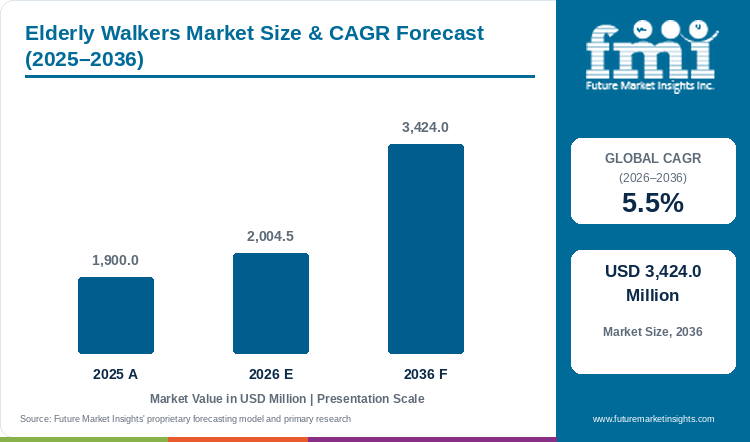
FMI projects the global elderly walkers market at USD 3,424.0 million in 2036, a 5.5% CAGR over 2026 to 2036. The market was valued at USD 1,900.0 million in 2025 and is estimated at USD 2,004.5 million in 2026.
Elderly Walkers Market Size and Forecast
Table 1: Elderly Walkers Market Size and Forecast
| Market size and forecast | Value |
|---|---|
| Market size in 2025 | USD 1,900.0 million |
| Estimated market size in 2026 | USD 2,004.5 million |
| Projected market size by 2036 | USD 3,424.0 million |
| CAGR from 2026 to 2036 | 5.5% |
Source: Future Market Insights analysis of the elderly walkers market, 2026.
The commercial divide runs between clinically supplied walking equipment and discretionary upgrades bought by users or families. Medicare covers prescribed walkers, including rollators, for eligible home use. Its October 2026 policy also recognizes combination wheeled walkers and transport chairs as durable medical equipment. Reimbursement still depends on meeting both relevant sets of coverage criteria. A combination design therefore faces a different purchasing route from an ordinary rollator.
Supplier activity reflects this division. Drive Medical introduced WalkWise in March 2026 as an attachment with activity monitoring and a subscription service. In Europe, Rollz International said it would handle TOPRO orders, service and spare parts in the Netherlands from January 2026. Dealer access and continuing service remain part of the premium offer. FMI expects growth in home healthcare products to intersect with walker purchasing, although this report counts the walking devices themselves.
Key Market Trends & Insights
- Four-wheeled rollators gain 5.8 percentage points of product share between 2026 and 2036 in FMI's outlook. Standard frames keep a separate purchasing role as wheeled models gain revenue.
- Online distribution is forecast to expand at 8.9% CAGR during 2026 to 2036. Its share rises from 26.0% to 35.7%, increasing the importance of accurate size information and an effective return route.
- Premium competition already involves distinct product families, so a higher average selling price needs a specific product justification. TOPRO's range spans outdoor and carbon designs, while Sunrise Medical markets the GEMINO 60 outdoor model and GEMINO 30 Carbon.
Regional Highlights
- The weight of China in global revenue increases. FMI projects China at 6.5% against 5.0% in 2026 by 2036.
- Global share declines for the United States, Japan and Germany even as revenue grows. FMI projects the United States at 32.4% against 33.0% in 2026, Japan at 8.4% against 9.0% in 2026 and Germany at 8.4% against 9.0% in 2026 by 2036.
Analyst Perspective
“Walker suppliers need two commercial offers. Clinically supplied frames compete within local assessment and payment arrangements. Premium rollators compete for an additional payment through lower carrying weight, a suitable folding design and dependable service. Online growth will reward brands that explain those differences clearly before an order is placed. A larger catalogue alone does not resolve a poor fit or a replacement brake that cannot be obtained.”
- Anurag Sharma, Principal Consultant, FMI
How is the Elderly Walkers Market segmented?
- By product: Four-wheeled rollators, Two-wheeled walkers, Standard walkers, and Knee walkers and other.
- By distribution: Retail pharmacies and stores, Online, Medical supply stores, and Hospitals and clinics.
- By frame material: Aluminium, Steel, and Carbon Fibre and Composites.
- By region: North America, Western Europe, East Asia, Oceania, and Rest of world.
Why does the Four-wheeled rollators segment lead by Product in the Elderly Walkers Market in 2026?
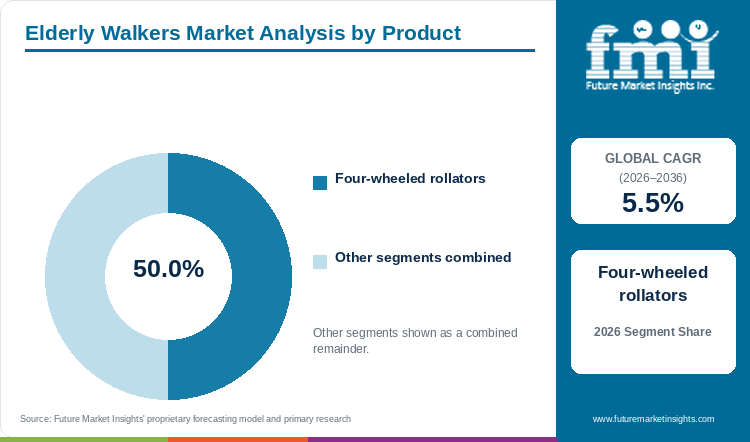
The Four-wheeled rollators segment holds 50.0% of the Elderly Walkers Market by product in 2026.
The commercial advantage comes from the breadth of the product offer. Suppliers sell indoor, outdoor and lighter-weight designs at different price points. TOPRO lists Troja, Olympos ATR and Pegasus families. Sunrise's GEMINO range similarly distinguishes an outdoor model from a carbon version. This gives specialist dealers a reason to stock more than one wheeled design.
In FMI's outlook, four-wheeled revenue grows at 6.7% CAGR from 2026 to 2036. Two-wheeled walkers reach USD 758.0 million by 2036, while standard walkers reach USD 492.0 million. Lower-priced equipment keeps a place in the mix as upgrading continues. The NHS distinguishes wheeled outdoor frames from unwheeled indoor options and stresses assessment of strength and fit. A manufacturer that abandons basic frames would therefore narrow its clinical supply offer.
The segment's stronger revenue growth favours companies with differentiated models and a functioning parts service. Product documentation must separate frame weight from supported user weight. For distributors, the relevant comparison covers the complete selling proposition and service commitment.
Two-wheeled walkers, Standard walkers and Knee walkers and other together hold the remaining 50.0% by product.
Table 2: Product, 2026 Share
| Leading Share | 2026 market share |
|---|---|
| Four-wheeled rollators | 50.0% |
| All Other Segments Combined Share | 50.0% |
Source: Future Market Insights analysis of the elderly walkers market, 2026.
Why does the Retail pharmacies and stores segment lead by Distribution in the Elderly Walkers Market in 2026?
The Retail pharmacies and stores segment holds 34.0% of the Elderly Walkers Market by distribution in 2026.
Retail pharmacies and stores begin the forecast with the leading share. Their lead is modest enough that channel strategy needs to anticipate a change. Online revenue expands from USD 521.2 million in 2026 to USD 1,222.5 million by 2036. The retail pharmacy and store segment grows at 3.9% CAGR, compared with 8.9% online. Medical supply stores also grow at 3.9%, while hospitals and clinics expand at 4.4%.
The channels perform different commercial tasks. A reimbursed purchase can require a qualified provider and prescribed documentation. France's official guidance describes a route involving both listed equipment and a prescription, with third-party payment dependent on the provider's arrangements. Cash sales have a different checkout process. Medline makes that distinction explicit on its consumer website.
FMI reads the online share gain as a change in sales access, with clinical assessment still required for prescribed products. Stores have a stronger defence when they combine product trial with a clear explanation of the payment route and continuing service. Online suppliers need equally precise specifications and terms.
Online, Medical supply stores and Hospitals and clinics together hold the remaining 66.0% by distribution.
Table 3: Distribution, 2026 Share
| Leading Share | 2026 market share |
|---|---|
| Retail pharmacies and stores | 34.0% |
| All Other Segments Combined Share | 66.0% |
Source: Future Market Insights analysis of the elderly walkers market, 2026.
Why does the Aluminium segment lead by Frame Material in the Elderly Walkers Market in 2026?
The Aluminium segment holds 64.0% of the Elderly Walkers Market by frame material in 2026.
Aluminium frames lead because walkers and rollators must be light enough for an older user to lift, fold and load into a car, and aluminium delivers that at a lower purchase price than composite frames. Standard frames keep a separate role in institutional supply. AIHW's 2026 report identifies walking frames as used by 7.3% of people with disability in the underlying 2022 survey, with use concentrated in cared accommodation.
Carbon-fibre and composite frames address a premium buyer. A higher selling price needs a specific justification, such as lower carrying weight for a user who lifts the walker into a vehicle. Steel remains in institutional supply where durability and low cost matter more than weight.
FMI's 2026 assessment values Aluminium at USD 1,282.9 million. Suppliers should present frame material as part of a product family, because the same rollator model can be offered in more than one material and the buyer compares weight, price and durability together.
Steel and Carbon Fibre and Composites together hold the remaining 36.0% by frame material.
Table 4: Frame Material, 2026 Share
| Leading Share | 2026 market share |
|---|---|
| Aluminium | 64.0% |
| All Other Segments Combined Share | 36.0% |
Source: Future Market Insights analysis of the elderly walkers market, 2026.
What are the key drivers restraints and opportunities?
Growth depends on converting mobility needs into suitable device purchases. Payment eligibility and service capacity constrain that conversion, while premium wheeled models and better channel execution expand the commercial opportunity.
Driver
Home and community care create purchasing routes for walking equipment through assessed support programmes.
Restraint
Coverage rules and out-of-pocket payments divide the market, while unsuitable products increase the burden of returns and reassessment.
Opportunity
Clear differentiation between basic supplied equipment and premium rollators gives manufacturers room to serve more than one price tier.
How do purchasing rules and qualification affect elderly walkers market demand?
The most useful demand indicators describe how equipment reaches an older user. Australia's Support at Home guidance places assistive technology within a separately funded scheme based on assessed need. It specifically identifies physiotherapists as potential prescribers of walking frames with a seat. In Ontario, selected wheeled walkers follow an authorizer and registered-vendor route. These systems connect the device order to a care decision.
The commercial implication is a need for local distribution that can operate within those routes. National representatives need the right documentation and a service arrangement appropriate to local providers. Suppliers already selling medical beds may share a homecare customer base, although walker selection and payment remain separate decisions. Canes, crutches and other ambulatory supports that use similar supply routes are covered in FMI's ambulatory aids market.
What limits reliable elderly walkers market supply and quality?
Category boundaries create financial risk. A four-wheeled walker with a resting seat and a product that also functions as a transport chair can fall under different coding rules. CMS changed the benefit-category treatment of the combination product from October 2026, but the clinical criteria still govern coverage. Marketing a multifunctional device as automatically reimbursable would misstate the rule.
Premium pricing faces another limit. In Germany, a person selecting equipment beyond the necessary level can be responsible for additional costs. Manufacturers consequently need a credible reason for a self-pay upgrade. A lighter frame has a different commercial proposition from an untested claim of better clinical outcomes. FMI expects more expensive rollators to grow in revenue, while the forecast retains substantial demand for standard and two-wheeled models.
Where can suppliers win additional business in the elderly walkers market?
Spare-parts supply is an opportunity tied directly to the product sale. Rollz's TOPRO distribution announcement includes service, warranty and after-sales responsibilities in the Netherlands. Combining those functions gives dealers an identifiable route for resolving product issues. It also makes service capacity relevant when a distributor changes brand representation.
The product boundary with patient transportation becomes more visible in combined walker and transport-chair designs. Such products need clear descriptions of each function. Suppliers should preserve that distinction while developing additional services around their established walking-aid range.
Elderly Walkers Market by Country (2026 to 2036)
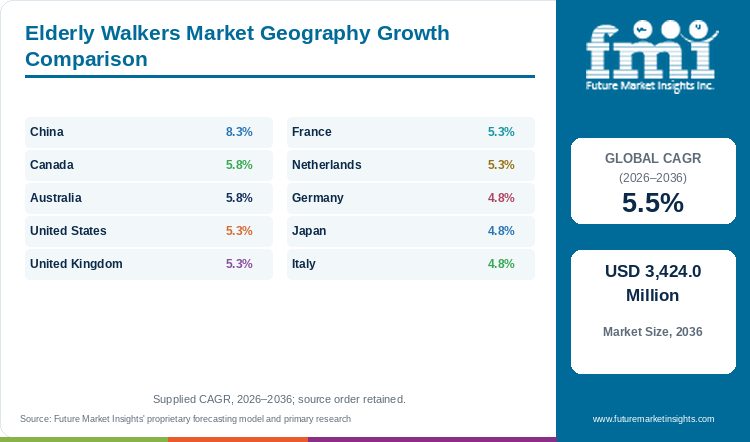
Table 5: Elderly Walkers Market Country Growth Forecast
| Country | CAGR, 2026 to 2036 |
|---|---|
| China | 8.3% |
| Canada | 5.8% |
| Australia | 5.8% |
| United States | 5.3% |
| United Kingdom | 5.3% |
| France | 5.3% |
| Netherlands | 5.3% |
| Germany | 4.8% |
| Japan | 4.8% |
| Italy | 4.8% |
Source: Future Market Insights analysis of the elderly walkers market, 2026.
China
China has the fastest forecast growth among the ten named countries. FMI projects revenue to increase from USD 100.2 million in 2026 to USD 222.9 million by 2036, a CAGR of 8.3% across 2026 to 2036. Its global revenue share increases from 5.0% to 6.5%. Revenue in China climbs by USD 122.7 million, second among the ten. The gain of USD 122.7 million equals 8.6% of the global increase of USD 1,419.5 million.
The policy setting supports investment in older-person services. In January 2026, the Chinese government described guidelines promoting technology-enabled elderly care and integration across home, community and institutional settings. The release reported 310.0 million people aged 60 and above at the end of 2024. That population figure identifies the scale of the ageing context.
For the walker industry, the commercial question is how that care infrastructure translates into distribution. Equipment providers need an offer suitable for different service settings, with product categories kept separate from adjacent care technologies. A policy emphasis on robotics does not create direct demand for an ordinary frame.
FMI sees room for both basic walking aids and differentiated rollators as national revenue expands. Suppliers should evaluate local representation and the after-sales cost of their own designs. The stronger forecast creates a reason to invest in market access, while evidence of actual channel orders remains necessary before committing inventory to a particular location.
Canada
Provincial purchasing arrangements matter more than a single Canadian reimbursement assumption. Ontario's Assistive Devices Program covers selected wheeled walkers for adults through registered vendors and an assessment process. Its guidance describes funding of 75.0% of the approved price, with additional arrangements for eligible social-assistance recipients.
FMI forecasts national elderly walker revenue to grow from USD 80.2 million in 2026 to USD 141.1 million by 2036. The 5.8% CAGR during 2026 to 2036 is ahead of the global rate. Canada's share therefore rises slightly from 4.0% to 4.1%. That expansion creates room for suppliers capable of addressing both approved-device purchasing and private upgrades. Growth of USD 60.9 million leaves Canada seventh among the ten named countries. On 2026 revenue, Canada stands joint seventh in the ten-country set.
Ontario's rules make authorization and vendor participation commercially meaningful. Its guidance also notes that registered businesses cannot charge above the approved price for the approved device. A manufacturer seeking access through that route must consider the authorized product configuration and the economics of its vendor relationship. An attractive consumer list price is a different commercial measure.
Hugo products are currently listed within Drive Medical's product catalogue. FMI expects local representatives to need clear model-level information and a dependable parts route. The national forecast should therefore be pursued province by province, with eligibility and approved supply arrangements checked at the point of sale.
Australia
Australia's Support at Home structure gives equipment purchasing a defined relationship with assessed care needs. Government guidance describes separate assistive technology and home-modification funding and identifies walking frames with a seat among aids that a physiotherapist may prescribe. This creates a route for supported supply, and eligibility depends on the listed device.
FMI forecasts Australian elderly walker revenue to rise from USD 40.1 million in 2026 to USD 70.5 million by 2036. The market expands at 5.8% CAGR during 2026 to 2036. Its small starting share means that distribution capability can matter more to an individual supplier than the global ranking suggests.
AIHW's 2026 publication provides a useful distinction between community and residential settings. It reports mobility-aid use among 79.0% of people with disability in cared accommodation, compared with 16.0% in households, using the underlying 2022 survey. They do show why institutional and home-based customers require separate analysis.
FMI expects suppliers to benefit from a range that can be supported through care providers and private retail. The practical constraint is maintaining an effective service route across the geography covered by a distributor. Manufacturers should account for delivery and parts responsibilities when setting their channel terms. The opportunity grows where a prescribed or recommended product is available through a reliable local supplier with clear follow-up responsibility.
United States
Medicare's home-use requirement creates an important boundary around the largest national market. Prescribed walkers and rollators can qualify as durable medical equipment, and reimbursement depends on the prescription. FMI estimates United States revenue at USD 661.5 million in 2026 and USD 1,109.7 million by 2036. The CAGR of 5.3% from 2026 to 2036 reflects a large starting base with room for different product tiers. The United States compounds at 5.3%, which is 0.2 points below the global 5.5%.
The October 2026 change for combination wheeled walkers and transport chairs is particularly relevant to suppliers with multifunctional models. The new benefit-category treatment still requires satisfaction of both walker and transport-chair criteria. Its commercial effect is a more specific coverage route for combined designs. Dealers need to keep the product code and the intended use aligned before promising reimbursement.
At the same time, Medline operates an explicitly cash-only consumer website. That channel demonstrates how a broad supplier can address private purchases separately from funded supply. FMI expects this distinction to shape competition between standard equipment and discretionary upgrades. Manufacturers have an opportunity to sell a more expensive frame through consumer channels while maintaining a clinically supplied range. Their exposure increases if promotional language blurs those arrangements. The national outlook favours clear pricing and channel responsibilities over an undifferentiated promise of universal coverage.
United Kingdom
Public loan equipment and private mobility retail coexist in the United Kingdom. NHS guidance says a walking frame can be borrowed through the health service, while consumers can also buy online or through mobility shops. These routes address different purchasing decisions and create different expectations for a supplier's price and service package.
United Kingdom revenue is projected to rise from USD 120.3 million in 2026 to USD 201.8 million by 2036. FMI's 5.3% CAGR across 2026 to 2036 points to continued growth across NHS issue and private retail channels. Standard frames remain relevant to a service-led supply route. Private purchasers provide a separate opportunity for outdoor and premium wheeled designs.
Fit and device selection matter to the structure of that private offer. The NHS highlights height, indoor or outdoor use, lifting strength and folding requirements among the factors to consider. Those factors create useful distinctions for an actual product comparison. A dealer can demonstrate how models differ in use.
The country is also served by international rollator brands. Sunrise Medical lists the United Kingdom among the markets for its GEMINO range. Competition therefore includes specialist products sold through local representatives, as well as broad catalogue suppliers. FMI expects service continuity and clear responsibility for warranty claims to help defend those dealer relationships. The private market rewards a coherent premium range, while publicly supplied frames remain subject to their own procurement economics and assessment pathways.
France
Mon Parcours Handicap uses the walker as an example of equipment with a freely set retail price and a fixed insurance reference amount.
FMI forecasts French elderly walker revenue of USD 120.3 million in 2026 and USD 201.8 million in 2036. Revenue grows at 5.3% CAGR from 2026 to 2036. France's slice of global revenue goes from 6.0% to 5.9%. Growth of USD 81.5 million leaves France joint fifth among the ten named countries. France holds joint fourth place by 2026 revenue. France's 5.3% CAGR sits 0.2 points below the global 5.5%.
The official guidance requires a prescription and inclusion in the reimbursable products and services list for the relevant insurance route. It also explains that third-party payment depends on the supplier's convention arrangements.These rules give an established pharmacy or equipment distributor a role in the supply route. The seller must explain what is covered and what the customer must pay.
For manufacturers, a French product range needs a clear distinction between the standard offer and additional features. The discussion should connect each price step to a documented specification and a service commitment. Sunrise's French distribution for GEMINO provides one example of an international specialist offer.FMI expects premium competition to remain viable where that offer is legible, while reimbursement limits continue to influence the volume end of the market.
Netherlands
Ordinary rollators occupy a private-purchase position in the Dutch system. Zorginstituut Nederland states that simple walking aids, including rollators and walking frames, are not reimbursed from the basic insurance package.This creates a different competitive setting from markets where a standard rollator is routinely supplied through a contracted insurer route.
The Netherlands elderly walkers market is forecast to expand at 5.3% CAGR from 2026 to 2036. Revenue grows from USD 60.1 million to USD 100.9 million over that period. FMI expects private purchasing and specialist retail to remain central to the commercial offer, while the precise treatment of more complex mobility aids should be checked separately.
Distribution changed at the beginning of the assessment period. A rollator company announced that it would become TOPRO's official distributor in the Netherlands from January 2026, taking responsibility for orders, service, warranty and spare parts. The arrangement connects two premium brands through a shared commercial contact.
For retailers, that structure reduces the number of contacts needed to address the represented ranges. For manufacturers, it places continuing service alongside initial sales access. FMI sees the Dutch opportunity in clear comparison between differently priced devices and an accessible after-sales route. A self-paying buyer has a direct reason to question what a premium price includes. Suppliers that make the product and support differences visible are better placed to compete than those relying on an assumption of basic-insurance reimbursement.
Germany
Germany's equipment market depends on the relationship between statutory insurers and contracted providers. The GKV system gives equipment quality requirements a place in those contracts. This creates a practical route to volume for established medical supply businesses. It also means a supplier's commercial offer includes documentation and delivery responsibilities beyond the frame itself.
FMI forecasts German elderly walker revenue to rise from USD 180.4 million in 2026 to USD 288.6 million by 2036. Growth of 4.8% CAGR over 2026 to 2036 is slower than the global rate. The country consequently loses some share of global revenue despite continued expansion. Manufacturers need to defend existing channels as well as pursue incremental premium sales.
The Gemeinsamer Bundesausschuss explains that its equipment directory is not exhaustive and that the individual insurer decides coverage in a particular case. It also notes that additional features beyond the necessary level can leave the user with extra costs. FMI sees two separate pricing disciplines in that structure. Standard equipment needs to fit the provider's contracted economics. A premium model needs an intelligible explanation for its additional cost.
Specialist rollator portfolios therefore compete on a documented point of difference. Carbon construction and outdoor configurations offer clear areas for comparison, while servicing remains part of the distributor relationship. Germany's established supply route makes repeat dealer access especially important as the market expands at a measured pace.
Japan
Japan draws a policy distinction between walking frames and wheeled walking vehicles. From April 2024, the long-term care insurance system introduced a choice between rental and purchase for selected aids, including walkers while excluding wheeled walking vehicles from that particular choice. Treating every rollator as covered by the purchase option would therefore misread the policy.
The distinction is commercially important in a market where FMI forecasts USD 180.4 million of revenue in 2026 and USD 288.6 million by 2036. Japan's elderly walkers market advances at 4.8% CAGR during 2026 to 2036. It shares Germany's starting value and growth rate in this outlook, but the route to a sale is different. A supplier must identify which product category is being offered and which rental or purchase arrangement applies.
The Ministry of Health, Labour and Welfare also describes the role of care managers and specialist welfare-equipment advisers in selecting equipment. For a manufacturer, that places product communication inside a professional supply relationship.
FMI expects Japan's revenue growth to remain tied to a mix of standard frames and wheeled designs. The commercial case for a distributor is strongest when its range is organized around the actual benefit categories. Confusing rental transactions with unit sales would also overstate device demand. Product turnover and the installed rental fleet need separate treatment when suppliers assess their own opportunities.
Italy
Reuse creates a distinction between equipment issued to a patient and a new walker sold in Italy. ASL Roma 1 says non-personalized aids, including walkers, remain its property and must be returned when no longer used. Suitable reusable equipment is given priority within that local service. It makes the replacement cycle commercially different from the number of users receiving equipment.
Italian elderly walker revenue is forecast at USD 80.2 million in 2026 and USD 128.2 million in 2036. The 4.8% CAGR from 2026 to 2036 produces steady expansion, while the country's global market share declines from 4.0% to 3.7%. FMI reads this as a market where an established local route matters more than an assumption of rapid category penetration.
International manufacturers already address Italy through specific product channels. One manufacturer includes the country in its GEMINO distribution pages. That presence illustrates the need to translate a global product range into an Italian offer with an identifiable supplier.
For public supply, the opportunity includes maintaining a usable equipment fleet as well as selling new units. Private customers make a separate choice between differently priced models. Suppliers carrying both frames and rollators can address a wider set of purchasing decisions, but a broader range also increases the number of parts and service commitments. FMI expects measured revenue growth to favour disciplined local representation and a range that remains commercially manageable after the initial sale.
Who are the notable companies in the Elderly Walkers Market?
Notable companies in the Elderly Walkers Market include Drive DeVilbiss Healthcare, now Drive Medical, Medline Industries, Invacare, Sunrise Medical and Topro.
Drive DeVilbiss Healthcare returned to the Drive Medical name in December 2025. Its current catalogue includes rollators and Hugo-branded walking equipment. Medline combines a broad walking-aid range with direct consumer access. Invacare markets walking aids under Dolomite, while Sunrise Medical supplies GEMINO rollators through country-specific channels. These are materially different offers and should not be ranked using an unsupported share estimate.
TOPRO focuses on a distinct rollator portfolio, including carbon and outdoor models. Rollz International provides another specialist proposition and now represents TOPRO distribution in the Netherlands under the announced arrangement. Carex belongs to Compass Health Brands, which signed a definitive acquisition agreement with Drive Medical in January 2026. Drive's German business later described the acquisition and integration of Compass, although neither source gives a completion date.
Etac's reviewed corporate range emphasizes rehabilitation, patient handling and related assistive products. Its inclusion here reflects that adjacent position and does not assert a measured share in adult walkers. Competition among the directly relevant suppliers centres on product range, channel access and the ability to support equipment after delivery. Counting separate brands as independent corporate competitors would obscure those relationships.
Key Developments in the Elderly Walkers Market
- In March 2026, Drive Medical introduced WalkWise by Drive, an activity-monitoring attachment for walkers and rollators with an app and subscription service. The launch expands the offer around the walking aid but does not by itself establish insurance coverage or clinical effectiveness.
- From January 2026, Rollz International said it would manage TOPRO orders, delivery, warranty and spare parts in the Netherlands. The arrangement makes local service responsibility part of the distribution proposition.
Key Players in the Elderly Walkers Market
- Drive DeVilbiss Healthcare, now Drive Medical
- Medline Industries
- Invacare
- Sunrise Medical
- Topro
- Rollz International
- Carex
- Hugo Mobility
- Etac
Elderly Walkers Market Report Scope
Table 6: Elderly Walkers Market Report Scope
| Coverage field | Report scope |
|---|---|
| Market definition | Walking frames and rollators supplied for older adults across retail, medical supply and online channels. |
| Product coverage | Four-wheeled rollators, two-wheeled walkers, standard walkers, and knee walkers and other. |
| Commercial boundary | Device revenue is assessed separately from broader homecare equipment and from monitoring subscriptions. |
| Quantitative Units | USD million |
| Distribution coverage | Retail pharmacies and stores, online, medical supply stores, hospitals and clinics. |
| Frame Material coverage | Aluminium, Steel, Carbon Fibre and Composites. |
| Country coverage | United States, Germany, Japan, United Kingdom, France, China, Italy, Canada, Netherlands and Australia |
| Companies and brands | Drive DeVilbiss Healthcare, Medline Industries, Invacare, Sunrise Medical, Etac, Topro, Rollz International, Carex and Hugo Mobility. |
| Exclusions | Wheelchairs sold independently, powered scooters, patient lifts, beds, paediatric-only gait equipment and unrelated care-service revenue. |
Source: Future Market Insights analysis of the elderly walkers market, 2026.
Elderly Walkers Market Research Methodology
FMI's elderly walker value and volume outlook is assessed alongside equipment-payment guidance, official disability statistics and original supplier materials. Country growth rates belong to the FMI forecast. External sources explain commercial conditions. The review distinguishes device categories and company roles and checks units, shares and periods. Device revenue excludes broader care services and subscriptions.
Elderly Walkers Market by Segments
Elderly Walkers Market segmented by Product:
- Four-wheeled rollators
- Two-wheeled walkers
- Standard walkers
- Knee walkers and other
Elderly Walkers Market segmented by Distribution:
- Retail pharmacies and stores
- Online
- Medical supply stores
- Hospitals and clinics
Elderly Walkers Market segmented by Frame Material:
- Aluminium
- Steel
- Carbon Fibre and Composites
Elderly Walkers Market by Region
- North America
- United States
- Canada
- Western Europe
- Germany
- United Kingdom
- France
- Italy
- Netherlands
- East Asia
- Japan
- China
- Oceania
- Australia
- Rest of world aggregate
Research Sources and Bibliography
- Australian Government Department of Health, Disability and Ageing. Support at Home Guidance for Health Professionals. October 2025. https://www.health.gov.au/sites/default/files/2025-10/support-at-home-guidance-for-health-professionals.pdf
- Australian Institute of Health and Welfare. People with Disability in Australia 2026: Use of Aids. Updated 10 June 2026, using ABS 2022 survey data. https://www.aihw.gov.au/reports/disability/people-with-disability-2026/contents/disability-population/use-of-aids
- ASL Roma 1. Assistenza Protesica. Official supply, ownership and reuse guidance. Updated 4 March 2026, accessed 9 November 2026. https://www.aslroma1.it/assistenza-protesica
- Centers for Medicare & Medicaid Services. Walkers: Policy Article A52503. Revision effective 1 October 2026. https://www.cms.gov/medicare-coverage-database/view/article.aspx?articleId=52503&ver=34
- Drive DeVilbiss Healthcare. Acquisition of the Product Line of De Oro Devices, Makers of NexStride. June 2025. https://www.drivemedical.com/news-article/drive-devilbiss-healthcare-acquires-product-line-of-de-oro-devices-makers-of-nexstride-gait-cueing-device
- Drive Medical. Drive DeVilbiss Healthcare Announces Return to Drive Medical Brand. December 2025. https://www.drivemedical.com/blog/drive-medical-rebranding
- Drive Medical. Drive Medical Acquires Compass Health Brands. 29 January 2026. The release describes a signed definitive agreement. https://www.drivemedical.com/news-article/drive-medical-acquires-compass-health-brands
- Drive Medical. Drive Medical Introduces WalkWise by Drive, Expanding Its Leadership in Innovative Mobility Solutions. March 2026. https://www.drivemedical.com/news-article/walkwise-by-drive
- Drive Medical. Hugo Product Catalogue. Current listings for Hugo walking aids, accessed 9 November 2026. https://shop.drivemedical.com/us/en/search/?text=hugo
- Drive Medical Germany. Press Release: Drive Medical Acquires Compass Health Brands. Accessed 9 November 2026. The release describes the acquisition and integration of Compass. https://drivemedical.de/en/news-artikel/2026/press/pm_compass_health
- Etac. Corporate Product and Brand Portfolio. Current manufacturer information, accessed 9 November 2026. https://www.etac.com/
- Gemeinsamer Bundesausschuss. Hilfsmittel. Official explanation of the equipment directory and additional costs, accessed 9 November 2026. https://www.g-ba.de/themen/veranlasste-leistungen/hilfsmittel/
- GKV-Spitzenverband. Richtlinien und Empfehlungen. Official guidance on equipment supply contracts and quality requirements, accessed 9 November 2026. https://www.gkv-spitzenverband.de/krankenversicherung/hilfsmittel/richtlinien_und_empfehlungen/richtlinien_und_empfehlungen.jsp
- Government of Ontario. Mobility Aids. Assistive Devices Program guidance, accessed 9 November 2026. https://www.ontario.ca/page/mobility-aids
- Invacare Sweden. Om Oss. Corporate and Dolomite product information, accessed 9 November 2026. https://www.invacare.se/sv/om-oss
- Medicare. Walkers. Coverage guidance, accessed 9 November 2026. https://www.medicare.gov/coverage/walkers
- Medline. Rollators and Walkers. Current consumer catalogue and cash-sale disclosure, accessed 9 November 2026. https://athome.medline.com/en/categories/mobility/rollators-walkers
- Ministry of Health, Labour and Welfare, Japan. Welfare Equipment and Home Modifications. Current guidance including the April 2024 rental-and-purchase choice, accessed 9 November 2026. https://www.mhlw.go.jp/stf/seisakunitsuite/bunya/0000212398.html
- Mon Parcours Handicap. Quelle prise en charge des aides techniques par l'Assurance Maladie? Official information service, accessed 9 November 2026. https://www.monparcourshandicap.gouv.fr/aides-techniques/quelle-prise-en-charge-des-aides-techniquesaides-materielles-par-lassurance
- NHS. Walking Aids, Wheelchairs and Mobility Scooters. Social care and support guidance, accessed 9 November 2026. https://www.nhs.uk/social-care-and-support/care-services-equipment-and-care-homes/walking-aids-wheelchairs-and-mobility-scooters/
- Rollz International. Announcement of Official TOPRO Distribution in the Netherlands from 1 January 2026. Original corporate post, accessed 9 November 2026. https://www.linkedin.com/posts/rollz-international_rollators-healthcare-rehabilitation-activity-7403798691633065984-mKFJ
- State Council of the People's Republic of China. China to Promote Tech-enabled Elderly Care to Enhance Seniors' Well-being. 13 January 2026. https://english.www.gov.cn/news/202601/13/content_WS69664e52c6d00ca5f9a088c6.html
- Sunrise Medical. GEMINO. Product families and country availability, accessed 9 November 2026. https://sunrisemedical-group.com/products/gemino
- TOPRO Mobility. Rollators: Product Families and Pegasus Test Result. Current manufacturer information, accessed 9 November 2026. https://topromobility.com/en/products/rollators/
- Zorginstituut Nederland. Bewegingshulpmiddelen (Zvw). Basic insurance coverage guidance, accessed 9 November 2026. https://www.zorginstituutnederland.nl/verzekerde-zorg/b/bewegingshulpmiddelen-zvw
This bibliography is provided for reader reference and is not exhaustive. The full report contains the complete reference list and detailed citations.
Table of Content
- Key Takeaways
- Market Size and CAGR
- Top Growth Driver
- Fastest Growing Segment
- Leading Region
- Key Companies
- Emerging Opportunities
- Executive Summary
- Global Market Outlook
- Demand-side Trends
- Supply-side Trends
- Technology Roadmap Analysis
- Analysis and Recommendations
- Analyst Perspective (What is happening? Why now? What should investors know?)
- Key Questions Answered
- How large is the market?
- What is the CAGR?
- What are key trends?
- Which region dominates?
- Who are the leaders?
Read More...
- Market Overview
- Market Coverage / Taxonomy
- Market Definition / Scope / Limitations
- Research Methodology
- Chapter Orientation
- Analytical Lens and Working Hypotheses
- Market Structure, Signals, and Trend Drivers
- Benchmarking and Cross-market Comparability
- Market Sizing, Forecasting, and Opportunity Mapping
- Research Design and Evidence Framework
- Desk Research Programme (Secondary Evidence)
- Expert Input and Fieldwork (Primary Evidence)
- Tooling, Models, and Reference Databases
- Data Engineering and Model Build
- Quality Assurance and Audit Trail
- Market Background
- Market Dynamics (Drivers, Restraints, Opportunity, Trends)
- Scenario Forecast (Optimistic, Likely, Conservative)
- Impact Analysis
- AI Impact
- Sustainability Impact
- Regulatory Impact
- Technology Impact
- Consumer / Buyer Analysis
- Purchase Drivers
- Adoption Barriers
- Buyer Journey
- Opportunity Map Analysis
- Product Life Cycle Analysis
- Supply Chain Analysis
- Investment Feasibility Matrix
- Value Chain Analysis
- PESTLE and Porter's Analysis
- Regulatory Landscape
- Regional Parent Market Outlook
- Production and Consumption Statistics
- Import and Export Statistics
- Global Market Analysis and Forecast, 2021 to 2036
- Historical Market Size Value (USD Million) Analysis, 2021 to 2025
- Current and Future Market Size Value (USD Million) Projections, 2026 to 2036
- Y-o-Y Growth Trend Analysis
- Absolute $ Opportunity Analysis
- Global Market Pricing Analysis, 2021 to 2036
- Global Market Analysis and Forecast, By Product, 2021 to 2036
- Introduction / Key Findings
- Historical Market Size Value (USD Million) Analysis By Product, 2021 to 2025
- Current and Future Market Size Value (USD Million) Analysis and Forecast By Product, 2026 to 2036
- Four-wheeled rollators
- Two-wheeled walkers
- Standard walkers
- Knee walkers and other
- Y-o-Y Growth Trend Analysis By Product, 2021 to 2025
- Absolute $ Opportunity Analysis By Product, 2026 to 2036
- Global Market Analysis and Forecast, By Distribution, 2021 to 2036
- Introduction / Key Findings
- Historical Market Size Value (USD Million) Analysis By Distribution, 2021 to 2025
- Current and Future Market Size Value (USD Million) Analysis and Forecast By Distribution, 2026 to 2036
- Retail pharmacies and stores
- Online
- Medical supply stores
- Hospitals and clinics
- Y-o-Y Growth Trend Analysis By Distribution, 2021 to 2025
- Absolute $ Opportunity Analysis By Distribution, 2026 to 2036
- Global Market Analysis and Forecast, By Frame Material, 2021 to 2036
- Introduction / Key Findings
- Historical Market Size Value (USD Million) Analysis By Frame Material, 2021 to 2025
- Current and Future Market Size Value (USD Million) Analysis and Forecast By Frame Material, 2026 to 2036
- Aluminium
- Steel
- Carbon Fibre and Composites
- Y-o-Y Growth Trend Analysis By Frame Material, 2021 to 2025
- Absolute $ Opportunity Analysis By Frame Material, 2026 to 2036
- Global Market Analysis and Forecast, By Region, 2021 to 2036
- Introduction
- Historical Market Size Value (USD Million) Analysis By Region, 2021 to 2025
- Current Market Size Value (USD Million) Analysis and Forecast By Region, 2026 to 2036
- North America
- Western Europe
- East Asia
- Oceania
- Market Attractiveness Analysis By Region
- North America Market Analysis and Forecast, By Country, 2021 to 2036
- Historical Market Size Value (USD Million) Trend Analysis By Market Taxonomy, 2021 to 2025
- Market Size Value (USD Million) Forecast By Market Taxonomy, 2026 to 2036
- By Country
- United States
- Canada
- By Product
- By Distribution
- By Frame Material
- By Country
- Market Attractiveness Analysis
- By Country
- By Product
- By Distribution
- By Frame Material
- Key Takeaways
- Western Europe Market Analysis and Forecast, By Country
- Historical Market Size Value (USD Million) Trend Analysis By Market Taxonomy, 2021 to 2025
- Market Size Value (USD Million) Forecast By Market Taxonomy, 2026 to 2036
- By Country
- Germany
- United Kingdom
- France
- Italy
- Netherlands
- By Product
- By Distribution
- By Frame Material
- By Country
- Market Attractiveness Analysis
- By Country
- By Product
- By Distribution
- By Frame Material
- Key Takeaways
- East Asia Market Analysis and Forecast, By Country
- Historical Market Size Value (USD Million) Trend Analysis By Market Taxonomy, 2021 to 2025
- Market Size Value (USD Million) Forecast By Market Taxonomy, 2026 to 2036
- By Country
- Japan
- China
- By Product
- By Distribution
- By Frame Material
- By Country
- Market Attractiveness Analysis
- By Country
- By Product
- By Distribution
- By Frame Material
- Key Takeaways
- Oceania Market Analysis and Forecast, By Country
- Historical Market Size Value (USD Million) Trend Analysis By Market Taxonomy, 2021 to 2025
- Market Size Value (USD Million) Forecast By Market Taxonomy, 2026 to 2036
- By Country
- Australia
- Rest of world aggregate
- By Product
- By Distribution
- By Frame Material
- By Country
- Market Attractiveness Analysis
- By Country
- By Product
- By Distribution
- By Frame Material
- Key Takeaways
- Key Countries Market Analysis
- United States
- Pricing Analysis
- Market Share Analysis, 2025
- By Product
- By Distribution
- By Frame Material
- Canada
- Pricing Analysis
- Market Share Analysis, 2025
- By Product
- By Distribution
- By Frame Material
- Germany
- Pricing Analysis
- Market Share Analysis, 2025
- By Product
- By Distribution
- By Frame Material
- United Kingdom
- Pricing Analysis
- Market Share Analysis, 2025
- By Product
- By Distribution
- By Frame Material
- Italy
- Pricing Analysis
- Market Share Analysis, 2025
- By Product
- By Distribution
- By Frame Material
- France
- Pricing Analysis
- Market Share Analysis, 2025
- By Product
- By Distribution
- By Frame Material
- China
- Pricing Analysis
- Market Share Analysis, 2025
- By Product
- By Distribution
- By Frame Material
- Japan
- Pricing Analysis
- Market Share Analysis, 2025
- By Product
- By Distribution
- By Frame Material
- Australia
- Pricing Analysis
- Market Share Analysis, 2025
- By Product
- By Distribution
- By Frame Material
- Netherlands
- Pricing Analysis
- Market Share Analysis, 2025
- By Product
- By Distribution
- By Frame Material
- United States
- Market Structure Analysis
- Competition Dashboard
- Competition Benchmarking
- Market Share Analysis of Top Players
- By Regional
- By Product
- By Distribution
- By Frame Material
- Emerging Startups
- Innovation Benchmarking
- Competition Analysis
- Competition Deep Dive
- Drive Medical
- Overview
- Product Portfolio
- Profitability by Market Segments
- Sales Footprint
- Strategy Overview
- Marketing Strategy
- Product Strategy
- Channel Strategy
- Medline Industries
- Invacare
- Sunrise Medical
- Topro
- Rollz International
- Carex
- Hugo Mobility
- Etac
- Drive DeVilbiss Healthcare, now Drive Medical
- Drive Medical
- Case Studies
- Success Stories
- Recent Developments
- Competition Deep Dive
- Assumptions & Acronyms Used
List of Tables
- Table 1: Global Market Value (USD Million) Forecast by Region, 2021 to 2036
- Table 2: Global Market Value (USD Million) Forecast by Product, 2021 to 2036
- Table 3: Global Market Value (USD Million) Forecast by Distribution, 2021 to 2036
- Table 4: Global Market Value (USD Million) Forecast by Frame Material, 2021 to 2036
- Table 5: North America Market Value (USD Million) Forecast by Country, 2021 to 2036
- Table 6: North America Market Value (USD Million) Forecast by Product, 2021 to 2036
- Table 7: North America Market Value (USD Million) Forecast by Distribution, 2021 to 2036
- Table 8: North America Market Value (USD Million) Forecast by Frame Material, 2021 to 2036
- Table 9: Western Europe Market Value (USD Million) Forecast by Country, 2021 to 2036
- Table 10: Western Europe Market Value (USD Million) Forecast by Product, 2021 to 2036
- Table 11: Western Europe Market Value (USD Million) Forecast by Distribution, 2021 to 2036
- Table 12: Western Europe Market Value (USD Million) Forecast by Frame Material, 2021 to 2036
- Table 13: East Asia Market Value (USD Million) Forecast by Country, 2021 to 2036
- Table 14: East Asia Market Value (USD Million) Forecast by Product, 2021 to 2036
- Table 15: East Asia Market Value (USD Million) Forecast by Distribution, 2021 to 2036
- Table 16: East Asia Market Value (USD Million) Forecast by Frame Material, 2021 to 2036
- Table 17: Oceania Market Value (USD Million) Forecast by Country, 2021 to 2036
- Table 18: Oceania Market Value (USD Million) Forecast by Product, 2021 to 2036
- Table 19: Oceania Market Value (USD Million) Forecast by Distribution, 2021 to 2036
- Table 20: Oceania Market Value (USD Million) Forecast by Frame Material, 2021 to 2036
List of Figures
- Figure 1: Global Market Pricing Analysis
- Figure 2: Global Market Value (USD Million) Forecast 2021-2036
- Figure 3: Global Market Value Share and BPS Analysis by Product, 2026 and 2036
- Figure 4: Global Market Y-o-Y Growth Comparison by Product, 2026-2036
- Figure 5: Global Market Attractiveness Analysis by Product
- Figure 6: Global Market Value Share and BPS Analysis by Distribution, 2026 and 2036
- Figure 7: Global Market Y-o-Y Growth Comparison by Distribution, 2026-2036
- Figure 8: Global Market Attractiveness Analysis by Distribution
- Figure 9: Global Market Value Share and BPS Analysis by Frame Material, 2026 and 2036
- Figure 10: Global Market Y-o-Y Growth Comparison by Frame Material, 2026-2036
- Figure 11: Global Market Attractiveness Analysis by Frame Material
- Figure 12: Global Market Value (USD Million) Share and BPS Analysis by Region, 2026 and 2036
- Figure 13: Global Market Y-o-Y Growth Comparison by Region, 2026-2036
- Figure 14: Global Market Attractiveness Analysis by Region
- Figure 15: North America Market Incremental Dollar Opportunity, 2026-2036
- Figure 16: Western Europe Market Incremental Dollar Opportunity, 2026-2036
- Figure 17: East Asia Market Incremental Dollar Opportunity, 2026-2036
- Figure 18: Oceania Market Incremental Dollar Opportunity, 2026-2036
- Figure 19: North America Market Value Share and BPS Analysis by Country, 2026 and 2036
- Figure 20: North America Market Value Share and BPS Analysis by Product, 2026 and 2036
- Figure 21: North America Market Y-o-Y Growth Comparison by Product, 2026-2036
- Figure 22: North America Market Attractiveness Analysis by Product
- Figure 23: North America Market Value Share and BPS Analysis by Distribution, 2026 and 2036
- Figure 24: North America Market Y-o-Y Growth Comparison by Distribution, 2026-2036
- Figure 25: North America Market Attractiveness Analysis by Distribution
- Figure 26: North America Market Value Share and BPS Analysis by Frame Material, 2026 and 2036
- Figure 27: North America Market Y-o-Y Growth Comparison by Frame Material, 2026-2036
- Figure 28: North America Market Attractiveness Analysis by Frame Material
- Figure 29: Western Europe Market Value Share and BPS Analysis by Country, 2026 and 2036
- Figure 30: Western Europe Market Value Share and BPS Analysis by Product, 2026 and 2036
- Figure 31: Western Europe Market Y-o-Y Growth Comparison by Product, 2026-2036
- Figure 32: Western Europe Market Attractiveness Analysis by Product
- Figure 33: Western Europe Market Value Share and BPS Analysis by Distribution, 2026 and 2036
- Figure 34: Western Europe Market Y-o-Y Growth Comparison by Distribution, 2026-2036
- Figure 35: Western Europe Market Attractiveness Analysis by Distribution
- Figure 36: Western Europe Market Value Share and BPS Analysis by Frame Material, 2026 and 2036
- Figure 37: Western Europe Market Y-o-Y Growth Comparison by Frame Material, 2026-2036
- Figure 38: Western Europe Market Attractiveness Analysis by Frame Material
- Figure 39: East Asia Market Value Share and BPS Analysis by Country, 2026 and 2036
- Figure 40: East Asia Market Value Share and BPS Analysis by Product, 2026 and 2036
- Figure 41: East Asia Market Y-o-Y Growth Comparison by Product, 2026-2036
- Figure 42: East Asia Market Attractiveness Analysis by Product
- Figure 43: East Asia Market Value Share and BPS Analysis by Distribution, 2026 and 2036
- Figure 44: East Asia Market Y-o-Y Growth Comparison by Distribution, 2026-2036
- Figure 45: East Asia Market Attractiveness Analysis by Distribution
- Figure 46: East Asia Market Value Share and BPS Analysis by Frame Material, 2026 and 2036
- Figure 47: East Asia Market Y-o-Y Growth Comparison by Frame Material, 2026-2036
- Figure 48: East Asia Market Attractiveness Analysis by Frame Material
- Figure 49: Oceania Market Value Share and BPS Analysis by Country, 2026 and 2036
- Figure 50: Oceania Market Value Share and BPS Analysis by Product, 2026 and 2036
- Figure 51: Oceania Market Y-o-Y Growth Comparison by Product, 2026-2036
- Figure 52: Oceania Market Attractiveness Analysis by Product
- Figure 53: Oceania Market Value Share and BPS Analysis by Distribution, 2026 and 2036
- Figure 54: Oceania Market Y-o-Y Growth Comparison by Distribution, 2026-2036
- Figure 55: Oceania Market Attractiveness Analysis by Distribution
- Figure 56: Oceania Market Value Share and BPS Analysis by Frame Material, 2026 and 2036
- Figure 57: Oceania Market Y-o-Y Growth Comparison by Frame Material, 2026-2036
- Figure 58: Oceania Market Attractiveness Analysis by Frame Material
- Figure 59: Global Market - Tier Structure Analysis
- Figure 60: Global Market - Company Share Analysis
Frequently Asked Questions
How big is the elderly walkers market in 2026?
FMI estimates the market at USD 2,004.5 million in 2026, up from USD 1,900.0 million in 2025. It is forecast to reach USD 3,424.0 million by 2036 at a 5.5% CAGR.
Which product leads the elderly walkers market in 2026?
Four-wheeled rollators leads by product with 50.0% in 2026. All other segments together hold 50.0%.
Which distribution and frame material lead in 2026?
Retail pharmacies and stores holds 34.0% by distribution and Aluminium holds 64.0% by frame material in FMI's 2026 assessment.
Which market is forecast to grow fastest through 2036?
China has the highest forecast CAGR at 8.3% during 2026 to 2036, followed by Canada and Australia at 5.8%.
Which named country has the fastest forecast growth?
China records the highest rate among the ten named countries at 8.3% CAGR from 2026 to 2036. The United States remains the largest national market by revenue.
Preview the report firsthand - request a free sample
Get SampleGet the brochure for pricing and purchase details.
Get PDF
